Friday, March 27, 2009

Chomsky on Giethner

Chomsky on Giethner

Noam Chomsky: Geithner plan is recycled Bush - Paulson


Noam Chomsky speaks to Paul Jay on the Obama - Geithner plan. Chomsky says that "they're simply recycling, the Bush-Paulson measures and changing them a little, but essentially the same idea: keep the institutional structure the same, try to kind of pass things up, bribe the banks and investors to help out, but avoid the measures that might get to the heart of the problem."
Bio

Noam Chomsky has written and lectured widely on linguistics, philosophy, intellectual history, contemporary issues, international affairs and U.S. foreign policy. His works include: Aspects of the Theory of Syntax; Cartesian Linguistics; Sound Pattern of English (with Morris Halle); Language and Mind; American Power and the New Mandarins; At War with Asia; For Reasons of State; Peace in the Middle East?; Reflections on Language; The Political Economy of Human Rights, Vol. I and II (with E.S. Herman); Rules and Representations; Lectures on Government and Binding; Towards a New Cold War; Radical Priorities; Fateful Triangle; Knowledge of Language; Turning the Tide; Pirates and Emperors; On Power and Ideology; Language and Problems of Knowledge; The Culture of Terrorism; Manufacturing Consent (with E.S. Herman); Necessary Illusions; Deterring Democracy; Year 501; Rethinking Camelot: JFK, the Vietnam War and US Political Culture; Letters from Lexington; World Orders, Old and New; The Minimalist Program; Powers and Prospects; The Common Good; Profit Over People; The New Military Humanism; New Horizons in the Study of Language and Mind; Rogue States; A New Generation Draws the Line; 9-11; and Understanding Power.

(Register or log in to make your comment.)
Transcript

NOTE: THIS TRANSCRIPT IS UNEDITED. CHANGES MAY ENSUE. THE REAL NEWS NETWORK IS NOT RESPONSIBLE FOR MISTAKES FOUND HEREIN.

PAUL JAY: Welcome to The Real News Network. We're in Cambridge at MIT with Professor Noam Chomsky, who I think needs no introduction. Thanks for joining us.

CHOMSKY: Glad to be with you.

JAY: So a few days ago, the Obama administration and Geithner, they announced their plan for the banks. What do you make of it?

CHOMSKY: Well, there are several plans, actually. One is capitalization. The other, the more recent one, is picking up the toxic assets with a private-public coalition. And that sent the stock market zooming right away. And you can see why: it's extremely good for bankers and investors. It means that an investor can, if they want, purchase these valueless assets. And if they happen to go up, well, it makes money; if they go down, the government insures it. So there might be a slight loss, but there could be a big gain. And that's—one financial manager put it in The Financial Times this morning, "It's a win-win situation."

JAY: A win-win situation if you're the investor.

CHOMSKY: If you're the investor, yeah.

JAY: If you're the investor.

CHOMSKY: For the public it's a lose-lose situation. But they're simply recycling, pretty much, the Bush-Paulson measures and changing them a little, but essentially the same idea: keep the institutional structure the same, try to kind of pass things up, bribe the banks and investors to help out, but avoid the measures that might get to the heart of the problem—however, at the cost, if you consider it a cost, of changing the institutional structure.

JAY: What's the plan you would support?

CHOMSKY: Well, I mean, say, for example, take the bonuses, the AIG bonuses that are, you know, causing such anger, rightfully. Dean Baker pointed out that there's an easy way to deal with it. Since the government pretty much owns AIG anyway (it just doesn't use its power to make decisions), split off the section of AIG—the financial investment section—that caused all the problems, split it off, and let it go bankrupt. And then the executives can seek to get their bonuses from a bankrupt firm if they like. So that would pretty much take care of the bankruptcy problem, and the government would still maintain its large-scale effective control, if it wants to exert it, of what's viable in AIG. And with the banks, the big banks, like Bank of America, one of the big problems is nobody knows what's going on inside. You know, there are very opaque devices and manipulations which technically the government—. They're not going to tell you themselves. You know, why should they? It's not their business. In fact, when Associated Press sent journalists to interview bank managers and investment-firm managers and ask them what they've done with the TARP [Troubled Assets Relief Program] money, they just laughed. They said, "It's none of your business. We're private enterprises. Your task, the public, is to fund us, but not to know what we're doing." But the government could find out—namely, essentially, take over the banks.

JAY: Is all of this sort of machinations of policy because they want to avoid nationalization?

CHOMSKY: You don't have to use the word "nationalization" if it bothers people, but some form of, you know, receivership which would at least allow independent investigators, government investigators, to get into the books, find out what they're doing, who owes what to whom, which is the basis for any form of modification. I mean, it could go on to something much beyond, but it's not contemplated. It's not a law of nature that corporations have to be dedicated solely to profit for their shareholders. It's not even legislation. It's mostly court decisions and management rules and so on. And it's perfectly conceivable for corporations, if they exist, to be responsible to stakeholders, to the community, to the workforce.

JAY: Well, especially when it's all public money at this point that's running the system.

CHOMSKY: Look, fact of the matter is it's almost always public money. So take, say, the richest man in the world, Bill Gates. How did he become the richest man in the world? Well, a lot of it was public money. In fact, places like where we're sitting right now,—

JAY: MIT.

CHOMSKY: —that's where computers were developed, the Internet was developed, fancy software was developed, either here or in similar places, and almost entirely on public funding. And then, of course, I mean, the way the system works, fundamentally—it's kind of an overstatement, but fundamentally, is that the public pays the costs and takes the risks, and the profit is privatized.

JAY: Which is what we're seeing now with the whole [inaudible] bailout.

CHOMSKY: Well, there's a lot of talk about it now because it's the financial institutions and it's very visible, but this happens all the time. I mean, as I say, computers and the Internet, the basis for the IT revolution in the late '90s.

JAY: So when you say "challenging the institutional structure," what would you like to see happen?

CHOMSKY: For a start, corporations, banks, and so on should be, I think, responsible to stakeholders. That's not a huge change. In fact, it's even been brought to the courts. It was an important case, highly relevant now. About 30 years ago, when the major steel companies wanted to destroy the Youngstown steel plants—major part of the steel industry, you know, the core of the community had been built up around it, and so on—and they wanted to move it or get rid of it. And the workers and the community wanted to keep it and felt they could run it privately. And in fact they brought a case up through the courts, arguing that the management rules ought to be changed so that stakeholders, rather than just shareholders, would have control over the corporation. Well, it lost in the courts, naturally, but it's a perfectly feasible idea. It could be a way to keep communities alive and the industry here.

JAY: So if you're looking at the financial system now and you take this principle, the representing the interests of all stakeholders, not just shareholders, what would that look like in terms of policy?

CHOMSKY: First of all, to begin with, it would mean that the government would not just bail out the banks, pour capital into them, but would exercise control. And control begins with inspection. So we find out what they're doing. And then you keep the viable parts. And if they're viable, they might just vote it into public control. I mean, the government could probably have, you know, bought AIG or Citigroup for far less than what they're paying them now. I mean, in a democratic society, the government would meet the public, and then there should be direct public engagement in what these institutions ought to do and how they ought to distribute their money, what the terms ought to be, and so on. I mean, they could be democratically run by the workforce, by the community.

JAY: But doesn't it—whether you use the word or not, requires a kind of nationalization. I mean, does the bank then become a publicly owned institution?

CHOMSKY: They become publicly owned institutions which serve the public and where decisions are made by the public. That's a long way off. You have to approach that in steps. When you think of nationalization, you know, the doctrinal system, with historical reasons, associates nationalization with, you know, some Big Brother taking it over, and the public follows orders. But that's not necessarily the way it's done. There are many nationalized institutions that are run quite efficiently. In fact, take, say, Chile, which is supposed to be the poster child for, you know, Thatcherite/Reaganite free-market economics. A large part of the economy's based on a nationalized, very efficient copper producer, Codelco, which was nationalized by Allende, but was so effective that during the Pinochet years it was never dismantled. Actually, it's being sort of chipped away at now, but it still provides the—I think it's still the biggest copper producer in the world, provides most of the government income. And elsewhere too there are highly successful nationalized firms. But nationalization is only one step towards democratization. The question is who manages them, who makes the decisions, who controls them. Now, in the case of nationalized institutions, it's still top-down, but it doesn't have to be. I mean, again, it's not a law of nature that institutions can't be democratically run.

JAY: What would it look like?

CHOMSKY: What would they look like?

JAY: Mm.

CHOMSKY: The participation by workers councils, by community organizations at meetings, discussions in which policies are made—that's how democracy's supposed to work. I mean, we're very far from that, I mean, even in the political system. Just take, say, primaries. Okay, the way our system works, candidates running for office, his campaign managers go to some town in New Hampshire and they set up a meeting, and the candidate comes in and says, "Here's what a nice guy I am. Vote for me." You know. And people either believe him or not and go home. Suppose we had a democratic system that worked the other way around. The people in the town of New Hampshire would get together at conferences, meetings, public organizations, and so on, and they would work out the policies that they would like to see. And then, if somebody's running for office, he can come; if they want, they could invite him, and he would listen to them. They would say, look, here's the policies we want you to implement; if you can do this, we'll allow you to represent us, but we'll recall you if you're not doing it.

JAY: Well, as you say, this is far off in terms of today's politics.

CHOMSKY: It's not that far off. It happens.

JAY: But at the national level, it's—.

CHOMSKY: At the national level it's far off. But let's take what's probably the most democratic country in the Western Hemisphere, although people don't like to think of it that way, Bolivia. It's the poorest country in the hemisphere. It's the poorest in South America. It's had elections in the last couple of years in which the large majority of the population, who happen to be the most repressed people in the hemisphere, the indigenous population, have for the first time in 500 years entered the political arena, determined the policies they want, and elected a leader from their own ranks, a poor peasant. And the issues are very serious—their control over resources, economic justice, cultural rights, the complexities of a very diverse multi-ethnic society. The policies are pretty much coming out of the public themselves, and the president is supposed to implement them. Now, you know, nothing works that perfectly, all sorts of problems, but that's kind of the basic theme. Okay. That's functioning democracy. It's almost the opposite of the way our system works.

JAY: Well, in the next segment of our interview, let's talk about the future of democracy, or what we might call it, in the United States. Please join us for the next segment of our interview with Professor Noam Chomsky.

Thursday, March 26, 2009

The Cuban 5 Must be Freed

The "Cuban 5" Must Be Freed - African World By Bill Fletcher, Jr., BlackCommentator.com Executive Editor


One of the oddest “espionage” cases on record is that of the so-called “Cuban 5.” The US Supreme Court is presently being petitioned to hear this case, a petition that has been accompanied by twelve amicus briefs from significant individuals and organizations.

The essence of this case is in some respects quite straight forward. Terrorist attacks have been conducted against Cuba, in one form or another, since the success of the Cuban Revolution in 1959. These terrorist attacks have ranged from assassinations, to bombings, to an ill-fated attempt in the mid 1960s to set up anti-government guerrilla bases within Cuba itself. What these terrorist attacks have had in common has been the explicit or implicit support of the US government. What they have also had in common has been the support of right-wing Cuban exiles in the USA.

In that context it should come as no surprise that the Cuban government would have an interest in knowing - in advance - of the plans by right-wing exile groups to carry out terrorist attacks. This is no different than any of the rhetoric we have been subject to by the US government since 11 September 2001 regarding the need to get ahead of the curve in knowing about terrorist assaults. Yet when the Cuban government deployed 5 individuals to investigate exile activity directed against the government of Cuba, and not investigating anything connected to the US government, arrests were carried out and convictions brought about in what can only be described as a kangaroo court.

Although there is a committee organized for the defense of the Cuban 5 (National Committee to Free the Cuban Five:), the case has received little objective attention in the US and there has been almost no US public awareness of the efforts to bring the case to the US Supreme Court. The activities of the Cuban 5 have been treated as if they were out of a Cold War Soviet spy operation, rather than being a response to nearly fifty years of aggression by the US government and its right-wing Cuban exile allies.

The arrest and conviction of the Cuban 5 was a hypocritical action by the US, particularly in light of its rhetoric regarding a war against terrorism. Yet fear of an indictment for hypocrisy has never dissuaded the US from taking actions that the rest of the world condemns.

This is all old news. We now have a new President - President Obama - and confronting him is not only the challenge of whether he will continue Bush’s so-called war against terrorism, but whether he will alter the on-going, hostile approach of the US against Cuba. Step #1 should be the freeing of the Cuban 5. They have been imprisoned under inhumane conditions after their convictions and their imprisonment stands as testimony to a foreign policy that has lost all credibility in the eyes of the global community.

President Obama has sent signals to the effect that US policy toward Cuba will change…slightly. It may become easier for families to reconnect and ultimately travel restrictions may be eased. But this is insufficient. The totality of US policy toward Cuba must be revamped. After all, it has not been Cuba that has launched attacks against the USA. Had Cuba carried out periodic incursions into the USA; had it supported individuals who bombed airplanes and hotels; and had it carried out assassination attempts against US Presidents, we would not even be having this discussion: Cuba would be a cinder.

President Obama: the “Cuban 5” must be freed.

BlackCommentator.com Executive Editor, Bill Fletcher, Jr., is a Senior Scholar with the Institute for Policy Studies, the immediate past president of TransAfrica Forum and co-author of, Solidarity Divided: The Crisis in Organized Labor and a New Path toward Social Justice (University of California Press), which examines the crisis of organized labor in the USA. Click here to contact Mr. Fletcher.
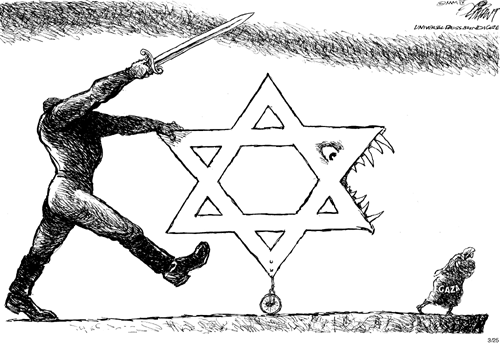
Anti-semitism (Arabs are semites too!)

Anti-semitism


oliphantgaza

This cartoon, which has just appeared in major newspapers courtesy of renowned (Pulitzer Prize-winning) cartoonist Pat Oliphant, is being denounced as "anti-Semitic." Once again, to no one's surprise, criticism of Israeli thuggery is equated to hatred for Jews.

The head of the Anti-Defamation League says of the figure at the left, "The implication is of an Israeli policy without a head or a heart." And whose fault is that, exactly? The cartoonist? Or the policy? [Actually I'm being a bit disingenuous; Israeli policy towards the Palestinians may not have a heart, but it certainly has a head, in that the Israelis know exactly what they are doing]

The Simon Wiesenthal Center says "It is cartoons like this that inspired millions of people to hate in the 1930s and help set the stage for the Nazi genocide." Once again, no. It is the Israeli barbarity toward the people of Gaza that inspires people to hate Israel and, unfortunately, in some cases Jews in general. And of course the supposed "genocide" against the Jews whose stage is being set is entirely fictional, whereas the actual genocide of the Palestinian people is quite real, and very much ongoing.

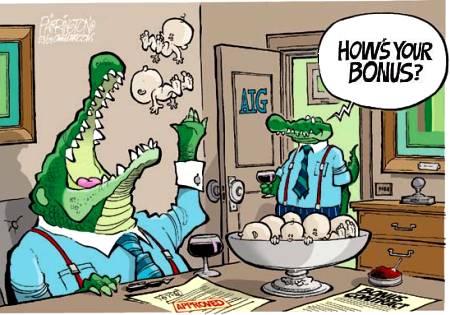
Whatever is to be done about that whole AIG thing?

Whatever is to be done about that whole AIG thing?

aig-baby-bonus.jpg

Great minds often think alike. Not necessarily in lockstep, but sometimes two different (and equally excellent) people come to the same conclusion. Take, for example, one of my long-time journalistic heroes, Joe Conason:

The popular urge to claw back the bogus bonuses paid by American International Group is irresistible and fully justified, but should the Treasury someday retrieve every single bonus dollar, that total of $165 million will make no difference to anyone except a few disgruntled traders. From the jaded perspective of the financiers, the uproar over the AIG bonuses may provide a welcome distraction from far more important (and lucrative) abuses in the world's offshore tax havens.

[...]

According to the Government Accountability Office, nearly all of America's top 100 corporations maintain subsidiaries in countries identified as tax havens. As the GAO notes, there could be reasons other than avoiding the IRS to set up branches in places such as Singapore, Luxembourg and Switzerland, where taxes are light or nonexistent and keeping clients' illicit secrets is considered a matter of national pride.

But what reason other than evasion could there be for Goldman Sachs Group to set up three subsidiaries in Bermuda, five in Mauritius, and 15 in the Cayman Islands? Why did Countrywide Financial need two subsidiaries in Guernsey? Why did Wachovia need 18 subsidiaries in Bermuda, three in the British Virgin Islands, and 16 in the Caymans? Why did Lehman Brothers need 31 subsidiaries in the Caymans? What do Bank of America's 59 subsidiaries in the Caymans actually do? Why does Citigroup need 427 separate subsidiaries in tax havens, including 12 in the Channel Islands, 21 in Jersey, 91 in Luxembourg, 19 in Bermuda and 90 in the Caymans? What exactly is going on at Morgan Stanley's 19 subs in Jersey, 29 subs in Luxembourg, 14 subs in the Marshall Islands, and its amazing 158 subs in the Caymans? And speaking of AIG, why does it have 18 subs in tax-haven countries? (Don't expect to find out from Fox News Channel or the New York Post, because News Corp. has its own constellation of strange subsidiaries, including 33 in the Caymans alone.)

When the cost of these shenanigans was last estimated two years ago, the U.S. government's annual loss in revenue due to tax avoidance by major corporations and super-rich individuals was pegged at about $100 billion -- considerably more than a rounding error, even today. But of course that is only a rough assessment, as is the estimate of $12 trillion in untaxed assets hidden around the world. Nobody will know for certain until the books are opened and transparency is established.

Now take another--Linda McQuaig:

Don't get me wrong: I'm not against tarring and feathering those AIG guys who helped destroy the world economy with their financial manoeuvres, and then received million-dollar bonuses to undo their own handiwork.

But focusing just on them is like just going after the crude thugs who unleashed dogs on Iraqi prisoners at Abu Ghraib, without noticing that their actions were the product of a climate of lawlessness and vengeance fostered by the White House.

Similarly, for several decades now, the financial and corporate elite has championed an unbridled capitalism, and pressed for the removal of crucial regulations needed to protect the public. It has also championed an ethos of greed that justified extraordinary compensation, and very low tax burdens, for those at the top.

In this climate -- with regulations stripped away, an intense fanning of the flames of acquisitiveness and the prospect of ever-larger bonuses dangled in front of them -- are we surprised that some Wall Street types unleashed their inner dog in ways that took little account of the public interest?

...and that took a beeline for all those offshore banks where transparency is a dirty word?

Offshore banks and other tax shelters should finally be called by their right name: ACCOMPLICES.

Last time I looked, aiding and abetting a crime was a crime unto itself, and an accomplice is held guilty right along with the main perpetrator. The laws of many a land all agree on this point. They wouldn't let a band of gangsters on a ghetto street get away with murder--so why allow it in the financial district?

The answer, I suspect, is because the banksters know how to bury a body where it won't be easily found. And where better than in a convoluted, opaque foreign banking system? Especially when the country where the accomplice-bank is located plumes itself on its "discretion" and "safety"?

Of course, those countries where the accomplice-banks squat are invariably small. Small geography, small population, small resources, small tax base. They don't produce much because they don't have much to produce with. And so it leads to a certain smallness of mind, as well. Particularly when it comes to cash. After all, if you ain't got money comin' in from anyplace else, shoot, why not take it from a well-heeled overseas crook? Especially if that crook dresses in Armani, Zegna, and every other trendy international name in the lexicon? Such things lend an awful lot of glitter and panache to a place that's home to just three inbred farmers and one cross-eyed cow*...

So of course it should come as no surprise that the infamous Stanford Bank would have its centre of thievery highway robbery offshore banking in Antigua, an island with a population of no more than maybe 100,000 souls.** And of these, how many pay taxes? How many make enough that anyone would levy taxes on them? And if collected, what good would that piffling amount of tax income do? The parliamentarians would all have to take second jobs at that rate. And how many jobs are on that island to begin with?

Obviously, political alternatives (such as communal rule, for example) aren't being considered. So it's little wonder that the local politicos, despite their insistences to the contrary, don't run a very tight ship where banking and transparency are concerned. And as long as that money keeps flowing, nobody worries much.

Until it all jumps up to bite them in the ass. Which, as bad luck would have it, is now the case. Allen Stanford was running an elaborate Ponzi scheme--who knew?

Well, the Antiguan authorities should have known--had they been keeping track. Which they weren't. After all, their little island nation had a reputation to uphold. And that reputation was not for transparency and integrity; it was for "discretion". Integrity and transparency don't pay the bills, much less build glitzy tourist attractions for all those foreign sun-seekers! What does? Cold, hard, foreign cash.

And, as the old Roman saying has it, Pecunia non olet. Money has no odor. Even if the way it was gotten stinks to high heaven, somehow that cash always manages to smell sweet...***

But let's not bog down in the question of whether money smells. I can tell you what stinks to the highest heaven, and so can my fellow Canadian:

Greed had become the new black. No one even seemed embarrassed to show it. As Barbara Amiel once said, "I have an extravagance that knows no bounds." This wasn't something she cooed privately into the ear of her husband, but rather boasted publicly to fashion magazine Vogue.

Of course, any attempt to critique greed or the unbridled capitalism that accommodates it is quickly dismissed. Resistance is pointless, we're told. Greed is simply natural -- as basic to the human condition as jealousy, anger, pride, pimples.

Linda McQuaig nailed it. The root of the problem lies not with any individual corporation, or any single small country specializing in offshore banking. The problem is greed, and more specifically, the way greed has been entrenched in our cultures and enshrined in our laws. Gordon Gekko's downfall in Wall Street should be proof enough that the man is wrong about the nature of the beast: Greed is not good. Greed kills. Greed wrecks entire economies, and not just in small countries; big ones are just as vulnerable. In fact, the bigger and more interconnected and globalized the economy, the more the old saying holds true: The harder they fall.

Unfortunately, it seems that a lot of real-life Wall Streeters never watched that movie to the end. They don't read good books, either. And they sure don't read what Joe Conason has written...

Whatever the accurate accounting proves to be, it is certain to exceed hundreds of billions annually worldwide. That is money every country will need badly for years, to repay debt, finance reconstruction, and fund services, as the world economy struggles to revive itself. Even in the developing countries, where incomes are much lower and billionaires tend to be scarce, the annual revenue loss could be as much as $50 billion -- enough to meet the U.N.'s Millennium Development Goals (if only the money were not stolen by local elites and wired away to numbered accounts in tax havens).

None of these tax havens could exist without the connivance or at least the cooperation of the world's most powerful governments, which remain dominated by financial industry lobbyists even now.

It sure looks hopeless at the rate things are currently going, does it not?

But wait...Linda McQuaig hasn't just nailed the problem of shrugging one's shoulders at greed, she has also unearthed some pretty earth-shaking stuff about who the real Atlases are that hold this world aloft:

[T]he late economic historian Karl Polanyi noted that resisting the rapacious effects of the unregulated market is also natural, perhaps even more basic in humans.

Polanyi pointed out that the rise of capitalism centuries ago was so disruptive to the lives of ordinary people -- who were forced into mines and factories after losing their rights to the common fields -- that it produced a counter-reaction aimed at controlling the market.

Indeed, Polanyi argued that while capitalism was a carefully planned set of laws designed by the financial elite, the reaction to capitalism -- protests, unionization, political agitation -- was a natural set of responses that emerged spontaneously from the masses.

The impulse to resist unbridled capitalism -- with its resulting extreme inequality and economic domination by the rich -- is basic and has persisted throughout the centuries, according to Polanyi.

It culminated in the rise of the social welfare state in the early decades after World War II -- an era in which the market excesses of the 1920s were reined in by financial regulation, and tax and spending policies led to greater social equity. In both the U.S. and Canada, there was real growth in the incomes of the middle and lower classes.

And you'll note that all that was done without telling the common people to invest, much less in offshore banking.

Free-marketers are always telling small countries to take harsh medicine (poison, really) to "cure" what ails them financially. This socialist scribbler would give the same advice, but a different kind of medicine. Mine would kill only the crooks (big ones especially) and cure the economy.

Ready for a dose?

Wednesday, March 25, 2009

George H. W. Bush's near indictment for obstruction of justice re: Orlando Letelier's assassination

March 25-26, 2009 -- George H. W. Bush's near indictment for obstruction of justice

Buried in the newspaper clipping files of the CIA are two short articles describing how Ronald Reagan's 1980 running mate, George H. W. Bush, was nearly indicted for obstruction of justice in the FBI's investigation of the car bombing assassination in downtown Washington, DC on September 21, 1976, of former Chilean Foreign Minister Orlando Letelier and his American female colleague Ronni Karpen Moffitt. A hit team sent by Chile to assassinate Letelier, known to Bush beforehand, placed a radio-controlled bomb under Letelier's car and detonated on Massachusetts Avenue's Sheridan Circle, near the Irish embassy.

One clipping from the September 1980 Progressivestates that the Jimmy Carter Justice Department was considering empaneling a grand jury to investigate Reagan's vice presidential running mate for not telling FBI agents what he knew about a Chilean Secret Police hit team active in the United States while Bush was director of the CIA. In addition, the Senate Intelligence Committee was probing what Bush knew and when he knew it about the assassination of Letelier.

Three Cuban members of Omega 7, the anti-Castro terroist group operating in the United States, were convicted of their role in the Letelier assassnation but their conviction was later overturned by a federal appeals court. Senator James Buckley (R-NY) had close ties to Omega 7. Buckley, the brother of the late right-wing pundit William Buckley, now serves on the U.S. District Court for the District of Columbia.

Bush and his deputy, General Vernon Walters, had apparently ordered the CIA station in Asuncion, Paraguay to grant two Chilean intelligence agents to be issued U.S. visas by the U.S. ambassador to Paraguay George W. Landau in July 1976. Landau took care to photograph the false Paraguayan passports with the U.S. visas as a safeguard.

Landau was told by a top official of Paraguayan dictator Alfredo Stroessner's government that Chilean President Augusto Pinochet had asked for the visas to be granted as a personal favor to him. The two Chilean agents, an expatriate American named Michael Vernon Townley and Armando Fernandez traveled to Washington to help plan the hit on Letelier. Secretary of State Henry Kissinger, who had helped form the "Operation Condor" intelligence sharing and mutual assassination pact among various South American dictatorships, was briefed on the assassination plans against Letelier and approved them.

The Washington Star newspaper's "The Ear" column on June 24, 1980, quotes two authors of the book, Assassination on Embassy Row, Saul Landau and John Dinges, as writing that Bush new "perfectly well" that Chilean Secret Police had sent an assassination squad to Washington but that Bush sat on the information. In addition, Bush instructed CIA sources to tell the press that the Chilean government of General Pinochet had "nothing" to do with the assassination of Letelier and Moffitt.

According to The Progressive piece, Carter declined to prosecute Bush because in an election year it would look "too political." Had Carter known that Bush was secretly and illegally negotiating covert arms sales to Iran in return for their holding the U.S. hostages until after the November 1980 election, Carter could have upped the charges against Bush to treason and the Democrats would have enjoyed their own "October Surprise" with Reagan being defeated and Bush never entering the White House but going to a federal "Big House."

Of the major conspirators in the assassination of Letelier, Walters is dead. However, Bush and Kissinger, who now serves as Barack Obama's special envoy to the Kremlin, are still alive and subject to prosecution for complicity to commit murder. Since there is no statute of limitation for murder and acts of terrorism, Bush and Kissinger are still liable to be charged for their involvement in the first major act of modern terrorism in the nation's capital -- the "9/21 attack."

Why Eliot Spitzer politically was assassinated

Why Eliot Spitzer politically was assassinated


The predatory lending industry
had a partner in the White House


Mortaging America's future
for a quick buck

This video was originally posted in March of 2008

It's one of the most amazing displays of journalistic incompetence and malpractice in recent memory.

The US news media failed to draw the obvious connection between the bizarre federal law enforcement investigation and leak campaign about the private life of New York Governor Spitzer and Spitzer's all out attack on the Bush administration for its collusion with predatory lenders.

While the international credit system grinds to a halt because of a superabundance of bad mortgage loans made in the US, the news media failed to cover the details of Spitzer's public charges against the White House.

Yet when salacious details were leaked about alleged details of Spitzer's private life, they took that information and made it the front page news for days.

To the 9/11 fiasco, the Iraq War, the travesty of the federal response to Hurricane Katrina, and the shredding of the US Constitution, we can now add a deliberate and reckless undermining of the credit and banking system of the US to the list of Bush administration "accomplishments."

No external enemy, or group of external enemies, could have done as much harm to the nation as this group has in less than eight years.

Hey, do you think it's a coincidence that a Bush was involved the last time the US banking industry fell into a black whole because of White House-facilitated fraud?

There's actually a lot of money to be made blowing up banks. Here's how Bush Sr. and his friends in the Mafia and CIA profited from it the last time:

Bush, the Mafia, the CIA and the Savings and Loan Scandal

War On Terror Within: The End of Jewish History by Gilad Atzmon

War On Terror Within: The End of Jewish History

The issue I am going to discuss today is probably the most important thing I’ve ever had to say about Israeli brutality and contemporary Jewish identity. I assume that I could have shaped my thought into a wide-ranging book or an analytical academic text but instead, I will do the very opposite, I will make it as short and as simple as possible.

In the weeks that have just passed we had been witness to an Israeli genocidal campaign against the Palestinian civilian population in Gaza. We had been witnessing one of the strongest armies in the world squashing women, elderly people and children. We saw blizzards of unconventional weapons bursting over schools, hospitals and refugee camps. We had seen and heard about war crimes committed before, but this time, the Israeli transgression was categorically different. It was supported by the total absolute majority of the Israeli Jewish population. The IDF military campaign in Gaza enjoyed the support of 94% of the Israeli population. 94% of the Israelis apparently approved of the air raids against civilians. The Israeli people saw the carnage on their TV screens, they heard the voices, they saw hospitals and refugee camps in flames and yet, they weren’t really moved by it all. They didn’t do much to stop their “democratically elected” ruthless leaders. Instead, some of them grabbed a seat and settled on the hills overlooking the Gaza Strip to watch their army turning Gaza into modern Hebraic coliseum of blood. Even now when the campaign seems to be over and the scale of the carnage in Gaza has been revealed, the Israelis fail to show any signs of remorse. As if this is not enough, all throughout the war, Jews around the world rallied in support of their “Jews-only state”. Such a popular support of outright war crimes is unheard of. Terrorist states do kill, yet they are slightly shy about it all. Stalin’s USSR did it in some remote Gulags, Nazi Germany executed its victims in deep forests and behind barbed wire. In the Jewish state, the Israelis slaughter defenceless women, children and the old in broad daylight, using unconventional weapons targeting schools, hospitals and refugee camps.

This level of group barbarism cries for an explanation. The task ahead can be easily defined as the quest for a realisation of Israeli collective brutality. How is it that a society has managed to lose its grip of any sense of compassion and mercy?

The Terror Within

More than anything else, the Israelis and their supportive Jewish communities are terrorised by the brutality they find in themselves. The more ruthless the Israelis are, the more frightened they become. The logic is simple. The more suffering one inflicts on the other, the more anxious one becomes of the possible potential deadly capacity around. In broad terms, the Israeli projects on the Palestinian, Arab, Muslim and Iranian the aggression which he finds in himself. Considering the fact that Israeli brutality is now proved to be with no limit and with no comparison, their anxiety is as at least as great.

Seemingly, the Israelis are fearful of themselves being the henchmen. They are engaged in a deadly battle with the terror within. But the Israeli is not alone. The Diaspora Jew who rallies in support of a state that pours white phosphorous on civilians is caught in the exact same devastating trap. Being an enthusiastic backer of an overwhelming crime, he is horrified by the thought that the cruelty he happens to find in himself may manifest itself in others. The Diaspora Jew who supports Israel is devastated by the imaginary possibility that a brutal intent, similar to his own, may one day turn against him. This very concern is what the fear of anti-Semitism is all about. It is basically the projection of the collective Zio-centric tribal ruthlessness onto others.

There is no Israeli – Palestinian Conflict

What we see here is a clear formation of a vicious cycle in which the Israeli and his supporters are becoming an insular fireball of vengeance that is fuelled by some explosive internal aggression. The meaning of it all is pretty revealing. Since Palestinians cannot militarily confront Israeli aggression and destructive capacity, we are entitled to argue that there is no Israeli-Palestinian conflict. All there is, is Israeli psychosis in which the Israeli is being shattered with anxiety by the reflection of his own ruthlessness. Being regarded as the Nazis of our time, the Israeli is thus doomed to seeing a Nazi in everyone. Similarly, there is no rise in anti-Semitism either. The Diaspora Zionist Jew is simply devastated by the possibility that someone out there is as ethically corrupted and merciless as he himself proved to be. In short, Israeli politics and Zionist lobbying should be seen as no less than a lethal Zio-centric collective paranoia on the verge of total psychosis.

Is there a way to redeem the Zionist of his bloody expedition? Is there a way to change the course of history, to save the Israelis and their supporters from total depravity? Probably the best way to pose this question is to ask whether there is a way to save the Israeli and the Zionist from themselves. As one may gather, I am not exactly interested in saving Israelis or Zionists, however, I do grasp that redeeming Zionists of their transgression may bring a prospect of peace to Palestine, Iraq and probably the rest of us. For those who fail to see it, Israel is just the tip of the iceberg. At the end of the day, America, Britain and the West are now subject to some similar forms of “politics of fear” that are the direct outcome of Neocon deadly interventionist ideology and practices.

The Shrink from Nazareth

Many years ago, so we are told, there was an Israelite who lived amongst his brethren in the land of Canaan. Like the contemporary Israelis, he was surrounded by hate, vengeance and fear. At a certain stage he had decided to intervene and to bring a change about, he realised that there was no other way to fight ruthlessness than to search for grace. “Turn your other cheek” was his simple suggestion. Identifying the Israelite’s psychosis as “a war against terror within”, Jesus grasped that the only way to counter violence is to look in the mirror while searching for Goodness within.

It is rather apparent that Jesus’ lesson paved the way to the formation of western universal ethics. Modern political ideologies drew their lesson from the Christian prospect. Marx’s normative search for equality can be seen as a secular rewriting of Jesus’ notion of brotherhood. And yet, not a single political ideology has managed to integrate the deepest notion of Jesus’ grace. To seek peace is primarily to search for one within. While Israelis and their Neocon twins would aim at achieving peace by means of deterrence, true peace is achieved by the search for harmony within. As a Lacanian scholar may suggest, to love your neighbour is actually to love yourself loving your neighbour. The case of the Israeli is the complete opposite. As they manage to prove time after time, they are really loving themselves hating their neighbours or in short, they simply love themselves hating in general. They hate almost everything: the neighbour, the Arab, Chavez, the German, Islam, the Goy, Pork, the Pope, the Palestinian, the Church, Jesus, Hamas, calamari and Iran. You name it, they hate it. One may have to admit that hating so much must be a very consuming project unless it gives pleasure. And indeed the Israeli “pleasure principle” could be articulated as follows: it continuously drives the Israeli to seek pleasure in hate while inflicting pain upon others.

It must be mentioned at this point that the “War Against Terror within” is not exactly a Jewish invention. Everyone, whether it is nations, peoples or individuals, are a potential subject to it. The consequences of American nuclear murderous slaughter in Hiroshima and Nagasaki made the American people into a terrorised collective. This collective anxiety is known as the “cold war”. America is yet to redeem itself of the fear that there maybe someone out there as merciless as America proved to be. To a certain extent, operation Shock and Awe had a very similar effect on Britain and America. It led to the creation of horrified masses easily manipulated by highly motivated elite. This exact type of politics is called “politics of fear”.

And yet, within the western discourse a correction mechanism is in place. Unlike the Jewish state that is getting radicalised by its own self feeding paranoia, in the West, evil is somehow confronted and contained eventually. The murderer is denounced and hope for peace is somehow reinstated till further notice. Not that I hold my breath for President Obama bringing any change, one thing is rather clear, Obama was voted in to bring a change. Obama is a symbol of our genuine attempt to curtail evil. In the Jewish state, not only it doesn’t happen, it can never happen. The difference between Israel and the West is rather obvious. In the West, Christian heritage is providing us with a possibility of a wish grounded on belief in universal goodness. Though, we are under the constant danger of exposure to evil, we tend to believe that goodness will eventually prevail. On the other hand, in Hebraic tribal discourse, Goodness is the property of the chosen. The Israelis do not see goodness or kindness in their neighbors, they see them as savage and as a life-threatening entity. For the Israelis, kindness is their very own property, accidentally they are also innocent and victims. Within the western universal discourse, goodness doesn’t belong to one people or a single nation, it belongs to all and to none at the same time. Within the western universal heritage, Goodness is found in each of us. It doesn’t belong to a political party or an ideology. The elevating notion of grace and a Good God is there in each of us, it is always very close to home.

What Kind Of Father Is That?

“Then when the Lord your God brings you to the land he promised your ancestors Abraham, Isaac, and Jacob to give you -” a land with large, fine cities you did not build, houses filled with choice things you did not accumulate, hewn out cisterns you did not dig, and vineyards and olive groves you did not plant – and you eat your fill.” (Deuteronomy: 6: 10-11).

“When the Lord your God brings you into the land you are entering to possess and drives out before you many nations…then you must destroy them totally. Make no treaty with them and show them no mercy.” (Deuteronomy 7:1-2)

At this point we may try to attempt and to grasp the root cause behind the severe lack of compassion within the Israeli discourse and its supportive lobbies. I believe that an elaboration on the troubled relationships between the Jews and their different Gods may throw some light on the topic. It is rather obvious that the ever growing list of Jewish “Gods”, “Idols” and “Father-figures” is slightly problematic at least as far as ethics and kindness are concerned. The very relationship between “the son” and the “non-ethical father” must be explored. The philosopher Ariella Atzmon (who happens to be my mother) defines the complexity of the false beginning as the “Fagin Syndrome”. Charles Dickens’ Fagin is a “kidsman”, an adult who recruits children and trains them as pickpockets and thieves, exchanging food and shelter for goods the children steal. Though the kids must be grateful towards their master, they must also despise him for turning them into thieves and pickpockets. The kids realise that Fagin’s goods are all stolen and his kindness is far from being genuinely honest or pure. Sooner or later the kids will turn against their master Fagin in an attempt to liberate themselves of the immoral catch.

From a father-son perspective, the Biblical Jewish God Jehovah is no different from what we might see in the Fagin syndrome. The father of Israel leads his chosen people through the desert to the promised land so they can rob and plunder its indigenous habitants. This is not exactly what one may expect of an ethical father or a “kind God”. Consequently, as much as the sons of Israel love Jehovah, they must also be slightly suspicious of him for turning them into robbers and murderers. They might even be apprehensive regarding his kindness. Thus, it shouldn’t take us by a surprise that throughout Jewish history more than just a few Jews had turned against their heavenly father.

However, bearing in mind the common secularist perception that Gods are actually invented by people, one may wonder, what leads to the invention of such an “unethical God”? What makes people follow the rules of such a God? It would be also interesting to find out what kind of alternative Gods Jews happened to pick or invent once Jehovah has been shunned.

Since emancipation, more than just a few Jews had been disassociating themselves from the traditional tribal setting and rabbinical Judaism. Many intermingled with their surrounding realities, dropped their chosen entitlement and turned into ordinary human beings. Many other Jews insisted upon dropping God yet maintaining their racially orientated tribal affiliation. They decided to base their tribal belonging on ethnic, racial, political, cultural and ideological grounds rather than the Judaic precept. Though they noticeably dropped Jehovah they insisted upon adopting a secularist view that was soon shaped into a monolithic religious-like precept. All throughout the 20th century, the two religious-like political ideologies that had been found to be most appealing by the Jewish masses were Marxism and Zionism.

Marxism can be easily portrayed as a secular universal ethical ideology. However, within the process of transformation into a Jewish tribal precept, Marxism has managed to lose any traces of humanism or universalism. As we know, early Zionist ideology and practice was largely dominated by Jewish leftists who regarded themselves as true followers of Marx. They genuinely believed that celebrating their Jewish national revival at the expense of Palestinians was a legitimate socialist endeavour.

Interestingly enough, their opponents, the anti-Zionist Bund of the East European Jewish Labour, didn’t really believe in the institutional robbery of the Palestinians, instead, they believed that taking from rich European is a great universal mitzvah on the path towards social justice.

The following are a few lines from The Bund’s anthem

We swear our stalwart hate persists,
Of those who rob and kill the poor:
The Tsar, the masters, capitalists.
Our vengeance will be swift and sure.
So swear together to live or die!

Without engaging in questions having to do with ethics or political affiliation, it is rather obvious that the Jewish Marxist anthem is overwhelmingly saturated with “hate” and “vengeance”. As much as Jews were enthusiastic about Marx, Marxism, Bolshevism and equality, the end of the story is known. Jews en masse dropped Marx a long time ago. They somehow left the revolution to some enlightened Goyim such as Hugo Chavez and Evo Morales. Leaders who truly internalised in the real meaning of universal equality and ethics.

Though in the late 19th century and the early 20th century, Marxism found many followers amongst European Jews, following the Holocaust, Zionism has gradually become the voice of world Jewry. Like Fagin, the Zionist Gods and Idols: Herzl, Ben Gurion, Nordau, Weizmann, promised their followers a new unethical beginning. Robbing the Palestinians was their path towards a long overdue historical justice. Zionism transformed the Old Testament from a spiritual text into a land registry. But again as in the case of Jehovah, the Zio God transformed the Jew into a thief, it promised him someone else’s property. This in itself may explain the Israeli resentment towards Zionism and Zionist ideology. Israelis prefer to see themselves as the natural dwellers of the land rather than pioneers in a non-ethical Jewish Diaspora colonial project. The Israeli Jew furnishes his political stand by means of severe ethical escapism. This may explain the fact that as much as the Israelis love their wars, they really hate to fight them. They are not willing to die for a big abstract remote ideology such as the “Jewish nation” or “Zionism”. They overwhelmingly prefer to drop white phosphorous and cluster bombs from afar.

However, along the relatively short history of modern Jewish nationalism the Zio God made friends with some other Gods and kosher idols. Back in 1917 Lord Balfour promised the Jews that they would erect their national home in Palestine. Needless to say, as in the case of Jehovah, Lord Balfour made the Jews into plunderers and robbers, he came up with an outright non-ethical promise. He promised the Jews someone else’s land. This was basically a false beginning. Evidently, it didn’t take long before the Jews turned against the British Empire. In 1947 the UN made exactly the same foolish mistake, it gave birth to the “Jews-only State” again at the expense of the Palestinians. It legitimised the robbery of Palestine in the name of the nations. Like in the case of shunned Jehovah, it didn’t take long before the Jews turned against the UN. “It doesn’t matter what the Goyim say, all that matters is what the Jews do”, said Israeli PM David Ben Gurion. Recently Israelis had managed to even shun their best subservient friends in the White House. On the eve of the last American presidential election Israeli Generals had been filmed denouncing President Bush for “damaging Israeli interests for being overwhelmingly supportive” (Ret. Brig General Shlomo Brom). The Israeli Generals basically blamed Bush for not stopping Israel from destroying its neighbours. The moral is rather clear, the Zionists and the Israelis will inevitably turn against their Gods, Idols, fathers and others who try to help them. This is the real meaning of the Fagin syndrome within the Israeli political context. They will always have to turn against their fathers.

I believe that the most interesting Jewish belief system of them all is the Holocaust Religion, which the Israeli Philosopher Yeshayahu Leibowitz rightly defined as the “new Jewish religion”. The most interesting aspect of the Holocaust religion is its God-figure, namely “the Jew”. The Jewish follower of that newly formed dogmatic precept believes in “the Jew”, the one who redeemed oneself. The one who “survived” the “ultimate genocidal” event. The followers believe in “the Jew”, the “innocent” victim sufferer who returned to his “promised land” and now celebrates his successful revival narrative. To a certain extent, within the Holocaust religious discourse, the Jew believes in “the Jew”, expressed as his/her powers and his/her eternal qualities. Within the newly formed religious framework, Mecca is Tel Aviv and the Holy Shrine is the Yad Vashem Holocaust Museum. The newly formed religion has many shrines (Museums) scattered around the world and it has many priests who spread the message around and punish its opposing elements. From a Jewish perspective, the Holocaust religion is a fully transparent expression of self love. It is where past and future merge into a meaningful present, it is when history is translated into praxis. Whether consciously or unconsciously, every person who identifies politically and ideologically (rather than religiously) as a Jew is, practically speaking, succumbing to the Holocaust religion and a follower of its father-figure “the Jew”. And yet, one may wonder, what about Kindness, is there any goodness in this newly formed ‘father-figure’? Is there any grace in this narrative of innocent victimhood that is celebrated daily at the expense of the Palestinian people?

If there is an end to history, the Holocaust religion embodies the very end of Jewish history. In the light of the Holocaust religion the “Father” and the “Son” unite at last. At least in the case of Israel and Zionism they bond into an amalgam of genocidal ideology and reality. In the light of the Holocaust religion and its epic survival ethos the Jewish State considers itself legitimated in dropping white phosphorus on women and children who they have caged in an inescapable open-air prison. Sadly enough, the crimes committed by the Jewish State are done on behalf of the Jewish people and in the name of their troubled history of persecution. The Holocaust religion brings to life what seems to be the ultimate possible form of insular brutal incarnation.

Historically Jews have shunned many Gods, they dropped Jehovah, they dumped Marx, some have never followed Zionism. But in the light of the Holocaust religion, while bearing in mind the scenes from Gaza, Jenin and Lebanon, the Jew may have to continue in the tradition and drop “the Jew”. He will have to accept that his newly formed father-figure was formed in his own shape. More concerning is the devastating fact that the new father is proved to be a call to kill. Seemingly, the new father is the ultimate evil God of them all.

I wonder how many Jews will be courageous enough to shun their esoteric newly formed father-figure. Will they be courageous enough to join the rest of humanity adopting a universal ethical discourse? Whether the Jew drops “The Jew”, only time will tell. Just to remove any doubt, I did drop my “Jew” a long time ago and I am doing fine.

Gilad Atzmon was born in Israel and served in the Israeli military. He lives in London, and is an editor at Palestine Think Tank, where this essay first appeared, and author of two novels: A Guide to the Perplexed and the recently released My One and Only Love. Atzmon is also one of the most accomplished jazz saxophonists in Europe. He can be reached at: atz@onetel.net.uk. Read other articles by Gilad.

Incriminating Evidence of Israeli War Crimes in Gaza - by Stephen Lendman

Incriminating Evidence of Israeli War Crimes in Gaza

Incriminating Evidence of Israeli War Crimes in Gaza - by Stephen Lendman

Throughout its history, Israel has willfully and repeatedly committed crimes of war and against humanity, always with impunity. Yet under customary legal standards and norms (including Geneva, Hague, the UN Charter, S.C. and G.A. resolutions), it's lawless, a serial abuser, a threat to the region and humanity, mostly as an oppressive occupier. Attacking Gaza is the latest episode in its six-decade reign of terror satisfying the definition of genocide against defenseless Palestinian civilians. This article covers more evidence from some disturbing but unsurprising newly published information.

On March 19, in the first of a series of articles, Haaretz headlined: "IDF killed civilians in Gaza under loose rules of engagement." Military correspondent Amos Harel revealed Israeli soldier and pilot ("dirty secret") testimonies of being ordered to kill unarmed civilians and destroy their property - accounts at variance with official claims that only military targets were attacked and that "Israeli troops observed a high level of moral behavior during the operation." Defense Minister Ehud Barak calls the IDF "the most moral army in the world."

"Moral" examples included an infantry squad leader recounting the shooting of a mother and her two children: "There was a house with a family inside....We put them in a room. Later we left the house and another platoon entered it, and a few days after that there was an order to release the family....The platoon commander let the family go and told them to go to the right. One mother and her two children didn't understand and went to the left," after which a rooftop sniper "shot them straight away....I don't think he felt too bad about it, because after all, as far as he was concerned, he (followed orders, and, besides, Palestinian lives are) less important" than our own soldiers.

Other incidents included:

-- a squad leader telling of a company commander ordering an elderly Palestinian woman to be shot and killed;

-- soldiers saying "we should kill everyone (in the center of Gaza); everyone there is a terrorist;"

-- soldiers writing "death to the Arabs on walls" and spitting on family pictures;

-- a squad leader saying: "At the beginning, the directive was to enter a house with an armored vehicle, break the door down, (and) start shooting inside - I call it murder - to shoot at everyone we identify;" commanders called it OK "because everyone left in the city is culpable because they didn't run away;"

-- soldiers ordered to indiscriminately destroy property and farmland;

-- orders given to enter a house, "switch on loudspeakers and tell (occupants) you have five minutes to run away and whoever doesn't will be killed;"

These and other accounts typify regular incidents in occupied Gaza and the West Bank. When revealed, official denials follow or in response to clear evidence, officers, like military advocate general Avichai Mendelblit, say the incidents will be investigated, after which everything is whitewashed, quietly forgotten, none of the guilty are prosecuted, and security forces keep using disproportionate force against defenseless Palestinian civilians.

In a March 19 analysis, Harel concluded that this "happen(s) in the field most of the time (and) as usual, reality is completely different from the gentler version provided by the military commanders to the public and media during (an) operation and after. The soldiers are not lying, for the simple reason that they have no reason to" and every reason to stay silent. The rule is: "You don't ask, we won't tell," but these soldiers, squad leaders, pilots and commanders did.

Further, there's a "continuity of testimony from different sectors that reflects a disturbing and depressing picture" of a rogue military willfully committing war crimes because they know they can get away with them. Harel concluded: "The IDF's ethical problems did not start in 2009." They go back decades, but according to some, military "deterioration" has been continuous from the 1967 war to Operation Cast Lead. Worse still is that Israeli history reveals six decades of relentless and continuous terror. Attacking Gaza for 22 days is just the latest episode.

On March 21, the London Independent's Donald Macintyre wrote: "Israelis (were) told to fight a 'holy war' in Gaza....a religious war" against Arabs, according to a soldier citing "the martial role of military rabbis during the operation." In rabbinate literature distributed to the troops, the message was: "We are the Jewish people, we came to this land by a miracle, God brought us back to this land, and now we need to fight to expel the Gentiles who are interfering with our conquest of this holy land."

According to the Israeli human rights group, Yesh Din, IDF head chaplain, Rabbi Avichai Rontzki, a brigadier general, distributed booklet material saying that it was "terribly immoral" to show mercy to a "cruel enemy" and that soldiers were fighting "murderers." Imagine rabbis claiming to be men of God, yet violating core Jewish dogma by preaching hate, premeditated murder, and lying about innocent civilians they're vilifying. Another example of the viciousness of a so-called civilized state, acting like barbarians (in the name of God) and calling it just.

There's more. On March 22 in Haaretz, Amira Hass headlined: "IDF soldiers ordered to shoot at Gaza rescuers" in citing a Hebrew handwritten document, "Rules of Engagement - Open fire also upon rescue." It confirms numerous reports and testimonies like the above that soldiers shot Palestinian civilians in cold blood, murdered them (and their rescuers), or in cases where they were still alive prevented their evacuation and let them bleed to death.

Hass stated: "The (above-mentioned) document provides written proof that IDF commanders ordered their troops to shoot at rescuers" besides ordering the killing of unarmed civilians and destruction of their property.

On March 22, London Observer writer Peter Beaumont headlined: "Gaza war crime claims gather pace as (still) more troops speak out." He cited a yet to be published "Breaking the Silence" report containing statements from 15 former soldiers. From their contacts with Operation Cast Lead participants, they corroborate the above claims of random killings and vandalism. According to the group's Mikhael Manekin:

"We have spoken to a lot of different people who served in different places in Gaza, including officers. We are not talking about some units being more aggressive than others, but underlying policy. So much so that we are talking to soldiers who said that they were having to restrain the orders given." According to one, Amir Marmor, orders from a Lt. Col. who briefed the troops were: "Shoot and don't worry about the consequences."

On March 20, Haaretz reporter Uri Blau disclosed that IDF soldiers ordered T-shirts marking the end of Operation Cast Lead featuring grotesque images of dead babies, mothers weeping at their children's graves, a gun aimed at a child and bombed-out mosque, and a pregnant Palestinian woman with a bull's eye depicted on her stomach with the English slogan, "1 shot, 2 kills."

These aren't just anecdotes from what Ehud Barak calls "the most moral army in the world." On March 22, Haaretz correspondent Gideon Levy wrote: "IDF ceased long ago being 'most moral army in the world.' " Moreover, imagining the military will investigate the charges is "propagandistic, ridiculous (and) meant not only to deceive the public, but also to offer shameless lies" as part of a cover-up the way these revelations are always handled.

These practices have gone on for decades. Orders come right from the top - to kill Arabs and commit atrocities and vandalism, and according to one Operation Cast lead soldier: "That's what is so nice, as it were, about Gaza - You see a person on a road....and you can just shoot him." This message is ingrained in young recruits, to see Jews as superior, Arabs as sub-humans, so it's "morally" OK to slaughter them.

Yet on March 22, Haaretz published GOC Home Front Command General Yair Golan's reply saying: "The reports were exaggerated and any deviations from the IDF's moral standards will be dealt with."

Then on March 23, it added IDF Chief Gabi Ashkenazi's claim that he did not believe Israeli soldiers harmed Palestinian civilians in "cold blood." He and Golan lied the way top commanders and government officials always do.

Yet Ashkenazi echoed Ehud Barak saying that "the IDF is the most moral army in the world" despite volumes of clear evidence to the contrary. He added that any "incidents" were "isolated," but Haaretz stated:

"The soldiers' testimonies run counter to the IDF's claims throughout the operation that troops observed a high level of moral behavior. A number of officers told Haaretz....that the testimonies did not surprise them, as 'anyone with eyes in his head knows that these things happened during the fighting in Gaza,' and they weren't 'isolated' incidents."

Gaza Civilian Testimonies

Documented by the Palestinian Centre for Human Rights (PCHR), they recount Operation Cast Lead's horror - highlighted by an Israeli soldier's message on Abu Hajaj's bedroom wall: "Death will find you....Soon."

PCHR noted the importance of finding "sanctuary in the comfort of one's home" at times of trauma, but Gazans lost it for 22 days and still suffer the effects. Briefly some examples:

-- the IDF occupied Mos'ab Dardona's Jabal Al Rayes northeast Gaza home, leaving behind wall drawings of soldiers urinating on toppled mosques and "devouring Palestinians villages;"

-- next door in Ibrahim Dardona's home, instead of using the bathroom, they left behind dozens of bags of feces and crude sexual diagrams on walls;

-- the defacing and other actions show a disturbing picture of racial hatred throughout Israeli society, according to PCHR's democratic development director, Hamdi Shaqqura; PCHR says thousands of Gazans are homeless, displaced, and forced to find shelter with relatives or move back to partially destroyed homes and cope as best they can;

-- in the agricultural area of Johr-ad-Dik, the IDF took over homes, displaced half the 2500 population and maliciously destroyed hundreds of olive and citrus trees;

-- the IDF ordered local residents near Saleh Abu Hajaj's home to leave; Saleh's daughter tied a white scarf to a stick, led out a group of civilians, then along with her mother was shot dead by the military;

-- in the Zeytoun district, IDF desecrated walls with messages like: "Die you all..Make war not peace..Arabs need to die," and on a gravestone "Arabs 1948 - 2009;"

-- inside Rashad Helmi Al Samouni's home, soldiers wrote: "There will be a day when we kill all the Arabs....Bad for the Arabs is good for me....A good Arab is an Arab in the grave (and) Peace now, but between Jews and Jews, not Jews and Arabs."

PCHR's conclusion was that whatever war crimes investigations reveal and what, if anything, follows from them, "it will do little to comfort the thousands of civilians whose sense of safety (in their own homes was) so categorically violated," something they no longer feel and for many never did.

PCHR published the names of 1417 Gazans killed by Israeli forces. It said 926 were civilians, 236 fighters, and 255 others civilian security forces, mostly police. Israel disputes the list claiming most targets "legitimate" despite clear evidence to the contrary, including from its own soldiers. In response, it's preparing its own list identifying most of the slain as "combatants or legitimate targets" without a shred of evidence for proof and plenty to disprove it.

PCHR also reported that in the week ending March 18:

-- IDF forces shot and injured 19 Palestinian civilians, including nine children and a US human rights activist;

-- the Israeli air force bombed selected Gaza sites, forcing civilians to abandon their homes and property in the areas;

-- Israeli forces conducted 39 incursions into West Bank communities, a practice occurring nearly daily; 39 Palestinian civilians were arrested, including six children for the crime of being Arab under Israeli occupation;

-- additional IDF arrests occurred at West Bank checkpoints, and measures to remove East Jerusalem Palestinians continue to make room for new Jewish settlements;

-- five West Bank homes were demolished leaving 49 Palestinians homeless; three other families were ordered from their homes in preparation for demolition;

-- West Bank settlement construction goes on unabated as part of an ethnic cleansing process;

-- settlers regularly attack Palestinians with impunity, and the Mossawa Advocacy Center for Arab Citizens reported (on March 21) a 1000% rise in 2008 crime rates over 2007 on Israeli Arab citizens; its leader, Jafar Farah, called it a "moral collapse;"

-- Gaza remains under siege with no progress made to end it; and

-- on March 23, PCHR reported that the IDF violated medical ethics during Operation Cast Lead by preventing Palestinian and ICRC medical teams from reaching the wounded; it also said Israel attacked 34 medical facilities, including eight hospitals, killing 16 medics and wounding 25 others.

Meanwhile on March 19, Richard Falk, UN Special Rapporteur on Human Rights in the Palestinian Territories, said: "If the (IDF) cannot (distinguish between civilians and military targets), its attack becomes unlawful and constitutes a war crime of the greatest magnitude under international law." He added that the UN (and human rights groups like Amnesty International) has clear evidence to support this conclusion and called for a formal investigation of IDF shelling of schools, mosques, ambulances, educational facilities, and homes as well as use of illegal weapons like white phosphorus.

Whatever follows, Gaza remains under siege. Allowed in humanitarian aid falls way short of supplying 1.5 million people with the barest subsistence they need. Through March 2, the UN Office for the Coordination of Humanitarian Affairs (OCHA) reported that Israeli violence continues and "authorities (still) limit the amount and range of goods allowed into Gaza....A range of essential goods, including supplies and equipment needed for rebuilding, are not being allowed into the territory." They're still kept out.

Basic items like medical equipment, veterinary supplies, macaroni, chickpeas, and lentils were suspended or delayed, and border crossings remain closed, except for brief periods. Like before, everything is in short supply or not available, including essential medical care, food and fuel. Earlier Amnesty International said "Gaza (was) reduced to bare survival." Today, it's no better under a continuing Israeli siege, illegal and brutal in the extreme, yet not denounced by world leaders to give Israel cover to maintain it.

The Adalah Legal Center for Arab Minority Rights in Israel's Position Paper on Israeli Civilian Killings in Gaza

Adalah (meaning justice in Arabic) is a 1996-established independent, non-profit, human rights organization serving Arab Israeli citizens' rights on issues of land, civil, political, cultural, social, religious, and economic matters among others. In February 2009, it examined the legality of Israel's 22 day Gaza attack, specifically the killing of civilian police and bombing of government buildings and Hamas institutions.

In citing the laws of war, it identified four central principles:

-- military necessity - that only those targets intended to "weaken or overcome the enemy or bring the battle to an end may be attacked;"

-- distinction - that must be drawn between combatants and military targets on the one hand, and civilians and non-military objects on the other; international law prohibits attacking the latter; doing so is a war crime; non-combatant civilians are protected by law under all circumstances; also, targets must clearly be military ones and nearby civilians must be warned in advance so they may leave;

-- proportionality - that prohibits disproportionate force likely to cause damage to or loss of human lives or objects; in other words, disproportionate to an intended military objective or that in any way is indiscriminate; and

-- the prevention of unnecessary suffering, especially for non-combatant civilians.

Beginning December 27 and continuing for 22 days, the IDF attacked uniformed police cadets and officers killing them and other civilians. During the period of fighting, non-combatant civilian Hamas members were also struck, including from its government.

International law prohibits attacking non-combatant civilian security forces, especially police whose role is to maintain law enforcement and public order.

Further, and despite using "rocket attacks" as a pretext, Israel attacked preemptively and aggressively, not in response to Hamas-initiated hostilities, and most initial targets were civilian ones. The IDF erroneously claimed that attacking uniformed police was legitimate because their role for 22 days changed from enforcers to combatants. By this logic, all civilians are legitimate targets because under attack they may defend themselves. That, in fact, is what Israel claims.

Under international law, civilians may only be harmed accidently or inadvertently as a result of attacks on legitimate military targets but never for reasons of military necessity, even when large numbers of combatants are present.

Adalah concluded:

"Members of a civilian police should benefit from the protection which is conferred upon them as civilians under customary international law. Given that the conditions for the exception to this rule - i.e., taking a direct part in hostilities at the time of the attack - were not met, the attack ran counter to customary international humanitarian law" and was illegal.

The same holds for attacking government buildings and institutions - a total of 68 buildings plus 31 offices belonging to NGOs, completely destroyed or damaged during the conflict. According to Major Avital Leibovitz, Head of International Communications Section in the IDF's Spokesperson's Office: "Anything affiliated with Hamas is a legitimate target," meaning all 1.5 million Gazans, the vast majority being non-combatant civilians, including women, children, and infants.

International law refutes Israeli policy, including under the principles of military necessity and distinction. These principles demand that military targets be differentiated from civilians and civilian objects (including government ones) to prevent deliberate attacks on them.

The only allowed exceptions relate to narrowly defined "vital and immediate military need" to defeat the enemy and end the battle, matters to which Israel didn't comply. Also, Israel ignored the requirement "to take all feasible precautions in attack, in particular the obligation to verify that objects (and individuals) to be attacked are military objectives," legitimate targets under international law.

Again Adalah: "Thus it is apparent that the attack on government buildings and institutions (as well as non-combatant civilians) on the basis of the claim that they formed part of the Hamas regime is illegal" under international law.

"Attacks that fail to distinguish between combatants and military targets and civilians and civilian objects constitute grave breaches of customary international law and are considered as war crimes. Attacks perpetrated against a civilian population may also be considered crimes against humanity if they are committed 'as part of a wide or systematic attack directed against any civilian population, with knowledge of the attack.' "

Planned months in advance, Israel's attack was premeditated, and under Article 8(2)(a)(1) and Article 8(2)(b)(1) of the Rome Statute of the International Criminal Court (ICC) constitutes a war crime. It's also a crime against humanity under the statute's Article 7(1) relating to the deliberate killing of civilians or deliberately attacking non-combatant ones.

Further, attacking government buildings and institutions is also a war crime under Article 8(2)(a)(1), Article 8(2)(b)(8), and Article 8(2)(b)(13) of the Rome Statute that prohibits the destruction of property and civilian objects for non-military necessity reasons.

Even though Israel is not party to the Statute, its Articles 7 and 8, relating to crimes of war and against humanity, reflect customary international law under which Israel, its officials, and military commanders at all levels may and should be held accountable.

Under international law, responsibility relates to perpetration, planning, inciting, and/or ordering a crime to be committed as well as "vicarious" (indirect) responsibility of civilian leaders and commanders for crimes committed by their subordinates. These conditions apply in the case of the 22 day Gaza attack - planned well in advance by high-level government and military officials and launched with overwhelming force against multiple targets on December 27.

Again, the evidence is clear, unequivocal, overwhelming, and conclusive that high-level Israeli government and military officials planned and willfully committed systematic crimes of war and against humanity of such gravity that justice demands they be held to account in an international court of law - either the ICC in the Hague or a special International Criminal Tribunal for Israel (ICTI).

Doing so will warn future Israeli governments and all others that no one is exempt from the law and they, too, will be prosecuted if evidence provides justification. The rule of law is sacrosanct, especially for wanton killing that when ongoing for sustained periods satisfies the definition of genocide. Israel long ago passed that threshold. No longer can its lawlessness go unpunished.

Stephen Lendman is a Research Associate of the Centre for Research on Globalization. He lives in Chicago and can be reached at lendmanstephen@sbcglobal.net.

Also visit his blog site at sjlendman.blogspot.com and listen to The Global Research News Hour on RepublicBroadcasting.org Monday - Friday at 10AM US Central time for cutting-edge discussions with distinguished guests on world and national issues. All programs are archived for easy listening.

http://www.globalresearch.ca/index.php?context=va&aid=12852
posted by Steve Lendman @ 3:11 AM

Insurance Industry is Simply a Parasite Feeding on the US Health System

Insurance Industry is Simply a Parasite Feeding on the US Health System

By Dave Lindorff

As the country contemplates a major reform and restructuring of the way we run our national health care system (if it can even be called that), it needs to be pointed out that the mammoth health insurance industry is nothing but a parasite on that system.

Health insurance companies add zero value to the delivery of health care. Indeed, they are a significant cost factor that sucks up, according to some estimates such as one by the organization Physicians for a National Health Program, as much as 31 percent of every dollar spent on medical services (a percentage that has been rising steadily year after year).

Insurance companies are damaging in more ways than simply cost, though.

They also actively interfere in the delivery of quality medical care, as anyone who has had to battle with some “nurse” on the phone at an insurance company to get required pre-authorization for needed procedure can attest. Just recently, the editor of a local weekly alternative paper in Philadelphia, Brian Hinkey, the victim of a near fatal hit-and-run accident last year who spent several days in a coma, and has been working hard to regain the use of all his limbs and faculties, reported in an opinion piece in the Philadelphia Inquirer on how his insurer after a few successful weeks of in-hospital rehab, denied him coverage for six critical weeks for out-patient rehab services, though every specialist on head injuries knows that early, consistent therapy is crucial to recovery of lost brain function.

This kind of human abuse is standard operating procedure for companies whose bottom lines are fattened the more services they can deny to insured clients. My own father, once doomed by a metastasized cancer following prostate surgery, was saved by a procedure offered by a physician in Atlanta that his Blue Cross plan in Connecticut refused to pay for. He had to finance the expensive treatment himself.

Now these medical system parasites are suddenly running scared, because it is clear that if everyone in America is to be guaranteed health insurance coverage—a promised goal of the new administration of President Barack Obama, and, according to polls, the desire of a large majority of the American people—they are going to stand exposed as a costly impediment to achieving that goal.

Insurance companies have managed to stay profitable and at least somewhat affordable to the private employers and workers who, together, have to pay for them, by denying care not just to policy holders, who are denied certain tests and treatments but especially to those who have known ailments, who are simply denied coverage altogether.

For decades, people with “pre-existing conditions” have been either barred from coverage, or have had to sign waivers that excluded them from getting coverage for treatment of those pre-existing conditions. In the worst case, which is all too common, people have ended up dying because they couldn’t get treatment for common and easily treated ailments like high blood pressure or diabetes.

Now we hear that two big insurance trade groups, the Blue Cross and Blue Shield Association and America’s Health Insurance Plans, have offered to "phase out the practice of varying premiums based on health status in the individual market" in the event that all Americans are required to obtain health insurance.

Well sure they’re doing that. If they didn’t, the government would force them to! The insurance industry, in saying that it would not price sick people out of coverage in a nationally-mandated health insurance scheme, is merely recognizing the political firestorm that would arise if it were not to do that, and were to force the sick and inform onto some government insurance plan, subsidized by taxpayers, while they just cherry-picked the healthy population, as they’ve been doing now for decades.

The whole point is that if everyone is included in the insurance pool, instead of only the healthy population, then the overall cost of being chronically or critically ill to the individual is spread over the whole of society. Premiums get adjusted accordingly.

Medicare is the model. Here we already have a government plan that covers every single elderly and disabled person.

If we were to simply extend Medicare to cover everyone in America, we would essentially have the Canadian model of health care (which, it should be pointed out, costs half what we pay in America for health care when private insurance and government programs are added together). As with current Medicare, the government would pay for treatment, with private doctors and hospitals providing the care, and with the government negotiating the permissible charges. That, in a nutshell, is what “single-payer” means—the government is the single payer for all health care. It doesn’t mean, as the right-wing critics claim in their scaremongering propaganda, that people would be forced to use certain doctors and certain hospitals. Far from it. That’s what private HMOs do.

Medicare is efficient (only 3.6% of Medicare’s budget goes to administrative costs, compared to 31% for health care delivered through private insurance plans), its clients like it, and doctors and hospitals accept it.

We should not be tricked by this seeming sudden appearance of decency on the part of these corporate parasites. There is simply no valid reason for preserving the private insurance industry’s role in any health care reform plan that is aimed at giving everyone access to health care in America. The Obama administration needs to jettison its “free market” fetish when it comes to health care. The financing of health care for all Americans can all be handled much better by the government. Medicare has proven this. Other countries—Britain, Australia, France, Canada, Taiwan and most other modern nations have proven this.

Leave the insurance industry to handle our car insurance and our life insurance. It has no more place in the delivery of health care than do tapeworms in the digestive process of our bowels.
___________________
DAVE LINDORFF is a Philadelphia-based journalist. He is author of “Marketplace Medicine: The Rise of the For-Profit Hospital Chains” (Bantam Books, 1992) and most recently of “The Case for Impeachment” (St. Martin’s Press, 2006). His work is available at www.thiscantbehappening.net