
Showing posts with label Global Economic Crisis. Show all posts

Tuesday, October 15, 2013

The Birth of the ‘De-Americanized’ World. Beijing Calls for Creation of New “Reserve Currency” to Replace the U.S. Dollar By Pepe Escobar

dollar3
This is it. China has had enough. The (diplomatic) gloves are off. It’s time to build a “de-Americanized” world. It’s time for a “new international reserve currency” to replace the US dollar.
It’s all here, in a Xinhua editorial, straight from the dragon’s mouth. And the year is only 2013. Fasten your seat belts – and that applies especially to the Washington elites. It’s gonna be a bumpy ride.
Long gone are the Deng Xiaoping days of “keeping a low profile”. The Xinhua editorial summarizes the straw that broke the dragon’s back – the current US shutdown. After the Wall Street-provoked financial crisis, after the war on Iraq, a “befuddled world”, and not only China, wants change.
  This paragraph couldn’t be more graphic:
„ Instead of honoring its duties as a responsible leading power, a self-serving Washington has abused its superpower status and introduced even more chaos into the world by shifting financial risks overseas, instigating regional tensions amid territorial disputes, and fighting unwarranted wars under the cover of outright lies.
 The solution, for Beijing, is to “de-Americanize” the current geopolitical equation – starting with more say in the International Monetary Fund and World Bank for emerging economies and the developing world, leading to a “new international reserve currency that is to be created to replace the dominant US dollar”. (1)
Note that Beijing is not advocating completely smashing the Bretton Woods system – at least for now, but it is for having more deciding power. Sounds reasonable, considering that China holds slightly more weight inside the IMF than Italy. IMF “reform” – sort of – has been going on since 2010, but Washington, unsurprisingly, has vetoed anything substantial.
As for the move away from the US dollar, it’s also already on, in varying degrees of speed, especially concerning trade amongst the BRICS group of emerging powers (Brazil, Russia, Indonesia, China and South Africa), which is now overwhelmingly in their respective currencies. The US dollar is slowly but surely being replaced by a basket of currencies.
“De-Americanization” is also already on. Take last week’s Chinese trade charm offensive across Southeast Asia, which is incisively leaning towards even more action with their top commercial partner, China. Chinese President Xi Jinping clinched an array of deals with Indonesia, Malaysia and also Australia, only a few weeks after clinching another array of deals with the Central Asian “stans”.
Chinese commitment to improve the Iron Silk Road reached fever pitch, with shares of Chinese rail companies going through the roof amid the prospect of a high-speed rail link with and through Thailand actually materializing. In Vietnam, Chinese Premier Li Keqiang sealed an understanding that two country’s territorial quarrels in the South China Sea would not interfere with even more business. Take that, “pivoting” to Asia.
All aboard the petroyuan
Everyone knows Beijing holds Himalayas of US Treasury bonds – courtesy of those massive trade surpluses accumulated over the past three decades plus an official policy of keeping the yuan appreciating very slowly, yet surely.
At the same time, Beijing has been acting. The yuan is also slowly but surely becoming more convertible in international markets. (Just last week, the European Central Bank and the People?s Bank of China agreed to set up a US$45-$57 billion currency swap line that will add to the yuan’s international strength and improve access to trade finance in the euro area.)
The unofficial date for full yuan convertibility could fall anywhere between 2017 and 2020. The target is clear; move away from piling up US debt, which implies, in the long run, Beijing removing itself from this market – and thus making it way more costly for the US to borrow. The collective leadership in Beijing has already made up its mind about it, and is acting accordingly.
The move towards a full convertible yuan is as inexorable as the BRICS move towards a basket of currencies progressively replacing the US dollar as a reserve currency. Until, further on down the road, the real cataclysmic event materializes; the advent of the petroyuan – destined to surpass the petrodollar once the Gulf petro-monarchies see which way the historical winds are blowing. Then we will enter a completely different geopolitical ball game.
 We may be a long way away, but what is certain is that Deng Xiaoping’s famous set of instructions is being progressively discarded; “Observe calmly; secure our position; cope with affairs calmly; hide our capacities and bide our time; be good at maintaining a low profile; and never claim leadership.”
  A mix of caution and deception, grounded on China’s historical confidence and taking into consideration serious long-term ambition, this was classic Sun Tzu. So far, Beijing was laying low; letting the adversary commit fatal mistakes (and what a collection of multi-trillion-dollar mistakes… ); and accumulating “capital”.
  The time to capitalize has now arrived. By 2009, after the Wall Street-provoked financial crisis, there were already Chinese rumblings about the “malfunctioning of the Western model” and ultimately the “malfunctioning of Western culture”.
Beijing has listened to Dylan (with Mandarin subtitles?) and concluded yes, the times they-are-a-changing. With no foreseeable social, economic and political progress – the shutdown is just another graphic illustration, if any was needed – the US slide is as inexorable as China, bit by bit, spreading its wings to master 21st century post-modernity.
Make no mistake; the Washington elites will fight it like the ultimate plague. Still, Antonio Gramsci’s intuition must now be upgraded; the old order has died, and the new one is one step closer to being born.

Wednesday, May 12, 2010

We are all Greeks now, or soon will be

lord-byron-at-missolonghi.jpg

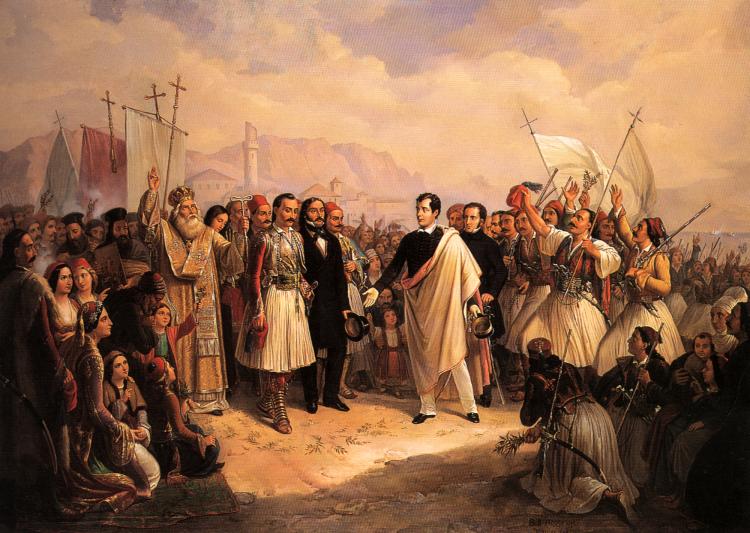
"Arrival of Lord Byron at Missolonghi", by Theodoros P. Vryzakis, 1861. National Gallery of Athens, Greece. The English Romantic poet sailed with his own fleet of ships as an aid agent of the London Committee in December of 1823, and stayed on to fight, eventually leading a Greek brigade. Four months after his arrival, he died of a fever at Missolonghi while preparing to launch an attack.

The isles of Greece! the isles of Greece!

Where burning Sappho loved and sung,

Where grew the arts of war and peace,--

Where Delos rose and Phoebus sprung!

Eternal summer gilds them yet,

But all, except their sun, is set.

--Lord Byron, "The Isles of Greece"

Lord Byron was either nearly two hundred years ahead of his time with that pronouncement, or else history is now by way of repeating itself, amplified. The struggle for Greek independence of Byron's day looks pale now in comparison to what lies ahead. Back then, it was only the Ottoman Empire the Greeks were up against. Today it's a vaster, more nebulous, and infinitely more bloodthirsty one, that of international capital.

Yeah, hi, it's me again. The pissed-off pedantic dissident of crapitalism has another axe to grind. And it's going to get swung over Greece--as far afield as Germany, France and even a whack or two at the good ol' Yankee military-industrial complex. You may want to grab yourself a big bottle of retsina, or ouzo, and a plate of Kalamata olives before you read on; this one's not for taking on an empty stomach. Plus, you may need something to throw when all this is over, although I doubt you'll be shouting "Opa!"

Y'okay. Let's begin.

Over at Ten Percent, blog-buddy Rick B has some good insights into the situation:

The quote 'inability of the Greek government to live within its means' is such a poisonous falsehood, as if financial institutions did not for years bribe key people into endless debt restructuring not because it helped them but because it made money for the banks. This is a merry game played by elites with the costs passed onto those not allowed to participate, yet the besuited oligarchs have the chutzpah to project their irresponsibility onto their victims. This is a rescue package within the rules of the game, better than what could have happened but ultimately it prolongs the scam. Neoliberalism, does not work, financialisation in place of actual productivity does not work (excuse the pun), capitalism unregulated and unconstrained does not work, Adam Smith was actually very clear on that despite what Randroids and laissez faire fundamentalists prefer to read into his works (by current standards he'd be labeled a socialist by corporate media). What we are seeing is a rolling breakdown of systems of human activity because we are serving the economy not making the economy serve us.

Right on, Rick, and you'll get no arguments from me. For the banksters to call the Greeks, along with the Irish, the Portuguese and the Spanish "PIGS", is gross projection from the overfed slop slurpers at the global trough. It's not the pampered people of those countries who are to blame; it's their lousy leaders, who opened the markets to foreign capital. Alas, it's the citizens who must reap what the politicians sowed, and of course, it's all tares; the banksters have already made off with the wheat. An economy where people serve capital, rather than the other way 'round, is one doomed to fail for all but those who have always had more than they could possibly have known what to do with anyway. A pity capitalism can't die of clogged arteries half as easily as its fat-assed proponents--being inanimate, it's infinitely capable of being resurrected by Victor Frankenstein and his electroshock machine!

I did promise to tell you what the role of the Germans in all this was, and I keep my word. So here's the ugly rotten maggoty meat of the matter, via Defense News:

France and Germany, while publicly urging Greece to make harsh public spending cuts, bullied its government to confirm billions of euros in arms deals, a leading Euro-MP alleged Friday.

Franco-German lawmaker Daniel Cohn-Bendit said that Paris and Berlin are seeking to force Prime Minister George Papandreou to spend Greece's scarce cash on submarines, a fleet of warships, helicopters and war planes.

[...]

"It's incredible the way the Merkels and Sarkozys of this world treat a Greek prime minister," he declared, adding that Papandreou had recently met Sarkozy and French Prime Minister Francois Fillon in Paris.

"Mr. Fillon and Mr. Sarkozy told Mr. Papandreou: 'We're going to raise the money to help you, but you are going to have to continue to pay the arms contracts that we have with you'," Cohn-Bendit said.

"In the past three months we have forced Greece to confirm several billion dollars in arms contracts. French frigates that the Greeks will have to buy for 2.5 billion euros. Helicopters, planes, German submarines."

Despite its economic woes, which recently deepened spectacularly when its credit rating was downgraded, Greece is one of Europe's biggest arms buyers, seeking to keep pace with its regional rival Turkey.

See why I'm angry? I'm a Bad German; "Deutschland, Deutschland Über Alles" is just the old Nazi version of the national anthem, as far as I'm concerned, and I have about as much use for that sentiment as I do for the Nazis. And since my mom's side of the family is from the Rheinland-Pfalz, right next to what's now Alsace-Lorraine, the tiny little soupçon of French blood I got from her means I'm also très fâchée about the whole steaming heap of merde coming from Sarko. This makes me hang my head about my ancestry, and doubt seriously of the goodness of humanity on the whole. Epic internationalist FAIL!

The only Greek I have is two years' worth of the ancient university stuff, just enough to foolishly convince me that I could almost translate Sappho if I wanted to, but like her poetry, it's very fragmentary. Greek history is what I'm now learning on the fly, also by snips and snaps. But it doesn't take a historian to see how stupid this whole arms race is. Greece is in the EU; last time I checked, Turkey was also, or well on its way to it. There is no logical (that's Greek) reason for an arms race between the two countries. And if it came down to it, Canada wouldn't be able to supply peacekeepers to get them off each other's throats, as it did in Cyprus. Our troops are too busy now making the world safe for pipelines capitalism "democracy" (another Greek word, and notice that I put it in quotes) in Afghanistan, don'cha know?

Meanwhile, Truthout has some good stuff on the Greek crisis and the growing resistance thereto. First, a little insight from a French analyst, Maurice Ulrich, of l'Humanité:

There are those who call for political unity in Europe right now, without which, they say, there will be no salvation. But to carry out which policies? What's come to the fore, today is the extreme noxiousness of a liberal Europe for its people. In the race for free and undistorted competition the poorest countries could only keep up with the richest by social dumping. The richest countries could only compete by playing on the same field. The message Europe is giving to Greece today - the same one it will give to Spain and Portugal tomorrow - is that the only way to keep in with a liberal Europe is to shatter salaries, pensions, and public services. But who really believes that tomorrow, or after tomorrow, our very own public services, pensions and salaries will be able resist?

[...]

What's happening in Greece isn't a fluke. Even as the media incriminate, and not without justification, the policies of Greek leaders, we must remember that they were aided and abetted by the very same players who now want to strip Greece of its hide and make a golden fleece. It's only the first of the crises that this capitalist Europe has in store for us. And it's precisely this Europe that we have to change. We want a Europe of cooperation, a different role for the European Central Bank (ECB), and we want the ECB to lend to Greece at 1% interest. It's what our petition calls for, a call that has been widely heard and one that must be amplified.

As Marx himself said: the free worker who goes to the free market to sell his hide 'has to expect to get it tanned.' The same is true for the people on liberal Europe's great competitive market. Yes. Now is the time to start resisting, to start working towards another kind of Europe. Now is the time to call up the people.

Then, sociologist Jean Ziegler, interviewed by the same French publication:

Caramanlis' right-wing government, which preceded the current PASOK (socialist) government, was a machine for systematically pillaging the country's resources. As in a banana republic, Greece's resources were privatized on a large scale even while tax evasion became massive. A reliable estimate by Swiss banks puts Greek tax-evading capitals in Swiss banks alone at 36 billion euro. In addition to this, some of the largest Greek ship-owners transferred their headquarters abroad: first among them, the biggest, namely Latsis, moved its own to Versoix near Geneva.

The scandalous end-result of all this is that the onus of paying heavily for the State's quasi-bankruptcy now falls on the Greek people, on Greek workers, while the ruling classes themselves have taken the precaution of transferring almost all their fortune abroad. The Greek public debt stands at 112% of the country's GDP.

[...]

With the European tax-payers' money (in the euro-area's fifteen countries and in Switzerland), draconian conditions are imposed on the Greek people. Under the guise of rescuing the country, the resources of whose State were pillaged by the previous, right-wing government, the rescuers make them suffer a considerable social backlash (a wage freeze, cuts in social benefits, in the number of public workers) and more privatizations - which has the advantage of bailing out the big European banks that were massively involved. This actually gives Europe and its financial institutions an opportunity to dismantle the Greek social welfare even though PASOK has been voted into office on a social justice platform.

[...]

The Europeans and the ECB could have lent funds to Greece at an exceptionally low rate to enable the country to meet its obligations in a short time. Instead, Greece was forced to choose between either borrowing at very high rates or accepting the EU and IMF's plan and the economic strings attached to it. Greece was reluctant to submit to the unacceptable conditions imposed by the EU and the IMF and had been hoping to get loans by itself on the international market. All it took to prevent this was for Standard and Poors, one of the private rating agencies, to lower its rating of the Greek State's solvency. And immediately Greece was barred access to the free capital market, or only at prohibitive rates of interest (almost 20%). Greece was left with no other choice but to submit to the conditions laid down in the EU and IMF's plan.

What gives me some heart in the midst of this massive Beschiss is the fact that the loudest internationalist voices against it are all, if their names are any indication, Franco-German (or Germano-French) leftists. People who are ethnically and ethically (woo! more Greek!) a lot like me, in other words.

And this leads me to the recent regional elections in Nordrhein-Westfalen (NRW). That's the most populous of the 16 German "lands" (states), and it also happens to be where my dad's side of the family hails from. The state recently dealt rightist Angela Merkel a huge bitch-slap by electing the centre-left Social Democratic Party (SPD) to the Bundesrat (upper house of the German parliament; the Bundestag is the lower). The Greens also doubled their percentage of the NRW vote over last time, and the socialist Left party is making its debut in the parliament thanks to this vote. All in all, it's a heavy blow to the CDU/CSU and the so-called "grand coalition", and it's gonna make it that much harder for Merkel to shove anything else filthy down Germany's collective throat.

So what motivated this heavy hitter among German lands to tack portside? The Greek crisis, and the fact that Angela Merkel decided to pillage German social services in order to make that hyper-conditional "bailout", i.e., to force the Greeks to buy all that aforementioned military hardware. Germans like their social services as much as we Canadians, go figure--and they are not at all impressed by international crapital taking a pound of flesh from those who are already skin and bones.

Of course, the major Anglo-Amurrican media (especially the bizmedia morons) deliberately choose to misinterpret the situation as merely a matter of Merkel being a weak sister, missing the overbearing crapitalist tyrant angle entirely (or worse, praising it.) All of them have one thing in common: they blame the Greeks, leaving out entirely the military-industrial angle. And no wonder: if they had to point the finger at the correct culprit, three more accusing fingers would be pointing right back at them in England and the US.

Who do you think started this damn snowball rolling, anyway? France? Germany? Gimme a break. As strong as the German economy has long been, historically, it's been sucked dry by two far bigger leeches than the so-called PIGS. The exsanguination of the German economy is the dirty little secret of London and New York during the Roaring Twenties. Bankers and stockbrokers, not Jews, were the real collective enemy of the Weimar Republic. They were, as Ike Eisenhower found out to his chagrin, also backing the collective enemy of the United States, relying on an endless weapons shopping spree to keep the economy rolling their way. But since it's hard to identify them just by looking, and they're well enough off to laugh at anyone who tries to make them wear a badge of shame, they'll never be rounded up and sent off to get a taste of their own medicine...

arbeit-macht-frei.jpg

...more's the pity. Because if true justice prevailed, they'd be the ones forced to eternally work off the debt they created, for slaves' wages. Or to put it more poetically, they'd be made to roll that stone endlessly up a hill, like Sisyphus in Hades, never reaching the top.

Meanwhile, Lord Byron is stirring in his grave. And the Greek Resistance is rising, phoenix-like, from its own pyre...I dare to hope. But unless we all join in, it will be as futile as the one Lord Byron tried so bravely to lead.

We are all Greeks now, or soon will be.

'Tis something, in the dearth of fame,

Though link'd among a fetter'd race,

To feel at least a patriot's shame,

Even as I sing, suffuse my face;

For what is left the poet here?

For Greeks a blush---for Greece a tear.

Tuesday, April 21, 2009

The Declaration of Cumaná

The Declaration of Cumaná

Apr 21 2009
ALBA

Cumaná, Venezuela

We, the Heads of State and Government of Bolivia, Cuba, Dominica, Honduras, Nicaragua and Venezuela, member countries of ALBA, consider that the Draft Declaration of the 5th Summit of the Americas is insufficient and unacceptable for the following reasons:

- The Declaration does not provide answers to the Global Economic Crisis, even though this crisis constitutes the greatest challenge faced by humanity in the last decades and is the most serious threat of the current times to the welfare of our peoples.

- The Declaration unfairly excludes Cuba, without mentioning the consensus in the region condemning the blockade and isolation to which the people and the government of Cuba have incessantly been exposed in a criminal manner.

For this reason, we, the member countries of ALBA believe that there is no consensus for the adoption of this draft declaration because of the reasons above stated, and accordingly, we propose to hold a thorough debate on the following topics:

1. Capitalism is leading humanity and the planet to extinction. What we are experiencing is a global economic crisis of a systemic and structural nature, not another cyclic crisis. Those who think that with a taxpayer money injection and some regulatory measures this crisis will end are wrong. The financial system is in crisis because it trades bonds with six times the real value of the assets and services produced and rendered in the world, this is not a “system regulation failure”, but a integrating part of the capitalist system that speculates with all assets and values with a view to obtain the maximum profit possible. Until now, the economic crisis has generated over 100 million additional hungry persons and has slashed over 50 million jobs, and these figures show an upward trend.

2. Capitalism has caused the environmental crisis, by submitting the necessary conditions for life in the planet, to the predominance of market and profit. Each year we consume one third more of what the planet is able to regenerate. With this squandering binge of the capitalist system, we are going to need two planets Earth by the year 2030.

3. The global economic crisis, climate change, the food crisis and the energy crisis are the result of the decay of capitalism, which threatens to end life and the planet. To avert this outcome, it is necessary to develop and model an alternative to the capitalist system. A system based on:

- solidarity and complementarity, not competition;
- a system in harmony with our mother earth and not plundering of human resources;
- a system of cultural diversity and not cultural destruction and imposition of cultural values and lifestyles alien to the realities of our countries;
- a system of peace based on social justice and not on imperialist policies and wars;
- in summary, a system that recovers the human condition of our societies and peoples and does not reduce them to mere consumers or merchandise.

4. As a concrete expression of the new reality of the continent, we, Caribbean and Latin American countries, have commenced to build our own institutionalization, an institutionalization that is based on a common history dating back to our independence revolution and constitutes a concrete tool for deepening the social, economic and cultural transformation processes that will consolidate our full sovereignty. ALBA-TCP, Petrocaribe or UNASUR, mentioning merely the most recently created, are solidarity-based mechanisms of unity created in the midst of such transformations with the obvious intention of boosting the efforts of our peoples to attain their own freedom. To face the serious effects of the global economic crisis, we, the ALBA-TCP countries, have adopted innovative and transforming measures that seek real alternatives to the inadequate international economic order, not to boost their failed institutions. Thus, we have implemented a Regional Clearance Unitary System, the SUCRE, which includes a Common Unit of Account, a Clearance Chamber and a Single Reserve System. Similarly, we have encouraged the constitution of grand-national companies to satisfy the essential needs of our peoples and establish fair and complementary trade mechanisms that leave behind the absurd logic of unbridled competition.

5. We question the G20 for having tripled the resources of the International Monetary Fund when the real need is to establish a new world economic order that includes the full transformation of the IMF, the World Bank and the WTO, entities that have contributed to this global economic crisis with their neoliberal policies.

6. The solutions to the global economic crisis and the definition of a new international financial scheme should be adopted with the participation of the 192 countries that will meet in the United Nations Conference on the International Financial Crisis to be held on June 1-3 to propose the creation of a new international economic order.

7. As for climate change, developed countries are in an environmental debt to the world because they are responsible for 70% of historical carbon emissions into the atmosphere since 1750. Developed countries should pay off their debt to humankind and the planet; they should provide significant resources to a fund so that developing countries can embark upon a growth model which does not repeat the serious impacts of the capitalist industrialization.

8. Solutions to the energy, food and climate change crises should be comprehensive and interdependent. We cannot solve a problem by creating new ones in fundamental areas for life. For instance, the widespread use of agricultural fuels has an adverse effect on food prices and the use of essential resources, such as water, land and forests.

9. We condemn the discrimination against migrants in any of its forms. Migration is a human right, not a crime. Therefore, we request the United States government an urgent reform of its migration policies in order to stop deportations and massive raids and allow for reunion of families. We further demand the removal of the wall that separates and divides us, instead of uniting us. In this regard, we petition for the abrogation of the Law of Cuban Adjustment and removal of the discriminatory, selective Dry Feet, Wet Feet policy that has claimed human losses. Bankers who stole the money and resources from our countries are the true responsible, not migrant workers. Human rights should come first, particularly human rights of the underprivileged, downtrodden sectors in our society, that is, migrants without identity papers. Free movement of people and human rights for everybody, regardless of their migration status, are a must for integration. Brain drain is a way of plundering skilled human resources exercised by rich countries.

10. Basic education, health, water, energy and telecommunications services should be declared human rights and cannot be subject to private deal or marketed by the World Trade Organization. These services are and should be essentially public utilities of universal access.

11. We wish a world where all, big and small, countries have the same rights and where there is no empire. We advocate non-intervention. There is the need to strengthen, as the only legitimate means for discussion and assessment of bilateral and multilateral agendas in the hemisphere, the foundations for mutual respect between states and governments, based on the principle of non-interference of a state in the internal affairs of another state, and inviolability of sovereignty and self-determination of the peoples. We request the new Government of the United States, the arrival of which has given rise to some expectations in the hemisphere and the world, to finish the longstanding and dire tradition of interventionism and aggression that has characterized the actions of the US governments throughout history, and particularly intensified during the Administration of President George W. Bush. By the same token, we request the new Government of the United States to abandon interventionist practices, such as cover-up operations, parallel diplomacy, media wars aimed at disturbing states and governments, and funding of destabilizing groups. Building on a world where varied economic, political, social and cultural approaches are acknowledged and respected is of the essence.

12. With regard to the US blockade against Cuba and the exclusion of the latter from the Summit of the Americas, we, the member states of the Bolivarian Alternative for the Peoples of Our America, reassert the Declaration adopted by all Latin American and Caribbean countries last December 16, 2008, on the need to end the economic, trade and financial blockade imposed by the Government of the United States of America on Cuba, including the implementation of the so-called Helms-Burton Act. The declaration sets forth in its fundamental paragraphs the following:

“CONSIDERING the resolutions approved by the United Nations General Assembly on the need to finish the economic, trade and financial blockade imposed by the United States on Cuba, and the statements on such blockade, which have been approved in numerous international meetings.

“WE AFFIRM that the application of unilateral, coercive measures affecting the wellbeing of peoples and hindering integration processes is unacceptable when defending free exchange and the transparent practice of international trade.

“WE STRONGLY REPEL the enforcement of laws and measures contrary to International Law, such as the Helms-Burton Act, and we urge the Government of the United States of America to finish such enforcement.

“WE REQUEST the Government of the United States of America to comply with the provisions set forth in 17 successive resolutions approved by the United Nations General Assembly and put an end to the economic, trade and financial blockade on Cuba.”

Additionally, we consider that the attempts at imposing the isolation of Cuba have failed, as nowadays Cuba forms an integral part of the Latin American and Caribbean region; it is a member of the Rio Group and other hemispheric organizations and mechanisms, which develops a policy of cooperation, in solidarity with the countries in the hemisphere; which promotes full integration of Latin American and Caribbean peoples. Therefore, there is no reason whatsoever to justify its exclusion from the mechanism of the Summit of the Americas.

13. Developed countries have spent at least USD 8 billion to rescue a collapsing financial structure. They are the same that fail to allocate the small sums of money to attain the Millennium Goals or 0.7% of the GDP for the Official Development Assistance. Never before the hypocrisy of the wording of rich countries had been so apparent. Cooperation should be established without conditions and fit in the agendas of recipient countries by making arrangements easier; providing access to the resources, and prioritizing social inclusion issues.

14. The legitimate struggle against drug trafficking and organized crime, and any other form of the so-called “new threats” must not be used as an excuse to undertake actions of interference and intervention against our countries.

15. We are firmly convinced that the change, where everybody repose hope, can come only from organization, mobilization and unity of our peoples.

As the Liberator wisely said:

Unity of our peoples is not a mere illusion of men, but an inexorable decree of destiny. — Simón Bolívar