
Gen. Petraeus: Too Big to JailBy Ray McGovern
March 06, 2015 "ICH" - "Consortium News" - The leniency shown former CIA Director (and retired General) David Petraeus by the Justice Department in sparing him prison time for the serious crimes that he has committed puts him in the same preferential, immune-from-incarceration category as those running the financial institutions of Wall Street, where, incidentally, Petraeus now makes millions. By contrast, “lesser” folks – and particularly the brave men and women who disclose government crimes – get to serve time, even decades, in jail.
Petraeus is now a partner at KKR, a firm specializing in large leveraged buyouts, and his hand-slap guilty plea to a misdemeanor for mishandling government secrets should not interfere with his continued service at the firm. KKR’s founders originally worked at Bear Stearns, the institution that failed in early 2008 at the beginning of the meltdown of the investment banking industry later that year.
Gen. David Petraeus in a photo with his biographer/mistress Paula Broadwell. (U.S. government photo)
Despite manifestly corrupt practices like those of subprime mortgage lenders, none of those responsible went to jail after the 2008-09 financial collapse which cost millions of Americans their jobs and homes. The bailed-out banks were judged “too big to fail” and the bankers “too big to jail.”
Two years ago, in a highly revealing slip of the tongue, Attorney General Eric Holder explained to Congress that it can “become difficult” to prosecute major financial institutions because they are so large that a criminal charge could pose a threat to the economy – or perhaps what he meant was an even bigger threat to the economy.
Holder tried to walk back his unintended slip into honesty a year later, claiming, “There is no such thing as ‘too big to jail.’” And this bromide was dutifully echoed by Holder’s likely successor, Loretta Lynch, at her confirmation hearing in late January.
Words, though, are cheap. The proof is in the pudding. It remains true that not one of the crooked bankers or investment advisers who inflicted untold misery on ordinary people, gambling away much of their life savings, has been jailed. Not one.
And now Petraeus, who gave his biographer/mistress access to some of the nation’s most sensitive secrets and then lied about it to the FBI, has also been shown to be too big to jail. Perhaps Holder decided it would be a gentlemanly thing to do on his way out of office – to take this awkward issue off Lynch’s initial to-do list and spare her the embarrassment of demonstrating once again that equality under the law has become a mirage; that not only big banks, but also big shots like Petraeus – who was Official Washington’s most beloved general before becoming CIA director – are, in fact, too big to jail.
It strikes me, in a way, as fitting that even on his way out the door, Eric Holder would not miss the opportunity to demonstrate his propensity for giving hypocrisy a bad name.
A Slap on Wrist for Serious Crimes
The Justice Department let David Petraeus cop a plea after requiring him to admit that he had shared with his biographer/mistress eight black notebooks containing highly classified information and then lied about it to FBI investigators. Serious crimes? The following quotes are excerpted from “U.S. v. David Howell Petraeus: Factual Basis in support of the Plea Agreement” offered by the U.S. District Court for the Western District of North Carolina, Charlotte Division:
“17. During his tenure as Commander of ISAF in Afghanistan, defendant DAVID HOWELL PETRAEUS maintained bound, five-by-eight-inch notebooks that contained his daily schedule and classified and unclassified notes he took during official meetings, conferences, and briefings. … A total of eight such books (hereinafter the “Black Books”) encompassed the period of defendant DAVID HOWELL PETRAEUS’S ISAF [Afghanistan] command and collectively contained classified information regarding the identities of covert officers, war strategy, intelligence capabilities and mechanisms, diplomatic discussions, quotes and deliberative discussions from high-level National Security Council meetings, and defendant DAVID HOWELL PETRAEUS’s discussions with the President of the United States of America. [emphasis added]
“18. The Black Books contained national defense information, including Top Secret//SCI and code word information.”
Despite the sensitivity of the notebooks and existing law and regulations, Petraeus did not surrender them to proper custody when he returned to the U.S. after being nominated to become the Director of the CIA. According to the Court’s “Factual Basis,” Petraeus’s biographer/mistress recorded a conversation of Aug. 4, 2011, in which she asks about the “Black Books.” The Court statement continues:
“ [Petraeus] ‘Umm, well, they’re really – I mean they are highly classified, some of them. … I mean there’s code word stuff in there.’ … On or about August 27, 2011, defendant DAVID HOWELL PETRAEUS sent an email to his biographer in which he agreed to provide the Black Books to his biographer. … On or about August 28, 2011, defendant DAVID HOWEL PETRAEUS delivered the Black Books to a private residence in Washington, D.C. where his biographer was staying. … On or about September 1, 2011, defendant DAVID HOWELL PETRAEUS retrieved the Black Books from the D.C. private residence and returned them to his own Arlington, Virginia home.” [emphasis added]
I would think it a safe guess that Petraeus’s timing can be attributed to his awareness that his privacy and freedom of movement was about to be greatly diminished, once his CIA personal security detail started keeping close track of him from his first day on the job as CIA Director, Sept. 6, 2011.
“32. On or about October 26, 2012, defendant DAVID HOWELL PETRAEUS was interviewed by two FBI special agents. … [He] was advised that the special agents were conducting a criminal investigation. … PETRAEUS stated that (a) he had never provided any classified information to his biographer, and (b) he had never facilitated the provision of classified information to his biographer. These statements were false. Defendant DAVID HOWELL PETRAEUS then and there knew that he previously shared the Black Books with his biographer.” [emphasis added]
Lying to the FBI? No problem. As “Expose Facts” blogger Marcy Wheeler immediately commented: “For lying to the FBI – a crime that others go to prison for for months and years – Petraeus will just get a two point enhancement on his sentencing guidelines. The Department of Justice basically completely wiped out the crime of covering up his crime of leaking some of the country’s most sensitive secrets to his mistress.”[emphasis added]
Talk about “prosecutorial discretion” or, in this case, indiscretion – giving Petraeus a fine and probation but no felony conviction or prison time for what he did! Lesser lights are not so fortunate. Just ask Chelsea (formerly Bradley) Manning who is serving a 35-year prison sentence for disclosing information to the public about U.S. war crimes and other abuses. Or Edward Snowden, who is stuck in Russia facing a U.S. indictment on espionage charges for informing the people about pervasive and unconstitutional U.S. government surveillance of common citizens.
Or former CIA officer John Kiriakou who was sent to prison for inadvertently revealing the name of one Agency official cognizant of CIA torture. Here’s what Neil MacBride, U.S. Attorney for the Eastern District of Virginia, said then: “The government has a vital interest in protecting the identities of those involved in covert operations. Leaks of highly sensitive, closely held and classified information compromise national security and can put individual lives in danger.”
When, on Oct. 23, 2012, Kiriakou acquiesced to a plea deal requiring two-and-a-half years in federal prison, then CIA Director Petraeus sent a sanctimonious Memorandum to Agency employees applauding Kiriakou’s conviction and noting, “It marks an important victory for our agency … there are indeed consequences for those who believe they are above the laws that protect our fellow officers and enable American intelligence agencies to operate with the requisite degree of secrecy.” [emphasis added]
Consequences for Kiriakou but not, as we now know, for Petraeus.
If you feel no discomfort at this selective application of the law, you might wish to scroll or page back to the “Factual Basis” for Petraeus’s Plea Agreement and be reminded that it was just three days after his lecture to CIA employees about the sanctity of protecting the identity of covert agents that Petraeus lied to FBI investigators – on Oct. 26, 2012 – about his sharing such details with his mistress.
Why Did Petraeus Do It?
Old soldiers like Petraeus (indeed, most aging but still ambitious men) have been known to end up doing self-destructive things by letting themselves be flattered by the attentions of younger women. This may offer a partial explanation – human weakness even in a self-styled larger-than-life super-Mensch. But I see the motivation as mostly vainglory. (The two are not mutually exclusive, of course.)
Looking back at Petraeus’s record of overweening ambition, it seems likely he was motivated first and foremost by a desire to ensure that his biographer would be able to extract from the notebooks some juicy morsels he may not have remembered to tell her about. This might enhance his profile as Warrior-Scholar-“King David,” the image that he has assiduously cultivated and promoted, with the help of an adulating neocon-dominated media.
Petraeus’s presidential ambitions have been an open secret. And with his copping a plea to a misdemeanor, his “rehabilitation” seems to have already begun. He has told friends that he would like to serve again in government and they immediately relayed that bright hope to the media.
Sen. John McCain was quick to call the whole matter “closed.” A strong supporter of Petraeus, McCain added this fulsome praise: “At a time of grave security challenges around the world, I hope that General Petraeus will continue to provide his outstanding service and leadership to our nation, as he has throughout his distinguished career.”
And Michael O’Hanlon, Brookings’ neocon military specialist who rarely gets anything right, spoke true to form to the New York Times: “The broader nation needs his advice, and I think it’s been evident that people still want to hear from him. … People are forgiving and I know he made a mistake. But he’s also a national hero and a national treasure.”
The “mainstream media” is trapped in its undeserved adulation for Petraeus’s “heroism.” It is virtually impossible, for example, for them to acknowledge that his ballyhooed, official-handout-based “success” in training and equipping tens of thousands of crack Iraqi troops was given the lie when those same troops ran away (the officers took helicopters) and left their weapons behind at the first sight of ISIL fighters a year ago.
Equally sham were media claims of the “success” for the “surges” of 30,000 troops sent into Iraq (2007) and 33,000 into Afghanistan (2009). Each “surge” squandered the lives of about 1,000 U.S. troops for nothing – yes, nothing – except in the case of Iraq buying time for President George W. Bush and Vice President Dick Cheney to get out of town without a clear-cut defeat hanging around their necks.
Many of the supposed successes of Petraeus’s Iraqi “surge” also predated the “surge,” including a high-tech program for killing top militants such as Al-Qaeda-in-Iraq leader Abu Musab al-Zarqawi and the formation of the so-called Sunni Awakening, both occurring in 2006 under the previous field commanders. And, Bush’s principal goal of the “surge” – to create political space for a fuller Sunni-Shiite reconciliation – was never accomplished. [See Consortiumnews.com’s “The Surge Myth’s Deadly Result.”]
And last, it is important to note that David Petraeus does not have a corner on the above-the-law attitudes and behavior of previous directors of the CIA. The kid-gloves treatment he has been accorded, however, will increase chances that future directors will feel they can misbehave seriously and suffer no serious personal consequence.
The virtual immunity enjoyed by the well connected – even when they lie to the FBI or tell whoppers in sworn testimony to Congress (as Director of National Intelligence James Clapper has done) – feeds the propensity to prioritize one’s own personal ambition and to delegate a back seat to legitimate national security concerns – even basic things like giving required protection to properly classified information, including the identity of covert officers.
One might call this all-too-common syndrome Self-Aggrandizing Dismissiveness (SAD). Sadly, Petraeus is merely the latest exemplar of the SAD syndrome. The unbridled ambitions of some of his predecessors at CIA – the arrogant John Deutch, for example – have been equally noxious and destructive. But we’ll leave that for the next chapter.
Full Disclosure: Petraeus has not yet answered McGovern’s letter of Feb. 3 regarding why McGovern was barred from a public speaking event by Petraeus in New York City on Oct. 30, 2014, and then was roughly arrested by police and jailed for the night. McGovern wonders if Petraeus failed to respond because he was pre-occupied working out his Plea Agreement.
Ray McGovern worked for a total of 27 years in all four of CIA’s main directorates. He served under seven Presidents and nine CIA Directors, and is co-founder of Veteran Intelligence Professionals for Sanity (VIPS). He now works for Tell the Word, a publishing arm of the ecumenical Church of the Saviour in inner-city Washington.
March 06, 2015 "ICH" - "Consortium News" - The leniency shown former CIA Director (and retired General) David Petraeus by the Justice Department in sparing him prison time for the serious crimes that he has committed puts him in the same preferential, immune-from-incarceration category as those running the financial institutions of Wall Street, where, incidentally, Petraeus now makes millions. By contrast, “lesser” folks – and particularly the brave men and women who disclose government crimes – get to serve time, even decades, in jail.
Petraeus is now a partner at KKR, a firm specializing in large leveraged buyouts, and his hand-slap guilty plea to a misdemeanor for mishandling government secrets should not interfere with his continued service at the firm. KKR’s founders originally worked at Bear Stearns, the institution that failed in early 2008 at the beginning of the meltdown of the investment banking industry later that year.
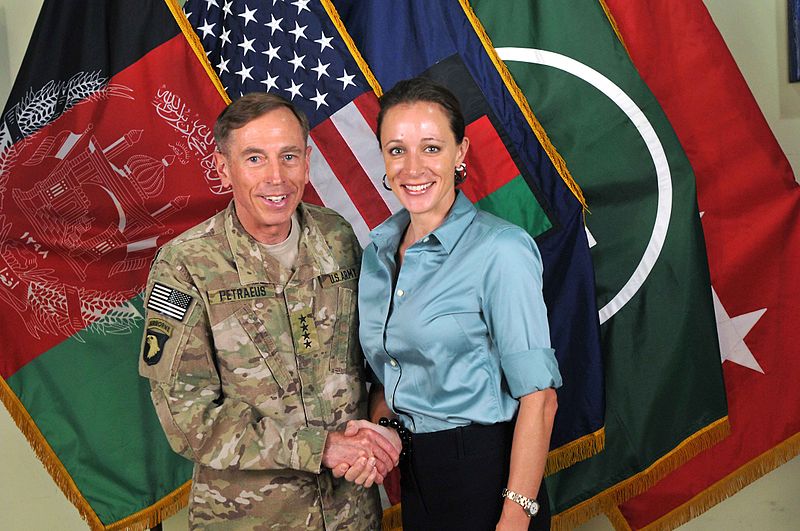
Gen. David Petraeus in a photo with his biographer/mistress Paula Broadwell. (U.S. government photo)
Despite manifestly corrupt practices like those of subprime mortgage lenders, none of those responsible went to jail after the 2008-09 financial collapse which cost millions of Americans their jobs and homes. The bailed-out banks were judged “too big to fail” and the bankers “too big to jail.”
Two years ago, in a highly revealing slip of the tongue, Attorney General Eric Holder explained to Congress that it can “become difficult” to prosecute major financial institutions because they are so large that a criminal charge could pose a threat to the economy – or perhaps what he meant was an even bigger threat to the economy.
Holder tried to walk back his unintended slip into honesty a year later, claiming, “There is no such thing as ‘too big to jail.’” And this bromide was dutifully echoed by Holder’s likely successor, Loretta Lynch, at her confirmation hearing in late January.
Words, though, are cheap. The proof is in the pudding. It remains true that not one of the crooked bankers or investment advisers who inflicted untold misery on ordinary people, gambling away much of their life savings, has been jailed. Not one.
And now Petraeus, who gave his biographer/mistress access to some of the nation’s most sensitive secrets and then lied about it to the FBI, has also been shown to be too big to jail. Perhaps Holder decided it would be a gentlemanly thing to do on his way out of office – to take this awkward issue off Lynch’s initial to-do list and spare her the embarrassment of demonstrating once again that equality under the law has become a mirage; that not only big banks, but also big shots like Petraeus – who was Official Washington’s most beloved general before becoming CIA director – are, in fact, too big to jail.
It strikes me, in a way, as fitting that even on his way out the door, Eric Holder would not miss the opportunity to demonstrate his propensity for giving hypocrisy a bad name.
A Slap on Wrist for Serious Crimes
The Justice Department let David Petraeus cop a plea after requiring him to admit that he had shared with his biographer/mistress eight black notebooks containing highly classified information and then lied about it to FBI investigators. Serious crimes? The following quotes are excerpted from “U.S. v. David Howell Petraeus: Factual Basis in support of the Plea Agreement” offered by the U.S. District Court for the Western District of North Carolina, Charlotte Division:
“17. During his tenure as Commander of ISAF in Afghanistan, defendant DAVID HOWELL PETRAEUS maintained bound, five-by-eight-inch notebooks that contained his daily schedule and classified and unclassified notes he took during official meetings, conferences, and briefings. … A total of eight such books (hereinafter the “Black Books”) encompassed the period of defendant DAVID HOWELL PETRAEUS’S ISAF [Afghanistan] command and collectively contained classified information regarding the identities of covert officers, war strategy, intelligence capabilities and mechanisms, diplomatic discussions, quotes and deliberative discussions from high-level National Security Council meetings, and defendant DAVID HOWELL PETRAEUS’s discussions with the President of the United States of America. [emphasis added]
“18. The Black Books contained national defense information, including Top Secret//SCI and code word information.”
Despite the sensitivity of the notebooks and existing law and regulations, Petraeus did not surrender them to proper custody when he returned to the U.S. after being nominated to become the Director of the CIA. According to the Court’s “Factual Basis,” Petraeus’s biographer/mistress recorded a conversation of Aug. 4, 2011, in which she asks about the “Black Books.” The Court statement continues:
“ [Petraeus] ‘Umm, well, they’re really – I mean they are highly classified, some of them. … I mean there’s code word stuff in there.’ … On or about August 27, 2011, defendant DAVID HOWELL PETRAEUS sent an email to his biographer in which he agreed to provide the Black Books to his biographer. … On or about August 28, 2011, defendant DAVID HOWEL PETRAEUS delivered the Black Books to a private residence in Washington, D.C. where his biographer was staying. … On or about September 1, 2011, defendant DAVID HOWELL PETRAEUS retrieved the Black Books from the D.C. private residence and returned them to his own Arlington, Virginia home.” [emphasis added]
I would think it a safe guess that Petraeus’s timing can be attributed to his awareness that his privacy and freedom of movement was about to be greatly diminished, once his CIA personal security detail started keeping close track of him from his first day on the job as CIA Director, Sept. 6, 2011.
“32. On or about October 26, 2012, defendant DAVID HOWELL PETRAEUS was interviewed by two FBI special agents. … [He] was advised that the special agents were conducting a criminal investigation. … PETRAEUS stated that (a) he had never provided any classified information to his biographer, and (b) he had never facilitated the provision of classified information to his biographer. These statements were false. Defendant DAVID HOWELL PETRAEUS then and there knew that he previously shared the Black Books with his biographer.” [emphasis added]
Lying to the FBI? No problem. As “Expose Facts” blogger Marcy Wheeler immediately commented: “For lying to the FBI – a crime that others go to prison for for months and years – Petraeus will just get a two point enhancement on his sentencing guidelines. The Department of Justice basically completely wiped out the crime of covering up his crime of leaking some of the country’s most sensitive secrets to his mistress.”[emphasis added]
Talk about “prosecutorial discretion” or, in this case, indiscretion – giving Petraeus a fine and probation but no felony conviction or prison time for what he did! Lesser lights are not so fortunate. Just ask Chelsea (formerly Bradley) Manning who is serving a 35-year prison sentence for disclosing information to the public about U.S. war crimes and other abuses. Or Edward Snowden, who is stuck in Russia facing a U.S. indictment on espionage charges for informing the people about pervasive and unconstitutional U.S. government surveillance of common citizens.
Or former CIA officer John Kiriakou who was sent to prison for inadvertently revealing the name of one Agency official cognizant of CIA torture. Here’s what Neil MacBride, U.S. Attorney for the Eastern District of Virginia, said then: “The government has a vital interest in protecting the identities of those involved in covert operations. Leaks of highly sensitive, closely held and classified information compromise national security and can put individual lives in danger.”
When, on Oct. 23, 2012, Kiriakou acquiesced to a plea deal requiring two-and-a-half years in federal prison, then CIA Director Petraeus sent a sanctimonious Memorandum to Agency employees applauding Kiriakou’s conviction and noting, “It marks an important victory for our agency … there are indeed consequences for those who believe they are above the laws that protect our fellow officers and enable American intelligence agencies to operate with the requisite degree of secrecy.” [emphasis added]
Consequences for Kiriakou but not, as we now know, for Petraeus.
If you feel no discomfort at this selective application of the law, you might wish to scroll or page back to the “Factual Basis” for Petraeus’s Plea Agreement and be reminded that it was just three days after his lecture to CIA employees about the sanctity of protecting the identity of covert agents that Petraeus lied to FBI investigators – on Oct. 26, 2012 – about his sharing such details with his mistress.
Why Did Petraeus Do It?
Old soldiers like Petraeus (indeed, most aging but still ambitious men) have been known to end up doing self-destructive things by letting themselves be flattered by the attentions of younger women. This may offer a partial explanation – human weakness even in a self-styled larger-than-life super-Mensch. But I see the motivation as mostly vainglory. (The two are not mutually exclusive, of course.)
Looking back at Petraeus’s record of overweening ambition, it seems likely he was motivated first and foremost by a desire to ensure that his biographer would be able to extract from the notebooks some juicy morsels he may not have remembered to tell her about. This might enhance his profile as Warrior-Scholar-“King David,” the image that he has assiduously cultivated and promoted, with the help of an adulating neocon-dominated media.
Petraeus’s presidential ambitions have been an open secret. And with his copping a plea to a misdemeanor, his “rehabilitation” seems to have already begun. He has told friends that he would like to serve again in government and they immediately relayed that bright hope to the media.
Sen. John McCain was quick to call the whole matter “closed.” A strong supporter of Petraeus, McCain added this fulsome praise: “At a time of grave security challenges around the world, I hope that General Petraeus will continue to provide his outstanding service and leadership to our nation, as he has throughout his distinguished career.”
And Michael O’Hanlon, Brookings’ neocon military specialist who rarely gets anything right, spoke true to form to the New York Times: “The broader nation needs his advice, and I think it’s been evident that people still want to hear from him. … People are forgiving and I know he made a mistake. But he’s also a national hero and a national treasure.”
The “mainstream media” is trapped in its undeserved adulation for Petraeus’s “heroism.” It is virtually impossible, for example, for them to acknowledge that his ballyhooed, official-handout-based “success” in training and equipping tens of thousands of crack Iraqi troops was given the lie when those same troops ran away (the officers took helicopters) and left their weapons behind at the first sight of ISIL fighters a year ago.
Equally sham were media claims of the “success” for the “surges” of 30,000 troops sent into Iraq (2007) and 33,000 into Afghanistan (2009). Each “surge” squandered the lives of about 1,000 U.S. troops for nothing – yes, nothing – except in the case of Iraq buying time for President George W. Bush and Vice President Dick Cheney to get out of town without a clear-cut defeat hanging around their necks.
Many of the supposed successes of Petraeus’s Iraqi “surge” also predated the “surge,” including a high-tech program for killing top militants such as Al-Qaeda-in-Iraq leader Abu Musab al-Zarqawi and the formation of the so-called Sunni Awakening, both occurring in 2006 under the previous field commanders. And, Bush’s principal goal of the “surge” – to create political space for a fuller Sunni-Shiite reconciliation – was never accomplished. [See Consortiumnews.com’s “The Surge Myth’s Deadly Result.”]
And last, it is important to note that David Petraeus does not have a corner on the above-the-law attitudes and behavior of previous directors of the CIA. The kid-gloves treatment he has been accorded, however, will increase chances that future directors will feel they can misbehave seriously and suffer no serious personal consequence.
The virtual immunity enjoyed by the well connected – even when they lie to the FBI or tell whoppers in sworn testimony to Congress (as Director of National Intelligence James Clapper has done) – feeds the propensity to prioritize one’s own personal ambition and to delegate a back seat to legitimate national security concerns – even basic things like giving required protection to properly classified information, including the identity of covert officers.
One might call this all-too-common syndrome Self-Aggrandizing Dismissiveness (SAD). Sadly, Petraeus is merely the latest exemplar of the SAD syndrome. The unbridled ambitions of some of his predecessors at CIA – the arrogant John Deutch, for example – have been equally noxious and destructive. But we’ll leave that for the next chapter.
Full Disclosure: Petraeus has not yet answered McGovern’s letter of Feb. 3 regarding why McGovern was barred from a public speaking event by Petraeus in New York City on Oct. 30, 2014, and then was roughly arrested by police and jailed for the night. McGovern wonders if Petraeus failed to respond because he was pre-occupied working out his Plea Agreement.
Ray McGovern worked for a total of 27 years in all four of CIA’s main directorates. He served under seven Presidents and nine CIA Directors, and is co-founder of Veteran Intelligence Professionals for Sanity (VIPS). He now works for Tell the Word, a publishing arm of the ecumenical Church of the Saviour in inner-city Washington.
