Showing posts with label Yemen. Show all posts

Saturday, December 02, 2017

Yemen - Saudis Throw The Towel - Saleh is Baaack - Russia Wins by Moon of Al


Yemen - Saudis Throw The Towel - Saleh is Baaack - Russia Wins

The war on Yemen has finally taken a turn towards an end. Former President Saleh is back in his leading position. They Saudis accepted their defeat. The Houthis will be thrown out of the capital Sanaa and return to their northern areas. Yemen is devastated and will need to rebuild. Everyone who participated in this war has lost. The only winner is Russia.
A recap:
During the "Arab spring" (U.S.) induced Yemeni revolution President Saleh was kicked out after ruling the country for 34 years. In 2012 the former Vice-President Hadi was "elected" as the new president on a one choice ballot. With U.S. support the system prevailed.

bigger
As I noted at that time:
The U.S. missed the chance to use the movement against Saleh for some real transition in Yemen. This will come back to bite.
Hadi was a Saudi puppet unable to rule the country. He tried to form a unity government under the National Dialogue Conference sponsored by the Gulf Cooperation Council. But two major constituencies were left out of the effort: the northern Yemeni Houthis of Zaidi belief, who for years had fought against Saudi-Wahhabi indoctrination in Yemen, and the followers of the ousted President Ali Abdullah Saleh. The Houthis and Saleh had fought each other for over a decade. Now they had a common enemy and united their efforts.
In 2015 the Houthi and Yemeni army troops loyal to Saleh took over the capital Sanaa. Hadi resigned (twice), fled to Aden in the south and later onto Riyadh in Saudi Arabia. The Saudis were afraid to lose influence over their dirt poor but self-confident neighbor. They falsely alleged that the Houthis were supported by their perceived arch-enemy Iran. They declared war on the country and tried to invade it. The U.S. and the UK supported and still support the Saudi war with intelligence, refueling flights for Saudi bombers and massive weapon supplies.
The Saudis sent their troops to invade the country, their neighboring United Arab Emirates sent its forces and additional mercenaries were hired from Sudan, south America and where ever they could be found. All to no avail. While the Saudis dropped more than 100 bombs per day onto Yemen their forces were defeated every time they tried to enter the mountainous heartland. The Houthi counterattacked within Saudi Arabia. They had no shoes but huge balls. Hundreds of Saudi border posts and military checkpoints were destroyed by them.
The Saudis tried to starve the Houthis of weapons, food and other supplies. They blockaded the country and bombed weapon depots, factories and all infrastructure. They completely destroyed Houthi cities in the north and tried to assassinate the leaders of the rebellion. Tens of thousands of Yemenis died in the often indiscriminate attacks. But the Houthi held out. For decades Yemen had been filled up with weapons. During his decades long rule former president Saleh had stashed ten-thousands of tons of ammunition and equipment. Additional supplies were captured or bought from the Saudi mercenaries.
The former Yemeni army units loyal to Saleh, as well as Saleh himself, stayed in the background. Their most visible contribution to the war was the launch of short range ballistic missiles (SRBM) against Saudi cities and military positions. These weapons had been bought earlier and were modified to have extended reach (see the excursion below).
The Saudi were stuck in a stalemate that cost them over $800 million per month. Al-Qaeda and the Islamic State were flourishing in the south which the Saudis and their allies nominally controlled. Saudi proxies were infighting with troops from the UAE. Missiles were falling down on Saudi cities. While only few missiles hit their targets each of them demonstrated the impotence of the Saudi rulers.
The Saudis finally send out peace feelers to former president Saleh. The Russians, who had kept their embassy in Sanaa open throughout the war, acted as the middleman. In mid October the first results of the diplomatic efforts became visible:
A Russian medical team flew into Sanaa on Oct. 11 with the approval of the Saudis, who control Yemeni airspace. The Russian surgeons then performed a life-saving procedure on the 75-year-old Saleh. Some reports say the surgery took place at the Russian Embassy in the capital. Saleh's exact health issue is unclear, but it apparently is a result of the severe burns and other injuries he suffered during an assassination attempt in 2011.
...
Most likely the Saudis are hoping to break the rebel alliance between Saleh and the Houthis, which has been fraying this year.
...
Both King Salman bin Abdul-Aziz Al Saud and his son, Crown Prince Mohammed bin Salman, have their prestige heavily invested in this war. They rushed into it precipitously 2½ years ago.
...
Salman was in Moscow earlier this month for an unprecedented state visit to Russia. ... It is reasonable to assume that the king and Putin discussed the Yemeni imbroglio. Russia has been openly critical of the UN's approach to the conflict, which Moscow rightly says is too friendly to the Saudi argument and insufficiently even-handed.
While Saleh was sick, the Houthis became uppity. They arrested and killed Saleh followers in Sanaa, occupied bases of his troops and raided homes of his officers. They may have gotten wind of the ongoing negotiations between Saleh and the Saudis. Over the last months their behavior towards their compatriots in Sanaa became unendurable.
Meanwhile negotiations between Saleh and the Saudis were ongoing in the backrooms and on the battle field. On November 4 the Yemeni troops launched a missile against the airport of the Saudi capital Riyadh. U.S. provided missile defense systems destroyed the missile before it hit, but the public damage was done. A serious hit on the airport would likely close it for civilian traffic. The economic and political consequences for the Saudi tyrants would be huge.
The Saudis responded with a total blockade of Yemen. Neither food nor medicine was allowed to pass. This led to a famine, hundreds of death per day and finally to a public outcry from the otherwise slavish UN. Not even the hundreds of millions the Saudis spend to manipulate the global media could prevent the backlash.
Another missile was fired on Thursday to increase the pressure. It targeting the southern Saudi city of Khamis Mushait. The Saudis finally folded. They agreed to Saleh's conditions.
We do not yet know what these conditions are but Saleh publicly announced that a deal had been made and immediately went to work. His first target were the no-longer-allied Houthi:
ADEN (Reuters) - Former Yemeni President Ali Abdullah Saleh said on Saturday he was ready for a "new page" in relations with the Saudi-led coalition fighting in Yemen if it stopped attacks on his country.The call came as his supporters battled Houthi fighters for a fourth day in the capital Sanaa while both sides traded blame for a widening rift between allies that could affect the course of the civil war.
...
"I call upon the brothers in neighboring states and the alliance to stop their aggression, lift the siege, open the airports and allow food aid and the saving of the wounded and we will turn a new page by virtue of our neighborliness," Saleh said in a televised speech.
The Saudis likewise publicly announced their agreement:
The Arab coalition has made a statement on Saturday amidst the ongoing fierce clashes in Sanaa.
...
The coalition also said that it recognizes the noble members of the the Yemeni General People’s Congress (GPC), the GPC’s leadership and the Yemeni people who were forced to remain under Houthi-Iranian control. Also, the coalition recognizes that these noble individuals have endured numerous murder threats, torture, bombings and seizure of public and private property.
The Yemeni General People’s Congress (GPC) is Saleh's party. He is still the GPC chairperson. Saleh is now again the Saudi accepted ruler of Yemen. The "legitimate" president Hadi will be buried in Riyadh.
Saleh called on all his followers to oust the Houthi from their positions. His nephew and potential successor Colonel Tariq Mohammed Abdullah Saleh will lead a new military council and run that side of the business. Houthi posters in Sanaa have been teared down. There is some fierce fighting ongoing in the city. Sanaa is Saleh territory. His troops are prepared and he is very likely to win the fight.
It is now left to Saleh and his family and followers to clean up the utter mess the U.S. induced "revolution" and the Saudi war on Yemen have caused. The Saudis will have to pay billions in reparations. Saleh's family will plunder a huge share of these. Despite the money Saleh is, like always, no ones puppet but the snake that bites everyone who stands in his way. That is how and why he could rule for so long.
The Houthis, who bravely fought against the Saudis, became too sure of themselves and too obnoxious towards their own people to be able to rule. They will be ousted from Sanaa and pushed back into their devastated northern homelands.
Everyone in Yemen lost in this war. Many, many have died for no good reason. It will take decades to rebuild all that was destroyed. The Saudis and the U.S. behind them have lost face and standing throughout the Arab world. They tried to fuck Yemen but Yemen fucked them.
The only real winners of the war are the Russians. They again demonstrated that they are able to create peace where the U.S. only creates war and chaos.
---
Excursion:
The Saudis have alleged all along that the Houthi are an Iranian proxy force. That is not true. The Houthis are not Shia and not follower of Iranian state doctrines. They don't take orders. The military support they receive from Iran is minimal. The Saudis especially allege that the missiles fired under the Houthi label by the former Yemen troops under Saleh's command are of Iranian origin. But that is unlikely. Yemen has been under Saudi blockade for more than two years and ballistic  missiles can not be smuggled under a coat. Yesterday Reuters released a short piece in supports of the Saudi allegations. But a closer reading shows that these are false.
In mid November a confidential report by a UN panel found no evidence that the missiles launched against the Saudis are of QIAM-1 type from Iran:
The supporting evidence provided in these [Saudi] briefings is far below that required to attribute this attack to a Qiam-1 SRBM,” wrote the panel. “The Saudi-Arabia led coalition has not yet though attributed the attempted attack against KKIA” — King Khalid International Airport, in the Saudi capital Riyadh — “to any particular type of SRBM.”“The Panel has seen no evidence to support claims of SRBM having been transferred to the Houthi-Saleh alliance from external sources in violation of paragraph 14 of resolution 2216,” the brief went on.
Like the specialists of IHS Janes (see below) the UN panel assessed that the missiles were modifications of a type that Yemen had earlier bought from North Korea:
The Yemeni military, the panel added, retained existing stockpiles of SCUD-B and Hwasong-6 missiles that were not completely destroyed by earlier Saudi airstrikes. The panel cite a Houthi spokesperson who said missiles that had been damaged were subsequently repaired and modified. “The panel has not discounted though that Yemen based foreign missile specialists may be providing advice,” the brief cautioned. The panel raised the possibility that missiles may have been altered to extend their range to reach targets farther into Saudi Arabia.
Now Reuters is trying to revive the Saudi claim by reporting on a new assessment with a very deceiving headline. Exclusive: Yemen rebel missiles fired at Saudi Arabia appear Iranian - U.N.:
Remnants of four ballistic missiles fired into Saudi Arabia by Yemen’s Houthi rebels this year appear to have been designed and manufactured by Riyadh’s regional rival Iran, a confidential report by United Nations sanctions monitors said, bolstering a push by the United States to punish the Tehran government.
The Reuters claim in its opening paragraph is not what the panel really said. Deeper into the report:
The independent panel of U.N. monitors, in a Nov. 24 report to the Security Council seen by Reuters on Thursday, said it “as yet has no evidence as to the identity of the broker or supplier” of the missiles
...
Design characteristics and dimensions of the components inspected by the panel are consistent with those reported for the Iranian designed and manufactured Qiam-1 missile,” the monitors wrote.
I agree that the "design characteristics" and "dimensions of components" are consistent with the QIAM-1. The explanation for that is trivial. The Iranian QIAM-1 is:
a licensed copy of the North Korean Hwasong-6.
The Hwasong-6:
is a North Korean tactical ballistic missile. It is derived from the Hwasong-5, itself a derivative of the Soviet R-17 Elbrus. It carries the NATO reporting name Scud.
According to an IHS Janes report (pdf) the missiles the Saleh government of Yemen had bought from North Korea were of the Hwasong-5 and probably Hwasong-6 type:
Prior to the outbreak of the current conflict, Yemen was known to have acquired R-17 Elbrus (SS -1C 'Scud B') ... ballistic missile systems from the Soviet Union
...
Spanish naval vessels intercepted a ship carrying 15 Scud-type ballistic missiles to Yemen in December [2002]. That ship was later allowed to complete the delivery. The missiles found on board were 'Scud Bs' (a reference to North Korea's Hwasong-5 copy of the R-17), according to a June 2003 US diplomatic cable. ,,, [I]t is possible that it was one of several shipments that also included longer-range variants such as the Hwasong-6, which is also known as the 'Scud-C', and has a range of 500-550 km.
The Yemen army has over 30 years of experience with Scud-type missiles and knows how to modify these. They revealed "new Yemeni made" Burkan missiles before they fired on Riyadh. Janes notes:
The stated dimensions of the Burkan-1 suggest that it is a standard Scud that has been lengthened with additional sections welded into its fuselage and fuel tanks so that it can carry the additional propellant needed to extend its range. Iraq carried out similar modifications to produce Al Hussein missiles capable of reaching Tehran during the 1980-88 Iran-Iraq War.
...
The Burkan-2 appears to use a new type of warhead section that is locally fabricated. Both Iran and North Korea have displayed Scud derivatives with shuttlecock-shaped warheads, but none of these match the Yemeni version. The range of the Burkan missiles also appears to have been extended by a reduction in the weight of their warheads.
The Yemenis use locally modified Haewsong-5 and 6 missiles bought from North Korea. Iran builds a licensed copy of the Haewsong-6 under the name QIAM-1. These QIAM missiles will naturally have similar "design characteristics" and "dimensions of components" as the North Korean missiles the Yemenis use.
Reuters is pointing its readers into the false direction when it claims that the Yemeni missiles "appear Iranian". In reality both, the Yemeni Burkan as well as the Iranian QIAM, are variants of the same North Korean Haewsong-5 and 6 which are themselves copies of the Soviet R-17/Scud-B/Scud-C types. All of these were build from the same specification sheet and engineering drawings. That their dimensions and parts look alike, as the UN panel says, follows from that but proves absolutely nothing.

Tuesday, November 11, 2014

SPECIAL REPORT. Treasury Department Neocons and Zionists play dangerous games in Yemen by Wayne Masen


SPECIAL REPORT. Treasury Department Neocons and Zionists play dangerous games in Yemen
David Cohen, the Under Secretary of Treasury for Terrorism and Financial Intelligence, and his band of neocon Zionists who randomly freeze accounts and bring sanctions against foreign officials and businessmen who do not comport with neocon diktats have now targeted Yemeni leaders. Cohen has systematically brought sanctions against any leaders who pose a threat to Zionist designs, whether they are leaders of Yemen who reject a Zionist plan conceived by former U.S. ambassador to Yemen Gerald Feierstein to carve up Yemen into six provinces dominated by a pro-U.S. government, Hungarian anti-European Union nationalist politicians, or Russian-speaking leaders of Crimea and eastern Ukraine,

In his zealous pursuit of Iranian sanctions, Cohen and his team have targeted third countries that have economic ties with Iran, including Belarus, Switzerland, Venezuela, and China.

Ever since the Under Secretary of Treasury for Terrorism and Financial Intelligence position was created in 2004, it has been in the hands of neocons. The first under secretary was Stuart Levey, whose favorite sanctions targets were Iran and Syria. Levey has since become the Chief Legal Officer for the scandal-plagued HSBC bank.

The director of the Treasury’s Office of Foreign Assets Control (OFAC), which enforces Cohen's orders, is Adam J. Szubin, yet another neocon Zionist with the power to engage in financial subterfuge in countries around the world.

The sanctions brought by Cohen's operation against three Yemeni leaders were authorized by President Obama's Executive Order of May 16, 2012, titled "Blocking Property of Persons, Threatening the Peace, Security, or Stability of Yemen." The first three targets were not members of Al Qaeda in the Arabian Peninsula, whose size and influence in Yemen have been vastly overblown by U.S. intelligence agencies, but against former Yemeni President  
o
Ali Abdullah Saleh and two Houthi rebel commanders, Abdullah Yahya al-Hakim and Abd al-Khaliq al-Huthi. The Houthis are Zaidi Shi'a Muslims with close links to Iran. Cohen's actions have extended from Syria to Yemen what has been a virtual U.S. war against Shia Islam. Saleh and the Houthi rebel commanders, who walked out of a shaky unity government, were charged by Cohen's office "for engaging in acts that directly or indirectly threaten the peace, security, or stability of Yemen." Saleh was said by Cohen of
"reportedly [becoming] one of the primary supporters of violence perpetrated by individuals affiliated with the Huthi group." Hakim was charged by the Treasury unit of "plotting a coup attempt against Yemen President Mansur Hadi as the Huthi forces sought to take over Sanaa, Yemen's capital."

The Houthi rebellion was triggered by incessant attacks on Zaidi Shi'a civilians in the north of Yemen carried out by the Yemeni central government's military, which was assisted by Saudi Arabia, the United States, and, extremely covertly, by Israel.

Contravening the orders of Washington, Saleh withdrew the ministers of his General People's Congress party from the unity cabinet led by Khaled Bahah, a former Yemeni ambassador to the United Nations and neocon-led Canada and an ardent fan of such social networking programs as Facebook and LinkedIn. Bahah, who hails from the secessionist south of Yemen but favors a unified Yemen, rose up in opposition to the Saleh government in March 2011. Saleh was ousted in a George Soros/Gene Sharp-style "themed revolution."

Yemeni President Abdrabuh Mansor Hadi appointed Bahah prime minister after Houthi rebels descended from their northern Yemeni stronghold along the Saudi border and occupied government buildings in Sana'a, the Yemeni capital. The Saudis, under orders from the United States and with the ascent of Israel, have waged an aerial bombing campaign against the Houthis from bases in Saudi Arabia. The United States reportedly hit Houthi positions from drones launched from Djibouti, across the Red Sea.
Ali Salim al-Beidh and other leaders of the former People's Democratic Republic of Yemen, or South Yemen, have given quiet support to the Houthis. Abdulrahman al Jifri, the former vice president of South Yemen, recently returned from exile in Saudi Arabia to a thunderous welcome at Aden International Airport. Jifri called for the restoration of the south's independence and he warned the Houthis not to encroach on the territory of South Yemen. The possibility that South Yemen could re-emerge as an independent state with a number of leaders of the former pro-Soviet republic in charge has definitely alarmed the United States and Israel's agents-of-influence in the Obama administration.

Cohen's sanctions order against Saleh and the Houthis stated "the U.S. supports Yemen in its efforts to make economic reforms and "will hold accountable" anyone who threatens the country's stability." There is a clear warning that Cohen and his colleagues are prepared to extend sanctions to others who oppose the Yemeni federation plan cooked up by the neocons and Zionists.

The Houthi takeover of Sana'a put a nail in the coffin of the Yemen federation plan conceived by Cohen's co-ideologues -- Feierstein and the former Deputy Assistant Secretary of State for Near Eastern Affairs Jeffrey Feltman. Now the Under-Secretary-General of the United Nations for Political Affairs, Feltman was an early opponent of any type of self-determination for southern Yemenis who wanted their independence restored or the Zaidi Shi'a Houthis of the north. According to a leaked February 23, 2010, U.S. embassy Muscat, Oman cable to the State Department, Feltman, in February 17 discussions with the Sultan of Oman and his advisers, stressed U.S. opposition to independence restoration for South Yemen. Omani Sultan Qabus bin Said gave Feltman a lesson on the history of South Yemen. The Sultan stated that "he had been personally involved in efforts to avert the 1994 civil war. The south entered the union because it calculated it would dominate the government, a calculation that proved wrong. The situation has been exacerbated because the north has neglected the south, especially after the north's victory in the war. Consequently, in the south today there are two schools developing. One is seeking greater autonomy within a united Yemen, and the other seeks independence."

However, things have changed since 2010 in the South. Officials of the former Marxist-led South Yemeni government have made common cause with the sultans and sheiks they toppled upon independence from Britain in 1967. Moreover, there are historical and traditional links between Oman and Saudi Arabia and the former sultanates of South Arabia.
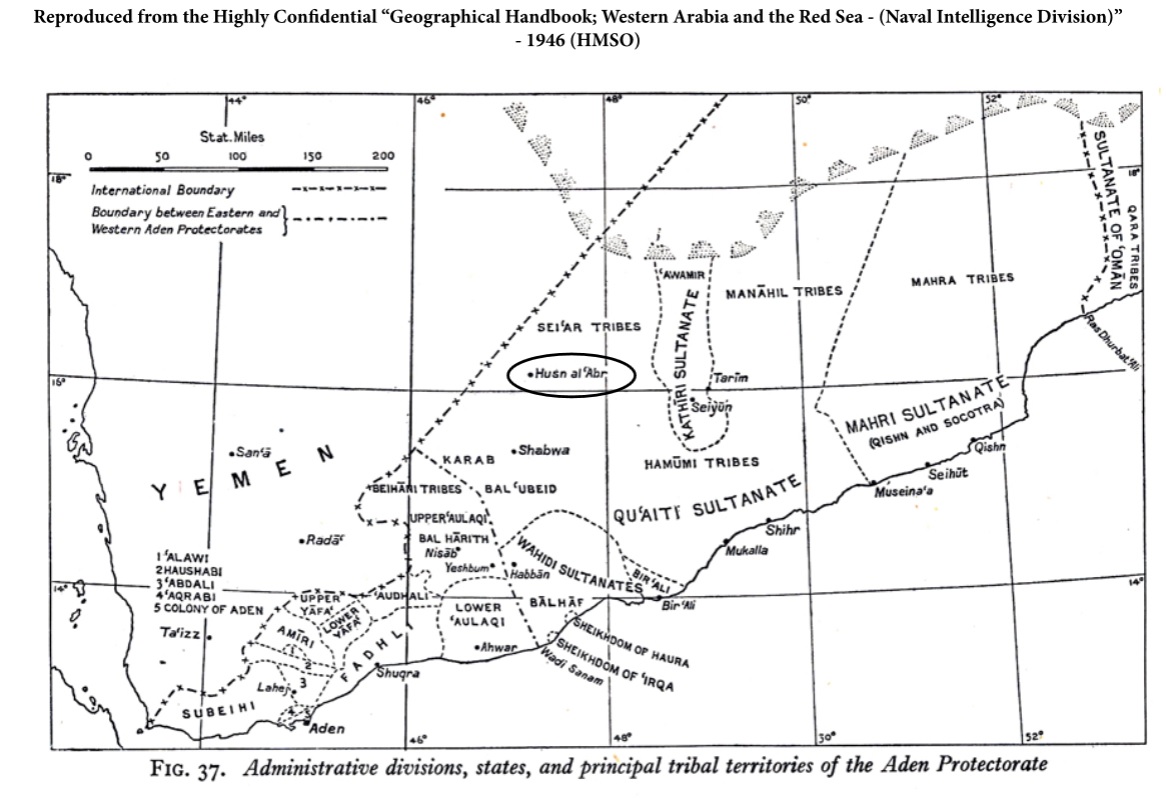
There have been contacts between Saudi intelligence and Ageel bin Muhammad al-Badr Hamidaddin, the pretender to the Mutawakkilite throne of the former Kingdom of Yemen. Al-Badr, who is exiled in London, would command the instant loyalty of many Yemenis if he were to become the leader of the restored kingdom ruling over north Yemen. Al-Badr would also be well-disposed to the status quo ante of the restored independence of South Yemen in the form of a federation of Aden and the restored sultanates of the Hadhramaut region or as four separate countries: South Yemen or South Arabia, the Qua'iti State of Hadhramaut, the Mahra Sultanate of Qishn and Socotra, and the Kathiri State of Seiyun. In addition to the exiled pretender king playing more of a role in Yemeni affairs, Mohammad Hameed Al-Din, the grandson of Yahya Hameed Al-Din, the imam who ruled north Yemen from 1911 until 1948, recently returned to Yemen from exile in Saudi Arabia.


Stamp issued by the Kingdom of Yemen in 1963 depicting the once and possible future flag of Yemen.

The leaders of the three largest former sultanates of eastern South Arabia are now flexing their political muscles along with the pro-South independence movement Al-Hirak. The new "unity" government in Sana'a even includes members of Al-Hirak, which has taken control of the important Oil Ministry. Throughout Aden and other South Arabian cities, the flags of the former South Yemen and even the former sultanates are seen more than the discredited flag of Yemen. Al-Hirak has formed the Supreme Council of the Revolutionary and Peaceful Southern Movement. The council has demanded that the former president of South Yemen, Al-Beidh, be restored as the president of the South. The name "Yemen" is so unpopular in the south that those who demand independence restoration merely refer to the aspiring nation as the "South." Others use its former pre-independence name of "South Arabia."

Sultan Ghalib II bin Awadh al-Qu'aiti of the Qu'aiti State in Hadhramaut; Abdullah bin Isa, the would-be restored Sultan of the Mahra Sutanate of Qishn and Socotra, the latter a strategic island in the Gulf of Aden long sought by the U.S. Navy as a base; and Husayn ibn Ali, the aspirant restored sultan of the Kathiri State of Seiyun in Hadhramaut have all initiated plans to see the independence or autonomy of their sultanates restored in either an independent Hadhramaut federation or as part of a loose federal South Yemen/South Arabia with its capital in Aden.


 [1234886_168015746729566_975067759_n]   [1549573_225793414275217_1615611587_n]

Left to right: The Qu'aiti Sultan Ghalib II, Abdullah bin Isa of the Mahra Sultanate of Qishn and Socotra, Sultan Husayn ibn Ali with the flag of the Kathiri State; Abdullah bin Isa surrounded by Mahra flags; and a sign denoting the border of Yemen and the Mahra Sultanate.


The Hadhramaut First/Hadhramaut League Forces emblem. The group seeks independence of the Hadhramaut. 

It is clear that Cohen and his Zionist colleagues' warning that further sanctions will be applied to "anyone who threatens the country's stability" is directed at the former monarchs -- imams, sultans, and sheiks of Yemen -- as well as the leaders of the Southern Movement (Al-Hirak) who reject the Feierstein plan. The Obama administration, in general, ignores the legitimate rights of the former South Yemen, the Hadhramaut, the Houthis, and the former Mutawakkilite kingdom. Some of the royalists and former Marxist South Yemeni republic leaders have sizable assets in London, Jeddah, Beirut, and other cities and Cohen's threat of seizing bank accounts is clearly not limited to Saleh and the two Houthi commanders.

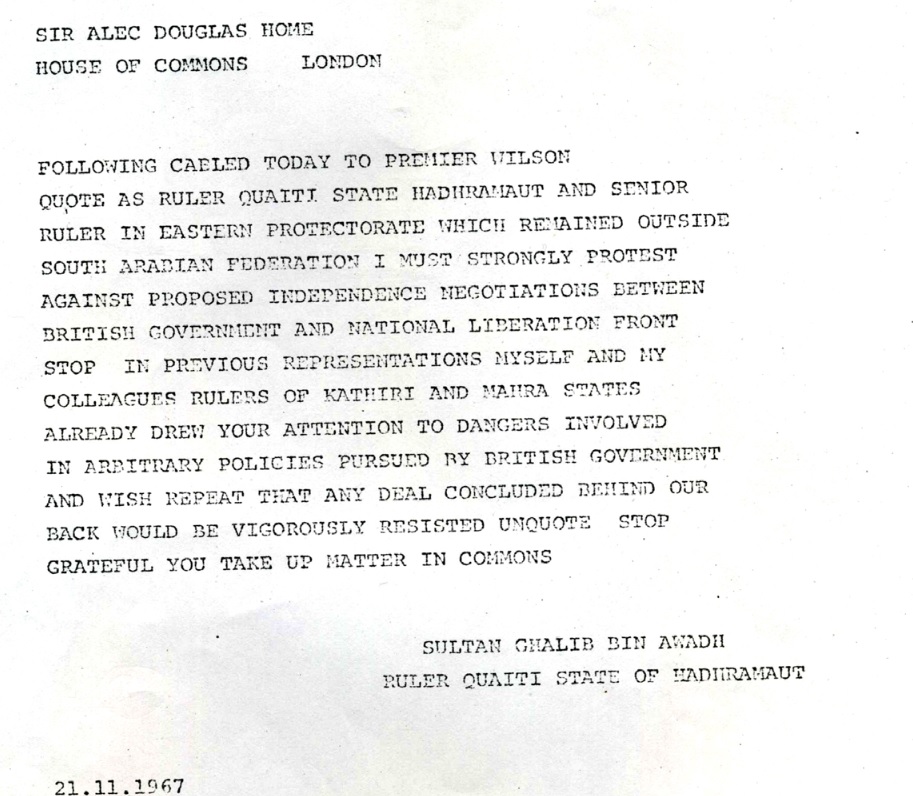
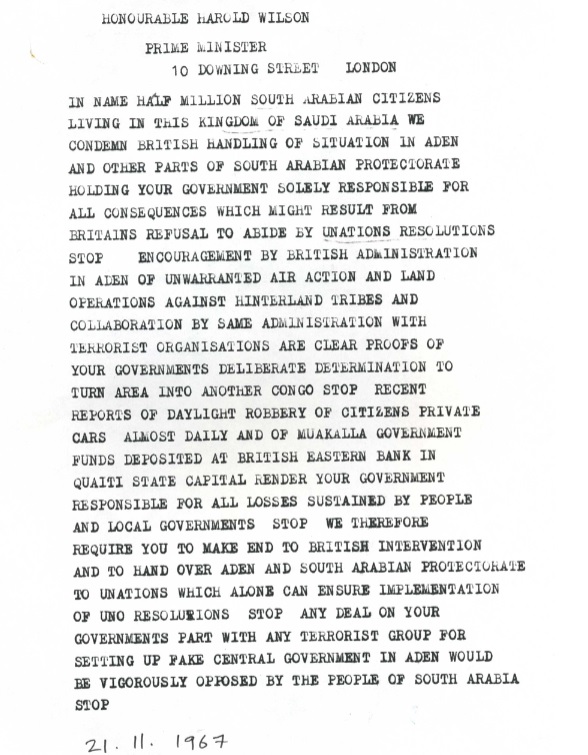
Cohen is merely stepping into the shoes of the British Foreign Office, which solf South Arabia down the drain in 1967 when Britain, hasty to withdraw its forces from "East of Suez," left local administrations in South Arabia to fend for themselves amid a guerrilla war waged by nationalist independence forces. The communiqués between the Qu'aiti Sultan and London speak volumes of the treachery of Britain. Today, for South Arabia, that treachery has been assumed by the United States with the guiding hand of neocons and Zionists who take their orders from Jerusalem and George Soros.


The flag of the Qu'aiti Sultanate (not to be confused with the Emirate of Kuwait in the northern Persian Gulf) is being seen again in South Arabia.


Sultan Ghalib II once faced arbitary policies from London. He and his colleagues now face them from Washington.


Britain's 1967 treachery in South Arabia now being repeated by grotesque interference in Yemeni affairs by Zionists in the U.S. Treasury Department.


The Central Intelligence Agency has falsely claimed that the resurgence of nationalism by sultanate-based tribes in South Yemen is the work of Al Qaeda in the Arabian Peninsula (AQAP). The charge is a bogus excuse for the CIA to attack the tribes with drones to extinguish their drive for self-determination. For the CIA, the attacks on the tribes are no different than the U.S. cavalry's genocide directed against the Native American tribes.


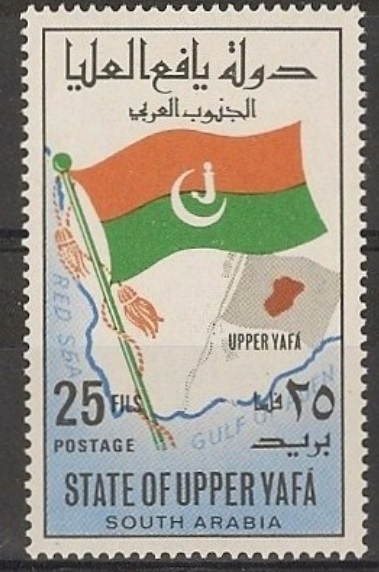
The CIA and Zionists like Feierstein, Cohen, and Szubin are determined to lie about tribal  restoration of states like Upper Yafa in South Arabia by calling it all "Al Qaeda." Zionists have always specialized in the "Big Lie."

Thursday, January 14, 2010

Yemen, Energy Crisis, & the Nigerian Crotch Bomber: The Privatization of Security & the Militarization of Society-Part II


Yemen and the Kissinger-Brzezinski Eurasian Plan

Spectre of Serial War

Security agencies are now focusing their sights on a whole set of countries deemed to be at-risk. According to a leaked confidential memo, people from these countries will be profiled and targeted for “additional screening” at airports. In the words of one US commentator for the Philadelphia Inquirer:

“… most frightening to me was that while the leaked document deemed that holders of passports from Cuba, Iran, North Korea, Libya, Syria, Sudan, Afghanistan, Lebanon, Somalia, Iraq, Yemen, and Algeria should be subjected to additional screening, no such special attention was given to holders of passports from Saudi Arabia – the home of 15 of the 9/11 hijackers. And now it’s worth noting that the list doesn’t include Pakistan or Nigeria – Umar Farouk’s home – either.”

The decision to widen the “screening” of travellers to encompass this vast array of countries deemed to be countries of particular threat to the West fits well within the original logic of the pre-9/11 geostrategy that has now become the ‘War on Terror’.

Hints of this geostrategy surfaced from disparate sources, such as former NATO Commander General Wesley Clarke, who wrote in his book Winning Modern Wars:

As I went back through the Pentagon in November 2001, one of the senior military staff officers had time for a chat. Yes, we were still on track for going against Iraq, he said. But there was more. This was being discussed as part of a five-year campaign plan, he said, and there were a total of seven countries, beginning with Iraq, then Syria, Lebanon, Libya, Iran, Somalia, and Sudan.

Clarke didn’t mention Yemen. But Yemen was explicitly mentioned in an address by the infamous Richard Perle – then Chairman of the Pentagon’s Defense policy Board and former Assistant Secretary of Defence in the Reagan administration – in the same month, at the Foreign Policy Research Institute in Washington DC:

Those who think Iraq should not be next may want to think about Syria or Iran or Sudan or Yemen or Somalia or North Korea or Lebanon or the Palestinian Authority.”

Obama’s Neocons: Kissinger and Brzezinski

BzrezinskiThe escalation of US military activity in Yemen, therefore, is by no means simply a response to events of recent years, but merely the continuing extension of a wider bipartisan geostrategy that was formulated not only by people largely associated with Republican neocons, but also by arch-Democrats, such as former US Secretary of State Henry Kissinger and former National Security Adviser to President Carter, Zbigniew Brzezinski. During the 1970s Middle East oil crisis, Kissinger secretly advocated that the US military might have to intervene to directly and permanently occupy the oil-producing Gulf States to prevent future volatility in US energy security. Four years before 9/11, in his study published by the Council on Foreign Relations, Brzezinski outlined in unnerving detail the contours of what the Bush, and now the Obama, administration, have pursued in the context of the ‘War on Terror’: a plan to dominate “Eurasia” – the landmass comprising the continents of Europe and Asia, at the juncture of which lies the Middle East:

“… how America ‘manages’ Eurasia is critical… A power that dominates Eurasia would control two of the world’s three most advanced and economically productive regions. A mere glance at the map also suggests that control over Eurasia would almost automatically entail Africa’s subordination, rendering the Western Hemisphere and Oceania geopolitically peripheral to the world’s central continent. About 75 per cent of the world’s people live in Eurasia, and most of the world’s physical wealth is there as well, both in its enterprises and underneath its soil. Eurasia accounts for 60 per cent of the world’s GNP and about three-fourths of the world’s known energy resources.”

“Two basic steps are thus required: first, to identify the geostrategically dynamic Eurasian states that have the power to cause a potentially important shift in the international distribution of power and to decipher the central external goals of their respective political elites and the likely consequences of their seeking to attain them;… second, to formulate specific U.S. policies to offset, co-opt, and/or control the above…”

KissingerDemocratic neocons Kissinger and Brzezinski continue to play a key role in Obama’s foreign and security policies, particularly in… (drum roll)… Eurasia! (Eureka? – no, way too easy) In December 2008 before Obama’s foreign policy team was even fully formed, the incoming President dispatched Kissinger to Moscow to meet Putin and president Medvedev. Kissinger re-visited Russia in March 2009, this time joined by a whole cohort of former senior US administration officials, just two weeks before the Medvedev-Obama summit in London. Although the White House insisted this was a purely private affair, it was obvious that his visit was part of normal ‘Track Two’ diplomacy. Brzezinski is also playing a behind-the-scenes advisory role to Obama, on Russia and NATO, as well as on issues in the Middle East including Iran and the Israeli-Palestinian conflict.

Just how key their role is, is a matter for debate. While Brzezinski has acted as Obama’s senior foreign policy advisor, Kissinger purportedly has no ‘official’ position. Or has he? “As the most recent National Security Advisor of the United States,” declared Obama’s National Security Advisor General Jim Jones at the 45th Munich Conference, “I take my daily orders from Dr. Kissinger, filtered down through Generaal [sic] Brent Scowcroft and Sandy Berger, who is also here. We have a chain of command in the National Security Council that exists today.”

Say what??

I think my role today is a little bit different than you might expect”, he added.

No kidding.

Profiling

US and UK governments are also exploring the prospect of profiling passengers on the basis of race, age and gender. While that is not to endorse profiling of any kind as a meaningful and viable security procedure, the Philadelphia Inquirer’s observation is worth noting – if profiling is going ahead, why is it avoiding US client states like Saudi Arabia and Pakistan, among others?

Curiously enough, Wesley Clarke put the case very well seven years ago:

And what about the real sources of terrorists – U.S. allies in the region like Egypt, Pakistan, and Saudi Arabia? Wasn’t it the repressive policies of the first, and the corruption and poverty of the second, that were generating many of the angry young men who became terrorists? And what of the radical ideology and direct funding spewing from Saudi Arabia? Wasn’t that what was holding the radical Islamic movement together?

It is more complicated than Clarke makes out, but he makes a valid point. Why are known state-sponsors of Islamist terrorism being ignored? The question, of course, brings up the wider issue – what exactly is Yemen’s relation to the pre-9/11 bipartisan geostrategy that is currently playing out at the hands of the Obama administration?

Militarization of Geopolitical Energy Choke-Points

A glimpse of the answer to this question actually arrived one day before the foiled attack from Associated Press:

“The Pentagon recently confirmed it has poured nearly $70 million in military aid into Yemen this year–compared with none in 2008. The U.S. military has boosted its counterterrorism training for Yemeni forces and is providing more intelligence, according to U.S. officials and analysts. The result appears to be a sharp escalation in Yemen’s campaign against al-Qaida, which previously amounted to scattered raids against militants, mixed with tolerance of some fighters who made vague promises they would avoid terrorist activity….

“Yemen’s government, which has little control outside the capital, has been distracted by other internal problems. It is fighting a fierce war against Shiite rebels who rose up near the Saudi border, and Saudi forces have gotten involved, battling rebels who have crossed into its territory. The government is also struggling with a secessionist movement in the once-independent south and trying to deal with rampant poverty…

“The central government’s lack of control of areas outside Yemen’s capital – places where many angry tribes are willing to take in al-Qaeda militants – have raised U.S. fears that the beleaguered nation could collapse into chaos. Yemen not only lies next to Saudi Arabia and near the oil-rich nations of the Persian Gulf, it overlooks vital sea routes in the Red Sea and Gulf of Aden.”

YemenCouple of key points become obvious from this. The last year, 2009, has seen a sudden massive, unprecedented escalation in US military intelligence activity in Yemen. The Abdulmutallab incident has only intensified and legitimized this activity. The US and Britain are moving to operate a joint “counter-terrorism police unit in Yemen along with more support for the Yemeni coastguard”, while also “pushing for more UN intervention to tackle the emerging terrorist threat in Somalia.” So there is a question of chronology – why now? Then the geopolitics – the US-UK presence in Yemen puts their military forces right on the cusp of the Horn of Africa, poised for intensified force projection in Africa, with a focus on fighting off Somali piracy. The region between Yemen and Somalia is where we find the Bab el-Mandab, the closure of which according to the US Energy Information Administration:

“… could keep tankers from the Persian Gulf from reaching the Suez Canal/Sumed pipeline complex, diverting them around the southern tip of Africa. The Strait of Bab el-Mandab is a chokepoint between the horn of Africa and the Middle East, and a strategic link between the Mediterranean Sea and Indian Ocean. It is located between Yemen, Djibouti, and Eritrea, and connects the Red Sea with the Gulf of Aden and the Arabian Sea. Exports from the Persian Gulf must pass through Bab el-Mandab before entering the Suez Canal. In 2006, an estimated 3.3 million bbl/d flowed through this waterway toward Europe, the United States, and Asia. The majority of traffic, around 2.1 million bbl/d, flows northbound through the Bab el-Mandab to the Suez/Sumed complex.”

Energy Crisis – US Corporate Loss

ExxonThere are various problems. Yemeni oil production has peaked, declining from 450,000 barrels per day in 2003 to 280,000 in early 2009. This has led to drastic decline in Yemen’s oil exports by around half – expected to decline to zero in about 10 years. During this period, the Yemen government has attempted increasingly to gain control over domestic oil production projects. As of 2005, a dispute broke out between two major US oil companies, Hunt Oil and ExxonMobil, and the Yemen government, over production of “Block 18”. “Natural gas reserves from Marib Block 18 and other fields located in the vicinity have been dedicated to the project, which will require approximately 1 billion cubic feet of gas per day to produce 6.7 million tonnes of LNG per annum”, reads Hunt Oil’s website on its Yemen projects. The existing gas production facilities in Marib Block 18 currently have a capacity of 3.2 billion cubic feet per day… The LNG will be shipped to markets in the U.S. and Korea.”

Through the Yemen Exploration and Production Company (YEPC), Hunt and Exxon have produced oil in Block 18 for 20 years since 1982. They say that this period was extended for five years in an agreement signed by the Yemen government and YEPC in January 2004, and beginning in November 2005. But Yemen would have none of it, reports Gulf Oil & Gas:

“Since November 15, 2005, the Government of Yemen has taken numerous actions to prevent YEPC from exercising its duties as operator of Block 18 in breach of the various legally executed and binding agreements signed in 2004. This is without precedent in Yemen. Further, Yemen has attempted to replace YEPC in the Marib Block with a government-owned company, Safer Exploration and Production Operations Company (‘SEPOC’)”

Hunt and Exxon responded by filing for arbitration with the International Chamber of Commerce in Paris. The outcome of this was announced in late November 2008 – and it didn’t look good for Big Oil. “… the outcome has ensured that the Yemeni state retains earnings from a disputed production block from 2005 to date”, reported Arabian Oil & Gas, “a ruling worth billions of dollars to the oil-revenue dependent state.” Clearly, Yemen’s insistence on maximising its control over gas revenues is partly a response to its rapidly plummeting revenues from oil exports.

The following year, 2009, saw an escalating deterioration of conditions inside Yemen, with intensifying and proliferating clashes between Yemeni security forces, al-Qaeda insurgents and Shi’ite rebels. Thus Yemen’s own oil and gas energy resources, its geostrategic position in relation to Gulf energy and North African energy supplies, and its escalating domestic energy crisis, have played a critical role in the deepening of US military involvement in Yemen under Obama from early 2009 – now escalating in the aftermath of the crotch-bombing incident.

# # # #

AhmedDr. Nafeez Ahmed is a bestselling author and political analyst. He is the Executive Director of the Institute for Policy Research & Development, and has taught courses in contemporary history and international relations theory at the University of Sussex. His Doctoral thesis investigated the radicalization processes and dynamics of violent conflict in the context of hierarchical social systems in the modern world. Dr. Ahmed has also published extensively on international security issues, including The London Bombings; The War on Truth; Behind the War on Terror; and The War on Freedom. He has been an expert commentator for BBC News 24, BBC World Today, Al-Jazeera English, among others. He is currently advising the Royal Military Academy Sandhurst on engaging British Muslim communities. Visit Dr. Nafeez’ website.


Wednesday, January 13, 2010

Yemen, Energy Crisis, and the Nigerian Crotch Bomber: The Privatization of Security and the Militarization of Society-Part I


Wednesday, 13. January 2010

Breakdown of Standard Security Procedures

nigerianOn Christmas Day, 2009, 23-year old Nigerian, Umar Farouk Abdulmutallab, allegedly tried to blow up a plane on route from Amsterdam to Detroit by detonating a device stitched to his underwear. Fortunately, in yet another example of the level of sophistication of the new league of violent extremists, Abdulmutallab succeeded only in setting fire to his own crotch, before being apprehended by fellow passengers.

Security officials now reveal that the attack was planned by an al-Qaeda network in Yemen, where Abdulmutallab was apparently radicalized and trained, although he had been originally recruited, they say, in London. During his stint in London as a student, Abdulmutallab had been President of the Islamic Society at University College London.

The incident has been described as a major intelligence failure exposing the ongoing weakness of US and British security infrastructures and procedures. According to President Barack Obama, intelligence agencies were unable to “connect and understand” separate strands of information that would have alerted them to the attempted attack. “What we have here is a situation in which the failings were individual, organizational, systemic and technological,” said one US official. “We ended up in a situation where a single point of failure in the system put our security at risk, where human error was compounded by systemic deficiencies in a way that we cannot allow to continue.

More simply: no one is to blame.

British Security Surveillance

The problem is that the official narrative is already hopelessly littered with contradictions. Abdulmutallab was apparently first added to the UK Border Agency’s immigration watch list in May 2009 after failing to get a UK entry visa. “His refusal was not on national security grounds”, claimed an early BBC report rather earnestly, but because he had been tagged as a potential illegal immigrant because he had applied to study at a bogus college… This would, in theory, have prevented him from entering the UK – but not from passing through the country, if he was in transit to another country.

We now know that MI5 had him “tagged” as far more than a “potential illegal immigrant.” “The security services knew three years ago that the Detroit bomber had “multiple communications’ with Islamic extremists in Britain”, reported the Times of London. “Umar Farouk Abdulmutallab was ‘reaching out’ to extremists whom MI5 had under surveillance while he was studying at University College London.” And then, another crucial caveat: “None of the information was passed to American officials, which will prompt questions about intelligence failures prior to the attack.”

Unfortunately, it now turns out that MI5’s files on Abdulmutallab were, indeed, passed on to the Americans – despite their initial claims that they had received nothing. As the Scotsman reported: “On Monday, Downing Street revealed that intelligence on Abdulmutallab had been passed to the US authorities before the Detroit incident. That revelation prompted suggestions of a rift between Gordon Brown and the White House, and increased pressure on US security agencies to explain why they had failed to identify the alleged bomber.

CIA and NSA

The narrative from the American side has now also taken shape. Security analyst Tom Burghardt provides a meticulous overview: Abdulmutallab was placed in a “catch-all” US terrorism watch list, the Terrorist Identities Datamart Environment (TIDE), containing 550,000 individuals. This by itself was not enough to put him on a no-fly list. But in September 2009, the National Security Agency (NSA) reportedly picked up intercepts among al-Qaeda leaders in Yemen planning an imminent terror plot by a Nigerian man. The intercepts were translated and disseminated “across classified computer networks”, including the National Counterterrorism Centre (NCTC) run by the Office of the Director of National Intelligence. Then in November, Abdulmutallab’s father, a former top Nigerian government official, provided detailed information to the US embassy in Nigeria warning that his son was a violent extremist.

The father of terrorism suspect Umar Farouk AbdulMutallab talked about his son’s extremist views with someone from the CIA and a report was prepared, but the report was not circulated outside the agency”, reported CNN. The information supposedly sat in CIA headquarters in Langley, Virgina, for five weeks. Yet it is not actually clear whether this was indeed the case: “But an intelligence official said that the son’s name, passport number and possible connection to extremists were indeed disseminated”, CNN continued. “State Department spokesman Ian Kelly said department staff did what they were supposed to have done by sending a cable to the National Counterterrorism Center in Washington about the matter.”

But officials did not revoke his two-year multiple-entry visa, which was issued in June 2008” added the BBC. “Instead, Mr Abdulmutallab’s file was marked for a full investigation should he ever reapply for a visa.

And the State Department’s initial justification for this studious inaction? … (drum roll)… the information received contained “nothing specific” that would have alerted authorities to the attack.

According to a US source familiar with terrorist watch list processes and procedures:

Once Abdulmutallab’s dad went to the embassy Nov. 19 and made a complaint, a report was generated and sent to NCTC

“Once NCTC receives such a report, an intelligence analyst checks to see if the person has any other associations in the database. If it’s the first time the person’s name is coming up, NCTC creates a record under the person’s name, as was done with Abdulmutallab, and that name is added to the TIDE [Terrorism Identities Datamart Environment] list. Agencies across the federal government have access to TIDE.”

“Once a person is added to TIDE, as Abdulmutallab was, an intelligence analyst determines if there is ‘reasonable suspicion’ that he is engaged or intends to engage in a terrorist attack. If the person is found to have ‘reasonable suspicion,’ then an unclassified list with that person’s name on it is sent to the Terrorist Screening Center. That did not happen with Abdulmutallab because the intelligence analyst at NCTC did not find ‘reasonable suspicion’ based on the State Department report, which the source said consisted only of what the Nigerian man’s father said — that he was concerned about his son.”

Unfortunately, we now know that this explanation cannot wash. Only two days after the failed attack, Associated Press reported that: “Abdulmutallab came to the attention of intelligence officials months earlier though [than November 2009], according to a U.S. government official involved in the investigation, who spoke on condition of anonymity because it is ongoing.”

Unjoining the Dots

Indeed, highly specific MI5 surveillance and reports tracking Abdulmutallab’s contacts with UK extremists and his “journey” of radicalization as early as 2007, were passed onto US authorities contrary to early official claims; detailed NSA intercepts uncovered al-Qaeda plot preparations in Yemen led by a Nigerian; urgent warnings from his own father documented by the CIA culminating in an extensive dossier covering issues from his educational history to his plans to study Islamic law in Yemen. If standard security procedures had been followed, Abdulmutallab should have been in the system and red-flagged. As Burghardt rightly observes:

“Despite the fact that Abdulmutallab was denied re-entry into Britain, paid $2,800 in cash for his ‘ticket to Paradise,’ and had no luggage that normally would accompany a person holding a 2-year entry visa into the U.S., the erstwhile lap bomber scored a goal each time and eluded every intrusive ‘profile’ presumably in place to keep us ‘safe.’ Talk about a hat trick!

Available evidence suggests that Abdulmutallab should have landed on TSA’s hush-hush ‘Selectee list’ for additional screening, or the agency’s ‘No-fly list.’ And given NSA intercepts and a CIA biographical report on the suspect, this alone should have barred him from entering the country if ‘normal’ security procedures were followed. They weren’t.”

Similarly, Mark Thompson of Time Magazine also noted, even disregarding the wider intelligence: “Abdulmutallab’s recent stay in Yemen, combined with his father’s warning and the fact that he paid cash for a one-way ticket and didn’t check any luggage, should have been sufficient to set off alarm bells.

President Barack Obama has now declared that this was a “systemic failure” that was “totally unacceptable.” But how could such a failure occur yet again, nearly 10 years after 9/11, which was blamed precisely on the same kind of “systemic failures” that should have been resolved given the billions of dollars of taxpayer’s funding already poured into a discredited intelligence community? Curiously, a Wired report in October 2009 noted that the Office of the Director of National Intelligence (ODNI) was “shutting down two of its more important collaboration tools, called uGov and BRIDGE” – uGov being the most significant here:

“ODNI frequently stands up temporary analytical groups that take in analysts from agencies like the Central Intelligence Agency (CIA), the DIA and the National Security Agency (NSA); the uGov domain made it easy to give all of them a common platform… UGov has been especially popular among the large tranche of analysts who joined the community after 9/11. The Office of the Director of National Intelligence (ODNI) runs the network.”

So just as critical information was coming into the intelligence community about Abdulmutallab, the ODNI began to dismantle one of its most important interagency information-sharing initiatives.

Profiteering from Fear: The Brennan Connection

It gets worse. The wider context that has been totally ignored by mainstream media is the wholesale privatization of the US national security infrastructure.

As Burghardt also notes, the NCTC responsible for the terror watch list is “outsourced” to The Analysis Corporation (TAC), a wholly-owned subsidiary of Global Strategies Group USA (GSG), a British firm. GSG USA’s President is John Hillel – a former contributing editor to the neoconservative propaganda outlet National Review, a defence policy advisor to George W. Bush during his first presidential campaign, and a Bush appointee to the post of Assistant Secretary of State for Political-Military Affairs (2005-7). Previously the NCTC’s first director, John Brennan became CEO of TAC in November 2005. Citing investigative journalist Tim Shorrock, Burghardt goes on to note that TAC provides counterterrorism support to “most of the agencies within the intelligence community”. One of its biggest clients is the NCTC, and one of its first tasks was the creation of the TIPOFF terrorist database, which later became TIDE.

Now, Obama has appointed John Brennan to lead a “comprehensive interagency review” of travel security measures. But in the words of IntelNews, “A veteran CIA official appointed to review the US government’s defective terrorism watch-list system, was actually involved in designing it, and later helped sustain it through a lucrative private-sector contract.” The report continues, noting that “not only was Brennan part of the US National Counterterrorism Center team that designed the terrorism watch-list system, but he also helped sustain it while heading the Analysis Corporation, a scandal-prone private contractor charged with overseeing the watch-list system.

No conflict of interest then.

This analysis suggests that the failure to red-flag Abdulmutallab in advance was not a consequence of “nothing specific” in terms of intelligence information (the first narrative of explanation); not the consequence of systemic loopholes in a flawed travel security system that prevented the joining of dots (the second narrative of explanation); but was the consequence of a failure to implement existing normal security procedures. But given the Obama administration’s current official discourse focusing on the idea of a flawed system, Brennan’s review will no doubt call for more taxpayer’s money to be poured into the expansion and consolidation of exotic new surveillance, profiling and security powers – from which his own company, TAC, will no doubt reap lucrative dividends.

# # # #

AhmedDr. Nafeez Ahmed is a bestselling author and political analyst. He is the Executive Director of the Institute for Policy Research & Development, and has taught courses in contemporary history and international relations theory at the University of Sussex. His Doctoral thesis investigated the radicalization processes and dynamics of violent conflict in the context of hierarchical social systems in the modern world. Dr. Ahmed has also published extensively on international security issues, including The London Bombings; The War on Truth; Behind the War on Terror; and The War on Freedom. He has been an expert commentator for BBC News 24, BBC World Today, Al-Jazeera English, among others. He is currently advising the Royal Military Academy Sandhurst on engaging British Muslim communities. Visit Dr. Nafeez’ website.


Tuesday, January 12, 2010

THE ROVING EYE Empire reloaded By Pepe Escobar

HONG KONG - One's got to hand it to failed underwear bomber Umar Farouk Abdulmuttalab. He is the real Man of the Year. With a single twitch of his lower parts, the now iconic young Nigerian single-handedly not only forced the Barack Obama administration to unleash tight airport security measures, a new virtual striptease craze bound to bolster the fortunes of selected players in the security industry; but he also managed to place no fewer than 675 million Muslims (plus sundry Nigerian and even Cuban Christians) on a Cyclopean terror list of 10 "prone to terrorism countries". [1]

That's quite a feat for an apparently trained-in-Yemen jihadi charged by a US grand jury - no irony intended - with "attempted use of a weapon of mass destruction". But weren't WMDs supposed to be buried in Iraq?

It's Pearl Harbor time
As much as 9/11 was the "Pearl Harbor" dreamed of by the neo-conservatives to unleash the American Eagle - which started with the bombing of Afghanistan and morphed into the disastrous invasion of Iraq - Abdulmuttalab's failed attempt to blow up Northwest Airlines Flight 253 on Christmas Day in the skies above Detroit is a godsend mini-Pearl Harbor destined to advance the Pentagon's "full spectrum dominance" doctrine.

Yemen could not be a more strategically mouth-watering proposition - with Saudi Arabia to the north, the Red Sea to the west, the Gulf of Aden to the south leading to the Arabian Sea, and on the other side, in Africa, Somalia.

As far as the Pentagon's "full spectrum dominance" goes, Yemen falls right into the Pentagon net alongside Somali pirates and the new bogeyman, al-Qaeda in the Arabic Peninsula (AQAP), when it comes to the militarization of a key strategic oil chokepoint, the Bab el-Mandab, no matter the avalanche of denials from the Barack Obama administration of any intention to put US boots on the ground in Yemen.

The Strait of Bab el-Mandab between Yemen, Djibouti and Eritrea is a key strategic oil chokepoint between the Horn of Africa and the Middle East, linking the Mediterranean and the Indian Ocean, through which flows at least 3.5 million barrels of oil a day towards the US, Europe and Asia.

Plus, from Washington's point of view, there's the potential of oil reserves lying in Yemen near Saudi Arabia at the Masila Basin and the Shabwa Basin, which could in the not too distant future fall nicely into US Big Oil's lap, unlike Iraq's. (See Iraq's oil auction hits the jackpot Asia Times Online, December 16, 2009).

So it's no surprise that Obama, on the record, had to expand the never-say-die "war on terror" - the cover narrative for "full spectrum dominance". According to Obama, AfPak is still "the epicenter of al-Qaeda", but the Yemen chapter is a "more serious problem". Thus comes into play still one more rehash of the same old narrative: a fragile dictator, Yemeni President Ali Abdullah Saleh (in absolute power since 1978) needs America to defeat the terrorists (AQAP).

In practice, the Obama administration has just wallowed in the mire of an Arab Afghanistan, propping up Saleh against the Southern Movement, an unlikely, popular-based alliance of socialists and Islamic conservatives led by a former jihadi, Tariq al-Fadhli, and now characterized as a full nationalist movement. In addition, the Saleh regime is fighting a Shi'ite rebellion in north Yemen. Saleh is Sunni. The rebels are Shi'ite. Saleh is obviously backed by the Wahhabi Saudi regime. Yemen's current oil, by the way, is crucially in the south.

Saleh predictably will dub all his enemies as "al-Qaeda" and call the cavalry - US Special Forces and legions of counter-intelligence operatives. Not to mention the drones. Few noted that last December 17, Obama ordered the bombing of suspected al-Qaeda positions in Yemen with cruise missiles, an attack in which 49 civilians were reported to have been killed, according to Agence France-Presse. Welcome to yet one more sinister Arab-Afghan amalgam.

United States intelligence admits there are no more than 200 al-Qaeda jihadis in southern Yemen (that certainly beats those 100 in Afghanistan). What AQAP basically wants is to bring down US-propped dictators such as Saleh, Egypt's Hosni Mubarak and the House of Saud - a popular agenda across much of the Middle East. So Obama may go to Cairo and talk about democracy in the Muslim world as much as he wants; what the Arab street registers is Obama playing the same old empire game of supporting yet another dictator.

It's the oil ...
"Full spectrum dominance" as applied to Yemen may be - as it always is - about the containment of China, as in threatening China's oil imports (6% of its total) from Port Sudan on the Red Sea, just north of the Bab el-Mandab.

But even if the US eventually controls the port of Aden - the gateway to Asia via the Indian Ocean - China will relentlessly continue to evolve its complex strategy of avoiding chokepoints such as the Strait of Hormuz, the Strait of Malacca, or indeed the Bab el-Mandab (See China plays Pipelineistan Asia Times Online, December 24).

The idea of "full spectrum dominance" is about threatening to cut energy flows not only to China but even to the European Union (EU) or anyone for that matter who crosses Washington's policy makers. And it's as much about Saudi Arabia as about China. As Saudi oil exports also have to negotiate the Bab el-Mandab, US "interest" in Yemen means a graphic warning to the House of Saud: don't even think of trading oil in euros or in a basket of currencies including the Chinese yuan.

It also is about isolating Iran - as in using a Sunni dictator to fight a Shi'ite rebellion and in militarizing a useful battleground alongside ally Saudi Arabia. In Washington's scenario, the winners should be the Pentagon, the Central Intelligence Agency and Israel's Mossad, and the losers should be China, Russia and Iran. The turbulent Yemeni street was not consulted and certainly has ideas of its own.

Obama is packaging his strategy as a "war on al-Qaeda". It's not a war. And even if the counter-insurgency gang in the Pentagon conducts it, it's destined to fail. Meanwhile, there's not the remotest chance in sight of a real US withdrawal from Iraq, the end of the AfPak war, or a viable, non-apartheid Palestinian state.

Now that would be a real, concerted counter-terrorist operation, to finish once and for all with the ghost of all those "al-Qaedas". It won't happen. The name of the game is "full spectrum dominance" and empire reloaded. Fasten your body scanners; the decade promises a bumpy ride.

Note
1. The countries are Sudan, Afghanistan, Algeria, Iraq, Lebanon, Nigeria, Pakistan, Saudi Arabia, Somalia and Yemen, plus "state sponsors of terrorism" Iran, Syria, Libya and Cuba.

Pepe Escobar is the author of Globalistan: How the Globalized World is Dissolving into Liquid War (Nimble Books, 2007) and Red Zone Blues: a snapshot of Baghdad during the surge. His new book, just out, is Obama does Globalistan (Nimble Books, 2009).

He may be reached at pepeasia@yahoo.com.

Monday, January 11, 2010

Obama's Yemeni odyssey targets China

By M K Bhadrakumar

A year ago, Yemeni President Ali Abdallah Saleh made the startling revelation that his country's security forces apprehended a group of Islamists linked to the Israeli intelligence forces. "A terrorist cell was apprehended and will be referred to the courts for its links with the Israeli intelligence services," he promised.

Saleh added, "You will hear about the trial proceedings." Nothing was ever heard and the trail went cold. Welcome to the magical land of Yemen, where in the womb of time the Arabian Nights were played out.

Combine Yemen with the mystique of Islam, Osama bin Laden, al-Qaeda and the Israeli intelligence and you get a heady mix. The head of the US Central Command, General David Petraeus, dropped in at the capital, Sana'a, on Saturday and vowed to Saleh increased American aid to fight al-Qaeda. United States President Barack Obama promptly echoed Petraeus' promise, assuring that the US would step up intelligence-sharing and training of Yemeni forces and perhaps carry out joint attacks against militants in the region.

Another Afghanistan?
Many accounts say that Obama, who is widely regarded as a gifted and intelligent politician, is blundering into a catastrophic mistake by starting another war that could turn out to be as bloody and chaotic and unwinnable as Iraq and Afghanistan. Yes, on the face of it, Obama does seem erratic. The parallels with Afghanistan are striking. There has been an attempt to destroy a US plane by a Nigerian student who says he received training in Yemen. And America wants to go to war.

Yemen, too, is a land of wonderfully beautiful rugged mountains that could be a guerilla paradise. Yemenis are a hospitable lot, like Afghan tribesmen, but as Irish journalist Patrick Cockurn recollects, while they are generous to passing strangers, they "deem the laws of hospitality to lapse when the stranger leaves their tribal territory, at which time he becomes 'a good back to shoot at'." Surely, there is romance in the air - almost like in the Hindu Kush. Fiercely nationalistic, almost every Yemeni has a gun. Yemen is also, like Afghanistan, a land of conflicting authorities, and with foreign intervention, a little civil war is waiting to flare up.


Is Obama so incredibly forgetful of his own December 1 speech outlining his Afghan strategy that he violated his own canons? Certainly not. Obama is a smart man. The intervention in Yemen will go down as one of the smartest moves that he ever made for perpetuating the US's global hegemony. It is America's answer to China's surge.

A cursory look at the map of region will show that Yemen is one of the most strategic lands adjoining waters of the Persian Gulf and the Arabian Peninsula. It flanks Saudi Arabia and Oman, which are vital American protectorates. In effect, Uncle Sam is "marking territory" - like a dog on a lamppost. Russia has been toying with the idea of reopening its Soviet-era base in Aden. Well, the US has pipped Moscow in the race.

The US has signaled that the odyssey doesn't end with Yemen. It is also moving into Somalia and Kenya. With that, the US establishes its military presence in an entire unbroken stretch of real estate all along the Indian Ocean's western rim. Chinese officials have of late spoken of their need to establish a naval base in the region. The US has now foreclosed China's options. The only country with a coastline that is available for China to set up a naval base in the region will be Iran. All other countries have a Western military presence.

The American intervention in Yemen is not going to be on the pattern of Iraq and Afghanistan. Obama will ensure he doesn't receive any body bags of American servicemen serving in Yemen. That is what the American public expects from him. He will only deploy drone aircraft and special forces and "focus on providing intelligence and training to help Yemen counter al-Qaeda militants", according to the US military. Obama's main core objective will be to establish an enduring military presence in Yemen. This serves many purposes.

A new great game begins
First, the US move has to be viewed against the historic backdrop of the Shi'ite awakening in the region. The Shi'ites (mostly of the Zaidi group) have been traditionally suppressed in Yemen. Shi'ite uprisings have been a recurring theme in Yemen's history. There has been a deliberate attempt to minimize the percentage of Shi'ites in Yemen, but they could be anywhere up to 45%.

More importantly, in the northern part of the country, they constitute the majority. What bothers the US and moderate Sunni Arab states - and Israel - is that the Believing Youth Organization led by Hussein Badr al-Houthi, which is entrenched in northern Yemen, is modeled after Hezbollah in Lebanon in all respects - politically, economically, socially and culturally.

Yemenis are an intelligent people and are famous in the Arabian Peninsula for their democratic temperament. The Yemeni Shi'ite empowerment on a Hezbollah-model would have far-reaching regional implications. Next-door Oman, which is a key American base, is predominantly Shi'ite. Even more sensitive is the likelihood of the dangerous idea of Shi'ite empowerment spreading to Saudi Arabia's highly restive Shi'ite regions adjoining Yemen, which on top of it all, also happen to be the reservoir of the country's fabulous oil wealth.

Saudi Arabia is entering a highly sensitive phase of political transition as a new generation is set to take over the leadership in Riyadh, and the palace intrigues and fault lines within the royal family are likely to get exacerbated. To put it mildly, given the vast scale of institutionalized Shi'ite persecution in Saudi Arabia by the Wahhabi establishment, Shi'ite empowerment is a veritable minefield that Riyadh is petrified about at this juncture. Its threshold of patience is wearing thin, as the recent uncharacteristic resort to military power against the north Yemeni Shi'ite communities bordering Saudi Arabia testifies.

The US faces a classic dilemma. It is all right for Obama to highlight the need of reform in Muslim societies - as he did eloquently in his Cairo speech last June. But democratization in the Yemeni context - ironically, in the Arab context - would involve Shi'ite empowerment. After the searing experience in Iraq, Washington is literally perched like a cat on a hot tin roof. It would much rather be aligned with the repressive, autocratic government of Saleh than let the genie of reform out of the bottle in the oil rich-region in which it has profound interests.

Obama has an erudite mind and he is not unaware that what Yemen desperately needs is reform, but he simply doesn't want to think about it. The paradox he faces is that with all its imperfections, Iran happens to be the only "democratic" system operating in that entire region.

Iran's shadow over the Yemeni Shi'ite consciousness worries the US to no end. Simply put, in the ideological struggle going on in the region, Obama finds himself with the ultra-conservative and brutally autocratic oligarchies that constitute the ruling class in the region. Conceivably, he isn't finding it easy. If his own memoirs are to be believed, there could be times when the vague recollections of his childhood in Indonesia and his precious memories of his own mother, who from all accounts was a free-wheeling intellectual and humanist, must be stalking him in the White House corridors.

Israel moves in
But Obama is first and foremost a realist. Emotions and personal beliefs drain away and strategic considerations weigh uppermost when he works in the Oval Office. With the military presence in Yemen, the US has tightened the cordon around Iran. In the event of a military attack on Iran, Yemen could be put to use as a springboard by the Israelis. These are weighty considerations for Obama.

The fact is that no one is in control as a Yemeni authority. It is a cakewalk for the formidable Israeli intelligence to carve out a niche in Yemen - just as it did in northern Iraq under somewhat comparable circumstances.

Islamism doesn't deter Israel at all. Saleh couldn't have been far off the mark when he alleged last year that Israeli intelligence had been exposed as having kept links with Yemeni Islamists. The point is, Yemeni Islamists are a highly fragmented lot and no one is sure who owes what sort of allegiance to whom. Israeli intelligence operates marvelously in such twilight zones when the horizon is lacerated with the blood of the vanishing sun.

Israel will find a toehold in Yemen to be a god-sent gift insofar as it registers its presence in the Arabian Peninsula. This is a dream come true for Israel, whose effectiveness as a regional power has always been seriously handicapped by its lack of access to the Persian Gulf region. The overarching US military presence helps

Israel politically to consolidate its Yemeni chapter. Without doubt, Petraeus is moving on Yemen in tandem with Israel (and Britain). But the "pro-West" Arab states with their rentier mentality have no choice except to remain as mute spectators on the sidelines.

Some among them may actually acquiesce with the Israeli security presence in the region as a safer bet than the spread of the dangerous ideas of Shi'ite empowerment emanating out of Iran, Iraq and Hezbollah. Also, at some stage, Israeli intelligence will begin to infiltrate the extremist Sunni outfits in Yemen, which are commonly known as affiliates of al-Qaeda. That is, if it hasn't done that already. Any such link makes Israel an invaluable ally for the US in its fight against al-Qaeda. In sum, infinite possibilities exist in the paradigm that is taking shape in the Muslim world abutting into the strategic Persian Gulf.

It's all about China
Most important, however, for US global strategies will be the massive gain of control of the port of Aden in Yemen. Britain can vouchsafe that Aden is the gateway to Asia. Control of Aden and the Malacca Strait will put the US in an unassailable position in the "great game" of the Indian Ocean. The sea lanes of the Indian Ocean are literally the jugular veins of China's economy. By controlling them, Washington sends a strong message to Beijing that any notions by the latter that the US is a declining power in Asia would be nothing more than an extravagant indulgence in fantasy.

In the Indian Ocean region, China is increasingly coming under pressure. India is a natural ally of the US in the Indian Ocean region. Both disfavor any significant Chinese naval presence. India is mediating a rapprochement between Washington and Colombo that would help roll back Chinese influence in Sri Lanka. The US has taken a u-turn in its Myanmar policy and is engaging the regime there with the primary intent of eroding China's influence with the military rulers. The Chinese strategy aimed at strengthening influence in Sri Lanka and Myanmar so as to open a new transportation route towards the Middle East, the Persian Gulf and Africa, where it has begun contesting traditional Western economic dominance.

China is keen to whittle down its dependence on the Malacca Strait for its commerce with Europe and West Asia. The US, on the contrary, is determined that China remains vulnerable to the choke point between Indonesia and Malaysia.

An engrossing struggle is breaking out. The US is unhappy with China's efforts to reach the warm waters of the Persian Gulf through the Central Asian region and Pakistan. Slowly but steadily, Washington is tightening the noose around the neck of the Pakistani elites - civilian and military - and forcing them to make a strategic choice between the US and China. This will put those elites in an unenviable dilemma. Like their Indian counterparts, they are inherently "pro-Western" (even when they are "anti-American") and if the Chinese connection is important for Islamabad, that is primarily because it balances perceived Indian hegemony.

The existential questions with which the Pakistani elites are grappling are apparent. They are seeking answers from Obama. Can Obama maintain a balanced relationship vis-a-vis Pakistan and India? Or, will Obama lapse back to the George W Bush era strategy of building up India as the pre-eminent power in the Indian Ocean under whose shadow Pakistan will have to learn to live?

US-India-Israel axis
On the other hand, the Indian elites are in no compromising mood. Delhi was on a roll during the Bush days. Now, after the initial misgivings about Obama's political philosophy, Delhi is concluding that he is all but a clone of his illustrious predecessor as regards the broad contours of the US's global strategy - of which containment of China is a core template.

The comfort level is palpably rising in Delhi with regard to the Obama presidency. Delhi takes the surge of the Israeli lobby in Washington as the litmus test for the Obama presidency. The surge suits Delhi, since the Jewish lobby was always a helpful ally in cultivating influence in the US Congress, media and the rabble-rousing think-tankers as well as successive administrations. And all this is happening at a time when the India-Israel security relationship is gaining greater momentum.

United States Defense Secretary Robert Gates is due to visit Delhi in the coming days. The Obama administration is reportedly adopting an increasingly accommodative attitude toward India's longstanding quest for "dual-use" technology from the US. If so, a massive avenue of military cooperation is about to open between the two countries, which will make India a serious challenger to China's growing military prowess. It is a win-win situation as the great Indian arms bazaar offers highly lucrative business for American companies.

Clearly, a cozy three-way US-Israel-India alliance provides the underpinning for all the maneuvering that is going on. It will have significance for the security of the Indian Ocean, the Persian Gulf and the Arabian Peninsula. Last year, India formalized a naval presence in Oman.

All-in-all, terrorism experts are counting the trees and missing the wood when they analyze the US foray into Yemen in the limited terms of hunting down al-Qaeda. The hard reality is that Obama, whose main plank used to be "change", has careened away and increasingly defaults to the global strategies of the Bush era. The freshness of the Obama magic is dissipating. Traces of the "revisionism" in his foreign policy orientation are beginning to surface. We can see them already with regard to Iran, Afghanistan, the Middle East and the Israel-Palestine problem, Central Asia and towards China and Russia.

Arguably, this sort of "return of the native" by Obama was inevitable. For one thing, he is but a creature of his circumstances. As someone put it brilliantly, Obama's presidency is like driving a train rather than a car: a train cannot be "steered", the driver can at best set its speed, but ultimately, it must run on its tracks.

Besides, history has no instances of a declining world power meekly accepting its destiny and walking into the sunset. The US cannot give up on its global dominance without putting up a real fight. And the reality of all such momentous struggles is that they cannot be fought piece-meal. You cannot fight China without occupying Yemen.


Ambassador M K Bhadrakumar was a career diplomat in the Indian Foreign Service. His assignments included the Soviet Union, South Korea, Sri Lanka, Germany, Afghanistan, Pakistan, Uzbekistan, Kuwait and Turkey.