

January 11, 2007
Be prepared for the possibility of a nuclear strike by Israel against Iran. The Sunday Times of London reports that Israel has ordered that its armed forces to be ready to be deployed against Iran’s nuclear enrichment facilities by the end of March. The Israeli Foreign Ministry has denied the veracity of the report.
Concerns about Iran’s nuclear enrichment program are particularly relevant considering Iran’s President Mahmoud Ahmadinejad’s vocal criticism of the State of Israel.
Speaking recently, both the American and Israeli governments have said that something needs to be done about Iran within the next couple of months. It is likely that any offensive military action will wait for the release of a report on Iran by the head of the International Atomic Energy Agency, Mohamed El-Baradei. However, reports from within the Israeli Defence establishment, which has been conducting an intensive intelligence gathering operation on Iran ever since the potential for nuclear armament was made apparent, have suggested that Iran would have the capability to build a warhead in 2 to 4 years.
Talk about the potential for military strikes against Iran has been in the news since Seymour Hersh’s article in the New Yorker in April of 2006. In his piece, entitled ‘Would President Bush go to war to stop Tehran from getting the bomb?’ Hersh cited insider sources saying that the U.S. was considering the option of dropping tactical nukes, known as “bunker-busters” on Iran in order to delay or destroy the country’s nuclear capabilities. The same kind of plan has now informally been set out by Israel. According to DemocracyNow!, they would use bombs that would be one-fifteenth the strength of the bombs dropped on Hiroshima and Nagasaki.
While the plans outlined by Hersh are for a uniquely air-offensive, the Times reports that an Israeli invasion would include land and air units. Not burdened by an existing ground war, as is the United States, Israel would probably be able to sustain such an excursion. However Lebanon has also proven that while a sustained ground assault might be unlikely to successfully achieve the objective, tactical air strikes are devastatingly efficient at destroying key infrastructure. A ground offensive would best succeed if it were limited to rapid raids rather than an all out ground assault.
Meanwhile, throughout all the subtle and not-so subtle threats by both the American and Israeli Administrations, Iran maintains that its uranium enrichment plans are for peaceful purposes only.
Iran is correct in affirming that it has the right to enrich uranium under the Non Proliferation Treaty. The United States, which is also a signatory, has contravened the treaty by ignoring the demand to disarm, and most strikingly, by making more nuclear warheads. It holds by far the most nuclear weapons in the world, and is the only country to have ever used them. The demand for an end to uranium enrichment is pure hypocrisy on the part of the United States. Israel, for its part, has not even acknowledged that it has nuclear weapons, except in a slip-up by President Ehud Olmert on German television, which was quickly denied. It is not a signatory to the treaty and is showing just as much hypocrisy as the United States in demanding a stop to any nuclear ambitions.
There is almost no way that Iran could counter-attack against Israel, which has the second largest air force and one of the most powerful armies in the world. The Israeli Defence Force (IDF) is partly funded by the American government, with U.S. weapons’ manufacturers supplying it with state of the art equipment. In all likelihood a counter-attack would come from within Iraq, where there are strong Shi’a links. Kenneth Pollack of the Brookings Institute has said that Iran “could make Iraq hell” for the occupying force by exerting its influence within the country and helping the Shi’a rebels in their defence of Iraq.
In light of the expected policy by Bush to increase troop levels in Iraq by 20,000 individuals, as reported by DemocracyNow!, any Iranian move to bolster the resistance would be perilous for American lives. The question is whether the potential for additional failures in Iraq is worth the potential for the destruction of nuclear sites in Iran.
It seems unlikely that any air strike will completely eliminate Iran’s entire nuclear capabilities. Most intelligence reports say that Iran has learned from the destruction of the Osirak reactor during the Iran-Iraq war and has spread out its operations in some 30-40 sites. Knowing where these sites are located is a problem, but one probably already solved by Israeli and American intelligence. Bombing them is another issue, and one that might not be wholly solved by the bunker-buster nukes that are at the disposal of the IDF.
Any attack by Israel, which would no doubt be backed by the United States diplomatically if not militarily, has dubious prospects. It would further inflame the anger Arabs in the region feel towards Israel, compounding the hate that springs from the occupation of Palestinian land, the choking off of its resources, and the killing of its people.
What also comes to mind is the recent “Summer Rain” offensive in Lebanon. The retaliation to the death of two Israeli soldiers and the capture of several others was severe, and occurred without an attempt at diplomacy. Many people in the region felt incensed by what they saw as an act of aggression and indiscriminate collateral damage against a country that had not condoned the initial affront against Israel.
The same kind of collateral damage will occur if there is a tactical nuclear strike against nuclear sites in Iran. The fallout will be immense, even if the bunker busters are supposed to emit fewer radiations because they explode beneath ground. Hundreds, if not thousands of people will die, many of them civilians who have nothing to do with the projects of their government. The environment will be toxic for the generations that follow.
Most of all, any attack against Iran will constitute an act of aggression and a crime against peace, the number one war crime under the Nuremberg Tribunal. Using nukes would compound the atrocity sparking the use of illegal weapon the likes of which the world has been fortunate to not see for 50 years. Finally the sheer hypocrisy of a nuclear attack to take out nuclear sites borders on the absurd.
But the chance of diminishing the scope of Iranian power might be too tempting to miss. Iran remains the primary opponent of an Israel-centered Middle East and because of its influence it is setting a widely recognized example of defiance to the demands of the West. Iran is demonstrating a strong political will, which others may follow, in pushing forward a program that has aroused the ire of the most powerful nations in the world. Destroying Iran’s ambitions would send a message to the other countries in the region about who they should look up to.
The U.S. has already proven that it will attack other countries preemptively and Israel has shown that it is inclined to retaliate with the utmost aggression to actions it deems offensive. Until now, diplomatic talks have all but failed. With Iran flatly refusing to stop enrichment, the question becomes “What next?” It seems that question may now be answered.
Thursday, January 11, 2007
U.S. attack on Somalia the idea of Christian "neo-Crusaders" in Pentagon.
January 11, 2007 --
Lt. Gen. William G. ("Jerry") Boykin, the neo-crusading Undersecretary of Defense for Intelligence who once stated in uniform before a Christian fundamentalist congregation that "the god of a Muslim [Somali] warlord was ‘an idol’ and that ‘my God was a real God," reportedly ordered an attack on chiefly Muslim Somalia as a way of helping his fellow neo-Crusaders in the Ethiopian embassy in Washington. Boykin, his fellow Pentagon fundamentalists, and Ethiopian diplomats are heavily involved in the activities of the Christian Embassy, an entity that seeks to convert U.S. and foreign military officers, top politicians in the U.S. and abroad, and foreign diplomats and their wives who are assigned to Washington. It is expected that Boykin will soon follow his boss, arch-neo-con Stephen Cambone, out of the Pentagon soon as part of Defense Secretary Robert Gates' housecleaning.
A top official of the Ethiopian opposition to Ethiopian dictator Meles Zenawi, a favorite of the Pentagon Christian fundamentalists, stated that there were never any "Al Qaeda" forces in Somalia and that the attack on that nation was a way for the Bush administration to militarily support Meles, whose army invaded Ethiopia a few weeks ago.
Christian soldiers marching against non-existent "Al Qaeda" in hapless Somalia.
This morning, the Bush administration admitted that no "Al Qaeda" suspects had been killed in US attacks on Somalia. However, Ethiopian opposition sources claim "thousands" of Somali civilians, including children, have been killed in the U.S. military campaign.
Lt. Gen. William G. ("Jerry") Boykin, the neo-crusading Undersecretary of Defense for Intelligence who once stated in uniform before a Christian fundamentalist congregation that "the god of a Muslim [Somali] warlord was ‘an idol’ and that ‘my God was a real God," reportedly ordered an attack on chiefly Muslim Somalia as a way of helping his fellow neo-Crusaders in the Ethiopian embassy in Washington. Boykin, his fellow Pentagon fundamentalists, and Ethiopian diplomats are heavily involved in the activities of the Christian Embassy, an entity that seeks to convert U.S. and foreign military officers, top politicians in the U.S. and abroad, and foreign diplomats and their wives who are assigned to Washington. It is expected that Boykin will soon follow his boss, arch-neo-con Stephen Cambone, out of the Pentagon soon as part of Defense Secretary Robert Gates' housecleaning.
A top official of the Ethiopian opposition to Ethiopian dictator Meles Zenawi, a favorite of the Pentagon Christian fundamentalists, stated that there were never any "Al Qaeda" forces in Somalia and that the attack on that nation was a way for the Bush administration to militarily support Meles, whose army invaded Ethiopia a few weeks ago.
Christian soldiers marching against non-existent "Al Qaeda" in hapless Somalia.
This morning, the Bush administration admitted that no "Al Qaeda" suspects had been killed in US attacks on Somalia. However, Ethiopian opposition sources claim "thousands" of Somali civilians, including children, have been killed in the U.S. military campaign.

Neither sanctions nor bombs will end the Iran nuclear crisis
If Bush really wants a safer Middle East, he should stop giving Tehran compelling reasons to acquire nuclear weapons
Roger Howard
Thursday January 11, 2007
The Guardian
As if George Bush did not have enough to contend with, another Middle East crisis is threatening to flare. In defiance of international condemnation and last month's UN security council resolution, Iran is pressing ahead with a programme of uranium enrichment that it claims is only for civilian energy but is widely suspected of concealing a bid to build a nuclear warhead. Is there anything the world can do to stop it - if indeed there is a pressing case for doing so?
According to recent leaks in the Israeli and British press, Israel believes that military action is the only answer. Officials in Tel Aviv argue that a nuclear bomb in Tehran's hands poses an unacceptable risk, one that a massive onslaught by warplanes - perhaps deploying Israel's own nuclear arsenal - could pre-empt and smash.
The Israelis may have a number of motives for spinning this story. They may be trying to intimidate Tehran, or soften up world opinion in advance of a strike. They could also be pressing Washington into taking a harder line with Iran. But what is certain is that the use of military force against Tehran would be an unmitigated disaster for everyone involved, not just the civilians incinerated in such an attack.
Not only would military strikes be unlikely to knock out targets that are well dispersed and defended, they would provoke deadly retaliation by Tehran's proxies in Iraq and Afghanistan against British and US servicemen; the price of oil would rocket, particularly if Iranian commanders retaliated by disrupting tanker traffic through the Strait of Hormuz; and throughout in the Muslim world and beyond massive popular reaction could well bring down pro-western regimes.
It is not as if Iran presents any immediate, compelling threat. Israeli officials argue that a nuclear bomb in the hands of a man who talks about Israel being "eliminated from the pages of time" poses an unacceptable risk, but he wields no power in foreign affairs. Moreover, Israel's nuclear deterrent would mean mutually assured destruction.
Most of Iran's critics continue to regard economic sanctions as an effective diplomatic tool, and last month the UN security council finally passed a resolution that imposed very mild sanctions on the Iranian regime for its nuclear non-compliance. Washington will be pushing for more if, as seems likely, Iran's enrichment programme goes on. But this would be more seriously resisted by Iran's allies on the council, Russia and China.
That is not to say that the US has no way of hitting the Iranian economy. It has put huge pressure on international banks not to back Iranian ventures, forcing many foreign businesses to curb their own trade and investment there. This has been particularly hard on Iran's oil sector, which earns nearly all the economy's foreign exchange. Yet such measures are unlikely to thwart Tehran, which will offer foreign contractors better terms or strike up closer relations with Chinese companies.
But even if sanctions did have any real economic impact, the effect would be more likely to rally ordinary Iranians to their country's nuclear cause. A civilian nuclear programme attracts wide popular support and most Iranians can hardly fail to see their nuclear cause as perfectly reasonable. Under the 1968 non-proliferation treaty, their country has an "inalienable right" to produce nuclear energy "for peaceful purposes"; and though their leaders have a track record of duplicity, most Iranians point to glaring double standards. Many other countries have been left free to pursue enrichment programmes, while others, such as India and Israel, are nuclear powers but have never signed the treaty.
Their history shows why Iranians are quick to sense injustice. For 2,000 years they have been subjugated by invaders and oppressors, from the Arabs to the Russian tsars. In the early 1950s the great Iranian nationalist Mohammed Mossadeq knew better than most how his fellow countrymen resented such iniquity. For two arduous years he rallied them to support his nationalisation of the Anglo-Iranian Oil Company, urging them to resist devastating British sanctions with a Shia spirit of self-sacrifice and martyrdom, until he was overthrown in a US and British-backed coup.
The same historical experiences explain why Iran has good reason to fear for its national security. How ironic, then, that its critics spin rumours of military strikes or talk openly of regime change in a way that would make any country want an ultimate deterrent of its own.
Here lies the crux of the Iranian nuclear dilemma. Threats to deny any country its inalienable rights, or the means to defend itself against nuclear neighbours, are always likely to fall on deaf ears. And to talk to Iranians in such terms is likely only to inflame their worst fears. If Iranians are to change their attitudes, America and its allies need to change theirs. They need to accept that Iran has as much right as any country to pursue a programme of civilian energy, and it cannot be blamed for pursuing nuclear weapons when it is surrounded by countries - Israel, Pakistan and the US - that have their own.
To dissuade the Iranians from pursuing either goal - nuclear energy or warheads - Washington would have to make massive concessions. It would need to fit the issue into a wider Middle East picture and find ways of making Iran feel less threatened. In return for cessation of uranium enrichment, or for more effective guarantees that it would not be used for a weapons programme, Washington could offer not only to lift all sanctions but also to drop calls for regime change and undertake not to meddle in Iran's domestic affairs; pull back its military presence in the region; and pressure Israel into surrendering or scaling down its nuclear arsenal. Israel talks about its defence against annihilation, but it might be such wider consequences of an Iranian nuclear programme that it really fears.
Unfortunately, Bush looks a long way from even considering such moves. He has rejected the recommendations of last month's Baker-Hamilton report, which called for dialogue with Tehran after 26 years of estrangement, and of congressmen who have called for a "grand bargain" to settle all the differences between Iran and the US.
By doing so, he has dramatically raised the stakes in the Middle East. In the coming months there is a real risk that Iran's nuclear ambitions could spark conflicts that make Iraq and Afghanistan look like small fry indeed.
· Roger Howard is the author of Iran Oil: the New Middle East Challenge and What's Wrong with Liberal Interventionism howard1966@btinternet.com
WAIST DEEP IN THE BIG MUDDY by Greg Palast
George W. Bush has an urge to surge. Like every junkie, he asks for just one more fix: let him inject just 21,000 more troops and that will win the war.
Been there. Done that. In 1965, Tom Paxton sang,
Lyndon Johnson told the nation
Have no fear of escalation.
I am trying everyone to please.
Though it isn't really war,
We're sending 50,000 more
To help save Vietnam from the Vietnamese.
Four decades later, Bush is asking us to save Iraq from the Iraqis.
There's always a problem with giving a junkie another fix. It can only make things worse. Our maximum leader says that unless he gets to mainline another 21,000 troops, "Iran would be emboldened in its pursuit of nuclear weapons," and terrorists "would have a safe haven from which to plan and launch attacks on the American people."
Excuse me, but didn't we hear that same promise in 2003? Nearly four years ago, on the eve of invasion, this same George Bush promised, "The terrorist threat to America and the world will be diminished the moment that Saddam Hussein is disarmed."
Instead of diminishing the threat from terrorists, Bush now admits, "Al Qaeda has a home base in Anbar province" -- something inconceivable under Saddam's rule.
Four years ago, Bush promised us, "When the dictator has departed, [Iraq] can set an example to all the Middle East of a vital and peaceful and self-governing nation." Just send in the 82d Airborne and, lickety-split, we'd have, "A new Iraq that is prosperous and free."
Well, fool me once, shame on you. Fool me twice, shame on me.
Here's my question: Who asked the waiter to deliver this dish? Who asked for the 21,000 soldiers?
We know the US military didn't ask for the 21,000 troops. (Outgoing commander General George Casey called for a troop reduction.)
We know the Iraqi government didn't ask for the 21,000 troops. (Prime Minister Nuri al-Maliki is reportedly unhappy about a visible increase in foreign occupiers).
So who wants the occupation to continue? The answer is in Riyadh. When the King of Saudi Arabia hauled Dick Cheney before his throne on Thanksgiving weekend, the keeper of America's oil laid down the law to Veep: the US will not withdraw from Iraq.
According to Nawaf Obaid, a Saudi who signals to the US government the commands and diktats of the House of Saud, the Saudis are concerned that a US pull-out will leave their Sunni brothers in Iraq to be slaughtered by Shia militias. More important, the Saudis will not tolerate a Shia-majority government in Iraq controlled by the Shia mullahs of Iran. A Shia combine would threaten Saudi Arabia's hegemony in the OPEC oil cartel.
In other words, it's about the oil.
So what's the solution? What's my plan? How do we get out of Iraq? Answer: the same way we got out of 'Nam. In ships.
But can we just watch from the ship rail as Shia slaughter Sunnis in Baghdad, Sunnis murder Shia in Anbar, Kurds "cleanse" Kirkuk of Turkmen and so on in a sickening daisy-chain of ethnic atrocities?
No. There's a real alternative. And it isn't more troops, George.
Let's imagine that somehow we could rip away the strings that allow Cheney and Rove and Abdullah to control our puppet president and he somehow, like the scarecrow in the Wizard of Oz, suddenly grew a brain. His speech last night would have sounded like this:
"My fellow Americans. Iraq is going to hell in a handbag. So the whole shebang doesn't collapse into mayhem and madness, we need to send in 21,000 more troops. So I've just wired King Abdullah of Saudi Arabia and told him to send them.
"My missive to the monarch reads: Dear Abdullah. It's time your 16,000 princelings got out of their Rolls Royces and formed the core of an Islamic Peacekeeping Force to prevent mass murder in Iraq. The American people are tired of you using the 82d Airborne as your private mercenary army. It seems like the Saudi military's marching song is, 'Onward Christian Soldiers.'
"Well, King Ab, we're out of here. We're folding tents and loading the wagons. For four years now, Saudis have been secretly funding the berserkers in the Iraqi 'insurgency' while the Iranians are backing the crazies in the militias. Well, we're telling you and the Persians: you're going to have to stop using your checkbooks to fund a proxy war and instead start keeping the peace. It's time you put your own tushies in the line of fire for a change."
"If the African Union nations, poor as they are, can maintain a peacekeeping force to stop killings in Sudan and Senegal, you Saudis, with all the military toys we've sold you, can certainly join with your Muslim brothers in Jordan, Iran and Turkey to take responsibility for your region's peace.
"And when you get to Fallujah, don't forget to drop us a postcard."
Well, that's my fantasy. But instead, War Junkie George will get his fix of another 21,000 American soldiers.
It reminds me far too chillingly of a Pete Seeger tune written when LBJ was saving Vietnam from Vietnamese. It was based on the true story of a US platoon in training, wading into the rising Mississippi, whose commander order them to keep going, deeper and deeper -- until they drowned.
We're waste deep in the Big Muddy
And the big fool says to push on.
************
Greg Palast is the author of the New York Times bestseller, "Armed Madhouse." His reports on Iraq and oil for BBC-TV and Harper's Magazine can be viewed at www.GregPalast.com
Been there. Done that. In 1965, Tom Paxton sang,
Lyndon Johnson told the nation
Have no fear of escalation.
I am trying everyone to please.
Though it isn't really war,
We're sending 50,000 more
To help save Vietnam from the Vietnamese.
Four decades later, Bush is asking us to save Iraq from the Iraqis.
There's always a problem with giving a junkie another fix. It can only make things worse. Our maximum leader says that unless he gets to mainline another 21,000 troops, "Iran would be emboldened in its pursuit of nuclear weapons," and terrorists "would have a safe haven from which to plan and launch attacks on the American people."
Excuse me, but didn't we hear that same promise in 2003? Nearly four years ago, on the eve of invasion, this same George Bush promised, "The terrorist threat to America and the world will be diminished the moment that Saddam Hussein is disarmed."
Instead of diminishing the threat from terrorists, Bush now admits, "Al Qaeda has a home base in Anbar province" -- something inconceivable under Saddam's rule.
Four years ago, Bush promised us, "When the dictator has departed, [Iraq] can set an example to all the Middle East of a vital and peaceful and self-governing nation." Just send in the 82d Airborne and, lickety-split, we'd have, "A new Iraq that is prosperous and free."
Well, fool me once, shame on you. Fool me twice, shame on me.
Here's my question: Who asked the waiter to deliver this dish? Who asked for the 21,000 soldiers?
We know the US military didn't ask for the 21,000 troops. (Outgoing commander General George Casey called for a troop reduction.)
We know the Iraqi government didn't ask for the 21,000 troops. (Prime Minister Nuri al-Maliki is reportedly unhappy about a visible increase in foreign occupiers).
So who wants the occupation to continue? The answer is in Riyadh. When the King of Saudi Arabia hauled Dick Cheney before his throne on Thanksgiving weekend, the keeper of America's oil laid down the law to Veep: the US will not withdraw from Iraq.
According to Nawaf Obaid, a Saudi who signals to the US government the commands and diktats of the House of Saud, the Saudis are concerned that a US pull-out will leave their Sunni brothers in Iraq to be slaughtered by Shia militias. More important, the Saudis will not tolerate a Shia-majority government in Iraq controlled by the Shia mullahs of Iran. A Shia combine would threaten Saudi Arabia's hegemony in the OPEC oil cartel.
In other words, it's about the oil.
So what's the solution? What's my plan? How do we get out of Iraq? Answer: the same way we got out of 'Nam. In ships.
But can we just watch from the ship rail as Shia slaughter Sunnis in Baghdad, Sunnis murder Shia in Anbar, Kurds "cleanse" Kirkuk of Turkmen and so on in a sickening daisy-chain of ethnic atrocities?
No. There's a real alternative. And it isn't more troops, George.
Let's imagine that somehow we could rip away the strings that allow Cheney and Rove and Abdullah to control our puppet president and he somehow, like the scarecrow in the Wizard of Oz, suddenly grew a brain. His speech last night would have sounded like this:
"My fellow Americans. Iraq is going to hell in a handbag. So the whole shebang doesn't collapse into mayhem and madness, we need to send in 21,000 more troops. So I've just wired King Abdullah of Saudi Arabia and told him to send them.
"My missive to the monarch reads: Dear Abdullah. It's time your 16,000 princelings got out of their Rolls Royces and formed the core of an Islamic Peacekeeping Force to prevent mass murder in Iraq. The American people are tired of you using the 82d Airborne as your private mercenary army. It seems like the Saudi military's marching song is, 'Onward Christian Soldiers.'
"Well, King Ab, we're out of here. We're folding tents and loading the wagons. For four years now, Saudis have been secretly funding the berserkers in the Iraqi 'insurgency' while the Iranians are backing the crazies in the militias. Well, we're telling you and the Persians: you're going to have to stop using your checkbooks to fund a proxy war and instead start keeping the peace. It's time you put your own tushies in the line of fire for a change."
"If the African Union nations, poor as they are, can maintain a peacekeeping force to stop killings in Sudan and Senegal, you Saudis, with all the military toys we've sold you, can certainly join with your Muslim brothers in Jordan, Iran and Turkey to take responsibility for your region's peace.
"And when you get to Fallujah, don't forget to drop us a postcard."
Well, that's my fantasy. But instead, War Junkie George will get his fix of another 21,000 American soldiers.
It reminds me far too chillingly of a Pete Seeger tune written when LBJ was saving Vietnam from Vietnamese. It was based on the true story of a US platoon in training, wading into the rising Mississippi, whose commander order them to keep going, deeper and deeper -- until they drowned.
We're waste deep in the Big Muddy
And the big fool says to push on.
************
Greg Palast is the author of the New York Times bestseller, "Armed Madhouse." His reports on Iraq and oil for BBC-TV and Harper's Magazine can be viewed at www.GregPalast.com
Experts Suggest the CIA, Not Kim Jong-il, is Counterfeiting Dollars - Stammen die „Supernotes“ von der CIA?
by Klaus W. Bender
Global Research, January 9, 2007
Frankfurter Allgemeine Sonntagszeitung, Germany, translated by Armin Broeggelwirth, Watching America
“Sources allege that the CIA prints the falsified 'Supernotes' at a secret facility near Washington to fund covert operations without Congressional oversight.”
January 6, 2006
Germany - Frankfurter Allgemeine Sonntagszeitung - Original Article (German)
The American secret service, the CIA, could be responsible for manufacturing the nearly-perfect counterfeit 50 and 100-dollar-notes that Washington pins on the terror regime of North Korea. The charge comes after an extensive investigation in Europe and Asia by the Sunday edition of the Frankfurter Allgemeinen Sonntagszeitung of Frankfurt, and after interviews with counterfeit money experts and leading representatives of the high-security publishing industry.
The U.S.-dollar forgeries designated "Supernotes," which are so good that even specialists are unable to distinguish them from genuine notes, have circulated for almost two decades without a reliable identification of the culprits. Because of their extraordinary quality, experts assume that some country must be behind the enterprise.
The administration of George W. Bush officially accused Pyongyang of the deed in the autumn of 2005, derailing Six-Party Talks on Pyongyang's nuclear weapons program. Since then, tensions on the Korean Peninsula have increased considerably. America charges that North Korea is financing its rocket and nuclear weapons program with the counterfeit "Supernotes."
North Korea is one of the world's poorest nations and lacks the technological capability to produce notes of such high quality. According to the Frankfurter Allgemeinen Sonntagszeitung, North Korea is at present unable to even produce the won [the North Korean currency]. The sources, which do not wish to be identified, allege that the CIA prints the falsified "Supernotes" at a secret facility near Washington to fund covert operations without Congressional oversight.
German Version Below
Stammen die „Supernotes“ von der CIA?
Diktator - aber auch Geldfälscher? Kim Jong-Il
06. Januar 2007
Der amerikanische Geheimdienst CIA könnte für die Herstellung der perfekt gefälschten 50- und 100-Dollar-Noten verantwortlich sein, welche Washington dem nordkoreanischen Terrorregime unterstellt. Das haben umfangreiche Recherchen der Frankfurter Allgemeinen Sonntagszeitung in Europa und Asien bei Falschgeldfahndern und führenden Vertretern der Hochsicherheitsdruckindustrie ergeben.
Die auch als „supernotes“ bezeichneten Dollar-Fälschungen, die selbst Fachleute nicht mehr von echten Noten zu unterscheiden vermögen, zirkulieren seit nahezu zwei Jahrzehnten, ohne daß die Täter ausfindig gemacht werden konnten. Wegen der außergewöhnlichen Qualität gehen Experten davon aus, daß dahinter ein Staat stehen muss. Die Administration von George W. Bush hatte offiziell Pjöngjang der Tat beschuldigt und damit im Herbst 2005 die Verhandlungen im Rahmen der Sechser-Runde über einen Verzicht Pjöngjangs auf sein Atomwaffenprogramm platzen lassen. Seither haben sich die Spannungen auf der Koreanischen Halbinsel bedrohlich verschäft. Amerika unterstellt, dass Nordkorea mit den gefälschten Dollar-Noten sein Raketen- und Atomwaffenprogramm finanziert.
Nordkorea ist eines der ärmsten Länder der Welt und technisch nicht zur Produktion der Dollarblüten in der Lage, schreibt die F.A.S. Es vermag derzeit nicht einmal seine eigene Währung Won zu drucken. Die Quellen, die nicht genannt werden wollen, unterstellen dem Bericht zufolge dem amerikanischen Geheimdienst, dass er die Dollar-Noten in einer Geheimdruckerei nahe Washington selbst fälscht, um sich so Geldmittel zur Finanzierung verdeckter Operationen in Krisengebieten zu verschaffen, die keinerlei Kontrolle durch den Kongress unterworfen wären.
Global Research, January 9, 2007
Frankfurter Allgemeine Sonntagszeitung, Germany, translated by Armin Broeggelwirth, Watching America
“Sources allege that the CIA prints the falsified 'Supernotes' at a secret facility near Washington to fund covert operations without Congressional oversight.”
January 6, 2006
Germany - Frankfurter Allgemeine Sonntagszeitung - Original Article (German)
The American secret service, the CIA, could be responsible for manufacturing the nearly-perfect counterfeit 50 and 100-dollar-notes that Washington pins on the terror regime of North Korea. The charge comes after an extensive investigation in Europe and Asia by the Sunday edition of the Frankfurter Allgemeinen Sonntagszeitung of Frankfurt, and after interviews with counterfeit money experts and leading representatives of the high-security publishing industry.
The U.S.-dollar forgeries designated "Supernotes," which are so good that even specialists are unable to distinguish them from genuine notes, have circulated for almost two decades without a reliable identification of the culprits. Because of their extraordinary quality, experts assume that some country must be behind the enterprise.
The administration of George W. Bush officially accused Pyongyang of the deed in the autumn of 2005, derailing Six-Party Talks on Pyongyang's nuclear weapons program. Since then, tensions on the Korean Peninsula have increased considerably. America charges that North Korea is financing its rocket and nuclear weapons program with the counterfeit "Supernotes."
North Korea is one of the world's poorest nations and lacks the technological capability to produce notes of such high quality. According to the Frankfurter Allgemeinen Sonntagszeitung, North Korea is at present unable to even produce the won [the North Korean currency]. The sources, which do not wish to be identified, allege that the CIA prints the falsified "Supernotes" at a secret facility near Washington to fund covert operations without Congressional oversight.
German Version Below
Stammen die „Supernotes“ von der CIA?
Diktator - aber auch Geldfälscher? Kim Jong-Il
06. Januar 2007
Der amerikanische Geheimdienst CIA könnte für die Herstellung der perfekt gefälschten 50- und 100-Dollar-Noten verantwortlich sein, welche Washington dem nordkoreanischen Terrorregime unterstellt. Das haben umfangreiche Recherchen der Frankfurter Allgemeinen Sonntagszeitung in Europa und Asien bei Falschgeldfahndern und führenden Vertretern der Hochsicherheitsdruckindustrie ergeben.
Die auch als „supernotes“ bezeichneten Dollar-Fälschungen, die selbst Fachleute nicht mehr von echten Noten zu unterscheiden vermögen, zirkulieren seit nahezu zwei Jahrzehnten, ohne daß die Täter ausfindig gemacht werden konnten. Wegen der außergewöhnlichen Qualität gehen Experten davon aus, daß dahinter ein Staat stehen muss. Die Administration von George W. Bush hatte offiziell Pjöngjang der Tat beschuldigt und damit im Herbst 2005 die Verhandlungen im Rahmen der Sechser-Runde über einen Verzicht Pjöngjangs auf sein Atomwaffenprogramm platzen lassen. Seither haben sich die Spannungen auf der Koreanischen Halbinsel bedrohlich verschäft. Amerika unterstellt, dass Nordkorea mit den gefälschten Dollar-Noten sein Raketen- und Atomwaffenprogramm finanziert.
Nordkorea ist eines der ärmsten Länder der Welt und technisch nicht zur Produktion der Dollarblüten in der Lage, schreibt die F.A.S. Es vermag derzeit nicht einmal seine eigene Währung Won zu drucken. Die Quellen, die nicht genannt werden wollen, unterstellen dem Bericht zufolge dem amerikanischen Geheimdienst, dass er die Dollar-Noten in einer Geheimdruckerei nahe Washington selbst fälscht, um sich so Geldmittel zur Finanzierung verdeckter Operationen in Krisengebieten zu verschaffen, die keinerlei Kontrolle durch den Kongress unterworfen wären.
Robert Fisk: Bush's new strategy
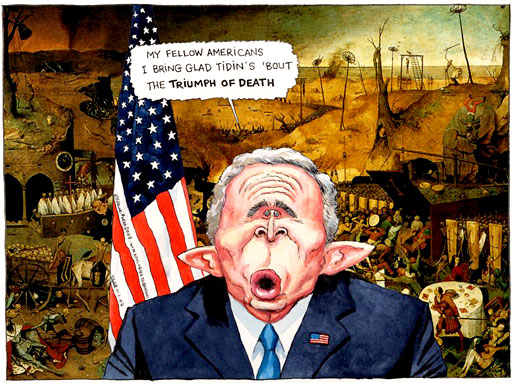
So into the graveyard of Iraq, George Bush, commander-in-chief, is to send another 21,000 of his soldiers. The march of folly is to continue...
Published: 11 January 2007
There will be timetables, deadlines, benchmarks, goals for both America and its Iraqi satraps. But the war against terror can still be won. We shall prevail. Victory or death. And it shall be death.
President Bush's announcement early this morning tolled every bell. A billion dollars of extra aid for Iraq, a diary of future success as the Shia powers of Iraq still to be referred to as the "democratically elected government" march in lockstep with America's best men and women to restore order and strike fear into the hearts of al-Qa'ida. It will take time oh, yes, it will take years, at least three in the words of Washington's top commander in the field, General Raymond Odierno this week but the mission will be accomplished.
Mission accomplished. Wasn't that the refrain almost four years ago, on that lonely aircraft carrier off California, Bush striding the deck in his flying suit? And only a few months later, the President had a message for Osama bin Laden and the insurgents of Iraq. "Bring 'em on!" he shouted. And on they came. Few paid attention late last year when the Islamist leadership of this most ferocious of Arab rebellions proclaimed Bush a war criminal but asked him not to withdraw his troops. "We haven't yet killed enough of them," their videotaped statement announced.
Well, they will have their chance now. How ironic that it was the ghastly Saddam, dignified amid his lynch mob, who dared on the scaffold to tell the truth which Bush and Blair would not utter: that Iraq has become "hell" .
It is de rigueur, these days, to recall Vietnam, the false victories, the body counts, the torture and the murders but history is littered with powerful men who thought they could batter their way to victory against the odds. Napoleon comes to mind; not the emperor who retreated from Moscow, but the man who believed the wild guerrilleros of French-occupied Spain could be liquidated. He tortured them, he executed them, he propped up a local Spanish administration of what we would now call Quislings, al-Malikis to a man. He rightly accused his enemies Moore and Wellington of supporting the insurgents. And when faced with defeat, Napoleon took the personal decision "to relaunch the machine" and advanced to recapture Madrid, just as Bush intends to recapture Baghdad. Of course, it ended in disaster. And George Bush is no Napoleon Bonaparte.
No, I would turn to another, less flamboyant, far more modern politician for prophecy, an American who understood, just before the 2003 launch of Bush's illegal invasion of Iraq, what would happen to the arrogance of power. For their relevance this morning, the words of the conservative politician Pat Buchanan deserve to be written in marble:
"We will soon launch an imperial war on Iraq with all the 'On to Berlin' bravado with which French poilus and British tommies marched in August 1914. But this invasion will not be the cakewalk neoconservatives predict ... For a militant Islam that holds in thrall scores of millions of true believers will never accept George Bush dictating the destiny of the Islamic world ...
"The one endeavour at which Islamic peoples excel is expelling imperial powers by terror and guerrilla war. They drove the Brits out of Palestine and Aden, the French out of Algeria, the Russians out of Afghanistan, the Americans out of Somalia and Beirut, the Israelis out of Lebanon... We have started up the road to empire and over the next hill we will meet those who went before."
But George Bush dare not see these armies of the past, their ghosts as palpable as the phantoms of the 3,000 Americans let us forget the hundreds of thousands of Iraqis already done to death in this obscene war, and those future spirits of the dead still living amid the 20,000 men and women whom Bush is now sending to Iraq. In Baghdad, they will move into both Sunni and Shia "insurgent strongholds" as opposed to just the Sunni variety which they vainly invested in the autumn because this time, and again I quote General Odierno, it is crucial the security plan be " evenhanded". This time, he said, "we have to have a believable approach, of going after Sunni and Shia extremists".
But a "believable approach" is what Bush does not have. The days of even-handed oppression disappeared in the aftermath of invasion.
"Democracy" should have been introduced at the start not delayed until the Shias threatened to join the insurgency if Paul Bremer, America's second proconsul, did not hold elections just as the American military should have prevented the anarchy of April 2003. The killing of 14 Sunni civilians by US paratroopers at Fallujah that spring set the seal on the insurgency. Yes, Syria and Iran could help George Bush. But Tehran was part of his toytown "Axis of Evil", Damascus a mere satellite. They were to be future prey, once Project Iraq proved successful. Then there came the shame of our torture, our murders, the mass ethnic cleansing in the land we said we had liberated.
And so more US troops must die, sacrificed for those who have already died. We cannot betray those who have been killed. It is a lie, of course. Every desperate man keeps gambling, preferably with other men's lives.
But the Bushes and Blairs have experienced war through television and Hollywood; this is both their illusion and their shield.
Churchills have gone, used as a wardrobe for a prime minister who lied to his people and a president who, given the chance to fight for his country, felt his Vietnam mission was to defend the skies over Texas.
But still he talks of victory, as ignorant of the past as he is of the future.
Pat Buchanan ended his prophecy with imperishable words: "The only lesson we learn from history is that we do not learn from history."
The Bush plan, and the question of withdrawal What Bush says 20,000 troops increase
Mistake of not sending sufficient troops must be rectified. Troops stabilise Baghdad and reinforce Anbar province, on condition that Iraqis take on Shia militias
$1bn reconstruction aid
Fresh funds will help create jobs and stimulate economy to show Iraqis there can be a peace dividend, and friendly Middle East states should help out too
Pullout
US commitment to Iraq is not open-ended but no timetable for troop withdrawal, even though US troops are expected to hand control to Iraqis by November
What Congress says 20,000 troops increase
Troop build-up is a mistake. House expected to vote on increase, Senate legislation forces Bush to seek congressional approval but neither move could block troop deployment
$1bn reconstruction aid
Don't throw good money after bad. US has squandered billions since the invasion and Democrats plan investigation. Millions of dollars 'overpaid' by Pentagon to Iraq contractors
Pullout
Bush has not learnt the lesson of November's mid-term elections which gave Democrats control of the House and Senate on the platform of a phased withdrawal from Iraq
What Baker says
20,000 troops increase
Up to 20,000 military trainers and troops embedded into and supporting Iraqi army, while combat troops drawn down to avoid increase in total numbers
$1bn reconstruction aid
US economic assistance should be boosted to $5bn per year. US should take anti-corruption measures by posting oil contracts on the internet for outside scrutiny
Pullout
All US combat troops not needed for force protection should be out of Iraq by the first quarter of 2008
Likely outcome 20,000 troops increase
Escalation of conflict
Money will be wasted, with official corruption in Iraq said to drain $7bn a year
Pullout
Troop surge could disguise 'cut and run' depending on the circumstances in both Iraq and America
Wednesday, January 10, 2007
The Dennis Kucinich Plan For Iraq
By Dennis Kucinich
01/10/07 "Information Clearing House" -- -- In November of 2006, after an October upsurge in violence in Iraq, the American people moved decisively to reject Republican rule, principally because of the conduct of the war. Democratic leaders well understand we regained control of the Congress because of the situation in Iraq. However, two months later, the Congress is still searching for a plan around which it can unite to hasten the end of US involvement in Iraq and the return home of 140,000 US troops.
There is a compelling need for a new direction in Iraq, one that recognizes the plight of the people of Iraq, the false and illegal basis of the United States war against Iraq, the realities on the ground which make a military resolution of the conflict unrealistic and the urgent responsibility of the United States, which caused the chaos, to use the process of diplomacy and international law to achieve stability in Iraq, a process which will establish peace and stability in Iraq allow our troops to return home with dignity.
The Administration is preparing to escalate the conflict. They intend to increase troop numbers to unprecedented levels, without establishing an ending date for the so-called troop surge. By definition, this escalation means a continuation of the occupation, more troop and civilian casualties, more anger toward the US, more support for the insurgency, more instability in Iraq and in the region, and prolonged civil war at a time when there is a general agreement in the world community that the solution in Iraq must be political not military. Iraq is now a training ground for insurgents who practice against our troops.
What is needed is a comprehensive political process. And the decision is not President Bush's alone to make.
Congress, as a coequal branch of government has a responsibility to assist in the initiation of this process. Congress, under Article 1, Section 8 of the US Constitution has the war-making power. Congress appropriates funds for the war. Congress does not dispense with its obligation to the American people simply by opposing a troop surge in Iraq.
There are 140,000 troops remaining in Iraq right now. What about them? When will they come home? Why would we leave those troops in Iraq when we have the money to bring them home? Soon the President will ask for more money for the war. Why would Congress appropriate more money to keep the troops in Iraq through the end of President Bush's term, at a total cost of upwards of two trillion dollars and thousands of more troop casualties, when military experts say there is no military solution? Our soldiers stand for us in the field, we must to stand for them in our legislature by bringing them home.
It is simply not credible to maintain that one opposes the war and yet continues to fund it. This contradiction runs as a deep fault line through our politics, undermining public trust in the political process and in those elected to represent the people. If you oppose the war, then do not vote to fund it.
If you have money which can be used to bring the troops home or to prosecute the war, do not say you want to bring the troops home while you appropriate money in a supplemental to keep them in Iraq fighting a war that cannot be won militarily. This is why the Administration should be notified now that Congress will not approve of the appropriations request of up to $160 billion in the spring for the purposes of continuing the occupation and the war. Continuing to fund the war is not a plan. It would represent the continuation of disaster.
The US sent our troops into Iraq without a clear mission. We created a financial, military and moral dilemma for our nation and now we are talking about the Iraq war as our problem. The Iraqis are forgotten. Their country has been destroyed: 650,000 casualties, [based on the Lancet Report which surveyed casualties from March of 2003 to July of 2006] the shredding of the social fabric of the nation, civil war, lack of access to food, shelter, electricity, clean drinking water and health care because this Administration, with the active participation of the Congress, authorized a war without reason, without conscience, without international law.
The US thinks in terms of solving our own military, strategic, logistical, and political problems. The US can determine how to solve our problems, but the Iraqi people will have problems far into the future. This requires an intensive focus on the processes needed to stabilize Iraq. If you solve the Iraqi problem you solve the US problem. Any comprehensive plan for Iraq must take into account as a primary matter the conditions and the needs of the Iraqi people, while providing our nation with a means of righting grievous wrongs and taking steps to regain US credibility and felicity within the world community.
I am offering such a plan today. This plan responds to the concerns of a majority of Americans. On Tuesday, when Congress resumes its work, I will present this plan to leadership and members as the only viable alternative to the Bush Administration's policy of continued occupation and escalation. Congress must know that it cannot and must not stand by and watch our troops and innocent Iraqi civilians die.
These are the elements of the Kucinich Plan:
1. The US announces it will end the occupation, close military bases and withdraw. The insurgency has been fueled by the occupation and the prospect of a long-term presence as indicated by the building of permanent bases. A US declaration of an intention to withdraw troops and close bases will help dampen the insurgency which has been inspired to resist colonization and fight invaders and those who have supported US policy. Furthermore this will provide an opening where parties within Iraq and in the region can set the stage for negotiations towards peaceful settlement.
2. US announces that it will use existing funds to bring the troops and necessary equipment home. Congress appropriated $70 billion in bridge funds on October 1st for the war. Money from this and other DOD accounts can be used to fund the troops in the field over the next few months, and to pay for the cost of the return of the troops, (which has been estimated at between $5 and $7 billion dollars) while a political settlement is being negotiated and preparations are made for a transition to an international security and peacekeeping force.
3. Order a simultaneous return of all US contractors to the United States and turn over all contracting work to the Iraqi government. The contracting process has been rife with world-class corruption, with contractors stealing from the US Government and cheating the Iraqi people, taking large contracts and giving 5% or so to Iraqi subcontractors.
Reconstruction activities must be reorganized and closely monitored in Iraq by the Iraqi government, with the assistance of the international community. The massive corruption as it relates to US contractors, should be investigated by congressional committees and federal grand juries. The lack of tangible benefits, the lack of accountability for billions of dollars, while millions of Iraqis do not have a means of financial support, nor substantive employment, cries out for justice.
It is noteworthy that after the first Gulf War, Iraqis reestablished electricity within three months, despite sanctions. Four years into the US occupation there is no water, nor reliable electricity in Baghdad, despite massive funding from the US and from the Madrid conference. The greatest mystery involves the activities of private security companies who function as mercenaries. Reports of false flag operations must be investigated by an international tribunal.
4. Convene a regional conference for the purpose of developing a security and stabilization force for Iraq. The focus should be on a process which solves the problems of Iraq. The US has told the international community, "This is our policy and we want you to come and help us implement it." The international community may have an interest in helping Iraq, but has no interest in participating in the implementation of failed US policy.
A shift in US policy away from unilateralism and toward cooperation will provide new opportunities for exploring common concerns about the plight of Iraq. The UN is the appropriate place to convene, through the office of the Secretary General, all countries that have interests, concerns and influence, including the five permanent members of the Security Council and the European community, and all Arab nations.
The end of the US occupation and the closing of military bases are necessary preconditions for such a conference. When the US creates a shift of policy and announces it will focus on the concerns of the people of Iraq, it will provide a powerful incentive for nations to participate.
It is well known that while some nations may see the instability in Iraq as an opportunity, there is also an even-present danger that the civil war in Iraq threatens the stability of nations throughout the region. The impending end of the occupation will provide a breakthrough for the cooperation between the US and the UN and the UN and countries of the region. The regional conference must include Iran, Syria, Egypt, Saudi Arabia and Jordan.
5. Prepare an international security and peacekeeping force to move in, replacing US troops who then return home. The UN has an indispensable role to play here, but cannot do it as long as the US is committed to an occupation. The UN is the only international organization with the ability to mobilize and the legitimacy to authorize troops.
The UN is the place to develop the process, to build the political consensus, to craft a political agreement, to prepare the ground for the peacekeeping mission, to implement the basis of an agreement that will end the occupation and begin the transition to international peacekeepers. This process will take at least three months from the time the US announces the intention to end the occupation.
The US will necessarily have to fund a peacekeeping mission, which, by definition will not require as many troops. Fifty percent of the peacekeeping troops must come from nations with large Muslim populations. The international security force, under UN direction, will remain in place until the Iraqi government is capable of handling its own security. The UN can field an international security and peacekeeping mission, but such an initiative will not take shape unless there is a peace to keep, and that will be dependent upon a political process which reaches agreement between all the Iraqi parties. Such an agreement means fewer troops will be needed.
According to UN sources, the UN the peacekeeping mission in the Congo, which is four times larger in area than Iraq, required about twenty thousand troops. Finally the UN does not mobilize quickly because they depend upon governments to supply the troops, and governments are slow. The ambition of the UN is to deploy in less than ninety days. However, without an agreement of parties the UN is not likely to approve a mission to Iraq, because countries will not give them troops.
6. Develop and fund a process of national reconciliation. The process of reconciliation must begin with a national conference, organized with the assistance of the UN and with the participation of parties who can create, participate in and affect the process of reconciliation, defined as an airing of all grievances and the creation of pathways toward open, transparent talks producing truth and resolution of grievances. The Iraqi government has indicated a desire for the process of reconciliation to take place around it, and that those who were opposed to the government should give up and join the government. Reconciliation must not be confused with capitulation, nor with realignments for the purposes of protecting power relationships.
For example, Kurds need to be assured that their own autonomy will be regarded and therefore obviate the need for the Kurds to align with religious Shia for the purposes of self-protection. The problem in Iraq is that every community is living in fear. The Shia, who are the majority fear they will not be allowed to government even though they are a majority. The Kurds are afraid they will lose the autonomy they have gained. The Sunnis think they will continue to be made to pay for the sins of Saddam.
A reconciliation process which brings people together is the only way to overcome their fears and reconcile their differences. It is essential to create a minimum of understanding and mutual confidence between the Shiites, Sunnis and Kurds.
But how can a reconciliation process be constructed in Iraq when there is such mistrust: Ethnic cleansing is rampant. The police get their money from the US and their ideas from Tehran. They function as religious militia, fighting for supremacy, while the Interior Ministry collaborates. Two or three million people have been displaced. When someone loses a family member, a loved one, a friend, the first response is likely to be that there is no reconciliation.
It is also difficult to move toward reconciliation when one or several parties engaged in the conflict think they can win outright. The Shia, some of whom are out for revenge, think they can win because they have the defacto support of the US. The end of the US occupation will enhance the opportunity for the Shia to come to an accommodation with the Sunnis. They have the oil, the weapons, and support from Iran. They have little interest in reconciling with those who are seen as Baathists.
The Sunnis think they have experience, as the former army of Saddam, boasting half a million people insurgents. The Sunnis have so much more experience and motivation that as soon as the Americans leave they believe they can defeat the Shia government. Any Sunni revenge impulses can be held in check by international peacekeepers. The only sure path toward reconciliation is through the political process. All factions and all insurgents not with al Queda must be brought together in a relentless process which involves Saudis, Turks and Iranians.
7. Reconstruction and Jobs. Restart the failed reconstruction program in Iraq. Rebuild roads, bridges, schools, hospitals, and other public facilities, houses, and factories with jobs and job training going to local Iraqis.
8. Reparations. The US and Great Britain have a high moral obligation to enable a peace process by beginning a program of significant reparations to the people of Iraq for the loss of lives, physical and emotional injuries, and damage to property. There should be special programs to rescue the tens of thousands of Iraqi orphans from lives of destitution. This is essential to enable reconciliation.
9. Political Sovereignty. Put an end to suspicions that the US invasion and occupation was influenced by a desire to gain control of Iraq's oil assets by A) setting aside initiatives to privatize Iraqi oil interests or other national assets, and B) by abandoning efforts to change Iraqi national law to facilitate privatization.
Any attempt to sell Iraqi oil assets during the US occupation will be a significant stumbling block to peaceful resolution. The current Iraqi constitution gives oil proceeds to the regions and the central government gets nothing. There must be fairness in the distribution of oil resources in Iraq. An Iraqi National Oil Trust should be established to guarantee the oil assets will be used to create a fully functioning infrastructure with financial mechanisms established protect the oil wealth for the use of the people of Iraq.
10. Iraq Economy. Set forth a plan to stabilize Iraq's cost for food and energy, on par to what the prices were before the US invasion and occupation. This would block efforts underway to raise the price of food and energy at a time when most Iraqis do not have the means to meet their own needs.
11. Economic Sovereignty. Work with the world community to restore Iraq's fiscal integrity without structural readjustment measures of the IMF or the World Bank.
12. International Truth and Reconciliation. Establish a policy of truth and reconciliation between the people of the United States and the people of Iraq. In 2002, I led the effort in the House of Representatives challenging the Bush Administration's plans to go to war in Iraq. I organized 125 Democrats to vote against the Iraq war resolution. The analysis I offered at that time stands out in bold relief for its foresight when compared to the assessments of many who today aspire to national leadership. Just as the caution I urged four years ago was well-placed, so the plan I am presenting today is workable, and it responds to the will of the American people, expressed this past November. This is a moment for clarity and foresight. This is a moment to take a new direction in Iraq. One with honor and dignity. One which protects our troops and rescues Iraqi civilians. One which repairs our relationship with Iraqis and with the world.
01/10/07 "Information Clearing House" -- -- In November of 2006, after an October upsurge in violence in Iraq, the American people moved decisively to reject Republican rule, principally because of the conduct of the war. Democratic leaders well understand we regained control of the Congress because of the situation in Iraq. However, two months later, the Congress is still searching for a plan around which it can unite to hasten the end of US involvement in Iraq and the return home of 140,000 US troops.
There is a compelling need for a new direction in Iraq, one that recognizes the plight of the people of Iraq, the false and illegal basis of the United States war against Iraq, the realities on the ground which make a military resolution of the conflict unrealistic and the urgent responsibility of the United States, which caused the chaos, to use the process of diplomacy and international law to achieve stability in Iraq, a process which will establish peace and stability in Iraq allow our troops to return home with dignity.
The Administration is preparing to escalate the conflict. They intend to increase troop numbers to unprecedented levels, without establishing an ending date for the so-called troop surge. By definition, this escalation means a continuation of the occupation, more troop and civilian casualties, more anger toward the US, more support for the insurgency, more instability in Iraq and in the region, and prolonged civil war at a time when there is a general agreement in the world community that the solution in Iraq must be political not military. Iraq is now a training ground for insurgents who practice against our troops.
What is needed is a comprehensive political process. And the decision is not President Bush's alone to make.
Congress, as a coequal branch of government has a responsibility to assist in the initiation of this process. Congress, under Article 1, Section 8 of the US Constitution has the war-making power. Congress appropriates funds for the war. Congress does not dispense with its obligation to the American people simply by opposing a troop surge in Iraq.
There are 140,000 troops remaining in Iraq right now. What about them? When will they come home? Why would we leave those troops in Iraq when we have the money to bring them home? Soon the President will ask for more money for the war. Why would Congress appropriate more money to keep the troops in Iraq through the end of President Bush's term, at a total cost of upwards of two trillion dollars and thousands of more troop casualties, when military experts say there is no military solution? Our soldiers stand for us in the field, we must to stand for them in our legislature by bringing them home.
It is simply not credible to maintain that one opposes the war and yet continues to fund it. This contradiction runs as a deep fault line through our politics, undermining public trust in the political process and in those elected to represent the people. If you oppose the war, then do not vote to fund it.
If you have money which can be used to bring the troops home or to prosecute the war, do not say you want to bring the troops home while you appropriate money in a supplemental to keep them in Iraq fighting a war that cannot be won militarily. This is why the Administration should be notified now that Congress will not approve of the appropriations request of up to $160 billion in the spring for the purposes of continuing the occupation and the war. Continuing to fund the war is not a plan. It would represent the continuation of disaster.
The US sent our troops into Iraq without a clear mission. We created a financial, military and moral dilemma for our nation and now we are talking about the Iraq war as our problem. The Iraqis are forgotten. Their country has been destroyed: 650,000 casualties, [based on the Lancet Report which surveyed casualties from March of 2003 to July of 2006] the shredding of the social fabric of the nation, civil war, lack of access to food, shelter, electricity, clean drinking water and health care because this Administration, with the active participation of the Congress, authorized a war without reason, without conscience, without international law.
The US thinks in terms of solving our own military, strategic, logistical, and political problems. The US can determine how to solve our problems, but the Iraqi people will have problems far into the future. This requires an intensive focus on the processes needed to stabilize Iraq. If you solve the Iraqi problem you solve the US problem. Any comprehensive plan for Iraq must take into account as a primary matter the conditions and the needs of the Iraqi people, while providing our nation with a means of righting grievous wrongs and taking steps to regain US credibility and felicity within the world community.
I am offering such a plan today. This plan responds to the concerns of a majority of Americans. On Tuesday, when Congress resumes its work, I will present this plan to leadership and members as the only viable alternative to the Bush Administration's policy of continued occupation and escalation. Congress must know that it cannot and must not stand by and watch our troops and innocent Iraqi civilians die.
These are the elements of the Kucinich Plan:
1. The US announces it will end the occupation, close military bases and withdraw. The insurgency has been fueled by the occupation and the prospect of a long-term presence as indicated by the building of permanent bases. A US declaration of an intention to withdraw troops and close bases will help dampen the insurgency which has been inspired to resist colonization and fight invaders and those who have supported US policy. Furthermore this will provide an opening where parties within Iraq and in the region can set the stage for negotiations towards peaceful settlement.
2. US announces that it will use existing funds to bring the troops and necessary equipment home. Congress appropriated $70 billion in bridge funds on October 1st for the war. Money from this and other DOD accounts can be used to fund the troops in the field over the next few months, and to pay for the cost of the return of the troops, (which has been estimated at between $5 and $7 billion dollars) while a political settlement is being negotiated and preparations are made for a transition to an international security and peacekeeping force.
3. Order a simultaneous return of all US contractors to the United States and turn over all contracting work to the Iraqi government. The contracting process has been rife with world-class corruption, with contractors stealing from the US Government and cheating the Iraqi people, taking large contracts and giving 5% or so to Iraqi subcontractors.
Reconstruction activities must be reorganized and closely monitored in Iraq by the Iraqi government, with the assistance of the international community. The massive corruption as it relates to US contractors, should be investigated by congressional committees and federal grand juries. The lack of tangible benefits, the lack of accountability for billions of dollars, while millions of Iraqis do not have a means of financial support, nor substantive employment, cries out for justice.
It is noteworthy that after the first Gulf War, Iraqis reestablished electricity within three months, despite sanctions. Four years into the US occupation there is no water, nor reliable electricity in Baghdad, despite massive funding from the US and from the Madrid conference. The greatest mystery involves the activities of private security companies who function as mercenaries. Reports of false flag operations must be investigated by an international tribunal.
4. Convene a regional conference for the purpose of developing a security and stabilization force for Iraq. The focus should be on a process which solves the problems of Iraq. The US has told the international community, "This is our policy and we want you to come and help us implement it." The international community may have an interest in helping Iraq, but has no interest in participating in the implementation of failed US policy.
A shift in US policy away from unilateralism and toward cooperation will provide new opportunities for exploring common concerns about the plight of Iraq. The UN is the appropriate place to convene, through the office of the Secretary General, all countries that have interests, concerns and influence, including the five permanent members of the Security Council and the European community, and all Arab nations.
The end of the US occupation and the closing of military bases are necessary preconditions for such a conference. When the US creates a shift of policy and announces it will focus on the concerns of the people of Iraq, it will provide a powerful incentive for nations to participate.
It is well known that while some nations may see the instability in Iraq as an opportunity, there is also an even-present danger that the civil war in Iraq threatens the stability of nations throughout the region. The impending end of the occupation will provide a breakthrough for the cooperation between the US and the UN and the UN and countries of the region. The regional conference must include Iran, Syria, Egypt, Saudi Arabia and Jordan.
5. Prepare an international security and peacekeeping force to move in, replacing US troops who then return home. The UN has an indispensable role to play here, but cannot do it as long as the US is committed to an occupation. The UN is the only international organization with the ability to mobilize and the legitimacy to authorize troops.
The UN is the place to develop the process, to build the political consensus, to craft a political agreement, to prepare the ground for the peacekeeping mission, to implement the basis of an agreement that will end the occupation and begin the transition to international peacekeepers. This process will take at least three months from the time the US announces the intention to end the occupation.
The US will necessarily have to fund a peacekeeping mission, which, by definition will not require as many troops. Fifty percent of the peacekeeping troops must come from nations with large Muslim populations. The international security force, under UN direction, will remain in place until the Iraqi government is capable of handling its own security. The UN can field an international security and peacekeeping mission, but such an initiative will not take shape unless there is a peace to keep, and that will be dependent upon a political process which reaches agreement between all the Iraqi parties. Such an agreement means fewer troops will be needed.
According to UN sources, the UN the peacekeeping mission in the Congo, which is four times larger in area than Iraq, required about twenty thousand troops. Finally the UN does not mobilize quickly because they depend upon governments to supply the troops, and governments are slow. The ambition of the UN is to deploy in less than ninety days. However, without an agreement of parties the UN is not likely to approve a mission to Iraq, because countries will not give them troops.
6. Develop and fund a process of national reconciliation. The process of reconciliation must begin with a national conference, organized with the assistance of the UN and with the participation of parties who can create, participate in and affect the process of reconciliation, defined as an airing of all grievances and the creation of pathways toward open, transparent talks producing truth and resolution of grievances. The Iraqi government has indicated a desire for the process of reconciliation to take place around it, and that those who were opposed to the government should give up and join the government. Reconciliation must not be confused with capitulation, nor with realignments for the purposes of protecting power relationships.
For example, Kurds need to be assured that their own autonomy will be regarded and therefore obviate the need for the Kurds to align with religious Shia for the purposes of self-protection. The problem in Iraq is that every community is living in fear. The Shia, who are the majority fear they will not be allowed to government even though they are a majority. The Kurds are afraid they will lose the autonomy they have gained. The Sunnis think they will continue to be made to pay for the sins of Saddam.
A reconciliation process which brings people together is the only way to overcome their fears and reconcile their differences. It is essential to create a minimum of understanding and mutual confidence between the Shiites, Sunnis and Kurds.
But how can a reconciliation process be constructed in Iraq when there is such mistrust: Ethnic cleansing is rampant. The police get their money from the US and their ideas from Tehran. They function as religious militia, fighting for supremacy, while the Interior Ministry collaborates. Two or three million people have been displaced. When someone loses a family member, a loved one, a friend, the first response is likely to be that there is no reconciliation.
It is also difficult to move toward reconciliation when one or several parties engaged in the conflict think they can win outright. The Shia, some of whom are out for revenge, think they can win because they have the defacto support of the US. The end of the US occupation will enhance the opportunity for the Shia to come to an accommodation with the Sunnis. They have the oil, the weapons, and support from Iran. They have little interest in reconciling with those who are seen as Baathists.
The Sunnis think they have experience, as the former army of Saddam, boasting half a million people insurgents. The Sunnis have so much more experience and motivation that as soon as the Americans leave they believe they can defeat the Shia government. Any Sunni revenge impulses can be held in check by international peacekeepers. The only sure path toward reconciliation is through the political process. All factions and all insurgents not with al Queda must be brought together in a relentless process which involves Saudis, Turks and Iranians.
7. Reconstruction and Jobs. Restart the failed reconstruction program in Iraq. Rebuild roads, bridges, schools, hospitals, and other public facilities, houses, and factories with jobs and job training going to local Iraqis.
8. Reparations. The US and Great Britain have a high moral obligation to enable a peace process by beginning a program of significant reparations to the people of Iraq for the loss of lives, physical and emotional injuries, and damage to property. There should be special programs to rescue the tens of thousands of Iraqi orphans from lives of destitution. This is essential to enable reconciliation.
9. Political Sovereignty. Put an end to suspicions that the US invasion and occupation was influenced by a desire to gain control of Iraq's oil assets by A) setting aside initiatives to privatize Iraqi oil interests or other national assets, and B) by abandoning efforts to change Iraqi national law to facilitate privatization.
Any attempt to sell Iraqi oil assets during the US occupation will be a significant stumbling block to peaceful resolution. The current Iraqi constitution gives oil proceeds to the regions and the central government gets nothing. There must be fairness in the distribution of oil resources in Iraq. An Iraqi National Oil Trust should be established to guarantee the oil assets will be used to create a fully functioning infrastructure with financial mechanisms established protect the oil wealth for the use of the people of Iraq.
10. Iraq Economy. Set forth a plan to stabilize Iraq's cost for food and energy, on par to what the prices were before the US invasion and occupation. This would block efforts underway to raise the price of food and energy at a time when most Iraqis do not have the means to meet their own needs.
11. Economic Sovereignty. Work with the world community to restore Iraq's fiscal integrity without structural readjustment measures of the IMF or the World Bank.
12. International Truth and Reconciliation. Establish a policy of truth and reconciliation between the people of the United States and the people of Iraq. In 2002, I led the effort in the House of Representatives challenging the Bush Administration's plans to go to war in Iraq. I organized 125 Democrats to vote against the Iraq war resolution. The analysis I offered at that time stands out in bold relief for its foresight when compared to the assessments of many who today aspire to national leadership. Just as the caution I urged four years ago was well-placed, so the plan I am presenting today is workable, and it responds to the will of the American people, expressed this past November. This is a moment for clarity and foresight. This is a moment to take a new direction in Iraq. One with honor and dignity. One which protects our troops and rescues Iraqi civilians. One which repairs our relationship with Iraqis and with the world.
Another U.S. government theft of Cuban funds frozen in that country
STATEMENT from the Ministry of
Foreign Affairs
Another U.S. government theft of Cuban funds frozen in that country
THE Ministry of Foreign Affairs has learned that on November 27 in the United States, Cuban funds were stolen for the fourth time from money illegally frozen in U.S. banks after the triumph of the Revolution, under the so-called “Regulations for the Control of Cuban Assets,” passed on July 8, 1963, establishing, among other steps, the freezing of Cuban assets in the United States as part of the illegal and cruel policy of blockade against Cuba.
This shameless theft was carried out to satisfy legal rulings on spurious lawsuits filed against our country in U.S. courts by U.S. citizens Janet Ray Weininger and Dorothy Anderson McCarthy. These plaintiffs received a total of $72,126,884 from Cuban funds frozen in bank accounts of the National Bank of Cuba and the Cuban Telecommunications Enterprise (EMTELCUBA). In both cases, U.S. federal courts upheld the rulings issued by a Florida state court.
One of the suits against Cuba was filed in the 11th Judicial Circuit Court for Miami-Dade County, a Florida state court, by Janet Ray Weininger, the daughter of American pilot Thomas Willard Ray, falsely alleging that he was summarily executed on April 19, 1961 during the mercenary invasion of Playa Girón.
In reality, he was a pilot who an aggressor from the United States, a CIA agent who was shot down during the invasion and whose body remained preserved at the Cuban Institute of Legal Medicine for 18 years because the U.S. government concealed his identity and refused to admit to his U.S. citizenship, in order to not acknowledge its direct responsibility in that failed invasion. Finally, after steps taken by the Ray family and after the U.S. government admitted to the pilot’s identity and citizenship, it was possible to hand over his body to his family in 1979.
In response to the other lawsuit, filed by Dorothy Anderson McCarthy, the abovementioned state court accepted charges of the supposed torture and extrajudicial execution of U.S. citizen Howard F. Anderson without any proof, and when in reality, he was a U.S. citizen who was tried on April 18, 1961 by the Revolutionary Court of Pinar del Río in Case No. 97 of that year for his subversive activities on behalf of the U.S. government and against the Cuban people, and sentenced to the death penalty.
Anderson had been detained by State Security forces on March 26, 1961, a few weeks before the Bay of Pigs invasion, for being a member of a group of former soldiers at the services of the dictatorship, members of the terrorist groups “Anti-communist Civic Association” (ACA) and “Democratic Revolutionary Front” (FRD), which were preparing armed uprisings, implementing instructions from the CIA. Eight tons of weapons were seized from Anderson’s group, which had buried them on the southern coast of Pinar del Río, and which had been brought to Cuba on February 22, 1961 by a boat with U.S. registration, in a CIA-directed operation. Investigations confirmed that Anderson, who was using the pseudonym “Lee” in Cuba, was the CIA’s liaison with the abovementioned counterrevolutionary organizations in Cuba.
During the processing of the lawsuits against Cuba that have now resulted in another theft of our frozen funds, the U.S. government acted with total complicity with the plaintiffs, arguing that U.S. law permitted the use of those funds to satisfy the rulings favoring the plaintiffs, and therefore that the Treasury Department could not place the slightest obstacle in the way, and even exempted them from obtaining licenses to be able to take possession of the funds.
These actions against Cuba are based on the arbitrary and politicized manipulation of the U.S. government designation of our country as a supposed “state sponsor of international terrorism,” as well as a distorted interpretation of U.S. laws themselves.
It is totally unacceptable for the Cuban state to be accused of the commission of supposed acts of terrorism against U.S. citizens. On the contrary, it has been precisely acts of terrorism and armed attacks against Cuba, perpetrated from that country, that have caused thousands of deaths and serious physical and psychological injuries to Cuban citizens, as well as extensive damages and economic harm to our country.
These and other, similar lawsuits filed in U.S. courts lack validity and legitimacy for Cuba, given they are based on totally false and manipulated arguments, constituting legal aberrations that can only be accommodated by and sustained on the irrational and hostile U.S. government policies toward Cuba.
The Cuban state has repeatedly exposed the illegal actions by successive U.S. administrations using Cuban funds illegally frozen in that country. In the past, these funds have been stolen by the decision or consent of several presidents and by the U.S. Congress itself, on the dates of October 2, 1996; February 12, 2001; and April 29, 2005, to “compensate” representatives of the terrorist mafia in Miami, particularly the families of pilots from the counterrevolutionary organization “Brothers to the Rescue” who were shot down on February 24, 1996 for repeatedly violating our airspace.
With the recent attack on Cuban financial assets frozen in U.S. banks, a total of $170,233,536 in funds has been stolen from our country.
The Ministry of Foreign Affairs accuses the U.S. government of making yet another unilateral decision to steal Cuban financial assets and therefore flagrantly failing to comply with its obligations to protect and watch over the absolute integrity of those funds, which belong to Cuban institutions.
The Cuban government does not recognize the jurisdiction of U.S. courts to judge the Republic of Cuba. Neither the U.S. government nor the legal agencies of that country have the legitimate right to hand over frozen Cuban funds to terrorist groups or to families of U.S. citizens involved in aggression against our country, thus directly encouraging this type of activity.
The Cuban government condemns these most recent attacks on Cuban funds frozen in the United States, given that they constitute actions in violation of international law and are yet another expression of the criminal U.S. government policy of blockade and hostility against our country.
Cuba will never renounce its right to demand that full responsibility should be taken by the U.S. government for the theft down to the last cent of funds that are legitimately ours.
Havana, January 10, 2007
Foreign Affairs
Another U.S. government theft of Cuban funds frozen in that country
THE Ministry of Foreign Affairs has learned that on November 27 in the United States, Cuban funds were stolen for the fourth time from money illegally frozen in U.S. banks after the triumph of the Revolution, under the so-called “Regulations for the Control of Cuban Assets,” passed on July 8, 1963, establishing, among other steps, the freezing of Cuban assets in the United States as part of the illegal and cruel policy of blockade against Cuba.
This shameless theft was carried out to satisfy legal rulings on spurious lawsuits filed against our country in U.S. courts by U.S. citizens Janet Ray Weininger and Dorothy Anderson McCarthy. These plaintiffs received a total of $72,126,884 from Cuban funds frozen in bank accounts of the National Bank of Cuba and the Cuban Telecommunications Enterprise (EMTELCUBA). In both cases, U.S. federal courts upheld the rulings issued by a Florida state court.
One of the suits against Cuba was filed in the 11th Judicial Circuit Court for Miami-Dade County, a Florida state court, by Janet Ray Weininger, the daughter of American pilot Thomas Willard Ray, falsely alleging that he was summarily executed on April 19, 1961 during the mercenary invasion of Playa Girón.
In reality, he was a pilot who an aggressor from the United States, a CIA agent who was shot down during the invasion and whose body remained preserved at the Cuban Institute of Legal Medicine for 18 years because the U.S. government concealed his identity and refused to admit to his U.S. citizenship, in order to not acknowledge its direct responsibility in that failed invasion. Finally, after steps taken by the Ray family and after the U.S. government admitted to the pilot’s identity and citizenship, it was possible to hand over his body to his family in 1979.
In response to the other lawsuit, filed by Dorothy Anderson McCarthy, the abovementioned state court accepted charges of the supposed torture and extrajudicial execution of U.S. citizen Howard F. Anderson without any proof, and when in reality, he was a U.S. citizen who was tried on April 18, 1961 by the Revolutionary Court of Pinar del Río in Case No. 97 of that year for his subversive activities on behalf of the U.S. government and against the Cuban people, and sentenced to the death penalty.
Anderson had been detained by State Security forces on March 26, 1961, a few weeks before the Bay of Pigs invasion, for being a member of a group of former soldiers at the services of the dictatorship, members of the terrorist groups “Anti-communist Civic Association” (ACA) and “Democratic Revolutionary Front” (FRD), which were preparing armed uprisings, implementing instructions from the CIA. Eight tons of weapons were seized from Anderson’s group, which had buried them on the southern coast of Pinar del Río, and which had been brought to Cuba on February 22, 1961 by a boat with U.S. registration, in a CIA-directed operation. Investigations confirmed that Anderson, who was using the pseudonym “Lee” in Cuba, was the CIA’s liaison with the abovementioned counterrevolutionary organizations in Cuba.
During the processing of the lawsuits against Cuba that have now resulted in another theft of our frozen funds, the U.S. government acted with total complicity with the plaintiffs, arguing that U.S. law permitted the use of those funds to satisfy the rulings favoring the plaintiffs, and therefore that the Treasury Department could not place the slightest obstacle in the way, and even exempted them from obtaining licenses to be able to take possession of the funds.
These actions against Cuba are based on the arbitrary and politicized manipulation of the U.S. government designation of our country as a supposed “state sponsor of international terrorism,” as well as a distorted interpretation of U.S. laws themselves.
It is totally unacceptable for the Cuban state to be accused of the commission of supposed acts of terrorism against U.S. citizens. On the contrary, it has been precisely acts of terrorism and armed attacks against Cuba, perpetrated from that country, that have caused thousands of deaths and serious physical and psychological injuries to Cuban citizens, as well as extensive damages and economic harm to our country.
These and other, similar lawsuits filed in U.S. courts lack validity and legitimacy for Cuba, given they are based on totally false and manipulated arguments, constituting legal aberrations that can only be accommodated by and sustained on the irrational and hostile U.S. government policies toward Cuba.
The Cuban state has repeatedly exposed the illegal actions by successive U.S. administrations using Cuban funds illegally frozen in that country. In the past, these funds have been stolen by the decision or consent of several presidents and by the U.S. Congress itself, on the dates of October 2, 1996; February 12, 2001; and April 29, 2005, to “compensate” representatives of the terrorist mafia in Miami, particularly the families of pilots from the counterrevolutionary organization “Brothers to the Rescue” who were shot down on February 24, 1996 for repeatedly violating our airspace.
With the recent attack on Cuban financial assets frozen in U.S. banks, a total of $170,233,536 in funds has been stolen from our country.
The Ministry of Foreign Affairs accuses the U.S. government of making yet another unilateral decision to steal Cuban financial assets and therefore flagrantly failing to comply with its obligations to protect and watch over the absolute integrity of those funds, which belong to Cuban institutions.
The Cuban government does not recognize the jurisdiction of U.S. courts to judge the Republic of Cuba. Neither the U.S. government nor the legal agencies of that country have the legitimate right to hand over frozen Cuban funds to terrorist groups or to families of U.S. citizens involved in aggression against our country, thus directly encouraging this type of activity.
The Cuban government condemns these most recent attacks on Cuban funds frozen in the United States, given that they constitute actions in violation of international law and are yet another expression of the criminal U.S. government policy of blockade and hostility against our country.
Cuba will never renounce its right to demand that full responsibility should be taken by the U.S. government for the theft down to the last cent of funds that are legitimately ours.
Havana, January 10, 2007
Washington and Its Contempt for the Venezuelan People - The History of Democracy Prevention in Venezuela - Part 2
by Chris Carlson
January 09, 2007
"Long live El Mocho Hernández!" cried Venezuelan dissidents and rebels more than one hundred years ago. The battle cry of a popular movement at the end of the 19th century, "El Mocho" referred to José Manuel Hernández, a wildly popular leader and candidate for president in 1897. But he was a little too popular for Washington's liking.
After years of dictatorship, El Mocho represented a wide array of groups in Venezuela that had grown unhappy with the ruling Caracas elite who centralized power in their hands. He called for free, open elections, free public education, a crackdown on corruption, and decentralization of power among other things. He wanted to give the right to vote to all males over age 18. After years of political exclusion of the masses, they were calling for a more participatory form of democracy. These were hardly radical demands.
But for Washington, closely allied to the elite class in Venezuela, this popular movement was dangerous to their interests. The U.S. minister to Venezuela warned of spreading anti-Americanism among the "unenlightened" classes.(1) The "unenlightened" meant the popular classes, the poor majority of the population. As Washington saw it, only the wealthy, educated people could have control: the stupid majority should be denied any power. If a popular movement could take power, they would certainly transform the elite-dominated system, and the elite would lose their privileges. Washington could lose control.
The conflict going on in Venezuela today with Hugo Chávez and the Bolivarian Revolution has exactly the same basis. In order to gain any popular representation and participation in the political system, the masses have struggled and fought for centuries against elite domination. The U.S. has been working against them all the way to the present. The Venezuelan masses who support Hugo Chávez today are demanding basically the same thing as those who supported El Mocho Hernández over a century ago; a real democracy with popular participation.
Dating back from the times of colonialism, a small elite class had always controlled and benefited from Venezuela's resources. The vast majority of the population has been neglected and were always excluded. The country was never developed nor modernized, very little industry was created, and the masses had neither job opportunities nor access to education. The economy has always been based on enriching a small minority with the export of primary resources, leaving everyone else out. The trick has been maintaining this undemocratic structure, which means preventing the majority from becoming involved.
Fear of the popular leader El Mocho led the U.S. minister to Venezuela, along with the Venezuelan elite class, to endorse El Mocho's conservative opponent, Ignacio Andrade.(2) According to them, the rural folk and popular masses that supported El Mocho couldn't be taken seriously as they were not "responsible" enough for full political participation. Both U.S. officials and the local elite showed their contempt for democracy when they agreed that the majority of the Venezuelan population should not play a role in politics until they had matured and "acquired the necessary culture." The people were not yet "ready" to participate.(3) When massive fraud stole the victory from El Mocho, Andrade took power even though it was obvious he was not the favorite of the majority. El Mocho Hernández represented the desire for popular participation and would be revered for decades by the excluded masses. However, Washington was relieved; another popular movement had been sidelined, the threat of democracy avoided.
Dictatorship: The Solution to the "Problem" of Democracy
Preferable to Washington was the brutal, iron-fisted dictator, Juan Vicente Gómez who came to power a decade later. Dictatorship was much less risky, mostly because it was allied to elite interests and seldom challenged Washington's hegemony. Gómez ruled for nearly three decades until his death in 1935. During that time he prohibited all political parties and elections. Political opponents were jailed, tortured, and killed. He was very unpopular among the masses, but the Venezuelan elite class and Washington were pleased. The "backwardness" and "racially inferiority" of the Venezuelan masses made a "popular form of government next to impossible."(4)
For the U.S. oil companies, the Gómez regime was extremely friendly. When oil was first discovered in Venezuela in the 1920's he allowed the oil companies to write Venezuela's oil legislation to their liking.(5) For the next two decades they would profit handsomely from Venezuela's oil, and the growth of the oil industry allowed Gómez and the elite class to build their own fortunes.(6)
Other U.S. businesses also benefited, as wealthy Venezuelans imported mostly U.S. manufactured goods. The vast oil incomes created an elite consumer class and U.S. entrepreneurs immediately saw the opportunity to import consumer products for the Venezuelan elite. U.S. corporations opened offices in Caracas.
But after decades of dictatorship throughout the beginning of the 20th century, another popular movement arose in the 1940's with the founding of a new political party, Acción Democrática (AD). After taking power through a coup, political reform was the first item on the agenda. AD declared universal suffrage for all citizens over eighteen, including women. All political parties were legalized, and open elections were finally held. For the first time in history, Venezuelans could all vote and choose their political representatives.(7)
The U.S. saw this popular movement as dangerous. The fact that AD had the support of the poor masses and labor groups meant they might actually make decisions in the interests of the majority. Of course, this is how a democracy is supposed to work, but for the U.S. and the Venezuelan elite, these would be the "wrong" decisions.(8)
A democratic system is the one thing that presents the biggest threat to the interests of the elite class and their Washington allies. Therefore, throughout the history of Venezuela the participation of the masses has always been prevented and carefully avoided. If the popular masses could, in some way, exercise power, they would surely make decisions that would go drastically against elite interests. Most likely they would try to break their dependence on U.S. imports. Most definitely they would raise taxes on U.S. oil companies and use the increased revenues to improve basic services for the masses, like education, health, infrastructure; exactly what Hugo Chávez has done over the last few years.
In 1947, in the country's first ever open presidential elections, AD's candidate Romulo Gallegos won with 73% of the vote. Three of every four Venezuelans had voted for him, and he immediately began to push through a progressive program of reforms.(9) New laws increased taxes on the oil industry's profits, and public education was expanded. AD had raised the minimum wage and began to promote economic diversification. To the U.S. oil companies' dismay, the party came through on its promises to pursue "social justice and better working conditions for the workers."(10)
But Romulo Gallegos, the first ever popularly elected president in Venezuela, only lasted 10 months. He was overthrown by a military coup the same year he took power. A military dictatorship quickly reversed all of AD's progressive reforms and exercised ruthless control over the population for the next 10 years. Gallegos was kicked out of the country. The effective leader of the coup, Marcos Pérez Jiménez, exiled and jailed AD leaders, and repressed all political opposition to him. Political parties and peasant unions were outlawed.(11)
Domestic elites and their allies in Washington concurred that popular democracy was dangerous to their interests. A U.S. Minister in Caracas declared that "the people of Venezuela are not yet ready nor adequately prepared for democracy."(12) A few years later, in 1954, the Eisenhower Administration awarded the ruthless dictator the Legion of Merit decoration for his "special meritorious conduct in the fulfillment of his high functions." (13)
It was indeed "meritorious conduct" when Pérez Jiménez answered by awarding new petroleum concessions to the U.S. companies. For the elite class and Washington, once again, dictatorship was preferable to democracy. Representation and participation of the masses was to be avoided and prevented.
Interestingly, there is a lot that hasn't changed in Venezuela. The popular movement led by Hugo Chávez has been harshly opposed by the elite class and Washington. As with popular movements of the past, the elite has sponsored coup attempts and other actions to remove the widely-supported president from power. Washington has supported their attempts, financing radical opposition groups, and plotting against the government.(14) The mass media, entirely controlled by the elite and linked to U.S. capital, has maintained a constant campaign of attacks against the government, convincing a substantial segment of the population that Hugo Chávez is a horrible dictator.(15)
The conflict is, and has always been, one of class struggle. The elite has always opposed any transformation of the economy, which is based on an unfair system of exploitation. The export of valuable resources finances the import of U.S.-produced goods. But the interests of the popular classes go directly against this system. For the masses to have jobs, education and a good standard of living, the economy must be diversified, and industry must be developed. Income from natural resources must be maximized and used for the benefit of the majority. The dependence on U.S. imports must be reduced.
Ultimately, the benefit of the majority means the dismantling of the undemocratic, elite-based system. For that reason, Washington and the local elite have always feared a popular democracy that serves the common good. From the days of "Viva El Mocho Hernández!" to the days of "Viva Chávez!" popular participation has always been the enemy.
____________________
(1) Ewell, Judith. Venezuela and the United States: From Monroe's Hemisphere to Petroleum's Empire. The University of Georgia Press, Athens, Georgia ©1996, pg. 97
(2) Ewell, pg. 95
(3) Ewell, pg. 92, 109
(4) Ewell, pg. 123
(5) Ewell, pg. 134
(6) Coronil, Fernando. The Magical State: Nature, Money, And Modernity in Venezuela. The University of Chicago Press ©1997, pg. 82
(7) Coronil, pg. 132
(8) Ewell, pg. 155
(9) Coronil, Pg. 139
(10) Country Studies US/Area Handbook Series, Federal Research Division of the Library of Congress, U.S. Department of the Army, ©2005, The Transition to Democratic Rule, http://countrystudies.us/venezuela/6.htm
(11) Country Studies US, The Transition to Democratic Rule, http://countrystudies.us/venezuela/6.htm
(12) Ewell, pg. 159
(13) Ewell, pg. 160
(14) Gott, Richard. Hugo Chávez and the Bolivarian Revolution. Verso ©2005, pg. 224
(15) Gott, pg. 246
________________________________
Chris Carlson is a North American student and activist living in Venezuela. See his personal blog at: www.gringoinvenezuela.com
January 09, 2007
"Long live El Mocho Hernández!" cried Venezuelan dissidents and rebels more than one hundred years ago. The battle cry of a popular movement at the end of the 19th century, "El Mocho" referred to José Manuel Hernández, a wildly popular leader and candidate for president in 1897. But he was a little too popular for Washington's liking.
After years of dictatorship, El Mocho represented a wide array of groups in Venezuela that had grown unhappy with the ruling Caracas elite who centralized power in their hands. He called for free, open elections, free public education, a crackdown on corruption, and decentralization of power among other things. He wanted to give the right to vote to all males over age 18. After years of political exclusion of the masses, they were calling for a more participatory form of democracy. These were hardly radical demands.
But for Washington, closely allied to the elite class in Venezuela, this popular movement was dangerous to their interests. The U.S. minister to Venezuela warned of spreading anti-Americanism among the "unenlightened" classes.(1) The "unenlightened" meant the popular classes, the poor majority of the population. As Washington saw it, only the wealthy, educated people could have control: the stupid majority should be denied any power. If a popular movement could take power, they would certainly transform the elite-dominated system, and the elite would lose their privileges. Washington could lose control.
The conflict going on in Venezuela today with Hugo Chávez and the Bolivarian Revolution has exactly the same basis. In order to gain any popular representation and participation in the political system, the masses have struggled and fought for centuries against elite domination. The U.S. has been working against them all the way to the present. The Venezuelan masses who support Hugo Chávez today are demanding basically the same thing as those who supported El Mocho Hernández over a century ago; a real democracy with popular participation.
Dating back from the times of colonialism, a small elite class had always controlled and benefited from Venezuela's resources. The vast majority of the population has been neglected and were always excluded. The country was never developed nor modernized, very little industry was created, and the masses had neither job opportunities nor access to education. The economy has always been based on enriching a small minority with the export of primary resources, leaving everyone else out. The trick has been maintaining this undemocratic structure, which means preventing the majority from becoming involved.
Fear of the popular leader El Mocho led the U.S. minister to Venezuela, along with the Venezuelan elite class, to endorse El Mocho's conservative opponent, Ignacio Andrade.(2) According to them, the rural folk and popular masses that supported El Mocho couldn't be taken seriously as they were not "responsible" enough for full political participation. Both U.S. officials and the local elite showed their contempt for democracy when they agreed that the majority of the Venezuelan population should not play a role in politics until they had matured and "acquired the necessary culture." The people were not yet "ready" to participate.(3)
Dictatorship: The Solution to the "Problem" of Democracy
Preferable to Washington was the brutal, iron-fisted dictator, Juan Vicente Gómez who came to power a decade later. Dictatorship was much less risky, mostly because it was allied to elite interests and seldom challenged Washington's hegemony. Gómez ruled for nearly three decades until his death in 1935. During that time he prohibited all political parties and elections. Political opponents were jailed, tortured, and killed. He was very unpopular among the masses, but the Venezuelan elite class and Washington were pleased. The "backwardness" and "racially inferiority" of the Venezuelan masses made a "popular form of government next to impossible."(4)
For the U.S. oil companies, the Gómez regime was extremely friendly. When oil was first discovered in Venezuela in the 1920's he allowed the oil companies to write Venezuela's oil legislation to their liking.(5) For the next two decades they would profit handsomely from Venezuela's oil, and the growth of the oil industry allowed Gómez and the elite class to build their own fortunes.(6)
Other U.S. businesses also benefited, as wealthy Venezuelans imported mostly U.S. manufactured goods. The vast oil incomes created an elite consumer class and U.S. entrepreneurs immediately saw the opportunity to import consumer products for the Venezuelan elite. U.S. corporations opened offices in Caracas.
But after decades of dictatorship throughout the beginning of the 20th century, another popular movement arose in the 1940's with the founding of a new political party, Acción Democrática (AD). After taking power through a coup, political reform was the first item on the agenda. AD declared universal suffrage for all citizens over eighteen, including women. All political parties were legalized, and open elections were finally held. For the first time in history, Venezuelans could all vote and choose their political representatives.(7)
The U.S. saw this popular movement as dangerous. The fact that AD had the support of the poor masses and labor groups meant they might actually make decisions in the interests of the majority. Of course, this is how a democracy is supposed to work, but for the U.S. and the Venezuelan elite, these would be the "wrong" decisions.(8)
A democratic system is the one thing that presents the biggest threat to the interests of the elite class and their Washington allies. Therefore, throughout the history of Venezuela the participation of the masses has always been prevented and carefully avoided. If the popular masses could, in some way, exercise power, they would surely make decisions that would go drastically against elite interests. Most likely they would try to break their dependence on U.S. imports. Most definitely they would raise taxes on U.S. oil companies and use the increased revenues to improve basic services for the masses, like education, health, infrastructure; exactly what Hugo Chávez has done over the last few years.
In 1947, in the country's first ever open presidential elections, AD's candidate Romulo Gallegos won with 73% of the vote. Three of every four Venezuelans had voted for him, and he immediately began to push through a progressive program of reforms.(9) New laws increased taxes on the oil industry's profits, and public education was expanded. AD had raised the minimum wage and began to promote economic diversification.
But Romulo Gallegos, the first ever popularly elected president in Venezuela, only lasted 10 months. He was overthrown by a military coup the same year he took power. A military dictatorship quickly reversed all of AD's progressive reforms and exercised ruthless control over the population for the next 10 years. Gallegos was kicked out of the country. The effective leader of the coup, Marcos Pérez Jiménez, exiled and jailed AD leaders, and repressed all political opposition to him. Political parties and peasant unions were outlawed.(11)
Domestic elites and their allies in Washington concurred that popular democracy was dangerous to their interests. A U.S. Minister in Caracas declared that "the people of Venezuela are not yet ready nor adequately prepared for democracy."(12) A few years later, in 1954, the Eisenhower Administration awarded the ruthless dictator the Legion of Merit decoration for his "special meritorious conduct in the fulfillment of his high functions." (13)
It was indeed "meritorious conduct" when Pérez Jiménez answered by awarding new petroleum concessions to the U.S. companies. For the elite class and Washington, once again, dictatorship was preferable to democracy. Representation and participation of the masses was to be avoided and prevented.
Interestingly, there is a lot that hasn't changed in Venezuela. The popular movement led by Hugo Chávez has been harshly opposed by the elite class and Washington. As with popular movements of the past, the elite has sponsored coup attempts and other actions to remove the widely-supported president from power. Washington has supported their attempts, financing radical opposition groups, and plotting against the government.(14) The mass media, entirely controlled by the elite and linked to U.S. capital, has maintained a constant campaign of attacks against the government, convincing a substantial segment of the population that Hugo Chávez is a horrible dictator.(15)
The conflict is, and has always been, one of class struggle. The elite has always opposed any transformation of the economy, which is based on an unfair system of exploitation. The export of valuable resources finances the import of U.S.-produced goods. But the interests of the popular classes go directly against this system. For the masses to have jobs, education and a good standard of living, the economy must be diversified, and industry must be developed. Income from natural resources must be maximized and used for the benefit of the majority. The dependence on U.S. imports must be reduced.
Ultimately, the benefit of the majority means the dismantling of the undemocratic, elite-based system. For that reason, Washington and the local elite have always feared a popular democracy that serves the common good. From the days of "Viva El Mocho Hernández!" to the days of "Viva Chávez!" popular participation has always been the enemy.
____________________
(1) Ewell, Judith. Venezuela and the United States: From Monroe's Hemisphere to Petroleum's Empire. The University of Georgia Press, Athens, Georgia ©1996, pg. 97
(2) Ewell, pg. 95
(3) Ewell, pg. 92, 109
(4) Ewell, pg. 123
(5) Ewell, pg. 134
(6) Coronil, Fernando. The Magical State: Nature, Money, And Modernity in Venezuela. The University of Chicago Press ©1997, pg. 82
(7) Coronil, pg. 132
(8) Ewell, pg. 155
(9) Coronil, Pg. 139
(10) Country Studies US/Area Handbook Series, Federal Research Division of the Library of Congress, U.S. Department of the Army, ©2005, The Transition to Democratic Rule, http://countrystudies.us/venezuela/6.htm
(11) Country Studies US, The Transition to Democratic Rule, http://countrystudies.us/venezuela/6.htm
(12) Ewell, pg. 159
(13) Ewell, pg. 160
(14) Gott, Richard. Hugo Chávez and the Bolivarian Revolution. Verso ©2005, pg. 224
(15) Gott, pg. 246
________________________________
Chris Carlson is a North American student and activist living in Venezuela. See his personal blog at: www.gringoinvenezuela.com
One of the "Good Guys", a true "American Hero" - Philip Agee, the ex-CIA spy who stayed out in the cold
After blowing the whistle on the dirty tactics of his CIA bosses in the 70s, Philip Agee was forced into exile. Thirty years on he has found a safe haven, but, he tells Duncan Campbell, the fight goes on
Duncan Campbell
Wednesday January 10, 2007
Guardian
Thirty years ago, Philip Agee, then a 41-year-old former CIA officer living in Cambridge, was told that he was to be deported from Britain as a threat to the security of the state. After a high-profile but unsuccessful attempt to fight the order, he and his young family left Britain for ever. But what happened to the man denounced as a traitor by George Bush Sr, threatened with death by his former colleagues and portrayed as a communist stooge by the British government?
A small fish restaurant off the Winterhude marketplace in Hamburg, on a grey afternoon, seems as good a place as any to meet a former CIA man who has spent much of his life looking over his shoulder. He is 71 now, grey-haired and a little battered around the face from recent surgery on a tumour, but still recognisable as the intense and clean-cut agent who took on the CIA all those years ago. It was his book, Inside the Company, published in 1975, that first revealed in detail many of the dirty tricks that his colleagues had been involved in across the world. Agee, a former philosphy and law student from a comfortable Florida family, had been in the CIA for more than a decade, working mainly in Latin America, before making his momentous decision to quit and tell.
"It was a time in the 70s when the worst imaginable horrors were going on in Latin America," he says. "Argentina, Brazil, Chile, Uruguay, Paraguay, Guatemala, El Salvador - they were military dictatorships with death squads, all with the backing of the CIA and the US government. That was what motivated me to name all the names and work with journalists who were interested in knowing just who the CIA were in their countries."
His intent to destabilise the organisation by revealing the identities of CIA agents infuriated his former employers. In Britain, he worked with publications such as Time Out, which in those days had a lengthy news section, to list the names of the agents, leading to many of them being sent back to Washington, their cover blown. The US government was livid.
Agee had made it clear he was going to settle in Cambridge with his partner, Angela, a leftwing Brazilian who had been jailed and tortured in her own country, and his two young sons by his estranged wife, and carry on exposing the CIA. But before he could unpack his bags, he was facing expulsion. He believes the US secretary of state, Henry Kissinger, urged the prime minister at the time, Jim Callaghan, to act because of a belief that Agee had disrupted the Jamaican elections in favour of leftwinger Michael Manley by exposing CIA activities there.
The home secretary, Merlyn Rees, issued the deportation order, informing colleagues - falsely and maliciously, according to Agee - that Agee was behind the deaths of two British agents. "Rees lied," he says. On the same day, a young American journalist, Mark Hosenball, who had just left Time Out where he had co-authored an exposé of GCHQ in Cheltenham, was also told to leave. The two became a cause celebre.
There were no safe havens for Agee. France refused to allow him to stay. The Netherlands, which had initially granted him admission, changed its mind, and he had no desire to risk a return to the US and probable prosecution and jail. Events in his personal life took over. His relationship with Angela, already strained by the pressures of deportation and his own frequent absences campaigning, ended. He met and fell in love with a ballet dancer called Giselle Roberge. At her suggestion, they married, which gave him the right to stay in Germany.
Agee currently splits his life between Hamburg and Havana. His US passport was revoked in 1979, but he was given a Grenadian one after helping that country's radical government. Then the Nicaraguans, under the Sandinista government, gave him one, which he was able to use until 1990 when his past caught up with him once more. "When Violetta Chamorro [a centrist candidate] was elected president," he explains, "she was desperate to have the Bush administration release the hundreds of millions of dollars they had promised in aid for relief and reconstruction. In order to release the aid, Bush made a series of demands and the revocation of my passport was one of them."
Since 1990, he has had a German passport. He did apply to get his US one back and duly visited the American interests section in Havana. "It was a spooky experience. The head of the section invited me to lunch - he was extremely friendly - but there was no way I would have lunch, much less a conversation about Cuba, with him. I did tell him I thought the US was getting a black eye over Iraq and Afghanistan, particularly over the torture." His bid to get the passport back was unsuccessful. "They wanted to have all the details of the Americans I was dealing with in the travel business [Agee started a company in the 90s to brings visitors to Cuba]. They expected me to rat on all the Americans who come to the country illegally. And I wasn't about to do that."
Looking back over the 30 years since he made his decision to step out into the cold, Agee says: "There was a price to pay. It disrupted the education of my children [Phil and Chris, teenagers then], and I don't think it was a happy period for them. It also cost me all my money. Everything I made from the book, I had to spend. But it made me a stronger person in many ways, and it ensured I would never lose interest or go back in the other direction politically. The more they did these dirty things, the more they made me realise what I was doing was important."
Under the US Freedom of Information Act, Agee has been able to see the scope of the operation mounted against him by an unforgiving CIA. "They admitted to having 18,000 pages on me. I figured out there were 120 pages a day for seven or eight years. That can only be things like telephone transcripts and letter intercepts. Some person from the Pentagon was talking about me and saying they had two or three people working on me full time. I thought it was so foolish, such a waste of money, because I don't do anything that's not public. I don't pay much attention to them any more, but now and then something will come up."
What comes up most often is the name of Richard Welch, the CIA station chief in Athens who was assassinated in 1975. Although Welch was named not by Agee but in other publications, Agee has often been blamed for his death. "George Bush's father came in as CIA director in the month after the assassination and he intensified the campaign, spreading the lie that I was the cause of the assassination. His wife, Barbara, published her memoirs and she repeated the same lie, and this time I sued and won, in the sense that she was required to send me a letter in which she apologised and recognised what she wrote about me was false. They've tried to make this story stick for years. I never know what government hand or neocon hand is behind the allegations, and I don't pay too much attention, but I know I haven't been forgotten."
Agee may not be on the run any more - he has been back to the US many times without being arrested and was allowed back into Britain under the Major government - but life is lived at least at a trot. He has just arrived from Spain, where he has addressed a rally in support of the Miami Five, the Cubans jailed for up to 25 years on espionage charges for infiltrating anti-Castro groups in Florida. Soon he will return from Hamburg to his other home, Havana, and his travel business. Initially, his customers came from the US, but Americans are forbidden by law from visiting Cuba and can be fined heavily if caught, so his clients now come mainly from Europe.
Would it be possible for someone in the CIA today to do what Agee did? "I think it would be much harder," he says. "I can think of plenty of people in the CIA who would be horrified by what the CIA has been doing in terms of the torture of suspected terrorists, but a person who tried to do what I did would face kidnapping and possibly being put on ice in a secret prison for many years to come."
Although the cases of Agee and Hosenball were inextricably linked, the two men have not met since their expulsions. Hosenball has had a successful journalistic career, first with the Sunday Times and now with Newsweek, a publication that has, coincidentally, always been hostile to Agee. "Newsweek is not about to be favourable to me or even neutral," says Agee. "It has been on my case from the very beginning."
If the CIA were hoping that age would mellow Agee, they were wrong. I had last seen him nearly 30 years ago at his farewell party in London as he said his reluctant goodbyes to what had become a large and vocal defence campaign. He wept on the ferry that took him away from Britain as he contemplated what the future might hold for him and his family, and you wondered how he would survive. But he remains as committed as ever, and busy working on another book, this time about the CIA's activitives in Venezuela over the years. "I never stopped what I started in London," he says, "and I don't expect to stop till I'm dead".
Guardian Unlimited © Guardian News and Media Limited 2007
Hugo Chavez Announces Nationalizations, Constitutional Reform for Socialism in Venezuela
By: Gregory Wilpert – Venezuelanalysis.com
Caracas, January 8, 2007 (venezuelanalysis.com)— During the swearing-in ceremony of his new cabinet, Venezuela’s President Chavez announced a series of dramatic new measures for moving ahead in establishing 21st century socialism in Venezuela. Among these new measures are the convocation of a new constitutional assembly and the re-nationalization of key industries.
In his speech Chavez characterized the preceding years of his presidency, 1999-2006, as a “phase of transition,” which ends now, and that “we are now entering a new era, the National Simon Bolivar Project of 2007-2021.” This project would head towards “Bolivarian Socialism, which requires greater levels of effort and engagement, clarity and efficiency, and revolutionary quality,” said Chavez. The year 2021 is significant for Chavez because it is the 200th anniversary of Venezuelan independence.
This new project, which Chavez promised to outline in greater detail during his own swearing-in on Wednesday, for his second full presidential term, consists of five “motors”: an “enabling” law, constitutional reform, popular education, reconfiguration of state power, and explosion of communal power.
1. Enabling law (ley habilitante), which Chavez referred to as the “mother law” of the project. This law would allow Chavez, over the period of one year, to pass laws on specified issues as decrees. This type of law has been given to Venezuelan presidents on several occasions before, such as during the first presidency of Carlos Andrés Perez (1974-1979) and early in Chavez’s presidency, following the passage of the 1999 constitution, to bring the country’s laws up to date to the new constitution.
Chavez said that part of this enabling law would be the nationalization of key industries that had been privatized under previous governments, such as the telecommunications company CANTV and the electricity companies. “All of that which was privatized, let it be nationalized,” said Chavez.
CANTV’s shares dropped by 14.2% following the announcement, until the New York Stock Exchange halted trading of CANTV shares. The former state company was privatized in 1991.
Also, his government would push for changing the minority stake the state oil company has in four Orinoco Oil Belt projects into a majority stake. The four Orinoco joint ventures are with the U.S. companies ExxonMobil, Conoco, and Chevron, France’s Total, Britain’s BP, and Norway’s Statoil. Together these produce 600,000 barrels of oil per day, about 18% of Venezuela’s total production. This move follows an earlier move to create joint ventures out of foreign companies’ operations in marginal oil fields.
Chavez also suggested that other revolutionary laws would be passed per decree as part of this enabling law. The text of the enabling law is nearly ready and would soon be presented to the National Assembly.
2. Constitutional reform is the second motor for the new phase of the Bolivarian Revolution. Chavez did not say what kinds of changes he envisioned, other than to say that this would require a “constituent power” [constitutional assembly]. Just as eight years ago we convoked [this power], I invoke and convoke the constituent power, the popular [grassroots] power, the true combustible so that these motors that I am talking about can bring us to a better future.”
One constitutional change Chavez did mention today would be to abolish the independence of the Central Bank, saying that such independence is a tool of neo-liberalism. Another change that Chavez has mentioned in the past is the possibility of getting rid of the two-term limit for presidential terms.
3. The third “motor” is the launch of a new drive for “Bolivarian popular education,” which would, “deepen the new values and demolish the old values of individualism, capitalism, of egotism,” said Chavez.
4. “A new geometry of power for the national map,” said Chavez is the fourth “motor,” which he admitted sounded rather abstract. Chavez explained that what he was referring to was the need to reorganize political power in Venezuela, so that the marginalized poorer areas, such as Apure state, would be more included. Also, he said that a law that his supporters had passed, the law of municipal councils, was not working and needed to be reformed.
5. Explosion of communal power, said Chavez, is the most powerful motor of this next phase. According to Chavez, this refers to giving more power to the recently created communal councils of 200 to 400 families, which would eventually eclipse the existing power structures, so as to create a “communal state.” What is needed, said Chavez, is to “dismantle the bourgeois state” because all states “were born to prevent revolutions.” Instead, the old state would have to be turned into a “revolutionary state.”
OAS General Secretary is an “Idiot” (Pendejo) for Interfering in Venezuela
Defending his decision not to renew the broadcast concession of the oppositional TV station RCTV, Chavez attacked OAS General Secretary Miguel Insulza, who had urged Chavez to reconsider the decision. RCTV’s broadcast concession is to expire in late May and Chavez announced last week that he would not renew it because RCTV has been acting irresponsibly because of its support of the 2002 coup attempt and of the oil industry shutdown.
According to the AP, Insulza issued a statement last week in reaction to Chavez’s announcement, in which he stated, “The closing of a mass communications outlet is a rare step in the history of our hemisphere and has no precedent in the recent decades of democracy,” Insulza also warned of the "political repercussions" that the action could bring.
He went on to say that any move that forces RCTV to close “gives the appearance of a form of censorship against freedom of expression and at the same time serves as a warning against other news organizations, leading them to limit their actions at the risk of facing the same fate.”
Chavez reacted very angrily to Insulza today, saying that Insulza is an “idiot” (pendejo) and called for his resignation. A General Secretary “who reaches this level must, out of dignity, leave his office,” said Chavez, adding, “Unless someone wants to once again convert the OAS into what Fidel Castro once called … the ministry of the colonies.”
Venezuela would denounce Insulza in the next OAS meetings because of “interference and lack of respect.” “We are not afraid, you are quite wrong,” said Chavez, addressing Insulza.
Venezuela has received widespread international criticism for the plan not to renew the RCTV concession, but Chavez has said that he does not care about such reactions and that his decision was irreversible and completely within the scope of Venezuelan law, which gives the executive discretionary power over the renewal of broadcast licenses. Venezuela’s communications minister Willian Lara has suggested that RCTV does not need to close once its license runs out because it sells programs throughout the continent and it could also opt offer its programming on cable.
See also: Chavez Swears-In New Cabinet for “Venezuelan Path to Socialism”
Caracas, January 8, 2007 (venezuelanalysis.com)— During the swearing-in ceremony of his new cabinet, Venezuela’s President Chavez announced a series of dramatic new measures for moving ahead in establishing 21st century socialism in Venezuela. Among these new measures are the convocation of a new constitutional assembly and the re-nationalization of key industries.
In his speech Chavez characterized the preceding years of his presidency, 1999-2006, as a “phase of transition,” which ends now, and that “we are now entering a new era, the National Simon Bolivar Project of 2007-2021.” This project would head towards “Bolivarian Socialism, which requires greater levels of effort and engagement, clarity and efficiency, and revolutionary quality,” said Chavez. The year 2021 is significant for Chavez because it is the 200th anniversary of Venezuelan independence.
This new project, which Chavez promised to outline in greater detail during his own swearing-in on Wednesday, for his second full presidential term, consists of five “motors”: an “enabling” law, constitutional reform, popular education, reconfiguration of state power, and explosion of communal power.
1. Enabling law (ley habilitante), which Chavez referred to as the “mother law” of the project. This law would allow Chavez, over the period of one year, to pass laws on specified issues as decrees. This type of law has been given to Venezuelan presidents on several occasions before, such as during the first presidency of Carlos Andrés Perez (1974-1979) and early in Chavez’s presidency, following the passage of the 1999 constitution, to bring the country’s laws up to date to the new constitution.
Chavez said that part of this enabling law would be the nationalization of key industries that had been privatized under previous governments, such as the telecommunications company CANTV and the electricity companies. “All of that which was privatized, let it be nationalized,” said Chavez.
CANTV’s shares dropped by 14.2% following the announcement, until the New York Stock Exchange halted trading of CANTV shares. The former state company was privatized in 1991.
Also, his government would push for changing the minority stake the state oil company has in four Orinoco Oil Belt projects into a majority stake. The four Orinoco joint ventures are with the U.S. companies ExxonMobil, Conoco, and Chevron, France’s Total, Britain’s BP, and Norway’s Statoil. Together these produce 600,000 barrels of oil per day, about 18% of Venezuela’s total production. This move follows an earlier move to create joint ventures out of foreign companies’ operations in marginal oil fields.
Chavez also suggested that other revolutionary laws would be passed per decree as part of this enabling law. The text of the enabling law is nearly ready and would soon be presented to the National Assembly.
2. Constitutional reform is the second motor for the new phase of the Bolivarian Revolution. Chavez did not say what kinds of changes he envisioned, other than to say that this would require a “constituent power” [constitutional assembly]. Just as eight years ago we convoked [this power], I invoke and convoke the constituent power, the popular [grassroots] power, the true combustible so that these motors that I am talking about can bring us to a better future.”
One constitutional change Chavez did mention today would be to abolish the independence of the Central Bank, saying that such independence is a tool of neo-liberalism. Another change that Chavez has mentioned in the past is the possibility of getting rid of the two-term limit for presidential terms.
3. The third “motor” is the launch of a new drive for “Bolivarian popular education,” which would, “deepen the new values and demolish the old values of individualism, capitalism, of egotism,” said Chavez.
4. “A new geometry of power for the national map,” said Chavez is the fourth “motor,” which he admitted sounded rather abstract. Chavez explained that what he was referring to was the need to reorganize political power in Venezuela, so that the marginalized poorer areas, such as Apure state, would be more included. Also, he said that a law that his supporters had passed, the law of municipal councils, was not working and needed to be reformed.
5. Explosion of communal power, said Chavez, is the most powerful motor of this next phase. According to Chavez, this refers to giving more power to the recently created communal councils of 200 to 400 families, which would eventually eclipse the existing power structures, so as to create a “communal state.” What is needed, said Chavez, is to “dismantle the bourgeois state” because all states “were born to prevent revolutions.” Instead, the old state would have to be turned into a “revolutionary state.”
OAS General Secretary is an “Idiot” (Pendejo) for Interfering in Venezuela
Defending his decision not to renew the broadcast concession of the oppositional TV station RCTV, Chavez attacked OAS General Secretary Miguel Insulza, who had urged Chavez to reconsider the decision. RCTV’s broadcast concession is to expire in late May and Chavez announced last week that he would not renew it because RCTV has been acting irresponsibly because of its support of the 2002 coup attempt and of the oil industry shutdown.
According to the AP, Insulza issued a statement last week in reaction to Chavez’s announcement, in which he stated, “The closing of a mass communications outlet is a rare step in the history of our hemisphere and has no precedent in the recent decades of democracy,” Insulza also warned of the "political repercussions" that the action could bring.
He went on to say that any move that forces RCTV to close “gives the appearance of a form of censorship against freedom of expression and at the same time serves as a warning against other news organizations, leading them to limit their actions at the risk of facing the same fate.”
Chavez reacted very angrily to Insulza today, saying that Insulza is an “idiot” (pendejo) and called for his resignation. A General Secretary “who reaches this level must, out of dignity, leave his office,” said Chavez, adding, “Unless someone wants to once again convert the OAS into what Fidel Castro once called … the ministry of the colonies.”
Venezuela would denounce Insulza in the next OAS meetings because of “interference and lack of respect.” “We are not afraid, you are quite wrong,” said Chavez, addressing Insulza.
Venezuela has received widespread international criticism for the plan not to renew the RCTV concession, but Chavez has said that he does not care about such reactions and that his decision was irreversible and completely within the scope of Venezuelan law, which gives the executive discretionary power over the renewal of broadcast licenses. Venezuela’s communications minister Willian Lara has suggested that RCTV does not need to close once its license runs out because it sells programs throughout the continent and it could also opt offer its programming on cable.
See also: Chavez Swears-In New Cabinet for “Venezuelan Path to Socialism”
Tuesday, January 09, 2007
Over 100,000 Pentagon paid mercenaries in Iraq, the forgotten "Surge"
By Barry Lando
What is striking about the current debate in Washington - whether to "surge" troops to Iraq and increase the size of the U.S. Army - is that roughly 100,000 bodies are missing from the equation: The number of American forces in Iraq is not 140,000, but more like 240,000.
What makes up the difference is the huge army of mercenaries - known these days as "private contractors." After the U.S. Army itself, they are easily the second-largest military force in the country. Yet no one seems sure of how many there are since they answer to no single authority. Indeed, the U.S. Central Command has only recently started taking a census of these battlefield civilians in an attempt to get a handle on the issue...
The private contractors are Americans, South Africans, Brits, Iraqis and a hodgepodge of other nationalities. Many of them are veterans of the U.S. or other armed forces and intelligence services, who are now deployed in Iraq (and Afghanistan and other countries) to perform duties normally carried out by the U.S. Army, but at salaries two or three times greater than those of American soldiers.
They work as interrogators and interpreters in American prisons; body guards for top U.S. and Iraqi officials; trainers for the Iraqi army and police; and engi-neers constructing huge new U.S. bases. They are often on the front lines. In fact, 650 of them have been killed in Iraq since the 2003 invasion
Their salaries, are, in the end, paid directly by the U.S. government - or tacked on as huge additional "security charges" to the bills of private American or other contractors. Yet the Central Command still doesn't have a complete list of who they are or what they are up to. The final figure could be much higher than 100,000.
The U.S. Congress, under Republican control until now, knows even less.
Yet these private contractors man their own helicopters and Humvees and look and act just like American troops.
"It takes a great deal of vigilance on the part of the military commander to en-sure contractor compliance," William L. Nash, a retired general, told the Washington Post. "If you're trying to win hearts and minds and the contractor is driving 90 miles per hour through the streets and running over kids, that's not helping the image of the American army. The Iraqis aren't going to distinguish between a contractor and a soldier."
But who, in the end, do these contractors answer to? The U.S. Central Command? Their company boss? Or the official they've been assigned to protect?
A recent case in point: The former Iraqi minister of electricity, who had been imprisoned on corruption charges, managed to escape in broad daylight in the heavily fortified Green Zone. Iraqi officials claim he was spirited away by con-tractors from a private security detail that had been hired when he was minis-ter.
Which raises another question. Who has jurisdiction over these private contrac-tors if they run afoul of the law in Iraq? Also, are they supposed to follow the Geneva Conventions? Or George W. Bush's conventions?
For instance, according to The New York Times, although 20 civilian contractors working in U.S. prisons in Afghanistan and Iraq - including Abu Ghraib - have been charged with mistreating prisoners, none has ever been successfully prosecuted.
Another point, which brings us back to the discussion about increasing Ameri-can troop levels in Iraq: It would seem that the Pentagon could outsource a "surge" by a simple accounting sleight of hand, quietly contracting for another 10,000 or 20,000 mercenaries to do the job, and the Congress and press would be none the wiser.
Barry Lando, a former 60 Minutes producer, is the author of "Web of Deceit: The History of Western Complicity in Iraq from Churchill to Kennedy to George W. Bush." He also blogs at Barrylando.com.
© 2007 Independent Media Institute. All rights reserved.
View this story online at: http://www.alternet.org/bloggers/lando/46429/
What is striking about the current debate in Washington - whether to "surge" troops to Iraq and increase the size of the U.S. Army - is that roughly 100,000 bodies are missing from the equation: The number of American forces in Iraq is not 140,000, but more like 240,000.
What makes up the difference is the huge army of mercenaries - known these days as "private contractors." After the U.S. Army itself, they are easily the second-largest military force in the country. Yet no one seems sure of how many there are since they answer to no single authority. Indeed, the U.S. Central Command has only recently started taking a census of these battlefield civilians in an attempt to get a handle on the issue...
The private contractors are Americans, South Africans, Brits, Iraqis and a hodgepodge of other nationalities. Many of them are veterans of the U.S. or other armed forces and intelligence services, who are now deployed in Iraq (and Afghanistan and other countries) to perform duties normally carried out by the U.S. Army, but at salaries two or three times greater than those of American soldiers.
They work as interrogators and interpreters in American prisons; body guards for top U.S. and Iraqi officials; trainers for the Iraqi army and police; and engi-neers constructing huge new U.S. bases. They are often on the front lines. In fact, 650 of them have been killed in Iraq since the 2003 invasion
Their salaries, are, in the end, paid directly by the U.S. government - or tacked on as huge additional "security charges" to the bills of private American or other contractors. Yet the Central Command still doesn't have a complete list of who they are or what they are up to. The final figure could be much higher than 100,000.
The U.S. Congress, under Republican control until now, knows even less.
Yet these private contractors man their own helicopters and Humvees and look and act just like American troops.
"It takes a great deal of vigilance on the part of the military commander to en-sure contractor compliance," William L. Nash, a retired general, told the Washington Post. "If you're trying to win hearts and minds and the contractor is driving 90 miles per hour through the streets and running over kids, that's not helping the image of the American army. The Iraqis aren't going to distinguish between a contractor and a soldier."
But who, in the end, do these contractors answer to? The U.S. Central Command? Their company boss? Or the official they've been assigned to protect?
A recent case in point: The former Iraqi minister of electricity, who had been imprisoned on corruption charges, managed to escape in broad daylight in the heavily fortified Green Zone. Iraqi officials claim he was spirited away by con-tractors from a private security detail that had been hired when he was minis-ter.
Which raises another question. Who has jurisdiction over these private contrac-tors if they run afoul of the law in Iraq? Also, are they supposed to follow the Geneva Conventions? Or George W. Bush's conventions?
For instance, according to The New York Times, although 20 civilian contractors working in U.S. prisons in Afghanistan and Iraq - including Abu Ghraib - have been charged with mistreating prisoners, none has ever been successfully prosecuted.
Another point, which brings us back to the discussion about increasing Ameri-can troop levels in Iraq: It would seem that the Pentagon could outsource a "surge" by a simple accounting sleight of hand, quietly contracting for another 10,000 or 20,000 mercenaries to do the job, and the Congress and press would be none the wiser.
Barry Lando, a former 60 Minutes producer, is the author of "Web of Deceit: The History of Western Complicity in Iraq from Churchill to Kennedy to George W. Bush." He also blogs at Barrylando.com.
© 2007 Independent Media Institute. All rights reserved.
View this story online at: http://www.alternet.org/bloggers/lando/46429/
Monday, January 08, 2007
Indeed there is Apartheid in Israel
A new order issued by the GOC Central command bans the conveyance of Palestinians in Israeli vehicles. Such a blatant violation of the right to travel joins the long list of humans rights violations carried out by Israel in the [Occupied] Territories.
By Shulamit Aloni
01/05/06 "Ynet " --- - Jewish self-righteousness is taken for granted among ourselves to such an extent that we fail to see what’s right in front of our eyes. It’s simply inconceivable that the ultimate victims, the Jews, can carry out evil deeds. Nevertheless, the state of Israel practises its own, quite violent, form of Apartheid with the native Palestinian population.
The US Jewish Establishment’s onslaught on former President Jimmy Carter is based on him daring to tell the truth which is known to all: through its army, the government of Israel practises a brutal form of Apartheid in the territory it occupies. Its army has turned every Palestinian village and town into a fenced-in, or blocked-in, detention camp. All this is done in order to keep an eye on the population’s movements and to make its life difficult. Israel even imposes a total curfew whenever the settlers, who have illegally usurped the Palestinians’ land, celebrate their holidays or conduct their parades.
If that were not enough, the generals commanding the region frequently issue further orders, regulations, instructions and rules (let us not forget: they are the lords of the land). By now they have requisitioned further lands for the purpose of constructing “Jewish only” roads. Wonderful roads, wide roads, well-paved roads, brightly lit at night – all that on stolen land. When a Palestinian drives on such a road, his vehicle is confiscated and he is sent on his way.
On one occasion I witnessed such an encounter between a driver and a soldier who was taking down the details before confiscating the vehicle and sending its owner away. “Why?” I asked the soldier. “It’s an order – this is a Jews-only road”, he replied. I inquired as to where was the sign indicating this fact and instructing [other] drivers not to use it. His answer was nothing short of amazing. “It is his responsibility to know it, and besides, what do you want us to do, put up a sign here and let some antisemitic reporter or journalist take a photo so he that can show the world that Apartheid exists here?”
Indeed Apartheid does exist here. And our army is not “the most moral army in the world” as we are told by its commanders. Sufficient to mention that every town and every village has turned into a detention centre and that every entry and every exit has been closed, cutting it off from arterial traffic. If it were not enough that Palestinians are not allowed to travel on the roads paved ‘for Jews only’, on their land, the current GOC found it necessary to land an additional blow on the natives in their own land with an “ingenious proposal”.
Humanitarian activists cannot transport Palestinians either
Major-General Naveh, renowned for his superior patriotism, has issued a new order. Coming into affect on 19 January, it prohibits the conveyance of Palestinians without a permit. The order determines that Israelis are not allowed to transport Palestinians in an Israeli vehicle (one registered in Israel regardless of what kind of numberplate it carries) unless they have received explicit permission to do so. The permit relates to both the driver and the Palestinian passenger. Of course none of this applies to those whose labour serves the settlers. They and their employers will naturally receive the required permits so they can continue to serve the lords of the land, the settlers.
Did man of peace President Carter truly err in concluding that Israel is creating Apartheid? Did he exaggerate? Don’t the US Jewish community leaders recognise the International Convention on the Elimination of all Forms of Racial Discrimination of 7 March 1966, to which Israel is a signatory? Are the US Jews who launched the loud and abusive campaign against Carter for supposedly maligning Israel’s character and its democratic and humanist nature unfamiliar with the International Convention on the Suppression and Punishment of the Crime of Apartheid of 30 November 1973? Apartheid is defined therein as an international crime that among other things includes using different legal instruments to rule over different racial groups, thus depriving people of their human rights. Isn’t freedom of travel one of these rights?
In the past, the US Jewish community leaders were quite familiar with the meaning of those conventions. For some reason, however, they are convinced that Israel is allowed to contravene them. It’s OK to kill civilians, women and children, old people and parents with their children, deliberately or otherwise without accepting any responsibility. It’s permissible to rob people of their lands, destroy their crops, and cage them up like animals in the zoo. From now on, Israelis and International humanitarian organisations’ volunteers are prohibited from assisting a woman in labour by taking her to the hospital. [Israeli human rights group] Yesh Din volunteers cannot take a robbed and beaten-up Palestinian to the police station to lodge a complaint. (Police stations are located at the heart of the settlements.) Is there anyone who believes that this is not Apartheid?
Jimmy Carter does not need me to defend his reputation that has been sullied by Israelophile community officials. The trouble is that their love of Israel distorts their judgment and blinds them from seeing what’s in front of them. Israel is an occupying power that for 40 years has been oppressing an indigenous people, which is entitled to a sovereign and independent existence while living in peace with us. We should remember that we too used very violent terror against foreign rule because we wanted our own state. And the list of victims of terror is quite long and extensive.
We do limit ourselves to denying the [Palestinian] people human rights. We not only rob of them of their freedom, land and water. We apply collective punishment to millions of people and even, in revenge-driven frenzy, destroy the electricity supply for one and half million civilians. Let them “sit in the darkness” and “starve”.
Employees cannot be paid their wages because Israel is holding 500 million shekels that belong to the Palestinians. And after all that we remain “pure as the driven snow”. There are no moral blemishes on our actions. There is no racial separation. There is no Apartheid. It’s an invention of the enemies of Israel. Hooray for our brothers and sisters in the US! Your devotion is very much appreciated. You have truly removed a nasty stain from us. Now there can be an extra spring in our step as we confidently abuse the Palestinian population, using the “most moral army in the world”.
Shulamit Aloni, the Israeli Prize laureate who once served as Minister of Education under Yitzhak Rabin, is from Yediot Acharonot, Israel’s largest circulating newspaper, which appeared in the Hebrew Ynet but not in the English-language Ynetnews.
Tranlated by Sol Salbe, an Australian editor, whose comments are in square brackets.
Hebrew original: http://www.ynet.co.il/articles/0,7340,L-3346283,00.html Yediot Acharonot, Israel’s largest circulating newspaper.
By Shulamit Aloni
01/05/06 "Ynet " --- - Jewish self-righteousness is taken for granted among ourselves to such an extent that we fail to see what’s right in front of our eyes. It’s simply inconceivable that the ultimate victims, the Jews, can carry out evil deeds. Nevertheless, the state of Israel practises its own, quite violent, form of Apartheid with the native Palestinian population.
The US Jewish Establishment’s onslaught on former President Jimmy Carter is based on him daring to tell the truth which is known to all: through its army, the government of Israel practises a brutal form of Apartheid in the territory it occupies. Its army has turned every Palestinian village and town into a fenced-in, or blocked-in, detention camp. All this is done in order to keep an eye on the population’s movements and to make its life difficult. Israel even imposes a total curfew whenever the settlers, who have illegally usurped the Palestinians’ land, celebrate their holidays or conduct their parades.
If that were not enough, the generals commanding the region frequently issue further orders, regulations, instructions and rules (let us not forget: they are the lords of the land). By now they have requisitioned further lands for the purpose of constructing “Jewish only” roads. Wonderful roads, wide roads, well-paved roads, brightly lit at night – all that on stolen land. When a Palestinian drives on such a road, his vehicle is confiscated and he is sent on his way.
On one occasion I witnessed such an encounter between a driver and a soldier who was taking down the details before confiscating the vehicle and sending its owner away. “Why?” I asked the soldier. “It’s an order – this is a Jews-only road”, he replied. I inquired as to where was the sign indicating this fact and instructing [other] drivers not to use it. His answer was nothing short of amazing. “It is his responsibility to know it, and besides, what do you want us to do, put up a sign here and let some antisemitic reporter or journalist take a photo so he that can show the world that Apartheid exists here?”
Indeed Apartheid does exist here. And our army is not “the most moral army in the world” as we are told by its commanders. Sufficient to mention that every town and every village has turned into a detention centre and that every entry and every exit has been closed, cutting it off from arterial traffic. If it were not enough that Palestinians are not allowed to travel on the roads paved ‘for Jews only’, on their land, the current GOC found it necessary to land an additional blow on the natives in their own land with an “ingenious proposal”.
Humanitarian activists cannot transport Palestinians either
Major-General Naveh, renowned for his superior patriotism, has issued a new order. Coming into affect on 19 January, it prohibits the conveyance of Palestinians without a permit. The order determines that Israelis are not allowed to transport Palestinians in an Israeli vehicle (one registered in Israel regardless of what kind of numberplate it carries) unless they have received explicit permission to do so. The permit relates to both the driver and the Palestinian passenger. Of course none of this applies to those whose labour serves the settlers. They and their employers will naturally receive the required permits so they can continue to serve the lords of the land, the settlers.
Did man of peace President Carter truly err in concluding that Israel is creating Apartheid? Did he exaggerate? Don’t the US Jewish community leaders recognise the International Convention on the Elimination of all Forms of Racial Discrimination of 7 March 1966, to which Israel is a signatory? Are the US Jews who launched the loud and abusive campaign against Carter for supposedly maligning Israel’s character and its democratic and humanist nature unfamiliar with the International Convention on the Suppression and Punishment of the Crime of Apartheid of 30 November 1973? Apartheid is defined therein as an international crime that among other things includes using different legal instruments to rule over different racial groups, thus depriving people of their human rights. Isn’t freedom of travel one of these rights?
In the past, the US Jewish community leaders were quite familiar with the meaning of those conventions. For some reason, however, they are convinced that Israel is allowed to contravene them. It’s OK to kill civilians, women and children, old people and parents with their children, deliberately or otherwise without accepting any responsibility. It’s permissible to rob people of their lands, destroy their crops, and cage them up like animals in the zoo. From now on, Israelis and International humanitarian organisations’ volunteers are prohibited from assisting a woman in labour by taking her to the hospital. [Israeli human rights group] Yesh Din volunteers cannot take a robbed and beaten-up Palestinian to the police station to lodge a complaint. (Police stations are located at the heart of the settlements.) Is there anyone who believes that this is not Apartheid?
Jimmy Carter does not need me to defend his reputation that has been sullied by Israelophile community officials. The trouble is that their love of Israel distorts their judgment and blinds them from seeing what’s in front of them. Israel is an occupying power that for 40 years has been oppressing an indigenous people, which is entitled to a sovereign and independent existence while living in peace with us. We should remember that we too used very violent terror against foreign rule because we wanted our own state. And the list of victims of terror is quite long and extensive.
We do limit ourselves to denying the [Palestinian] people human rights. We not only rob of them of their freedom, land and water. We apply collective punishment to millions of people and even, in revenge-driven frenzy, destroy the electricity supply for one and half million civilians. Let them “sit in the darkness” and “starve”.
Employees cannot be paid their wages because Israel is holding 500 million shekels that belong to the Palestinians. And after all that we remain “pure as the driven snow”. There are no moral blemishes on our actions. There is no racial separation. There is no Apartheid. It’s an invention of the enemies of Israel. Hooray for our brothers and sisters in the US! Your devotion is very much appreciated. You have truly removed a nasty stain from us. Now there can be an extra spring in our step as we confidently abuse the Palestinian population, using the “most moral army in the world”.
Shulamit Aloni, the Israeli Prize laureate who once served as Minister of Education under Yitzhak Rabin, is from Yediot Acharonot, Israel’s largest circulating newspaper, which appeared in the Hebrew Ynet but not in the English-language Ynetnews.
Tranlated by Sol Salbe, an Australian editor, whose comments are in square brackets.
Hebrew original: http://www.ynet.co.il/articles/0,7340,L-3346283,00.html Yediot Acharonot, Israel’s largest circulating newspaper.
Subscribe to:
Posts (Atom)