Showing posts with label Newswire. Show all posts

Saturday, April 10, 2010

Nakba, the Forgotten Child of the Holocaust


By Steve Amsel • Apr 10th, 2010
Photo by Michael Levin

Photo by Michael Levin

Sunday evening at sundown, sirens will sound throughout Israel to commemorate the start of Holocaust Remembrance Day. On Monday, ceremonies will be held in various cities, the main one being at Yad Vashem, the memorial park in Jerusalem.

Friday was the anniversary of the massacre at Deir Yassin, the start of the ‘other holocaust’, known as the Nakba. There were no sirens to signify this as the Nakba is the ‘forgotten child of the holocaust’. In Israel today it is forbidden to even speak of this, to make sure it remains forgotten. You can read about The Children of Deir Yassin in this essay.

Let’s take a brief look at what the Nakba was…

“We thought it would be a matter of weeks, only until the fighting died down. Of course, we were never allowed to go home.” Nina Saah, Washington, DC

“My family’s farm of oranges, grapefruits and lemons, centuries old, was gone.” Darwish Addassi, Walnut Creek, California

“Those of us who left unwillingly in 1948 are plagued with painful nostalgia. My house in West Jerusalem is an Israeli nursery school now.” Inea Bushnaq, New York, New York

“The people of New Orleans woke up one morning to complete devastation and had to flee. The Nakba was our Hurricane Katrina.” Abe Fawal, Birmingham, Alabama

Sixty years ago, more than 700,000 Palestinians lost their homes and belongings, their farms and businesses, their towns and cities. Jewish militias seeking to create a state with a Jewish majority in Palestine, and later, the Israeli army, drove them out. Israel rapidly moved Jews into the newly-emptied Palestinian homes. Nakba means “catastrophe” in Arabic, and Palestinians refer to the destruction of their society and the takeover of their homeland as an-Nakba, “The Catastrophe.”

Ten Facts about the Nakba

1. The Nakba is a root cause of the Israeli/Palestinian problem.

It is marked on May 15, the day after Israel declared its independence in 1948.

2. This traumatic event created the Palestinian refugee crisis.

By the end of 1948, two-thirds of the Palestinian population was exiled. It is estimated that more than 50% were driven out under direct military assault. Others fled as news spread of massacres committed by Jewish militias in Palestinian villages like Deir Yassin and Tantura.

3. Jewish leaders saw “transfer” as an important step in the establishment of Israel.

Jewish leaders spoke openly of the need to use military clashes to expel as many Palestinians as possible before other Arab countries could come to their defense. The Haganah militia’s Plan Dalet was the blueprint for this ethnic cleansing. Israel’s first Prime Minister, David Ben Gurion, said “We must use terror, assassination, intimidation, land confiscation, and the cutting of all social services to rid the Galilee of its Arab population.” (Seewhat other leading Israelis have said about transfer.)

4. Hundreds of Palestinian villages and towns were destroyed.

Jewish forces depopulated more than 450 Palestinian towns and villages, most of which were demolished.

5. Palestinian property and belongings were simply taken.

The newly-established Israeli government confiscated refugee land and properties without respect to Palestinian rights or desires to return to their homes.

Israeli historian Tom Segev reported that: “Entire cities and hundreds of villages left empty were repopulated with new [Jewish] immigrants… Free people – Arabs – had gone into exile and become destitute refugees; destitute refugees – Jews – took the exiles’ places in the first step in their lives as free people. One group [Palestinians] lost all they had while the other [Jews] found everything they needed – tables, chairs, closets, pots, pans, plates, sometimes clothes, family albums, books radios, pets….

6. Some Palestinians stayed in what became Israel.

While most Palestinians were driven out, some remained in what became Israel. Although citizens of the new state, they were subject to Israeli military rule until 1966. Today, Palestinian citizens of Israel comprise nearly 20 percent of Israel’s population. They have the right to vote and run for office, but more than 20 Israeli laws explicitly privilege Jews over non-Jews. Nearly one-quarter of Israel’s Palestinians are “internally displaced” persons, unable to return to the homes and lands that were taken from them.

7. There are still millions of Palestinian refugees dispersed around the world.

Today, there are 4.4 million Palestinian refugees registered as such with the United Nations, and at least another estimated 1 million who are not so registered. Thus a majority of the Palestinian people, around 10 million persons, are refugees.

8. Refugees have internationally-recognized rights.

All refugees enjoy internationally-recognized rights to return to areas from which they have fled or were forced out, to receive compensation for damages, and to either regain their properties or receive compensation and support for voluntary resettlement. This right has been explicitly acknowledged in recent peace agreements in Cambodia, Rwanda, Croatia, Bosnia-Herzegovina, Guatemala, Northern Ireland, Kosovo, Sierra Leone, Burundi, and Darfur. This right was affirmed for the Palestinians by the United Nations Resolution 194 of 1948. Israel, however, does not allow Palestinian refugees to return, although a Jew from anywhere in the world can settle in Israel.

9. Justly resolving refugee rights is essential to Middle East peace.

An overwhelming majority of Palestinians believes that refugee rights must be fulfilled for peace between Palestinians and Israelis to endure. And according to an August 2007 poll by the Jerusalem Media and Communications Center, nearly 70 percent believe that refugees should be allowed to return to “their original land”.

10. The Nakba has implications for Americans.

Israel’s ongoing denial of Palestinian rights – and unconditional U.S. financial and diplomatic support for Israel – fuels anti-American sentiment abroad. A 2002 Zogby poll, conducted in eight Arab countries showed that “the negative perception of the United States is based on American policies, not a dislike of the West.” The same poll showed that “the Palestinian issue was listed by many Arabs among the political issues that affect them most personally.” Resolution of the Palestinian refugee issue would undoubtedly improve America’s international image, by proving that the U.S. government supports the consistent application of international law.

From

A video showing the horrors of the Nakba……

Two years ago Foreign Minister Tzipi Livni was quoted as saying that there can be no Palestinian state unless and until the victims learn to forget the word Nakba.
“The Palestinians will celebrate their statehood when they erase the word Nakba from their lexicon,” said Livni, whose father, Eitan, who died in 1991, played an active part in effecting the genocidal campaign of murder and terror that culminated in the establishment of Israel.

Last year, Livni had the temerity to say that the creation of a Palestinian state on parts of the West Bank would have to address Israel’s Arab citizens.

NEWS FLASH…..

The Nakba will NOT be forgotten and there WILL be a Palestinian State!

source: http://desertpeace.wordpress.com/2010/04/10/the-forgotten-child-of-the-holocaust/

Thursday, January 28, 2010

Send $300 billion to Detroit, not to Israel


Blaine4WRITTEN BY Blaine Coleman

Was there any excuse for a bunch of armed European settlers to occupy Palestine?

No.

Was there any excuse for those armed gangs—now called the “Israel Defense Forces”– to ally themselves with the most racist regimes on Earth, including Apartheid South Africa?

No.

Was there any excuse for handing $300 billion to Israel, as it mass-murdered so many Palestinians and Lebanese?

No– but Congressman Dingell admits that Israel really did get $300 billion from your pocket, from the U.S. Congress.

That $300 billion should be spent to re-build Detroit, not to fortify the Israel Defense Forces.

I hope the Detroit City Council will send that message to Congress.

It would solve a lot of problems, in Detroit and worldwide.

Resolutions for Boycott and Sanctions against Israel

The Ann Arbor Human Rights Commission sent a very modest version of that message to its own City Council a few years ago.

A “Resolution in Support of Ending U.S. Military Support for Israel” was approved—unanimously– by the Ann Arbor Human Rights Commission, in December 2003:

http://dearbornboycottsisrael.blogspot.com/2010/01/resolution-in-support-of-ending-us.html

The Commission urged the Ann Arbor City Council to approve that same Palestine Resolution.

The City Council has certainly had enough time to think about it!

Now that the Israel Defense Forces have massacred 1400 Palestinian people in Gaza, the City Council should be jumping to approve that Resolution and more.

In fact, every City Council should join the student governments of Wayne State University, and the University of Sussex, in demanding total boycott against the Apartheid state of Israel.

The Palestinian people have demanded exactly those kinds of boycott resolutions.

City Council’s Revenge, against the Palestinian People:

Yes, the Ann Arbor Human Rights Commission stood up for the Palestinian People.

Within a year, City Council member Joan Lowenstein stated that the Commission’s chairperson would not be reappointed, and the Commission found itself with no staff.

Now the City Council has approved the appointment of a man from “Friends of the Israel Defense Forces” to the Ann Arbor, Michigan Human Rights Commission.

That new Commissioner’s name is Neal Elyakin.

Don’t Deny the Palestinian People’s Existence

Ann Arbor’s new Human Rights Commissioner, Mr. Neal Elyakin, has publicly written that “The term ‘Palestinian’ is itself a masterful twisting of history… If the Palestinians are indeed a myth, then the real question becomes ‘Why?’ Why invent a fictitious people? The answer is that the myth of the Palestinian People serves as the justification for Arab occupation of the Land of Israel.”

  1. First of all, no one should deny the real Holocaust suffered by the Palestinian people.

Armed Zionist settlers destroyed over 500 Palestinian villages.

Most of Palestine was emptied of Palestinians. The Palestinians were driven out by massacres, rapes, and other violent means, according to Professor Ilan Pappe.

  1. How can anyone deny the existence of the Palestinian people?
  2. How is a Palestinian child, in Ann Arbor, supposed to feel? If her city’s Human Rights Commissioner uses that kind of language about Palestinians, how safe can she feel?

Resolution to Spend $300 Billion on Detroit, not on Israel:

Ann Arbor’s Human Rights Commission must speak clearly now.

It must repudiate any statement from its Commissioners claiming that the Palestinian people are a “myth”.

It must push the City Council to approve a resolution to boycott all products from Israel, and to cut off all aid to Israel. Those billions of dollars belong in Detroit, to begin repairing a half-century of federally-enforced strangulation imposed on Detroit.

I also hope the Detroit City Council will step up to the plate.

I hope the Detroit City Council will approve a Resolution asking Congress to totally cut off the trillions currently spent slaughtering Muslims in Palestine, Iraq, Afghanistan, Yemen, Somalia and Pakistan.

That Resolution should tell Congress to spend those trillions of dollars to re-build Detroit and every inner city.

What Detroiter would say “no” to that?

–Blaine Coleman

Blaine Coleman has been demanding a Resolution to Spend $300 Billion on Detroit, not on Israel, for years– at Detroit City Council, at Ann Arbor City Council, and at the Michigan Student Assembly. He asks readers to do the same.

Saturday, January 16, 2010

ISRAELI CHARITIES ‘CASHING IN’ ON PALESTINIAN SUFFERING

WRITTEN BY STEVE AMSEL

January 14, 2010

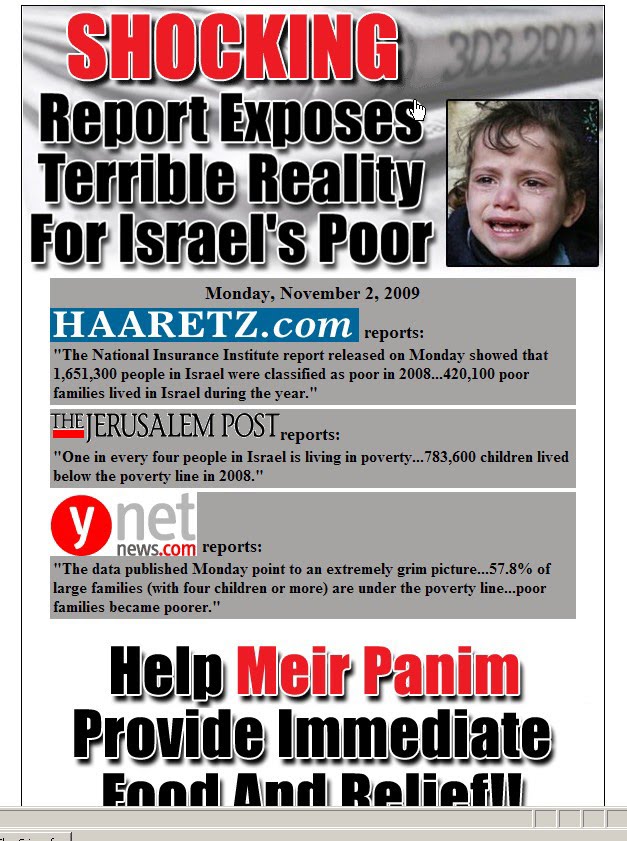
The above photo (part of an ad campaign) is being circulated throughout the Israeli press. The organisation that sponsored the ad operates (for hungry Jews only) soup kitchens in every major Israeli city. Below is the ad in question….
Feeding the poor is a wonderful deed…..asking for contributions to continue this work is to be expected….. BUT…. the photo used is not one of a poor, hungry Jewish child. It is the photo of a child in Gaza at the funeral of her brother who was killed by the zionists during the blitzkrieg a year ago. The same child can be seen in THIS article that appeared in the Telegraph.
The following montage shows the child in the ad and the (same) Palestinian child.
click on image to enlarge
How could the zionists be so deceptive? Along with their beliefs that Palestinians are not human, do they also believe that they feel no pain or suffering? Do they see nothing morally wrong with using images of suffering Palestinian children to raise funds for ‘Jewish only’ charities?
I have no problem supporting charitable institutions, especially those that feed the hungry, but I would NEVER support one that would turn away a non Jew, especially one such as Meir Panim.
Just another example of the inhumanity of zionism and those associated with it.

Saturday, September 26, 2009

Zahi Khouri – Think Again: Palestine

Zahi Khouri – Think Again: Palestine

By Haitham Sabbah
Illustration By Carlos Latuff

Illustration By Carlos Latuff

President Obama got the leaders of Israel and Palestine to shake hands this week. But a meeting in Midtown does not a Palestinian deal make. Here’s why.

By Zahi Khouri *

"Economic Peace Is Possible."

No. Neither sustainable economic development nor peace is possible without political freedom.

The idea of "economic peace" suggests an economic conflict, and the Palestinian-Israeli conflict is certainly not that. Although economic issues do figure into Palestinian concerns, they are not nearly as important as addressing the rights of Palestinian refugees, terminating Israel's occupation of Palestinian land, and establishing a viable, independent, and sovereign Palestinian state, with East Jerusalem as its capital. To suggest that economics are what this is about would be to sideline history and to willfully ignore the reality of Israel's occupation. This conflict is political and it calls for a solution that is political.

Besides, even if economic growth were issue No. 1, the greatest impediment to economic development and opportunity for Palestinians is not the absence of industrial parks as advocated by the Israeli government under its model of "economic peace." Rather, it is the denial of basic freedoms and rights to Palestinians under occupation and the myriad restrictions Israel imposes on the free movement of Palestinian goods and people within, and in and out of, the occupied Palestinian territory. It is the inability of Palestinians to access the 60 percent of the occupied West Bank under Area C (Israeli control), including the 40 percent that Israel claims for its settlement enterprise. And it is the forced isolation of occupied East Jerusalem, long the economic heart of the Palestinian economy, from the rest of the West Bank. All these economic constraints are fundamental to the architecture of Israel's occupation.

In short, "economic peace" is a slogan designed to give the appearance of positive movement while distracting from the real issues and the ongoing dispossession of Palestinians. It does not mean, nor does it promise, an end to Israel's occupation. Rather, it offers economic crumbs in an effort to normalize and better manage the occupation.

"As with Gaza, a West Bank Withdrawal Endangers Israel."

Wrong. Israel argues that its withdrawal from Gaza was rewarded with rocket attacks by Hamas. The attraction of such an argument lies in its simplicity. But just as "economic peace" is designed to divert attention away from the real issues, the argument that a Gaza withdrawal was dangerous for the Israelis is designed to mask the reality that Israel never stopped occupying the Gaza Strip.

Contrary to popular belief, Israel's unilateral disengagement from Gaza in 2005 did not bring about an end to the occupation. Yes, Israel removed its settlers (who, in many cases, relocated to settlements in the West Bank). And yes, Israel withdrew its troops — though only as far as the border. From that close distance, Israel has imposed a medieval-style siege on Gaza that continues to this day. Israel remains an occupying power under international law because it retains effective control over Gaza's borders and its land, sea, and airspace, allowing it to suffocate and starve Gaza as it is doing today.

The scale of the humanitarian crisis that Israel has created in Gaza is hard to convey. Even before the election of Hamas in 2006, there were severe restrictions on the amount of food, water, fuel, and other essentials allowed to enter the Gaza Strip. In 2006, then-senior Israeli government advisor Dov Weisglass callously claimed that "the idea is to put the Palestinians on a diet, but not to make them die of hunger." The result was that by the end of 2007, well over 80 percent of Gaza's population lived below the poverty line. Authorities have also clamped down on Gaza's imports and exports, suffocating the Palestinian economy. By November 2007, the U.N. World Food Program was already warning that less than half of Gaza's food import needs were being met. Following the election of Hamas, Israel tightened these economic restrictions further to enforce a complete closure, further compounding the humanitarian crisis. It is within this context that Israel's disengagement from Gaza must be judged.

Of course, rocket attacks from Gaza are not a proper response to Israel's harsh policies. Palestine is a just cause fought for in the name of rights, universal principles, and international law; its actions must be faithful to that. The lesson that should be drawn from Gaza is that the only guarantee of security for Israel is a full end to its occupation and domination — not just an end in name. The only form of withdrawal carrying the promise of peace is a full withdrawal — from the West Bank and East Jerusalem, along with Gaza — that allows for the establishment of an independent and sovereign Palestinian state.

"Arab Intransigence Blocks Peace."

Four words: the Arab Peace Initiative. First proposed by Saudi Arabia in 2002 and subsequently endorsed by 57 Arab and Islamic states, the Arab Peace Initiative offers full normalization of relations with Israel in exchange for Israel's full withdrawal from all territory occupied in 1967, as well as a just and agreed upon solution for Palestinian refugees in accordance with U.N. General Assembly Resolution 194. That resolution, in essence, says to Israel: Do what is required of you under international law and U.N. resolutions, and the Arab and Islamic world will normalize relations in return. Israel's response so far has been to ignore the Arab Peace Initiative, squandering what is a historic opportunity.

As for the Palestinians, President Mahmoud Abbas and Prime Minister Salam Fayyad are the most accommodating Palestinian leaders ever to hold office. Yet Israel is frittering away their time at the helm; Israeli leaders evidently feel no urgency to negotiate. Eventually, this window of opportunity will close. As settlers flock to the territories, Palestinians will determine that a Palestinian state is no longer viable. When the debated solution turns from two states to one state with equal rights for all, Israel may well regret it did not seize multiple opportunities to return all of the West Bank and East Jerusalem as part of a peace deal.

"Settlements Are Not the Issue."

They are crucial. Israeli settlement activity is precisely the undertaking that is foreclosing the possibility of a Palestinian state. Recent U.S. efforts to restart meaningful negotiations have faltered around Israel's refusal to implement a comprehensive settlement freeze in keeping with obligations under both international law and the "road map." Israel's refusal to comply has undermined the credibility of the peace process and eroded Palestinian public confidence in the ability of negotiations to bring tangible results.

Rather than favoring Palestinians or Israelis, a credible peace process holds both accountable to commitments made in the name of peace. The true test of meaningful negotiations, as distinct from negotiations for their own sake, is what happens on the ground. The faux freeze Prime Minister Benjamin Netanyahu is now proposing — build units already in the pipeline and then implement a brief six-month freeze, all the while continuing pell-mell with construction in East Jerusalem — is powerful on-the-ground evidence that Netanyahu and his coalition intend to build greater Israel at the expense of Palestinians.

Israeli settlements pose the greatest threat to the two-state solution. Settlements and their related infrastructure, like settler bypass roads, account for more than 40 percent of the West Bank, fragmenting the territory, monopolizing freshwater resources, and confining Palestinians to a series of disconnected cantons where unemployment, poverty, and hopelessness have reached endemic levels. Settlements run counter to the very principle of "land for peace" on which the Middle East peace process is built, and they make a viable and sovereign Palestinian state a physical impossibility. Without a viable and sovereign Palestinian state, there is no two-state solution.

"Israel's Occupation Is Not Apartheid."

It is. In fact, it would be most accurate to call it occupation, colonialism, and apartheid all rolled into one. This is the conclusion reached in a recent report commissioned by the Human Sciences Research Council of South Africa, titled "Occupation, Colonialism, Apartheid?", that brought together a team of international scholars and legal experts to assess Israel's occupation vis-à-vis international law.

On apartheid, the report identifies a series of discriminatory laws, standards, and practices that Israel applies exclusively to Palestinians living under occupation — laws, standards, and practices which do not apply to Israeli settlers living in the occupied West Bank and that are intended to "maintain [Israel's] domination over Palestinians in the OPT [occupied Palestinian territories] and to suppress opposition of any form."

In particular, the report identifies three pillars of apartheid as it existed in South Africa, noting that they also exist in the occupied Palestinian territory today. The first pillar consists of laws and policies that "establish Jewish identity for purposes of law and afford a preferential legal status and material benefits to Jews over non-Jews." The ramifications of this include the massive disparity in terms of the rights and privileges enjoyed by Israeli settlers compared with Palestinians, such as the denial of the right of return for Palestinian refugees compared with the 1950 Law of Return allowing all Jews to immigrate to Israel or, since 1967, the occupied Palestinian territory.

The second pillar concerns Israeli policies intended to segregate the population along racial lines. These policies center on the confinement of Palestinians to areas that resemble "Bantustans" (the largest being Israel's complete closure on Gaza), policed by Israel using a network of walls, roadblocks, checkpoints, and a special permit regime. Meanwhile, the Israelis construct settlements and a separate road system to service them, all built on confiscated Palestinian land that Palestinians can no longer access.

The final pillar focuses on repressive measures initiated under the rubric of "security." For example, Palestinians are subject to arbitrary arrest, administrative detention, extrajudicial killings, torture, and an oppressive code of military laws and military courts that fall short of international standards for a fair trial. These measures are reinforced by restrictions on freedom of expression, assembly, association, movement, and so on, which are ultimately designed to suppress Palestinian dissent while reinforcing Israeli control.

In short, former U.S. President Jimmy Carter, who grew up in the Jim Crow South, has it right when he uses the term apartheid to describe Israel's policies in the occupied Palestinian territory. And the facts are increasingly on the table. Whether the Barack Obama administration, already saddled with a brutal fight over health care, has the courage to challenge Israel's "economic peace," siege of Gaza, intransigence, settlements, and apartheid remains to be seen.

* Zahi Khouri is chief executive of the Palestinian National Beverage Co. (a Coca-Cola franchisee), chairman of the Palestinian Tourism Investment Co., and chairman of the board of the NGO Development Center, a Palestinian nongovernmental organization.

Sunday, June 14, 2009

UN Fact Finding Mission on Gaza War begins: call for submissions


By Mary Rizzo • Jun 11th, 2009 at 21:45 •

NATIONS UNIES

UNITED NATIONS

UNITED NATIONS FACT FINDING MISSION ON THE GAZA CONFLICT

Fax: (41-22) 928 9003, Telephone: (41 22) 928 9205, E-mail: factfindinggaza@ohchr.org

Call for Submissions

Pursuant to Resolution S-9/1 of the United Nations Human Rights Council (HRC), adopted on 12 January 2009 at the conclusion of the 9th Special Session of the Council, the President of the Human Rights Council established, on 3 April 2009, an International Independent Fact Finding Mission mandated “to investigate all violations of International Human Rights Law and International Humanitarian Law that might have been committed at any time in the context of the military operations that were conducted in Gaza during the period from 27 December 2008 and 18 January 2009 whether before during or after.

The President of the Council, Ambassador Martin Ihoeghian Uhomoibhi, appointed the following as members of the Fact Finding Mission: Justice Richard J. Goldstone, former Chief Prosecutor of the International Criminal Tribunals for the former Yugoslavia and Rwanda and current Spinoza Fellow at the Netherlands Institute for Advanced Study in the Humanity and Social Sciences; Professor Christine Chinkin, Professor of International Law at the London School of Economics and Political Science, University of London; Ms. Hina Jilani, Advocate of the Supreme Court of Pakistan and former Special Representative of the Secretary General on Human Rights Defenders; and Colonel (retired from the Irish Armed Forces) Desmond Travers, member of the Board of Directors of the Institute for International Criminal Investigations (IICI).

The United Nations Fact Finding Mission on the Gaza Conflict is pleased to invite all interested persons and organizations to submit relevant information and documentation that will assist in the implementation of the Mission's mandate.

Submissions should focus on events and conduct that occurred in the context of the armed conflict that took place between 27 December 2008 and 19 January 2009. The Mission considers that, for the purposes of its mandate, events since June 2008 are particularly relevant to the conflict.

The Mission would be grateful if submissions were presented as concisely as possible.

Due to time constraints the Mission would be grateful to receive submissions in English, but will also accept submissions in Arabic or Hebrew.

Unless otherwise indicated by the author, the Mission will assume that submissions can be made public. Please indicate whether you wish parts or whole submissions to be treated as confidential.

Any information submitted to the Mission in writing should be sent to the Secretariat of the Fact-Finding Mission c/o OHCHR, G. Motta 48, Geneva, or at the email: factfindinggaza@ohchr.org, no later than 30 June 2009.

8 June 2009

THAT was the formal calling, and I hope many are able to contribute.

THIS is what was written about the Chairman of the Commission:

Mideast war crimes investigation has an unusual chief in Richard Goldstone

by Alexander Higgins/Associated Press

Sunday April 19, 2009, 10:16 PM

GENEVA — The Palestinian human rights debate has taken a new turn with the appointment of Richard Goldstone, a Jew with close ties to Israel, to head a U.N. investigation into atrocities allegedly committed in Israel's recent war with Hamas.

Goldstone, who played a prominent role in the campaign against apartheid in his native South Africa, rose to global prominence in 1994 when he became U.N. chief prosecutor for war crimes.

That made him the point man to investigate two of the worst human rights disasters of the time: genocide in the former Yugoslavia and in Rwanda.

Now the 70-year-old judge is turning to the Israeli-Palestinian dispute, and the U.N.'s demand to investigate the three-week war in which more than 1,000 Palestinians died as Israel waged an offensive to stop Hamas rocket attacks that have killed more than 20 Israelis.

The investigation called by the 47-nation Human Rights Council was only supposed to look at Israeli conduct, but Goldstone didn't accept the assignment until the council's Nigerian president, Martin Uhomoibhi, said it would also look at Palestinian actions.

Asked how he felt as a Jew leading an investigation that involves the Jewish state, Goldstone said: "It certainly came to me as quite a shock."

Goldstone, who is on the board of governors of the Hebrew University of Jerusalem, said, "I've taken a deep interest in Israel, in what happens in Israel, and I have been associated with organizations that have worked in Israel."

But he said he intends to live up to his reputation for impartiality.

As head of a five-member South African judicial commission in the early 1990s he criticized all political groups — from President F.W. de Klerk's white-led government to Nelson Mandela's African National Congress and its rival, the Inkatha Freedom Party.

The large contingent of Arab and other Muslim countries on the U.N. human rights body has led to a stream of condemnations of Israel almost to the exclusion of human rights problems elsewhere.

The council followed form again in January when it drew up the demand for a mission "to investigate all violations of international human rights law and international humanitarian law by the occupying Power, Israel, against the Palestinian people."

Previously Israel has rejected council investigations, calling them biased, and an Israeli official said Wednesday his government was unlikely to cooperate with the Goldstone probe because it distrusts the U.N. rights council.

But Yousef Rizka, political adviser to Gaza Prime Minister Ismail Haniyeh of Hamas, said Goldstone's team would be welcome in Gaza.

"They will find the full cooperation by the Palestinian government and the Palestinian people, because the crimes of the occupation are clear and no one can underestimate it," Rizka said.

No date has been set for the investigators to travel to the region.

Aharon Leshno Yaar, Israel's ambassador to U.N. organizations in Geneva, said: "It is clear to everybody who follows this council and the way that it treats Israel that justice cannot be the outcome of this mission."

It doesn't matter that the president of the council has broadened the mandate, Leshno Yaar told The Associated Press. "It's not his authority," nor does the choice of Goldstone make any difference, he said.

New York-based Human Rights Watch said that it has criticized the council in the past "for its exclusive focus on Israeli rights violations."

But Israel should cooperate because Goldstone can be trusted to make the inquiry "demonstrate the highest standards of impartiality," the group wrote to U.S. Secretary of State Hillary Clinton and 27 European foreign ministers.

The international criticism of the Gaza offensive has deepened a sense among Israelis that their country is being treated unfairly. They see a double standard in the U.N. council's call to investigate Israel but not the Islamic militants who for years have been firing rockets into Israeli towns and villages.

Uhomoibhi, the council president, said he instructed Goldstone to produce a report "that truly reflects the events on the ground, and that includes dealing with all violations in an impartial and objective manner."

Goldstone said after being appointed April 3 that an impartial investigation of alleged war crimes before, during and after the December-January fighting was in the interest of both Israelis and Palestinians.

"I am already on public record as having expressed my deep concern for the heavy loss of innocent lives in Gaza and Israel," Goldstone said.

ShareThis Bookmark and Share
Tagged as: , , ,

Mary Rizzo is an art restorer, translator and writer living in Italy. Editor and co-founder of Palestine Think Tank, co-founder of Tlaxcala translations collective. Her personal blog is Peacepalestine.
Email this author | All posts by Mary Rizzo