Sunday, March 27, 2011

Welcome to the new NATO quagmire

THE ROVING EYE
Welcome to the new NATO quagmire
By Pepe Escobar

To follow Pepe's articles on the Great Arab Revolt, please click here

See also UN's 'coalition of the opposed' grows

The minute Turkey's Foreign Minister Ahmet Davutoglu told the Anatolia news agency, "The coalition that was formed following the Paris meeting will abandon the mission and hand it over entirely to a single command system under NATO", the issue was settled.

The North Atlantic Treaty Organization is about to enter the era of the double quagmire - as in Central Asia (Afghanistan) and northern Africa (Libya). And everyone thought NATO was

 
supposed to be defending Europe from the commies. Libya now is an official victim of the endless war club.

This predictable coup de theater (see Endgame: Divide, Rule and roll with the oil Asia Times Online, March 25) does not alter the fact Odyssey Dawn remains an American war. Well, not a war, according to the White House, but a "time-limited, scope-limited military action".

For the moment it's a time-limited etc conducted by General Carter Ham, out of his Africom headquarters in Stuttgart, Germany (none among 53 African countries wanted Africom). Next week it will become a time-limited etc conducted by US Admiral James Stavridis, NATO's top military commander.

For all practical purposes it's an all-American time-limited etc affair - enforced by Globocop NATO, with a handy Pentagon back up in the form of readily available "interdiction strike packages" - inimitable Pentagon speak for fighter jets loaded with missiles and ready to strike.

War by committee, revisited
As a crucial member of NATO and self-promoting preferential bridge between the West and the Muslim world, Turkey had to calibrate a very tricky strategy. The government led by Prime Minister Recep Tayyip Erdogan - with extensive business interests in Libya - spent the whole week making it crystal clear that the NATO mission must be totally restricted to protecting civilians, enforcing the UN arms embargo and providing humanitarian aid.

Predictably, the US and Britain were absolutely convinced that the military campaign in Libya could only be run by NATO.

The problem was how to deal with pesky France, led by neo-Napoleonic President Nicolas Sarkozy. The French government was lobbying hard for a joint Anglo-French military command - with France on top, bien sur.

The final decision spells out that NATO's huge "assets" will run the whole show on the ground, while a political committee will provide the "governance".

It's a copy of the International Security and Assistance Force (ISAF) arrangement in Afghanistan. (ISAF by the way does not provide much security and much less assistance). ISAF is led by NATO, and includes non-NATO countries such as Australia and New Zealand. The Libyan body will theoretically include those paragons of equality and equanimity - Gulf members of the Arab League. For the moment, that translates only into Qatar, which has pledged a huge fleet consisting of two Mirage fighter jets.

Sarkozy's argument for France to lead was that a signal should be sent that the West was not once again imposing its will over a Muslim country. As if there's much difference between NATO and a French-Anglo-Saxon committee.

But in the end Sarko dug his own tomb (where was Carla to teach her beloved Chou Chou some manners?) He treated the Turkish government like a bunch of illegal immigrants. France did not invite Turkey to last Saturday's summit in Paris which was the prelude to the war, sorry, "time-limited, scope-limited military action". Sarko wanted his Mirages to be the leading stars of the show.

Erdogan and Davutoglu saw right through it - the burning Sarko desire to launch not only the no-fly zone but his 2012 presidential re-election campaign as well. In a speech in Istanbul, Erdogan said, "I wish that those who only see oil, gold mines and underground treasures when they look in [Libya's] direction, would see the region through glasses of conscience from now on." To top it off, Sarko had made it clear numerous times that he is against Turkey's bid to join the European Union, saying it belongs in the Middle East, not Europe.

The tawdriest part of the whole spectacle is that Sarko was propelled to grab the limelight on Libya by another shameless self-promoter, French philosopher Bernard Henri-Levy, king of the chest-revealing white shirt, who flew to Benghazi sniffing a golden media opportunity, ingratiated himself with the "rebels", and from there called Sarko and urged him to fulfill his glorious Arab liberator destiny.

But enough of these clowns. Which leaves Turkey on the spot. Last week, at the al-Jazeera forum in Doha, Davutoglu said, "The legal status and territorial integrity of states including Libya and Yemen should be protected." Yet no one knows what NATO's ultimate designs on Libya really are.

NATO will be in charge of enforcing the no-fly zone and the arms embargo. Sooner rather than later NATO will decide that's not enough - that more air strikes on Colonel Muammar Gaddafi's forces are essential. Turkey has not signed up for that kind of action - and has already said it won't.

When the NATO secretary general, Danish right-winger Anders Fogh Rasmussen, says something like, "we must think how NATO can assist North African countries in their transition to democracy", Turkey better have an exit strategy, or at least a good explanation to the Muslim world when a deadly quagmire sets in. Otherwise, from a bridge between East and West, it will be reduced to a bridge to hell.

Pepe Escobar is the author of Globalistan: How the Globalized World is Dissolving into Liquid War (Nimble Books, 2007) and Red Zone Blues: a snapshot of Baghdad during the surge. His new book, just out, is Obama does Globalistan (Nimble Books, 2009).

He may be reached at pepeasia@yahoo.com.

Monday, March 21, 2011

THE ROVING EYE - The Odyssey Dawn top 10

by
Pepe Escobar

To follow Pepe's articles on the Great Arab Revolt, please click here.

War is peace. Protesters are now off-camera, missile diplomacy is on camera. Packaged in moral uprightness, Tomahawks, Typhoons, Tornados, Rafales, Mirages, B-2s and F-18s - not to mention sexy European Storm Shadow cruise missiles and possible guest star the F-22 Raptor radar-evading stealth jet - now speak the language of democracy. These "military assets", displaying their "unique capabilities", are now "protecting the Libyan people". Run for cover - or become collateral damage.

And now for our top 10 list:

10. The return of Ulysses. Operation "Odyssey Dawn"? Gotta
hand it to Pentagon ghost writers. Homer's Odyssey is the archetype of all travel writing. So Odysseus/Ulysses roams the Med again. The return of the heroes who conquered Troy is now the return of the heroes who gave you shock and awe. Benghazi is Ithaca, with Tripoli in the waiting list. Muammar Gaddafi plays the Cyclops. But who's Circe? Hillary Clinton? Homeric Ulysses was upgraded from a fishing boat to the USS Mount Whitney, the flagship of the US Navy's 6th Fleet. So one must assume that, for now, Ulysses is commander Samuel Locklear III, who's in charge of the bombing.

As for Homer revised by Shakespeare, the trophy goes to chairman of the US Joint Chief of Staff, Admiral Mike Mullen. He told CNN Operation Odyssey Dawn "isn't about seeing him [Gaddafi] go". But then he told NBC Gaddafi could stay, as in "it's very uncertain on how this ends". No wonder no one in this Odyssey has yet claimed to be Penelope.

9. The invisible Africom. There's total radio silence about the commander of the US Africom, General Carter Ham. He's in charge of all those Tomahawks, from his office in Stuttgart, Germany; after all, none among 53 African countries offered to host Africom. After the current phase 1, the command switches from Africom to the Anglo-French duo, or to the North Atlantic Treaty Organization (NATO) in Brussels. Africom's main business is to guarantee the rapid deployment of "highly mobile troops" - to fight the never-extinct "war on terror", laser in on all those oil fields, try to offset China's business drive in Africa; talk about an open-ended mission. In short: Africom is about the Pentagon's militarization of Africa - suavely sold as "bringing peace and security". It's all part of the time-tested Pentagon's full spectrum dominance doctrine.

8. The R2P enigma. Top American humanitarian imperialists - or liberal hawks - include US Secretary of State Hillary Clinton, US ambassador to the United Nations Susan Rice, and National Security Council senior directors Samantha Power and Gayle Smith. They are all suckers for R2P - "responsibility to protect", the new international norm that supposedly prevents and stops genocides, war crimes, ethnic cleansing and crimes against humanity.

R2P is still hazy. How many civilians must be killed before R2P kicks in? A few thousand? (a fair estimate of Gaddafi's victims before Odyssey Dawn). And where next for R2P? Here's a list of candidates. Yemen. Bahrain. Saudi Arabia. Israel. Uzbekistan. Ivory Coast. Sudan. Somalia. North Korea. Myanmar. Iran. Pakistan. And - remember Xinjiang and Tibet - China. Don't count on the UN to "protect" civilians in any of these destinations.

7. The new Obama doctrine, or Bush 2.0. The Obama administration turned George W Bush's wars in Iraq and Afghanistan into open-ended occupations; started an air/counter-insurgency war in Pakistan; bolstered a war in Somalia; bolstered a war in Yemen; and now started a war in Libya. The Western/Arab League war in Libya perfectly fits the new, two-pronged Obama doctrine of US outreach/regime alteration; outreach (former "regime change") for "evil dictators", alteration for "our" bastards.

That accounts for Washington desperately trying to position itself on the right side of history at least in one chapter of the great 2011 Arab revolt - amid all the geostrategic imperatives of trying to somewhat control the course of the Arab revolutions, and to keep an eye on the oil.

Gaddafi for his part labeled the US/Anglo-French bombing a "crusader aggression" and his regime's resistance, a "long war". He thus managed to mix the Pentagon with al-Qaeda in one sweep. And we always thought they were fighting each other. His Bab al-Azizia compound in Tripoli has already been bombed. At least his family is not featured in a Pentagon deck of cards - yet.

6. No R2P for Israel. In late 2008, while no one was watching, Israel bombed Gaza, killed 1,300 people, the absolute majority civilians, and destroyed at least 20,000 buildings. The UN didn't bother to invoke R2P, or impose a no-fly zone over Gaza to protect its civilians (50% of them children). Israel never respected any of countless UN Security Council resolutions. By the way, George W Bush invaded Iraq in 2003 without a UN Security Council resolution.

5. No R2P for Yemen. President Ali Abdullah Saleh is a "valuable ally" in the "war on terror" - against al-Qaeda in the Arabian Peninsula (AQAP); although he is the Yemeni Gaddafi, he falls into the privileged "regime alteration" category. President Barack Obama said he "strongly condemn[s]" snipers killing Yemeni civilians and says those responsible "must be held accountable". This means Saleh's government. Bit of a problem though; these are the people getting US cash and weapons to fight "terror".

4. The oh so democratic Arab League. The voting at the Arab League calling for a no-fly zone over Libya was unanimous. But at first, Algeria and Syria were strongly against it. Damascus publicly justified itself as against another Western intervention in Arab affairs.

This never deterred the six Gulf Cooperation Council (GCC) dictatorships (Saudi Arabia, Bahrain, Kuwait, Oman, Qatar and United Arab Emirates), which lobbied hard for no-fly. American and European diplomats are desperate for the Arab League - and not NATO - to do something, like flying the odd jet and paying most of the bill to provide the illusion that the West is not attacking another Muslim country.

Washington explicitly requested that from Qatar, the UAE and Jordan. Qatar and UAE - which helped Saudi Arabia to invade Bahrain - are now invoked to secure "democracy" for Libya. The UAE will support democracy with 24 Mirage 2000-9s and F-16s and Qatar with up to 6 Mirage 2000-5s.

The Arab League first warned against an "attack" on Libya - as if a no-fly zone could be imposed by broomsticks, not bombs. Then supreme opportunist Amr Moussa, head of the Arab League, criticized Odyssey Dawn because of the inevitable collateral damage. And then he backtracked. No one cares, as long as the Arab League rubber stamps Odyssey Dawn to make it look like an Arab decision.

3. No R2P for Bahrain. The House of Saud invasion of Bahrain to help Sunni "cousins" the al-Khalifa dynasty - with pitiful coverage by otherwise progressive al-Jazeera - smells like a deal between the House of Saud and the emir of Qatar, which implies Washington behind it as well; the immensely corrupt and fearful House of Saud does absolutely nothing without Washington's approval. al-Jazeera reports have called for a "dialogue" between government and opposition in Bahrain; no such calls for Libya.

The GCC dictatorships are basically Pentagon annexes. Since 2007, they've bought no less than $70 billion in weapons - and counting. Libya is part of the African Union (AU). Gaddafi requested support from the AU against his internal opposition; that's exactly the same as Bahrain asking for support from the GCC. The difference is the AU did not vote for a no-fly zone - nor invaded a neighbor, a la Saudi Arabia.

The al-Khalifas in Bahrain have been so scared by the protest movement that they had to physically demolish the Pearl monument at the center of the homonymous square in Manama, with its six white curved beams topped with a huge pearl. This implies also destroying Bahrain's history; before becoming "business friendly", Bahrain was a pearl diving center. Now it's just "bullet-friendly Bahrain."

2. How good was my dictator. Just yesterday Italian Prime Minister Silvio "Bunga Bunga" Berlusconi was literally kissing Gaddafi's hand - and allowing him to pose this tent in Rome. He dropped him like a stone. Same with the Brits who were merrily selling loads of weapons to the colonel.

As for neo-Napoleonic French President Nicolas Sarkozy, Gaddafi was a godsend - allowing Sarko to officially pose as the new Arab nationalist hero. France in effect prohibited NATO from intervening at the start of Odyssey Dawn, so Sarko's dashing Mirages could get all the glory. Carla Bruni - who calls his husband Chou Chou - must be very impressed; who needs bunga bunga when you can actually bang, bang?

1. Democratic Saudi Arabia. To have the holy grail of medievalism and repression - the House of Saud - voting in the Arab League to bring democracy to Libya while quashing any progressive moves inside the kingdom (and invading a neighbor) will forever live in infamy as the Top Hypocrisy of the Great 2011 Arab Revolt. King Abdullah's billionaire package of "reforms", ie bribes, essentially bolster the House of Saud's two strategic pillars; the security/repression establishment (60,000 new jobs for the Interior Ministry), and the religious clerics (more money to the Commission for the Promotion of Virtue and Prevention of Vice). Even if they have successfully preempted the kingdom's "Day of Rage", this proves how scared they really are.

What many don't know is that Operation Odyssey Dawn is personal - and has nothing to do with Greek heroism but Bedouin hatred. It revolves around the extremely bad blood between King Abdullah and Gaddafi since 2002, in the run-up to the war on Iraq, when Gaddafi accused Abdullah of selling out the Arab world to Washington. So this is not Operation Odyssey Dawn; it's Operation House of Saud Takes Out Gaddafi. With all the heavy lifting subcontracted to the West, of course, and the eastern Libya protesters posing as extras.

Odyssey Dawn - a "just war" - started exactly eight years after the Iraq war. In 2003, at the start of Operation Enduring Freedom - still ongoing, having "liberated" over a million Iraqis from life - George W Bush said, "American and coalition forces are in the early stages of military operations to disarm Iraq, to free its people and to defend the world from grave danger".

This Saturday, at the start of Operation Odyssey Dawn, Barack Obama said, "Today we are part of a broad coalition. We are answering the calls of a threatened people. And we are acting in the interests of the United States and the world."

Maybe we should call this whole thing Operation Enduring Odyssey - and send the bill to the House of Saud.

Pepe Escobar is the author of Globalistan: How the Globalized World is Dissolving into Liquid War (Nimble Books, 2007) and Red Zone Blues: a snapshot of Baghdad during the surge. His new book, just out, is Obama does Globalistan (Nimble Books, 2009).

He may be reached at pepeasia@yahoo.com.

Protesting against the war in Obama's America: Worse than Bush

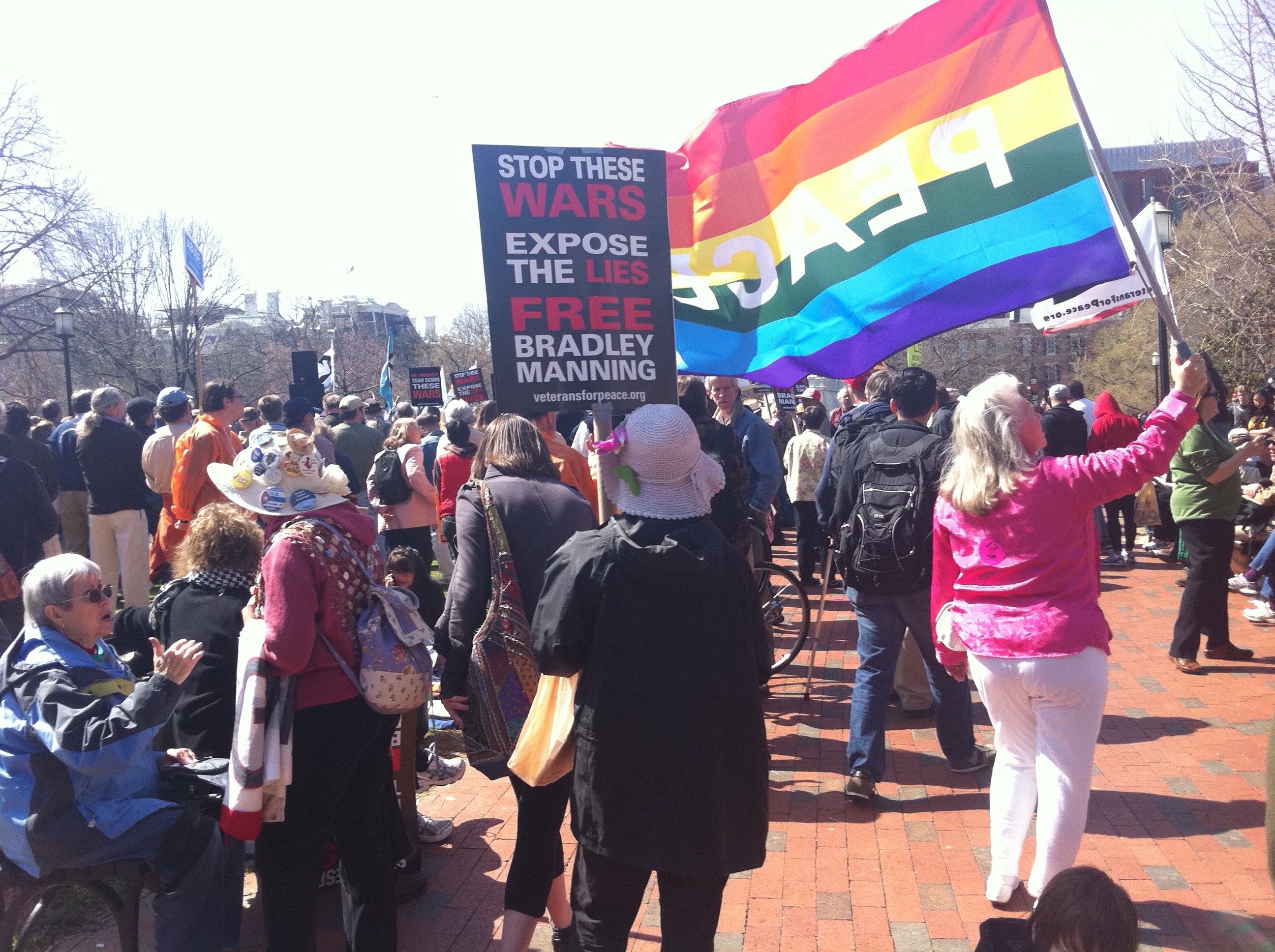
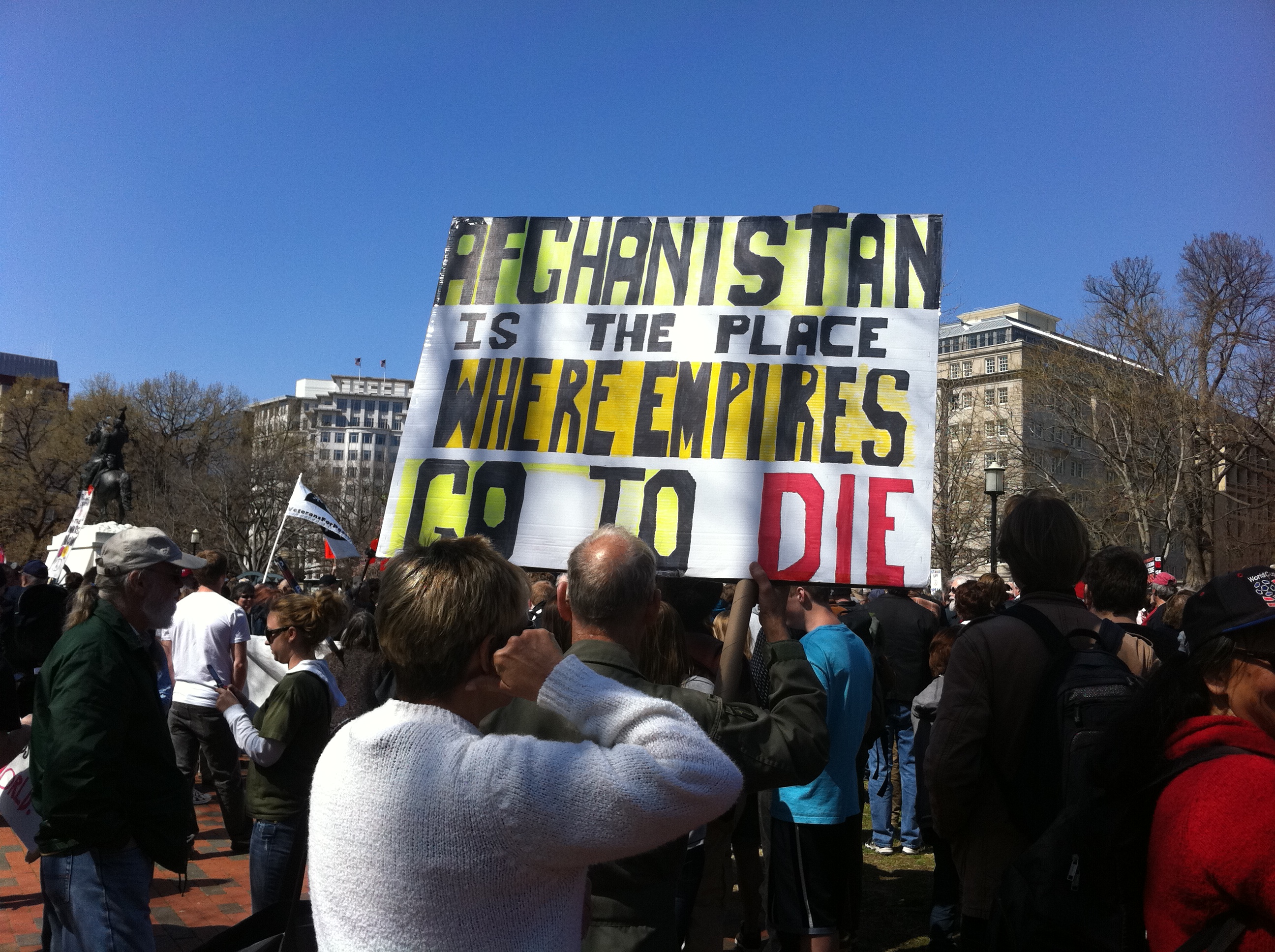
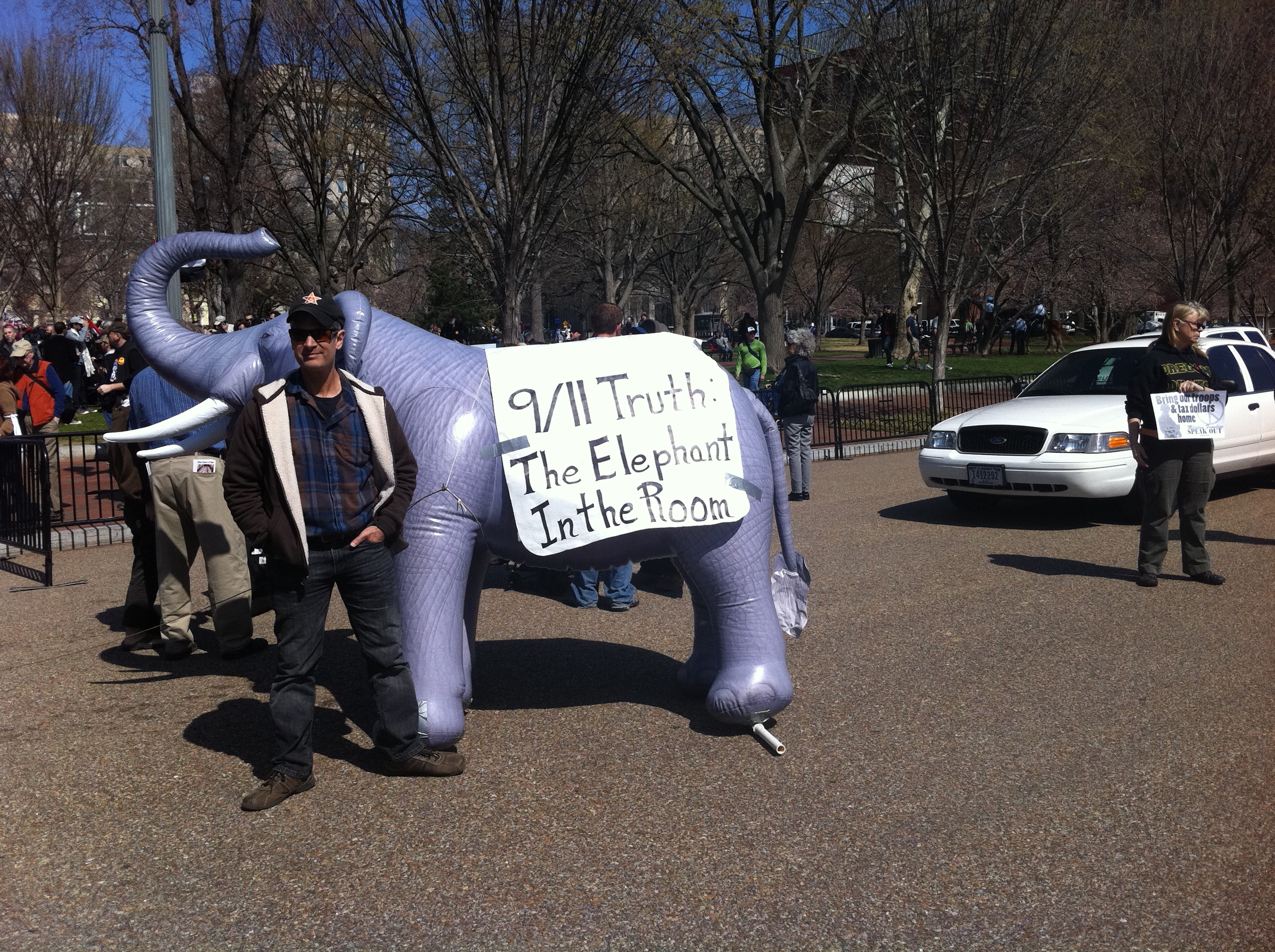
There was another anti-war rally in Washington, DC on March 19. Unlike the protests during the Bush administration, the rally against Obama's wars in Afghanistan Iraq, Pakistan, and now, Libya, barely drew 500 people. Some of the anti-war rallies during the Bush administration drew over 300,000. However, this is a Democratic administration, so many pressure group provocateurs on the left feel that Obama, who is continuing two of Bush's wars, and who started two more in Pakistan and Libya, is justified in enforcing America's imperial military designs. 

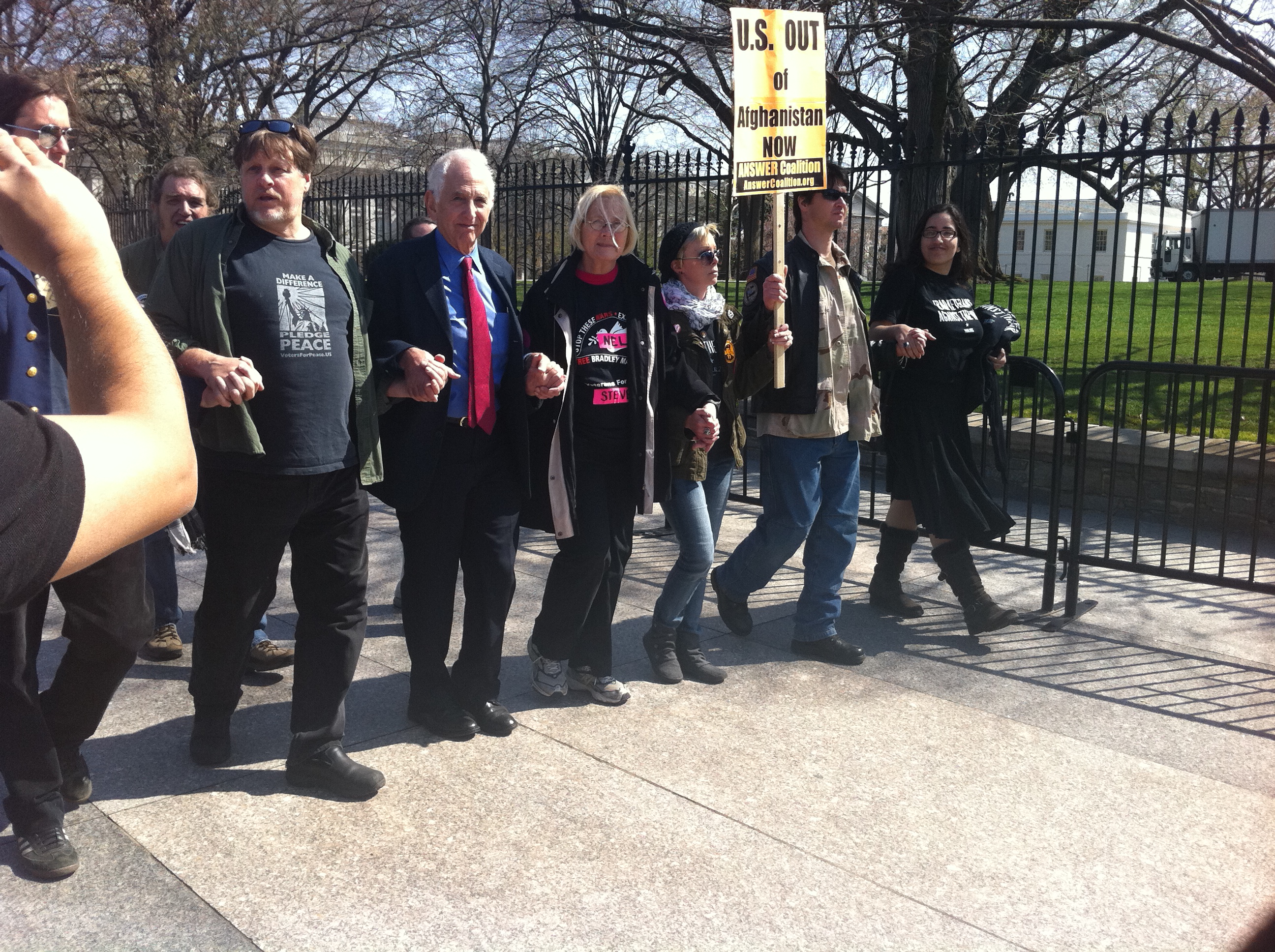
However, in a security force action not seen in Washington during the Bush-era anti-war demonstrations, U.S. Park Police, working with Secret Service and other security forces, used a "bait-and-switch" tactic, coupled with a crowd herding procedure known as kettling, to disrupt the anti-war demonstration at Lafayette Park in front of the White House.

Kettling, the movement of large crowds of protesters into a confined area where, subsequently, only a limited number of people are allowed to leave or everyone is confined and arrested, has been a favorite tactic of police in the United Kingdom, Canada, Germany, France, and Denmark.

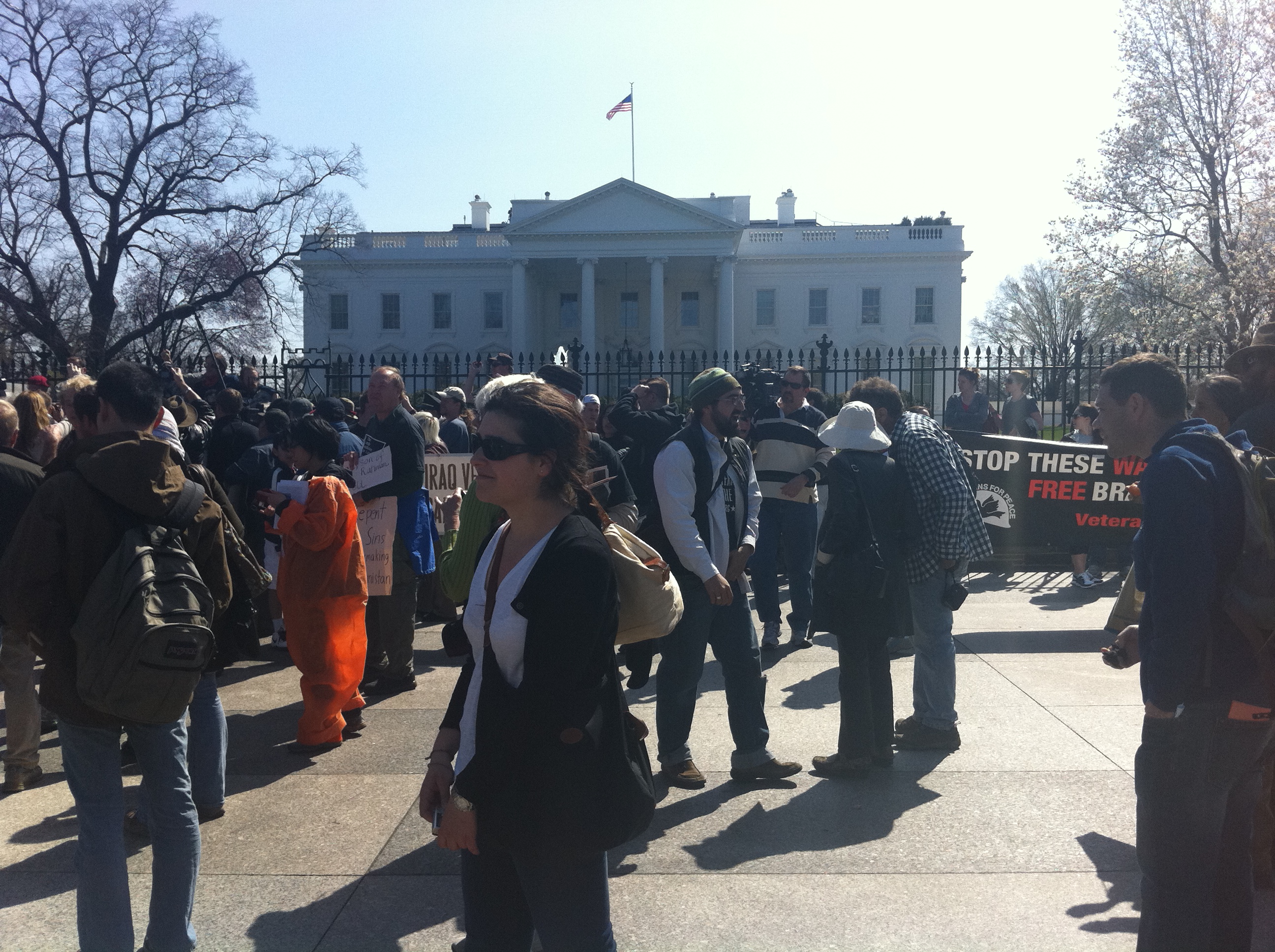
On Saturday, police had indicated to protest organizers that no one would be arrested unless they chained themselves to the White House fence. However, as protesters continued to mass in front of the White House on Pennsylvania Avenue, chanting "Free Bradley Manning" and "Who's street? Our street!," the security forces had other plans, perhaps not wanting to set a precedent for an American version of Cairo's Tahrir Square in front of the White House.

Rapidly, American security forces began to close in protesters, tourists, some 9/11 Truth demonstrators, anti-Qaddafi and Syrian regime protesters, and media within a barrier of interlocking metal fence sections. At the same time, a phalanx of horse-mounted Park Police began to kettle protesters within a smaller confined area while other security forces began to push back people on Pennsylvania toward Lafayette Park. It was clear that anyone who remained on Pennsylvania Avenue would be subject to arrest and a $500 fine.

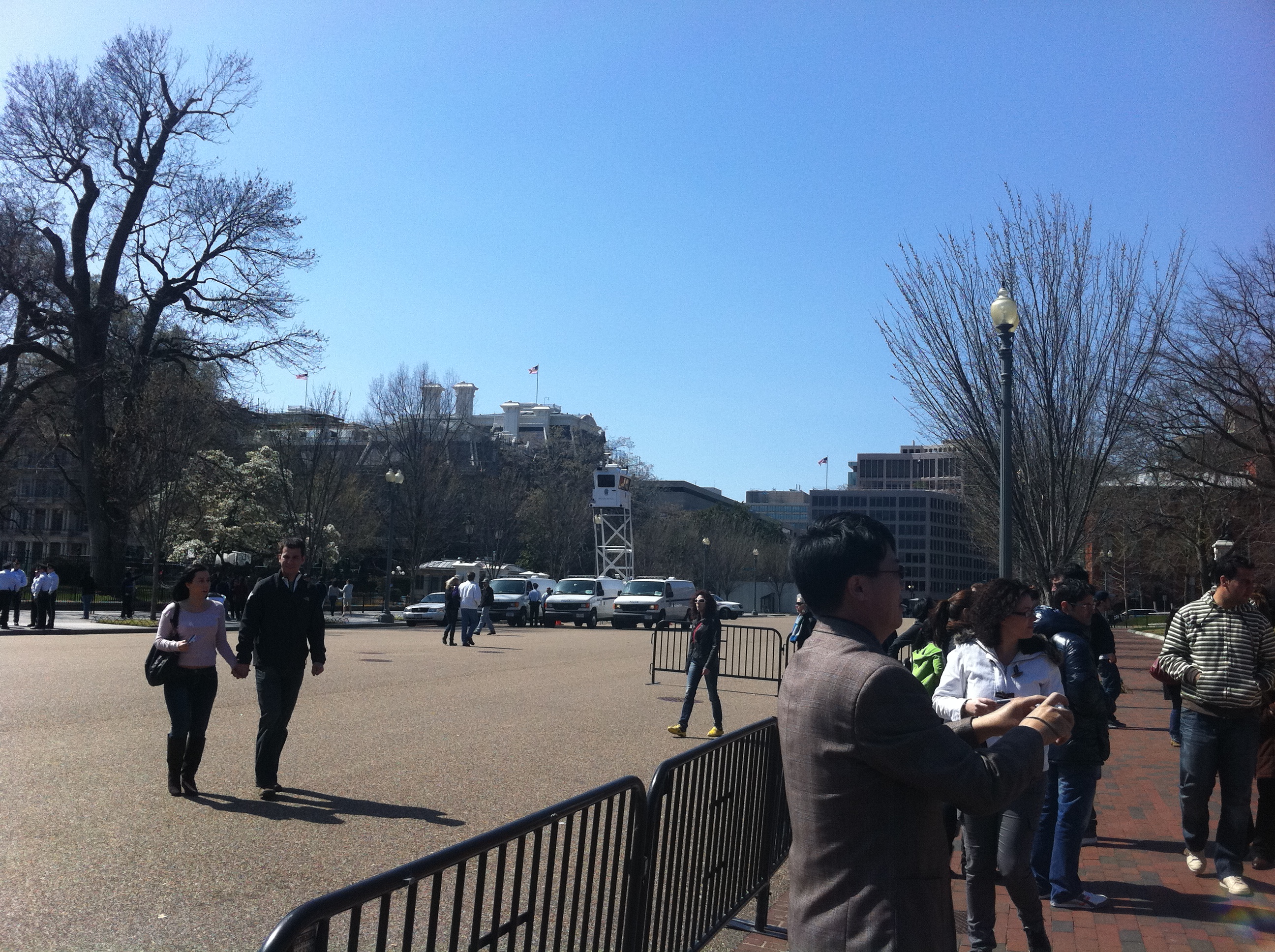
Some protesters, including Pentagon Papers whistleblower Daniel Ellsberg, removed to leave, and were arrested. The lesson learned is that if Americans even contemplate a Tahrir Square in front of the White House, they will need many more than 500 protesters and they will have to be prepared to take on some well-armed and equippped security forces, including the Park Police's newest "toy," one of Homeland Security Secretary Janet Napolitano's portable parking lot towers.
 
 
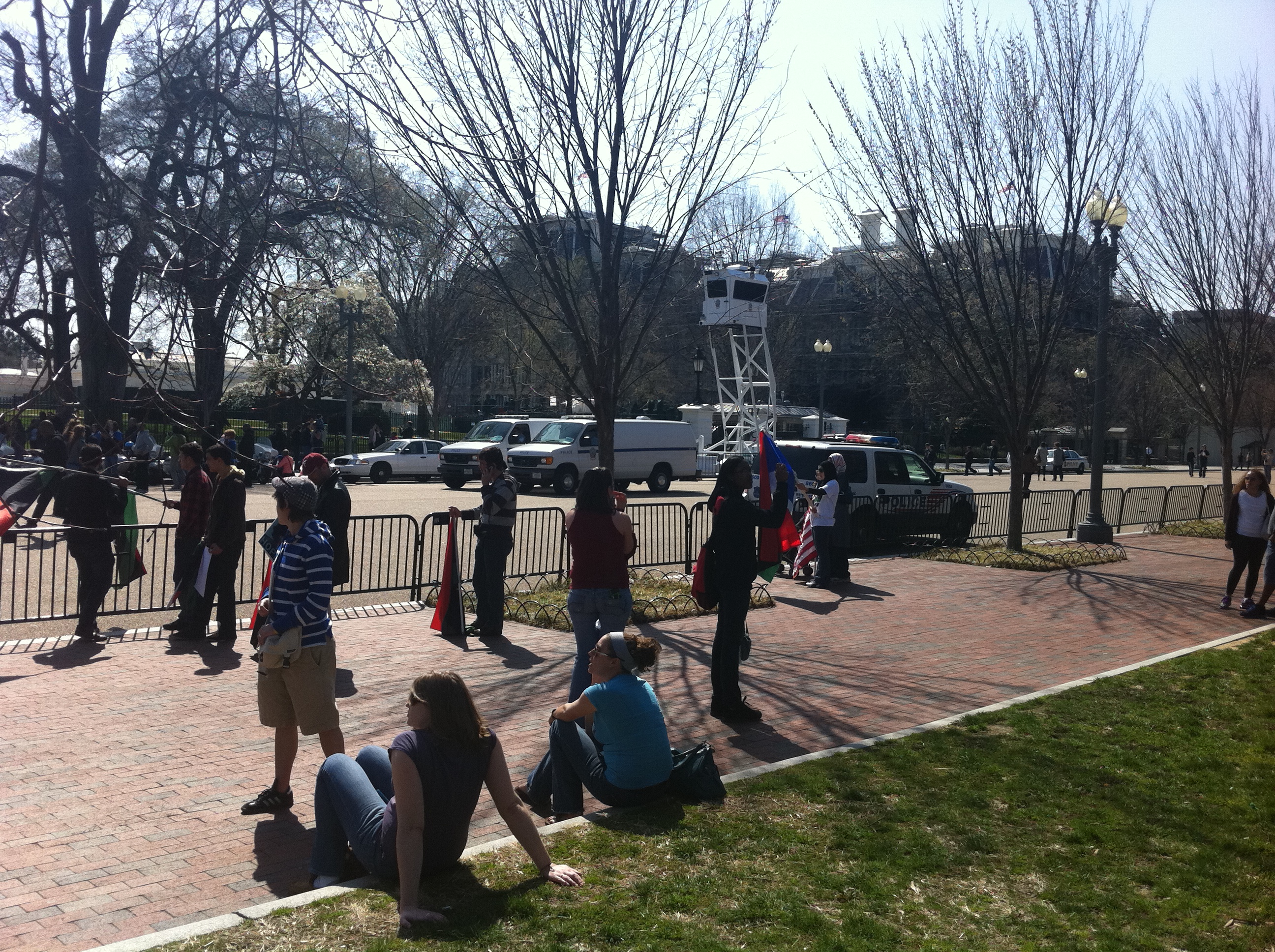
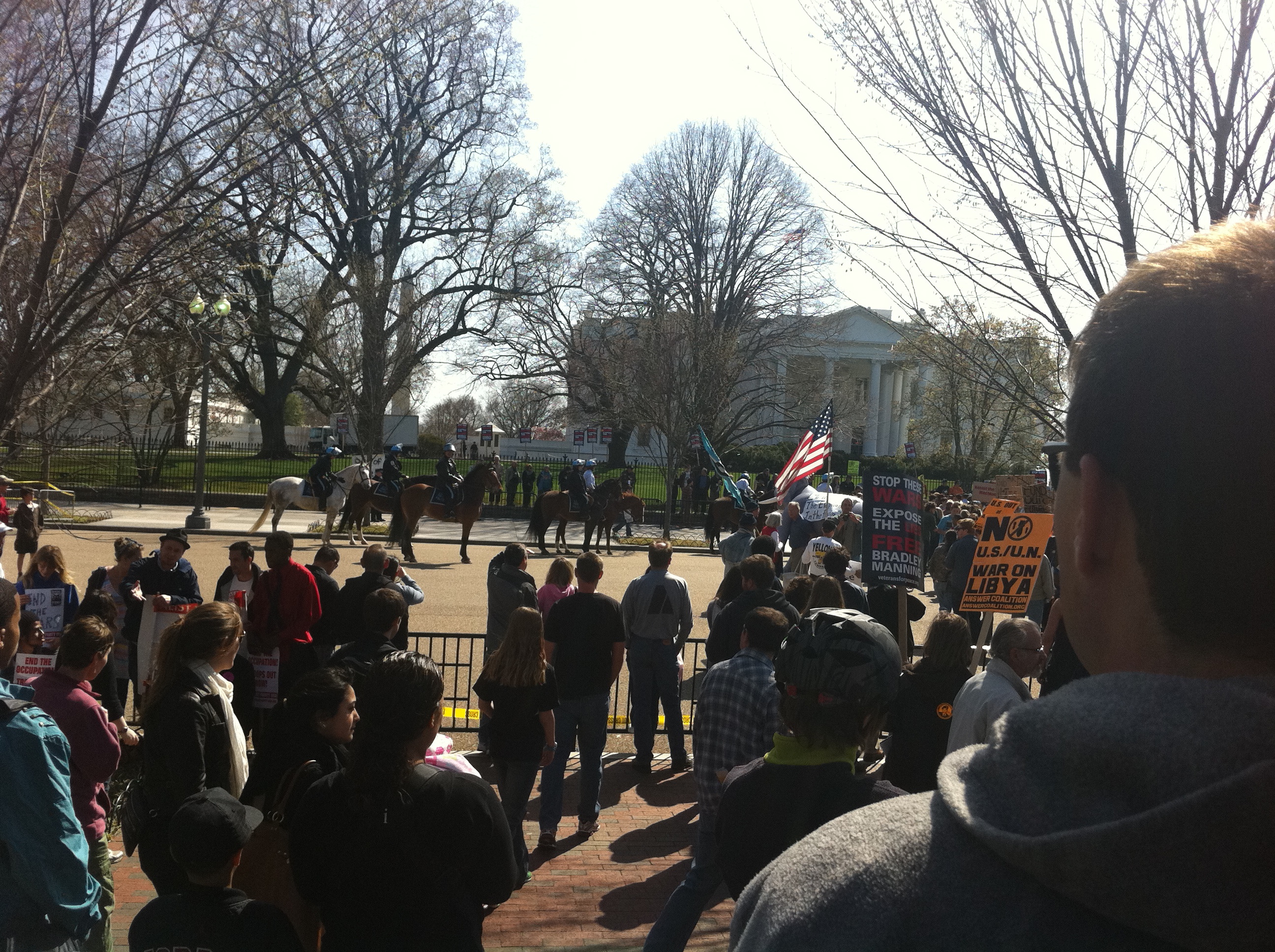
Above: Anti-war demonstration in Lafayette Park began like many others. Bottom right: Daniel Ellsberg (third from left) and retired Army Col. Ann Wright (fourth from left) lock arms in a silent march past thge White House.


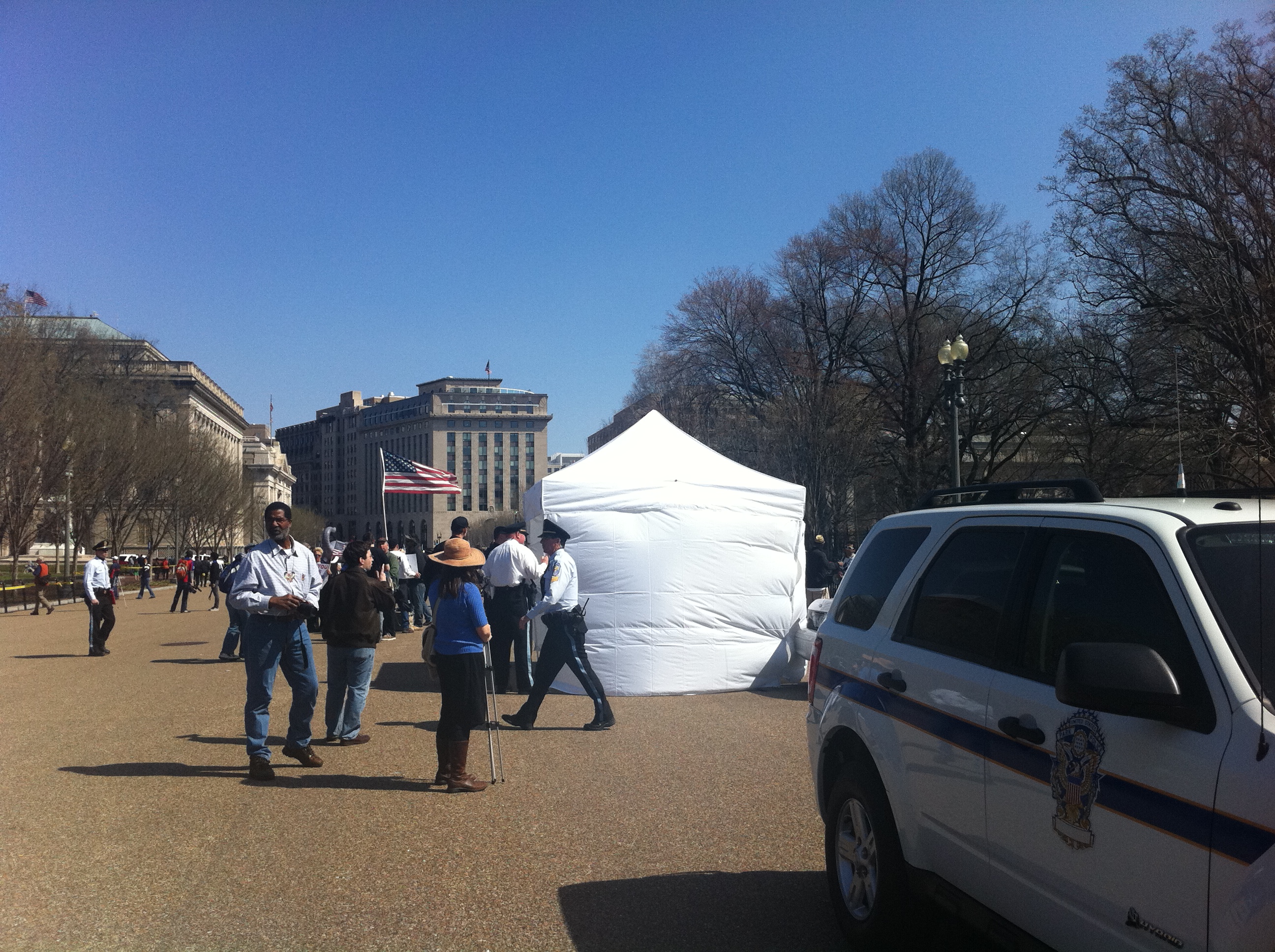
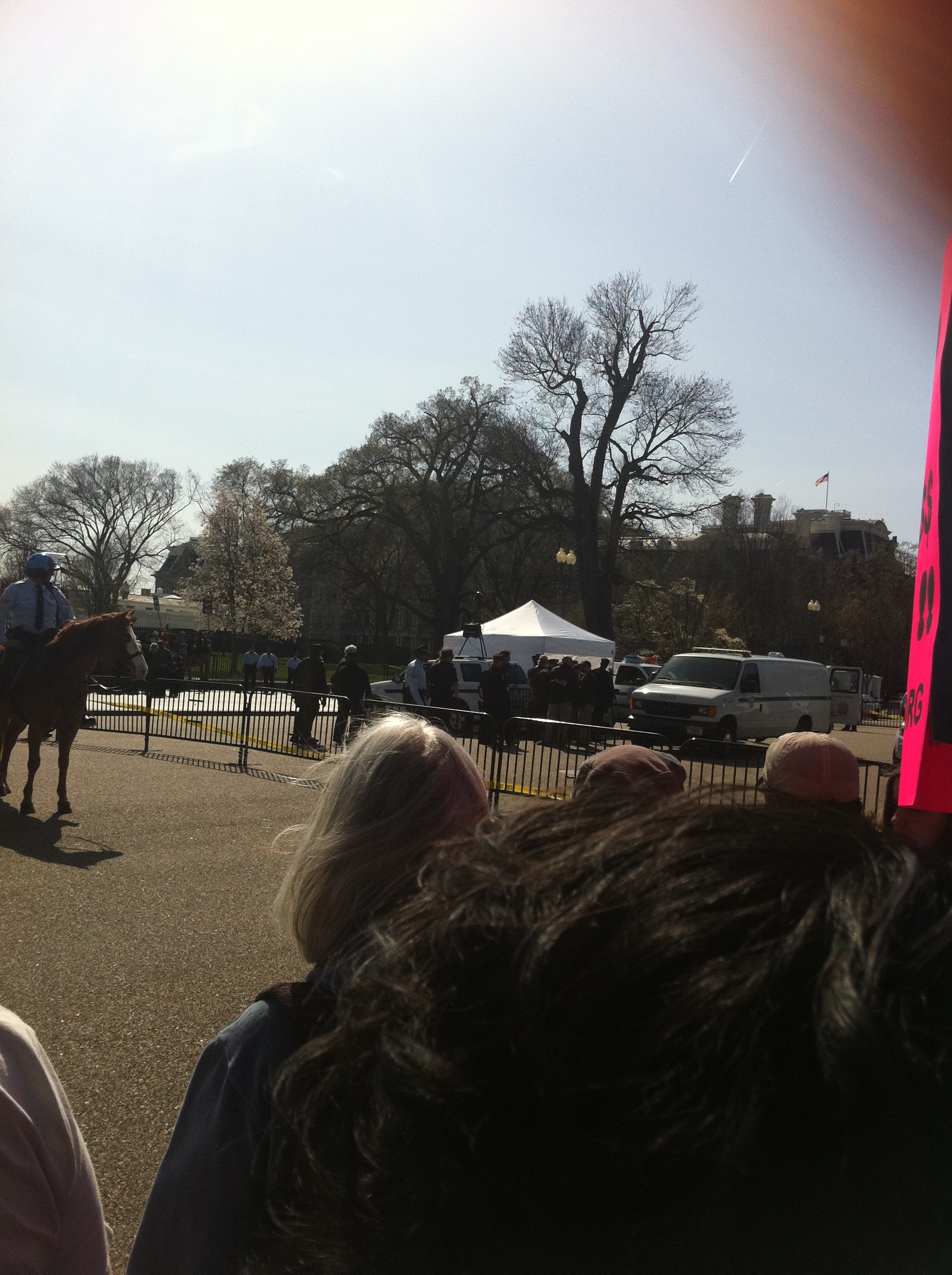
Upper left (Napolitano's new spy toy, the parking lot tower, at far end of Pennsylvania Avenue), Upper right (security forces set up processing tent for arrested protesters); lower left (protesters, tourists, and media being "kettled" behind fences on Pennsylvania Ave.: it was a signal to leave or risk arrest); lower right (security forces ring protesters with fences).
 L
Left (mounted security forces begin kettling process); right (after kettling, arrests being made, including that of Daniel Ellsberg).

Monday, March 14, 2011

EARLY EDITION. When it comes to major disasters, Obama's priority is the same: protect the corporate interests


President Obama, as he displayed so ignominiously in the aftermath of the Gulf of Mexico oil disaster, has, once again, demonstrated that his first priority in the face of major disasters is the protection of corporate interests. Obama's reaction to the post-quake nuclear power plant disasters in Japan complements what amounts to a cover-up of the danger posed by nuclear power plants in quake-prone areas. Obama has good reason to be protective of the nuclear power industry: he is in their pockets as much as he was in the pockets of BP and other oil companies after the Deepwater Horizon oil platform explosion and subsequent oil deluge in the Gulf.

The nearly 40 year-old nuclear reactor that experienced a core meltdown and explosion, Fukushima Daiichi’s Unit 1, was manufactured by General Electric and built in Japan at a time when memories of the U.S. atomic bombing of Hiroshima and Nagasaki were still fresh in the minds of many Japanese. Of course, thanks to slick public relations and the support of both the U.S. and Japanese governments, the fear of the Japanese public about nuclear power plants was assuaged by guarantees that the safety of the plants was guaranteed, even during an earthquake in seismically-active Japan.

Nuclear power generation has been a good business for the United States and Japan. In 2007, GE Hitachi Nuclear Energy, headquartered in Wilmington, North Carolina, was formed as a U.S.-Japanese global joint company to advance nuclear power plant construction around the world. GE Hitachi Nuclear Energy had some 80 employees and contractors working at the Fukushima 1 plant at the time of the nuclear disaster.

Just as Obama permitted BP to call the shots for all government emergency response and regulatory agencies in the aftermath of the Deepwater Horizon disaster, the president decided to send a White House team under the direction of the CIA-infused US Agency for International Development (USAID) Disaster Assistance Response Team
to Japan to provide consultation to the Japanese government. Additionally, Energy Secretary Stephen Chu was asked to keep in contact with Japanese nuclear energy officials to ascertain needs. Obama decided not to send personnel from the Nuclear Regulatory Commission, National Nuclear Security Administration, or even the Federal Emergency Management Agency (FEMA) to Japan.

The reason for Obama's tepid response is his ties to the U.S. nuclear power industry. American experts who may have discovered the true nature of the nuclear disaster may have leaked the details to the media and for the most opaque administration in U.S. history, that would be the real "disaster."

Obama's close relationship with GE chief executive officer Jeffrey Immelt, who the president named as chairman of the White House Council on Jobs and Competitiveness,
is a top Obama corporate cheerleader and a major campaign donor. And for the corporate- and Wall Street-owned and operated Obama, it is the needs of the corporations, not those affected by corporate greed, malfeasance, and cover-ups that matters in the end.

GE and its nuclear arm, GE Hitachi Nuclear Energy, are not Obama's only friends and donors in the nuclear power industry. Chicago-based Exelon Corporation, which operates nuclear power plants in Illinois, Pennsylvania, and New Jersey, was the fourth-largest donor to Obama's presidential campaign in 2008. Thanks to its $269,000 in campaign cash, Obama has responded favorably to the needs of Exelon. Exelon was created in 2000 with the merger of Commonwealth Edison's parent corporation, Unicom of Chicago, and PECO Energy of Philadelphia. Representing Unicom in the merger was Rahm Emanuel, later Obama's White House chief of staff and newly-elected mayor of Chicago. Unicom was also advised by Goldman Sachs, the firm that has supplied many of the Obama administration's top officials. Former White House political adviser David Axelrod also acted as a consultant for Exelon.

In addition to his connections to GE Hitachi, Obama's now-imprisoned fundraiser, Tony Rezko was involved in shady deals with GE Capital Corporation. Rezko has been accused of helping to flip a real estate deal in order to facilitate a mortgage for the president's home in south Chicago's Hyde Park neighborhood.

And in a major tip of the hat to the nuclear industry, Obama asked for $8.3 billion in federal loan guarantees for the construction of new nuclear power plants in the United States. In his 2012 budget, Obama has asked for $36 billion in loan guarantees for new nuclear power plants, and he has the support of the Republicans in Congress even though there are opponents and skeptic in his own Democratic Party.

Obama's attempt to put a smiley face on the nuclear disaster in Japan is coupled by charges that the government of Prime Minister Naoto Kan, who has admitted to accepting campaign donations from foreign sources, illegal in Japan, has dragged his feet on publicly admitting the true nature of the nuclear disaster in Japan. The mayor of Tsuruga City has questioned whether the Japanese government is telling all about the situation at Fukushima.

It appears that Kan was taking a page from Obama's disaster response playbook in delaying the announcement that the evacuation zone around the Fukushima plant had been extended from a radius of 6 to 12 miles around the stricken complex. The Japanese government, after admitting a meltdown had occurred at Fukushima Unit 1, revealed a similar meltdown had occurred a Unit 3. A hydrogen explosion occurred at Unit 3 on March 14 at 11:08 am (Tokyo time), resulting in the collapse of a building wall. Fukushima Units 2 and 6 are also experiencing critical safety problems but TEPCO and GE Hitachi officials are revealing little in the way of details. Some Japanese officials have leaked information that the level of radiation near the Fukushima reactors are at a strength that results in uncontrolled vomiting, immediate hair loss, and the onset of fast-acting cancer. However, Obama and Kan, more interested in placating the needs of corporations, continue to downplay the seriousness of the nuclear catastrophe.

Tokyo Electric Power Company (TEPCO), the operator of the Fukushima reactors, appeared more interested in public relations than in informing the public about the true nature of the disaster. Kan followed TEPCO's lead in much the same way as Obama followed the lead of BP after the Gulf of Mexico disaster. And for good measure, TEPCO lined up its primary lobbyist, D L A Piper, in Washington, to ensure the U.S. media remained relatively sanguine in its reporting on the unfolding disaster at Fukushima.

The media spin on behalf of the powerful nuclear industry is underway at full force. Fukushima is being downplayed by corporate media shills who are stating that the disaster is not at the level of Chernobyl or Three Mile Island. Nuclear Regulatory Commission statements that radiation from Japan poses no threat to the United States are being hyped by such neocon publications as the Wall Street Journal and the newly neocon-leaning Christian Science Monitor, which is neither "Christian" nor "scientific" in its reporting on a major disaster-in-the-making.

WMR has learned that the mega-quake that struck Japan could not have come at a better time for Kan and his government for a reason that extends to the web of Washington's and the CIA's influence-peddling in Japan.

The foreign campaign donation scandal that saw Kan's Foreign Minister and potential heir apparent, Seiji Maehara, resign just days before the quake, also implicated Kan. Kan took over from his predecessor, Yukio Hatoyama, after Hatoyama was forced to recant on his earlier campaign promise to have a U.S. Marine Corps base moved from Okinawa after pressure was applied by the Obama administration. After the humiliation of being forced to change his mind on the Okinawa base, Hatoyama resigned in September 2010.

The mega-quake just as Kan was answering questions in the Diet in Tokyo and admitting to accepting a 1.04 million yen C
ampaign donation from a South Korean businessman representing Chuo Syogin, a financial entity based in Yokohama that provides various services for South Korean residents of Japan. WMR is told by a well-informed source that the South Korean donations to Kan and Maehara represent a pass-through established by the CIA decades ago that saw the United States pass money to Japanese politicians using the auspices of the Korean Central Intelligence Agency (KCIA), now the National Intelligence Service of South Korea, the Japanese Yakuza organized crime syndicate, and elements in South Korea of the Unification Church of Reverend Sun Myung Moon.
Meanwhile, Obama's information czar, the Fagin-like plotter and schemer of disinformation campaigns, Cass Sunstein, head of the White House Office of Information Regulatory Affairs, is seeing his "cognitive infiltration" of the Internet playing out in full force. Automated "personae" and "sock puppets," funded by the US Air Force and endorsed by the Department of Justice, are ensuring that pro-nuclear energy comments are being posted on web site comment sections, discussion groups, and blogs worldwide.

When it comes to the suffering of the people of Japan and potential disastrous health effects for Americans living in Hawaii, Alaska, the West Coast, and the Rockies, Obama is content to defer to the interests of the nuclear power industry and ignore the interests of the people of the United States, Japan, Canada, and other nations that will be impacted by the nuclear disaster that is continuing to unfold in Japan. Obama continues to defend the interests of BP and the oil industry even as the health problems of the people of the Gulf of Mexico worsen by the day. For someone who grew up privileged, protected by family members in the employment of the CIA and its front organizations, Obama, owned lock, stock, and barrel by Big Oil and Big Nuclear, cannot do anything else. Over the weekend, as Japan's nuclear situation worsened, Obama chose to attend Washington's annual Gridiron dinner, a collection of Washington's pedantic journalistic elite where jokes, skits, and minstrel and Vaudeville shtick rule the evening. In May 2010, as oil gushed from the seabed of the Gulf of Mexico, Obama chose to laugh off an evening at the White House Correspondents' dinner. Chortling and back slapping with the oligarchs is what Obama was trained and groomed to do.

Sunday, March 13, 2011

Is Egypt the Future IndoTurkeZil? So Many Ways to Strut Your Democratic Stuff in a New World


By Pepe Escobar
Three mummies were recently found in an underground temple in Luxor, Egypt. Translated hieroglyphs identified them as the Clash of Civilizations, the End of History, and Islamophobia. They ruled in Western domains into the second decade of the twenty-first century before dying and being embalmed.
That much is settled. Without them, the Middle East is already a new world that must be understood in a new way.  For one thing, Egypt, that previously moribund land of “stability” and bosom buddy of whoever was in power in Washington, has been hurled into the Middle East’s New Great Game.  The question is: What will be its fate -- and that of the millions of Egyptians who took to the streets in a staggering show of aggressive nonviolence in January and February?
It is, of course, impossible to say, especially since shadow play is the norm and the realities of rule are hard to discern. In a country where “politics” has for decades meant the army, it’s notable that the key actor supposedly coordinating the “transition to democracy” remains an appointee of Pharaoh Hosni Mubarak, Field Marshall Mohamed Hussein Tantawi from the Supreme Army Council.  At least, popular pressure has forced Tantawi’s military junta to appoint a new transitional Prime Minister, the Tahrir-Square-friendly former transport minister Essam Sharaf.
Keep in mind that the hated emergency laws from the Mubarak era, part of what provoked the Egyptian uprising to begin with, are still in place and that the country’s intellectuals, its political parties, labor unions, and the media all fear a silent counterrevolution. At the same time, they almost uniformly insist that the Tahrir Square revolution will neither be hijacked nor rebranded by opportunists. As the ideological divide between liberalism, secularism, and Islamism disintegrated when the country’s psychological Wall of Fear came down, lawyers, doctors, textile workers -- a range of the country’s civil society -- remain clear on one thing: they will never settle for a theocracy or a military dictatorship. They want full democracy.
No wonder what that implies makes Western diplomatic circles tremble. An Egyptian army even remotely accountable to an elected civilian government will not, for instance, collaborate in the Israeli siege of Gaza’s Palestinians, or in CIA renditions of terror suspects to the country’s prisons, or blindly in that monstrous farce, the Israeli-Palestinian “peace process.”
Meanwhile, there are more pedestrian matters to deal with: How, for example, will the army-directed transition towards September elections make the economic numbers add up? In 2009, Egypt’s import bill was $56 billion, while the country’s exports only added up to $29 billion. Tourism, foreign aid, and borrowing helped fill the gap. The uprising sent tourism into a tailspin and who knows what kinds of aid and loans anyone will fork over in the months to come.
Meanwhile, the country will have to import no less than 10 million tons of wheat in 2011 at about $3.3 billion (if grain prices don’t continue to rise) to keep people at least half-fed. This is but a small part of Mubarak’s tawdry legacy, which includes 40 million Egyptians, almost half the population, living on less than $2 a day, and it’s not going to disappear overnight, if at all.
Hit by a rolling, largely peaceful revolution all across MENA (the newly popular acronym for the Middle East and Northern Africa), Washington and an aging Fortress Europe, filled with fear, wallow in a mire of perplexity. Even after the dust from those rebellious Northern African winds settles, it’s hardly a given that they will grasp just how all the cultural stereotypes used to explain the Middle East for decades also managed to vanish.
My favorite line of the Great Arab Revolt of 2011 is still Tunisian scholar Sarhan Dhouib’s: “These revolts are an answer to [George W.] Bush’s intent to democratize the Arab world with violence.”  If “shock and awe” is now also an artifact of an ancient world, what’s next? 
Models for Rent or Sale
On February 3rd, the Turkish Economic and Social Studies Foundation published a poll conducted in seven Arab countries and Iran. No less than 66% of respondents considered Turkey, not Iran, the ideal model for the Middle East. A media scrum from Le Monde to the Financial Times now evidently concurs. After all, Turkey is a functional democracy in a Muslim-majority country where the separation of mosque and state prevails.
That stellar Islamic scholar at Oxford, Tariq Ramadan, the grandson of Muslim Brotherhood founder Hassan al-Banna, also recently labeled the “Turkish way” as “a source of inspiration.”  In late February, Turkish Foreign Minister Ahmet Davutoglu agreed, with a surfeit of modesty that barely covered the ambitions of the new Turkey, insisting that his country does not want to be a model for the region, “but we can be a source of inspiration.” 
The Egyptian Marxist economist Samir Amin -- widely respected across the developing world -- suspects that, whatever the hopes of the Turks and others, including so many Egyptians, Washington has quite different ideas about Egypt’s destiny.   It wants, he believes, not a Turkish model but a Pakistani one for that country: that is, the mix of an “Islamic power” with a military dictatorship. It won’t fly, Amin is convinced, because “the Egyptian people are now highly politicized.”
The process of true democratization that began back in the distant 1950s in Turkey proved to be a long road. Nonetheless, despite periodic military coups and the continuing political power of the Turkish army, elections were, and remain, free. The Justice and Development Party, or AKP, now at the Turkish helm, was founded in August 2001 by former members of the Refah Party, a much more conservative Islamic group with an ideology similar to that of today’s Muslim Brotherhood in Egypt.
As the AKP mellowed out, however, the pro-business, pro-European Union wing of the country’s Islamists mixed with various center-right politicians and, in 2002, the AKP finally took power in Ankara. Only then could they begin to slowly undermine the stranglehold of the traditional Istanbul-based secular Turkish elite and the military that had held power since the 1920s.
Yet the AKP did not dream of dismantling the secular system first installed by Turkey’s founding father Mustapha Kemal Ataturk in 1924. The Turkish civil code he instituted was inspired by Switzerland with citizenship based on secular law. While the country is predominantly Muslim, of course, its people simply would not welcome a system, as in Khomeinist Iran, that is guided by religion.
The AKP should be viewed as the equivalent of the Christian Democrats in Europe after the 1950s -- dynamic, business-oriented conservatives with religious roots. In Egypt, the moderate wing of the Muslim Brotherhood has many similarities to the AKP and looks to it for inspiration. In the new Egypt, it will finally be a legitimate political party and most experts believe that it could garner 25% to 30% of the vote in the first election of the new era. 
All Roads Lead to Tahrir
Turkish critics -- usually from the Western-oriented technical and managerial caste -- regularly accuse the democracy-meets-Islam Turkish model of being little more than a successful marketing ploy, or worse, a Middle Eastern version of Russia. After all, the army still wields disproportionate behind-the-scenes power as guarantor of the state’s secular framework. And the country’s Kurdish minority is not really integrated into the system (although in September 2010 Turkish voters approved constitutional changes that give greater rights to Christians and Kurds).
With its glorious Ottoman past, notes Orhan Pamuk, the 2006 winner of the Nobel Prize for Literature, Turkey was never colonized by a world power, and thus “‘veneration of Europe’ or ‘imitation of the West’ never had the humiliating connotations” described by Frantz Fanon or Edward Said for much of the rest of the Middle East and North Africa.
There are stark differences between Turkey’s road to a military-free democracy in 2002 and the littered path ahead for Egypt’s young demonstrators and nascent political parties. In Turkey the key actors were pro-business Islamists, conservatives, neo-liberals, and right-wing nationalists. In Egypt they are pro-labor Islamists, leftists, liberals, and left-wing nationalists.
The Tahrir Square revolution was essentially unleashed by two youth groups: the April 6 Youth Movement (which was geared towards solidarity with workers on strike), and We Are All Khaled Said (which mobilized against police brutality). Later, they would be joined by Muslim Brotherhood activists and -- crucially -- organized labor, the masses of workers (and the unemployed) who had suffered from years of the International Monetary Fund’s “structural adjustment” poison. (As late as April 2010, an IMF delegation visited Cairo and praised Mubarak’s “progress.”)
The revolution in Tahrir Square made the necessary connections in a deeply comprehensible way.  It managed to go to the heart of the matter, linking miserable wages, mass unemployment, and increasing poverty to the ways in which Mubarak’s cronies (and also the military establishment) enriched themselves.  Sooner or later, in any showdown to come, the way the military controls so much of the economy will be an unavoidable topic -- the way, for instance, army-owned companies continue to make a killing in the water, olive oil, cement, construction, hotel, and oil industries, or the way the military has come to own significant tracts of land in the Nile Delta and on the Red Sea, “gifts” for guaranteeing regime stability.
It’s not surprising that key sectors in the West are pushing for a “safe” Turkish model for Egypt. Yet, given the country’s immiseration, it’s unlikely that young protesters and their working class supporters will be appeased even by the possibility of a Turkish-style, neoliberal, Islamo-democratic system. What this leftist/liberal/Islamist coalition is fighting for is a labor-friendly, independent, truly sovereign democracy. It doesn’t take a PhD. from the London School of Economics, like the one bought by Saif al-Islam al-Gaddafi, to see how cataclysmic this newly independent outlook could be for the current status quo.  
Mirror, Mirror on the Wall

Don’t misunderstand: Whether the Tahrir Square activists want to reproduce the Turkish system in Egypt or not, Turkey itself is immensely popular there, as it increasingly is in the wider Arab world. That offers Ankara’s politicians the perfect scenario for consolidating the country’s regional leadership role, distinctly on the rise since, in 2003, its leaders established their independence by rebuffing George W. Bush’s desire to use Turkish territory in his invasion of Iraq. 
That popularity was only heightened after eight of the nine victims shot by Israeli commandos in the Gaza freedom flotilla fiasco turned out to be Turks.  When Prime Minister Recep Tayyip Erdogan vociferously condemned Israel for its “bloody massacre,” he instantly became the “King of Gaza.” When Mubarak finally responded to the Tahrir Square demonstrations by announcing that he would not run again for president in 2011, President Obama didn’t say much, and former British Prime Minister Tony Blair urged Egypt not to “rush towards elections.” As for Erdogan, he virtually ordered Mubarak to step down, live on al-Jazeera for the whole Muslim world to see.
While Washington fiddled with embracing the wrong side of history, however reluctantly and chaotically, in the company of those staunch Mubarak defenders Israel and Saudi Arabia, Erdogan -- with a canny assessment of regional politics -- preferred to back Egyptians attempting to chart their own destiny. And it paid off. 
The point is not that America is now “losing” Turkey, nor that, as some critics have charged, Erdogan is dreaming of becoming a neo-Ottoman Caliph (whatever that might mean).  What must be understood here is a new Turkish concept: strategic depth. For that we need to turn to a book, Stratejik Derinlik: Turkiye’nin Uluslararasi Konumu (Strategic Depth: Turkey’s International Position), published in Istanbul in 2001 by Ahmet Davutoglu, then a professor of international relations at the University of Marmara, now Turkey’s Foreign Minister.
In that book, Davutoglu looked into a future that seems ever closer to now and placed Turkey at the center of three concentric circles: 1) the Balkans, the Black Sea basin, and the Caucasus; 2) the Middle East and the Eastern Mediterranean; 3) the Persian Gulf, Africa, and Central Asia. When it came to future areas of influence, even in 2001 he believed that Turkey could potentially claim no less than eight: the Balkans, the Black Sea, the Caucasus, the Caspian, Turkic Central Asia, the Persian Gulf, the Middle East and the Mediterranean. Today, he is a key player, and in many of those same areas of potential influence, people are indeed looking to Turkey.  It’s a remarkable moment for Davutoglu, who remains convinced that Ankara will be a force to reckon with in the Middle East. As he puts it, simply enough, “This is our home.”
Take the idea of Turkey’s “strategic depth” and combine it with the Great Arab Revolt of 2011 and you understand why Erdogan has launched a bid not just to make the Turkish model the Egyptian one or even the Middle Eastern one, but to upstage Egypt as the future mediator between the region and the West. That Erdogan and Davutoglu were heading in this direction has been clear enough from the way, in the past few years, they have tried to insert themselves as mediators between Syria and Israel and have launched a complex political, diplomatic, and economic opening towards Iran.
And speaking of historical ironies, just as Iran’s fundamentalist leaders were watching an Egyptian regime deeply hostile to them go down, protests by the Iranian Green Movement suddenly began to rock Tehran again -- during a visit by none other than Turkish President Abdullah Gul. The protests were handled with what amounted to a velvet glove (by Tehran’s standards) because the military dictatorship of the mullahtariat found itself in a potentially losing competition with its Turkish ally to become the number one inspirational source for Arab mass movements. 
Java: Democracy with Your Coffee?
If Egyptians want lessons in the establishment of democracy, Turkey is hardly the only place to turn to for inspiration.  They could, for example, look to Latin America. For the first time in over 500 years, South America is fully democratic. As in Egypt, so in many Latin American countries in the Cold War era, dictatorships were the order of the day and militaries ruled.  In Brazil, for instance, the “slow, gradual, and secure” political opening that left a military dictatorship behind took practically a decade.
That implies a lot of patience. The same applies to another model: Indonesia. There, in 1998, Suharto, an aging U.S.-backed dictator 32 years in power, finally resigned only a few days after returning from a visit to, of all places, Cairo. Indonesia then looked a lot like Egypt in February 2011: a Western-friendly, predominantly Muslim nation, impoverished and fed up with a mega-corrupt military dictator who crushed leftist intellectuals as well as political Islam.
Thirteen years later, Indonesia is the world’s third largest democracy and the freest in Southeast Asia, with a secular government, a booming economy, and the military out of politics.
I still have vivid memories of riding a bike one day in May 1998 across the Indonesian capital, Jakarta, while it was literally on fire, rage exploding in endless columns of smoke. Washington did not intervene then, nor did China, nor the 10-member Association of Southeast Asian Nations. Indonesians did it for themselves. The transition followed an existing, if previously largely ignored, constitution. (In Egypt, the constitution now must be amended via a referendum.)
True, Indonesians had to live for a while with Suharto’s handpicked vice president, the affable B.J. Habibie (so unlike Mubarak’s handpicked successor the sinister Omar “Sheikh al-Torture” Suleiman). It took a year to organize new elections, amend electoral laws, and get rid of appointed seats in Parliament. It took six years for the first direct presidential election.  And yes, corruption is still a huge problem, and wealth and the right connections go a long way (as is true, some would say, in the U.S.). But today, the rule of law prevails.
An “Islamic state” never had a chance. Today, only 25% of Indonesians vote for Islamic parties, while the well-organized Prosperous Justice Party, an ideological descendant of the Muslim Brotherhood, but now officially open to non-Muslims, holds only four out of 37 seats in the cabinet of President Yudhoyono, and expects to win no more than 10% of the vote in the 2014 elections.
While Indonesia remains close to the U.S. and is heavily courted by Washington as a counterweight to China, Brazil under the presidency of immensely popular Luis Ignacio “Lula” da Silva charted a far more independent path for itself and, by example, much of Latin America. This process took almost a decade and future historians may see it as at least as significant as the fall of the Berlin Wall.
In Eastern Europe, 1989 could be seen, in part, as a chain of rebellions by people yearning to get access to the global market. The Great Arab Revolt, on the other hand, has been an uprising in significant part against the dictatorship of that same market.  Protestors from Tunisia to Bahrain are striking out in favor of social inclusion and new, better social and economic contracts. No wonder this staggering, ongoing upheaval is regarded across Latin America with tremendous empathy and with the feeling that "We did it, and now they’re doing it."
The future is, of course, unknown, but perhaps a decade or two from now, we’ll be able to say that the Egyptians and other Arab peoples struck out not on the Turkish model, nor even the Brazilian or Indonesian ones, but onto a set of new paths. Perhaps the future from Cairo to Tunis, Benghazi to Manama, Algiers to (Allah willing) a post-House of Saud Saudi Arabia will involve inventing a new political culture and the new economic contracts that would go with it, ones that will be indigenous and, hopefully, democratic in new and surprising ways. 
Which brings us back to Turkey. It’s perfectly feasible that Islam will be one of the building blocks of something entirely new, something no one today has a clue about, something that will resemble what was, in Europe, the separation between politics and religion. In the spirit of May 1968, perhaps we can even picture an Arab Banksy plastering a stencil across all Arab capitals: Imagination in Power! 

Pepe Escobar is the roving correspondent for Asia Times. His latest book is Obama does Globalistan (Nimble Books, 2009). He may be reached at pepeasia@yahoo.com.
Copyright 2011 Pepe Escobar

From our top Asia source: Tohoku Quake and Tsunami Monitor 2: "The Good News Guys" .


Sunday 13 March 2011 (0800 hrs Tokyo Time)
Following a high-level meeting called by the lame-duck prime minister, Japanese agencies are no longer releasing independent reports without prior approval from the top. The censorship is being carried out following the imposition of the Article 15 Emergency Law. Official silencing of bad news is a polite way of reassuring the public. According to the chief Cabinet Secretary, reactor heat is being lowered and radiation levels are coming down. The Unit 1 reactor container is not cracked despite the explosion that destroyed its building. The explosion did not erupt out of the reactor.

So what caused the explosion that blasted away the reinforced concrete roof and walls? Silence.

Yes, there's nothing to worry about if residents just stay indoors, turn off their air-cons and don't breathe deeply. Everyone, go back to sleep.

The radiation leak at Fukushima No.1 nuclear plant is now officially designated as a "4" on the international nuclear-events scale of 7. This is the same criticality rating at an earlier minor accident at Tokaimura plant in Ibaraki. Technically, there is no comparison. Tokaimura did not experience a partial meltdown.

Enough of the Good New

The mayor of Tsuruga City, home of the trouble-plagued Monju plutonium-breeder reactor in Fukui Prefecture, isn't buying Tokyo's weak explanation about the Fukushima 1 blast and demanded the Nuclear and Industrial Safety Agency to conduct an all-points investigation immediately.

A specialist medical team from the National Radiology Health Institute, flown by helicopter from Chiba to a field center 5 km from the No.1 Nuclear Plant, found radiation illness in 3 residents out of a sample group of 90. Overnight that number of civilian-nuclear "hibakusha" shot up to 19, but in other counts to 160. The evacuation zone has been further widened from 10 km to 20 km.

A third reactor, Unit 6, has lost its cooling system and is overheating along with Reactors 1 and 2.

Fukushima No.2 plant, further south, is ringed by a wall of silence as a quiet evacuation is being conducted.

Firefighters are pumping seawater into the three overheated Fukushima 1 reactors. The mandatory freshwater supply is missing, presumably due to tsunami contamination from surging ocean waves. An American nuclear expert has called this desperation measure the equivalent of a "Hail Mary pass"...

So, the Prime Minister should be hoping that Japan's tiny Christian community is feverishly praying. Because right now, Japan and much of the world are living on a prayer.

Players not prayers.

USA: The White House sent in a team to consult withe US-friendly Naoto Kan government. Instead of dispatching in experts from the Department of Energy, Nuclear Safety Agency and Health Department, President Obamas sent representatives of USAID, which is cover for the CIA.

The presence of these paranoiac bumblers only confirms suspicions of a top-level cover up. Why would the Agency be worried about the disaster? There are security considerations, such as regional "enemies" Pyongyang, Beijing and Moscow taking advantage of the crisis. To the contrary, China and Russia have both offered carte blanche civilian aid.

Second, to coordinate a pro-American public campaign synchronized with the US relief effort from the nuclear carrier USS Ronald Reagan. Many Japanese might actually be alarmed by Navy ships offshore, reminding them of the firebombing campaign in the big war, and US helicopters rumbling overhead as if Sendai was Danang Vietnam 1968. The whole "aid" exercise smacks of a con job aimed at keeping US military bases in Okinawa and surreptitiously at a Japanese Self-Defense Force firing range at the foot of Mount Fuji.

Third, to ensure the safekeeping of Misawa Air Force Base in quake-hit Iwate Prefecture. Misawa, the hub of US electronic warfare and high-tech espionage in East Asia with its fleet of P-3 Orions and an ECHELON eavesdropping antennae.

PRC: In contrast to Washington's ulterior motives, China in an unprecedented move has sent in an emergency team into Japan. Unbeknownst to the world, China has world-leading expertise in extinguishing nuclear meltdowns and blocking radiation leaks at their uranium mines and military nuclear plants. This was discovered on a 2003 visit to a geological research center in the uranium-rich Altai mountain region of Xinjiang, where a scientist disclosed "off the record" China's development of mineral blends that block radiation "much more than 90 percent, nearly totally". When asked why the institute doesn't commercialize their formulas, he responded: "We've never thought about that." That's too bad because if one of China's exports was ever needed, it's their radiation blanket.

Russia: Moscow too, is offering unconditional aid, despite ongoing territorial conflict with Japan over four northern islands. The Russian Air Force, from bases in Kamchatka and the Kuriles, could play a key role in cloud-seeding to prevent radioactive particles from drifting over to the United States. Americans should learn how to act as team players in an international community, especially now their own children's lives will be at stake in the event of a total meltdown in Fukushima.

Canada: Meteorology is becoming evermore interesting, despite the "what me worry" attitudes of the global-warming skeptics. A freak of nature called El Nino Variable, if it occurs later this spring, could push the Pacific jet stream northward, meaning western Canada and more U.S. states could find themselves along a winding stream of radiation fallout from Japan.


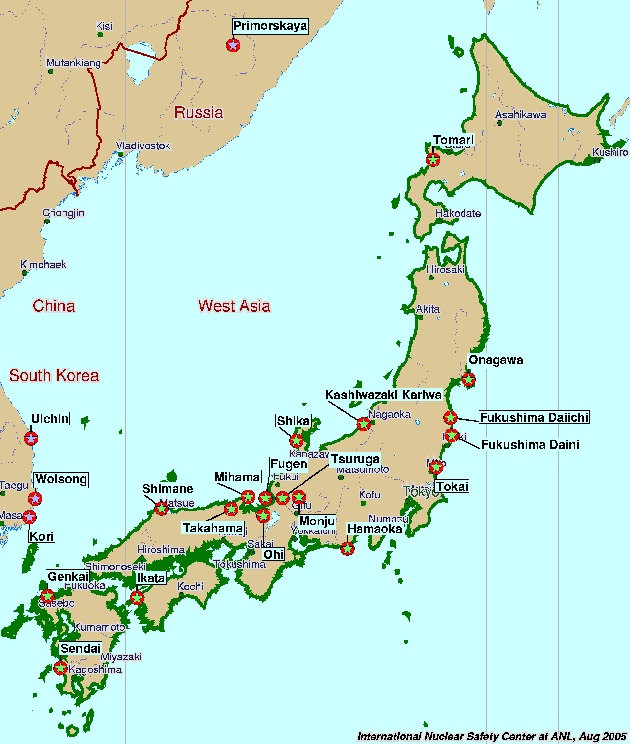
Japanese nuclear power plants.

Thursday, March 10, 2011

The Embarrassments of Empire 
Washington Wonders What to Say about Arab Freedom


By David Bromwich

From Egypt to Pakistan, February 2011 will be remembered as a month unusually full of the embarrassments of empire. Americans were enthralled by a spectacle of liberty in which we felt we should somehow be playing a part. Here were popular movements toward self-government, which might once have looked to the United States as an exemplar, springing up all across North Africa and the Middle East.  Why did they not look up to us now?

The answer became clearer with every equivocal word of the Obama administration, and every false step it took in trying to manage the crisis. A person suffers embarrassment when something true about himself emerges in spite of reasonable efforts to conceal it. It is the same with nations. Sovereign nations are abstract entities, of course -- they cannot have feelings as people do -- but there are times when they would blush if they could.

Egyptian President Hosni Mubarak was weakened and finally brought down by nonviolent popular actions that started in Cairo and spread to Alexandria, Suez, and many other cities. At first, Mubarak took a dictator’s prerogative and named his successor.  Soon after, he changed his mind and declined to step down.  At last, he gave in to the unrelenting demands of the people and pressure from the army.
Throughout the 18 days of upheaval, Washington spoke of the need for an “orderly transition.”
 President Obama and his advisers seemed to side with the Egyptian demonstrators vaguely and sentimentally, yet they never sought a connection with them, not even through a figure of international renown like Mohamed ElBaradei, the former Director General of the International Atomic Energy Agency who earned a Nobel peace prize in 2005. The U.S. took extreme care not to offend Mubarak. There was a period of perhaps three days after Obama dispatched Frank Wisner (a former ambassador and personal friend of Mubarak) as special envoy to consult with the dictator when the world was given to understand that America was planning the longest of farewells.

Such was the American response to an expression of popular will that had no precedent. For in the end, the protest swept up millions of demonstrators: by some estimates nearly a quarter of Egypt’s population of 81 million, in a mass action whose exhilaration could be shared by all who watched. The crowd in Tahrir Square had none of the poisonous quality of a mob.  Even the most respectable citizens -- doctors, lawyers, teachers, shopkeepers, women as well as men -- were drawn in little by little, visiting the demonstrations after work, throwing in their lot, and finally staying overnight in the square.

President Obama sanctified the process only after it was sealed by success. He said, in a telling phrase, that it had been a “privilege” for him to watch “history taking place.”  To add, as Obama did, that the result belonged to the Egyptian people alone was fitting; yet the protestors could respond with perfect justice that they owed nothing to American help. Was this degree of detachment inevitable?
Look into the order of events a little more closely and you see a picture of the contradictions of American policy over the last half-century. On day one of the protest, Secretary of State Hillary Clinton pronounced the Egyptian government “stable”; two days later, on a news program, Vice President Joe Biden refused to call Mubarak a dictator; the following day, President Obama said he had spoken to Mubarak and “urged him to meet the aspirations of the Egyptian people.”

If that sounds vague, far vaguer was to come. Having dispatched Wisner to Cairo, the president committed himself to this sentiment: “An orderly transition must be meaningful, it must be peaceful, and it must begin now.”  A wishful commandment that read like a polite editorial.  It left unclear the meaning of “orderly,” the meaning of “now,” and the meaning of “meaningful.”

Day nine found the administration “concerned” about attacks on the protestors, but not concerned enough to do anything.  Obama did, however, call Mubarak once more. In a private version of the “wishful commandment,” he told him that it was time to go. Mubarak did not go.

The chaos of day 12 offers a striking reflection of the stance of the White House as spectator. Returned from Cairo, Wisner asserted that Mubarak must be allowed to stay for several months longer, since his “continued leadership is critical.” In the same tenor, Hillary Clinton affirmed that any transition to democracy “takes some time. There are certain things that have to be done in order to prepare.” Yet the White House and the State Department went out of their way to dissociate themselves from the explicit conservatism of Wisner’s injunction.

Right to the end, Obama limited himself to comforting generalities whose practical significance was obscure. On day 13, for example, he allowed that Egypt was “not going to go back to what it was.” Meanwhile, the administration that went on the record in favor of “real, concrete” reforms never named one.

Stability First, Democracy Second

To say that our leaders covered themselves with shame would be melodramatic. To say that they were embarrassed by unforeseeable obstructions would be much too kind.  They could not help speaking for democracy, because that is what the U.S. thinks it stands for; if our actions sometimes expose us to the charge of hypocrisy, our words have the single-mindedness of sincere belief. How then did American policy in February come so palpably untethered?

We have supported a succession of military strongmen in Egypt going as far back as 1952, when the CIA judged Gamal Abdel Nasser a plausible bulwark against Communism. The U.S. gives Egypt $1.3 billion annually in aid (mostly military). Of all our clients, only Israel gets more, at $3 billion annually. The view in Washington has long been that those two nations will oversee “the neighborhood” on our behalf. That is why a nonviolent insurgency on the West Bank, if it should occur, would meet as baffled a response from Washington as the February days in Egypt. The embarrassment is part of the situation.

A fair surmise is that Obama was no less confusing in private than in public; that when he spoke to Mubarak, his words were muffled and decorous: "You must begin leaving, but I will never desert you" -- something like that. The difference between Mubarak's shakiness in his first televised speech to the country and his evident composure in his second speech may well be explained by a signal that he took for an assurance.

I will never desert you, one recalls, is the message that Barack Obama conveyed to Secretary of the Treasury Hank Paulson (when Obama was still a candidate); to the banks and financial firms (in February 2009); to Dick Cheney and the torture lawyers (in his National Archives Speech of May 2009); to General David Petraeus (in the months preceding the 2009 administration review of the Afghan War); to Israeli Prime Minister Benjamin Netanyahu via the Israeli defense minister Ehud Barak (in the summer of 2009); and to the U.S. Chamber of Commerce (in February 2011).
The need to give assurance seems to be an inseparable trait of Obama’s character.  He deals with big decisions by first moving to cement a secure alliance with the powers-that-be, no matter how discredited they are, no matter how resounding his previous contempt for them may have been. Yet this is a reflex that often prematurely cedes control to the powerful over whom he might otherwise be in a position to exert leverage. That fight, however, is not for him.

To say it another way, Obama visibly hates crisis.  He is so averse to the very idea of instability that he seems unable to use a crisis to his advantage. Seldom, to judge by the evidence thus far, is he the first, second, or third person in the room to recognize that a state of crisis exists. The hesitation that looked like apathy and the hyper-managerial tone of his response to the BP oil spill offered a vivid illustration of this trait. Egypt brought out the same pattern.

How did the statements and actions of the president and his advisers strike Egyptian demonstrators who were risking their lives for freedom? A February 6th story in the New York Times by Kareem Fahim, Mark Landler, and Anthony Shadid concluded that “the moves amounted to a rebuff to the protesters,” and added that this was the way things looked to those in Tahrir Square: “By emphasizing the need for a gradual transition, only days after emphasizing that change there must begin immediately, the Obama administration was viewed as shifting away from the protesters in the streets and toward stronger backing for Mr. Mubarak’s hand-picked elite.”

To capture the zig-zag path of American policy over the 18 days before Mubarak fell is not an easy task; but it is fair to say that the administration went from thinking the protests signified next to nothing, to pleading for an orderly transition, to emphasizing the necessary slowness of an orderly transition, to upbraiding Mubarak for so obviously standing in place, to rejoicing at the triumph of liberty. All this, in the course of just over two weeks.

Why could the U.S. not speak with a single voice? We say the word “democracy” and invoke its prestige with such careless fluency that we are surprised when we see its face. But here, the embarrassment was not only public and diplomatic, it was also personal and sentimental. A dictator through long acquaintance may become a familiar and comforting associate. In the second week of February, it emerged that Wisner’s law firm, Patton Boggs, had handled arbitration and litigation on behalf of Mubarak’s government, and that Secretary of State Clinton had said as recently as March 2009: “I really consider President and Mrs. Mubarak to be friends of my family.”

Our Empire and Our Election Cycles

If American officials looking at Egypt felt themselves “cabined, cribbed, confined,” anyone who knew the history of our Middle East policy could see the immediate cause. There was also a mediate cause, so ubiquitous as to be easily forgotten. This was, of course, Israel and the constant presence of Israel in American politics. In the last three months alone, Sarah Palin made public plans for a trip to Israel, and the Christian Zionist Mike Huckabee said that the U.S. ought to “encourage the Israelis to build as much as they can and as rapidly as they can” on the West Bank and in East Jerusalem. 

Nor has Barack Obama been indifferent to such pressures. In earlier years, he expressed unmistakable sympathy for the cause of Palestinian independence; but the story changed in 2008, as he entered the last leg of the race for president. In a speech to the American Israel Public Affairs Committee (AIPAC), in June of that year, Obama made an astonishing pledge with religious overtones: the American commitment to Israeli security was, he said, “sacrosanct.”   On his way to the White House, Obama purged his advisorate of figures like Robert Malley and Zbigniew Brzezinski who were deemed unsuitable by the Israel lobby.

Then, in June 2009, he made his celebrated Cairo speech, with its message of hope and sympathy for the progress of a liberal Muslim society. There at Cairo University, Obama called for a halt both to Palestinian terror and the Israeli occupation. Soon after, Hillary Clinton reiterated the demand that Israel enforce a complete stop to the building of settlements, with no exceptions for “outposts” or “natural growth.”

Benjamin Netanyahu simply defied these grave utterances; and he soon found he could do so with impunity. By the end of that summer, Obama had been persuaded to let pass in quiet disapproval anything Israel chose to do.  The mid-term elections were now drawing close; and Obama apparently judged it expedient to have his Chief of Staff Rahm Emanuel and family photographed on a visit to the Golan Heights.

Yet the ascent of the administration to that perfection of embarrassment was gradual and its stages deserve to be remembered.  When, in March 2010, Vice President Joe Biden paid a visit to Israel (saying “It’s good to be home”), he was greeted by an announcement from the interior ministry that it had approved the construction of 1,600 new building units for Jews in East Jerusalem: a calculated insult to President Obama. This led Biden to issue a public rebuke of Netanyahu, and Hillary Clinton to restate the administration’s anti-settlement policy. A request by Netanyahu to visit the White House was subsequently refused.

Netanyahu, however, realized that such embarrassment would eventually work to his advantage. By the end of May, thoughts of the mid-term election were coming to the fore in Washington. Without Israeli policy having changed in any way, the Obama administration began to warm up. The election-sensitive nature of this thaw was borne out by the revelation, in January 2011, that the White House had been dealing with Ehud Barak in preference to Netanyahu; that it had been charmed by his competence, seduced by his promises, and was now “furious” at his non-performance in the peace process.

So the pattern has been: a step toward pressure on Israel, followed by a step back into the arms of the Israel lobby -- the second step coinciding with an upcoming election cycle.  The 2012 election and its financing are already much on Obama’s mind. Unhappily for him, Turkey, Brazil, and other countries sympathetic to the Palestinian cause chose this moment to put forward a U.N. resolution condemning the Israeli occupation of conquered lands and designating Israel’s settlements there “illegal.”

Again, there was an embarrassed phone call from Obama, this time to Mahmoud Abbas, the president of the Palestinian Authority. Could the PA put off the vote? Or, if there had to be a U.N. statement, did it have to commit the U.S. to a legally binding resolution?  But Abbas himself had lost confidence in Obama and his own reputation had recently been badly tarnished by WikiLeaks revelations of the PA’s capitulation to past American requests.  The settlements were in any case in violation of international law, specifically article 49 of the Fourth Geneva Convention which states:  “The Occupying Power shall not deport or transfer parts of its own civilian population into the territory it occupies.” Abbas accordingly rebuffed Obama’s entreaty for a milder resolution and the American president suffered the embarrassment of issuing his first veto in the U.N. in utter defiance of the hopes expressed so eloquently in his Cairo speech.

But the interlude was not over. For Obama could not bear to stand as the sole obstacle (alongside Israel) to a unanimous vote in favor of the resolution without making it clear that he did so with a bad conscience.  The U.S. ambassador to the United Nations, Susan Rice, offered the explanation in public in a speech that managed to concede almost every particular the resolution had specified: “Continued settlement activity violates Israel’s international commitments, devastates trust between the parties, and threatens the prospects for peace.”

If there is any precedent for such an “Explanation of Vote,” the precedents must be few. The only difference between Obama’s position and the U.N. resolution was that the resolution would have backed such words by enforceable action. “Set honor in one eye,” says Brutus in Julius Caesar, “and death i’ th’other, and I will look on both indifferently.” The embarrassment of the U.N. vote was that Obama set justice in one eye, and a presidential campaign in the other, and the world was in a position to see which way he turned.

Diplomacy and Counterterrorism

Raymond Davis is the American operative in Pakistan, officially described at first as a “technical adviser,” who on January 25th interrupted a drive in the city of Lahore to shoot and kill two Pakistanis. Davis took care to photograph the corpses and called in a back-up jeep for help, which, in its rush, knocked over and killed a third Pakistani.  Before he could get back to the U.S. consulate, Davis was arrested by the local police.

On February 20th, the Guardian journalist Declan Walsh confirmed the suspicion which the strange incident had immediately spurred that Davis was a CIA agent.  The Pakistani government was aware of his identity, Walsh reported, and that was why it had resisted an Obama administration demand that Davis be accorded diplomatic immunity. The following day, the New York Times revealed that it had known who Davis’s employer was for some time, but -- at the request of the White House and the State Department -- had refrained from publishing an accurate account of the shooting and its aftermath.
Obama’s cup of embarrassment in February was close to running over, but at least he now had a newspaper to share his embarrassment. Why did the Times suppress the truth about Raymond Davis? For reasons of empire. After all, the facts were known all over Pakistan and had been published in the Pakistani press.

In obeying a White House request to keep them out of the American press, the Times (along with the Washington Post and Associated Press) was protecting not Davis himself but a government definition of “tact,” while fostering the ignorance of American citizens about the actions of our own government. The protocol of the press under imperial rules -- as the British discovered in the Boer War and Americans have come to know in Iraq, Afghanistan, and Pakistan -- is simple and endlessly repeatable: power comes before truth except in cases where the truth is conspicuous.

Journalists are now learning what historians have known for many years -- an agent like Davis is an instrument of a policy that was wrong from the start. For Pakistan has always existed in a state of deep and partly justified paranoia regarding India.  After the Soviet withdrawal from Afghanistan in 1989, Pakistani leaders came to consider it a requirement of “strategic depth” that Afghanistan be a reasonably stable neighbor with a compliant government.  From the moment in late 2001 when, to spare an investment of ground forces, the Bush administration threw in its lot with the warlords of the Northern Alliance in its invasion of Afghanistan, that policy was sent awry.  From then on, Pakistan’s leadership would regard the American presence as essentially unstable and counter it in every way consistent with simulated friendship.

Practical wisdom about these matters has never been hard to come by. It shows in the secret dispatches of the foreign service, which we can now read, thanks to another embarrassment: the release of secret diplomatic cables by WikiLeaks. In a cable from Islamabad, dated September 23, 2009, for example, the U.S. Ambassador to Pakistan Anne Patterson sent the following piece of sound advice to the Obama administration:

“In response to queries posed by the National Security Council, Embassy Islamabad believes that it is not possible to counter al-Qaeda in Pakistan absent a comprehensive strategy that 1) addresses the interlinked Taliban threat in Afghanistan and Pakistan, 2) brings about stable, civilian government in Afghanistan, and 3) reexamines the broader role of India in the region. As the queries presuppose, the ending of Pakistani establishment support to terrorist and extremist groups, some Afghan-focused and some India-focused, is a key element for success. There is no chance that Pakistan will view enhanced assistance levels in any field as sufficient compensation for abandoning support to these groups, which it sees as an important part of its national security apparatus against India. The only way to achieve a cessation of such support is to change the Pakistan government's own perception of its security requirements.”

Among the most remarkable features of Ambassador Patterson’s warning were her repeated mention of India and her allusion to the conflict over Kashmir: scarcely mentioned in official American descriptions of what the U.S. is doing in Pakistan. And here a further embarrassment appears in the background to lengthen the shadow of the Davis incident. The cables show that the Obama administration either is not using, or is not sharing with the American people, the most elementary knowledge of the complexity of a commitment it inherited from its predecessor and now has greatly broadened. These cables suggest that a rhetorical policy, not just of simplification but of conscious distortion, has guided Obama’s frequent iterations that “the enemy” in Pakistan is al-Qaeda. It would be as fair to say that the American enemy in Pakistan is Pakistan, and Pakistan’s relationship to India, and our own relationship to both.

Embarrassments Are Sacrosanct 

Even in the depths of mortification, a lower depth still threatens Washington, thanks to our double image of ourselves. As the sole superpower, we want to be everywhere (and everywhere in charge); but as the best hope of democracy, we must be seen to be nowhere (and nowhere in charge). You might suppose that the greatest threat to such a double image lies in the possibility of the endless documentary on American foreign policy and America’s wars being offered by WikiLeaks. In fact, the government’s reactions to WikiLeaks have posed a far greater danger -- not to America the superpower, but to the constitutional America in whose name it acts.

The deeper embarrassments of officialdom can easily assume the shape of patriotic outrage. Newt Gingrich, for example, has said that Julian Assange, the founder of WikiLeaks, should be treated as an “enemy combatant”; Sarah Palin has claimed he should be pursued just as we pursue the leaders of al-Qaeda and the Taliban; Peter King has recommended that WikiLeaks be classified as a terrorist organization. These statements were predictable, considering from whom they came.

It was not to be expected that an American secretary of state would skirt the edge of the same vigilante sentiments. Yet Hillary Clinton did just that when, embarrassed at the exposure of the slack security of the foreign service and the peculiar frankness of its portraits, she said that WikiLeaks had launched “an attack on the international community.” The community of the people of the world, or the community of secret governments and secret armies? To be an enemy of the latter would make Assange an honest journalist. To be an enemy of the former would make him a terrorist.

Attorney General Eric Holder, confronted by the same ferocious descriptions of Assange, and himself embarrassed -- since people were looking to his department to prosecute, even though it was not clear Assange had broken a law -- resolved to discover a law that could be attached to a penalty whose appropriateness he appeared to have decided in advance. “There’s a real basis,” said Holder vaguely, “there’s a predicate for us to believe that crimes have been committed here.”

Was the vice president, too, embarrassed when he spoke of Assange as “a high-tech terrorist”? He should have been. If there is a weapon of high-tech terror that is feared in the world today, it is the drones that -- as part of the CIA’s covert war in the Pakistani tribal borderlands -- now regularly fire missiles into houses to kill presumed enemies of the U.S., along with anyone standing nearby. And if there is a world leader known for his advocacy of drone warfare, it is Vice President Biden.
We are in the second week of March, and the embarrassments show no sign of abating. On March 3rd, the president stated that the Libyan dictator Muammar Gaddafi must go -- or, in the preferred euphemism of the moment, that he “needs to step down” -- and must do it “now.”  What could that mean? How does Obama propose to make it stick?

Even for a president who, in the realms of war and peace, is apt to imagine his words weigh more than other people’s actions, there are some words that sound so much like actions you should take care not to speak them too emphatically.  But never mind: officials in the State Department and at the White House, we are told, have come across a subtler way of expressing themselves than the Bush-Cheney administration which spoke so crudely of “regime change.” They now speak of “regime alteration.”
Lives and deaths may actually hang on words like these. We think of ourselves as the patron country of democracy in a world that wants to be patronized, but there are other ways of looking at the United States, and other ways of looking at patronage. Samuel Johnson completed his great Dictionary of the English Language in 1755 without financial backers from the aristocracy.  When Lord Chesterfield arrived late on the scene to offer his help, Johnson replied in a letter that has become famous: “Is not a patron, my lord, one who looks with unconcern on a man struggling for life in the water, and when he has reached ground, encumbers him with help?”

Barack Obama, Frank Wisner, and Hillary Clinton were, in exactly that sense, patrons of the struggle for liberty by the people of Egypt. We embarrass other countries with our help, and it is only natural that we stumble. We are sleepwalking in someone else’s house.

David Bromwich is editor of a selection of Edmund Burke’s speeches, On Empire, Liberty, and Reform, and co-editor of the Yale University Press edition of John Stuart Mill’s On Liberty.  He writes regularly for the New York Review of Books, the London Review of Books, and the Huffington Post. To listen to Timothy MacBain’s latest TomCast audio interview in which Bromwich discusses how President Obama’s personality affects the way he reacts to crises, click here, or download it to your iPod here.
Copyright 2011 David Bromwich