
Monday, March 07, 2011
Saturday, March 05, 2011
The lion wants his juice back
THE ROVING EYE
By Pepe Escobar
By Pepe Escobar
You're Muammar Gaddafi, and you're sitting in your Bab al-Azizia bunker sipping green tea and surveying the odds of staying in power. Let's see. You control some neighborhoods in Tripoli; some cities in the far west, near the Tunisian border; your birthplace, Sirte. And that's it.
You may have lost like 90% of your country. You tried to get Zawiya (west of Tripoli) back and failed; those god-damned tribals betrayed you. You tried to get Misrata (east of Tripoli), and failed. You tried to get Brega - the second-largest processing and oil shipping terminal in Libya - and failed.
The Americans and Brits are dying to invade. "Experts" say you're boxed in and have only Zimbabwe as an exile destination. Venezuelan President "brother" Hugo Chavez wants to send a multinational delegation to negotiate. Negotiate what? This is your country. L'Etat, c'est moi - the state is me, King Muammar. Nobody can steal my mojo.
They froze your multi-billionaire assets from A to Z. They shut down your banks. But you've still got some dough. A whole lot of weaponry. A few (malfunctioning) jets. You have those thousands of black African mercenaries. You have the 10,000-strong special brigade led by your son Khamis. You got state TV.
So what do you do? You double down. And go for broke.
The lion sleeps tonight
Danger: the African king of kings in his bunker is like a lion resting under a tree. He knows that from the west the "rebels" - or in shorthand official narrative "al-Qaeda zombie youths on drugs" - haven't got a chance to hurt him unless they organize a very complex attack army out of many rag-tag bands with Kalashnikovs and rocket-propelled grenades in scattered towns.
He knows that the rebels in the east have to do the same - plus travel, unprotected, along an infinite desert highway just to get to Sirte, where they can be smashed by his jets and tanks.
So he knows they can defend - Zawiya, Misrata, Brega - but they don't have what it takes to attack. That gives him enough time to better plan how to go for the kill.
There's only one problem with this Lion King scenario. What if he runs out of oil?
No less than 80% of Libya's oil fields and refineries are now in the hands of those "al-Qaeda zombie youths on drugs". Gaddafi knows he needs to get Brega back - and quick. He'll go for it, again, and with a more lethal strategy. He still holds Ras Lanouf, 80 kilometers west of Brega - the refinery (220,000 barrels a day), the port and the airport. But he can't afford to lose Brega.
Brega is not exporting any oil. There are no tankers coming and going. Oil production in the southeastern fields that feed Brega has been downsized, from 90,000 barrels a day to just 11,000; there's nowhere to store them. There's no oil flowing at the Nafoora field, part of the Sirte Basin. Italy's ENI, the top foreign oil major, is repatriating all non-essential personnel. Libya's daily production dropped from 1.6 million barrels to 850,000, and will fall further.
More than this oil on storage, Gaddafi needs working refineries pumping out juice for his already cranky military machine. The crowds in liberated Benghazi say that they don't need oil money - because they never got much of from central government anyway in Cyrenaica. The problem is sooner rather than later they will need more weapons. Thus they will need oil money to buy them.
Benghazi is convulsed by rumors of Gaddafi's secret police infiltrated everywhere gathering local intel - even inside the courthouse which has been transformed into eastern liberated Libya's Revolution Central. No wonder al-Jazeera is reporting that people in Brega and Ajdabiya badly want a no-fly zone - to the horror of pan-Arab media.
It's stalemate time - and the lion is biding his time, never more dangerous when he maneuvers in the shade. Although the Algerian government has vociferously denied, officially, it is helping Gaddafi, Algeria, with 40% unemployment and across the board pent-up rage, is also on the brink. Frightful Fortress Europe, meanwhile, prays. While the Greenstream gas pipeline from Libya to Sicily is now closed (Italians are not yet freaking out), Spain dreams of the new US$1.4 billion gas pipeline from Algeria set to open in a few days.
Doomsday practitioners already visualize Algeria's oil production - 1.4 million barrels a day - soon going down the drain alongside Libya's. No wonder the head of oil research at Barclays Capital, Paul Horsnell, says things can potentially be worse than Iran 1979; "The world has only 4.5 million barrels per day of spare capacity."
Thus speculation will be king for the foreseeable future. Meanwhile, the lion sleeps, tonight and in subsequent nights, musing how he'll get his juice back while a sinister chill envelops Libya all over again.
Pepe Escobar is the author of Globalistan: How the Globalized World is Dissolving into Liquid War (Nimble Books, 2007) and Red Zone Blues: a snapshot of Baghdad during the surge. His new book, just out, is Obama does Globalistan (Nimble Books, 2009).
He may be reached at pepeasia@yahoo.com.

Harvey Point base, once known as a U.S. Navy Supply Center, but which has existed for some five decades as a CIA's "special operations" training facility under Defense Department "cover."
UPDATE. Harvey Point's "distinguished" alumni
WMR's article on the CIA's highly-secretive Harvey Point Defense Testing Activity near Hertford, North Carolina apparently rattled more than a few cages in upper echelon Washington, perhaps so much so that WMR experienced a communication outage on March 3 that was blamed by AT&T on a degraded cell phone tower in south Arlington, Virginia.
WMR spoke to a number of military personnel who served in the Tidewater, Virginia area who were unfamiliar with the Harvey Point base, once known as a U.S. Navy Supply Center, but which has existed for some five decades as a CIA's "special operations" training facility under Defense Department "cover."
Complementing the CIA's agent training facility at Camp Peary, Virginia, just outside Williamsburg, Harvey Point was once known as "Isolation Tropic", as opposed to Camp Peary, also known as "Isolation" or "The Farm." Harvey Point is sometimes referred to by CIA officers as "The Point."
The CIA has good reason to be silent about the operations at Harvey Point. For decades, under the guise of "counter-terrorism" training, Harvey Point has been training terrorists, including members of the Kosovo Liberation Army, anti-Castro commandos of Brigade 2506 and Alpha 66, the South Korean Central Intelligence Agency (KCIA), Israel's Sayeret Matkal commandos, Angolan guerrillas of the National Union for the Total Independence of Angola (UNITA), Chechen guerrillas, the secret police of the infamous Greek colonels' junta, and the Honduran death squad Movimiento Anti-Communista Hondureno (MACHO), as well as CIA Latin America cocaine smugglers used in "Operation Pseudo Miranda" during William Casey's reign at Langley. The latter operation was described by former CIA operative Kenneth C. Bucchi in his 2000 book, "Operation Pseudo Miranda: A Veteran of the CIA Drug Wars Tells All." The training of the CIA cocaine smugglers, according to Bucchi, was conducted at Harvey Point and the Tonopah Test Range (Area 52), located 70 miles northwest of the CIA's top secret testing facility at Area 51 in Nevada.
Through the auspices of the International Police Academy, using the conduit of a CIA proprietary called International Police Services, Inc. (INPOLSE) of Washington, DC, foreign police officers were sent to Harvey Point for training in bombings, arson, and assassinations. There is some evidence in Guyana that members of Jim Jones's People's Temple and their Guyanese security liaison officers also received training in weapons use at Harvey Point. Jonestown is widely believed to have been a CIA MK-ULTRA mind control operation with the cover story that most of the Americans who died there did so after drinking poisoned Kool Aid. In fact, most were shot to death at close range.
In 2009, the archives of the Health Ministry of Guyana was gutted by a fire caused by an arson attack. Suspiciously, a contingent from the US Southern Command based in Miami was dispatched to Georgetown to "investigate" the fire. On October 24, 1979, almost a year after the Jonestown massacre, Vincent Teekah, Guyana's Minister of Education was assassinated by a gunshot at close range. On June 13, 1980, Guyanese opposition leader Walter Rodney was assassinated by a car bomb. Guyanese Defense Force officers were among those trained at Harvey Point and the CIA was linked to the assassinations of Teekah and Rodney.
One of Harvey Point's graduates was General Ziaur Rahman, who is believed to have participated in the assassination of Bangladesh President Sheikh Mujibur Rahman on August 15, 1975, along with members of his family and staff. One of the generals involved was believed to be Ziaur Rahman who is alleged to have been working for the CIA. Two of Sheikh Mujib's daughters escaped assassination since they were visting West Germany at the time. One is Bangladesh's current prime minister, Sheikh Hasina Wazed. Ziaur Rahman became president in 1977 after serving as the de facto leader since the coup. Immediately, Ziaur Rahman reversed Sheikh Mujib's secular and socialist policies, turning Bangladesh into an "Islamic" republic tied to the West. On May 30, 1981, Ziaur Rahman was assassinated by a group of army officers.
Harvey Point was also involved in the training of other Islamists. In his 2000 book, "Unholy Wars," this editor's late friend John Cooley, the longtime Middle East correspondent for ABC News, wrote that Harvey Point was used to train the Afghan mujaheddin, including many irregulars who would later end up in the ranks of the Taliban and Osama bin Laden's "Al Qaeda" organization. At Harvey Point the Afghan guerrilla fighters learned about "sophisticated fuses, timers, and explosives; automatic weapons with armor-piercing ammunition, remote-control devices for triggering mines and bombs." Cooley further described tje Afghans' CIA training at Harvey Point, Camp Peary, and Fort Bragg. It included honing the Afghans' local skills of local Afghan skills of throat cutting and disemboweling, as well as more sophisticated training in bombing commercial aircraft, buses, cars, limousines, power plants and transmission towers, office buildings, airport terminals, hotels, movie theaters, and hotels.
Prime Minister Hasina recently forced Nobel Peace Prize laureate Muhammed Yunus off the board of Bangldesh's Grameen Bank and cited as one of the reasons Yunus's micro-loan program, for which he was awarded the Nobel Prize, as "sucking blood from the poor" with micro-loan program. President Obama's mother, Stanley Ann Dunham Soetoro, worked on micro-loan programs for the Ford Foundation, among other organizations, in Pakistan and Indonesia.
Harvey Point has also been used by Los Alamos National Laboratory to conduct nuclear material detection testing. In a 1998 paper delivered to the Institute of Nuclear Materials Management Conference in Naples, Florida, technical details of the work at Harvey Point are described as follows:
"Quantrad Sensor, Inc. (QSI) licensed the Ranger (TM) technology from Los Alamos National Laboratory (LANL) in 1997. The Material Control and Accountability group at LANL uses the Ranger (TM) for in situ nuclear material (NM) confirmation measurements, medical isotope entry/exit confirmations, hand scanning, and shipper confirmations. QSI is developing new applications by adapting the LANL software to identify unknown isotopes for nuclear smuggling and other national security scenarios.
Initial efforts at Harvey Point expanded the existing LANL NM confirmation software to include more isotopes and a nontechnical display. After Harvey Point, QSI replaced the ruggedized detector (≈1 0%) with a higher-resolution detector (7.5%) and developed a real-time pattern recognition system, RangerMaster. As a basis for RangerMaster, a spectrum for each isotope in the library was simulated with SYNTH. Careful analysis of the SYNTH spectra revealed that all the isotopes in the library could be identified with a unique set of regions of interest (ROIs). Initial validation of RangerMaster (TM) was done with the SYNTH spectra and the archived data from Harvey Point. Next, actual field tests were conducted at hospitals and the DOE Remote Sensing Laboratory (RSL) operated by Bechtel."
Bechtel has long maintained a cozy relationship with the CIA. Before World War II, Steve Bechtel formed a military-industrial complex partnership with John McCone. McCone later became the chairman of the Atomic Energy Commission and later, director of the CIA. The CIA has used Bechtel to provide cover for non-official cover CIA operatives abroad.
While the U.S. Army's "School of the Americas," now known as the Western Hemisphere Institute for Security and Cooperation, has been called the "School of the Assassins," Harvey Point can justifiably be called the "School of the Terrorists." And furthermore, the American taxpayers fund both operations without even a whimper from members of Congress. America: stick a fork in it, it's done.
UPDATE: On November 24, 2010, The Daily Advance of Elizabeth City, North Carolina ran a story about the fuselage of a Boeing 727 being transported through eastern North Carolina from Laurinburg to Harvey Point via Edenton on North Carolina highways. The plane was being hauled by Waff Contracting Company of Edenton and the photograph of the fuselage was taken by Debra Waff. One poster on the paper's website expressed outrage that the paper would publish the photo and news of the fuselage transport: "The transport of the fuselage was unannounced for a reason. IT WAS NONE OF THE NEWS MEDIA'S BUSINESS! What goes on at Harvey Point, or any military other bases, is really a matter of national security and does not need broadcasting to the public."
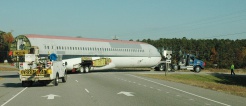
Strange goings on at Harvey Point with North Carolina highways looking like airport runways.
On December 10, 2008, The Virginia Pilotreported that Al Waff, the general superintendent of Waff Contracting, was kidnapped by a man with a semi-automatic handgun outside his Edenton homeand was forced to drive the unknown assailant to Mobile, Alabama. Waff was not robbed but the assailant forced Waff to remove the battery from his cell phone during the drive. Waff was not harmed in the car jacking.
WMR's article on the CIA's highly-secretive Harvey Point Defense Testing Activity near Hertford, North Carolina apparently rattled more than a few cages in upper echelon Washington, perhaps so much so that WMR experienced a communication outage on March 3 that was blamed by AT&T on a degraded cell phone tower in south Arlington, Virginia.
WMR spoke to a number of military personnel who served in the Tidewater, Virginia area who were unfamiliar with the Harvey Point base, once known as a U.S. Navy Supply Center, but which has existed for some five decades as a CIA's "special operations" training facility under Defense Department "cover."
Complementing the CIA's agent training facility at Camp Peary, Virginia, just outside Williamsburg, Harvey Point was once known as "Isolation Tropic", as opposed to Camp Peary, also known as "Isolation" or "The Farm." Harvey Point is sometimes referred to by CIA officers as "The Point."
The CIA has good reason to be silent about the operations at Harvey Point. For decades, under the guise of "counter-terrorism" training, Harvey Point has been training terrorists, including members of the Kosovo Liberation Army, anti-Castro commandos of Brigade 2506 and Alpha 66, the South Korean Central Intelligence Agency (KCIA), Israel's Sayeret Matkal commandos, Angolan guerrillas of the National Union for the Total Independence of Angola (UNITA), Chechen guerrillas, the secret police of the infamous Greek colonels' junta, and the Honduran death squad Movimiento Anti-Communista Hondureno (MACHO), as well as CIA Latin America cocaine smugglers used in "Operation Pseudo Miranda" during William Casey's reign at Langley. The latter operation was described by former CIA operative Kenneth C. Bucchi in his 2000 book, "Operation Pseudo Miranda: A Veteran of the CIA Drug Wars Tells All." The training of the CIA cocaine smugglers, according to Bucchi, was conducted at Harvey Point and the Tonopah Test Range (Area 52), located 70 miles northwest of the CIA's top secret testing facility at Area 51 in Nevada.
Through the auspices of the International Police Academy, using the conduit of a CIA proprietary called International Police Services, Inc. (INPOLSE) of Washington, DC, foreign police officers were sent to Harvey Point for training in bombings, arson, and assassinations. There is some evidence in Guyana that members of Jim Jones's People's Temple and their Guyanese security liaison officers also received training in weapons use at Harvey Point. Jonestown is widely believed to have been a CIA MK-ULTRA mind control operation with the cover story that most of the Americans who died there did so after drinking poisoned Kool Aid. In fact, most were shot to death at close range.
In 2009, the archives of the Health Ministry of Guyana was gutted by a fire caused by an arson attack. Suspiciously, a contingent from the US Southern Command based in Miami was dispatched to Georgetown to "investigate" the fire. On October 24, 1979, almost a year after the Jonestown massacre, Vincent Teekah, Guyana's Minister of Education was assassinated by a gunshot at close range. On June 13, 1980, Guyanese opposition leader Walter Rodney was assassinated by a car bomb. Guyanese Defense Force officers were among those trained at Harvey Point and the CIA was linked to the assassinations of Teekah and Rodney.
One of Harvey Point's graduates was General Ziaur Rahman, who is believed to have participated in the assassination of Bangladesh President Sheikh Mujibur Rahman on August 15, 1975, along with members of his family and staff. One of the generals involved was believed to be Ziaur Rahman who is alleged to have been working for the CIA. Two of Sheikh Mujib's daughters escaped assassination since they were visting West Germany at the time. One is Bangladesh's current prime minister, Sheikh Hasina Wazed. Ziaur Rahman became president in 1977 after serving as the de facto leader since the coup. Immediately, Ziaur Rahman reversed Sheikh Mujib's secular and socialist policies, turning Bangladesh into an "Islamic" republic tied to the West. On May 30, 1981, Ziaur Rahman was assassinated by a group of army officers.
Harvey Point was also involved in the training of other Islamists. In his 2000 book, "Unholy Wars," this editor's late friend John Cooley, the longtime Middle East correspondent for ABC News, wrote that Harvey Point was used to train the Afghan mujaheddin, including many irregulars who would later end up in the ranks of the Taliban and Osama bin Laden's "Al Qaeda" organization. At Harvey Point the Afghan guerrilla fighters learned about "sophisticated fuses, timers, and explosives; automatic weapons with armor-piercing ammunition, remote-control devices for triggering mines and bombs." Cooley further described tje Afghans' CIA training at Harvey Point, Camp Peary, and Fort Bragg. It included honing the Afghans' local skills of local Afghan skills of throat cutting and disemboweling, as well as more sophisticated training in bombing commercial aircraft, buses, cars, limousines, power plants and transmission towers, office buildings, airport terminals, hotels, movie theaters, and hotels.
Prime Minister Hasina recently forced Nobel Peace Prize laureate Muhammed Yunus off the board of Bangldesh's Grameen Bank and cited as one of the reasons Yunus's micro-loan program, for which he was awarded the Nobel Prize, as "sucking blood from the poor" with micro-loan program. President Obama's mother, Stanley Ann Dunham Soetoro, worked on micro-loan programs for the Ford Foundation, among other organizations, in Pakistan and Indonesia.
Harvey Point has also been used by Los Alamos National Laboratory to conduct nuclear material detection testing. In a 1998 paper delivered to the Institute of Nuclear Materials Management Conference in Naples, Florida, technical details of the work at Harvey Point are described as follows:
"Quantrad Sensor, Inc. (QSI) licensed the Ranger (TM) technology from Los Alamos National Laboratory (LANL) in 1997. The Material Control and Accountability group at LANL uses the Ranger (TM) for in situ nuclear material (NM) confirmation measurements, medical isotope entry/exit confirmations, hand scanning, and shipper confirmations. QSI is developing new applications by adapting the LANL software to identify unknown isotopes for nuclear smuggling and other national security scenarios.
Initial efforts at Harvey Point expanded the existing LANL NM confirmation software to include more isotopes and a nontechnical display. After Harvey Point, QSI replaced the ruggedized detector (≈1 0%) with a higher-resolution detector (7.5%) and developed a real-time pattern recognition system, RangerMaster. As a basis for RangerMaster, a spectrum for each isotope in the library was simulated with SYNTH. Careful analysis of the SYNTH spectra revealed that all the isotopes in the library could be identified with a unique set of regions of interest (ROIs). Initial validation of RangerMaster (TM) was done with the SYNTH spectra and the archived data from Harvey Point. Next, actual field tests were conducted at hospitals and the DOE Remote Sensing Laboratory (RSL) operated by Bechtel."
Bechtel has long maintained a cozy relationship with the CIA. Before World War II, Steve Bechtel formed a military-industrial complex partnership with John McCone. McCone later became the chairman of the Atomic Energy Commission and later, director of the CIA. The CIA has used Bechtel to provide cover for non-official cover CIA operatives abroad.
While the U.S. Army's "School of the Americas," now known as the Western Hemisphere Institute for Security and Cooperation, has been called the "School of the Assassins," Harvey Point can justifiably be called the "School of the Terrorists." And furthermore, the American taxpayers fund both operations without even a whimper from members of Congress. America: stick a fork in it, it's done.
UPDATE: On November 24, 2010, The Daily Advance of Elizabeth City, North Carolina ran a story about the fuselage of a Boeing 727 being transported through eastern North Carolina from Laurinburg to Harvey Point via Edenton on North Carolina highways. The plane was being hauled by Waff Contracting Company of Edenton and the photograph of the fuselage was taken by Debra Waff. One poster on the paper's website expressed outrage that the paper would publish the photo and news of the fuselage transport: "The transport of the fuselage was unannounced for a reason. IT WAS NONE OF THE NEWS MEDIA'S BUSINESS! What goes on at Harvey Point, or any military other bases, is really a matter of national security and does not need broadcasting to the public."
Strange goings on at Harvey Point with North Carolina highways looking like airport runways.
On December 10, 2008, The Virginia Pilotreported that Al Waff, the general superintendent of Waff Contracting, was kidnapped by a man with a semi-automatic handgun outside his Edenton homeand was forced to drive the unknown assailant to Mobile, Alabama. Waff was not robbed but the assailant forced Waff to remove the battery from his cell phone during the drive. Waff was not harmed in the car jacking.
Thursday, March 03, 2011
The end of the end of history
THE ROVING EYE
By Pepe Escobar
How does it feel to be on your own, like a complete unknown, like a rolling stone, crisscrossing the desert sands, howling to the winds that the end of the end of history is now?
Western ideological categories lie mummified in a tomb. There's no dichotomy, or "clash" of civilizations, between Western parliamentary democracy and Islam.
Slovenian Slavoj Zizek, the Elvis of philosophy, told al-Jazeera a few weeks ago that the real tragedy of Arab nations was the disappearance of a strong, secular left. No wonder; all United States-backed dictators in MENA (Middle East/Northern Africa) killed or exiled the best and the brightest among progressive intellectuals.
Now, one may even dream that the notion of fighting incompetent/corrupt/unjust governments in the name of social justice in MENA is about to contaminate Europe and the US (as it already did; "from Cairo to Wisconsin") - and a new day is dawning for workers' movements that suffer from austerity and "structural adjustments" concocted by the International Monetary Fund (IMF). New internationalist workers of the world, class of 2011, unite.
And how not to marvel that neo-liberalism applied to the Arab world also allowed the emergence of Islamist groups able to orient into political action the enormous collective anger provoked by horrible wealth distribution?
How does it feel to be laughing out loud at those silly neo-cons after they had peddled for years the notion that Arabs could be free, maybe, but they didn't really know that they wanted to be free, and they couldn't do it by themselves, so they needed the Pentagon to "shock and awe" them into the real thing?
Meanwhile, assorted Zionists and Zio-cons are left to pray for the emergence in Egypt of at least a moderate Islamist-tinged government that is willing to preserve the 1979 Camp David accords, without discussing the whole, ongoing, decades-long Palestinian tragedy. Fat chance.
How not to rejoice that the Tunisian and Egyptian revolutions emerged within a secular and nationalist framework, thus debunking Tehran's revolution monopoly, according to which the US-backed Shah of Iran was dethroned by Islam as ideology?
So now it's one, two, three, what are we fighting for? The fight is for one, two, three, a million revolutions against not only the aging, resident Euro-American-empowered tyrant of choice but the whole US Treasury/IMF/World Bank-concocted architecture of "reality".
Arab nationalism, Arab nationalist solidarity, Arab nationalist al-Jazeera, Internet as a super al-Jazeera - it's all on, for all Arabs to see and do and practice themselves. And the West has no plan B - or any hint of Barack Obama/Hillary Clinton-style "orderly transition" for Bahrain, Yemen or Libya.
Yet the revolution has not even started.
The Sunni dynasty in Bahrain will keep playing an Arab Shakespearean drama. Following up on a 2009 WikiLeaks cable, King Hamad will keep "gradually shifting power" to his son, crown prince Salman, from the powerful Prime Minister Khalifa bin Sal Al-Khalifa. The prime minister is the king's uncle and the crown prince's great uncle. Meanwhile the Bahrain National Security Service, run by Sheik Khalifa bin Abdullah al-Khalifa, will keep getting its marching orders from the US Central Intelligence Agency.
The "strong tribal alliance" Gulf Cooperation Council (GCC) will use tanks, jets, mercenaries, whatever it takes, to prevent regime change in weak link Bahrain. After all the GCC - Bahrain, Qatar, Kuwait, Oman, Saudi Arabia, the United Arab Emirates - sits on 45% of global oil reserves, and they are not letting the loot go in the name of "democracy".
And even while al-Qaeda lies as moribund as Mubarak, and has absolutely no ideological or sociological influence over northern Africa, shrill imperial voices keep warning of Libya descending into the status of a giant Somalia. As if the "Egyptian doctor", Ayman al-Zawahiri, would materialize tomorrow in liberated eastern Libya and apply for a job as the new emir. Now that would be a real clash of civilizations.
Pepe Escobar is the author of Globalistan: How the Globalized World is Dissolving into Liquid War (Nimble Books, 2007) and Red Zone Blues: a snapshot of Baghdad during the surge. His new book, just out, is Obama does Globalistan (Nimble Books, 2009).
He may be reached at pepeasia@yahoo.com.
Wednesday, March 02, 2011
Don't take your eyes off the Gulf
THE ROVING EYE
By Pepe Escobar
Picture a feudal, or neo-medieval, paradise, the former home of legendary Sindbad the Sailor, absolutely ruled by an unmarried, slim, lute-playing septuagenarian who prefers to live alone in his palace; paradigm of discretion Sultan Qabus bin Sa'id. That, in a nutshell, is Oman.
Oman practices Ibadi Islam - neither Sunni nor Shi'ite - also found in selected latitudes in northern and eastern Africa. This couldn't be further apart from Wahhabism, or al-Qaeda style jihadi fanaticism. In Omani terms, Ibadi Islam involves finding the right mix between tribal custom and the state apparatus (Qabus is very fond of consultations with tribal leaders).
Washington - and London - absolutely love Qabus; the graduate of the Sandhurst military academy in Britain is a lover of Mozart and Chopin, and his strategic acumen is compared to Singapore's founding father Lee Kwan Yew. (When I went to Oman I actually felt I was in an Arabian Singapore. It helped that I had lived in Singapore. Everything in Oman is too neat - and too Disneyland-perfect, in a Singaporean Stepford Wives way.)
American love is helped by the sultan having given a big hand to George H W Bush during the first Gulf war in 1991 against Iraq's Saddam Hussein, and extending the favor to George W Bush, allowing for 20,000 US troops to hang out in Oman before the invasions of both Afghanistan and Iraq. To top it off, the deepest stretch of the exceedingly strategic Strait of Hormuz - essential for the navigation of supertankers in the Persian Gulf - lies in Omani territory.
Sorry to intrude on your idyll
Qabus, in power since 1970, may still not be an object of revulsion in his Gulf of Oman paradise. But his - and Oman's elites - time may be running out under the relentless great 2011 Arab revolt clock.
In The Economist's shoe-thrower index, Oman is in no less than sixth place, right behind Hosni Mubarak-deposed Egypt and way ahead of Zine el-Abidine Ben Ali-deposed Tunisia and Khalifa-in-peril Bahrain. Half the population of less than three million is less than 21 years old. Unemployment is rife - especially among the youth carrying a useless diploma. Of a total of up to 40,000 high school graduates a year, only a few find a job.
This could not but spell major trouble. Bloggers and tweeters from Oman stress there have been demonstrations in Sur and the crucially strategic ports of Salalah (in the south, near Yemen) and Sohar (where the police used live ammunition, killing a 15-year-old boy; the Omani police - as well as the Mukhabarat - is trained in Jordan). No less than 3,000 protesters were fought with tear gas. The road from Sohar to al-Ayn - across the border in the United Arab Emirates (UAE) - was shut down.
The protesters are basically complaining about miserable wages, compared to relentless, rising inflation; and that most jobs go to foreigners (employed by foreign corporations) or to Omanis from the capital Muscat.
Peaceful protesters say they won't relent until they get better pay. The sultan has preemptively raised the national minimum wage from US$316 a month to $520; protesters want "not less than $1,300". And more: better pensions; free further education for all Omanis; and even the resignation of the government. During the weekend, the sultan also reshuffled his cabinet and the government announced 50,000 more jobs, plus unemployment benefits. The protesters' reaction: "Mere words".
What's also crucial is that none of this is being fully reported in the Gulf. Al-Jazeera is eerily quiet. Al-Arabiyya - a House of Saud mouthpiece - is also very quiet. Not to mention broadcasters in Oman itself. Al-Jazeera has been heavily criticized in many quarters for weeks on its sloppy coverage of Bahrain - compared to a 24/7 blitzkrieg when it comes to Egypt or Libya. This has raised ample suspicion that for the emir of Qatar, there's "fight for democracy" (in northern Africa) and "fight for democracy" (in the Gulf).
Dire straits
Sohar - the former home of Sindbad - 80 kilometers from the UAE border and 200km from the capital Muscat, deserves very close attention. It is Oman's industrial powerhouse - harboring one the world's biggest port development projects plus a refinery, a petrochemical complex, an aluminum smelter and a steel factory. Oil workers in Sohar are now becoming protesters. It's not far fetched for them to block pipeline exports as a means of pressuring the sultan. Oman pumps around 860,000 barrels of oil a day and exports roughly 750,000 barrels.
The global economy knows the Persian Gulf is its number one oil hub. The paranoid notion that the Strait of Hormuz would be shut down by Iran in a war against the US/Israel was always a chimera fabricated by neo-cons. Reality is now spelling another scenario; real democracy intervening in "beacon of stability" Oman.
From the point of view of the global economy, the fight for democracy could become a nightmare scenario. Were both Libya and Oman to go totally out of the market, the global economy would lose 2.5 million barrels of oil a day, 3% of what it consumes. There's no evidence Saudi Arabia could compensate for it without pushing their equipment and infrastructure to the limit. Translation; oil may go beyond $150 a barrel in a matter of days. And this without even factoring possible March protests in Saudi Arabia.
Oman is not exactly an accident of history like the Gulf sheikhdoms - which were basically a "string of pearls" in the British empire's naval highway along the Indian Ocean. No wonder imperialist-in-chief Lord Curzon called them "petty Arab chiefships" (arguably that has not changed much under imperial US administration). As far as Washington is concerned, Oman remains the proverbial "stable US ally" - with its highly US-trained navy attached and, crucially, deployed right at the mouth of the exceedingly strategic Strait of Hormuz.
Oman is not exactly a recent family hacienda established in the desert - like the House of Saud. The ruling dynasty - al-Bu Sa'id - has been in power longer than the US has been a country.
But let's add some juice to all this "stability". Oman has harbored one of the most sophisticated opposition movements in the whole Arab world - largely embodied by the Popular Front for the Liberation of Oman. Some of its leaders were co-opted by the sultan, but the progressive, modernizing impetus remain.
As much as the US State Department goes out of its way to stress Oman respects human rights, political rights remain close to zero. No free press, no free speech, no freedom of assembly, no freedom of religion. Oman may not be ultra-repressive Saudi Arabia, or Wild West Yemen - but it's not Scandinavia either (Washington think tank types insist on comparing the sultan to Scandinavian prime ministers).
The great 2011 Arab revolt is, to quote Bob Dylan, "driving 90 miles an hour in a dead-end street" in Bahrain; is about to make a pit-stop in Saudi Arabia; and it has already hit Oman. The septuagenarian sultan has diabetes, no heirs to his throne, and is now officially puzzled by unemployed youth and angry workers right at this doorstep. Beware of humanitarian imperialism possibly rearing its ugly head in Libya. But all eyes should focus on the Strait of Hormuz; on the Omani, not the Iranian, shore.
Pepe Escobar is the author of Globalistan: How the Globalized World is Dissolving into Liquid War (Nimble Books, 2007) and Red Zone Blues: a snapshot of Baghdad during the surge. His new book, just out, is Obama does Globalistan (Nimble Books, 2009).
He may be reached at pepeasia@yahoo.com.
By Pepe Escobar
Picture a feudal, or neo-medieval, paradise, the former home of legendary Sindbad the Sailor, absolutely ruled by an unmarried, slim, lute-playing septuagenarian who prefers to live alone in his palace; paradigm of discretion Sultan Qabus bin Sa'id. That, in a nutshell, is Oman.
Oman practices Ibadi Islam - neither Sunni nor Shi'ite - also found in selected latitudes in northern and eastern Africa. This couldn't be further apart from Wahhabism, or al-Qaeda style jihadi fanaticism. In Omani terms, Ibadi Islam involves finding the right mix between tribal custom and the state apparatus (Qabus is very fond of consultations with tribal leaders).
Washington - and London - absolutely love Qabus; the graduate of the Sandhurst military academy in Britain is a lover of Mozart and Chopin, and his strategic acumen is compared to Singapore's founding father Lee Kwan Yew. (When I went to Oman I actually felt I was in an Arabian Singapore. It helped that I had lived in Singapore. Everything in Oman is too neat - and too Disneyland-perfect, in a Singaporean Stepford Wives way.)
American love is helped by the sultan having given a big hand to George H W Bush during the first Gulf war in 1991 against Iraq's Saddam Hussein, and extending the favor to George W Bush, allowing for 20,000 US troops to hang out in Oman before the invasions of both Afghanistan and Iraq. To top it off, the deepest stretch of the exceedingly strategic Strait of Hormuz - essential for the navigation of supertankers in the Persian Gulf - lies in Omani territory.
Sorry to intrude on your idyll
Qabus, in power since 1970, may still not be an object of revulsion in his Gulf of Oman paradise. But his - and Oman's elites - time may be running out under the relentless great 2011 Arab revolt clock.
In The Economist's shoe-thrower index, Oman is in no less than sixth place, right behind Hosni Mubarak-deposed Egypt and way ahead of Zine el-Abidine Ben Ali-deposed Tunisia and Khalifa-in-peril Bahrain. Half the population of less than three million is less than 21 years old. Unemployment is rife - especially among the youth carrying a useless diploma. Of a total of up to 40,000 high school graduates a year, only a few find a job.
This could not but spell major trouble. Bloggers and tweeters from Oman stress there have been demonstrations in Sur and the crucially strategic ports of Salalah (in the south, near Yemen) and Sohar (where the police used live ammunition, killing a 15-year-old boy; the Omani police - as well as the Mukhabarat - is trained in Jordan). No less than 3,000 protesters were fought with tear gas. The road from Sohar to al-Ayn - across the border in the United Arab Emirates (UAE) - was shut down.
The protesters are basically complaining about miserable wages, compared to relentless, rising inflation; and that most jobs go to foreigners (employed by foreign corporations) or to Omanis from the capital Muscat.
Peaceful protesters say they won't relent until they get better pay. The sultan has preemptively raised the national minimum wage from US$316 a month to $520; protesters want "not less than $1,300". And more: better pensions; free further education for all Omanis; and even the resignation of the government. During the weekend, the sultan also reshuffled his cabinet and the government announced 50,000 more jobs, plus unemployment benefits. The protesters' reaction: "Mere words".
What's also crucial is that none of this is being fully reported in the Gulf. Al-Jazeera is eerily quiet. Al-Arabiyya - a House of Saud mouthpiece - is also very quiet. Not to mention broadcasters in Oman itself. Al-Jazeera has been heavily criticized in many quarters for weeks on its sloppy coverage of Bahrain - compared to a 24/7 blitzkrieg when it comes to Egypt or Libya. This has raised ample suspicion that for the emir of Qatar, there's "fight for democracy" (in northern Africa) and "fight for democracy" (in the Gulf).
Dire straits
Sohar - the former home of Sindbad - 80 kilometers from the UAE border and 200km from the capital Muscat, deserves very close attention. It is Oman's industrial powerhouse - harboring one the world's biggest port development projects plus a refinery, a petrochemical complex, an aluminum smelter and a steel factory. Oil workers in Sohar are now becoming protesters. It's not far fetched for them to block pipeline exports as a means of pressuring the sultan. Oman pumps around 860,000 barrels of oil a day and exports roughly 750,000 barrels.
The global economy knows the Persian Gulf is its number one oil hub. The paranoid notion that the Strait of Hormuz would be shut down by Iran in a war against the US/Israel was always a chimera fabricated by neo-cons. Reality is now spelling another scenario; real democracy intervening in "beacon of stability" Oman.
From the point of view of the global economy, the fight for democracy could become a nightmare scenario. Were both Libya and Oman to go totally out of the market, the global economy would lose 2.5 million barrels of oil a day, 3% of what it consumes. There's no evidence Saudi Arabia could compensate for it without pushing their equipment and infrastructure to the limit. Translation; oil may go beyond $150 a barrel in a matter of days. And this without even factoring possible March protests in Saudi Arabia.
Oman is not exactly an accident of history like the Gulf sheikhdoms - which were basically a "string of pearls" in the British empire's naval highway along the Indian Ocean. No wonder imperialist-in-chief Lord Curzon called them "petty Arab chiefships" (arguably that has not changed much under imperial US administration). As far as Washington is concerned, Oman remains the proverbial "stable US ally" - with its highly US-trained navy attached and, crucially, deployed right at the mouth of the exceedingly strategic Strait of Hormuz.
Oman is not exactly a recent family hacienda established in the desert - like the House of Saud. The ruling dynasty - al-Bu Sa'id - has been in power longer than the US has been a country.
But let's add some juice to all this "stability". Oman has harbored one of the most sophisticated opposition movements in the whole Arab world - largely embodied by the Popular Front for the Liberation of Oman. Some of its leaders were co-opted by the sultan, but the progressive, modernizing impetus remain.
As much as the US State Department goes out of its way to stress Oman respects human rights, political rights remain close to zero. No free press, no free speech, no freedom of assembly, no freedom of religion. Oman may not be ultra-repressive Saudi Arabia, or Wild West Yemen - but it's not Scandinavia either (Washington think tank types insist on comparing the sultan to Scandinavian prime ministers).
The great 2011 Arab revolt is, to quote Bob Dylan, "driving 90 miles an hour in a dead-end street" in Bahrain; is about to make a pit-stop in Saudi Arabia; and it has already hit Oman. The septuagenarian sultan has diabetes, no heirs to his throne, and is now officially puzzled by unemployed youth and angry workers right at this doorstep. Beware of humanitarian imperialism possibly rearing its ugly head in Libya. But all eyes should focus on the Strait of Hormuz; on the Omani, not the Iranian, shore.
Pepe Escobar is the author of Globalistan: How the Globalized World is Dissolving into Liquid War (Nimble Books, 2007) and Red Zone Blues: a snapshot of Baghdad during the surge. His new book, just out, is Obama does Globalistan (Nimble Books, 2009).
He may be reached at pepeasia@yahoo.com.
Tuesday, March 01, 2011
Convite: Revoltas Árabes - Participem e Divulguem!

Nesse sentido, ficarei honrado se você, amigo e camarada, que mora em Sampa, se somar a nós da FMG, à UJS, ao PCdoB, ao Cebrapaz e ao portal Vermelho, se pudesse comparecer a esse importante evento, que contará com outras pessoas, intelectuais que também estudam o mundo árabe.
Obrigado por tudo e forte abraço
PS: se você puder ajudar na divulgação, em suas listas, redes sociais, eu agradeço
Prof. Lejeune Mirhan
Diretor do Sindicato dos Sociólogos do Estado de São Paulo
Sociólogo, Escritor, Arabista e Professor
Membro da Academia de Altos Estudos Ibero-Árabe de Lisboa
Colunista do Portal Vermelho e da Revista "Sociologia"
Celulares: 11-9887-1963 e 19-8196-3145
Residência: 19-3255-6481 e 19-3368-6481 e 82
www.sociologos.org.br
Ego sum pauper. Nihil habeo. Cor dabo".
("Eu sou pobre. Nada tenho. Dou meu coração")
Revoltas nos Países Árabes é Tema de Debate na Terça-feira
As revoltas que estão se espalhando atualmente nos países árabes, do norte da África ao Oriente Médio, serão tema do próximo debate que o Portal Vermelho, o Cebrapaz, a Secretaria de Relações Internacionais do PCdoB, a Fundação Maurício Grabois e a UJS realizarão na próxima terça-feira, 1º de março, em São Paulo.
O debate terá a presença do sociólogo e professor arabista Lejeune Mirhan, de Arlene Elizabeth Clemesha, que é professora de História Árabe e atual Diretora do Centro de Estudos Árabes da USP e de Mohamed Habib, professor da Unicamp, Pró-Reitor e Vice Presidente do Instituto de Cultura Árabe, além de Ricardo Abreu Alemão, Secretário de Relações Internacionais do PCdoB.
O debate terá início às 18h30 de 1º de março, no 6º andar da sede nacional do PCdoB, na rua Rego Freitas, 192, no bairro da República, em São Paulo. O Portal Vermelho, o Cebrapaz, a Secretaria de Relações Internacionais do PCdoB, a Fundação Maurício Grabois e a União da Juventude Socialista são as entidades que organizam o debate. A entrada é franca.
Subscribe to:
Posts (Atom)