Showing posts with label CIA drug operation. Show all posts

Monday, August 24, 2015

Jeb Bush's missing CIA years: Caracas banker and Miami money launderer by Wayne Madsen


Jeb Bush's missing CIA years: Caracas banker and Miami money launderer
by Wayne Masen
During the recent Republican presidential candidates' "debate" in Cleveland, former Florida Governor John Ellis Bush (JEB) wanted to recount his eight years as governor of the Sunshine State. However, it is not Bush the politician who should be of interest to voters but Bush the Central Intelligence Agency "non-official cover" banker in Venezuela and Miami-based real estate businessman/money launderer who should alarm the American electorate. While Jeb's brother, George W. Bush, glossed over his AWOL status with the Texas Air National Guard, Jeb does not have a military record to defend but he does have a CIA employment record to fess up to.

Jeb's early work in Venezuela and south Florida is much more troubling than Dubya pretending to be on active duty in Texas while he was actually off in Alabama helping a GOP U.S. Senate campaign and getting sloppy drunk in redneck bars. Jeb should fully explain his relationship with Alberto Duque, a Colombian national  who laundered drug money for the Medellin and Cali narco-cartels and Nicaraguan contras while serving as owner of City National Bank of Miami and president of the General Coffee Company of Colombia. Apparently, there was more than coffee arriving in sacks of coffee coming into Miami from Colombia. Duque financed a $30 million real estate development project run by Jeb Bush. In 1983, Duque was convicted for fraud and sent to federal prison. Duque hired a Bush family CIA crony to serve as City National Bank's president. He was Don Beazley, who previously worked for the CIA's Nugan Hand Bank in Australia. Before it collapsed, Nugan Hand was responsible for laundering money from the CIA's Golden Triangle opium and heroin smuggling operations from Southeast Asia's Golden Triangle and paying off U.S. surrogates in Asia, including Ferdinand Marcos in the Philippines, Suharto in Indonesia, Park Chung Hee in South Korea, and various Thai generals.

In return for CIA money gifts, Marcos ordered his Energy Minister, Geronimo Velasco, to have the Philippines National Oil Corporation enter into business relationships with three Bush family-owned businesses: Zapata Petroleum Corporation, Zapata Offshore Company, and Overbey Oil Development Corporation. The three Bush firms were also linked to various CIA activities, including the abortive 1961 Bay of Pigs invasion of Cuba. Jeb Bush's Texas Commerce Bank was also the bank used by the Zapata companies. Velasco died of a sudden heart attack in San Francisco in 2007. Velasco's Republic Glass Corporation became a holding company that owned a number of British Virgin Islands-based subsidiaries.

Beazley had also been president of Great American Bank of Miami. The bank was indicted for drug money laundering in 1982. Beazley also negotiated the sale of Second National Bank of Homestead, a subsidiary of Great American, to Nugan Hand. It was in this environment of interconnected CIA money laundering banks that Jeb Bush found himself and his real estate business immersed in the 1980s.

On January 25, 1980, Frank Nugan, the Australian co-founder of Nugan Hand Bank, was found dead in his car near Bowenfels, New South Wales from a "self-inflicted" rifle shot wound to his head. The card of ex-CIA director William Colby, who, himself was found floating in Chesapeake Bay, Maryland in 1996, was found in Nugan's pocket. Colby was Nugan Hand's legal counsel. Hand had planned to move with his wife and three young children to Florida but someone apparently did not like the idea of Nugan showing up in Florida during the year George H W Bush was trying to become the president of the United States.

After serving as vice president for Texas Commerce Bank in Caracas from 1977 to 1979, Bush joined his father's presidential campaign in 1980. Serving with Bush on the campaign was the CIA official who gave him his in-brief at Langley in 1977, Robert Gambino, the deputy director of security at the agency. In the 1980s, Jeb Bush provided liaison between his father's national security adviser, Donald Gregg, and various Florida-based right-wing Nicaraguan and Cuban exile organizations helping to fight the clandestine war against the Sandinista government of Nicaragua. Jeb was appointed by his father to the board of the National Republican Institute, the GOP branch of the National Endowment for Democracy (NED), the CIA-financed money laundering operation that saw millions pour into the coffers of the Nicaraguan contras, Cuban exile groups, and Salvadorean, Guatemalan, and Honduran death squads. Jeb acted as a liaison between Dr. Mario Castejon, a right-wing candidate for president of Guatemala, and Vice President Bush. Castejon sought funding for a secret shipment of arms to the contras and other right-wing rebel groups in Central America that would be masked as "medical supplies."

Jeb Bush's relationship with City National Bank, whose other senior director was Leonard Abess, a director of the Anti-Defamation League (ADL) Foundation, ensured that a large share of NED money flowed to Israeli security firms like Tadiran, which helped Guatemala and Honduras track down leftist guerrillas and exterminate them. Jeb Bush's current support for Israel stems from his early business relationships with Zionists like Abess and other offshoots of the Meyer Lansky "Kosher Nostra" crime family in south Florida. Abess is currently a member of the Federal Reserve Bank branch of Miami. [See linked article below in "Summary" on pre-9/11 Fed money movement to Fed branch in Miami].


Jeb's thank you letter to Gambino after his 1977 CIA in-briefing at Langley. Texas Commerce Bank was owned by the family of James Baker, an early George H W Bush adviser as well as close friend.

It could be argued that Jeb Bush, from his in-brief by Gambino at the CIA in 1977, to his unsuccessful run for governor of Florida in 1994 was a reliable CIA and Israeli asset. In 1990, Jeb urged his father to pardon Cuban terrorist Orlando Bosch, a man wanted for the 1976 bombing of a Cuban civilian passenger plane that had taken off from Bridgetown, Barbados. Jeb Bush was also a supporter of the U.S. House of Representatives candidacy of Ileana Ros-Lehtinen, one of the most rabid anti-Castro and pro-Israeli members of Congress. Jeb also succeeded in having his father name Dexter Lehtinen, Ileana's husband, to be U.S. Attorney for Southern Florida. Lehtinen permitted a number of Jeb's friends in the Cuban and Jewish communities in southern Florida to escape prosecution for crimes ranging from drug money laundering to narcotics smuggling and contract assassinations to banking fraud.

Most of Jeb's business friends were CIA-linked bankers. In addition to Beazley, Duque, and Abess, these included Paul Helliwell, a Miami-based lawyer and the owner of two CIA money laundering banks, Great American Bank of Miami, later bought by Nugan Hand and indicted in 1982 for drug money laundering, and Castle Bank & Trust Ltd. of Nassau in the Bahamas. Helliwell, a veteran of the Office of Strategic Security (OSS) during World War II, died at the age of 62 on Christmas Eve of 1976, just a few weeks before George H W Bush departed as CIA director. The autopsy said Helliwell died from "complications of emphysema." Castle Bank shut down in 1977, the same year that Jeb moved to Caracas to work for Texas Commerce Bank. An affiliated bank that shared directors with Castle Bank, Mercantile Bank & Trust of Freeport, Bahamas, also suspended operations in 1977. Castle Bank, which had laundered CIA money to pay off such dictators as Marcos in the Philippines, Rafael Trujillo in the Dominican Republic, and Anastasio Somoza in Nicaragua, saw much of its revenue initially come from Nationalist Chinese drug smugglers operating out of the Golden Triangle in Southeast Asia.

In addition to Nassau, Helliwell's Castle Bank operated out of the Cayman Islands and Panama. Among the bank's account holders were the Pritzker family of Chicago, which owns the Hyatt Hotel chain, and the daughter of President Chiang Kai-shek of Taiwan. Between 1964 and 1975, Helliwell's major CIA front company, Sea Supply Corporation, ran covert military operations against Cuba from Andros Island, the largest island in the Bahamas.

Jeb's business deals also put him in close contact with two other Florida banks, Northside Bank of Miami, owned by the Cali cartel, and the Popular Bank and Trust Company, once owned by Nicaragua's Somoza but transferred to CIA control after his assassination by Sandinista commandos in Paraguay in 1980.

After his return from Caracas to Florida in 1979, Jeb befriended the right-wing Nicaraguan community as much as he did the right-wing exiled Cubans. Much of the billions of dollars that the Somoza family stole from Nicaragua ended up in CIA-connected banks that helped finance Jeb's many real estate and other ventures.


Jeb Bush as CIA "NOC" in the late 1970s [left]. Is Jeb Bush [right circled] at the 1980 funeral of ex-Nicaraguan fascist dictator Anastasio Somoza at Miami's Woodlawn Park Cemetery? Others in attendance included U.S. Representatives Larry McDonald (D-GA) and John Murphy (D-NY). Somoza was assassinated by a Sandinista car bomb in Asuncion, Paraguay. The explosion left only Somoza's feet intact.
One of Gambino's last acts as the CIA's director of security was to preserve the myriad of CIA special clearance categories, including those that permitted NOCs like Jeb Bush and drug- and arms-smuggling proprietary companies and money laundering banks to flourish. The Carter administration had ordered the intelligence community to reduce its compartmented access system with over 50 code words to just five special code word compartments by July 1980. The National Security Agency and Gambino balked and the new system, code named APEX, never materialized. When Jeb's father became vice president in 1981, APEX was scrapped for the original system, which saw the number of special compartments grow in number in order to accommodate operations that included trading weapons for hostages with Iran and covertly funding the Nicaraguan contras.

One CIA official who was alarmed over APEX was the man who CIA director George H W Bush named as deputy director for covert operations in 1976, Ted Shackley, aka the "Blond Ghost." Shackley was an old colleague of George H W Bush stemming from his days as the station chief of JMWAVE, the Miami CIA office dedicated to overthrow Fidel Castro in Cuba. It was there that Shackley and Bush became involved with Cuban exile  and mafia parties that were later tied to the assassination of President John F. Kennedy in Dallas in 1963. The "Cuba thing" was mentioned by President Richard Nixon on Oval Office tapes subpoenaed in the Watergate scandal. It is now known that the "Cuba thing" was code for the assassination of Kennedy and the CIA's involvement in the operation. Shackley was also involved with Donald Gregg in the Phoenix assassination program in South Vietnam and Project FUBELT, the CIA operation to overthrow President Salvador Allende of Chile on September 11, 1973.

An undated TOP SECRET memo to Shackley from a CIA official whose name is redacted but believed to be Gambino provides details of Shackley and the CIA's security division opposition to APEX. The memo states: "there is no intention of establishing under the Community Security Group responsibility for a centralized computerized data base of all SCI [Sensitive Compartmented Information] approvals. The CSG has no functional role in this area at this time, and one is planned for the future. The CIA Special Security Center's Compartmented Information Branch is the home of the community service on special access certifications and records. They handle SPECLE . . . Any effort to upgrade the SPECLE system is years away. Further, NSA has taken no steps toward inputting their COMINT clearances." In other words, the policy of President Jimmy Carter and his CIA director, Admiral Stansfield Turner, to limit CIA special compartments and display more accountability was being undermined by two Bush embeds in Langley, Gambino and Shackley. Shackley and Gambino were eventually forced by Turner to retire. The almost limitless penchant of the CIA to create special compartments permitted assets like Jeb Bush at the Texas Commerce Bank and Barack Obama, Jr. at Business International Corporation to evade public scrutiny as CIA employees. In a January 24, 1980 memo, to Gambino from the CIA member of the APEX Steering Group, special compartments are described as as protecting "industrial" personnel working for the CIA, NSA, and Defense Intelligence Agency.

Shackley became involved in the "October Surprise" plot by Bush and William Casey against Carter, also known as the "arms-for-no-hostages" conspiracy. Gambino joined the 1980 Bush for President and, later, the Reagan-Bush campaign. According to Jeff Stein, writing for Newsday'sJuly 25, 1980 issue, joining Gambino on the campaign were at least 40 other ex-CIA officers hired by Bush and Casey.

Jeb Bush's rise to financial and political power in Florida is coupled with a trail of dead bodies, failed banks and savings and loan institutions accused of laundering money for the CIA, and dubious characters who served as CIA assets. Until Jeb Bush fully accounts for his business activities in the 1970s, 80s, and early 90s, he is actually more unfit for the presidency than his draft-dodging and AWOL status brother, George W. Bush.


Monday, December 22, 2014

America: Cesspool of Terror by Stephen Lendman


America: Cesspool of Terror

by Stephen Lendman

It bears repeating what other articles stressed. No nation in world history caused more harm to more people over a longer duration than America. Rogue state ruthlessness by any standard.

North Korea is right calling America "a cesspool of terrorism." Its sordid history proves it. More on this below.

Pyongyang's comment came after Washington irresponsibly accused it of hacking Sony Pictures' film "The Interview." 

Negatively portraying leader Kim Jong-un. Including a plot to assassinate him. No evidence whatever links North Korea to the hacking attack.

Pyongyang categorically denies it. A government statement saying "(w)hoever is going to frame our country for a crime should present concrete evidence."

A baseless FBI accusation alone exists. Enough for media scoundrels to respond as expected. 

The New York Times like others. Irresponsibly accusing North Korea of "a destructive cyberattack on American soil."

The film is typical Hollywood trash. Movie moguls in lockstep with US policy. No plot too far-fetched omitted.

Even Tarzan was exploited decades earlier. Waging war on Nazism in "Tarzan Triumphs." Hitler was no match for the king of the jungle. 

He defeated German invaders singlehandedly. An elephant blitzkrieg helped. Reinvented history boosts profits.

"The Interview" is destabilizing US propaganda. Co-director Seth Rogen admitted collaboration with Washington's military/intelligence establishment.

Telling The New York Times: "Throughout this process, we made relationships with certain people who work in the government as consultants, who I'm convinced are in the CIA."

North Korea is one of many US targets. America's sordid history reflects it. Even The New York Times in part discussed it.

An October article saying "(t)he Central Intelligence Agency has run guns to insurgencies across the world during its 67-year history - from Angola to Nicaragua to Cuba." 

"The continuing CIA effort to train Syrian rebels is just the latest example of an American president becoming enticed by the prospect of using the spy agency to covertly arm and train rebel groups."

Washington targets all governments not in lockstep with its policy. William Blum calls "democracy" America's deadliest export.

Its imperial agenda makes the world safe for monied interests. Benefitting their bottom line priorities.

"Prevent(ing) the rise of any society that might serve as a successful example of an alternative to the capitalist model," said Blum.

(E)xtend(ing) political and economic hegemony over as wide an area as possible…"

"This in the name of fighting a supposed moral crusade against what cold warriors convinced themselves, and the American people, was the existence of an evil International Communist Conspiracy, which in fact never existed, evil or not."

Post-WW II, intervened against dozens of nations. Lawlessly. Advancing its imperial agenda. 

In China's 1945-49 civil war. Against communist forces aligned with America against imperial Japan.

In 1947-48, "(u)sed every trick in the book" to prevent communists from gaining power "legally and fairly," said Blum.

In 1947-49, backed Greek fascists against leftists. A reign of terror followed their ascension to power.

In 1945 -53, defeated Filipino leftist Huks. Installed fascist puppets as presidents. Notably Ferdinand Marcos. Replacing him when he fell out of favor.

In 1945-53, suppressed popular South Korean progressive forces. Backed conservative imperial Japanese collaborators. Longstanding corrupt, reactionary, brutal rule followed.

In 1949-53, Washington and Britain unsuccessfully tried toppling Albanian communists. Wanted fascists replacing them.

In the 1950s, CIA operatives conducted wide-ranging "sabotage, terrorism, dirty tricks, an psychological warfare against East Germany," said Blum.

In 1953, Washington ousted Iran's democratically elected Prime Minister Mohammad Mossadegh. The CIA's first coup.

In 1954, Washington toppled Guatemala's Jacobo Arbenz Guzman. In 1952, Truman authorized CIA action. Eisenhower followed through. 

Paramilitary subversion and psychological warfare followed. Forcing him out. Carlos Castillo Armas replaced him. 

Death squad justice followed. So did decades of genocide. Against indigenous Guatemalans.

Eisenhower doctrine said America "is prepared to use armed forces to assist " any Middle East country "requesting assistance against armed aggression from any country controlled by international communism."

Meaning America alone usurped right to regional oil. In 1956-58, twice attempted to oust Syria's government.

Landed 14,000 troops in Lebanon. Conspired to topple Egypt's Gamal Abdel Nasser. Targeted Indonesia's Sukarno for replacement. 

CIA operatives "began throwing money into the elections, plotted Sukarno's assassination, tried to blackmail him with a phony sex film, and joined forces with dissident military officers to wage a full-scale war against the government," said Blum.

"Sukarno survived it all." Until later ousted. More on this below.

In 1953-64, British Guyana was targeted. To oust leftist Cheddi Jagan. Democratically elected three times.

Representing the threat of a good example. A successful alternative to predatory capitalism. Forced out in 1964.

US Vietnamese policy is one of its most sordid. Beginning under Truman. Continuing under Eisenhower.

No matter that Ho Chi Minh modeled his declaration of independence after America's. A generation of war followed. Millions of corpses attested to US brutality.

Cambodia's Prince Sihanouk refused to be a US client. Years of US hostility towards his government followed. Including Nixon/Kissinger's secret 1969/70 "carpet bombings."

Ousting Sihanouk in 1970. Facilitating Khmer Rouge leader Pol Pot's rise to power. According to Blum:

"(F)ive years of American bombing had caused Cambodia's traditional economy to vanish. The old Cambodia had been destroyed forever."

Washington supported Pol Pot. Militarily and diplomatically. Despite his reign of terror.

"In June 1960, Patrice Lumumba became Congo's first prime minister after independence from Belgium," Blum explained.

In 1961 assassinated. On orders from Eisenhower. Followed by "years of civil conflict and chaos and the rise to power of Mobutu Sese Seko."

Retained it for 30 years. At the expense of his people. Deeply impoverished. "Mobutu became a multibillionaire," said Blum.

Washington opposed Brazilian President Joao Goulart's policies. Toppled him in 1964. By military coup. With "covert American involvement," said Blum. Ruthless dictatorship followed.

In February 1963, Juan Bosch became the Dominican Republic's first democratically elected president.

Months later ousted by military coup. Supported by Washington. Nineteen months later revolt tried reinstating him. US forces crushed it.

On January 1, 1959, Fidel Castro's guerrilla fores ousted US-backed fascist Fulgencio Batista.

Remained president until his February 2008 retirement. Transformed Cuba from a repressive brothel to a populist state. Defying US imperialism successfully. An exception proving the rule.

In 1965, US-backed General Suharto ousted Sukarno by military coup. A campaign The New York Times called "one of the most savage mass slaying of modern political history." Killing hundreds of thousands.

In 1967, US-supported military putschists replaced Greece's democratically elected government. 

The usual aftermath followed. State terror. Including martial law. Censorship. Mass arrests. 

Targeted killings. Torture and other abuses. Affecting thousands of victims in the regime's first month alone. A seven-year Greek nightmare followed.

On September 11, 1973, US-backed General Augusto Pinochet ousted democratically elected Salvador Allende. 

"Caravan of Death" reign of terror followed. Including mass arrests. Disappearances. Torture. Mass murder. Targeting anyone suspected of regime opposition.

In 1975, Henry Kissinger orchestrated East Timor's invasion. Suharto massacred hundreds of thousands.

From 1978- 89, Washington waged dirty war on Nicaragua's Sandinista government. Using Contra death squads. "Freedom fighters," according to Reagan.

In 1983, America ousted Grenada's Maurice Bishop government. To prevent "another Cuba." Followed by fascist governance.

Blum saying is "US-trained police force and counter-insurgency forces acquired a reputation for brutality, arbitrary arrest, and abuse of authority…"

In 1986, Washington bombed Libya. Targeting Gaddafi. Killing dozens. Wounding many more. Including Gaddafi's two young sons. His infant daughter perished. He survived.

Panama's Manuel Noreiga wasn't convenient US stooge enough. He forgot who's boss. Imprisonment in America, France and Panama followed.

At the cost of thousands of Panamanian lives. Many others wounded. Around 15,000 left homeless.

America's 1980-92 war on Salvadoran freedom took around 75,000 lives.

US supported Balkan wars raged throughout the 1990s. Balkanizing the former Yugoslavia. Seven countries replaced one.

Culminating with US-led NATO raping Yugoslavia in 1999. For 78 days. Using 600 warplanes. Flying 3,000 sorties.

Using thousands of tons of ordnance. Unprecedented up to that time. Inflicting mass slaughter and destruction. Naked aggression. Dirty war. Civilians suffered most.

Washington supported Haitian father and son Duvalier despots for 30 years. CIA operatives worked with death squads. Torturers. Drug traffickers.

Twice ousted Jean-Bertrand Aristide from office. Haiti's first ever democratically elected president. Overwhelmingly supported. Replaced by despotic rule.

January 17, 1991 - February 28 Operation Desert Shield destroyed the cradle of civilization. 

In 2003, Bush II continued where Bush I and Clinton left off. Ousting Saddam. Nonexistent WMDs the pretext. 

Current Iraqi cauldron of violence conditions worse than ever. Obama's Iraq war III bears much responsibility.

Bush's Afghan war was planned months before launching. Continues without end. 

America's longest war. Its most expensive. Permanent occupation planned. 

Afghans are some of the world's most long-suffering people. For decades because of US imperial policy.

US-led NATO's Libyan aggression transformed Africa's most developed nation into dystopian harshness. Out-of-control violence rages.

Obama's war on Syria continues. IS is the pretext. Assad the target. Regime change the objective.

Washington wages propaganda, political, economic, social and hot wars against all sovereign independent states. State terror by any standard. 

Part of its plan for unchallenged world dominance. Risking humanity's survival. 

Rogue states operate this way. America's exceeds history's worst.

Stephen Lendman lives in Chicago. He can be reached at lendmanstephen@sbcglobal.net. 

His new book as editor and contributor is titled "Flashpoint in Ukraine: US Drive for Hegemony Risks WW III."

http://www.claritypress.com/LendmanIII.html

Visit his blog site at sjlendman.blogspot.com. 

Friday, December 12, 2014

CIA has history of blanket denials, even drug running by Wayne Madsen


CIA has history of blanket denials

The Central Intelligence Agency, which lives and breathes according to the mantra of "plausible deniability," has a long history of denying wrongdoing. The current CIA director, John Brennan, has joined with past directors to reject the allegations of torture contained in both the Senate Intelligence Committee report and a classified key findings and conclusions of an internal CIA review commissioned by former CIA director Leon Panetta. The latter information was revealed by Senator Mark Udall when he read on the Senate floor the classified passages into the Congressional Record, an act that automatically and legally declassified the information. Udall said the Panetta Review revealed that the CIA repeatedly provided inaccurate information on its interrogation program to the Congress, the President, and the public.

In November 1972, the CIA, in an internal memorandum, denied allegations leveled against the agency by reporter Seymour Hersh in a conversation with Representative Lucien Nedzi, the CIA-friendly chairman of the Intelligence Subcommittee of the House Armed Services Committee, the forerunner of the House Permanent Select Committee on Intelligence. Nedzi was discovered to be so close to the CIA, he resigned his chairmanship and was replaced by the more CIA-hostile Otis Pike.

There was one press allegation that the CIA managed to have "successfully conned all of our congressional oversight committees." The agency's response was "Interesting, if true."

When confronted with Hersh's allegations that CIA director Richard Helms was so ineffective as CIA director that the agency was experiencing unprecedented leaks of information, the CIA countered by blaming "mischievous and troublesome leaks" on three ex-employees. Only Victor Marchetti's name is unredacted, however, one of the other CIA ex-employees is clearly Phil Agee, and the third is Marchetti's former State Department Bureau of Intelligence and Research co-author John D. Marks.

The CIA rejected accusations that it failed to keep the Nedzi committee and other committees "adequately informed" of its operations in Laos. The agency also rejected allegations that Helms was a "strong advocate of the so-called 'dirty tricks' component of the Agency." However, the CIA also stated that because of Helms's "long experience in clandestine operations, he occasionally does indeed take an active part in the direction of such operations."

The agency also declared that the "allegation of Agency involvement with the Special Forces to carry out assassinations and sabotage missions in South America have appeared in various forms in the press [REDACTED]. They are completely false." However, the CIA record shows that this statement was a flat out lie and the CIA had been involved in assassinations and terrorist operations in Chile, where the Chilean Army Chief of Staff General René Schneider was shot to death in a botched CIA-led kidnapping operation in 1970, as well as in Uruguay, Bolivia, Brazil, Peru, and Argentina.

The CIA rejected a report by Jack Anderson that Rocky Mountain Airline, a CIA proprietary, was transporting heroin. The CIA admitted there was a "Rocky Mountain Airways" based in Colorado but that it had "no Agency connection." However, the CIA was being purposefully pedantic. There was an Agency proprietary airline called "Rock Mountain Air" that was based near Phoenix and which was established by the CIA's airline chief, George Doole.

As far as a press report that the U.S. bombed Communist-controlled poppy fields in Laos in order to drove the price up to benefit the CIA-led army of Laotian General Vang Pao. The CIA stated this was "totally false." It was later determined that the CIA, using its proprietary Air America airline, was routinely smuggling heroin out of Laos. The CIA contended that "CIA involvement in the drug traffic have been repeatedly investigated and in each case found to be completely without substance." Evidence of CIA involvement in smuggling drugs continued throughout the 1970s and 1980s, especially with regard to U.S. operations in the 1980s in Central America and Colombia. More recently, the agency has been accused of protecting the opium trade in areas of Afghanistan controlled by pro-American war lords.

There was an allegation by Hersh that Representative Bertrand Podell (D-NY) received $10,000 in cash from Israel in return for his "public criticism of the Soviet treatment of Jews." The CIA memo states that Nedzi said "he wouldn't be surprised if this was true," although the CIA claimed it had "no information." In 1973, Podell was indicted on 10 federal corruption counts, including a charge that he
 received $41,350 in a bribe to ensure that a small Florida airline received government permission to fly a route to the Bahamas. Podell pleaded guilty and served four and a half months in prison.

The CIA said the U.S. Navy was the only government agency that was in a position to comment on a press allegation that "a U.S. submarine on a reconnaissance mission ran aground at Murmansk harbor in 1967, and the U.S. is conducting electronic and photographic reconnaissance in the harbors of both Murmansk and Vladivostok." The CIA claimed it was not in a position to comment. However, in a June 1968 memo, the CIA stated it was well aware that the USS Scorpion, a nuclear submarine, was lost after two acoustic explosions were detected on May 22, 1968. The Scorpion had been diverted from its course back to Norfolk in order to investigate Soviet submarine mine "seeding" operations near the Canary Islands. Such tasking would have involved the CIA as would have submarine espionage missions in Soviet naval ports. The Navy, for two weeks, claimed that the submarine was merely overdue in port and not lost at sea. The CIA's "no comment" on U.S.-Soviet undersea confrontations in Murmansk harbor certainly lends credence to the belief that the Scorpion and a few Soviet submarines sank as a result of hostile actions by the other side.


CIA: a long history of lies and denials

The CIA even rejected reports that "CIA spooks" regularly met at Pouget's Restaurant in downtown Washington, DC to chat freely about CIA operations. The CIA said that when the CIA was headquartered downtown before it moved to Langley, Virginia twelve years earlier, the allegation of CIA lunches at Pouget's was true. However, the agency said that after it moved to Virginia, CIA employees no longer lunched at Pouget's. However, Pouget's was not even located near CIA buildings in Washington but was on Connecticut Avenue in the Cleveland Park neighborhood. The CIA even lied about the fact even after the move to Langley its employees continued to dine at the restaurant for lunch and dinner.

Tuesday, October 14, 2014

"Kill the Messenger" has an important message by Wayne Madsen


"Kill the Messenger" has an important message

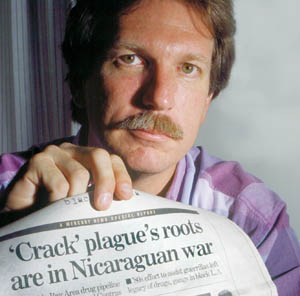
The movie "Kill the Messenger" carries an important message about today's journalism. As pioneering investigate journalist Gary Webb discovered, news that exposes deep-seated government corruption is too important to be left to the corporate news's boards of directors, lawyers, or advertising managers. "Dark Alliance," Webb's San Jose Mercury Newsseries and later book with the same title on the Central Intelligence Agency's drug smuggling activities into the United States, are the most important contributions to investigative journalism in recent memory. Webb's series and book covered the time period during which President Ronald "Bonzo" Reagan and his astrologist-enchanted wife were uttering the words, "Just Say No to Drugs." 
The Pulitzer Prize-winning Webb received accolades from his Mercury News bosses and colleagues after he nailed the CIA and such Reagan administration officials as National Security Council "go-fer" Oliver North and CIA director William Casey for bartering cocaine from Central and South America for money to buy weapons for the Nicaraguan contras. However, Webb's fame was fleeting. After the CIA activated its journalist assets within the ranks of the Washington PostLos Angeles Times, andNew York Times, Webb was subjected to a barrage of ridicule and charges that he was a "conspiracy theorist" who made up the entire tale of the CIA pumping cocaine into Los Angeles and other cities to obtain massive amounts of cash to arm the contras.


Gary Webb: As much a victim of corrupt "journalists" as he was of the CIA.
Webb quit his job at the "Merc News" rather than subject himself to the paper's decision to print a retraction of his well-researched and well-sourced story. Once again, the always-dubious Wikipedia gets it wrong, dead wrong, in its false claim that Webb was fired. In the interest of full public disclosure, Wikipedia should carry the logo of the CIA to denote it as rank government propaganda outlet founded by a former Internet pornographer, Jimmy Wales.
Of course, Webb's CIA sources were largely off-the-record because of the dangers they would face if identified. This editor can attest to the type of harassment Webb received because I have received it myself from journalists who are actually nothing more than "court stenographers" who have not penned a story of any importance in their entire careers. The CIA developed the term "conspiracy theorist" in the wake of the John F. Kennedy assassination in order to dissuade any enterprising journalist from delving too deeply into the CIA's dark secrets. Today, the concept still prevails with the CIA actively supporting various fringe websites [we all know which sites we're talking about] that cater to UFOs, chemtrails, and Loch Ness and Chupacabra monsters that also lift, without permission, serious news stories to damage their credibility.
"Killing the Messenger" ends with a note about Webb's fate. The film's closing scroll states that Webb was found shot in the head twice on December 10, 2004 and that police ruled it a suicide. The film also erroneously states that Webb's career as a journalist ended after he left the Merc News. That is not correct. Webb worked for the alternative pressSacramento News and Review. It was while he was working on a state contract fraud story involving Affiliated Computer Systems (ACS) of Dallas, Texas prior to the 2004 election that Webb contacted this editor by e-mail.
I had been tracking down a story involving ACS, a Republican-owned firm, and its role in purging voter rolls of likely Democrats in 2004 in the same manner that Florida Secretary of State Katherine Harris used Database Technologies Online (DBT Online), owned by Florida cocaine smuggler Hank Asher, to purge Florida voter rolls of Democratic voters in 2000, ensuring George W. Bush's election as president. Webb was intrigued with my leads on ACS and potential electoral roll scrubbing in various states. It is noteworthy that Asher died "peacefully" at his Florida home in 2013 from "natural causes."
Although Webb wrote to me that he was only interested in the fraud aspects of ACS and Sacramento's red-light camera system, which was illegally raking in huge amounts of money for ACS and Sacramento, I felt that he was looking into other aspects of the company that I was pursuing.
I informed Webb that my investigation was focusing on former Indianapolis Republican mayor Stephen Goldsmith, an ACS vice president, and his links with Mitch Daniels, Bush's director of the Office of Management and Budget until 2003. Although Daniels resigned his OMB job to run for governor of Indiana in 2004, his links to ACS and Goldsmith, as well as his ties to election manipulator Karl Rove, suggest that Daniels was doing more in 2004 than merely running for governor. And the Bush team was intent on keeping Kerry out of the White House at all costs.
After all, John Kerry, who, as chairman of the Senate Banking subcommittee in the 1980s was looking into the same CIA drug smuggling activities that Webb later nailed in the 1990s, would suffer the most from ACS’s purging of voter rolls on behalf of their big time GOP directors. Webb and I exchanged numerous e-mails on our investigation of ACS right up until the time of his death on December 10.
A week earlier, I published a series of articles on how the Bush family used drug money stashed overseas in bank accounts in the Isle of Man, Nevis, and other tax havens to pay for the foreign software programming support from Ukraine, Brazil, and other countries that flipped the 2004 election from Kerry to Bush, especially in the states of Ohio, Florida, and Nevada. Kerry's victory in any one of those states would have made him the president.
My sources on the story were also former CIA operatives involved in the 1980s drug smuggling activities. But they, like Webb's, insisted for reasons of personal safety to remain off the record. When the police discovered Webb's body in his home, after the journalist had complained to family and friends of massive government surveillance activities directed against him, I was subjected to a barrage of criticism over my stories about how the Bush administration and its CIA and Saudi friends paid for flipping the election against Kerry. I always had a thought that Webb, in his pursuit of ACS, had delved even deeper than I had on the 2004 election theft story. Rather than investigate "lightning striking twice," that is the second theft in a row of a presidential election by Bush cronies, the mainstream media viciously attacked me in the same manner they attacked Webb in the 1990s. My chief accuser, who claimed I made up the election fraud story, was MSNBC’s Keith Olbermann who published a screed about the story’s lack of proof on his MSNBC blog. I responded by telling the former ESPN sportscaster that he should stick with covering mindless football and baseball games and leave the job of investigative journalism to the professionals. Olbermann, ironically, was later dumped by MSNBC for not following the pre-approved commentary scripts from the head office. Other critics of the story were DailyKos and DemocraticUnderground, two alleged pro-Democratic Party websites but in reality nothing more than well-financed “controlled opposition” repositories of political pabulum.
Gary Webb, unlike the establishment “plants” who attacked him -- controlled journalists like David Corn of The Nation; Walter Pincus of theWashington Post [who was once on the CIA's payroll], and Tim Weiner of the New York Times -- thoroughly flushed out the back story. After their despicable treatment of Webb, no one should believe a damned word of what these three poltroons and their sell-out colleagues have written, are writing, or will ever write. Webb, unlike the do-nothing scribes of the "house organ" newspapers, actually performed "shoe leather" journalism, an art that self-important blatherers like Chris Matthews and Wolf Blitzer would never be able to perform away from their teleprompters and smart phones.

Although I never met Gary Webb personally, I was proud of the fact that he chose to contact me on a story about a corrupt government contractor, a story that likely had tentacles reaching as far into the White House as did Webb's "Dark Alliance" of the 1980s.

Friday, December 20, 2013

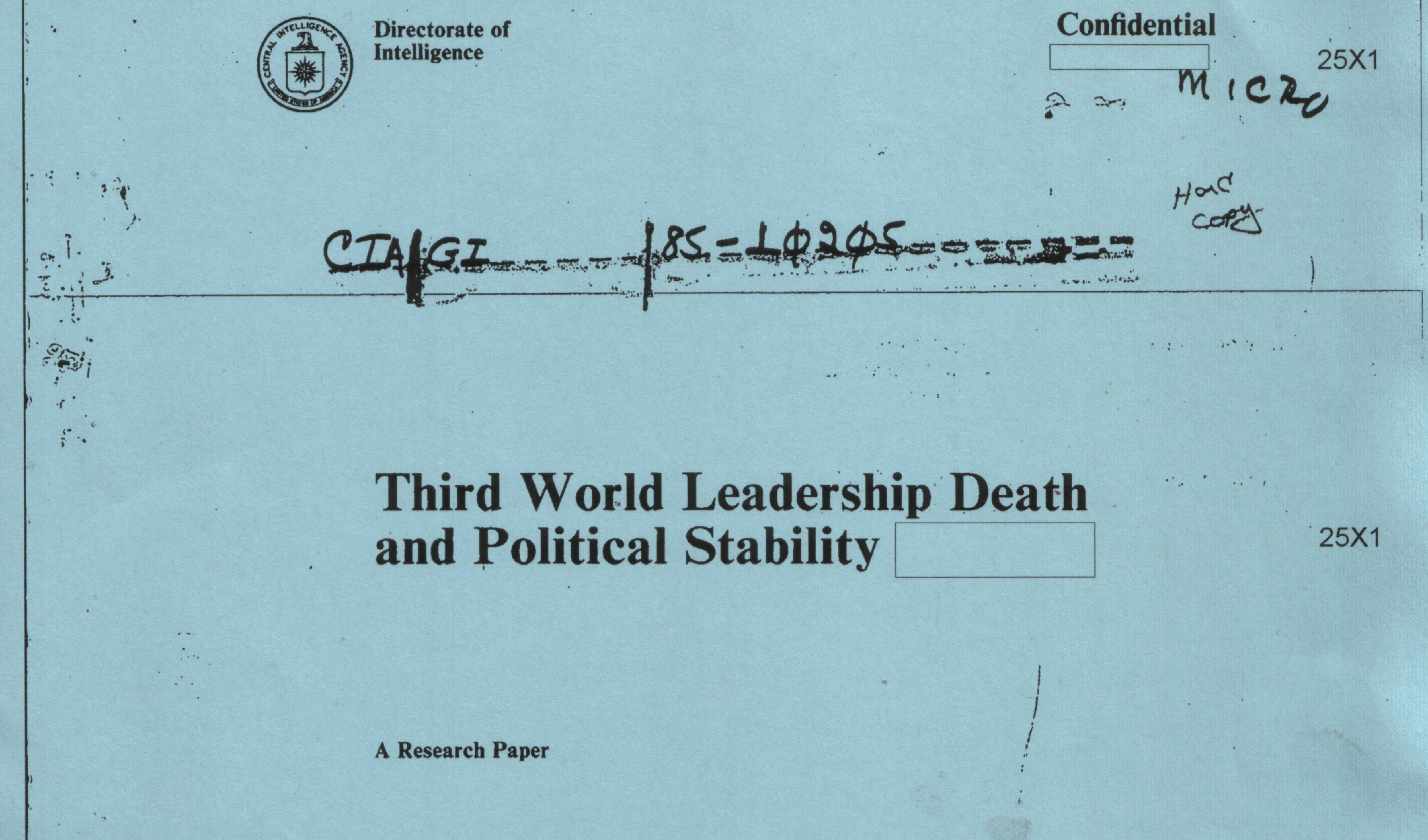
CIA's 1985 list of vulnerable Third World leaders: 27 of 38 were ousted through coups, revolts, or death


CIA hit list on Third World leaders discovered

Virtually gone unnoticed in the millions of pages of declassified CIA files is an August 1985 report prepared by the agency's Directorate of Intelligence on the survivability of 38 Third World leaders. When compared to the historical record of what befell these leaders, a whopping 73.6 percent, 27 leaders on the CIA list, lost power as a result of assassinations, coups, untimely deaths, and mass popular revolts engineered from abroad.

CIA's 1985 list of vulnerable Third World leaders: 27 of 38 were ousted through coups, revolts, or death
BahrainIsa bin Sulman al Khalifa. Died of heart attack, 1999, after meeting U.S. Secretary of Defense William Cohen
BeninMathieu Kerekou. Ousted in civilian coup, 1990
BhutanJigme Singye Wangchuck. Abdicated 2006
BurmaU Ne Win. Ousted, internal coup, 1988
ChileGen. Augusto Pinochet. Stepped down in negotiated agreement, 1988
CubaFidel Castro. Resigned in 2006 during grave illness
GambiaDawda K. Jawara. Ousted, CIA coup, 1994
GuyanaForbes Burnham. Died after throat surgery at Georgetown Hospital, Washington, DC, 1985. Originally inserted by CIA after coup against British Guiana's Marxist prime minister Cheddi Jagan
HaitiJean-Claude Duvalier. Ousted in CIA coup, 1986
IndonesiaSuharto. Resigned during mass demonstrations, 2003. Originally inserted into power by CIA coup in 1965
LesothoLeabua Jonathan. Ousted in military coup in 1986
LibyaMuammar Qaddafi. Executed in 2011 by CIA-supported rebels
MalawiH. Kamuzu Banda. Ousted by popular revolt 1993
MaliMoussa Traore. Ousted by popular revolt 1991
NepalBirendra Bir Bikram. Assassinated in CIA-backed coup 2001
NigerSeyni Kountche. Died in Paris hospital of brain tumor, 1987
ParaguayAlfredo Stroessner. Ousted in coup, 1989
PhilippinesFerdinand E. Marcos. Ousted in popular revolt, 1986
QatarKhalifa bin Hamad al Thani. Ousted in palace coup, 1995
RwandaJuvenal Habyarimana. Assassinated in CIA-linked aircraft shoot down, along with Burundi President Cyprien Ntaryamira, 1994
SomaliaMohammed Siad Barre. Ousted in revolt in 1991
SudanGaafar al Nimeiry. Ousted in coup in 1985
SyriaHafez al Assad. Died in 2000. His son, Bashar al Assad, faced CIA-backed civil war in 2011
VietnamLe Duan. Died of heart attack suffered during 27th Communist Party Congress during party schism
ZaireMobutu Sese Seko.  Ousted in CIA-led foreign invasion in 1997
ZambiaForced from office by international pressure in 1991


The CIA even ranked the vulnerability of the above leaders. The leaders of Burma, Morocco, and Tunisia were considered among the most vulnerable in 1985, with those of the Philippines, Somalia, Sudan, and Zambia closely following. The least vulnerable leaders were those of Qatar, Rwanda, Togo, Oman, Bhutan, Benin, and Nepal.
 
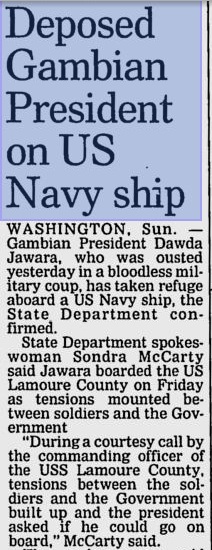
Gambian President Dawda Jawara was overthrown in a 1994 U.S.-backed military coup while he was on board the visiting U.S. Navy ship, the USS Lamoure County, docked in Banjul harbor.

The CIA report concluded that "U.S. interests are substantial in about two-thirds of these high-risk cases -- Chile, Indonesia, Morocco, the Philippines, Somalia, Syria, and Tunisia." The report strongly suggests that whether a Third World regime was "friendly or antagonistic to U.S. interests" any political instability that would affect U.S. strategic or economic interests would be grounds for the U.S. to seek the removal from power of friend or foe. In this regard, the CIA report cited "Cuba, Indonesia, Jordan, Libya, Morocco, North Korea, the Philippines, Singapore, Somalia, Sudan, Syria, Tunisia, and Zaire as "important to the United States."


Perhaps in what was an early recognition of the power of civil society organizations to create political instability, something that was later employed by the CIA, George Soros, and Gene Sharp against governments in Serbia, Georgia, Ukraine, Egypt, Tunisia, Kyrgyzstan, and Tunisia, the CIA report states: "Greater instability occurred in countries where social organizations were able to mobilize their constituents -- South Korea, Spain, Portugal, Egypt, and the Dominican Republic."

The CIA considered Tunisia under President Habib Bourguiba ripe for post-succession turmoil. Bourguiba was a special target because of his links to "revolutionary regimes dominated by longstanding charismatic leaders like Ho Chi Minh of Vietnam, Mao Zedong of China . . . Tito of Yugoslavia." All except Bourguiba were Communists. Marcos pf the Philippines was likened to one of aging oligarchs who, in their older years, became problems for the United States. In addition to Marcos, these leaders cited by the CIA included Franco of Spain and Hafez al Assad of Syria.

The CIA interest in fomenting insurrections against world leaders, which, in some cases, would lead to assassination, was in direct violation of three presidential executive orders barring the CIA from involvement in any way with political assassinations. The orders were 
EO 11905 signed by Gerald Ford; EO 12036signed by Jimmy Carter, which barred even indirect CIA involvement in political assassinations; and EO 12333, signed by Ronald Reagan. In 1998, Bill Clinton reinterpreted the assassination ban and permitted assassinations as long as there was a  counter-terrorism predicate. After 9/11, George W. Bush authorized the CIA to kill anyone the CIA placed on its Worldwide Attack Matrix. Barack Obama has done nothing to change the Bush policy on political assassinations.

Thursday, December 05, 2013

Hollywood Without the Happy Ending How the CIA Bungled the War on Terror


Hollywood Without the Happy Ending 
How the CIA Bungled the War on Terror 
By Pratap Chatterjee
Call it the Jason Bourne strategy.
Think of it as the CIA’s plunge into Hollywood -- or into the absurd.  As recent revelations have made clear, that Agency’s moves couldn’t be have been more far-fetched or more real.  In its post-9/11 global shadow war, it has employed both private contractors and some of the world’s most notorious prisoners in ways that leave the latest episode of the Bourne films in the dust: hired gunmen trained to kill as well as former inmates who cashed in on the notoriety of having worn an orange jumpsuit in the world's most infamous jail.

The first group of undercover agents were recruited by private companies from the Army Special Forces and the Navy SEALs and then repurposed to the CIA at handsome salaries averaging around $140,000 a year; the second crew was recruited from the prison cells at Guantanamo Bay and paid out of a secret multimillion dollar slush fund called “the Pledge.”
Last month, the Associated Press revealed that the CIA had selected a few dozen men from among the hundreds of terror suspects being held at Guantanamo and trained them to be double agents at a cluster of eight cottages in a program dubbed "Penny Lane." (Yes, indeed, the name was taken from the Beatles song, as was "Strawberry Fields," a Guantanamo program that involved torturing “high-value” detainees.) These men were then returned to what the Bush administration liked to call the “global battlefield,” where their mission was to befriend members of al-Qaeda and supply targeting information for the Agency’s drone assassination program.
Such a secret double-agent program, while colorful and remarkably unsuccessful, should have surprised no one.  After all, plea bargaining or persuading criminals to snitch on their associates -- a tactic frowned upon by international legal experts -- is widely used in the U.S. police and legal system.  Over the last year or so, however, a trickle of information about the other secret program has come to light and it opens an astonishing new window into the privatization of U.S. intelligence.
Hollywood in Langley
In July 2010, at his confirmation hearings for the post of the Director of National Intelligence, James Clapper explained the use of private contractors in the intelligence community: "In the immediate aftermath of the Cold War... we were under a congressional mandate to reduce the community by on the order of 20%... Then 9/11 occurred... With the gusher... of funding that has accrued particularly from supplemental or overseas contingency operations funding, which, of course, is one year at a time, it is very difficult to hire government employees one year at a time. So the obvious outlet for that has been the growth of contractors."
Thousands of "Green Badges" were hired via companies like Booz Allen Hamilton and Qinetiq to work at CIA and National Security Agency (NSA) offices around the world, among the regular staff who wore blue badges. Many of them -- like Edward Snowden -- performed specialist tasks in information technology meant to augment the effectiveness of government employees.
Then the CIA decided that there was no aspect of secret war which couldn’t be corporatized.  So they set up a unit of private contractors as covert agents, green-lighting them to carry guns and be sent into U.S. war zones at a moment's notice. This elite James Bond-like unit of armed bodyguards and super-fixers was given the anodyne name Global Response Staff (GRS).
Among the 125 employees of this unit, from the Army Special Forces via private contractors came Raymond Davis and Dane Paresi; from the Navy SEALs Glen Doherty, Jeremy Wise, and Tyrone Woods. All five would soon be in the anything-but-covert headlines of newspapers across the world.  These men -- no women have yet been named -- were deployed on three- to four-month missions accompanying CIA analysts into the field.
Davis was assigned to Lahore, Pakistan; Doherty and Woods to Benghazi, Libya; Paresi and Wise to Khost, Afghanistan. As GRS expanded, other contractors went to Djibouti, Lebanon, and Yemen, among other countries, according to a Washington Post profile of the unit.
From early on, its work wasn’t exactly a paragon of secrecy. By 2005, for instance, former Special Forces personnel had already begun openly discussing jobs in the unit at online forums. Their descriptions sounded like something directly out of a Hollywood thriller. The Post portrayed the focus of GRS personnel more mundanely as "designed to stay in the shadows, training teams to work undercover and provide an unobtrusive layer of security for CIA officers in high-risk outposts."
"They don't learn languages, they're not meeting foreign nationals, and they're not writing up intelligence reports," a former U.S. intelligence official told that paper. "Their main tasks are to map escape routes from meeting places, pat down informants, and provide an ‘envelope’ of security... if push comes to shove, you're going to have to shoot."
In the ensuing years, GRS embedded itself in the Agency, becoming essential to its work.  Today, new CIA agents and analysts going into danger zones are trained to work with such bodyguards. In addition, GRS teams are now loaned out to other outfits like the NSA for tasks like installing spy equipment in war zones.
The CIA’s Private Contractors (Don’t) Save the Day
Recently these men, the spearhead of the CIA’s post-9/11 contractor war, have been making it into the news with startling regularity.  Unlike their Hollywood cousins, however, the news they have made has all been bad. Those weapons they’re packing and the derring-do that is supposed to go with them have repeatedly led not to breathtaking getaways and shootouts, but to disaster.  Jason Bourne, of course, wins the day; they don’t.
Take Dane Paresi and Jeremy Wise. In 2009, not long after Paresi left the Army Special Forces and Wise the Navy SEALs, they were hired by Xe Services (the former Blackwater) to work for GRS and assigned to Camp Chapman, a CIA base in Khost, Afghanistan. On December 30, 2009, Humam Khalil Abu-Mulal al-Balawi, a Jordanian doctor who had been recruited by the CIA to infiltrate al-Qaeda, was invited to a meeting at the base after spending several months in Pakistan's tribal borderlands. Invited as well were several senior CIA staff members from Kabul who hoped Balawi might help them target Ayman al-Zawahiri, then al-Qaeda’s number two man, who also hailed from Jordan.
Details of what happened are still sketchy, but the GRS men clearly failed to fulfill their security mission. Somehow Balawi, who turned out to be not a double but a triple agent, made it onto the closed base with a bomb and blew himself up, killing not just Paresi and Wise but also seven CIA staff officers, including Jennifer Matthews, the base chief.
Thirteen months later, in January 2011, another GRS contractor, Raymond Davis, decided to shoot his way out of what he considered a difficult situation in Lahore, Pakistan. The Army Special Forces veteran had also worked for Blackwater, although at the time of the shootings he was employed by Hyperion Protective Services, LLC.
Assigned to work at a CIA safe house in Lahore to support agents tracking al-Qaeda in Pakistan, Davis had apparently spent days photographing local military installations like the headquarters of the paramilitary Frontier Corps. On January 27th, his car was stopped and he claims that he was confronted by two young men, Faizan Haider and Faheem Shamshad. Davis proceeded to shoot both of them dead, and then take pictures of their bodies, before radioing back to the safe house for help. When a backup vehicle arrived, it compounded the disaster by driving at high speed the wrong way down a street and killing a passing motorcyclist.
Davis was later caught by two traffic wardens, taken to a police station, and jailed. A furor ensued, involving both countries and an indignant Pakistani media.  The U.S. embassy, which initially claimed he was a consular official before the Guardian broke the news that he was a CIA contractor, finally pressured the Pakistani government into releasing him, but only after agreeing to pay out $2.34 million in compensation to the families of those he killed.
A year and a half later, two more GRS contractors made front-page news under the worst of circumstances. Former Navy SEALs Glen Doherty andTyrone Woods had been assigned to a CIA base in Benghazi, Libya, where the Agency was attempting to track a developing North African al-Qaeda movement and recover heavy weapons, including Stinger missiles, that had been looted from state arsenals in the wake of an U.S.-NATO intervention which led to the fall of the autocrat Muammar Qaddafi.
On September 11, 2012, U.S. Ambassador Christopher Stevens was staying at a nearby diplomatic compound when it came under attack. Militants entered the buildings and set them on fire.  A CIA team, including Doherty, rushed to the rescue, although ultimately, unlike Hollywood’s action teams, they did not save Stevens or the day. In fact, several hours later, the militants raided the CIA base, killing both Doherty and Woods.
The Gang That Couldn’t Shoot Straight
The disastrous denouements to these three incidents, as well as the deaths of four GRS contractors -- more than a quarter of CIA casualties since the War on Terror was launched -- raise a series of questions: Is this yet another example of the way the privatization of war and intelligence doesn’t work?  And is the answer to bring such jobs back in-house? Or does the Hollywood-style skullduggery (gone repeatedly wrong) hint at a larger problem?  Is the present intelligence system, in fact, out of control and, despite a combined budget of$52.6 billion a year, simply incapable of delivering anything like the “security” promised, leaving the various spy agencies, including the CIA, increasingly desperate to prove that they can "defeat" terrorism?
Take, for example, the slew of documents Edward Snowden -- another private contractor who at one point worked for the CIA -- released about secret NSA programs attempting to suck up global communications at previously unimaginable rates. There have been howls of outrage across the planet, including from spied-upon heads of state.  Those denouncing such blatant invasions of privacy have regularly raised the fear that we might be witnessing the rise of a secret-police-like urge to clamp down on dissent everywhere.
But as with the CIA, there may be another explanation: desperation.  Top intelligence officials, fearing that they will be seen as having done a poor job, are possessed by an ever greater urge to prove their self-worth by driving the intelligence community to ever more (rather than less) of the same.
As Jeremy Bash, chief of staff to Leon Panetta, the former CIA director and defense secretary, told MSNBC: "If you're looking for a needle in the haystack, you need a haystack."  It’s true that, while the various intelligence agencies and the CIA may not succeed when it comes to the needles, they have proven effective indeed when it comes to creating haystacks.
In the case of the NSA, the Obama administration’s efforts to prove that its humongous data haul had any effect on foiling terrorist plots -- at one point, they claimed 54 such plots foiled -- has had a quality of genuine pathos to it.  The claims have proven so thin that administration and intelligence officials have struggled to convince even those in Congress who support the programs, let alone the rest of the world, that it has done much more than gather and store staggering reams of information on almost everyone to no particular purpose whatsoever.  Similarly, the FBI has made a point of trumpeting every “terrorist” arrest it has made, most of which, on closer scrutiny, turn out to be of gullible Muslims, framed by planted evidence in plots often essentially engineered by FBI informants.
Despite stunning investments of funds and the copious hiring of private contractors, when it comes to ineptitude the CIA is giving the FBI and NSA a run for their money. In fact, both of its recently revealed high-profile programs -- GRS and the Guantanamo double agents -- have proven dismal failures, yielding little if anything of value.  The Associated Press account of Penny Lane, the only description of that program thus far, notes, for instance, that al-Qaeda never trusted the former Guantanamo Bay detainees released into their midst and that, after millions of dollars were fruitlessly spent, the program was canceled as a failure in 2006.
If you could find a phrase that was the polar opposite of “more bang for your buck,” all of these efforts would qualify.  In the case of the CIA, keep in mind as well that you’re talking about an agency which has for years conducteddrone assassination campaigns in Pakistan, Yemen, and Somalia. Hundreds of innocent men, women, and children have been killed along with numerous al-Qaeda types and “suspected militants,” and yet -- many experts believe -- these campaigns have functioned not as an air war on, but for, terror.  In Yemen, as an example, the tiny al-Qaeda outfit that existed when the drone campaign began in 2002 has grown exponentially.
So what about the Jason Bourne-like contractors working for GRS who turned out to be the gang that couldn’t shoot straight? How successful have they been in helping the CIA sniff out al-Qaeda globally?  It’s a good guess, based on what we already know, that their record would be no better than that of the rest of the CIA.
One hint, when it comes to GRS-assisted operations, may be found in documents revealed in 2010 by WikiLeaks about joint CIA-Special Operations hunter-killer programs in Afghanistan like Task Force 373. We don’t actually know if any GRS employees were involved with those operations, but it’s notable that one of Task Force 373's principal bases was in Khost, where Paresi and Wise were assisting the CIA in drone-targeting operations. The evidence from the WikiLeaks documents suggests that, as with GRS missions, those hunter-killer teams regularly botched their jobs by killing civilians and stoking local unrest.
At the time, Matthew Hoh, a former Marine and State Department contractor who often worked with Task Force 373 as well as other Special Operations Forces "capture/kill" programs in Afghanistan and Iraq, told me: "We are killing the wrong people, the mid-level Taliban who are only fighting us because we are in their valleys. If we were not there, they would not be fighting the U.S."
As details of programs like Penny Lane and GRS tumble out into the open, shedding light on how the CIA has fought its secret war, it is becoming clearer that the full story of the Agency's failures, and the larger failures of U.S. intelligence and its paramilitarized, privatized sidekicks has yet to be told.
Pratap Chatterjee, a TomDispatch regular, is executive director of CorpWatchand a board member of Amnesty International USA. He is the author ofHalliburton's Army and Iraq, Inc. 
Copyright 2013 Pratap Chatterjee