Showing posts with label FREEDOM OF THE MEDIA. Show all posts

Thursday, October 31, 2013

Glen Greenwald - On leaving the Guardian


On leaving the Guardian

Reporting the NSA story hasn't been easy, but it's always been fulfilling. It's what journalism at its crux is about, and we must protect that

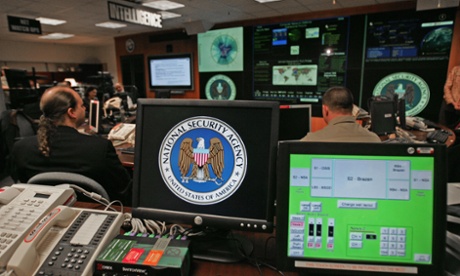
A computer workstation showing the National Security Agency (NSA) logo inside the Threat Operations Center in the Washington suburb of Fort Meade, Maryland.
A computer workstation showing the National Security Agency (NSA) logo inside the Threat Operations Center in the Washington suburb of Fort Meade, Maryland. Photograph: Paul J Richards/AFP/Getty Images
As many of you know, I'm leaving the Guardian in order to work with Pierre Omidyar, Laura Poitras, Jeremy Scahill and soon-to-be-identified others on building a new media organization. As I said when this
news was reported a couple of weeks ago, leaving the Guardian was not an easy choice, but this was a dream opportunity that was impossible to decline.
We do not yet have an exact launch date for the new outlet, but rest assured: I'm not going to disappear for months or anything like that. The new site will be up and running reasonably soon.
In the meantime, I'll continue reporting in partnership with foreign media outlets (stories on mass NSA surveillance in France began last week in Le Monde, and stories on bulk surveillance of Spanish citizens and NSA's cooperation with Spanish intelligence have appeared this week in Spain's El Mundo), as well as in partnership with US outlets. As I did yesterday when responding to NSA claims about these stories, I'll also periodically post on my personal blog – here – with an active comment section, as well as on our pre-launch temporary blog. Until launch of the new media outlet, the best way to learn of new stories, new posts, and other activity is my Twitter feed, @ggreenwald. My new email address and PGP key are here.
I'm gratified by my 14-month partnership with the Guardian and am particularly proud of what we achieved together over the last five months. Reporting the NSA story has never been easy, but it's always been invigorating and fulfilling. It's exactly why one goes into journalism and, in my view, is what journalism at its crux is about. That doesn't mean that the journalists and editors who have worked on this story have instantly agreed on every last choice we faced, but it does mean that, on the whole, I leave with high regard for the courage and integrity of the people with whom I've worked and pride in the way we've reported this story.
As I leave, I really urge everyone to take note of, and stand against, what I and others have written about for years, but which is becoming increasingly more threatening: namely, a sustained and unprecedented
attack on press freedoms 
and the news gathering process in the US. That same menacing climate is now manifest in the UK as well, as evidenced by the truly stunning warnings issued this week by British Prime Minister David Cameron:
British Prime Minister David Cameron said on Monday his government was likely to act to stop newspapers publishing what he called damaging leaks from former US intelligence operative Edward Snowden unless they began to behave more responsibly.
"If they (newspapers) don't demonstrate some social responsibility it will be very difficult for government to stand back and not to act," Cameron told parliament, saying Britain's Guardian newspaper had "gone on" to print damaging material after initially agreeing to destroy other sensitive data.
There are extremist though influential factions in both countries which want to criminalize not only whistleblowing but the act of journalism itself(pdf). I'm not leaving because of those threats – if anything, they make me want to stay and continue to publish here – but I do believe it's urgent that everyone who believes in basic press freedoms unite against this.
Allowing journalism to be criminalized is in nobody's interest other than the states which are trying to achieve that. As Thomas Jefferson wrote inan 1804 letter to John Tyler:
Our first object should therefore be, to leave open to him all the avenues to truth. The most effectual hitherto found, is the freedom of the press. It is, therefore, the first shut up by those who fear the investigation of their actions.
I hope everyone who believes in basic press freedoms will defend those journalistic outlets when they are under attack – all of them – regardless of how much one likes or does not like them.
Finally: thanks, most of all, to my readers and commenters who participate in so many ways in the journalism I do. I've always said that my favorite aspect of online political writing is how interactive and collaborative it is with one's readers: that has always been, and always will be, crucial in so many ways to what I do.

Monday, October 28, 2013

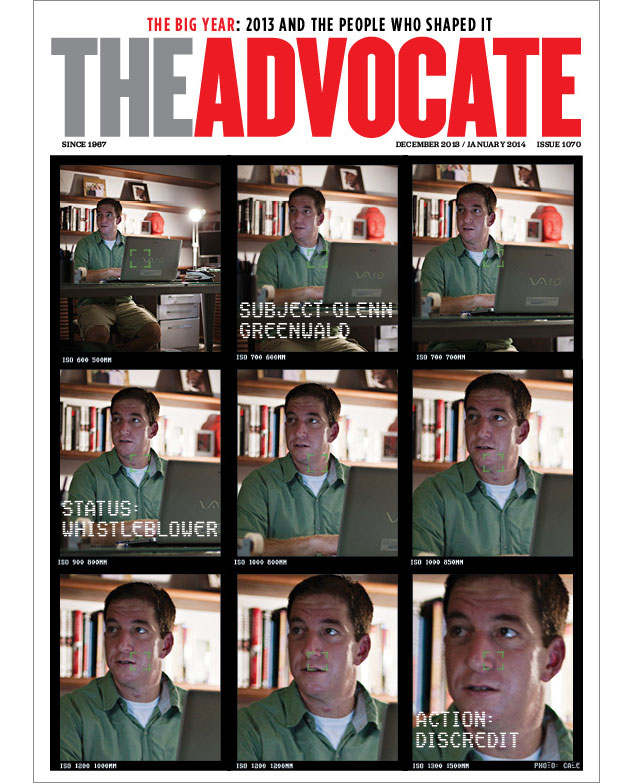
Enemy of the State - Glenn Greenwald


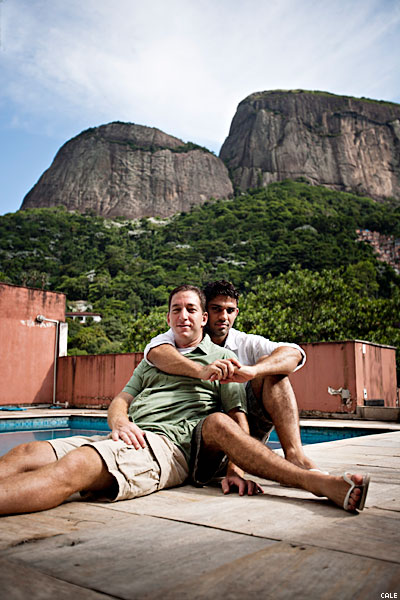
David Miranda (left) and Glenn Greenwald
Enemy of the State
By Natasha Vargas-Cooper
Originally published on Advocate.com October 24 2013 5:00 AM ET

Glenn Greenwald scrunches over his laptop, the fizzing, glinty look in his eyes settling into something more staid and intense. It’s twilight in Gavea, the upscale enclave of Rio de Janeiro built alongside a hand-planted rainforest in the Zona Sul. The monkeys who routinely raise hell from the rubber trees that adorn Greenwald’s backyard have fled for the evening. A knot of ten dogs, mostly strays scooped off Rio’s traffic-gnarled streets, snore and grumble on the cream tiled floor. Without warning, Greenwald, who has the rat-tat-tat chattiness of Midnight Cowboy’s Ratso Rizzo crossing a Manhattan street corner, falls into a chilly silence. His small, fleshy hands flutter over the keyboard. Who knows what business is afoot inside his browser.

The tense quiet stretches on for minutes, made all the more uneasy by legions of invisible toads shamelessly burping from the mangroves. He could be devising his next series of explosive reports on secret Unites States and United Kingdom surveillance programs (he has been working on classified documents on U.S. assassination initiatives). Or, given his open contempt for major media organizations, he could be typing his resignation email to The Guardian. Or he could be prepping for his upcoming testimony before the Brazilian senate about how David Miranda, Greenwald’s partner of eight years, was detained and interrogated in Heathrow airport by U.K. officials for nine hours under the Terrorism Act in August. Maybe word has come down that the U.S. Department of Justice has launched a long-anticipated criminal investigation against Greenwald.

Or maybe he’s just paying a parking ticket.

“Here.” Greenwald snaps his head up and flips his laptop screen toward me as a hyper baby pinscher leaps into his lap. He points to his onscreen chat window. “I’m just talking with Snowden right now.” He flashes a chummy grin. “It’s our nightly check-in.” Greenwald giggles, sips a little red wine, and continues chatting with the 30-year-old former systems analyst whose explosive revelations about the American surveillance state have rocked Washington, put the Obama administration on the defensive, and damaged U.S. relations around the world.

“Moscow kinda sucks,” Greenwald reports.


One of the problems with political ideologues is that they can be such a drag. While I’ve always admired Greenwald’s work — rigorous 3,000-word columns packed with hyperlinks to federal court documents, obscure government memoranda, and dissident dispatches by foreign bloggers — I worried that in the flesh, Greenwald would be grim, cold, and wonky. His obsession with surveillance and privacy issues have made him into an ideological pillar of the rather sterile, unfriendly world of civil libertarian politics, a group not known for its warmth and humanism.

My hesitation dissipates the instant Greenwald and Miranda pick me up off an Ipanema boulevard in their red mini station wagon. I’m tagging along with the couple to a photo shoot for a feature spread (fully clothed) for the Brazilian edition of Playboy. “It’s a very tasteful magazine,” Greenwald insists. “It’s run by gays!” With Katy Perry playing on the radio, we spend our first hour together mostly talking about Cesar Millan and the tyrannical nature of chihuahuas. Miranda, who has found his own global acclaim and notoriety since being detained at Heathrow, is on his phone trying to coordinate picking up scalped tickets to a sold-out Bon Jovi/Nickleback concert in Rio. “I am going to this concert!” he declares. Greenwald credits Miranda, a Brazilian native who is currently finishing a degree in communications, for his success in journalism. “He’s like my Svengali,” says Greenwald.

Greenwald, 46, met Miranda, 28, in 2005, on the first day of a two-month vacation in Rio. At the time, Greenwald was just beginning to transition from his job as a constitutional law litigator to fiery polemicist. He was reading on the beach at Copacabana; Miranda was playing beach volleyball. Miranda’s beach ball rolled onto Greenwald’s towel: “Oi! Meu nome é Glenn.” They moved in together that week. “As a gay man, when you come to Rio for seven weeks, you’re not looking for a relationship,” Greenwald says with a bawdy laugh, “but I never fell in love so fast.”

Miranda, born to a protsitute and passed from alcoholic aunt to alcoholic aunt after his mother died when he was four years old, was uneducated until he met Greenwald, and had worked in low-wage jobs in Rio all his life. Their first night together they spoke in broken English and Portuguese. Miranda closed by serenading Greenwald with love songs. “He has the most monotone, atrocious voice,” says Greenwald as the three of us have lunch in an upscale Rio mall. “If he sings now, I’m like, ‘Oh my god, I can’t stand this!’ but I was so instantly in love with him that I was convinced I’d found my own Enrique Iglesias on the first note.” Now multiple movie studios and TV show developers are courting the couple to dramatize their story:

Woodward and Bernstein for the digital age — just slightly gayer.

Greenwald and Miranda never moved to the U.S. together because, until the Supreme Court struck down the Defense of Marriage Act in June, Miranda could not get an immigration visa. “For eight years we didn’t have that option,” Greenwald says, “but then, literally the week DOMA got struck down, this other little barrier to living in the United States popped up: I might be arrested indefinitely the second I got off the plane.”

Not that Brazil has been some kind of tropical detention center for Greenwald: “Rio is the best fucking place in the world,” he says as we cruise along the white sands of Copacabana. “The people and the culture have taught me a different way to live; it’s all spoken to my soul since I got here. The U.S. is more concerned with being an actor in the world and influencing the world. You don’t have to be here too long to figure out there’s never any thought at any time of invading another country. I mean, I assume if Argentina invaded Brazil for some reason then, yes, OK, but you realize when staying in another country that the notion of constant invasion is extremely radical.”

Exile, self-imposed or otherwise, is a state of being that Greenwald seems most comfortable with, anyway. He prides himself on being an iconoclastic outsider and maintains an open disdain for beltway journalists and media pundits whom he regards as “sleazeballs” and “courtiers of power.” Media is the church of the “savvy” insiders who only care about who won what, Greenwald says, paraphrasing NYU media critic Jay Rosen. “They hate idealism or anyone who believes in something, because that just seems really naïve or loser-ish to them. It makes you a hopeless ideologue or a fringe-y weirdo. The currency they respect is power and success in Washington, and for them that is something to admire instead of be suspicious about or object to.” Greenwald delivers this little outlander manifesto with an effusive, cheeky verve. There’s no trace of solemnity or pathological political correctness, just a plucky fuck-you attitude that for anyone who has a natural distrust of authority serves as an easy entrée to quick camaraderie. Us vs. them.

Edward Snowden broke his general radio silence to tell me via email why he picked Greenwald to bust open his story rather than, say, a more mainstream reporter for the Washington Post or theNew York Times.

 “The bottom line is that sources risking serious harm to return public information to public hands must have absolute confidence that the journalists they go to will report on that information rather than bury it,” Snowden says, clearly referring to the Times’ year-long equivocation over publishing reports of the Bush administration’s warrantless wiretapping — a major turning point in both Snowden’s and Greenwald’s political development. “Glenn’s writing consistently demonstrated his belief that journalists should serve people rather than governments, and that gives sources the confidence to shoulder great risks to do good.”

In the five days I spent with Greenwald, he revealed himself to be buoyant, chummy, emotional, and a total charmer. It also became clear that the greatest engine driving his work is not a dogged commitment to abstract ideals but the tender relationships he builds with the few who are very close to him, be it Miranda, Snowden, a disembodied screen name on an Internet message board, or the flock of half-blind sclerotic mutts he shepherds.


Greenwald’s immediate family was small and unlucky. Originally from New York City, they settled in South Lake, Fla., then a lower middle-class enclave filled with small, cheap rental housing under constant threat of demolition by condo developers. Greenwald had a housewife mother, Arlene, and an accountant father, Daniel. His parents were never abusive or neglectful. “They were decent,” Greenwald assures, “but fucked up in their own ways.” Greenwald’s father, a short, small, Jewish man, idealized a campy sort of conservatism that repulsed Greenwald. “He had pictures of Oliver North, Ronald Reagan, and John Wayne in his office,” Greenwald recalls. “It didn’t really have anything to do with politics — he just idealized this fake machismo, which is something he lacked.”

During Greenwald’s teen years, his father left his mother, and she was forced to take a series of low-wage jobs to support Greenwald and his brother while their father racked up debt from second and third marriages. She worked as a cashier at McDonald’s, coming home at night with hundreds of scratch cards from the restaurant to win free hamburgers and sodas. “That’s how we ate for a while.” Greenwald says. It’s all a far cry from his current digs, a spacious two-story wood-and-glass home five minutes from Rio’s glistening beaches but nestled in a bucolic canyon that bleeds into jungle. And yet, a lack of furniture and the towels on the sofa to protect against his pack of rescued dogs gives the whole place a slap-dash feel. “You can’t have a pristine house with ten dogs,” he says as his pets gurgle for his attention while we sit on the back porch that he uses as his office. “And I’d rather have the ten dogs.”

Greenwald’s political development skipped a generation; it can be traced back to his socialist grandparents, with whom he and his mother lived in South Lake for a while when he was in high school. Appalled by the rapacious efforts of land developers, Greenwald’s grandfather, Louis L. Greenwald, ran for city council on a populist ticket, rallying working-class renters, largely immigrants and single women, to take on the condo overlords. The elder Greenwald went by LL and took pride in his campaign slogan, “Give ’em hell, LL!” “He was elected on this totally insurgent campaign,” Greenwald recalls. “Very ideological about fighting power structures.”

Greenwald’s nascent political philosophy was also fueled by his adolescent sexual awakening. “I came of age in the late ’70s, early ’80s, when things were way worse than they are now. And, you know, you get this strong sense that somehow the prevailing order is antithetical to who you are—it rejects you, is hostile to you, it teaches you that you’re bad and wrong and dirty. You feel like you can’t reason or deal with it. You just feel it and its powerful force. So there’s a lot of different ways to cope and deal with that.”

This all comes from Greenwald in an unstoppable verbal torrent. He doesn’t skip a beat as he hand-feeds raw hot dogs to more canine strays that wander in from the trees. He gushes, “One way is people internalize those judgments. Like, ‘I’m horrible, I’m filthy, I’m broken, I’m wrong, I’m defective, I’m going to go destroy myself’ — which is why gay teens end up killing themselves, right? I just decided to turn the aggression on the people I felt were attacking me. I was like, ‘You’re not going to tell me that I’m wrong, I’m going to show you that your actions are wrong.’ So that was the approach I took toward authority. This very hostile, aggressive way of being that required me to analyze all figures of power and that eventually became waging war on prevailing orthodoxies. And when you do that, it’s an intellectually lonely exercise, but you become much stronger.”

It’s 1985 and you’re angry, you’re gay, you’re Jewish — what do you in your senior year of high school to channel your existentialist angst and alienation? If you’re Glenn Greenwald, you run for city council. His grandfather was getting too old to carry out his “vendettas” against the council, so Greenwald — a veteran of high school speech and debate clubs — ran for his seat. “I came to believe if you’re smart, skilled, and have the resources, you should use those things to fuck with the powerful.” He officially entered the race at age 17 but would turn 18 by the day of the vote, making his candidacy legal. “Those incumbent pigs went to court to try to get me off the ballot,” Greenwald snorts. At the first public debate, Greenwald slaughtered his rivals and won the endorsement of all the local news rags and the biggies, the Sun Sentinel and Miami Herald. Greenwald ran twice, coming in close each time but not close enough.

Grappling with the powerful head-on was more attractive to Greenwald than actual politicking or policymaking, so he went off to law school at NYU, graduated top of his class, and went to work for one of the most slickly prestigious law firms in New York: Wachtell, Lipton, Rosen & Katz. As a junior associate, Greenwald had a dazzling number of zeroes on his paychecks, suspenders on his shoulders, and wildly expensive shoes on his feet. He got access to the gilt-edged world of corporate law. But he only lasted 18 months. “I just wanted to know I could enter this world of power,” he says. “It was riveting and exotic. But I wanted to prove that I could conquer it and that there was not a part of that world that wasn’t accessible to me.”

Part of Greenwald’s decision to leave his firm was over a pair of Rollerblades. His then-long-term boyfriend bought a pair, strapped them on, fell, and broke both his wrists. Greenwald sued Rollerblade on his boyfriend’s behalf, but his firm protested: They hadn’t given him permission, and what if Rollerblade had been a potential client? “I can’t deal with constraints like that,” Greenwald says with a tinge of self-effacement. “I chafe at any restraints on what I can do or say.”

He used his year-one bonus to start his own law firm with a small, scrappy, staff that specialized in constitutional law and civil rights. There was a strict dress code: Everyone had to be in suits all the time. To this day, Greenwald wears sober suits whenever he makes any public appearance — no open-shirted radical with a shaggy haircut here. He did five years of pro bono work defending neo-Nazis, among other unpopular clients, over First Amendment issues. Eternally restless, Greenwald predictably found too many constraints in the practice of law as well. “I was pouring my energy into these
institutions that were created to yield these unjust outcomes,” he says. “So it just felt like hitting your head into a brick wall.”

Greenwald’s focus drifted away from the courts, and by mid-decade he was spending more and more time online, stirred by the fuck-all attitude of insurgent political bloggers who were trying to break the stranglehold that stodgy mainstream institutions like the Washington Post and CNN held over political discourse. “This was a time when Ezra Klein, who is now, like, the mayor of Washington hack media, used to write things like ‘Fuck Tim Russert with a spiky acid-tipped dick!’” Greenwald cackles gleefully. Klein has since apologized for his thorny phallus comment, saying “it haunts [him] to this day.” In 2005, Greenwald started his own blog, where, as he puts it, “I could say whatever the fuck I wanted, however I wanted,” and has since apologized for absolutely nothing.

Back before the words Google and Zuckerberg were branded on our psyches, Greenwald was seduced by the strange and unruly promise of Web 1.0. He would argue for hours with strangers on right-wing message boards and experiment with different identities, sexual and otherwise, in chat rooms and over instant messaging, all in service of what he describes as a fundamental part of his self-exploration. It’s only inside a private, anonymous space, away from judgmental eyes, that people can violate orthodoxy and explore new boundaries, Greenwald argues. “The private realm is where creativity, dissent, and innovation exclusively reside,” he says. Even the most radical exhibitionist has parts of their life that they want kept hidden, he reasons. “If you eliminate that private realm, you breed conformity. When all your behavior is public, then you’re going to do the things that the society insists you do and nothing else,” Greenwald says, “and you lose so much of who you are as a human being.”

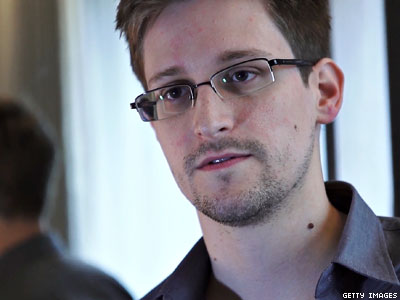
At left: Edward Snowden
 “When I was talking to strangers over the Internet in the 1990s, there would be a much more intense connection because they’re disembodied, so it’s just your brain and your soul interacting with this other person and it just frees you up in this incredibly empowering way,” he says over fries at an outdoor café in Leblon, the Beverly Hills of Rio. Over our heads looms a huge poster of an illustrated magazine cover that depicts a bespectacled Snowden gently kissing Vladimir Putin while he surreptitiously places a “Free Pussy Riot” sticker on the Russian prime minister’s back. Greenwald sneers, “I hate that cover. It’s so stupid.”

Greenwald concedes he gets “a little mean” when asked about his or Snowden’s feelings on Russia. “I’m well aware of the flaws in Russian society, just like I’m well aware of all the flaws in American society,” Greenwald says. “Thousands of people apply for and are given asylum in the U.S. every year, and nobody says, ‘Isn’t it so weird and ironic that people are applying for asylum in a country that has an ocean prison where people are put in cages without trial for 10 years, uses drones, or torture?’” he says, half annoyed. “The point of asylum is not to declare to the world what country you think is the pinnacle of civilization. The point of asylum is to find a country that’s both willing and able to protect you from political persecution.” Greenwald adds, “In no way is asylum an endorsement of a country’s politics, laws, or values. He didn’t choose to be there. He was trying to get transit to Latin America, and then the U.S. revoked his passport and threatened other countries out of offering Snowden safe passage.”

At the end of Greenwald’s trip to meet Snowden in Hong Kong, he was convinced that Snowden would be snatched up by the U.S. and held in custody without trial for years, much like whistleblower Chelsea Manning, whom Greenwald considers a hero. Manning’s three-year pre-trial incarceration and 35-year sentence proves, Greenwald says, that Snowden was right to find harbor anywhere he could. “The question shouldn’t be why is Snowden in Russia? The question should be why is America no longer safe for whistleblowers?”
Greenwald’s early experimental phase on the Internet — which overlapped with the Bush administration’s warrantless wiretapping scandals — stoked much of his obsession with surveillance and privacy, first for sport on his own blog, then as a full-time columnist for Salon, followed by a year long stint at The Guardian. Greenwald quit the London-based outlet two weeks after our visit to join a new media venture backed by billionaire and eBay founder Pierre Omidyar, which Greenwald describes as a “once in-a-career dream journalistic opportunity.” If Greenwald’s notoriety as a civil liberties purist emerged during the Bush years, he really stuck out as one of the few voices on the liberal side of the spectrum that did not go easy on Barack Obama’s own transgressions. His work in breaking the surveillance program documents gathered by Snowden has made him a household name.

Greenwald has been very careful about the way he talks about his relationship with Snowden, not just for security reasons but because Snowden told Greenwald before they met in Hong Kong that he wanted to be out of the public eye in order for people to focus on the substance of the NSA leaks. Greenwald publicly cheered Snowden’s bravery and integrity for coming forward so others would not be blamed or interrogated, but today, Greenwald has more chest-thumping swagger about Snowden; he is practically pink with pride.

“Here’s the real reason Snowden came forward,” Greenwald says, a charge of adrenaline bursting through him as he throws his arms out. “He wanted to undermine the culture of fear by saying ‘Yeah, motherfuckers, not only did I spoil your secrets but here’s who I am! I look like every Midwestern son, you can’t marginalize me because I’m like you; this is my beautiful girlfriend and my stable career! I’m not some Ted Kaczynski maladjusted maniac living in the forest!’ It was a deliberately and provocatively bold thing to do.”

Greenwald also admires Snowden for not uploading the tens of thousands of classified documents to which he had access to the Internet, WikiLeaks style, forcing the public to sort through countless memoranda and policy papers without quite knowing what they’re looking at (though Greenwald is a staunch defender of Julian Assange’s work and actively fundraises for WikiLeaks). Instead, Snowden has worked with Greenwald to select the most essential documents and underscore their impact.

Unlike Assange, the editor-in-chief of WikiLeaks who now lives in the Ecuadorian embassy in London, Greenwald praises Snowden for not going to the New York Times or the Washington Postto break the NSA stories. He often chides his friend for his reliance on mainstream media to broadcast WikiLeaks stories. “I’m like, ‘Hey, asshole! Why do you keep handing documents to the New York Times when you could give them to an independent journalist and elevate independent media?’” Greenwald believes Snowden’s decision to give him the documents has prompted some soul-searching in places like the New York Times. Snowden echoes this belief as well, as he wrote in his email to me:

“Glenn’s work is a foreshadowing of the death of ‘access journalism.’ What we’re seeing with the NSA reporting is that prioritizing the interests of officials over the public, the news audience, is not a winning strategy. Journalists and institutions that hold power to account will attract sources who can provide the facts you aren’t going to get in a briefing room. The access game is a mirage; the officials alienated by hard questions have no choice but to take your calls when confronted with the truth.”


At left: Greenwald and Miranda at home in Rio de Jainero
A lot has been written about Snowden and Greenwald’s professional relationship and the comedy of errors-style course of events surrounding their first meeting. Vastly under-reported is the emotional relationship that has bonded the two men.
When Greenwald first saw Snowden in the restaurant of a Hong Kong hotel, his heart sank. Greenwald had flown across the globe with documentary filmmaker Laura Poitras to meet their anonymous source and was picturing a dandruff-dusted former spook in his 60s — not an IT guy in his 20s. “He looked so young!” Greenwald exclaims. “He was wearing a white T-shirt, hipster glasses, and sneakers, and I was like, ‘Is this the source’s son? His assistant? His gay lover? What the fuck is going on?’”

Greenwald and Poitras escorted Snowden to his grungy hotel room. Snowden had not left the room in two weeks and did not want to let any maids in to tidy, so there were stacks of plates everywhere. “I didn’t judge,” Greenwald says. “I knew he’d worked for the NSA at some point and the situation was fucked in ways I couldn’t even understand.” Snowden, Greenwald remembers, sensed their disappointment and tension. “It was so tense between us at first, we were both so stiff, and I think we didn’t like each other at first,” he says. Poitras set up a camera and immediately started filming the two, and Greenwald went into full-blown litigator mode, conducting a six-hour, nonstop examination of Snowden.

“I wanted to find his solid foundation,” Greenwald recalls. “I wanted to know he had agency and autonomy.” He wanted a deeply satisfying explanation of Snowden’s motivations, not only for leaking but for wanting to go public with his identity. “I just needed to know that it was real and grounded in clear-eyed analysis and self-awareness,” Greenwald says. “Snowden was giving me bullshit answers.”

Snowden continued to insist he was no hero and was just trying to do the right thing as Greenwald fired questions, trying to isolate what informed Snowden’s sense of right and wrong, until Snowden gave Greenwald an answer he didn’t expect but immediately understood. It wasn’t Hegelian theories on power structures or Ron Paul rhetoric about privacy; it wasn’t Nietzsche’s Genealogy of Morals (Greenwald’s greatest influence) or Jeffersonian notions of government. It was comic books and video games. “You have good guys who are forced to do difficult but good things,” Snowden said to Greenwald, a bit embarrassed.

Greenwald, who has no interest in either video games or comics, knows first-hand what sort of moral universe they can create for their devotees; Miranda has built his entire ethical code on countless hours of video gameplay.

“It’s not a simplistic ideology. David is one of the most complex, intellectually curious, and sophisticated people I’ve ever met, and he’s the one who convinced me that being influenced by the moral dynamics of a comic book or video game is no less noble than being shaped by a novel or a book,” Greenwald reasons. “You can watch The Matrix and take it as an action movie, or you can delve into all its greater existentialist meanings. All of the narratives in these comic books are about these single individuals devoted to justice who have the willingness to be brave, who can defeat even the most powerful edifices of evil.”

When Miranda was detained in England, Greenwald spent most of those nine hours binge-eating Doritos and talking to Snowden over encrypted chat. “I was furious; I felt so powerless, but I think Snowden was even more outraged.”

I ask Greenwald if Snowden told him the names of any of the video games or comic books that influenced him. “No,” Greenwald says, laughing. “How the fuck would I know any of that Dungeons and Dragons shit?” But it was the answer he was looking for, authentic and solid. They moved forward and the rest is history, still unfolding before us.

And there’s more to come. During our last meeting over a candlelit Thai dinner lubricated with some local red wine, Greenwald is veritably fizzing with all his plans. He’s pounding out a book on the Snowden story, set for publication in the spring. And, he warns, there’s still a lot of grenades to be thrown from the Snowden document cache. He has some dreams, of course, but the Work comes first.

“I’ve always thought stability was suffocating and deadly. Like, when I read that the kids I went to law school with have stayed at the same firm, I feel like I’m reading an obituary. How much money do you need? Six million, seven million? Put that in the bank and do something else. Get out!” he says with another sip of wine.

“Can I tell you what I would do with $6 million?” he says with a faraway, almost bashful tone to his voice. “I have this fantasy of buying farmland in Brazil with David and just taking care of as many dogs as we can. Is that totally crazy?”

Sunday, December 19, 2010

Emperor waits in wings with waterboard By Pepe Escobar


Oh! spies are of no use nowadays. Their profession is over. The newspapers do their work instead.
- Oscar Wilde, An Ideal Husband, Act III

"He will not be going back to that cell once occupied by Oscar Wilde."

Eventually he didn't. But little did Mark Stephens, one of Julian Assange's lawyers, know that it would still take over three twisting-and-turning hours for his client to finally exit the Royal Courts of Justice in central London a free man.

It's as if WikiLeaks founder Assange, emerging from the silence of the shadows to the proverbially frantic media scrum, already knew that the real war starts now - and has nothing to do with jealous groupies, broken condoms and "sex by surprise".

This was the key passage of Assange's brief statement, read immediately after he was able to breathe the air of London again. He said, "During my time in solitary confinement in the bottom of a Victorian prison, I had time to reflect on the conditions of those people around the world also in solitary confinement, also on remand, in conditions that are more difficult than those faced by me. Those people also need your attention and support."

As in: pay excruciatingly close attention to what the US government is doing to Bradley Manning, the 22-year-old army private accused of leaking hundreds of thousands of cables to WikiLeaks. Manning has been held in solitary confinement at the US Marine Corps brig in Quantico, Virginia, for five months now. He has not been convicted of any crime. In a devastating Salon article, Glenn Greenwald has stressed that Manning is "under conditions that constitute cruel and inhumane treatment and, by the standards of many nations, even torture".

So that was Assange's terse way of saying to the world: Big Brother is watching you. And what they're doing to Manning they want to do to me, to you, and metaphorically to anyone who believes in freedom of information.

Make my day, leaker
Much to the horror of the emperor, WikiLeaks is still in business, from now on comfortably ensconced in a vast, remote Georgian country house, Ellingham Hall, to where Assange is bailed, on the borders of Norfolk and Suffolk.

Assange will be the guest of honor of former British army captain Vaughan Smith, also the founder of the Frontline media club in London, where Assange previously lived for a while. As WikiLeaks spokesman Kristinn Hrafnsson made it clear, broadband is good. And that's all the members of WikiLeaks, who "have never all been in the same place", need.

What a far cry from Assange almost turning into the most notorious political prisoner in the world.

Now everyone knows, thanks to legal blogger Carl Gardner, that it was actually UK crown prosecutors - and not Sweden - that were against the Westminster court's granting of bail to Assange this past Tuesday (technically in line with Article 12 of European Arrest Warrant legislation - the Swedish prosecution has at any rate also pointed out that the door remains open to an Assange extradition to other European Union countries).

This only served to fuel worldwide suspicion that the United Kingdom was using the broken condom/"sex by surprise" Swedish drama as an excuse to hold Assange in solitary confinement, without his computer, 23 hours and 30 minutes a day, under non-stop infrared surveillance, until the "special relationship" US master could come up with some brand-new charge and go for an extradition order.

This Thursday though, before granting Assange conditional bail, British judge Duncan Ouseley acknowledged a crucial point. He stressed that Assange had cooperated with the Swedes, and even if he was ultimately convicted in Sweden there was a strong probability he would not even go to jail.

Earlier in the day, Assange's lawyer Stephens had said: "We haven't addressed the question of American legal action or the potential for it." Well, they better do it, and fast. Even if a possible US government charge of "conspiracy" has no legal equivalence in the UK. Not to mention that the US does not have jurisdiction over where any of these US-only so-called "crimes" may have occurred.

Only the terminally naive could believe that the US Justice Department did not order the Swedish government to mobilize Interpol into producing a lightning-fast arrest warrant linked to the syrupy broken condom/"sex by surprise" saga.

All across the land of the free, the emperor has been pulling a Beijing (one may say emperors are all alike), deploying a variety of methods to actually censor the net - and TV - and dispatch the cables to digital oblivion. Some methods are worthy of the Three Stooges: the US Air Force blacking out from its computers anything linked to "cablegate"; the Pentagon banning anyone from even looking at newspapers.

Other methods are slightly more refined. Assange won the readers' poll as Time magazine's Person of the Year. But the editors could not possibly have the guts to respect public opinion and infuriate the emperor even more. So they gave the prize to an autistic geek who invented Facebook
because his girlfriend dumped him.

Barbara Walters, who in the US is worshipped as a sort of Hera of TV interviewers, regards Assange as "borderline criminal"; if she didn't, she wouldn't even get a "hi!" from Hillary Clinton. Bill Keller, the chief editor of The New York Times, had the gall to write: "We agree wholeheartedly that transparency is not an absolute good. Freedom of the press includes freedom not to publish, and that is a freedom we exercise with some regularity". Keller, a so-called journalist, in practice wishes he didn't have to publish "cablegate". He has made it plain that the New York Times sees the role of mass media as upholding government secrecy. In ancient Soviet times there was Pravda; now Pravda lives in New York and is written in English.

And to top it off we have Nobel Peace Prize winner Barack Obama's administration pulling out all stops in its extra-judicial blitzkrieg on WikiLeaks. The fact that WikiLeaks broke no US law is of course irrelevant.

The emperor badly needs to set an example: see what happens when you defy my will. Yet the US Department of Justice's strategy doesn't exactly embody Kant's categorical imperative. They will try by all means necessary to force Manning to testify against Assange - and then charge Assange as a conspirator in "cablegate" and the Iraq and Afghan file leaks.

In a nutshell: the Obama administration is about to criminalize investigative journalism. And criminalize good journalism, period. Yale Law Professor Jack Balkin has stressed that "the conspiracy theory also threatens traditional journalists as well". And all this by applying tortuous logic worthy of the Bush era: "OK, let's make a deal with this American geek who leaked the bloody thing so we can nail that bloody foreigner who put it on the net."

The US government is out to waterboard Wiki. We're all about to get drowned.

Pepe Escobar is the author of Globalistan: How the Globalized World is Dissolving into Liquid War (Nimble Books, 2007) and Red Zone Blues: a snapshot of Baghdad during the surge. His new book, just out, is Obama does Globalistan (Nimble Books, 2009).

He may be reached at pepeasia@yahoo.com.

Wednesday, March 18, 2009

In which Bina snorts derisively and rolls her eyes

In which Bina snorts derisively and rolls her eyes

you-fucking-crybaby.jpg

Oh, boo hoo. Once again, the Inter-American Press OWNERS'* Association has its collective diapers in a bunch:

The Inter American Press Assn. (IAPA) wound up its mid-year meeting in Paraguay on Monday declaring that freedom of the press in the Americas deteriorated over the last six months because of several adverse factors, including "the murders of journalists and violence against them, campaigns to discredit the press and a climate of hostility by some governments toward news media and reporters and as a consequence of the U.S. newspaper industry crisis."

The statement on the group's website reports that populist governments in the region followed the lead of "Venezuelan President Hugo Chavez [and] stepped up their campaigns of abuse and ridicule of news organizations and individual reporters."

My translation follows:

Waaaaaa! We don't get to be palangristas** with impunity anymore! We're being held accountable by a skeptical public***! And they're voting with their feet and not buying our crap anymore! Help, help, we're being oppressed!

There. Much better.

In case you're wondering what they're screaming about, it seems that the people of Venezuela and Bolivia****, to name just two, are no longer fooled by the palangristas among them. Sure, a Bolivian government spokesperson has spoken out against the IAPOA's bullshit, but there's no governmental censorship happening there. Or, for that matter, in Venezuela. What there is, is a loss of influence for opinions fabricated by the endogenous right and the usual suspects in Washington.

To make things even more entertaining, two Venezuelan commercial networks are now at each other's throats because one has been deemed somewhat more objective than the other. That is, Venevisión = Chicken Noodle Network, Globovisión = FUX Snooze. Of course, Venezuelan FUX Snooze accuses Venezuelan Chicken Noodle Network of "not defending principles". ("Not defending principles" = practicing a reasonable facsimile of journalism rather than fomenting coups d'état.)

As for the woes of the US papers, those could have been seen from a long way off, if only someone had opened a window and hung their head out for a good look around. When they gobble ad revenues for the owners' profit rather than getting their income from newsstand sales and subscriptions and spending it on quality reporting, well...my heart bleeds less than you'd think it should. It's the crapitalist media model, and since it's built on selling shit and fabricating bogus opinions rather than fully and accurately informing the public, it deserves to be in financial trouble.

Especially if there are palangristas in the mix. Those are invariably Bhad Nhews.


*I stuck that in there, because it belongs there and was left out by some strange oversight. (Yes, I'm being kind. "Some strange oversight" = some disingenuous asshole, most likely.)

**Palangrista = media whore paid by either commercial interests or the CIA (or both!) to put out crapaganda, not report objectively and/or honestly.

***It's amazing how often they conflate free-but-unfavorable public opinion with oppression by (democratically elected) governments, but they gotta use that old, tired "ZOMG it's a commie!!!11eleven!!!" meme somewhere.

****Incidentally, Venezuela and Bolivia are two countries in which no journalists, however fascistic or obnoxious, have been killed of late. A few leftist ones have been roughed up by rightards, but no one has died. For that, you'll have to go to Mexico or Colombia. And if you do, you'll find a disproportionate number of lefty journos on the lists. It begs the question of why the owners of their respective media outlets haven't done more to protect them in such a hostile climate, but the IAPOA doesn't believe in discussing that. They'd much prefer to deflect your attention to imaginary oppression in Venezuela and Bolivia. Guess why.

Saturday, February 09, 2008

Lies, Damn Lies and the Murdoch Empire - by Stephen Lendman

by Stephen Lendman

For Big Media, truth is a scare commodity and in times of war it's the first casualty, or as esteemed journalist John Pilger noted: "Journalism (not truth) is the first casualty (of war). Not only that: it('s)....a weapon of war (by its) virulent censorship....by omission (and its) power....can mean....life and death for people in faraway countries, such as Iraq."

Famed journalist George Seldes put it another way by condemning the "prostitution of the press" in an earlier era when he covered WW I, the rise of fascism, and most major world and national events until his death in 1995 at age 104. He also confronted the media in books like "Lords of the Press." In it and others, he condemned their corruption, suppression of the truth, and news censorship before the television age, and said "The most sacred cow of the press is the press itself, (and the press is) the most powerful force against the general welfare of the majority of the people."

Orwell also knew a thing or two about truth and said telling it is a "revolutionary act in times of universal deceit." Much else he said applies to the man this article addresses and the state of today's media. He was at his allegorical best in "Animal Farm" where power overwhelms freedom, and "All animals are equal but some....are more equal than others." And he observed in "Nineteen Eighty-Four" that "Those who control the present control the future (and) Those who control the future control the past."

Today's media barons control the world as opinion makers. Like in Orwell's world, they're our national thought control police gatekeepers sanitizing news so only the cleansed residue portion gets through with everything people want most left out - the full truth all the time. They manipulate our minds and beliefs, program our thoughts, divert our attention, and effectively destroy the free marketplace of ideas essential to a healthy democracy they won't tolerate.

None more ruthlessly than Murdoch and the infoentertainment empire he controls. Its flagship US operation is Fox News that Fairness & Accuracy in Reporting (FAIR) calls "the most biased name in news....with its extraordinary right-wing tilt." In response, Murdock defiantly "challenge(s) anybody to show me an example of bias in Fox News Channel" because in his world the entire political spectrum begins and ends with his views. For him and his staff, "fair and balanced," we report, you decide" means supporting the boss. Alternative views are biased, verboten and rarely aired. But they're hammered when they are as the "liberal" mainstream that's code language for CNN and other rivals at a time all media giants match the worst of Fox and are often as crude, confrontational and unprofessional.

Distinguished Australian-raised journalist Bruce Page wrote the book on Murdoch called "The Murdoch Archigelago." It's about a man he calls "one of the world's leading villains (and) global pirate(s)" who rampages the mediasphere putting world leaders on notice what he expects from them and what he'll offer in return. It's "let's make a deal," Murdoch-style that's uncompromisingly hardball. Acquiesce or get hammered in print and on-air with scathing innuendo, misinformation and outright lies. Few politicians risk it. Others with alternative views have no choice, and world leaders like Hugo Chavez are used to this type character assassination.

He mostly worries about the other kind and with good reason as long-time Latin American expert James Petras reported November 28. Four days before a crucially important constitutional reform referendum, he published an article headlined: "Venezuela's D-Day - The December 2, 2007 Constituent Referendum: Democratic Socialism or Imperial Counter-Revolution."

In it, he reported that the Venezuelan government "broadcast and circulated a confidential (US embassy) memo to the CIA" revealing "clandestine operations....to destabilize (the referendum) and coordinate the civil military overthrow of the elected Chavez government." It's because independent polls predicted the referendum would pass even though they proved wrong. The dominant media readied to pounce on the results but instead went into gloat mode on a win Chavez called a "phyrric victory" but Murdock headlines trumpeted "Chavez's president-for-life-bid defeated." This is the type vintage copy Page covers with reams of examples in his book.

Its central theme is that the media baron wants to privatize "a state propaganda service (and manipulate it) without scruple (or) regard for the truth." In return he wants "vast government favors such as tax breaks, regulatory relief, and monopoly" market control free from competitors having too much of what he wants solely for himself and apparently feels it's owed to him.

Because of his size and media clout, he usually gets his way and mostly in places mattering most - in the biggest markets with greatest profit potential in a business where truth is off the table and partnering with government for a growing revenue stream and greater influence is all that counts.

The Murdock Empire from Inception

Murdoch's empire is vast and is part of his News Corporation that was incorporated in Australia in 1979 (Murdoch's home). It was then reincorporated in 2004 in the US in the corporate-friendly state of Delaware with its headquarters in New York. The company was huge when media experts Robert McChesney and Edward Herman wrote about it in their 1997 book, "The Global Media Giants." Back then, it ranked fifth in size among the giants (it's now third after Time Warner and Disney) with $10 billion in 1996 sales when the authors called the company "the archetype for the twenty-first century media firm....and the best case study (example) for understanding global media firm behavior."

Gross revenue today tops $28 billion, operating income is nearly $4.5 billion, the company has over 47,000 employees, it operates on six continents, 75% of its business is in the US, and one industry analyst told McChesney and Herman 10 years ago "Murdoch seems to have Washington in his back pocket" as he keeps getting favorable rulings to do what he wants. And that was under Bill Clinton who signed the outrageous 1996 Telecommunications (giveaway) Act for Big Media and Big Telecom that let them consolidate further through mergers and acquisitions and be able to squash competition and diversity.

In those days and earlier, Murdoch aimed high to control "multiple forms of programming - news, sports, films and children's shows--and beam them via satellite or TV stations to homes (around the world with) Viacom CEO Sumner Redstone (once saying) Murdock 'want(ed) to conquer the world.' " Other media chiefs said he was doing it, and he's "the one media executive they most respect and fear, and the one whose moves they study."

Murdoch inherited his father's Australian News Limited newspapers in 1952. He had no journalistic background but compensated by cultivating political influence through favorable electoral coverage. He became managing director of News Limited in 1953 and then took over running Adelaide News in 1954. He founded News Corporation in 1979 but years earlier concentrated on acquisitions and expansion to build his business. In 1964, he launched Australia's first national daily, The Australian, later acquired The Daily Telegraph in Sydney, and in the late 1960s entered the UK market by snaring The News of the World. In 1950, it was the world's most popular English language newspaper with a peak circulation of around 8.4 million. It was about six million when Murdock got it in 1968.

More acquisitions followed. They included The (London) Times and The Sunday Times in 1981, and by the 1980s he was a dominant force in the US. He bought the film studio, Twentieth Century Fox, that launched Fox Television and now notorious Fox News.

Today, the company is in everything media-related (except music) and describes itself on its web site as "Creating and distributing top-quality news, sports and entertainment around the world." That's in the eye of the beholder where there's considerable disagreement with the official company position. Nonetheless, the site lists a vast array of News Corporation operations:

-- Filmed entertainment: 20th Century Fox, 20th Century Fox Espanol, 20th Century Fox Home Entertainment, 20th Century Fox International, 20th Century Fox Television, Fox Searchlight Pictures, Fox Studios Australia, Fox Studios Baja, Fox Studios LA, Fox Television Studios, and Blue Sky Studios;

-- Television: Fox Broadcasting, Fox Sports Australia, Fox Television Stations, FOXTEL, MyNeworkTV, STAR; and the newest entry, Fox Business, to compete with CNBC and Bloomberg;

-- Cable: Fox Business Network (just launched), Fox Movie Channel, Fox News Channel, Fox Sports Channel, Fox College Sports, Fox Sports Enterprises, Fox Sports En Espanol, Fox Sports Net, Fox Soccer Channel, Fox Reality, Fuel TV, FX, National Geographic, Channel United States, Channel Worldwide, Speed, and Stats, Inc.;

-- Direct broadcast satellite television: BSkyB, DirectTV, and Sky Italia;

-- Magazines and Inserts: Big League, Inside Out, donna hay, ALPHA, News America Marketing, Smart Source, The Weekly Standard, and Gemstar - TV Guide International Inc.;

-- Newspapers: 21 in "Australasia" including the Daily Telegraph and Sunday Telegraph, Herald Sun and Sunday Herald Sun, Post-Currier, Sunday Mail, Sunday Times, The Australian, The Mercury, and the Weekly Times; 6 in the UK including The Times, The Sunday Times, The Sun, and News International; and two in the US - the New York Post (the Columbia Journalism review calls "a force for evil") and Wall Street Journal as of December 13 when News Corporation announced the completion of its acquisition of Dow Jones & Company;

-- Books: HarperCollins Publishers, Australia, Canada, Children's Books, United States, United Kingdom, Zondervan;

-- Other assets: 25 are listed including Broadsystem, Fox Interactive Media, IGN Entertainment, FoxSports.com, Fox.com, News Outdoor and others.

News Corp. even claims to be addressing climate change, says it's "committed" to "lowering the energy use of its businesses" across the globe, will "switch to renewable sources of power when economically feasible," and will "become carbon neutral by 2010." True or false, it's likely the company does address its energy consumption to cut costs as most other businesses also do, climate change or not.

Bruce Page picks up the story in "The Murdoch Archipelago" published in 2003. Even while attacking the media baron, he says he and others do some good. Murdoch, for instance, "exposes numberless sexual peccadilloes, and much lesser crime - but not dud military campaigns or Enronesque frauds." He specializes in sensationalist pseudo-journalism that distorts the truth on the news and loads it with juiced-up reports on murder, mayhem, mishaps, celebrity gossip and soft porn. Page goes on to say "the world would be better off without News Corp." and before he ever bought it "There's certainly a good case that he should not own The Wall Street Journal."

Too late, now that the Bancroft family sold it to him for the billions he offered and muscle he applied to get it like he always does. They might have considered former Chicago columnist Mike Royko's comment when he left the Sun-Times after Murdock bought it (and later sold it Hollinger, Inc.'s fraud convicted Conrad Black). Moving to the Tribune, he remarked "no self-respecting fish would (want to be) wrapped in a Murdoch paper....His goal is not quality journalism (it's) vast power, political power." Murdoch's own private joke also should have scared them off that "God doesn't trust (him) in the dark." Nor should anyone anywhere, anytime.

Page's polemic traces Murdoch's history in his lengthy book covering his rise from early beginnings to his unrivaled status in today's media world. It's the story of power and a man who wields it ruthlessly as a world class predator - with deception and chicanery, arrogance and artfulness, charm and cunning and sheer muscle, will, intimidation, poisonous influence and toadying to get his way as he generally does. Whatever Rupert wants, Rupert gets, and nothing stands in his way. That goes for governments and his editors as well as reporters in print and on-air. No one crosses Murdoch. Anyone practicing real journalism gets dispatched elsewhere to pursue it.

Page explained from firsthand accounts that Murdoch newsrooms aren't fun places to work. He upbraids editors and interferes with their work. Also, as explained above, he uses his operations for power play politics to bend governments to his will. As his influence grows, so does the bending, and along with it, fake journalism bearing no resemblance to the real kind. It's a Murdoch specialty by a world class pariah in a media world beset with them, but Murdoch's the worst. He's bereft of ethics, an authoritarian boss, and the book is full of examples of how he throws his weight around, bullies people and prevails. It also expresses particular displeasure about the way he cozied up to the Chinese in 1994 by removing BBC World News (no media paragon, just classier than Murdoch) from Satellite TV Asia Region in return for special favors he got.

Page also exposes Murdoch's absurd claim to be an enemy of the establishment, a populist, and battler for the common man. This from someone raised in privilege, courts the powerful, represents entrenched wealth, is now a billionaire, benefitted from nepotism, is passing his empire to his children, smashes print unions, runs a "bordello of papers" as the Sunday Times called it before he bought it, and has easy access to Number 10, the White House and other seats of power.

Page worries that media barons cause serious harm by undermining democracy, and Murdoch's the worst of the bunch. He targets the vulnerable, attacks disenfranchised minorities and bashes gays, Muslims, innocent victims of war and oppression, and anyone getting in his way. Page warns that unless we see his threat and confront it, all free societies are at risk.

Page also exposes the Murdoch myth of an archetypical entrepreneur whose "journalistic (and business) genius" got him where he is. Nonsense about a man, like his father, who uses press power for business favors to gain more power. Yet he audaciously told his biographer, William Shawcross, to "Give me an example. When have we ever asked for anything?" Page has reams of it exposing Murdoch's guile and mendacity about wanting a "level (media) playing-field." Just the opposite. He's obsessed with monopoly control and smashes competition for it.

He also smashes editors who disobey him. One observer called him unhinged, out of control and completely amoral while a former Sunday Times editor, Andrew Neil, describes the "terrorism" Murdoch spreads throughout his empire to get his way. Neil also wrote: "Rupert expects his papers to stand broadly for what he believes - a combination of right-wing Republicanism from America mixed with undiluted Thatcherism from Britain."

Murdoch's US Fox News Flagship

Fox News smoothes the way for him as a round-the-clock Bush administration commercial imitating real news. It debuted in 1996 and one of its on-air hosts explained the "Channel was launched (because) something was wrong with news media....somewhere bias found its way into reporting....Fox....is committed to being fair and balanced (covering) stories everybody is reporting--and....stories....you will see only on Fox."

Later, the Columbia Journalism Review had a different view. It reported "several" former Fox employees "complained of 'management sticking their fingers' in the writing and editing of stories to cook the facts to make a story more palatable to right-of-center tastes." One of them complained about never running into that before before while FAIR reported "Fox's signature political news show, Special Report with Brit Hume, was originally created as a daily one-hour update devoted to the 1998 Clinton sex scandal." So much for "fair and balanced" real news.

This type attack never happens to a Republican and hasn't for Fox's presidential favorite, Rudy Giuliani, who was sinking fast, fared poorly in early primaries and now has withdrawn from the race. Nonetheless, his leadership failures and marital transgressions were ignored, and so were his ties to friend, business partner and former New York City Police Commissioner, Bernard Kerik. He was indicted on 16 counts of federal corruption, including bribery, conspiracy, tax fraud, and lying on his federal disclosure forms for not reporting a $250,000 "loan" (a likely payoff) from an Israeli billionaire that may have been sent to him for Giuliani for favors rendered.

An added twist is that a former Kerik lover, Judith Regan, sued Murdock's News Corp. and accused the company of pressuring her to commit perjury to protect Giuliani's presidential hopes. Fox News won't explain or cover it, but it daily airs preferential bias for Giuliani in its slanted reporting. It's a blatant example of unethical coverage to manipulate news for its own purpose.

FAIR also blasted one of Hume"s regular features - "The Political Grapevine" that's billed as "the most scintillating two minutes in television" as a sort of right-wing "hot-sheet." It features anchor Hume "reading off a series of gossipy items culled from other (generally) right-wing" sources. It's not subtle and is blatantly partisan calling Democrats, environmentalists, the liberal media, civil rights groups, anti-war activists and Hollywood and other liberals "villians" while Republicans are good guys or "heros who can do no wrong." When critics jump on Fox, it hits back claiming a responsibility to correct the "liberal media's bias" with Bill O'Reilly saying Fox "gives voice to people who can't get on other networks." What it does, of course, is slant the news its way to please the boss, and that means a distorted hard-right point of view only.

It also means the more people watch it, the less informed they are as News Dissector Danny Schechter explained about all TV news in his candid insider's book "The More You Watch, The Less You Know." That doesn't bother Murdock who spends millions for lobbying and hundreds of thousands more for political contributions - mostly to Republicans but also to friendly Democrats to buy and keep his growing influence. It pays off with senators like Trent Lott once telling the Washington Post: "If it hadn't been for Fox, I don't know what I'd have done for the news." He means a right-wing echo chamber pretending to be unbiased.

Long-time Republican operative Roger Ailes runs it for Murdoch with FAIR once quoting former senior Bush aide Lee Atwater saying he operates on "two speeds - attack and destroy." He also called Clinton a "hippie president," refers to liberals as "bigots," and assures all on-air programming conforms to his views. Only Republicans get hired to air them and those screened for jobs are asked to be sure.

As for punditry and political debate, here's how FAIR characterizes it: on shows like Hannity & Colmes, The O'Reilly Factor and The Beltway Boys it's like watching "a Harlem Globetrotters game (knowing) which side is supposed to win." Or maybe pro wrestling. The discussion is so lopsided, it's impossible hiding Fox's partisanship, and it shows with on-air hosts like Tony Snow endorsing Republican Bob Dole for President in 1996 and then seamlessly becoming White House press secretary from May, 2006 to September, 2007. Other Fox "journalists" are as bad and collect handsome fees addressing Republican gatherings and corporate interest groups with big name ones like O'Reilly reportedly charging $50,000 per engagement on the lecture circuit delivering red meat to audiences that love it.

So do hard core Fox viewers who swallow the channel's pro-Bush, pro-war, pro-occupation America uber alles type journalism combined with juiced-up infotainment reports imitating real news. It makes it hard knowing where one ends and the other begins. In the mainstream, much of it is the same, and all of it defiles what journalism should do -

-- be the principle source of political information to create an informed citizenry Jefferson said was "the bulwark of a democracy;"

-- provide a wide range of opinion and analysis of all key issues affecting everyone;

-- hold governments accountable to the public interest and not just the privileged elite part of it; and generally

-- "comfort the afflicted and afflict the comfortable."

Murdoch and the rest of the dominant media fail the test. Their concentrated power blunt democracy by destroying its essential free marketplace of ideas. Today, social control substitutes for diversity, free expression, and an informed electorate; pro-business ideology trumps the greater good; and the single-minded pursuit of profit triumphs over beneficial social change. Combatting it means confronting the media barons who are as determined as Murdoch to squash us.

Organizations like Free Press are doing it. It's a "national nonpartisan organization working to increase informed public participation in crucial media policy debates." It aims to "generate policies that will produce a more competitive and public interest-oriented media system with a strong nonprofit and noncommercial sector" promoting greater diversity. The more democratic our media, the more accountable government will be to public concerns. Free Press focuses on four broad areas to help: "media ownership" for greater competition and diversity; "independent and public media" free from the single-minded pursuit of profit; "internet freedom" from corporate control; and "media reform" of a corrupted system aided by government that must end.

To happen, public participation is essential, and for that organizations like Free Press are crucial. Corporate media control is the core issue of our time along with overall corporate dominance with governments as their handmaiden. Democracy and a free society are impossible unless that changes. It's we the people vs. the Murdochs of the world, and we've only just begun fighting back.

Stephen Lendman lives in Chicago and can be reached at lendmanstephen@sbcglobal.net. Also visit his blog site at sjlendman.blogspot.com.
Tuesday, June 19, 2007

Venezuela y su profunda libertad de expresión

Luis Britto García
APM

El sector privado acumula 90 periódicos y 700 radioemisoras comerciales. Salvo dos diarios que guardan un cierto equilibrio, todos predican el derrocamiento violento del gobierno.


Venezuela es el país donde hay más libertad de expresión en el mundo. En ella el sector privado acumula 90 periódicos, 700 radioemisoras comerciales, 78 por ciento de las televisoras VHF y 82 por ciento de las VHF. Salvo dos diarios que guardan un cierto equilibrio informativo, los medios privados predican el derrocamiento violento del gobierno democrático y divulgan falsedades y puntos de vista contrarios a él sin que éste haya respondido jamás con medidas de censura, cierre, suspensión ni confiscación de ediciones.

Venezuela es el país con menos libertad de expresión. Los medios privados suplantan a los partidos políticos, inventan partidos y dirigencias mediáticas, incitan a la discriminación étnica y social, a la guerra civil, al sabotaje de la industria petrolera y al golpe de Estado, colaboran activamente en éste al interferir las emisiones del gobierno democrático y difundir falsa información, pactan con la dictadura mediática, imponen un apagón comunicacional a favor de ella, vetan medio millar de comunicadores y mantienen un interdicto contra toda persona, noticia o institución que no se ajuste a su línea editorial. Decir que en Venezuela la telebasura equivale a libertad de expresión es ser cómplice de agresión contra ésta.

Para sostener que las limitadas concesiones del espectro radioeléctrico son propiedad absoluta y perpetua de particulares y no del pueblo, las agencias publicitarias que comandan la oposición presentan la imagen de un maquillado opositor que se arrodilla ante un policía que no le hace nada como si fuera “el estudiantado”; y a éste como “el país”.

Pero en Venezuela no se han movilizado a favor de la telebasura ni trabajadores ni empresarios ni militares ni medios audiovisuales, salvo la frenética Globovisión. Mucho menos el estudiantado.

El gobierno bolivariano ha incrementado del 3 por ciento al 9 por ciento del PIB la inversión educativa. Para 1998, la matrícula en educación media, diversificada y profesional totalizaba 400.794 alumnos. Gracias al proyecto bolivariano, para 2005 alcanza a 618.898, de los cuales sólo 172.711 están en dependencias privadas.

De éstos, se han movilizado unos cuantos centenares de la Universidad Católica Andrés Bello y de la Universidad Metropolitana, y otros centenares de la Universidad Central de Venezuela, la Universidad Simón Bolívar y la de los Andes. Ni siquiera en ellas son mayoría los opositores que estudian: en todas los bolivarianos han realizado concentraciones contra la renovación de concesión; en la Central, perdieron la Federación de Centros porque concurrieron a las elecciones divididos.

Más que al síndrome de retiro de la telebasura, los niños bien obedecen a su origen de clase. En el Informe de la Defensoría del Pueblo para 2005, Luis Fuenmayor Toro explica que desde 1989 los universitarios “ingresan por vía de mecanismos como pruebas internas, cursos propedéuticos y lo que se conoce como acceso ‘discrecional’ es decir, por decisión del Decano”. Según la Defensoría, “esta práctica ha traído como efecto la exclusión sistemática de la población de más bajos recursos de la educación superior”. Los opositores que estudian protestan contra la posibilidad de que otros puedan seguir estudios.

Por la boca muere el pez, y por la lengua quien defiende el privilegio. El 7 de junio queda al desnudo la inopia ideológica instilada por la telebasura. Examinemos su Decálogo.

Diez opositores que estudian dicen no tener libertad de expresión, exigen un debate en la Asamblea Nacional, y se les otorga. (Primer Mandamiento: Concederás cuanto se nos antoje). Cuando otros estudiantes van a hablar, los opositores se marchan. (Segundo Mandamiento: Nuestra libertad de expresión es negársela a los demás). El documento que reclama la confrontación demanda: "Solicitamos que dicho debate sea difundido a través de todos los Medios de Comunicación públicos y privados" (Tercer Mandamiento: Sólo protestarás para las cámaras). Al teledifundido debate acuden diez oposicionistas y sólo habla uno (Cuarto Mandamiento: Mi pluralidad será unanimidad). En la telegénica decena no hay una sola mujer, un solo moreno, un solo indígena (Quinto Mandamiento: El Club de Toby no acepta chicas ni razas no arias). En lugar de debatir, el portavoz lee un papel (Sexto Mandamiento: No pensarás). La chuleta se le queda y resulta estar redactada en papel con membrete de la publicidad ARS (Séptimo mandamiento: Permítanos pensar por usted).

El único fundamento que se alega para las protestas es el interés de un cliente de publicidad ARS: “Nos encontramos en esta tribuna para manifestar nuestro repudio al cierre arbitrario de RCTV. En un principio nuestra movilización nace en respuesta a la medida tomada de manera injusta contra RCTV responde a la apropiación indebida de las antenas de transmisión de RCTV.La bandera de RCTV la mantendremos hasta que la señal del Canal 2 vuelva a su legítima frecuencia. No estamos luchando por los intereses de un grupo empresarial” (Octavo Mandamiento: El cliente tiene siempre la razón).

Tras protestas políticas ante instituciones políticas, informan que “no estamos luchando en nombre de intereses internacionales, no estamos luchando a favor de una tendencia política, estamos en la calle haciendo política sin los políticos tradicionales” (Noveno Mandamiento: Tirarás la piedra del golpe suave y esconderás la mano antipolítica).

El publicitario documento no aduce razón alguna para las protestas: “También quisiéramos aclarar que no venimos aquí a exponer nuestras tendencias políticas y nuestro proyecto de país, simplemente porque como colectivo aún estamos construyéndolo” (Décimo Mandamiento: No aclares, porque oscureces). Sentenció Oscar Wilde que los periodistas ingleses no tenían nada que decir, y lo decían. Los voceros de la telebasura exigen el monopolio total de medios e instituciones para expresar el cero. Llevan cuatro décadas haciéndolo.

En reciente artículo en Rebelión, Pascual Serrano manifestó su asombro ante estudiantes que se movilizan a favor de una marca de fábrica, hoy RCTV, quizá mañana Coca Cola o CNN.

Es la pesadilla de Melanie Klein en No Logo: las ideas sustituidas por marcas. Ni siquiera eso. En su programa “En confianza”, de la televisión de servicio público, Ernesto Villegas pregunta a algunos defensores del canal cuya concesión caducó, qué programas de él les gustaban. No recuerdan ninguno. Apenas alguien contesta “en las tardes, Radio Rochela”. Pero ésta no se transmitía “en las tardes”, sino por la noche, una vez a la semana. El dolor por el ingreso a la educación de los menos favorecidos, más que la nostalgia de la telebasura, detona la rabieta de los niños bien.

El derecho a que los demás no tengan derechos es defendido por los procedimientos que cabe esperar. La tarde del 27 de mayo el país y el mundo vio por televisión que los manifestantes reunidos ante la Comisión Nacional de Telecomunicaciones embestían y desmantelaban la cerca de protección de la Policía Metropolitana; que impactos de bala dejaban huellas en paredes y postes inmediatos a ésta; que ese día fueron heridos once efectivos y ningún manifestante.

Posteriormente otro policía quedó parapléjico por un balazo en Mérida. En la Universidad Católica Andrés Bello el 11 de junio una multitud acosó al estudiante bolivariano Robert Serra arrojándole latas, peroles y monedas. Las autoridades confesionales de dicha casa de estudios juegan a la picaresca académica eliminando el examen final para promover automáticamente a quienes manifiestan.

En conversaciones telefónicas grabadas y teledifundidas, políticos tradicionales confiesan tener el control remoto de los manifestantes, y añaden que no los acompañan para no desacreditarlos. Abandonando la máscara, el oposicionista que estudia Yon Goicoechea aparece en las páginas sociales de El Nacional del 16 de junio partiendo un confite con Marcel Granier y las dirigencias golpistas del partido Primero Justicia.

En la concentración “apolítica” frente a la Defensoría del Pueblo, lucen pancartas del partido Acción Democrática. A una de las marchas a favor de RCTV se une Rowen Rosten, director de la CIA para América Latina. Los logos de quienes protestan lucen el mismo puño del movimiento OTPOR, promotor de un golpe dirigido por la CIA en Serbia.

Las protestas son pretextos de un golpismo suave que no se atreve a decir su nombre y juega su única carta a la intervención extranjera. De allí las pancartas redactadas en inglés, los viajes de delegaciones de opositores ante el Parlamento Europeo, ante la OEA, ante Guillermo Endara, potentado de la banca transnacional y ex presidente títere de un gobierno de ocupación estadounidense en Panamá.

A tales hechos, tal falsificación mediática. Una vez más, los medios retransmiten de manera continua una manifestación aislada, para fingir que sucede en todo el país y todo el tiempo, e ignoran las concentraciones populares de apoyo a la no renovación de la concesión.

Tras el debate ante la Asamblea Nacional, los opositores que estudian piden ser protegidos en vehículos de los cuerpos de seguridad: El Nacional y El Universal publican fotografías y titulares mintiendo que han sido detenidos. La página web de la oposición publica fotos, nombres, teléfonos y direcciones de los estudiantes bolivarianos que les respondieron, invitando al acoso de idéntica manera que se hizo con los directivos del Consejo Nacional Electoral.

You Tube censura el espacio que le había concedido a Luigino Brasci, y borra de él cerca de cuatrocientos videos que defienden el proceso bolivariano. Dos sicarios ultiman a una estudiante de la UCAB, y los medios proclaman que ha sido víctima de los chavistas, a pesar de que los asesinos confiesan que han actuado por órdenes de la heredera del grupo comunicacional De Armas.

El diario español El País corea la falsedad, y se niega a desmentirla a pesar de repetidos reclamos. Cuando se agota el cuarto de hora de celebridad de RCTV, los medios la sustituyen por el tema de la libertad de expresión, luego por el de la autonomía universitaria. Cuando resulta evidente que las universidades privadas en las cuales estudian los opositores son justamente las que carecen de autonomía, cambian el disco por el de la reconciliación. Por el prontuario anterior, es obvio que, una vez más, la telebasura requiere de una reconciliación urgente con la imparcialidad, con la veracidad y sobre todo con la ética.

Mientras los voceros de la telebasura exponen libremente estas perlas por todos los medios públicos y privados como legitimación del golpe suave y escenifican protestas que no se aventuran fuera de las zonas residenciales de lujo o las escalinatas eléctricas del Centro Comercial Sambil, y en las cuales sólo salen heridos los policías, un millón de venezolanos manifiesta en la avenida Bolívar a favor de la no renovación de las concesiones; el Tribunal Supremo de México anula por inconstitucional una ley que pretendía hacerlas perpetuas, y en Brasil se discute sobre la renovación o no de concesiones a 28 televisoras y 153 radios. Venezuela reabre el debate entre pueblos y medios, entre monopolio de la comunicación y libertad de expresión, y la manipulación mediática no hace más que avivarlo.

Luis Britto García es un destacado intelectual latinoamericano