
Showing posts with label atomic bomb. Show all posts

Thursday, March 05, 2015

Israel, Iran and the Bomb: A Love Story By Jeffrey Cavanaugh


Israel, Iran and the Bomb: A Love Story

Netanyahu wants to talk about Iran’s nuclear ambitions, but why isn’t anybody talking about Israel’s not-so-secret arsenal?

On Tuesday, Israeli Prime Minister Benjamin Netanyahu went to Washington, D.C., and appeared before a joint session of Congress — not the Knesset — to give a speech on the dangers of Iran’s nuclear weapons program.
Iran’s nuclear program, Netanyahu declared, poses a clear and present danger not just to the Jewish state he heads, but to the entire region, and the United States, too. In stern tones the implied “Senator from Tel Aviv” warned Congress that the nuclear deal being cobbled together by Washington and Tehran in order to ward off war between them was a bad deal that would leave Iran unacceptably close to possessing a bomb.
By his calculations, with the in-place nuclear infrastructure Washington’s deal would likely allow Iran to keep, Netanyahu estimated Iran would be able to build a nuclear weapon in a year or less.
“This is a bad deal — a very bad deal,” intoned Netanyahu. “We’re better off without it.”
It’s not exactly clear who the “we” Netanyahu referred to was – assuming, of course, that one sees some degree of difference between the interests of the U.S. and Israel. Yet the message the prime minister was trying to convey was easy enough to understand: Iran is a cheat and a liar that cannot under any circumstances be trusted.

The 200-kiloton elephant in the room
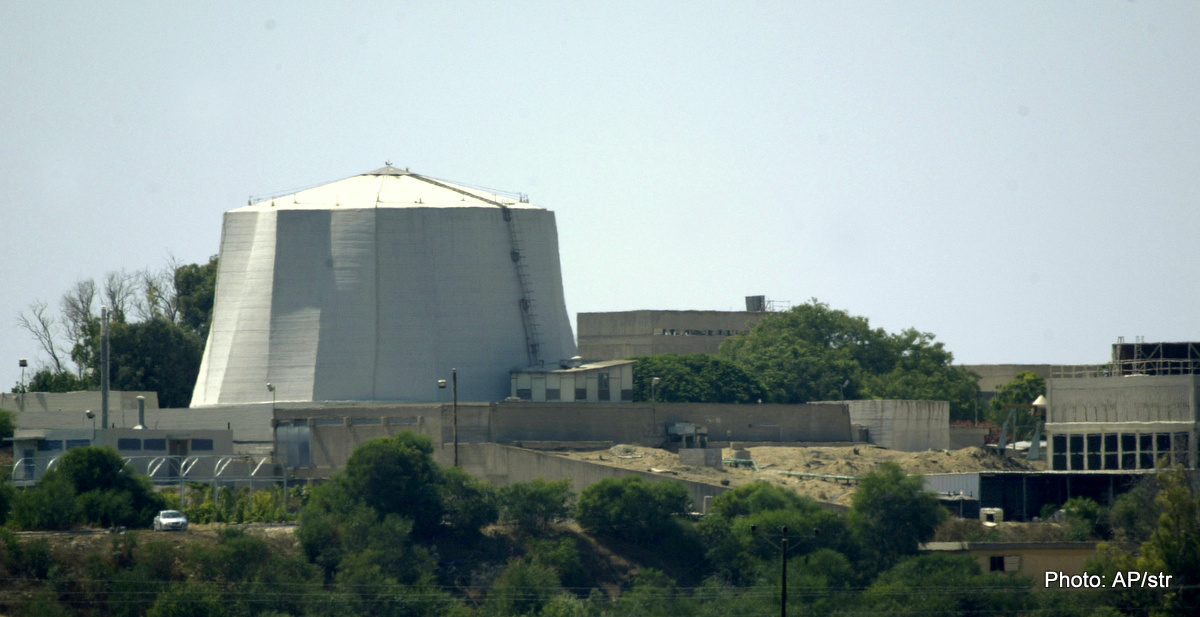
Israel's Sorek nuclear reactor center near the central Israeli town of Yavne.Israel’s Sorek nuclear reactor center near the central Israeli town of Yavne.

Left totally unmentioned by Netanyahu and nearly all discussion of the speech in the U.S. media is any note of, no matter how slight, Israel’s own nuclear weapons program. Indeed, although Israel’s nuclear arms are undeclared and the state is not a signatory of the Nuclear Non-Proliferation Treaty, its possession of these weapons has been an open secret since the 1980s, when a low-level Israeli nuclear technician by the name ofMordechai Vanunu leaked details of the program to a British newspaper. Vanunu was arrested, tried in a secret court and convicted. He would ultimately serve 18 years in prison, 11 of them in solitary confinement.
What Vanunu revealed to the public was widely known in official circles for years, and in 1987 the U.S. Defense Department noted that, “as far as nuclear technology is concerned, the Israelis are roughly where the U.S. was in the fission weapon field circa 1955-1960.” The DOD went on to say that U.S. intelligence believed Israel was also well on its way to developing the technology it would need to produce hydrogen bombs, which are also now widely believed to be present in the Israeli arsenal. Although estimates of the size of the Israeli inventory vary, minimum calculations place it at 75 weapons and maximum at 400, with most placing it somewhere between 100-200 warheads.
The Stockholm International Peace Research Institute provides perhaps the best guess, which is that Israel has 80 intact nuclear weapons, with enough material for many more. Of that 80, it says, 50 are deployed on Jericho II medium-range ballistic missiles and the remaining 30 are aircraft-delivered gravity bombs. There is also speculation that some of Israel’s weapons are based at sea on its new Dolphin submarines, which means that Israel has not only nuclear weapons, but a fully functioning deterrent triad of missiles, bombers and subs. Israel, in other words, not only has a nuclear force as big as or bigger than North Korea’s, Pakistan’s or India’s, but one that possibly approaches the United Kingdom’s in terms of size and sophistication.

The story of the Israeli bomb

While there is debate over the size of Israel’s stockpile, how Israel got the bomb in the first place is far better known. Starting shortly after the birth of the Israeli state itself, David Ben-Gurion gave his country’s scientific establishment the mission of creating what was termed at the time “the bomb in the basement” – a last-resort option that would stave off final defeat by Arab armies, or at least make achieving that hideously costly. Funds gathered from overseas, including Jewish contributions to the State of Israel, were in part funneled to this project, and Israeli scientists and intelligence officials were directed to acquire information from foreign sources on how to build a bomb.
The best efforts to achieve this came in France, where a close relationship between the Israeli and the French defense establishments gave Israeli scientists access to French nuclear research sites. This relationship also eventually led to the purchase of the Dimona reactor complex. Indeed, during the late 1950s over 2,500 French technical experts were present at the reactor site and operated behind a veil of secrecy so thick that the workers were forbidden to write directly to relatives lest they give away their location. When questioned by the British and Americans, Israelis claimed Dimona was a grasslands research institute or a manganese processing plant. After Charles de Gaulle came to power in 1959, however, the Franco-Israeli nuclear alliance chilled — but not before Israel was able to acquire enough material and expertise to begin a full-fledged, independent weapons program of its own.
To succeed, though, Israel would have to overcome what was probably its greatest obstacle to acquiring nuclear weapons: the U.S. It should be remembered that in the early years of the Cold War Israel and the U.S. were not as close as they are today. At best Israel was seen as a nuisance and an electoral prop for Democrats like Harry Truman, and under Dwight D. Eisenhower the U.S. was often actively hostile. Indeed, Eisenhower opposed not just Israeli participation in the Suez Crisis of 1956 but forced Israel as well as Britain and France to retreat from their assault on Egypt with their tails tucked firmly between their legs.
Although not as skeptical of the utility of Israel as an ally as Eisenhower, John F. Kennedy nonetheless put the screws to Israel over its nuclear ambitions due to the experience he gained during the Cuban Missile Crisis. Seeing a need to push back against the threat of nuclear war after the close call over Cuba, Kennedy offered the Nuclear Non-Proliferation Treaty to the world and pushed for countries to sign. Among the requirements, of course, were vigorous inspections to ensure that existing nuclear facilities in non-nuclear states would not be used to build weapons.
Although the U.S. was aware of Israel’s Dimona reactor by 1958, when U2 flights and on-the-ground assessments observed what the Israelis were doing, inspections of the type Kennedy was championing would expose just exactly what the Israelis were up to — drawing the wrath of the proliferation-phobic Kennedy and handing a propaganda coup to the Soviets and Moscow’s Arab allies. The Israelis did eventually give in and allow inspectors, but what ensued as U.S. technical experts poked and prodded Dimona was a kabuki-esque affair, wherein the American teams were stymied in almost every way via tactics any contemporary U.N. weapons inspector would recognize as an attempt to obfuscate, distract and cheat.

Acceptance of the Israeli bomb

This song and dance went on for the remainder of the Kennedy administration, only waning under the far more pro-Israel Lyndon Johnson, who, like Truman, used his support of Israel as a political prop. What’s more, as Moscow made inroads in Egypt and Syria and the likelihood of war between Arabs and Israelis increased, the decision was made in the U.S. and other Western countries to look the other way and, in effect, allow the Israelis to build their bomb.  By 1967, on the eve of the Six-Day War, it is believed that this acquiescence allowed the Israelis to secretly accumulate enough fissile material to build a crude nuclear bomb prior to the outbreak of hostilities on June 5 of that year.
Although Israel’s crushing victory in that war assured its bomb would not be used, the frightening encounter between Israel and its enemies led Israel to a crash program geared toward mass-producing nuclear weapons as quickly as possible. As in the 1950s resources were leveraged, the biggest obstacle to physically increasing Israel’s stockpile was overcome in 1968 via an audacious covert operation that stole up to 200 tons of yellowcake uranium from a Belgian mining company that the Mossad, in a complex operation, had shipped from Antwerp to Genoa and thence on to Israel.
Indeed, the Belgians weren’t the only ones who were robbed. In a memo on Israeli nuclear activities prepared for President Richard Nixon by Henry Kissinger himself, Kissinger noted that Israel’s nuclear program “is one where the Israelis have persistently deceived and may even have stolen from us.” Here, this was further implied when in 1976 CIA Deputy Director Carl Duckett informed officials at the U.S. Nuclear Regulatory Commission that the agency suspected some 200-600 pounds of highly enriched uranium had been stolen by Israel from a processing plant in Pennsylvania owned by the Nuclear Materials and Equipment Corporation. It was, according to one of the officials privy to the secret at the time, one of the most glaring cases of diverted nuclear materials in history.
Eventually acknowledging their failure, the White House under Johnson and then Nixon created the present regime of official lies about Israeli nuclear capabilities by getting the Israelis to pledge to be the first to “not introduce” nuclear weapons to the Middle East — which the Israelis defined as agreeing to not officially test weapons or state officially that they possessed them. This concordant became a foundation of U.S.-Israeli relations when Nixon met Golda Meier after U.S. intervention in the 1973 Yom Kippur War, which itself may have been forced by Israeli desperation and Israel’s implied threat to use their bombs to stave off imminent battlefield defeat.

A rogue is a rogue is a rogue

In the context of the Cold War, when Israeli actions against a Soviet client could have forced a nuclear response by Moscow — a response which would lead inevitably to an exchange with the U.S. and its other allies — it made eminent sense to protect Israel so it would not be forced to use its weapons and so cause that chain of events to occur, which came close to actually happening in 1973. It may have unfairly privileged Israeli interests over nearly everyone else in the Middle East in official Washington circles, but it nonetheless kept an unstable region and its nuclear powder keg under wraps for the remaining duration of America’s conflict with the Soviet Union.
But does this same logic hold sway today? To be sure, relations between Russia and the U.S. are frosty, but the degree to which American and Russian security interests are tied to the fates of their client states in the Middle East is far less than what it once was. Furthermore, American guarantees of security have profited the U.S. very little. In exchange for providing carte blanche protection for Israel in exchange for its nuclear silence, the U.S. has received little but Israeli intransigence on the issue of Palestine and next to no help on other important regional issues. Indeed, America’s very protection of Israel makes the U.S. widely hated in the region. The U.S. alliance with Israel is thus for the most part a one-way street from which America derives very little benefit.
So when you click on the news and see Netanyahu talk about the dangers of a bad deal and the threat of a rogue nuclear state, understand that he knows what he is talking about. After all, his country is experienced in fooling inspectors and lying to the U.S. about its nuclear intentions. It, too, has stolen nuclear materials and broken numerous international laws to build a secret nuclear weapons lab and stockpile. If the emerging narrative about what actually happened in 1973 is correct, it has even engaged in nuclear blackmail to get its way. Given all this, one wonders if maybe Israel couldn’t teach Iran a lesson or two in this particular area of statecraft.

Monday, October 12, 2009

LBJ aided and abetted Israel's uranium enrichment program

Archived CIA files, woefully incomplete because of the political selectivity involved with the Freedom of Information and National Archives and Records Administration Acts, do contain enough information that highlights the participation of the administration of President Lyndon Johnson in the illegal acquisition by Israel of enriched uranium from the United States for Israel's nuclear weapons program.

Apparently, the CIA got around the political problems associated with maintaining detailed records on Israel's nuclear proliferation by keeping open source articles on the Israeli espionage activities. One of the archived documents is a Washington Postarticle written by Charles Babcock, dated June 5, 1986, titled "U.S. an Intelligence Target of the Israelis, Officials Say."

The article details the operations of Mossad operative Raphael ("Rafi") Eitan in illegally procuring 200 pounds of enriched uranium -- enough uranium for six nuclear fission bombs -- from a company called NUMEC -- Nuclear Materials and Equipment Corporation -- in Apollo, Pennsylvania in September 1968. Eitan and three other Mossad operatives traveled to NUMEC's plant and arranged with its owner, an American Zionist nuclear scientist named Zalman M. Shapiro, to have the enriched uranium shipped to Israel clandestinely. Shapiro denied the charges that he gave the uranium to the Israelis and the FBI closed the case, code named "Operation Divert," without charges ever being filed.

The Post article, however, points to a declassified FBI document that points to "Raphael Eitan, chemist, Ministry of Defense, Israel, born 11/23/26 in Israel," was part of the four-man Mossad team that went to the NUMEC facility in September 1968. The actual visit was on September 10, 1968 and it was approved by the Atomic Energy Commission. The team also included Avraham Hermoni, the scientific counselor at the Israeli embassy in Washington, and two officials of Israel's Department of Electronics, which was part of the Israeli Ministry of Science and Development. The Pittsburgh Tribune-Reviewidentified the other two Israelis as Ephraim Beigon and Abraham Bendor, aka Avraham Shalom. Bendor later became the head of Shin Bet, Israel's domestic intelligence service. In addition, Ephraim Lahav, the science minister-counsellor of the Israeli embassy in Washington, made several trips to NUMEC in the 1960s. One of NUMEC's metallurgists was Bernard Cinai, aka Baruch Cinai, an Israeli citizen. NUMEC's illegal nuclear proliferation network extended from Israel and the United States to Britain, France, Japan, Spain, Belgium, and Germany. NUMEC and Israel ran a front operation called Isotopes and Radiation Enterprises (ISORAD). Some NUMEC engineers ended up working for Westinghouse Electric and were interviewed by FBI agents about the missing uranium.

Federal law enforcement sources told the Postthat Hermoni attended a meeting at Shapiro's house in November 1968 at which 11 American scientists were present. In June 1969, FBI counter-intelligence agents witnessed Shapiro meeting with another Israeli embassy science attache at Pittsburgh airport. Shapiro's home and work phones were tapped by FBI agents and he was trailed by FBI agents at every move. Attorney General Ramsey Clark authorized electronic surveillance of Shapiro based on the evidence compiled of his dealings with Mossad. Shapiro used an encrypted telephone provided by Mossad to communicate with Mossad agents in New York.

The only sanctions taken against NUMEC was a $930,000 fine it received from the Atomic Energy Commission (AEC) for losing the enriched uranium. However, it was clear that FBI director J. Edgar Hoover, who usually held ultimate sway over domestic espionage matters, wanted to indict Shapiro, who later became the head of the Pittsburgh chapter of the Zionist Organization of America, but was overruled by the Atomic Energy Commission and the Johnson and Nixon White Houses. However, there is also evidence of a strange turn-around in Hoover's feelings about NUMEC and Shapiro. The AEC sent a letter to Hoover in the late 1960s asking whether Shapiro should register as a foreign agent. The FBI director replied that Shapiro was not required to do so. However, after the Justice Department ordered the FBI to back down from its investigation of Israeli nuclear smuggling and the role NUMEC played in it in 1972, Hoover reportedly became very offended at the FBI being called off the case. Hoover died suddenly after his the rift with the Justice Department.

The FBI tried to interview Navy Admiral Hyman Rickover, the father of the U.S. nuclear submarine, over his dealings with NUMEC and his awarding the firm lucrative Navy contracts. Rickover refused any interviews with FBI agents over his association with the firm. The Navy's contracts with NUMEC saw the transfer of weapons-grade uranium from Oak Ridge National Laboratory in Tennessee to the Apollo plant ostensibly for the production of fuel rods for U.S. nuclear submarines.

In 1974, after the Israeli penetration of America's nuclear weapons program had reached critical mass, the chairman of the Joint Chiefs of Staff, Air Force General George "Scratchy" Brown, stated to a Duke University audience that Jews had too much control over America's banks, newspapers and elected officials and that Israel was a "burden" to the Department of Defense. One nettlesome individual Brown had to deal with was Israeli Colonel Yosef Langotsky, the assistant army attache at the Israeli embassy in Washington. Langotsky was known to the FBI as a Mossad spy and he often was caught in secure areas of the Pentagon trying to recruit agents, most of them American Jewish employees of the Defense Department, into serving Israeli intelligence. Langotsky was eventually refused access to the Pentagon and he was recalled by the Tel Aviv authorities in 1979. Brown's comments about Jews were: "they own, you know, the banks in this country. The newspapers. Just look at where the Jewish money is." President Gerald Ford refused to fire Brown, although Ford was under immense pressure to do so, and Brown continued to serve into President Jimmy Carter's administration. Carter also resisted Jewish pressure to fire Brown. Brown retired on June 21, 1978 and died some six months later in December 1978 from a fast-acting form of cancer.

An investigation of Israeli nuclear proliferation by Representative Morris Udall's (D-AZ) House Committee on Interior and Insular Affairs yielded little success. In December 1978, Shapiro told Udall under oath, "Let me state emphatically that I have never participated in any theft or diversion of special nuclear material." Udall, who ran for President in 1976, was diagnosed with Parkinson's disease the year following his investigation of Israel's nuclear materials smuggling from the United States. The disease forced Udall to resign from Congress in 1991 and he died in 1998.

It was after Representative John Murtha (D-PA) asked for an investigation of the radioactive pollution caused by NUMEC, Atlantic Richfield, and Babcok & Wilson Co. at the Apollo plutonium and uranium plant in 2002, that the corporate media began investigating Murtha's connections with lobbyists. Representative Steny Hoyer (D-MD), whose sister served as executive director of the American Israel Public Affairs Committee (AIPAC), edged out Murtha for House Majority Leader after the Democrats took over control of the House in 2006. Murtha was also targeted in the FBI "Abscam" investigation, which used a convicted con-man named Melvin Weinberg to target a number of Democrats, including Senator Harrison Williams (D-NJ), who believed they were dealing with an Arab sheikh who was actually an impostor. Many, including federal judges, believed the Abscam investigation had a certain "odor" about it and was a case of prosecutorial misconduct.

Israel's illegal acquisition of U.S. nuclear technology was aided and abetted by President Lyndon B. Johnson and his CIA director Richard Helms. The chief of the CIA's Science and Technology directorate, Carl Duckett, planned to draft a National Intelligence Estimate (NIE) in 1969 detailing Israel's development of an atomic bomb in 1968. Duckett told the Post that Johnson told Helms not to publish the NIE. According to the Post, Duckett said Johnson told Helms "Don't tell anyone else, even Dean Rusk and Robert McNamara." Rusk and McNamara were Johnson's Secretaries of State and Defense, respectively. The CIA reportedly had secretly placed "sniffing" devices at Dimona that provided intelligence that proved Israel was developing nuclear weapons. The CIA also kept a wary eye on the smaller Israeli nuclear research facility at Nahal Soreq on the Mediterranean coast, although the site was often used by Israeli propagandists to show to the world that Israel's nuclear ambitions were purely peaceful. Soreq NRC was a branch of Shapiro's and the Israeli government's ISORAD. Duckett and his team had asked the AEC in a 1969 to estimate how many nuclear bombs Israel could make if it possessed all the missing uranium from NUMEC.

Ever since the Johnson administration, every U.S. president has followed a policy of "don't ask, don't tell" when it comes to Israel's nuclear weapons. An acknowledgement by the United States of Israel's nuclear arsenal would not only spur demands for Israel to open its program to international inspection but also focus on the covert methods by which Israel obtained the materials for its nuclear program. However, on a few occasions, U.S. intelligence and military documents have pointed to Israel's nuclear weapons program. The Post article cites a CIA document that was "inadvertently" made public in 1974. The document states: "We believe Israel already had produced nuclear weapons. Our judgment is based on Israeli acquisition of large quantities of uranium, partly by clandestine means."

One of the reasons that Israel is preventing Israeli nuclear scientist Mordechai Vanunu from emigrating from Israel is the knowledge the scientist undoubtedly possesses of Israel's clandestine nuclear technology acquisition program, including its work with apartheid South Africa and Taiwan in developing nuclear weapons outside the framework of the nuclear Non-Proliferation Treaty. Vanunu was kidnapped by Mossad agents in Rome and tried and sentenced him in a secret tribunal in Israel for providing photographs of Israeli's Dimona nuclear weapons site to the Sunday Times of London. Israeli Prime Minister David Ben-Gurion had claimed the facility was a "textile factory." Vanunu, who worked at Dimona, was sentenced to 18 years in solitary confinement. Vanunu now leads a Kafkaesque existence in Israel and although he converted to Christianity from Judaism in 1985, Vanunu, a native of Morocco, is prevented from leaving Israel for Australia or the United States.

A longtime CIA operative told WMR that, ideally, the United States should offer to swap convicted Israeli spy Jonathan Pollard for Vanunu. Ironically, Pollard's Israeli control officer during his espionage for Israel while working for U.S. Naval Intelligence, was Eitan, who later became the head of an Israeli government owned chemical company. Eitan now leads the Gil pensioners' party in the Israeli Knesset. The failure to offer Pollard for Vanunu by successive U.S. administrations points to the power that Israel has over the U.S. decision-making process. In this case, what is good for America is not good for Israel and the loyalty of the Israel Lobby in Washington genuflects to what is good for Israel.

During Pollard's espionage for Israel in the 1980s, the FBI identified California businessman Richard K. Smyth in a scheme to ship 810 "krytrons," electronic triggers for nuclear weapons, to Israel. Smyth fled the United States after his federal indictment in May 1985. Babcock & Wilson Company, which took over the Apollo plant from NUMEC, continued to report the loss of enriched uranium.

Shapiro eventually went to work for Westinghouse's nuclear fuel division and he served as a consultant to the CIA.

With the revelations about the cooperation between the Turkish "Deep State" and Israeli in nuclear proliferation networks brought to light by former FBI translator Sibel Edmonds, as well as what is known about the CIA brass plate counter-proliferation operations of Brewster Jennings and Associates and Valerie Plame Wilson, there is no reason to believe that Israel has stopped its aggressive acquisition of nuclear materials and technology from the United States and other countries. Shapiro's and the Israeli government's ISORAD later inked a fuel contract with a Turkish entity called Global Fluids International SA. ISORAD has also developed links with the Chinese and Indian nuclear programs. The Post article maintained in the CIA archives quotes John Davitt, the head of the Justice Department's internal security section until 1980, as saying that Israeli intelligence was "more active than anyone but the KGB . . . They were targeted on the United States about half the time and on Arab countries about half the time."

Documented evidence that individuals with AIPAC, the Defense Technology Security Administration (DTSA), and the Jewish Institute for National Security Affairs (JINSA), as well as successive "science advisers" at the Israeli embassy in Washington and the Israeli Consulate General in New York have been involved in espionage activities in the United States indicates that not much has changed since Davitt identified the Israeli intelligence threat during his time at the Justice Department.