
Showing posts with label economy. Show all posts

Tuesday, May 27, 2014

Europe and Ukraine: A tale of two elections by Pepe Escobar


Europe and Ukraine: A tale of two elections


Pepe Escobar is the roving correspondent for Asia Times/Hong Kong, an analyst for RT and TomDispatch, and a frequent contributor to websites and radio shows ranging from the US to East Asia.
Published time: May 27, 2014 09:26
Ukrainian presidential candidate Petro Poroshenko walks in front of screen displaying results of the presidential elections in Ukraine prior his press-conference in Kiev on May 26, 2014. (AFP Photo / Sergei Supinsky)
The regime changers in Kiev decided to hold a presidential election on May 25, the same day as European Parliament elections, in order to demonstrate their desire to follow a European-centric foreign policy.Circumstances surrounding the European and Ukrainian elections were far from being a mere coincidence.
Talk about two elections somewhat joined at the hip! In the end, the Ukraine election did actually represent European foreign policy in action – manifested in regime change leading to the specter of civil war.
Few in Europe would have noticed how this process is so far away from “democracy” –instead enshrining intolerance and an ideology of blind confrontation, as represented by this “debate” in Kiev driven by a clueless Yale historian.
Key facts that should be understaood are how the West ignored the Odessa massacre, as well as the detention of Russian journalists; and how the West dismissed the aspirations of eastern and southern Ukrainians as the work of “pro-Russians” or “terrorists.” These people simply became objects of repression - fully supervised by the West, with now the whole regime change theatre of the absurd in Kiev legitimized through an election charade.
Way beyond the established fact of an Atlantic push against Russian western borderlands, Ukraine remains a catfight of local oligarchies. No wonder the new Ukrainian president is also an oligarch; the 7th wealthiest citizen in the land, who owns not just a chocolate empire, but also automotive plants, a shipyard in Crimea and a TV channel. The only difference is that he’s a NATO oligarch

It’s the economy, stupid

Meanwhile, in NATOstan, local and transnational elites have been desperately trying to spin a measure of success. Abstention remains notable – only roughly 4 in 10 Europeans take the trouble to vote on what goes on in Strasbourg, with a majority alienated enough to legitimize the mix of internal European austerity and international belligerence.
Yet the vote on Sunday went way beyond “anti-establishment,” nationalist – and frankly xenophobic or even fascistic – parties consolidating the rejection of “more EU.”
Hardly discussed in the pre-vote campaigns were the Snowden NSA revelations; the shady negotiations between Washington and Brussels over a free trade agreement which will be a boon for US Big Business; and how the financial casino supervised by the European Central Bank, the IMF, and the European Commission (EC) will remain untouched, further ravaging the European middle classes.
The anti-EU crowd performed very well in France, the UK, Denmark and Greece. Not so well in Italy and the Netherlands. The mainstream did relatively well in Germany and ultraconservative Spain – even though losing votes to small parties.
A general view shows press crews working in the hemicycle of the European Parliament during the announcement of the European Parliament elections results on May 25, 2014 in Brussels. (AFP Photo / Georges Gobet)

In Italy, the ruling Democratic Party of current Prime Minister Matteo Renzi did very well (almost 41 percent). The Italian Tony Blair keeps promising a vague “radical reform” – whatever that means. As for the anti-establishment 5 Star party of comedian Beppe Grillo, it lost a lot of votes.
In regions such as northwest France, which includes Normandy – a traditional bastion of the Left – Marine Le Pen’s National Front got a whopping 32.6 percent of the vote. With Francois Hollande’s pathetic socialists in power, Le Pen could not but have the last laugh.
And that duly prompted a portentous intellectual nullity such as the former executive editor of the International Herald Tribune to roar that Marine Le Pen is the French Vladimir Putin.
Essentially, European voters said two things out loud: either “the EU sucks,” or “we couldn’t care less about you, Eurocrat suckers.”
As if that sea of lavishly pensioned Brussels apparatchiks – the Eurocrats - would care. After all, their mantra is that “democracy” is only good for others (even Ukrainians…) but not for the EU; when the European flock of sheep votes, they should only be allowed to pick obscure Brussels-peddled and Brussels-approved treaties.
Brussels, anyway, is bound to remain the Kafkaesque political epitome of centralized control and red tape run amok. No wonder the EU is breathlessly pivoting with itself as the global economy relentlessly pivots to Asia.

Follow the money

To believe that an EU under troika austerity will bail Kiev out of its massive outstanding debts is wishful thinking. The recipe - already inbuilt in the $17 billion IMF “rescue” package is, of course, austerity.
Oligarchs will remain in control, while assorted plunderers are already lining up. Former US Secretary of State Madeleine Albright – for whom hundreds of thousands of Iraqi children were expendable –“observed” the elections, and most of all observed how to privatize Telecom Ukraine, as she is doing now with Telekom Kosovo.
There’s no evidence Right Sector and Svoboda will cease to be crypto-fascist, racist and intolerant just because Poroshenko – the King of Ukrainian Chocolate – is now the president. By the way, his margin for maneuver is slim, as his own markets – not to mention some of his factories – are in Russia. Heavy industry and the weapons industry in eastern Ukraine depend on Russian demand. It would take at least a whopping $276 billion for the West to “stabilize” eastern Ukraine. The notion of the EU “saving” Ukraine is D.O.A.
Moscow, once again, just needs to do what it is doing: nothing. And make sure there will be no economic or political help unless a federalized – and Finlandized - Ukraine with strong regions sees the light of day.
Even the Brookings Institution has reluctantly been forced to admit that the US neo-con gambit has failed miserably; there’s no Ukraine without Russian help.
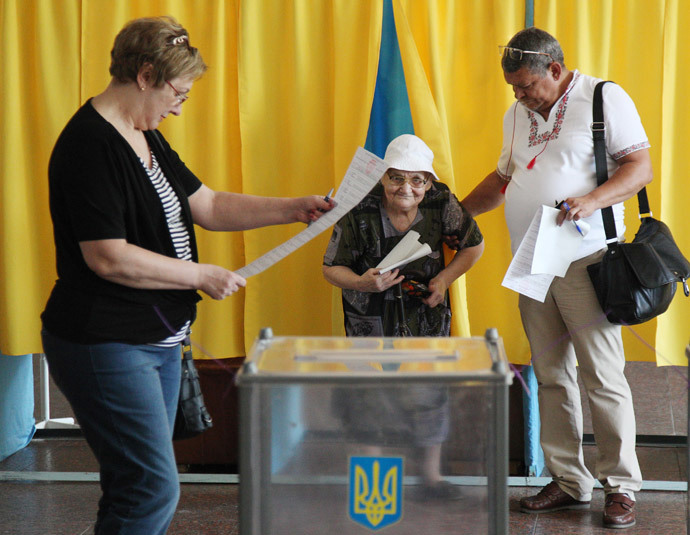
A man assists a woman with the casting of her ballot at polling station in the southern Ukrainian city of Dnipropetrovsk on May 25, 2014. (AFP Photo / Anatolii Stepanov)

So it’s up to the Chocolate King to prove himself a leader of all Ukrainians, and only then will he have a shot at entente cordiale with – and even help from - Moscow.
Signs so far are mixed. Poroshenko said Ukraine could “possibly” become an EU member state by 2025 (it won’t happen). He ruled out entering NATO (wise move). He rejects federalization (dumb move). He believes that with a strong economy Crimea would want to be back (wishful thinking). Still, he believes in reaching a compromise with Moscow (that’s what Moscow always wanted, even before regime change).

What a mess

Back in NATOstan, there’s the crucial point of what happens to the ultra-right-wing anti-EU brigade in the Parliament in Strasbourg. They may all abhor the EU, but the fact is this ideological basket case will hardly form an alliance.
An alliance would mean at least 25 Parliament members coming from at least 7 different countries. Marine Le Pen has already stepped into the ring. She has an agreement with the nasty Geert Wilders in the Netherlands, and could also count on the Austrian FPO and the Belgian Vlaams Belang. The Swedish Democrats – which are in fact crypto-Nazis – are sitting on the fence. The Greek neo-Nazis of Golden Dawn and the Hungarian Jobbik are out. As for UKIP, they definitely don't see themselves as part of this “family.”
What this ultimately means is that conservative and moderate parties, as per the status quo, will remain in control, expressed via an extremely likely coalition of the European People’s Party (center-right) and the Socialists and Democrats (center-left).
What comes next, in the second half of 2014, is the appointment of a new EU Commission. That’s Kafka redux, as in the bureaucrat-infested executive arm of the EU, which shapes the agenda, sort of (when it’s not busy distributing subventions in color-coded folders for assorted European cows.)
There are 5 candidates fighting for the position of EC president. According to the current EU treaty, member states have to consider the result of EU Parliament elections when appointing a new president. Germany wants a conservative. France and Italy want a socialist. So expect a tortuous debate ahead to find who will succeed the spectacularly mediocre Jose Manuel Barroso.
The favorite is a right-winger of the European People’s Party, former Prime Minister of Luxembourg Jean-Claude Juncker. He is an avid defender of banking secrecy while posing himself as a champion of“market social economy.”
Then there’s more Kafka: choosing the new president of the EU Council and the High Representative for Foreign Affairs. Translation: the EU won’t decide anything, or “reform” anything for months. That includes the critical negotiations with the Americans over the free trade deal.
It’s absolutely impossible to spin these Sunday elections as not discrediting even more the EU project as it stands.
As I’ve seen for myself, since early 2014, in 5 among the top EU countries, what matters for the average citizen is as follows: how to deal with immigration; how to fight the eradication of the welfare state; the implications of the free trade agreement with the US; the value of the euro –including an absurdly high cost of living; and what the ECB mafia is actually doing to fight unemployment.
With Kafka in charge for the foreseeable future, what’s certain is that Paris and Berlin will drift further and further apart. There will be no redesign of the EU’s institutions. And the next Parliament, filled with sound and fury, will be no more than a hostage of the devastating, inexorable political fragmentation of Europe.“Saving” Ukraine? What a joke. The EU cannot even save itself.
The statements, views and opinions expressed in this column are solely those of the author and do not necessarily represent those of RT.


Sunday, November 28, 2010

The 234-Year Old Virgin

by David Macaray / November 26th, 2010

An old joke: An Oxford professor meets a former student and asks what he’s been up to.  The student tells him he’s working on his doctoral thesis, whose topic is the survival of the class system in the U.S.  The prof expresses surprise. “I didn’t think there was a class system in the U.S.,” he says. “Nobody does,” the student replies.  “That’s how it survives.”

Not only has the so-called “trickle-down” theory of economics been revealed to be a cruel hoax, but most of the good industrial jobs have left the country, the middle-class has been eviscerated, the wealthiest Americans (even in the wake of the recession) have quintupled their net worth, and polls show that upwards of 70-percent of the American public feel the country is “headed in the wrong direction.”

No jobs, no prospects, no leverage, no short-term solutions, no long-term plans, no big ideas to save us.  While the bottom four-fifths struggle to stay zafloat, and the upper one-fifth cautiously tread water, the top one-percent continue to accumulate wealth at a staggering rate.

Thanks to the global engine, there are now hundreds of billionaires.  Oligarchies, “client-state” capitalism, wanton deregulation, CEOs earning monster salaries, corporations receiving taxpayer welfare, and half the U.S. Congress boasting of being millionaires.  Meanwhile, personal debt in the U.S. continues to soar, one in ten people are out of work, and food stamp usage sets new records every month.

Yet even with near-record unemployment, the Department of Commerce reported this week that U.S. companies just had their best quarter… ever.  Businesses recorded profits at an annual rate of $1.66 trillion in the third quarter, which is the highest rate (in non-inflation-adjusted figures) since the government began keeping records, over 60 years ago.  Shrinking incomes, fewer jobs… but bigger corporate profits.  Not a good sign.

Yet when you broach the dreaded subject of “class warfare” you get blank stares.  When you try to demonstrate, through reams of charts and graphs and statistics, that the system is largely rigged to accommodate the wealthy and powerful — and that we face a genuine Us vs. Them dilemma — people back away.

It’s puzzling.  Why is there so stubborn a conviction that class distinctions don’t exist?  Could it be fueled by something as basic as old-fashioned Yankee optimism?  Could it be a form of whistling in the dark — combating fear and despair by denying that things are as bad as they seem?  Or could it be the unfortunate product of self-delusion and vanity….of no one wishing to be labeled “working class”?

Whatever the reason, it goes way beyond the arithmetic.  Reminding people that the super rich are not only dedicated to hanging on to what they have but committed to accumulating more — and constantly trolling for additional ways to game the system — doesn’t elicit much more than a stifled yawn.  No one gets spooked.  “That’s always been true,” they grumble.

But what does spook them is the suggestion that this dynamic has become institutionalized.  What does spook them is the notion that the deadly trifecta of greed, globalization, and collusion between government and business has more or less rendered the American Dream unattainable for a large segment of the population, and that the country’s best days are clearly behind it.  This is where people balk.

Years ago on the former CNN panel show, The Capital Gang, there was a segment where paleoconservative Robert Novak was arguing over tax rates with the show’s resident “liberals,” journalists Mark Shields and Al Hunt.  After the usual bickering,  Novak dropped his bombshell.  He bluntly accused Shields and Hunt of trying to “foment class warfare.”

Panic ensued.  Instead of defiantly answering in the affirmative (“Hell, yes, we’re talking class warfare!!”), these two guys practically fell over themselves in protest, vehemently denying the accusation.  They reacted as if Novak had accused them of high treason.  It was pathetic.

In former Secretary of Labor Robert Reich’s excellent memoir, Locked in the Cabinet, there’s an account of Lloyd Bentsen, Clinton’s Treasury Secretary, making a similar reference.  In reply to Reich’s observation that the wage gap was widening precipitously, Bentsen says, “Look, Bob, we shouldn’t do social engineering through the tax code.  There’s no reason to declare class warfare.”

While the rich obviously don’t want us rocking the boat, the disparity has become so alarming, even billionaire investor Warren Buffet broke ranks and acknowledged that the Bush-era tax cuts should be allowed to expire.  Said Buffet, “If anything, the wealthiest Americans should pay even more in taxes.”

Buffet’s sacrilege aside, as long as those three catch-phrases — class warfare, social engineering, and redistribution of wealth — continue to provoke Pavlovian responses from Republicans and Democrats alike, the super rich have nothing to worry about.

Thursday, March 01, 2007

One Year of Evo: economic boom, the threat of balkanisation and the role of the military

by Alberto Cruz


On January 22, Evo Morales celebrated his first year as Bolivia’s president. No one can deny that in this time, despite the problems he has had to confront, there has been a clear improvement in the majority of principal economic indicators, possible thanks to the fact that one of the first measures of his government was ending the relationship with the International Monetary Fund. By allowing the agreement with the IMF to expire it has given the government of Morales a certain liberty to push forward with new economic and development policies.

One of the first measures put in march by the government of Evo Morales was to increase its control over hydrocarbons. The high prices on the international market and the increase in taxes for petroleum companies demonstrated to Bolivians that the changes could reach their pockets in beneficial way, along with the social plans that have reached even the most distant and abandoned places: literacy programs, soft credit loans for the purchasing of tractors by agricultural cooperatives, extension of healthcare thanks to the 2000 Cuban doctors and other improvements.

With a starts, and criticism for what has been considered a timid policy at the time of putting into practice the nationalisation of hydrocarbons, what is certain is that it has allowed the country to have a growth rate –talking always in macroeconomic terms – of 4.1% this year, a percentage not seen in Bolivia during the 20 years that the country was subject to the dictates of the IMF and World Bank.

Nevertheless, the critics are not without reason. Although it is true that their exists is an anti-imperialist position, one of independence from the IMF and World Bank, everything possible has been done to preserve macroeconomic stability. “Evaluating the contracts [with the multinationals such as the Spanish Repsol, Brazilian Petrobras, British BG or French Total] and its reaches in working in the interest of national development, it is worrying to verify that we continue to prioritise responding to the interest of the companies who have found in the new terms of the contracts, terms not only acceptable, but moreover, conditions favorable to their transnational character: they conserve their strategic role in the hydrocarbon industry in the country and are obtaining large profits as they further consolidate the role they have consigned to us in their international strategy, that of a primary exporting country” reads one of the specialised reports published at the end of 2006. It continues, saying something even more disturbing: “the possibility of Bolivian initiatives to industrialise gas and petroleum, are possible but overall they do not promise to be of great impact; in large part because the economic resources that should be destined for YPFB are, if not omitted, frankly reduced for a decent time. What is certain is that under the new conditions we have taken on, the interrogation over which resources will be capitalised on by YPFB to assume the strategic challenge of industrialisation remains without answer. Industrialisation within the nation territory and through YPFB loses viability because the new contractual terms opt for ratifying YPFB as a supervisory company and administrator of contracts; renouncing the taking of operative control of the industry and becoming an effective manager of its development.” [1]

The government of Morales has maintained a more pragmatic behaviour and has not given the state company, Yacimientos Petroliferos Fiscales de Bolivia (YPFB), the predominant role that, for example, Venezuela’s PDVSA has been playing, to push forward a drastic change in the improvement of the living conditions of the great majority of the population. A lost opportunity, where one has to point out the important role that Lula’s Brazil has played in “moderating” the application of the nationalisation. Regardless of this, it is not just a few voices who are asking for a “refoundation” of YPFB so that production and exploitation of hydrocarbons is really in the hands of this state institution.

The oligarchy's game plan

The moderate nationalisation of hydrocarbons did not expressly disturb the oligarchy (according to the polls 90% of the Bolivian population supported the nationalisation), but what did was the passing of the new agrarian reform law which if applied to the full extent would suppose the redistribution to campesinos of some 123,000 kilometres squared of idle and unproductive land, a size equivalent to two countries, Austria and Switzerland put together. For now, only 11% of the idle land in the hands of large landowners has been handed over to campesinos. It is not a frontal attack on the large landowners, nor less so, but it is a measure that the oligarchy considered a vital threat to its status quo, given it is where their power is situated: the actual Episcopal Conference of Bolivia considers that 90% of productive land in Bolivia is in the hands of 50,000 people.


Since then the attempts to overthrow the Morales government have been continuous, only changing in form, amongst which the latest is the demand of “autonomy” from a series of departments: Beni, Pando, Santa Cruz and Tarija. The oligarchy’s proposal for regional autonomy only won in these departments, and was abruptly defeated in the rest of the country, but the US ambassador in this Andean country, Phillip Goldberg, is playing a crucial role in the plans for what is now occurring. This man has occupied important positions in the US diplomatic missions in ex-Yugoslavia and in Kosovo, which is why his naming was not coincidental, given it occurred only months after the failure in the referendum on autonomy pushed by the oligarchy. In Bolivia the trajectory of this ambassador has been followed in great detail and they speak openly of the dangers of the “balkanisation” of the east of the country [2].

Since that moment, the objective has been to overthrow Morales. The so-called opposition and the economic elite consider that the reforms put in march are a threat to their way of life and they are using all the means possible to impede them being consolidated. It is also a racist struggle: “if us cambas [white, majority inhabitants of these departments] don’t unite, the collas [indigenous peoples] will want to ruin us, given that unfortunately we have an indigenous president” [3]. It could be said louder, but not clearer than this.

Following the partial failure at that moment to impede the passing of the agrarian reform law – and although it is moving forward very slowly – the oligarchy has opted to agitate around the banners of autonomy for what in Bolivia is know as the “half moon”, the most eastern departments which hold the largest reserves of gas in the country and where the most fertile lands exist. During the months of November and December, the oligarchy launched various ultimatums warning the government that if it did not attend to its demands it would declare “de facto” autonomy, to which Morales responded with a call to the armed forces to defend national unity.

Campesino-military alliance

Although the separatist pretensions are not likely to succeed in the immediate future, it is worth looking at the role that the government of Evo Morales has given to the army and recall what the president of Venezuela, Hugo Chavez, did after winning the 1998 elections: rely on the army as the only institution implanted across the whole territory.

One of Morales’ first objectives after winning the election was to neutralise the army, which was a hypothetical obstacle for his government. The Bolivian Army has always been classist, strongly influences by the National Security Doctrine that the US sponsored, which in synthesis considered the army as the guarantor of internal security, that is to say, controlled social mobilisations. Morales wanted to convert the army into his ally and, following the Venezuelan model, “guarantee the democratic revolution”. For this he took advantage of the “missile crisis” – the sending of Chinese missiles in the hands of the Bolivian army to the US during the term of the preceding executive – to put into retirement 28 generals, promoting people in intermediary posts such as colonels, opened the military academy to indigenous cadets (vetoed from entering until that moment) and thereby gained a greater fidelity on the part of the new military estate.


The change in the army, carried out not without fears given that the oligarchy counts on important ties with the estate which have always being faithful to them, was visualised on May 1, 2006, when Evo Morales decreed the nationalisation of hydrocarbons and the army occupied the gas fields and refineries of the multinationals, provoking a undisguised malaise in the European Union, expressed to Morales via the European commissar on energy, Andris Piebalgs and the Austrian minister of the same branch, Martin Bartenstein (at the time Austria held the presidency of the EU). Half a year later the same operation was carried out with the nationalisation of minerals, symbolised in the take over by the state of the Vinto tin smelter plant in Oruro last February 9. Here again members of the army were used and Morales announced that it would be this institution which was to be put in charge of controlling 25 technological centres where future technicians in the field of minerals would be trained up.

At the same time, Evo Morales gave the armed forces of Bolivia the mission of extending social development to all parts of the country in front of the incapacity of the state to guarantee its presence in all the territory and guarantee attention to the basic necessities of the population. That is why it is not uncommon to see a soldier carrying out tasks in eliminating parasites, vaccination programs, teaching literacy – in collaboration with the Ministry of Education and Culture – or building roadways. The army has also carried forward the “Free Surgery Campaign” in separated zones, covering aspects that the Cuban doctors, in charge of the preventive medicine, do not.

And this in a moment in which Morales has decided to accelerate the campesino-military alliance by giving military status to the “red ponchos”, Aymara campesino soldiers with a long combative tradition in Bolivia, who he entrusted with defending territorial integrity “together with the armed forces” [4].

The oligarchy has seen in this a real threat and considers them “illegal armed groups”, threatens a civil war and affirms that the popular vote of the departments who accepted the autonomy proposal has to be respected. Here we have an example of the manipulation of information, much liked by the defenders of liberty, and in the footsteps of Globovision in Venezuela: “the government [of Evo Morales] is promoting violence, the exclusion of minorities, racism, sectarianism, it deepens differences of ethnicity, social class, campesinos and city dwellers, rich and poor and is dangerously polarising the country into regions. It does not have the vision to accept that the “half moon” wants autonomy, that they won the vote. It wants to centralise, taking power and control of the state institutions, and lacks a program of government. The election of the judges to the Supreme Court by appointment, signifies the buying of justice” [5].

This is the universal discourse of the oligarchy when it sees its privileges in danger, valid in any country in the world. The first year of Evo Morales has bright and dark spots, but it is necessary to support an experience that has rescued the sovereignty and dignity of Bolivia, at the same time as pushing forward a multicultural and participative democracy never before seen in this Andean country, even despite the rejection of the oligarchy and US. Maybe more and better things could have been done, but what has been done until now is nothing small.

Alberto Cruz is an analyst at the Center of Political Studies for International Relations and Development. Translated from Rebelion

--------------------------------------------

Endnotes

[1] Bolivia Press nº 12, 3 de diciembre de 2006.

[2] CEDIB, 15 de enero de 2007.

[3] Declarations made by David Torrico, president of the Comité Cívico de Pando to La Razón el 4 de julio de 2006.

[4] La Razón, January 24, 2007.

[5] La Razón, January 25, 2007.