Sunday, November 06, 2005

Chavez Says of Bush, 'The Man Was Beaten'

Original article in Spanish in CLARÍn
MAR DEL PLATA, Argentina: We were like five musketeers, standing our ground and fencing well. And in the duel, we prevailed." These were the words uttered by Venezuelan President Hugo Chavez. He was describing the contentious five-hours of negotiation between Chavez and the presidents of the Mercosur countries to find a consensus on the final document of the Summit of the Americas. "And Nestor Kirchner played Dartagnan," added.

All for One and One For All!
[Editor's Note: In the story of The Three Musketeers, Dartagnan was the main character that travels to Paris in order to join "The Musketeers," who were the French King's personal guard. The implication is that Argentina's President Kirchner has now joined Chavez and those Latin American countries that oppose the Bush Administration and its plans for the Free Trade Agreement of the Americas. Mercosur, or the Common Market of the South, was created in 1991 as a way of economically integrating South American countries. It is comprised of Argentina, Brazil, Paraguay and Uraguay].

At a press conference that began after a two-hour delay and before answering a single question, Chavez spent over an hour describing the, "unedited, intense and frank debate that was like none other at a Summit."

In concluding his remarks, he assured listeners that the defeated party had been the President of the United States. "The man was beaten and he never saw it coming. The grand defeat went to Mister George "W." Bush, which is why he left ahead of time," he declared, amidst the laughter of his ministers, who had accompanied from their first class rooms at the Republica Hotel.

According to Chavez, negotiations on the document for this Summit had been stagnant for the past year, and the time for Mar Del Plata Summit had arrived with "the FTAA dead." The topic wasn’t even on the Summit’s final session agenda, a session that began at 10 in the morning and adjourned for lunch at 12:30.

"We had to discuss jobs and the fight against poverty. And I proposed that we put in practice a program identical to the one introduced by John F. Kennedy in 1963," said Chavez, amidst several historical and Biblical references.

"Suddenly, the hare jumped, " continued the Venezuelan president as though he was recounting a story to friends in a bar. "Panama left and he [Bush] wanted to give oxygen to the dead. He wanted to revive the FTAA. The glitter of Washington’s proposal was gone. And Mercosur stood its ground. Lula stood very firm. Nestor "Dartagnan" Kirchner, very firm. Tabare [Uruguayan President Tabare Vazquez], calm and firm. [Paraguayan President] Nicanor [Duarte Frutos], firm. It is good, but you already know as I do," he said.

"But the pressure began immediately. The United States and Canada pressed with all the leverage they had. Kirchner, within moments, removed his sword. He said: we don’t like being dictated to," he continued. Chavez said that finally, "they realized when faced with our resolve, they would be unable to browbeat us," and we arrived at a consensus over what the two main issues of disagreement are. "He was incredible, after five hours of debate. Kirchner had to call three recesses, and after all that discussion, our original proposal was adopted. At its heart, it is exactly what we have sought from the beginning, with a few changes at the margins. We fought hard and we prevailed."

"The FTAA is dead. The FTAA is dead," Chavez said, closing out his remarks.

Chávez and Maradona Lead Massive Rebuke of Bush

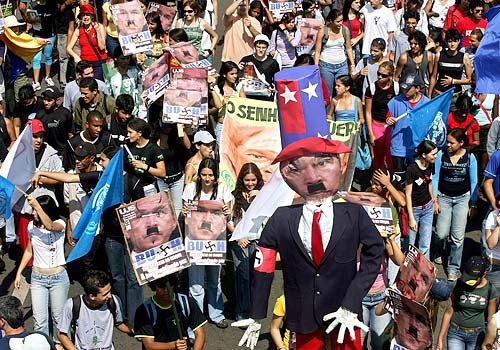
Some aspects of George Bush's travels have become commonplace, including massive protests, sporadic violence and tight security operations. All of these usual elements--notably the imperial-style arrival of the US president with an entourage of 2,000 people and four AWACS surveillance systems--were present at the Fourth Summit of the Americas in Mar del Plata, Argentina.

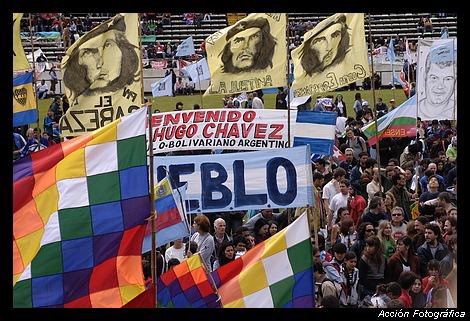
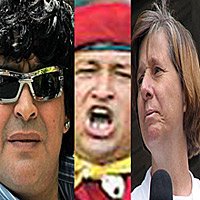
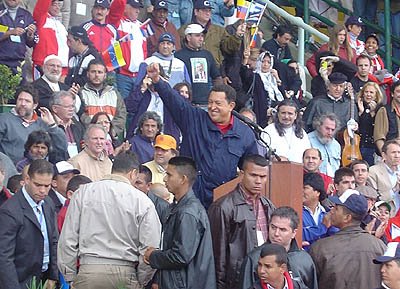
But the opposition to Bush and his proposed Free Trade Area of the Americas (FTAA), as well as neoconservative economic policies and capitalism in general, took on a creative twist this time, with a massive march that ended in a rally at a sports stadium involving a heterogeneous group of Latin American leaders: Venezuelan President Hugo Chávez, Bolivian socialist leader Evo Morales, Argentine leaders of the unemployed, Mothers of Plaza de Mayo, a Nobel Peace Prize laureate, singers from all over the continent, and, of course, Diego Maradona, legendary soccer hero.

A counter-meeting, the Summit of the People, began in the city on Monday, and concluded on Thursday with recommendations to summarily suspend FTAA talks, combat inequality in the region, and "energetically reject the militarization of the continent promoted by the empire of the north."

At the culminating event of the march against Bush, Chávez called the stadium in which over 25,000 demonstrators had gathered the "gravesite of the FTAA."

He also proposed a Bolivarian Alternative for Latin America and the Caribbean (ALBA, a Spanish acronym meaning "dawn") to replace the controversial FTAA. Regional opponents of Bush's free trade agreement accuse it of fomenting inequality and placing poorer countries at the mercy of wealthier ones. The Bolivarian alternative proposes regional integration with the goal of fighting poverty and social exclusion.

Fiery Welcome for Bush in Panama Sunday

Panama, Nov 6 (Prensa Latina) With his ears still ringing from shouting protestors in Argentina and Brazil, US President George W. Bush will arrive Sunday night in Panama, where he will be welcomed by the government and more uproar.

Bush will visit Panama with empty pockets after the 4th Summit of the Americas in Mar del Plata and of meetings held in Brasilia, but hopeful of exerting leverage in the famous canal country.

Navy patrol boats and war helicopters are guarding the city's Miramar Intercontinental Hotel, where Bush and his entourage will stay during a less-that-24-hour visit to this Panamanian nation.

In these past few days, Martin Torrijos's government has defended the occupant of the White House's visit to this country, saying that his aim is to strengthen bilateral ties in all fields, especially in the economic and trade sphere.

The Panamanian delegation in Mar del Plata had offered itself this weekend to try and save the virtually buried Free Trade Area of the Americas (FTAA), but the notion was rejected by the Mercosur and Venezuela, among others.

Grassroots groups, union organizations, farmers and students have vowed to actively protest the presence of the US president, and have lined up some whopping rallies for the coming hours.

The Washington kingpin's arrival will coincide with the end of a vigil to discredit his anti-terrorist policy, which is marked by the double morality of protecting Luis Posada Carriles and Orlando Bosch in his country, the absurd and unfair war of Iraq and his hegemonic desires for Latin America.

Bush's agenda includes meetings with his Panamanian counterpart, some journalists and baseball players, as well as seeing the Panama Canal Zone. He has not mentioned the military bases.

Vietnam Sues US to Cleanse Agent Orange


Hanoi, Nov 6 (Prensa Latina) A project to decontaminate Vietnam´s environment from dioxins sprayed by the US was presented Sunday in this city by a Japanese scientist before the Vietnamese Association for Victims of Agent Orange.

Ecologist Furukawa Hisao, the project´s author and former professor of Toyo University, presented his concept to clean up areas damaged by this highly toxic product at a working session with the Association members.

The US military showered dioxins over wooded zones of Indochina, Vietnam and Cambodia, and although the pretext was to defoliate trees to deprive guerrilla fighters from refuge, the effects were even felt in its own troops.

The Japanese scientist, also executive director of the Network for Peace and Environment, said that recovering ecosystems affected by dioxin would reduce its harmful effects in humans.

Hisao will call on Japanese and Vietnamese scientists to take part in the project and assist in raising funds from the Japanese people and international community.

In Vietnam over a half million people are Agent Orange victims either from direct contact with the product or from being born with defects resulting from damages to human genes.

Vietnamese Agent Orange victims presented a suit before US courts for manufacturing companies to pay massive indemnities to victims.

The US justice system has denied that right and Vietnam is waiting for an appeal presented to the Supreme Court.

Dioxin is di and tri-chlorophenoxyacetic acids, and has a lasting toxic effect in people

Bolivian Leader Slams US Campaign

Caracas, Nov 4 (Prensa Latina) Presidential candidate Evo Morales stated the US is spearheading a campaign in Bolivia to damage the reputation of social movements, according to an interview published by Venezuelan Pax Magazine on Friday.

Morales, leader of the Movimiento al Socialismo (Movement toward Socialism, MAS), asserted that power groups present farmers´ organizations as drug dealers and terrorists.

These are tactics to discredit social movements, noted Morales, who is favored by surveys to win the December presidential elections.

The MAS leader said Spanish landowners accounted for most coca growers in colonial times, and it was the US that promoted its cultivation among miners.

Now they penalize the coca plant when it has become a cultural force that is part of the national identity and economy, he added.

It is legal for Coca-Cola but illegal for the indigenous population, replied Morales, saying the World Health Organization has proven that coca leaves cause no damage to human beings.

The indigenous leader also asked why agents of the US Drug Enforcement Agency "wear uniforms, carry weapons and suppress demonstrators in Bolivia with impunity."

He called to re-found the nation to seek justice and equity for an honourable, sovereign and productive country where all people can live, and defended his proposal for a Constitutive Assembly that represents all Bolivians.

Bush Visit to Brazil Gets Official Welcome and Jeers on the Streets

The Brazilian government is preparing for the upcoming visit to Brazil by the President of the United States, George W. Bush, and his entourage. Bush is expected to arrive in Brasília tonight and stay until Sunday, November 6.

Bush is coming at the invitation of President Luiz Inácio Lula da Silva. The two plan to meet on Sunday, in the morning and early afternoon, at the Torto Farm [the presidential grange on the outskirts of the federal capital].

The Brazilian government regards the visit as important, informed the undersecretary of political affairs of the Ministry of Foreign Relations, Antônio Patriota.

"We hope that it will be a very important visit to renew the bilateral relationship, which is at a favorable juncture," he stated.

According to Patriota, a joint communiqué should be issued at the end of the encounter. Among the topics that should come up for discussion are the reinforcement of cooperation instruments in the areas of science and technology, education, environment, and health, and measures for the promotion of racial equality.

According to the Ministry of Foreign Relations, the United States is Brazil's single most important trade partner, receiving nearly a fifth of what Brazil exports.

Bush's visit to Brasília bodes changes in the city's routine. One of the largest security schemes on record is being mounted in the federal capital. Altogether, over 600 members of the Brazilian Federal Police, the FBI, the Army, the Navy, and the Air Force will be involved. Agents from the US Secret Service and the Brazilian Intelligence Department will also participate in what is being dubbed Operation America.

Protests against the US government are also expected. "Naturally, like every host who receives a foreign guest, we are worried about making sure that the visit occurs under acceptable circumstances. However, demonstrations in Brazil are usually peaceful, a natural expression of democracy," Patriota affirmed. According to the undersecretary, the demonstrations should be handled naturally, not as a cause of concern.

'Welcome' Mr. Bush (By Frei Betto)

President Bush: Welcome to a sovereign country called Brazil. As President Lula has already shown, we don't want the FTAA and we have a government that backs Chávez's Venezuela and Fidel's Cuba. We were a colony of Portugal for 322 years, so we know what it is to produce wealth for the benefit of others.

Even today the Brazilian people work very hard in order to pay the e(x)ternal foreign debt contracted by our elites without asking our people. Our tributary burden is one of the highest in the world, 36% of the GNP; our annual interest rate is more than 19%; every year our government spends (on interest payments of the debt) more than ten times the budget for new investments. Officially, our primary surplus is 4.45%. Actually, it's over 5%, because our government's economic pundits believe in all faith that the god market can produce the miracle of the nation's welfare without any structural changes, such as agrarian reform. And I'm not saying that it is our problem, because the IMF, which you order around, controls our economy. I don't know of a single country that has left poverty behind thanks to the IMF.

I come to ask for peace. Twenty-eight hundred years ago a Jew called Isaiah claimed that there will be peace only as a consequence of justice. You believe that peace will come by the force of arms. But war is the terrorism of the wealthy, as terrorism is the war of the poor. Wasn't the U.S. defeat in Vietnam enough? One million people died in that war, 50,000 of which were Americans. Sooner or later your country will have to leave Iraq with no pride left, loaded with the burden of thousands of young Americans (many of them Blacks and Latinos) doomed to death because they believed that what is good for the United States is good for the world.

Your country has only 6% of the world's population. Yet it controls 50% of the planet's wealth. You have never asked for democracy in Saudi Arabia, where there are the greatest oil reserves in the world, because that country's autocratic government follows Uncle Sam's policy, although it's the source of bin Laden and the terrorists that blew up the Twin Towers. Last year, the spending of the whole world on weapons was almost $900 billion. The United States spent almost half of that sum – $390 billion. Only $50 billion a year, until 2015, would be needed to eradicate hunger in the planet!

Why does death deserve more money than life? Isn't there something wrong in that rationale? Why does capitalism place private property above human life and the collective welfare? Why do 5 million children under 5 years of age die every year while the wealthy countries give less than 10% of the money they spend in arms for international cooperation?

You should know that 86 million people have died in wars since 1940. The two atomic bombs, which your country dropped on the innocent populations of Hiroshima and Nagasaki, evaporated almost 100,000 lives and left a wake of cancer that stretches to the present in the offspring of the victims. Most of them young people. Around two thousand U.S. troops have died in Iraq in that insane war re-launched in 2003. Your father invaded that country in 1991, and the result embarrassed your nation in such a manner that you felt the obligation of repeating the gesture, with the hope of toppling Saddam Hussein. So you did, but the resistance of Iraqis has challenged, to the present, your country's military might. Among civilians, some 130,000 Iraqis have died from attacks by the United States in 1991. Thanks to arms supplied by the U.S., including chemical weapons, particularly at the time of the Iraq-Iran war, Saddam killed some 200,000 Iraqis.

Recently, I visited your country. In Utah, many persons asked for my impression of the United States. I said that the difference between your country and mine is that in the U.S. you are convinced that there is no happiness without money. And my people are happy without money. It's enough to have the five "Fs": feijoa (beans), flour (farinha), faith (fe), soccer (futebol) and party (festa). That irrational search for wealth is what prevents the people of the United States from feeling solidarity towards the poor of the world. We all saw what happened to many Blacks and poor people of New Orleans during the destruction caused by Hurricane Katrina. They were forsaken, until you responded when you perceived that, in the eyes of the world, the king was naked. And as a bonus, one of your advisors had the gall to suggest abortion for Black women as a measure of reducing poverty in the United States.

"Welcome", President Bush, to the nation of the future. We want to be fraternal friends of the people of the United States, without having the CIA threatening our democracy, as in 1964, when it helped to set up a dictatorship that lasted 21 years, and to have reciprocity in our trade relations, with full respect for our sovereignty.

Chavez Calls for Latin American Unity


Mar del Plata, Argentina, Nov 4 (Prensa Latina) Venezuelan President Hugo Chavez stated Friday true Latin American independence would only be achieved through unity.

Nations will only save these lands if they are united, Chavez told reporters in the Argentine city of Mar del Plata, host of the 4th Summit of the Americas, with participation of 32 regional heads of states.

The leader of the Bolivarian Revolution is expected to address Friday a mass rally at Mar del Plata's Mundialista Stadium, as part of the closing ceremony of the 3rd Summit of the Peoples.

More than 5,000 participants at the Summit of the Peoples, whose sessions concluded Thursday night with a resounding condemnation of US hegemonic policy, took to the streets early Friday morning in a march to repudiate US President George W. Bush and the Washington-proposed free trade agreement.

Former ace Argentine soccer player Diego Armando Maradona, Bolivian indigenous leader and presidential candidate Evo Morales, Bosnian film director Emir Kusturica, Argentine writer and Deputy Miguel Bonasso joined the march.

Maradona told media that he was opposed to the Bush presence here, and ratified his participation in the activity at the Mundialista Stadium.

The act is considered the highest point of actions by social, union, indigenous and human-rights groups against Bush, who Nobel Peace Prize laureate Adolfo Perez Esquivel accused of crimes against humanity.

Al Carajo! From Comrade Joaquin by Stan Goff

Hugo Chávez was in fine form this morning at the football (soccer)
stadium counter-rally in Mar del Plata, quoting Rosa Luxembourg,
preaching socialism for the XXIst Century and generally kicking the ass
of the ruling class while a mile away the other heads of state of the
hemisphere (minus one little island whose leader wasn’t invited cause
even now after four and a half decades the mere thought of his beard
makes the Yankees wet their pants) were trying to come up with a plan to
upstage Chavez's coup: at the stadium he had Maradonna seated at his
right hand.

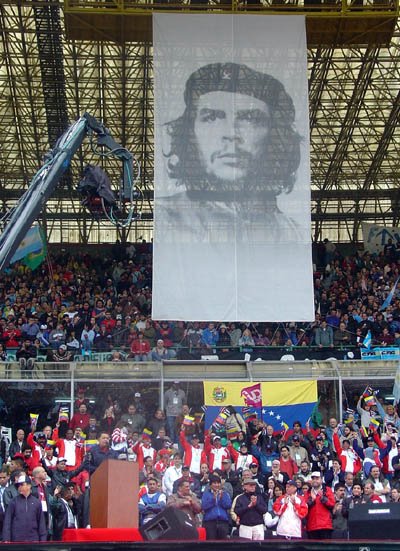
And what a crowd! A gigantic ghosted version of Korda's famous image of
Che over the flags of all the nations of Latin America and the Caribbean
sewn together in anti-imperialist solidarity, giant banners with Sandino
and Bolivar and Martí and a sea of placards with Evita's image. And an
indigenous leader - it may have been Evo Morales, but I’m not sure -
telling a reporter as he marched, "we demand the right to
plurinationality." They want their rights as indigenous people, as
Bolivians, AND as Latin Americans recognized and respected.

On the podium, the man who has replaced Fidel Castro as "Bush's nemesis
in Latin America" in Lucía Newman's scripts, the leader of the
Bolivarian Revolution, President Hugo Chavez.

Bush faces Latin fury as popularity sinks at home

President George Bush, his presidency foundering and his popularity at record lows at home, ran into new protests abroad yesterday at a Western hemisphere summit in Argentina - a gathering that is theoretically focussed on trade but which has so far only served to highlight the battered image of the US across Latin America.

Mr Bush went into the 34-nation meeting intent on promoting traditional US doctrines of free trade and liberal market economics, with the goal of a giant free trade area, building on the existing agreements, that would stretch from Alaska to the Southern Ocean.

But not far from the sealed-off, massively protected hotel where the leaders met, some 10,000 demo-nstrators marched through the resort city of Mar del Plata. "Get Out Bush," they chanted, in protest not only at the free trade proposals but at the Iraq war and other US policies

"We don't have any confidence in anything Mr Bush might propose here," said Juan Gonzales, an Argentine trade union leader. Whatever emerged, it "will only prolong hunger, poverty and death in Latin America," he said. Among those at the protest rallies were Hugo Chavez, the radical Venezuelan leader and vitriolic critic of the Bush administration, and the legendary Argentinian footballer Diego Maradona.

The Bush Effect: U.S. Military Involvement in Latin America Rises, Development and Humanitarian Aid Fall

While President George W. Bush is in Latin America to push his controversial free trade agenda, there is another type of trade to be concerned about. U.S. military aid, training and arms sales to the region have all increased sharply since the beginning of the war on terrorism and threaten to exacerbate conflict, empty national coffers and sidetrack development programs.

Through the Foreign Military Financing program, military aid has drastically increased during the Bush administration. In 2000, U.S. military aid to Latin America was $3.4 million, a tiny share of worldwide FMF spending of $4.7 billion. By 2006, overall spending on Foreign Military Financing actually decreased to $4.5 billion, after peaking at $6 billion in 2003. But military aid to Latin America increased to over 34 times its year 2000 levels, to $122 million.

After the Summit of the Americas in Argentina, President Bush will visit Brazil and Panama. Argentina is the third largest recipient of military aid in Latin America, with a total of $6.3 million between 2000 and 2006. Panama, where the United States long controlled the canal area, is also a major recipient of military aid, with a total of $5 million for the same period. Argentina's population is ten times that of Panama, making the near parity in their military aid levels striking.

But, when looking at military aid to the region, it is most noteworthy that El Salvador tops the list of recipients, with almost $23 million in FMF since 2002. This relatively large amount of military aid can be explained at least in part by looking at Salvadoran support for the war on terrorism. El Salvador is one of the Bush administration's few remaining allies with troops in Iraq, and six Salvadoran Special Forces soldiers have been awarded the Bronze Star.

The administration has also sought to draw a parallel between El Salvador's transition to democracy and Iraq's rocky progress toward that goal. While in San Salvador last year, Secretary of Defense Donald Rumsfeld praised the country's progress, saying "when one looks at this country and recognizes the fierce struggle that existed here 20 years ago and the success they've had despite the fact that there was a war raging during the elections, it just proves that the sweep of human history is for freedom." He added, "We've seen it in [El Salvador], we've seen it in Afghanistan and I believe we'll see it in Iraq."

El Salvador, which emerged from a U.S.-backed civil war in 1992, is also the second largest recipient on military training though IMET, and it is 11th on the list of arms sales recipients, purchasing a total of $46.8 million in weaponry between 2000 and 2003. During the civil war, in which 75,000 people were killed over 12 years, Washington contributed $1.5 million a day in military and economic aid to support the dictatorship's fight against guerillas.

Marine tells of 'carte blanche' to kill

A former US marine has told a jury that he was given "carte blanche" to kill and was told to "shoot first and ask questions later" while serving in Iraq following the outbreak of war in 2003.

Jimmy Massey was giving evidence in the Dublin Circuit Criminal Court trial of five antiwar protesters accused of criminal damage of a US aeroplane at Shannon Airport in February 2003.

Mr Massey was a platoon sergeant in the US Marines stationed in Kuwait in the lead up to the outbreak of the Iraq war and served there following the invasion until May 15, 2003.

The accused have pleaded not guilty to two counts each of causing damage without lawful excuse to a naval plane, property of the United States Government and to glass door panels, property of Aer Rianta at Shannon Airport on February 3, 2003.

They are Ciaron O'Reilly, an Australian national and Damien Moran, aged 25, both of South Circular Road, Rialto; Nuin Dunlop, aged 34, a US citizen and counsellor living on Walkinstown Road, Dublin; Karen Fallon, aged 35, a Scottish marine biologist living on South Circular Road, Rialto; and Deirdre Clancy, aged 35, a copy editor of Castle Avenue, Clontarf, Dublin.

Mr Massey told Mr Brendan Nix SC, defending Ms Fallon, that prior to invasion he was briefed of the terms of the Geneva Convention and rules of engagement. He said he was told that intelligence reports "painted every Iraqi as a potential terrorist".

In response to Mr Nix’s query as to what was their "firing policy". Mr Massey replied: "To shoot first and ask questions later. We were given carte blanche to kill."

Bush in Argentina: Bringing Imperialism Back to Public Debate

A few years ago, Tulio Halperin Donghi, Argentina's most eminent historian, argued that "dependency" or "imperialism" were no longer part of the agenda of Latin American historiography or public debate. This was not due to their lack of significance as political concepts, he said, but because they have been accepted as part of an unchangeable reality. Imperialism and dependency affect us, that's for sure; but there is no point in discussing it any longer, "just as we don't discuss the rain". It is just there.

Indeed, the very word "imperialism" (not to mention "capitalism") was for most of the 90s something of a relic in Argentina, confined to die-hard leftists, and rejected by politicians, academics, and journalists alike. In comparison to that situation, the last couple of weeks leading to the Summit of the Americas seem to have made visible a dramatic change in Argentine culture.

George Bush's visit, quite expectedly, was to be resisted by local activists and social movements. That we all knew. Somewhat unexpected was the general strike called by CTA, one of the main national unions, which was observed by many workers throughout the country. But nobody would have guessed such an intense participation of common people and even mainstream public figures in anti-Bush activities.

Of Course They’re Rioting in Argentina

On one of my recent trips to Latin America, I saw a child no older than five years old standing at a busy intersection, begging drivers for money. He was barefoot and his skin and clothes were covered with a thick layer of black smog. This child had managed to learn how to navigate the heavy traffic, aggressive drivers and had developed strategies for survival. For him and for the other 220 million people who live in poverty in Latin America, every moment of his life is a constant reminder of why the Bush's economic policies are not working.

Bush's close to 70% disapproval ratings in Latin America do not come as a surprise to people who live there. Last week, before Bush's arrival, Argentineans were predicting that thousands would hit the streets in protest, some even warned him not to come. Yet Bush and his advisors are clueless about the sentiment of those who disagree with them. And this is perhaps Bush's worst mistake. With a little research, Bush's advisors should have known that Argentina of all countries should be the last place the Bush should visit after the worse week of his presidency.

Argentineans know better than any other South Americans that Bush style economic development with open markets, deregulation and privatization only leads to increased poverty. After following the recipe of the free market, Argentina suffered one of the worst economic and political crises in the Americas in 2001 and 2002.

Most Latin Americans know that this summit is not about "creating jobs and about strengthening democracy" as the title of the summit claims but about pushing unfair trade deals that undermine the rights of workers in Latin American countries and destroy the environment.

But president Bush obviously did not read the early signs of disapproval of his actions like the stalled FTAA (Free Trade Area of the Americans) talks, and the development of MECOSUR, an effort by Brazil, Venezuela, Argentina and Cuba to develop an alternative to the FTAA.

Now Bush is being forced to face the music and chanting of tens of thousands of people who are coming from across Argentina and Latin America to protest against him. In fact in Latin America he is being crowned as the most unpopular US president in history. It is time for the Bush Administration and for US citizens to open our eyes to the misery the poor in our nation and around the world are suffering. We can't continue to claim disbelief at the levels of poverty in New Orleans or at the failure of free trade in Latin America.

Ana Perez is the Cuba program director at Global Exchange, www.globalexchange.org.

Bush's visit sparks upheavals in Argentina

The participation of US President George W. Bush in the Summit of the Americas in Argentina has unleashed a wave of popular outrage in that country and across much of Latin America.

Mar del Plata, the seaside resort where the 34 hemispheric heads of state are meeting, was the scene Friday of pitched battles between demonstrators and riot police, with clouds of teargas choking the streets just blocks from the meeting. At least one bank was set on fire, as protesters answered teargas canisters and rubber bullets with stones and Molotov cocktails.

Facing unprecedented hostility from the American people, reflected in his record drop in the polls, Bush is regarded as a political and social pariah south of the US border. The demonstrations outside the summit were joined by bitter divisions within the meeting itself.

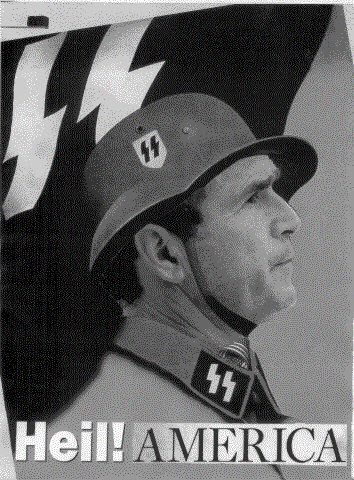
Tens of thousands of people marched in a heavy rain Friday morning in Mar del Plata, demonstrating their opposition to the war in Iraq and protesting the Bush administration's economic and military policies in Latin America. The march began shortly after 8 a.m. and filled 15 blocks with crowds chanting "Bush Out!" and "Fascist Bush, You Are the Terrorist!"

Leading the march was Argentine Nobel Peace Prize winner Adolfo Pérez Esquivel and Bolivian cocalero leader and presidential candidate Evo Morales. Also in the front rank was a delegation from the Mothers of the Plaza de Mayo, the organization that challenged the former US-backed dictatorship, demanding the return of their "disappeared" children during Argentina's "dirty war."

FTAA interred at Mal del Plata

3rd SUMMIT OF THE PEOPLES OF AMERICA
FTAA interred at Mal del Plata
• Next comes the turn of capitalism, affirms Hugo Chávez
• More than 80,000 people on anti-Bush march • Impressive event in World Stadium

MAR DEL PLATA, Argentina, November 4. - The FTAA has been defeated by the peoples of this continent and today saw its interment in Mal del Plata. But this does not mean that capitalism is dead; capitalism is the next to be buried and for that we shall have to fight much harder, affirmed Venezuelan President Hugo Chávez to the 80,000-plus participants on the march against US President W. Bush and his imperialist project of domination.

After a 3-hour march along the central Independence Avenue to the World Stadium, demonstrators from all parts of our hemisphere shared their common dreams and ideas with Chávez, whom they identified as the voice of Our America in the other summit organized by the White House, whose 4th edition began this Friday afternoon.

FIDEL IN THE COMBAT

After analyzing the current situation in the region, the Bolivarian leader communicated a piece of news that aroused prolonged applause and cheering. Just before entering the stadium he spoke by phone with President Fidel Castro who had seen the march live on television and followed the event via Telesur, and sent his greetings to everyone.

Chávez said that he had said goodbye to his friend with his habitual phrase: "Ever onward to victory, Patria o Muerte, Venceremos," and "Fidel, in an emotional voice, like a roar of thunder that crossed the Caribbean, the Orinoco, Amazonia, La Plata River and reached as far as here, told me: 'Chávez, long live Che!'"

CHALLENGES AND ALTERNATIVES

In a packed stadium, the Venezuelan president affirmed that to win the major undertaking against imperialism, we have to follow the formula given by Simón Bolívar: Constance and more constance; patience and more patience; work and more work; unity and more unity to make our utopia possible, to achieve the salvation of our peoples.

It is not only about saying No to the Free Trade Area of the Americas (FTAA) but constructing an alternative way. And that is where are proposal for the ALBA (Bolivarian Alternative for the Americas) is inscribed, the continuation of the 200-year project initiated by our forefathers, he emphasized.


Cuban delegation leaves the 3rd Summit of the peoples

Venezuela and Cuba, he commented, have advanced with a firm step, much political will and popular participation in the construction of the ALBA, with great efforts in the political, social, economic and technological spheres.

As a result of a strategic agreement between the two countries, Venezuela has defeated illiteracy in less than two years. In that short period one and a half million Venezuelans have learned to read and write and are going on to reach 6th grade.

That is the proposal that I am taking to the Presidents' Summit: let's stop going from summit to summit, from speeches to more speeches and let's go directly to defeat illiteracy in Latin America, where there are close to 40 million illiterate people and if one includes functional illiterates, the total is 200 million.

To be continued...

Rioters shatter Bush's hopes of forging free trade coup


President George W Bush was poised for a big new political setback last night as a diplomatic push for a major free trade agreement seemed stalled amid fierce opposition from key countries and scenes of violence and rioting in Argentina and Uruguay.
Bush, who is already beset by a host of domestic political troubles, had hoped for a major foreign policy coup to take some of the pressure off his beleaguered White House. He has put breaking down free trade barriers in the region at the top of the agenda at the Summit of the Americas, which has brought together leaders from 34 different countries in the Argentine city of Mar Del Plata.

But the end of the summit was delayed as talks dragged on inconclusively about a proposed Free Trade Area of the Americas (FTAA). A group of left-leaning countries, headed by Brazil, Venezuela and others, opposed the idea, saying it would open their countries to exploitation by large American firms and do little to alleviate poverty. Bush left the summit before it ended as discussions about whether to adopt a clause scheduling FTAA talks for next year continued past a deadline set for a summit declaration.

Saturday, November 05, 2005

A silver lining for Rumsfeld in the bird flu threat

In the midst of the Bush administration's belated response to the threat of a global bird flu pandemic, the Pentagon last week quietly issued a legal memorandum concerning Defense Secretary Donald Rumsfeld's participation in the government's plan to confront the danger.

This is not a small matter for the Bush administration, given the president’s single-minded determination to exploit what is a very real public health danger to promote his own political agenda of eliminating constitutional restrictions on the use of the US military on American soil.

The government's 396-page response plan, posted on the Internet this week (http://www.pandemicflu.gov), speaks of using military forces to seal off towns and communities declared to be stricken with the disease, imposing what the document refers to as a cordon sanitaire, or sanitary barrier. Presumably this would mean armed troops manning roadblocks with orders to use deadly force to prevent people from either entering or leaving.

In a statement last month, Bush called for the use of the military in this fashion, and urged Congress to consider changing the law to give him greater latitude to deploy military forces domestically. The statement drew sharp criticism from public health officials, who suggested that Bush was proposing what amounted to martial law, a policy that has little efficacy in dealing with the threat of a pandemic.

Last week's Pentagon memo indicated that Rumsfeld could participate in the martial law component of the government’s plan. He is recusing himself only from decisions regarding the use of drugs to prevent or treat bird flu.

The problem, it seems, is that the defense secretary is a major stockholder in Gilead Sciences, the company that holds the patent on the prescription antiviral drug Tamiflu, which is said to be the most effective medicine to prevent influenza or ameliorate the symptoms among those already infected.

From 1997 until he came back to Washington in 2001 to head the Pentagon and prepare for the war against Iraq, Rumsfeld was Gilead's CEO. He separated with the corporation on very profitable terms and still holds Gilead stock worth up to $25 million, according to his recent federal financial disclosures. The stock's price has soared from $35 to over $50 over the past six months as fears of the pandemic have grown.

As Fortune magazine put it on its web site, "The prospect of a bird flu outbreak may be panicking people around the globe, but it’s proving to be very good news for Defense Secretary Donald Rumsfeld and other politically connected investors in the California biotech company that owns the rights to Tamiflu..."

Dick Cheney's Song of America - The Plan is for the United States to rule the world.

The Plan is for the United States to rule the world. The overt theme is unilateralism, but it is ultimately a story of domination. It calls for the United States to maintain its overwhelming military superiority and prevent new rivals from rising up to challenge it on the world stage. It calls for dominion over friends and enemies alike. It says not that the United States must be more powerful, or most powerful, but that it must be absolutely powerful.

Few writers are more ambitious than the writers of government policy papers, and few policy papers are more ambitious than Dick Cheney's masterwork. It has taken several forms over the last decade and is in fact the product of several ghostwriters (notably Paul Wolfowitz and Colin Powell), but Cheney has been consistent in his dedication to the ideas in the documents that bear his name, and he has maintained a close association with the ideologues behind them. Let us, therefore, call Cheney the author, and this series of documents the Plan.

The Plan was published in unclassified form most recently under the title of Defense Strategy for the 1990s, (pdf) as Cheney ended his term as secretary of defense under the elder George Bush in early 1993, but it is, like "Leaves of Grass," a perpetually evolving work. It was the controversial Defense Planning Guidance draft of 1992 - from which Cheney, unconvincingly, tried to distance himself – and it was the somewhat less aggressive revised draft of that same year. This June it was a presidential lecture in the form of a commencement address at West Point, and in July it was leaked to the press as yet another Defense Planning Guidance (this time under the pen name of Defense Secretary Donald Rumsfeld). It will take its ultimate form, though, as America’s new national security strategy – and Cheney et al. will experience what few writers have even dared dream: their words will become our reality.

The Plan is for the United States to rule the world. The overt theme is unilateralism, but it is ultimately a story of domination. It calls for the United States to maintain its overwhelming military superiority and prevent new rivals from rising up to challenge it on the world stage. It calls for dominion over friends and enemies alike. It says not that the United States must be more powerful, or most powerful, but that it must be absolutely powerful.

Trade Agreement Stalled as Americas Meeting Ends

MAR DEL PLATA, Argentina, Nov. 5 - A two-day summit meeting of leaders of 34 Western Hemisphere nations attended by President Bush was drawing to a close here on Saturday without a clear agreement on when and how to resume stalled negotiations aimed at achieving a hemispherewide free trade agreement.

Mr. Bush had hoped to persuade his counterparts from Latin America and the Caribbean to deliver a resounding endorsement of the plan, known as the Free Trade Area of the Americas. But suspicions of American intentions prevailed in the end, and the final communiqué seemed likely to fall short of that ambitious goal.
=====================
But Latin America has never spoken with one voice on free trade. Many layers of doubt and dissent are on display here, and some may have been worsened by Washington's insistence on an agreement.

On the left are those, led by Venezuela's fiery, populist president, Hugo Chávez, who oppose free trade in any form. Mr. Chávez calls the Free Trade Area of the Americas "an annexationist plan" that would stifle or destroy local industry, roll back social safety nets and labor protections, and permanently extend American political domination of the region to the economic realm.

"We have to bury F.T.A.A." because it is the latest manifestation of "an old project of the imperial eagle that from the beginning has wanted to sink its claws" into Latin America, Mr. Chávez said Friday at a rally here of 25,000 people, who chanted anti-Bush and anti-Free Trade Area of the Americas slogans. "It is part of the capitalist model, directed from Washington, that has beaten down our peoples for so long."

In contrast, Brazil and Argentina, the leaders of the Mercosur bloc, the third-largest trading group in the world, do not oppose the concept of free trade, only Washington's version. The Mercosur group, which includes Paraguay and Uruguay, was founded in 1991 to eliminate trade barriers among its members, but also aims to achieve political integration. It covers an area with a population of nearly 250 million and produces more than $1 trillion annually in goods and services,

Panama angry over US weapons left along canal

ESCOBAL, Panama (Reuters) - When the U.S. military handed over control of the Panama Canal in 1999, it left behind thousands of unexploded weapons strewn across jungle firing ranges that are still killing people.

Many Panamanians accuse the United States of ignoring the dangers and President George W. Bush will face protests over the controversy during a visit starting on Sunday night.

Washington controlled the inter-oceanic waterway and a five-mile strip either side of the canal for almost all of the 20th century, and used some of the land for firing ranges.

It gave control of the canal to Panama at the end of 1999, but handover treaties only obliged it to clear up unexploded munitions as far as was "practicable."

Around 30,000 acres were cleaned but 8,000 acres are still scattered with live mortars, grenades, bombs, rockets and Agent Orange residue. Outside the canal zone, seven mustard gas bombs weighing between 500 pounds and 1,000 pounds were abandoned on Panama's uninhabited Pacific island of San Jos

Bush faces Latin fury as popularity sinks at home


President George Bush, his presidency foundering and his popularity at record lows at home, ran into new protests abroad yesterday at a Western hemisphere summit in Argentina - a gathering that is theoretically focussed on trade but which has so far only served to highlight the battered image of the US across Latin America.

Mr Bush went into the 34-nation meeting intent on promoting traditional US doctrines of free trade and liberal market economics, with the goal of a giant free trade area, building on the existing agreements, that would stretch from Alaska to the Southern Ocean.

But not far from the sealed-off, massively protected hotel where the leaders met, some 10,000 demo-nstrators marched through the resort city of Mar del Plata. "Get Out Bush," they chanted, in protest not only at the free trade proposals but at the Iraq war and other US policies

"We don't have any confidence in anything Mr Bush might propose here," said Juan Gonzales, an Argentine trade union leader. Whatever emerged, it "will only prolong hunger, poverty and death in Latin America," he said. Among those at the protest rallies were Hugo Chavez, the radical Venezuelan leader and vitriolic critic of the Bush administration, and the legendary Argentinian footballer Diego Maradona.

Bush feels hand of God as poll ratings slump


America's faith in George Bush and in his decision to go to war in Iraq has plummeted in the wake of a White House intelligence scandal that went to court this week, according to a new poll.

As the president encountered violent protests in Argentina at the start of his Latin America tour yesterday, a survey published by the Washington Post and ABC News showed that public confidence was eroding rapidly back home.

Nearly six in 10 Americans, 58%, said they had doubts about the president's honesty, a 13% rise in 18 months. Only 32% believed Mr Bush was handling ethical issues well, a significantly worse score than Bill Clinton achieved in his last scandal-besmirched year in office. His overall popularity has plunged to 39%, a new low for the Washington Post/ABC survey.
Mr Bush is no more popular in Argentina, where a protest by several thousand demonstrators turned ugly. In the coastal city of Mar del Plata, where he is attending a regional summit, protesters set fire to a bank, looted stores and battled riot police.

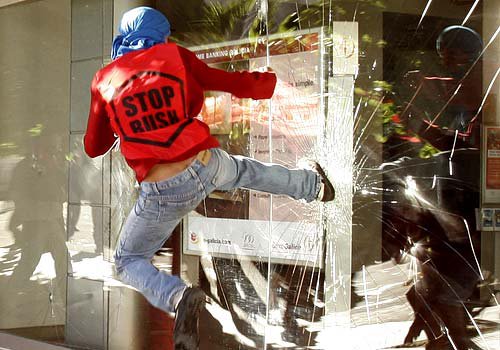
Earlier, the tone was struck by the former football star Diego Maradona, who wore a "Stop Bush" T-shirt to an anti-Bush "counter-summit" that drew some 4,000 protesters from around the world and easily eclipsed the official summit in the public's attention. "I'm proud as an Argentine to repudiate the presence of this human trash, George Bush," said Maradona.

Maradona's anti-Bush sentiment was replicated across a country driven to a near standstill by tens of thousands of people angry at the Iraq war and the US president's push for a region-wide free trade deal. Hospital and subway workers went on strike in Buenos Aires.

The latest popularity poll was published after Lewis "Scooter" Libby became the first White House aide for 130 years to be indicted in office. He appeared in court on Thursday to plead not guilty to five charges of lying to investigators.

At its core, the case concerns the evidence of Iraq's weapons of mass destruction assembled by Mr Libby - at the time the vice-president's chief of staff - and other White House officials to justify the war in Iraq. The president's top political adviser, Karl Rove, is still under investigation for his role in the case, which has refocused attention on the WMD debacle.

According to yesterday's poll, 55% of Americans think the president "intentionally misled the American public" in making the case for war, and 60% now believe it was not worth fighting. Yesterday, Mr Bush was asked whether Mr Rove would keep his job. He refused to discuss the issue on the grounds that the investigation was ongoing.

"I understand the preoccupation with polls," he said. "The way you build credibility with the American people is to set a clear agenda ... and get the job done. And the agenda I am working now is important to the American people."

He pointed to the growth of the US economy, but the poll suggested he was facing scepticism there too. Despite a 3.8% growth rate over the past three months, nearly two-thirds of respondents believed the economy was performing poorly.

Mr Bush is hoping to revive a plan for free trade across the Americas. Yet his economic ideas find few fans in South America, where growing poverty and unemployment are blamed squarely on the free trade policies applied during the past 15 years by regional governments under pressure from the US and the International Monetary Fund.

"We are marching against the creation of a free trade region in the Americas, against the repayment of the foreign debt and against the militarisation of Latin America," said the Argentinian economist Julio Gambina as he arrived with the marchers at the Mar del Plata sports stadium, where Venezuela's president, Hugo Chávez, addressed the "counter-summit". Mr Chávez, possibly Mr Bush's most vociferous detractor in the western hemisphere, left the American president in no doubt about the opposition to his free trade pact, saying: "Every one of us has brought an a shovel, an undertaker's shovel, because here in Mar del Plata is the tomb of [the pact]."

The 15,000-strong crowd broke out in a roar as Maradona, riding high on his rebirth as Argentina's leading television personality with his own weekly talkshow, embraced Mr Chávez at the microphone and roared: "Argentina has its dignity! Let's throw Bush out of here!".

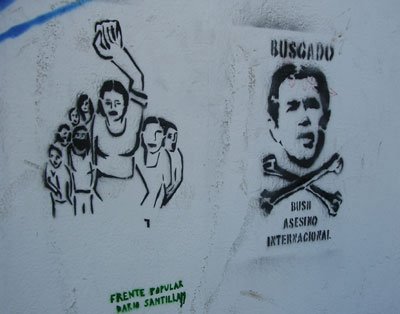
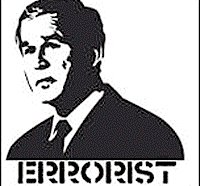
AntiBush image from Argentina

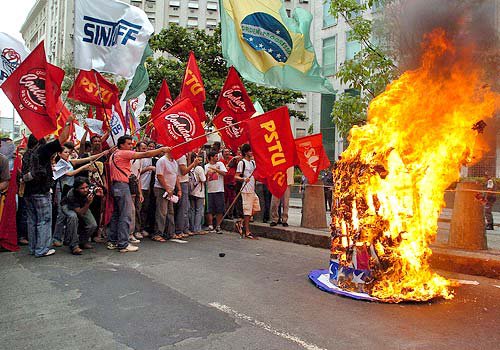
AntiBush images from Brasil


Bush represents the Jackals & Assessinos

Argentina Centro de Medios Independientes (( i ))
Original article http://argentina.indymedia.org/news/2005/11/344029.php

Bush represents the Jackals & Assessinos
Por Henk Ruyssenaars - Friday, Nov. 04, 2005 at 10:04 AM
fpf@chello.nl (Casilla de correo válida)

The US/IMF's 'free trade': "When the economic 'hit men' fail in this scenario, the next step is what we call 'the jackals'. Jackals are C.I.A-sanctioned people that come in and try to foment a coup or revolution. If that doesn't work, they perform assassinations, or try to."

IT IS BETTER TO DIE STANDING ON YOUR FEET, THAN TO LIVE IN NEOCON SLAVERY ON YOUR KNEES.

Henk Ruyssenaars - former Latin America correspondent

FPF - Nov. 4th - 2005 - A troubled President George Bush II is at the Summit of the Americas in Argentine, where representatives of more than 30 nations now are gathering in Mar del Plata. Bush's 'minders' - his 'advisers' which also are represented by the malignant and murderous International Monetary Fund* (IMF) - want Bush to proceed with their FTAA plans, to - as usual one must say - further rob the money and resources in a by them proposed L-American 'free trade' area, that would include the countries in the Western Hemisphere except Castro's Cuba.

'US Free Trade' stands for 'rob'm blind' - blame them for being not able to see - and 'get away with anything'. George Bush II has acknowledged that the 'Free Trade Area of the Americas', once one of his highest trade priorities, is at an impasse, with the U.S. facing numerous and justified disagreements with South American countries. "The FTAA has stalled, I agree," Bush, throwing both arms in the air, said in response to a question in an interview with Latin American reporters last Tuesday, Nov. 1.

The problem is more how Bush and his racket can be 'stalled' and jailed as soon as is possible, before they accomplish their Apocalypse. Criminals like Bush and his ilk are only alive because they spend by us all paid tax-fortunes on an army of sometimes also uniformed hired killers, which are supposed to protect global villains like him. - [http://www.blackwaterusa.com/] - The mercenaries in Rumsfeld's SS [http://tinyurl.com/c645e] protect the 'Pol Pots' of our time, served by the 'banking establishment' via the US fake Federal Reserve [http://tinyurl.com/d3ntq] and their World Bank and the IMF with it's 'Jackals'.*

Bush and his delegation represent the absolute worst on the globe right now: the warmaking criminals who have tried to scavenge and wreck Argentina and the rest of Latin America and the world, by abusing their power and greedily treat it as an economic US-backyard. For them human beings, laws or international conventions do not count: they are lawless and ruthless, as was shown in Argentina too, and globally over and over again. - [http://tinyurl.com/2xz35]

IMF: MAR DEL PLATA - 'SEA OF GOLD' (MONEY)

Bush II and his 'advisers' are in many ways globally often responsible for those kind of all encompassing miseries, and they absolutely don't give a damn about whether you die or suffer enormously, as happened at that dark hour in Argentina's history: "Recently, Latin America has watched Argentina, the once heralded miracle of the liberal economic ideal, crash to economic depths that could not have been imagined even just a few years ago. Things are so bad that a recent reality-TV show has contestants competing for subsistence-level employment.

After watching the Argentinean economy crash and burn, Latin Americans have been searching for alternative models, and have looked toward a group of charismatic individuals with a decidedly leftist (? - HR) orientation." - [http://tinyurl.com/9wjjq]

A GOOD RELATIONSHIP: YOU ARE MY FRIEND, I KILL YOU FOR FREE

In a round-table interview with Latin American journalists this week, Bush described the trip as part of his effort "to have a good relationship in the neighborhood." He did not dispute a questioner's view that there was "growing anti-Americanism" in the region. And than followed the understatement of the year by the most despised creature on earth: "Look, I understand not everybody agrees with the decisions I've made, but that's not unique to Central or South America," Bush said, according to a transcript released Wednesday. "But that's what happens when you make decisions." [http://tinyurl.com/ddlpy]

BUSH'S GRINGO POINT OF VIEW

For once this professional liar was right when he said ''that's not unique to Central or South America'' because the whole thinking world disagrees with him. What from Bush's Gringo point of view is called "decisions" and "to have a good relationship in the neighborhood" - is in reality the abject abuse of a whole country and whole continents, to reconfigure the economy and energy needs of the worst administration ever on Earth: the present neocon junta's regime in the United States. And here's how those gringo vultures - which all and each one of them and whatever nationality, should have been in jail a long time ago - steal from and rape humanity and countries, as told by an insider who 'got to see the light': CIA JACKALS & WORLD BANK WOLFOWITZ - Thursday, March 17, 2005:

IMF banker: "When the economic 'hit men' fail in this scenario, the next step is what we call the jackals. 'Jackals' are C.I.A-sanctioned people that come in and try to foment a coup or revolution. If that doesn't work, they perform assassinations, or try to."

Confessions of an economic 'hit man' - Url.: http://tinyurl.com/aavfa

El artículo original está en Url.: http://tinyurl.com/aavfa

THEY MUST ABSOLUTELY BE STOPPED

Henk Ruyssenaars

FOOTNOTES/LINKS:

Because this will be very important for many to see and hear; please take one hour out of your life, and learn and get still better informed about the big lines - and huge lies - why things happen, and why your life looks the way it does in the neocon Matrix.

Why should there be more cash in your wallet? - See the 'Real Video' and transcript: they really are worth every minute of your time - Url.: http://www.informationclearinghouse.info/article8171.htm

* Canadian writer Paul Harris: ''The US a nation of peace lovers...?'' - Url.: http://tinyurl.com/9fxke

* MSNBC Poll: Ninety-four percent believes that George Bush and the neocon media mislead the nation to go to war with Iraq - Url.: http://www.msnbc.msn.com/id/8248969/

* TIME/Life poll: The Biggest Threat To Peace - Which country really poses the greatest danger to world peace in 2003? TIME asked for readers' views - Url.: http://tinyurl.com/4f34

* WASHINGTON, Oct. 13 /U.S. Newswire/ - According to the new NBC News/Wall Street Journal poll President Bush's national approval rating has declined to 39 (today 35) percent, the lowest level during his Presidency. And among African-Americans, Bush has only a 2 percent - Url.: http://tinyurl.com/b365o

* GULAG: Russian 1970 Nobel Prize winner Aleksandr Solzjenitsyn described the Soviet prison camp system in his best-selling book 'The Gulag Archipelago'. He has since 2000 been globally declared 'dead' by the people involved, when he published about 'the last taboo on Russia' - Url.: http://tinyurl.com/bkoz8

* Brainwashed? Take the free 'Gullibility Factor' test to find out if you're really a mind slave or not - Url.: http://tinyurl.com/cbgnc

* Corporate News Media: Incompetent, Criminally Negligent or Complicit? - Url.: http://tinyurl.com/cqpfe

* Good news source: VHeadline.com Venezuela - Url.: http://www.vheadline.com/main.asp

* CIA/NED covert operations in Venezuela - Url.: http://tinyurl.com/7drl5

FPF-COPYRIGHT NOTICE - In accordance with Title 17 U. S. C. Section 107 - any copyrighted work in this message is distributed by the Foreign Press Foundation under fair use, without profit or payment, to those who have expressed a prior interest in receiving the information. Url.: http://liimirror.warwick.ac.uk/uscode/17/107.html

FOREIGN PRESS FOUNDATION
http://tinyurl.com/b4x5x
Editor : Henk Ruyssenaars
http://tinyurl.com/amn3q
The Netherlands
FPF@Chello.nl

-0-


tinyurl.com/aavfa


© 2001-2005 Argentina Centro de Medios Independientes (( i )). Copyleft: Se permite la copia, distribución y uso de los contenidos de Indymedia Argentina, siempre y cuando NO se utilice con fines comerciales, a no ser que se obtenga permiso expreso del autor y en todos los casos se reconozca la autoría (poniendo como fuente http://argentina.indymedia.org ). Las opiniones vertidas por los visitantes o colaboradores en el sitio pueden no reflejar las ideas de Indymedia Argentina. Usamos software libre. sf-active v0.9.4 Descargo | Privacidad
Friday, November 04, 2005

Las guerras mienten por Eduardo Galeano

"-Pero el motivo... -indagó el señor Duval-. Un hombre no mata por nada. —¿El motivo? –contestó Ellery, encogiéndose de hombros–. Usted ya conoce el motivo." Ellery Queen. Aventuras en la Mansión de las Tinieblas. Las guerras dicen que ocurren por nobles razones: la seguridad internacional, la dignidad nacional, la democracia, la libertad, el orden, el mandato de la civilización o la voluntad de Dios. Ninguna tiene la honestidad de confesar: Yo mato para robar.

No menos de tres millones de civiles murieron en el Congo a lo largo de la guerra de cuatro años que está en suspenso desde fines de 2002.

Murieron por el coltan, pero ni ellos lo sabían. El coltan es un mineral raro, y su raro nombre designa la mezcla de dos raros minerales llamados columbita y tantalita. Poco o nada valía el coltan, hasta que se descubrió que era imprescindible para la fabricación de teléfonos celulares, naves espaciales, computadoras y misiles; y entonces pasó a ser más caro que el oro.

Casi todas las reservas conocidas de coltan están en las arenas del Congo. Hace más de cuarenta años, Patricio Lumumba fue sacrificado en un altar de oro y diamantes. Su país vuelve a matarlo cada día. El Congo, país pobrísimo, es riquísimo en minerales, y ese regalo de la naturaleza se sigue convirtiendo en maldición de la historia. Los africanos llaman al petróleo "mierda del Diablo". En 1978 se descubrió petróleo en el sur de Sudán. Siete años después, se sabe que las reservas llegan a más del doble, y la mayor cantidad yace al oeste del país, en la región de Darfur.

Allí ha ocurrido recientemente, y sigue ocurriendo, otra matanza. Muchos campesinos negros, dos millones según algunas estimaciones, han huido o han sucumbido, por bala, cuchillo o hambre, al paso de las milicias árabes que el gobierno respalda con tanques y helicópteros. Esta guerra se disfraza de conflicto étnico y religioso entre los pastores árabes, islámicos, y los labriegos negros, cristianos y animistas. Pero ocurre que las aldeas incendiadas y los cultivos arrasados estaban donde ahora empiezan a estar las torres petroleras que perforan la tierra.

La negación de la evidencia, injustamente atribuida a los borrachos, es la más notoria costumbre del presidente del planeta, que gracias a Dios no bebe una gota. Él sigue afirmando, un día sí y otro también, que su guerra de Irak no tiene nada que ver con el petróleo. "Nos han engañado ocultando información sistemáticamente", escribía desde Irak, allá por 1920, un tal Lawrence de Arabia: "El pueblo de Inglaterra ha sido llevado a Mesopotamia para caer en una trampa de la que será difícil salir con dignidad y con honor". Yo sé que la historia no se repite; pero a veces dudo. ¿Y la obsesión contra Chávez? ¿Nada tiene que ver con el petróleo de Venezuela esta frenética campaña que amenaza matar, en nombre de la democracia, al dictador que ha ganado nueve elecciones limpias?

Y los continuos gritos de alarma por el peligro nuclear iraní, ¿nada tienen que ver con el hecho de que Irán contenga una de las reservas de gas más ricas del mundo? Y si no, ¿cómo se explica eso del peligro nuclear? ¿Fue Irán el país que descargó las bombas nucleares sobre la población civil de Hiroshima y Nagasaki? La empresa Bechtel, con sede en California, había recibido en concesión, por 40 años, el agua de Cochabamba. Toda el agua, incluyendo el agua de las lluvias. No bien se instaló, triplicó las tarifas. Una pueblada estalló, y la empresa tuvo que irse de Bolivia. El presidente Bush se apiadó de la expulsada, y la consoló otorgándole el agua de Irak.

Muy generoso de su parte. Irak no sólo es digno de aniquilación por su fabulosa riqueza petrolera: este país, regado por el Tigris y el Éufrates, también merece lo peor porque es la más rica fuente de agua dulce de todo el Oriente Medio.

El mundo está sediento. Los venenos químicos pudren los ríos y las sequías los exterminan, la sociedad de consumo consume cada vez más agua, el agua es cada vez menos potable y cada vez más escasa. Todos lo dicen, todos lo saben: las guerras del petróleo serán, mañana, guerras del agua.

En realidad, las guerras del agua ya están ocurriendo. Son guerras de conquista, pero los invasores no echan bombas ni desembarcan tropas. Viajan vestidos de civil estos tecnócratas internacionales que someten a los países pobres a estado de sitio y exigen privatización o muerte. Sus armas, mortíferos instrumentos de extorsión y de castigo, no hacen bulto ni meten ruido.

El Banco Mundial y el Fondo Monetario Internacional, dos dientes de la misma pinza, impusieron, en estos últimos años, la privatización del agua en 16 países pobres. Entre ellos, algunos de los más pobres del mundo, como Benín, Níger, Mozambique, Ruanda, Yemen, Tanzania, Camerún, Honduras, Nicaragua… El argumento era irrefutable: o entregan el agua o no habrá clemencia con la deuda ni préstamos nuevos.

Los expertos también tuvieron la paciencia de explicar que no hacían eso por desmantelar soberanías, sino por ayudar a la modernización de los países hundidos en el atraso por la ineficiencia del Estado. Y si las cuentas del agua privatizada resultaban impagables para la mayoría de la población, tanto mejor: a ver si así se despertaba por fin su dormida voluntad de trabajo y de superación personal. En la democracia, ¿quién manda? ¿Los funcionarios internacionales de las altas finanzas, votados por nadie? A fines de octubre del año pasado, un plebiscito decidió el destino del agua en Uruguay. La gran mayoría de la población votó, por abrumadora mayoría, confirmando que el agua es un servicio público y un derecho de todos.

Fue una victoria de la democracia contra la tradición de impotencia, que nos enseña que somos incapaces de gestionar el agua ni nada; y contra la mala fama de la propiedad pública, desprestigiada por los políticos que la han usado y maltratado como si lo que es de todos fuera de nadie.

El plebiscito de Uruguay no tuvo ninguna repercusión internacional. Los grandes medios de comunicación no se enteraron de esta batalla de la guerra del agua, perdida por los que siempre ganan; y el ejemplo no contagió a ningún país del mundo. Éste fue el primer plebiscito del agua y hasta ahora, que se sepa, fue también el último.n

Eduardo Galeano
Periodista y escritor uruguayo, autor de Las Venas Abiertas de América Latina, La canción de nosotros, Días y noches de amor y de guerra, Las palabras andantes, El libro de los abrazos, entre otros.

Silvio Rodríguez: "Uno abre un periódico un día, escribe algo indignado, y termina al frente de una manifestación"

Las canciones lo van transformando a uno, incluso lo van metiendo en líos. Uno abre un periódico, escribe algo indignado y luego termina al frente de una manifestación”. Así comentó el cantautor cubano Silvio Rodríguez el ambiente previo a la gran Marcha por la Dignidad Latinoamericana de repudio contra Bush prevista para mañana a las siete de la mañana en Mar del Plata.

Estas declaraciones las realizó en el marco de un encuentro sobre la función de la canción y el compromiso que se desarrollo en la carpa del ALBA en el marco de la Cumbre de los Pueblos. Junto a Silvio Rodríguez participaron cantautores de varios países latinoamericanos que respondieron a numerosas preguntas de los cientos de personas que participaban en la Cumbre de los Pueblos.

El trovador cubano recordó su compromiso con esta Marcha, “no como artista, sino como ser cívico, como terrícola, me opongo a esos ladrones y asesinos a costa de la oprobio de otros seres humanos, de su educación, de su alimentación. A todos esos responsables les quiero decir que estaré en la Marcha como terrícola, no como artista”. Silvio Rodríguez se dirigió a Bush como “un loco que invade, mata, roba el petróleo y quiere darnos lecciones de justicia y hasta quiere que lloremos sus muertos”.

El cantautor habló de la música respondiendo, al igual que el resto de los artistas, a la pregunta con la que se inició la charla: “¿Para qué sirve hoy la canción?”. Según Silvio, debajo de esa pregunta y de sus posibles respuestas “subyace algo interesante de lo que se habla poco: la canción como escuela”. “Porque uno –continuó-, cuando empieza a cantar no imagina que se va a enfrentar algún día a grandes públicos y que va a ser aclamado por hacer lo que le gusta. Cuando uno hace lo que quiere y se pone en contacto con los demás, se transforma en algo que no es lo que hizo, sino lo que hacen los demás junto con uno”.

Silvio Rodríguez, franqueado por dos grandes imágenes de Martí y Bolivar, también habló de Cuba: “Soy de un país que lleva medio siglo bloqueado de la forma más brutal y por el imperio más grande con el objetivo de desacreditar su revolución y calumniarla”.

En cuanto al momento que atraviesa América Latina, afirmó que “estamos en la búsqueda del sueño de Martí y Bolívar. Este es uno de los momentos históricos que, espero, ayude a hacer posible ese sueño americano”.

Durante el acto los cantautores respondieron a numerosas preguntas del público, alguna de ellas hizo referencia al papel de las organizaciones no gubernamentales en la lucha contra la pobreza. Sobre ello, Silvio Rodríguez puntualizó que “el hecho de que sean las ONG´s las que estén luchando contra la pobreza, no hace preguntarnos qué están haciendo los gobiernos”.

Como ya se anunció anteriormente, Silvio Rodríguez actuará junto a otros cantautores como el uruguayo Daniel Viglietti, el chileno Francisco Villa, los cubanos Vicente Feliu y Amaury Pérez y el argentino Raly Barrionuevo; en el multitudinario acto final del Estado Mundialista de Mar del Plata tras la Marcha de repudio a Bush. Este acto será clausurado con la intervención del presidente venezolano Hugo Chávez.

www.marchacontrabush.com
www.cumbredelospueblos.org

Fox's "México Seguro" Anti-Drug Operation Being Used to Shield Dirty-War Criminals

The World Socialist Wed Site has a very interesting article this week on the Mexican government’s continued efforts to cover up its crimes against the student movement in the late 1960's and seventies. Two of the seminal events in the history of Mexican social movements were the massacres of student demonstrators at Tlatelolco in 1968, by the Mexican army, and San Cosme (both areas of Mexico City) in 1971, by government-backed "Falcon" paramilitaries. And one of the major reasons both Mexicans and the international community hailed President Vicente Fox’s 2000 electoral victory - the first break in a 70-year reign by the Institutional Revolutionary Party - was the supposed end it would bring to that party’s historic crushing of dissent and impunity for political crimes. As this article shows, Fox's efforts to clean up the government's record and hold the responsible accountable have hardly been sincere.

But of special interest, I think, to us and our readers is a revelation made in an accompanying interview with economist and Committee of 68 member Alejandro Alvarez, who shows how the drug war is used to shield states from scrutiny over these kinds of issues. Read on for an excerpt...

RA: What is the international context of this whitewash?

AA: The Fox government is colluding with US security agencies. At the same time that it turns its back on international treaties and agreements on genocide and human rights, it wants to enforce security arrangements with the US that violate the Mexican constitution. When Fox met with Bush in Waco, Texas in March of this year he agreed to a scheme called México Seguro [Secure Mexico], which is just another way of trampling on human rights using organized crime and drug trafficking as an excuse for police-military occupations and repression. Some of those in the army that now lead these operations also participated in the dirty war. The army is being shielded from responsibility for the massacres and repression of the 1960s and 1970s in part because of its current role. The argument currently in vogue is that the armed forces are blameless for the killings and disappearances because they were following orders from elected officials.

Read the full interview here.

3rd Summit of the Peoples of America - Mass continental protest march against Bush

MAR DEL PLATA, Argentina.—The chief of the White House, W. Bush, is about to receive a clear signal of continental rejection generated by his neofascist policies, when tens of thousands of people march through the streets of this city at the end of the sessions of the 3rd Summit of the Peoples, attended by more than 600 organizations and social movements of the region.

The final objectives of the march, ratified yesterday in a press conference by Nobel Peace Prize winner Adolfo Pérez Esquivel, one of the organizers of the event whose debates focused on alternatives in the face of capitalism, are to express a round NO to Bush and the imperialist FTAA project (Free Trade Area of the Americas).

The outstanding human rights defender also assured that if there would be support mobilizations in many parts of Argentina.

The Continental Mobilization Event: No to Bush! Another America is possible! (the name given to the march) is also a demonstration of support on the streets of Mar del Plata for the Bolivarian Revolution and its leader, Venezuelan President Hugo Chávez, who is to take part in the protest and is to speak in a mass meeting in the World Stadium, where later on, eminent singer-songwriters like Silvio Rodríguez, Amaury Pérez, Daneil Viglietti, Rally Barrionuevo and Panco Villa, and others, are to raise their voices.

Those attending the demonstration include Pibe de Oro and Diego Armando Maradona, who have reiterated their wish that Argentines deliver an unequivocal message: "Goerge Bush is persona non grata for our peoples!"

From dawn Argentine Channel 23 has been transmitting live the arrival of Maradona, Evo Morales, Miguel Bonaso and other outstanding participants in the Summit at the railroad terminal in Buenos Aires to take the train which will bring them here. Maradona said that he was hoping for a peaceful march, without violence, which would demonstrate to Bush "how much damage he has done to us." Replying to journalists he affirmed: "I love Fidel very much, with all my heart."

The 300-plus Cuban delegates to the 3rd Summit will be on the march in tight ranks alongside their brothers and sisters from the region, moreover defending the America’s right to its much-needed integration, already proposed in the Bolivarian Alternative for the Americas (ALBA).

Until late last night the artist members of the Cuban delegation were preparing large banners: one of them with the face of Che accompanied by the flags of the continent.

The demonstrators are to walk almost 30 blocks of the Independence Avenue, from the intersection with Luro Street to the World Stadium. The people who have been meeting over these days in the city, 400 kilometers from Buenos Aires, are to be joined by almost 1,000 more leaving the capital at 6:00 a.m. on the so-called ALBA Train.

ALARCON SPEAKS

Ricardo Alarcón, president of the Cuban National Assembly, who is heading the island delegation, affirmed that what has been happening in the last few days is the real Summit of the Americas, because it is a people’s one; he stressed that the FTAA is moribund and thanked Adolfo Esquivel Pérez for his efforts in developing the event.

Addressing thousands of people attending the Assembly of the Peoples of America in the Polivalente Stadium, Alarcón commented that this Friday’s anti-Bush march will be orderly, disciplined, peaceful and civilized, which is the way of the peoples. War, violence and irrationality, he said, "belong to Bush, not us." He also spoke of the struggle of our people for the liberation of the Five, criticized the bellicose policy of the White House and called on Latin Americans to continue united for their genuine and essential independence.

Mar del Plata teme y rechaza a Mr. Danger

El sentimiento más expresado por el marplatense común es el temor, el miedo, en cualquiera de sus manifestaciones. Por suerte, para la mayoría de estos apacibles ciudadanos acostumbrados a la vida turística de este frió puerto ubicado a 400 Km de la Capital, el miedo tiene un solo culpable: George W. Bush. Y mejor aún: la gente lo ha convertido en una sola actitud: rechazo a él.


Esta sana reacción social es comprensible cuando se vive la sensación de estar en una ciudad sitiada con una cabeza de playa internacional y una vigilancia policial como si hubiera estado de sitio. Ocurre, a pesar del cuidado que pusieron en guardar las apariencias en una ciudad cuyo mayor capital es, precisamente, su apariencia.


Es como los tranquilos habitantes entendieran que si no fuera por la anunciada presencia del presidente estadounidense, Mar del Plata viviría las delicias del mensaje del afiche que hizo imprimir la Municipalidad: “Mar del Plata Ciudad Cumbre”.


Cualquier ciudadano en la calle, en los bares o restaurantes, autobuses, en los pintorescos quioscos de esquina o en los ciber-cafés, cualquiera dice frases como estas que pudimos registrar:


“El problema no son los presidentes, es el presidente Bush que trae los peligros del terrorismo”


“Si no fuera por la presencia de Bush nuestra ciudad seria una fiesta”


“Dicen que puede haber problemas porque viene el presidente de los Estados Unidos”


“Si no fuera por este hijo de puta, no vendrían los piqueteros y los violentos a jodernos la ciudad”


“¿No podrían hacer la cumbre esta sin Bush?”

“Menos mal que vienen Chávez y Maradona así Bush respeta un poco”


Botica ideológica


Como es normal, la gente expresa a través del sentimiento contra el presidente Bush todas sus concepciones, creencias políticas, posiciones sociales, intereses particulares, ilusiones y confusiones a partir de realidades particulares. Vericuetos ideológicos donde la bueno y lo malo se mezclan tal como están mezclados en la realidad gris de sus existencias. Sin embargo, en medio de la madeja ideológica se percibe la identificación de Bush con imágenes como “Torres gemelas”, “Irak”, “terrorismo”, “odio a Chávez” y cosas parecidas.


Uno de los signos más llamativos lo encontramos en los taxistas de la ciudad. Si se hiciera un relevamiento de sus opiniones, posiblemente más del 90 por ciento estaría contra la presencia del fulano yanqui en Mar del Plata. Esto es mucho pedirle a un sector social caracterizado por sus opiniones políticas conservadoras.


Para algunos observadores, este sentimiento tan marcado entre los habitantes anfitriones, nutrirá de muchísima gente la marcha que encabezaran Maradona y las decenas de organizaciones que convocan a la manifestación del viernes. Sin embargo, puede ocurrir lo contrario. Lo que dicen que piensan hacer varios vecinos a los que escuchamos expresiones, es que se guardarán en sus casas con sus familiares “y veremos todo por la tele porque no se sabe que puede pasar”. Ahí esta el secreto.

Zona de exclusión


La vaina (hecho) que más ofende y produce rechazo a Bush entre los marplatenses, es el vallado metálico pertrechado con unos 200 policías bien armados y dispuestos a reprimir, que cubren las 32 bocacalles entre las 61 manzanas convertidas en línea de separación entre lo seguro y lo inseguro. Allí nace la “zona de exclusión” donde permanecerán los presidentes, sus comitivas y la diplomacia de la OEA y los embajadores.

La curiosidad del caso es que la gente de Mar del Plata ha convertido lo seguro en inseguro y viceversa. Las 250 manzanas resguardadas son, para ellos, las más inseguras de la ciudad. Un aporte de la dialéctica de la actual de la lucha política mundial. Todo lo que toque Bush se convierte en riesgo.


La línea quebrada de 62 manzanas que divide la ciudad en dos, se alarga en forma de “L” contra una franja de casi 250 manzanas que se recuestan a la playa de Mar del Plata. Vista en un mapa parece una cabecera de playa en una historia de guerra. Esta “zona de exclusión” está ocupada por fuerzas militares y policiales al mando de un comando unificado donde es visible la presencia del aparato de inteligencia de Estados Unidos.

En esa “zona” ocupada habitan unas 15.000 personas, trabajan otras 3.000 y se concentran los negocios gastronomitos, inmobiliarios, culturales y hoteleros más caros de la ciudad.


Casi 10.000 personas se fueron a zonas vecinas o a casas de familiares en otros barrios. Se fueron por temor. ¿A que? A cualquier cosa de las que simboliza la próxima presencia de Bush, y cada cosa esta relacionada en el imaginario popular con el terror, la guerra, la agresión imperial, aunque no usen esas palabras.


Bien que le viene al presidente estadounidense, el epíteto puesto por el presidente venezolano, Hugo Chávez, en unas de sus salidas graciosas cargadas de anti imperialismo: Hello Mr. Danger. Los marplatenses lo entendieron correctamente.

Cúpula dos Povos começa em Mar de Plata, uma cidade sitiada


Apesar da segurança para os 34 presidentes que participam da Cúpula das Américas, que ocorre dias 4 e 5 em Mar del Plata, 500 organizações sociais mantêm agenda da Cúpula dos Povos contra Bush, que inclui Alca, militarização e OMC. Protestos devem ter presença de Chávez, Maradona e Cindy Sheehan.

A pequena cidade de Mar del Plata, principal destino dos turistas de Buenos Aires no verão, conhecida por suas belas praias, suntuosos cassinos e por ser sede da mais famosa marca argentina de alfajores, a Hawana, está um caos. Escolhida como sede da IV Cúpula das Américas, que reúne, nos próximos dias 4 e 5, 34 presidentes dos continentes americanos, nas últimas semanas virou uma cidade sitiada.

A área onde ocorrem as reuniões presidenciais – cerca de 250 quadras – foi cercada por grades, ninguém entra sem uma credencial especial, incluindo os jornalistas. Cerca de 7 mil agentes federais e da polícia militar argentinos, além de dois mil especialistas em segurança dos serviços secretos americanos, estão postados por todos os lados, nas ruas, nos topos dos prédios, nas praças; helicópteros americanos fazem contínuos sobrevôos da cidade, e, "estacionados" nos aeroportos de Buenos Aires e Mar del Plata, a força aérea americana mantém pelo menos sete de aviões de guerra C-17.

Em Mar del Plata, está tudo pronto para receber chefes de Estado como Owen S. Arthur, de Barbados, ou Baldwin Spencer, de Antigua e Barbuda. E obviamente George W. Bush, dos EUA.

Do outro lado da cidade, distante do mar e dos cassinos, George Bush também tem sido o centro das atenções. Mais de 500 organizações sociais de grande parte dos países americanos iniciam nesta terça (1º) a Cúpula dos Povos, organizada pela Aliança Social Continental (rede de mais de 500 entidades e movimentos da região que lutam contra a Área de Livre Comércio das Américas (Alca), os Tratados de Livre Comércio bi e multilaterais (TLCs) e a militarização estadunidense na América Latina).

A pauta, que deve aprofundar as articulações contra a Alca e os TLCs, pretende definir estratégias de luta pela revisão e o não pagamento das dívidas externas dos países em desenvolvimento e organizar a oposição e as ações dos movimentos sociais para a próxima reunião ministerial da Organização Mundial do Comércio (que ocorrerá em dezembro em Hong Kong). Fóruns setoriais de mulheres, sindicalistas, indígenas, defensores dos direitos humanos, entre outros, também preparam uma grande marcha contra a presença de Bush na Argentina no dia 4.

Manifestação contra Bush

A marcha deve contar com "estrelas" como o ex-jogador Diego Maradona e será encerrada com uma fala do presidente venezuelano Hugo Chávez no conjunto poliesportivo de Mar del Plata e com shows de grandes nomes da música latina, como Silvio Rodríguez, Víctor Heredia e León Gieco. Antes de Chávez, farão uso da palavra a americana Cindy Sheehan, mãe de um soldado de 24 anos morto no Iraque e que se tornou o principal símbolo da oposição à guerra de Bush dentro dos EUA; Ramsey Clark, que liderou a luta contra a guerra de Vietnã na década de 60, e Javier Couso, irmão do jornalista espanhol assassinado em Bagdá em 2003 pelas tropas norte-americanas que bombardearam o hotel Palestine.

Segundo avaliação preliminar dos organizadores, o protesto deve reunir cerca de 50 mil ativistas. O jornal Pagina 12 informou que Maradona, o deputado Miguel Bonasso e o cineasta bósnio Emir Kusturica, além de "outras 150 personalidades", virão de trem. Outra caravana de cerca de mil ônibus trará dirigentes sociais e políticos de vários partidos, que se juntarão aos participantes da Cúpula dos Povos.

Construir alternativas é o principal desafio da III Cúpula dos Povos


“Estamos aqui não somente para resistir ou rechaçar as políticas neoliberais. Nosso desafio E construir alternativas a elas”.
Com essa afirmação, Juan González, da Central de Trabalhadores Argentinos (CTA) sintetizou, na tarde de hoje, o principal objetivo da III Cúpula dos Povos, que acontece de 1 a 5 de novembro em Mar del Plata, na Argentina.

Juán ressaltou que a construção de alternativas deve se dar nos quatro eixos de luta defendidos pela Aliança Continental Internacional: contra a militarização, contra os tratados de livre comércio e a favor da autoderminação dos povos, contra a pobreza e a favor de uma outra economia de inserção e crescimento das comunidades. O sindicalista também salientou a importancia de repudiar a presença do presidente dos Estados Unidos George W. Bush, que representa a intenção de dominar e de tornar os povos americanos dependentes.

Adolfo Pérez Esquivel, Prêmio Nobel da Paz e um coordenadores da Cúpula dos Povos, destacou o encontro como um espaço de construção do pensamento de liberdade e de determinação própria da comunidade americana, em contraposição ao pensamento único difundido pelos países dominantes. Esquivel apontou como funções do encontro rechaçar o desaparecimento dos camponeses e das pequenas indústrias nacionais, a militarização e o ingresso de tropas norte-americanas no Paraguai. “Nosso povo não precisa de mais exércitos, ainda mais dos Estados Unidos. Ele precisa de recursos para a saúde, para combater a pobreza. Precisamos de ações para a vida e não para a morte”, falou. O prêmio Nobel ainda destacou a conquista mais recente dos povos americanos, que foi a erradicação do analfabetismo na Venezuela.

Durante a conferência, duas presenças se destacaram: Blanca Chancoso, representante da Confederação da Nacionalidade Indígena do Equador (CONAIE), e Camille Chalmers, do Haiti. Blanca disse que os povos indígenas vieram ao encontro para lutar pelo fim do terrorismo norte- americano de Bush, que “invade e mata os povos americanos”. Já Camille falou da dívida externa dos povos americanos, salientando que são um meio dos países mais ricos controlarem os mais pobres. Ele também comentou sobre a situação haitiana, afirmando que estava na Cúpula para denunciar a presença das tropas estrangeiras no território e a atual conjuntura de miséria do país. “A pobreza que estamos vivendo hoje é produto dos 500 anos de saque e de colonização e das políticas governamentais de liberação dos nossos recursos”, argumentou.

Photos from Mar del Plata


Anti Bush images from Mar del Plata


Latin America prepares to 'say no to Bush'

United States President George Bush left his problems at home on Thursday only to find himself flying into a whole new world of hurt at the Summit of Americas in Argentina, where tens of thousands of protesters, led by the football star and broadcaster Diego Maradona, were due to greet the president in a "say no to Bush" march.

The president can expect an equally unfriendly welcome from some of the leaders and top officials attending the summit in the seaside town of Mar del Plata. Among those he can expect to come face to face with is Hugo Chávez, the outspoken President of Venezuela who has accused the Bush administration of attempting to orchestrate a coup against him and last week said the US was planning to invade his country.

About 10 000 police and security agents have erected a ring of steel around the town, while Argentinian navy vessels have been positioned off the coast. Most commercial flights are due to be suspended once the 34-nation summit begins. But with so many protesters in the area, there are fears that trouble could break out.

Last weekend, small bombs were thrown at several American bank branches and chain-store branches. Maradona has urged viewers of his popular television show to join him in a protest outside the meeting. Argentina's piquetero movement -- made up of protesters known for blocking roads and confronting authorities -- has promised to descend on the resort in force.

Cuba, the only country in the hemisphere not invited to the summit hosted by the Organisation of American States, will be attending a People's Summit in Mar del Plata set up by left-wing groups to counter the official version. Family members of fallen US soldiers in Iraq as well as Iraqi civilians who have suffered at the hands of US troops will also be there.

Chávez, an important ally of Cuba's President Fidel Castro, is due to visit the People's Summit on Friday and give a speech at a basketball stadium timed to coincide with the start of the Summit of Americas.

Before flying there, he said Venezuela would object to any attempt by the US to revive proposals for the creation of Free Trade Area of the Americas (FTAA), which would overtake the European Union as the world's largest tariff-free zone.

Bush has been a forceful proponent of the idea, but talks have repeatedly stalled, with opponents fearful it would allow corporations to dominate the poor.

"They aren't going to revive it, even if they produce a 10 000-page document," Chávez told the Caracas-based TV channel Telesur.

"Latin America remains the region of most inequalities in the world," Cuban Foreign Minister Felipe Perez Roque told The Associated Press (AP). "The FTAA is just more of the same neo-liberal policies."

On Thursday, government officials at the summit site were still bickering over whether the event's final declaration would include crucial language on when high-level FTAA talks might resume.

Victor Hugo Varsky, an Argentinian representative, said negotiators were advancing very slowly.

"Some countries don't want any mention," he told AP. "Others want to progress towards a trade accord." -- Guardian Unlimited © Guardian Newspapers Limited 2005