THE US military is conducting a propaganda campaign to magnify the role of the leader of al-Qaeda in Iraq, according to internal military documents and officers familiar with the program.
The effort has raised his profile in a way that some military intelligence officials believe may have overstated his importance and helped the Bush Administration tie the war to the organisation responsible for the September 11 terrorist attacks.
The documents say that the US campaign aims to turn Iraqis against Abu Musab al-Zarqawi, a Jordanian, by playing on their perceived dislike of foreigners. US authorities claim some success with the effort, noting that some tribal Iraqi insurgents have attacked Zarqawi loyalists.
For the past two years US military leaders have been using Iraqi media and other outlets in Baghdad to publicise Zarqawi's role in the insurgency. The documents explicitly list the "US home audience" as a target of a broader propaganda campaign.
Some senior intelligence officers believe Zarqawi's role might have been overemphasised by the propaganda campaign, which has included leaflets, radio and television broadcasts, internet postings and at least one leak to an American journalist.
Although Zarqawi and other foreign insurgents in Iraq have conducted deadly bombing attacks, they remain "a very small part of the actual numbers", Colonel Derek Harvey, who served as a military intelligence officer in Iraq, told an army meeting in Kansas last year.
In a transcript of the meeting, Colonel Harvey said, "Our own focus on al-Zarqawi has enlarged his caricature, if you will - made him more important than he really is, in some ways."
There has been a running argument among specialists in Iraq about how much significance to assign to Zarqawi, who spent seven years in prison in Jordan for attempting to overthrow the government there. After his release he spent time in Pakistan and Afghanistan before moving his base of operations to Iraq. He has been sentenced to death in his absence for planning the assassination of a US diplomat, Lawrence Foley, in Jordan in 2002. US authorities have said he is responsible for dozens of deaths in Iraq and have placed a $US25 million ($34 million) bounty on him.
The military's propaganda program has largely been aimed at Iraqis, but seems to have spilled over into the US media. One "selective leak" about Zarqawi was made to Dexter Filkins, a New York Times reporter based in Baghdad. Filkins's resulting article, about a letter supposedly written by Zarqawi and boasting of suicide attacks in Iraq, ran on the Times front page in February, 2004. The report also ran in The Sydney Morning Herald.
Filkins said he was not told there was a psychological operations campaign aimed at Zarqawi, but he assumed the military was releasing the letter "because it had decided it was in its best interest to have it publicised".
He said he was sceptical about the document's authenticity then, and remains so now.
"There was no attempt to manipulate the press," Brigadier General Mark Kimmitt, the US military's chief spokesman when the propaganda campaign began in 2004, said on Friday.
Officials said one indication that the campaign worked was that over the past several months there had been reports of Iraqi tribal insurgents attacking Zarqawi loyalists, especially in the culturally conservative province of Anbar.
"What we're finding is indeed the people of al-Anbar - Falluja and Ramadi, specifically - have decided to turn against terrorists and foreign fighters," Major-General Rick Lynch, a US military spokesman in Baghdad, said in February.
Friday, June 09, 2006
The Timely Death of al-Zarqawi - Hubub in Hibhib By CHRIS FLOYD
Abu Musab Saddam Osama al-Zarqawi, the extremely elusive if not entirely mythical terrorist mastermind responsible for every single insurgent action in Iraq except for the ones caused by the red-tailed devils in Iran or the stripey-tailed devils in Syria, has reportedly been killed in an airstrike in Hibhib, an area north of Baghdad, Iraqi Prime Minister Nuri Kamal al-Maliki announced today.
Zarqawi, the notorious shape-shifter who, according to grainy video evidence, was able to regenerate lost limbs, speak in completely different accents, alter the contours of his bone structure and also suffered an unfortunate binge-and-purge weight problem which caused him to change sizes with almost every appearance, was head of an organization that quite fortuitously dubbed itself "Al Qaeda in Iraq" just around the time that the Bush Administration began changing its pretext for the conquest from "eliminating Iraq's [non-existent] weapons of mass destruction" to "fighting terrorists over there so we don't have to fight them over here."
The name change of the Zarqawi gang from its cumbersome original "The Monotheism and Holy War Group" to the more media-sexy "Qaeda" brand was thus a PR godsend for the Bush Administration, which was then able to associate the widespread native uprising against the Coalition occupation with the cave-dwelling dastards of the bin Laden organization. This proved an invaluable tool for the Pentagon's massive "psy-op" campaign against the American people, which was successful in sufficiently obscuring reality and defusing rising public concerns about what many experts have termed "the full-blown FUBAR" in Iraq until after the 2004 elections.
However, in the last year, even the reputed presence of a big stonking al Qaeda beheader guy roaming at will across the land has not prevented a catastrophic drop in support for President Bush in general and the war in Iraq in particular. Polls show that substantial majorities even those still psy-oped into believing the conquest has something to do with fighting terrorism are now saying that the war "is not worth it" and call for American forces to begin withdrawing.
With the Zarqawi theme thus producing diminishing returns, the Administration has had another stroke of unexpected luck with his reputed sudden demise. Moreover, the fact that Zarqawi was killed in a military action means that Mr. Bush will not have to cough up the $25 million reward placed on the head of the terrorist chieftain. That money will now be given to Mr. Bush's favorite charity, Upper-Class Twits Against the Inheritance Tax, an Administration spokesman said.
Despite its fortuitousness, the reputed death of the multi-legged brigand came as no real surprise. After all, approximately 376 of his "top lieutenants" had been killed or captured by Coalition forces in the past three years, according to press reports, and some 5,997 lower-ranking "al Qaeda terrorists" have been killed in innumerable operations during that same period, according to Pentagon press releases. With the widespread, on-going, much-publicized decimation of his group, Zarqawi had obviously been rendered isolated and ineffective except of course for the relentless series of high-profile terrorist spectaculars he kept carrying out, according to other Pentagon press releases.
News of the reputed rub-out brought bipartisan praise. "This enormous victory in the War on Terror is due entirely to the courage and wisdom of the president," squealed Senate Majority Leader Lick Spittle of Tennessee. "He has seen us through when so many of the flag-burning destroyers of marriage wanted to cut and run. I think this president is the best president the world has ever seen, and if I am ever fortunate enough to be chosen as president by the American people minus the three million or so whose votes will be discarded, lost, inadvertently mangled or just ignored, of course I promise I'll be a president just like him!"
"We must give credit where credit is due," said Democratic Sen. Joe Biden, in a rare television appearance. "I have my differences with the way the Administration is conducting this war, but the elimination of Zarqawi is, I believe, a turning point, comparable to the capture of Saddam Hussein, the first Iraqi elections, the second Iraqi elections, the formation of the first Iraqi government and the formation of the second Iraqi government. This is not the end, or even the beginning of the end, but it is, I believe, the end of the beginning. And no, I didn't plagiarize that. I made it up my own self."
The reputed end of Zarqawi's reign of terror comes a mere four years after U.S. forces had pinpointed his hideout and were prepared to destroy his entire operation, only to be forestalled by the White House. Before the war, Zarqawi and his band of non-Iraqi Islamic extremists had a camp in northern Iraq, in territory controlled by American-backed Kurdish forces, who had wrested it from the hands of Saddam Hussein. U.S. Special Forces, CIA agents and other American personnel had a free hand to operate there; indeed, anti-Saddam Iraqi exiles held open meetings in the territory, safe from the reach of the dictator.
In June 2002, American forces had locked in on Zarqawi's location. They prepared a detailed attack plan that would have destroyed the terrorist band. But their request to strike was turned down not once, but twice by the White House. Administration officials feared that such a strike would have muddied the waters in their public relations effort to foment war fever against Saddam's regime.
At every turn, the Bush team had painted a picture of Saddam Hussein as a powerful dictator able to threaten the entire world. They had implied, insinuated and sometimes openly declared that he was in league with al Qaeda. But this wildly successful psy-ops campaign would have been undermined by a raid on Zarqawi, which would have exposed the truth: that Saddam was a crippled, toothless despot who had lost control of much of his own land and couldn't even threaten vast enemy armies within his own borders much less his neighbors or the rest of the world. It would have also exposed the fact that the only Islamic terrorists operating on Iraqi soil were in areas controlled by America and its allies which, now that Mr. Bush's invasion has opened the whole country to extremist terror, is still the case.
With Zarqawi's Bush-granted liberty reputedly at an end, the Pentagon moved quickly to confirm the identity of the man killed in Hibhib today. At a joint press conference with Prime Minister Maliki, U.S. Gen. George Casey said Zarqawi's body had been identified by "fingerprints, facial recognition and known scars" after a painstaking forensic examination by Lt. Col. Gil Grissom and Major Catherine Willows.
In yet another amazing coincidence, the announcement of the death of Zarqawi or somebody just like him came just as Prime Minister Maliki was finally submitting his candidates for the long-disputed posts of defense and interior ministers, which then sailed through parliament after months of deadlock. The fortuitous death also came after perhaps the worst week of bad PR the Bush Administration has endured during the entire war, with an outpouring of stories alleging a number of horrific atrocities committed by U.S. troops in recent months.
Oddly enough, Zarqawi first vaulted into the American consciousness just after the public exposure of earlier U.S. atrocities: the tortures at Abu Ghraib prison in the spring of 2004. With story after story of horrible abuse battering the Administration during an election year, Zarqawi, or someone just like him, suddenly appeared with a Grand Guignol production: the beheading of American civilian Nick Berg. This atrocity was instantly seized upon by supporters of the war to justify the "intensive interrogation" of "terrorists" even though the Red Cross had determined that 70 to 90 percent of American captives at that time had committed no crime whatsoever, much less been involved in terrorism, as the notorious anti-war Wall Street Journal reported. Abu Ghraib largely faded from the public eye indeed, it was not mentioned by a single speaker at the Democratic National Convention a few weeks later or raised as an issue during the presidential campaign that year.
Today's news has likewise knocked the new atrocity allegations off the front pages, to be replaced with heartening stories of how, as the New York Times reports, Zarqawi's death "appears to mark a major watershed in the war." Thus in his reputed end as in his reputed beginning, the Scarlet Pimpernel of Iraq has, by remarkable coincidence, done yeoman service for the immediate publicity needs of his deadly enemy, the Bush Administration.
It is not yet known who will now take Zarqawi's place as the new all-purpose, all-powerful bogeyman solely responsible for every bad thing in Iraq. There were recent indications that Maliki himself was being measured for the post, after he publicly denounced American atrocities and the occupiers' propensity for hair-trigger killing of civilians, but he seems to be back with the program now. Administration insiders are reportedly divided over shifting the horns to Iranian President Mahmoud Ahmadinejad's already much-demonized head, or planting them on extremist Shiite cleric Muqtada al-Sadr, or elevating some hitherto unknown local talent or maybe just blaming the whole shebang on Fidel Castro, for old times' sake.
The announcement of the new bogeyman is expected sometime in the coming weeks.
***
UPDATE: It looks like the Twits might not get that reward money after all. Prime Minister Maliki said that those who helped locate Zarqawi, or someone just like him, in Hibhib, would get their reward later: "We believe in honoring our commitments." However, the (London) Times' man in Iraq, Ned Parker, tells us that Zazqawi might have been shopped to the Americans by Iraqi insurgents:
"One of the most interesting things about the news of his death is the timing. There have been talks going on since the election last December by US and Iraqi officials to try to bring the homegrown insurgency back into the political process. Certainly there was tension between the homegrown Iraqi insurgency and Zarqawi's foreign fighters. So it's possible a deal was finally cut by some branch of the Iraqi insurgency to eliminate al-Zarqawi and rid themselves of his heavy-handed influence."
So if Bush does decide to pay off the informants -- and it's his money, after all, not Maliki's; in fact, in today's Iraq, any money that Maliki's government might still have left after three years of occupation rapine is Bush's money too -- but if Zarqawi's rumblers are paid off, then it's likely that Bush will be forking over $25 million to Iraq's Sunni insurgents. That will certainly keep them flush with IEDs for a long time to come. It's FUBAR every which way you turn in Bush's Babylon.
Chris Floyd is an American journalist. He writes weekly column for The Moscow Times and is a regular contributor to CounterPunch. His blog, Empire Burlesque, can be found at www.chris-floyd.com.

Abu Musab al-Zarqawi: Dead Again
Let's see. Abu Musab al-Zarqawi, the phantom terrorist with super-human powers, was killed in the Sulaimaniyah mountains of northern Iraq, and then he was killed in the northern Iraqi city of Mosul, followed by a death during Operation Matador near the town of Qaim on the Syrian border, and finally he was killed, along with his mentor, Osama bin Laden, in the besieged city of Fallujah. Now we are told he was “killed in a U.S. air raid north of Baghdad [in the town of Hibhib near Baquba],” according to Iraqi Prime Minister Nuri al-Maliki, Reuters reports.
Read the full post
Killing al-Zarqawi: End of a Pentagon-Dairat al-Mukhabarat Collaboration?
Wayne Madsen writes:
The U.S. military spokesman’s revelation that Zarqawi’s body was partly identified from tattoos is noteworthy. Abu Abdel-Rahman al-Iraqi, described as the Deputy Emir of Al Qaeda in Iraq on an Al Qaeda web site, stated that Zarqawi was a martyred mujahed sheikh. Zarqawi was a lieutenant of strict Wahhabi Islam adherent Osama Bin Laden. However, why Zarqawi would have had tattoos is baffling. Islam specifically forbids tattoos. According to Islamic texts, the Prophet Mohammed forbade tattooing...
Read the full post
UNREPORTED: THE ZARQAWI INVITATION by Greg Palast
They got him -- the big, bad, beheading berserker in Iraq. But, something's gone unreported in all the glee over getting Zarqawi ... who invited him into Iraq in the first place?
If you prefer your fairy tales unsoiled by facts, read no further. If you want the uncomfortable truth, begin with this: A phone call to Baghdad to Saddam's Palace on the night of April 21, 2003. It was Secretary of Defense Donald Rumsfeld on a secure line from Washington to General Jay Garner.
The General had arrives in Baghdad just hours before to take charge of the newly occupied nation. The message from Rumsfeld was not a heartwarming welcome. Rummy told Garner, Don't unpack, Jack -- you're fired.
What had Garner done? The many-starred general had been sent by the President himself to take charge of a deeply dangerous mission. Iraq was tense but relatively peaceful. Garner's job was to keep the peace and bring democracy.
Unfortunately for the general, he took the President at his word. But the general was wrong. "Peace" and "Democracy" were the slogans.
"My preference," Garner told me in his understated manner, "was to put the Iraqis in charge as soon as we can and do it in some form of elections."
But elections were not in The Plan.
The Plan was a 101-page document to guide the long-term future of the land we'd just conquered. There was nothing in it about democracy or elections or safety. There was, rather, a detailed schedule for selling off "all [Iraq's] state assets" -- and Iraq, that's just about everything -- "especially," said The Plan, "the oil and supporting industries." Especially the oil.
There was more than oil to sell off. The Plan included the sale of Iraq's banks, and weirdly, changing it's copyright laws and other odd items that made the plan look less like a program for Iraq to get on its feet than a program for corporate looting of the nation's assets. (And indeed, we discovered at BBC, behind many of the odder elements -- copyright and tax code changes -- was the hand of lobbyist Jack Abramoff's associate Grover Norquist.)
But Garner didn't think much of The Plan, he told me when we met a year later in Washington. He had other things on his mind. "You prevent epidemics, you start the food distribution program to prevent famine."
Seizing title and ownership of Iraq's oil fields was not on Garner's must-do list. He let that be known to Washington. "I don't think [Iraqis] need to go by the U.S. plan, I think that what we need to do is set an Iraqi government that represents the freely elected will of the people." He added, "It's their country … their oil."
Apparently, the Secretary of Defense disagreed. So did lobbyist Norquist. And Garner incurred their fury by getting carried away with the "democracy" idea: he called for quick elections -- within 90 days of the taking of Baghdad.
But Garner's 90-days-to-elections commitment ran straight into the oil sell-off program. Annex D of the plan indicated that would take at least 270 days -- at least 9 months.
Worse, Garner was brokering a truce between Sunnis, Shias and Kurds. They were about to begin what Garner called a "Big Tent" meeting to hammer out the details and set the election date. He figured he had 90 days to get it done before the factions started slitting each other's throats.
But a quick election would mean the end of the state-asset sell-off plan: An Iraqi-controlled government would never go along with what would certainly amount to foreign corporations swallowing their entire economy. Especially the oil. Garner had spent years in Iraq, in charge of the Northern Kurdish zone and knew Iraqis well. He was certain that an asset-and-oil grab, "privatizations," would cause a sensitive population to take up the gun. "That's just one fight you don't want to take on right now."
But that's just the fight the neo-cons at Defense wanted. And in Rumsfeld's replacement for Garner, they had a man itching for the fight. Paul Bremer III had no experience on the ground in Iraq, but he had one unbeatable credential that Garner lacked: Bremer had served as Managing Director of Kissinger and Associates.
In April 2003, Bremer instituted democracy Bush style: he canceled elections and appointed the entire government himself. Two months later, Bremer ordered a halt to all municipal elections including the crucial vote to Shia seeking to select a mayor in the city of Najaf. The front-runner, moderate Shia Asad Sultan Abu Gilal warned, "If they don't give us freedom, what will we do? We have patience, but not for long." Local Shias formed the "Mahdi Army," and within a year, provoked by Bremer's shutting their paper, attacked and killed 21 U.S. soldiers.
The insurgency had begun. But Bremer's job was hardly over. There were Sunnis to go after. He issued "Order Number One: De-Ba'athification." In effect, this became "De-Sunni-fication."
Saddam's generals, mostly Sunnis, who had, we learned, secretly collaborated with the US invasion and now expected their reward found themselves hunted and arrested. Falah Aljibury, an Iraqi-born US resident who helped with the pre-invasion brokering, told me, "U.S. forces imprisoned all those we named as political leaders," who stopped Iraq's army from firing on U.S. troops.
Aljibury's main concern was that busting Iraqi collaborators and Ba'athist big shots was a gift "to the Wahabis," by which he meant the foreign insurgents, who now gained experienced military commanders, Sunnis, who now had no choice but to fight the US-installed regime or face arrest, ruin or death. They would soon link up with the Sunni-defending Wahabi, Abu Musab al-Zarqawi, who was committed to destroying "Shia snakes."
And the oil fields? It was, Aljibury noted, when word got out about the plans to sell off the oil fields (thanks to loose lips of the US-appointed oil minister) that pipelines began to blow. Although he had been at the center of planning for invasion, Aljibury now saw the greed-crazed grab for the oil fields as the fuel for a civil war that would rip his country to pieces:
"Insurgents," he said, "and those who wanted to destabilize a new Iraq have used this as means of saying, 'Look, you're losing your country. You’re losing your leadership. You're losing all of your resources to a bunch of wealthy people. A bunch of billionaires in the world want to take you over and make your life miserable.' And we saw an increase in the bombing of oil facilities, pipelines, of course, built on -- built on the premise that privatization [of oil] is coming."
General Garner, watching the insurgency unfold from the occupation authority's provocations, told me, in his understated manner, "I'm a believer that you don't want to end the day with more enemies than you started with."
But you can't have a war president without a war. And you can't have a war without enemies. "Bring 'em on," our Commander-in-Chief said. And Zarqawi answered the call.
**********
Greg Palast is the author of Armed Madhouse out this week from Penguin Dutton, from which this is adapted.
Armed Madhouse: Who's Afraid of Osama Wolf?, China Floats Bush Sinks, the Scheme to Steal '08, No Child's Behind Left and other Dispatches from the Front Lines of the Class War. Order it now.
Does Torture Matter to the US?
Go to Original
Caution
By Antoine de Gaudemar
Libération
Thursday 08 June 2006
While it contains a striking synthesis of known but difficult to prove information, the Council of Europe's report on the CIA's anti-terrorist activities assumes a particular symbolic importance. In the name of that struggle, many serious human rights breaches have been tolerated since September 11, of which the most flagrant are the existence of the Guantanamo camp, as well as the kidnappings and transfers of suspects by a sophisticated and clandestine system of special planes, compliant airports and "outsourced" prisons. A system that has long benefited from the more or less passive complicity of numerous European states and against which weigh the heavy accusations of torture. That Europe should finally officially react against this arbitrariness and abuse is a strong signal to the American government and public opinion. Even as US public opinion rises up against the Iraq war because it counts its death every day, it seems to close its eyes to the consequences of the war against terrorism in the matter of human rights. Since the cascade of revelations about this scandal, a slow dawning of awareness is taking place in the United States that strengthens the growing opposition to the Iraq war. The Dick Marty report also has the merit of forcing those European states that have been singled out to provide an explanation for their behavior as well as forcing the whole continent to denounce the illegal, but up to now tolerated, practices of the CIA. For such are the stakes: does the fight against terrorism justify the violation of the basis and the legitimacy of a state of laws? No, answers the Council of Europe, and the caution is salutary.
Go to Original
Practices That Matter Little in the United States
By Laurent Mauriac
Libération
Thursday 08 June 2006
Since September 11, 2001, human rights come after the country's security.
Several mentions on CNN yesterday morning, but to insist on the absence of "direct proof"; a dispatch from the Associated Press agency on the New York Times' site ... Yesterday's publication of the Council of Europe's report on the CIA's secret prisons aroused only a calculated treatment in the American media.
For Nancy Snow, a professor of communication at California State University, the media are in unison with the American population, which has not been characterized by a sustained interest in human rights since the September 11 attacks. "The polls and the research shows that those preoccupations take a back seat to questions of national security," she explains. "It's as though we had returned to the Cold War period, and that risks lasting for years still."
A little more optimistic, Tom Malinowski, director of the Washington office of the association for the defense of human rights, Human Rights Watch, observes some progress: "After the attacks, people didn't pay any attention to it; all that counted was self-protection. Now, there are several debates on these questions." He cites notably the amendment prohibiting torture voted in by the Senate in October under pressure from Republican John McCain against the will of the President. According to him, the CIA profits from a certain indulgence with respect to its activities, by their very nature secret, on the part of public opinion. Nonetheless, he notes that even on that question a Senate committee asked the government at the end of May to reveal the existence and location of the secret prisons. "The Council of Europe's report is a summary of what has already been discovered," assures Tom Malinowski. "The fact that it comes from the Council is especially important for European opinion."
The thin American media coverage is also an artifact of the lack of available information. "The government has done a good job of keeping everything secret," deems Steven Watt, a lawyer for the association that defends public freedoms, the American Civil Liberties Union. "The judiciary system has allowed no information to be divulged out of fear of compromising national security."
Nancy Snow considers that the government is implementing a propaganda strategy to limit the impact of worries over human rights on public opinion. The researcher has notably analyzed Bush's many speeches on the fight against terrorism. "He only speaks in generalities. It's a war, the president explains, between democracy and tyranny, between light and darkness, a war that the United States is sure to win because it represents the good. You will look in vain for any complexity in Bush's speeches. The simpler it is, the better it works."
For her, the growing disapproval of the war in Iraq is due above all to the human and financial losses. Public opinion does not question "the war against terror" or the idea that "we are not, all the same, going to accord human rights to our enemies."
Translation: t r u t h o u t French language correspondent Leslie Thatcher.
-------
Thursday, June 08, 2006
U.S. interventionism defeated at OAS General Assembly BY PASTOR VALLE-GARAY , University of York
TORONTO, Canada.— It's classically typical of the George W. Bush administration: more lost than a homeless dog. One has only to look at what happened to the under secretary of state in the Dominican Republic this past week.
Robert Zoellick, leading his country’s delegation, arrived ill-prepared at the 36th General Assembly of the Organization of American States (OAS) in Santo Domingo. One would assume that a delegation leader would come to such events after thoroughly consulting with State Department experts. Not so.
Perhaps the issue is the OAS. Gringo proconsuls have traditionally attended the forum as if they were wearing the headdress of an arrogant Catholic archbishop. They would arrive and preach, and the servile flock would genuflect and vote in line with orders from the Vatican in Washington. Once the farce was concluded, masters and slaves would retire to sip cocktails in the gringo's suite.
Things have changed. These days, Zoellick would barely say mass. Nobody is following his orders. Deaf ears to silly words.
Perhaps it is because, in holding on to the last vestiges of their ignorant arrogance, Bush and company have not yet grasped our irreversible political changes. Our America is no longer the backyard of the White House. Period.
Perhaps it is because the State Department did not have the decency to warn the under secretary that Washington's negligence has cost it the miniscule support that it used to have in the hemisphere. Now Bush is as popular as a homeless dog.
Perhaps, perhaps, perhaps. One could speculate ad nauseum. The reality is that Zoellick underestimated the intelligence and determination of delegates not to let themselves be trampled over by imperialist political maneuvers.
During his speech, Zoellick made a fool of himself, thus confirming Washington's abysmal ignorance regarding hemispheric issues and international diplomacy. The gringo agenda began to collapse with a loud crash when Zoellick wrongly assumed that Brazil and Argentina would block Venezuela's entry onto the UN Security Council. That backfired. Both nations announced their unconditional support for Venezuela's candidacy.
Zoellick also underestimated the hemisphere's diplomats when he urged a condemnation of Venezuela. He accused President Hugo Chávez of interfering in the Peruvian elections. The forum categorically rejected Zoellick's nonsense. When they got no support, Zoellick and Peru withdrew their accusations. Ironically, the OAS refusal represents a resounding and unequivocal slap in the face to Washington’s crude interventionism in the hemisphere.
Desperate after these defeats, Zoellick tried to convince Brazil, Argentina and other nations to criticize President Chavez' "illusion of populism" and his influence in the hemisphere. Very stupid. Zoellick crashed against a solid wall of opposition. In unmistakable and direct diplomatic language, Brazilian Foreign Minister Celso Marín reminded Zoellick of "the importance of non-intervention." Marín’s statement made it clear that the OAS is not going to meddle in Venezuela's internal affairs. That was confirmed by the final resolution, which condemned all foreign intervention in the hemisphere. Without mentioning any particular country, the resolution is a subtle but obvious criticism of Washington's interventionism in Cuba, Venezuela, Bolivia and Nicaragua.
Zoellick's audacity was further unmasked. The under secretary of state demanded that that OAS send "as soon as possible" an observer mission to Nicaragua to prevent the "old strongmen of corruption and communism who want to stay in power." According to Zoellick, Nicaragua needs "justice, transparence and direct and clear reports" regarding the upcoming November elections, when that Central American nation will elect its president and General Assembly representatives.
One of two possibilities: either the State Department misinformed Zoellick before he traveled to the Dominican Republic, or he was drunk when he made his demands. In a press conference in Managua, Patricio Fajardo, coordinator of the 33-member OAS election observer mission, stated this week that a group of eight technicians has been in Nicaragua since May 7 to monitor the elections. The head of the mission, Gustavo Fernandez, also arrived there this week, accompanied by OAS special advisors; Nina Pacari, former Ecuadorian foreign minister; Ignacio Waker, of Chile; and Ana Maria Sanjuan, of Venezuela.
Zoellick is not stupid. Nor is he ignorant of the OAS initiative supported by Nicaraguan political parties for the presidential elections. Zoellick is perverse. Only an imprudent individual would to try to mislead the OAS regarding the organization’s activities. However, Zoellick’s imbecility is based on the obsession of the White House of denying victory to the Sandinista Party in the presidential elections.
For more than a year, Bush has been sending high-ranking diplomats to Nicaragua. He began with former Secretary of State Colin Powell, followed by two dozen bureaucrats bent on advocating the political unity of the opposition parties, destabilization of the Front (Sandinista National Liberation Front - FSLN), and Nicaraguan democracy.
With that aim, Paul Trivelli, current U.S. ambassador in Managua, has been meeting night and day with the opposition; has published articles against Daniel Ortega in Nicaraguan dailies, and has appeared on television as part of the disgusting campaign to grossly insult the Sandinista Party and the Nicaraguan people. None of it has done him any good. On the contrary: instead of bringing together the traitors and bootlickers of the opposition, the only thing he has achieved is to divide them even further into individual power-seekers.
Every candidate, no matter how good-for-nothing, is suffering from the Bush complex. He or she trusts that Washington’s political and financial support will assure him or her of the coveted presidency independent of other insignificant opposition leaders or unity of purpose against their formidable rival.
As a result of Trivelli's interventionism, the opposition has become weaker, while it would seem that the Front, with its greater discipline and superior organizational capacity, could win the elections, including the presidency and the General Assembly. In effect, Trivelli's failure has given the White House another Olympic-sized nightmare. This week, it was rumored in Managua that Bush, disappointed over the failure, is to replace Trivelli with John Maisto, a mafioso trusted by the White House and a former ambassador in Managua. The conspirators were too late. Not even the Cardinal will save them this time; in fact, he himself has made a 180-degree turn, and is supporting Ortega's candidacy.
In short, Bush, Zoellick, Trivelli and the rest of Washington's pack of imbeciles lack the moral authority to cynically demand that other nations refrain from the interventionism that the White House has made into the axis of its foreign policy. Bush's interventionism is as transparent, vile and brazen in Nicaragua as its interventionism and attacks to destabilize and overthrow the legitimate governments of Presidents Fidel Castro in Cuba, Hugo Chavez in Venezuela and Evo Morales in Bolivia.
The culmination of Washington's cynicism was revealed during the 36th General Assembly of the Organization of American States that has just concluded in the Dominican Republic. Zoellick arrived with the single and evil purpose of accusing Venezuela of meddling in Peru’s affairs. He didn’t succeed. The hemisphere rejected him, and he left the forum as he deserved to: humiliated. Like a trouble-making street dog, with his tail between his legs, and dragging along to Washington the exposed shamefulness of White House interventionism in Nicaragua, Cuba, Venezuela and Bolivia, together with a resounding and unequivocal message that the community of Our America is no longer bending to Yankee hegemony.
International Terrorist Luis Posada Carriles threatens to put more pressure on the Bush’s
WASHINGTON, June 7.—The defense of the international terrorist Luis Posada Carriles is currently evaluating another maneuver for the release of the criminal, this time based on testimonies from U.S. politicians and former soldiers, according to a Prensa Latina cable.
"We are trying to establish that Luis Posada was always a tool employed and paid by the government of this country (the United States), which, for political convenience is now attempting to qualify as terrorist the same activities that it formerly promoted," stated the lawyer Eduardo Soto.
According to the Spanish-language edition of the Miami Herald, Soto is attempting to call John Kerry, the senator and former presidential candidate, and Oliver North, a significant figure in the Iran-Contra affair, in real terms a drug trafficking scandal.
According to the lawyer, Kerry, North and "a few others" could be called as witnesses to demonstrate that for years his client acted under instructions from and with the backing of the U.S. government.
One of the means of pressuring the government is Posada Carriles’ participation in actions against the Sandinista Revolution, in particular its link to the arms for drugs exchange, whose central figure was the then vice president George Bush I.
The scandal broke when it emerged that the United States was financing Nicaraguan counterrevolutionary groups with money from that exchange of arms for drugs.
The operation was executed by the CIA and headed by Oliver North, then a member of the National Security Council, under the orders of Bush Sr.
In Soto’s opinion, Senator Kerry was "a key piece in the investigation into the Iran-Contras case," and has sufficient knowledge of reports and testimonies that record the participation of former CIA agent Posada in that operation.
Operating under the pseudonym of Ramon Medina, the criminal was located at the Ilopango base in El Salvador when the scandal broke in 1986 after the bringing down in Nicaragua of a U.S. aircraft piloted by Eugene Hassenfus.
At that time Kerry was involved in the investigation into the implication of the National Security Council (NSC) in supplying the Nicaraguan Contras with military hardware via profits from the sale of weapons to Iran.
At Posada Carriles’ trial, scheduled for July 6 in a federal court in El Paso, Texas, the court is to decide on the habeas corpus petition for the terrorist lodged in early April.
Soto is hoping that the authorities will release the criminal and grant him U.S. citizenship in payment for his services to the U.S. army from 1963-65 during the war in Vietnam and, years later, as a paid agent in operations in Central America and other CIA fronts in Latin America.
The international criminal is in a detention center in Texas, where he was placed in May 2005 after making a public appearance in Miami, when his illegal entry into the United States was made evident.
To date, he has only been charged on that migratory count, in spite of the application for extradition presented by Venezuela, whose justice system is demanding him for his responsibility in the sabotage of a Cuban passenger plane in 1976, an act of terrorism in which 73 people died. Posada was sprung from a Venezuelan jail with the help of U.S. and Venezuelan officials to hook up with Felix Rodriguez Mengutía, who needed him as a bastion in the scandalous trafficking in Central America.
His criminal record also includes the plotting of a series of bombing attacks on tourist installations in Havana in 1997, one of which led to the death of the young Italian Fabio di Celmo.
Posada Carriles entered the United States illegally after being pardoned in 2004 by the then Panamanian president, Mireya Moscoso before she left the position.
Together with three other terrorists, he was serving a sentence in a Panama prison after organizing an attempt on the life of President Fidel Castro in the framework of the 2000 Ibero-American Summit in that country.
Dear Veterans and their families, Depleted Uranium, DU Warning
Dear Veterans and their families,
There is a new element of concern in the health of veterans who had deployed to Iraq in the first Gulf War and to those returning from the present conflict.
Medical experts report that Depleted Uranium, DU, weapons used in 1991 and since 2003 have saturated that nation with microscopic toxic uranium dust like particles that are repeatedly carried into the air in the frequent sandstorms, and that breathing in, even small amounts is responsible for the increased rate of multiple types of cancer among our veterans as well as the suffering and dying people of Iraq.
They also report that this is the cause of a significant rise in veteran's children, being born with minor to major birth defects. I am listing two web sites. The first, a comprehensive report by Leuren Moret, an internationally known scientist and an expert
on radiation and public health. http://www.globalresearch.ca/articles/MOR407A.html
The second, by Betty Mekdeci, the Executive Director of Birth Defect Research for Children. http://www.birthdefects.org/NIEHS/3510.html
This is a study of the children with a birth defect born to the average American family, compared to those born to a parent who had served in the 1991 Gulf War.
Please, remember, both of these articles report ONLY, on the consequences of the 1991 war. More information will be forthcoming from these two most important sources and you can learn more about Birth Defect Research for Children by going to Yahoo's Goodsearch.com.
320 tons of DU weapons were reported to have been used in the Gulf War. Most estimates of the DU dropped during the sanctions of the 1990's and to the present time, average 2000 tons or more. Over 400,000 US troops have cycled in and out of Iraq, many, on their second or third tour of duty.
Medical experts tell us, it often takes 4 to 5 years for cancers to develop. Kindly study these two reports , and you will clearly see the grave probability, that these statistics are but the tip of the cancer, and birth defect ice burg, bearing down on us in the future.
With Peace to all, and the deep hope for a more humane world soon, rather than later.
Bud Deraps, Navy Veteran WW2, Member of Veterans for Peace.
peacebud@earthlink.net
Wednesday, June 07, 2006
"Godless" is Gutless by Greg Palast
"Godless" is Gutless
Greg Palast
June 7th, 2006
Anne Coulter says we're "Godless" -- we "liberals." And by "liberals," she means anyone who wants to keep the government out of our underpants, out of Iraq, and out of the business of helping Big Business shoplift America.
It's time someone took on the blonde bully.
Anne, I realize yesterday was special day for you, releasing your book on June 6 -- 06-06-06.
Going through it, I must, admit, is heavy going: 'Godless' is a 300-page brick of solid meanness and pin-head hatreds packaged like a fashion magazine: Big Brother wears Prada.
You accuse those who don't sign on to your list of prejudices as the Lord's enemies. That's not original, Anne: the Taliban thought of it before you and they too were partial to dressing in black.
You want to talk about Godless? OK, let's go:
Would the Lord lie us into a war?
Would the Lord let thousands drown in New Orleans while chilling at a golf resort?
Would the Lord have removed tens of thousands of Black soldiers from the voter rolls as the Republican Party did in 2004?
You talk about being "Christian" -- but with all your zeal to fire up electric chairs and Abrams tanks, you sound more like a Roman.
I suggest this, Anne: let's debate. Set the time, set the place, and I'll be there. Nose to nose, my facts versus your fanaticism.
But I know you don't have the guts to do anything but lob idiocies from your electronic Fox-hole.
Your new book is called, "Godless." Your autobiography should be called, "Gutless."
Greg Palast, winner of the George Orwell Courage-In-Journalism Prize, is the author of the New York Times bestseller, The Best Democracy Money Can Buy. Yesterday, he released his book, Armed Madhouse: Who's Afraid of Osama Wolf?, China Floats Bush Sinks, the Scheme to Steal '08, No Child's Behind Left and other Dispatches from the Front Lines of the Class War." Order it now from www.GregPalast.com or your local book shop.
The George, Laura, and Condi Show
June 7, 2006 -- Mayflower Hotel sources in Washington, DC have gone from "neither confirm nor deny" the presence of Laura Bush there last week to conceding that if she stayed there "she would have been registered under a different name." This is standard procedure when the Secret Service wants to cover the presence of a VIP, especially the First Lady whose presence at the hotel last week was bound to fuel speculation about her rocky relationship with George W. Bush. The Mayflower Hotel is owned by Marriott Corporation and insiders report that the corporate headquarters has warned against anyone talking about the presence last week of the First Lady. Longtime employees are definitely "afraid to talk about this Mrs. Bush thing," said one source.
From a State Department source, WMR has learned that there is definitely "something to the Bush-Rice" relationship. "They definitely have something going on between them," said the source speaking on strict anonymity.
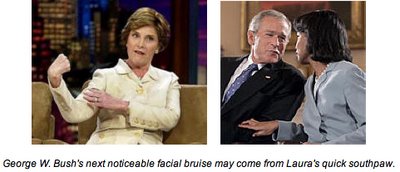
From a State Department source, WMR has learned that there is definitely "something to the Bush-Rice" relationship. "They definitely have something going on between them," said the source speaking on strict anonymity.

Tuesday, June 06, 2006
4 years after failed coup, Venezuela tallies gains
4 years after failed coup, Venezuela tallies gains
Search WWW Search pww.org
Archive Recent Editions 2006 Editions April 22, 2006
Author: W. T. Whitney Jr.
People's Weekly World Newspaper, 04/20/06 15:02
The course of Venezuelan politics after the failed 2002 coup against Hugo Chavez contains elements of both change and continuity.
Four years later, Chavez remains the target of U.S. media disinformation. For example, on the eve of the 2002 coup attempt, Juan Forero of The New York Times wrote of Chavez's "autocratic style and left-wing policies," which "have alienated a growing number of people." Shortly after the coup Forero gave credence to the lie that the Venezuelan president had resigned, and hailed his illegitimate would-be successor as a "manager and conciliator."
Chavez, of course, was almost immediately restored to office by a mass outpouring of the Venezuelan people and with the aid of patriotic elements in the military.
Today, writing about presidential elections slated for this December, Forero heaps praise on an opposition candidate, Julio Borges of the Justice First party. While other opposition parties seem to be favoring an election boycott, Forero has Borges saying that a boycott "only adds to Mr. Chavez's power and has already made Venezuela in effect a one-party state." The suggestion is that Chavez has bought the voters’ favor, "having funneled billions of dollars in oil revenue to the poor."
The electoral opposition is frustrated and divided. After multiple election victories and a parliamentary election boycott last November, the Chavez movement has electoral politics just about to itself now.
Surveys show that almost two-thirds of the adult population is behind the president. His government gets high marks for advances in education (69.4 percent), housing (65.3 percent) and health care (65.2 percent). A Chilean survey last year showed that Venezuelans are first among Latin Americans in viewing their country as "totally democratic."
Venezuela's working people have experienced an increase in their buying power. New car sales have risen sharply, due in part to cheap gasoline, and last year shopping mall sales rose 40 percent.
On the other hand, surveys show that more than 50 percent of the people are worried about crime and corruption. Nationwide protests staged on April 6 in response to the murders of three teenage brothers and their chauffeur demonstrate that such concerns can quickly turn into more generalized anti-government agitation.
Police were apparently complicit in the crime. Leaders of the Justice First Party exploited the demonstrations for political gain. The Chavez government announced the formation of a National Institute of Police Reform and the transfer of soldiers to police duty.
U.S. government meddling remains constant. Washington had a hand in the failed coup four years ago; naval ships floated offshore and U.S. money was to the opposition was flowing.
In 2004, the U.S.-based National Endowment for Democracy transferred more than $50,000 to Sumate, a supposedly nonpartisan group, which organized against Chavez during that year's recall campaign. Last February, a report appeared that the U.S. "Office on Transition Initiatives" had distributed $4.5 million to opposition parties in 2005.
Tensions are high. Venezuelan officials criticized U.S. Ambassador William Brownfield for staging a provocation on April 7. His small motorcade ventured into a pro-Chavez barrio, where Brownfield handed out sports equipment. Demonstrators pounded on his car and threw eggs and tomatoes. Chavez charged the ambassador with violating diplomatic protocol and threatened to expel him.
Threats mount from neighboring Colombia, where U.S. troops and mercenaries are on the ground, a right-wing government is in power and paramilitaries are available to the highest bidder.
However, the Chavez government still enjoys support from the Venezuelan military. In April 2002, units commanded by General Raul Baduel backed the popular mobilization and were instrumental in returning Chavez to power. Speaking April 10 in Maracay, Baduel reaffirmed the army's role "in the maintenance of internal order, and active participation in national development."
atwhit@megalink.net
Return of the Petri Dish Warriors - A New Biowar Arms Race Begins in Maryland By KEVIN ZEESE
"You will do well to try to innoculate the Indians by means of blanketts, as well as to try every other method that can serve to extirpate this execrable race..."
- Approval by Lord Gen. Jeffrey Amherst, British Commander-in-Chief of America, for Col. H. Bouquet's suppression of Pontiac's Rebellion with smallpox laced-blankets, July 1763. The attack partially backfired when Bouquet infected his own troops.
- Approval by Lord Gen. Jeffrey Amherst, British Commander-in-Chief of America, for Col. H. Bouquet's suppression of Pontiac's Rebellion with smallpox laced-blankets, July 1763. The attack partially backfired when Bouquet infected his own troops.
Noam Chomsky on Latin America's Move Towards "Independence and Integration" The United States is Terrified By Noam Chomsky
Jun062006
The United States is Terrified
By Noam Chomsky
Watch 128k stream Watch 256k stream
Noam Chomsky - the renowned linguist and political analyst - was in New York Monday where he gave a press conference at the United Nations. Chomsky is professor of linguistics and philosophy at the Massachusetts Institute of Technology. He is author of dozens of books, including his latest "Failed States: The Abuse of Power and the Assault on Democracy." We go now to an excerpt of Monday's press conference. Chomsky was asked to give his take on the current political climate in Latin America.
Noam Chomsky, speaking June 5, 2006.
NOAM CHOMSKY: Now remember, the U.S. is a global power, so you can't just look at one region. You have to look at what's going on everywhere. So if we go back, say, to the last intelligence projection of the Clinton administration, National Intelligence Council, year 2000, their projection for the next 15 years, they -- just keeping to energy, but there's a lot more. They took it as a matter of course that the United States would control Middle East oil. They don't discuss that much. And then they say the United States, though it will control Middle East oil, because that’s a lever of world control, nevertheless it, itself, will rely on what were called more stable Atlantic Basin resources, meaning West African dictatorships and the western hemisphere. That's what the U.S. will rely on.
Well, what's been going on in Latin America since then significantly threatens that. For the first time in its history, first time since the Spanish colonization, Latin America is moving towards a degree of independence and also a degree of integration. The history of Latin America -- Latin America is very sharply split between a tiny rich elite and huge poverty, and the rich elite have been the only active ones politically. They were oriented towards the colonial power. So that's where they ship their capital. That's where they have their second wealthy homes, you know, send their kids to school, this whole business. Very little integration internal to Latin America. I mean, even the transportation system shows that. It's beginning to change. They are moving towards a degree of independence and towards a degree of integration.
And the United States is terrified. Just keeping to oil alone, it means that the energy resources -- I mean, the major energy producer in the hemisphere is Venezuela. The U.S. kicked the British out under Wilson, Woodrow Wilson. It’s known as Wilsonian idealism. They kicked the British out as soon as the oil age began, because they knew that Venezuela had enormous oil resources. That meant supporting a bunch of utterly brutal dictators, while Venezuela became by 1928 the leading oil exporter in the world. It’s remained very high. Venezuela is now going towards independence, and the United States is frantic. That's why you have this hysteria about Chavez. It’s not because he's attacking anyone or anything like. It's hysteria because he's not following orders. It’s kind of like Serbia, but much more serious, because this is a big energy producer.
And the United States is terrified. Just keeping to oil alone, it means that the energy resources -- I mean, the major energy producer in the hemisphere is Venezuela.
Furthermore, it influences others. The major energy producer in South America second to Venezuela is Bolivia. Well, you know what just happened there. They're moving towards independence, as well. And, in fact, the whole region from Venezuela down to Argentina is pretty much out of control, not totally, but pretty much.
The U.S. in the past has had two fundamental mechanisms for controlling Latin America: one is violence, the other is economic strangulation. They're both weakening. The last exercise of violence was in the year 2002, when in its dedication to democracy promotion the U.S. supported a military coup to overthrow the elected government of Venezuela. Well, had to back down, for one thing, because there was a popular uprising in Venezuela. But another reason was just the reaction in Latin America, where democracy is taken a lot more seriously than it is in North America and Europe and people don't think it's amusing anymore to have elected governments overthrown by a military coup. So the U.S. had to back down and turn to subversion instead, which is what’s going on now. That's the last major use of violence.
And so, the U.S. is preparing for more use of violence. If you take a look at the number of U.S. military personnel throughout Latin America, the military bases, the training of Latin American officers, that's all going up very sharply. In fact, for the first time ever, there are now more U.S. military personnel in Latin America than personnel for the major federal aid organizations. That never happened during the Cold War. Also military training for Latin American officers, and you know what that means.
Military training is being shifted from the State Department to the Pentagon. That's important. The State Department is under congressional supervision, and there are conditionalities, human rights and democracy conditionalities. They're not imposed very much, but they're there, you know, and they have some effect. You switch it to the Pentagon, there's no controls. Do whatever you want. And the whole region is surrounded by bases, and I suspect there will be secessionist movements coming along in Venezuela and Bolivia and possibly Iran. So the military option has by no means been abandoned, but it’s nothing like what it was before. I mean, in the past, you just overthrew governments, you know, didn't think twice about it.
As for the economic option, that's being lost, too. The most dramatic case, perhaps, was Argentina. Argentina was the poster child for the IMF. And following IMF rules, it led to the worst economic disaster in its history, totally collapsed. Then, violating IMF rules radically, they pulled out of it and have had rapid growth. And the international investing community and the IMF, which is a branch of the Treasury Department, couldn't do anything about it, even the refusal to pay debt. And Argentina -- in fact, the president of Argentina said, ‘Well, we're ridding ourselves of the IMF.’ That means of U.S. economic strangulation. And worse, he was helped in that by Venezuela, which bought a large part of the debt. Bolivia is probably doing the same. Brazil had already done it. Well, you know, you rid yourself of the IMF, meaning the Treasury Department, that's seriously weakening the measures of economic strangulation.
And it's worse. A lot of these policies are gaining significant popular appeal. Just read a scholarly paper by a very anti-Castro Cuban American scholar, who reports -- I don't know where he got it from, but he said about 170,000 Latin Americans have been, in the last couple years, have been treated in Cuban medical facilities, and most of them restoring sight under Cuban-Venezuelan programs, where Venezuela pays for it and people -- blind people, others who need medical care in the U.S. dependencies, where they can't get it, of course -- are sent to Cuba, where they come back seeing. They were blind. You know, okay, that has its effects on countries. Called Operation Miracle.
And within Venezuela, as far as -- you can like it or hate it, but the interesting question is what Venezuelans think about it. Okay, well, a good knowledge of that. There's extensive polls taken, Latin American and North American polls. It turns out that the popularity of the government has shot way up in the last -- since 1998, and it now is the most popular elected government in Latin America; in fact, in the hemisphere, because this government is not popular. So it's the most popular elected government in Latin America, and it keeps going up. Well, reasons not too obscure, but, sure, it's driving the United States berserk. That's why you have the constant hysteria from the government and the media about the terrible things in Venezuela and Bolivia.
The United States is Terrified
By Noam Chomsky
Watch 128k stream Watch 256k stream
Noam Chomsky on Latin America's Move Towards "Independence and Integration"
Noam Chomsky - the renowned linguist and political analyst - was in New York Monday where he gave a press conference at the United Nations. Chomsky is professor of linguistics and philosophy at the Massachusetts Institute of Technology. He is author of dozens of books, including his latest "Failed States: The Abuse of Power and the Assault on Democracy." We go now to an excerpt of Monday's press conference. Chomsky was asked to give his take on the current political climate in Latin America.
Noam Chomsky, speaking June 5, 2006.
NOAM CHOMSKY: Now remember, the U.S. is a global power, so you can't just look at one region. You have to look at what's going on everywhere. So if we go back, say, to the last intelligence projection of the Clinton administration, National Intelligence Council, year 2000, their projection for the next 15 years, they -- just keeping to energy, but there's a lot more. They took it as a matter of course that the United States would control Middle East oil. They don't discuss that much. And then they say the United States, though it will control Middle East oil, because that’s a lever of world control, nevertheless it, itself, will rely on what were called more stable Atlantic Basin resources, meaning West African dictatorships and the western hemisphere. That's what the U.S. will rely on.
Well, what's been going on in Latin America since then significantly threatens that. For the first time in its history, first time since the Spanish colonization, Latin America is moving towards a degree of independence and also a degree of integration. The history of Latin America -- Latin America is very sharply split between a tiny rich elite and huge poverty, and the rich elite have been the only active ones politically. They were oriented towards the colonial power. So that's where they ship their capital. That's where they have their second wealthy homes, you know, send their kids to school, this whole business. Very little integration internal to Latin America. I mean, even the transportation system shows that. It's beginning to change. They are moving towards a degree of independence and towards a degree of integration.
And the United States is terrified. Just keeping to oil alone, it means that the energy resources -- I mean, the major energy producer in the hemisphere is Venezuela. The U.S. kicked the British out under Wilson, Woodrow Wilson. It’s known as Wilsonian idealism. They kicked the British out as soon as the oil age began, because they knew that Venezuela had enormous oil resources. That meant supporting a bunch of utterly brutal dictators, while Venezuela became by 1928 the leading oil exporter in the world. It’s remained very high. Venezuela is now going towards independence, and the United States is frantic. That's why you have this hysteria about Chavez. It’s not because he's attacking anyone or anything like. It's hysteria because he's not following orders. It’s kind of like Serbia, but much more serious, because this is a big energy producer.
And the United States is terrified. Just keeping to oil alone, it means that the energy resources -- I mean, the major energy producer in the hemisphere is Venezuela.
Furthermore, it influences others. The major energy producer in South America second to Venezuela is Bolivia. Well, you know what just happened there. They're moving towards independence, as well. And, in fact, the whole region from Venezuela down to Argentina is pretty much out of control, not totally, but pretty much.
The U.S. in the past has had two fundamental mechanisms for controlling Latin America: one is violence, the other is economic strangulation. They're both weakening. The last exercise of violence was in the year 2002, when in its dedication to democracy promotion the U.S. supported a military coup to overthrow the elected government of Venezuela. Well, had to back down, for one thing, because there was a popular uprising in Venezuela. But another reason was just the reaction in Latin America, where democracy is taken a lot more seriously than it is in North America and Europe and people don't think it's amusing anymore to have elected governments overthrown by a military coup. So the U.S. had to back down and turn to subversion instead, which is what’s going on now. That's the last major use of violence.
And so, the U.S. is preparing for more use of violence. If you take a look at the number of U.S. military personnel throughout Latin America, the military bases, the training of Latin American officers, that's all going up very sharply. In fact, for the first time ever, there are now more U.S. military personnel in Latin America than personnel for the major federal aid organizations. That never happened during the Cold War. Also military training for Latin American officers, and you know what that means.
Military training is being shifted from the State Department to the Pentagon. That's important. The State Department is under congressional supervision, and there are conditionalities, human rights and democracy conditionalities. They're not imposed very much, but they're there, you know, and they have some effect. You switch it to the Pentagon, there's no controls. Do whatever you want. And the whole region is surrounded by bases, and I suspect there will be secessionist movements coming along in Venezuela and Bolivia and possibly Iran. So the military option has by no means been abandoned, but it’s nothing like what it was before. I mean, in the past, you just overthrew governments, you know, didn't think twice about it.
As for the economic option, that's being lost, too. The most dramatic case, perhaps, was Argentina. Argentina was the poster child for the IMF. And following IMF rules, it led to the worst economic disaster in its history, totally collapsed. Then, violating IMF rules radically, they pulled out of it and have had rapid growth. And the international investing community and the IMF, which is a branch of the Treasury Department, couldn't do anything about it, even the refusal to pay debt. And Argentina -- in fact, the president of Argentina said, ‘Well, we're ridding ourselves of the IMF.’ That means of U.S. economic strangulation. And worse, he was helped in that by Venezuela, which bought a large part of the debt. Bolivia is probably doing the same. Brazil had already done it. Well, you know, you rid yourself of the IMF, meaning the Treasury Department, that's seriously weakening the measures of economic strangulation.
And it's worse. A lot of these policies are gaining significant popular appeal. Just read a scholarly paper by a very anti-Castro Cuban American scholar, who reports -- I don't know where he got it from, but he said about 170,000 Latin Americans have been, in the last couple years, have been treated in Cuban medical facilities, and most of them restoring sight under Cuban-Venezuelan programs, where Venezuela pays for it and people -- blind people, others who need medical care in the U.S. dependencies, where they can't get it, of course -- are sent to Cuba, where they come back seeing. They were blind. You know, okay, that has its effects on countries. Called Operation Miracle.
And within Venezuela, as far as -- you can like it or hate it, but the interesting question is what Venezuelans think about it. Okay, well, a good knowledge of that. There's extensive polls taken, Latin American and North American polls. It turns out that the popularity of the government has shot way up in the last -- since 1998, and it now is the most popular elected government in Latin America; in fact, in the hemisphere, because this government is not popular. So it's the most popular elected government in Latin America, and it keeps going up. Well, reasons not too obscure, but, sure, it's driving the United States berserk. That's why you have the constant hysteria from the government and the media about the terrible things in Venezuela and Bolivia.
Venezuela Backs Plan to Sell Oil in Euros
Venezuela supports the idea of selling oil in euros instead of U.S. dollars, a proposal also supported by fellow OPEC member Iran, the country's oil minister said.
"Iran has an initiative that we support. They are going to start to do oil transactions in euros," Oil Minister Rafael Ramirez said Thursday in an interview with state television.
Selling oil in euros would in theory boost world demand for the European currency at the expense of the dollar.
Analysts have said the proposal is highly unlikely to materialize but could in theory have serious consequences for the U.S. economy by undermining the value of the dollar and diminishing its status as the currency used in central-bank reserves.
Venezuelan President Hugo Chavez is one of the U.S. government's most vocal critics on the world stage.
"If a market in euros is created, with the euro as a reference, we could send our supplies so they are sold under this (currency)," added Ramirez, who is also the president of the state oil company Petroleos de Venezuela SA.
Ramirez spoke ahead of a meeting of the Organization of Petroleum Exporting Countries in Caracas.
OPEC president Edmund Daukoru said afterward that while some member countries have raised the possibility, "they have not formally tabled" the proposal yet to the group.
Earlier this month, Iran's oil ministry granted a license for the creation of a euro-denominated market, an idea first floated back in 2004, though just who would trade on it remains unclear.
If Iran or Venezuela were to demand payment for oil in euros, commodities experts have said it could lead central bankers around the world to convert some dollar reserves into euros, possibly causing a decline in the dollar's value.
Oil is currently denominated in dollars around the globe, through direct sales between producers and consumers or in trades made on markets in New York and London.
No Bravery - A nation blind to their disgrace

A 4 Minute Video
Produced by GlobalFreePress.com
Music by James Blunt
There are children standing here,
Arms outstretched into the sky,
Tears drying on their face.
He has been here.
Brothers lie in shallow graves.
Fathers lost without a trace.
A nation blind to their disgrace,
Since he's been here.
And I see no bravery,
No bravery in your eyes anymore.
Only sadness.
Houses burnt beyond repair.
The smell of death is in the air.
A woman weeping in despair says,
He has been here.
Tracer lighting up the sky.
It's another families' turn to die.
A child afraid to even cry out says,
He has been here.
And I see no bravery,
No bravery in your eyes anymore.
Only sadness.
There are children standing here,
Arms outstretched into the sky,
But no one asks the question why,
He has been here.
Old men kneel and accept their fate.
Wives and daughters cut and raped.
A generation drenched in hate.
Yes, he has been here.
And I see no bravery,
No bravery in your eyes anymore.
Only sadness.
US administration "Black Op" can be behind recent attack against Russian diplomats in Baghdad
The Russian embassy in Iraq has no information about the fate and whereabouts of the Russian citizens captured in Baghdad. The embassy cooperates with local authorities, coalition forces and political parties in Iraq, but it has not been possible to collect any information about the hostages yet. The embassy is working with Iraqi security forces and other departments to find and release the Russian citizens.
Four Russian diplomats have been kidnapped in Baghdad on Saturday; another officer of the Russian embassy has been killed. Experts believe that the assault has been meticulously planned. A group of Russian diplomats were traveling in a Chevrolet Suburban vehicle. They stopped the car only 400 meters far from the embassy to buy some groceries. A group of armed assaulters blocked the vehicle on the road and opened automatic fire. The next minute the attackers seized four passengers of the Chevrolet vehicle - all of them Russian embassy employees - pushed them into the minibus and took the hostages in an unknown direction. Security guard Vitaly Titov was seriously wounded during the attack, although the kidnappers left him on the scene. Titov was alive when other employees of the Russian embassy rushed to help their colleagues. The man died on the way to the hospital.
Several news agencies reported on Saturday night that the Russian hostages had been freed as a result of a special operation conducted by US and Iraqi troops. The Internal Affairs Ministry of Iraq rejected the information later.
None of the Iraqi terrorist groups have claimed responsibility for the attack against Russian citizens yet. Special services believe that the terrorists kidnapped the Russian diplomats with a view to hold them to ransom. The majority of hostage-taking incidents in Iraq have occurred because of the financial reason so far. Over 200 foreigners and 1,000 Iraqi people have been kidnapped in the war-torn country after the collapse of Saddam Hussein's regime. However, the kidnappers have not released any statements yet, although they usually ask for money during 24 hours after the crime. Furthermore, Iraqi kidnappers prefer to attack European nationals or those coming from wealthy countries of the Persian Gulf. Russia does not fit in these two categories. That is why, special services believe, the kidnappers could have other motives for their attack.
Some specialists believe that the attack against Russian diplomats in Baghdad could be good for Washington. The US administration is particularly concerned about the Moscow-run politics in Iraq (which contradicts to Washington's goals) and the activities of Russian special services in Iraq. To crown it all, the Bush's administration dislikes the image of 'a friend of Iraq' which Russia propagandizes.
Former Iraqi Ambassador to Russia Abbas Halaf stated that the attack against the Russian diplomats had been instigated by US troops in Iraq. The official believes that the USA tries to punish Russia for its political activities in the region, especially in Iraq. It is worthy of note that US soldiers attacked a column of Russian diplomats and wounded five of them in April of 2003.
Translated by Dmitry Sudakov
Pravda.Ru
General Raul Baduel: The US are waging a 4th generation war against Venezuela
The role of mainstream media in military strategy
General Raul Baduel: The US are waging a 4th generation war against Venezuela
by Rosa Miriam Elizalde and Luis Báez
Division General Raul Isaias Baduel, commander in chief of the Venezuelan army, analyzes the United States' plan for subversion of Venezuela. After having attempted to overthrow President Chavez by organizing a coup d'état and having fomented his assasination in vain, they are waging a 4th generation war in which the media have become a real weapon. By manipulating information, they try to demonize the government in front of the international community and to delegitimize it in the eyes of its own people.
When was it that in your life as member of the Venezuelan army you began to distance yourself from the American military doctrine?
General Raul Baduel: Since we were in the Military Academy we used to have serious discussions on the military exchange between the American and the Venezuelan armies. Obviously, that relationship was aimed at recruiting, co-opting and subordinating our Armed Forces officers to the interests of the United States, pushing the interest of our country to the background. That was evident, particularly in the higher-ranking officers, and the past years have proved we were right. As time past by links between Venezuelan officers and the Unites States Army and Security Agencies were more evident.
All this was quite evident during the April 2002 coup d'état. In addition, I belong to a generation sympathetic to the Cuban Revolution and its emblematic figures -Fidel, Che. Even when we could not share its ideological positions we did agree with its ideals of dignity, which have not often been welcomed in other parts of the world though such ideals are the most important things for us and when I say us I mean not only the Venezuelan, but this cosmic race made up of the Latin American and Caribbean people. Those who can not understand this can not properly analyze the threatening hegemonic pressures the United States makes on our countries.
How were you influenced by the School of the Americas?
During year 1993, I took a course on Command and General Staff at the School of the Americas in Fort Benning, Georgia. The school has its terrible story but, to be fair, I did not notice the gorillalike instruction environment people said it had, and it probably did. Its most sinister time was when it was located in Panama, when it served as the American penetration door in our armies. I remember the days I spent there very well; the continual protests in front of the school whose facade was even marked with blood (red ink).
Of course, it was the year in which the report of the United Nations Truth Commission was made public, where the names of dozens of Central American officers involved in the terrible crimes in El Salvador were included. More than a third of the officers mentioned were graduated from the School of the Americas.
By then, a huge debate was taking place and we followed it. But to be fair, during the year I spent there I did not see anything that would make me think that officers were being trained to torture or to practice other criminal acts. What I can say for sure is that almost at the end of the course some American comrades with whom I had a good friendship told me I had been watched during the whole year for my record as a rebel officer related to the Bolivarian Movement.
A regional block power
A proposal on the possibility of a military integration in a Regional Block Power has been presented in certain alternative circles. Do you think it can be viable?
That is Heinz Dietrich's project, a friend who has invited me to some international events I have not been able to attend, and who has been working with Ecuadorian General Rene Vargas Pazos. He writes to me quite often. I have said to him I think this kind of integration is necessary though leaving aside all militaristic conceptions which may represent an assault on the dignity of other peoples. The integration must be based on what is stipulated in our Constitution, regarding issues such as National Security which goes beyond strictly military affairs and has to do with the existence of the very same Nation State.
It is already said that 51 out of the 100 biggest economies of the world are not countries, but corporations. That is why corporative crime and corporative predators are topics dealt with in the context of a trend which no longer recognizes the sovereignty of nations or legitimates the nationalistic feelings. That is the reason why taking the right steps for the economic, political, social, cultural, scientific, environmental, geographical and military integration is necessary.
Wouldn't it be more prudent to focus on the economic integration of our peoples, by supporting ALBA (Bolivarian Alternative for The Americas), a promising and viable project to improve the social conditions of our countries?
It's obvious. I think a debate must take place to define our priorities. I think the struggle for our economic independence linked to political and social issues must be our main goal. The human being is our most valued capital and our priority.
Many of our serious problems come from the lack of or a poor education. That is why educating the people is what will help us to find the solutions to our problems. This is a crucial issue and I am not saying it in the spirit of arguing with friend Heinz.
The assassination of the president: an option?
The news is the possibility of an assassination in Venezuela.
We have analyzed the present scenario, in which our process is being developed and we are convinced assassination is an option the United States might use. Maybe, it is the only option they have not applied in a context in which all possible resources have been used to damage the Security and the Defense of the country.
What are the other options they have applied or that they are still applying?
First, "the fourth generation war." In the future, when we analyze what happened in our country since 1999 we’ll see more clearly that we suffered from this kind of war encouraged and financed by the United States...
... where the methods applied were already implemented during the Latin America "dirty war" ...
That's right. A war where two sides with conventional weapons facing each other in the theater of operations is no longer necessary. The history of Venezuela over the past six years has been a panoplied one, what has also been called an "asymmetric conflict" which is not a new concept though we have seen it here very clearly: not only the media can become an operative weapon, more powerful than the armed divisions, but the distinction between war and peace, the fronts and the battlefields are not longer defined.
This is the reason why a joint responsibility precept between the State and the society regarding the Defense of the nation was included in our Constitution.
Another scenario we have analyzed is the coup d'état. Sometimes, I act sarcastically when I talk about this and I say the rulings of the Court regarding the events of April 2002 placed us in a particular position: we have to invent a new theory of Law to describe such actions with a highly innovative glossary of terms because according to the ruling the coup d'état was not a coup d'état.
And despite this, the evidence of the United States interference in the indescribable events of April 11 is overwhelming. In the 42 Paratrooper Infantry Brigade in Maracay we gathered a lot of evidences that show the American interference during and after the events because many people believed we were a proper channel to establish contacts with the coup-plotters and they gave us information. Here, in Tiuna Fort we have enough evidences to show the entrance to the barracks and the participation of American military attaches in Caracas...
The names of some were published: Lieutenant Colonel James Rodgers, assistant military attache, and Colonel Ronald McCammon, intelligence officer, celebrated the "victory" with the military coup-plotters in the Headquarters of the Army the very same April 11. However, the United States has denied this categorically...
Yes, but there are the records of the incoming and outgoing document register of Fort Tiuna. That can not be erased; besides, we have the testimony of those who saw them. There are evidences also of the presence of American ships and airplanes in Venezuelan territory. Those who know about radars know these records can not be made up and our radars were installed by the United States. They know perfectly well what we are talking about and we are not lying. Look, there is a joke about all this: Why has the United States never had a coup d'état? Because they don't have an American embassy there.
If we analyze closely what happened on April 2002 in Venezuela, it could be affirmed that the assassination attempt was already implemented.
Of course. The first purpose of every coup is to overthrow the President violently. If we take a look at the Latin America history we'll see many examples where the United States has been succeedingly involved. Sometimes they killed the president but there are times in which it is not necessary to physically murder the Head of State to politically destroy him.
Killing a president is not a crime
The executive order signed by President Bush after September 11 in which he granted CIA agents the legal and executive authorization to kill the "terrorist" leaders by virtue of the United States "National Security" is public. I remember the statements that then American ambassador to Caracas, Charles Shapiro, made to AP press agency in October 2003: "Killing a president is not necessarily a crime"...
This is a very particular practice and moral of the American elite. We perfectly know the differences between the American government and the American people, which is a noble people and I can prove it because I have good memories of American friends, especially some paratroopers. But, undoubtedly, such a practice reminds us of Ortega and Gasset's phrase: "The United States of America preach a moral they don't practice."
This has to do with a third scenario we have analyzed regarding the United States: the possibility of inciting a regional war as an extension of the internal conflicts of the neighboring countries, Colombia, in particular. We had and we have reasons to say to international organizations that Venezuela sees as a cause of concern the overwhelming support and imbalance regarding the combat power the United States has created and encouraged even more in Colombia, especially after the passing of the USA Patriot Act.
The fact that Venezuela has bought weapons arose a satanization campaign against the Bolivarian government in the United States and some analysts think the submittal of a bill authorizing the Department of State to increase the global efforts to eliminate and control conventional weapons is not casual.
Fortunately, some judicious voices have been raised too in Colombia and they have said they understand that Venezuela protects its borders. The American discourse about the militarization of Venezuela is very cynical though not new. During my course at the School of the Americas, I remember an Afro-American woman, a three-stars General and adviser to President Clinton on Security issues, who gave us a lecture in which she described as the region in unacceptable terms. In year 1993, that lady was saying the same things they are saying now. I was forced to reply.
What did you say?
Her conclusion was something like this: "poor Colombia which is next to Venezuela and can not move out." For instance, she said that tensions in the Venezuelan-Colombian border were mainly due to the fact that our country was a great supplier of weapons to violence-generating elements in Colombia, the guerrilla in particular, whom we were giving refuge. When she talked about drug trafficking, she also mentioned Venezuela as the great supplier of the chemical elements necessary for the traffic, despite being a paradise for dollars-laundering and a privileged via to send the drug to other countries, in particular, the United States. She also said the position of Venezuela regarding the guerrilla was not clearly defined. Of course, I stood up and rejected that, though I specified I was not speaking on behalf of the government of my country. I said we regretted the internal problems in Colombia; that by taking into account the historical links of our two peoples, we wanted the conflict to be ended, but that was the responsibility of the Colombians people.
Venezuela does have the right to claim not to be the target and victim of the actions perpetrated by violent groups. I once heard President Uribe recognize that Colombia had the duty -and I think it was fair- to protect the corridors through which violence reached Venezuela. Our country must protect itself too and this is what we are doing. What is surprising is why our right to protect our sovereignty is so questioned, and the reason is known: this conflict can be used as a casus bellis to intervene in our country.
This is very dangerous. I have heard the same discourse in American official entities during the last ten years as well as the call to get involved in that conflict which I think would be a serious mistake. I repeat: we defend the peoples' self-determination and sovereignty principles. Colombia is our neighbor and we are sorry for its situation but only Colombians must solve it.
The Granda Case is an example of how the United States can generate a conflict, yes or not?
Yes, absolutely. God helps us from getting involved in such a perverse game!
"Fictitious Enemy"
Once Chavez' denounced the United States attempt to kill him, right wing sectors inside and outside Venezuela have reacted by saying that the government has created a fictitious enemy to gain political benefits and that the debate on the possible intervention is nothing but paranoia. What's your opinion?
Among other hostile scenarios, we have also considered the possibility of a military intervention. It is not paranoia. The examples of military interventions led by the United States and its coalition are just there in the Middle East, in a context in which international organizations are not a contentious factor. A mandate from the UN Security Council to intervene anywhere in the world is not necessary.
When I listen to those puppets repeating what others say -for instance, that we are going towards militarism- I ask them to check the texts written by the experts in the field, such as Samuel Huntington, Noam Chomsky, John Berger and many other theorists who have studied the concept of militarism and pretorianism. Read what these prestigious professors -most of them are Americans- have written and compare it with the Venezuelan situation and you will clearly see who the militarists and pretorianism supporters are, if those of us who do our work or if those who one day went to a public place to demand the conciliation with the American positions in the name of freedom and democracy. This is what the fourth generation war is all about: neutralizing the population through the media by convincing our people and the world that the Venezuela of Hugo Chavez has become an outlaw state.
I don’t know if I already said that during the events of April 2002, a French journalist went to interview me in Maracay. He worked for a television station and was a war correspondent expert who had reported from several military scenarios. He told me he had left France convinced that here he was going to find a country in the middle of a civil war and showed me the reports in which it was said that I, General Baudel, was massacring the people. They also mentioned paratroopers attacking military units and the civil population. He vehemently told me: what I have seen here is the opposite, the people demanding the return of the President of the Republic, the people going into the barracks and who are not repressed at all.
Unfortunately, not everybody can come to Venezuela to see with his own eyes what is actually happening here.
Domestically speaking, we are more politically stabilized today and the revolution is more powerful. The very same opposition has acknowledged its defeat. However, American authorities have begun year 2005 by saying Venezuela is a "regional threat", an "unstable government", an "insecure oil supplier."
Due to the fact that I am an active soldier I must be careful with what I say for my opinions might have a political impact. But as a soldier who has the honor of commanding the Venezuelan Army, we have to analyze the threats the supreme interests and purposes of the Venezuelan State might face. We agree with what President Hugo Chavez has said as the Head of State and Commander in Chief of the National Armed Forces, a post the people have legitimately given to him.
By the end of last year, the President presented a new strategic plan for the development of the Venezuelan State and there he outlined an objective that has to do with us directly and it is the formation of a new Venezuelan military strategy where we have three main strategic lines: strengthening the Army -that does not mean we are going to get involved in an arms race-, strengthening the civil-military ties and the reserve.
This is a mandate the people has given to us, stated in Article 328 of our Constitution. There, the people gave us 'a what for' which means to guarantee the sovereignty and independence of the nation and to secure the integrity of the geographical space.
It also gave us a 'how': the military defense, the cooperation and maintenance of the internal order and the active participation in the national development. These three missions must have a dynamic balance and I can guarantee that as soldiers we see ourselves not only as the administrators of legal and legitimate violence of the State of Venezuela but as promoters of peace and social safety.
The Venezuelan Army and the other closed forces are not a threat to the region. The American government knows it perfectly well. In any case, they would just be a contention wall against those who might attempt to subvert the sacred objectives our people have entrusted to us.
Rosa Miriam Elizalde and Luis Báez
Chavez appreciates mil-tech cooperation with Russia
CARACAS, June 4 (Itar-Tass) - President Hugo Chavez of Venezuela has highly appreciated military cooperation with Russia when addressing the activists of student organisations on Saturday.
In view of the embargo that the US administration imposed in May on the supply of armaments to Venezuela, Chavez pointed out that the delivery of the first batch of 30,000 Russian-made AK-103 submachine-guns frustrated US attempts at weakening and disarming the Venezuelan Army.
Chavez referred to the AK-103, which were brought to Puerto Cabello on the same day aboard a Russian ship, as the most up-to-date small arms. In all, according to contracts signed, the Rosoboronexport organisation is to deliver 100,000 automatic rifles of the latest generation to Venezuela before the end of this year.
The Venezuelan president also announced plans to buy SU-30 jetfighters from Russia and gave the highest appraisal of the flying and technico-tactical characteristics of the combat aircraft. The planes and the already purchased Russian military helicopters will raise the operational effectiveness of Venezuela's Air Force, Chavez emphasised.
Resist this US backlash against Cuba by Ian Gibson
Faced with a loss of influence in Latin America as a result of the shift to the left, the US government has been furiously lobbying sympathetic European states to create political leverage on Washington's behalf. As a partner in a "special relationship", Whitehall is a prime target.
The first test of the new US strategy towards its recalcitrant neighbours will come next week when the EU meets to agree a united approach to relations with Cuba. The "common position" will set out a policy for engagement with the Havana administration and is binding on member states. The threat is of a shift towards a diplomatic freeze, or even sanctions against the Caribbean island.
Those of us who have observed Cuba's social system remain perplexed by the following contradiction: that the determination to "make poverty history" attracts strong support from the EU in principle, yet when a country takes steps to ensure the concept becomes reality, a disapproving silence ensues. This has been demonstrated in Cuba, Venezuela, Bolivia and even Argentina.
Cuba is the only country in Latin America that does not receive assistance from international financial institutions such as the World Bank and the International Monetary Fund, which are supposed to contribute to the development of third world countries. It is also the only nation on the continent with whom the EU has not signed a cooperation agreement. Yet social advances continue, underpinned by moderate but consistent economic growth.
The UN recently announced that Cuba is the only country in Latin America that has no malnutrition. The World Health Organisation reports that the Cuban doctor-patient ratio is 1:170, better than the US average of 1:188. In addition, WHO has commended Cuba for outstanding literacy levels and rates of infant mortality and life expectancy that outstrip Washington DC - despite 45 years of an illegal economic blockade imposed by successive US administrations. Cuba's international activities also deserve recognition. It is operating humanitarian missions in 68 countries and, in 2005 alone, 1,800 doctors from 47 developing countries graduated in Cuba under a free scholarship scheme.
Yet western governments - including our own - offer little acknowledgement of these achievements. The Foreign Office explains it "cannot have normal relations with Cuba" due to human-rights concerns. Amnesty International claims that 72 prisoners of conscience are detained in Cuban jails, an allegation rejected by the Cuban government, which argues that all were tried and found guilty of being in the pay of an enemy power - the US. The International Red Cross has meanwhile reported that up to 40,000 people are detained by coalition forces in Iraq without charge.
If we are to promote the eradication of poverty and greater global cohesion, there must be a sense of justice and mutual respect. Our government should promote exchanges with nations like Cuba and see what we can learn from one another. Scope exists for cooperation in biotechnology. Vaccine exports from Cuba doubled last year and clinical trials in several countries established Cuba as a world leader in cancer research and treatment.
It must be hoped that the EU will resist US pressure, despite the tendency of countries like Poland and the Czech Republic to rush to do Washington's bidding. More than 170 MPs have signed a Commons motion calling for an independent positive approach to Cuba in the Brussels negotiations. They recognise that there is much to gain from cooperation with Latin America but, as recent history reminds us, much to be lost from policies of isolation.
· Ian Gibson is the Labour MP for Norwich North and chairs the all-party parliamentary group on Cuba
gibsoni@parliament.uk
Subscribe to:
Posts (Atom)