Sunday, September 25, 2011

The West and the Rest in a One-Model-Fits-All World The Decline and Fall of Just About Everyone


By Pepe Escobar
More than 10 years ago, before 9/11, Goldman Sachs was predicting that the BRIC countries (Brazil, Russia, India, China) would make the world economy’s top ten -- but not until 2040.  Skip a decade and the Chinese economy already has the number two spot all to itself, Brazil is number seven, India 10, and even Russia is creeping closer. In purchasing power parity, or PPP, things look even better.  There, China is in second place, India is now fourth, Russia sixth, and Brazil seventh.

No wonder Jim O’Neill, who coined the neologism BRIC and is now chairman of Goldman Sachs Asset Management, has been stressing that “the world is no longer dependent on the leadership of the U.S. and Europe.”  After all, since 2007, China’s economy has grown by 45%, the American economy by less than 1% -- figures startling enough to make anyone take back their predictions. American anxiety and puzzlement reached new heights when the latest International Monetary Fund projections indicated that, at least by certain measurements, the Chinese economy would overtake the U.S. by 2016.  (Until recently, Goldman Sachs was pointing towards 2050 for that first-place exchange.)

Within the next 30 years, the top five will, according to Goldman Sachs, likely be China, the U.S., India, Brazil, and Mexico. Western Europe?  Bye-bye!

A System Stripped to Its Essence
Increasing numbers of experts agree that Asia is now leading the way for the world, even as it lays bare glaring gaps in the West’s narrative of civilization.  Yet to talk about “the decline of the West” is a dangerous proposition. A key historical reference is Oswald Spengler’s 1918 essay with that title. Spengler, a man of his times, thought that humanity functioned through unique cultural systems, and that Western ideas would not be pertinent for, or transferable to, other regions of the planet. (Tell that howler to the young Egyptians in Tahrir Square.)
Spengler, of course, captured the Western-dominated zeitgeist of another century. He saw cultures as living and dying organisms, each with a unique soul. The East or Orient was “magical,” while the West was “Faustian.” A reactionary misanthrope, he was convinced that the West had already reached the supreme status available to a democratic civilization -- and so was destined to experience the “decline” of his title.

If you’re thinking that this sounds like an avant-la-lettre Huntingtonesque “clash of civilizations,” you can be excused, because that’s exactly what it was.

Speaking of civilizational clashes, did anyone notice that “maybe” in a recent TIME cover story picking up on Spenglerian themes and headlined “The Decline and Fall of Europe (and Maybe the West)”?  In our post-Spenglerian moment, the “West” is surely the United States, and how could that magazine get it so wrong? Maybe? After all, a Europe now in deep financial crisis will be “in decline” as long as it remains inextricably intertwined with and continues to defer to “the West” -- that is, Washington -- even as it witnesses the simultaneous economic ascent of what’s sometimes derisively referred to as “the South.”

Think of the present global capitalist moment not as a "clash," but a “cash of civilizations.”
If Washington is now stunned and operating on autopilot, that’s in part because, historically speaking, its moment as the globe’s “sole superpower” or even “hyperpower” barely outlasted Andy Warhol’s notorious 15 minutes of fame -- from the fall of the Berlin Wall and collapse of the Soviet Union to 9/11 and the Bush doctrine. The new American century was swiftly throttled in three hubris-filled stages: 9/11 (blowback); the invasion of Iraq (preemptive war); and the 2008 Wall Street meltdown (casino capitalism).

Meanwhile, one may argue that Europe still has its non-Western opportunities, that, in fact, the periphery increasingly dreams with European -- not American -- subtitles. The Arab Spring, for instance, was focused on European-style parliamentary democracies, not an American presidential system. In addition, however financially anxious it may be, Europe remains the world’s largest market. In an array of technological fields, it now rivals or outpaces the U.S., while regressive Persian Gulf monarchies splurge on euros (and prime real estate in Paris and London) to diversify their portfolios.

Yet, with “leaders” like the neo-Napoleonic Nicolas Sarkozy, David (of Arabia) Cameron, Silvio (“bunga bunga”) Berlusconi, and Angela (“Dear Prudence”) Merkel largely lacking imagination or striking competence, Europe certainly doesn’t need enemies.  Decline or not, it might find a whole new lease on life by sidelining its Atlanticism and boldly betting on its Euro-Asian destiny.  It could open up its societies, economies, and cultures to China, India, and Russia, while pushing southern Europe to connect far more deeply with a rising Turkey, the rest of the Middle East, Latin America, and Africa (and not via further NATO “humanitarian” bombings either).

Otherwise, the facts on the ground spell out something that goes well beyond the decline of the West: it’s the decline of a system in the West that, in these last years, is being stripped to its grim essence. Historian Eric Hobsbawm caught the mood of the moment when he wrote in his book How to Change the World that “the world transformed by capitalism,” which Karl Marx described in 1848 “in passages of dark, laconic eloquence is recognisably the world of the early twenty-first century.”

In a landscape in which politics is being reduced to a (broken) mirror reflecting finance, and in which producing and saving have been superseded by consuming, something systemic comes into view. As in the famous line of poet William Butler Yeats, “the center cannot hold” -- and it won’t either.

If the West ceases to be the center, what exactly went wrong?

Are You With Me or Against Me?
It’s worth remembering that capitalism was “civilized” thanks to the unrelenting pressure of gritty working-class movements and the ever-present threat of strikes and even revolutions. The existence of the Soviet bloc, an alternate model of economic development (however warped), also helped.  To counteract the USSR, Washington’s and Europe’s ruling groups had to buy the support of their masses in defending what no one blushed about calling “the Western way of life.”  A complex social contract was forged, and it involved capital making concessions.

No more.  Not in Washington, that’s obvious.  And increasingly, not in Europe either.  That system started breaking down as soon as -- talk about total ideological triumph! -- neoliberalism became the only show in town.  There was a single superhighway from there and it swept the most fragile strands of the middle class directly into a new post-industrial proletariat, or simply into unemployable status.

If neoliberalism is the victor for now, it’s because no realist, alternative developmental model exists, and yet what it has won is ever more in question. Meanwhile, except in the Middle East, progressives the world over are paralyzed, as if expecting the old order to dissolve by itself. Unfortunately, history teaches us that, at similar crossroads in the past, you are as likely to find the grapes of wrath, right-wing populist-style, as anything else -- or worse yet, outright fascism.
“The West against the rest” is a simplistic formula that doesn’t begin to describe such a world. Imagine instead, a planet in which “the rest” are trying to step beyond the West in a variety of ways, but also have absorbed that West in ways too deep to describe.  Here’s the irony, then: Yes, the West will “decline,” Washington included, and still it will leave itself behind everywhere.

Sorry, Your Model Sucks
Suppose you’re a developing country, shopping in the developmental supermarket.  You look at China and think you see something new -- a consensus model that’s turning on the lights everywhere -- or do you?  After all, the Chinese version of an economic boom with no political freedom may not turn out to be much of a model for other countries to follow. In many ways, it may be more like an inapplicable lethal artifact, a cluster bomb made up of shards of the Western concept of modernity married to a Leninist-based formula where a single party controls personnel, propaganda, and -- crucially -- the People’s Liberation Army.
At the same time, this is a system evidently trying to prove that, even though the West unified the world -- from neocolonialism to globalization -- that shouldn’t imply it’s bound to rule forever in material or intellectual terms.

For its part, Europe is hawking a model of supra-national integration as a means of solving problems and conflicts from the Middle East to Africa. But any shopper can now see evidence of a European Union on the verge of cracking amid non-stop inter-European bickering that includes national revolts against the euro, discontent over NATO’s role as a global Robocop, and a style of ongoing European cultural arrogance that makes it incapable of recognizing, to take one example, why the Chinese model is so successful in Africa.

Or let’s say our shopper looks to the United States, that country still being, after all, the world’s number one economy, its dollar still the world’s reserve currency, and its military still number one in destructive power and still garrisoning much of the globe.  That would indeed seem impressive, if it weren’t for the fact that Washington is visibly on the decline, oscillating wildly between a lame populism and a stale orthodoxy, and shilling for casino capitalism on a side street in its spare time.  It’s a giant power enveloped in political and economic paralysis for all the world to see, and no less visibly incapable of coming up with an exit strategy.
Really, would you buy a model from any of them?  In fact, where in a world in escalating disarray is anyone supposed to look these days when it comes to models?

One of the key reasons for the Arab Spring was out-of-control food prices, driven significantly by speculation. Protests and riots in Greece, Italy, Spain, France, Germany, Austria, and Turkey were direct consequences of the global recession. In Spain, nearly half of 16- to 29-year-olds -- an overeducated “lost generation” -- are now out of jobs, a European record.
That may be the worst in Europe, but in Britain, 20% of 16- to 24-year-olds are unemployed, about average for the rest of the European Union. In London, almost 25% of working-age people are unemployed.  In France, 13.5% of the population is now officially poor -- that is, living on less than $1,300 a month.

As many across Western Europe see it, the state has already breached the social contract. The indignados of Madrid have caught the spirit of the moment perfectly: “We’re not against the system, it’s the system that is against us."

This spells out the essence of the abject failure of neoliberal capitalism, as David Harvey explained in his latest book, The Enigma of Capital.  He makes clear how a political economy “of mass dispossession, of predatory practices to the point of daylight robbery, particularly of the poor and the vulnerable, the unsophisticated and the legally unprotected, has become the order of the day.”

Will Asia Save Global Capitalism?
Meanwhile Beijing is too busy remixing its destiny as the global Middle Kingdom -- deploying engineers, architects, and infrastructure workers of the non-bombing variety from Canada to Brazil, Cuba to Angola -- to be much distracted by the Atlanticist travails in MENA (aka the region that includes the Middle East and Northern Africa).

If the West is in trouble, global capitalism is being given a reprieve -- how brief we don’t know -- by the emergence of an Asian middle class, not only in China and India, but also in Indonesia (240 million people in boom mode) and Vietnam (85 million). I never cease to marvel when I compare the instant wonders and real-estate bubble of the present moment in Asia to my first experiences living there in 1994, when such countries were still in the “Asian tiger,” pre-1997-financial-crisis years.

In China alone 300 million people -- “only” 23% of the total population -- now live in medium-sized to major urban areas and enjoy what’s always called “disposable incomes.”  They, in fact, constitute something like a nation unto themselves, an economy already two-thirds that of Germany’s.

The McKinsey Global Institute notes that the Chinese middle class now comprises 29% of the Middle Kingdom’s 190 million households, and will reach a staggering 75% of 372 million households by 2025 (if, of course, China’s capitalist experiment hasn’t gone off some cliff by then and its potential real-estate/finance bubble hasn’t popped and drowned the society).
In India, with its population of 1.2 billion, there are already, according to McKinsey, 15 million households with an annual income of up to $10,000; in five years, a projected 40 million households, or 200 million people, will be in that income range. And in India in 2011, as in China in 2001, the only way is up (again as long as that reprieve lasts).

Americans may find it surreal (or start packing their expat bags), but an annual income of less than $10,000 means a comfortable life in China or Indonesia, while in the United States, with a median household income of roughly $50,000, one is practically poor.

Nomura Securities predicts that in a mere three years, retail sales in China will overtake the U.S. and that, in this way, the Asian middle class may indeed “save” global capitalism for a time -- but at a price so steep that Mother Nature is plotting some seriously catastrophic revenge in the form of what used to be called climate change and is now more vividly known simply as “weird weather.”

Back in the USA
Meanwhile, in the United States, Nobel Peace Prize laureate President Barack Obama continues to insist that we all live on an American planet, exceptionally so.  If that line still resonates at home, though, it’s an ever harder sell in a world in which the first Chinese stealth fighter jet goes for a test spin while the American Secretary of Defense is visiting China. Or when the news agency Xinhua, echoing its master Beijing, fumes against the “irresponsible” Washington politicians who starred in the recent debt-ceiling circus, and points to the fragility of a system “saved “ from free fall by the Fed’s promise to shower free money on banks for at least two years.

Nor is Washington being exactly clever in confronting the leadership of its largest creditor, which holds $3.2 trillion in U.S. currency reserves, 40% of the global total, and is always puzzled by the continued lethal export of “democracy for dummies” from American shores to the Af-Pak war zones, Iraq, Libya, and other hot spots in the Greater Middle East.  Beijing knows well that any further U.S.-generated turbulence in global capitalism could slash its exports, collapse its property bubble, and throw the Chinese working classes into a pretty hardcore revolutionary mode.

This means -- despite rising voices of the Rick Perry/Michele Bachmann variety in the U.S. -- that there’s no “evil” Chinese conspiracy against Washington or the West. In fact, behind China’s leap beyond Germany as the world’s top exporter and its designation as the factory of the world lies a significant amount of production that’s actually controlled by American, European, and Japanese companies.  Again, the decline of the West, yes --  but the West is already so deep in China that it’s not going away any time soon.  Whoever rises or falls, there remains, as of this moment, only a one-stop-shopping developmental system in the world, fraying in the Atlantic, booming in the Pacific.

If any Washington hopes about “changing” China are a mirage, when it comes to capitalism’s global monopoly, who knows what reality may turn out to be?

Wasteland Redux
The proverbial bogeymen of our world -- Osama, Saddam, Gaddafi, Ahmadinejad (how curious, all Muslims!) -- are clearly meant to act like so many mini-black holes absorbing all our fears.  But they won’t save the West from its decline, or the former sole superpower from its comeuppance.

Yale’s Paul Kennedy, that historian of decline, would undoubtedly remind us that history will sweep away American hegemony as surely as autumn replaces summer (as surely as European colonialism was swept away, NATO’s “humanitarian” wars notwithstanding).  Already in 2002, in the run-up to the invasion of Iraq, world-system expert Immanuel Wallerstein was framing the debate this way in his book The Decline of American Power: the question wasn’t whether the United States was in decline, but if it could find a way to fall gracefully, without too much damage to itself or the world.  The answer in the years since has been clear enough: no.

Who can doubt that, 10 years after the 9/11 attacks, the great global story of 2011 has been the Arab Spring, itself certainly a subplot in the decline of the West?  As the West wallowed in a mire of fear, Islamophobia, financial and economic crisis, and even, in Britain, riots and looting, from Northern Africa to the Middle East, people risked their lives to have a crack at Western democracy.

Of course, that dream has been at least partially derailed, thanks to the medieval House of Saud and its Persian Gulf minions barging in with a ruthless strategy of counter-revolution, while NATO lent a helping hand by changing the narrative to a “humanitarian” bombing campaign meant to reassert Western greatness.  As NATO’s secretary-general Anders Fogh Rasmussen put the matter bluntly, “If you’re not able to deploy troops beyond your borders, then you can’t exert influence internationally, and then that gap will be filled by emerging powers that don’t necessarily share your values and thinking.”

So let’s break the situation down as 2011 heads for winter. As far as MENA is concerned, NATO’s business is to keep the U.S. and Europe in the game, the BRICS members out of it, and the “natives” in their places.  Meanwhile, in the Atlantic world, the middle classes barely hang on in quiet desperation, even as, in the Pacific, China booms, and globally the whole world holds its breath for the next economic shoe to drop in the West (and then the one after that).

Pity there’s no neo-T.S. Eliot to chronicle this shabby, neo-medievalist wasteland taking over the Atlanticist axis. When capitalism hits the intensive care unit, the ones who pay the hospital bill are always the most vulnerable -- and the bill is invariably paid in blood.

Pepe Escobar is the roving correspondent for Asia Times and a TomDispatch.com regular. His latest book is Obama does Globalistan (Nimble Books, 2009). To listen to Timothy MacBain’s latest Tomcast audio interview in which Escobar reflects on the fate of the global economy click here, or download it to your iPod here. He may be reached at pepeasia@yahoo.com.
Copyright 2011 Pepe Escobar

NATO's War on Libya is Directed against China: AFRICOM and the Threat to China's National Energy Security


Global Research, September 25, 2011


Share

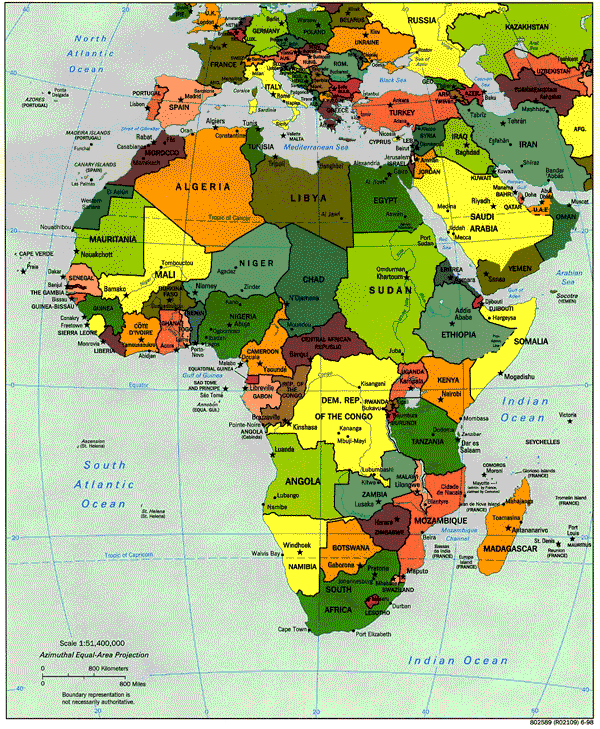
MAP above. Africom's regional interests. Copyright Stratcom 2011

The Washington-led decision by NATO to bomb Gaddafi's Libya into submission over recent months, at an estimated cost to US taxpayers of at least $1 billion, has little if anything to do with what the Obama Administration claims was a mission to "protect innocent civilians." In reality it is part of a larger strategic assault by NATO and by the Pentagon in particular to entirely control China's economic achilles heel, namely China's strategic dependence on large volumes of imported crude oil and gas. Today China is the world's second largest imported of oil after the United States and the gap is rapidly closing.

If we take a careful look at a map of Africa and also look at the African organization of the new Pentagon Africa Command—AFRICOM—the pattern that emerges is a careful strategy of controlling one of China's most strategically important oil and raw materials sources.

NATO's Libya campaign was and is all about oil. But not about simply controlling Libyan high-grade crude because the USA is nervous about reliable foreign supplies. It rather is about controlling China's free access to long-term oil imports from Africa and from the Middle East. In other words, it is about controlling China itself.

Libya geographically is bounded to its north by the Mediterranean directly across from Italy, where Italian ENI oil company has been the largest foreign operator in Libya for years. To its west it is bounded by Tunisia and by Algeria. To its south it is bounded by Chad. To its east it is bounded by both Sudan (today Sudan and Southern Sudan) and by Egypt. That should tell something about the strategic importance of Libya from the standpoint of the Pentagon's AFRICOM long-term strategy for controlling Africa and its resources and which country is able to get those resources. 

Gaddafi's Libya had maintained strict national state control over the rich reserves of high quality "light, sweet" Libyan crude oil. As of 2006 data Libya had the largest proven oil reserves in Africa, some 35%, larger even than Nigeria. Oil consessions had been extended to Chinese state oil companies as well as Russian and others in recent years. Not surprisingly a spokesman from the so-called opposition claiming victory over Gaddafi, Abdeljalil Mayouf, information manager at Libyan rebel oil firm AGOCO, told Reuters, "We don't have a problem with Western countries like the Italians, French and UK companies. But we may have some political issues with Russia, China and Brazil." China and Russia and Brazil either opposed UN sanctions on Libya or pressed for a negotiated settlement of the internal conflict and an end to NATO bombing.

As I have detailed elsewhere,1  Gaddafi, an old adherent of Arab socialism on the line of Egypt's Gamal Nasser, used the oil revenues to improve the lot of his people. Health care was free as was education. Each Libyan family was given a state grant of $50000 towards buying a new house and all bank loans were according to Islamic anti-usury laws, interest free. The state was also free of debt. Only by bribery and massive infiltration into the tribal opposition areas of the eastern part of the country could the CIA, MI6 and other NATO intelligence operatives, at an estimated cost of $1 billion, and massive NATO bombing of civilians, destabilize the strong ties between Gaddafi and his people.

Why then did NATO and the Pentagon lead such a mad and destructive assault on a peaceful sovereign country? Clear is that one of the prime reasons was to complete the encirclement of China's oil and vital raw material sources across northern Africa.

Pentagon alarm over China

Step-by-step in the past several years Washington had begun to create the perception that China, which was the "dear friend and ally of America" less than a decade ago, was becoming the greatest threat to world peace because of China's enormous economic expansion. The painting of China as a new "enemy" has been complex as Washington is dependent on China to buy the lion's share of the US Government debt in the form of Treasury paper.

In August the Pentagon released its annual report to Congress on China's military status. 2 This year the report sent alarm bells ringing across China for a strident new tone. The report stated among other things, “Over the past decade, China’s military has benefited from robust investment in modern hardware and technology. Many modern systems have reached maturity and others will become operational in the next few years,” the Pentagon said in the report. It added that “there remains uncertainty about how China will use its growing capabilities... China’s rise as a major international actor is likely to stand out as a defining feature of the strategic landscape of the early 21st century.”3

In a matter of perhaps two to five years, depending on how the rest of the world reacts or plays their cards, the Peoples' Republic of China will emerge in the controlled Western media painted as the new "Hitler Germany." If that seems hard to believe today, just reflect on how that was done with former Washington allies such as Egypt's Mubarak or even Saddam Hussein. In June this year, former US Secretary of the Navy and now US Senator from Virginia, James Webb, startled many in Beijing when he told press that China was fast approaching what he called a “Munich moment,” when Washington must decide how to maintain a strategic balance, a reference to the 1938 crisis over Czechoslovakia when Chamberlain opted for appeasement with Hitler over Czechoslovakia. Webb added, “If you look at the last 10 years, the strategic winner has been China.” 4

The same massively effective propaganda machine of the Pentagon, led by CNN, BBC, the New York Times or London Guardian will get the subtle command from Washington to "paint China and its leaders black." China is becoming far too strong and far too independent for many in Washington and in Wall Street. To control that, above all China's oil import dependency has been identified as her Achilles Heel. Libya is a move to strike directly at that vulnerable Achilles heel.

China moves into Africa

The involvement of Chinese energy and raw materials companies across Africa had become a major cause of alarm in Washington where an attitude of malign neglect had dominated Washington Africa policy since the Cold War era. As its future energy needs became obvious several years ago China began a major African economic diplomacy which reached a crescendo in 2006 when Beijing literally rolled out the red carpet to heads of more than forty African states and discussed a broad range of economic issues. None were more important for Beijing than securing future African oil resources for China's robust industrialization.

China moved into countries which had been virtually abandoned by former European colonial powers like France or Britain or Portugal.

Chad is a case in point. The poorest and most geographically isolated African countries, Chad was courted by Beijing which resumed diplomatic ties in 2006.    


In October 2007 China's state oil giant CNPC signed a contract to build a refinery jointly with Chad's government. Two years later they began construction of an oil pipeline to carry oil from a new Chinese field in the south some 300 kilometers to the refinery. Western-supported NGO's predictably began howling about environmental impacts of the Chinese oil pipeline. The same NGOs were curiously silent when Chevron struck oil in 2003 in Chad. In July 2011 the two countries, Chad and China celebrated opening of the joint venture oil refinery near Chad's capital of Ndjamena. 5 Chad's Chinese oil activities are strikingly close to another major Chinese oil project in what then was Sudan's Darfur region bordering Chad.

Sudan had been a growing source of oil flows to China since cooperation began in the late 1990s after Chevron abandoned its stake there. By 1998 CNPC was building a 1500 km long oil pipeline from southern Sudan oilfields to Port Sudan on the Red Sea as well as building a major oil refinery near Khartoum. Sudan was the first large overseas oilfield project operated by China. By the beginning of 2011 Sudan oil, most all from the conflict-torn south, provided some 10% of China's oil imports from taking more than 60% of Sudan's daily oil production of 490,000 barrels. Sudan had become a point of vital Chinese national energy security.

According to geological estimates, the subsurface running from Darfur in what was southern Sudan through Chad into Cameroon is one giagantic oil field in extent perhaps equivalent to a new Saudi Arabia. Controlling southern Sudan as well as Chad and Cameroon is vital to the Pentagon strategy of "strategic denial" to China of their future oil flows. So long as a stable and robust Ghaddafi regime remained in power in Tripoli that control remained a major problem. The simultaneous splitting off of the Republic of South Sudan from Khartoum and the toppling of Ghaddafi in favor of weak rebel bands beholden to Pentagon support was for the Pentagon Full Spectrum Dominance of strategic priority. 


AFRICOM responds

The key force behind the recent wave of Western military attacks against Libya or more covert regime changes such as those in Tunisia, Egypt and the fateful referendum in southern Sudan which has now made that oil-rich region "independent" has been AFRICOM, the special US military command established by the Bush Administration in 2008 explicitly to counter the growing Chinese influence over Africa's vast oil and mineral wealth.

In late 2007, Dr. J. Peter Pham, a Washington insider who advises the US State and Defense Departments, stated openly that among the aims of the new AFRICOM, is the objective of "protecting access to hydrocarbons and other strategic resources which Africa has in abundance ... a task which includes ensuring against the vulnerability of those natural riches and ensuring that no other interested third parties, such as China, India, Japan, or Russia, obtain monopolies or preferential treatment." 6

In testimony before the US Congress supporting creation of AFRICOM in 2007, Pham, who is associated with the neo-conservative Foundation for Defense of Democracies, stated:

"This natural wealth makes Africa an inviting target for the attentions of the People’s Republic of China, whose dynamic economy...has an almost insatiable thirst for oil as well as a need for other natural resources to sustain it...China is currently importing approximately 2.6 million barrels of crude per day, about half of its consumption; more than 765,000 of those barrels—roughly a third of its imports—come from African sources, especially Sudan, Angola, and Congo (Brazzaville). Is it any wonder, then, that…perhaps no other foreign region rivals Africa as the object of Beijing’s sustained strategic interest in recent years...

Intentionally or not, many analysts expect that Africa—especially the states along its oil-rich western coastline—will increasingly becoming a theatre for strategic competition between the United States and its only real near-peer competitor on the global stage, China, as both countries seek to expand their influence and secure access to resources."7

It is useful to briefly recall the sequence of Washington-sponsored "Twitter" revolutions in the ongoing so-called Arab Spring. The first was Tunisia, an apparently insignificant land on north Africa's Mediterranean. However Tunisia is on the western border of Libya. The second domino to fall in the process was Mubarak's Egypt. That created major instability across the Middle East into north Africa as Mubarak for all his flaws had fiercely resisted Washington Middle East pollicy. Israel also lost a secure ally when Mubarak fell.  

Then in  July 2011 Southern Sudan declared itself the independent Republic of South Sudan, breaking away from Sudan after years of US-backed insurgency against Khartoum rule. The new Republic takes with it the bulk of Sudan's known oil riches, something clearly not causing joy in Beijing. US Ambassador to the UN Susan Rice, led the US delegation to the independence celebrations, calling it "a testament to the Southern Sudanese people." She added, in terms of making the secssion happen, "the US has been as active as anyone." US President Obama openly supported seccession of the south. The breakaway was a project guided and financed from Washington since the Bush Administration decided to make it a priority in 2004. 8          

Now Sudan has suddenly lost its main source of hard currency oil revenue. The secession of the south, where three-quarters of Sudan’s 490 000 barrels a day of oil is produced, has aggravated economic difficulties in Khartoum cutting some 37% off its total revenues. Sudan’s only oil refineries and the only export route run north from oilfields to Port Sudan on the Red Sea in northern Sudan. South Sudan is now being encouraged by Washington to build a new export pipeline independent of Khartoum via Kenya. Kenya is one of the areas of strongest US military influence in Africa.9

The aim of the US-led regime change in Libya as well as the entire Greater Middle East Project which lies behind the Arab Spring is to secure absolute control over the world's largest known oil fields to control future policies in especially countries like China. As then US Secretary of State Henry Kissinger is reported to have said during the 1970's when he was arguably more powerful than the President of the United States, "If you control the oil you control entire nations or groups of nations."

For the future national energy security of China the ultimate answer lies in finding secure domestic energy reserves. Fortunately there are revolutionary new methods to detect and map presence of oil and gas where even the best current geology says oil is not to be found. Perhaps therein lies a way out of the oil trap that has been laid for China. In my newest book, The Energy Wars I detail such new methods for those interested.


F. William Engdahl is author of Full Spectrum Dominance: Totalitarian Democracy in the New World Order
 Notes
1 F. William Engdahl, Creative Destruction: Libya in Washington's Greater Middle East Project--Part II, March 26, 2011, accessed in http://www.globalresearch.ca/index.php?context=va&aid=23961
2 Office of the Secretary of Defense, ANNUAL REPORT TO CONGRESS: Military and Security Developments Involving the People’s Republic of China 2011, August 25, 2011, accessed in www.defense.gov/pubs/pdfs/2011_cmpr_final.pdf.
3 Ibid.
4 Charles Hoskinson, DOD report outlines China concerns, August 25, 2011, accessed in http://www.politico.com/news/stories/0811/62027.htmlhttp://www.politico.com/news/stories/0811/62027.html
Xinhua, China-Chad joint oil refinery starts operating, July 1, 2011, acessed in http://english.peopledaily.com.cn/90001/90776/90883/7426213.html. BBC News, Chad pipeline threatens villages, 9 October 2009, accessed in http://news.bbc.co.uk/2/hi/8298525.stm.
6 F. William Engdahl, China and the Congo Wars: AFRICOM. America's New Military Command, November 26, 2008, accessed in http://www.globalresearch.ca/index.php?context=va&aid=11173
7 Ibid.
8 Rebecca Hamilton, US Played Key Role in Southern Sudan's Long Journey to Independence, July 9, 2011, accessed in http://pulitzercenter.org/articles/south-sudan-independence-khartoum-southern-kordofan-us-administration-role
9 Maram Mazen, South Sudan studies new export routes to bypass the north, March 12, 2011, accessed in http://www.gasandoil.com/news/2011/03/south-sudan-studies-routes-other-than-north-for-oil-exports

F. William Engdahl is a frequent contributor to Global Research.  Global Research Articles by F. William Engdahl

Ahmadinejad's unedited remarks to United Nations General Assembly


From the UN: Iranian President Mahmoud Ahmadinejad's speech to the UN General Assembly minus the commentary and spin from Israel's propaganda machine of AIPAC, ADL, MEMRI, and CAMERA.


Click here for original transcript from the Iranian Mission to the UN.

A depressed president Obama hooked on Google "vanity searches"


WMR has learned from government sources with close contacts inside the White House that media reports that The New York Times is developing a story on President Obama suffering from clinical depression are correct and that Obama is fixated on how the media, including certain web sites, view his presidency.

WMR has previously reported on Obama's narcissistic personality and how it has adversely affected his leadership capabilities as president. Obama's day usually begins by his conducting "vanity searches" on Google to see how he is being treated by both the main stream media and political blogs. When he encounters negative articles, Obama flies of the handle in a rage punctuated by the use of foul language, according to sources close to the White House. Obama is reportedly totally obsessed with how the media is covering him.

Obama's three major interlocutors between his administration and Democratic Party officials and the Congress -- chief of staff Bill Daley, First Lady Michelle Obama, and political adviser Valerie Jarrett -- have concluded the best current course of action is to keep Obama in the environment he handles best: the campaign trail where he is the focus of adulation by swooning crowds.

WMR has been told by informed sources that when he first read our accounts of his background with the CIA, including his employment with Business International Corporation, and the CIA histories of his mother and grandparents, Obama flew into a rage -- the possible source for three independent reports that indicated that the White House wanted this editor "dead."

Privately, some White House officials have expressed fear to Democratic Party officials and elected Democratic office holders around the nation that Obama is on the verge of a mental breakdown. The White House officials believe that only by putting Obama in front of adoring crowds in a carefully-orchestrated campaign mode can they buy time for the administration. However, the White House sources have expressed grave doubts about Obama's ability to maintain his composure when faced with growing criticism. Their worst fear is that Obama will suffer from a public breakdown, sealing the end of his re-election chances and dooming the down-ticket electoral prospects for the Democratic Party in 2012 and beyond.

When faced with impeachment during his final months in office, Richard Nixon, who also suffered from depression and was drinking heavily and taking anti-depressants, opted to resign from office in August 1974. Nixon's predecessor, Lyndon Johnson, depressed over the failure of his Vietnam War strategy, opted to forego his re-election campaign in March 1968.

Observers of White House politics have pointed to Daley using the term "I" when he is discussing the administration's policies, an indication that Daley is increasingly calling the shots on major policy issues in the White House. However, Daley's increased profile has resulted in growing friction between him and Jarrett and the First Lady.

Obama is known to search the Internet for stories about himself before he receives the President's Daily Brief from top intelligence officials. Woe be it to any intelligence briefer who reports on information obtained from open sources. Obama, who, in many cases has already read such accounts, will let loose with a barrage of abusive epithets, yelling, at times, "I already know that you stupid motherfucker!"

Ron Suskind's new book, "Confidence Men," which mainly concerns the dysfunctional nature of the Obama White House, has resulted in a full-court press being directed by the White House and its spin doctors against the Pulitzer Prize-winning journalist.

When asked whether one or more over-zealous White House aides may have taken Obama's rage at this editor for the reports about the CIA backgrounds of Obama and his family as a  reason to convey a personal threat, the answer was that, given the current nature of the White House staff, such a scenario was more than likely. We have also been told that Obama was well-aware of this editor's recent foray into Indonesia in search of details about his and his family's time in that country.

Friday, September 23, 2011

When Congress used to investigate the CIA


In 1977, the Senate Select Committee on Intelligence conducted a detailed investigation of the CIA's mind control program MK-ULTRA. Today, discussions of MK-ULTRA are relegated to the "conspiracy theory" category, but it wasn't always that way.

Click for download of Senate hearing transcript. This report does not disappoint.

WMR previously reported on the connection of the Human Ecology Fund and the CIA-funded work of anthropologists like Stanley Ann Dunham. Was the highly classified QKHILLTOP, which became the Human Ecology Fund, the covert program under which Stanley Armour and Stanley Ann Dunham first operated?

From WMR, March 28, 2011 -- "An even darker side to the CIA's use of anthropologists in its research was the involvement of the CIA front, the Society for the Investigation of Human Ecology and the Human Ecology Fund, in research projects that involved the study of sex, stress, and refugees. These studies, a personal favorite of CIA director Allen Dulles, involved the study of human pain, methods of persuasion, and enhanced interrogation practices. The CIA 'human ecology' projects link the CIA's MK-ULTRA, MK-NAOMI, and MK-DELTA psychological operations to field programs such as those involving both Ann Dunham and her husband, Lolo Soetoro, a participant in counter-insurgency operations in Indonesia and West Papua on the island of New Guinea.  The [UCLA Ralph] Beals Report cites 'large and unstudied' New Guinea  as being 'saturated' by an 'increasing number of social scientists' who began encountering one another in the field."

Message from Cynthia McKinney -- Troy Davis and other issues


Cynthia McKinney
The art of leadership and the fight for justice
What role outrage?
22 September 2011 (the morning after)

After Georgia was forced by the United States Supreme Court to abandon its scheme to deny Black people the right to an undiluted vote and representation, Leroy Johnson became the first Black person elected to the Georgia State Senate since Reconstruction.  The year was 1962.  During his tenure, Johnson used his considerable influence inside the body to become the Senate's Chair of the Judiciary Committee.  From this position, he was able to bottle-up legislation that was bad for the State of Georgia, especially its Black residents.  Outside and inside the State Senate, Leroy Johnson practiced the art of leadership and engaged in the fight for justice.  He produced solid results for a people who were hungry for justice.  Who among our elected officials today exercises the art of leadership in an engaged struggle for justice?  Sadly, the numbers are way too small. It is more expedient to exchange silence for merely "being there," in the end exercising no leadership at all and becoming a spectator to power in abandonment of those who need the effective use of power the most.  The art of the struggle has veritably been abandoned for merely occupying a seat at the table when the purpose of the struggle for the seat at the table was to empower the struggle for justice.  The only reason we send people to occupy that seat is to leverage the power of the community where power is exercised, on behalf of those who need it the most.

As I was commiserating over the Troy Davis situation with a former member of the Georgia Legislature who rose to the highest possible position within that body for his party, he lamented that for all of his years in the Legislature, he had not introduced a single death penalty bill.  I quickly interjected that he was so busy putting out other fires and sticking his fingers in all the holes of the leaky dikes and schooling his colleagues on the effective use of the power of their elected positions that he couldn't do everything.  It will be interesting to see what legislative actions his former colleagues will initiate in the face of this clear act of barbarism by my state.

Occupying these "seats at the table" is important.  Engaging in the struggle for justice is important.  And contrary to what many would have us believe, leadership is important.  That's why so much effort is spent on co-opting or marginalizing the leaders of conscience that we do have and preventing authentic representatives of our values to occupy those seats at the table.

Therefore, more is required of us.  We must hone the skill of discernment.  We must not give our vote to just anybody to occupy these positions of power.  We must not allow "posers" to represent us.  Posers are those who wear the jackets of authority, who are put in positions of power by us, but who do not engage in the artful use of that power on our behalf.  Discerning who is friend and who is poser has been difficult.  But, is being made more possible by the arrogance now of those who do not have the interests of the people at heart.  They seem not to care that their "neanderthal" is showing.  But we can look at them and clearly see that they ain't us.  Their actions are a clue that they do not share our values.

Unfortunately, posers exist all around us: and in the media, too.  The job now of people of conscience is to make sure that we don't enable these posers by our own supportive behavior.  My friend reminded me that Leroy Johnson, alone in the Georgia State Senate, was more powerful in the 1960s than are the 55 Black members of the Georgia Legislature now.  We need to stop and think about that.  

More is less?  What role have we all had to play in such a circumstance?  Is our leadership more of a reflection of who we are than we have acknowledged?  What can we do differently in order to get a better result?

Abu Ghraib has its antecedents right here in the United States.  The violence sponsored by the United States abroad has its origins inside the United States.  As the United States and NATO drop bombs on unsubmitting African people in Libya, the United States kills an innocent Black man in Georgia.  There is more to come unless we affirmatively take steps to stop it.  Republican voters cheered at the prospects of more executions at a recent Presidential debate.  In a recent article, http://www.defense.gov/news/newsarticle.aspx?id=65344, Africom brags on its lessons learned from Libya:  

The command had to define what effects it needed, and what specific targets would contribute to achieving those effects – a precise endeavor, Ham said. If attacking a communications node, planners must ask themselves what does that particular node do? How does it connect to other nodes? What’s the right munition to use? What’s the likelihood of collateral damage? What’s the right time of day to hit it? What’s the right delivery platform? And finally, how to synchronize attacks.
“That level of detail and precision … was not something the command had practiced to the degree that we were required to do in Odyssey Dawn,” Ham said. . . . If we were to launch a humanitarian operation, how do we do so effectively with air traffic control, airfield management, those kind of activities?” he said.
The United States has to craft those practices with African partners, he added.
U.S. allies in Libya are as barbaric as their sponsors.  Despite youtube's efforts to dissuade  it from being seen, please watch this video sent to me from France:  http://www.youtube.com/watch?v=00LBdf1uy2E&feature=player_embedded&skipcontrinter=1

As committed Libyans valiantly resist the entire NATO arsenal of modern and old-fashioned killfare, a new kind of perverse global plantation is being created.  There is a clear and present danger that Africa and Asia will become U.S. killing fields for the next decade or more while the United States, itself, becomes a police state--unless we stop this poser leadership that really stopped representing us a long t.  If we fail to stop them, watch that video again--and welcome to the new America, hauntingly familiar to a place we never left.

Tuesday, September 20, 2011

Israel's nuclear smuggling network was key element in Carnaby murder in Houston


Israel, working with deeply-embedded intelligence moles in the United States, including within the U.S. government and "off-the-books" intelligence front companies, has been pilfering spent U.S. nuclear fuel from American nuclear arms caches at a phenomenal rate over the last several years. U.S. and foreign intelligence sources have confirmed that much of the nuclear fuel has been shipped to Israel and other locations via the port of Houston.

The illegal smuggling of spent highly-enriched uranium (HEU) and plutonium fuel from U.S. nuclear weapons facilities is the same outbound Houston shipping pipeline used by Bush-influenced Carlyle Group and the firm's front companies in Spain and France to ship precursor nerve gas chemicals to Saddam Hussein's Iraq in the 1980s, according to one Pentagon intelligence source.

The nuclear smuggling is a major back story to a September 8 Government Accountability Office (GAO) report titled "Nuclear Nonproliferation: U.S. Agencies Have Limited Ability to Account for, Monitor, and Evaluate the Security of U.S. Nuclear Material Overseas." The most serious finding in the GAO report states:

"DOE [Department of Energy], NRC [Nuclear Regulatory Commission], and State are not able to fully account for U.S. nuclear material overseas that is subject to nuclear cooperation agreement terms because the agreements do not stipulate systematic reporting of such information, and there is no U.S. policy to pursue or obtain such information. U.S. nuclear cooperation agreements generally require that partners report inventory information upon request, however, DOE and NRC have not systematically sought such data. DOE and NRC do not have a comprehensive, detailed, current inventory of U.S. nuclear material--including weapon-usable material such as highly enriched uranium (HEU) and separated plutonium--overseas that includes the country, facility, and quantity of material. In addition, NRC and DOE could not fully account for the current location and disposition of U.S. HEU overseas in response to a 1992 congressional mandate. U.S. agencies, in a 1993 report produced in response to the mandate, were able to verify the location of 1,160 kilograms out of 17,500 kilograms of U.S. HEU estimated to have been exported. DOE, NRC, and State have established annual inventory reconciliations with five U.S. partners, but not the others it has transferred material to or trades with."

The report also states that a nuclear cooperation agreement between the United States and Israel was allowed to lapse. The GAO report also states: "DOE's Global Threat Reduction Initiative (GTRI) removes U.S. nuclear material from vulnerable facilities overseas but can only bring back materials that have an approved disposition pathway and meet the program's eligibility criteria." WMR has been informed that because of the amount of HEU and plutonium smuggled from the United States outside of "approved disposition pathways," there is no way for the United States to know exactly where HEU and plutonium has been distributed, especially to unauthorized end-users who have been using the spent nuclear material in violation of the nuclear non-proliferation treaty (NPT) or U.S. export control laws. Countries that fall into this category, according to our sources, include Japan, Israel, South Korea, North Korea, Saudi Arabia, India, Syria, Iran, Burma, Egypt, Turkey, Taiwan, and Pakistan.

The major reason behind the nuclear material smuggling from the United States stems from Israel quietly re-establishing its global nuclear smuggling operations, rampant during the 1960s when it was working to acquire nuclear weapons. Israel's Dimona nuclear reactor capabilities have always been clouded in maximum secrecy but it is known that the facility suffered a major equipment failure in the 1990s that impacted on Israel's ability to re-process nuclear fuel. The diminished capabilities of the Negev Nuclear Research Center prompted Israel, in the 1990s, to actively smuggle nuclear materials, including enriched plutonium, to Israel. The smuggling operations immediately became known to the CIA's Counterproliferation Division and its non-official cover (NOC) Brewster Jennings & Associates operation headed up by Valerie Plame Wilson's. It was a major reason why Vice President Dick Cheney, his counsel Scooter Libby, State Department Undersecretary for Political Affairs (and President Obama's current envoy to Afghanistan and Pakistan) Marc Grossman, and others within the Bush administration exposed the Brewster Jennings operations.

Israel's search for replacement enriched plutonium hit pay-dirt when its intelligence service discovered that the Pantex nuclear facility near Amarillo, Texas, stores enriched plutonium fuel that is 99 percent pure plutonium that does not require reprocessing for another 60 to 90 years. Israel gained access to the classified details of the Pantex operation by tapping into classified government communication networks through the Israeli-owned communication company AMDOCS.

The Israelis discovered that only U.S. nuclear cores composed of plutonium alloys were ripe for theft at Pantex. The 99 percent plutonium fuel was more well-guarded. However, the older plutonium alloy cores were unstable and the shipment of the cores through the port of Houston required refrigerated containers to keep them cooler than 150 degrees.The Israelis used refrigeration trucks to move the cores through the port of Houston from Amarillo and into refrigeration containers loaded on board ships belonging to Zim-American Israeli Shipping Company, a firm with close links to the Mossad. The plutonium cores were shipped to Israel and Dimona.


One individual who had the port of Houston under close scrutiny was CIA contractor/informant/source Roland "Tony" Carnaby. Carnaby had set up a number of video surveillance cameras at the port of Houston and routinely uploaded the stored videos from the camera units to his Macintosh computer. WMR has learned from intelligence sources that Carnaby possessed a major secret about the smuggling operation: much of the nuclear material being shipped through Houston by Israel, more than its needs, was being re-sold by Israel on the international black market. On April 29, 2008, Carnaby was shot to death by two Houston police officers after what was reported to have been a high-speed chase by police. After he was killed, the Houston police took possession of Carnaby's Macintosh computer. WMR previously reported that Carnaby kept Israeli intelligence assets and agents under close scrutiny in Houston and that he had a strange encounter with an Israeli Consulate General official the evening before he was shot. WMR also previously reported on Mossad's penetration of the Houston Police Department and the Harris County Sheriff's Office. Radiation detectors routinely scan containers at Houston for the presence of nuclear materials, hence, it was important for the Mossad to counteract Carnaby's security systems at the port.


It is known that Carnaby used a number of cell phones to dial into port video cameras to turn them on, stop them, and download captured video data. However, an Israeli firm, Orsus, was scheduled to begin installation of its own surveillance at the port, putting Carnaby's surveillance operations in jeopardy. The financial backers of Orsus include ComSor Venture Fund LDC, a joint operation of Comverse Technology, which includes its subsidiary Verint Systems, and Soros Fund Management's Quantum Industrial Holdings Ltd. Other investors in Orsus include Israel's Koor Industries, the leading shareholder of Tadiran, the Israeli defense electronics firm; Cial Industries and Investment, an Israeli holding company; the Cedar Fund, an 'Israeli-related' venture capital firm; Israel Infinity Venture Capital Fund; and Poalim Capital Markets, a subsidiary of Bank Hapoalim, Israel's largest bank."

Carnaby was, reportedly, working with the FBI on the Israeli nuclear smuggling issue and the FBI office in Houston requested that the Houston police call off their chase of Carnaby. It was too late for Carnaby. He was marked for assassination by Mossad and its friends in Houston area law enforcement because of his knowledge of the nuclear smuggling program. Israel was also concerned that Carnaby, a Lebanese-American with close ties to some of Lebanon's political groups opposed to Israel, might leak details of the operations to his Lebanese friends, information that would soon end up in the hands of Iranian and Syrian counter-intelligence.

One of the countries that received re-sold American plutonium fuel from Israel was Japan. However, the Japanese soon discovered that the plutonium for which they were paying the Israelis top dollar was too old and provided only short-life usable nuclear weapons. Japan decided to go it alone on their nuclear weapons development but not before they planned to blow the whistle on the Israeli and American smuggling operation to the International Atonic Energy Agency (IAEA). Before the Japanese could act, the super-quake struck Japan, along with the devastating tsunami. At that point in time, Israel and the Americans programmed their Stuxnet computer virus to trigger the nuclear catastrophe at Fukushima, the major site for Japan's nuclear weapons development program. Stuxnet, developed to disrupt Iran's nuclear program, is also effective against the nuclear power generation systems of other nations using standard supervisory control and data acquisition (SCADA) software, including the plutonium MOX fuel processing operations at Fukushima. Stuxnet can be used to blackmail recipients of the smuggled plutonium material, including MOX fuel, into silence. The Fukushima disaster destroyed physical evidence of the Israeli smuggling operation to Japan. However, Japanese intelligence possesses other evidence of the Israeli smuggling operations.

The recent explosion at a MOX fuel plutonium processing facility at the French Marcoule nuclear power plant was a warning to France, courtesy of Stuxnet, not to support Palestine's bid for UN membership. It is not yet clear whether the MOX being used at Marcoule was developed from the unstable and old American plutonium cores smuggled and re-sold by Israel. However, U.S. intelligence has evidence that Israel has re-sold some of its stolen plutonium material to India in return for that nation providing Israel with missile systems and related technology.
The disassociation of the CIA and FBI from interest in Carnaby's murder in Houston was directly linked to the power of the Israel Lobby in Washington, which will stop at nothing to ensure that Israeli crimes and intelligence activities in the United States remain unexposed and unpunished.

Tuesday, September 13, 2011

Enduring freedom forever By Pepe Escobar

THE ROVING EYE

The West in vain tries to find
a form of agony worthy of its past
- E M Cioran


Enduring Freedom is how the United States government defined its official, military response to 9/11. It should have been Operation Infinite Justice; but then some apparatchik found out that also happened to be a definition of God. Ten years after 9/11, facts on the ground spell out a world shocked and awed to endure war rather than justice, while freedom, shrinking by the minute, is just another word for everything left to lose.

Osama bin Laden used to define 9/11 as Yaum Niu York ("the day of New York"). Little did the now decomposed corpse at the bottom of the Arabian Sea know he would unleash an early 21st century conformed as a wasteland littered with militarized newspeak [1].

Ground Zero spawned the George Bush-designated global war on terror (GWOT), a nonsensical war against a tactic. A more realistic Pentagon called it The Long War. United States national security morphed into Homeland Security. The threatened hyperpower rushed to manufacture a fearful civil liberty shredder, the Patriot Act, approved by Bush on October 2001, and enshrined as permanent in March 2006.

For Washington, 9/11 was never about blowback. It happened because of a dysfunctional system displaying failure of imagination. After the fact, world public opinion never ceased to be massaged by an army of message force multipliers, from defense specialists to security experts. And an array of Code Oranges, elevated security concerns and specifics-free warnings kept the US masses on its toes.

Faster than the speed of rumor, Humint, Sigint, Imint (human, signals and imagery intelligence), backed up by Techint and CI (technical and counter intelligence) merged into a swarm of psyops (usually relying on bad humint). But for all its technical wizardry, the US government botched the elusive goal of Total Information Awareness (TIA) - a megalomaniac, Dr Strangelove-style project by the Pentagon's DARPA (Defense Advanced Research Projects Agency).

After the end of the USSR, a flimsy al-Qaeda had been elevated to the status of global bogeyman. That was in reference to al-Qa'eda al-Askariyya ("the military base"), an obscure outfit whose existence was officially acknowledged on February 23, 1998 as part of a World Islamic Front to fight Jews and Christians, founded at a meeting in Peshawar, Pakistan.

Bin Laden always characterized al-Qaeda as a training-and-fighting, loose network - as much as he exhorted the cavalry of Islam to do battle. Bin Laden was essentially a fundamentalist Wahhabi who felt a duty to fight jahiliyya ("ignorance") - understood as much in Egyptian fundamentalist Sayyid Qutb's sense (as infidel Arab regimes), as in the ignorance predominant before the arrival of Islam in the 7th century.

Instead of being bombed to the stone age, Pakistan under then-president Pervez Musharraf (or "Busharraf") joined GWOT. In a planetary screenplay, jihadis - or Islamo-fascists - were universally depicted as the bad guys, while the mujahideen had been the good guys when still promoted as freedom fighters during the 1980s anti-Soviet jihad.

In Afghanistan, the Taliban were duly bombed out of power. Bin Laden and Ayman al-Zawahiri escaped from Tora Bora to a black void. And then the dark side became the new normal.

Burn, trillions, burn
Bush's Iraq adventure - sold to the world by Curveball, aka phony Iraqi defector Rafid Ahmed Alwan - was the first war in history entirely paid by credit card. By 2008, Joseph Stiglitz and Linda Bilmes calculated the Afghanistan/Iraq wars were costing up to $5 trillion - and counting. Direct US government spending alone was roughly $2 trillion, and counting - $17,000 for every US household.
Back in 2002, real power in Washington revolved around the Office of Special Plans - that Soviet-sounding unit bent to prove there was a direct link between Iraq and al-Qaeda. Everybody else would be off-message - also as in critics of the war after the fall of Baghdad in April 2003.

For the neo-cons - who knew absolutely nothing about Iraq - what counted was the positive domino theory; invading Iraq would set up a wave of democracy all across the Arab world. Arabs would finally become model Americans.

The Bush-Dick Cheney junta may have enshrined pre-emptive war (justified by international law only when there's an imminent danger). That was the Bush doctrine, announced in January 2002. But after Shock and Awe, the Iraq muqawama ("resistance") had other ideas.

Sunni Iraqis rallied around "resistance" instead of "national liberation", as the Americans preferred the innocuous insurgency, whose connotations avoid the reality of revolt, revolution and civil war.

Soon martyrdom operations - what the West calls suicide bombing, and what used to be known in Arabic as amaliyya intihariyya ("suicidal mission") - were the law of the land. Every newscast was dripping with improvised explosive devices (IEDs) - later developed into VBIEDs, vehicle-borne IEDs; radiological dispersal devices (aka dirty bombs); and explosively formed penetrators. There was no safe haven for anybody (a tautology, since a haven must be safe).

The hyperpower was now ruled by a ticking bomb principle - according to which the US could not afford to play by the rules anymore. Yet there was always a scarcity of actionable information. Thus the constant tweaking of the rules of engagement; the US Marines, for instance, followed shout, show, shove, shoot - where "shoot" almost always trumped the other three.

Tweaking the rules inevitably led to an alternative set of procedures ; controversial interrogation techniques, enhanced interrogation techniques, harsh interrogation techniques and even dark art deployed against alleged enemy combatants (the pre-9/11 distinction between enemy and unlawful combatant had totally vanished).

It was imperative to send scores of enemy combatants or high value terrorist suspects to the Baghdad Correctional Facility - aka Torture Central Abu Ghraib, where biscuits (Behavioral Science Consultation Teams, trained in Fort Bragg's SERE - Survival, Evasion, Resistance and Escape - school) would conduct interrogation.

Biscuits were introduced into the famous detention facility Guantanamo by Major General Geoffrey "we gotta Gitmo-ize" Miller and then - successfully - transported to Abu Ghraib. Gitmo-ize meant the gory spectacle of forced nudity, hooding, men shackled in painful stress positions, dog attacks, walling and waterboarding - a remix of the Vietnam-era pump and dump (pump them for information and then dump their bodies).

Excesses of course were not caused by George "you have to treat these detainees like dogs" Miller's policies, but by a few bad apples. And damn those quaint Geneva conventions.

The world was also introduced to extraordinary rendition - aka state kidnapping and deportation - via a flotilla of Central Intelligence Agency (CIA) ghost planes. The practice of outsourcing torture was in fact contract killing handed over to the security agencies of Egypt, Jordan, Syria, Libya, Morocco, Saudi Arabia, Pakistan and rough ally Uzbekistan, much adept at boiling of body parts and electroshocks on genitals.

Blackwater - later renamed Xe - became the Holy Grail of the mercenary-evangelical complex, making a killing in Iraq, as well as hordes of defense contractors and private security contractors - aka mercenaries.

Apologists of the August 2002 torture memo wildly cheered American troops who subscribed to the torture crowd, while smirking over torture lite. For Dick "Angler" Cheney, waterboarding was a "no-brainer", a "dunk in the water".

But then Iraq became a quagmire. The Bush-Cheney junta chose to dodge a Babel of war assessments and a benchmark hell in Iraq by ordering a surge, while building Fortress Baghdad - aka the US Embassy, the largest in the world.

And then the war in Afghanistan, like a bat out of hell, came out of a prolonged coma with a vengeance, and morphed into an American/European war against Pashtuns, first-class warriors who have defeated every empire in sight. The recipe for a Western "victory" was yet another surge.

Our way or the highway
The Pentagon's Long War couldn't do it; people in Northern Africa did it. The Arab Spring defeated 9/11, and defeated al-Qaeda. It even defeated Osama bin Laden before the Abbottabad raid (essentially a targeted assassination performed by a commando after the invasion of the aerial space of a sovereign nation).

But just as the Arab Spring also seemed to have defeated the fallacy of that Holy Triad - Islamophobia, the clash of civilizations and the end of history ...

... Everything turned kinetic, via Operation Odyssey Dawn. Washington, London and Paris decided to ditch international law as it was in effect since the 1648 Treaty of Westphalia. R2P - "responsibility to protect" civilians - had its ballistic baptism, the perfect humanitarian cover for the defense of Atlanticist economic and strategic interests. With the added benefit of Nobel Peace Prize winner and multiple war developer Barack Obama presiding over the metamorphosis of NATO into a global Robocop - with or without a UN green light. The West's got a brand new bag; a global militia.

Iraq - bypassing the United Nations - was about regime change. Libya - with UN blessing - was also about regime change, even though Obama swore it wasn't.

Ten years after 9/11, The Long War metamorphosed into fourth-generation warfare - theoretically "new" asymmetric warfare cum counter-insurgency. Welcome to the CIA as a paramilitary militia. Welcome to Dronistan - General Atomics MQ-1 Predators targeting militants and indulging in the odd collateral damage - as in terminating Pashtun weddings.

And welcome to the Joint Special Operations Command (JSOC), developed by former Iraq surge hero and current CIA director General David Petraeus as "an almost industrial-scale counter-terrorism killing machine", as defined by Petraeus minion John Nagl.

The JSOC is what in Latin America in the 1970s was known as a death squad, but now under the Pentagon direct aegis; masters of kill/capture, based on a flimsy legal or blatantly extra-legal premise, going after a target assassination list that even includes American citizens.

Will the circle be unbroken? Of course not; Obama's American Way of War - now boasting virtually zero casualties, as in Libya - has the same objectives as Bush's.

The Pentagon will leave Afghanistan and Iraq over its dead collective body. The Pentagon will set up an Africom base in Libya. Amid a deluge of known unknowns, unknown unknowns, these are the real birth pangs of a new Middle East. What really matters is the Pentagon's obsession in controlling the whole arc of instability. Remember fiery Washington neo-con rhetoric between the early 2002 axis of evil speech and the March 2003 invasion of Iraq; real men go to Tehran. The Playstation King of Jordan and the arch-counter-revolutionary King of Saudi Arabia will keep harping about the existential threat of the Shi'ite crescent.

Furious and/or dejected hearts and minds all across the arc of instability will remain alienated. All manner of blowback will prevail. For instance, one just has to time how long will it take for Libya to be raped by NATO powers. Blowback? Bring them on, the CIA/Pentagon would brag. It will be a cakewalk.

So what rough beast, its hour come out at last, will be slouching towards ... Kabul? Baghdad? Tripoli? Riyadh? ... to be born? There's no endgame in sight; that's the real meaning of Mission Accomplished. Ten years after 9/11, the road to war is a mission that goes on forever.

Note
1. Hats off to the late, great Fred Halliday of the Barcelona Institute for International Studies, compiler of Shock and Awed: a dictionary of the war on terror (University of California Press, 2010).

Pepe Escobar is the author of Globalistan: How the Globalized World is Dissolving into Liquid War (Nimble Books, 2007) and Red Zone Blues: a snapshot of Baghdad during the surge. His new book, just out, is Obama does Globalistan (Nimble Books, 2009).

He may be reached at pepeasia@yahoo.com.


Another Century of War - by Stephen Lendman


Post-9/11, new millennium Bush and Obama policies eroded democracy, institutionalized state repression, accelerated economic decline, launched multiple imperial wars, and headed America for tyranny and ruin.

Neither will live down that legacy. Nor will complicit Republicans and Democrats, destroying nation for unbridled self-interest. As a result, in the century's second decade, America's no longer fit to live in. Imagine its far worse state years from now, resembling the worst of banana republic harshness, deprivation, and despair.

A frightening prospect, it goes largely unacknowledged until finally recognized too late to:

-- derail America's addiction to war;

-- prevent completing the grandest of grand theft looting of public and working household assets;

-- deter the destruction of eroding democratic values;

-- stop the transformation of America into a full-blown fascist police state; as well as

-- wreck the country in the process, leaving behind a rotting sinkhole of dystopian harshness, inequality, and depravation.

Yet it's clear. Corporate omnipotence and wars are immoral, illegal, harmful to popular interests, and only happen when corrupt officials betray the public trust, selling their souls for power and personal gain.

Imagine the difference if militarism and imperial wars ended, replaced by a commitment to peace and dedication to devote public resources to productive economic growth, benefitting everyone in the process.

In his seminal book, "A Century of War," Gabriel Kolko called the 20th century:

"the bloodiest in all history. More than 170 million people were killed." In WW II, 70% of them were civilians, "mainly (from) the bombing of cities by Great Britain and America." There was nothing good about "the good war" nor any others.

In Kolko's "Another Century of War?" he stressed how America contributes to much of the world's disorder through interventions, and as being the world's largest arms producer and exporter, profiting by proliferating death and destruction.

Post-WW II, Washington became a global menace, today calling "terrorism" the main threat - a bogus fiction to justify militarism and perpetual wars, heading the nation for moral, political and economic bankruptcy. According to Kolko:

"The way America's leaders are running the nation's foreign policy is not creating peace or security at home or stability abroad. The reverse is the case: its interventions have been counterproductive."

As a result, he believes the Korean War began America's decline, followed by successive policy failures, notably Vietnam, exacerbated further post-9/11.

As a result, its century of domination is ending, but who can predict how, when, or potential disasters it may cause before it does, including perhaps to planet earth, already dying from avoidable toxins.

With leaders like Bush and Obama, and likely worse ones to follow, Chalmers Johnson, before his 2010 death, said the "extinction that befell....the Soviet Union (was) unavoidable."

The same fate awaits America, he believed, stopping short of suggesting a mushroom-shaped cloud end to consume much more than one nation. It's because US policy's on a nuclear hair trigger, a reinvented MAD.

It threatens the unimaginable, bolstered by annual $1.5 trillion "defense" budgets, including all related categories, more than the rest of the world combined at a time America has no enemies except ones it invents.

As a result, he saw America heading for bankruptcy, authoritarian rule and loss of personal freedom, believing those elements approached fruition.

Begun under earlier presidents, Bush and Obama accelerated America's current state, noticeably by:
an abdication of rule of law principles, erosion of democratic values, and loss of personal freedoms, including due process and judicial fairness;

a nation with no enemies permanently at war;

secret, unaccountable global prison gulag, at home and abroad;

orture as official policy;

persecuting and scapegoating, Blacks, Latino immigrants, Muslims, and other minorities for political advantage;

he most secretive, intrusive, repressive government in our history under lawless, duplicitous leaders;

omeland social decay;

wrecking the economy to enrich bankers, war profiteers, and other corporate favorites;

an unprecedented wealth disparity combined with out-of-control corporate power;

a corrupt two-party duopoly, serving wealth and power at the expense of growing need;

weakened checks, balances and separation of powers;

a dysfunctional Congress, beholden to powerful corporate interests, notably Wall Street, war profiteers and Big Oil;

a secret, unaccountable intelligence establishment with near-limitless funding;

a corporate-controlled media, manipulating the public mind with managed news and infotainment;

a destructive military/industrial/intelligence service/media/think tank/academia complex Dwight Eisenhower couldn't have imagined when he warned about its lesser incarnation in his farewell address; and

endemic corruption, stemming from incestuous ties between government and business, flaunting the notion of government of, for or by the people.


Could past generations conceive an America sunk so low? Can thoughtful analysts imagine a way out? Does anyone think failure can avoid full-blown tyranny?

Do they doubt future conditions too frightful to imagine, the same fate that doomed past empires, betraying their roots for corrupted destructive power, heading them for tyranny and ruin.

Trends analyst Gerald Celente and others remember when the business of America was business. Now it's war, more war, multiple wars, permanent wars, pillaging one nation after another for wealth, power, and dominance, while homeland needs go begging.

A previous article said America never was the "land of the free and home of the brave." In fact, it's become a "Let 'em eat cake" society.

Whether or not Marie Antoinette actually said it, France's 1789-99 revolution was very real, delivering guillotine justice, not promised "Liberte, Egalite, and Fraternite," a status now destroying what's left of American freedom, heading for the trash bin of history if not already there.

At issue is America's militarized colossus, waging global wars, looting the nation, bankrupting it, wrecking the remnants of a free society. Plagued by the same dynamic that doomed past empires, the misguided notion that militarism sustains growth is pursued.

In fact, it erodes it by sacrificing industrial America, shifting production and other high-paying service operations abroad to focus on war making and banker occupation (financial warfare).

As a result, essential homeland needs go begging, including healthcare, education, job creation, the nation's crumbling infrastructure, and a free society, sacrificed for unbridled greed and power.

With bipartisan support, it suggests Dante's ninth gate of Hell, bearing the inscription: "Abandon all hope, ye who enter here."

It's up to mass awareness to stop it - by any means necessary. Dante's alternative is too grim to accept and needn't be with committed public resistance. What better time than now to ignite it.

A Final Comment

Previous articles explained international and US laws pertaining to waging war, what America's leaders long ago forgot and ignore.

Under the Constitution's Article I, Section 8, only Congress may declare war, not the president. That, in fact, last happened on December 8, 1941 after Japan attacked Pearl Harbor. As a result, all subsequent US wars have been illegal, including Obama's against Iraq, Afghanistan, Pakistan, Libya, Yemen, Somalia, and numerous proxy ones.

Moreover, the UN Charter explains under what conditions violence and coercion (by one state against another) are justified.

Article 2(3) and Article 33(1) require peaceful settlement of international disputes. Article 2(4) prohibits force or its threatened use. And Article 51 allows the "right of individual or collective self-defense if an armed attack occurs against a Member....until the Security Council has taken measures to maintain international peace and security."

In other words, justifiable self-defense is permissible. However, Charter Articles 2(3), 2(4), and 33 absolutely prohibit any unilateral threat or use of force not:
specifically allowed under Article 51;

uthorized by the Security Council; or

permitted by the US Constitution only amendments ratified by three-fourths of the states can change.


In addition, three General Assembly resolutions also prohibit non-consensual belligerent intervention, including:
the 1965 Declaration on the Inadmissibility of Intervention in the Domestic Affairs of States and the Protection of Their Independence and Sovereignty;

the 1970 Declaration on Principles of International Law Concerning Friendly Relations and Cooperation among States in Accordance with the Charter of the United Nations; and

the 1974 Definition of Aggression.


Nonetheless, Washington spurns international and US laws repeatedly, especially waging preemptive aggressive wars, what the Nuremberg Tribunal's Justice Robert Jackson called "the supreme international crime against peace," sentencing convicted Nazi war criminals to death for committing it.

The War Powers Resolution (WPR) resolution holds for legal wars. Applying it to Libya was a red herring as America has no authority to attack another country illegally, and may only do so in self-defense until the Security Council acts.

Unless America ends its addiction to permanent war, its eroded free society will be lost. If that's not incentive enough to prevent, what is!

Stephen Lendman lives in Chicago and can be reached at lendmanstephen@sbcglobal.net.

Also visit his blog site at sjlendman.blogspot.com and listen to cutting-edge discussions with distinguished guests on the Progressive Radio News Hour on the Progressive Radio Network Thursdays at 10AM US Central time and Saturdays and Sundays at noon. All programs are archived for easy listening.

http://www.progressiveradionetwork.com/the-progressive-news-hour/.


http://sjlendman.blogspot.com/2011/09/another-century-of-war.html