
Monday, December 07, 2009

Toxic munitions cause of baby deaths and deformities in Fallujah


Global Research, December 7, 2009


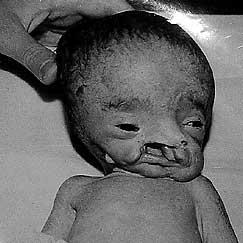
In September this year, say campaigners, 170 children were born at Fallujah General Hospital, 24 per cent of whom died within seven days. Three-quarters of these exhibited deformities, including "children born with two heads, no heads, a single eye in their foreheads, or missing limbs". The comparable data for August 2002 -- before the invasion -- records 530 births, of whom six died and only one of whom was deformed.

The data -- contained in a letter sent by a group of British and Iraqi doctors and campaigners to the United Nations last month -- presaged claims made in a report in The Guardian yesterday that there has been a sharp rise in birth defects in the city. The paper quoted Fallujah General's director and senior specialist, Dr Ayman Qais, as saying: "We are seeing a very significant increase in central nervous system anomalies... There is also a very marked increase in the number of cases of brain tumours." Earlier this year Sky News reported a Fallujah grave-digger saying that, of the four or five new-born babies he buries every day, most have deformities. [right: Iraqi boys play with remains of US rocket.]

The campaigners' letter to the UN calls for an independent investigation to be set up, "the cleaning up of toxic materials used by the occupying forces, including depleted uranium and white phosphorus", and an inquiry launched to discover if any war crimes have been committed.

The campaigners believe that either white phosphorus or depleted uranium is a major, if not only, cause of the birth defects. White phosphorus, which US military has admitted firing on insurgents in heavily populated Fallujah, has a long history of military use, dating back to the First World War.

And although no scientific study has ever proved a causal link between depleted uranium and serious medical problems Ð and several studies seem to have proved the opposite -- it is by no means in the clear. Ever since the first Gulf War, its use has been linked to cancers among returning troops.

WHAT IS DEPLETED URANIUM?

Depleted Uranium, or DU, is a waste material left over from the nuclear industry. A vast amount of this waste DU is produced when natural uranium is enriched for use in nuclear reactors and nuclear weapons. Only the uranium isotope U-235 can be used in nuclear processes, such as reactors and weapons. As most of this isotope is removed from naturally occurring uranium, the remaining uranium product comprises U-238 and smaller amounts of the more highly radioactive U-235 and U-234. DU is both chemically toxic and radioactive. It is this latter product, the left over uranium, comprising mainly U-238, which has been used to make 'depleted' uranium weapons. It is used for weapons because this heavy, dense metal is judged by the army to be an excellent penetrator of enemy armour, tanks, and even buildings.

A large amount of DU in the stockpiles held in the United States has been contaminated with recycled spent nuclear fuel from nuclear reactors. For example trace amounts of U-236 and highly radioactive substances such as plutonium, neptunium and technetium were found in a DU anti-tank shell used in Kosovo. Hundreds of thousands of tons of this contaminated stock was exported to the UK, France and other countries in the 1990s. The extent to which this DU has been contaminated with recycled spent fuel is still unknown and undisclosed.

Governments have largely ignored the serious dangers this recycled fuel represents. A common defence used by the British and US governments and their militaries is to claim that depleted uranium is less radioactive than natural uranium and therefore does not constitute a risk to human health. This statement is, however, misleading. In its natural form uranium is present in our environment in very small quantities as an ore, for example in rocks and soil. Conversely, the DU used by the military has been concentrated relative to background amounts, and is therefore many times more radioactive than uranium ore.

In May 2003 Scott Peterson, a writer with the US newspaper CSM, examined radioactivity levels next to DU bullets in Baghdad and found Geiger-counter readings were 1900 times greater than background radiation levels next to DU bullets. When natural uranium is concentrated in a similar form to 'depleted' uranium it emits about 40% more alpha radiation, 15% more gamma radiation and around the same level of beta radiation. The chemical toxicity of uranium does not depend on the isotope, therefore enriched, 'normal', and depleted uranium are equally toxic chemically.

It is extremely difficult and expensive for the nuclear industry to store DU. It is thought that the US currently has 1 billion tonnes of depleted uranium radioactive waste, while the UK has at least 50,000 tonnes. This waste is stored in cylinders at many sites across the US and UK and is vulnerable to corrosion and leaks owing to ageing cylinders and outside storage. It is stored mainly in the form of depleted uranium hexafluoride (DUF6) which can leak if the corroding cylinders are breached. At least 10 cylinders are known to have breached during the past 10 years.

Turning this DU waste into weapons solves some of the problem faced by the Government and nuclear industry, concerning what to do with these large stockpiles. Not only is DU practically free of charge for the arms manufacturers, but it no longer has to be stored and monitored indefinitely.

THE HEALTH EFFECTS OF DEPLETED URANIUM

Depleted uranium is a risk to health both as a toxic heavy metal and as a radioactive substance. The UK and US Governments have long sought to play down these risks. While, as late as 2003, the UK Government was claiming that DU presented no harm to soldiers or civilians, yet accumulating and alarming evidence from scientists, soldiers and activists has forced them to back down and recognise the risks posed.(1) However what is clear from reading all major studies is that more research urgently needs to be done. There exists very little research on the effects of uranium contamination in humans and accurate tests to understand exposure doses from military uses of DU have never been done.

There are three main routes through which DU exposure on the battlefield takes place: inhalation, ingestion and wounding.(2) As a DU penetrator hits its target some of the DU from the weapon reacts with the air in the ensuing fire and becomes a fine dust (often called an 'aerosol') that makes inhalation and ingestion a possibility for those in the area. Even after the dust has settled, the danger remains that it may be resuspended in the future by further activity or the wind, and again pose a threat to civilians and others for many years into the future. DU particles have been reported as travelling twenty-five miles on air currents.(3) Open wounds also allow a gateway for DU into the body and some veterans have also been left with DU fragments in their bodies, remaining after combat.

Inhaled DU dust will settle in the nose, mouth, lung, airways and guts. As a DU penetrator hits its target, the high temperatures caused by the impact ensure the DU dust particles become ceramic and therefore water insoluble. This means that, unlike other more soluble forms of uranium, DU will stay in the body for much longer periods of time. This aspect of uranium toxicology has often been ignored in studies of the health effects of DU, which base their excretion rates on soluble uranium. DU dust can remain in the sticky tissues of the lung and other organs such as the kidneys for many years. It is also deposited in the bones where it can remain for up to 25 years.(4) This helps explain why studies of Gulf War veterans have found that soldiers are still excreting DU in their urine over 12 years after the 1991 conflict (5) . Ingested DU can be incorporated into bone and from there will irradiate the bone marrow, increasing the risk of leukaemia and an impaired immune system. (6)

External exposure to DU entails exposure to alpha, beta and gamma radiation. Although the skin will block alpha particles, beta and gamma radiation can penetrate beyond the dead outer skin layers and damage living tissue. Beta particles can penetrate to a depth of 2 cm, while gamma radiation (through a process called 'the Compton effect') generates beta particle radiation along its trajectory through the body. Neither is all external exposure to alpha radiation harmless. Cataracts, for example, can be caused by exposure to alpha radiation.(7)

Inside the body, DU poses a health risk in a variety of ways to different organs. The kidneys are the first organ to be dfamaged by DU. At a high dose kidney uranium levels can lead to kidney failure within a few days of exposure.8 Lower doses lead to kidney dysfunction, and can lead to an increased risk of kidney disease later in life.

As a radioactive emitter, DU also presents a risk to the lungs. Traditionally, radiation dosimetry measures the extent of harm by calculating the external radiation absorbed by the tissues; the so-called 'absorbed' dose.(9)However because DU dust is inhaled or ingested, it can remain in the body tissues and emit intensive radiation over a longer period. This way it can cause a large amount of damage over a relatively small area, changing a person's genetic codes and causing cancers. For these reasons soldiers and civilians exposed to DU risk developing lung cancers, particularly if they are smokers because their lungs will already have been irritated.

There is much new evidence emerging about the risks from so-called 'low level' radiation and the damage it can do to DNA. Considerable evidence has been accumulated recently about the 'by-stander' effect, which shows that irradiated cells pass on damage to surrounding healthy cells. In this way it is thought low-level radiation can cause much greater damage than would otherwise be expected.(10) Studies have also shown that irradiated cells pass on chromosomal aberrations to their progeny so that non-irradiated cells several generations, or cell divisions later, will exhibit this radiation-induced genomic instability (RIGI).(11)

New evidence is also suggesting that the chemical toxicity of DU and its radioactivity reinforce each other in a so-called 'synergistic effect', which means it 'punches above its own weight' in terms of the damage it can do to cells. Alexandra Miller of the US Armed Forces Radiobiology Research Institute in the USA found in a study in 2003 that when human bone cells are exposed to DU, fragments break away from the chromosomes and form tiny rings of genetic material. This damage was seen in new cells more than a month after removal of the DU, leading to an eight-fold increase in genetic damage relative to that expected.


It's not just in terms of increased risk of cancer that DU DNA damage can affect health. It is also implicated in causing a depressed immune system, reproductive problems, and birth defects. For example, a study of US Gulf War veterans has found that they are up to three times as likely to have children with birth deformities than fathers who had not served; and that pregnancies result in significantly higher rates of miscarriage.(12) A major 2004 Ministry of Defence-funded survey study from the London School of Hygiene and Tropical Medicine has found that babies whose fathers served in the first Gulf War are 50 per cent more likely to have physical abnormalities. They also found a 40 per cent increased risk of miscarriage among women whose partners served in the Gulf.

In Basra, in southern Iraq, there have been striking reports for a number of years about the rise in local childhood cancers and birth deformities seen there. The findings of a leading Iraqi epidemiologist, Dr Alim Yacoub,13 were presented in New York in June 2003 and suggest there has been a more than five fold increase in congenital malformations and a quadrupling of the incidence rates of malignant diseases in Basra.(14)

The Dutch Journal of Medical Science reported the findings of the Flemish eye doctor, Edward De Sutter. He found 20 cases out of 4000 births in Iraq of babies with the phenomenon anophthalmos: babies who have been born with only one eye or who are missing both eyes. The very rare condition usually only affects 1 out of 50 million births.

The damaging effects to health that DU weapons present are of particular concern because of the likelihood of civilians becoming exposed after conflicts have ended. Children especially are at risk because of playing in and ingesting contaminated soil and most of the health risks discussed are of particular danger to younger children.

ENVIRONMENTAL CONTAMINATION FROM DU

The release of DU into the environment can pollute land and water for decades to come. Its danger is not limited to battlefield releases but will expose present and future generations of civilians to contaminated food and water supplies. Environmental releases of this sort can also be expected to have negative effects on plant and animal life although little is known about this.

DU dust in the environment can become resuspended through weather conditions and human activity, such as farming. Of particular worry is that children are especially vulnerable to receiving significant exposures through playing on sites and ingestion of contaminated soil by way of typical hand-to-mouth activity.

DU can also contaminate soil through corrosion from the original penetrator. It is believed that 70-80% of all DU penetrators used in the Gulf and the Balkans remain buried in the soil. A United Nations Environment Programme study in Spring 2002 found that recovered penetrators had decreased in mass by 10-15%. Corrosion can feed uranium into groundwater, where it can travel into local water supplies. DU in soil can also enter the food chain since it is taken up by plants grown in it and by animals used for food. A UNEP post- conflict report on Bosnia and Herzegovina has indeed found that DU had also leached into local groundwater. The same study found that radioactive hotspots persisted at some of the sites studied. Klaus Toepfer, the Executive Director of UNEP, said at the time, "Seven years after the conflict, DU still remains an environmental concern and, therefore, it is vital that we have the scientific facts, based upon which we can give clear recommendations on how to minimise any risk".

The British and US militaries have demonstrated extreme irresponsibility in releasing DU into the environment, using it without proper monitoring or information about the risks it poses even in their own countries. In January 2003, the US Navy admitted routinely firing DU from its Phalanx guns in prime fishing waters off the coast of Washington state since 1977. At the Dundrennan testsite in Scotland around 30 tonnes of DU rounds have been fired into the Solway Firth. Only one has ever been retrieved, when it was found in a fisherman's net.

Both governments have been equally callous in their disregard concerning the long term risk to civilians in countries where they have used DU.

DU AND THE MILITARY

DU is used in a variety of military applications. It is attractive to the military, governments and the nuclear industry for three main reasons. Firstly, as mentioned earlier, it is in cheap and plentiful supply and solves the problem of storage and monitoring. Secondly, it is a very effective battlefield weapon because its high density and self-sharpening qualities enable it to penetrate hard targets with ease. Thirdly, DU is pyrophoric, which means it burns on impact, enhancing its ability to destroy enemy targets. The UK test firing of DU began at the Eskmeals range in Cumbria in the early 1960s. Testing continues today at Dundrennan, in Southern Scotland, most recently before the 2003 attack on Iraq. DU is now used in two types of ammunition in the British armed forces: the 120 mm anti-tank rounds (CHARM 3), which is fired by the Army's Challenger tanks and 20mm rounds used by the Royal Navy's Phalanx Close-In Weapon System (a missile defence system). The Phalanx system was developed by the US Navy and is used by both the Australian and British Navies. In 1993, a leaked Pentagon report revealed how the use of DU could lead to increased cancer risks: this leak caused the US manufacturers to switch to tungsten alternatives. Because of this the Royal Navy has been forced to convert its replacement ammunition to tungsten too, although it still has stockpiles of DU.

The US military uses DU mainly for its Abrahams tanks and A10 warplanes, although it is also used in its Bradley fighting vehicles, AV-8B Harrier aircraft, Super Cobra helicopter and its Navy Phalanx system. It is also used by the US military for a variety of other applications including bombshells, tank armour plating, aircraft ballast and anti-personnel mines. Although the US and UK militaries are the only countries who have been properly documented as using DU weapons, they are known to be held by at least seventeen other countries including: Australia, Bahrain, France, Greece, Israel, Jordan, Kuwait, Pakistan, Russia, Saudi Arabia, South Korea, Taiwan, Thailand, Turkey, and the United Arab Emirates.

The testing of DU weapons has caused considerable contamination at test sites across the world. At Dundrennan, in Scotland, for example, a 2004 Ministry of Defence report revealed how, since 1982 over 90 shells had either been misfired or had malfunctioned and scattered fragments of DU across the ground. Despite searches, some of these fragments have never been recovered. Contamination levels were high in these areas, which have had to be fenced off. At Okinawa in Japan, and Vieques, an island of Puerto Rico, the US military used DU weapons without the appropriate licences and without informing their respective governments or local populations. In the US, the Army is attempting to walk away from its responsibilities to decontaminate former test sites, such as Picatinny Arsenal in New Jersey and Jefferson Proving Ground in Indiana.

It is now clear that the military have known the risks of depleted uranium but failed to provide safety instructions to soldiers in both the 1991 Gulf Wars and the Balkan conflicts. A study prepared for the US Army in July 1990, a month before Iraq invaded Kuwait, says: "The health risks associated with internal & external DU exposure during combat conditions are certainly far less than other combat-related risks. Following combat, however, the condition of the battlefield and the long-term health risks to natives & combat veterans may become issues in the acceptability of the continued use of DU."

Furthermore, a leaked 1993 document from the US Army Surgeon General's office said, "When soldiers inhale or ingest DU dust they incur a potential increase in cancer risk ... that increase can be quantified in terms of projected days of life loss."

DU IN IRAQ

The 1991 Gulf War saw the first verified use of DU weapons. Around 320 tonnes of DU in weapons were used in the war, of which about 1 tonne was used by the UK military. According to data from the US Department of Defense, tens or hundreds of thousands of US military personnel could have been exposed to DU. Both the US and UK Governments refused any responsibility for decontamination and both refused to study the exposure rates or after-effects of this DU use. After a few years, evidence began to emerge from Iraq about the increasing incidence of cancer and birth deformities in the south of the country. After heavy US lobbying in November 2001 the UN General Assembly voted down an Iraqi proposal that the UN study the effects of the DU used there.

In the 2003 attack on Iraq, the US and UK militaries used DU again despite the lack of reliable data on the effects of using it in Iraq 12 years previously. The British Government has admitted using 1.9 tonnes of DU. Even though this is only a tiny proportion of all DU used in Iraq, it is double the amount used in 1991. The US authorities have still not said how much has been used, although an initial Pentagon source revealed 75 tons of DU may remain in Iraq from A-10 planes alone.

The implications for Iraqi civilians are very alarming. Unlike the first Gulf War, which was largely confined to desert areas, much of the DU use has been in built-up, heavily populated areas. The US Government has refused any cleanup of DU in Iraq, clinging to the statement that it has no link with ill health, while the British Government has for the first time admitted it does have a responsibility but says it is low on their list of priorities.

OTHER COUNTRIES CONTAMINATED BY DU

BOSNIA 1994-1995

DU rounds were used in Bosnia by US A-20 warplanes under the auspices of the North Atlantic Treaty Organisation (NATO). Around 10,800 DU rounds, or 3 tonnes, were used in Bosnia. However NATO always denied DU had been used until 2000, 6 years after the attacks, when media reports began to emerge. For all this time no cleanups or public awareness campaigns could be run, leading to unnecessary civilian exposures. The UNEP report,1 mentioned earlier, and released in March 2003, found DU contamination of drinking water and radioactive 'hotspots'. UNEP recommended ongoing monitoring of drinking water, cleanup of DU sites, cleaning of contaminated buildings and the release by NATO of all DU-attack coordinates.

KOSOVO, YUGOSLAVIA - 1999

US A-10 aircraft fired around 31,300 rounds of DU, or 9 tons of DU in areas of Kosovo, Serbia and Montenegro during NATO action there in 1999. Partial information about the use of DU was released a year after the war when UN Secretary General KofiAnnan sent a letter requesting the information to NATO Secretary General Lord George Robertson. An analysis in a UNEP Post-Conflict field study of recovered DU shells, published in March 2001, found that some of the shells were made with recycled uranium (that is, with uranium that had been through a nuclear reactor) and were contaminated with plutonium. The study did not find widespread contamination but did find evidence of airborne movement of DU dust. It also found localised points of concentrated contamination showing U-238 at 10,000 times normal background levels. The study recommended decontamination, removal of penetrators and drinking water monitoring. A separate report published by UNEP on DU contamination in Serbia and Montenegro found "widespread, but low-level DU contamination, airborne DU particles" and that "DU dust was widely dispersed into the environment."

As well as official reports there has been widespread anecdotal evidence of so-called 'Balkans syndrome' among both soldiers deployed in the region and civilian populations. Symptoms are similar sounding to "Gulf War Syndrome" with heightened levels of leukaemia, respiratory and immune system illnesses. By mid-2004 twenty-seven Italian soldiers have died of symptoms thought to be linked to DU exposure. A court in Rome ordered the Italian Ministry of Defence to compensate the family of Stefano Melone, a soldier who died of a malignant vascular tumour. According to the court, Mr Melone's death was "due to exposure to radioactive and carcinogen substances" on missions in the Balkans.

Tension was caused within NATO as member countries were not warned that their soldiers would be entering DU contaminated zones.

AFGHANISTAN 2001- 2004

There is some evidence that DU has been used in Afghanistan, although this has never been confirmed officially. For example, US A-10s and Harrier aircraft, which both use DU ammunition, are known to have been active in the region. Defense Secretary Donald Rumsfeld has said that the US has found radioactivity indicating DU use by the Taliban or Al-Qaeda.


Geneva Convention Rules (to which US and UK are signees)

- The limitation of unnecessary human suffering [Art.35.2]
- The limitation of damage to the environment [Art. 35.3 and 55.1]
- It is prohibited to employ weapons, projectiles and material and methods of warfare of a nature to cause superfluous injury or unnecessary suffering [Art. 35.3]
- It is prohibited to employ methods or means of warfare which are intended, or may be expected, to cause widespread, long-term and severe damage to the natural environment. [Art. 35.2]
- In order to ensure respect for and protection of the civilian population and civilian objects, the Parties to the conflict shall at all times distinguish between the civilian population and combatants and between civilian objects and military objectives and accordingly shall direct their operations only against military objectives. [Art. 48]
- Indiscriminate attacks are prohibited. Indiscriminate attacks are:
(a) those which are not directed at a specific military objective;
(b) those which employ a method or means of combat which cannot be directed at a specific military objective; or
(c) those which employ a method or means of combat the effects of which cannot be limited as required by this Protocol; and consequently, in each such case, are of a nature to strike military objectives and civilians or civilian objects without distinction. [Art.51.4]
- Care shall be taken in warfare to protect the natural environment against widespread, long-term and severe damage. This protection includes a prohibition of the use of methods or means of warfare which are intended or may be expected to cause such damage to the natural environment and thereby to prejudice the health or survival of the population. [Art. 55.1]

Sunday, December 06, 2009

The truth about "Gay Edgar Hoover"

The truth about "Gay Edgar Hoover"

Three separate and well-informed sources, including a former White House press photographer and a noted researcher on the late FBI director J. Edgar Hoover, have confirmed that not only was Hoover gay, which, according to FBI agents interviewed by one of our sources, was well-known to a number of FBI agents, but was a cross-dresser, as well. Apparently, it was Hoover's fondness for male nude figurines that prompted the few FBI agents invited to visit Hoover's home to wonder about their celebrated "tough guy" director.

In addition, Hoover's longtime close association with his deputy director Clyde Tolson -- some would call it a gay marriage -- set off the "gaydar" among many seasoned FBI agents.

Hoover, who was known as "Weird Mary" by his neighbors who lived near his eerily quiet home at 4936 31st Place in northwest Washington, DC, was often spied wearing either a dress or an old woman's-style house coat while watering his flowers and rosebushes. Hoover masked his face by wearing a beekeeper's hat and face net, according to one source who often passed by "Weird Mary's" home. Hoover insisted on being called "Mary" when in the company of gay partners at his home and at parties with very exclusive invitation lists.

Hoover's homosexual and transvestite antics were also known to the Mafia, which used the information to blackmail Hoover into never waging a full scale onslaught by the FBI against its top leaders, including mob financier Meyer Lansky.

Although Hoover's relationship with Tolson seemed monoganous enough, WMR learned from one informed source that Hoover once had a homosexual relationship with a young Chilean diplomat assigned to the Chilean embassy in Washington.

"Mary" and "Franny"

A source who is familiar with the child abuse scandals of the Roman Catholic Church also revealed to WMR that Hoover also frequently swapped young males, some underage, for the purposes of sex with the gay Archbishop of New York City, Francis Cardinal Spellman, known as "Franny" in New York's gay community. Hoover and Spellman shared something in addition to young males -- a fervent commitment to right-wing politics.

The boy swapping between Hoover and Spellman was known to President John F. Kennedy through the Archbishop of Boston, Richard Cardinal Cushing, who, although a heavy drinker, was straight but despised Spellman with a passion. Cushing reportedly told Kennedy and his brothers Robert and Teddy about Spellman and Hoover. Hoover, who maintained an extensive personal file on the Kennedys, as he did a number of U.S. political and other leaders, realized that he faced a situation of "mutually assured destruction" if he exposed any of the Kennedys' affairs.

President Kennedy was not the only president to know about Hoover's secret life style. When White House Chief of Staff H. R. Haldeman informed President Richard Nixon of Hoover's sudden death in May 1972, Nixon replied, "Jesus Christ! That old cocksucker!"

Thursday, December 03, 2009

Pardon John Brown


Yesterday, David Reynolds, a CUNY Graduate Center professor who wrote a courageous, groundbreaking biography of John Brown published in 2005, emphasized the necessity of rehabilitating John Brown:

It's important for Americans to recognize our national heroes, even those who have been despised by history. Take John Brown.

Today is the 150th anniversary of Brown’s hanging — the grim punishment for his raid weeks earlier on Harpers Ferry, Va. With a small band of abolitionists, Brown had seized the federal arsenal there and freed slaves in the area. His plan was to flee with them to nearby mountains and provoke rebellions in the South. But he stalled too long in the arsenal and was captured. He was brought to trial in a Virginia court, convicted of treason, murder and inciting an insurrection, and hanged on Dec. 2, 1859.

It’s a date we should hold in reverence. Yes, I know the response: Why remember a misguided fanatic and his absurd plan for destroying slavery?

There are compelling reasons. First, the plan was not absurd. Brown reasonably saw the Appalachians, which stretch deep into the South, as an ideal base for a guerrilla war. He had studied the Maroon rebels of the West Indies, black fugitives who had used mountain camps to battle colonial powers on their islands. His plan was to create panic by arousing fears of a slave rebellion, leading Southerners to view slavery as dangerous and impractical.

Second, he was held in high esteem by many great men of his day. Ralph Waldo Emerson compared him to Jesus, declaring that Brown would “make the gallows as glorious as the cross.” Henry David Thoreau placed Brown above the freedom fighters of the American Revolution. Frederick Douglass said that while he had lived for black people, John Brown had died for them. A later black reformer, W. E. B. Du Bois, called Brown the white American who had “come nearest to touching the real souls of black folk.”

Du Bois was right. Unlike nearly all other Americans of his era, John Brown did not have a shred of racism. He had long lived among African-Americans, trying to help them make a living, and he wanted blacks to be quickly integrated into American society. When Brown was told he could have a clergyman to accompany him to the gallows, he refused, saying he would be more honored to go with a slave woman and her children.

Reynolds concludes with a request that Brown receive a posthumous presidential pardon, and you can go here to sign a petition encouraging Obama to issue it. Despite the passage of time,the life of John Brown still touches upon the rawest of nerves in the American experience.

While subsequent revisionist historians succeeded in stigmatizing him as part of a broader project to justify the emergence of the New South and the segregation that replaced slavery, many people, such as myself, have always known better, and held him in our hearts. Many of us preserved a different, almost folkloric, rememberance of Brown at odds with mainstream historical accounts. The intensity of the stigmatization merely reflected the desperation of those who recognized that they could never erase his shining example as a man who, despite his flaws, never shrank from confronting the most horrific injustice of his time.

Make no mistake. Brown retains enemies to this day, not because of his recourse to violence, after all, if there is one common thread that runs through much of American history, it is violence, violence to seize lands from Native Americans, violence to bring African Americans here as slaves and maintain control over them, violence to expand the frontier from the Appalachians to the Pacific Ocean and beyond, violence to impose a neoliberal economic order upon peoples and states who resist it.

Indeed, violence is, as H. Rap Brown once said, as American as apple pie. If Barack Obama proved anything by his decision to send more troops to Afghanistan, it is the continuing accuracy of this acid assessment. So, no, John Brown was not maligned because he was violent, because to do so would have required the condemnation of many of the most prominent American social and political figures of the last 233 years. Non violence is for the opponents of American imperial designs, not for those who facilitate them.

Instead, Brown is considered beyond the pale because he ultimately determined that violence was the only means to achieve the liberation of the slaves, and acted upon that belief. And, more than that, he did not insist upon a white monopoly upon the use of violence for this purpose, but sought to empower the slaves to free themselves by seizing the arsenal at Harper's Ferry in order to distribute weapons to them. Brown believed that enslaved African Americans had the ability to free themselves and should be assisted in the endeavor.

In this respect, as well as his reliance upon the past examples of black rebels like Toussaint L'ouverture in Haiti, Brown foreshadowed the national liberation movements of the 20th Century. Not surprisingly, Toussaint L'ouverture also finds himself exiled to the same circle of historical oblivion as Brown because his life runs counter to the modernization mythology that still infuses much of our perspective about US and European imperialism. Brown was no socialist, but, in a sense, he was actually more radical than many leftists of the time, because he embraced the notion of a multicultural society wherein capital did not exploit racial and class divisions to its advantage, similar to the sort of polyglot social formations described by historians like Peter Linebaugh and Marcus Rediker.

Paradoxically, if one believes that Brown made the Civil War inevitable, he accelerated the transformation of the US from an agrarian economy to an industrial one, one in which his utopian vision of white, black, red, brown and yellow struggling together on the frontier as individualists bound together collectively was overwhelmed by the emergence of a working class in the mill and in the slaughterhouse. The steam engine, the railroad and the manufacturing processes that emerged during the war rendered his vision obsolete. As Brown stood on the scaffold, he was frozen in that moment when the workers of America were about to be proletarianized on a massive scale.

But Brown not only rejected the white monopoly on violence, he challenged the state monopoly on it as well. He did not, like the Project for a New American Century, petition the government to launch a war to achieve his end, the eradication of slavery. He trained and provisioned his own group for this purpose, a 19th Century example of an affinity group, as it were, with a well thought out plan for igniting a slave insurrection. In this, he prefigures propaganda by the deed, much as his earlier life, such as his homesteads, his attempt to break the wool monopoly, his farming in an integrated community in upstate New York and his participation in the underground railroad, prefigured the anarchist emphasis upon the creation of social institutions independent of the government, mutual aid and free agreement. No one had to explain the concept of direct action to John Brown, he was too busy living it.


Fool Me Twice by Philip Giraldi


Remember the old line, "Fool me once, shame on you. Fool me twice, shame on me," the point being that after you are conned once you should never again be so gullible as to be taken in a second time? Well, by that standard the American public and media should be ashamed of themselves as they are about to be fooled again. It is hard to ignore the fact that Washington is marching towards a confrontation with Iran that will surely lead to war that is being orchestrated by the same players that brought about Iraq.

Consider for a moment how the argument to use military force against Iran is being shaped in a way that is very similar to the arguments that were used to prepare for war with Iraq. First of all, Iran is regularly vilified as being led by a homicidal and genocidal maniac in the form of President Mahmoud Ahmadinejad. Ahmadinejad is described as a threat to world peace and he is alleged to be intent on establishing Iranian hegemony over the entire Persian Gulf region. Ahmadinejad has repeatedly been compared to Hitler by the US and Israeli media.

Back in 2002-2003 the narrative was similar. Saddam Hussein was likewise described as a homicidal and genocidal maniac threatening world peace and seeking to establish Iraqi hegemony over the Persian Gulf. He also was compared to Hitler.

But the reality in both cases was and is quite different. Saddam’s army was, after 1991, an empty shell and his country was crippled by sanctions. Ahmadinejad does not control his own country’s armed forces and does not have the authority to start a war even if he wanted to do so. Ahmadinejad has never personally threatened to attack anyone except in retaliation and Iran has not started a war of aggression since 1747. Neither Ahmadinejad nor Saddam Hussein have anything in common with Hitler, who led a major world military and industrial power, apart from flights of hyperbole on the part of some journalists and politicians.

And then there are the nuclear weapons. Saddam was alleged to be developing them, threatening a "mushroom cloud" over American cities, and the same claims are being made about Iran. The fact is that Saddam had no nuclear weapons program when the US attacked him and Iran doesn’t currently have a program either. Iran insists on its right to peaceful nuclear energy supervised by UN inspectors from the International Atomic Energy Agency, a right that all countries that are signatories to the Non-Proliferation Treaty (NPT) enjoy. The United States admits that Iran has a right to electricity generation but agrees with Israel that Tehran should not be able to control the uranium enrichment process. Meanwhile Israel, Pakistan, and India, all American "friends" and non-signatories of the NPT, are free to enrich uranium and use it to make bombs without so much as a harsh word from Washington.

In 2002 the Bush administration asserted that Iraq was virtually a nation on a war footing with a major clandestine weapons industry that included conventional weapons, chemical and biological weapons, and delivery systems to include pilotless drones that could cross the Atlantic. Photos were displayed in the UN "proving" Washington’s assertions. It is now alleged by many of the same experts that Iran is building itself up into a regional superpower with missiles that can one day strike Europe.

Again, the facts contradict the propaganda. Saddam had none of the weapons attributed to him. The UN, the US, and other western intelligence agencies knew that Iraq had been effectively disarmed and had not reconstituted its capabilities but chose to ignore the facts that did not fit the agenda. Iran is being tarred with the same brush in spite of its having a military budget equivalent to only 1% of that of the US and less also than that of its nuclear armed neighbor Israel. Its army is large but poorly trained and equipped and cannot even think of invading any of its neighbors, let alone strike the US. Its navy is capable only of patrolling its coastal waters and would be overwhelmed if it were to confront even a small portion of the US Navy. Its air force would be destroyed by the first day of fighting with the US or with any of its better armed neighbors and its missile program is reported to be more bluster than reality, beset with technical problems and lack of funding.

In 2002 it was widely reported, based on fabricated evidence, that Saddam would likely turn his weapons of mass destruction over to terrorists to use. Currently, it is being claimed that Iran will develop a nuclear weapon and then provide it to radical groups to detonate somewhere in the world. The fact is that the terrorist scenario is a fiction, highly implausible unless one assumes that both Saddam’s Iraq and today’s Iran are intent on suicide. The detonation of a nuclear device is not an anonymous act. It has a technical signature that tells what kind of weapon it was and, from that information, it can be determined who made it. A nuclear attack by a radical group would face tremendous logistical problems in moving the heavy device to a target and making it work, but even if it could be done it would immediately be traced to Iran and Iran would be obliterated on the following day by either the United States or Israel.

Back in 2002-3 it was widely reported that Iraq was a "threat to Israel." Nowadays Israel repeats the same claim over and over again regarding Iran and is echoed by its minions in the media and the US Congress. In reality, Iraq’s threat to Israel consisted of Saddam’s regime sending payments to support families of Palestinians who had been killed by the Israelis, which some might actually consider a humanitarian gesture even though it surely delivered a political message. Today’s Iran has no ability to strike a heavily armed and militarily overwhelming Israel in any serious way and repeated claims that Tehran has threatened to wipe Israel off the map are deliberate mistranslations. Iran has never threatened to attack anyone while Israel, on the contrary, and the United States have repeatedly asserted their right to take military action against Iran.

American politicians frequently claimed in 2002 that Saddam Hussein’s Iraq was seeking to destabilize its neighbors. Saddam reportedly had clandestine groups operating in neighboring Kuwait, in Saudi Arabia, and in the Palestinian territories. The same claims are now made about Iran, that it controls militias in Iraq, is assisting the Taliban in Afghanistan, insurgents in Yemen and Saudi Arabia, Hezbollah in Lebanon, and Hamas in Gaza. It has been claimed that the Mullahs are "killing our soldiers" in Iraq and Afghanistan by providing weapons to the several insurgencies. All such claims are either false or overstated. Saddam, of course, had no international ambitions after his army was largely destroyed in 1991. Iran understandably has concerns about what is going on along its borders and has relationships of various kinds with political groups and government leaders, but the claim that it controls proxies in many countries is greatly exaggerated. The allegation that it is supplying weapons to insurgents is largely bogus, based on the capture of a small number of Iranian produced weapons that are marked in English rather than Farsi, suggesting that they come from the international arms market rather than from an Iranian arsenal. Iran’s ability to destabilize an entire region is greatly exaggerated. Ironically, it is the United States that is undeniably supporting armed insurgencies inside Iran including Baluchistan separatists and Arabs in the provinces bordering Iraq.

In 2002-3 the neocons who were behind the Iraq war repeatedly claimed triumphantly that Iraq would be a military cakewalk. The same claims are being made about Iran, i.e., that the vast US advantage in firepower would end the war quickly, with all of Iran’s known military and nuclear targets knocked out. But the neocons were wrong about Iraq’s ability to resist unconventionally, resulting in the United States still maintaining a huge military presence in that unhappy land six years later. Iran is even more formidable than Iraq, being physically larger and having had time and resources to prepare for an expected attack. Since it holds the geographical center between US forces in Iraq and Afghanistan it is able to dictate events from its interior lines, using irregular forces to strike where it wants to and when it wants to. It could easily cut the tenuous 344 mile long supply line for US troops in Iraq that snakes up from Kuwait. It could close the Straits of Hormuz and, in the narrow and shallow waters of the Persian Gulf, it might even get lucky and hit a US aircraft carrier with one of its Chinese silkworm cruise missiles. It could quickly make the US position in both Afghanistan and Iraq untenable and send world oil prices soaring.

Finally, one should recall that the bottom line justification for the war with Iraq was the repeated somewhat generic message that Iraq was a threat to the United States. That message was deliberately fabricated and was known to be false by the criminals in the Bush Administration and the media who led the march to war. That same song is being played again regarding Iran. Iraq’s government in 2003 was in reality a threat to no one but the country’s own people. Iran, troubled by a poor economy, political dissension, and civil unrest, is in no position to attack anyone. If anything, its leadership might welcome an attack by Israel or the United States to unite its people against a foreign aggressor. It would be the ultimate irony if a military attack by Israel or the US or a combination of the two were to accomplish little beyond strengthening Iran’s political conservatives and accelerating the drive to obtain a nuclear weapon for self defense.

Read more by Philip Giraldi

Obamathink on Afghanistan: Escalate to Exit - by Stephen Lendman

Ahead of his address to the nation on December 1, The New York Times broke the news in an Eric Schmitt article titled, "Obama Issues Order for More Troops in Afghanistan," saying:

During a late November 29 Oval Office meeting with top Pentagon brass, "Obama issued orders to send about 30,000 additional American troops to Afghanistan (over the next six months in) what may be one of the most defining decisions of his presidency." Compounding months of public betrayal, it's perhaps another outrage that will make him a one-term president, the way Vietnam ended Lyndon Johnson's hope for a second term.

An additional 30,000+ will raise US forces to about 100,000 plus whatever additional numbers NATO countries provide that at best will be small and come grudgingly for a war no one believes can be won, and some feel never should have been waged.

To these numbers, add a shadow footprint consisting of tens of thousands of private contractors - 73,968 according to a September 21, 2009 Congressional Research Service (CRS) Report as of June 2009. Included are familiar names like Kellogg, Brown and Root, Fluor Corp, Lockheed Martin and hired guns like DynCorp and Xe (formerly Blackwater USA) costing tens of billions of dollars in Iraq and Afghanistan for lack of oversight so scandalous that rampant waste, fraud, and abuse go unmonitored and will worsen with more troops.

In addition, CRS reports that supporting each soldier costs $1 million a year, partly because private contractors replaced US troops at a far higher expense plus no oversight giving them license to steal for over eight years and do it as well in Iraq. Yet policy going forward will worsen things and greatly increase costs, already over-stretched by America's largest ever military budget at a time the country has no enemies.

Worse still, besides earlier in the year reinforcements, more buildup "represents a high-stakes gamble by a new commander in chief that he can turn....an eight-year old" quagmire into victory, a possibility many in the Pentagon think unlikely to impossible and other experts agree.

According to Schmitt, Obama will test "his ability to rally an American public that according to polls has grown sour on the war, as well as (vice president Joe Biden and) his fellow Democracts in Congress" - like Senator Carl Levin, Armed Services Committee chairman, as well as Colin Powell, and his Afghan ambassador, Karl Eikenberry.

On condition of anonymity, a senior Defense Department official told The Times that "the first additional troops would be thousands of Marines sent to opium-rich Helmand Province, a Taliban stronghold in the south....(They'll begin arriving) in January (to be) followed by a steady flow of tens of thousands."

A November 25 Washington Post Scott Wilson article titled, "War speech to outline escalation and exit" strategies will "outline plans for ending it. (He'll) outline a modest endgame (to) allow US forces to leave and set a general time frame" in 2011, according to some, and after what's announced, beginning in July 2011, over a decade after American forces arrived.

Timelines are always flexible, and Obama hedged by saying withdrawal depends on "conditions on the ground," with further interventions likely because "The struggle against violent extremism will not be finished quickly. (It) extends well beyond Afghanistan and Pakistan," meaning Iran, Somalia, and perhaps Venezuela, Bolivia, Ecuador and/or Cuba, given the Pentagon's growing presence in Colombia as a regional garrison for waging hemispheric conflicts.

Yet he said America can't afford and shouldn't shoulder an open-ended commitment - which, among others, begs these questions:

-- besides the situation in Iraq, why are we in Afghanistan at all; and

-- why for an unwinnable, illegal war over-stretching the federal budget toward bankruptcy while ignoring vital homeland needs.

Also, opposition is increasing, including among congressional Democrats. The situation is unstable and much depends on uncontrollable factors and a growing conviction that after eight years, the war is lost and withdrawal, not escalation is advised.

Others fear imperial madness, perpetual wars, the illusion of Pax Americana, and the nation transitioning toward tyranny, already entrenched with a strong foothold, but who'll tell the public when the media won't, and everyone knows politicians lie, especially the president and others with power.

Nonetheless, Obama told West Point cadets he'll "bring this war to a successful conclusion," and added:

"America, we are passing through a time of great trial. And the message that we send in the midst of these storms must be clear: that our cause is just, our resolve unwavering....If I did not think that the security of the United States and the safety of the American people were at stake in Afghanistan, I would gladly order every single one of our troops home tomorrow" - while telling foreign allies: "This is not just America's war."

Fact Check

Planned a year or more in advance, America willfully, maliciously, illegally, and preemptively attacked a non-belligerent nation (four weeks after 9/11 on October 7) in violation of international and US laws. Those responsible are war criminals. Those continuing it, including congressional members funding it, are as well. Those claiming America's security was threatened lied. It wasn't then. It's not now, and international and US laws are clear.

The UN Charter's Article 51 allows the "right of individual or collective self-defense if an armed attack occurs against a Member....until the Security Council has taken measures to maintain international peace and security."

In other words, justifiable self-defense is permissible. In addition, Charter Articles 2(3), 2(4), and 33 absolutely prohibit any unilateral threat or use of force not specifically allowed under Article 51 or authorized by the Security Council.

Three General Assembly resolutions concur, absolutely prohibiting "non-consensual military intervention:"

-- the 1965 Declaration on the Inadmissibility of Intervention in the Domestic Affairs of States and the Protection of Their Independence and Sovereignty;

-- the 1970 Declaration on Principles of International Law Concerning Friendly Relations and Cooperation among States in Accordance with the Charter of the United Nations; and

-- the 1974 Definition of Aggression, drawing largely on the UN Charter's Article II, paragraph 4 stating:

"All members shall refrain in their international relations from the threat or use of force against the territorial integrity or political independence of any state, or in any other manner inconsistent with the Purposes of the United Nations."

Aggression was defined:

-- a "crime against peace;"

-- the "Invasion of a State by the armed forces of another State, with or without occupation of the territory; (and)

-- attacks on marine fleets."

The UN Charter's Article 39 provides for the Security Council to determine the existence of any act of aggression and "shall make recommendations, or decide what measures shall be taken in accordance with Articles 41 and 42, to maintain or restore international peace and security."

The Rome Statute of the International Court of Justice calls the crime of aggression one of the "most serious crimes of concern to the international community," and provides for it to fall under the jurisdiction of the International Criminal Court (ICC) after state parties agree on a definition and define the conditions under which guilty parties may be prosecuted.

The Nuremberg Tribunal said:

"To initiate a war of aggression....is not only an international crime; it is the supreme international crime (against peace) differing only from other war crimes in that it contains within itself the accumulated evil of the whole."

Under the Constitution's Supremacy Clause (Article VI, paragraph 20), the Constitution, federal statutes, and US treaties are "the supreme law of the land," including international laws (like Geneva) to which America is a signatory. The paragraph reads:

"This Constitution, and the Laws of the United States which shall be made in Pursuance thereof; and all Treaties made, or which shall be made, under the Authority of the United States, shall be the supreme Law of the Land; and the Judges in every State shall be bound thereby, any Thing in the Constitution or Laws of any state to the Contrary notwithstanding."

US law is also clear and unequivocal. Under the Constitution's Article I, Section 8, only Congress may:

-- "....provide for the common defense and general welfare of the United States....

-- ....declare war, grant letters of marque and reprisal, and make rules concerning captures on land and water;

-- "....provide and maintain a navy;

-- ....make rules for the government and regulation of the land and naval forces;

-- ....provide for calling forth the militia to execute the laws of the union, suppress insurrections and repel invasions; (and)

--....provide for organizing, arming, and disciplining, the militia, and for governing such part of them as may be employed in the service of the United States...."

Nowhere does it authorize a preemptive, imperial, aggressive attack on a non-belligerent nation.

The Founders considered declaring and waging wars so important that no single person, including the president, should decide it alone.

Congress last obeyed the law on December 8, 1941, the day after Pearl Harbor. Thereafter, every US war was illegal, according to the Constitution of the United States. By continuing such wars, President Obama stands guilty of war crimes and is fully accountable under US and international laws.

Further, under Article I, Section 7, only Congress may fund wars as:

"All bills for raising revenue shall originate in the House of Representatives; but the Senate may propose or concur with amendments as on other Bills."

Either body may originate appropriation bills, although the House claims sole responsibility for it. Either one may amend bills, including revenue and appropriation measures. Congress may resist defunding, but it's empowered to withhold future amounts without which wars and occupations aren't possible so the current ones would end.

Congressional appropriation power is key under Article I, Section 9, Clause 7 saying:

"No money shall be drawn from the treasury; and a regular statement and account of receipts and expenditures of all public money shall be published from time to time."

It means Congress alone has constitutional power over the federal budget, including the funding of wars. Cut it off and wars and occupations end, with or without presidential concurrence.

After years of congressional inaction, the 1972 Church-Clifford amendment, attached to foreign aid legislation, tried to end Southeast Asian war funding, but it was defeated in the House. However, the June 1973 Church-Case amendment succeeded after earlier attempts failed, and ended America's involvement in Vietnam. In the same year, over Richard Nixon's veto, Congress passed the War Powers Act (still the law) requiring the president to consult with Congress before authorizing troop deployments for extended periods.

Without congressional collusion, wars can't be fought or continued. The 111th Congress and most previous ones have been complicit in America's aggressive wars and share equal guilt with the president and top Pentagon brass. Ending wars politically are daunting, but doing so financially is as simple as cutting off funding.

Afghanistan's Tragic History: Ravaged by Wars Without End

For centuries, Afghanistan has been war-torn and ravaged by invaders, yet endured by repeatedly repelling them - more recently against Britain in the 19th and early 20th centuries and the Soviets in the 1980s. Today imperial America risks the same fate after eight failed years, yet those in power won't act because of Afghanistan's strategic importance and fear of strong repercussions from an opposition looking for reasons to criticize.

As a result, Afghans keep suffering the way John Pilger poignantly described under conditions there in his 2006 book, "Freedom Next Time, saying:"

"Throughout all the humanitarian crises in living memory, no country has been abused and suffered more, and none helped less than Afghanistan." He described Kabul like many parts of the country today, plagued by "contours of rubble rather than streets, where people live in collapsed buildings, like earthquake victims waiting for rescue (with) no light....heat," or relief from perpetual wars and human misery, the result of imperial invasions and internal conflicts.

Over time, the toll has been horrific:

-- unemployment is around 50%;

-- impoverishment is among the highest in the world affecting nearly two-thirds of the country;

-- in October 2008, spokesman for the UN mission in Kabul, Adrian Edwards, told the BBC that:

"The human conditions in Afghanistan are very serious. Continuous insecurity, drought and booming food prices on the world level are the main cause for the emergence of this situation but the condition in the future months is not tangible. There is no doubt that people are in dire need of food."

-- conditions today are no better and perhaps worse;

-- those with jobs don't earn enough to meet minimal needs;

-- life expectancy at 44 years is one of the lowest in the world;

-- the infant mortality rate is the world's highest with 20% of children dying before age five;

-- an Afghan woman dies in childbirth every 30 minutes;

-- 75% of the population has no access to safe drinking water;

-- homelessness is epidemic forcing many to live under deplorable conditions;

-- only one doctor is available per 6,000 people and one nurse per 2,500 people;

-- unexploded ordnance kills or wounds hundreds each month, a situation worsening as conflict persists;

-- children are kidnapped and sold into slavery or murdered for their organs;

-- less than 6% of Afghans have access to electricity, available only sporadically;

-- women's literacy is about 19%, and many have to beg on streets or turn to prostitution to survive.

In addition, no part of the country is safe. Internal conflict rages. Life for most Afghans is intolerable, and accounting for around 60% of its economy, Afghanistan is the world's largest opium producer.

On September 2, 2009, the UN Office on Drugs and Crime reported that opium cultivation dropped to 123,000 hectares, down from the 2007 193,000 hectare peak. However, production fell only 10% to 6,900 tons from 2008 because farmers get more yield per bulb. At the same time, world demand is stable at around 5,000 tons, much less than Afghanistan supplies. In contrast, prior to America's invasion, the Taliban eradicated 94% of opium production, reducing it to 185 tons according to UN figures.

Under eight years of occupation, it again flourishes, mostly benefitting organized crime, the CIA, and powerful Western business and financial interests, in America most of all.

Also, in its latest 2009 report, Transparency International ranks Afghanistan the world's second most corrupt country after Somalia under its US-backed Transitional Federal Government and African Union paramilitary peacekeepers. Occupied Iraq ranks fifth, further testimony to imperialism's exploitive failure and its harm to targeted countries.

Meanwhile, since Afghan commander, Gen. Stanley McChrystal, took charge of US and NATO forces last June, he's favored more troops for a wider war he can't win using similar tactics he was infamous for as head of the Pentagon's Joint Special Operations Command (JSOC) - established in 1980 and comprised of the Army's Delta Force and Navy seals, de facto death squads writer Seymour Hersh once described as an "executive assassination wing" operating out of Dick Cheney's office.

While escalating the Afghan war, he's also destabilizing Pakistan to balkanize both countries, weakening them by design to control the Caspian Sea's oil and gas riches and their energy routes to secured ports for export. The strategy includes encircling Russia, China, and Iran, obstructing their solidarity and cohesion, toppling the Iranian government, perhaps attacking its nuclear sites, eliminating Israel's main regional rival, defusing a feared geopolitical alliance, and securing the ultimate goal of unchallenged Eurasian dominance in a part of the world rich in oil, gas and other vital minerals.

It's a huge task for any commander, let alone a man James Petras calls a "notorious psychopath" who's perhaps the right man to pin failure on if things go sour or if popular discontent reaches critical mass, forcing withdrawal like from Vietnam. Blame it on the general, not the commander-in-chief who appointed him who may not get off easily, nor should he given an ill-chosen strategy cooler heads want to avoid, but not vocal hawks who demand he press on no matter the long odds or overstretched the budget, threatening bankruptcy because of its unaffordability combined with bailing out Wall Street and other obligations.

The die is cast. Escalation is now fact by a man promising change, delivering betrayal, and seeing his approval rating fall from a 68% late January high to 47% according to the December 1 Rasmussen Report, a number steadily falling because growing numbers of supporters are losing faith. Heading into 2010, the combination of economic hardship, eroding civil liberties, and wasted billions on futile wars promises to raise public discontent and disapproval of a president and Congress they no longer trust. What's disturbing is why they did in the first place.

Stephen Lendman is a Research Associate of the Centre for Research on Globalization. He lives in Chicago and can be reached at lendmanstephen@sbcglobal.net.

Also visit his blog site at sjlendman.blogspot.com and listen to the Lendman News Hour on RepublicBroadcasting.org Monday - Friday at 10AM US Central time for cutting-edge discussions with distinguished guests on world and national issues. All programs are archived for easy listening.

http://republicbroadcasting.org/Global%20Research/index.php?cmd=archives.year&ProgramID=33&year=9

The Afghan Quagmire


by Ralph Nader

Misusing professional cadets at West Point as a political prop, President Barack Obama delivered his speech on the Afghanistan war forcefully but with fearful undertones. He chose to escalate this undeclared war with at least 30,000 more soldiers plus an even larger number of corporate contractors.

He chose the path the military-industrial complex wanted. The “military” planners, whatever their earlier doubts about the quagmire, once in, want to prevail. The “industrial” barons because their sales and profits rise with larger military budgets.

A majority of Americans are opposed or skeptical about getting deeper into a bloody, costly fight in the mountains of central Asia while facing recession, unemployment, foreclosures, debt and deficits at home. Congressman Dennis Kucinich (D-OH), after hearing Mr. Obama’s speech said, “Why is it that war is a priority but the basic needs of people in this country are not?”

Let’s say needs like waking up to do something about 60,000 fatalities a year in our country related to workplace diseases and trauma. Or 250 fatalities a day due to hospital induced infections, or 100,000 fatalities a year due to hospital malpractice, or 45,000 fatalities a year due to the absence of health insurance to pay for treatment, or, or, or, even before we get into the economic poverty and deprivation. Any Obama national speeches on these casualties?

Back to the West Point teleprompter speech. If this is the product of a robust internal Administration debate, the result was the same cookie-cutter, Vietnam approach of throwing more soldiers at a poorly analyzed situation. In September, the chair of the Joint Chiefs of Staff, Admiral Mike Mullen told an American Legion Convention, “I’ve seen the public opinion polls saying that a majority of Americans don’t support the effort at all. I say, good. Let’s have the debate, let’s have that discussion.”

Where? Not in Congress. There were only rubberstamps and grumbles; certainly nothing like the Fulbright Senate hearings on the Vietnam War.

Where else? Not in the influential commercial media. Forget jingoistic television and radio other than the satire of Jon Stewart plus an occasional non-commercial Bill Moyers show or rare public radio commentary. Not in the op-ed pages of The New York Times and the Washington Post.

A FAIR study published in the organization’s monthly newsletter EXTRA reports that of all opinion columns in The New York Times and the Washington Post over the first 10 months of 2009, thirty-six out of forty-three columns on the Afghanistan War in the Times supported the war while sixty-one of the sixty-seven Post columns supported a continued war.

So what would a rigorous public and internal administration debate have highlighted? First, the more occupation forces there are, the more they fuel the insurgency against the occupation, especially since so many more civilians than fighters lose their lives. Witness the wedding parties, villagers, and innocent bystanders blown up by the U.S. military’s superior weaponry.

Second, there was a remarkable absence in Obama’s speech about the tribal conflicts and the diversity of motivations of those he lumped under the name of “Taliban.” Some are protecting their valleys, others are in the drug trade, others want to drive out the occupiers, others are struggling for supremacy between the Pashtuns on one side and the Tajiks and Uzbeks on the other (roughly the south against the north). The latter has been the substance of a continuing civil war for many years.

Third, how can Obama’s plan begin to work, requiring a stable, functioning Afghan government—which now is largely a collection of illicit businesses milking the graft, which grows larger in proportion to what the American taxpayers have to spend there—and the disorganized, untrained Afghan army—mainly composed of Tajiks and Uzbeks loathed by the Pashtuns.

Fourth, destroying or capturing al Qaeda attackers in Afghanistan ignores Obama’s own intelligence estimates. Many observers believe al Qaeda has gone to Pakistan or elsewhere. The New York Times reports that “quietly, Mr. Obama has authorized an expansion of the war in Pakistan as well—if only he can get a weak, divided, suspicious Pakistani government to agree to the terms.”

Hello! Congress did not authorize a war in Pakistan, so does Obama, like Bush, just decree what the Constitution requires to be authorized by the legislative branch? Can we expect another speech at the Air Force Academy on the Pakistan war?

Fifth, as is known, al Qaeda is a transnational movement. Highly mobile, when it is squeezed. As Rolf Mowatt-Larssen, the former CIA officer operating in Pakistan, said: “There is no direct impact on stopping terrorists around the world because we are or are not in Afghanistan.” He argues that safe havens can be moved to different countries, as has indeed happened since 9/11.

Sixth, the audacity of hope in Obama’s speech was illustrated by his unconvincing date of mid-2011 for beginning the withdrawal of U.S. soldiers from Afghanistan. The tendered exit strategy, tied to unspecified conditions, was a bone he tossed to his shaky liberal base.

The White House recently said it costs $1 million a year to keep each single soldier in Afghanistan. Take one fifth of that sum and connect with the tribal chiefs to build public facilities in transportation, agriculture, schools, clinics, public health, and safe drinking water.

Thus strengthened, these tribal leaders know how to establish order. This is partly what Ashraf Ghani, the former respected Afghan finance minister and former American anthropology professor, called concrete “justice” as the way to undermine insurgency.

Withdraw the occupation, which now is pouring gasoline on the fire. Bring back the saved four-fifths of that million dollars per soldier to America and provide these and other soldiers with tuition for their education and training.

The principal authority in Afghanistan is tribal. Provide the assistance, based on stage-by-stage performance, and the tribal leaders obtain a stake in stability. Blown apart by so many foreign invaders—British, Soviet, American—and internally riven, the people in the countryside look to tribal security as the best hope for a nation that has not known unity for decades.

Lifting the fog of war allows other wiser policies urged by experienced people to be considered for peace and security.

Rather than expanding a boomeranging war, this alternative has some probability of modest success unlike the sure, mounting loss of American and Afghani lives and resources.


Ralph Nader is a consumer advocate, lawyer, and author. His most recent book - and first novel - is, Only The Super Wealthy Can Save Us. His most recent work of non-fiction is The Seventeen Traditions.

Armitage Part II: History in Washington


Thursday, 3. December 2009

Mizgin’s Desk Reports

Mizginslogo2Our first look at the life of Richard Armitage, the new American Turkish Council chairman, focused on his adventures in Southeast Asia. Today we’ll look at his history in Washington.

Back in Washington in 1980, Armitage served as a foreign policy advisor to President-elect Ronald Reagan, and was soon appointed by Reagan to the position of Deputy Assistant Secretary of Defense for East Asia and Pacific Affairs. Armitage held that position from 1981 until 1983, when he was promoted to the position of Assistant Secretary of Defense for International Security Policy. Wikipedia has a list of the duties associated with Armitage’s position as Assistant Secretary of Defense. He held this position until 1989.

ArmitageScrowcroftDuring this time, Armitage became involved with US arms shipments from Israel to Iran that eventually became known as the Iran-Contra Affair. In a report by Independent Counsel Lawrence Walsh, it was determined that US weapons were, in fact, delivered to the Islamic Republic of Iran by Israel on behalf of the US. Neoconservative Michael Ledeen and Iranian businessman Manucher Ghorbanifar facilitated links between the US, Israel, and Iran and they would be mentioned years later when a subsequent US administration sought to manufacture evidence of yellowcake sales to Iraq.

LTC Oliver North modified the original plan of arms sales to Iran in order to divert money to the Nicaraguan Contras and it is through North that Armitage became entangled in the affair. According to the History Commons, with links to reports by the Independent Counsel on Iran-Contra Affairs:

“National Security Council (NSC) officer Oliver North has become far more outspoken among government officials about his illegal funding of the Nicaraguan Contras (see May 16, 1986). During a meeting of his Restricted Interagency Group (RIG—see Late 1985 and After), CIA official Alan Fiers, a member of the group, is discomfited at North’s straightforward listing of the many activities that he is causing to be conducted on behalf of the Contras, everything from supplying aircraft to paying salaries. Fiers is even less sanguine about North’s frank revelations about using illegally solicited private funding for the Contras (see May 16, 1986). North goes down the list, asking if each activity should be continued or terminated, and, according to Fiers, making it very clear that he can cause his Contra support program (which he now calls PRODEM, or “Project Democracy”) to respond as he directs. North also begins arranging, through Assistant Secretary of State Elliott Abrams, for $2 million in stopgap funding for the project. North will confirm the $2 million in an e-mail to NSC Director John Poindexter. North will conduct similar meetings in August and September 1986, at least one of which will include Assistant Defense Secretary Richard Armitage (see July 22, 1987) and other Defense Department officials (see November 13, 1990). It is not until Fiers testifies in 1991 about North’s behaviors that verification of North’s discussion of such specifics about Contra activities and funding will be made public (see July 17, 1991).”

In September, 1986, North brought up for discussion in an RIG meeting in Armitage’s office the fact that the Panamanian dictator, Manuel Noriega, would be willing to conduct sabotage inside Nicaragua for money. The discussion focuses on the possibility of paying Noriega from private funds. The offer is ultimately rejected.

In July, 1987, Armitage failed to recall anything:

“Assistant Secretary of Defense Richard Armitage, who has attended some of Oliver North’s Restricted Interagency Group (RIG) meetings (see Late 1985 and After and July 1986 and After), testifies before the Joint House-Senate Committee investigating Iran-Contra (see May 5, 1987). Armitage is asked about RIG meetings in which North recited a list of his activities in coordinating the Contras, discussed the private funding of the Contras, and demanded item-by-item approval from group members: “[D]o you recall, regardless of what dates, regardless of where it was, regardless of whether it had exactly the players he said—because he could have gotten all that wrong—do you recall any meeting at which he did anything close to what his testimony suggests?” Armitage replies, “I do not.” It is not until RIG member Alan Fiers, a former CIA official, testifies in 1991 about North’s behaviors that verification of North’s discussion of such specifics about Contra activities and funding will be made public (see July 17, 1991).”

The Office of the Independent Council eventually decided not to prosecute Armitage for his role in the Iran-Contra Affair:

“The notes demonstrated that Weinberger’s early testimony — that he had only vague and generalized information about Iran arms sales in 1985 — was false, and that he in fact had detailed information on the proposed arms sales and the actual deliveries. The notes also revealed that Gen. Colin Powell, Weinberger’s senior military aide, and Richard L. Armitage, assistant secretary of defense for international security affairs, also had detailed knowledge of the 1985 shipments from Israeli stocks. Armitage and Powell had testified that they did not learn of the November 1985 HAWK missile shipment until 1986.

[ . . . ]

“There was little evidence that Powell’s early testimony regarding the 1985 shipments and Weinberger’s notes was willfully false. Powell cooperated with the various Iran/contra investigations and, when his recollection was refreshed by Weinberger’s notes, he readily conceded their accuracy. Independent Counsel declined to prosecute Armitage because the OIC’s limited resources were focused on the case against Weinberger and because the evidence against Armitage, while substantial, did not reach the threshold of proof beyond a reasonable doubt.”

As a result of the conclusions of the Independent Council, we may assume that Armitage received a less than honorable exoneration in this scandal. Shortly afterwards, Armitage became entangled in another scandal which forced him to withdraw his name from consideration by George H. W. Bush as the Secretary of the Army:

“Richard L. Armitage, President Bush’s choice as Secretary of the Army, withdrew his name from consideration today rather than undergo confirmation hearings expected to include questions about his role in the Iran-contra affair and his relationship with a woman convicted of illegal gambling.

“Over the past two years, Mr. Armitage has been the focus of repeated allegations about his private life, some of them published by the columnist Jack Anderson. The Texas industrialist H. Ross Perot joined the fray in 1987 when he complained to then Vice President Bush of Mr. Armitage’s possible involvement in drug operations when he served in the Vietnam War.

“Mr. Armitage has denied the charges. He was out of town today and could not be reached for comment. He withdrew so that he could spend more time with his wife and eight children, said a Pentagon spokesman.

[ . . . ]

“Mr. Armitage’s withdrawal, which came before his name was formally submitted to the Senate represented a surprising reversal. Just two weeks ago, he had been providing Democratic senators with a detailed written rebuttal of the allegations relating to Vietnam and Ms. O’Rourke. Mr. Armitage told senators he was ready to refute the charges personally at his confirmation hearings, a Senate aide said.”

Frank Carlucci, National Security Advisor at the time, asked Ross Perot in secret to drop his investigation of Armitage’s involvement with Nguyet O’Rourke and her connections to organized crime. Both Carlucci and Armitage would later serve as board members of the Middle East Policy Council.

During the Gulf War, Armitage served as a special emmissary to the King of Jordan and later in the 1990s he “directed US assistance to the new independent states (NIS) of the former Soviet Union.” In 1996, the US-Azerbaijan Chamber of Commerce was established in Washington with Armitage on its board of directors. Other board members included John Imle of Unocal while Zbigniew Brzezinski served the USACC as an Honorary Council Advisor. By the end of the 1990s, Armitage would have served as a lobbyist for Unocal at a time that Unocal was courting the Taliban in Texas in order to win a pipeline bid to move Turkmenistani gas through Afghanistan to Pakistan.

It was in 1997, too, that Armitage “went to Burma on a trip sponsored by the Burma/Myanmar Forum, a Washington group with major funding from UNOCAL.” Burmese villagers filed a lawsuit against Unocal for human rights abuses. Armitage was implicated in the lawsuit. Hamid Karzai and Zalmay Khalilzad were, like Armitage, also affiliated with Unocal. Karzai was a representative of Unocal in Afghanistan while Khalilzad was an advisor to Unocal and participated in its talks with the Taliban.

Armitage and Khalilzad were both signatories of the PNAC letter to President Clinton in 1998 which outlined the policy of “containment” of Saddam Hussein that would be adopted by the Bush administration in its war against Iraq after 11 September, 2001. Before those attacks, however, Armitage would be called back to public service by The Vulcans.


Wednesday, December 02, 2009

Obama's Af-Pak is as Whack as Bush's Iraq

Obama Samby BAR executive editor Glen Ford
President Obama has reached a watershed in his presidency: he has devolved to the intellectual level of George Bush, while retaining his world class powers of speech. History may remember Obama as just another vapid but predatory imperialist president who happens to be…superficially eloquent. Unfortunately, the clarity of Obama’s diction is not matched by coherence of policy. Af-Pak is at least as whack as Bush’s Iraq.
Obama's Af-Pak is as Whack as Bush's Iraq
by BAR executive editor Glen Ford
More occupation means less occupation.”
Barack Obama’s oratorical skills have turned on him, revealing, as George Bush’s low-grade delivery never could, the perfect incoherence of the current American imperial project in South Asia. Bush’s verbal eccentricities served to muddy his entire message, leaving the observer wondering what was more ridiculous, the speechmaker or the speech. There is no such confusion when Obama is on the mic. His flawless delivery of superbly structured sentences provides no distractions, requiring the brain to examine the content – the policy in question – on its actual merits. The conclusion comes quickly: the U.S. imperial enterprise in Afghanistan and Pakistan is doomed, as well as evil.
The president’s speech to West Point cadets was a stream of non sequitors so devoid of logic as to cast doubt on the sanity of the authors. “[T]hese additional American and international troops,” said the president, “will allow us to accelerate handing over responsibility to Afghan forces, and allow us to begin the transfer of our forces out of Afghanistan in July of 2011.”
Obama claims that, the faster an additional 30,000 Americans pour into Afghanistan, the quicker will come the time when they will leave. More occupation means less occupation, you see? This breakneck intensification of the U.S. occupation is necessary, Obama explains, because “We have no interest in occupying your country.”
The U.S. imperial enterprise in Afghanistan and Pakistan is doomed, as well as evil.”
If the Americans were truly interested in occupying Afghanistan, the logic goes, they would slow down and stretch out the process over many years, rather than mount an 18-month surge of Taliban-hunting. The Afghans are advised to hold still – the pulsating surge will be over before they know it.
At present, of course, the Americans have assumed all “responsibility” for Afghanistan – so much so that President Hamid Karzai only learned about Obama’s plans earlier on Tuesday during a one-hour tele-briefing. This is consistent with Obama’s detailed plans for Afghan liberation, under U.S. tutelage. The president is as wedded to high stakes testing of occupied peoples as he is for American public school children. “This effort must be based on performance. The days of providing a blank check are over,” said the Occupier-in-Chief. He continued:
And going forward, we will be clear about what we expect from those who receive our assistance. We will support Afghan Ministries, Governors, and local leaders that combat corruption and deliver for the people. We expect those who are ineffective or corrupt to be held accountable.”
Such rigorous oversight of their country’s affairs should keep Afghan minds off the fact that they have been fighting to remain independent of foreign rule for centuries, if not millennia. If Obama is right, Afghans might also be distracted from dwelling on the question of who their “Ministries, Governors, and local leaders” are answerable to – the Afghan people or the Americans?
Obama advises Afghans to be patient and trusting regarding their sovereignty.”
Although President Obama is anxious to bring U.S. troop levels above 100,000 as quickly as possible, he advises Afghans to be patient and trusting regarding their sovereignty. “It will be clear to the Afghan government, and, more importantly, to the Afghan people, that they will ultimately be responsible for their own country." That is, it will become clear in the fullness of time, but hopefully no later than 18 months after the planned surge begins. If all goes well, the Taliban will be dead or nearly so, and the non-Taliban Afghans will be prepared to begin assuming “responsibility for their own country.” If not, then the Americans will be forced to continue as occupiers – reluctantly, of course, since, as the whole world and the more intelligent class of Afghans know, the Americans “have no interest in occupying your country” – unless they have to.
Should the Afghans become confused about American intentions, they might consult with their Pakistani neighbors, for whom President Obama also has plans.
[We] have made it clear that we cannot tolerate a safe-haven for terrorists whose location is known, and whose intentions are clear,” the president declared. “America is also providing substantial resources to support Pakistan's democracy and development. We are the largest international supporter for those Pakistanis displaced by the fighting.”
Obama did not mention that it was the Americans that coerced and bribed the Pakistani military into launching the attacks that displaced over a million people in the Swat region and hundreds of thousands more in border areas. How nice of them to join in humanitarian assistance to the homeless.
The Pakistanis, like the Afghans, were assured the Americans will not abandon them to their own, independent devices. Said Obama: “And going forward, the Pakistani people must know: America will remain a strong supporter of Pakistan's security and prosperity long after the guns have fallen silent, so that the great potential of its people can be unleashed.”
Some Pakistanis might consider that a threat. According to polling by the Pew Global Attitudes Project, only 16 percent of Pakistanis held a favorable view of the United States in 2009. Actually, that’s a point or two higher than U.S. popularity in Occupied Palestine (15 percent) and Turkey (14 percent), the only other Muslim countries on the Pew list.
Not to worry. Obama knows things that escape the rest of us. For example, the fact that “we have forged a new beginning between America and the Muslim World - one that recognizes our mutual interest in breaking a cycle of conflict, and that promises a future in which those who kill innocents are isolated by those who stand up for peace and prosperity and human dignity.”
Which means, we can expect those polling numbers to start going up, soon.
Only 16 percent of Pakistanis held a favorable view of the United States in 2009.”
When Obama isn’t launching bold initiatives and “new beginnings,” he’s busy taking care of U.S. imperial business as usual. Obama is most proud that the U.S. spends more on its military than all the rest nations of the planet, combined.
[T]he United States of America has underwritten global security for over six decades,” he told the cadets, “a time that, for all its problems, has seen walls come down, markets open, billions lifted from poverty, unparalleled scientific progress, and advancing frontiers of human liberty.” Others might not view the rise of U.S. hegemony in such a positive light. But they are wrong, said the president. “For unlike the great powers of old, we have not sought world domination. Our union was founded in resistance to oppression. We do not seek to occupy other nations. We will not claim another nation's resources or target other peoples because their faith or ethnicity is different from ours.”
In Obama’s worldview, it’s the thought that counts. Americans don’t seek world domination; it just comes to them. “We do not seek to occupy other nations,” they leave us no choice. If it were not for American concern for the welfare of all the world’s people, the U.S. would not maintain 780 military bases in other people's countries.
Obama has certainly matured as an American-style statesman in his nine and a half months in office. As a TV Native American might say, “Black man in white house speak like forked tongued white man.” Only better.

BAR executive editor Glen Ford can be contacted at Glen.Ford@BlackAgendaReport.com.