
Judging by the CIA- and Pentagon-supported coup d'etat against Honduran President Manuel Zelaya and the attempted coup against Ecuadorian President Rafel Correa, the Obama administration's Latin American foreign policy bears a strong resemblance to the policies of the Reagan administration.
In fact, the latest reports from Ecuador that rebellious Ecuadorian police discussed killing Correa during their siege of the president at the Police Hospital in Quito bears an eerie resemblance to the U.S.-inspired attack on and assassination of Chilean President Salvador Allende during the military coup of September 11, 1973.
Recorded police transmissions during the coup attempt provide evidence that some of the rebel police officers who besieged Correa at the hospital discussed killing him. Video recordings also show retired Army Major Fidel Araujo, a supporter of Correa's pro-U.S. predecessor, Lucio Gutierrez, stirring up anti-Correa protesters.
Most of Latin America's leaders have called the rebellion against Correa an attempted coup. U.S. Secretary of State Hillary Clinton has chosen to call the coup a police protest. The Obama administration, which was unsuccessful in ousting Correa as it did Zelaya in Hionduras last year, has clearly suffered a major defeat in Ecuador.
Organization of American States (OAS) Secretary General Jose Miguel Insulza has called the rebellion an attempted coup and Venezuela's President Hugo Chavez has charged the CIA and the Obama administration with being behind the coup attempt. Chavez's charge has been supported by the revelation that Zimbabwe's President Robert Mugabe, who was to travel to Quito from the UN General Assembly summit in New York, was warned not to go by the CIA, which had advance knowledge of the rebellion against Correa.
The CIA reprtedly knew in advance that the coup against Correa would turn violent since Langley told Mugabe that his own safety would be in peril if he went ahead with his visit to Quito. The CIA warning to Mugabe was conveyed through Zimbabwe's Central Intelligence Organization (CIO). Mugabe quickly flew from New York to Harare, leaving members of his own delegation in the dark, according to the Zim Daily.
The CIA is known to have, along with Israel's Mossad, penetrated the Ecuadorian National Police, and CIA and Mossad fingerprints on the coup attempt are becoming clearer by the day. The CIA and Mossad also conspired in the coup against Zelaya in Honduras.
Stung by the failure of the coup against Correa, Obama was forced to call the Ecuadorian leader and offer his support for Ecuador's "democratic institutions." Obama's hypocrisy in expressing support for Ecuador's president while not referring to the rebellion as a coup attempt is obvious. In the case of Honduras, Obama never expressed support for Zelaya or the country's democratic institutions because the U.S.-backed coup was successful. For Ecuador, Obama had to change his tune and offer Correa tepid support a week after the coup attempt.
Considering Obama's snub of Suriname's President Desi Bouterse at a White House reception for world leaders in New York for the UN General Assembly summit, the Suriname leader could find himself the next target of an Obama-sanctioned coup in Latin America. Bouterse's lack of an invitation to the White house reception at New York's Museum of natural History came as a surprise to Bouterse's fellow Caribbean Common Market (CARICOM) leaders. Bouterse is the former military ruler of Suriname whose Mega Alliance party won last May's general election and he was inaugurated on August 12. A little over a decade ago, Bouterse was sentenced to prison in absentia by a Dutch court ion charges of cocaine trafficking. Suriname law prohibits its citizens from being extradited to foreign countries.
However, it may not be the criminal charges that have been levelled agianst Bouterse in the Netherlands and in Suriname that has the Obama administration anxious to depose him. Bouterse was a primary target of the CIA during the Reagan administration because of his close ties to Fidel Castro's Cuba, the Sandinista government in Nicaragua, and the Marxist government of Grenada.
Bouterse originally took power in Suriname following a military coup in February 1980. Bouterse's government declared Suriname a socialist republic. CIA director William Casey and his deputy, Robert Gates, who now serves as Obama's Defense Secretary, planned a coup to oust Bouterse from power. Casey and Gates cited Bouterse's close ties with Latin America's leftist governments, a program that bears a stark resemblance to the present Obama and Hillary Clinton program to oust the leftist government of Honduras, followed by destabilization efforts in Ecuador, Bolivia, and other nations, including, once again, Suriname.
In December 1982, the CIA went ahead with plans to toppled Bouterse. The CIA worked closely with Dutch intelligence to establish contacts with Bouterse's opposition in Suriname, including politicians, businessmen, and journalists. The Dutch provided asistance to former President Henck Chin a Sen and his Amsterdam-based opposition forces. The CIA plan included landing Surinamese rebels in Paramaribo, the Suriname capital, and seize power. There were also reports that the CIA planned to assassinate Bouterse durin the coup, a direct violation of a White House executive order banning assassinations of foreign leaders. The CIA's chief in-country liaison for the coup was U.S. ambassador to Suriname Robert Duemling.
WMR has obtained a formerly Top Secret CIA National Intelligence Daily, dated March 12, 1982,in which it is disclosed the CIA was closely following an attempted coup against Bouterse by conservative military officers on March 11, 1982. The CIA report states: "Dissident military officers opposing the leftist trend of the military leadership launched a coup yesterday, but forces loyal to the government are still resisting. The group, calling itself the Army of National Liberation, is led by two officers who have been associated with conservative elements of the Surinamese society . . . Although the rebels have control of the Army's main barracks and ammunition depot in Paramaribo, government strongman Army Commander Bouterse and troops loyal to him apparently have taken up a defensive position in the capital's police camp some 6 kilometers away. Fighting subsided somewhat last night, with both sides claiming to be in control and appealing for support from military troops and citizenry. A large number of rank-and-file military, who had objected to Bouterse's leftist policies several months ago, probably will join the dissidents if Bouterse's position weakens further."
The failed coup attempt against Bouterse in March resulted in a CIA warning, contained in a CIA "Monthly Warning Assessment for Latin America" sent by the National Intelligence Officer for Latin America on July 29, 1982.The formerly Secret report states, "State/INR summarized the growing danger that Castro will have a second Grenada-type success. Suriname's leader, Bouterse, visited Grenada for two weeks in May, met with Cubans there, met with Castro, is sending military and security personnel for Cuban training, has a very far left foreign minister, will receive Cuban assistance in foreign affairs, and will receive some Cuban weapons. There was no dissent that the situation is very bad. NIO/LA repeats a warning he has made for six months, that Suriname is on the way into the Cuban orbit through a Grenada-like subversive operation." The warning was signed by Constantine Menges who was born in Ankara, Turkey after his family fled from Nazi Germany, Menges was Casey's National Intelligence Officer for Latin America who would later join the Reagan National Security Council and, after his retirement join the neoconservative Hudson Institute and rail against the leftist government of Venezuela's Hugo Chavez and the threat from Iran. Menges died in 2004 and his career was praised by the neoconservative echo chamber in Washington. Even after the fall of the Communist bloc, Menges continued to warn of a "communist" threat to the United States from Russia and China.
The March coup failed but the opposition would try again in December, only to be defeated a second time. The CIA's reference to "conservative elements of Surinamese society" is noteworthy. The Javanese community, with its strong presence in business, were opposed to Bouterse, who was from the more numerous and more leftist Creole African sector.
The CIA-Dutch plan was tipped off to Bouterse, possibly by the Brazilians who were opposed to a coup. Boutesre took swift retaliatory action. Although Bouterse was blamed for firebombing radio stations and a newspaper and union office in Paramaribo on December 8, 1982, there are suspicions that these may have been false flag operations carried out by the CIA to destabilize Bouterse. Key opposition figures, including two leaders of the Communist Party, arrested and they were executed on the evening of December 8 at Fort Zeelandia. Bouterse has denied ordering the executions. However, Bouterse still faces a criminal investigation for the executions but as President he now enjoys immunity from prosecution.
After the debacle in Paramaribo, the Senate and House Intelligence Committees blocked any further CIA actions to overthrow Bouterse and the CIA's plans for a Suriname coup were leaked to the media, including ABC News.
After the coup attempt against Bouterse, Cuba increased its aid to Suriname and helped to train Bouterse's personal security force. Bouterse veered further to the left and attended the non-aligned summit in New Delhi, flying first to Havana with Grenada Prime Minister Maurice Bishop, then to Moscow, and on to New Delhi. However, on October 23, 1983, after U.S. military forces invaded Grenada after the bloody coup against and execution of Bishop, Bouterse became alarmed at the Reagan administration's military aggressiveness. Bouterse expelled the Cuban ambassador, fired several pro-Cuban Suriname government officials, and terminated Cuba's assistance program, all with the approval of Duemling.
Suriname's third largest ethnic group is Javanese from Indonesia. In 1982, Obama's mother, Stanley Ann Dunham, who spoke Javanese, was well-entrenched with CIA programs in Java through her employment with the US Agency for International Development (USAID) and Ford Foundation, and who used her Indonesian last name, re-spelled Sutoro from Soetpro, would have been a valuable asset for the CIA's program to destabilize Suriname through its large Javanese minority. Curiously, Ann Sutoro's employment contract with the Ford Foundation ended in December 1982, the same month that the CIA attempted to oust Bouterse. During her 1981-1982 contract with the Ford Foundation, Dunham Sutoro spent a lot of time liaising with the Ford Foundation's headquarters in New York, a city that was also a base for the Surinamese opposition.
In 1982, Barack Obama, Jr. was in his last year at Columbia University in New York and in 1982 he went to work for the CIA front company, Business International Corporation, which conducted outreach for the CIA to various leftist governments around the world, seeking to expand its intelligence contacts in otherwise hostile environments.
Although CARICOM leaders expressed shock that Obama would fail to invite Bouterse to the White House reception last month in New York, the nexus of Obama's work in 1983 for the CIA and his mother's possible ties to Surinam's Javanese community to assist in the coup against Bouterse may lie at the heart of Obama's disdain for the Suriname President. Considering Obama's adoption of Nixon- and Reagan-era coup policies in Latin America, Bouterse should consider himself the next target for an Obama-authorized coup in Latin America. Unlike the coup against Zelaya and the attempt against Correa, a coup attempt against Bouterse could carry with it a family vendetta from President Obama, himself.
Thursday, October 07, 2010
ECUADOR: WHAT REALLY HAPPENED By Eva Golinger
On the morning of Thursday, September 30, 2010, the city of Quito, capital of Ecuador, awoke in chaos. Groups of rebellious, armed police had taken over several areas of the city, disrupting transit, burning tires and violently protesting what they alleged was an unfair law set to cut their wages.
In an attempt to quell the situation, President Rafael Correa, immediately decided in-person dialogue would be the best way to explain to the insubordinate and rioting police officers that the law they opposed was actually going to improve their wages, benefits and overall job security.
Around 9:30am, Correa informed his entourage he would be going to the police Regiment Quito Number One to talk to the officers. Upon his arrival, police were yelling and shouting at him, many wearing hoods and gasmasks covering their faces. The Ecuadoran President opted to grap a microphone and address the angry crowd, trying to explain the benefits of the new law to them while also pointing out that clearly, they were being deceived and manipulated by interested forces seeking to desestabilize the country and his government.
The police wouldn’t listen to reason. They continued to demand Correa retract the law, while, weapons drawn, they fired tear gas at him and threw rocks and other hard items towards him and his entourage. Realizing no dialogue was possible under the circumstances, Correa defiantly exclaimed that he would not bow down to such pressure through violence and force. His government would stand by the law. “Kill me if you want, but I will not be forced to act through violence”, he declared before the crowd of armed, enraged police.
Some took his challenge seriously. As his security team tried to escort him from the scene, President Correa was hit and attacked by several police officers and items hurled from the angry crowd. A tear gas bomb almost grazed his head, while the mob around him tried to kick him in his recently-operated knee, because of which he was still walking with a cane. Official recordings later revealed that during those tense and dangerous moments, police officers called out to “kill him” on their radios. “Kill the President”, “Kill Correa”, “He won’t get out alive today”, ordered the higher-ranking officers on the internal police patrol radios.
“Kill them all, open fire, shoot them, ambush them, but don’t let that bastard leave”, said police over the radios, referring to the President and the team of ministers and secret service that accompanied him. “Kill that ‘s.o.b’ Correa”, they shouted, with clear intention to assassinate the head of state.
The President’s people barreled through the crowd, carrying him out while pushing back the violent police with force. Because of the toxic inhalation of gases during the incident, President Correa was taken to the nearby military hospital. Once inside, military and police forces involved in the rebellion wouldn’t let him leave.
“You’re not leaving here until you sign”, they ordered their Commander in Chief, indicating he sign a paper retracting the law they disliked. But Ecuador’s head of state held his position. “Through force, nothing. Through dialogue, everything”, he declared.
Days after, President Correa reflected on that moment. “I sincerely believed I wasn’t going to get out alive. I felt sorry for my family. More than fear, I felt serenity and sadness that we had arrived to this point”, he confessed before international media during a press conference after the whole ordeal ended.
COORDINATED COUP
As the President was held hostage in the hospital, military forces shut down Quito’s air force base and halted all flights from the international airport. The coup was beginning to take shape.
As thousands of Correa’s supporters filled the streets to protest the coup, they were met by police violence and repression. Security forces also impeded pro-Correa parliament members from accessing the National Assembly. Hours later, political groups supporting the coup violently forced their way into Ecuador’s state television station, Ecuador TV, to air their intentions and accuse President Correa of provoking the national crisis.
In Guayaquil, looting and rioting was rampant, and insubordinate police also joined the rebellion. Several anti-Correa organizations began to emit declarations calling for President Correa’s resignation and to dissolve his government and parliament. Some of these organizations, such as the indigenous coalition Pachakutik, have members and sectors that receive funding from US agencies, including USAID, National Endowment for Democracy (NED) and the National Democratic Institute (NDI).
During an interview on CNN from Brazil, former president and coup-leader Lucio Gutierrez called for President Correa’s resignation and blamed him for the situation in the country. Hours before, Correa had implicated Gutierrez in the coup attempt underway. “I reject the accusations made by President Correa and deny that a coup attempt is taking place. It’s just a police protest and a demonstration of the terrible economic policies of Correa in Ecuador”, said Gutierrez, adding, “This could be a self-imposed coup, like Hugo Chavez did, many international media are doubting he was kidnapped”. (Note: A coup was executed against Venezuelan President Chavez in April 2002 by an opposition coalition of dissident military officers, business leaders, political groups and private media, supported by the Bush administration. It failed after 48 hours, though Chavez was held hostage by coup forces until he was rescued by loyal military officers).
Gutierrez himself was ousted by popular rebellion and imprisoned for corruption just two years after taking office in 2003. Since then, he has run against Correa in the presidential elections. Last year he lost to Correa’s 55% landslide victory, taking only 28% of the vote.
After the coup on Thursday, President Correa reiterated his claim that Gutierrez was one of the forces behind the destabilization attempt. “Clearly Patriotic Society (Gutierrez’s party) and the Gutierrez brothers are behind this”. The Ecuadoran head of state also blamed right-wing US groups for supporting the coup. “Just like in Honduras, opposition groups in Ecuador receive funding from ‘right-wing’ organizations in the United States”, he declared.
USAID, NED, NDI and other US agencies operate multimillion-dollar programs in Ecuador to fund and train political parties, organizations and programs that promote US agenda throughout the country. During both the 2002 coup in Venezuela against President Hugo Chavez and the 2009 coup against Honduran President Manuel Zelaya, groups perpetuating the destabilization received US funding and support.
DRAMATIC RESCUE
After nearly eight hours held hostage by violent police forces, President Correa was rescued in a late night operation by Special Forces. The heavily armed camaflouged military forces raided the hospital, engaging in dangerous cross-fire with police involved in the coup. The President was secured and taken out in a wheelchair, while the bullet fire continued. His car was hit several times with bullets, in a clear attempt to assassinate him.
At least ten people were killed and over 200 injured during the coup attempt.
Afterward, President Correa was received at the Presidential Palace by hundreds of supporters who cheered him on, expressing their indignation at the events of the day, vowing to “radicalize” their “citizen’s revolution”, as Correa’s policies are termed in Ecuador.
Throughout the day, regional leaders expressed their condemnation of the coup attempt and reiterated absolute support for President Correa. Near midnight, South American heads of state from Bolivia, Colombia, Uruguay, Peru and Venezuela gathered in Argentina for an emergency UNASUR meeting to back Correa and seek solutions to the crisis. They embraced with relief as the images of Correa’s rescue were broadcast across the continent on Telesur, Latin America’s television station.
The coup had been stopped, but the forces behind it still remain active. Ecuador imposed a state of emergency last Thursday, which was extended this week through Friday. As the dust settles on the attempted coup, the parties and actors involved become more visible.
US-funded organizations, big business interests, police and military trained at the US School of the Americas, Cold War relics from US agencies, including Norman A. Bailey, veteran intelligence specialist working closely with opposition groups, and politicians such as Lucio Gutierrez, a strong Bush-ally, were all involved in trying to overthrow Rafael Correa’s government. They failed this time around, but the threat remains. Ecuador hasn’t seen its last coup d’etat.
In an attempt to quell the situation, President Rafael Correa, immediately decided in-person dialogue would be the best way to explain to the insubordinate and rioting police officers that the law they opposed was actually going to improve their wages, benefits and overall job security.
Around 9:30am, Correa informed his entourage he would be going to the police Regiment Quito Number One to talk to the officers. Upon his arrival, police were yelling and shouting at him, many wearing hoods and gasmasks covering their faces. The Ecuadoran President opted to grap a microphone and address the angry crowd, trying to explain the benefits of the new law to them while also pointing out that clearly, they were being deceived and manipulated by interested forces seeking to desestabilize the country and his government.
The police wouldn’t listen to reason. They continued to demand Correa retract the law, while, weapons drawn, they fired tear gas at him and threw rocks and other hard items towards him and his entourage. Realizing no dialogue was possible under the circumstances, Correa defiantly exclaimed that he would not bow down to such pressure through violence and force. His government would stand by the law. “Kill me if you want, but I will not be forced to act through violence”, he declared before the crowd of armed, enraged police.
Some took his challenge seriously. As his security team tried to escort him from the scene, President Correa was hit and attacked by several police officers and items hurled from the angry crowd. A tear gas bomb almost grazed his head, while the mob around him tried to kick him in his recently-operated knee, because of which he was still walking with a cane. Official recordings later revealed that during those tense and dangerous moments, police officers called out to “kill him” on their radios. “Kill the President”, “Kill Correa”, “He won’t get out alive today”, ordered the higher-ranking officers on the internal police patrol radios.
“Kill them all, open fire, shoot them, ambush them, but don’t let that bastard leave”, said police over the radios, referring to the President and the team of ministers and secret service that accompanied him. “Kill that ‘s.o.b’ Correa”, they shouted, with clear intention to assassinate the head of state.
The President’s people barreled through the crowd, carrying him out while pushing back the violent police with force. Because of the toxic inhalation of gases during the incident, President Correa was taken to the nearby military hospital. Once inside, military and police forces involved in the rebellion wouldn’t let him leave.
“You’re not leaving here until you sign”, they ordered their Commander in Chief, indicating he sign a paper retracting the law they disliked. But Ecuador’s head of state held his position. “Through force, nothing. Through dialogue, everything”, he declared.
Days after, President Correa reflected on that moment. “I sincerely believed I wasn’t going to get out alive. I felt sorry for my family. More than fear, I felt serenity and sadness that we had arrived to this point”, he confessed before international media during a press conference after the whole ordeal ended.
COORDINATED COUP
As the President was held hostage in the hospital, military forces shut down Quito’s air force base and halted all flights from the international airport. The coup was beginning to take shape.
As thousands of Correa’s supporters filled the streets to protest the coup, they were met by police violence and repression. Security forces also impeded pro-Correa parliament members from accessing the National Assembly. Hours later, political groups supporting the coup violently forced their way into Ecuador’s state television station, Ecuador TV, to air their intentions and accuse President Correa of provoking the national crisis.
In Guayaquil, looting and rioting was rampant, and insubordinate police also joined the rebellion. Several anti-Correa organizations began to emit declarations calling for President Correa’s resignation and to dissolve his government and parliament. Some of these organizations, such as the indigenous coalition Pachakutik, have members and sectors that receive funding from US agencies, including USAID, National Endowment for Democracy (NED) and the National Democratic Institute (NDI).
During an interview on CNN from Brazil, former president and coup-leader Lucio Gutierrez called for President Correa’s resignation and blamed him for the situation in the country. Hours before, Correa had implicated Gutierrez in the coup attempt underway. “I reject the accusations made by President Correa and deny that a coup attempt is taking place. It’s just a police protest and a demonstration of the terrible economic policies of Correa in Ecuador”, said Gutierrez, adding, “This could be a self-imposed coup, like Hugo Chavez did, many international media are doubting he was kidnapped”. (Note: A coup was executed against Venezuelan President Chavez in April 2002 by an opposition coalition of dissident military officers, business leaders, political groups and private media, supported by the Bush administration. It failed after 48 hours, though Chavez was held hostage by coup forces until he was rescued by loyal military officers).
Gutierrez himself was ousted by popular rebellion and imprisoned for corruption just two years after taking office in 2003. Since then, he has run against Correa in the presidential elections. Last year he lost to Correa’s 55% landslide victory, taking only 28% of the vote.
After the coup on Thursday, President Correa reiterated his claim that Gutierrez was one of the forces behind the destabilization attempt. “Clearly Patriotic Society (Gutierrez’s party) and the Gutierrez brothers are behind this”. The Ecuadoran head of state also blamed right-wing US groups for supporting the coup. “Just like in Honduras, opposition groups in Ecuador receive funding from ‘right-wing’ organizations in the United States”, he declared.
USAID, NED, NDI and other US agencies operate multimillion-dollar programs in Ecuador to fund and train political parties, organizations and programs that promote US agenda throughout the country. During both the 2002 coup in Venezuela against President Hugo Chavez and the 2009 coup against Honduran President Manuel Zelaya, groups perpetuating the destabilization received US funding and support.
DRAMATIC RESCUE
After nearly eight hours held hostage by violent police forces, President Correa was rescued in a late night operation by Special Forces. The heavily armed camaflouged military forces raided the hospital, engaging in dangerous cross-fire with police involved in the coup. The President was secured and taken out in a wheelchair, while the bullet fire continued. His car was hit several times with bullets, in a clear attempt to assassinate him.
At least ten people were killed and over 200 injured during the coup attempt.
Afterward, President Correa was received at the Presidential Palace by hundreds of supporters who cheered him on, expressing their indignation at the events of the day, vowing to “radicalize” their “citizen’s revolution”, as Correa’s policies are termed in Ecuador.
Throughout the day, regional leaders expressed their condemnation of the coup attempt and reiterated absolute support for President Correa. Near midnight, South American heads of state from Bolivia, Colombia, Uruguay, Peru and Venezuela gathered in Argentina for an emergency UNASUR meeting to back Correa and seek solutions to the crisis. They embraced with relief as the images of Correa’s rescue were broadcast across the continent on Telesur, Latin America’s television station.
The coup had been stopped, but the forces behind it still remain active. Ecuador imposed a state of emergency last Thursday, which was extended this week through Friday. As the dust settles on the attempted coup, the parties and actors involved become more visible.
US-funded organizations, big business interests, police and military trained at the US School of the Americas, Cold War relics from US agencies, including Norman A. Bailey, veteran intelligence specialist working closely with opposition groups, and politicians such as Lucio Gutierrez, a strong Bush-ally, were all involved in trying to overthrow Rafael Correa’s government. They failed this time around, but the threat remains. Ecuador hasn’t seen its last coup d’etat.

Wednesday, October 06, 2010
Monday, October 04, 2010
Obama administration fingerprints on Ecuador coup attempt by Wayne Madsen*
With Nobel Peace Prize laureate Barack Obama, coups against unaccommodating Latin American leaders would appear to be back in style. After Honduran President Zalaya’s overthrow in June 2009, Ecuador’s Rafael Correa was the latest target. An outspoken member of the Bolivarian Alliance (ALBA), Correa had been giving Washington a tough time. Behind the abortive coup, Wayne Madsen’s investigation not only unveils the modus operandi of the CIA, but also lays bare Mossad’s murky activities inside Ecuador.
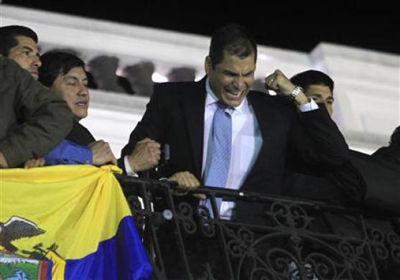
- Ecuadorean President Rafael Correa speaks from the balcony of the Carondolet Palace as hundreds of supporters gathered to greet him in Quito; September 30, 2010.
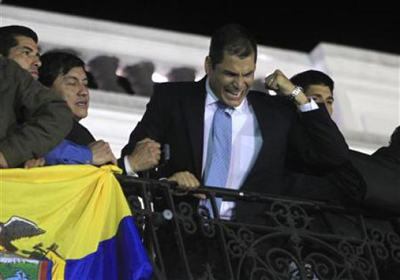
Using the standard CIA playbook on toppling democratically-elected governments in Latin America, the Obama administration, which was not happy with Ecuadorian President Rafael Correa’s moves to increase state control over oil companies in the nation and his decision to oust the United States military from its airbase at Manta, appears to have suffered a major defeat in the failed coup attempt in Ecuador by police officers and Air Force personnel who were backed by rightist elements in the National Assembly and business community. Correa was re-elected with an overwhelming majority last year after he gave the U.S. military its walking papers from the Manta airbase. The Pentagon and CIA have been working to topple Correa ever since by pumping money into opposition political parties and other groups through NGOs funded by the U.S. National Endowment for Democracy.
In a statement from Correa after his rescue from the Police Hospital in Quito by a military special operations team, the president warned of a larger conspiracy launched against him by his political opposition, saying the "attempt at destabilization is the result of a strategy that has been brewing for quite some time. A barrage of messages and misinformation have been given to the National Police, which today has been realized through violent actions from a conspiracy attempt."
Correa’s predecessor, the pro-U.S. Lucio Gutierrez, who is wedded to foreign oil company interests in the country, was accused by the government of covertly supporting the police and Air Force mutineers.
Although Secretary of State Hillary Clinton issued a weak statement saying the United States backed Correa, it came one day after Clinton heaped praise on former Secretary of State Henry Kissinger, the person who helped to craft the September 11, 1973 coup in Chile and the assassination of its progressive president Salvador Allende. In fact, Clinton and Obama had given military and political support to the right-wing junta that ousted democratically-elected progressive President Manuel Zelaya in Honduras in June 2009 and has fought against allowing the ousted democratically-elected president of Haiti, Jean-Bertrand Aristide, to return to his country from exile in South Africa after the CIA-engineered coup against him in 2004.
Clinton’s tepid response to the attempted coup against Correa was in marked contrast to the strong denunciations of the attempted coup and messages of support for Correa that came from Venezuela, Brazil, Argentina, Peru, Mexico, Bolivia, Cuba, and Spain.

- Riot police repel supporters of Ecuadorean President Rafael Correa from reaching the hospital where he took refuge for protection from police protesters, in Quito; September 30, 2010.

And the fact that Correa, like Venezuelan President Hugo Chavez, who was briefly ousted in an April 2002 coup organized by the CIA, was held as a virtual hostage at the Police Hospital in Quito for the greater part of a day provided a grim reminder of an old CIA tactic in staging coups in Latin America. Chavez was briefly held hostage on a Venezuelan island in the Caribbean while a U.S.-registered plane stood by to fly him into exile. In an emergency Latin American summit meeting in Argentina, Chavez saw the U.S. behind the events in Ecuador. He said, "The Yankee extreme right is trying right now, through arms and violence, to retake control of the continent." Chavez’s own experience with a CIA backed coup and the June 2009 coup, supported by the Pentagon, CIA, and Mossad against his ally Zelaya in Honduras, makes him an expert on CIA and Mossad tactics in the region. Informed sources have told WMR [1] that Correa and Chavez are currently comparing notes on the coups launched against them.
Ecuadorian intelligence will be looking closely at the wereabouts of key CIA personnel stationed at the CIA station at the US embassy in Quito and a smaller CIA station within the US Agency for International Development (USAID) mission in Guayaquil. In the 2002 coup attempt against Chavez, the US embassy’s top CIA and DIA officers were discovered to be helping to direct the coup from Venezuelan military installations.
Clinton’s State Department has been casting Ecuador in a bad light throughout the past two years, calling the country "difficult to do business in," the only real priority that the Obama administration cares about due to its total subservience to Wall Street and the fat cat bankers. The State Department’s "Investment Climate Statement" for Ecuador states: "Ecuador can be a difficult place in which to do business. . . There are restrictions or limitations on private investment in many sectors that apply equally to domestic and foreign investors . . . A 2006 hydrocarbons law imposed new conditions in the petroleum sector that have been problematic for many companies, complicated by a 2007 decree that imposed additional restrictions. A 2008 mining mandate stalled mining activity, and a new Mining Law is expected in early 2009. Negotiations for a free trade agreement between the United States and Ecuador, which would have included investment provisions, stopped in April 2006. The current Government of Ecuador has not expressed interest in restarting negotiations."
Correa’s financial policies, as well as his foreign policy that saw him order out the American base at Manta and establish close ties with Venezuela, Iran, and other countries inimical to American and Israeli hegemony, placed a huge CIA and Mossad target on Correa’s back. In June, Ecuador sponsored a resolution at the Organization of American State (OAS) summit in Lima condemning Israel’s attack on the Turkish aid flotilla transporting humanitarian aid to Gaza. Ten nations voted with Ecuador in support of the resolution.
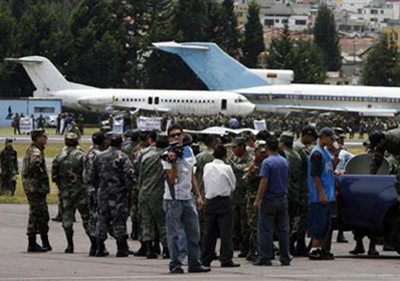
- Ecuadorian army soldiers stand on the runway of the military airbase of the Mariscal Sucre International Airport to force its closure, in Quito; September 30, 2010.
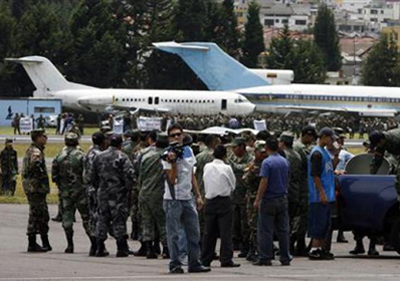
The uprising among Ecuadorian Air Force ranks, with Air Force personnel taking over and shutting down Quito’s international airport, will have Ecuadorian counter-intellligence personnel looking closely at the possible role of Israeli technicians and trainers who support the Air Force’s 26 Israeli-made Kfir combat planes. Israel also reportedly sold Python-3 air-to-air missiles to the Ecuadorian Air Force in 1997.
Mossad also has its hooks into the Ecuadorian National Police, where the main coup plotters received support. Mossad is chiefly tasked with spying on Ecuador’s large Ecuadorian-Arab community. The activities of the Mossad station at the Israeli embassy in Quito before and during the coup attempt will also draw the attention of counter-intelligence officers. Last year, Tel Aviv-based On Track Innovations received a contract to provide an electronic biometric-based electronic identification card system to Ecuador’s Central Registry Office.
Sunday, October 03, 2010
Obama greets progressives demanding end to wars and jobs and public health care with automatic weapons
There was a real disconnect between the majority of the quarter-million people who gathered around the Lincoln Memorial and the professional Democratic Party hacks who spoke at "One Nation Working Together" protest held on October 2 in Washington, DC. The crowd, estimated at around 250,000 was larger than the Glenn Beck right-wing "Tea Party" protest rally last month and more than the "tens of thousands" described by the pro-corporate Washington Post.
Many protesters were shocked to see National Park Police stationed throughout the protesters with automatic weapons at the ready. Some expressed shock that such a protest by people who had been Obama's base in the 2008 election would be met by machine guns, a scene never witnessed during the multiple anti-war protests in Washington during the Bush administration.
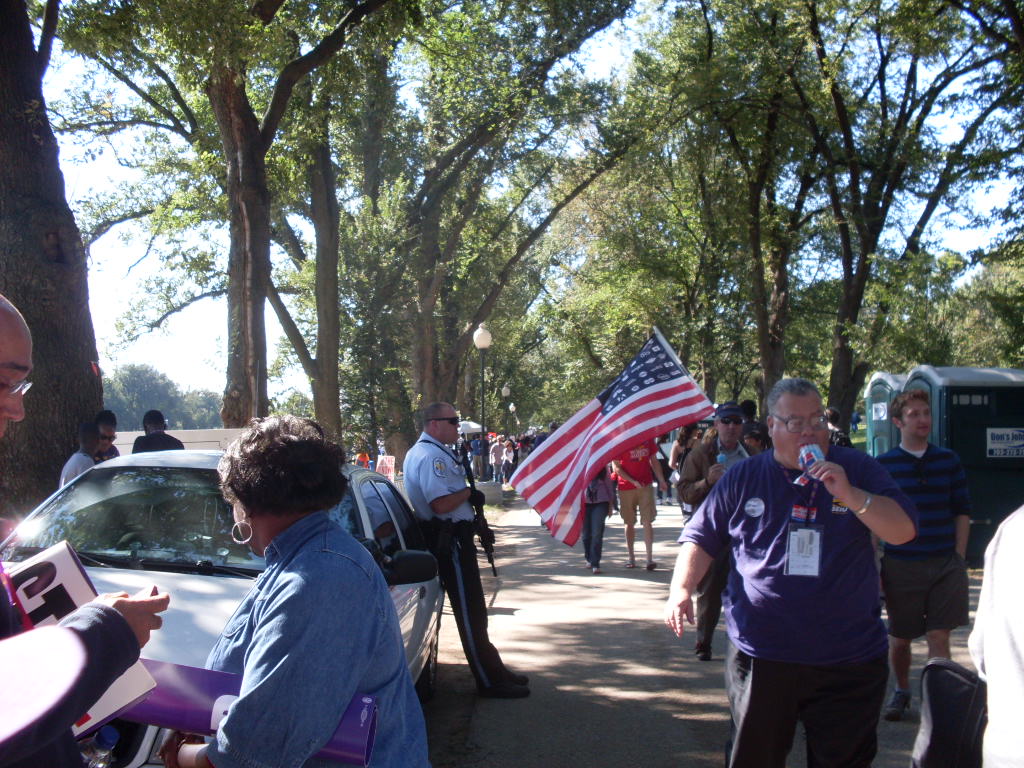

In a scene not even witnessed during the anti-war marches and rallies during the Bush administration, protesters demanding peace, jobs, education, and public health care were confronted by Park Police bearing automatic weapons. The automatic weapons angered many protesters, formerly part of Obama's political base.
Even the sponsors of the rally, representing such Obama political base groups as the AFL-CIO, NAACP, National Council of La Raza, the Service Employees International Union, and the U.S. Student Association that distributed less-than-controversial protest signs bearing such messages as "Working Together" and "Supporting Change We Voted For" and paraded political, civil rights, and labor leaders who supported the usual laundry list of demands, could prevent anti-Obama speeches and protest signs. Harry Belafonte told the protesters that Obama's decision to surge U.S. troops strength in Afghanistan cost an estimated $30 billion, He added that the money could have been better spent in the United States.
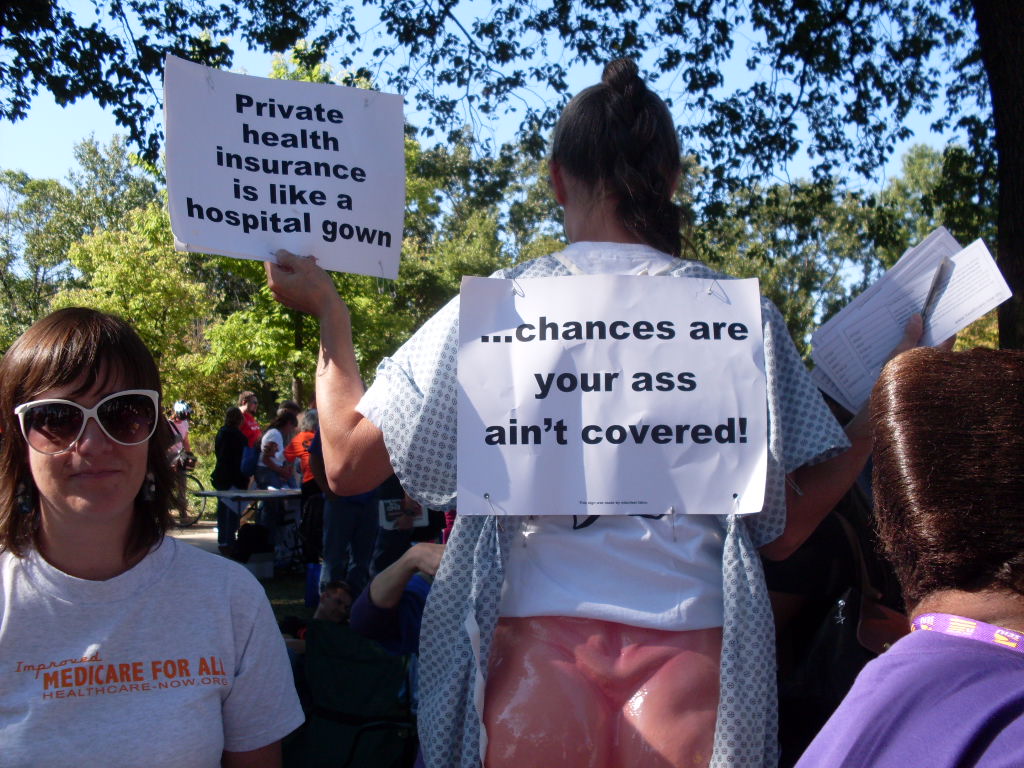
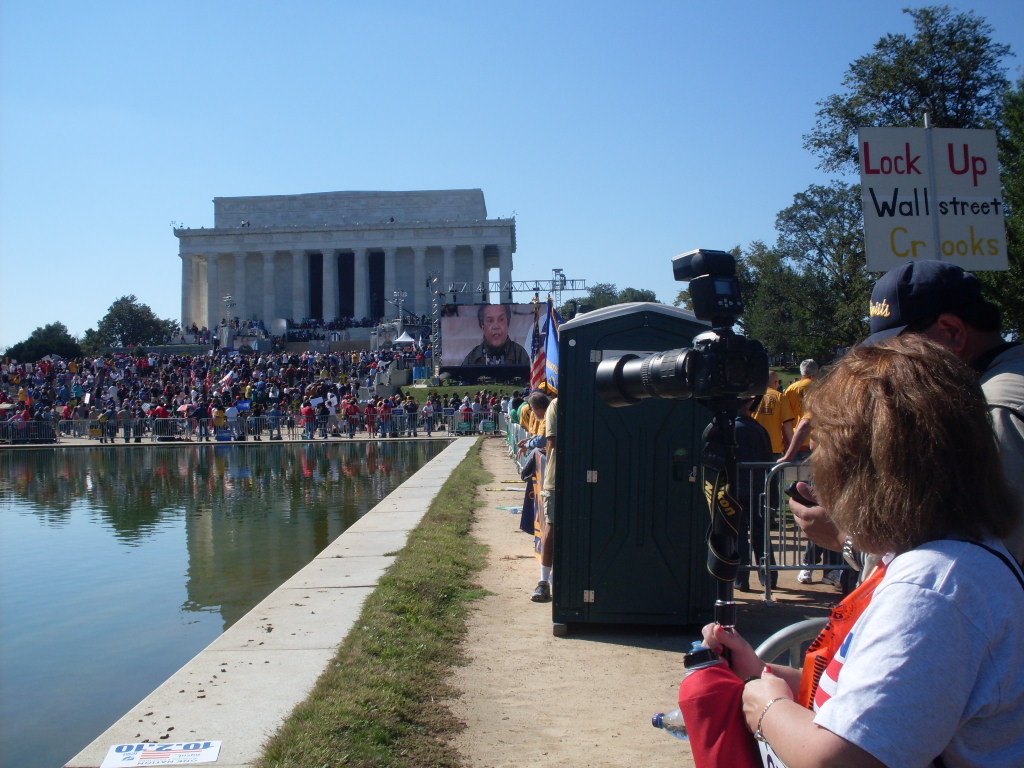
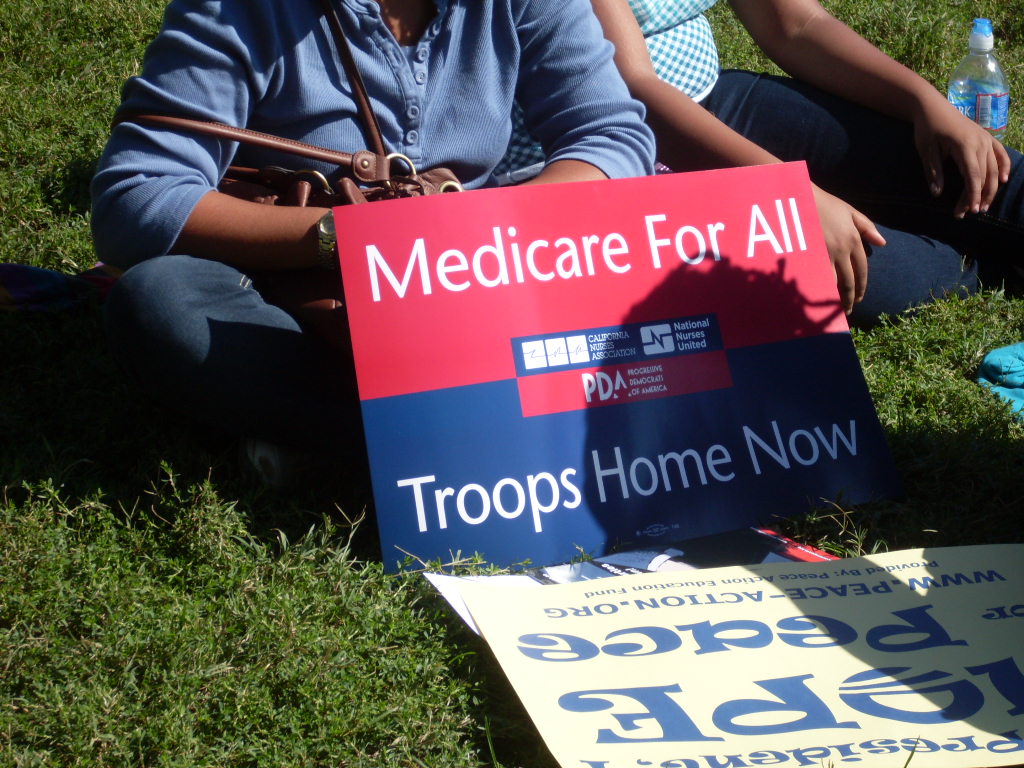
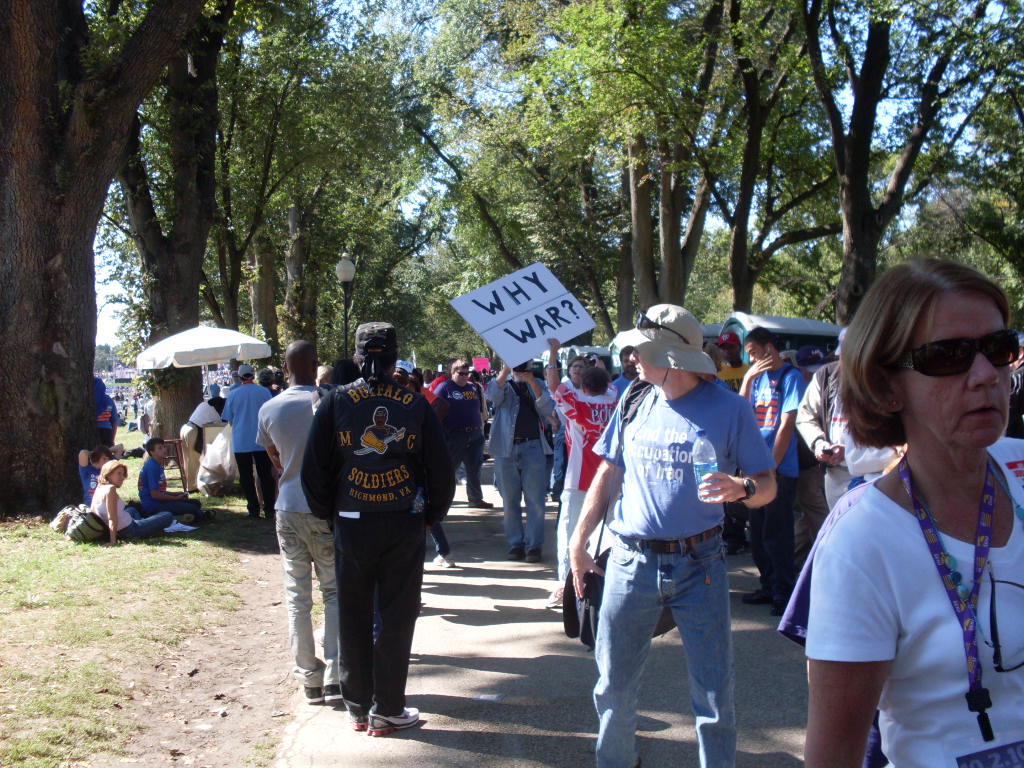
WMR provides the following pictoral gallery of today's protest. Many of the signs were far from "Obama friendly." The loss of the progressive left by Obama could have a dramatic effect on the chances of Democratic candidates in the off-year election, now just weeks away.

This family was overheard telling other protesters that Park Police told them they could not have their sign on the grounds of the Washington Monument. The reason: it was disrespectful to George Washington. Who knew George Washington was a Zionist?








Friday, October 01, 2010
THE ROVING EYE - An American dream made in Brazil
By Pepe Escobar
SAO PAULO - Brazil is a country the world loves to love. Brazil is a (joyful) riddle wrapped in a (chaotic) enigma, with the added complexity that the riddle and the enigma are ritualistically juggling with football, dancing a samba, ogling a sensual mulata, watching a telenovela and sipping a lethal caipirinha - all at the same time.
The distinctive cultural trace of Brazil is anthropophagy - from culture to technology, the legacy of a former, lazy European monarchy in a tropical country where the aborigines, after banqueting over the odd whitey, were merrily exterminated while Europeans and black slaves copulated freely, with no Catholic guilt involved (there's no sin below the Equator). If this sounds like the plot of a carnival parade, that's because it is.
French general and statesman Charles de Gaulle once quipped that Brazil "is not a serious country". Multi-ethnic, multicultural Brazilians, addicted to tolerance but most of the time drenched in complacency, preferred to believe - and joked about - the eternal promise of "the country of the future" (as Austrian novelist Stefan Zweig coined it over 70 years ago).
Now Brazil is on a roll - and profiting from global goodwill has become a crucial element of its re-turbocharged soft power. It don't mean a thing if it ain't got that Brazilian swing. The country is the "B" in Goldman Sachs-coined BRIC - the new, emerging global powers; less inscrutable and misunderstood than China, less authoritarian than Russia, less shambolic than India (and with no religious problems). And let's face it; much more fun. A new, two-fold national narrative has taken over; Brazil will become "the fifth power" - that is, the fifth-largest global economy (bye-bye Britain and France). And the New American Dream is made in Brazil.
Surfing USA, remixed
No wonder Anglo-American elites of the North tend to fry their brains confronted with so much tropical ebullience. At the Group of 20 (G-20) in London, United States President Barack Obama could not contain himself. "I love this guy," he said of Brazil's President Luiz Inacio Lula da Silva, "He's the most popular politician on Earth." Time magazine recently named Lula as "the most influential person in the world". The Economist, never a fan of hyperbole, is convinced Brazil will become the fifth power by 2025.
But was the London Independent hyperbolic when it blared, "The world's most powerful woman will start coming into her own next weekend?" On Sunday, Dilma Rousseff, 63, Lula's former chief of staff, may indeed become the next Brazilian president, even without a run-off on October 31. She may become more powerful than German Chancellor Angela Merkel or US Secretary of State Hillary Clinton - but Brazilians would quip, what about celebrities Madonna and Angelina Jolie?
The Financial Times, for its part, preferred to buy lunch last Friday in Sao Paulo for former president (1995-2002) Fernando Henrique Cardoso, colloquially known as FHC. It may have been a matter of the wrong president at the wrong (overrated) restaurant. Never one to shy away from self-promotion, FHC the peacock, multiple honorary PhD sociologist grumbled, "I did the reforms. Lula surfed the wave."
FHC's key reform was to crush hyperinflation by launching the "real" - the new Brazilian currency - plan in the mid-1990s; but it's telling how he still refuses to give Lula credit for responsible fiscal management and for fighting exclusion (but not corruption), and lifting about 30 million Brazilians out of poverty.
Welcome to Brazilian idiosyncrasy; a new poll by the Pew Global Attitudes Project reveals that 79% of Brazilians see political corruption as a "major problem", even while 75% approve of Lula's government, and no less than 80% take Lula personally to the skies.
But even enjoying this stratospheric 80% approval rate Obama can only dream about, Lula is not a god; in eight years in office, he couldn't push a crucial tax reform through an inept, corruption-corroded congress. And without it, the New American Dream - essentially concerning a newly empowered lower-middle class consuming homes, cars, televisions and computers like there's no tomorrow - can't rally take off. As much as the current Brazilian boom - essentially fueled by the non-stop sale of commodities to China - cannot be sustainable forever.
Lula - issued from a very poor family in the poor northeast, and a former metalworker - rattled the nerves of the old-style Brazilian sub-imperialist comprador elite to an extent that is hard to fathom abroad. Historian Jose Honorio Rodrigues has pointed out how these elites have always been "alienated, anti-progressive, anti-nation and anti-contemporary". And they "have never reconciled with the people". The recent, vicious Brazilian corporate media anti-Lula drive can be explained as a war against poor people that are finally emancipating themselves and following a path whose trailblazer was Lula himself. Who said class struggle was dead? One just has to visit Brazil - still the most unequal society in supremely unequal Latin America.
Stella by starlight
Lula once again seems to surf on the right wave of history as the takes a formidable risk by picking as his successor an austere and until recently obscure middle-class apparatchik who has never faced the ballot box. The daughter of a Bulgarian immigrant, Dilma "Iron Lady" Rousseff, or colloquially Dilma, as a kid dreamed of becoming a ballerina, a firefighter or a trapeze artist. But then the Brazilian generals smashed democracy in 1964 and installed their own tropical brand of the war on terror - to defend what they called "national security".
It's fascinating to observe today that Lula essentially did what the Joao Goulart government was trying to do before the military coup in 1964; to empower urban and rural workers. The comprador elites only cared about exports and an upper middle class mired in conspicuous consumption - the auto industry was the axis of the Brazilian economy at the time. The military dictatorship favored corporate - national and international - capitalism; those who profited immensely included Brazilian media groups, controlled by eight families.
Dilma fought against the dictatorship development "model" by joining the clandestine Palmares Armed Revolutionary Vanguard. Her codename was "Stella". Stella, like musician Jim Morrison of the Doors did, wanted to change the world, and change it now. These vanguards, in the 1960s and 1970s, used to kidnap foreign diplomats for ransom and shoot foreign - some American - torture experts training the dictatorship's death squads (hello General David Petraeus; does that ring a bell?) Dilma was tortured by the secret police in Sao Paulo's then Abu Ghraib, given a 25-month sentence for "subversion", and only recovered her freedom three years later. She was ready to try to change the system from within.
How Brazil beat the crisis
Developmentalism will be the name of the game in a Dilma government. It's gonna be a bumpy ride - especially because Brazil's infrastructure is in shambles and education levels are still on the slightly better side of appalling. It's unclear whether Dilma will follow to the letter the mantra among luminaries of her Workers' Party (PT) - that Brazil can keep growing without foreign investment in oil and agriculture, for instance.
Dilma holds on to a key guru - her former economics teacher Luciano Coutinho, now head of the humongous National Bank for Economic and Social Development (BNDES). He may be Brazil's next finance minister. With Sao Paulo functioning as Brazil's Wall Street, no wonder the city's big bankers and financial markets, not to mention rentiers, are not amused.
The key criticism is that the Brazilian Treasury has been showering BNDES with cash, thus ballooning public debt. But this process also explains why and how Brazil won against the 2008 Wall Street-provoked global financial crisis.
When China announced its massive, nearly US$600 billion stimulus package in late 2008, the economists at BNDES knew they would have to, literally, follow the money. There were no lines of credit to anybody, Brazil included. So to fight an inevitable recession approaching, a $60 billion loan from the Treasury to BNDES was designed. This was the absolute opposite of the capital market-crazy FHC years. Coutinho recently insisted to journalist Consuelo Dieguez that countries with strong public banks, such as Brazil, China, India and South Korea, were the ones that really managed to beat the crisis.
Brazil may be allowed to hold a slight grudge against the US that explains why the country did not modernize much earlier.
The steel giant CSN - still in business - was built in 1941 with full American support; the US badly needed Brazilian steel for World War II. The Brazilian government was led to believe that after the war, Washington would keep investing in the country's modernization; Franklin Roosevelt, or FDR, had even organized a committee to study a development plan for Brazil, including massive financial help. But FDR died in April 1945. Harry Truman preferred to rebuild the losers in the war, Germany and Japan. The problem is, the war automatically fostered protectionism. From the 1940s ahead, Brazil was an economy almost as closed as current fellow BRICs Russia and China at the time.

Yet it took only a decade for Brazil to develop a serious industrial base; starting in the early 1960s, Brazil's economy jumped from 50th in the world to eighth. Gross national product at the time was growing at 7% a year. That was the so-called "Brazilian miracle". The problem is, the military only favored businessmen close to the regime with massive BNDES loans. After the 1973 oil shock, reality set in. With no oil and no cash to pay interest on foreign debt, Brazil tanked.
Flash forward to the 1990s. In an irony noted by many a Brazilian economist, the BNDES was reborn from the ashes to run the privatization drive; instead of developing state companies, it was ordered to dismantle them. And yet once again, those who profited handsomely were very close to the government, that is, flashy FHC and his coterie.
Now BNDES is betting on commodities companies to become Brazil's national champions; cellulose, food, meatpacking, petrochemicals, oil, mining. No sign of high-technology companies. A non-governmental organization study claims that mining, steelmaking, ethanol, cellulose, oil, gas, hydroelectric power and agrobusiness received almost half of the nearly $280 billion BNDES funds during the eight years of Lula. JBS, for instance, became the world's biggest meat producer.
Lula policy entails, for instance, borrowing money at a 10,75% interest rate to buy oil giant Petrobras shares. These Treasury loans do not appear on the budget, increasing gross debt but not the net debt. Brazilian gross debt has already reached a staggering 63% of gross domestic product (GDP). No wonder hordes of economists are horrified; there's a hurricane of money to lend, but few good ideas, and no sign of an industrial policy strategy. And why is that? Essentially because the country lacks a solid, well planned project for long-term development. Dilma will be smart enough to notice that China buying loads of commodities cannot drive Brazil's industrial policy.
The name of the game in the complex China-Brazil relationship is "pockets of prosperity". China is now Brazil's top trading partner, ahead of the US for the first time in 2009. China consumed almost 14% of Brazil's exports in 2009, and Brazil consumed almost 13% of Chinese exports. If you're a Brazilian soy exporter, you're a certified multi-millionaire. If you belong to the once-thriving Brazilian shoe industry, you're about to go bankrupt.

Relying on China is not exactly a recipe for sustainable growth. The obvious way out for Brazil is to sell not only commodities but added-value goods; to follow the Samsung way. And here's the supreme catch; Brazil can't do it without urgently updating the decrepit infrastructure in ports, airports and highways (a 2007 study by the Transport Confederation found that 74% of Brazilian roads were in "terrible or bad" condition); it needs to modernize the notoriously Byzantine tax code; and it must smash the nerve-wracking bureaucracy that slows down businesses in Brazil, the so-called "Brazil cost" (the country is 129th out of 183 in terms of ease of doing business, according to a 2009 World Bank report).
Dilma has vowed to invest more than $550 billion between 2011 and 2014 to improve Brazil's agricultural export drive and to prepare for the 2014 football World Cup and the 2016 Summer Olympic Games. But not much has been discussed about the tax code reform and the bureaucratic machine. The tax burden is at 34.4%, much higher than fellow BRICs and even developed countries such as Japan (17.6%) and the US (26.9%), according to a recent study by the Brookings Institution.
Last Friday, when Lula opened the Sao Paulo stock exchange, the Bovespa index jumped in market value to become the world's second-biggest because of Petrobras selling a whopping $68 billion worth of shares in the biggest share issue in corporate history. Excited investors from Brazil and abroad had asked for double that amount.
The capitalization of Petrobras - now the second-biggest oil company in the world just behind Exxon - took the state participation to 48% and in fact graphically reverted the FHC years, when control of Brazil's most strategic company was broken up and pulverized. Now come the customary market doubts over efficiency and productivity at Petrobras. The company is launching a monster $224 billion investment program for 2010 to 2014. For those like the PT staunchly defending Brazilian sovereignty, this Petrobras on steroids will be essential in the exploitation of pre-salt oil and its probable 50 billion barrels lying at the bottom of the Atlantic Ocean.
Another Brazilian giant is miner Vale, which the Boston Consulting Group says has created more value over the past decade than any other large firm in the world. Once again, thank China; with a market capitalization of $147 billion, Vale is now the world's second-largest miner behind BHP Billiton.
The new Kuwait
Inevitably, the Brazilian boom would generate its share of megabillionnaires. Such as Jorge Paulo Lemann, Brazil's second-richest man worth $11.5 billion, who engineered the $52 billion takeover of Anheuser-Busch Cos., founded Brazil's largest investment bank and recently conducted the $3.3 billion takeover of Burger King, the biggest restaurant acquisition of the past 10 years.
But the top dog is undoubtedly EBX Group owner Eike Batista. Excited investors are placing a value of about $5 a barrel on Batista's subsidiary OGX's estimated seven billion barrels of shallow water oil reserves. No wonder China's Sinopec Group and CNOOC are about to buy into OGX assets. Just as a comparison, if someone invested $100 in OGX in September 2009, now that would be worth $180, compared with a meager $80 in Petrobras and $113 in the Bovespa stock index. OGX, a start-up, has a market capitalization of about $38 billion and is not generating any revenue - yet.
Batista predicted in an already notorious interview on Charlie Rose that Brazil would be producing 5 to 6 million barrels of oil per day (bpd) by 2020, with OGX itself betting on 730,000 bpd by 2015 and 1.4 million bpd by 2019. Batista could have a net worth of $100 billion by 2020; not accidentally his dream is to become the world's top multibillionaire.
He's also fond of repeating the mantra that "we are today the United States of the 1950s". So foreign investment is more than welcome; "Come! It's the time to make your bets on a country with 200 million consumers and the perfect demographics for the next 10 years. This oil story is a 30-year growth story." And what's good for him is good for Brazil. Inevitably, Batista also predicted that Brazil should become the "fifth power" by 2015-2020, behind Germany, Japan, China and the US.
No wonder American economists are raving. Last week, at a seminar on global governance in Brasilia, American economist James Galbraith stressed, "Social inequality in Brazil is being reduced in the last few years because the country spends less money to help the financial sector and more money to help Brazil." And he took no time to once again smash neo-liberal dogma; "There can be sustainable social and economic growth side-by-side with a functional democratic process."
Brazil entertains high hopes of entering Standard Chartered's recently coined "7% club" - that is, countries with annual GDP growth of 7% or more for an extended period. Based on the 10 years up to 2008, club members are China (9.7% average), followed by India, Vietnam, Ethiopia, Uganda and Mozambique. Several countries are not far behind the BRICs and could hit the top four before 2030. In this case, Russia might "fall" - or even Brazil. Thus, the future of BRIC may be to become BRICI (with Indonesia), BRICK (with South Korea) or even BASIC (Russia replaced by South Africa, or Afrique du Sud).
University of Missouri's Michael Hudson, who's also recently been to Brazil, insists the main task of the BRICs is to build an alternative for the International Monetary Fund and the World Bank. And Brazil must create "its own development strategy" - which, as we have seen, is still non-existent. Hudson ominously predicts that Washington will do everything in its power to oppose this independence - referring to what happened to Iran in the 1950s when it wanted to control its own oil, and to Afghanistan when a secular government took over in the late 1970s.
A new social contract?
Amid so much ballyhoo, it's always healthy to find dissenting voices. Marxist historian Paulo Alves de Lima stresses how Brazil is now living the construction of a new national mythology:
It's the formulation of a project for the monopolistic capitalism created by the military dictatorship. A new ideology for the future has been born; universalization of the middle class, the end of poverty with the exploitation of pre-salt reserves, stable democracy, strength of the industrial-military complex ... They are promising paradise while Obama must declare to the world that American poverty is increasing. Top universities are embracing the myth and the concept of 'superior society' - neither capitalist nor socialist, and even less defined as subordinate capitalism. Our future is to march to this new paradise.Undoubtedly, shades of FDR are everywhere. Mainstream media are obsessed with the notion that Brazil is now a middle-class society. It's true that tens of millions now can afford their own house. Their self-esteem has ballooned; and most people live "an admittedly decent material life". But wait a minute; that's American economist Paul Krugman describing the US in the 1950s and 1960s. Is there at least a psychological parallel - like in an overwhelming feeling of optimism, the "future is in your hands" style?
These new individualistic Brazilians indeed resemble the Americans of the 1950s and 1960s. Essentially, their priorities are family, stability and professional success, no matter their social class and the region from which they come. With poverty in Brazil falling 41% from 2003 to 2008, technically almost half of the Brazilian population is now "new middle class". But this is not the traditional American middle class. Families with a maximum per capita income of $2,500 monthly, qualified as the "C" class, make up 40% of Brazil's overall income. The "B" and "C" classes, together, make up for almost 70%. For a country always defined by inequality (third place in the world until recently, only behind Bolivia and Haiti, according to the United Nations Development Program, and now 11th), that's a lot.
In developing countries, the so-called "global middle class" groups around 400 million people; and 2 billion others may join them before 2030. Social mobility in Brazil is only beginning. But millions do indeed feel that Brazil today feels like the US in the 1960s in terms of jobs on offer, rising income, and unlimited opportunities. Yet essentially this is still a very poor middle class - reflecting the extreme inequality that still prevails.
Dilma anyway inherits a unique historical conjuncture generated by Lula; for the first time inequality, injustice and social exclusion in Brazil actually decreased. It's imperative to know in relation to what; that happened in relation to the overwhelming inequality of the model privileged by two decades of military dictatorship. Leftist sociologist Emir Sader insists the process is only beginning, and still has to break the monopolies of financial capital, powerful landowners and the power of monopolistic media.
He could be referring to a struggle now going on all over South America. With a fearful Europe increasingly turning to the right and extreme-right and a dejected New Great Depression US at the mercy of wacko populists of the Tea Party variety, it is South America - and parts of Asia and Africa - that now seem to be on the right side of history. The American television series Mad Men celebrates the (now dying) American dream. Maybe now the time has come for the Mad Men from the tropics.
Pepe Escobar is the author of Globalistan: How the Globalized World is Dissolving into Liquid War (Nimble Books, 2007) and Red Zone Blues: a snapshot of Baghdad during the surge. His new book, just out, is Obama does Globalistan (Nimble Books, 2009).
He may be reached at pepeasia@yahoo.com.
The Anti-Empire Report - The secret to understanding US foreign policy
by William Blum
In one of his regular "Reflections" essays, Fidel Castro recently discussed United States hostility towards Venezuela. "What they really want is Venezuela's oil," wrote the Cuban leader. 9 This is a commonly-held viewpoint within the international left. The point is put forth, for example, in Oliver Stone's recent film "South of the Border". I must, however, take exception.
In the post-World War Two period, in Latin America alone, the US has had a similar hostile policy toward progressive governments and movements in Guatemala, Salvador, Nicaragua, Honduras, Grenada, Dominican Republic, Chile, Brazil, Argentina, Cuba, and Bolivia. What these governments and movements all had in common was that they were/are leftist; nothing to do with oil. For more than half a century Washington has been trying to block the rise of any government in Latin America that threatens to offer a viable alternative to the capitalist model. Venezuela of course fits perfectly into that scenario; oil or no oil.
This ideology was the essence of the Cold War all over the world.
The secret to understanding US foreign policy is that there is no secret. Principally, one must come to the realization that the United States strives to dominate the world. Once one understands that, much of the apparent confusion, contradiction, and ambiguity surrounding Washington's policies fades away. To express this striving for dominance numerically, one can consider that since the end of World War Two the United States has:
- Endeavored to overthrow more than 50 foreign governments, most of which were democratically-elected.
- Grossly interfered in democratic elections in at least 30 countries.
- Waged war/military action, either directly or in conjunction with a proxy army, in some 30 countries.
- Attempted to assassinate more than 50 foreign leaders.
- Dropped bombs on the people of some 30 countries.
- Suppressed dozens of populist/nationalist movements in every corner of the world. 10
The United States institutional war machine has long been, and remains, on automatic pilot.
Notes
9 Reflections by Comrade Fidel, "What they want is Venezuela's oil", September 27, 2010 ↩
10 A link to any of the first five lists can be obtained by writing to William Blum at bblum6@aol.com. The sixth list has not yet been uploaded to the Internet. ↩
The Anti-Empire Report - In struggle with the American mind
by William Blum
Since The Great Flood hit Pakistan in July ...
- many millions have been displaced, evacuated, stranded or lost their homes; numerous roads, schools and health clinics destroyed
- hundreds of villages washed away
- millions of livestock have perished; for the rural poor something akin to a Western stock market crash that wipes out years of savings
- countless farms decimated, including critical crops like corn; officials say the damage is in the hundreds of millions of dollars and it does not appear that Pakistan will recover within the next few years
- infectious diseases are rising sharply
- airplanes of the United States of America have flown over Pakistan and dropped bombs on dozens of occasions 1
I direct these remarks to readers who have to deal with Americans who turn into a stone wall upon hearing the United States accused of acting immorally; America, they are convinced, means well; our motives are noble. And if we do do something that looks bad, and the badness can't easily be covered up or explained away ... well, great powers have always done things like that, we're no worse than the other great powers of history, and a lot better than most. God bless America.
A certain percentage of such people do change eventually and stop rationalizing; this happens usually after being confronted X-number of times with evidence of the less-than-beautiful behavior of their government around the world. The value of X of course varies with the individual; so don't give up trying to educate the hardened Americans you come in contact with. You never know when your enlightening them about a particular wickedness of their favorite country will be the straw that breaks their imperialist-loving back. (But remember the warning from Friedrich Schiller of Germany: Mit der Dummheit kämpfen Götter selbst vergebens. — "With stupidity even the gods struggle in vain.")
Here's a recent revelation of wickedness that might serve to move certain of the unenlightened: New evidence has recently come to light that reinforces the view of a CIA role in the murder of Patrice Lumumba, the first prime minister of The Congo following its independence from Belgium in 1960. The United States didn't pull the trigger, but it did just about everything else, including giving the green light to the Congolese officials who had kidnaped Lumumba. CIA Station Chief Larry Devlin, we now know, was consulted by these officials about the transfer of Lumumba to his sworn enemies. Devlin signaled them that he had no objection to it. Lumumba's fate was sealed. 2
It was a classic Cold War example of anti-communism carried to absurd and cruel lengths. Years later, Under Secretary of State C. Douglas Dillon told a Senate investigating committee that the National Security Council and President Eisenhower had believed in 1960 that Lumumba was a "very difficult if not impossible person to deal with, and was dangerous to the peace and safety of the world." 3 This statement moved author Jonathan Kwitny to observe:
How far beyond the dreams of a barefoot jungle postal clerk in 1956, that in a few short years he would be dangerous to the peace and safety of the world! The perception seems insane, particularly coming from the National Security Council, which really does have the power to end all human life within hours. 4
President Eisenhower personally gave the order to kill the progressive African leader. 5
We can't know for sure what life for the Congolese people would have been like had Lumumba been allowed to remain in office. But we do know what followed his assassination — one vicious dictator after another presiding over 50 years of mass murder, rape, and destruction as competing national forces and neighboring states fought endlessly over the vast mineral wealth in the country. The Congo would not hold another democratic election for 46 years.
Overthrowing a country's last great hope, with disastrous consequences, is an historical pattern found throughout the long chronicle of American imperialist interventions, from Iran and Guatemala in the 1950s to Haiti and Afghanistan in the 1990s, with many examples in between. Washington has been working on Hugo Chávez in Venezuela for a decade.
Just like the commercials that warn you "Don't try this at home", I urge you not to waste your time trying to educate the likes of Thomas Friedman of the New York Times, who not long ago referred to "the men and women of the US Army, Navy, Air Force and Marine Corps" as "the most important peacekeepers in the world for the last century." 6 What can you say to such a man? And this is the leading foreign policy columnist for America's "newspaper of record". God help us. The man could use some adult supervision.
Notes
- Wikipedia, Drone attacks in Pakistan ↩
- AllAfrica.com, New Evidence Shows U.S. Role in Congo's Decision to Send Patrice Lumumba to His Death, August 1st 2010↩
- The Select Committee to Study Governmental Operations with Respect to Intelligence Activities (US Senate: The Church Committee), Interim Report: Alleged Assassination Plots Involving Foreign Leaders, November 20, 1975, p.58↩
- Jonathan Kwitny, Endless Enemies: The Making of an Unfriendly World (1984), p.57↩
- New York Times, February 22, 1976, p.55 ↩
- New York Times, October 11, 2009↩
More on the Coup attempt in Ecuador by Sabina Becker
Wow. Was today exciting or what?
Even in a gasmask, yowza.
Holy fucking moly. Just when I thought nothing was going on in the world, a fascist coup decided to go down (and fuck up) in Ecuador. The federal police took the president prisoner in the military hospital where he'd recently had knee surgery, and tear-gassed rioting ensued. So far, the Red Cross reports two dead (both police) and 88 injured. (Sadly, we can expect these tolls to rise.)
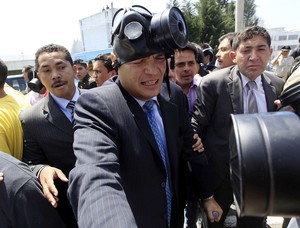
President Correa finally made it out of the hospital, with the help of a hefty contingent of loyal soldiers and citizens who fought it out barrel-to-barrel with the police in an intense firefight; he was spirited out from an underground parking garage in a grey truck. His rescuers pulled him out in a wheelchair with a gasmask on his face to protect him against the tear gas which the cops were shooting with no regard for the other patients at the hospital (including at least 20 newborn babies, so's you know. Yeah, those fascists value human life so much!)
I ended up spending the night hunched over a hot (and often balky) tweeter, RTing and translating headlines from Spanish to English. And biting my nails for President Correa, and vowing to kill anyone who harmed one hair on that fine head of his. And cursing the crappy reporting from all the Anglo sources, including the usual shitty suspects (Chicken Noodle Network; the fucking Torygraph, with its creative use of quotation marks) and the otherwise excellent (Al-Jazeera, HOW COULD YOU?) They all wrongly reported that Correa had cut police salaries; in fact, he has doubled them. And there is ample evidence that the CIA was behind this one, too...where is it ever not?
Anyhow, other than my own frenetic tweetlings, there was Otto, keeping score here, here, here and here. He was awesome in his own right, and I was thankful he was still tweeting when my birdie temporarily lost its cheep.
And how about those UNASUR leaders? In spite of tremendous political differences, they were unanimous in condemning the coup. They are meeting in Buenos Aires as I write this. Chavecito was first and loudest in condemning the coup; Fidel predicted it would fall apart quickly, and it did. Evo even suggested, in a ballsy move, that they all fly to Quito to make clear to the police that Correa was to be freed at once, no fucking around. (Just when I thought I couldn't possibly love those guys any more than I already did. That'll teach me.)
Needless to say, tomorrow's FLFB entry is all sewn up, and I won't be left scrounging for material as I'd feared I might. If anything, I'll have a surplus. Can you guess what I'll be blogging, kiddies? (Hint: Diabetics, please have your insulin syringes handy. You're gonna need 'em.)
Subscribe to:
Posts (Atom)