Showing posts with label Coup. Show all posts

Saturday, July 16, 2016

SPECIAL REPORT. Turkish sources: Erdogan behind "false flag" coup by Wayne Madsen Report


SPECIAL REPORT. Turkish sources: Erdogan behind "false flag" coup
by Wayne Madsen Report
WMR has been informed by Turkish and foreign intelligence sources inside Turkey that Turkish President Recep Tayyip Erdogan staged the July 15 military coup in order to determine what sections of the military would support it. Erdogan, who was never in any real danger of being overthrown by the small group of mid- and lower-ranking military officers who rallied to support the coup, will use the incident as a way to flush out supporters of exiled Turkish charismatic Islamic leader Fethulleh Gulen.

Turkish sources report that the coup was limited by Erdogan's design from the very start. Although the coup began as a classic military overthrow of a civilian government, with strategic points -- the two cross-Bosporus bridges, the Istanbul international airport, the state broadcast network TRT, and the General Staff headquarters in Ankara -- all being taken by the coup leaders, it was doomed to failure.

It is still a mystery how the coup leaders, who limited their actions to seizing a few but not all strategic centers, could shut down all social media in Turkey, including Facebook, Twitter, and YouTube. In fact, after Erdogan left his holiday hotel in Marmaris on the Aegean Sea, his plane was reportedly refused landing at Istanbul's Ataturk International Airport, which was in rebel hands. Erdogan's propaganda operation then began to put out false information that Erdogan, who was in the air on his presidential plane, was seeking asylum in Germany. WMR's sources report that Erdogan's plane never strayed far from Turkish airspace. Although major social media was shut down, Erdogan appeared on FaceTime from his iPhone on CNN Turk, which had not yet been seized by the rebel military forces.

If the coup had been a serious attempt, FaceTime would have been cut off and CNN Turk would have been seized at the same time that TRT was taken over. Also, the state-run Anadolu news agency continued to issue statements from Prime Minister Binali Yildirim claiming that the coup had been put down just after it started. An actual coup would have seen the news agency also shut down.

Erdogan instructed his supporters to take to the streets, in addition to seizing Ataturk airport from the pro-coup military forces. After Erdogan supporters took over the airport, Erdogan landed at the airport during the early morning hours of July 16 to be met by cheering crowds. Generating even more sympathy for himself, Erdogan claimed that his hotel in Marmaris was bombed after he left it for his plane. It would also be in Erdogan's interest to order the bombing of his massive presidential palace in Ankara, again, as a way to garner popular sympathy and support.

Erdogan also held a news conference in which he not only threatened Gulen but his host state of Pennsylvania: "I have a message for Pennsylvania: You have engaged in enough treason against this nation. If you dare, come back to your country." Erdogan substituted Pennsylvania for the name Gulen. However, it is clear that Erdogan, who is used to threatening political leaders in his own country, was referring to Pennsylvania politicians who support Gulen, including senators Bob Casey, a Democrat, and Pat Toomey, a Republican.

Gulen denied any involvement in the coup. Erdogan has issued an arrest warrant for Gulen and a request to the Obama administration to extradite the cleric to Turkey. An attempt by the U.S. Justice Department to pull Gulen's permanent residency status was forcibly opposed in the U.S. appellate court in Philadelphia by the Central Intelligence Agency. As WMR reported in 2008, "the appeals court ruled that Gulen was 'an alien of extraordinary ability,' a decision that saw approval of Gulen's residency status. Observers of the case suspect the CIA intervened with the court on Gulen's behalf."

Erdogan has already begun a purge of the military and intelligence services. Apparently, the police opted to side with Erdogan. Almost 2000 military officers and conscripts have been arrested by Erdogan's government and the president and Prime Minister Yildirim both stated that the coup participants will be dealt with harshly. Most of the coup participants were from the air force, Army armored units, and military police. It appears that in rounding up coup participants, Erdogan's government is involved in a fish net operation, using the coup as an excuse to also arrest Erdogan critics. The coup attempt was a standard "fly paper" operation, with Erdogan and his allies now seeing which officers attached themselves to the coup.


An actual professional coup would have shut down all social media, including Instagram and FaceTime.

Our sources in Turkey claim that the coup attempt was a false flag operation for a number of reasons:

  • The coup attempt started out as a textbook overthrow but rapidly fell apart. Many in Turkey believe that if such a coup was a serious operation, it would not have dissipated so rapidly.
  • After first claiming they had total control of Turkey, the coup leaders gave up with only token resistance.
  • By closing all lanes on the cross-Bosporus bridges and not keeping one lane open so people could get home from work, the population grew angry at the "coup" and its "leaders."
  • Erdogan's plane landed without incident. In an actual coup, his plane would have been surrounded by the military and he would have been placed under arrest. Or, if the presidential plane insisted on landing against the military's orders, it could have been shot down.
  • Erdogan was met at the airport by a crowd waving brand new Turkish flags, the folds still visible. This is always a sign of George Soros's involvement in themed revolutions, with protesters always waving factory-fresh flags. Some Erdogan supporters were also seen waving brand new flags representing the Muslim separatist group of East Turkestan in western China, a group supported by Soros. Soros's Open Society Institute operates freely in Istanbul and Soros is on friendly terms with Erdogan.
  • Erdogan's government ordered the imams to begin using the minarets to urge people into the streets. In an actual military coup, the minaret speaker systems would have been ordered to remain silent or power would have been cut off to the mosques. Erdogan's Justice and Development Party (AKP) supporters were marching in the streets hand-in-hand with imams and other Muslim officials shouting "Allahu Akbar."
  • The Pentagon claims it was surprised by the coup. However, U.S. military officers are attached as NATO liaison officers to the Turkish Defense Ministry and Turkish officers work inside the Pentagon. It is doubtful that such a coup could have been planned by a small group of Turkish officers without the Turkish General Staff and U.S. liaison officers knowing about it.
  • Erdogan's government, on the morning after the coup attempt, ordered the sacking of 2,745 judges.
There were also three military attacks on the Turkish parliament in Ankara. It is very possible that these were carried out by pro-Erdogan military units. Erdogan has been trying to force through a new Constitution for Turkey that would confer even more powers on the president. Erdogan has also seized control of Gulen-owned media, including the newspaper Zaman and he recently suggested that Syrian refugees in Turkey, including a number of jihadists, be granted Turkish citizenship. These moves were met with hostility by Turkey's opposition parties in parliament. By ordering an attack on parliament, Erdogan was sending a not-so-subtle message to the opposition. In the wake of the coup, Erdogan has silenced the political opposition while having messages of support from U.S. president Barack Obama, German chancellor Angela Merkel, British prime minister Theresa May, and EU President Donald Tusk, among others.

In orchestrating the coup, Erdogan combined a bit of Adolf Hitler's strategy. Hitler ordered the burning of the Reichstag, blaming it on "Communists," in order to abrogate the German Weimar constitution and grant more powers to himself. By waiting to see who joined the false flag coup, Erdogan also borrowed a page from Hitler after the Operation Valkyrie attempt to kill the fuehrer in a remote control bombing. Hitler waited to address the nation until all the supporters of Valkyrie made themselves known. It was then that Hitler ordered their arrests and executions. Erdogan is now operating as Hitler did in 1944 from East Prussia. Erdogan is ordering the arrests of all those involved in or suspected to have been involved in the coup that was destined to fail. And that makes Erdogan infinitely more dangerous than any actual military junta that would have taken over Turkey to restore secular rule and steer the country away from Erdogan's delusion of Ottoman grandeur.

Tuesday, February 18, 2014

THE ROVING EYE Iran's real 'nuclear' revolution By Pepe Escobar


THE ROVING EYE
Iran's real 'nuclear' revolution
By Pepe Escobar

The nuclear talks between Iran and the P5+1 (the five permanent members of the UN Security Council plus Germany) are back this Tuesday in Vienna. The stakes couldn't be higher. It will be a long and winding road. Hidden agendas on both sides badly want the talks to fail - and will spare no effort towards that goal.

Supreme Leader Ayatollah Khamenei could be interpreted as a stony realist, when he said that the talks will go nowhere. It's as if the Supreme Leader had read Manufactured Crisis: The Untold Story of the Iran Nuclear Scare, a crucial book by Martha Gellhorn Prize winner Gareth Porter which is being launched today in New York. In the book, Porter thoroughly debunks the whole narrative of the Iran nuclear dossier as sold to the world by the George W Bush administration, assorted neo-cons and the Israeli Likud.

And it gets much worse, in terms of prospects for a final deal to be reached this year. According to Porter, "the Obama administration has introduced the subject of 'possible military dimensions' into the nuclear negotiations. That means that the United States will be demanding an explanation for 'evidence' that the book shows was fabricated. That is a decision that could threaten the conclusion of a final agreement with Iran."

Meanwhile, on Tuesday last week, millions of people hit the streets in Tehran in a massive rally celebrating the 35 years of the Islamic revolution. How come?

For all its economic mismanagement, Iran's illiteracy rate has been reduced to near zero. Women are active, participative voters (try even raising the issue in the House of Saud's paradise). There has been remarkable scientific progress, even under harsh sanctions. Pursuing a civilian nuclear program is a matter of national consensus.

This piece - significantly, published by al-Arabiya, which is controlled by the House of Saud - at least tries not to sound entirely as cheap Arab propaganda, making a valid point about the real threat for the Islamic revolution coming from disaffected youth across Iran.

Yet this is not the key point. The Islamic republic won't disintegrate tomorrow. What's much more crucial is to revisit the key reasons why the revolution happened 35 years ago, and why, when it comes to Iranian geopolitical independence, it remains somewhat popular.

That may also shed light on why the West - and especially the United States - still refuses to normalize its relations with Iran. After all, what happened 35 years ago in Iran was never properly understood in the US in the first place. In geopolitical terms, this was the real "nuclear" revolution - one of the most far-reaching developments of what Eric Hobsbawm defined as "the short 20th century".

And perhaps this is what the Supreme Leader meant about the talks going nowhere; certainly the case as long as Washington, especially, refuses to abandon the reductionism of Iran as a bunch of fanatics.

That Kissinger oil shock 
As early as the presidency of Harry Truman, the US supported the Shah of Iran's dictatorship, no holds barred. No wonder those days are sorely missed.

In 1953, after the CIA coup against Mohammad Mossadegh, the Shah - who lived mostly in the French Riviera - was "invited" to rule as a CIA puppet (John F Kennedy had met him in wild parties in the French Riviera and found him to be a dangerous megalomaniac). In return for re-establishing British "rights" to Persian oil, Washington self-attributed 55% for the concessions and the Brits got the rest.

The CIA trained the Savak - the Shah's secret police. It was the best of times. The Shah not only excelled in his role of gendarme of political/economic US interests in the Persian Gulf; as he did not share Arab hatred of Israel, Tel Aviv had access to Persian oil (that ended after Ayatollah Ruhollah Khomeini seized power).

The Shah ruthlessly suppressed and persecuted every political party in Iran and even massacred Kurds (Saddam Hussein was taking notes.) He started to take his own propaganda seriously, including believing in the myth of being a new King of Kings. He became the number one cheerleader of the 1973 OPEC oil shock, to which he got the green light from none other than Henry Kissinger.

In a nutshell, this was a follow-up of the 1972 "Nixon doctrine", when it became clear the US defeat in Vietnam was all but a done deal. That's when Tricky Dicky started to promote gatekeepers all over the "free world". And no region was more crucial than the Persian Gulf.

The Shah loved it. But he was always complaining that he didn't have enough dough to buy all those weapons the industrial-military complex was offering him. So Kissinger - a David Rockefeller errand boy - squared the circle, with the rise of oil prices by Organization of the Petroleum Exporting Countries, or OPEC.

With this move, Kissinger instantly inflated the profits of US Big Oil - which at the time accounted for five of the Seven Sisters, and crucially boasted three that were Rockefeller-owned (Exxon, Mobil and Socal). At the same time, since Japan and then West Germany and the rest of Western Europe depended on Persian Gulf oil much more than the US did, Kissinger devised the perfect way to torpedo the devastating Japanese and German industrial and trade competition.

You won't find any of this on Kissinger's turgidly ambitious tomes, or on any US corporate media files for that matter. But that explains much of the world born out of the "oil shock".

Like most US puppets - talk about hubris - the Shah never understood that he was just a puppet. His corporate multinational economic model as applied to Iran had the predictable effects; much like today (even in Europe and the US), a tiny minority consuming like there's no tomorrow and a huge majority increasingly miserable, as the Shah bet on cash crops instead of an agrarian reform to guarantee the subsistence of millions of peasants - many of them illiterate, pious Shi'ites - who had been booted out of the countryside by American agribusiness, which dismissed them as a superfluous workforce.

These miserable masses inflated Tehran and other Iranian big cities, turning into the mass base for Khomeini's revolution. And the rest is history.

Nothing is inaccessible 
Then Jimmy Carter - that hick Hamlet - when still campaigning for the presidency against Gerald Ford in 1976, admitted in a debate that the Shah was a torturer. Two years later, as president, Carter now considered him "an island of stability" and "a friend".

During the 1970s, it was "just" for Iran to carry out a nuclear program, among other motives to intimidate revolutionary Arab nationalism. Yet now, under an Islamic republic, a civilian nuclear program is an "existential threat".

The Shah's banker was David Rockefeller, never tired of extolling the "patriotism" and "tolerance" of his client, not to mention his modernizing drive - everything duly parroted by US corporate media even as Amnesty International and the State Department itself had Himalayas of documents proving the Shah was one of the top torturers of modern history. What mattered is that he brought excellent dividends for then Chase Manhattan.

One never lost money underestimating the cluelessness of US corporate media. When the Islamic revolution started, US media as a whole told the world that the Shah was undefeatable; that Khomeini and his followers were a minority of religious fanatics; and that the real motive for the revolution was that the Shah was a Great Modernizer (the Rockefeller script), rejected by those same Muslim fanatics. It's fair to say this script is still being peddled today.

When the Shah fled Iran, the whole US media bought the fallacy of "going for a holiday". When Khomeini boarded that Air France flight from Paris and arrived in Tehran in absolute triumph, no wonder no one in the US had a clue what was going on. US media preferred to mock Khomeini's "fanaticism" - which at the time paled compared with Pope John Paul II, who considered women to be an inferior species.

The Iranian bourgeoisie - modern, social democrat, inheriting the political line of Mossadegh - managed to drive a lot of support from progressives in Europe. At a time when Le Monde was still a very good newspaper and not the sub-American trash it is today, one just needed to read the dispatches by ace correspondent Eric Rouleau to confirm it.

Khomeini, for his part, had the charisma (and that spectral voice on cassette tapes), supported by the only political organization tolerated by the Shah, the roughly 160,000 mullahs, who duly mobilized those wretched masses rendered useless by American agribusiness interests.

Yet, from the beginning, Khomeini negotiated with the bourgeoisie - as when he named Mehdi Bazargan as prime minister and Bani Sadr as president (a socialist and a Western-style modernizer). Only when the Shah system was totally eradicated did Khomeini go into overdrive to purge everyone but his religious followers - recreating, on a smaller scale, the Shah's inferno, but in the name of Allah. Well, as Mao said, no revolution is a dinner party.

As for Jimmy "Hamlet" Carter, he never officially recognized Khomeini as the Iranian leader. Washington didn't even try to talk to him. A whiff of geopolitical intelligence would have the Americans trying to share some tea when he was still exiled in Paris. But David Rockefeller and his parrot Kissinger would scream, so a cowed Carter retreated into his shell. After the Islamic revolution, Washington never returned the estimated US$60 billion the Shah, family and cronies stole from Iran.

This catalogue of disinformation during the 1970s and 1980s is now mirrored by the disinformation of all these past few years about the Iranian nuclear program. No wonder most Americans - and plenty of Europeans - remain clueless.

When Khomeini died - and I vividly remember every newspaper in Europe on June 5, 1989, sharing the front page between that and Deng Xiaoping ordering the Tiananmen massacre - the great philosopher Daryush Shayegan, a former professor at the University of Tehran, published a superb article in Liberation explaining the Big Picture, from the Shah's "legacy" to Khomeini.

Shayegan wrote that both men, the Shah and the Imam, committed the same fatal mistakes and "incarnated, each their own way, two typically Iranian traits: cultural schizophrenia and the dream of grandeur". So the whole drama was about two juxtaposed Irans: Imperial Iran and "the suffering Iran of the blood of the Martyr". Both expressed an impossible dream and, "like the 12th century mystical poet Ruzbehan from Shiraz would say, the same 'dementia of the inaccessible'."

Today, 35 years after the Islamic revolution, what Iranians seek is hardly inaccessible: the end of Western sanctions and the end of sections of the West perennially treating the country as a bunch of religious "fanatics".

Russia, China, Turkey, Pakistan, other Asian nations, all Latin American nations, all African nations, all treat Iran as normal. Beyond the clash of "heroic flexibility" against American exceptionalism, if only the US establishment would finally get over it, and deal - realistically - with what happened in Tehran 35 years ago. Only then these talks in Vienna will go somewhere, and we may have a final nuclear deal in 2014.

Pepe Escobar is the author of Globalistan: How the Globalized World is Dissolving into Liquid War (Nimble Books, 2007), Red Zone Blues: a snapshot of Baghdad during the surge (Nimble Books, 2007), and Obama does Globalistan (Nimble Books, 2009).

He may be reached at pepeasia@yahoo.com.
 

Monday, September 09, 2013

Obama's CIA company routinely helped to overthrow foreign governments

Obama's CIA company routinely helped to overthrow foreign governments


Documents uncovered from CIA archives by WMR describe how Business International Corporation (BIC), the Central Intelligence Agency front company for whom Barack Obama worked from 1983 to 1985, routinely helped the CIA to overthrow foreign governments, including that of Australia in 1975.
Obama's early experience in working for a CIA front that identified governments ripe for ouster helps to explain his eagerness to overthrow Syria's President Bashar al Assad and his past enthusiasm for George Soros/Gene Sharp-inspired "themed" rebellions against Libya's Muammar Qaddafi, Egypt's Hosni Mubarak, and Tunisia's Zine El Abidine Ben Ali. 

CIA archives contain a 1983 interview by the publication CounterSpy with Australian Labor Party politician Joan Coxsedge, co-author with Ken Coldicutt and Gerry Harant of the book "Rooted in Secrecy: the Clandestine Element in Australian Politics." 

Coxsedge maintains that the CIA, assisted by Business International Corporation, engineered the ouster of Labor Prime Minister Gough Whitlam in 1975 by longtime CIA asset and extreme right-winger, Governor General John Kerr. 

Whitlam and his government had established close ties with communist and Arab nations but its questioning of the role of the National Security Agency (NSA) bases in Alice Springs and Nurunggar and its goal of returning control of Australian mineral resources from multinational corporations to the Australian people marked it for ouster by the CIA and Kerr. Coxsedge stated that Business International actually represented "20 of the most powerful multinationals" operating in Australia and it and the CIA coordinated their efforts to oust Whitlam and his government from office. In anticipation of a move against Whitlam, President Richard Nixon in 1973 appointed career diplomat and suspected CIA asset Marshall Green as ambassador to Canberra.

Kerr, the official representative of Queen Elizabeth, dismissed Whitlam's government on November 11, 1975 outside of the normal electoral process. The Australian armed forces and police were put on alert because Kerr, the Business International executives, and the CIA expected a strong reaction from the Australian people. The "constitutional coup" took place without one Molotov cocktail being thrown and not one labor strike taking place.

Kerr worked closely with U.S. intelligence during World War II and during the Cold War he was an important member of the CIA-connected Australian Association of Cultural Freedom, a branch of the CIA's global Congress for Cultural Freedom. Kerr was also the first president of Law Asia, founded by the CIA-linked Asia Foundation. The Asia Foundation funded many of the activities at the East-West Center at the University of Hawaii, including the guest house where Barack Obama, Sr. and Lolo Soetoro, Obama's father and step-father, respectively, stayed during their CIA-provided college education. The Asia Foundation also funded Ann Dunham Soetoro's clandestine activities in Indonesia after the CIA's ouster of President Sukarno.


Although Whitlam was replaced by conservative Malcolm Fraser, it was Labor Party Party politician Bob Hawke who had been groomed by Langley even before Hawke was elected to Parliament. Coxsedge reported on a speech in Melbourne in April 1981 given by Allan Carroll, Business International's Director of Client Services for Australia and Southeast Asia to an elite group of corporate executives. Carroll said he predicted accurately that Hawke would come to power as prime minister and that it was Carroll's
own actions that made that happen.

A CIA "National Intelligence Daily" dated March 10, 1976, stated that "Hawke is the best qualified candidate to succeed Whitlam" as leader of the Labor Party. The CIA document shows that Hawke was "talent spotted" at an early stage, likely while an operative and later as president of the Australian Confederation of Trade Unions (ACTU), where he would eventually purge from the leadership ranks known and suspected Communists.

Hawke ran for a seat in the Australian House in 1980 and won. After securing Labor Party leader Bill Hayden's resignation in a backroom Labor caucus coup in 1983, Hawke became Labor Party leader and defeated Fraser in the general election later that year, becoming Prime Minister. Hawke was always identified with the pro-Israeli wing of the Australian Labor Party and Whitlam's ouster as Labor Party leader in 1977, after his loss of the prime ministership in 1975, was blamed on a dirty trick engineered by Hawke and other pro-Israeli Laborites to spread the rumor that Whitlam had received campaign cash from Saddam Hussein in Iraq.

In 1983, while Coxsedge was in in the United States recounting the role of Business International Corporation in overthrowing Whitlam in 1975, Barack Obama, Jr. was not only working for the company in Manhattan but was reportedly in a two-year relationship with Genevieve Cook, an Australian diplomat's daughter who he met in Jakarta when the two lived there as children in the post-CIA coup years in the late 1960s. Obama's step-father, Lolo, served as a Lieutenant Colonel in the Indonesian Army where he helped in clean-up operations against Communists and their sympathizers. Meanwhile, his wife and Obama's mother Ann was fingering suspected Communists in Javanese villages as part of the CIA's Operation PROSYMS. Most of the suspected Communists turned over to Lolo and his Army friends were executed by military and paramilitary teams advised by the CIA and U.S. Special Operations personnel.

Cook's father, Michael Cook, was appointed as the director general of Australia's Office of National Assessments (ONA) intelligence office by Fraser, the man who took over from Whitlam after his ouster by the CIA-Business International team. Cook later became Australian ambassador to Washington from 1989 to 1993. In 1983, Genevieve Cook was teaching at a Quaker school in Brooklyn while Obama was working across the East River for Business International at its office near United National headquarters. Genevieve Cook's mother, Helen Ibbitson, had divorced Michael Cook and re-married an American, Philip Jessup, Jr. the counsel of the National Gallery of Art. Ibbitson's exertise on Khmer culture in Cambodia mirrored that of Ann Dunham's knowledge of Javanese history and culture in Indonesia. Both countries were hotbeds for CIA and ASIO activity, especially in the 1960s.

The CIA's International Operations Division was active in using art specialists, jazz musicians, journalists, fiction writers, and animated filmmakers to penetrate foreign organizations with similar cultural interests. Although the program was viewed with skepticism by Presidents like Harry Truman and Dwight Eisenhower, it gained ground with the more culture-minded John F. Kennedy.

Jessup, whose father was American diplomat Philip Jessup, Sr. and a key player in the post-war Bretton Woods conference that led to the establishment of the World Bank and International Monetary Fund, had been in the "art business" in Indonesia during the Suharto regime. Such lines of business in Third World countries wracked by coups and revolutions were often CIA non-official cover (NOC) contrivances. Ann Dunham's career in Indonesia and Pakistan was closely linked to projects funded by the World Bank and IMF.

Green was the central point of contact for the CIA and Business International coup plotters in Australia. Coxsedge reported how a minister of Whitlam's government was threatened by Green in the minister's own office in Canberra. Green said that if the Whitlam government handed control of U.S. subsidiaries in Australia to Australians, "we would move in." Green was also the U.S. ambassador to Indonesia during the bloody CIA-engineered coup that ousted President Sukarno and replaced him with the fascist autocrat, General Suharto. For two years, 1967 and 1969, Green was Dunham's nominal boss at the U.S. embassy in Jakarta. Green would have also undoubtedly had contact with Cook at the Australian embassy in Jakarta since the two missions coordinated their coup planning activities through the respective CIA and ASIO stations in the Indonesian capital.

Ironically, in 1979 Green joined the board of the Population Crisis Committee, an NGO dedicated to halting overpopulation. While Green was the U.S. ambassador in Jakarta, it is estimated that between 800,000 to 1 million Indonesian Communists and ethnic Chinese were killed by Suharto's CIA-backed forces.

Obama appears to have crafted his predilection for ousting governments while serving as a CIA apprentice at Business International, the CIA's major partner is overthrowing governments. Gough Whitlam and Joan Coxsedge are still alive, Whitlam at the age of 97. Obama's urge to attack and oust governments from Libya and Tunisia and Egypt to Syria is nothing new to them. They've seen it all done before by individuals with whom Obama grew up and worked with from an early age.

Tuesday, November 02, 2010

Anti-communism 101: Hijacking history

We like to think of death as the time for truth. No matter how much the deceased may have lived a lie, when he goes to meet his presumed maker the real, sordid facts of his life will out. Or at least they should; the obituary being the final chance to set the record straight. But obituaries very seldom perform this function, certainly not obituaries of those who played an important role in American foreign policy; the myths surrounding foreign policy and the deceased individual's role therein accompany him to the grave, and thence into Texas-approved American history textbooks.

In January of this year I commented in this report on the obituary of Lincoln Gordon 5, former ambassador to Brazil and State Department official. The obituary in the Washington Post painted him, as I put it, as a "boy wonder, intellectual shining light, distinguished leader of men, outstanding American patriot." No mention whatsoever was made of the leading role played by Gordon in the military overthrow of a progressive Brazilian government in 1964, resulting in a very brutal dictatorship for the next 21 years. Later, Gordon blatantly lied about his role in testimony before Congress.

Now we have the death a few weeks ago of Phillips Talbot, who was appointed by President Kennedy to be Assistant Secretary of State for Near Eastern and South Asian affairs and later became ambassador to Greece. In 1967 the Greek military and intelligence service, both closely tied to the CIA, overthrew another progressive government, that of George Papandreou and his son, cabinet minister Andreas Papandreou. For the next seven years the Greek people suffered utterly grievous suppression and torture. Talbot's obituary states: "Dr. Talbot was asleep in his bed while tanks rumbled through the streets of Athens and was completely surprised when Armed Forces radio announced at 6:10 a.m. that the military had taken control of the country. Dr. Talbot was adamant that the United States was impartial throughout the transition. 'You may be assured that there has been no American involvement in or, in fact, prior knowledge of the climactic events that those residing in this country have lived through in the past couple of years,' Dr. Talbot told the New York Times in 1969 shortly before he returned home." 6

Andreas Papandreou had been arrested at the time of the coup and held in prison for eight months. Shortly after his release, he and his wife Margaret visited Ambassador Talbot in Athens. Papandreou later related the following:

I asked Talbot whether America could have intervened the night of the coup, to prevent the death of democracy in Greece. He denied that they could have done anything about it. Then Margaret asked a critical question: What if the coup had been a Communist or a Leftist coup? Talbot answered without hesitation. Then, of course, they would have intervened, and they would have crushed the coup. 7

In November 1999, during a visit to Greece, President Bill Clinton was moved to declare:

When the junta took over in 1967 here the United States allowed its interests in prosecuting the cold war to prevail over its interest — I should say its obligation — to support democracy, which was, after all, the cause for which we fought the cold war.(sic) It is important that we acknowledge that. 8

Clinton's surprising admission prompted the retired Phillips Talbot to write to the New York Times: "With all due respect to President Clinton, he is wrong to imply that the United States supported the Greek coup in 1967. The coup was the product of Greek political rivalries and was contrary to American interests in every respect. ... Some Greeks have asserted that the United States could have restored a civilian government. In fact, we had neither the right nor the means to overturn the junta, bad as it was." 9

Or, as Bart Simpson would put it: "I didn't do it, no one saw me do it, you can't prove anything!"

After reading Talbot's letter in the Times in 1999 I wrote to him at his New York address reminding him of what Andreas Papandreou had reported on this very subject. I received no reply.

The cases of Brazil and Greece were of course just two of many leftist governments overthrown, as well as revolutionary movements suppressed, by the United States during the Cold War on the grounds that America had a moral right and obligation to defeat the evil of Soviet communism that was — we were told — instigating these forces. It was always a myth. Bolshevism and Western liberalism were united in their opposition to popular revolution. Russia was a country with a revolutionary past, not a revolutionary present. Even in Cuba, the Soviets were always a little embarrassed by the Castro-Guevara radical fervor. Stalin would have had such men imprisoned. The Cold War was not actually a struggle between the United States and the Soviet Union. It was a struggle between the United States and the Third World. What there was, was people all over the Third World fighting for economic and political changes against US-supported repressive regimes, or setting up their own progressive governments. These acts of self-determination didn't coincide with the needs of the American power elite, and so the United States moved to crush those governments and movements even though the Soviet Union was playing virtually no role at all in the scenarios. It is remarkable the number of people who make fun of conspiracy theories but who accept without question the existence of an International Communist Conspiracy. 10

Thursday, October 07, 2010

Obama's next coup target: Suriname, in replay of Reagan Latin American policies

Judging by the CIA- and Pentagon-supported coup d'etat against Honduran President Manuel Zelaya and the attempted coup against Ecuadorian President Rafel Correa, the Obama administration's Latin American foreign policy bears a strong resemblance to the policies of the Reagan administration.

In fact, the latest reports from Ecuador that rebellious Ecuadorian police discussed killing Correa during their siege of the president at the Police Hospital in Quito bears an eerie resemblance to the U.S.-inspired attack on and assassination of Chilean President Salvador Allende during the military coup of September 11, 1973.

Recorded police transmissions during the coup attempt provide evidence that some of the rebel police officers who besieged Correa at the hospital discussed killing him. Video recordings also show retired Army Major Fidel Araujo, a supporter of Correa's pro-U.S. predecessor, Lucio Gutierrez, stirring up anti-Correa protesters.

Most of Latin America's leaders have called the rebellion against Correa an attempted coup. U.S. Secretary of State Hillary Clinton has chosen to call the coup a police protest. The Obama administration, which was unsuccessful in ousting Correa as it did Zelaya in Hionduras last year, has clearly suffered a major defeat in Ecuador.

Organization of American States (OAS) Secretary General Jose Miguel Insulza has called the rebellion an attempted coup and Venezuela's President Hugo Chavez has charged the CIA and the Obama administration with being behind the coup attempt. Chavez's charge has been supported by the revelation that Zimbabwe's President Robert Mugabe, who was to travel to Quito from the UN General Assembly summit in New York, was warned not to go by the CIA, which had advance knowledge of the rebellion against Correa.

The CIA reprtedly knew in advance that the coup against Correa would turn violent since Langley told Mugabe that his own safety would be in peril if he went ahead with his visit to Quito. The CIA warning to Mugabe was conveyed through Zimbabwe's Central Intelligence Organization (CIO). Mugabe quickly flew from New York to Harare, leaving members of his own delegation in the dark, according to the Zim Daily.

The CIA is known to have, along with Israel's Mossad, penetrated the Ecuadorian National Police, and CIA and Mossad fingerprints on the coup attempt are becoming clearer by the day. The CIA and Mossad also conspired in the coup against Zelaya in Honduras.

Stung by the failure of the coup against Correa, Obama was forced to call the Ecuadorian leader and offer his support for Ecuador's "democratic institutions." Obama's hypocrisy in expressing support for Ecuador's president while not referring to the rebellion as a coup attempt is obvious. In the case of Honduras, Obama never expressed support for Zelaya or the country's democratic institutions because the U.S.-backed coup was successful. For Ecuador, Obama had to change his tune and offer Correa tepid support a week after the coup attempt.

Considering Obama's snub of Suriname's President Desi Bouterse at a White House reception for world leaders in New York for the UN General Assembly summit, the Suriname leader could find himself the next target of an Obama-sanctioned coup in Latin America. Bouterse's lack of an invitation to the White house reception at New York's Museum of natural History came as a surprise to Bouterse's fellow Caribbean Common Market (CARICOM) leaders. Bouterse is the former military ruler of Suriname whose Mega Alliance party won last May's general election and he was inaugurated on August 12. A little over a decade ago, Bouterse was sentenced to prison in absentia by a Dutch court ion charges of cocaine trafficking. Suriname law prohibits its citizens from being extradited to foreign countries.

However, it may not be the criminal charges that have been levelled agianst Bouterse in the Netherlands and in Suriname that has the Obama administration anxious to depose him. Bouterse was a primary target of the CIA during the Reagan administration because of his close ties to Fidel Castro's Cuba, the Sandinista government in Nicaragua, and the Marxist government of Grenada.

Bouterse originally took power in Suriname following a military coup in February 1980. Bouterse's government declared Suriname a socialist republic. CIA director William Casey and his deputy, Robert Gates, who now serves as Obama's Defense Secretary, planned a coup to oust Bouterse from power. Casey and Gates cited Bouterse's close ties with Latin America's leftist governments, a program that bears a stark resemblance to the present Obama and Hillary Clinton program to oust the leftist government of Honduras, followed by destabilization efforts in Ecuador, Bolivia, and other nations, including, once again, Suriname.

In December 1982, the CIA went ahead with plans to toppled Bouterse. The CIA worked closely with Dutch intelligence to establish contacts with Bouterse's opposition in Suriname, including politicians, businessmen, and journalists. The Dutch provided asistance to former President Henck Chin a Sen and his Amsterdam-based opposition forces. The CIA plan included landing Surinamese rebels in Paramaribo, the Suriname capital, and seize power. There were also reports that the CIA planned to assassinate Bouterse durin the coup, a direct violation of a White House executive order banning assassinations of foreign leaders. The CIA's chief in-country liaison for the coup was U.S. ambassador to Suriname Robert Duemling.

WMR has obtained a formerly Top Secret CIA National Intelligence Daily, dated March 12, 1982,in which it is disclosed the CIA was closely following an attempted coup against Bouterse by conservative military officers on March 11, 1982. The CIA report states: "Dissident military officers opposing the leftist trend of the military leadership launched a coup yesterday, but forces loyal to the government are still resisting. The group, calling itself the Army of National Liberation, is led by two officers who have been associated with conservative elements of the Surinamese society . . . Although the rebels have control of the Army's main barracks and ammunition depot in Paramaribo, government strongman Army Commander Bouterse and troops loyal to him apparently have taken up a defensive position in the capital's police camp some 6 kilometers away. Fighting subsided somewhat last night, with both sides claiming to be in control and appealing for support from military troops and citizenry. A large number of rank-and-file military, who had objected to Bouterse's leftist policies several months ago, probably will join the dissidents if Bouterse's position weakens further."

The failed coup attempt against Bouterse in March resulted in a CIA warning, contained in a CIA "Monthly Warning Assessment for Latin America" sent by the National Intelligence Officer for Latin America on July 29, 1982.The formerly Secret report states, "State/INR summarized the growing danger that Castro will have a second Grenada-type success. Suriname's leader, Bouterse, visited Grenada for two weeks in May, met with Cubans there, met with Castro, is sending military and security personnel for Cuban training, has a very far left foreign minister, will receive Cuban assistance in foreign affairs, and will receive some Cuban weapons. There was no dissent that the situation is very bad. NIO/LA repeats a warning he has made for six months, that Suriname is on the way into the Cuban orbit through a Grenada-like subversive operation." The warning was signed by Constantine Menges who was born in Ankara, Turkey after his family fled from Nazi Germany, Menges was Casey's National Intelligence Officer for Latin America who would later join the Reagan National Security Council and, after his retirement join the neoconservative Hudson Institute and rail against the leftist government of Venezuela's Hugo Chavez and the threat from Iran. Menges died in 2004 and his career was praised by the neoconservative echo chamber in Washington. Even after the fall of the Communist bloc, Menges continued to warn of a "communist" threat to the United States from Russia and China.

The March coup failed but the opposition would try again in December, only to be defeated a second time. The CIA's reference to "conservative elements of Surinamese society" is noteworthy. The Javanese community, with its strong presence in business, were opposed to Bouterse, who was from the more numerous and more leftist Creole African sector.

The CIA-Dutch plan was tipped off to Bouterse, possibly by the Brazilians who were opposed to a coup. Boutesre took swift retaliatory action. Although Bouterse was blamed for firebombing radio stations and a newspaper and union office in Paramaribo on December 8, 1982, there are suspicions that these may have been false flag operations carried out by the CIA to destabilize Bouterse. Key opposition figures, including two leaders of the Communist Party, arrested and they were executed on the evening of December 8 at Fort Zeelandia. Bouterse has denied ordering the executions. However, Bouterse still faces a criminal investigation for the executions but as President he now enjoys immunity from prosecution.

After the debacle in Paramaribo, the Senate and House Intelligence Committees blocked any further CIA actions to overthrow Bouterse and the CIA's plans for a Suriname coup were leaked to the media, including ABC News.

After the coup attempt against Bouterse, Cuba increased its aid to Suriname and helped to train Bouterse's personal security force. Bouterse veered further to the left and attended the non-aligned summit in New Delhi, flying first to Havana with Grenada Prime Minister Maurice Bishop, then to Moscow, and on to New Delhi. However, on October 23, 1983, after U.S. military forces invaded Grenada after the bloody coup against and execution of Bishop, Bouterse became alarmed at the Reagan administration's military aggressiveness. Bouterse expelled the Cuban ambassador, fired several pro-Cuban Suriname government officials, and terminated Cuba's assistance program, all with the approval of Duemling.

Suriname's third largest ethnic group is Javanese from Indonesia. In 1982, Obama's mother, Stanley Ann Dunham, who spoke Javanese, was well-entrenched with CIA programs in Java through her employment with the US Agency for International Development (USAID) and Ford Foundation, and who used her Indonesian last name, re-spelled Sutoro from Soetpro, would have been a valuable asset for the CIA's program to destabilize Suriname through its large Javanese minority. Curiously, Ann Sutoro's employment contract with the Ford Foundation ended in December 1982, the same month that the CIA attempted to oust Bouterse. During her 1981-1982 contract with the Ford Foundation, Dunham Sutoro spent a lot of time liaising with the Ford Foundation's headquarters in New York, a city that was also a base for the Surinamese opposition.

In 1982, Barack Obama, Jr. was in his last year at Columbia University in New York and in 1982 he went to work for the CIA front company, Business International Corporation, which conducted outreach for the CIA to various leftist governments around the world, seeking to expand its intelligence contacts in otherwise hostile environments.

Although CARICOM leaders expressed shock that Obama would fail to invite Bouterse to the White House reception last month in New York, the nexus of Obama's work in 1983 for the CIA and his mother's possible ties to Surinam's Javanese community to assist in the coup against Bouterse may lie at the heart of Obama's disdain for the Suriname President. Considering Obama's adoption of Nixon- and Reagan-era coup policies in Latin America, Bouterse should consider himself the next target for an Obama-authorized coup in Latin America. Unlike the coup against Zelaya and the attempt against Correa, a coup attempt against Bouterse could carry with it a family vendetta from President Obama, himself.

ECUADOR: WHAT REALLY HAPPENED By Eva Golinger

On the morning of Thursday, September 30, 2010, the city of Quito, capital of Ecuador, awoke in chaos. Groups of rebellious, armed police had taken over several areas of the city, disrupting transit, burning tires and violently protesting what they alleged was an unfair law set to cut their wages.

In an attempt to quell the situation, President Rafael Correa, immediately decided in-person dialogue would be the best way to explain to the insubordinate and rioting police officers that the law they opposed was actually going to improve their wages, benefits and overall job security.

Around 9:30am, Correa informed his entourage he would be going to the police Regiment Quito Number One to talk to the officers. Upon his arrival, police were yelling and shouting at him, many wearing hoods and gasmasks covering their faces. The Ecuadoran President opted to grap a microphone and address the angry crowd, trying to explain the benefits of the new law to them while also pointing out that clearly, they were being deceived and manipulated by interested forces seeking to desestabilize the country and his government.

The police wouldn’t listen to reason. They continued to demand Correa retract the law, while, weapons drawn, they fired tear gas at him and threw rocks and other hard items towards him and his entourage. Realizing no dialogue was possible under the circumstances, Correa defiantly exclaimed that he would not bow down to such pressure through violence and force. His government would stand by the law. “Kill me if you want, but I will not be forced to act through violence”, he declared before the crowd of armed, enraged police.

Some took his challenge seriously. As his security team tried to escort him from the scene, President Correa was hit and attacked by several police officers and items hurled from the angry crowd. A tear gas bomb almost grazed his head, while the mob around him tried to kick him in his recently-operated knee, because of which he was still walking with a cane. Official recordings later revealed that during those tense and dangerous moments, police officers called out to “kill him” on their radios. “Kill the President”, “Kill Correa”, “He won’t get out alive today”, ordered the higher-ranking officers on the internal police patrol radios.

“Kill them all, open fire, shoot them, ambush them, but don’t let that bastard leave”, said police over the radios, referring to the President and the team of ministers and secret service that accompanied him. “Kill that ‘s.o.b’ Correa”, they shouted, with clear intention to assassinate the head of state.

The President’s people barreled through the crowd, carrying him out while pushing back the violent police with force. Because of the toxic inhalation of gases during the incident, President Correa was taken to the nearby military hospital. Once inside, military and police forces involved in the rebellion wouldn’t let him leave.

“You’re not leaving here until you sign”, they ordered their Commander in Chief, indicating he sign a paper retracting the law they disliked. But Ecuador’s head of state held his position. “Through force, nothing. Through dialogue, everything”, he declared.

Days after, President Correa reflected on that moment. “I sincerely believed I wasn’t going to get out alive. I felt sorry for my family. More than fear, I felt serenity and sadness that we had arrived to this point”, he confessed before international media during a press conference after the whole ordeal ended.

COORDINATED COUP

As the President was held hostage in the hospital, military forces shut down Quito’s air force base and halted all flights from the international airport. The coup was beginning to take shape.

As thousands of Correa’s supporters filled the streets to protest the coup, they were met by police violence and repression. Security forces also impeded pro-Correa parliament members from accessing the National Assembly. Hours later, political groups supporting the coup violently forced their way into Ecuador’s state television station, Ecuador TV, to air their intentions and accuse President Correa of provoking the national crisis.

In Guayaquil, looting and rioting was rampant, and insubordinate police also joined the rebellion. Several anti-Correa organizations began to emit declarations calling for President Correa’s resignation and to dissolve his government and parliament. Some of these organizations, such as the indigenous coalition Pachakutik, have members and sectors that receive funding from US agencies, including USAID, National Endowment for Democracy (NED) and the National Democratic Institute (NDI).

During an interview on CNN from Brazil, former president and coup-leader Lucio Gutierrez called for President Correa’s resignation and blamed him for the situation in the country. Hours before, Correa had implicated Gutierrez in the coup attempt underway. “I reject the accusations made by President Correa and deny that a coup attempt is taking place. It’s just a police protest and a demonstration of the terrible economic policies of Correa in Ecuador”, said Gutierrez, adding, “This could be a self-imposed coup, like Hugo Chavez did, many international media are doubting he was kidnapped”. (Note: A coup was executed against Venezuelan President Chavez in April 2002 by an opposition coalition of dissident military officers, business leaders, political groups and private media, supported by the Bush administration. It failed after 48 hours, though Chavez was held hostage by coup forces until he was rescued by loyal military officers).

Gutierrez himself was ousted by popular rebellion and imprisoned for corruption just two years after taking office in 2003. Since then, he has run against Correa in the presidential elections. Last year he lost to Correa’s 55% landslide victory, taking only 28% of the vote.

After the coup on Thursday, President Correa reiterated his claim that Gutierrez was one of the forces behind the destabilization attempt. “Clearly Patriotic Society (Gutierrez’s party) and the Gutierrez brothers are behind this”. The Ecuadoran head of state also blamed right-wing US groups for supporting the coup. “Just like in Honduras, opposition groups in Ecuador receive funding from ‘right-wing’ organizations in the United States”, he declared.

USAID, NED, NDI and other US agencies operate multimillion-dollar programs in Ecuador to fund and train political parties, organizations and programs that promote US agenda throughout the country. During both the 2002 coup in Venezuela against President Hugo Chavez and the 2009 coup against Honduran President Manuel Zelaya, groups perpetuating the destabilization received US funding and support.

DRAMATIC RESCUE

After nearly eight hours held hostage by violent police forces, President Correa was rescued in a late night operation by Special Forces. The heavily armed camaflouged military forces raided the hospital, engaging in dangerous cross-fire with police involved in the coup. The President was secured and taken out in a wheelchair, while the bullet fire continued. His car was hit several times with bullets, in a clear attempt to assassinate him.

At least ten people were killed and over 200 injured during the coup attempt.

Afterward, President Correa was received at the Presidential Palace by hundreds of supporters who cheered him on, expressing their indignation at the events of the day, vowing to “radicalize” their “citizen’s revolution”, as Correa’s policies are termed in Ecuador.

Throughout the day, regional leaders expressed their condemnation of the coup attempt and reiterated absolute support for President Correa. Near midnight, South American heads of state from Bolivia, Colombia, Uruguay, Peru and Venezuela gathered in Argentina for an emergency UNASUR meeting to back Correa and seek solutions to the crisis. They embraced with relief as the images of Correa’s rescue were broadcast across the continent on Telesur, Latin America’s television station.

The coup had been stopped, but the forces behind it still remain active. Ecuador imposed a state of emergency last Thursday, which was extended this week through Friday. As the dust settles on the attempted coup, the parties and actors involved become more visible.

US-funded organizations, big business interests, police and military trained at the US School of the Americas, Cold War relics from US agencies, including Norman A. Bailey, veteran intelligence specialist working closely with opposition groups, and politicians such as Lucio Gutierrez, a strong Bush-ally, were all involved in trying to overthrow Rafael Correa’s government. They failed this time around, but the threat remains. Ecuador hasn’t seen its last coup d’etat.

Monday, October 04, 2010

Obama administration fingerprints on Ecuador coup attempt by Wayne Madsen*


With Nobel Peace Prize laureate Barack Obama, coups against unaccommodating Latin American leaders would appear to be back in style. After Honduran President Zalaya’s overthrow in June 2009, Ecuador’s Rafael Correa was the latest target. An outspoken member of the Bolivarian Alliance (ALBA), Correa had been giving Washington a tough time. Behind the abortive coup, Wayne Madsen’s investigation not only unveils the modus operandi of the CIA, but also lays bare Mossad’s murky activities inside Ecuador.

JPEG - 66.3 kb
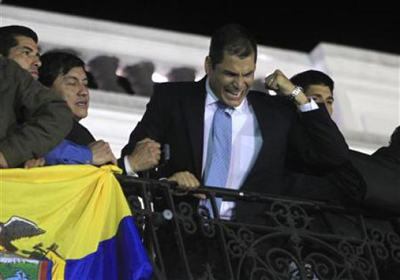
Ecuadorean President Rafael Correa speaks from the balcony of the Carondolet Palace as hundreds of supporters gathered to greet him in Quito; September 30, 2010.

Using the standard CIA playbook on toppling democratically-elected governments in Latin America, the Obama administration, which was not happy with Ecuadorian President Rafael Correa’s moves to increase state control over oil companies in the nation and his decision to oust the United States military from its airbase at Manta, appears to have suffered a major defeat in the failed coup attempt in Ecuador by police officers and Air Force personnel who were backed by rightist elements in the National Assembly and business community. Correa was re-elected with an overwhelming majority last year after he gave the U.S. military its walking papers from the Manta airbase. The Pentagon and CIA have been working to topple Correa ever since by pumping money into opposition political parties and other groups through NGOs funded by the U.S. National Endowment for Democracy.

In a statement from Correa after his rescue from the Police Hospital in Quito by a military special operations team, the president warned of a larger conspiracy launched against him by his political opposition, saying the "attempt at destabilization is the result of a strategy that has been brewing for quite some time. A barrage of messages and misinformation have been given to the National Police, which today has been realized through violent actions from a conspiracy attempt."

Correa’s predecessor, the pro-U.S. Lucio Gutierrez, who is wedded to foreign oil company interests in the country, was accused by the government of covertly supporting the police and Air Force mutineers.

Although Secretary of State Hillary Clinton issued a weak statement saying the United States backed Correa, it came one day after Clinton heaped praise on former Secretary of State Henry Kissinger, the person who helped to craft the September 11, 1973 coup in Chile and the assassination of its progressive president Salvador Allende. In fact, Clinton and Obama had given military and political support to the right-wing junta that ousted democratically-elected progressive President Manuel Zelaya in Honduras in June 2009 and has fought against allowing the ousted democratically-elected president of Haiti, Jean-Bertrand Aristide, to return to his country from exile in South Africa after the CIA-engineered coup against him in 2004.

Clinton’s tepid response to the attempted coup against Correa was in marked contrast to the strong denunciations of the attempted coup and messages of support for Correa that came from Venezuela, Brazil, Argentina, Peru, Mexico, Bolivia, Cuba, and Spain.

JPEG - 83.4 kb
Riot police repel supporters of Ecuadorean President Rafael Correa from reaching the hospital where he took refuge for protection from police protesters, in Quito; September 30, 2010.

And the fact that Correa, like Venezuelan President Hugo Chavez, who was briefly ousted in an April 2002 coup organized by the CIA, was held as a virtual hostage at the Police Hospital in Quito for the greater part of a day provided a grim reminder of an old CIA tactic in staging coups in Latin America. Chavez was briefly held hostage on a Venezuelan island in the Caribbean while a U.S.-registered plane stood by to fly him into exile. In an emergency Latin American summit meeting in Argentina, Chavez saw the U.S. behind the events in Ecuador. He said, "The Yankee extreme right is trying right now, through arms and violence, to retake control of the continent." Chavez’s own experience with a CIA backed coup and the June 2009 coup, supported by the Pentagon, CIA, and Mossad against his ally Zelaya in Honduras, makes him an expert on CIA and Mossad tactics in the region. Informed sources have told WMR [1] that Correa and Chavez are currently comparing notes on the coups launched against them.

Ecuadorian intelligence will be looking closely at the wereabouts of key CIA personnel stationed at the CIA station at the US embassy in Quito and a smaller CIA station within the US Agency for International Development (USAID) mission in Guayaquil. In the 2002 coup attempt against Chavez, the US embassy’s top CIA and DIA officers were discovered to be helping to direct the coup from Venezuelan military installations.

Clinton’s State Department has been casting Ecuador in a bad light throughout the past two years, calling the country "difficult to do business in," the only real priority that the Obama administration cares about due to its total subservience to Wall Street and the fat cat bankers. The State Department’s "Investment Climate Statement" for Ecuador states: "Ecuador can be a difficult place in which to do business. . . There are restrictions or limitations on private investment in many sectors that apply equally to domestic and foreign investors . . . A 2006 hydrocarbons law imposed new conditions in the petroleum sector that have been problematic for many companies, complicated by a 2007 decree that imposed additional restrictions. A 2008 mining mandate stalled mining activity, and a new Mining Law is expected in early 2009. Negotiations for a free trade agreement between the United States and Ecuador, which would have included investment provisions, stopped in April 2006. The current Government of Ecuador has not expressed interest in restarting negotiations."

Correa’s financial policies, as well as his foreign policy that saw him order out the American base at Manta and establish close ties with Venezuela, Iran, and other countries inimical to American and Israeli hegemony, placed a huge CIA and Mossad target on Correa’s back. In June, Ecuador sponsored a resolution at the Organization of American State (OAS) summit in Lima condemning Israel’s attack on the Turkish aid flotilla transporting humanitarian aid to Gaza. Ten nations voted with Ecuador in support of the resolution.

JPEG - 91.8 kb
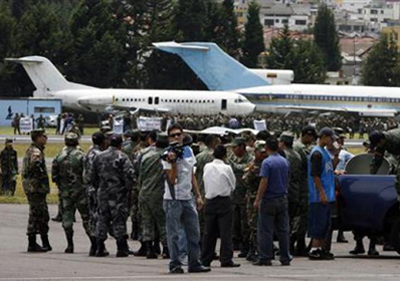
Ecuadorian army soldiers stand on the runway of the military airbase of the Mariscal Sucre International Airport to force its closure, in Quito; September 30, 2010.

The uprising among Ecuadorian Air Force ranks, with Air Force personnel taking over and shutting down Quito’s international airport, will have Ecuadorian counter-intellligence personnel looking closely at the possible role of Israeli technicians and trainers who support the Air Force’s 26 Israeli-made Kfir combat planes. Israel also reportedly sold Python-3 air-to-air missiles to the Ecuadorian Air Force in 1997.

Mossad also has its hooks into the Ecuadorian National Police, where the main coup plotters received support. Mossad is chiefly tasked with spying on Ecuador’s large Ecuadorian-Arab community. The activities of the Mossad station at the Israeli embassy in Quito before and during the coup attempt will also draw the attention of counter-intelligence officers. Last year, Tel Aviv-based On Track Innovations received a contract to provide an electronic biometric-based electronic identification card system to Ecuador’s Central Registry Office.

Friday, October 01, 2010

More on the Coup attempt in Ecuador by Sabina Becker

Wow. Was today exciting or what?

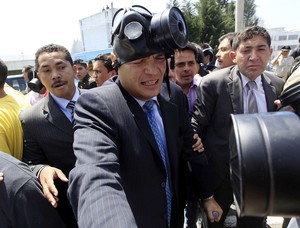
correa-gasmask.jpg

Even in a gasmask, yowza.

Holy fucking moly. Just when I thought nothing was going on in the world, a fascist coup decided to go down (and fuck up) in Ecuador. The federal police took the president prisoner in the military hospital where he'd recently had knee surgery, and tear-gassed rioting ensued. So far, the Red Cross reports two dead (both police) and 88 injured. (Sadly, we can expect these tolls to rise.)

President Correa finally made it out of the hospital, with the help of a hefty contingent of loyal soldiers and citizens who fought it out barrel-to-barrel with the police in an intense firefight; he was spirited out from an underground parking garage in a grey truck. His rescuers pulled him out in a wheelchair with a gasmask on his face to protect him against the tear gas which the cops were shooting with no regard for the other patients at the hospital (including at least 20 newborn babies, so's you know. Yeah, those fascists value human life so much!)

I ended up spending the night hunched over a hot (and often balky) tweeter, RTing and translating headlines from Spanish to English. And biting my nails for President Correa, and vowing to kill anyone who harmed one hair on that fine head of his. And cursing the crappy reporting from all the Anglo sources, including the usual shitty suspects (Chicken Noodle Network; the fucking Torygraph, with its creative use of quotation marks) and the otherwise excellent (Al-Jazeera, HOW COULD YOU?) They all wrongly reported that Correa had cut police salaries; in fact, he has doubled them. And there is ample evidence that the CIA was behind this one, too...where is it ever not?

Anyhow, other than my own frenetic tweetlings, there was Otto, keeping score here, here, here and here. He was awesome in his own right, and I was thankful he was still tweeting when my birdie temporarily lost its cheep.

And how about those UNASUR leaders? In spite of tremendous political differences, they were unanimous in condemning the coup. They are meeting in Buenos Aires as I write this. Chavecito was first and loudest in condemning the coup; Fidel predicted it would fall apart quickly, and it did. Evo even suggested, in a ballsy move, that they all fly to Quito to make clear to the police that Correa was to be freed at once, no fucking around. (Just when I thought I couldn't possibly love those guys any more than I already did. That'll teach me.)

Needless to say, tomorrow's FLFB entry is all sewn up, and I won't be left scrounging for material as I'd feared I might. If anything, I'll have a surplus. Can you guess what I'll be blogging, kiddies? (Hint: Diabetics, please have your insulin syringes handy. You're gonna need 'em.)

Thursday, September 30, 2010

Obama administration fingerprints on Ecuador coup attempt

Using the standard CIA playbook on toppling democratically-elected governments in Latin America, the Obama administration, which was not happy with Ecuadorian President Rafael Correa's moves to increase state control over oil companies in the nation and his decision to oust the United States military from its airbase at Manta, appears to have suffered a major defeat in the failed coup attempt in Ecuador by police officers and Air Force personnel who were backed by rightist elements in the National Assembly and business community. Correa was re-elected with an overwhelming majority last year after he gave the U.S. military its walking papers from the Manta airbase. The Pentagon and CIA have been working to topple Correa ever since by pumping money into opposition political parties and other groups through NGOs funded by the U.S. National Endowment for Democracy.

In a statement from Correa after his rescue from the Police Hospital in Quito by a military special operations team, the president warned of a larger conspiracy launched against him by his political opposition, saying the "attempt at destabilization is the result of a strategy that has been brewing for quite some time. A barrage of messages and misinformation have been given to the National Police, which today has been realized through violent actions from a conspiracy attempt."

Correa's predecessor, the pro-U.S. Lucio Gutierrez, who is wedded to foreign oil company interests in the country, was accused by the government of covertly supporting the police and Air Force mutineers.

Although Secretary of State Hillary Clinton issued a weak statement saying the United States backed Correa, it came one day after Clinton heaped praise on former Secretary of State Henry Kissinger, the person who helped to craft the September 11, 1973 coup in Chile and the assassination of its progressive president Salvador Allende. In fact, Clinton and Obama had given military and political support to the right-wing junta that ousted democratically-elected progressive President Manuel Zelaya in Honduras in June 2009 and has fought against allowing the ousted democratically-elected president of Haiti, Jean-Bertrand Aristide, to return to his country from exile in South Africa after the CIA-engineered coup against him in 2004.

Clinton's tepid response to the attempted coup against Correa was in marked contrast to the strong denunciations of the attempted coup and messages of support for Correa that came from Venezuela, Brazil, Argentina, Peru, Mexico, Bolivia, Cuba, and Spain.

And the fact that Correa, like Venezuelan President Hugo Chavez, who was briefly ousted in an April 2002 coup organized by the CIA, was held as a virtual hostage at the Police Hospital in Quito for the greater part of a day provided a grim reminder of an old CIA tactic in staging coups in Latin America. Chavez was briefly held hostage on a Venezuelan island in the Caribbean while a U.S.-registered plane stood by to fly him into exile. In an emergency Latin American summit meeting in Argentina, Chavez saw the U.S. behind the events in Ecuador. He said, "The Yankee extreme right is trying right now, through arms and violence, to retake control of the continent." Chavez's own experience with a CIA backed coup and the June 2009 coup, supported by the Pentagon, CIA, and Mossad against his ally Zelaya in Honduras, makes him an expert on CIA and Mossad tactics in the region. Informed sources have told WMR that Correa and Chavez are currently comparing notes on the coups launched against them.

Ecuadorian intelligence will be looking closely at the wereabouts of key CIA personnel stationed at the CIA station at the US embassy in Quito and a smaller CIA station within the US Agency for International Development (USAID) mission in Guayaquil. In the 2002 coup attempt against Chavez, the US embassy's top CIA and DIA officers were discovered to be helping to direct the coup from Venezuelan military installations.

Clinton's State Department has been casting Ecuador in a bad light throughout the past two years, calling the country "difficult to do business in," the only real priority that the Obama administration cares about due to its total subservience to Wall Street and the fat cat bankers. The State Department's "Investment Climate Statement" for Ecuador states: "Ecuador can be a difficult place in which to do business. . . There are restrictions or limitations on private investment in many sectors that apply equally to domestic and foreign investors . . . A 2006 hydrocarbons law imposed new conditions in the petroleum sector that have been problematic for many companies, complicated by a 2007 decree that imposed additional restrictions. A 2008 mining mandate stalled mining activity, and a new Mining Law is expected in early 2009. Negotiations for a free trade agreement between the United State and Ecuador, which would have included investment provisions, stopped in April 2006. The current Government of Ecuador has not expressed interest in restarting negotiations." Correa's financial policies, as well as his foreign policy that saw him order out the American base at Manta and establish close ties with Venezuela, Iran, and other countries inimical to American and Israeli hegemony, placed a huge CIA and Mossad target on Correa's back. In June, Ecuador sponsored a resolution at the Organization of American State (OAS) summit in Lima condemning Israel's attack on the Turkish aid flotilla transporting humanitarian aid to Gaza. Ten nations voted with Ecuador in support of the resolution.

The uprising among Ecuadorian Air Force ranks, with Air Force personnel taking over and shutting down Quito's international airport, will have Ecuadorian counter-intellligence personnel looking closely at the possible role of Israeli technicians and trainers who support the Air Force's 26 Israeli-made Kfir combat planes. Israel also reportedly sold Python-3 air-to-air missile to the Ecuadorian Air Force in 1997.

Mossad also has its hooks into the Ecuadorian National Police, where the main coup plotters received support/ Mossad is chiefly tasked with spying on Ecuador's large Ecuadorian-Arab community. The activities of the Mossad station at the Israeli embassy in Quito before and during the coup attempt will also draw the attention of counter-intelligence officers. Last year, Tel Aviv-based On Track Innovations received a contract to provide an electronic biometric-based electronic identification card system to Ecuador's Central Registry Office.

Saturday, January 16, 2010

U.S. troops in Haiti to prevent Aristide's return (and other dirty secrets)

President Obama, in keeping with his CIA lineage, has permitted the Pentagon under Robert Gates to take charge of the humanitarian relief efforts in Haiti. As Cuban and Venezuelan field hospitals were already rendering first aid and trauma care to Haitians injured in the mega-quake, Obama was gathered at a White House photo op with Vice President Joe Biden and other Cabinet officers to state that U.S. military reconnaissance aircraft would fly over Haiti to assess the situation from the air. A U.S. P-3 Orion spy plane from Comalapa air base in El Salvador was dispatched to conduct the surveillance operation, an act that was already being accomplished by earth satellites, the images of which were available on Google Maps.

As Obama was garnering praise from such sycophantic White House outlets as the largely-discredited Washington Post, an 37-person Icelandic search-and-rescue team was pulling trapped earthquake victims from the rubble of collapsed buildings in Port-au-Prince. Iceland, a nation bankrupted by Obama's banker pals on Wall Street and in the City of London, was able to react in a way that the slumbering and oafish dying super-power, the United States, could not -- with action aimed at providing immediate assistance to the Haitian people.

Obama's generals and admirals, who are mostly more concerned about their appearance than in taking charge and moving out, were still scratching their heads about where to land the U.S. Marines and 82nd Airborne. In fact, military aircraft carrying weapons and other war supplied crowded the airport aprons at Port-au-Prince airport that could be used by planes from other countries carrying much-needed food, water, and medical supplies. Argentine doctors already on the scene in Haiti complained that they were running out of simple sewing kits being used as stitches for the injured who had undergone surgery.

When U.S. Special Operations forces hit the ground at Port-au-Prince airport they pointed their weapons at desperate Haitians at the airport perimeter who wanted help not a gun pointed in their faces. Russia, Spain, Mexico, Chile, and Guatemala were rushing in food and water for Haiti.

Meanwhile, Obama was phoning former President George W. Bush to ask for his a former President Bill Clinton to launch a fund drive for Haitian earthquake relief. Former Secretary of State Colin Powell, who was partly behind engineering the 2004 coup that deposed democratically-elected Haitian President Jean-Bertrand Aristide, attended a Haitian relief fundraiser at a Washington hotel called "W." The symbology could not have been worse -- it was Bush who showed the world that he was totally disinterested in the 2004 Asian earthquake and tsunami and hurricane Katrina in 2005 that decimated New Orleans and surrounding areas.

Apparently, the so-called media-savvy Obama failed to realize the revolting nature of asking Bush to do anything related to Haiti when people remembered his lack of action over Katrina. Bodies of African-Americans floating in the streets of New Orleans became juxtaposed with the bodies of Afro-Haitians piling up in the streets of Port-au-Prince. But, of course, Obama is the "Max Headroom" of America's political leadership -- a talking head -- whose rhetorical flourishes speak louder than principles or concrete action.

Aristide, from an exile in South Africa imposed by the United States, France, and Canada, vowed to return to Haiti to be with his people in their time of stress and despair. Aristide, a former Roman Catholic priest, served the people of the Haitian slum of La Saline and he understands best the plight of his people. On the other hand, Rene Preval, the U.S. stooge who was placed in power twice by the CIA and the U.S. Southern Command to replace Aristide, once in a fraudulent election [Preval won in 1995 with 88 percent of the vote in a 25 percent voter turnout] and the other in a coup, could only complain to CNN's Sanjay Gupta about not having any place to sleep for the night, "I cannot live in the palace. I cannot live in my own house, because the two collapsed."

Preval has been reaping all sorts of "free trade" deals that caused Haiti's agrarian population to stream into Port-au-Prince to work in the sweat shops heralded as "progress" by the likes of George Soros and his gang of thieves on Wall Street. Because of Port-au-Prince's swelled population of sweat shop workers, the death count from the earthquake will be much higher as the result of collapsed tenements that housed more people than they were designed for.

Dr. Gupta, who was Obama's first choice to be Surgeon-General of the United States, was more interested in using dying Haitians in makeshift hospitals as stage props for CNN's ratings than in rendering medical assistance to the injured. Imagine, being one of the few doctors available to the severely injured and breaking away to go on camera and tell some old fool like Larry King or some Israeli agent of influence like Wolf Blitzer about how awful the situation is in Haiti.

However, Gates and his military brass will ensure that Aristide will not show up to threaten Preval's continuing disastrous leadership of Haiti. It was Gates, who was George H. W. Bush's nominee to be CIA director, who helped plan the military coup that ousted Aristide the first time in September 1991. Gates, at the time, was Bush's deputy national security adviser.

Clinton helped Aristide regain his presidency from the CIA-backed coup leader General Raoul Cedras in 1994. But Clinton's disastrous flip-flopping on Haitian refugees from the Cedras dictatorship plunged his new administration into a major crisis. It is certain that when Haiti's earthquake struck, people like Obama's Chief of Staff Rahm Emanuel were conducting focus group polls to find out how U.S. assistance to Haiti would be received by the public. Although a clear majority of Americans favor helping the beleaguered people of Haiti, and many feel that Obama's assistance has been extremely slow, Emanuel only seems to be concerned about the handful of Americans, including Pat Robertson, Rush Limbaugh, and Glenn Beck, who have uttered racist language in reacting to the Haitian tragedy, are worth listening to. But Emanuel does not view things through the enlightened lenses of America's founders but through the religious myopic eyesight of Talmudic interpreters.

Haiti under Aristide and Preval, was forced by Clinton to agree to horribly one-sided "free trade" deals that saw Haiti's workers press ganged into toiling away in Port-au-Prince sweat shops to produce clothing for America's major retailers like Disney. Haiti had no choice -- Clinton imposed devastating economic sanctions against Aristide to force his compliance with the diktats of the International Monetary Fund and World Bank. Clinton sweetened the pie for his Arkansas rice growing cronies by ensuring that Haiti went from being an exporter of nutritional rice to an importer of expensive bleached and genetically-modified "junk rice" primarily from Arkansas.

When Aristide regained the presidency in 2000, he took immediate steps to improve the lot of the Haitian workers -- he raised the minimum wage to two dollars a day. Bush decided it was time for the CIA and the Southern Command to remove Aristide, which they did with the help of France and Canada. Aristide was exiled to the Central African Republic and then South Africa.

Preval regained office in 2006 after a phony election engineered with the help of the National Endowment for Democracy's International Republican Institute (IRI) and the National Democratic Institute (NDI), two CIA contrivances acting under the aegis of the U.S. Republican and Democratic Parties, respectively. Soros has adopted Haitian politicians like former Prime Minister Michèle Pierre-Louis who continue to advocate disastrous "free trade" policies and provides them with funding and travel expenses through his Open Society Institute (OSI).

UN "peacekeeping" forces in Haiti have ensured that Aristide and his Lavalas Party does not regain power. One of the methods the UN uses is periodically raiding pro-Aristide slums and killing Lavalas activists in their homes. Bill Clinton was rewarded last year for his guile and deceit committed against Haiti by being named by UN Secretary General Ban Ki-moon as the UN's Special Envoy for Haiti.

When Honduran President Manuel Zelaya also raised the minimum wage in his country, the CIA and Southern Command arranged for a military coup to remove him. Obama has now decided to place the Southern Command, headquartered in the right-wing Latin American exilee rat's nest of Miami, to coordinate humanitarian relief in Haiti along with the head of the US Agency for International Development (USAID) a CIA pass-through headed by Rajiv Singh, a one-time political hack for Pennsylvania's corrupt Democratic Governor Ed Rendell.

The perfidy that is America's relationship with Haiti extends to Bill Clinton's wife, Secretary of State Hillary Clinton. She has appointed her chief of staff Cheryl Mills to oversee America's role in Haiti. Mills has stated: "We actually see our role as ensuring that the leadership of Haiti is able to provide the leadership that the Haitian people properly expect them to provide." That represents an endorsement of the hapless leadership of Preval and a thumbs down to any return for Aristide.

Note: The editor's book, "Jaded Tasks" is named for the covert Pentagon and CIA coperation that removed Aristide in 2004: Operation Jaded Task. Aristide was presented a signed copy of the book in South Africa with a note that states I hope he is rightfully restored to the presidency in Haiti. Haiti needs Aristide more now than it has ever needed him in the past. People like Obama, Gates, Emanuel, the Clintons, Mills, and Southern Command commander General Douglas Fraser need to step out of the way and allow the legitimate president of Haiti to lead his people out of the rubble of their country, "moving from misery to poverty with dignity," as he said from Oliver Tambo International Airport in Johannesburg awaiting permission for a return to his native country.

Friday, January 15, 2010

The Coups d'État in Latin America and the Dangers Facing Venezuela

by Alejandro Torres Rivera

Venezuelan Vice President and Defense Minister Ramón Alonso Carrizales stated that his nation's government held objective proof of the violation by a U.S. military aircraft of Venezuelan air space.

He said the following: “On May 17, 2009, an American war plane took off from Curaçao, violated our air space and a flight-exclusion zone, the Orchilla Air Base. We have a record of the dialogue between the control tower and the aircraft, in which the pilot was asked if he had authorization to overfly the area and what the motive for his incursion was.”

More recently, Venezuelan President Hugo Chávez Frías also denounced the entry into Venezuelan territory of a P-3 aircraft for about 15 minutes. The plane was escorted out of Venezuelan air space by F-16 aircraft of the Venezuelan Air Force.

The same plane that afternoon returned to pierce the Venezuelan air space for about 19 minutes and was again escorted out of Venezuelan air space by F-16 fighters of the Venezuelan Air Force.

The denunciation made by the Venezuelan minister and the one made by President Chávez again bring to public discussion the topic of the coups d'état in Latin American countries, particularly at a time when the government of Venezuela is denouncing Colombia's plans, encouraged by the United States, to create the conditions “to justify an aggression against our nation on the basis of false-positives or simulations of punishable deeds.”

Modesto Emilio Guerrero's essay “Memoirs of Coups d'État in Latin America During the 20th Century” quotes Cursio Malaparte, author of “The Technique of the Coup d'État,” as saying that the coup d'état is nothing more than a “recourse to power when there is a risk of losing power.”

The author says that, in 1968, 62 percent of Latin America, Africa, the Middle East and Southwest Asia were governed by military dictatorships. He also says that a study of 25 countries between 1902 and the 2002 coup against Venezuela's constitutional president, Hugo Chávez Frías, revealed that “327 coups d'état took place, counting those that stabilized as dictatorships for months or years and those that lasted a few days, like the repeated coups in Bolivia.”

In his list of coups during the 20th Century, he ranks Bolivia first, with 56; Guatemala, 36; Peru, 31; Panama, 24; Ecuador, 23; Cuba, 17; Haiti, 16 until 1995; the Dominican Republic, 16; Venezuela, 12; Brazil, 10; Chile, 9; Colombia and Argentina, 8, and Uruguay, 5.

Little more than 10 coups were staged on the Caribbean islands. In countries like Paraguay, Nicaragua and the Dominican Republic, the military dictatorships that usurped the political power held control of the nation for decades.

According to Guerrero, “in almost 30 percent of the cases, the coups and the dictatorships resulted from the direct intervention of United States troops, at least from the end of the Spanish-American War. If we look only at the Caribbean and Central America down to Panama, the rate would approach 70 percent.”

In an essay titled “Making Coups d'État Invisible: What the Hegemonic Theory of Political Science Refuses To See,” Atilio Borón denounced on Jan. 5 a theory about Honduras, propounded by a report by the Latinobarómetro Corporation in Santiago, Chile, that says:

“In the year 2009, Latin America suffered for the first time a coup d'état after 31 years since democracy was inaugurated in the so-called ‘third wave of democracy.’”

According to Borón, such assertion “is not only a notable error of history but also a symptom of something a lot deeper. It reveals the incurable limitations of the hegemonic concept of theory and methodology in social sciences that date back to our Anglo-Saxon inspiration.”

To document the falsity of the information provided by the Latinobarómetro Corp., Borón recreates what happened during the coups d'état in Venezuela on April 11, 2002, and establishes the participation of the United States and Spain, as well as the complicity of functionaries in the European Union and the then-existing governments of Colombia and El Salvador.

Borón also reminds us of the coups in El Salvador in 1979; Bolivia in 1978, 1979 and 1980; Paraguay in 1989; Haiti in 1988, 1990, 1991 and 2004.

To these coups, we could add those promoted by the United States in the second half of the 20th Century, to wit:

  • the coup d'état in Cuba by Fulgencio Batista in 1952;

  • the overthrow of Jacobo Arbenz in Guatemala in 1954;

  • the armed invasion promoted against the Cuban Revolution on Bay of Pigs in 1961;

  • the coup against José María Velasco Ibarra in Ecuador in 1961;

  • the coup against Brazilian President João Goulart in 1964;

  • the invasion of the Dominican Republic on April 28, 1965;

  • the deployment in Guatemala and Bolivia of Green Beret military advisers in 1966-67;

  • the coups in Uruguay and Chile in 1973;

  • the military dictatorship in Argentina, beginning in 1976;

  • the intervention in the Salvadoran conflict in 1980;

  • the support from Honduras of the Dirty War against the Sandinista revolution, beginning in 1980;

  • the invasion of Grenada in 1983;

  • the invasion of Panama in 1989;

  • the intervention in Nicaragua's electoral process in the 1990 elections;

  • the Plan Colombia, beginning in 2000;

  • the coup d'état in Venezuela in 2002, and

  • the coup d'état in Honduras in 2009.

For these events, Borón points out, palliatives are used to describe bloody and illegal deeds that lead to the overthrow of governments that were installed legitimately by the people. Thus, the Newspeak creates terminology that justifies the theory of the coup, such as “liberating revolution,” “process of national reorganization,” “government of national reconciliation,” “government of national salvation,” “solution to a power vacuum,” “transition government,” “interim government,” etc.

The government of the Bolivarian Republic of Venezuela is right when it denounces its concern over the increasingly open threats posed against it by the U.S. and Colombian policies. One need only read the essay written by Wayne Madsen and Richard Bennett on April 19, 2002, titled “U.S. Returns to Bad Old Ways in Venezuela.”

“Under the cover of training exercises in the Caribbean, the U.S. Navy provided signals intelligence and communications-jamming support to the Venezuelan military,” the document says.

“For its part, the CIA provided Special Operations Group personnel under the command of a lieutenant colonel assigned by the Special Operations Command in Fort Bragg, N.C. They had been in Venezuela since 2001 and belonged to the U.S. Special Operations Intelligence Support Activity. They reportedly made contact with high-ranking officers in the Venezuelan Armed Forces, including Gen. Lucas Rincón, Vice Minister of Security; Gen. Luis Camacho Kairuz; businessmen and labor union leaders from the Venezuelan Workers Federation, among others.

“The coup was also supported by Special Operations psychological warfare (PSYOPs) personnel deployed from Fort Bragg, North Carolina. They put together Spanish-language television announcements, purportedly from Venezuelan political and business leaders and aired by Venezuelan television and radio stations, saying Chavez "provoked" the crisis by ordering his supporters to fire on peaceful protesters in Caracas. U.S. electronic warfare technicians also helped to jam cell phone and radio frequencies in Caracas and other major cities in co-operation with the Intelligence Battalion Brig. Gen. Andrés Ibarra of the Venezuelan Army's high command.”

The threat against Venezuela is certainly not a bizarre idea. It is up to all of us, as this year begins, to redouble our solidarity with the Venezuelan people and the defense of their Revolution.

This article is an excerpt from an article written by Puerto Rican attorney Alejandro Torres Rivera