Thursday, January 09, 2014

The Anti-Empire Report #124 By William Blum – Published January 9th, 2014


The Anti-Empire Report #124

By William Blum – Published January 9th, 2014

“At last the world knows America as the savior of the world!” – President Woodrow Wilson, Paris Peace Conference, 1919

The horrors reported each day from Syria and Iraq are enough to make one cry; in particular, the atrocities carried out by the al-Qaeda types: floggings; beheadings; playing soccer with the heads; cutting open dead bodies to remove organs just for mockery; suicide bombers, car bombs, the ground littered with human body parts; countless young children traumatized for life; the imposition of sharia law, including bans on music … What century are we living in? What millennium? What world?
People occasionally write to me that my unwavering antagonism toward American foreign policy is misplaced; that as awful as Washington’s Museum of Horrors is, al-Qaeda is worse and the world needs the United States to combat the awful jihadists.
“Let me tell you about the very rich,” F. Scott Fitzgerald famously wrote. “They are different from you and me.”
And let me tell you about American leaders. In power, they don’t think the way you and I do. They don’t feel the way you and I do. They have supported “awful jihadists” and their moral equivalents for decades. Let’s begin in 1979 in Afghanistan, where the Moujahedeen (“holy warriors”) were in battle against a secular, progressive government supported by the Soviet Union; a “favorite tactic” of the Moujahedeen was “to torture victims [often Russians] by first cutting off their nose, ears, and genitals, then removing one slice of skin after another”, producing “a slow, very painful death”. 
With America’s massive and indispensable military backing in the 1980s, Afghanistan’s last secular government (bringing women into the 20th century) was overthrown, and out of the victoriousMoujahedeen arose al Qaeda.
During this same period the United States was supporting the infamous Khmer Rouge of Cambodia; yes, the same charming lads of Pol Pot and The Killing Fields. 
President Carter’s National Security Adviser, Zbigniew Brzezinski, was a leading force behind the US support of both the Moujahedeen and the Khmer Rouge. What does that tell you about that American leader? Or Jimmy Carter – an inspiration out of office, but a rather different person in the White House? Or Nobel Peace Laureate Barack Obama, who chose Brzezinski as one of his advisers?
Another proud example of the United States fighting the awful jihadists is Kosovo, an overwhelmingly Muslim province of Serbia. The Kosovo Liberation Army (KLA) began an armed conflict with Belgrade in the early 1990s to split Kosovo from Serbia. The KLA was considered a terrorist organization by the US, the UK and France for years, with numerous reports of the KLA having contact with al-Qaeda, getting arms from them, having its militants trained in al-Qaeda camps in Pakistan, and even having members of al-Qaeda in KLA ranks fighting against Serbia.  But Washington’s imperialists, more concerned about dealing a blow to Serbia, “the last communist government in Europe”, supported the KLA.
The KLA have been known for their torture and trafficking in women, heroin, and human body parts (sic).  The United States has naturally been pushing for Kosovo’s membership in NATO and the European Union.
More recently the US has supported awful jihadists in Libya and Syria, with awful consequences.
It would, moreover, be difficult to name a single brutal dictatorship of the second half of the 20th Century that was not supported by the United States; not only supported, but often put into power and kept in power against the wishes of the population. And in recent years as well, Washington has supported very repressive governments, such as Saudi Arabia, Honduras, Indonesia, Egypt, Colombia, Qatar, and Israel.
Not exactly the grand savior our sad old world is yearning for. (Oh, did I mention that Washington’s policies create a never-ending supply of terrorists?)
And what do American leaders think of their own record? Former Secretary of State Condoleezza Rice was probably speaking for the whole private club when she wrote that in the pursuit of its national security the United States no longer needed to be guided by “notions of international law and norms” or “institutions like the United Nations” because America was “on the right side of history.” 

If you’ve never done anything you wouldn’t want the government to know about, you should re-examine your life choices.

“The idea is to build an antiterrorist global environment,” a senior American defense official said in 2003, “so that in 20 to 30 years, terrorism will be like slave-trading, completely discredited.” 
One must wonder: When will the dropping of bombs on innocent civilians by the United States, and invading and occupying their country become completely discredited? When will the use of depleted uranium, cluster bombs, CIA torture renditions, and round-the-world, round-the-clock surveillance become things that even men like George W. Bush, Dick Cheney, Barack Obama, and John Brennan will be too embarrassed to defend?
Last month, a former National Security Agency official told the Washington Post that the Agency’s workers are polishing up their résumés and asking that they be cleared – removing any material linked to classified programs – so they can be sent out to potential employers. He noted that one employee who processes the résumés said, “I’ve never seen so many résumés that people want to have cleared in my life.” 
Morale is “bad overall”, said another former official. “The news – the Snowden disclosures – it questions the integrity of the NSA workforce,” he said. “It’s become very public and very personal. Literally, neighbors are asking people, ‘Why are you spying on Grandma?’ And we aren’t. People are feeling bad, beaten down.” 
President Obama was recently moved to declare that he would be proposing “some self-restraint on the NSA” and “some reforms that can give people more confidence.” He also said “In some ways, the technology and the budgets and the capacity [at NSA] have outstripped the constraints. And we’ve got to rebuild those in the same way that we’re having to do on a whole series of capacities … [such as] drone operations.” 
Well, dear readers and comrades, we shall see. But if you’re looking for a glimmer of hope to begin a new year, you may as well try grabbing onto these little offerings. When the American Empire crumbles, abroad and at home, as one day it must, Edward Snowden’s courageous actions may well be seen as one of the key steps along that road. I’ve long maintained that only the American people have the power to stop The Imperial Machine – the monster that eats the world’s environment, screws up its economies, and spews violence on every continent. And for that to happen the American people have to lose their deep-seated, quasi-religious belief in “American Exceptionalism”. For many, what they’ve been forced to learn the past six months has undoubtedly worn deep holes into the protective armor that has surrounded their hearts and minds since childhood.
A surprising and exhilarating example of one of these holes in the armor is the New Year’s day editorial in the New York Times that is now well known. Entitled “Edward Snowden, Whistle-blower” – itself a legitimation of his actions – its key part says: “Considering the enormous value of the information he has revealed, and the abuses he has exposed, Mr. Snowden deserves better than a life of permanent exile, fear and flight. He may have committed a crime to do so, but he has done his country a great service.”
The president has been moved to appoint a committee to study NSA abuses. This of course is a standard bureaucratic maneuver to keep critics at bay. But the committee – Review Group on Intelligence and Communications Technologies – did come up with a few unexpected recommendations in its report presented December 13, the most interesting of which perhaps are these two:
“Governments should not use surveillance to steal industry secrets to advantage their domestic industry.”
“Governments should not use their offensive cyber capabilities to change the amounts held in financial accounts or otherwise manipulate the financial systems.” 
The first recommendation refers to a practice, though certainly despicable, that is something the United States has been doing, and lying about, for decades.  Just this past September, James Clapper, Director of US National Intelligence, declared: “What we do not do, as we have said many times, is use our foreign intelligence capabilities to steal the trade secrets of foreign companies.” 
Clapper is the same gentleman who told Congress in March that the NSA does not intentionally collect any kind of data on millions of Americans; and, when subsequently challenged on this remark, declared: “I responded in what I thought was the most truthful, or least untruthful, manner by saying ‘no’.” 
The second recommendation had not been revealed before, in a Snowden document or from any other source.
“That was a strangely specific recommendation for something nobody was talking about,” observed the director of a government transparency group. 
ABC News reported that “A spokesperson for the NSA declined to comment on the issue of bank account hacking, and a representative for U.S. Cyber Command did not immediately return an emailed request for comment.” 
Manipulating bank records is about as petty and dishonorable as a superpower can behave, and could conceivably, eventually, lead to the end of the NSA as we’ve all come to know and love it. On the other hand, the Agency no doubt holds some very embarrassing information about anyone in a position to do them harm.

The bombing of Flight 103 – Case closed?

When the 25th anniversary of the 1988 bombing of PanAm Flight 103 occurred on December 21 I was fully expecting the usual repetitions of the false accusation against Libya and Moammar Gaddafi as being responsible for the act which took the lives of 270 people over and in Lockerbie, Scotland. But much to my surprise, mingled with such, there were a rash of comments skeptical of the official British-US version, made by various people in Scotland and elsewhere, including by the governments of the United States, the United Kingdom and Libya.
In a joint statement the three governments said they were determined to unearth the truth behind the attack. “We want all those responsible for this brutal act of terrorism brought to justice, and to understand why it was committed”, they declared. 
Remarkable. In 1991, the United States indicted a Libyan named Adelbaset al-Megrahi. He was eventually found guilty of being the sole perpetrator of the crime, kept in prison for many years, and finally released in 2009 when he had terminal cancer, allegedly for humanitarian reasons, although an acute smell of oil could be detected. And now they speak of bringing to justice “those responsible for this brutal act of terrorism”.
The 1988 crime was actually organized by Iran in retaliation for the American shooting down of an Iranian passenger plane in July of the same year, which took the lives of 290 people. It was carried out by the Popular Front for the Liberation of Palestine - General Command (PFLP-GC), a 1968 breakaway from a component of the Palestine Liberation Organization, with some help from Syria. And this version was very widely accepted in the Western world, in government and media circles. Until the US buildup to the Gulf War came along in 1990 and the support of Iran and Syria was needed. Then, suddenly, we were told that it was Libya behind the crime.
If the US and UK now wish to return to Iran, and perhaps Syria, as the culprits, they will have a lot of explaining to do about their previous lie. But these two governments always have a lot of explaining to do. They’re good at it. And the great bulk of their indoctrinated citizens, with little resistance, will accept the new/old party line, and their mainstream media will effortlessly switch back to the old/new official version, since Iran and Syria are at the top of the current list of Bad Guys. (The PFLP-GC has been quiescent for some time and may scarcely exist.)
If you’re confused by all this, I suggest that you start by reading my detailed article on the history of this case, written in 2001 but still very informative and relevant. You may be rather surprised.
The UK, US and Libyan governments have now announced that they will co-operate to reveal “the full facts” of the Lockerbie bombing. And Robert Mueller, the former head of the FBI, said he believes more people will be charged. This could be very interesting.

Free books of historical value

  1. The complete set, less one volume, of the 15 Church Committee (1975-6) volumes. Lacking only Final Report, book 6: “Congressional Research Service. Supplementary Reports on Intelligence Activities.”
  2. The complete set, less one volume, of the 6 Pike Committee volumes. Lacking only volume 6: “Committee Proceedings, part II”
  3. The Rockefeller Commission Report, one volume.
  4. Hearings on FISA (Foreign Intelligence Surveillance Act) before Senate Select Committee on Intelligence (same as Church Committee), one volume.
Total of 21 volumes, all from 1975-1976, all in good condition. Either pick them up in Washington, DC or send me $10 for postage.

Notes

  1. Washington Post May 11, 1979; New York Times, April 13 1979
  2. William Blum, “Rogue State: A Guide to the World’s Only Superpower” (2005), chapter 10
  3. RT TV (Russia Today, Moscow), May 4, 2012
  4. Associated Press, December 14, 2010
  5. Foreign Affairs (Council on Foreign Relations), January/February 2000 issue
  6. New York Times, January 17, 2003
  7. Washington Post, December 7, 2013
  8. Washington Post, December 18, 2013
  9. Washington Post, December 7, 2013
  10. “Liberty and Security in a Changing World”, p.221
  11. See Anti-Empire Report, #118, June 26, 2013, second part
  12. Statement by Director of National Intelligence James R. Clapper on Allegations of Economic Espionage, September 8, 2013
  13. NBC News, June 9, 2013
  14. Kel McLanahan, executive director of National Security Counselors, speaking to ABC News Radio, December 23, 2013
  15. ABC News Radio, December 23, 2013
  16. Reuters news agency, December 22, 2013
Any part of this report may be disseminated without permission, provided attribution to William Blum as author and a link to this website are given.

Tuesday, January 07, 2014

America’s Black-Ops Blackout - Unraveling the Secrets of the Military’s Secret Military By Nick Turse


America’s Black-Ops Blackout 
Unraveling the Secrets of the Military’s Secret Military 
By Nick Turse
“Dude, I don’t need to play these stupid games. I know what you’re trying to do.”  With that, Major Matthew Robert Bockholt hung up on me.
More than a month before, I had called U.S. Special Operations Command (SOCOM) with a series of basic questions: In how many countries were U.S. Special Operations Forces deployed in 2013? Are manpower levels set to expand to 72,000 in 2014?  Is SOCOM still aiming for growth rates of 3%-5% per year?  How many training exercises did the command carry out in 2013?  Basic stuff.
And for more than a month, I waited for answers.  I called.  I left messages.  I emailed.  I waited some more.  I started to get the feeling that Special Operations Command didn’t want me to know what its Green Berets and Rangers, Navy SEALs and Delta Force commandos -- the men who operate in the hottest of hotspots and most remote locales around the world -- were doing. 
Then, at the last moment, just before my filing deadline, Special Operations Command got back to me with an answer so incongruous, confusing, and contradictory that I was glad I had given up on SOCOM and tried to figure things out for myself.

Click here to see a larger version

U.S. Special Operations Forces around the world, 2012-2013 (key below article) ©2014 TomDispatch ©Google
I started with a blank map that quickly turned into a global pincushion.  It didn’t take long before every continent but Antarctica was bristling with markers indicating special operations forces’ missions, deployments, and interactions with foreign military forces in 2012-2013.  With that, the true size and scope of the U.S. military’s secret military began to come into focus.  It was, to say the least, vast.
A review of open source information reveals that in 2012 and 2013, U.S. Special Operations forces (SOF) were likely deployed to -- or training, advising, or operating with the personnel of -- more than 100 foreign countries.   And that’s probably an undercount.  In 2011, then-SOCOM spokesman Colonel Tim Nye told TomDispatch that Special Operations personnel were annually sent to 120 countries around the world. They were in, that is, about 60% of the nations on the planet.  “We’re deployed in a number of locations,” was as specific as Bockholt would ever get when I talked to him in the waning days of 2013. And when SOCOM did finally get back to me with an eleventh hour answer, the number offered made almost no sense. 
Despite the lack of official cooperation, an analysis by TomDispatch reveals SOCOM to be a command on the make with an already sprawling reach. As Special Operations Command chief Admiral William McRaven put it inSOCOM 2020, his blueprint for the future, it has ambitious aspirations to create “a Global SOF network of like-minded interagency allies and partners.”  In other words, in that future now only six years off, it wants to be everywhere.    
The Rise of the Military’s Secret Military
Born of a failed 1980 raid to rescue American hostages in Iran (in which eight U.S. service members died), U.S. Special Operations Command was established in 1987.  Made up of units from all the service branches, SOCOM is tasked with carrying out Washington’s most specialized and secret missions, including assassinations, counterterrorist raids, special reconnaissance, unconventional warfare, psychological operations, foreign troop training, and weapons of mass destruction counter-proliferation operations.
In the post-9/11 era, the command has grown steadily.  With about 33,000 personnel in 2001, it is reportedly on track to reach 72,000 in 2014.  (About half this number are called, in the jargon of the trade, “badged operators” -- SEALs, Rangers, Special Operations Aviators, Green Berets -- while the rest are support personnel.)  Funding for the command has also jumped exponentially as SOCOM’s baseline budget tripled from $2.3 billion to $6.9 billion between 2001 and 2013.  If you add in supplemental funding, it had actually more than quadrupled to $10.4 billion. 
Not surprisingly, personnel deployments abroad skyrocketed from 4,900 “man-years” -- as the command puts it -- in 2001 to 11,500 in 2013.  About 11,000 special operators are now working abroad at any one time and on any given day they are in 70 to 80 countries, though the New York Timesreported that, according to statistics provided to them by SOCOM, during one week in March 2013 that number reached 92
The Global SOF Network
Last year, Admiral McRaven, who previously headed the Joint Special Operations Command, or JSOC -- a clandestine sub-command that specializes in tracking and killing suspected terrorists -- touted his vision for special ops globalization.  In a statement to the House Armed Services Committee, he said:
“USSOCOM is enhancing its global network of SOF to support our interagency and international partners in order to gain expanded situational awareness of emerging threats and opportunities. The network enables small, persistent presence in critical locations, and facilitates engagement where necessary or appropriate...”
In translation this means that SOCOM is weaving a complex web of alliances with government agencies at home and militaries abroad to ensure that it’s at the center of every conceivable global hotspot and power center.  In fact, Special Operations Command has turned the planet into a giant battlefield, divided into many discrete fronts: the self-explanatory SOCAFRICA; the sub-unified command of U.S. Central Command in the Middle East SOCCENT; the European contingent SOCEUR; SOCKOR, which is devoted strictly to Korea; SOCPAC, which covers the rest of the Asia-Pacific region; and SOCSOUTH, which conducts special ops missions in Central and South America and the Caribbean, as well as the globe-trotting JSOC.
Since 2002, SOCOM has also been authorized to create its own Joint Task Forces, a prerogative normally limited to larger combatant commands like CENTCOM.  These include Joint Special Operations Task Force-Philippines, 500-600 personnel dedicated to supporting counterterrorist operations by Filipino allies against insurgent groups like Abu Sayyaf.
A similar mouthful of an entity is the NATO Special Operations Component Command-Afghanistan/Special Operations Joint Task Force-Afghanistan, which conducts operations, according to SOCOM, “to enable the International Security Assistance Force (ISAF), the Afghan National Security Force (ANSF), and the Government of the Islamic Republic of Afghanistan (GIRoA) to provide the Afghan people a secure and stable environment and to prevent insurgent activities from threatening the authority and sovereignty of GIRoA.”  Last year, U.S.-allied Afghan President Ha­mid Karzai had a different assessment of the “U.S. special force stationed in Wardak province,” which heaccused of “harassing, annoying, torturing, and even murdering innocent people.”
According to the latest statistics made available by ISAF, from October 2012 through March 2013, U.S. and allied forces were involved in 1,464 special operations in Afghanistan, including 167 with U.S. or coalition forces in the lead and 85 that were unilateral ISAF operations.  U.S. Special Operations forces are also involved in everything from mentoring lightly armed local security forces under the Village Stability Operations initiative to the training of heavily armed and well-equipped elite Afghan forces -- one of whose U.S.-trained officers defected to the insurgency in the fall.
In addition to task forces, there are also Special Operations Command Forward (SOC FWD) elements which, according to the military, “shape and coordinate special operations forces security cooperation and engagement in support of theater special operations command, geographic combatant command, and country team goals and objectives.”  These light footprint teams -- including SOC FWD Pakistan, SOC FWD Yemen, and SOC FWD Lebanon -- offer training and support to local elite troops in foreign hotspots.  In Lebanon, for instance, this has meant counterterrorism training for Lebanese Special Ops forces, as well as assistance to the Lebanese Special Forces School to develop indigenous trainers to mentor other Lebanese military personnel.
Click here to see a larger version

Special Operations Command Central (SOCCENT) briefing slide by Col. Joe Osborne, showing SOC FWD elements
SOCOM’s reach and global ambitions go further still.  TomDispatch’s analysis of McRaven’s first two full years in command reveals a tremendous number of overseas operations.  In places like Somalia and Libya, elite troops have carried out clandestine commando raids.  In others, they have used airpower to hunt, target, and kill suspected militants.  Elsewhere, they have waged an information war using online propaganda.  And almost everywhere they have been at work building up and forging ever-tighter ties with foreign militaries through training missions and exercises. 
“A lot of what we will do as we go forward in this force is build partner capacity,” McRaven said at the Ronald Reagan Library in November, noting that NATO partners as well as allies in the Middle East, Asia, and Latin America  “are absolutely essential to how we’re doing business.” 
In March 2013, for example, Navy SEALs conducted joint training exerciseswith Indonesian frogmen.  In April and May, U.S. Special Operations personnel joined members of the Malawi Defense Forces for Exercise Epic Guardian.  Over three weeks, 1,000 troops engaged in marksmanship, small unit tactics, close quarters combat training, and other activities across three countries -- Djibouti, Malawi, and the Seychelles.
In May, American special operators took part in Spring Storm, the Estonian military’s largest annual training exercise.  That same month, members of the Peruvian and U.S. special operations forces engaged in joint training missions aimed at trading tactics and improving their ability to conduct joint operations.  In July, Green Berets from the Army’s 20th Special Forces Group spent several weeks in Trinidad and Tobago working with members of that tiny nation’s Special Naval Unit and Special Forces Operation Detachment.  That Joint Combined Exchange Training exercise, conducted as part of SOCSOUTH’s Theater Security Cooperation program, saw the Americans and their local counterparts take part in pistol and rifle instruction and small unit tactical exercises.
In September, according to media reports, U.S. Special Operations forces joined elite troops from the 10 Association of Southeast Asian Nations member countries -- Indonesia, Malaysia, the Philippines, Singapore, Thailand, Brunei, Vietnam, Laos, Myanmar (Burma), and Cambodia -- as well as their counterparts from Australia, New Zealand, Japan, South Korea, China, India, and Russia for a US-Indonesian joint-funded coun­terterrorism exercise held at a training center in Sentul, West Java.
Tactical training was, however, just part of the story.  In March 2013, for example, experts from the Army’s John F. Kennedy Special Warfare Center and School hosted a week-long working group with top planners from the Centro de Adiestramiento de las Fuerzas Especiales -- Mexico’s Special Warfare Center -- to aid them in developing their own special forces doctrine.
In October, members of the Norwegian Special Operations Forces traveled to SOCOM's state-of-the-art Wargame Center at its headquarters on MacDill Air Force Base in Florida to refine crisis response procedures for hostage rescue operations.  “NORSOF and Norwegian civilian leadership regularly participate in national field training exercises focused on a scenario like this,” said Norwegian Lieutenant Colonel Petter Hellesen. “What was unique about this exercise was that we were able to gather so many of the Norwegian senior leadership and action officers, civilian and military, in one room with their U.S counterparts.”
MacDill is, in fact, fast becoming a worldwide special ops hub, according to a report by the Tampa Tribune.  This past fall, SOCOM quietly started up an International Special Operations Forces Coordination Center that provides long-term residencies for senior-level black ops liaisons from around the world.  Already, representatives from 10 nations had joined the command with around 24 more slated to come on board in the next 12-18 months, per McRaven’s global vision.
In the coming years, more and more interactions between U.S. elite forces and their foreign counterparts will undoubtedly take place in Florida, but most will likely still occur -- as they do today -- overseas.  TomDispatch’s analysis of official government documents and news releases as well as press reports indicates that U.S. Special Operations forces were reportedly deployed to or involved with the militaries of 106 nations around the world during 2012-2013.
For years, the command has claimed that divulging the names of these countries would upset foreign allies and endanger U.S. personnel.  SOCOM’s Bockholt insisted to me that merely offering the total number would do the same.  “You understand that there is information about our military… that is contradictory to reporting,” he told me.  “There’s certain things we can’t release to the public for the safety of our service members both at home and abroad.  I’m not sure why you’d be interested in reporting that.”
In response, I asked how a mere number could jeopardize the lives of Special Ops personnel, and he responded, “When you work with the partners we work with in the different countries, each country is very particular.”  He refused to elaborate further on what this meant or how it pertained to a simple count of countries.  Why SOCOM eventually offered me a number, given these supposed dangers, was never explained.
Bringing the War Home
This year, Special Operations Command has plans to make major inroads into yet another country -- the United States.  The establishment of SOCNORTH in 2014, according to the command, is intended to help “defend North America by outpacing all threats, maintaining faith with our people, and supporting them in their times of greatest need.”  Under the auspices of U.S. Northern Command, SOCNORTH will have responsibility for the U.S., Canada, Mexico, and portions of the Caribbean.
While Congressional pushback has thus far thwarted Admiral McRaven’s efforts to create a SOCOM satellite headquarters for the more than 300 special operators working in Washington, D.C. (at the cost of $10 million annually), the command has nonetheless stationed support teams and liaisons all over the capital in a bid to embed itself ever more deeply inside the Beltway.  “I have folks in every agency here in Washington, D.C. -- from the CIA, to the FBI, to the National Security Agency, to the National Geospatial Agency, to the Defense Intelligence Agency,” McRaven said during a panel discussion at Washington’s Wilson Center in 2013.  Referring to the acronyms of the many agencies with which SOCOM has forged ties, McRaven continued: “If there are three letters, and in some cases four, I have a person there. And they have had a reciprocal agreement with us. I have somebody in my headquarters at Tampa.”  Speaking at Ronald Reagan Library in November, he put the number of agencies where SOCOM is currently embedded at 38.
“Given the importance of interagency collaboration, USSOCOM is placing greater emphasis on its presence in the National Capital Region to better support coordination and decision making with interagency partners.  Thus, USSOCOM began to consolidate its presence in the NCR [National Capitol Region] in early 2012,” McRaven told the House Armed Services Committee last year.
One unsung SOCOM partner is U.S. AID, the government agency devoted to providing civilian foreign aid to countries around the world whose mandate includes the protection of human rights, the prevention of armed conflicts, the provision of humanitarian assistance, and the fostering of “good will abroad.”  At a July 2013 conference, Beth Cole, the director of the Office of Civilian-Military Cooperation at U.S. AID, explained just how her agency was now quietly aiding the military’s secret military.
“In Yemen, for example, our mission director has SVTCs [secure video teleconferences] with SOCOM personnel on a regular basis now. That didn’t occur two years ago, three years ago, four years ago, five years ago,” Cole said, according to a transcript of the event.  But that was only the start.  “My office at U.S. AID supports SOF pre-deployment training in preparation for missions throughout the globe... I’m proud that my office and U.S. AID have been providing training support to several hundred Army, Navy, and Marine Special Operations personnel who have been regularly deploying to Afghanistan, and we will continue to do that.”
Cole noted that, in Afghanistan, U.S. AID personnel were sometimes working hand-in-hand on the Village Stability Operation initiative with Special Ops forces.  In certain areas, she said, “we can dual-hat some of our field program officers as LNOs [liaison officers] in those Joint Special Operations task forces and be able to execute the development work that we need to do alongside of the Special Operations Forces.”  She even suggested taking a close look at whether this melding of her civilian agency and special ops might prove to be a model for operations elsewhere in the world.
Cole also mentioned that her office would be training “a senior person” working for McRaven, the man about to “head the SOF element Lebanon” -- possibly a reference to the shadowy SOC FWD Lebanon.  U.S. AID would, she said, serve as a facilitator in that country, making “sure that he has those relationships that he needs to be able to deal with what is a very, very, very serious problem for our government and for the people of that region.”
U.S. AID is also serving as a facilitator closer to home.  Cole noted that her agency was sending advisors to SOCOM headquarters in Florida and had “arranged meetings for [special operators] with experts, done roundtables for them, immersed them in the environment that we understand before they go out to the mission area and connect them with people on the ground.”  All of this points to another emerging trend: SOCOM’s invasion of the civilian sphere.
In remarks before the House Armed Services Committee, Admiral McRaven noted that his Washington operation, the SOCOM NCR, “conducts outreach to academia, non-governmental organizations, industry, and other private sector organizations to get their perspective on complex issues affecting SOF.”  Speaking at the Wilson Center, he was even more blunt: “[W]e also have liaison officers with industry and with academia... We put some of our best and brightest in some of the academic institutions so we can understand what academia is thinking about.”
SOCOM’s Information Warfare
Not content with a global presence in the physical world, SOCOM has also taken to cyberspace where it operates the Trans Regional Web Initiative, a network of 10 propaganda websites that are run by various combatant commands and made to look like legitimate news outlets.  These shadowy sites -- including KhabarSouthAsia.comMagharebia which targets North Africa, an effort aimed at the Middle East known as Al-Shorfa.com, and another targeting Latin America called Infosurhoy.com -- state only in fine print that they are “sponsored by” the U.S. military.
Last June, the Senate Armed Services Committee called out the Trans Regional Web Initiative for “excessive” costs while stating that the “effectiveness of the websites is questionable and the performance metrics do not justify the expense.”  In November, SOCOM announced that it was nonetheless seeking to identify industry partners who, under the Initiative, could potentially “develop new websites tailored to foreign audiences.”
Just as SOCOM is working to influence audiences abroad, it is also engaged in stringent information control at home -- at least when it comes to me.  Major Bockholt made it clear that SOCOM objected to a 2011 article of mine about U.S. Special Operations forces.  “Some of that stuff was inconsistent with actual facts,” he told me.  I asked what exactly was inconsistent.  “Some of the stuff you wrote about JSOC… I think I read some information about indiscriminate killing or things like that.”
I knew right away just the quote he was undoubtedly referring to -- a mention of the Joint Special Operations Command’s overseas kill/capture campaign as “an almost industrial-scale counterterrorism killing machine.”  Bockholt said that it was indeed “one quote of concern.”  The only trouble: I didn’t say it.  It was, as I stated very plainly in the piece, the assessment given by John Nagl, a retired Army lieutenant colonel and former counterinsurgency adviser to now-retired general and former CIA director David Petraeus.
Bockholt offered no further examples of inconsistencies.  I asked if he challenged my characterization of any information from an interview I conducted with then-SOCOM spokesman Colonel Tim Nye.  He did not.  Instead, he explained that SOCOM had issues with my work in general.  “As we look at the characterization of your writing, overall, and I know you’ve had some stuff on Vietnam [an apparent reference to my bestselling book, Kill Anything That Moves: The Real American War in Vietnam] and things like that -- because of your style, we have to be very particular on how we answer your questions because of how you tend to use that information.” Bockholt then asked if I was anti-military.  I responded that I hold all subjects that I cover to a high standard.
Bockholt next took a verbal swipe at the website where I’m managing editor,TomDispatch.com.  Given Special Operations Command’s penchant for dabbling in dubious new sites, I was struck when he said that TomDispatch -- which has published original news, analysis, and commentary for more than a decade and won the 2013 Utne Media Award for “best political coverage” -- was not a “real outlet.”  It was, to me, a daring position to take when SOCOM’s shadowy Middle Eastern news site Al-Shorfa.com actually carries a disclaimer that it “cannot guarantee the accuracy of the information provided.”
With my deadline looming, I was putting the finishing touches on this article when an email arrived from Mike Janssen of SOCOM Public Affairs.  It was -- finally -- a seemingly simple answer to what seemed like an astonishingly straightforward question asked a more than a month before: What was the total number of countries in which Special Operations forces were deployed in 2013?  Janssen was concise. His answer: 80.
How, I wondered, could that be?  In the midst of McRaven’s Global SOF network initiative, could SOCOM have scaled back their deployments from 120 in 2011 to just 80 last year?  And if Special Operations forces were deployed in 92 nations during just one week in 2013, according to official statistics provided to the New York Times, how could they have been present in 12 fewer countries for the entire year?  And why, in his March 2013 posture statement to the House Armed Services Committee, would Admiral McRaven mention "annual deployments to over 100 countries?"  With minutes to spare, I called Mike Janssen for a clarification.  “I don’t have any information on that,” he told me and asked me to submit my question in writing -- precisely what I had done more than a month before in an effort to get a timely response to this straightforward and essential question.
Today, Special Operations Command finds itself at a crossroads.  It is attempting to influence populations overseas, while at home trying to keep Americans in the dark about its activities; expanding its reach, impact, and influence, while working to remain deep in the shadows; conducting operations all over the globe, while professing only to be operating in “a number of locations”; claiming worldwide deployments have markedly dropped in the last year, when evidence suggests otherwise.
“I know what you’re trying to do,” Bockholt said cryptically before he hung up on me -- as if the continuing questions of a reporter trying to get answers to basic information after a month of waiting were beyond the pale.  In the meantime, whatever Special Operations Command is trying to do globally and at home, Bockholt and others at SOCOM are working to keep it as secret as possible.
Nick Turse is the managing editor of TomDispatch.com and a fellow at the Nation Institute.  An award-winning journalist, his work has appeared in theNew York TimesLos Angeles Timesthe Nationon the BBCand regularlyat TomDispatch. He is the author most recently of the New York Timesbestseller Kill Anything That Moves: The Real American War in Vietnam (just out in paperback).  You can catch his conversation with Bill Moyers about that book by clicking here
Key to the Map of U.S. Special Operations Forces around the world, 2012-2013
Red markers: U.S. Special Operations Forces deployment in 2013.
Blue markers: U.S. Special Operations Forces working with/training/advising/conducting operations with indigenous troops in the U.S. or a third country during 2013.
Purple markers: U.S. Special Operations Forces deployment in 2012.
Yellow markers: U.S. Special Operations Forces working with/training/advising/conducting operations with indigenous troops in the U.S. or a third country during 2012.
Follow TomDispatch on Twitter and join us on Facebook or Tumblr. Check out the newest Dispatch Book, Ann Jones’s They Were Soldiers: How the Wounded Return From America’s Wars -- The Untold Story.
Copyright 2013 Nick Turse

Monday, December 30, 2013

THE ROVING EYE - All in play in the New Great Game By Pepe Escobar


THE ROVING EYE
All in play in the New Great Game
By Pepe Escobar

The big story of 2014 will be Iran. Of course, the big story of the early 21st century will never stop being US-China, but it's in 2014 that we will know whether a comprehensive accord transcending the Iranian nuclear program is attainable; and in this case the myriad ramifications will affect all that's in play in the New Great Game in Eurasia, including US-China.

As it stands, we have an interim deal of the P5+1 (the UN Security Council's five permanent members plus Germany) with Iran, and no deal between the US and Afghanistan. So, once again, we have Afghanistan configured as a battleground between Iran and the House of Saud, part of a geopolitical game played out in overdrive since the US invasion of Iraq in 2003 along the northern rim of the Middle East all the way to Khorasan and South Asia.

Then there's the element of Saudi paranoia, extrapolating from the future of Afghanistan to the prospect of a fully "rehabilitated" Iran becoming accepted by Western political/financial elites. This, by the way, has nothing to do with that fiction, the "international community"; after all, Iran was never banished by the BRICS, (ie Brazil, Russia, India, China and South Africa), the Non-Aligned Movement and the bulk of the developing world.

Those damned jihadis
Every major player in the Barack Obama administration has warned Afghan President Hamid Karzai that either he signs a bilateral "security agreement" authorizing some ersatz of the US occupation or Washington will withdraw all of its troops by the end of 2014.

Wily puppet Karzai will milk this for all it's worth - as in extracting hardcore concessions. Yet, whatever happens, Iran will maintain if not enlarge its sphere of influence in Afghanistan. This intersection of Central and South Asia is geopolitically crucial for Iranian to project power, second only to Southwest Asia (what we call the "Middle East").

We should certainly expect the House of Saud to keep using every nasty trick available to the imagination of Saudi Arabia's Bandar bin Sultan, aka Bandar Bush, to manipulate Sunnis all across AfPak with a target of, essentially, preventing Iran from projecting power.

But Iran can count on a key ally, India. As Delhi accelerates its security cooperation with Kabul, we reach the icing on the Hindu Kush; India, Iran and Afghanistan developing their southern branch of the New Silk Road, with a special niche for the highway connecting Afghanistan to the Iranian port of Chabahar (Afghanistan meets the Indian Ocean).

So watch out for all sorts of interpolations of an Iran-India alliance pitted against a Saudi-Pakistani axis. This axis has been supporting assorted Islamists in Syria - with nefarious results; but because Pakistan has also been engulfed in appalling violence against Shi'ites, Islamabad won't be too keen to be too closely aligned with the House of Saud in AfPak.

Washington and Tehran for their part happen to be once more aligned (remember 2001?) in Afghanistan; neither one wants hardcore jihadis roaming around. Even Islamabad - which for all practical purposes has lost all its leverage with the Taliban in AfPak - would like jihadis to go up in smoke.

All these players know that any number of remaining US forces and swarms of contractors will not fill the power vacuum in Kabul. The whole thing is bound to remain murky, but essentially the scenario points to the Central-South Asia crossroads as the second-largest geopolitical - and sectarian - battleground in Eurasia after the Levantine-Mesopotamian combo.

Zero energy from our neighbor?
As much as India, Iraq is also in favor of a comprehensive deal with Iran. And to think that Iran and Iraq might have been engaged in a silent nuclear arms race with one another at the end of the last century, just for Baghdad now to fiercely defend Tehran's right to enrich uranium. Not to mention that Baghdad depends on Iran for trade, electricity and material help in that no-holds-barred war against Islamists/Salafi-jihadis.

Turkey also welcomes a comprehensive agreement with Iran. Turkey's trade with Iran has nowhere to go but up. The target is US$30 billion by 2015. More than 2,500 Iranian companies have invested in Turkey. Ankara cannot possibly support Western sanctions; it makes no business sense. Sanctions go against its policy of expanding trade. Moreover, Turkey depends on inexpensive natural gas imported from Iran.

After deviating wildly from its previous policy of "zero problems with our neighbors", Ankara is now waking up to the business prospect of Syrian reconstruction. Iraq may help, drawing from its oil wealth. Energy-deprived Turkey can't afford to be marginalized. A re-stabilized Syria will mean the go-ahead for the $10 billion Iran-Iraq-Syria pipeline. If Ankara plays the game, an extension could be in the cards - fitting its self-proclaimed positioning as a privileged Pipelineistan crossroads from East to West.

The bottom line is that the Turkish-Iranian conflict over the future of Syria pales when compared with the energy game and booming trade. This points to Ankara and Tehran increasingly converging into finding a peaceful solution in Syria.

But there's a huge problem. The Geneva II conference on January 22 may represent the nail in the coffin of the House of Saud's push to inflict regime change on Bashar al-Assad. Once again, this implies that Bandar Bush is ready to go absolutely medieval - plowing the whole spectrum of summary executions, beheadings, suicide and car bombings and all-out sectarianism all along the Iraqi-Syrian-Lebanese front.

At least there will be a serious counterpunch; as Sharmine Narwani outlines here, the former "Shi'ite crescent" - or "axis of resistance" - is now reconstituting itself as a "security arc" against Salafi-jihadis. Pentagon conceptualizers of the "arc of instability" kind never thought about that.

Missile nonsense, anyone? 
Adults in Washington - not exactly a majority - may have already visualized the fabulous derivatives of a Western deal with Iran by examining China's approval and the possibility of future Iranian help to stabilize Afghanistan.

For China, Iran is a matter of national security - as a top source of energy (plus all those myriad cultural affinities between Persians and Chinese since Silk Road times). Threatening a country to which the US owes over $1 trillion with third-party, Department of the Treasury sanctions for buying Iranian oil seems to be off the cards, at least for now.

As for Moscow, by coming with a diplomatic resolution to the chemical weapons crisis in Syria, Vladimir Putin no less than saved the Obama administration from itself, as it was about to plunge into a new Middle Eastern war of potentially cataclysmic consequences. Immediately afterwards, the door was opened for the first breach since 1979 of the US-Iran Wall of Mistrust.

Crucially, after the Iranian nuclear interim deal was signed, Russian Foreign Minister Sergei Lavrov went for the jugular; the deal cancels the need for NATO's ballistic missile defense in Central Europe - with interceptor bases in Romania and Poland set to become operational in 2015 and 2018, respectively. Washington has always insisted on the fiction that this was designed to counter missile "threats" from Iran.

Without the Iranian pretext, the justification for ballistic missile defense is unsustainable.

The real negotiation starts more-or-less now, in early 2014. Logically the endgame by mid-2014 would be no more sanctionsin exchange for close supervision of Iran's nuclear program. Yet this is a game of superimposed obfuscations. Washington sells itself the myth that this is about somewhat controlling the Iranian nuclear program, an alternative plan to an ultra high-risk Shock and Awe strike to annihilate vast swathes of Iranian infrastructure.

No one is talking, but it's easy to picture BRICS heavyweights Russia and China casually informing Washington what kind of weaponry and material support they would offer Iran in case of an American attack.

Tehran, for its part, would like to interpret the tentative rapprochement as the US renouncing regime change, with Supreme Leader Ayatollah Khamenei paying the price of trading elements of a nuclear program for the end of sanctions.

Assuming Tehran and Washington are able to isolate their respective confrontational lobbies - a titanic task - the benefits are self-evident. Tehran wants - and badly needs - investment in its energy industry (at least $200 billion) and other sectors of the economy. Western Big Oil is dying to invest in Iran. The economic opening will inevitably be part of the final agreement - and for Western turbo-capitalism this is a must; a market of 80 million largely well-educated people, with fabulous location, and swimming in oil and gas. [1] What's not to like?

Peacemaker or just a trickster? 
Tehran supports Assad in large part to combat the jihadi virus - incubated by wealthy sponsors in Saudi Arabia and the Gulf. So whatever the spin in Washington, there's no possibility of a serious solution for Syria without involving Iran. The Obama administration now seems to realize that Assad is the least bad among unanimously bad options. Who would have bet on it only three months ago?

The interim deal with Iran is the first tangible evidence that Barack Obama is actually considering leaving his foreign policy mark in Southwest Asia/Middle East. It helps that the 0.00001% who run the show may have realized that a US president globally perceived as a dancing fool engenders massive instability in the Empire and all its satrapies.

The bottom line is that Obama needs to respect his partner Hassan Rouhani - who has made clear to the Americans he must secure non-stop political backing by Khamenei; that's the only way to sideline the very powerful religious/ideological lobby in Tehran/Qom against any deal with the former "Great Satan". So "Great Satan" needs to negotiate in good faith.

A realpolitik old hand (with a soft heart) would say that the Obama administration is aiming at a balance of power between Iran, Saudi Arabia and Israel.

A more Machiavellian realpolitik old hand would say this is about pitting Sunni versus Shi'ite, Arabs versus Persians, to keep them paralyzed.

Perhaps a more prosaic reading is that the US as a mob protector is no more. As much as everyone is aware of a powerful Israel lobby and an almost as powerful Wahhabi petrodollar lobby in Washington, it's never discussed that neither Israel nor the House of Saud have a "protector" other than the US.

So from now on, if the House of Saud sees Iran as a threat, it will have to come up with its own strategy. And if Israel insists on seeing Iran as an "existential threat" - which is a joke - it will have to deal with it as a strategic problem. If a real consequence of the current shift is that Washington will not fight wars for Saudi or Israeli sake anymore, that's already a monumental game changer.

Xi Jinping and Vladimir Putin see it is in their interest to "protect" peacemaker Obama. And yet everyone remains on slippery territory; Obama as peacemaker - this time really honoring his Nobel Prize - may be just a mirror image. And Washington could always march towards regime change in Tehran led by the next White House tenant after 2016.

For 2014 though, plenty of signs point to a tectonic shift in the geopolitical map of Eurasia, with Iran finally emerging as the real superpower in Southwest Asia over the designs of both Israel and the House of Saud. Now that's (geopolitical) entertainment. Happy New Year.

Note:
1. Iran Deal Opens Door for Businesses, Wall Street Journal, December 1, 2013.

Pepe Escobar is the author of Globalistan: How the Globalized World is Dissolving into Liquid War (Nimble Books, 2007), Red Zone Blues: a snapshot of Baghdad during the surge (Nimble Books, 2007), and Obama does Globalistan (Nimble Books, 2009).

He may be reached at pepeasia@yahoo.com.


(Copyright 2013 Asia Times Online (Holdings) Ltd. All rights reserved. Please contact us about sales, syndication and republishing.)

Friday, December 20, 2013

CIA's 1985 list of vulnerable Third World leaders: 27 of 38 were ousted through coups, revolts, or death


CIA hit list on Third World leaders discovered

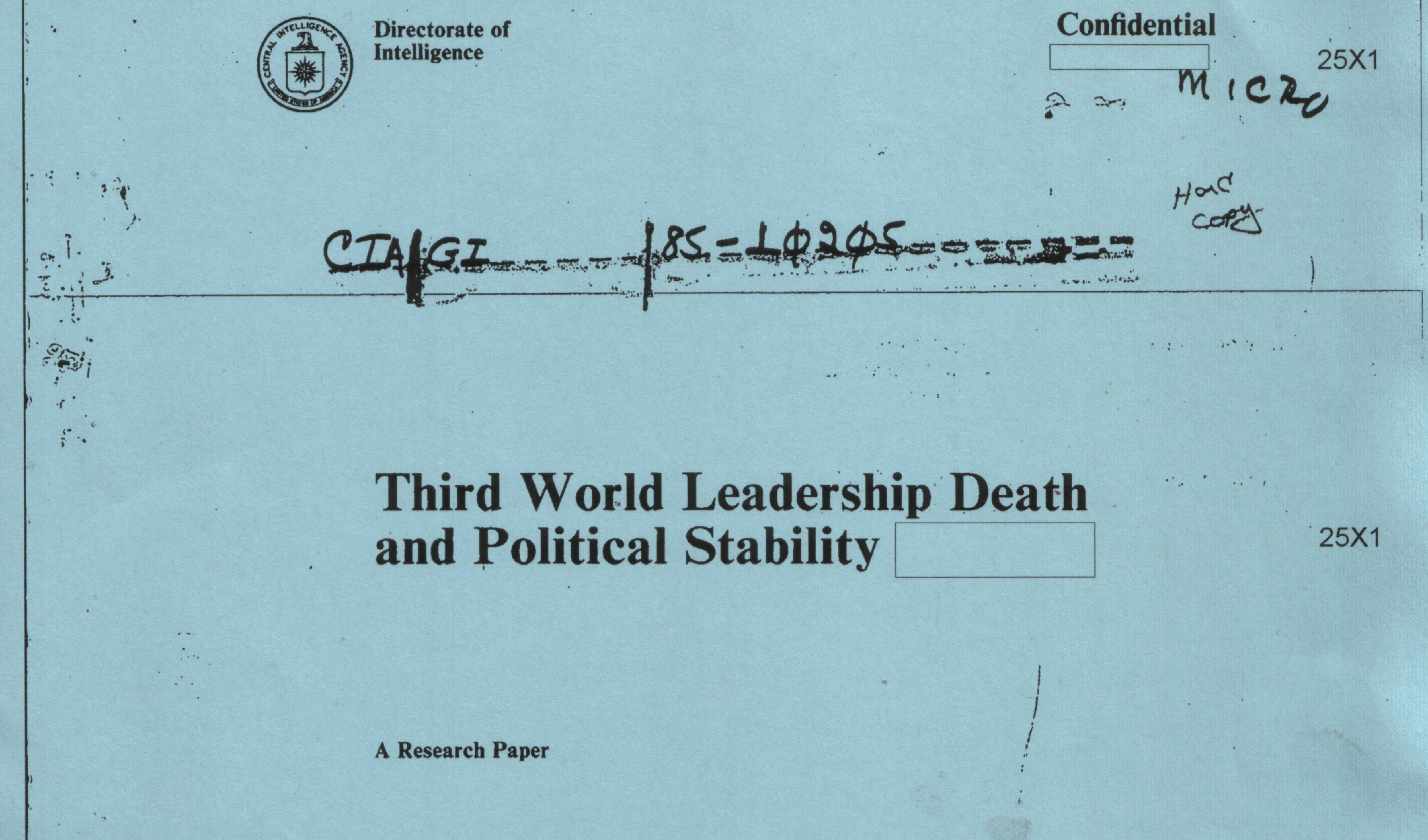
Virtually gone unnoticed in the millions of pages of declassified CIA files is an August 1985 report prepared by the agency's Directorate of Intelligence on the survivability of 38 Third World leaders. When compared to the historical record of what befell these leaders, a whopping 73.6 percent, 27 leaders on the CIA list, lost power as a result of assassinations, coups, untimely deaths, and mass popular revolts engineered from abroad.

CIA's 1985 list of vulnerable Third World leaders: 27 of 38 were ousted through coups, revolts, or death
BahrainIsa bin Sulman al Khalifa. Died of heart attack, 1999, after meeting U.S. Secretary of Defense William Cohen
BeninMathieu Kerekou. Ousted in civilian coup, 1990
BhutanJigme Singye Wangchuck. Abdicated 2006
BurmaU Ne Win. Ousted, internal coup, 1988
ChileGen. Augusto Pinochet. Stepped down in negotiated agreement, 1988
CubaFidel Castro. Resigned in 2006 during grave illness
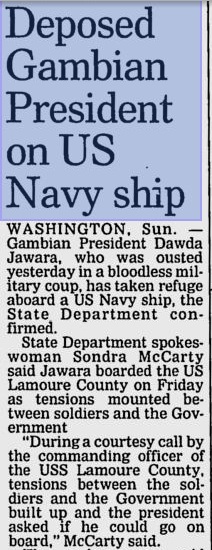
GambiaDawda K. Jawara. Ousted, CIA coup, 1994
GuyanaForbes Burnham. Died after throat surgery at Georgetown Hospital, Washington, DC, 1985. Originally inserted by CIA after coup against British Guiana's Marxist prime minister Cheddi Jagan
HaitiJean-Claude Duvalier. Ousted in CIA coup, 1986
IndonesiaSuharto. Resigned during mass demonstrations, 2003. Originally inserted into power by CIA coup in 1965
LesothoLeabua Jonathan. Ousted in military coup in 1986
LibyaMuammar Qaddafi. Executed in 2011 by CIA-supported rebels
MalawiH. Kamuzu Banda. Ousted by popular revolt 1993
MaliMoussa Traore. Ousted by popular revolt 1991
NepalBirendra Bir Bikram. Assassinated in CIA-backed coup 2001
NigerSeyni Kountche. Died in Paris hospital of brain tumor, 1987
ParaguayAlfredo Stroessner. Ousted in coup, 1989
PhilippinesFerdinand E. Marcos. Ousted in popular revolt, 1986
QatarKhalifa bin Hamad al Thani. Ousted in palace coup, 1995
RwandaJuvenal Habyarimana. Assassinated in CIA-linked aircraft shoot down, along with Burundi President Cyprien Ntaryamira, 1994
SomaliaMohammed Siad Barre. Ousted in revolt in 1991
SudanGaafar al Nimeiry. Ousted in coup in 1985
SyriaHafez al Assad. Died in 2000. His son, Bashar al Assad, faced CIA-backed civil war in 2011
VietnamLe Duan. Died of heart attack suffered during 27th Communist Party Congress during party schism
ZaireMobutu Sese Seko.  Ousted in CIA-led foreign invasion in 1997
ZambiaForced from office by international pressure in 1991


The CIA even ranked the vulnerability of the above leaders. The leaders of Burma, Morocco, and Tunisia were considered among the most vulnerable in 1985, with those of the Philippines, Somalia, Sudan, and Zambia closely following. The least vulnerable leaders were those of Qatar, Rwanda, Togo, Oman, Bhutan, Benin, and Nepal.
 
Gambian President Dawda Jawara was overthrown in a 1994 U.S.-backed military coup while he was on board the visiting U.S. Navy ship, the USS Lamoure County, docked in Banjul harbor.

The CIA report concluded that "U.S. interests are substantial in about two-thirds of these high-risk cases -- Chile, Indonesia, Morocco, the Philippines, Somalia, Syria, and Tunisia." The report strongly suggests that whether a Third World regime was "friendly or antagonistic to U.S. interests" any political instability that would affect U.S. strategic or economic interests would be grounds for the U.S. to seek the removal from power of friend or foe. In this regard, the CIA report cited "Cuba, Indonesia, Jordan, Libya, Morocco, North Korea, the Philippines, Singapore, Somalia, Sudan, Syria, Tunisia, and Zaire as "important to the United States."


Perhaps in what was an early recognition of the power of civil society organizations to create political instability, something that was later employed by the CIA, George Soros, and Gene Sharp against governments in Serbia, Georgia, Ukraine, Egypt, Tunisia, Kyrgyzstan, and Tunisia, the CIA report states: "Greater instability occurred in countries where social organizations were able to mobilize their constituents -- South Korea, Spain, Portugal, Egypt, and the Dominican Republic."

The CIA considered Tunisia under President Habib Bourguiba ripe for post-succession turmoil. Bourguiba was a special target because of his links to "revolutionary regimes dominated by longstanding charismatic leaders like Ho Chi Minh of Vietnam, Mao Zedong of China . . . Tito of Yugoslavia." All except Bourguiba were Communists. Marcos pf the Philippines was likened to one of aging oligarchs who, in their older years, became problems for the United States. In addition to Marcos, these leaders cited by the CIA included Franco of Spain and Hafez al Assad of Syria.

The CIA interest in fomenting insurrections against world leaders, which, in some cases, would lead to assassination, was in direct violation of three presidential executive orders barring the CIA from involvement in any way with political assassinations. The orders were 
EO 11905 signed by Gerald Ford; EO 12036signed by Jimmy Carter, which barred even indirect CIA involvement in political assassinations; and EO 12333, signed by Ronald Reagan. In 1998, Bill Clinton reinterpreted the assassination ban and permitted assassinations as long as there was a  counter-terrorism predicate. After 9/11, George W. Bush authorized the CIA to kill anyone the CIA placed on its Worldwide Attack Matrix. Barack Obama has done nothing to change the Bush policy on political assassinations.

Thursday, December 19, 2013

Putin cracks down on Soros influence in Russian state media


Putin cracks down on Soros influence in Russian state media
Russian President Vladimir Putin has taken proactive measures against a Russian state media organization which had been infiltrated by journalists who could hardly be distinguished from the raft of paid propagandists who have been targeting the Russian government for years.

The English-language Russian state-owned news broadcaster RT, formerly "Russia Today," came under the sights of former Secretary of State Hillary Clinton and former chairman of the U.S. Broadcasting Board of Governors Walter Isaacson before the launching of the "Arab Spring" movement.Clinton and Isaacson bemoaned the fact that RT was trumping the U.S. propaganda networks in ratings, including the Voice of America and Radio Free Europe/Asia/Liberty at a time when the Russian and Western broadcast media were facing off in a way not seen since the Cold War. Alarming to the Obama administration was the fact that more and more Americans were seeking their news from news networks like RT and Al Jazeera and bypassing the traditional commercial and highly-controlled U.S. commercial news networks.

Soon, RT's studio in Washington, DC began regularly featuring guests and even hosts paid by pro-western think tanks and non-governmental organizations funded by anti-Putin hedge fund tycoon George Soros. Among these were the Center for American Progress, a pro-Barack Obama think tank funded by Soros and located around the corner from RT's studios. Many RT guests actually used and increasingly abused the network's airwaves to criticize Putin.

Under siege by the West in Kyiv's Maidan Square and facing boycotts and snubs at the upcoming Sochi Winter Olympics, Putin acted swiftly. He announced that the parent of RT, the Russian Information Agency (RIA)/Novosti, which also ran the Voice of Russia, was being disestablished. Replacing RIA/Novosti was Rossiya Segodnya, which is Russian for "Russia Today," the same name that the RT English-language television news network once used.

RIA/Novosti and the Voice of Russia had been caught broadcasting anti-government content during the waves of 2012 anti-Putin demonstrations in Russia which were indistinguishable from that emanating from the Soros- and U.S. Agency for International Development (USAID)/National Endowment for Democracy (NED)-funded media in Moscow and other cities in central and eastern Europe which once again followed the cookie-cutter recipes by Harvard’s Gene Sharp’s color revolution recipes which had been so successfully funded in a number of countries before. This editor's own experience with some Voice of Russia correspondents in the United States has been challenging, to say the least.  In one instance, a West Coast Voice of Russia correspondent stooped down to calling a WMR story as a "conspiracy theory", the by now familiar buzzwords of mainstream media defamation of investigation of uncomfortable truths.  Not surprisingly, an examination of the correspondent's background yielded a link to CIA activities. The same CIA links are apparent in the resumé of an RT host operating out of the network's Washington studio.
The new head of Russia Today is a popular news anchor on Rossiya 1 named Dmitry Kiselev. No sooner had Kiselev broadcast a news report featuring this WMR editor  warning of a British embassy in Moscow plot to capture National Security Agency (NSA) whistleblower Edward Snowden, Putin scrapped RIA/Novosti and named Kiselev the chief of the new Russia Today operation.
 
Putin not only signaled that he would no longer tolerate Russian state-paid journalists acting as ciphers for Soros and Western intelligence propaganda outlets, but he simultaneously telegraphed his confidence in Kiselev's reporting, including the report on the British embassy operation targeting Snowden.

       Screengrab of Dmitry Kiselev during a broadcast

On December 8, Rossiya 1 news anchor Dmitry Kiselev (left) broadcast a report on a British embassy spy plot to kidnap Edward Snowden that featured WMR editor. The next day, December 9, President Putin named Kiselev as the new head of a revamped state news organization called Russia Today, which combines the Voice of Russia, RT, and RIA.


Since his appointment, Kiselev has been denounced by the Soros- and U.S.-funded media in a far-reaching agitptop campaign throughout Russia, Europe, and the United States. He was immediately stereotyped withclichés from the Soros progressive linguistic war chest as a Cold Warrior, a homophobe, and a Putin lackey.
 
However, the Soros outlets fail to include the fact that Kiselev is the most popular news anchor in Russia and is viewed in the same manner by Russians that Walter Cronkite was once seen by Americans. Considering these strong characteristics, WMR warmly applauds the appointment of Mr. Kiselev and anticipates that the true voice of Russia will be restored and preserved and under his leadership will certainly not be replaced by the paid messages of Soros which are so common in the western world.

The purging of Soros-linked journalists from Russian state media will restore somewhat the checks-and-balances seen in global journalism during the Soviet era. The CIA constantly complained that the Soviet media continually placed "disinformation" in the western English-language media. However, these Soviet news stories, including those from Novosti and TASS, often exposed CIA and other U.S. covert operations that were largely ignored by the western media. Every time the CIA was caught involved in a clandestine operation, courtesy of the Soviet media, the U.S. State Department had to issue denial after denial. The fact that the stories were carried by the Soviet media did not make them untrue.

Some examples of the Soviet reporting of possible CIA misdeeds include:

- An alleged coup plot by the United States in Ghana in 1984.
- CIA involvement in the assassination of Indian Prime Minister Indira Gandhi due to the CIA's role in bankrolling the Sikh uprising.
- Reports picked up by the Guyanese media that the CIA was behind the 1978 Jonestown massacre.

In an era when only a few corporations control most of the world's media, an aggressive Russian state-owned media is not only welcome but it is necessary.