
THE ROVING EYE
To follow Pepe's articles on the Great Arab Revolt, please click here.
The key slogan in Tahrir Square in Egypt was "the people want the downfall of the regime". When it comes to Saudi Arabia, it's more like "the House of Saud wants the downfall of its people".
Which brings us to the US$36 billion question; can an ailing monarch (Saudi King Abdullah) bribe his subjects with oil money (including a last-minute, Hosni Mubarak-style 15% pay rise to public servants) and thus escape the furious freedom winds of the great 2011 Arab revolt? The world will be able to watch a preview this Friday, as a Facebook-organized "Day of Rage" hits the globe's largest gas station.
Yet don't expect to see much on al-Jazeera - because the coverage won't be anything like Egypt and Libya; it has already been pre-empted by a princely visit to the emir of Qatar; al-Jazeera is based in Qatar, while the al-Arabyya news channel is a mouthpiece of the House of Saud. Bahrain, Kuwait, Oman, Qatar, Saudi Arabia and the United Arab Emirates all belong to the Gulf Cooperation Council (GCC). Obviously none of these GCC kings and emirs want to be swept away by democracy; revolution is only for "others", like Tunisia, Egypt and Libya.
Rage is here to stay
It's official; for the House of Saud, everyone opposing them is an Osama bin Laden, as a hack working for Saudi Prince Salman and his son, who's the editor of the Ash-Sharq al-Awsat paper, made sure this week (in doubt, he also added Iran). The juicy part is that the House of Saud itself gave birth to the original bin Laden - no to mention 15 of the 19 jihadis on 9/11.
This branding of all Saudi opposition as al-Qaeda (Zine El-Abidine Ben Ali, Mubarak, Muammar Gaddafi, they all did it) followed the Saudi shura (council) praising a ruling by Medieval Wahhabi clerics in favor of banning any demonstrations - on religious grounds (even though a lot of Saudis on Facebook stressed the country is a signatory to an international treaty recognizing the right of people to demonstrate).
Whatever Wahhabis rule, the House of Saud won't get rid of the underlying rage permeating a mass of unemployed youth wired to the world by Facebook and Twitter (almost half of the total population is under 18). They won't get rid of a demographic boom (from the current 19 million to 30 million in a decade); an overall unemployment rate of 20% compared to 9 million employed foreigners; a monoculture dependent on oil; a paltry education system that can't train people for useful work; and the fact that Saudis are hip to neighborly Bahrain on fire, yearning for democracy.
King Abdullah seems to be certain his billions in handouts will do the trick. He's certainly not listening to Prince Al-Waleed bin Talal bin Abdulaziz al-Saud - arguably the West's favorite Arab investor, who told the New York Times, "Arab governments can no longer afford to take their populations for granted, or to assume that they will remain static and subdued". He forgot to add that the House of Saud is absolutely blind to politics - and does not understand the meaning of dignity or democracy.
The demands carried by the Day of Rage are straightforward; a constitutional monarchy; end to corruption; the right to elect at least some of their rulers; freedom for women; and the release of thousands of political prisoners. But like in Bahrain, the demands could easily escalate to "Bring down the House of Saud".
Echoes by Facebook and Twitter from the streets of Riyadh, as well as comments in Saudi newspapers, are uplifting. Apparently Saudis of all ages and professions are following the great 2011 Arab revolt to the minute, wondering if the same could happen "here" - and blaming the House of Saud for unemployment and corruption - in public places; this in a country where any public gathering is strictly forbidden, and punishable by lashings and jail (from several months to two years).
Saudi media have reported on two people who have burned themselves in protest. A nasty crackdown last week in the city of Qatif - including attacks on Shi'ite women - related to a protest for the release of political prisoners, turned even more people against the monarchy. Last week after Friday prayers in Riyadh, protesters gathered in front of al-Rajhi mosque and chanted anti-government and anti-corruption slogans.
Meet the Hunayn revolution
The fact that this is being branded the Hunayn revolution makes the House of Saud freak out even more. Hunayn is a valley near Mecca where Prophet Mohammed battled a confederation of Bedouins in the year 630. The Prophet's forces won. A reference in the Koran, 9: 25-26, reads like a direct message to the House of Saud: "God gave you victory on many battlefields. Recall the day of Hunayn when you fancied your great numbers. So the earth, with all its wide expanse, narrowed before you and you turned tail and fled. Then God made his serenity to descend upon his Messenger and the believers, and sent down troops you did not see - and punished the unbelievers."
It doesn't take a PhD in Koranic studies to see "the unbelievers", in this Hunayn revolution remix - as King Abdullah and his court.
For the Day of Rage, at least 10,000 security goons have been deployed to the key northeastern Shi'ite-majority provinces - where the oil is, and which congregate around 10% of the kingdom's population. There's a risk of serious confrontations. In this case, according to the organizers, women should march as human shields in front of the protesters; this may not work, as it did not dissuade the goons in Qatif.
Trying to defuse the tension, and building on King Abdullah's $36 billion bonanza in state handouts, Saudi Minister of Labor Adel al Faqih now seems to have seen the light as well - and is promising all sorts of economic plans that he says will finally erase unemployment, inflation and poverty. He even promised to end all restrictions on women's employment (but then he had to backtrack). Most Saudis are not convinced - in a society where only those with wasta (connections) can get some sort of privilege.
Moreover, this is a society where for many "reform" is a sin, and with the rulers handing out education to fanatic clerics, constructive criticism and intellectual debate are also widely considered sins.
People for instance still vehemently defend the medieval Commission for the Promotion of Virtue and Prevention of Vice as essential for good governance. The Saudi Minister of Religion is always a member of the al-Sheikh family (descendants of Ibn Abdul Wahab). Wahhabism is rigid as a rock, allows no interpretation, no "idolatry", veneration of statues, or even works of art. Not to mention no smoking, no shaving of beards, and very few rights for women. And if you don't follow it, even if you're a Muslim, you're the enemy. No wonder this society produced al-Qaeda and jihadis - and no science or ideas.
Make no mistake; for all their glitzy skylines and investor-friendly self-image, Saudi Arabia and the Gulf Cooperation Council countries are all ruled by secrecy and fear. No political parties, no trade unions, no defense of workers safety, no defense of immigrant rights, no women's groups, and very few legal organizations to ensure a fair and independent judicial process. If you're branded as an "al-Qaeda" opposition (or an Iranian agent) you can be detained indefinitely without trial - Guantanamo-style. Or you disappear in jail after a grotesque trial. Torture is of course endemic. And foreign workers - especially non-Muslims - live in perpetual fear.
Washington and European capitals are shaken to the core with the prospect of those northern African winds producing a freedom storm in Saudiland - and the Persian Gulf.
So forget about "democracy" or "human rights". Enter the brand new Barack Obama administration "regime alteration" doctrine, where popular aspirations in the Gulf - from Saudi Arabia to Bahrain and Oman - are ditched to the benefit of the "stability" afforded by "key allies", swing producers House of Saud and hosts of the 5th Fleet the al-Khalifa dynasty in Bahrain. Moreover, the House of Saud has told the al-Khalifa that if they do not crush their own Shi'ite-majority revolt, Saudi forces will. And Washington won't bat an eyelid. As it won't bat an eyelid if this Day of Rage turns into a bloodbath.
Pepe Escobar is the author of Globalistan: How the Globalized World is Dissolving into Liquid War (Nimble Books, 2007) and Red Zone Blues: a snapshot of Baghdad during the surge. His new book, just out, is Obama does Globalistan (Nimble Books, 2009).
He may be reached at pepeasia@yahoo.com.
Wednesday, March 09, 2011
Tuesday, March 08, 2011
The perfect (desert) storm By Pepe Escobar
THE ROVING EYE
To follow Pepe's articles on the Great Arab Revolt, please click here.
The great 2011 Arab revolt, the cry for democracy in Northern Africa, the mostly Shi'ite revolt in the Persian Gulf, the Western despair over the price of oil, and the new United States Middle East doctrine of "regime alteration" - not to mention the Pentagon's full-spectrum dominance doctrine - have been convoluted into the ultimate political storm in MENA (Middle East/Northern Africa). The storm deploys devastating gusts of hypocritical winds.
For starters, the enlightened, democratic West has decided Muammar Gaddafi has to be taken down - or out.
The George W Bush administration invaded both Afghanistan and Iraq, killing hundreds of thousands of people in the process, directly and indirectly; and as everyone knows, with no end in sight, and with total impunity. Now it's the turn for the law of the (wild) West to be applied, via the Barack Obama administration, to the African king of kings - as in it's OK if we bearers of the White Man's Burden kill a lot of people, but not OK if the killer is a John Galliano-dressed Bedouin weirdo.
This is the absolute bottom line; either the West arms the eastern liberated Libya rebels to their teeth, or Muammar Gaddafi will win this war, by switching the fight from cities to the desert, and by applying slightly increasing degrees of force. Thus, in a slightly duller version of endless plot advancements in mafia movies, the "debate" from Washington and Brussels to Riyadh concerns the most effective method for taking him down (or out). Enter plans A and B.
People change beats regime change
Plan A - Washington has placed a "highly classified" request for the House of Saud to arm the rebels, as The Independent's Robert Fisk has advanced, without details (none available in Arab media, either). So essentially this would be - what else is new - history repeating itself as farce; a remix of the Ronald Reagan-era Iran-Contra scandal, with Washington possibly betting on control of Libya's oil and gas (echoes of Iraq neo-conned; make it history twice repeating itself as farce).
The House of Saud has every reason to arm liberated eastern Libya with much-needed anti-tank rockets, mortars and ground-to-air missiles against Gaddafi - not least because aging Saudi King Abdullah hates his guts (no wonder; Gaddafi put a contract to kill the king over a year ago). According to al-Arabiyya - a mouthpiece of the House of Saud - Gaddafi is the only Arab dictator left in power, which proves once again that the desert family oil hacienda is indeed impervious to irony.
The added irony that this scheme also copies the Saudis distributing weapons for the mujahideen in Afghanistan in the 1980s via Pakistan (make it history thrice repeating itself as farce) obviously escaped everyone in Washington. Hail to Benghazi as the new Peshawar!
Anyway, the Saudi reward for riding along is already inbuilt in the Obama administration's brand new Middle East strategy of "regime alteration". Everything one needs to know about the doctrine is here.
Next Friday, an Egyptian-style day of rage is planned for Saudi Arabia. Preemptive repression has been fierce - including a ban on all demonstrations, because, says the Interior Ministry, they are against sharia law. A big round of applause here to the hardline Prince Nayef bin Abdul-Aziz, one of the king's brothers, for his efforts previous and post-day of rage.
And then there's the mostly Shi'ite rebellion in neighborly Bahrain - home of the US 5th Fleet - which must be contained at all costs, lest it spills over to oil-producing, Shi'ite majority northeast Saudi Arabia. So according to "regime alteration" ("help keep longtime allies who are willing to reform in power"), and all in the name of "stability", US President Barack Obama can't say a word if the House of Saud cracks down big time over its Shi'ites, or if it helps the al-Khalifas in Bahrain with tanks and troops to crack down big time over their Shi'ites. Translation: screw the democratic aspirations of the people of Bahrain and a substantial chunk of the people of Saudi Arabia; Washington just can't get enough of its valuable allies, the al-Khalifa monarchy in Bahrain and the House of Saud.
Humanitarian hell-raisers, rejoice
Then there's Plan B - the North Atlantic Treaty Organization (NATO) takes over to fight "crimes against humanity" and "genocide". Essentially this would be Kosovo all over again (make it history repeating itself for the fourth time).
As a no-fly zone over Libya is the object of fiery debate, NATO has already decided to increase AWACs surveillance flights over Libyan territory to 24/7, according to US ambassador to NATO Ivo Daalder. Translation; they're already searching for targets. Even as a reticent Pentagon has admitted on the record that a no-fly zone means war, febrile NATO secretary general Anders Fogh Rasmussen insisted NATO is ready to raise hell until, predictably, he backtracked.
As this is not a remix of Bush and the neo-conservatives - at least not officially - first there must be a mandate from the United Nations Security Council; France and Britain are feverishly working on a draft resolution. And then support must be assured from Russia (already said no), China (already said nothing), the toothless Arab League (almost a given) and the African Union (more complicated, because Gaddafi bought a lot of its leaders).
As for all those US-protected beacons of equality in the Persian Gulf - now hands-free to keep repressing the democratic aspirations of their people and the army of Asian slaves who service their elites - support is a cakewalk. A statement released by the foreign ministers from the six-member Gulf Cooperation Council (GCC) "demands that the UN Security Council take all necessary measures to protect civilians, including enforcing a no-fly zone over Libya".
NATO intervention, if it happens, will be sold to the whole planet as the return of humanitarian imperialism. From the point of view of NATO/ Pentagon/European Union public relations purposes, that's another cakewalk. Former terrorist Gaddafi has now been rebranded as "the new Hitler", after Slobodan Milosevic in Yugoslavia (as well as Saddam Hussein in Iraq; make it history repeating itself as farce for the fifth time). And Gaddafi is a much easier sell; the total terrorist freak show package.
Cui bono?
There's no question Gaddafi and his gang are practicing "human-rights abuses" in Libya. But what about those tens of thousands killed by the Pentagon from Baghdad to Fallujah and beyond? Were they inhuman, and holders of no rights, by any chance?
Moreover, the same enlightened West that's now so worried about the people of Libya did not give much of a damn to the people of Egypt until it was absolutely certain that Mubarakism was gone. (Gaddafi by the way was perfectly aligned with Obama, French President Nicolas Sarkozy, British Prime Minister David Cameron and Italian Premier Silvio Berlusconi in the early days of Tahrir Square).
While he was servicing the masters, the walking terrorist freak show with his portable tent and Ukrainian nurses could not be a better friend. He merrily embraced neo-liberalism; he opened up the energy holy grail to European corporations (BP, Repsol, Total, ENI); he lavishly bought their weapons (Italy, France, UK and Germany were the top four providers); he got the US$70 billion of the Libyan Investment Authority to prop up European businesses; and most of all he put a lid over the migratory flux from the Maghreb and black Africa towards Europe.
And what about then-US secretary of state Condoleezza Rice in 2008 extolling the US and Libya's permanent shared interests, including "human rights and democracy"?
The problem now is that the West is simply clueless on what post-Gaddafi Libya could turn out to be. The "rebels" include everyone from progressive, secular intellectuals to hardcore Islamists and neo-liberal-addicted businessmen. Libya is not Tunisia or Egypt - which can be monitored and even relatively tamed by Washington/Brussels.
Libya without Gaddafi could be a complex collection of clannish tribes with no experience of Western-style political culture slouching towards "anarchy". Thus the reasoning for a NATO intervention; so "we", the enlightened, can control those barbarians' worst impulses, facilitate an "orderly transition" (US Secretary of State Hillary Clinton, anyone?) and profit from their energy wealth. Besides, the Mediterranean is a NATO lake already.
There's NATO - but there's also NATO's Partnership for Peace. Every single nation in the 27-nation European Union is a member of one or the other (Cyprus was the last one to adhere, last month).
NATO is as ubiquitous as death, taxes and financial corruption. NATO means war in Afghanistan; Operation Active Endeavor - as in airborne counter-terrorism in the Middle East (for instance, the AWACs surveying Libya); and also Operation Ocean Shield off the Horn of Africa.
Every European nation bordering the Mediterranean - or in the Mediterranean - is part of NATO or the Partnership for Peace. And all the African nations on the Mediterranean - except Libya - are members of NATO's Mediterranean Dialogue partnership: Algeria, Egypt, Morocco and Tunisia. Israel is a key member of the Mediterranean Dialogue. This means that among Mediterranean littoral nations, only Lebanon (slapped with a five-year-long naval blockade), Syria and, of course Libya are not members of NATO or any partnership program. The bottom line, once again: the Mediterranean is a NATO lake.
We've seen this movie before
True democrats the world over cannot but rate "regime alteration" as a pitiful, pathetic Obama administration strategy. Moreover, there's absolutely no guarantee that NATO won't go for its own take on regime alteration; a balkanization of Libya just as it happened in Yugoslavia (or just like the Pentagon, via local oligarchies, tried in Bolivia in 2008).
The White House cannot possibly want a real war against the African king of kings. Obama is being set up by the neo-cons - who as the Clintonistas of 1999 and themselves in 2003 in Iraq, brandish the always misleading sweet sword of so-called humanitarian intervention.
Neo-cons such as the cosmically despicable John Yoo - the lawyer who told Bush torture is OK - have virtually ordered the Obama administration to stuff the UN's "antiquated rules" and cut to the chase. Compared to it, the proposal by Venezuelan President Hugo Chavez for a neutral mediation sounds like a stone monument to common sense. Yet no one is listening - not Washington, not NATO, not the Gaddafi clan, not the rebels.
Here we go again. The first one willing to send a Stinger missile to the freedom fighters so they can take down Gaddafi's helicopters gunships, raise your hand. History repeats itself as farce for, well, we lost count.
Pepe Escobar is the author of Globalistan: How the Globalized World is Dissolving into Liquid War (Nimble Books, 2007) and Red Zone Blues: a snapshot of Baghdad during the surge. His new book, just out, is Obama does Globalistan (Nimble Books, 2009).
He may be reached at pepeasia@yahoo.com.
To follow Pepe's articles on the Great Arab Revolt, please click here.
The great 2011 Arab revolt, the cry for democracy in Northern Africa, the mostly Shi'ite revolt in the Persian Gulf, the Western despair over the price of oil, and the new United States Middle East doctrine of "regime alteration" - not to mention the Pentagon's full-spectrum dominance doctrine - have been convoluted into the ultimate political storm in MENA (Middle East/Northern Africa). The storm deploys devastating gusts of hypocritical winds.
For starters, the enlightened, democratic West has decided Muammar Gaddafi has to be taken down - or out.
The George W Bush administration invaded both Afghanistan and Iraq, killing hundreds of thousands of people in the process, directly and indirectly; and as everyone knows, with no end in sight, and with total impunity. Now it's the turn for the law of the (wild) West to be applied, via the Barack Obama administration, to the African king of kings - as in it's OK if we bearers of the White Man's Burden kill a lot of people, but not OK if the killer is a John Galliano-dressed Bedouin weirdo.
This is the absolute bottom line; either the West arms the eastern liberated Libya rebels to their teeth, or Muammar Gaddafi will win this war, by switching the fight from cities to the desert, and by applying slightly increasing degrees of force. Thus, in a slightly duller version of endless plot advancements in mafia movies, the "debate" from Washington and Brussels to Riyadh concerns the most effective method for taking him down (or out). Enter plans A and B.
People change beats regime change
Plan A - Washington has placed a "highly classified" request for the House of Saud to arm the rebels, as The Independent's Robert Fisk has advanced, without details (none available in Arab media, either). So essentially this would be - what else is new - history repeating itself as farce; a remix of the Ronald Reagan-era Iran-Contra scandal, with Washington possibly betting on control of Libya's oil and gas (echoes of Iraq neo-conned; make it history twice repeating itself as farce).
The House of Saud has every reason to arm liberated eastern Libya with much-needed anti-tank rockets, mortars and ground-to-air missiles against Gaddafi - not least because aging Saudi King Abdullah hates his guts (no wonder; Gaddafi put a contract to kill the king over a year ago). According to al-Arabiyya - a mouthpiece of the House of Saud - Gaddafi is the only Arab dictator left in power, which proves once again that the desert family oil hacienda is indeed impervious to irony.
The added irony that this scheme also copies the Saudis distributing weapons for the mujahideen in Afghanistan in the 1980s via Pakistan (make it history thrice repeating itself as farce) obviously escaped everyone in Washington. Hail to Benghazi as the new Peshawar!
Anyway, the Saudi reward for riding along is already inbuilt in the Obama administration's brand new Middle East strategy of "regime alteration". Everything one needs to know about the doctrine is here.
Next Friday, an Egyptian-style day of rage is planned for Saudi Arabia. Preemptive repression has been fierce - including a ban on all demonstrations, because, says the Interior Ministry, they are against sharia law. A big round of applause here to the hardline Prince Nayef bin Abdul-Aziz, one of the king's brothers, for his efforts previous and post-day of rage.
And then there's the mostly Shi'ite rebellion in neighborly Bahrain - home of the US 5th Fleet - which must be contained at all costs, lest it spills over to oil-producing, Shi'ite majority northeast Saudi Arabia. So according to "regime alteration" ("help keep longtime allies who are willing to reform in power"), and all in the name of "stability", US President Barack Obama can't say a word if the House of Saud cracks down big time over its Shi'ites, or if it helps the al-Khalifas in Bahrain with tanks and troops to crack down big time over their Shi'ites. Translation: screw the democratic aspirations of the people of Bahrain and a substantial chunk of the people of Saudi Arabia; Washington just can't get enough of its valuable allies, the al-Khalifa monarchy in Bahrain and the House of Saud.
Humanitarian hell-raisers, rejoice
Then there's Plan B - the North Atlantic Treaty Organization (NATO) takes over to fight "crimes against humanity" and "genocide". Essentially this would be Kosovo all over again (make it history repeating itself for the fourth time).
As a no-fly zone over Libya is the object of fiery debate, NATO has already decided to increase AWACs surveillance flights over Libyan territory to 24/7, according to US ambassador to NATO Ivo Daalder. Translation; they're already searching for targets. Even as a reticent Pentagon has admitted on the record that a no-fly zone means war, febrile NATO secretary general Anders Fogh Rasmussen insisted NATO is ready to raise hell until, predictably, he backtracked.
As this is not a remix of Bush and the neo-conservatives - at least not officially - first there must be a mandate from the United Nations Security Council; France and Britain are feverishly working on a draft resolution. And then support must be assured from Russia (already said no), China (already said nothing), the toothless Arab League (almost a given) and the African Union (more complicated, because Gaddafi bought a lot of its leaders).
As for all those US-protected beacons of equality in the Persian Gulf - now hands-free to keep repressing the democratic aspirations of their people and the army of Asian slaves who service their elites - support is a cakewalk. A statement released by the foreign ministers from the six-member Gulf Cooperation Council (GCC) "demands that the UN Security Council take all necessary measures to protect civilians, including enforcing a no-fly zone over Libya".
NATO intervention, if it happens, will be sold to the whole planet as the return of humanitarian imperialism. From the point of view of NATO/ Pentagon/European Union public relations purposes, that's another cakewalk. Former terrorist Gaddafi has now been rebranded as "the new Hitler", after Slobodan Milosevic in Yugoslavia (as well as Saddam Hussein in Iraq; make it history repeating itself as farce for the fifth time). And Gaddafi is a much easier sell; the total terrorist freak show package.
Cui bono?
There's no question Gaddafi and his gang are practicing "human-rights abuses" in Libya. But what about those tens of thousands killed by the Pentagon from Baghdad to Fallujah and beyond? Were they inhuman, and holders of no rights, by any chance?
Moreover, the same enlightened West that's now so worried about the people of Libya did not give much of a damn to the people of Egypt until it was absolutely certain that Mubarakism was gone. (Gaddafi by the way was perfectly aligned with Obama, French President Nicolas Sarkozy, British Prime Minister David Cameron and Italian Premier Silvio Berlusconi in the early days of Tahrir Square).
While he was servicing the masters, the walking terrorist freak show with his portable tent and Ukrainian nurses could not be a better friend. He merrily embraced neo-liberalism; he opened up the energy holy grail to European corporations (BP, Repsol, Total, ENI); he lavishly bought their weapons (Italy, France, UK and Germany were the top four providers); he got the US$70 billion of the Libyan Investment Authority to prop up European businesses; and most of all he put a lid over the migratory flux from the Maghreb and black Africa towards Europe.
And what about then-US secretary of state Condoleezza Rice in 2008 extolling the US and Libya's permanent shared interests, including "human rights and democracy"?
The problem now is that the West is simply clueless on what post-Gaddafi Libya could turn out to be. The "rebels" include everyone from progressive, secular intellectuals to hardcore Islamists and neo-liberal-addicted businessmen. Libya is not Tunisia or Egypt - which can be monitored and even relatively tamed by Washington/Brussels.
Libya without Gaddafi could be a complex collection of clannish tribes with no experience of Western-style political culture slouching towards "anarchy". Thus the reasoning for a NATO intervention; so "we", the enlightened, can control those barbarians' worst impulses, facilitate an "orderly transition" (US Secretary of State Hillary Clinton, anyone?) and profit from their energy wealth. Besides, the Mediterranean is a NATO lake already.
There's NATO - but there's also NATO's Partnership for Peace. Every single nation in the 27-nation European Union is a member of one or the other (Cyprus was the last one to adhere, last month).
NATO is as ubiquitous as death, taxes and financial corruption. NATO means war in Afghanistan; Operation Active Endeavor - as in airborne counter-terrorism in the Middle East (for instance, the AWACs surveying Libya); and also Operation Ocean Shield off the Horn of Africa.
Every European nation bordering the Mediterranean - or in the Mediterranean - is part of NATO or the Partnership for Peace. And all the African nations on the Mediterranean - except Libya - are members of NATO's Mediterranean Dialogue partnership: Algeria, Egypt, Morocco and Tunisia. Israel is a key member of the Mediterranean Dialogue. This means that among Mediterranean littoral nations, only Lebanon (slapped with a five-year-long naval blockade), Syria and, of course Libya are not members of NATO or any partnership program. The bottom line, once again: the Mediterranean is a NATO lake.
We've seen this movie before
True democrats the world over cannot but rate "regime alteration" as a pitiful, pathetic Obama administration strategy. Moreover, there's absolutely no guarantee that NATO won't go for its own take on regime alteration; a balkanization of Libya just as it happened in Yugoslavia (or just like the Pentagon, via local oligarchies, tried in Bolivia in 2008).
The White House cannot possibly want a real war against the African king of kings. Obama is being set up by the neo-cons - who as the Clintonistas of 1999 and themselves in 2003 in Iraq, brandish the always misleading sweet sword of so-called humanitarian intervention.
Neo-cons such as the cosmically despicable John Yoo - the lawyer who told Bush torture is OK - have virtually ordered the Obama administration to stuff the UN's "antiquated rules" and cut to the chase. Compared to it, the proposal by Venezuelan President Hugo Chavez for a neutral mediation sounds like a stone monument to common sense. Yet no one is listening - not Washington, not NATO, not the Gaddafi clan, not the rebels.
Here we go again. The first one willing to send a Stinger missile to the freedom fighters so they can take down Gaddafi's helicopters gunships, raise your hand. History repeats itself as farce for, well, we lost count.
Pepe Escobar is the author of Globalistan: How the Globalized World is Dissolving into Liquid War (Nimble Books, 2007) and Red Zone Blues: a snapshot of Baghdad during the surge. His new book, just out, is Obama does Globalistan (Nimble Books, 2009).
He may be reached at pepeasia@yahoo.com.

Monday, March 07, 2011
Saturday, March 05, 2011
The lion wants his juice back
THE ROVING EYE
By Pepe Escobar
By Pepe Escobar
You're Muammar Gaddafi, and you're sitting in your Bab al-Azizia bunker sipping green tea and surveying the odds of staying in power. Let's see. You control some neighborhoods in Tripoli; some cities in the far west, near the Tunisian border; your birthplace, Sirte. And that's it.
You may have lost like 90% of your country. You tried to get Zawiya (west of Tripoli) back and failed; those god-damned tribals betrayed you. You tried to get Misrata (east of Tripoli), and failed. You tried to get Brega - the second-largest processing and oil shipping terminal in Libya - and failed.
The Americans and Brits are dying to invade. "Experts" say you're boxed in and have only Zimbabwe as an exile destination. Venezuelan President "brother" Hugo Chavez wants to send a multinational delegation to negotiate. Negotiate what? This is your country. L'Etat, c'est moi - the state is me, King Muammar. Nobody can steal my mojo.
They froze your multi-billionaire assets from A to Z. They shut down your banks. But you've still got some dough. A whole lot of weaponry. A few (malfunctioning) jets. You have those thousands of black African mercenaries. You have the 10,000-strong special brigade led by your son Khamis. You got state TV.
So what do you do? You double down. And go for broke.
The lion sleeps tonight
Danger: the African king of kings in his bunker is like a lion resting under a tree. He knows that from the west the "rebels" - or in shorthand official narrative "al-Qaeda zombie youths on drugs" - haven't got a chance to hurt him unless they organize a very complex attack army out of many rag-tag bands with Kalashnikovs and rocket-propelled grenades in scattered towns.
He knows that the rebels in the east have to do the same - plus travel, unprotected, along an infinite desert highway just to get to Sirte, where they can be smashed by his jets and tanks.
So he knows they can defend - Zawiya, Misrata, Brega - but they don't have what it takes to attack. That gives him enough time to better plan how to go for the kill.
There's only one problem with this Lion King scenario. What if he runs out of oil?
No less than 80% of Libya's oil fields and refineries are now in the hands of those "al-Qaeda zombie youths on drugs". Gaddafi knows he needs to get Brega back - and quick. He'll go for it, again, and with a more lethal strategy. He still holds Ras Lanouf, 80 kilometers west of Brega - the refinery (220,000 barrels a day), the port and the airport. But he can't afford to lose Brega.
Brega is not exporting any oil. There are no tankers coming and going. Oil production in the southeastern fields that feed Brega has been downsized, from 90,000 barrels a day to just 11,000; there's nowhere to store them. There's no oil flowing at the Nafoora field, part of the Sirte Basin. Italy's ENI, the top foreign oil major, is repatriating all non-essential personnel. Libya's daily production dropped from 1.6 million barrels to 850,000, and will fall further.
More than this oil on storage, Gaddafi needs working refineries pumping out juice for his already cranky military machine. The crowds in liberated Benghazi say that they don't need oil money - because they never got much of from central government anyway in Cyrenaica. The problem is sooner rather than later they will need more weapons. Thus they will need oil money to buy them.
Benghazi is convulsed by rumors of Gaddafi's secret police infiltrated everywhere gathering local intel - even inside the courthouse which has been transformed into eastern liberated Libya's Revolution Central. No wonder al-Jazeera is reporting that people in Brega and Ajdabiya badly want a no-fly zone - to the horror of pan-Arab media.
It's stalemate time - and the lion is biding his time, never more dangerous when he maneuvers in the shade. Although the Algerian government has vociferously denied, officially, it is helping Gaddafi, Algeria, with 40% unemployment and across the board pent-up rage, is also on the brink. Frightful Fortress Europe, meanwhile, prays. While the Greenstream gas pipeline from Libya to Sicily is now closed (Italians are not yet freaking out), Spain dreams of the new US$1.4 billion gas pipeline from Algeria set to open in a few days.
Doomsday practitioners already visualize Algeria's oil production - 1.4 million barrels a day - soon going down the drain alongside Libya's. No wonder the head of oil research at Barclays Capital, Paul Horsnell, says things can potentially be worse than Iran 1979; "The world has only 4.5 million barrels per day of spare capacity."
Thus speculation will be king for the foreseeable future. Meanwhile, the lion sleeps, tonight and in subsequent nights, musing how he'll get his juice back while a sinister chill envelops Libya all over again.
Pepe Escobar is the author of Globalistan: How the Globalized World is Dissolving into Liquid War (Nimble Books, 2007) and Red Zone Blues: a snapshot of Baghdad during the surge. His new book, just out, is Obama does Globalistan (Nimble Books, 2009).
He may be reached at pepeasia@yahoo.com.
Harvey Point base, once known as a U.S. Navy Supply Center, but which has existed for some five decades as a CIA's "special operations" training facility under Defense Department "cover."
UPDATE. Harvey Point's "distinguished" alumni
WMR's article on the CIA's highly-secretive Harvey Point Defense Testing Activity near Hertford, North Carolina apparently rattled more than a few cages in upper echelon Washington, perhaps so much so that WMR experienced a communication outage on March 3 that was blamed by AT&T on a degraded cell phone tower in south Arlington, Virginia.
WMR spoke to a number of military personnel who served in the Tidewater, Virginia area who were unfamiliar with the Harvey Point base, once known as a U.S. Navy Supply Center, but which has existed for some five decades as a CIA's "special operations" training facility under Defense Department "cover."
Complementing the CIA's agent training facility at Camp Peary, Virginia, just outside Williamsburg, Harvey Point was once known as "Isolation Tropic", as opposed to Camp Peary, also known as "Isolation" or "The Farm." Harvey Point is sometimes referred to by CIA officers as "The Point."
The CIA has good reason to be silent about the operations at Harvey Point. For decades, under the guise of "counter-terrorism" training, Harvey Point has been training terrorists, including members of the Kosovo Liberation Army, anti-Castro commandos of Brigade 2506 and Alpha 66, the South Korean Central Intelligence Agency (KCIA), Israel's Sayeret Matkal commandos, Angolan guerrillas of the National Union for the Total Independence of Angola (UNITA), Chechen guerrillas, the secret police of the infamous Greek colonels' junta, and the Honduran death squad Movimiento Anti-Communista Hondureno (MACHO), as well as CIA Latin America cocaine smugglers used in "Operation Pseudo Miranda" during William Casey's reign at Langley. The latter operation was described by former CIA operative Kenneth C. Bucchi in his 2000 book, "Operation Pseudo Miranda: A Veteran of the CIA Drug Wars Tells All." The training of the CIA cocaine smugglers, according to Bucchi, was conducted at Harvey Point and the Tonopah Test Range (Area 52), located 70 miles northwest of the CIA's top secret testing facility at Area 51 in Nevada.
Through the auspices of the International Police Academy, using the conduit of a CIA proprietary called International Police Services, Inc. (INPOLSE) of Washington, DC, foreign police officers were sent to Harvey Point for training in bombings, arson, and assassinations. There is some evidence in Guyana that members of Jim Jones's People's Temple and their Guyanese security liaison officers also received training in weapons use at Harvey Point. Jonestown is widely believed to have been a CIA MK-ULTRA mind control operation with the cover story that most of the Americans who died there did so after drinking poisoned Kool Aid. In fact, most were shot to death at close range.
In 2009, the archives of the Health Ministry of Guyana was gutted by a fire caused by an arson attack. Suspiciously, a contingent from the US Southern Command based in Miami was dispatched to Georgetown to "investigate" the fire. On October 24, 1979, almost a year after the Jonestown massacre, Vincent Teekah, Guyana's Minister of Education was assassinated by a gunshot at close range. On June 13, 1980, Guyanese opposition leader Walter Rodney was assassinated by a car bomb. Guyanese Defense Force officers were among those trained at Harvey Point and the CIA was linked to the assassinations of Teekah and Rodney.
One of Harvey Point's graduates was General Ziaur Rahman, who is believed to have participated in the assassination of Bangladesh President Sheikh Mujibur Rahman on August 15, 1975, along with members of his family and staff. One of the generals involved was believed to be Ziaur Rahman who is alleged to have been working for the CIA. Two of Sheikh Mujib's daughters escaped assassination since they were visting West Germany at the time. One is Bangladesh's current prime minister, Sheikh Hasina Wazed. Ziaur Rahman became president in 1977 after serving as the de facto leader since the coup. Immediately, Ziaur Rahman reversed Sheikh Mujib's secular and socialist policies, turning Bangladesh into an "Islamic" republic tied to the West. On May 30, 1981, Ziaur Rahman was assassinated by a group of army officers.
Harvey Point was also involved in the training of other Islamists. In his 2000 book, "Unholy Wars," this editor's late friend John Cooley, the longtime Middle East correspondent for ABC News, wrote that Harvey Point was used to train the Afghan mujaheddin, including many irregulars who would later end up in the ranks of the Taliban and Osama bin Laden's "Al Qaeda" organization. At Harvey Point the Afghan guerrilla fighters learned about "sophisticated fuses, timers, and explosives; automatic weapons with armor-piercing ammunition, remote-control devices for triggering mines and bombs." Cooley further described tje Afghans' CIA training at Harvey Point, Camp Peary, and Fort Bragg. It included honing the Afghans' local skills of local Afghan skills of throat cutting and disemboweling, as well as more sophisticated training in bombing commercial aircraft, buses, cars, limousines, power plants and transmission towers, office buildings, airport terminals, hotels, movie theaters, and hotels.
Prime Minister Hasina recently forced Nobel Peace Prize laureate Muhammed Yunus off the board of Bangldesh's Grameen Bank and cited as one of the reasons Yunus's micro-loan program, for which he was awarded the Nobel Prize, as "sucking blood from the poor" with micro-loan program. President Obama's mother, Stanley Ann Dunham Soetoro, worked on micro-loan programs for the Ford Foundation, among other organizations, in Pakistan and Indonesia.
Harvey Point has also been used by Los Alamos National Laboratory to conduct nuclear material detection testing. In a 1998 paper delivered to the Institute of Nuclear Materials Management Conference in Naples, Florida, technical details of the work at Harvey Point are described as follows:
"Quantrad Sensor, Inc. (QSI) licensed the Ranger (TM) technology from Los Alamos National Laboratory (LANL) in 1997. The Material Control and Accountability group at LANL uses the Ranger (TM) for in situ nuclear material (NM) confirmation measurements, medical isotope entry/exit confirmations, hand scanning, and shipper confirmations. QSI is developing new applications by adapting the LANL software to identify unknown isotopes for nuclear smuggling and other national security scenarios.
Initial efforts at Harvey Point expanded the existing LANL NM confirmation software to include more isotopes and a nontechnical display. After Harvey Point, QSI replaced the ruggedized detector (≈1 0%) with a higher-resolution detector (7.5%) and developed a real-time pattern recognition system, RangerMaster. As a basis for RangerMaster, a spectrum for each isotope in the library was simulated with SYNTH. Careful analysis of the SYNTH spectra revealed that all the isotopes in the library could be identified with a unique set of regions of interest (ROIs). Initial validation of RangerMaster (TM) was done with the SYNTH spectra and the archived data from Harvey Point. Next, actual field tests were conducted at hospitals and the DOE Remote Sensing Laboratory (RSL) operated by Bechtel."
Bechtel has long maintained a cozy relationship with the CIA. Before World War II, Steve Bechtel formed a military-industrial complex partnership with John McCone. McCone later became the chairman of the Atomic Energy Commission and later, director of the CIA. The CIA has used Bechtel to provide cover for non-official cover CIA operatives abroad.
While the U.S. Army's "School of the Americas," now known as the Western Hemisphere Institute for Security and Cooperation, has been called the "School of the Assassins," Harvey Point can justifiably be called the "School of the Terrorists." And furthermore, the American taxpayers fund both operations without even a whimper from members of Congress. America: stick a fork in it, it's done.
UPDATE: On November 24, 2010, The Daily Advance of Elizabeth City, North Carolina ran a story about the fuselage of a Boeing 727 being transported through eastern North Carolina from Laurinburg to Harvey Point via Edenton on North Carolina highways. The plane was being hauled by Waff Contracting Company of Edenton and the photograph of the fuselage was taken by Debra Waff. One poster on the paper's website expressed outrage that the paper would publish the photo and news of the fuselage transport: "The transport of the fuselage was unannounced for a reason. IT WAS NONE OF THE NEWS MEDIA'S BUSINESS! What goes on at Harvey Point, or any military other bases, is really a matter of national security and does not need broadcasting to the public."
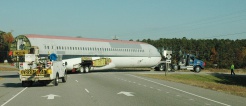
Strange goings on at Harvey Point with North Carolina highways looking like airport runways.
On December 10, 2008, The Virginia Pilotreported that Al Waff, the general superintendent of Waff Contracting, was kidnapped by a man with a semi-automatic handgun outside his Edenton homeand was forced to drive the unknown assailant to Mobile, Alabama. Waff was not robbed but the assailant forced Waff to remove the battery from his cell phone during the drive. Waff was not harmed in the car jacking.
WMR's article on the CIA's highly-secretive Harvey Point Defense Testing Activity near Hertford, North Carolina apparently rattled more than a few cages in upper echelon Washington, perhaps so much so that WMR experienced a communication outage on March 3 that was blamed by AT&T on a degraded cell phone tower in south Arlington, Virginia.
WMR spoke to a number of military personnel who served in the Tidewater, Virginia area who were unfamiliar with the Harvey Point base, once known as a U.S. Navy Supply Center, but which has existed for some five decades as a CIA's "special operations" training facility under Defense Department "cover."
Complementing the CIA's agent training facility at Camp Peary, Virginia, just outside Williamsburg, Harvey Point was once known as "Isolation Tropic", as opposed to Camp Peary, also known as "Isolation" or "The Farm." Harvey Point is sometimes referred to by CIA officers as "The Point."
The CIA has good reason to be silent about the operations at Harvey Point. For decades, under the guise of "counter-terrorism" training, Harvey Point has been training terrorists, including members of the Kosovo Liberation Army, anti-Castro commandos of Brigade 2506 and Alpha 66, the South Korean Central Intelligence Agency (KCIA), Israel's Sayeret Matkal commandos, Angolan guerrillas of the National Union for the Total Independence of Angola (UNITA), Chechen guerrillas, the secret police of the infamous Greek colonels' junta, and the Honduran death squad Movimiento Anti-Communista Hondureno (MACHO), as well as CIA Latin America cocaine smugglers used in "Operation Pseudo Miranda" during William Casey's reign at Langley. The latter operation was described by former CIA operative Kenneth C. Bucchi in his 2000 book, "Operation Pseudo Miranda: A Veteran of the CIA Drug Wars Tells All." The training of the CIA cocaine smugglers, according to Bucchi, was conducted at Harvey Point and the Tonopah Test Range (Area 52), located 70 miles northwest of the CIA's top secret testing facility at Area 51 in Nevada.
Through the auspices of the International Police Academy, using the conduit of a CIA proprietary called International Police Services, Inc. (INPOLSE) of Washington, DC, foreign police officers were sent to Harvey Point for training in bombings, arson, and assassinations. There is some evidence in Guyana that members of Jim Jones's People's Temple and their Guyanese security liaison officers also received training in weapons use at Harvey Point. Jonestown is widely believed to have been a CIA MK-ULTRA mind control operation with the cover story that most of the Americans who died there did so after drinking poisoned Kool Aid. In fact, most were shot to death at close range.
In 2009, the archives of the Health Ministry of Guyana was gutted by a fire caused by an arson attack. Suspiciously, a contingent from the US Southern Command based in Miami was dispatched to Georgetown to "investigate" the fire. On October 24, 1979, almost a year after the Jonestown massacre, Vincent Teekah, Guyana's Minister of Education was assassinated by a gunshot at close range. On June 13, 1980, Guyanese opposition leader Walter Rodney was assassinated by a car bomb. Guyanese Defense Force officers were among those trained at Harvey Point and the CIA was linked to the assassinations of Teekah and Rodney.
One of Harvey Point's graduates was General Ziaur Rahman, who is believed to have participated in the assassination of Bangladesh President Sheikh Mujibur Rahman on August 15, 1975, along with members of his family and staff. One of the generals involved was believed to be Ziaur Rahman who is alleged to have been working for the CIA. Two of Sheikh Mujib's daughters escaped assassination since they were visting West Germany at the time. One is Bangladesh's current prime minister, Sheikh Hasina Wazed. Ziaur Rahman became president in 1977 after serving as the de facto leader since the coup. Immediately, Ziaur Rahman reversed Sheikh Mujib's secular and socialist policies, turning Bangladesh into an "Islamic" republic tied to the West. On May 30, 1981, Ziaur Rahman was assassinated by a group of army officers.
Harvey Point was also involved in the training of other Islamists. In his 2000 book, "Unholy Wars," this editor's late friend John Cooley, the longtime Middle East correspondent for ABC News, wrote that Harvey Point was used to train the Afghan mujaheddin, including many irregulars who would later end up in the ranks of the Taliban and Osama bin Laden's "Al Qaeda" organization. At Harvey Point the Afghan guerrilla fighters learned about "sophisticated fuses, timers, and explosives; automatic weapons with armor-piercing ammunition, remote-control devices for triggering mines and bombs." Cooley further described tje Afghans' CIA training at Harvey Point, Camp Peary, and Fort Bragg. It included honing the Afghans' local skills of local Afghan skills of throat cutting and disemboweling, as well as more sophisticated training in bombing commercial aircraft, buses, cars, limousines, power plants and transmission towers, office buildings, airport terminals, hotels, movie theaters, and hotels.
Prime Minister Hasina recently forced Nobel Peace Prize laureate Muhammed Yunus off the board of Bangldesh's Grameen Bank and cited as one of the reasons Yunus's micro-loan program, for which he was awarded the Nobel Prize, as "sucking blood from the poor" with micro-loan program. President Obama's mother, Stanley Ann Dunham Soetoro, worked on micro-loan programs for the Ford Foundation, among other organizations, in Pakistan and Indonesia.
Harvey Point has also been used by Los Alamos National Laboratory to conduct nuclear material detection testing. In a 1998 paper delivered to the Institute of Nuclear Materials Management Conference in Naples, Florida, technical details of the work at Harvey Point are described as follows:
"Quantrad Sensor, Inc. (QSI) licensed the Ranger (TM) technology from Los Alamos National Laboratory (LANL) in 1997. The Material Control and Accountability group at LANL uses the Ranger (TM) for in situ nuclear material (NM) confirmation measurements, medical isotope entry/exit confirmations, hand scanning, and shipper confirmations. QSI is developing new applications by adapting the LANL software to identify unknown isotopes for nuclear smuggling and other national security scenarios.
Initial efforts at Harvey Point expanded the existing LANL NM confirmation software to include more isotopes and a nontechnical display. After Harvey Point, QSI replaced the ruggedized detector (≈1 0%) with a higher-resolution detector (7.5%) and developed a real-time pattern recognition system, RangerMaster. As a basis for RangerMaster, a spectrum for each isotope in the library was simulated with SYNTH. Careful analysis of the SYNTH spectra revealed that all the isotopes in the library could be identified with a unique set of regions of interest (ROIs). Initial validation of RangerMaster (TM) was done with the SYNTH spectra and the archived data from Harvey Point. Next, actual field tests were conducted at hospitals and the DOE Remote Sensing Laboratory (RSL) operated by Bechtel."
Bechtel has long maintained a cozy relationship with the CIA. Before World War II, Steve Bechtel formed a military-industrial complex partnership with John McCone. McCone later became the chairman of the Atomic Energy Commission and later, director of the CIA. The CIA has used Bechtel to provide cover for non-official cover CIA operatives abroad.
While the U.S. Army's "School of the Americas," now known as the Western Hemisphere Institute for Security and Cooperation, has been called the "School of the Assassins," Harvey Point can justifiably be called the "School of the Terrorists." And furthermore, the American taxpayers fund both operations without even a whimper from members of Congress. America: stick a fork in it, it's done.
UPDATE: On November 24, 2010, The Daily Advance of Elizabeth City, North Carolina ran a story about the fuselage of a Boeing 727 being transported through eastern North Carolina from Laurinburg to Harvey Point via Edenton on North Carolina highways. The plane was being hauled by Waff Contracting Company of Edenton and the photograph of the fuselage was taken by Debra Waff. One poster on the paper's website expressed outrage that the paper would publish the photo and news of the fuselage transport: "The transport of the fuselage was unannounced for a reason. IT WAS NONE OF THE NEWS MEDIA'S BUSINESS! What goes on at Harvey Point, or any military other bases, is really a matter of national security and does not need broadcasting to the public."
Strange goings on at Harvey Point with North Carolina highways looking like airport runways.
On December 10, 2008, The Virginia Pilotreported that Al Waff, the general superintendent of Waff Contracting, was kidnapped by a man with a semi-automatic handgun outside his Edenton homeand was forced to drive the unknown assailant to Mobile, Alabama. Waff was not robbed but the assailant forced Waff to remove the battery from his cell phone during the drive. Waff was not harmed in the car jacking.
Thursday, March 03, 2011
The end of the end of history
THE ROVING EYE
By Pepe Escobar
How does it feel to be on your own, like a complete unknown, like a rolling stone, crisscrossing the desert sands, howling to the winds that the end of the end of history is now?
Western ideological categories lie mummified in a tomb. There's no dichotomy, or "clash" of civilizations, between Western parliamentary democracy and Islam.
Slovenian Slavoj Zizek, the Elvis of philosophy, told al-Jazeera a few weeks ago that the real tragedy of Arab nations was the disappearance of a strong, secular left. No wonder; all United States-backed dictators in MENA (Middle East/Northern Africa) killed or exiled the best and the brightest among progressive intellectuals.
Now, one may even dream that the notion of fighting incompetent/corrupt/unjust governments in the name of social justice in MENA is about to contaminate Europe and the US (as it already did; "from Cairo to Wisconsin") - and a new day is dawning for workers' movements that suffer from austerity and "structural adjustments" concocted by the International Monetary Fund (IMF). New internationalist workers of the world, class of 2011, unite.
And how not to marvel that neo-liberalism applied to the Arab world also allowed the emergence of Islamist groups able to orient into political action the enormous collective anger provoked by horrible wealth distribution?
How does it feel to be laughing out loud at those silly neo-cons after they had peddled for years the notion that Arabs could be free, maybe, but they didn't really know that they wanted to be free, and they couldn't do it by themselves, so they needed the Pentagon to "shock and awe" them into the real thing?
Meanwhile, assorted Zionists and Zio-cons are left to pray for the emergence in Egypt of at least a moderate Islamist-tinged government that is willing to preserve the 1979 Camp David accords, without discussing the whole, ongoing, decades-long Palestinian tragedy. Fat chance.
How not to rejoice that the Tunisian and Egyptian revolutions emerged within a secular and nationalist framework, thus debunking Tehran's revolution monopoly, according to which the US-backed Shah of Iran was dethroned by Islam as ideology?
So now it's one, two, three, what are we fighting for? The fight is for one, two, three, a million revolutions against not only the aging, resident Euro-American-empowered tyrant of choice but the whole US Treasury/IMF/World Bank-concocted architecture of "reality".
Arab nationalism, Arab nationalist solidarity, Arab nationalist al-Jazeera, Internet as a super al-Jazeera - it's all on, for all Arabs to see and do and practice themselves. And the West has no plan B - or any hint of Barack Obama/Hillary Clinton-style "orderly transition" for Bahrain, Yemen or Libya.
Yet the revolution has not even started.
The Sunni dynasty in Bahrain will keep playing an Arab Shakespearean drama. Following up on a 2009 WikiLeaks cable, King Hamad will keep "gradually shifting power" to his son, crown prince Salman, from the powerful Prime Minister Khalifa bin Sal Al-Khalifa. The prime minister is the king's uncle and the crown prince's great uncle. Meanwhile the Bahrain National Security Service, run by Sheik Khalifa bin Abdullah al-Khalifa, will keep getting its marching orders from the US Central Intelligence Agency.
The "strong tribal alliance" Gulf Cooperation Council (GCC) will use tanks, jets, mercenaries, whatever it takes, to prevent regime change in weak link Bahrain. After all the GCC - Bahrain, Qatar, Kuwait, Oman, Saudi Arabia, the United Arab Emirates - sits on 45% of global oil reserves, and they are not letting the loot go in the name of "democracy".
And even while al-Qaeda lies as moribund as Mubarak, and has absolutely no ideological or sociological influence over northern Africa, shrill imperial voices keep warning of Libya descending into the status of a giant Somalia. As if the "Egyptian doctor", Ayman al-Zawahiri, would materialize tomorrow in liberated eastern Libya and apply for a job as the new emir. Now that would be a real clash of civilizations.
Pepe Escobar is the author of Globalistan: How the Globalized World is Dissolving into Liquid War (Nimble Books, 2007) and Red Zone Blues: a snapshot of Baghdad during the surge. His new book, just out, is Obama does Globalistan (Nimble Books, 2009).
He may be reached at pepeasia@yahoo.com.
Wednesday, March 02, 2011
Don't take your eyes off the Gulf
THE ROVING EYE
By Pepe Escobar
Picture a feudal, or neo-medieval, paradise, the former home of legendary Sindbad the Sailor, absolutely ruled by an unmarried, slim, lute-playing septuagenarian who prefers to live alone in his palace; paradigm of discretion Sultan Qabus bin Sa'id. That, in a nutshell, is Oman.
Oman practices Ibadi Islam - neither Sunni nor Shi'ite - also found in selected latitudes in northern and eastern Africa. This couldn't be further apart from Wahhabism, or al-Qaeda style jihadi fanaticism. In Omani terms, Ibadi Islam involves finding the right mix between tribal custom and the state apparatus (Qabus is very fond of consultations with tribal leaders).
Washington - and London - absolutely love Qabus; the graduate of the Sandhurst military academy in Britain is a lover of Mozart and Chopin, and his strategic acumen is compared to Singapore's founding father Lee Kwan Yew. (When I went to Oman I actually felt I was in an Arabian Singapore. It helped that I had lived in Singapore. Everything in Oman is too neat - and too Disneyland-perfect, in a Singaporean Stepford Wives way.)
American love is helped by the sultan having given a big hand to George H W Bush during the first Gulf war in 1991 against Iraq's Saddam Hussein, and extending the favor to George W Bush, allowing for 20,000 US troops to hang out in Oman before the invasions of both Afghanistan and Iraq. To top it off, the deepest stretch of the exceedingly strategic Strait of Hormuz - essential for the navigation of supertankers in the Persian Gulf - lies in Omani territory.
Sorry to intrude on your idyll
Qabus, in power since 1970, may still not be an object of revulsion in his Gulf of Oman paradise. But his - and Oman's elites - time may be running out under the relentless great 2011 Arab revolt clock.
In The Economist's shoe-thrower index, Oman is in no less than sixth place, right behind Hosni Mubarak-deposed Egypt and way ahead of Zine el-Abidine Ben Ali-deposed Tunisia and Khalifa-in-peril Bahrain. Half the population of less than three million is less than 21 years old. Unemployment is rife - especially among the youth carrying a useless diploma. Of a total of up to 40,000 high school graduates a year, only a few find a job.
This could not but spell major trouble. Bloggers and tweeters from Oman stress there have been demonstrations in Sur and the crucially strategic ports of Salalah (in the south, near Yemen) and Sohar (where the police used live ammunition, killing a 15-year-old boy; the Omani police - as well as the Mukhabarat - is trained in Jordan). No less than 3,000 protesters were fought with tear gas. The road from Sohar to al-Ayn - across the border in the United Arab Emirates (UAE) - was shut down.
The protesters are basically complaining about miserable wages, compared to relentless, rising inflation; and that most jobs go to foreigners (employed by foreign corporations) or to Omanis from the capital Muscat.
Peaceful protesters say they won't relent until they get better pay. The sultan has preemptively raised the national minimum wage from US$316 a month to $520; protesters want "not less than $1,300". And more: better pensions; free further education for all Omanis; and even the resignation of the government. During the weekend, the sultan also reshuffled his cabinet and the government announced 50,000 more jobs, plus unemployment benefits. The protesters' reaction: "Mere words".
What's also crucial is that none of this is being fully reported in the Gulf. Al-Jazeera is eerily quiet. Al-Arabiyya - a House of Saud mouthpiece - is also very quiet. Not to mention broadcasters in Oman itself. Al-Jazeera has been heavily criticized in many quarters for weeks on its sloppy coverage of Bahrain - compared to a 24/7 blitzkrieg when it comes to Egypt or Libya. This has raised ample suspicion that for the emir of Qatar, there's "fight for democracy" (in northern Africa) and "fight for democracy" (in the Gulf).
Dire straits
Sohar - the former home of Sindbad - 80 kilometers from the UAE border and 200km from the capital Muscat, deserves very close attention. It is Oman's industrial powerhouse - harboring one the world's biggest port development projects plus a refinery, a petrochemical complex, an aluminum smelter and a steel factory. Oil workers in Sohar are now becoming protesters. It's not far fetched for them to block pipeline exports as a means of pressuring the sultan. Oman pumps around 860,000 barrels of oil a day and exports roughly 750,000 barrels.
The global economy knows the Persian Gulf is its number one oil hub. The paranoid notion that the Strait of Hormuz would be shut down by Iran in a war against the US/Israel was always a chimera fabricated by neo-cons. Reality is now spelling another scenario; real democracy intervening in "beacon of stability" Oman.
From the point of view of the global economy, the fight for democracy could become a nightmare scenario. Were both Libya and Oman to go totally out of the market, the global economy would lose 2.5 million barrels of oil a day, 3% of what it consumes. There's no evidence Saudi Arabia could compensate for it without pushing their equipment and infrastructure to the limit. Translation; oil may go beyond $150 a barrel in a matter of days. And this without even factoring possible March protests in Saudi Arabia.
Oman is not exactly an accident of history like the Gulf sheikhdoms - which were basically a "string of pearls" in the British empire's naval highway along the Indian Ocean. No wonder imperialist-in-chief Lord Curzon called them "petty Arab chiefships" (arguably that has not changed much under imperial US administration). As far as Washington is concerned, Oman remains the proverbial "stable US ally" - with its highly US-trained navy attached and, crucially, deployed right at the mouth of the exceedingly strategic Strait of Hormuz.
Oman is not exactly a recent family hacienda established in the desert - like the House of Saud. The ruling dynasty - al-Bu Sa'id - has been in power longer than the US has been a country.
But let's add some juice to all this "stability". Oman has harbored one of the most sophisticated opposition movements in the whole Arab world - largely embodied by the Popular Front for the Liberation of Oman. Some of its leaders were co-opted by the sultan, but the progressive, modernizing impetus remain.
As much as the US State Department goes out of its way to stress Oman respects human rights, political rights remain close to zero. No free press, no free speech, no freedom of assembly, no freedom of religion. Oman may not be ultra-repressive Saudi Arabia, or Wild West Yemen - but it's not Scandinavia either (Washington think tank types insist on comparing the sultan to Scandinavian prime ministers).
The great 2011 Arab revolt is, to quote Bob Dylan, "driving 90 miles an hour in a dead-end street" in Bahrain; is about to make a pit-stop in Saudi Arabia; and it has already hit Oman. The septuagenarian sultan has diabetes, no heirs to his throne, and is now officially puzzled by unemployed youth and angry workers right at this doorstep. Beware of humanitarian imperialism possibly rearing its ugly head in Libya. But all eyes should focus on the Strait of Hormuz; on the Omani, not the Iranian, shore.
Pepe Escobar is the author of Globalistan: How the Globalized World is Dissolving into Liquid War (Nimble Books, 2007) and Red Zone Blues: a snapshot of Baghdad during the surge. His new book, just out, is Obama does Globalistan (Nimble Books, 2009).
He may be reached at pepeasia@yahoo.com.
By Pepe Escobar
Picture a feudal, or neo-medieval, paradise, the former home of legendary Sindbad the Sailor, absolutely ruled by an unmarried, slim, lute-playing septuagenarian who prefers to live alone in his palace; paradigm of discretion Sultan Qabus bin Sa'id. That, in a nutshell, is Oman.
Oman practices Ibadi Islam - neither Sunni nor Shi'ite - also found in selected latitudes in northern and eastern Africa. This couldn't be further apart from Wahhabism, or al-Qaeda style jihadi fanaticism. In Omani terms, Ibadi Islam involves finding the right mix between tribal custom and the state apparatus (Qabus is very fond of consultations with tribal leaders).
Washington - and London - absolutely love Qabus; the graduate of the Sandhurst military academy in Britain is a lover of Mozart and Chopin, and his strategic acumen is compared to Singapore's founding father Lee Kwan Yew. (When I went to Oman I actually felt I was in an Arabian Singapore. It helped that I had lived in Singapore. Everything in Oman is too neat - and too Disneyland-perfect, in a Singaporean Stepford Wives way.)
American love is helped by the sultan having given a big hand to George H W Bush during the first Gulf war in 1991 against Iraq's Saddam Hussein, and extending the favor to George W Bush, allowing for 20,000 US troops to hang out in Oman before the invasions of both Afghanistan and Iraq. To top it off, the deepest stretch of the exceedingly strategic Strait of Hormuz - essential for the navigation of supertankers in the Persian Gulf - lies in Omani territory.
Sorry to intrude on your idyll
Qabus, in power since 1970, may still not be an object of revulsion in his Gulf of Oman paradise. But his - and Oman's elites - time may be running out under the relentless great 2011 Arab revolt clock.
In The Economist's shoe-thrower index, Oman is in no less than sixth place, right behind Hosni Mubarak-deposed Egypt and way ahead of Zine el-Abidine Ben Ali-deposed Tunisia and Khalifa-in-peril Bahrain. Half the population of less than three million is less than 21 years old. Unemployment is rife - especially among the youth carrying a useless diploma. Of a total of up to 40,000 high school graduates a year, only a few find a job.
This could not but spell major trouble. Bloggers and tweeters from Oman stress there have been demonstrations in Sur and the crucially strategic ports of Salalah (in the south, near Yemen) and Sohar (where the police used live ammunition, killing a 15-year-old boy; the Omani police - as well as the Mukhabarat - is trained in Jordan). No less than 3,000 protesters were fought with tear gas. The road from Sohar to al-Ayn - across the border in the United Arab Emirates (UAE) - was shut down.
The protesters are basically complaining about miserable wages, compared to relentless, rising inflation; and that most jobs go to foreigners (employed by foreign corporations) or to Omanis from the capital Muscat.
Peaceful protesters say they won't relent until they get better pay. The sultan has preemptively raised the national minimum wage from US$316 a month to $520; protesters want "not less than $1,300". And more: better pensions; free further education for all Omanis; and even the resignation of the government. During the weekend, the sultan also reshuffled his cabinet and the government announced 50,000 more jobs, plus unemployment benefits. The protesters' reaction: "Mere words".
What's also crucial is that none of this is being fully reported in the Gulf. Al-Jazeera is eerily quiet. Al-Arabiyya - a House of Saud mouthpiece - is also very quiet. Not to mention broadcasters in Oman itself. Al-Jazeera has been heavily criticized in many quarters for weeks on its sloppy coverage of Bahrain - compared to a 24/7 blitzkrieg when it comes to Egypt or Libya. This has raised ample suspicion that for the emir of Qatar, there's "fight for democracy" (in northern Africa) and "fight for democracy" (in the Gulf).
Dire straits
Sohar - the former home of Sindbad - 80 kilometers from the UAE border and 200km from the capital Muscat, deserves very close attention. It is Oman's industrial powerhouse - harboring one the world's biggest port development projects plus a refinery, a petrochemical complex, an aluminum smelter and a steel factory. Oil workers in Sohar are now becoming protesters. It's not far fetched for them to block pipeline exports as a means of pressuring the sultan. Oman pumps around 860,000 barrels of oil a day and exports roughly 750,000 barrels.
The global economy knows the Persian Gulf is its number one oil hub. The paranoid notion that the Strait of Hormuz would be shut down by Iran in a war against the US/Israel was always a chimera fabricated by neo-cons. Reality is now spelling another scenario; real democracy intervening in "beacon of stability" Oman.
From the point of view of the global economy, the fight for democracy could become a nightmare scenario. Were both Libya and Oman to go totally out of the market, the global economy would lose 2.5 million barrels of oil a day, 3% of what it consumes. There's no evidence Saudi Arabia could compensate for it without pushing their equipment and infrastructure to the limit. Translation; oil may go beyond $150 a barrel in a matter of days. And this without even factoring possible March protests in Saudi Arabia.
Oman is not exactly an accident of history like the Gulf sheikhdoms - which were basically a "string of pearls" in the British empire's naval highway along the Indian Ocean. No wonder imperialist-in-chief Lord Curzon called them "petty Arab chiefships" (arguably that has not changed much under imperial US administration). As far as Washington is concerned, Oman remains the proverbial "stable US ally" - with its highly US-trained navy attached and, crucially, deployed right at the mouth of the exceedingly strategic Strait of Hormuz.
Oman is not exactly a recent family hacienda established in the desert - like the House of Saud. The ruling dynasty - al-Bu Sa'id - has been in power longer than the US has been a country.
But let's add some juice to all this "stability". Oman has harbored one of the most sophisticated opposition movements in the whole Arab world - largely embodied by the Popular Front for the Liberation of Oman. Some of its leaders were co-opted by the sultan, but the progressive, modernizing impetus remain.
As much as the US State Department goes out of its way to stress Oman respects human rights, political rights remain close to zero. No free press, no free speech, no freedom of assembly, no freedom of religion. Oman may not be ultra-repressive Saudi Arabia, or Wild West Yemen - but it's not Scandinavia either (Washington think tank types insist on comparing the sultan to Scandinavian prime ministers).
The great 2011 Arab revolt is, to quote Bob Dylan, "driving 90 miles an hour in a dead-end street" in Bahrain; is about to make a pit-stop in Saudi Arabia; and it has already hit Oman. The septuagenarian sultan has diabetes, no heirs to his throne, and is now officially puzzled by unemployed youth and angry workers right at this doorstep. Beware of humanitarian imperialism possibly rearing its ugly head in Libya. But all eyes should focus on the Strait of Hormuz; on the Omani, not the Iranian, shore.
Pepe Escobar is the author of Globalistan: How the Globalized World is Dissolving into Liquid War (Nimble Books, 2007) and Red Zone Blues: a snapshot of Baghdad during the surge. His new book, just out, is Obama does Globalistan (Nimble Books, 2009).
He may be reached at pepeasia@yahoo.com.
Tuesday, March 01, 2011
Convite: Revoltas Árabes - Participem e Divulguem!

Nesse sentido, ficarei honrado se você, amigo e camarada, que mora em Sampa, se somar a nós da FMG, à UJS, ao PCdoB, ao Cebrapaz e ao portal Vermelho, se pudesse comparecer a esse importante evento, que contará com outras pessoas, intelectuais que também estudam o mundo árabe.
Obrigado por tudo e forte abraço
PS: se você puder ajudar na divulgação, em suas listas, redes sociais, eu agradeço
Prof. Lejeune Mirhan
Diretor do Sindicato dos Sociólogos do Estado de São Paulo
Sociólogo, Escritor, Arabista e Professor
Membro da Academia de Altos Estudos Ibero-Árabe de Lisboa
Colunista do Portal Vermelho e da Revista "Sociologia"
Celulares: 11-9887-1963 e 19-8196-3145
Residência: 19-3255-6481 e 19-3368-6481 e 82
www.sociologos.org.br
Ego sum pauper. Nihil habeo. Cor dabo".
("Eu sou pobre. Nada tenho. Dou meu coração")
Revoltas nos Países Árabes é Tema de Debate na Terça-feira
As revoltas que estão se espalhando atualmente nos países árabes, do norte da África ao Oriente Médio, serão tema do próximo debate que o Portal Vermelho, o Cebrapaz, a Secretaria de Relações Internacionais do PCdoB, a Fundação Maurício Grabois e a UJS realizarão na próxima terça-feira, 1º de março, em São Paulo.
O debate terá a presença do sociólogo e professor arabista Lejeune Mirhan, de Arlene Elizabeth Clemesha, que é professora de História Árabe e atual Diretora do Centro de Estudos Árabes da USP e de Mohamed Habib, professor da Unicamp, Pró-Reitor e Vice Presidente do Instituto de Cultura Árabe, além de Ricardo Abreu Alemão, Secretário de Relações Internacionais do PCdoB.
O debate terá início às 18h30 de 1º de março, no 6º andar da sede nacional do PCdoB, na rua Rego Freitas, 192, no bairro da República, em São Paulo. O Portal Vermelho, o Cebrapaz, a Secretaria de Relações Internacionais do PCdoB, a Fundação Maurício Grabois e a União da Juventude Socialista são as entidades que organizam o debate. A entrada é franca.
Monday, February 28, 2011
And the (Arab) Oscars go to ...
By Pepe Escobar
Hi, this is not the gorgeously delightful Anne Hathaway, but please allow me to be your Oscar presenter today. As we all know, navel-gazing Hollywood is not exactly fond of the Arab world - except in Orientalist terms.
If only real life was a movie scripted by Aaron Sorkin, directed by David Fincher, with leading starring roles for Colin Firth and Jeff "The Dude" Bridges (and not Hosni Mubarak and Muammar Gaddafi) - and with an uplifting ending. We wish. Anyway, in the (real) Arab world, this is what Oscar night - somewhere over the rainbow - would probably be like.
Best movie: Social Networks Smash Kings' Speeches - a MENA (Middle East/Northern Africa) production.
Best solo performance by a leading actor: The African King of King's Speech telling of an al-Qaeda conspiracy carried out by "rats" on hallucinogenic-laced milk and Nescafe.
Best Norma Desmond moment: Hosni "I'm ready for my close-up" Mubarak.
Best James Cagney "Look Ma, top of the world!" moment: Muammar Gaddafi's last stand.
Best Julie Andrews "The hills are alive with the sound of music" moment: King "Playstation" Abdullah of Jordan, for whom all's swell in his playground.
Best "Jaws" moment: King Hamad al-Khalifa of Bahrain, ordering his mercenaries to shoot unarmed civilians.
Best male disappearing act: Omar "Sheikh al-Torture" Suleiman, United States-anointed conductor of an "orderly transition" in Egypt.
Best female disappearing act since Alfred Hitchcock's Pycho: Galyna Kolotnytska, Gaddafi's favorite "voluptuous" Ukrainian nurse, who saw the way the desert wind was blowing and caught a flight to Kiev.
Best creepy sound editing and sound engineering: ex aequo between Bahrain's South Asian/Jordanian mercenary forces killing protesters at the Lulu/Pearl roundabout and Gaddafi's black Africans mercenaries killing protesters in Benghazi.
Best costumes: the liberated Eastern Libya crowd.
Best music: the Egyptian revolution official rap song, by Ramy Donjewan (in Arabic). Close second: Hip Hop song for Egyptian revolution, by Syrian-American rapper Omar Offendum and others (in English)
Best nonsensical plot advance: a perplexed "West" asking for "moderation" from North Africa/Middle East regimes built over the total lack of moderation.
Best line: Tunisian scholar Sarhan Dhouib; "These revolts are an answer to [former US president George W] Bush's intent of democratizing the Arab world with violence."
Best producer: the House of Saud. Over the years, produced Wahhabism, Osama bin Laden, al-Qaeda, the Taliban and 15 of the 19 box-cutter wielding 9/11 actors. May be brought down by an emerging production house - Facebook-savvy "Burning Down the House" (of Saud). Runner-up: Washington Inc; from producer of tyranny and torture, via neo-liberalism and waterboarding, to promoter of made-in-USA Google/Facebook/Twitter "change we can believe in" in the Arab world.
Best TV show: al-Jazeera broadcasting to the whole Arab world the February 18 US veto in the UN Security Council of a resolution condemning illegal Israeli settlements in occupied Palestine (World: 14 votes; US: one vote).
Best Egypt is not Iran performance: Sheikh Yusuf al Qaradawi returning from exile in Qatar and addressing 1 million people at Tahrir Square in Cairo to say - to Christians and Muslims alike - he is not Ayatollah Ruhollah Khomeini. Runner-up: Libya like Iran in 1979, as in only two possible outcomes: restoration (of the Gaddafi regime) or total revolution.
Best tear jerker: assorted Zionists, neo-cons and Zio-cons freaking out with the potential emergence of a new, independent, sovereign Middle East.
Best comeback since the collapse of the Ottoman empire in 1922: the Arab world. Up to World War II, miserable life under the colonial boot of France and Britain. Then, since 1956, basically an immense US satrapy, dominated by brutal and corrupt client dictators/monarchs propped up with weapons and "advisers" from Washington. And now, finally, a glimpse towards the road to independence.
Best disaster movie in the high seas: the Mediterranean, imperial Rome's Mare Nostrum, 500 million people spread out over 2.5 million square kilometers from Gibraltar to the Bosphorus. Just when the White House was trying to focus on the Pacific and the Indian Ocean.
Worst comeback since Freddy Kruger: humanitarian imperialism in Libya - as in possible North Atlantic Treaty Orginization intervention in an oil-rich country of only 6 million people with a gross domestic product that is roughly 70% of Egypt's (85 million people). So much oil, so few people ...
Best buddy-buddy movie: Muammar Gaddafi and Italian President Silvio Berlusconi. The African King of Kings invited his "amico" to his harem, where he learned the bunga bunga first-hand. Berlusconi later kissed the king's hands in a meeting in Sirte, probably mistaking him for the Pope.
Best international co-production: Libya holding a 7.2% share in Unicredit, Italy's largest bank, and energy giant ENI investing more than $50 billion in exploration/extraction of oil and gas in Libya.
Worst James Bond-style paranoid plot: Western "intelligence" sources warning of Somalization in Libya, as in the emergence of an alleged al-Qaeda emirate in eastern Cyrenaica.
Best sequel with a plot twist: Gaddafi's Libya as the new Saddam Hussein's Iraq. In the original plot, Iraq was isolated and already destroyed by a decade of an US-led blockade; in the remake Libya is a darling of the West after being blessed by the Bush-Blair-Berlusconi trio.
Best invisible plot twist: US ambassador to the United Nations Susan Rice telling the Security Council, "Those who slaughter civilians will be held personally accountable." Well, what about Israel slaughtering at least 400 children and over 900 men and women in Gaza two years ago? As for referring Gaddafi to the International Criminal Court (ICC) for alleged crimes against humanity, the US itself is not a member of the ICC because it fears US politicians and the Pentagon will be accused of war crimes.
Best career move: Gaddafi's possible new act as techno/trance/hip hop sensation.
Best supporting actress: France's Foreign Minister Michelle Alliot-Marie, who didn't even wait for Oscar night to resign over her offer of French "savoir faire" to "resolve security situations" a few days before dictator Zine el-Abidine Ben Ali fled Tunisia - and this after she holidayed in Tunisia during the protests. Worst actor: Saif al-Islam al-Gaddafi. You may buy a diploma from the London School of Economics, but that doesn't mean you cease to be a thug.
Worst actress: socialite Queen "YouTube" Rania of Jordan. As clueless about the real world as Paris Hilton.
Best screenplay: to live and die and live again in Tahrir Square.
Best ensemble Cast: runners-up range from the extraordinary collective spirit, creativity and unity of purpose displayed by people from Tahrir Square to the Pearl/Lulu roundabout in Bahrain. But the Oscar has to go to the mother of the Great 2011 Arab revolt, Tunisia.
Popular pressure forced prime minister and Ben Ali crony Muhammad al-Ghannushi to resign. They know change goes way beyond deposing the dictator. Unlike Egypt, they are cutting the army no slack. And every day their chants in solidarity with Palestine are more forceful. Go, Tunisia, go.
And yes, somewhere over the rainbow (Arab) dreams come true. May the force be with you.
Pepe Escobar is the author of Globalistan: How the Globalized World is Dissolving into Liquid War (Nimble Books, 2007) and Red Zone Blues: a snapshot of Baghdad during the surge. His new book, just out, is Obama does Globalistan (Nimble Books, 2009).
He may be reached at pepeasia@yahoo.com.
Hi, this is not the gorgeously delightful Anne Hathaway, but please allow me to be your Oscar presenter today. As we all know, navel-gazing Hollywood is not exactly fond of the Arab world - except in Orientalist terms.
If only real life was a movie scripted by Aaron Sorkin, directed by David Fincher, with leading starring roles for Colin Firth and Jeff "The Dude" Bridges (and not Hosni Mubarak and Muammar Gaddafi) - and with an uplifting ending. We wish. Anyway, in the (real) Arab world, this is what Oscar night - somewhere over the rainbow - would probably be like.
Best movie: Social Networks Smash Kings' Speeches - a MENA (Middle East/Northern Africa) production.
Best solo performance by a leading actor: The African King of King's Speech telling of an al-Qaeda conspiracy carried out by "rats" on hallucinogenic-laced milk and Nescafe.
Best Norma Desmond moment: Hosni "I'm ready for my close-up" Mubarak.
Best James Cagney "Look Ma, top of the world!" moment: Muammar Gaddafi's last stand.
Best Julie Andrews "The hills are alive with the sound of music" moment: King "Playstation" Abdullah of Jordan, for whom all's swell in his playground.
Best "Jaws" moment: King Hamad al-Khalifa of Bahrain, ordering his mercenaries to shoot unarmed civilians.
Best male disappearing act: Omar "Sheikh al-Torture" Suleiman, United States-anointed conductor of an "orderly transition" in Egypt.
Best female disappearing act since Alfred Hitchcock's Pycho: Galyna Kolotnytska, Gaddafi's favorite "voluptuous" Ukrainian nurse, who saw the way the desert wind was blowing and caught a flight to Kiev.
Best creepy sound editing and sound engineering: ex aequo between Bahrain's South Asian/Jordanian mercenary forces killing protesters at the Lulu/Pearl roundabout and Gaddafi's black Africans mercenaries killing protesters in Benghazi.
Best costumes: the liberated Eastern Libya crowd.
Best music: the Egyptian revolution official rap song, by Ramy Donjewan (in Arabic). Close second: Hip Hop song for Egyptian revolution, by Syrian-American rapper Omar Offendum and others (in English)
Best nonsensical plot advance: a perplexed "West" asking for "moderation" from North Africa/Middle East regimes built over the total lack of moderation.
Best line: Tunisian scholar Sarhan Dhouib; "These revolts are an answer to [former US president George W] Bush's intent of democratizing the Arab world with violence."
Best producer: the House of Saud. Over the years, produced Wahhabism, Osama bin Laden, al-Qaeda, the Taliban and 15 of the 19 box-cutter wielding 9/11 actors. May be brought down by an emerging production house - Facebook-savvy "Burning Down the House" (of Saud). Runner-up: Washington Inc; from producer of tyranny and torture, via neo-liberalism and waterboarding, to promoter of made-in-USA Google/Facebook/Twitter "change we can believe in" in the Arab world.
Best TV show: al-Jazeera broadcasting to the whole Arab world the February 18 US veto in the UN Security Council of a resolution condemning illegal Israeli settlements in occupied Palestine (World: 14 votes; US: one vote).
Best Egypt is not Iran performance: Sheikh Yusuf al Qaradawi returning from exile in Qatar and addressing 1 million people at Tahrir Square in Cairo to say - to Christians and Muslims alike - he is not Ayatollah Ruhollah Khomeini. Runner-up: Libya like Iran in 1979, as in only two possible outcomes: restoration (of the Gaddafi regime) or total revolution.
Best tear jerker: assorted Zionists, neo-cons and Zio-cons freaking out with the potential emergence of a new, independent, sovereign Middle East.
Best comeback since the collapse of the Ottoman empire in 1922: the Arab world. Up to World War II, miserable life under the colonial boot of France and Britain. Then, since 1956, basically an immense US satrapy, dominated by brutal and corrupt client dictators/monarchs propped up with weapons and "advisers" from Washington. And now, finally, a glimpse towards the road to independence.
Best disaster movie in the high seas: the Mediterranean, imperial Rome's Mare Nostrum, 500 million people spread out over 2.5 million square kilometers from Gibraltar to the Bosphorus. Just when the White House was trying to focus on the Pacific and the Indian Ocean.
Worst comeback since Freddy Kruger: humanitarian imperialism in Libya - as in possible North Atlantic Treaty Orginization intervention in an oil-rich country of only 6 million people with a gross domestic product that is roughly 70% of Egypt's (85 million people). So much oil, so few people ...
Best buddy-buddy movie: Muammar Gaddafi and Italian President Silvio Berlusconi. The African King of Kings invited his "amico" to his harem, where he learned the bunga bunga first-hand. Berlusconi later kissed the king's hands in a meeting in Sirte, probably mistaking him for the Pope.
Best international co-production: Libya holding a 7.2% share in Unicredit, Italy's largest bank, and energy giant ENI investing more than $50 billion in exploration/extraction of oil and gas in Libya.
Worst James Bond-style paranoid plot: Western "intelligence" sources warning of Somalization in Libya, as in the emergence of an alleged al-Qaeda emirate in eastern Cyrenaica.
Best sequel with a plot twist: Gaddafi's Libya as the new Saddam Hussein's Iraq. In the original plot, Iraq was isolated and already destroyed by a decade of an US-led blockade; in the remake Libya is a darling of the West after being blessed by the Bush-Blair-Berlusconi trio.
Best invisible plot twist: US ambassador to the United Nations Susan Rice telling the Security Council, "Those who slaughter civilians will be held personally accountable." Well, what about Israel slaughtering at least 400 children and over 900 men and women in Gaza two years ago? As for referring Gaddafi to the International Criminal Court (ICC) for alleged crimes against humanity, the US itself is not a member of the ICC because it fears US politicians and the Pentagon will be accused of war crimes.
Best career move: Gaddafi's possible new act as techno/trance/hip hop sensation.
Best supporting actress: France's Foreign Minister Michelle Alliot-Marie, who didn't even wait for Oscar night to resign over her offer of French "savoir faire" to "resolve security situations" a few days before dictator Zine el-Abidine Ben Ali fled Tunisia - and this after she holidayed in Tunisia during the protests. Worst actor: Saif al-Islam al-Gaddafi. You may buy a diploma from the London School of Economics, but that doesn't mean you cease to be a thug.
Worst actress: socialite Queen "YouTube" Rania of Jordan. As clueless about the real world as Paris Hilton.
Best screenplay: to live and die and live again in Tahrir Square.
Best ensemble Cast: runners-up range from the extraordinary collective spirit, creativity and unity of purpose displayed by people from Tahrir Square to the Pearl/Lulu roundabout in Bahrain. But the Oscar has to go to the mother of the Great 2011 Arab revolt, Tunisia.
Popular pressure forced prime minister and Ben Ali crony Muhammad al-Ghannushi to resign. They know change goes way beyond deposing the dictator. Unlike Egypt, they are cutting the army no slack. And every day their chants in solidarity with Palestine are more forceful. Go, Tunisia, go.
And yes, somewhere over the rainbow (Arab) dreams come true. May the force be with you.
Pepe Escobar is the author of Globalistan: How the Globalized World is Dissolving into Liquid War (Nimble Books, 2007) and Red Zone Blues: a snapshot of Baghdad during the surge. His new book, just out, is Obama does Globalistan (Nimble Books, 2009).
He may be reached at pepeasia@yahoo.com.
Friday, February 25, 2011
Israeli art students and mall kiosk vendors just young Israelis who want to see the world? Guess again
Although they were the subject to a multi-agency investigation for their links to Israeli intelligence, Israeli "art students" and mall kiosk vendors, who have been extremely active in the United States in the months before and years after 9/11, have always maintained they are merely Israelis who want to travel and "see the world" after completing their military service. Practically every Israeli working as door-to-door art salespeople and mall vendors are working in the United States illegally, violating their tourist visas.
After the detention of Israeli art students by U.S. authorities hit the media in early 2002, Mark Regev, the then-spokesman for the Israeli embassy in Washington who now serves as Israeli Prime Minister Binyamin Netanyahu's spokesman, denied that any Israelis arrested in the United States were espionage agents. Regev categorically stated, "Israel does not spy on the United States," as if convicted American spy for Israel Jonathan Pollard never existed. Israeli sympathizers and propagandists within the U.S. corporate media all canted the same meme about the Israeli art students being spies: "It is an urban myth," they dutifully repeated ad infinitum.
However, in employment advertisements run in Israeli newspapers in 1979, it is quite clear that the hiring of Israeli students after their military service to subsequently be sent to the United States was a Mossad operation tied directly to the Israeli government. Those interested in Mossad spy work in the United States were directed to send their personal details to a post office box in Tel Aviv or the Israeli Consulate General in New York. The consulate is the largest Mossad station in the United States, with Washington, DC and Houston in second and third place.
Newspaper ad recruiting Israeli students for espionage work in the United States. Source: Covert Action Information Bulletin, Dec. 1980.
The advertisement read:
REQUIRED: STUDENTS TO WORK IN THE USA
Necessary qualifications:
- Completion of military service in a combat unit (command position)
- Good health, profile 82 at least.
- Must be studying in the United States and/or planning to fo there in Summer 1979 or beginning of 1980. Candidates must have been accepted at an educational institution in the United States.
- Candidate must pay travel expenses.
- Those interested should write and enclose a personal biography, personal information, identity card number.
In U.S.A.: General Consulate/Israel in New York
800 Second Avenue, New York, NY 10017
---Only Qualified Persons Will Be Answered ---
Thursday, February 24, 2011
The Gulf's terror of democracy
THE ROVING EYE
By Pepe Escobar
This Tuesday, no less than 20% of the population of Bahrain poured into the Lulu (Pearl) roundabout in Manama in its biggest anti-feudal monarchy demonstration intimately connected to the great 2011 Arab revolt. A whole cross-section of Bahraini society - teachers, lawyers, engineers, their wives and children - rolled along in a wide, unbroken column of red and white, the colors of the national flag.
This Wednesday, there were reasons to believe the revolt was finally hitting the holy grail, ie, the House of Saud, as 100 youngsters hit the streets of Hafar al-Batin, in northeast Saudi Arabia, calling for the end of its drenched-in-oil feudal monarchy. What's extraordinary is that this happened as "Custodian of the Two Holy Mosques" Saudi King Abdullah, 85, was returning home after three months following surgery in the US and convalescence in Morocco - amid massive regime propaganda, complete with Orientalist touches such as men in white robes doing traditional Bedouin sword dances on special carpets.
For the House of Saud, the revolt is the ultimate nightmare; as the whole world knows by now, tiny Shi'ite-majority Bahrain borders the large Shi'ite majority oil-producing parts of Saudi Arabia. So no wonder King Abdullah had barely set foot on his carpets when he went pre-emptive to quell any possible democracy-yearning moves, launching a US$35 billion program that includes one year of unemployment benefits for jobless young people, and adding into a national development fund which helps people to buy homes, set up businesses and get married.
In theory, Saudi Arabia has pledged no less than a massive $400 billion until the end of 2014 to improve education, healthcare and infrastructure. Chief economist at Banq Saudi Fransi, John Sfakianakis, euphemistically puts it as "the king trying to create wider trickle down of wealth in the shape of social welfare''.
Invariably, euphemism stops at politics; there's no sign the king will invest in the political aspirations of his subjects - as political parties, labor unions and protests remain absolutely banned. And there's no evidence he's inclined to address the huge social problems - from government repression to religious intolerance - which have forced him to announce this multibillion "trickle down" gambit.
And guess who was there to greet King Abdullah and discuss the "crisis"- code for The Great 2011 Arab Revolt? That's right – his Sunni neighbor feudal monarch, King Hamad al-Khalifa of Bahrain.
Killing them softly with our song
The Western-concocted Disneyworld narrative that King Hamad was "reform-minded", interested in "advancing democracy" and "preserving stability", was totally shattered by his mercenary army firing live ammo from anti-aircraft guns from APCs at protesters who were carrying flowers, or American Bell helicopters overhead chasing people and shooting at them.
A Twitter posting last week by Bahraini journalist Amira al-Husseini summed it all up; "I too love Bahrain. I am Bahraini. My blood is Bahraini - and I witnessed my country die in the eyes of its children today."
The Shi'ite rebellion against the over-200-year-old al-Khalifa dynasty - invaders from the mainland, by the way - has in fact been going on for decades, and includes hundreds of political prisoners tortured in four prisons in and around Manama by Jordanian "advisers", and a regime whose army is mostly composed by Punjabi and Pakistani Baloch soldiers.
It took quite a while - but then that strategic phone call from Washington made sure to the al-Khalifa to at least manage the killing with a little more savvy.
The record of how US foreign policy has nimbly adapted to the great 2011 Arab revolt yields a few lessons. Egypt's ousted president Hosni Mubarak and Bahrain's King Hamad are "moderate" and certainly not "evil"; after all they were and are, respectively, pillars of "stability" in MENA (Middle East-Northern Africa).
On the other hand, Libya's Muammar Gaddafi and Syria's Bashar al-Assad are really bad, because they are not submissive to Washington's diktats. The moral scale conditioning the US response is directly determined by the degree the dictator/feudal monarch in question is a US satrap.
This explains the instant US revulsion (by the State Department, and only this Wednesday by President Barack Obama himself) at Gaddafi's bombing of his own people, while US corporate media and scores of think-tank analysts scramble to see who comes up with the most elaborate adjectives crucifying Gaddafi. Nothing beats denouncing a dictator who doesn't fit the Washington lackey model.
Meanwhile, on the other side of MENA, there was hardly a peep when Hamad's repression apparatus - partly imported from Saudi Arabia - killed his own citizens at the Pearl roundabout. Well, rehabilitated terrorist Gaddafi has always been a lunatic, while for Bahrain a long mantra applies; Bahrain as "close ally" of the US, "small but strategically valuable nation", home of the 5th Fleet, essential to ensure the flow of oil through the Strait of Hormuz, bulwark against Iran, etc.
Anyway, even after the massacre, Sheikh Ali Salman, leader of the largest, opposition Shi'ite party al-Wefaq, as well as Ebrahim Sharif, leader of the secular party Wa'ad, and Mohammed Mahfood from the Islamic Action Society, have agreed to meet Crown Prince Salman bin Hamad al-Khalifa for a monarchy-proposed dialogue.
Husain Abdullah, director of Americans for Democracy and Human Rights in Bahrain, is not convinced; "I am not sure if the ruling family themselves are serious about any serious dialogue because when you watch the Bahrain TV, you see nothing but sectarian attacks on those who are staying in the Lulu roundabout-square."
For Abdullah, what's in fact happening is "more people openly calling for the regime to be toppled, through peaceful means, and Bahrain to be ruled by the people of Bahrain. In addition, there is a serious call for complete (not partial, which is the case now) civil disobedience in the country to force the ruling family to leave the country in the same manner that took place in Tunisia and Egypt." No wonder the House of Saud is freaking out.
The uprising of Bahrain's 70% Shi'ites, plus quite a few Sunnis - the protest mantra is "No Shi'ite, no Sunni, only Bahraini" - started as a civil rights movement. But the crown prince would better deliver quickly - otherwise this will become a full-blown revolution. For the moment there's a lot of rhetoric about "stability", "calm", "security", "national cohesion" and nothing about serious electoral and constitutional reform.
There are reasons to believe Salman - following Saudi advice - may be trying to pull a Mubarak and make vague promises for a distant future. We all know how it ended up on Tahrir Square.
The protesters started asking for an elected prime minister, a constitutional monarchy, and an end to discrimination against Shi'ites. Now Matar Ibrahim, one of 18 Shi'ite members of parliament, says the gap between the demonstrators at the Pearl roundabout and the official political opposition talking to the crown prince has become an abyss. The top rallying call around the Pearl roundabout has become "Down, Down Khalifa."
Thousands of workers at the huge Alba aluminum plant have already made sure that a very powerful industrial and trade union movement backs the mostly Shi'ite protesters. The head of the Alba trade union, Ali Bin Ali - who happens to be a Sunni - has already warned that they could go on strike at any moment.
We want our social rights
Were peaceful, democratic regime change happen in Bahrain, the mega-losers would be Saudi Arabia and the US.
Bahrain is a classic case of the US empire of bases colluding with an unsavory feudal monarchy/dictatorship. Naturally the US Joint Chiefs of Staff favors dictatorship-dictated "order and stability" - as well as old colonial power Britain; the massacres of civilians in Bahrain - and Libya - have been brought to you by the Sandhurst military academy and BAE systems.
King Hamad graduated from the US Army Command and General Staff School at Fort Leavenworth, Kansas, and "takes a leading role in directing Bahrain's security policy", according to a 2009 WikiLeaks cable. He was defense minister from 1971 to 1988 and is a big fan of US heavy weaponry.
The "very Western in his approach" crown prince for his part is a graduate of a US Defense Department high school in Bahrain and the American University in Washington. Translation; two Pentagon-minded vassals are in charge of delivering democratic reforms to Bahrain.
International banking center Bahrain - with a gross domestic product per capita just under $20,000 - is also very high, alongside Saudi Arabia and the United Arab Emirates, in the scale of wealthy oligarchies based on slave labor, the proverbial "large pool of migrant workers providing cheap labor". It has spent a fortune promoting itself as "Business Friendly Bahrain". Last week it was more like "Bullet-friendly Bahrain".
The great 2011 Arab revolt, for all its specific reasons in different countries, is definitely not about religion (as Mubarak, Gaddafi and Hamad have claimed) - but essentially working class unrest directly provoked by the global crisis of capitalism.
Clash of civilizations, end of history, Islamophobia and other silly concepts are dead and buried. People want their social rights, and to navigate the waters of political democracy and social democracy. In this sense the Arab street is now the vanguard of the whole world. If the al-Khalifa don't get it, they are bound to go down.
Pepe Escobar is the author of Globalistan: How the Globalized World is Dissolving into Liquid War (Nimble Books, 2007) and Red Zone Blues: a snapshot of Baghdad during the surge. His new book, just out, is Obama does Globalistan (Nimble Books, 2009).
He may be reached at pepeasia@yahoo.com.
By Pepe Escobar
There's a specter haunting the Persian Gulf: democracy.
This Tuesday, no less than 20% of the population of Bahrain poured into the Lulu (Pearl) roundabout in Manama in its biggest anti-feudal monarchy demonstration intimately connected to the great 2011 Arab revolt. A whole cross-section of Bahraini society - teachers, lawyers, engineers, their wives and children - rolled along in a wide, unbroken column of red and white, the colors of the national flag.
This Wednesday, there were reasons to believe the revolt was finally hitting the holy grail, ie, the House of Saud, as 100 youngsters hit the streets of Hafar al-Batin, in northeast Saudi Arabia, calling for the end of its drenched-in-oil feudal monarchy. What's extraordinary is that this happened as "Custodian of the Two Holy Mosques" Saudi King Abdullah, 85, was returning home after three months following surgery in the US and convalescence in Morocco - amid massive regime propaganda, complete with Orientalist touches such as men in white robes doing traditional Bedouin sword dances on special carpets.
For the House of Saud, the revolt is the ultimate nightmare; as the whole world knows by now, tiny Shi'ite-majority Bahrain borders the large Shi'ite majority oil-producing parts of Saudi Arabia. So no wonder King Abdullah had barely set foot on his carpets when he went pre-emptive to quell any possible democracy-yearning moves, launching a US$35 billion program that includes one year of unemployment benefits for jobless young people, and adding into a national development fund which helps people to buy homes, set up businesses and get married.
In theory, Saudi Arabia has pledged no less than a massive $400 billion until the end of 2014 to improve education, healthcare and infrastructure. Chief economist at Banq Saudi Fransi, John Sfakianakis, euphemistically puts it as "the king trying to create wider trickle down of wealth in the shape of social welfare''.
Invariably, euphemism stops at politics; there's no sign the king will invest in the political aspirations of his subjects - as political parties, labor unions and protests remain absolutely banned. And there's no evidence he's inclined to address the huge social problems - from government repression to religious intolerance - which have forced him to announce this multibillion "trickle down" gambit.
And guess who was there to greet King Abdullah and discuss the "crisis"- code for The Great 2011 Arab Revolt? That's right – his Sunni neighbor feudal monarch, King Hamad al-Khalifa of Bahrain.
Killing them softly with our song
The Western-concocted Disneyworld narrative that King Hamad was "reform-minded", interested in "advancing democracy" and "preserving stability", was totally shattered by his mercenary army firing live ammo from anti-aircraft guns from APCs at protesters who were carrying flowers, or American Bell helicopters overhead chasing people and shooting at them.
A Twitter posting last week by Bahraini journalist Amira al-Husseini summed it all up; "I too love Bahrain. I am Bahraini. My blood is Bahraini - and I witnessed my country die in the eyes of its children today."
The Shi'ite rebellion against the over-200-year-old al-Khalifa dynasty - invaders from the mainland, by the way - has in fact been going on for decades, and includes hundreds of political prisoners tortured in four prisons in and around Manama by Jordanian "advisers", and a regime whose army is mostly composed by Punjabi and Pakistani Baloch soldiers.
It took quite a while - but then that strategic phone call from Washington made sure to the al-Khalifa to at least manage the killing with a little more savvy.
The record of how US foreign policy has nimbly adapted to the great 2011 Arab revolt yields a few lessons. Egypt's ousted president Hosni Mubarak and Bahrain's King Hamad are "moderate" and certainly not "evil"; after all they were and are, respectively, pillars of "stability" in MENA (Middle East-Northern Africa).
On the other hand, Libya's Muammar Gaddafi and Syria's Bashar al-Assad are really bad, because they are not submissive to Washington's diktats. The moral scale conditioning the US response is directly determined by the degree the dictator/feudal monarch in question is a US satrap.
This explains the instant US revulsion (by the State Department, and only this Wednesday by President Barack Obama himself) at Gaddafi's bombing of his own people, while US corporate media and scores of think-tank analysts scramble to see who comes up with the most elaborate adjectives crucifying Gaddafi. Nothing beats denouncing a dictator who doesn't fit the Washington lackey model.
Meanwhile, on the other side of MENA, there was hardly a peep when Hamad's repression apparatus - partly imported from Saudi Arabia - killed his own citizens at the Pearl roundabout. Well, rehabilitated terrorist Gaddafi has always been a lunatic, while for Bahrain a long mantra applies; Bahrain as "close ally" of the US, "small but strategically valuable nation", home of the 5th Fleet, essential to ensure the flow of oil through the Strait of Hormuz, bulwark against Iran, etc.
Anyway, even after the massacre, Sheikh Ali Salman, leader of the largest, opposition Shi'ite party al-Wefaq, as well as Ebrahim Sharif, leader of the secular party Wa'ad, and Mohammed Mahfood from the Islamic Action Society, have agreed to meet Crown Prince Salman bin Hamad al-Khalifa for a monarchy-proposed dialogue.
Husain Abdullah, director of Americans for Democracy and Human Rights in Bahrain, is not convinced; "I am not sure if the ruling family themselves are serious about any serious dialogue because when you watch the Bahrain TV, you see nothing but sectarian attacks on those who are staying in the Lulu roundabout-square."
For Abdullah, what's in fact happening is "more people openly calling for the regime to be toppled, through peaceful means, and Bahrain to be ruled by the people of Bahrain. In addition, there is a serious call for complete (not partial, which is the case now) civil disobedience in the country to force the ruling family to leave the country in the same manner that took place in Tunisia and Egypt." No wonder the House of Saud is freaking out.
The uprising of Bahrain's 70% Shi'ites, plus quite a few Sunnis - the protest mantra is "No Shi'ite, no Sunni, only Bahraini" - started as a civil rights movement. But the crown prince would better deliver quickly - otherwise this will become a full-blown revolution. For the moment there's a lot of rhetoric about "stability", "calm", "security", "national cohesion" and nothing about serious electoral and constitutional reform.
There are reasons to believe Salman - following Saudi advice - may be trying to pull a Mubarak and make vague promises for a distant future. We all know how it ended up on Tahrir Square.
The protesters started asking for an elected prime minister, a constitutional monarchy, and an end to discrimination against Shi'ites. Now Matar Ibrahim, one of 18 Shi'ite members of parliament, says the gap between the demonstrators at the Pearl roundabout and the official political opposition talking to the crown prince has become an abyss. The top rallying call around the Pearl roundabout has become "Down, Down Khalifa."
Thousands of workers at the huge Alba aluminum plant have already made sure that a very powerful industrial and trade union movement backs the mostly Shi'ite protesters. The head of the Alba trade union, Ali Bin Ali - who happens to be a Sunni - has already warned that they could go on strike at any moment.
We want our social rights
Were peaceful, democratic regime change happen in Bahrain, the mega-losers would be Saudi Arabia and the US.
Bahrain is a classic case of the US empire of bases colluding with an unsavory feudal monarchy/dictatorship. Naturally the US Joint Chiefs of Staff favors dictatorship-dictated "order and stability" - as well as old colonial power Britain; the massacres of civilians in Bahrain - and Libya - have been brought to you by the Sandhurst military academy and BAE systems.
King Hamad graduated from the US Army Command and General Staff School at Fort Leavenworth, Kansas, and "takes a leading role in directing Bahrain's security policy", according to a 2009 WikiLeaks cable. He was defense minister from 1971 to 1988 and is a big fan of US heavy weaponry.
The "very Western in his approach" crown prince for his part is a graduate of a US Defense Department high school in Bahrain and the American University in Washington. Translation; two Pentagon-minded vassals are in charge of delivering democratic reforms to Bahrain.
International banking center Bahrain - with a gross domestic product per capita just under $20,000 - is also very high, alongside Saudi Arabia and the United Arab Emirates, in the scale of wealthy oligarchies based on slave labor, the proverbial "large pool of migrant workers providing cheap labor". It has spent a fortune promoting itself as "Business Friendly Bahrain". Last week it was more like "Bullet-friendly Bahrain".
The great 2011 Arab revolt, for all its specific reasons in different countries, is definitely not about religion (as Mubarak, Gaddafi and Hamad have claimed) - but essentially working class unrest directly provoked by the global crisis of capitalism.
Clash of civilizations, end of history, Islamophobia and other silly concepts are dead and buried. People want their social rights, and to navigate the waters of political democracy and social democracy. In this sense the Arab street is now the vanguard of the whole world. If the al-Khalifa don't get it, they are bound to go down.
Pepe Escobar is the author of Globalistan: How the Globalized World is Dissolving into Liquid War (Nimble Books, 2007) and Red Zone Blues: a snapshot of Baghdad during the surge. His new book, just out, is Obama does Globalistan (Nimble Books, 2009).
He may be reached at pepeasia@yahoo.com.
Renewed "chatter" about a possible U.S. military attack on Iran
WMR's sources in the national security establishment are reporting on "chatter" that they are hearing about a possible U.S. military attack on Iran in the autumn, with October or November the likely months.
Although such chatter about U.S. military action against Iran has been heard before, the current talk comes amid two significant developments.
First, U.S.-backed regimes in the Middle East and North Africa have either already been ousted or are in danger of being overthrown. With U.S. clients Bahrain and Saudi Arabia under domestic pressure, talk of a U.S. attack on Iran, which would be popular with the Bahraini and Saudi regimes, tends to bolster those regimes.
Second, WMR has been informed that U.S. oil companies are drilling 1200 new oil wells in west Texas to raise U.S. domestic oil production. The companies have been told by the government that they have a 12 to 18-month window to drill new wells and a 24-month window to achieve maximum oil production. In the event of a U.S .military attack on Iran, oil exports from the Persian Gulf would be severely impacted.
WMR has been told that oil storage containers are currently being built in west Texas to hold the oil extracted from the new wells. Within the last three months, a number of oil exploration and support services personnel have arrived in towns all over west Texas. More significantly, Federal Emergency Management Agency (FEMA) personnel have also arrived in west Texas in support of the oil drilling operations.
- Bahrainis peacefully demanded political reforms. Regime responded killing peaceful protestors
Latheef Farook
 Bahrainis, especially majority Shiites, came out in an unprecedented peaceful demonstration demanding constitutional reforms seeking political freedom and justice. However the autocratic minority Sunni regime responded with violent crackdown raining death and destruction.
As a result the people who once asked for political reforms now demand the removal of the king and his regime to pave the way for a government run by an elected parliament.
Bahrain, with a chain of 30 islands and a territory of 717 sq kilometers, has a population of around 800,000 of which around three quarters are Shiites. They accuse the regime of shutting them out of housing, healthcare and government jobs. They also complain of unemployment and poverty and accuse the government of employing expatriates - according to 2010 UN figures there were 235,108 expats.
Some of the Shiite villages lack even basic needs in contrast to the mansions of the elite in exclusive areas. The island is ruled by Khalifah family, Sunni Muslims, which captured power in 1783 after expelling the Persians who still view Bahrain as a renegade province exacerbating sectarian tensions.
The two sides do not trust each and the suspicion has been deep rooted and historic.
Bahrain, a British protectorate under the 1861 Treaty with UK, became independent on 15 August 1971. In February 2002 the country became a hereditary monarchy with a toothless and cosmetic bicameral legislature and a powerless consultative Council.
The political system is a medieval style autocratic tribal rule as in the case of rest of the Gulf countries. Sunnis dominated by the ruling Khalifa family remain a privileged lot with all the powers and perks. They control the armed forces, the government, government machinery, business, wealth, land, exclusive beaches and almost everything other than the air which the Khalifas cannot prevent the Shiites from breathing.,
As in the case of all pro western countries Bahrain too is westernized and corrupt. Liquor flows freely and some areas known for prostitution involving Muslim women from poverty stricken North Africa , Central Asia and several other countries including Iraq where women who once lived a decent life but driven to poverty following the US invasion. Friday is usually a Holy Day for Muslims worldwide. However here in Bahrain it is a day of fun, wining, dining and sinning starting from Thursday onward. Saudis and others from the region flock to the island for their weekend fun and sin.
People in general resist this shameful state of affair. However they are helpless as speaking about this means asking for trouble .Thus they suffer in silence with deep frustration.
Though a tiny island Bahrain has huge regional and international political dimensions and implications. For example Iran has been sympathetic towards the Shiites. This causes serious concern in Saudi Arabia which has a sizable suppressed Shiite population in its eastern region known for its oil wealth which is controlled by the Saudi ruling family. To ward off any potential Iranian threat Saudi Arabia built multibillion dollar causeway linking Bahrain with Saudi mainland.

Bahrain is also the home for US Navy's Fifth Fleet which is a shield for American forces against many countries "especially Iran, spy on Iran and controls the Strait of Hormoz. Thus it would do everything to ensure that the regime remains in power.
It was under such circumstance that the Bahrainis, encouraged by political developments in Tunisia, Egypt, Jdan,.Yemen and Alegria, came out on peaceful demonstrations on 14 Monday 2011 to draw attention to their longstanding grievances. They called for a new constitution that would move the country toward democracy as well as limited state control for the monarchy over top government posts and all critical decisions.
The regime responded with force using clubs, tear gas and live ammunition killing a peaceful demonstrator and injuring many enraging all alike.
The ruler King Hamad bin Isa Al Khalifah apologized.
The death prompted the opposition to call for massive participation. When the people gathered for the funeral the regime, once again, unleashed violence killing more peaceful demonstrators. In a single pre-dawn assault on Thursday by riot police on protesters sleeping in the Pearl Square four people were killed, 231 wounded and 60 others were missing,. The attack has been strongly condemned by members of the international community, including the United Nations.
One columnist said "The king Hamad has blood on his hands after his mercenary security forces - Pakistani, Indian, Syrian and Jordanian - with no previous warning, attacked sleeping, peaceful protesters at 3 am on Thursday at the Pearl roundabout. Altogether seven peaceful demonstrators were killed, hundreds injured and scores disappeared-some believe killed. In the midst eighteen members of the Bahrain parliament resigned from their posts to protest against the violent crackdown.
Shiite cleric Ayatollah Sheikh Isa Kassim who described the killing as massacre warned that Bahrain's Shia uprising has just begun and if Manama fails to satisfy the people's legitimate demands for change quickly, it will pay a heavy price. He urged Bahraini authorities to release innocent prisoners and to fight the widespread corruption .He also criticized Manama for not trying to prevent the spread of atheism in the country, warning that if the government does not change its policy, in the near future, atheism will prevail.
In this volatile and tense environment King Hamad praised the troops for what he described as their "bravery". This was not only provocative but also insult to peaceful demonstrators. The inevitable result was the people who for political reforms now demand the removal of the king himself and his government
Shiites dug in at Pearl roundabout, Bahraini version of Cairo's Tahrir Square, stating they will not leave until their demands are met. .
The US, Saudi Arabia and the rest of the Gulf rulers will not allow the fall of King Hamad and his regime. Change of regime means a nightmare scenario for US and the Gulf States as it would tantamount to handing over power to a pro Irani Bahrain.
In Bahrain it is Iran vs. US, Britain, Israel and the Gulf sheikhdoms which were brought under US security umbrella during the past two decades. Perhaps it is time for serious and meaningful reforms meeting some of Shiites' demands?
Latheef Farook is a Senior Sri Lankan journalist who, after working for Ceylon Daily News and Ceylon Observer for almost a decade, led a team to Dubai in February 1979 where he re launched Gulf News. After almost a quarter century in the Gulf he is now based in Colombo.
Bahrainis, especially majority Shiites, came out in an unprecedented peaceful demonstration demanding constitutional reforms seeking political freedom and justice. However the autocratic minority Sunni regime responded with violent crackdown raining death and destruction. As a result the people who once asked for political reforms now demand the removal of the king and his regime to pave the way for a government run by an elected parliament.
Bahrain, with a chain of 30 islands and a territory of 717 sq kilometers, has a population of around 800,000 of which around three quarters are Shiites. They accuse the regime of shutting them out of housing, healthcare and government jobs. They also complain of unemployment and poverty and accuse the government of employing expatriates - according to 2010 UN figures there were 235,108 expats.
Some of the Shiite villages lack even basic needs in contrast to the mansions of the elite in exclusive areas. The island is ruled by Khalifah family, Sunni Muslims, which captured power in 1783 after expelling the Persians who still view Bahrain as a renegade province exacerbating sectarian tensions.
The two sides do not trust each and the suspicion has been deep rooted and historic.
Bahrain, a British protectorate under the 1861 Treaty with UK, became independent on 15 August 1971. In February 2002 the country became a hereditary monarchy with a toothless and cosmetic bicameral legislature and a powerless consultative Council.
The political system is a medieval style autocratic tribal rule as in the case of rest of the Gulf countries. Sunnis dominated by the ruling Khalifa family remain a privileged lot with all the powers and perks. They control the armed forces, the government, government machinery, business, wealth, land, exclusive beaches and almost everything other than the air which the Khalifas cannot prevent the Shiites from breathing.,
As in the case of all pro western countries Bahrain too is westernized and corrupt. Liquor flows freely and some areas known for prostitution involving Muslim women from poverty stricken North Africa , Central Asia and several other countries including Iraq where women who once lived a decent life but driven to poverty following the US invasion. Friday is usually a Holy Day for Muslims worldwide. However here in Bahrain it is a day of fun, wining, dining and sinning starting from Thursday onward. Saudis and others from the region flock to the island for their weekend fun and sin.
People in general resist this shameful state of affair. However they are helpless as speaking about this means asking for trouble .Thus they suffer in silence with deep frustration.
Though a tiny island Bahrain has huge regional and international political dimensions and implications. For example Iran has been sympathetic towards the Shiites. This causes serious concern in Saudi Arabia which has a sizable suppressed Shiite population in its eastern region known for its oil wealth which is controlled by the Saudi ruling family. To ward off any potential Iranian threat Saudi Arabia built multibillion dollar causeway linking Bahrain with Saudi mainland.
Bahrain is also the home for US Navy's Fifth Fleet which is a shield for American forces against many countries "especially Iran, spy on Iran and controls the Strait of Hormoz. Thus it would do everything to ensure that the regime remains in power.
It was under such circumstance that the Bahrainis, encouraged by political developments in Tunisia, Egypt, Jdan,.Yemen and Alegria, came out on peaceful demonstrations on 14 Monday 2011 to draw attention to their longstanding grievances. They called for a new constitution that would move the country toward democracy as well as limited state control for the monarchy over top government posts and all critical decisions.
The regime responded with force using clubs, tear gas and live ammunition killing a peaceful demonstrator and injuring many enraging all alike.
The ruler King Hamad bin Isa Al Khalifah apologized.
The death prompted the opposition to call for massive participation. When the people gathered for the funeral the regime, once again, unleashed violence killing more peaceful demonstrators. In a single pre-dawn assault on Thursday by riot police on protesters sleeping in the Pearl Square four people were killed, 231 wounded and 60 others were missing,. The attack has been strongly condemned by members of the international community, including the United Nations.
One columnist said "The king Hamad has blood on his hands after his mercenary security forces - Pakistani, Indian, Syrian and Jordanian - with no previous warning, attacked sleeping, peaceful protesters at 3 am on Thursday at the Pearl roundabout. Altogether seven peaceful demonstrators were killed, hundreds injured and scores disappeared-some believe killed. In the midst eighteen members of the Bahrain parliament resigned from their posts to protest against the violent crackdown.
Shiite cleric Ayatollah Sheikh Isa Kassim who described the killing as massacre warned that Bahrain's Shia uprising has just begun and if Manama fails to satisfy the people's legitimate demands for change quickly, it will pay a heavy price. He urged Bahraini authorities to release innocent prisoners and to fight the widespread corruption .He also criticized Manama for not trying to prevent the spread of atheism in the country, warning that if the government does not change its policy, in the near future, atheism will prevail.
In this volatile and tense environment King Hamad praised the troops for what he described as their "bravery". This was not only provocative but also insult to peaceful demonstrators. The inevitable result was the people who for political reforms now demand the removal of the king himself and his government
Shiites dug in at Pearl roundabout, Bahraini version of Cairo's Tahrir Square, stating they will not leave until their demands are met. .
The US, Saudi Arabia and the rest of the Gulf rulers will not allow the fall of King Hamad and his regime. Change of regime means a nightmare scenario for US and the Gulf States as it would tantamount to handing over power to a pro Irani Bahrain.
In Bahrain it is Iran vs. US, Britain, Israel and the Gulf sheikhdoms which were brought under US security umbrella during the past two decades. Perhaps it is time for serious and meaningful reforms meeting some of Shiites' demands?
Latheef Farook is a Senior Sri Lankan journalist who, after working for Ceylon Daily News and Ceylon Observer for almost a decade, led a team to Dubai in February 1979 where he re launched Gulf News. After almost a quarter century in the Gulf he is now based in Colombo.
Tuesday, February 22, 2011
'Brother' Gaddafi, you're going down By Pepe Escobar
You know the fat lady is about to sing when a dictator unleashes hell from above over his own unarmed, civilian compatriots, and bombs parts of his capital city. That's a bridge too far even by the unspeakable standards of Western-backed dictators in the Arab world.
You know the (ghastly) show may be over when Sheikh Yousef al-Qaradawi, one of the most popular Sunni authorities in the world, not least because of his weekly show on al-Jazeera, issues a fatwa - "I am issuing a fatwa now to kill [Muammar] Gaddafi. To any soldier, to any man who can pull the trigger and kill this man to do so" - and then prays live, on al-Jazeera, for the end of the
Libyan dictator ("O Lord save the Libyans from this pharaoh." When he finishes, the al-Jazeera anchor says "Amen").
You know the bells are ringing when your "Abu Omar Brigade", responsible for your protection, is still on a rampage; but your ambassadors around the world defect en masse; your own deputy ambassador to the United Nations, Ibrahim Omar al-Dabashi, says your government is carrying out genocide; your fighter pilots refuse to bomb your cities; your military officers, in a statement, ask all members of the army to head to Tripoli and depose you; a coalition of Islamic leaders tells all Muslims it is their duty to rebel against you because of your "bloody crimes against humanity"; and to top it off, people are calling for a "million man march" following the Egyptian model.
And what about the Maltese Falcons? In a day of volcanic activity, it's hard to beat the spectacular defection of two colonels of the Libyan Air Force, who flew their Mirages to Malta. They had refused to bomb protesters in Benghazi, telling Maltese authorities they had come so close to carrying out their mission that they could see the crowds on the ground. They also passed "classified" information about what the Libyan military has been up to.
And all this in just one day - Monday.
It was not enough to deploy "black African" mercenaries in a shoot-to-kill rampage in Benghazi. Already on Sunday, Sheikh Faraj al-Zuway, leader of the crucial al-Zuwayya tribe in eastern Libya, had threatened to cut oil exports to the West within 24 hours unless what he called the "oppression of protesters" in Benghazi was stopped.
Akram Al-Warfalli, a leader of the al-Warfalla tribe, one of Libya's biggest, in the south of Tripoli, had told al-Jazeera Gaddafi is "no longer a brother, we tell you to leave the country". The 500,000-strong Berber, Tuaregs from the southern desert, are also against him. When you have four of your key tribes - the spine of your system - marching on Tripoli to get rid of you, you better watch out.
History may eventually register how Gaddafi's appalling 41-year rule in Libya (he was already in power when "Tricky Dicky" Richard Nixon was the United States president) virtually collapsed in only 24 hours. There will be blood - a lot of blood; but "brother" is about to go down.
'Rivers of blood will run through Libya'
The beginning of the end was classic Arab dictator stuff; Saif al-Islam al-Gaddafi, looking like an upscale bouncer in suit and tie, went on Libyan state TV on Sunday night instead of his father to deliver a threatening/repellent/pathetic speech that only infuriated the Libyan masses even more, after six days of protests in the historic Cyrenaica region.
After threatening to "eradicate the pockets of sedition" (echoes of Iran's leadership eradicating protests last week) Gaddafi's "modernizing" son said Libyans risked igniting a civil war in which Libya's oil wealth "will be burned".
In 2009, Said received a PhD from the London School of Economics (LSE) with a thesis titled "The Role of Civil Society in the Democratization of Global Governance Institutions: From 'Soft Power' to Collective Decision-Making". Last year he delivered a lecture about it at the LSE (listen to it here.)
Isn't wonderful that the ghastliest dictators in the world may send their offspring to the best schools in the world where they can appease the West's false consciousness while back at home they openly threaten their own people and go for sniper fire, automatic weapons and heavy artillery against their unarmed compatriots?
It's doubtful the LSE taught Saif how to ignite a flash civil war with just a rant. But that's what he accomplished.
Libyan writer Faouzi Abdelhamid - comparing the name Saif al-Islam ("sword of Islam") with Saif al-I'dam ("sword of execution") came out all guns blazing, calling the whole Gaddafi clan criminals and thieves; "You don't even have the right of living among us as ordinary citizens, because you're guilty of high treason".
By the time Saif was delivering his threats, the eastern city of Benghazi had already fallen to the protesters. Tripoli was next, on Monday. With the regime blocking all phone lines, all day Monday occasional, frantic tweets relayed all sorts of terrifying rumors and facts - inevitably clouded by the ominous sound of live ammunition. Helicopters raining bullets down on people in the streets below. Fighter jets launching strikes. Snipers firing from building tops.
Schools, government offices and most stores in Tripoli were closed, with armed "Revolutionary Committees", ie regime thugs, patrolling the streets hunting for protesters in Tripoli's old city. According to Salem Gnan, a London-based spokesman for the National Front for the Salvation of Libya, 80 people may have died when protesters surrounded Gaddafi's residence and were shot at from inside the compound.
As the People's Hall - where the parliament meets when it is in session in Tripoli - was set on fire and all cities south of Tripoli were progressively being "liberated", al-Jazeera managed to trace the source of jamming of its Arabsat satellite frequency to a Libyan intelligence building south of the capital.
Ahmed Elgazir, a human-rights researcher with the Libyan News Center (LNC) in Geneva, later told al-Jazeera he got a call for help from a woman witnessing a massacre in progress on a satellite phone. Eyewitnesses reported to Agence France-Presse another "massacre" in the Fashloum and Tajoura districts of Tripoli. By late Monday night, the (unconfirmed) death toll in Tripoli alone had reached at least 250.
Among Libyans, virtually all information all around the country was and remains word of mouth. But tweets that reached al-Jazeera or the BBC also emphasized a profound disgust with the deafening silence of the "international community" ("Are we only worth mentioning when it has to do with oil and terrorism?")
Round up the oily condemnations
Said "international community" indeed started noticing when the Libyan Quryna newspaper reported protests had broken out in the northern city of Ras Lanuf, whose oil refinery processes 220,000 barrels a day.
Yes, apart from Gaddafi's antics, Libya registers in the West because it exports 1.7 million barrels of oil a day. Its gross domestic product is US$77 billion - number 62 in world rankings; that theoretically implies a per capita income of over $12,000 a year, more, for instance, than BRIC member Brazil. But profound inequality is the norm; roughly 35% of Libyans live below the poverty line, and unemployment is running at an unbearable 30%. The oil wealth stays in Tripolitania. Eastern Libya - Cyrenaica - where the anti-Gaddafi revolution started, is dirt poor.
In the high-stakes front, the Libyan Investment Authority (LIA) - also owner of a London-based hedge fund - has invested more than $70 billion around the world. It's a major shareholder, for instance, in the Financial Times, Fiat and one of Italy's top soccer clubs, Juventus. LIA invests - and plans to invest - billions in Britain.
Cue to the European Union (EU) foreign ministers issuing the usual, bland, bureaucratic condemnation. At least Italian Prime Minister, "bunga bunga" idol and close Gaddafi pal Silvio Berlusconi, who had said earlier he didn't want to "disturb" his friend, had to qualify the massacre of civilians as "unacceptable" and profess he was "alarmed". To see Berlusconi literally kissing Gaddafi's hands, go here No less than 32% of Libya's oil exports go to Italy.
Then there's another classic - Washington's deafening silence. US Secretary of State Hillary Clinton issued the standard bland condemnation. Libyan-American scientist and activist Naeem Gheriany told the Institute for Public Accuracy the Barack Obama administration "says it's 'concerned' about the situation - there's no real condemnation in spite of the dire situation. People are being massacred in the hundreds, Gaddafi is reportedly using anti-aircraft guns to shoot people. In a few days, more people in Libya have apparently been killed than in weeks in Iran, Tunisia, Bahrain, Yemen and even Egypt (which has a much larger population) ... Even the oil cannot justify this silence."
Not to mention that Washington and Gaddafi have been the best "war on terror" pals. Captured al-Qaeda operative Ibn al-Sheikh al-Libi - the object of a Central Intelligence Agency "rendition" to former Egyptian president Hosni Mubarak and Omar "Sheikh al-Torture" Suleiman, who duly tortured him into confessing to a non-existent Saddam-al-Qaeda weapons of mass destruction connection that then-secretary of state Colin Powell used as "intelligence" at his United Nations speech in February 2003 - was later tracked in Libya by Human Rights Watch just to end up his life as an alleged "suicide".
Milan villa or The Hague?
Libyan opposition writer Ashour Shamis has remarked, "For Gaddafi it's kill or be killed". The family told Saudi paper al-Sharq al-Awsat, "We will all die on Libyan soil." That means Gaddafi and a row of hated offspring.
Son Khamis - the commander of an elite special forces unit, trained in Russia - is the mastermind of the repression in Benghazi. Son Saadi is, or was there too, alongside the head of military intelligence, Abdullah al-Senussi.
Son Muatassim is Gaddafi's national security adviser and, until now, possible successor. In 2009, he tried to set up his own special forces unit to erode Khamis's power.
Son Saif, the "modernizer" with an LSE diploma, cuts no mustard with the regime's old guard and the dreaded "Revolutionary Committees".
Son Saadi is basically a thug fond of raising hell across nightclubs in Europe. Same applies to son Hannibal.
It all looks and sounds like a cheap blood-splattered gangster movie. What to make of Gaddafi's bizarre 20-second appearance on state TV early this Tuesday ("I'm in Tripoli, not in Venezuela"), clutching an umbrella, sitting inside a cream-colored microvan and sporting a winter hat with ear flaps, with no clue of what is going on? (After all he was supporting his pals, Tunisia's Zine el-Abidine Ben Ali, and to Mubarak, until the very end). He defined TV channels - such as al-Jazeera - as "dogs" (in the 1980s he had already used hit squads to murder exiled "stray dogs" who challenged his revolution).
Still, Gaddafi should not be underestimated. He controls all the hardware - defense, security, foreign affairs. Plus all those "black African" mercenaries/exterminators paid in gold. Yemen's Ali Abdullah Saleh said Yemen was not Egypt or Tunisia. Gaddafi said Libya was not Egypt or Tunisia. Mubarak said Egypt was not Tunisia.
They were all wrong; the entire Arab world now is Tunisia. The Libyan masses hate "their" leader. Even fellow Arab dictators - with the exception of the House of Saud - hate him. He has few expat options. Venezuela's Hugo Chavez would be crazy to offer him asylum and forever destroy his "champion of the poor" credibility.
Well, there's always Berlusconi. Nice villa near Milan, great pasta, and he can pitch his Bedouin tent in the luxurious gardens. And if Berlusconi is sent to jail in his "Rubygate"-related trial in April, Gaddafi may even move up to the main residence. But, after you bombed your own citizens from the air, and hired mercenaries to shoot them, there is only one choice destination: the International Criminal Court in The Hague.
Pepe Escobar is the author of Globalistan: How the Globalized World is Dissolving into Liquid War (Nimble Books, 2007) and Red Zone Blues: a snapshot of Baghdad during the surge. His new book, just out, is Obama does Globalistan (Nimble Books, 2009).
He may be reached at pepeasia@yahoo.com.
You know the (ghastly) show may be over when Sheikh Yousef al-Qaradawi, one of the most popular Sunni authorities in the world, not least because of his weekly show on al-Jazeera, issues a fatwa - "I am issuing a fatwa now to kill [Muammar] Gaddafi. To any soldier, to any man who can pull the trigger and kill this man to do so" - and then prays live, on al-Jazeera, for the end of the
Libyan dictator ("O Lord save the Libyans from this pharaoh." When he finishes, the al-Jazeera anchor says "Amen").
You know the bells are ringing when your "Abu Omar Brigade", responsible for your protection, is still on a rampage; but your ambassadors around the world defect en masse; your own deputy ambassador to the United Nations, Ibrahim Omar al-Dabashi, says your government is carrying out genocide; your fighter pilots refuse to bomb your cities; your military officers, in a statement, ask all members of the army to head to Tripoli and depose you; a coalition of Islamic leaders tells all Muslims it is their duty to rebel against you because of your "bloody crimes against humanity"; and to top it off, people are calling for a "million man march" following the Egyptian model.
And what about the Maltese Falcons? In a day of volcanic activity, it's hard to beat the spectacular defection of two colonels of the Libyan Air Force, who flew their Mirages to Malta. They had refused to bomb protesters in Benghazi, telling Maltese authorities they had come so close to carrying out their mission that they could see the crowds on the ground. They also passed "classified" information about what the Libyan military has been up to.
And all this in just one day - Monday.
It was not enough to deploy "black African" mercenaries in a shoot-to-kill rampage in Benghazi. Already on Sunday, Sheikh Faraj al-Zuway, leader of the crucial al-Zuwayya tribe in eastern Libya, had threatened to cut oil exports to the West within 24 hours unless what he called the "oppression of protesters" in Benghazi was stopped.
Akram Al-Warfalli, a leader of the al-Warfalla tribe, one of Libya's biggest, in the south of Tripoli, had told al-Jazeera Gaddafi is "no longer a brother, we tell you to leave the country". The 500,000-strong Berber, Tuaregs from the southern desert, are also against him. When you have four of your key tribes - the spine of your system - marching on Tripoli to get rid of you, you better watch out.
History may eventually register how Gaddafi's appalling 41-year rule in Libya (he was already in power when "Tricky Dicky" Richard Nixon was the United States president) virtually collapsed in only 24 hours. There will be blood - a lot of blood; but "brother" is about to go down.
'Rivers of blood will run through Libya'
The beginning of the end was classic Arab dictator stuff; Saif al-Islam al-Gaddafi, looking like an upscale bouncer in suit and tie, went on Libyan state TV on Sunday night instead of his father to deliver a threatening/repellent/pathetic speech that only infuriated the Libyan masses even more, after six days of protests in the historic Cyrenaica region.
After threatening to "eradicate the pockets of sedition" (echoes of Iran's leadership eradicating protests last week) Gaddafi's "modernizing" son said Libyans risked igniting a civil war in which Libya's oil wealth "will be burned".
In 2009, Said received a PhD from the London School of Economics (LSE) with a thesis titled "The Role of Civil Society in the Democratization of Global Governance Institutions: From 'Soft Power' to Collective Decision-Making". Last year he delivered a lecture about it at the LSE (listen to it here.)
Isn't wonderful that the ghastliest dictators in the world may send their offspring to the best schools in the world where they can appease the West's false consciousness while back at home they openly threaten their own people and go for sniper fire, automatic weapons and heavy artillery against their unarmed compatriots?
It's doubtful the LSE taught Saif how to ignite a flash civil war with just a rant. But that's what he accomplished.
Libyan writer Faouzi Abdelhamid - comparing the name Saif al-Islam ("sword of Islam") with Saif al-I'dam ("sword of execution") came out all guns blazing, calling the whole Gaddafi clan criminals and thieves; "You don't even have the right of living among us as ordinary citizens, because you're guilty of high treason".
By the time Saif was delivering his threats, the eastern city of Benghazi had already fallen to the protesters. Tripoli was next, on Monday. With the regime blocking all phone lines, all day Monday occasional, frantic tweets relayed all sorts of terrifying rumors and facts - inevitably clouded by the ominous sound of live ammunition. Helicopters raining bullets down on people in the streets below. Fighter jets launching strikes. Snipers firing from building tops.
Schools, government offices and most stores in Tripoli were closed, with armed "Revolutionary Committees", ie regime thugs, patrolling the streets hunting for protesters in Tripoli's old city. According to Salem Gnan, a London-based spokesman for the National Front for the Salvation of Libya, 80 people may have died when protesters surrounded Gaddafi's residence and were shot at from inside the compound.
As the People's Hall - where the parliament meets when it is in session in Tripoli - was set on fire and all cities south of Tripoli were progressively being "liberated", al-Jazeera managed to trace the source of jamming of its Arabsat satellite frequency to a Libyan intelligence building south of the capital.
Ahmed Elgazir, a human-rights researcher with the Libyan News Center (LNC) in Geneva, later told al-Jazeera he got a call for help from a woman witnessing a massacre in progress on a satellite phone. Eyewitnesses reported to Agence France-Presse another "massacre" in the Fashloum and Tajoura districts of Tripoli. By late Monday night, the (unconfirmed) death toll in Tripoli alone had reached at least 250.
Among Libyans, virtually all information all around the country was and remains word of mouth. But tweets that reached al-Jazeera or the BBC also emphasized a profound disgust with the deafening silence of the "international community" ("Are we only worth mentioning when it has to do with oil and terrorism?")
Round up the oily condemnations
Said "international community" indeed started noticing when the Libyan Quryna newspaper reported protests had broken out in the northern city of Ras Lanuf, whose oil refinery processes 220,000 barrels a day.
Yes, apart from Gaddafi's antics, Libya registers in the West because it exports 1.7 million barrels of oil a day. Its gross domestic product is US$77 billion - number 62 in world rankings; that theoretically implies a per capita income of over $12,000 a year, more, for instance, than BRIC member Brazil. But profound inequality is the norm; roughly 35% of Libyans live below the poverty line, and unemployment is running at an unbearable 30%. The oil wealth stays in Tripolitania. Eastern Libya - Cyrenaica - where the anti-Gaddafi revolution started, is dirt poor.
In the high-stakes front, the Libyan Investment Authority (LIA) - also owner of a London-based hedge fund - has invested more than $70 billion around the world. It's a major shareholder, for instance, in the Financial Times, Fiat and one of Italy's top soccer clubs, Juventus. LIA invests - and plans to invest - billions in Britain.
Cue to the European Union (EU) foreign ministers issuing the usual, bland, bureaucratic condemnation. At least Italian Prime Minister, "bunga bunga" idol and close Gaddafi pal Silvio Berlusconi, who had said earlier he didn't want to "disturb" his friend, had to qualify the massacre of civilians as "unacceptable" and profess he was "alarmed". To see Berlusconi literally kissing Gaddafi's hands, go here No less than 32% of Libya's oil exports go to Italy.
Then there's another classic - Washington's deafening silence. US Secretary of State Hillary Clinton issued the standard bland condemnation. Libyan-American scientist and activist Naeem Gheriany told the Institute for Public Accuracy the Barack Obama administration "says it's 'concerned' about the situation - there's no real condemnation in spite of the dire situation. People are being massacred in the hundreds, Gaddafi is reportedly using anti-aircraft guns to shoot people. In a few days, more people in Libya have apparently been killed than in weeks in Iran, Tunisia, Bahrain, Yemen and even Egypt (which has a much larger population) ... Even the oil cannot justify this silence."
Not to mention that Washington and Gaddafi have been the best "war on terror" pals. Captured al-Qaeda operative Ibn al-Sheikh al-Libi - the object of a Central Intelligence Agency "rendition" to former Egyptian president Hosni Mubarak and Omar "Sheikh al-Torture" Suleiman, who duly tortured him into confessing to a non-existent Saddam-al-Qaeda weapons of mass destruction connection that then-secretary of state Colin Powell used as "intelligence" at his United Nations speech in February 2003 - was later tracked in Libya by Human Rights Watch just to end up his life as an alleged "suicide".
Milan villa or The Hague?
Libyan opposition writer Ashour Shamis has remarked, "For Gaddafi it's kill or be killed". The family told Saudi paper al-Sharq al-Awsat, "We will all die on Libyan soil." That means Gaddafi and a row of hated offspring.
Son Khamis - the commander of an elite special forces unit, trained in Russia - is the mastermind of the repression in Benghazi. Son Saadi is, or was there too, alongside the head of military intelligence, Abdullah al-Senussi.
Son Muatassim is Gaddafi's national security adviser and, until now, possible successor. In 2009, he tried to set up his own special forces unit to erode Khamis's power.
Son Saif, the "modernizer" with an LSE diploma, cuts no mustard with the regime's old guard and the dreaded "Revolutionary Committees".
Son Saadi is basically a thug fond of raising hell across nightclubs in Europe. Same applies to son Hannibal.
It all looks and sounds like a cheap blood-splattered gangster movie. What to make of Gaddafi's bizarre 20-second appearance on state TV early this Tuesday ("I'm in Tripoli, not in Venezuela"), clutching an umbrella, sitting inside a cream-colored microvan and sporting a winter hat with ear flaps, with no clue of what is going on? (After all he was supporting his pals, Tunisia's Zine el-Abidine Ben Ali, and to Mubarak, until the very end). He defined TV channels - such as al-Jazeera - as "dogs" (in the 1980s he had already used hit squads to murder exiled "stray dogs" who challenged his revolution).
Still, Gaddafi should not be underestimated. He controls all the hardware - defense, security, foreign affairs. Plus all those "black African" mercenaries/exterminators paid in gold. Yemen's Ali Abdullah Saleh said Yemen was not Egypt or Tunisia. Gaddafi said Libya was not Egypt or Tunisia. Mubarak said Egypt was not Tunisia.
They were all wrong; the entire Arab world now is Tunisia. The Libyan masses hate "their" leader. Even fellow Arab dictators - with the exception of the House of Saud - hate him. He has few expat options. Venezuela's Hugo Chavez would be crazy to offer him asylum and forever destroy his "champion of the poor" credibility.
Well, there's always Berlusconi. Nice villa near Milan, great pasta, and he can pitch his Bedouin tent in the luxurious gardens. And if Berlusconi is sent to jail in his "Rubygate"-related trial in April, Gaddafi may even move up to the main residence. But, after you bombed your own citizens from the air, and hired mercenaries to shoot them, there is only one choice destination: the International Criminal Court in The Hague.
Pepe Escobar is the author of Globalistan: How the Globalized World is Dissolving into Liquid War (Nimble Books, 2007) and Red Zone Blues: a snapshot of Baghdad during the surge. His new book, just out, is Obama does Globalistan (Nimble Books, 2009).
He may be reached at pepeasia@yahoo.com.
Those who secretly back Qaddafi
WMR has learned from a well-placed source that Libyan dictator Muammar Qaddafi has called in a number of political and financial markers in his bid to cling on to power, no matter the costs, including waging a bloody genocidal campaign against the Libyan people.
The Obama administration's major concern in trying to extend Qaddafi's stay in power for as long as possible is to protect documents and potential witnesses within the Libyan Jamahiriyah Security Organization (JSO). The CIA used Libyan intelligence and security facilities and assets for its "extraordinary rendition" and torture program, first authorized by then-deputy Attorney General Eric Holder in 1997. Holder is currently President Obama's Attorney General and, as with Egypt's Hosni Mubarak government and its joint General Intelligence Directorate-CIA kidnapping and torture program run by Omar Suleiman ("Sheik Al-Torture"), the Obama administration is supporting the CIA in its quest to ensure that no details, including documents and witnesses, emerge from the Libyan JSO-CIA operation.
The Obama administration wants to buy time for Qaddafi so that it can exfiltrate from Libya, JSO and other assets involved with the "Al Qaeda" rendition, torture, and tracking program. In fact, in a long and rambling speech delivered by Muammar Qaddafi today on Libyan state television, he railed against the Bin Laden and "Al Qaeda" threat to his regime.
WMR previously reported that a CIA rendition Boeing 737 operated by CIA front company Keeler and Tate Management of Reno, Nevada, arrived at RAF Northolt, UK on November 14, 2003, from Mitiga, Libya. The plane also arrived in Libya on January 12; March 12; October 28; October 12; October 19, 2003 and February 21; March 7, 9, 16,; April 21, 23; September 7, 2004; and January 7, 16, 18, 19, 2005. The CIA Boeing torture plane flew missions between Mitiga airport in Tripoli and Valletta, Malta; Oxford, UK; Dulles International Airport, Washington; Palma de Mallorca, Spain; Frankfurt, Germany; Morocco; and Glasgow, Scotland.
Another CIA rendition aircraft, a Gulfstream IV, leased to the CIA by Phillip H. Morse, a minority partner of the Boston Red Sox, departed Tripoli on May 5, 2004 en route to Tenerife, Canary Islands.
However, according to our source, it is the financial connections of the Qaddafi family to a number of lucrative business deals with the United States, United Kingdom, Italy, and Russia that has these countries dragging their feet on demanding the Qaddafi regime to step down. Saif al-Islam Qaddafi enjoys a close relationship with former Labor Business Secretary Lord Peter Mandelson, according to our source. It was Mandelson, who Saif reportedly calls "Mandy," who introduced Saif to Nathaniel Rothschild, the wealthy scion of the financially- and politically-powerful Rothschild family.
Our source reports that Saif Qaddafi, 'Nate" Rothschild, and "Mandy" are frequent diners at Moscow's ritzy Pushkin Restaurant, and have often held meetings there with Oleg Deripaska, the billionaire Russian tycoon who partly owns RUSAL, the Russian aluminum company. Deripaska, Mandelson, Saif Qaddafi, and Rothschild also met at Deripaska's Corfu estate and on the tycoon's yacht, often docked in Montenegro. The team was apparently attempting to cash in on the U.S. Air Force's lucrative tanker refueling project. RUSAL is slated to provide the aluminum for EADS (European Aeronautic Defense and Space Company), one of the two bidders -- Boeing is the other -- on the controversial contract that has been rife with fraud. Wheh informed that the Qaddafi family was involved with the tycoons backing EADS' contract bid, some U.S. national security officials expressed alarm.
However, as WMR reported on June 9, 2008, ". . . the McCain campaign wants to bury the story of McCain's 70th birthday bash held on board the yacht of a Russian aluminum tycoon in the Adriatic Sea. The party was held on August 29, 2006, McCain's birthday and followed a congressional junket by McCain and five other GOP senators to the Republic of Georgia. The host for McCain's yacht party off the coast of the Republic of Montenegro was, according to WMR sources with close links to the Republican Party, Oleg Deripaska, one of Russia's most powerful tycoons who made his billions in cornering Russia's aluminum market in the 1990s. The 40-year old Deripaska is also politically-connected, having married the daughter of Russia's late President Boris Yeltsin. Unlike most other Russian tycoons, who now live in exile abroad and are protected by Israeli passports, Deripaska maintains close relations to Russian Prime Minister Vladimir Putin and another Russian tycoon, Roman Abramovich, who was also invested in Russia's aluminum industry. In 2000, Deripaska merged his firm, Basic Element, with Abramovich's firm, RusAl. Both tycoons maintain expensive homes in London."
WMR has also been informed by our source that Newscorp owner Rupert Murdoch has been a frequent guest at Corfu soirees also attended by Saif Qaddafi, Rothschild, Mandelson, and Derispaska. Newscorp owns Fox and SKy News.
On March 25, 2009, WMR reported: "British intelligence sources report to WMR that a series of high-level financial deals between Libya, British Prime Minister Gordon Brown, Chancellor of the Exchequer Alistair Darling, Business Secretary Peter Mandelson, former Speaker of the House of Commons Michael Martin, and Scottish First Minister Alexander Salmond resulted in the release from a Scottish prison of Abdelbaset Ali al-Megrahi, the Libyan Arab Airlines officials convicted of planting the bomb on board Pan Am 103 that killed 281 people on the plane and in the village of Lockerbie in 1988. Megrahi's colleague, Lamen Khalifa Fhimah, was acquitted of charges in the terrorist attack.In fact, according to the British intelligence sources, the Libyans were never responsible for the bombing of PanAm 103, which was carried out by the Iranians and their Popular Front for the Liberation of Palestine-General Command (PFLP-GC) proxies in Lebanon's Bekaa Valley in retaliation for the shooting down by the USS Vincennes of an Iran Air Airbus-300 over the Persian Gulf in July 1988 that killed all 290 passengers and crew."
Our report continued: "Negotiations on the deal to free Megrahi, who stood to embarass the British and U.S. governments with new evidence of his innocence if the appeal of his conviction had gone forward, began last October after two major Scottish banks, Halifax Bank of Scotland (HBOS) and Royal Bank of Scotland (RBS), collapsed. After HSBC and Barclays made overtures to the Bank of England to buy HBOS and RBS, the proposals were rejected by what is known in Whitehall as the "Larnarkshire Mafia" -- Brown, Darling, and Martin -- intervened in the Scottish financial crisis and ordered that public money vice commercial funds be used to prop up HBOS and RBS. Eventually, Lloyds TSB bought HBOS creating Lloyds Banking Group, which was, itself, later bailed out by the British government.
The word from Whitehall is that, although Parliament is in summer recess, senior staffers know that a major secret deal was worked out between Number 10 and Number 11 Downing Street (the residences of the Prime Minister and Chancellor of the Exchequer, respectively) and Qaddafi and sealed after a meeting two weeks ago between Mandelson and Qaddafi's son, Saif al Islam Qaddafi, at a Rothschild family-owned villa on Corfu.
The deal worked out is that profits realized from future oil and gas deals between Britain and Libya will be used to bail out the Scottish banks."
With these powerful connections, the Qaddafi regime is pressing his friends and allies in London, Washington, Moscow, and within the Silvio Berlusconi mafia that runs Italy, that they must stress "stability" -- a word also heard as Mubarak was on the rope in Cairo -- over democracy. So far, Qaddafi has drawn some success as he clings to power.
Subscribe to:
Posts (Atom)