
Showing posts with label Kissinger. Show all posts

Thursday, April 06, 2017

North Korea wasn't first to pursue nuke weapons on the Korean peninsula By The Wayne Madsen Report


North Korea wasn't first to pursue nuke weapons on the Korean peninsula
By The Wayne Madsen Report
North Korea was not the first power on the Korean peninsula to pursue the acquisition of nuclear weapons. That distinction goes to U.S. ally South Korea under the dictatorship of Park Chung Hee. Ironically, as the U.S. corporate media joins the Pentagon in rattling war sabers against North Korea, the daughter of the South Korean leader who gave the green light to a South Korean nuclear arsenal, Park Geun-hye, was recently placed in prison on criminal fraud charges following her impeachment and removal from the South Korean presidency.

Currently, U.S. news networks are sending crews to South Korea to file reports on the U.S. military readiness to repel an attack from the North. Along with those reports come advertisements from such war contractors as Northrop Grumman, Boeing, and Lockheed Martin.

A Confidential cable from the U.S. embassy in Seoul to Secretary of State Henry Kissinger on July 30, 1974, just a little over a week before the resignation of President Richard Nixon, set off quiet alarms in Washington. A South Korean official told the U.S. ambassador in Seoul that word reached Seoul that North Korea was preparing to ratify the nuclear Non-Proliferation Treaty (NPT). While such a move would have been welcomed in the region as a step toward de-nuclearization of the Korean peninsula, the South Korean government waffled on whether it would follow Pyongyang's lead in acceding to the NPT.

In fact, as a series of U.S. State Department cables indicate, the South Koreans had no intention of following Pyongyang on ratifying the NPT. The reason was simple: the Park dictatorship had secretly been developing its own nuclear arsenal.

Seoul began letting its nuclear cat out of the bag in an editorial in the July 12, 1974, edition of the Korean Central Intelligence Agency (KCIA)-dominated newspaper Kyunghyang Shinmun. The editorial thought it unwise for South Korea to pursue non-proliferation under the American nuclear protection umbrella. The cable from Seoul to Kissinger stated that the editorial was unambiguous about Seoul's intentions: "the ROK [Republic of Korea] can no longer take a negative attitude on the spread of nuclear capability out of humanitarian or sentimental concerns." The cable contained a stark warning for Washington: "Most senior ROK defense planners desire to obtain capability eventually to produce nuclear weapons." The cable added that U.S. pressure on Seoul could be expected to be met by "growing independence" by South Korea on defense matters.

The year 1974 presented a "perfect storm" for South Korea to embark on a nuclear weapons program. The skyrocketing of oil prices that year propelled South Korea's nuclear power industry, which was bolstered by two Westinghouse nuclear power plants then under construction and contracts for Canada to supply South Korea with two CANDU reactors. In addition, Seoul was talking to Gulf General Atomics about obtaining three 800-megawatt reactors that used highly-enriched uranium fuel. Moreover, the International Atomic Energy Agency (IAEA), believing South Korea to be "loyal" to the cause of nuclear non-proliferation, heartily endorsed the South's obtaining additional nuclear power plants through 1985.

The highly-enriched uranium obtained by the South was also necessary for the development of nuclear weapons. South Korea also had a separate covert program to develop weapons-grade plutonium. As seen from its acquisition of "dual use" nuclear technology, Seoul's nuclear weapons program had gone far beyond the planning stages when the U.S. embassy in Seoul first alerted Kissinger about Seoul's nuclear ambitions.

The Canadian ambassador in Seoul informed his U.S. counterpart that Canada was aware that South Korea might decide to divert its CANDU nuclear reactor technology to nuclear weapons production. In August 1974, Park, obviously aware that Washington was preoccupied with the resignation of Nixon and was not looking closely at Korea, privately told South Korean journalists that he ordered South Korean scientists to develop atom bombs by 1977. The CIA then believed that South Korea could develop its own nuclear bomb by 1980 by diverting technology for its nuclear power plants and secretly acquiring nuclear fuel reprocessing equipment from France. Park's agents also approached McDonnell-Douglas to acquire 200-mile range ballistic missiles capable of reaching Pyongyang from South Korean territory.

Under tremendous pressure from the Gerald Ford administration, South Korea, which had signed the NPT in 1968, finally ratified it in 1975. However, it is believed that work never actually stopped on South Korea's nuclear weapons program. Like that of Japan, it was buried deep within the "peaceful" nuclear power program. During the Jimmy Carter administration, when it was announced that the U.S. would withdraw its ground troops from South Korea, Park resumed the covert South Korean nuclear weapons program by secretly trying to obtain nuclear fuel reprocessing technology and materials from France. South Korea was not the only country with nuclear weapons aspirations to have approached the French for reprocessing capabilities. The French were negotiating a similar agreement with Pakistan.

It was South Korea's pursuit of nuclear weapons that resulted in North Korea pressuring China and the Soviet Union for a similar capability. Pyongyang's intention of ratifying the NPT was a casualty of Seoul's intentions. There is no evidence that either Beijing or Moscow provided the North with nuclear weapons technology, decisions that prompted the North to look elsewhere.

In 1992, after the fall of the Soviet Union and the end of the Cold War, North and South Korea signed the "Joint Declaration of South and North Korea on the Denuclearization of the Korean Peninsula." Although the North had not signed the NPT, it agreed with Seoul to not seek to "possess nuclear reprocessing and uranium enrichment facilities." Furthermore, North and South vowed that they would not "test, manufacture, produce, receive, possess, store, deploy or use nuclear weapons." North Korea proceeded to violate the North-South accord by continuing to develop a nuclear weapons capability. It tested an underground nuclear weapon at the Punggye-ri Test Site in 2006.

In 2004, the South Koreans had a surprise for the IAEA. It declared to the agency that it had conducted uranium enrichment and conversion and plutonium separation experiments at the Korea Atomic Energy Research Institute (KAERI). The IAEA considered the South's breach a severe violation of the NPT. The South Korean government said the experiments had been conducted "without the knowledge or authorization of the government." In a structured society like South Korea, the claim by Seoul was laughable, if it had not been so serious a move to acquire weapons-grade nuclear material.

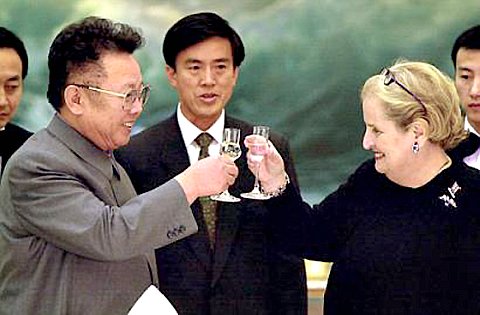
  N. Korea-Kim Jong Il & Sec of State Madeline Albright.jpg Former U.S. President Bill Clinton (R) meeting with North Korea's leader Kim Jong-il (L) in Pyongyang
It takes a certain amount of tact, patience, and experience to deal with North Korea: Jimmy Carter with Kim Il Sung, 1994 [left], Secretary of State Madeleine Albright and Kim Jong Il, 2000 [center], Bill Clinton with Kim Jong Il, 2009 [right]. Trump misses out on all three requirements.

Today, the war mongers inside the Trump administration are hankering for a military showdown with North Korea. Such brinkmanship comes at a potential deadly cost to the United States. There are over 130,000 American citizens, including military forces, living in South Korea. Most live within range of North Korean artillery, which, in the first stages of a military conflict, will rain down their shells on metropolitan Seoul.

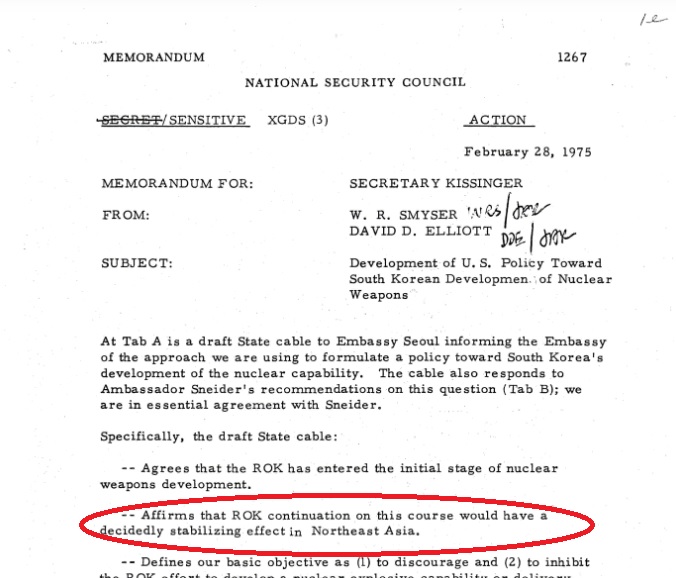
The Trump administration appears to be as befuddled and incompetent on Korea as was the Ford administration. For example, a February 28, 1975, National Security Council memo to Secretary of State Henry Kissinger, who also served as National Security Adviser, stated that South Korea's "initial stage of nuclear weapons development . . . would have a decidedly stabilizing effect in Northeast Asia," when the exact opposite was the case.

South Korea's covert nuclear weapons program under Park came to a halt in 1979 after the South Korean president was shot to death by his own KCIA chief. Although the KCIA's founding organization, the U.S. CIA, denied any role in the assassination, it was noted that the normal CIA complement of between 40 and 50 agents at the CIA station in Seoul doubled to over a 100 just prior to the assassination. Most of the agents worked out of the U.S. embassy's 5th floor, in what was called the CIA's "Research Unit."


North Korea's leader, Kim Jong Un, is an unstable character. However, he was schooled in Switzerland and is the first in three generations of Kim leaders to have lived in a Western country, becoming familiar with Western "culture," good and bad. Kim's grandfather Kim Il Sung and father Kim Jong Il were experienced Communist Party functionaries and were capable of diplomacy while not always abiding by international agreements. Kim Il Sung met in Pyongyang in 1994 with former President Jimmy Carter. Secretary of State Madeleine Albright met with Kim Jong Il in 2000 in Pyongyang, a meeting that was followed by one between Kim Jong Il and former President Bill Clinton in 2009. Kim Il Jong's sudden death in 2011, which may not have been by natural causes, ended high-level contacts between Pyongyang and Washington.

Kim Jong Un is a loose cannon, as seen with his ordering the assassination by VX nerve agent of his half-brother, Kim Jong-nam, at Kuala Lumpur International Airport. However, even a loose cannon can be lured with the dangling of lucrative "carrots." However, the Trump administration and its neanderthal thinkers like CIA director Mike Pompeo lack the gravitas to come up with a unique way to deal with Kim Jong Un without setting the Korean peninsula ablaze with a nuclear fire.

One thing is for certain. Neither China nor Russia will permit the U.S. Pacific Command to extend its territory to the Yalu River border with China or the Tumen River border with Russia. Unlike West Germany's unification with East Germany, there is no great desire among most South Koreans to absorb North Korea. An exception is the very elderly who still have relatives in the North. Therefore, any move to eliminate Kim from the scene will only have the support of China and Russia if a new North Korean regime adheres to a strict neutrality, guaranteed by all the powers in the region, including Japan and the United States.

There is likely an anti-Kim faction within the North Korean military that would move against the Kims if they were guaranteed leadership of a neutral North Korea in return for abandoning the North's nuclear weapons program. The best the U.S. can hope for is the emergence of a North Korean version of Marshal Tito, someone that will keep his country stable as a strictly neutral power in exchange for a guarantee of non-aggression from all regional powers, including the United States and a rapidly re-militarizing Japan. However, the North will need an insurance policy and that is its continued possession of short- and intermediate-range conventional missiles, not the intercontinental ballistic missiles like the one just test-fired by North Korea.

Trump considers himself the ultimate deal maker. However, given the presence of James Mattis at the Pentagon, Pompeo at the CIA, and right-wing lunatic Stephen Bannon always at Trump's side, Trump will not be able to deal with Pyongyang because he frankly lacks the intelligence and education to carry off such a feat. While "only Nixon could go to China," Trump does not have the wherewithal to navigate his way back to New York on the New Jersey Turnpike. On the issue of North Korea, a Trump White House official was anonymously quoted as saying, "The clock has now run out [on North Korea], and all options are on the table." That is not incredibly original or insightful.

Friday, December 09, 2016

Henry Kissinger's ideological "daughter": Kathleen Troia "K.T." McFarland by Wayne Madsen Report


Kissinger's ideological "daughter": Kathleen Troia "K.T." McFarland
Former Secretary of State Henry Kissinger, who has held meetings with Donald Trump since his election, will have one of his ideological "daughters," Kathleen Troia "K.T." McFarland, deeply embedded in the Trump White House as deputy national security adviser.

McFarland worked for Kissinger's National Security Council in the Nixon White House and went on to work in the Reagan administration as Defense Secretary Caspar Weinberger's speechwriter. Although Ronald Reagan did his best to keep Kissinger proteges far away from senior levels of his administration, owing to Reagan's distrust of Kissinger, "eastern elites," and the Trilateral Commission, McFarland was an exception. McFarland was a major force behind crafting Reagan's Strategic Defense Initiative ("Star Wars") propaganda.

McFarland is, so far, the highest-ranking neo-conservative to be named to the Trump administration. In addition to her Kissinger ties, McFarland is also a board member of the Central Intelligence Agency-founded Jamestown Foundation, a creation of CIA director William Casey during the early years of the Reagan administration. Jamestown formulated disastrous anti-Soviet policies, including those that nurtured anti-Soviet Muslim guerrillas, an act that led to the ultimate creation of Al Qaeda and the Taliban.

McFarland is also close to the disgraced former CIA director General Petraeus. She has been quietly pushing Petraeus for Secretary of State even though, if chosen, Petraeus would become the fourth general named by Trump to senior posts in his administration, joining retired generals Michael Flynn, James Mattis, and John Kelly.

In 2006, McFarland launched a Senate campaign against New York's then-Senator Hillary Clinton. Her GOP primary campaign self-destructed after her 16-year old daughter Camilla McFarland was arrested after shoplifting $300 worth of string bikinis and a pair of jeans from two boutique shops in Southampton, Long Island. Questions are now being asked how McFarland can be trusted with the nation's highest secrets when she could not prevent her own daughter, then-attending the elite Taft boarding school in Connecticut, from turning into a politically-embarrassing five finger-discount teenager.


Neo-cons, former Henry "Scoop" Jackson Democrats who infiltrated the Reagan administration, handed the president the worst political scandal since Watergate, the Iran-contra affair. History shows that neo-cons are poisonous to any administration that permits them to nest. Neo-cons were responsible for the disastrous U.S. invasions and occupations of Iraq and Afghanistan, a permanent stain on the administration of George W. Bush.

McFarland, Petraeus, former US ambassador to the United Nations John Bolton, Arkansas Senator Tom Cotton, neo-con policy wonk Frank Gaffney, Bolton's spokesman at the UN Richard Grenell, and others of their ilk only know how to commit mischief in the long-term neo-con goal of confronting China, Russia, Iran, Syria, Cuba, and other nations that refuse to toe the American line.

Saturday, July 05, 2014

How Washington protects itself By Noam Chomsky


How Washington protects itself
By Noam Chomsky 

The question of how foreign policy is determined is a crucial one in world affairs. In these comments, I can only provide a few hints as to how I think the subject can be productively explored, keeping to the United States for several reasons. First, the US is unmatched in its global significance and impact. Second, it is an unusually open society, possibly uniquely so, which means we know more about it. Finally, it is plainly the most important case for Americans, who are able to influence policy choices in the US - and indeed for others, insofar as their actions can influence such choices. The general principles, however, extend to the other major powers, and well beyond. 

There is a "received standard version", common to academic scholarship, government pronouncements, and public discourse. It holds that the prime commitment of governments is to ensure security, and that the primary concern of the US and its allies since 1945 was the Russian threat. 

There are a number of ways to evaluate the doctrine. One obvious question to ask is: What happened when the Russian threat disappeared in 1989? Answer: everything continued much as before. 

The US immediately invaded Panama, killing probably thousands of people and installing a client regime. This was routine practice in US-dominated domains - but in this case not quite as routine. For first time, a major foreign policy act was not justified by an alleged Russian threat. 

Instead, a series of fraudulent pretexts for the invasion were concocted that collapse instantly on examination. The media chimed in enthusiastically, lauding the magnificent achievement of defeating Panama, unconcerned that the pretexts were ludicrous, that the act itself was a radical violation of international law, and that it was bitterly condemned elsewhere, most harshly in Latin America. Also ignored was the US veto of a unanimous Security Council resolution condemning crimes by US troops during the invasion, with Britain alone abstaining. 

All routine. And all forgotten (which is also routine). 

From El Salvador to the Russian border
The administration of George H W Bush issued a new national security policy and defense budget in reaction to the collapse of the global enemy. It was pretty much the same as before, although with new pretexts. It was, it turned out, necessary to maintain a military establishment almost as great as the rest of the world combined and far more advanced in technological sophistication - but not for defense against the now-nonexistent Soviet Union. Rather, the excuse now was the growing "technological sophistication" of Third World powers. Disciplined intellectuals understood that it would have been improper to collapse in ridicule, so they maintained a proper silence. 

The US, the new programs insisted, must maintain its "defense industrial base". The phrase is a euphemism, referring to high-tech industry generally, which relies heavily on extensive state intervention for research and development, often under Pentagon cover, in what economists continue to call the US "free-market economy". 

One of the most interesting provisions of the new plans had to do with the Middle East. There, it was declared, Washington must maintain intervention forces targeting a crucial region where the major problems "could not have been laid at the Kremlin's door". Contrary to 50 years of deceit, it was quietly conceded that the main concern was not the Russians, but rather what is called "radical nationalism", meaning independent nationalism not under US control. 

All of this has evident bearing on the standard version, but it passed unnoticed - or perhaps, therefore it passed unnoticed. 

Other important events took place immediately after the fall of the Berlin Wall, ending the Cold War. One was in El Salvador, the leading recipient of US military aid - apart from Israel-Egypt, a separate category - and with one of the worst human rights records anywhere. That is a familiar and very close correlation. 

The Salvadoran high command ordered the Atlacatl Brigade to invade the Jesuit University and murder six leading Latin American intellectuals, all Jesuit priests, including the rector, Fr. Ignacio Ellacuria, and any witnesses, meaning their housekeeper and her daughter. The Brigade had just returned from advanced counterinsurgency training at the US Army John F Kennedy Special Warfare Center and School in Fort Bragg, North Carolina, and had already left a bloody trail of thousands of the usual victims in the course of the US-run state terror campaign in El Salvador, one part of a broader terror and torture campaign throughout the region. All routine. Ignored and virtually forgotten in the United States and by its allies, again routine. But it tells us a lot about the factors that drive policy, if we care to look at the real world. 

Another important event took place in Europe. Soviet president Mikhail Gorbachev agreed to allow the unification of Germany and its membership in NATO, a hostile military alliance. In the light of recent history, this was a most astonishing concession. There was a quid pro quo. President Bush and Secretary of State James Baker agreed that NATO would not expand "one inch to the East", meaning into East Germany. Instantly, they expanded NATO to East Germany. 

Gorbachev was naturally outraged, but when he complained, he was instructed by Washington that this had only been a verbal promise, a gentleman's agreement, hence without force. If he was na?ve enough to accept the word of American leaders, it was his problem. 

All of this, too, was routine, as was the silent acceptance and approval of the expansion of NATO in the US and the West generally. President Bill Clinton then expanded NATO further, right up to Russia's borders. Today, the world faces a serious crisis that is in no small measure a result of these policies. 

The appeal of plundering the poor
Another source of evidence is the declassified historical record. It contains revealing accounts of the actual motives of state policy. The story is rich and complex, but a few persistent themes play a dominant role. One was articulated clearly at a western hemispheric conference called by the US in Mexico in February 1945 where Washington imposed "An Economic Charter of the Americas" designed to eliminate economic nationalism "in all its forms". There was one unspoken condition. Economic nationalism would be fine for the US whose economy relies heavily on massive state intervention. 

The elimination of economic nationalism for others stood in sharp conflict with the Latin American stand of that moment, which State Department officials described as "the philosophy of the New Nationalism [that] embraces policies designed to bring about a broader distribution of wealth and to raise the standard of living of the masses". As US policy analysts added, "Latin Americans are convinced that the first beneficiaries of the development of a country's resources should be the people of that country". 

That, of course, will not do. Washington understands that the "first beneficiaries" should be US investors, while Latin America fulfills its service function. It should not, as both the Truman and Eisenhower administrations would make clear, undergo "excessive industrial development" that might infringe on US interests. Thus Brazil could produce low-quality steel that US corporations did not want to bother with, but it would be "excessive", were it to compete with US firms. 

Similar concerns resonate throughout the post-World War II period. The global system that was to be dominated by the US was threatened by what internal documents call "radical and nationalistic regimes" that respond to popular pressures for independent development. That was the concern that motivated the overthrow of the parliamentary governments of Iran and Guatemala in 1953 and 1954, as well as numerous others. In the case of Iran, a major concern was the potential impact of Iranian independence on Egypt, then in turmoil over British colonial practice. In Guatemala, apart from the crime of the new democracy in empowering the peasant majority and infringing on possessions of the United Fruit Company - already offensive enough - Washington's concern was labor unrest and popular mobilization in neighboring US-backed dictatorships. 

In both cases the consequences reach to the present. Literally not a day has passed since 1953 when the US has not been torturing the people of Iran. Guatemala remains one of the world's worst horror chambers. To this day, Mayans are fleeing from the effects of near-genocidal government military campaigns in the highlands backed by President Ronald Reagan and his top officials. As the country director of Oxfam, a Guatemalan doctor, reported recently, 

"There is a dramatic deterioration of the political, social, and economic context. Attacks against Human Rights defenders have increased 300% during the last year. There is a clear evidence of a very well organized strategy by the private sector and Army. Both have captured the government in order to keep the status quo and to impose the extraction economic model, pushing away dramatically indigenous peoples from their own land, due to the mining industry, African Palm and sugar cane plantations. In addition the social movement defending their land and rights has been criminalized, many leaders are in jail, and many others have been killed". 

Nothing is known about this in the United States and the very obvious cause of it remains suppressed. 

In the 1950s, President Eisenhower and Secretary of State John Foster Dulles explained quite clearly the dilemma that the US faced. They complained that the Communists had an unfair advantage. They were able to "appeal directly to the masses" and "get control of mass movements, something we have no capacity to duplicate. The poor people are the ones they appeal to and they have always wanted to plunder the rich". 

That causes problems. The US somehow finds it difficult to appeal to the poor with its doctrine that the rich should plunder the poor. 

The Cuban example
A clear illustration of the general pattern was Cuba, when it finally gained independence in 1959. Within months, military attacks on the island began. Shortly after, the Eisenhower administration made a secret decision to overthrow the government. John F Kennedy then became president. He intended to devote more attention to Latin America and so, on taking office, he created a study group to develop policies headed by the historian Arthur Schlesinger, who summarized its conclusions for the incoming president. 

As Schlesinger explained, threatening in an independent Cuba was "the Castro idea of taking matters into one's own hands". It was an idea that unfortunately appealed to the mass of the population in Latin America where "the distribution of land and other forms of national wealth greatly favors the propertied classes, and the poor and underprivileged, stimulated by the example of the Cuban revolution, are now demanding opportunities for a decent living". Again, Washington's usual dilemma. 

As the CIA explained, "The extensive influence of 'Castroism' is not a function of Cuban power... Castro's shadow looms large because social and economic conditions throughout Latin America invite opposition to ruling authority and encourage agitation for radical change", for which his Cuba provides a model. Kennedy feared that Russian aid might make Cuba a "showcase" for development, giving the Soviets the upper hand throughout Latin America. 

The State Department Policy Planning Council warned that "the primary danger we face in Castro is... in the impact the very existence of his regime has upon the leftist movement in many Latin American countries… The simple fact is that Castro represents a successful defiance of the US, a negation of our whole hemispheric policy of almost a century and a half" - that is, since the Monroe Doctrine of 1823, when the US declared its intention of dominating the hemisphere. 

The immediate goal at the time was to conquer Cuba, but that could not be achieved because of the power of the British enemy. Still, that grand strategist John Quincy Adams, the intellectual father of the Monroe Doctrine and Manifest Destiny, informed his colleagues that over time Cuba would fall into our hands by "the laws of political gravitation", as an apple falls from the tree. In brief, US power would increase and Britain's would decline. 

In 1898, Adams's prognosis was realized. The US invaded Cuba in the guise of liberating it. In fact, it prevented the island's liberation from Spain and turned it into a "virtual colony" to quote historians Ernest May and Philip Zelikow. Cuba remained so until January 1959, when it gained independence. Since that time it has been subjected to major US terrorist wars, primarily during the Kennedy years, and economic strangulation. Not because of the Russians. 

The pretense all along was that we were defending ourselves from the Russian threat - an absurd explanation that generally went unchallenged. A simple test of the thesis is what happened when any conceivable Russian threat disappeared. US policy toward Cuba became even harsher, spearheaded by liberal Democrats, including Bill Clinton, who outflanked Bush from the right in the 1992 election. On the face of it, these events should have considerable bearing on the validity of the doctrinal framework for discussion of foreign policy and the factors that drive it. Once again, however, the impact was slight. 

The virus of nationalism
To borrow Henry Kissinger's terminology, independent nationalism is a "virus" that might "spread contagion". Kissinger was referring to Salvador Allende's Chile. The virus was the idea that there might be a parliamentary path towards some kind of socialist democracy. The way to deal with such a threat is to destroy the virus and to inoculate those who might be infected, typically by imposing murderous national security states. That was achieved in the case of Chile, but it is important to recognize that the thinking holds worldwide. 

It was, for example, the reasoning behind the decision to oppose Vietnamese nationalism in the early 1950s and support France's effort to reconquer its former colony. It was feared that independent Vietnamese nationalism might be a virus that would spread contagion to the surrounding regions, including resource-rich Indonesia. That might even have led Japan - called the "superdomino" by Asia scholar John Dower - to become the industrial and commercial center of an independent new order of the kind imperial Japan had so recently fought to establish. That, in turn, would have meant that the US had lost the Pacific war, not an option to be considered in 1950. The remedy was clear - and largely achieved. Vietnam was virtually destroyed and ringed by military dictatorships that kept the "virus" from spreading contagion. 

In retrospect, Kennedy-Johnson National Security Adviser McGeorge Bundy reflected that Washington should have ended the Vietnam War in 1965, when the Suharto dictatorship was installed in Indonesia, with enormous massacres that the CIA compared to the crimes of Hitler, Stalin, and Mao. These were, however, greeted with unconstrained euphoria in the US and the West generally because the "staggering bloodbath", as the press cheerfully described it, ended any threat of contagion and opened Indonesia's rich resources to western exploitation. After that, the war to destroy Vietnam was superfluous, as Bundy recognized in retrospect. 

The same was true in Latin America in the same years: one virus after another was viciously attacked and either destroyed or weakened to the point of bare survival. From the early 1960s, a plague of repression was imposed on the continent that had no precedent in the violent history of the hemisphere, extending to Central America in the 1980s under Ronald Reagan, a matter that there should be no need to review. 

Much the same was true in the Middle East. The unique US relations with Israel were established in their current form in 1967, when Israel delivered a smashing blow to Egypt, the center of secular Arab nationalism. By doing so, it protected US ally Saudi Arabia, then engaged in military conflict with Egypt in Yemen. Saudi Arabia, of course, is the most extreme radical fundamentalist Islamic state, and also a missionary state, expending huge sums to establish its Wahhabi-Salafi doctrines beyond its borders. It is worth remembering that the US, like England before it, has tended to support radical fundamentalist Islam in opposition to secular nationalism, which has usually been perceived as posing more of a threat of independence and contagion. 

The value of secrecy
There is much more to say, but the historical record demonstrates very clearly that the standard doctrine has little merit. Security in the normal sense is not a prominent factor in policy formation. 

To repeat, in the normal sense. But in evaluating the standard doctrine we have to ask what is actually meant by "security": security for whom? 

One answer is: security for state power. There are many illustrations. Take a current one. In May, the US agreed to support a UN Security Council resolution calling on the International Criminal Court to investigate war crimes in Syria, but with a proviso: there could be no inquiry into possible war crimes by Israel. Or by Washington, though it was really unnecessary to add that last condition. The US is uniquely self-immunized from the international legal system. In fact, there is even congressional legislation authorizing the president to use armed force to "rescue" any American brought to the Hague for trial - the "Netherlands Invasion Act", as it is sometimes called in Europe. That once again illustrates the importance of protecting the security of state power. 

But protecting it from whom? There is, in fact, a strong case to be made that a prime concern of government is the security of state power from the population. As those who have spent time rummaging through archives should be aware, government secrecy is rarely motivated by a genuine need for security, but it definitely does serve to keep the population in the dark. And for good reasons, which were lucidly explained by the prominent liberal scholar and government adviser Samuel Huntington, the professor of the science of government at Harvard University. In his words: "The architects of power in the United States must create a force that can be felt but not seen. Power remains strong when it remains in the dark; exposed to the sunlight it begins to evaporate". 

He wrote that in 1981, when the Cold War was again heating up, and he explained further that "you may have to sell [intervention or other military action] in such a way as to create the misimpression that it is the Soviet Union that you are fighting. That is what the United States has been doing ever since the Truman Doctrine". 

These simple truths are rarely acknowledged, but they provide insight into state power and policy, with reverberations to the present moment. 

State power has to be protected from its domestic enemy; in sharp contrast, the population is not secure from state power. A striking current illustration is the radical attack on the Constitution by the Obama administration's massive surveillance program. It is, of course, justified by "national security". That is routine for virtually all actions of all states and so carries little information. 

When the NSA's surveillance program was exposed by Edward Snowden's revelations, high officials claimed that it had prevented 54 terrorist acts. On inquiry, that was whittled down to a dozen. A high-level government panel then discovered that there was actually only one case: someone had sent $8,500 to Somalia. That was the total yield of the huge assault on the Constitution and, of course, on others throughout the world. 

Britain's attitude is interesting. In 2007, the British government called on Washington's colossal spy agency "to analyze and retain any British citizens' mobile phone and fax numbers, emails, and IP addresses swept up by its dragnet", the Guardian reported. That is a useful indication of the relative significance, in government eyes, of the privacy of its own citizens and of Washington's demands. 

Another concern is security for private power. One current illustration is the huge trade agreements now being negotiated, the Trans-Pacific and Trans-Atlantic pacts. These are being negotiated in secret - but not completely in secret. They are not secret from the hundreds of corporate lawyers who are drawing up the detailed provisions. It is not hard to guess what the results will be, and the few leaks about them suggest that the expectations are accurate. Like NAFTA and other such pacts, these are not free trade agreements. In fact, they are not even trade agreements, but primarily investor rights agreements. 

Again, secrecy is critically important to protect the primary domestic constituency of the governments involved, the corporate sector. 

The final century of human civilization?
There are other examples too numerous to mention, facts that are well-established and would be taught in elementary schools in free societies. 

There is, in other words, ample evidence that securing state power from the domestic population and securing concentrated private power are driving forces in policy formation. Of course, it is not quite that simple. There are interesting cases, some quite current, where these commitments conflict, but consider this a good first approximation and radically opposed to the received standard doctrine. 

Let us turn to another question: What about the security of the population? It is easy to demonstrate that this is a marginal concern of policy planners. Take two prominent current examples, global warming and nuclear weapons. As any literate person is doubtless aware, these are dire threats to the security of the population. Turning to state policy, we find that it is committed to accelerating each of those threats - in the interests of the primary concerns, protection of state power and of the concentrated private power that largely determines state policy. 

Consider global warming. There is now much exuberance in the United States about "100 years of energy independence" as we become "the Saudi Arabia of the next century" - perhaps the final century of human civilization if current policies persist. 

That illustrates very clearly the nature of the concern for security, certainly not for the population. It also illustrates the moral calculus of contemporary Anglo-American state capitalism: the fate of our grandchildren counts as nothing when compared with the imperative of higher profits tomorrow. 

These conclusions are fortified by a closer look at the propaganda system. There is a huge public relations campaign in the US, organized quite openly by Big Energy and the business world, to try to convince the public that global warming is either unreal or not a result of human activity. And it has had some impact. The US ranks lower than other countries in public concern about global warming and the results are stratified: among Republicans, the party more fully dedicated to the interests of wealth and corporate power, it ranks far lower than the global norm. 

The current issue of the premier journal of media criticism, the Columbia Journalism Review, has an interesting article on this subject, attributing this outcome to the media doctrine of "fair and balanced". In other words, if a journal publishes an opinion piece reflecting the conclusions of 97% of scientists, it must also run a counter-piece expressing the viewpoint of the energy corporations. 

That indeed is what happens, but there certainly is no "fair and balanced" doctrine. Thus, if a journal runs an opinion piece denouncing Russian President Vladimir Putin for the criminal act of taking over the Crimea, it surely does not have to run a piece pointing out that, while the act is indeed criminal, Russia has a far stronger case today than the US did more than a century ago in taking over southeastern Cuba, including the country's major port - and rejecting the Cuban demand since independence to have it returned. And the same is true of many other cases. The actual media doctrine is "fair and balanced" when the concerns of concentrated private power are involved, but surely not elsewhere. 

On the issue of nuclear weapons, the record is similarly interesting - and frightening. It reveals very clearly that, from the earliest days, the security of the population was a non-issue, and remains so. There is no time here to run through the shocking record, but there is little doubt that it strongly supports the lament of General Lee Butler, the last commander of the Strategic Air Command, which was armed with nuclear weapons. In his words, we have so far survived the nuclear age "by some combination of skill, luck, and divine intervention, and I suspect the latter in greatest proportion". And we can hardly count on continued divine intervention as policymakers play roulette with the fate of the species in pursuit of the driving factors in policy formation. 

As we are all surely aware, we now face the most ominous decisions in human history. There are many problems that must be addressed, but two are overwhelming in their significance: environmental destruction and nuclear war. For the first time in history, we face the possibility of destroying the prospects for decent existence - and not in the distant future. For this reason alone, it is imperative to sweep away the ideological clouds and face honestly and realistically the question of how policy decisions are made, and what we can do to alter them before it is too late. 

Noam Chomsky is Institute Professor emeritus in the Department of Linguistics and Philosophy at Massachusetts Institute of Technology. Among his recent books are Hegemony or SurvivalFailed StatesPower SystemsOccupy, and Hopes and Prospects. His latest book, Masters of Mankind, will be published soon by Haymarket Books, which is also reissuing twelve of his classic books in new editions over the coming year. His website is www.chomsky.info. 

Follow TomDispatch on Twitter and join us on Facebook andTumblr. Check out the newest Dispatch Book, Rebecca Solnit'sMen Explain Things to Me. 

(Copyright 2014 Noam Chomsky) 

Tuesday, February 18, 2014

THE ROVING EYE Iran's real 'nuclear' revolution By Pepe Escobar


THE ROVING EYE
Iran's real 'nuclear' revolution
By Pepe Escobar

The nuclear talks between Iran and the P5+1 (the five permanent members of the UN Security Council plus Germany) are back this Tuesday in Vienna. The stakes couldn't be higher. It will be a long and winding road. Hidden agendas on both sides badly want the talks to fail - and will spare no effort towards that goal.

Supreme Leader Ayatollah Khamenei could be interpreted as a stony realist, when he said that the talks will go nowhere. It's as if the Supreme Leader had read Manufactured Crisis: The Untold Story of the Iran Nuclear Scare, a crucial book by Martha Gellhorn Prize winner Gareth Porter which is being launched today in New York. In the book, Porter thoroughly debunks the whole narrative of the Iran nuclear dossier as sold to the world by the George W Bush administration, assorted neo-cons and the Israeli Likud.

And it gets much worse, in terms of prospects for a final deal to be reached this year. According to Porter, "the Obama administration has introduced the subject of 'possible military dimensions' into the nuclear negotiations. That means that the United States will be demanding an explanation for 'evidence' that the book shows was fabricated. That is a decision that could threaten the conclusion of a final agreement with Iran."

Meanwhile, on Tuesday last week, millions of people hit the streets in Tehran in a massive rally celebrating the 35 years of the Islamic revolution. How come?

For all its economic mismanagement, Iran's illiteracy rate has been reduced to near zero. Women are active, participative voters (try even raising the issue in the House of Saud's paradise). There has been remarkable scientific progress, even under harsh sanctions. Pursuing a civilian nuclear program is a matter of national consensus.

This piece - significantly, published by al-Arabiya, which is controlled by the House of Saud - at least tries not to sound entirely as cheap Arab propaganda, making a valid point about the real threat for the Islamic revolution coming from disaffected youth across Iran.

Yet this is not the key point. The Islamic republic won't disintegrate tomorrow. What's much more crucial is to revisit the key reasons why the revolution happened 35 years ago, and why, when it comes to Iranian geopolitical independence, it remains somewhat popular.

That may also shed light on why the West - and especially the United States - still refuses to normalize its relations with Iran. After all, what happened 35 years ago in Iran was never properly understood in the US in the first place. In geopolitical terms, this was the real "nuclear" revolution - one of the most far-reaching developments of what Eric Hobsbawm defined as "the short 20th century".

And perhaps this is what the Supreme Leader meant about the talks going nowhere; certainly the case as long as Washington, especially, refuses to abandon the reductionism of Iran as a bunch of fanatics.

That Kissinger oil shock 
As early as the presidency of Harry Truman, the US supported the Shah of Iran's dictatorship, no holds barred. No wonder those days are sorely missed.

In 1953, after the CIA coup against Mohammad Mossadegh, the Shah - who lived mostly in the French Riviera - was "invited" to rule as a CIA puppet (John F Kennedy had met him in wild parties in the French Riviera and found him to be a dangerous megalomaniac). In return for re-establishing British "rights" to Persian oil, Washington self-attributed 55% for the concessions and the Brits got the rest.

The CIA trained the Savak - the Shah's secret police. It was the best of times. The Shah not only excelled in his role of gendarme of political/economic US interests in the Persian Gulf; as he did not share Arab hatred of Israel, Tel Aviv had access to Persian oil (that ended after Ayatollah Ruhollah Khomeini seized power).

The Shah ruthlessly suppressed and persecuted every political party in Iran and even massacred Kurds (Saddam Hussein was taking notes.) He started to take his own propaganda seriously, including believing in the myth of being a new King of Kings. He became the number one cheerleader of the 1973 OPEC oil shock, to which he got the green light from none other than Henry Kissinger.

In a nutshell, this was a follow-up of the 1972 "Nixon doctrine", when it became clear the US defeat in Vietnam was all but a done deal. That's when Tricky Dicky started to promote gatekeepers all over the "free world". And no region was more crucial than the Persian Gulf.

The Shah loved it. But he was always complaining that he didn't have enough dough to buy all those weapons the industrial-military complex was offering him. So Kissinger - a David Rockefeller errand boy - squared the circle, with the rise of oil prices by Organization of the Petroleum Exporting Countries, or OPEC.

With this move, Kissinger instantly inflated the profits of US Big Oil - which at the time accounted for five of the Seven Sisters, and crucially boasted three that were Rockefeller-owned (Exxon, Mobil and Socal). At the same time, since Japan and then West Germany and the rest of Western Europe depended on Persian Gulf oil much more than the US did, Kissinger devised the perfect way to torpedo the devastating Japanese and German industrial and trade competition.

You won't find any of this on Kissinger's turgidly ambitious tomes, or on any US corporate media files for that matter. But that explains much of the world born out of the "oil shock".

Like most US puppets - talk about hubris - the Shah never understood that he was just a puppet. His corporate multinational economic model as applied to Iran had the predictable effects; much like today (even in Europe and the US), a tiny minority consuming like there's no tomorrow and a huge majority increasingly miserable, as the Shah bet on cash crops instead of an agrarian reform to guarantee the subsistence of millions of peasants - many of them illiterate, pious Shi'ites - who had been booted out of the countryside by American agribusiness, which dismissed them as a superfluous workforce.

These miserable masses inflated Tehran and other Iranian big cities, turning into the mass base for Khomeini's revolution. And the rest is history.

Nothing is inaccessible 
Then Jimmy Carter - that hick Hamlet - when still campaigning for the presidency against Gerald Ford in 1976, admitted in a debate that the Shah was a torturer. Two years later, as president, Carter now considered him "an island of stability" and "a friend".

During the 1970s, it was "just" for Iran to carry out a nuclear program, among other motives to intimidate revolutionary Arab nationalism. Yet now, under an Islamic republic, a civilian nuclear program is an "existential threat".

The Shah's banker was David Rockefeller, never tired of extolling the "patriotism" and "tolerance" of his client, not to mention his modernizing drive - everything duly parroted by US corporate media even as Amnesty International and the State Department itself had Himalayas of documents proving the Shah was one of the top torturers of modern history. What mattered is that he brought excellent dividends for then Chase Manhattan.

One never lost money underestimating the cluelessness of US corporate media. When the Islamic revolution started, US media as a whole told the world that the Shah was undefeatable; that Khomeini and his followers were a minority of religious fanatics; and that the real motive for the revolution was that the Shah was a Great Modernizer (the Rockefeller script), rejected by those same Muslim fanatics. It's fair to say this script is still being peddled today.

When the Shah fled Iran, the whole US media bought the fallacy of "going for a holiday". When Khomeini boarded that Air France flight from Paris and arrived in Tehran in absolute triumph, no wonder no one in the US had a clue what was going on. US media preferred to mock Khomeini's "fanaticism" - which at the time paled compared with Pope John Paul II, who considered women to be an inferior species.

The Iranian bourgeoisie - modern, social democrat, inheriting the political line of Mossadegh - managed to drive a lot of support from progressives in Europe. At a time when Le Monde was still a very good newspaper and not the sub-American trash it is today, one just needed to read the dispatches by ace correspondent Eric Rouleau to confirm it.

Khomeini, for his part, had the charisma (and that spectral voice on cassette tapes), supported by the only political organization tolerated by the Shah, the roughly 160,000 mullahs, who duly mobilized those wretched masses rendered useless by American agribusiness interests.

Yet, from the beginning, Khomeini negotiated with the bourgeoisie - as when he named Mehdi Bazargan as prime minister and Bani Sadr as president (a socialist and a Western-style modernizer). Only when the Shah system was totally eradicated did Khomeini go into overdrive to purge everyone but his religious followers - recreating, on a smaller scale, the Shah's inferno, but in the name of Allah. Well, as Mao said, no revolution is a dinner party.

As for Jimmy "Hamlet" Carter, he never officially recognized Khomeini as the Iranian leader. Washington didn't even try to talk to him. A whiff of geopolitical intelligence would have the Americans trying to share some tea when he was still exiled in Paris. But David Rockefeller and his parrot Kissinger would scream, so a cowed Carter retreated into his shell. After the Islamic revolution, Washington never returned the estimated US$60 billion the Shah, family and cronies stole from Iran.

This catalogue of disinformation during the 1970s and 1980s is now mirrored by the disinformation of all these past few years about the Iranian nuclear program. No wonder most Americans - and plenty of Europeans - remain clueless.

When Khomeini died - and I vividly remember every newspaper in Europe on June 5, 1989, sharing the front page between that and Deng Xiaoping ordering the Tiananmen massacre - the great philosopher Daryush Shayegan, a former professor at the University of Tehran, published a superb article in Liberation explaining the Big Picture, from the Shah's "legacy" to Khomeini.

Shayegan wrote that both men, the Shah and the Imam, committed the same fatal mistakes and "incarnated, each their own way, two typically Iranian traits: cultural schizophrenia and the dream of grandeur". So the whole drama was about two juxtaposed Irans: Imperial Iran and "the suffering Iran of the blood of the Martyr". Both expressed an impossible dream and, "like the 12th century mystical poet Ruzbehan from Shiraz would say, the same 'dementia of the inaccessible'."

Today, 35 years after the Islamic revolution, what Iranians seek is hardly inaccessible: the end of Western sanctions and the end of sections of the West perennially treating the country as a bunch of religious "fanatics".

Russia, China, Turkey, Pakistan, other Asian nations, all Latin American nations, all African nations, all treat Iran as normal. Beyond the clash of "heroic flexibility" against American exceptionalism, if only the US establishment would finally get over it, and deal - realistically - with what happened in Tehran 35 years ago. Only then these talks in Vienna will go somewhere, and we may have a final nuclear deal in 2014.

Pepe Escobar is the author of Globalistan: How the Globalized World is Dissolving into Liquid War (Nimble Books, 2007), Red Zone Blues: a snapshot of Baghdad during the surge (Nimble Books, 2007), and Obama does Globalistan (Nimble Books, 2009).

He may be reached at pepeasia@yahoo.com.
 

Thursday, January 14, 2010

Yemen, Energy Crisis, & the Nigerian Crotch Bomber: The Privatization of Security & the Militarization of Society-Part II


Yemen and the Kissinger-Brzezinski Eurasian Plan

Spectre of Serial War

Security agencies are now focusing their sights on a whole set of countries deemed to be at-risk. According to a leaked confidential memo, people from these countries will be profiled and targeted for “additional screening” at airports. In the words of one US commentator for the Philadelphia Inquirer:

“… most frightening to me was that while the leaked document deemed that holders of passports from Cuba, Iran, North Korea, Libya, Syria, Sudan, Afghanistan, Lebanon, Somalia, Iraq, Yemen, and Algeria should be subjected to additional screening, no such special attention was given to holders of passports from Saudi Arabia – the home of 15 of the 9/11 hijackers. And now it’s worth noting that the list doesn’t include Pakistan or Nigeria – Umar Farouk’s home – either.”

The decision to widen the “screening” of travellers to encompass this vast array of countries deemed to be countries of particular threat to the West fits well within the original logic of the pre-9/11 geostrategy that has now become the ‘War on Terror’.

Hints of this geostrategy surfaced from disparate sources, such as former NATO Commander General Wesley Clarke, who wrote in his book Winning Modern Wars:

As I went back through the Pentagon in November 2001, one of the senior military staff officers had time for a chat. Yes, we were still on track for going against Iraq, he said. But there was more. This was being discussed as part of a five-year campaign plan, he said, and there were a total of seven countries, beginning with Iraq, then Syria, Lebanon, Libya, Iran, Somalia, and Sudan.

Clarke didn’t mention Yemen. But Yemen was explicitly mentioned in an address by the infamous Richard Perle – then Chairman of the Pentagon’s Defense policy Board and former Assistant Secretary of Defence in the Reagan administration – in the same month, at the Foreign Policy Research Institute in Washington DC:

Those who think Iraq should not be next may want to think about Syria or Iran or Sudan or Yemen or Somalia or North Korea or Lebanon or the Palestinian Authority.”

Obama’s Neocons: Kissinger and Brzezinski

BzrezinskiThe escalation of US military activity in Yemen, therefore, is by no means simply a response to events of recent years, but merely the continuing extension of a wider bipartisan geostrategy that was formulated not only by people largely associated with Republican neocons, but also by arch-Democrats, such as former US Secretary of State Henry Kissinger and former National Security Adviser to President Carter, Zbigniew Brzezinski. During the 1970s Middle East oil crisis, Kissinger secretly advocated that the US military might have to intervene to directly and permanently occupy the oil-producing Gulf States to prevent future volatility in US energy security. Four years before 9/11, in his study published by the Council on Foreign Relations, Brzezinski outlined in unnerving detail the contours of what the Bush, and now the Obama, administration, have pursued in the context of the ‘War on Terror’: a plan to dominate “Eurasia” – the landmass comprising the continents of Europe and Asia, at the juncture of which lies the Middle East:

“… how America ‘manages’ Eurasia is critical… A power that dominates Eurasia would control two of the world’s three most advanced and economically productive regions. A mere glance at the map also suggests that control over Eurasia would almost automatically entail Africa’s subordination, rendering the Western Hemisphere and Oceania geopolitically peripheral to the world’s central continent. About 75 per cent of the world’s people live in Eurasia, and most of the world’s physical wealth is there as well, both in its enterprises and underneath its soil. Eurasia accounts for 60 per cent of the world’s GNP and about three-fourths of the world’s known energy resources.”

“Two basic steps are thus required: first, to identify the geostrategically dynamic Eurasian states that have the power to cause a potentially important shift in the international distribution of power and to decipher the central external goals of their respective political elites and the likely consequences of their seeking to attain them;… second, to formulate specific U.S. policies to offset, co-opt, and/or control the above…”

KissingerDemocratic neocons Kissinger and Brzezinski continue to play a key role in Obama’s foreign and security policies, particularly in… (drum roll)… Eurasia! (Eureka? – no, way too easy) In December 2008 before Obama’s foreign policy team was even fully formed, the incoming President dispatched Kissinger to Moscow to meet Putin and president Medvedev. Kissinger re-visited Russia in March 2009, this time joined by a whole cohort of former senior US administration officials, just two weeks before the Medvedev-Obama summit in London. Although the White House insisted this was a purely private affair, it was obvious that his visit was part of normal ‘Track Two’ diplomacy. Brzezinski is also playing a behind-the-scenes advisory role to Obama, on Russia and NATO, as well as on issues in the Middle East including Iran and the Israeli-Palestinian conflict.

Just how key their role is, is a matter for debate. While Brzezinski has acted as Obama’s senior foreign policy advisor, Kissinger purportedly has no ‘official’ position. Or has he? “As the most recent National Security Advisor of the United States,” declared Obama’s National Security Advisor General Jim Jones at the 45th Munich Conference, “I take my daily orders from Dr. Kissinger, filtered down through Generaal [sic] Brent Scowcroft and Sandy Berger, who is also here. We have a chain of command in the National Security Council that exists today.”

Say what??

I think my role today is a little bit different than you might expect”, he added.

No kidding.

Profiling

US and UK governments are also exploring the prospect of profiling passengers on the basis of race, age and gender. While that is not to endorse profiling of any kind as a meaningful and viable security procedure, the Philadelphia Inquirer’s observation is worth noting – if profiling is going ahead, why is it avoiding US client states like Saudi Arabia and Pakistan, among others?

Curiously enough, Wesley Clarke put the case very well seven years ago:

And what about the real sources of terrorists – U.S. allies in the region like Egypt, Pakistan, and Saudi Arabia? Wasn’t it the repressive policies of the first, and the corruption and poverty of the second, that were generating many of the angry young men who became terrorists? And what of the radical ideology and direct funding spewing from Saudi Arabia? Wasn’t that what was holding the radical Islamic movement together?

It is more complicated than Clarke makes out, but he makes a valid point. Why are known state-sponsors of Islamist terrorism being ignored? The question, of course, brings up the wider issue – what exactly is Yemen’s relation to the pre-9/11 bipartisan geostrategy that is currently playing out at the hands of the Obama administration?

Militarization of Geopolitical Energy Choke-Points

A glimpse of the answer to this question actually arrived one day before the foiled attack from Associated Press:

“The Pentagon recently confirmed it has poured nearly $70 million in military aid into Yemen this year–compared with none in 2008. The U.S. military has boosted its counterterrorism training for Yemeni forces and is providing more intelligence, according to U.S. officials and analysts. The result appears to be a sharp escalation in Yemen’s campaign against al-Qaida, which previously amounted to scattered raids against militants, mixed with tolerance of some fighters who made vague promises they would avoid terrorist activity….

“Yemen’s government, which has little control outside the capital, has been distracted by other internal problems. It is fighting a fierce war against Shiite rebels who rose up near the Saudi border, and Saudi forces have gotten involved, battling rebels who have crossed into its territory. The government is also struggling with a secessionist movement in the once-independent south and trying to deal with rampant poverty…

“The central government’s lack of control of areas outside Yemen’s capital – places where many angry tribes are willing to take in al-Qaeda militants – have raised U.S. fears that the beleaguered nation could collapse into chaos. Yemen not only lies next to Saudi Arabia and near the oil-rich nations of the Persian Gulf, it overlooks vital sea routes in the Red Sea and Gulf of Aden.”

YemenCouple of key points become obvious from this. The last year, 2009, has seen a sudden massive, unprecedented escalation in US military intelligence activity in Yemen. The Abdulmutallab incident has only intensified and legitimized this activity. The US and Britain are moving to operate a joint “counter-terrorism police unit in Yemen along with more support for the Yemeni coastguard”, while also “pushing for more UN intervention to tackle the emerging terrorist threat in Somalia.” So there is a question of chronology – why now? Then the geopolitics – the US-UK presence in Yemen puts their military forces right on the cusp of the Horn of Africa, poised for intensified force projection in Africa, with a focus on fighting off Somali piracy. The region between Yemen and Somalia is where we find the Bab el-Mandab, the closure of which according to the US Energy Information Administration:

“… could keep tankers from the Persian Gulf from reaching the Suez Canal/Sumed pipeline complex, diverting them around the southern tip of Africa. The Strait of Bab el-Mandab is a chokepoint between the horn of Africa and the Middle East, and a strategic link between the Mediterranean Sea and Indian Ocean. It is located between Yemen, Djibouti, and Eritrea, and connects the Red Sea with the Gulf of Aden and the Arabian Sea. Exports from the Persian Gulf must pass through Bab el-Mandab before entering the Suez Canal. In 2006, an estimated 3.3 million bbl/d flowed through this waterway toward Europe, the United States, and Asia. The majority of traffic, around 2.1 million bbl/d, flows northbound through the Bab el-Mandab to the Suez/Sumed complex.”

Energy Crisis – US Corporate Loss

ExxonThere are various problems. Yemeni oil production has peaked, declining from 450,000 barrels per day in 2003 to 280,000 in early 2009. This has led to drastic decline in Yemen’s oil exports by around half – expected to decline to zero in about 10 years. During this period, the Yemen government has attempted increasingly to gain control over domestic oil production projects. As of 2005, a dispute broke out between two major US oil companies, Hunt Oil and ExxonMobil, and the Yemen government, over production of “Block 18”. “Natural gas reserves from Marib Block 18 and other fields located in the vicinity have been dedicated to the project, which will require approximately 1 billion cubic feet of gas per day to produce 6.7 million tonnes of LNG per annum”, reads Hunt Oil’s website on its Yemen projects. The existing gas production facilities in Marib Block 18 currently have a capacity of 3.2 billion cubic feet per day… The LNG will be shipped to markets in the U.S. and Korea.”

Through the Yemen Exploration and Production Company (YEPC), Hunt and Exxon have produced oil in Block 18 for 20 years since 1982. They say that this period was extended for five years in an agreement signed by the Yemen government and YEPC in January 2004, and beginning in November 2005. But Yemen would have none of it, reports Gulf Oil & Gas:

“Since November 15, 2005, the Government of Yemen has taken numerous actions to prevent YEPC from exercising its duties as operator of Block 18 in breach of the various legally executed and binding agreements signed in 2004. This is without precedent in Yemen. Further, Yemen has attempted to replace YEPC in the Marib Block with a government-owned company, Safer Exploration and Production Operations Company (‘SEPOC’)”

Hunt and Exxon responded by filing for arbitration with the International Chamber of Commerce in Paris. The outcome of this was announced in late November 2008 – and it didn’t look good for Big Oil. “… the outcome has ensured that the Yemeni state retains earnings from a disputed production block from 2005 to date”, reported Arabian Oil & Gas, “a ruling worth billions of dollars to the oil-revenue dependent state.” Clearly, Yemen’s insistence on maximising its control over gas revenues is partly a response to its rapidly plummeting revenues from oil exports.

The following year, 2009, saw an escalating deterioration of conditions inside Yemen, with intensifying and proliferating clashes between Yemeni security forces, al-Qaeda insurgents and Shi’ite rebels. Thus Yemen’s own oil and gas energy resources, its geostrategic position in relation to Gulf energy and North African energy supplies, and its escalating domestic energy crisis, have played a critical role in the deepening of US military involvement in Yemen under Obama from early 2009 – now escalating in the aftermath of the crotch-bombing incident.

# # # #

AhmedDr. Nafeez Ahmed is a bestselling author and political analyst. He is the Executive Director of the Institute for Policy Research & Development, and has taught courses in contemporary history and international relations theory at the University of Sussex. His Doctoral thesis investigated the radicalization processes and dynamics of violent conflict in the context of hierarchical social systems in the modern world. Dr. Ahmed has also published extensively on international security issues, including The London Bombings; The War on Truth; Behind the War on Terror; and The War on Freedom. He has been an expert commentator for BBC News 24, BBC World Today, Al-Jazeera English, among others. He is currently advising the Royal Military Academy Sandhurst on engaging British Muslim communities. Visit Dr. Nafeez’ website.