
SPECIAL REPORT. Ebola is just another product of 1972 treaty violations
The first outbreak of the deadly Ebola hemorrhagic fever was recorded on July 27, 1976 in the southern Sudan. The first victim of the disease suffered from the Sudan strain of the virus. The man, who worked at the Nzara Cotton Manufacturing Factory in the Sudanese town of Nzara, was dead ten days later. The outbreak quickly spread to the town of Maridi, where hapless villagers struck by the virus went because it was the location of the nearest hospital. Infections were also reported in Juba and Tembura. In 1976, southern Sudan was the scene of a guerrilla-led civil war that pitted black southern Sudanese against the largely Arab central government in Khartoum. In 2011, after the long civil war, one in which the CIA and Mossad supported the South Sudanese against Khartoum, the Republic of South Sudan declared its independence.
In 1976, Zaire was being used as a base for an illegal CIA war against the Marxist-led government of Angola. The 1976 Clark Amendment to the Arms Control Act, authored by Senator Dick Clark (D-IA) and passed by the Senate, forbid the U.S. government from aiding any sides in the Angolan civil war. CIA director George Bush merely ignored the act and provided covert assistance to right-wing Angolan guerrillas in a total violation of the law.
Just as the CIA did with the House of Representatives Boland Amendment forbidding any U.S. government involvement in the Nicaraguan civil war, the CIA merely ignored the law and began supporting the anti-Marxist guerrillas, including UNITA guerrillas led by Jonas Savimbi, in Angola. Assistance to the guerrillas was provided through Zaire, then run by CIA client-dictator Mobutu Sese Seko. U.S. mercenaries fighting on behalf of the minority white government of Rhodesia reportedly helped the Salisbury regime of Prime Minister Ian Smith develop bio-warfare agents, including anthrax, to use against black nationalist guerrillas. Some of these bio-warfare weapons were also transferred to CIA-backed rebels in Angola from both Rhodesia and Zaire.
After the anthrax attacks in the United States in 2001, the FBI dispatched a team of agents to South Africa and Zimbabwe to investigate then-primary "person of interest" Dr. Steven Hatfill's role in the 1970s with South Africa's Project COAST and Rhodesia's Selous Scouts own bio-war program, much of it developed with the assistance of the South Africans. There is reason to believe that the FBI was called off its investigation when a link between Hatfill and a covert CIA operation to aid the Rhodesian Selous Scouts during the 1970s was discovered. This link included the provision of bio-warfare agents, including anthrax and West Nile virus,from Fort Detrick and Project COAST.
In 2000, the FBI discovered a network of veterans of the South African bio-warfare program, code named Project COAST, living in the Los Angeles area. A UCLA gynecologist and high-level Mormon named Dr. Larry Ford was linked to the chief of Project COAST, Dr. Wouter Basson. Ford's partner in his firm Biofem Pharmaceuticals was shot and wounded on February 28, 2000 and shortly thereafter, Ford allegedly committed suicide in his Irvine, California home. The FBI discovered canisters containing cultures of cholera, salmonella, botulism, and typhus buried in Ford's backyard. FBI agent Doug Baker revealed that Ford had connections to the CIA but later quickly recanted after he received pressure from FBI headquarters. However, Ford's friend Basson was linked to Don Mayes, a retired CIA officer and one of Basson's former employee, Dan Goosen, and the CIA and FBI. Mayes acted as the CIA's and FBI's go-between to Goosen and Basson. on behalf of Basson, Goosen was trying to sell the CIA a genetically-engineered pathogen that combined intestinal bacteria with gas gangrene, a very fatal concoction. The pathogen was shipped from South Africa to the FBI office in Key West in a toothpaste tube, a favorite container for Gottlieb, where former CIA-turned-FBI agent Robert Zlockie took possession of the tube. Negotiations for the CIA to buy the pathogen reportedly broke down, however, there were reports that Goosen met with officials of Bioport, the Michigan-based firm that sold anthrax vaccines to the Pentagon. There were reports at the time that investors in Bioport included The Carlyle Group, on whose board George H. W. Bush sat. The toothpaste tube was reportedly sent to Fort Detrick.

A small arsenal, in addition to pathogen canisters, were discovered buried in Dr. Larry Ford's backyard. Some believe that Ford took over from Dr. Sidney Gottlieb as the CIA's "Dr. Death," but in a much more covert fashion with maximized "plausible deniability" of agency involvement.
During the CIA's illegal involvement in warfare in Zaire and Angola, two novel viruses appeared on the scene: Ebola and Human Immunodeficiency Virus (HIV). The CIA's longtime "Dr. Strangelove" for creating exotic methods to kill people, the club-footed Hungarian-Jew Dr. Sidney Gottlieb, saw Africa as a virtual "Petri dish" for carrying out his macabre experiments. In 1960, Gottlieb developed a deadly poison that was to be put on Congolese Prime Minister Patrice Lumumba's toothbrush and cause instant death. Gottlieb also worked on various "exotic" medical means to dispatch Cuban leader Fidel Castro.
Other Gottlieb exploits included blue mold against Cuba's tobacco crop; cane smut against its sugar crop; African swine fever, which is related to the coronavirus Severe Acute Respiratory Syndrome (SARS), which is related to the deadly 1918 Spanish flu; and a hemorrhagic strain of Dengue fever against Cuba's human population. In the months after 9/11 and long after Gottlieb's retirement from the CIA, a cousin of hemorrhagic Dengue fever, the Crimean-Congo Hemorrhagic Fever (CCHF), made its debut among civilians in Afghanistan and Pakistan. Russian scientists who examined SARS claimed that the virus was genetically created by fusing mumps and measles pathogens. They pointed their fingers at Fort Detrick.
Although Gottlieb retired from the CIA in 1972, after 20 years of service with Langley, there is no evidence that the CIA discontinued its involvement with biological warfare experimentation, even after the United States signed, along with the United Kingdom and the USSR, the Convention on the Prohibition of the Development, Production and Stockpiling of Bacteriological (Biological) and Toxin Weapons and on their Destruction or "BWC." Evidence suggests that the CIA merely transferred its bio-war programs to the
U.S. Army Medical Research Institute of Infectious Diseases (USAMRIID) in Fort Detrick, Maryland where bio-warfare research was being conducted under the cover of "non-proliferation" enforcement and research. Other banned research was conducted at Fort Detrick's British counterpart at the Defense Evaluation and Research Agency (DERA) in Porton Down in Wiltshire, England.

Dr. Sidney Gottlieb, aka "Joseph Schneider."
HIV first infected Cuban troops in Angola who were assisting the central government in battling CIA- and South African-supported rebels throughout Angola. Those returning Cuban troops in turn infected Cuban civilians. It was from the Cuban vector that HIV was then transmitted to the United States via Cuban refugees who received political asylum in Florida. The Soviet news agency TASS was always ridiculed for producing propaganda, however, the CIA and State Department had full-time operations to counter everything reported by the news agency, indicating that the United States was concerned to counter TASS even when their reports were correct, which they were more times than not. On March 30, 1987, TASS reported that East German scientists concluded that HIV was a manufactured virus, developed by gene splicing a visna virus, a retrovirus that causes encephalitis and pneumonia in sheep, with HTLV-1, the first retrovirus that was known to infect humans. The East German scientists traced HIV back to Fort Detrick. The U.S. State Department labled the story "Soviet propaganda," but the U.S. government has never really owned up to its "Dr. Frankstein" medical operations in Africa or elsewhere.
In fact, the U.S. government, with suspicions of CIA involvement, was subjecting African-American to injections with syphilis as late as 1972. The U.S. Public Health Service forced syphilis infection operation was coordinated with Tuskegee Institute in Alabama. The Atomic Energy Commission, again, with suspected CIA involvement, subjected American civilians and military personnel, including the population of Bikini Atoll in the Marshall Islands, as well as Australian citizens, to radiation experiments as part of Projects SUNSHINE and GABRIEL.
An August 2, 1977 letter from CIA director Admiral Stansfield Turner to Senator Daniel Inouye (D-Hawaii) reveals the nature of the CIA's work with Fort Detrick's USAMRIID on bio-warfare projects. The letter states that as part of the CIA's MKULTRA project, various subprojects involved "funding for unspecified activities connected with the Army's Special Operations Division at Ft. Detrick, Md . . . Under CIA's Project MKNAOMI, the Army assisted CIA in developing, testing, and maintaining biological agents and delivery systems for use against humans as well as against animals and crops. The objectives of these subprojects cannot be identified from the recovered material beyond the fact that the money was to be used where normal funding channels would require more written or oral justification than appeared desirable for security reasons or where operational considerations dictated short lead time for purchases." [Emphasis added]
Turner claimed MKNAOMI bio-warfare operations ended in 1960, however, statements by CIA director William Colby released later indicated that the CIA destroyed much of the MKNAOMI records that existed up until 1972. The records were part of a trove of CIA documents that Colby referred to as the agency's "Family Jewels."
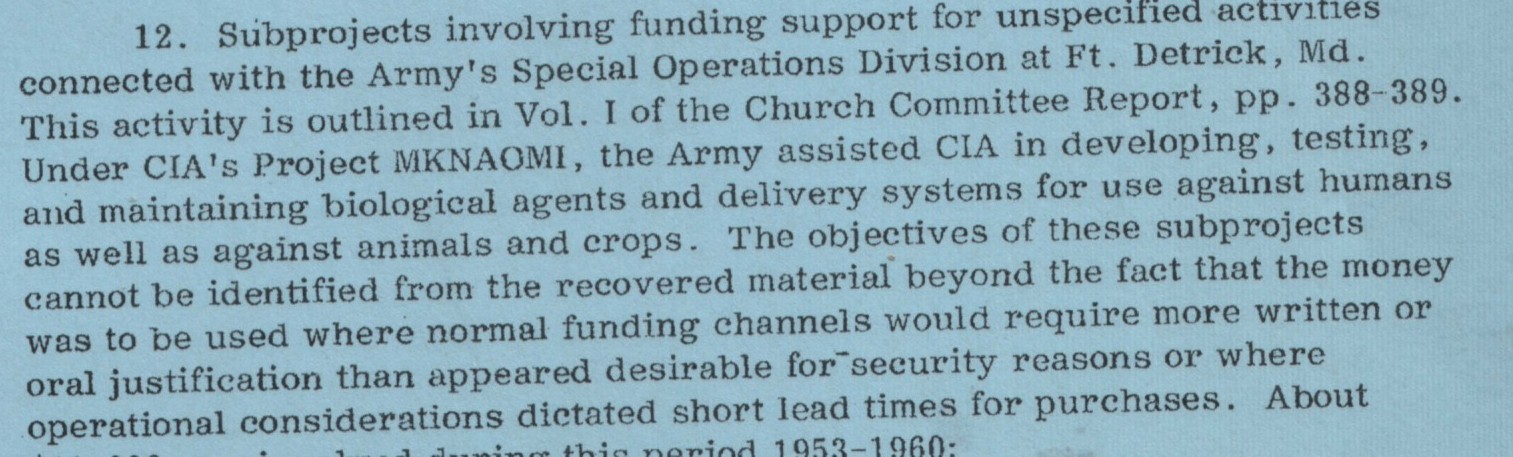
Turner's less-than-candid admission to Inouye about the CIA's bio-war program with Fort Detrick.
On August 26, 1976, after the Zaire strain of Ebola first appeared near the Ebola River in the Republic of Zaire, now the Democratic Republic of Congo, the virus recorded a fatality rate of over 85 percent. A school headmaster, who had been visiting northern Zaire, arrived at the Yambuku Mission Hospital and was misdiagnosed as suffering from malaria. Many of those who had contact with the headmaster before and after he died contracted Ebola. During the following few months, there were 602 reported cases of Ebola in Zaire and in southern Sudan. Of these, 431 people died from the two strains of the novel virus. The international news media painted the Zaire "hot zone" as a virtual geographic death zone.
News reports at the time emphasized two major points: 1) the nearly-always fatal disease caused its victims to die a horrible death, turning their internal organs into jellified masses and 2) the virus was thankfully limited to a remote part of Zaire and did not pose a threat to any major urban centers. It was the remoteness of the virus outbreak that led the Western nations to brush off the virus as deadly but only affecting black Africans because of its remoteness.
That Western mindset largely resulted in governments in Washington, London, Paris, and other capitals brushing off the latest incarnation of the Zaire strain of Ebola which has killed well over 4000 people in Guinea, Liberia, and Sierra Leone and may infect as many as 1.5 million people by early 2015, according to the World Health Organization (WHO). After all, Western leaders reasoned, the virus was only killing black Africans. Even America's overly-hyped first "African-American president," Barack Obama, failed to take the recent Ebola outbreak seriously when he invited leaders of African states, along with their staffs and cabinet ministers, African business leaders, and journalists, to a Washington, DC summit with little regard for the contagiousness of Ebola. White House staffers appeared to have forgotten that the WHO determined that when Ebola first broke out in Zaire in 1976 that it could be transmitted by airborne means.
Three other strains of Ebola, known as Ebola hemorrhagic fever (EHF), a member of the Filoviridae family of viruses, are known to exist in addition to the very deadly Zaire and the less deadly Sudan strains. They are the Côte d’Ivoire or Taï Forest, Bundibugyo (Uganda), and Reston (Virginia) strains. There was an outbreak of Ebola-Zaire in Uganda between 2000 and 2001 in the Gulu District; a Taï strain outbreak spread from chimpanzees to a human in October 1994; an outbreak of Zaire strain in November, 1994 in the gold mining camps of
Meouka, Andock, and Minkebe in Gabon followed by other outbreaks in 1996 in Mayibout and the Booué region of Gabon and 2001 in Libreville, the capital city; an Ebola-Zaire outbreak in Yambio, South Sudan in 2004; and a re-emergence of Ebola-Zaire in an outbreak in Kasaï-Occidental province, DRC, in 2007, as well as in 2008 and 2009. Ebola-Zaire also hitKagadi in the Kibaale District of Uganda in 2012 with a 66 percent fatality rate.
In 2007, a new form of Ebola, the Bundibugyo strain, less deadly than Ebola-Zaire, struck Uganda. In 2008, the least deadly form of Ebola, the U.S. lab-produced Reston strain, infected humans from a group of infected pigs in the Philippines. It was the first case of non-humans or primates being infected by Ebola.
There was another Zaire strain outbreak in Kikwit, Zaire in 1995 and an outbreak of the virus in the Republic of Congo (Brazzaville) in the Mbomo or Kéllé districts in 2003 and 2007.
In addition to humans, Ebola is known to infect primates such as gorillas, chimpanzees, and monkeys, in addition to forest antelopes, fruit bats, porcupines, and, as seen in the Philippines, pigs.
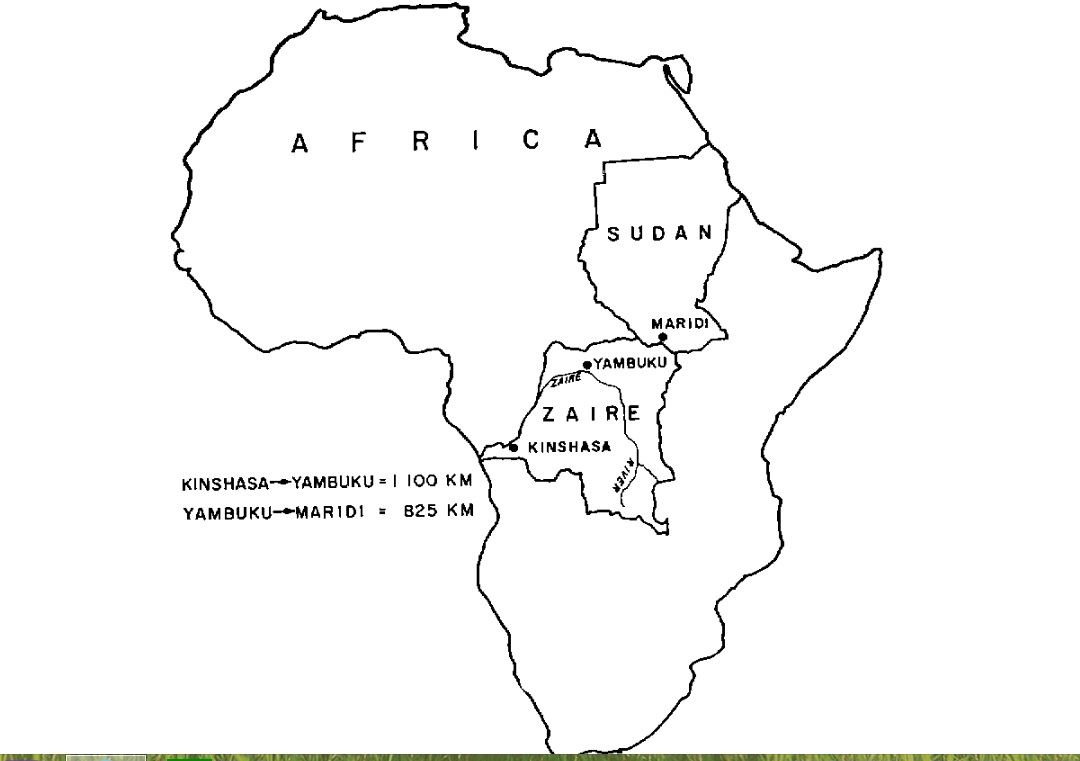
The original 1976 Ebola outbreak "hot zones."
The first victim of the West African Ebola-Zaire outbreak was a 2-year old boy who died from the virus on December 6, 2013 in Meliandou, Guinea. From the town, the virus spread to nearby villages. The initial area of contagion is close to the lucrative Simandou iron mine, which has long been a target of exploitation of Israeli mining magnate and Israel's richest man Benny Steinmetz and his Benny Steinmetz Group Resources (BSGR) and the hedge fund tycoon George Soros. Steinmetz has been under FBI investigation for bribery. In addition, he attempted to launch a coup against Guinean President Alpha Condé after BSGR, based in Guernsey with offices in London and Geneva, was stripped of its mining rights in Guinea after attempting to bribe Guinean officials. Steinmetz's attempt to foment an anti-Condé coup among disaffected Guinean army officers and members of the minorty Fula tribe.

Pentagon map showing current Ebola "hot zones" in West Africa.
One of Steinmetz's associates, Frederic Cilins, was arrested by the FBI in Jacksonville, Florida before he could begin destroying several BSRG documents proving that Steinmetz had paid bribes to Guinean officials in violation of the U.S. Foreign Corrupt Practices Act. There was a recent scare at Jacksonville's Baptist Hospital after someone who had contact with a recent visitor to West Africa complained of initial Ebola-like symptoms. The patient did not indicate whether his contact had been in Guinea or the nature of that person's business in Guinea, Sierra Leone, or Liberia. The Simandou mine is in close proximity to the Guinean borders with both Sierra Leone and Guinea.
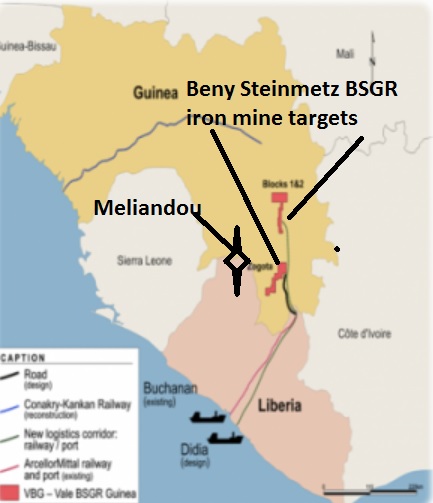
Ebola outbreak in Guinea near Israeli tycoon's attempted iron mining bonanza.
By March 2014, as more Guineans were sickened with the virus, an isolation unit was established by Doctors Without Borders in Gueckedou, near Meliandou. By March 25, four southeastern districts in Guinea suffered Ebola outbreaks with the first cases also reported from across the tri-border area in Lofa and Nimba counties, Liberia and in Kailahun District, Sierra Leone. By June, the first Ebola cases were reported in Monrovia, the Liberian capital and in Kenema, Port Loko, and the Western Districts of Sierra Leone. By July, the virus had spread to Sierra Leone's Bo District and the capital city of Freetown.
With the exception of the contained outbreak of Ebola in 2001 in Libreville, Gabon, the virus's arrival in Monrovia and Freetown were the first time the disease had hit major metropolitan areas. At the end of July, a Liberian-American man died from Ebola after flying from Monrovia to the mega-metropolis of Lagos, Nigeria. Nigeria, as well as Senegal, managed to contain the virus with minimal fatalities. Meanwhile, mandatory quarantine zones were established throughout Liberia, Sierra Leone, and Guinea. President Obama dispatched U.S. troops and National Guardsmen to the West African nations to deal with the Ebola outbreak.
By October, there were reported Ebola cases in the United States from a Liberian man who later died of the virus in a Dallas hospital after traveling from Liberia. Other cases in Spain, the UK, Germany, Norway, and France were reported from medical workers who had been in West Africa and who contracted the virus from patients. Ebola-Zaire also saw an outbreak in the Boende District of the DRC, however, WHO said the outbreak was unconnected to that in West Africa.
Oddly, as the White House named Ron Klain as the "Ebola czar," it also announced late Friday afternoon, on October 16, that it was cutting off funding to risk government experimentation that studied certain infectious agents by making them more dangerous. The timing of the White House announcement was odd, considering that it was reported by WMR that the H1N1 swine influenza "novel" strain was the product of resurrecting the deadly 1918 Spanish flu from DNA extracted by scientists from the U.S. Armed Forces Institute of Pathology in Rockville, Maryland from the corpse of a female Inuit teen who died from the disease in 1918. U.S. government-funded scientists succeeded in combining the resurrected Spanish flu DNA with other viruses, including swine and avian flu. The White House also asked scientists currently conducting research on influenza, SARS and MERS (Middle East Respiratory Syndrome) and other coronaviruses such as the Hong Kong and New Haven viruses, to "voluntarily" halt all current research. Did President Obama delve into the work of USAMRIID, the University of Wisconsin-Madison, the Centers of Disease Control (CDC), and the National Institutes of Health (NIH) to discover that the BWC of 1972 was being routinely violated since it was signed? In addition to H1N1 flu, scientists, including Yoshihiro Kawaoka of University of Wisconsin-Madison, were researching ways to make H5N1 avian flu able to "species jump" from ferrets to humans.
The White House Office of Science and Technology Policy and the Department of Health and Human Services did not put a time limitation on the research moratorium but Kawaoke indicated future research projects on influenza and coronaviruses would not be started and that he would consult with NIH on applying the moratorium on current research efforts. The White House policy does not affect research Ebola but only applies to influenza and coronaviruses.
On the heels of the White House order curtailing research on "risky" viruses, the Pentagon announced that the U.S. Northern Command (NORTHCOM) would work with USAMRIID, the suspected original source of the "Ames strain" anthrax pathogen used in the 2001 postal system attacks, to send Ebola medical teams to areas of the United States reporting outbreaks. USAMRIID not only has the anthrax release on its rap sheet but also the recombination of deadly flu viruses for which the White House ordered a cut-off in funding hours before the Pentagon's announcement on military teams being used to protect the "homeland" from Ebola.
The first outbreak of the deadly Ebola hemorrhagic fever was recorded on July 27, 1976 in the southern Sudan. The first victim of the disease suffered from the Sudan strain of the virus. The man, who worked at the Nzara Cotton Manufacturing Factory in the Sudanese town of Nzara, was dead ten days later. The outbreak quickly spread to the town of Maridi, where hapless villagers struck by the virus went because it was the location of the nearest hospital. Infections were also reported in Juba and Tembura. In 1976, southern Sudan was the scene of a guerrilla-led civil war that pitted black southern Sudanese against the largely Arab central government in Khartoum. In 2011, after the long civil war, one in which the CIA and Mossad supported the South Sudanese against Khartoum, the Republic of South Sudan declared its independence.
In 1976, Zaire was being used as a base for an illegal CIA war against the Marxist-led government of Angola. The 1976 Clark Amendment to the Arms Control Act, authored by Senator Dick Clark (D-IA) and passed by the Senate, forbid the U.S. government from aiding any sides in the Angolan civil war. CIA director George Bush merely ignored the act and provided covert assistance to right-wing Angolan guerrillas in a total violation of the law.
Just as the CIA did with the House of Representatives Boland Amendment forbidding any U.S. government involvement in the Nicaraguan civil war, the CIA merely ignored the law and began supporting the anti-Marxist guerrillas, including UNITA guerrillas led by Jonas Savimbi, in Angola. Assistance to the guerrillas was provided through Zaire, then run by CIA client-dictator Mobutu Sese Seko. U.S. mercenaries fighting on behalf of the minority white government of Rhodesia reportedly helped the Salisbury regime of Prime Minister Ian Smith develop bio-warfare agents, including anthrax, to use against black nationalist guerrillas. Some of these bio-warfare weapons were also transferred to CIA-backed rebels in Angola from both Rhodesia and Zaire.
After the anthrax attacks in the United States in 2001, the FBI dispatched a team of agents to South Africa and Zimbabwe to investigate then-primary "person of interest" Dr. Steven Hatfill's role in the 1970s with South Africa's Project COAST and Rhodesia's Selous Scouts own bio-war program, much of it developed with the assistance of the South Africans. There is reason to believe that the FBI was called off its investigation when a link between Hatfill and a covert CIA operation to aid the Rhodesian Selous Scouts during the 1970s was discovered. This link included the provision of bio-warfare agents, including anthrax and West Nile virus,from Fort Detrick and Project COAST.
In 2000, the FBI discovered a network of veterans of the South African bio-warfare program, code named Project COAST, living in the Los Angeles area. A UCLA gynecologist and high-level Mormon named Dr. Larry Ford was linked to the chief of Project COAST, Dr. Wouter Basson. Ford's partner in his firm Biofem Pharmaceuticals was shot and wounded on February 28, 2000 and shortly thereafter, Ford allegedly committed suicide in his Irvine, California home. The FBI discovered canisters containing cultures of cholera, salmonella, botulism, and typhus buried in Ford's backyard. FBI agent Doug Baker revealed that Ford had connections to the CIA but later quickly recanted after he received pressure from FBI headquarters. However, Ford's friend Basson was linked to Don Mayes, a retired CIA officer and one of Basson's former employee, Dan Goosen, and the CIA and FBI. Mayes acted as the CIA's and FBI's go-between to Goosen and Basson. on behalf of Basson, Goosen was trying to sell the CIA a genetically-engineered pathogen that combined intestinal bacteria with gas gangrene, a very fatal concoction. The pathogen was shipped from South Africa to the FBI office in Key West in a toothpaste tube, a favorite container for Gottlieb, where former CIA-turned-FBI agent Robert Zlockie took possession of the tube. Negotiations for the CIA to buy the pathogen reportedly broke down, however, there were reports that Goosen met with officials of Bioport, the Michigan-based firm that sold anthrax vaccines to the Pentagon. There were reports at the time that investors in Bioport included The Carlyle Group, on whose board George H. W. Bush sat. The toothpaste tube was reportedly sent to Fort Detrick.
A small arsenal, in addition to pathogen canisters, were discovered buried in Dr. Larry Ford's backyard. Some believe that Ford took over from Dr. Sidney Gottlieb as the CIA's "Dr. Death," but in a much more covert fashion with maximized "plausible deniability" of agency involvement.
During the CIA's illegal involvement in warfare in Zaire and Angola, two novel viruses appeared on the scene: Ebola and Human Immunodeficiency Virus (HIV). The CIA's longtime "Dr. Strangelove" for creating exotic methods to kill people, the club-footed Hungarian-Jew Dr. Sidney Gottlieb, saw Africa as a virtual "Petri dish" for carrying out his macabre experiments. In 1960, Gottlieb developed a deadly poison that was to be put on Congolese Prime Minister Patrice Lumumba's toothbrush and cause instant death. Gottlieb also worked on various "exotic" medical means to dispatch Cuban leader Fidel Castro.
Other Gottlieb exploits included blue mold against Cuba's tobacco crop; cane smut against its sugar crop; African swine fever, which is related to the coronavirus Severe Acute Respiratory Syndrome (SARS), which is related to the deadly 1918 Spanish flu; and a hemorrhagic strain of Dengue fever against Cuba's human population. In the months after 9/11 and long after Gottlieb's retirement from the CIA, a cousin of hemorrhagic Dengue fever, the Crimean-Congo Hemorrhagic Fever (CCHF), made its debut among civilians in Afghanistan and Pakistan. Russian scientists who examined SARS claimed that the virus was genetically created by fusing mumps and measles pathogens. They pointed their fingers at Fort Detrick.
Although Gottlieb retired from the CIA in 1972, after 20 years of service with Langley, there is no evidence that the CIA discontinued its involvement with biological warfare experimentation, even after the United States signed, along with the United Kingdom and the USSR, the Convention on the Prohibition of the Development, Production and Stockpiling of Bacteriological (Biological) and Toxin Weapons and on their Destruction or "BWC." Evidence suggests that the CIA merely transferred its bio-war programs to the
U.S. Army Medical Research Institute of Infectious Diseases (USAMRIID) in Fort Detrick, Maryland where bio-warfare research was being conducted under the cover of "non-proliferation" enforcement and research. Other banned research was conducted at Fort Detrick's British counterpart at the Defense Evaluation and Research Agency (DERA) in Porton Down in Wiltshire, England.
Dr. Sidney Gottlieb, aka "Joseph Schneider."
HIV first infected Cuban troops in Angola who were assisting the central government in battling CIA- and South African-supported rebels throughout Angola. Those returning Cuban troops in turn infected Cuban civilians. It was from the Cuban vector that HIV was then transmitted to the United States via Cuban refugees who received political asylum in Florida. The Soviet news agency TASS was always ridiculed for producing propaganda, however, the CIA and State Department had full-time operations to counter everything reported by the news agency, indicating that the United States was concerned to counter TASS even when their reports were correct, which they were more times than not. On March 30, 1987, TASS reported that East German scientists concluded that HIV was a manufactured virus, developed by gene splicing a visna virus, a retrovirus that causes encephalitis and pneumonia in sheep, with HTLV-1, the first retrovirus that was known to infect humans. The East German scientists traced HIV back to Fort Detrick. The U.S. State Department labled the story "Soviet propaganda," but the U.S. government has never really owned up to its "Dr. Frankstein" medical operations in Africa or elsewhere.
In fact, the U.S. government, with suspicions of CIA involvement, was subjecting African-American to injections with syphilis as late as 1972. The U.S. Public Health Service forced syphilis infection operation was coordinated with Tuskegee Institute in Alabama. The Atomic Energy Commission, again, with suspected CIA involvement, subjected American civilians and military personnel, including the population of Bikini Atoll in the Marshall Islands, as well as Australian citizens, to radiation experiments as part of Projects SUNSHINE and GABRIEL.
An August 2, 1977 letter from CIA director Admiral Stansfield Turner to Senator Daniel Inouye (D-Hawaii) reveals the nature of the CIA's work with Fort Detrick's USAMRIID on bio-warfare projects. The letter states that as part of the CIA's MKULTRA project, various subprojects involved "funding for unspecified activities connected with the Army's Special Operations Division at Ft. Detrick, Md . . . Under CIA's Project MKNAOMI, the Army assisted CIA in developing, testing, and maintaining biological agents and delivery systems for use against humans as well as against animals and crops. The objectives of these subprojects cannot be identified from the recovered material beyond the fact that the money was to be used where normal funding channels would require more written or oral justification than appeared desirable for security reasons or where operational considerations dictated short lead time for purchases." [Emphasis added]
Turner claimed MKNAOMI bio-warfare operations ended in 1960, however, statements by CIA director William Colby released later indicated that the CIA destroyed much of the MKNAOMI records that existed up until 1972. The records were part of a trove of CIA documents that Colby referred to as the agency's "Family Jewels."
Turner's less-than-candid admission to Inouye about the CIA's bio-war program with Fort Detrick.
On August 26, 1976, after the Zaire strain of Ebola first appeared near the Ebola River in the Republic of Zaire, now the Democratic Republic of Congo, the virus recorded a fatality rate of over 85 percent. A school headmaster, who had been visiting northern Zaire, arrived at the Yambuku Mission Hospital and was misdiagnosed as suffering from malaria. Many of those who had contact with the headmaster before and after he died contracted Ebola. During the following few months, there were 602 reported cases of Ebola in Zaire and in southern Sudan. Of these, 431 people died from the two strains of the novel virus. The international news media painted the Zaire "hot zone" as a virtual geographic death zone.
News reports at the time emphasized two major points: 1) the nearly-always fatal disease caused its victims to die a horrible death, turning their internal organs into jellified masses and 2) the virus was thankfully limited to a remote part of Zaire and did not pose a threat to any major urban centers. It was the remoteness of the virus outbreak that led the Western nations to brush off the virus as deadly but only affecting black Africans because of its remoteness.
That Western mindset largely resulted in governments in Washington, London, Paris, and other capitals brushing off the latest incarnation of the Zaire strain of Ebola which has killed well over 4000 people in Guinea, Liberia, and Sierra Leone and may infect as many as 1.5 million people by early 2015, according to the World Health Organization (WHO). After all, Western leaders reasoned, the virus was only killing black Africans. Even America's overly-hyped first "African-American president," Barack Obama, failed to take the recent Ebola outbreak seriously when he invited leaders of African states, along with their staffs and cabinet ministers, African business leaders, and journalists, to a Washington, DC summit with little regard for the contagiousness of Ebola. White House staffers appeared to have forgotten that the WHO determined that when Ebola first broke out in Zaire in 1976 that it could be transmitted by airborne means.
Three other strains of Ebola, known as Ebola hemorrhagic fever (EHF), a member of the Filoviridae family of viruses, are known to exist in addition to the very deadly Zaire and the less deadly Sudan strains. They are the Côte d’Ivoire or Taï Forest, Bundibugyo (Uganda), and Reston (Virginia) strains. There was an outbreak of Ebola-Zaire in Uganda between 2000 and 2001 in the Gulu District; a Taï strain outbreak spread from chimpanzees to a human in October 1994; an outbreak of Zaire strain in November, 1994 in the gold mining camps of
Meouka, Andock, and Minkebe in Gabon followed by other outbreaks in 1996 in Mayibout and the Booué region of Gabon and 2001 in Libreville, the capital city; an Ebola-Zaire outbreak in Yambio, South Sudan in 2004; and a re-emergence of Ebola-Zaire in an outbreak in Kasaï-Occidental province, DRC, in 2007, as well as in 2008 and 2009. Ebola-Zaire also hitKagadi in the Kibaale District of Uganda in 2012 with a 66 percent fatality rate.
In 2007, a new form of Ebola, the Bundibugyo strain, less deadly than Ebola-Zaire, struck Uganda. In 2008, the least deadly form of Ebola, the U.S. lab-produced Reston strain, infected humans from a group of infected pigs in the Philippines. It was the first case of non-humans or primates being infected by Ebola.
There was another Zaire strain outbreak in Kikwit, Zaire in 1995 and an outbreak of the virus in the Republic of Congo (Brazzaville) in the Mbomo or Kéllé districts in 2003 and 2007.
In addition to humans, Ebola is known to infect primates such as gorillas, chimpanzees, and monkeys, in addition to forest antelopes, fruit bats, porcupines, and, as seen in the Philippines, pigs.
The original 1976 Ebola outbreak "hot zones."
The first victim of the West African Ebola-Zaire outbreak was a 2-year old boy who died from the virus on December 6, 2013 in Meliandou, Guinea. From the town, the virus spread to nearby villages. The initial area of contagion is close to the lucrative Simandou iron mine, which has long been a target of exploitation of Israeli mining magnate and Israel's richest man Benny Steinmetz and his Benny Steinmetz Group Resources (BSGR) and the hedge fund tycoon George Soros. Steinmetz has been under FBI investigation for bribery. In addition, he attempted to launch a coup against Guinean President Alpha Condé after BSGR, based in Guernsey with offices in London and Geneva, was stripped of its mining rights in Guinea after attempting to bribe Guinean officials. Steinmetz's attempt to foment an anti-Condé coup among disaffected Guinean army officers and members of the minorty Fula tribe.
Pentagon map showing current Ebola "hot zones" in West Africa.
One of Steinmetz's associates, Frederic Cilins, was arrested by the FBI in Jacksonville, Florida before he could begin destroying several BSRG documents proving that Steinmetz had paid bribes to Guinean officials in violation of the U.S. Foreign Corrupt Practices Act. There was a recent scare at Jacksonville's Baptist Hospital after someone who had contact with a recent visitor to West Africa complained of initial Ebola-like symptoms. The patient did not indicate whether his contact had been in Guinea or the nature of that person's business in Guinea, Sierra Leone, or Liberia. The Simandou mine is in close proximity to the Guinean borders with both Sierra Leone and Guinea.
Ebola outbreak in Guinea near Israeli tycoon's attempted iron mining bonanza.
By March 2014, as more Guineans were sickened with the virus, an isolation unit was established by Doctors Without Borders in Gueckedou, near Meliandou. By March 25, four southeastern districts in Guinea suffered Ebola outbreaks with the first cases also reported from across the tri-border area in Lofa and Nimba counties, Liberia and in Kailahun District, Sierra Leone. By June, the first Ebola cases were reported in Monrovia, the Liberian capital and in Kenema, Port Loko, and the Western Districts of Sierra Leone. By July, the virus had spread to Sierra Leone's Bo District and the capital city of Freetown.
With the exception of the contained outbreak of Ebola in 2001 in Libreville, Gabon, the virus's arrival in Monrovia and Freetown were the first time the disease had hit major metropolitan areas. At the end of July, a Liberian-American man died from Ebola after flying from Monrovia to the mega-metropolis of Lagos, Nigeria. Nigeria, as well as Senegal, managed to contain the virus with minimal fatalities. Meanwhile, mandatory quarantine zones were established throughout Liberia, Sierra Leone, and Guinea. President Obama dispatched U.S. troops and National Guardsmen to the West African nations to deal with the Ebola outbreak.
By October, there were reported Ebola cases in the United States from a Liberian man who later died of the virus in a Dallas hospital after traveling from Liberia. Other cases in Spain, the UK, Germany, Norway, and France were reported from medical workers who had been in West Africa and who contracted the virus from patients. Ebola-Zaire also saw an outbreak in the Boende District of the DRC, however, WHO said the outbreak was unconnected to that in West Africa.
Oddly, as the White House named Ron Klain as the "Ebola czar," it also announced late Friday afternoon, on October 16, that it was cutting off funding to risk government experimentation that studied certain infectious agents by making them more dangerous. The timing of the White House announcement was odd, considering that it was reported by WMR that the H1N1 swine influenza "novel" strain was the product of resurrecting the deadly 1918 Spanish flu from DNA extracted by scientists from the U.S. Armed Forces Institute of Pathology in Rockville, Maryland from the corpse of a female Inuit teen who died from the disease in 1918. U.S. government-funded scientists succeeded in combining the resurrected Spanish flu DNA with other viruses, including swine and avian flu. The White House also asked scientists currently conducting research on influenza, SARS and MERS (Middle East Respiratory Syndrome) and other coronaviruses such as the Hong Kong and New Haven viruses, to "voluntarily" halt all current research. Did President Obama delve into the work of USAMRIID, the University of Wisconsin-Madison, the Centers of Disease Control (CDC), and the National Institutes of Health (NIH) to discover that the BWC of 1972 was being routinely violated since it was signed? In addition to H1N1 flu, scientists, including Yoshihiro Kawaoka of University of Wisconsin-Madison, were researching ways to make H5N1 avian flu able to "species jump" from ferrets to humans.
The White House Office of Science and Technology Policy and the Department of Health and Human Services did not put a time limitation on the research moratorium but Kawaoke indicated future research projects on influenza and coronaviruses would not be started and that he would consult with NIH on applying the moratorium on current research efforts. The White House policy does not affect research Ebola but only applies to influenza and coronaviruses.
On the heels of the White House order curtailing research on "risky" viruses, the Pentagon announced that the U.S. Northern Command (NORTHCOM) would work with USAMRIID, the suspected original source of the "Ames strain" anthrax pathogen used in the 2001 postal system attacks, to send Ebola medical teams to areas of the United States reporting outbreaks. USAMRIID not only has the anthrax release on its rap sheet but also the recombination of deadly flu viruses for which the White House ordered a cut-off in funding hours before the Pentagon's announcement on military teams being used to protect the "homeland" from Ebola.

 The escalation of US military activity in Yemen, therefore, is by no means simply a response to events of recent years, but merely the continuing extension of a wider bipartisan geostrategy that was formulated not only by people largely associated with Republican neocons, but also by arch-Democrats, such as former US Secretary of State Henry Kissinger and former National Security Adviser to President Carter, Zbigniew Brzezinski. During the 1970s Middle East oil crisis, Kissinger secretly advocated that the US military might have to intervene to
 Democratic neocons Kissinger and Brzezinski continue to play a
 Couple of key points become obvious from this. The last year, 2009, has seen a sudden massive, unprecedented escalation in US military intelligence activity in Yemen. The Abdulmutallab incident has only intensified and legitimized this activity.
 There are various problems. Yemeni oil production has peaked,
