

But the bromide-heavy speech that President George W. Bush gave yesterday at the Naval Academy presents a clear strategy for quagmire and eventual disaster. Despite the gathering storm of opposition to his approach to the war in Iraq, the speech was bereft of new ideas, calling to mind the words of Emerson: "A foolish consistency is the hobgoblin of little minds."
The problem is that this hobgoblin has consequences. Bush's renewed warning of a future "Islamic empire from Indonesia to Spain" at first seemed to me as outlandish as President Ronald Reagan's warning that the Russians planned to transit Nicaragua to invade Texas. On second thought, Bush's concern may become self-fulfilling prophecy, since the course he is on could hardly be better designed to usher in an eventual Islamic, rather than American, "empire."
Iraqi Security Forces: A Pathetic Pillar
The president indicated that in the days ahead he would be addressing various pillars of his policy in Iraq. Yesterday's speech was devoted largely to the training of Iraqi army and security forces, and he protested too much in his efforts to accentuate the positive. His tortured attempt to explain why, after so many months of US training, only one Iraqi army battalion can fight independently was no more convincing that earlier attempts by Defense Secretary Donald Rumsfeld and his star-bedecked generals. Statistics just confuse the issue, we have been told; progress is being made. Trust us.
All this is reminiscent of the rhetoric at a similar juncture at the beginning - yes, the beginning - of US involvement in the Vietnam War. The Lyndon Johnson tapes show how in February 1964 President Johnson found fault with a draft of a major policy speech by then-Defense Secretary Robert McNamara:
LBJ: "I wonder if you shouldn't find two minutes to devote to Vietnam."
McN: "The problem is what to say about it."
LBJ: "I would say that we have a commitment to Vietnamese freedom ... Our purpose is to train [the South Vietnamese] people, and our training's going good."
The training was not going good then, and it's not going good now. The Johnson administration's self-deception helped usher in a decade of war resulting in 2-3 million Vietnamese and 58,000 American servicemen killed. The parallel is eerie. Just a few months ago Rumsfeld was talking about the need for US forces to remain in Iraq for perhaps as long as 12 years.
Friday, December 02, 2005
Flight logs reveal hundreds of CIA flights to Europe: report
More than 300 CIA flights have landed at European airports, a British newspaper said, adding a new element to claims that Washington has been transporting terrorist suspects to secret prisons in Europe.
The Guardian daily said it had seen flight logs documenting the flights by 26 planes operated by the Central Intelligence Agency (CIA).
The information showed an "unprecedented" amount of travel by the agency but did not reveal which planes took part in alleged prison transfers, it said.
The CIA has been accused in reports of using European countries for the transport, illegal detention and torture of suspected Islamist terrorists in the wake of the September 11, 2001 attacks on the United States.
Outrage over the reports mounted in Europe this week as EU Justice Commissioner Franco Frattini threatened sanctions on Monday for any member nation hosting CIA prison camps on their soil.
The Guardian daily said it had seen flight logs documenting the flights by 26 planes operated by the Central Intelligence Agency (CIA).
The information showed an "unprecedented" amount of travel by the agency but did not reveal which planes took part in alleged prison transfers, it said.
The CIA has been accused in reports of using European countries for the transport, illegal detention and torture of suspected Islamist terrorists in the wake of the September 11, 2001 attacks on the United States.
Outrage over the reports mounted in Europe this week as EU Justice Commissioner Franco Frattini threatened sanctions on Monday for any member nation hosting CIA prison camps on their soil.

Espionage - Washington Puts its Friends in the Line of Fire by Guennadi Evstafiev
It is necessary to place in context the espionage cases that are currently shaking the US leading class. Actually, there is nothing new in the recurrent trend of the military power to keep watch over the civil power and a collective will to manipulate allies, even before adversaries, says – for Voltaire Network – General Guennadi Evstafiev.
The US capital is used to espionage cases that shake it every six to twelve months. Each one of them has, in its way, its own characteristics. For example, two years ago, Defense Secretary Donald Rumsfeld created, practically behind the back of Congress, a new secret service [1]. The Pentagon was then accused of waging a war against both friends and foes.
Traditionally, Republicans have always had the urgent need to know each others’ political secrets and to collect compromising files about their own friends, let alone their enemies. Whatever their advocates may say, it is well known that discretion and an unpredictable nature have always been typical features of Washington’s policy under Republican administrations.
For example, the Philippines have never been hostile towards Washington. Actually, it is a loyal ally although Manila was a US protectorate in the past. However, as the habit becomes a conditioned response, the US special services put together a compromising file on President Gloria Arroyo, a file that, according to the Philippine Justice Minister, "could be used to destabilize the government of the Philippines".
However, due to a boomerang effect, a trick of fate put the United States under the observation of spies who worked – what a paradox! - for the Philippine opposition.
A former US marine of Philippine origin, Leandro Aragonchillo, who worked for three years for the White House and later for the FBI, was arrested for having transmitted hundreds of documents and confidential data to his accomplices in Manila. Although they were mainly members of the opposition, the possibility that government officials could also be involved in the network is not ruled out. However, the spy was not professional enough and acted almost openly, downloading data from computers in the very heart of the "American" power.
Mordechai Vanunu’s 36-hour preventive arrest for using his freedom of speech
Mordechai Vanunu, activist and ex-engineer at the Israeli Dimona Nuclear Center, was once again arrested on November 18, 2005 by Israeli authorities and submitted to a 36-hour preventive detention and later released thanks to his lawyer’s mediation. That was the first detention after Vanunu was released in 2004 from 18 years in solitary confinement. On this occasion, he was suspect of having violated his freedom condition by having talked to the press several times, including an interview he granted last month to Sylvia Cattori for Voltaire Network and another one to our colleagueGreg Szymanski (American Free Press), whom he briefed on his arrest at a border post near Jerusalem:
Vanunu said:"After remaining in jail for 36 hours and under isolation conditions I was finally taken before the judge; they wanted to submit me to domiciliary custody for 15 days and give me a strong fine. However, my lawyer proved that I was not detained in a free territory and that the terms for my parole were vague", he said and affirm that he would not "allow Israeli authorities to prevent [him] from using [his] freedom of speech"..
Vanunu said:"After remaining in jail for 36 hours and under isolation conditions I was finally taken before the judge; they wanted to submit me to domiciliary custody for 15 days and give me a strong fine. However, my lawyer proved that I was not detained in a free territory and that the terms for my parole were vague", he said and affirm that he would not "allow Israeli authorities to prevent [him] from using [his] freedom of speech"..
America's double standard on terrorism
Cuban expatriate Luis Posada Carriles, an old U.S. terrorist chicken, has come home to roost in Bush's nest, exposing the president's anti-terrorist policies as a hoax.
Posada, 77, unabashedly embodies violence as Gandhi stood for nonviolence. His resume contains a long list of terrorist "accomplishments," including the bombing of a Cuban commercial airliner over Barbados in which all 73 people aboard died.
Posada, 77, unabashedly embodies violence as Gandhi stood for nonviolence. His resume contains a long list of terrorist "accomplishments," including the bombing of a Cuban commercial airliner over Barbados in which all 73 people aboard died.
Resisting the New Conquistadors - Salvadorans Mobilize Against Gold Mining
In the fields above Carasque, you can still find shrapnel from bombs the Salvadoran Air Force dropped on the village in the 1980s. Early this fall, signs of a new threat began appearing on the mountainside – survey tags left by a Canadian mining company searching for gold.
Benigno Orellana, the community's representative to the Municipal Council in Nueva Trinidad, says, "Right now, the permission is for exploration, later it will be for exploitation." He's worried:
That’s a fate people in Carasque aren't willing to accept – after surviving decades of violence and repression, they are not about to allow a mining company to force them off their land.
Earlier this year, the Salvadoran government granted two Canadian companies – Au Martinique Silver and Intrepid Minerals – licenses for gold exploration in the department of Chalatenango, near the Honduran border. Au Martinique’s website promises investors that "El Salvador has the lowest risk profile for investment in all of Central America." But what they haven't taken into account is the region's strong history of community organizing, and the lengths its people are willing to go to defend their land and their livelihood.
Benigno Orellana, the community's representative to the Municipal Council in Nueva Trinidad, says, "Right now, the permission is for exploration, later it will be for exploitation." He's worried:
"If the mining companies come in, it will be worse than the twelve years of war. This is a project of death for our communities and a project of wealth for those who exploit us. They will leave behind a desert where we can't sustain our crops, can't feed our animals, and can't get water to drink."
That’s a fate people in Carasque aren't willing to accept – after surviving decades of violence and repression, they are not about to allow a mining company to force them off their land.
Earlier this year, the Salvadoran government granted two Canadian companies – Au Martinique Silver and Intrepid Minerals – licenses for gold exploration in the department of Chalatenango, near the Honduran border. Au Martinique’s website promises investors that "El Salvador has the lowest risk profile for investment in all of Central America." But what they haven't taken into account is the region's strong history of community organizing, and the lengths its people are willing to go to defend their land and their livelihood.
Thursday, December 01, 2005
The U.S. government vs. al Jazeera
The big story I haven't been covering, since it broke while I was out of town for a few days, is the story that Bush threatened to bomb the al Jazeera offices in Qatar in 2004 during the assault on Fallujah. Politics in the Zeros has been all over the story, and Jeremy Scahill has done a fine job of providing the context for the threatened bombing, making it clear that this threat didn't just come out of the blue. Today, in his press briefing, Scott McClellan said something which was possibly very revealing:
The terrorist offices???!!! Let's be clear on what happened. The al Jazeera office in Kabul, whose location was known to the U.S., was destroyed by a U.S. missile shortly before the Northern Alliance entered Kabul and began a campaign of reprisals, which were then less able to be reported to the outside world. The U.S. first claimed that a bomb must have gone "astray," and denied knowing the location of the al Jazeera office. But then they changed their tune and claimed that the office was a known headquarters for al Qaida.
And now, McClellan repeats that lie (and slander), equating the al Jazeera office in Kabul with "terrorist offices." Really, however, he needn't bother, since the U.S. has no problem openly attacking actual press offices. As even CNN reminds us (as Left I on the News has many times):
Unlike Left I on the News, however, CNN failed to remind its readers that that act was a prima facie war crime. One which McClellan (and his bosses) are proud to embrace.
Q Two more Middle East-related questions. I know you've been asked before about the so-called al Jazzier memo, but Europeans are making quite a big deal about it. Can you assure them that even if the President did say when he was elected said he was doing that in jest?
MR. McCLELLAN: Can I assure them what?
Q That if the President really did make those comments, he was doing so in jest?
MR. McCLELLAN: Make what comments?
Q About allegedly bombing al Jazeera --
MR. McCLELLAN: Any such notion that we would engage in that kind of activity is just absurd.
Q Well, do you know if the comments were made?
MR. McCLELLAN: I don't know what comments you're referring to. I haven't seen any comments quoted.
Q Somebody said that they had a memo, or that they took notes during --
MR. McCLELLAN: Let me just repeat for you, Connie. Any such notion that America would do something like that is absurd.
Q They bomb them in Afghanistan then -- their office.
MR. McCLELLAN: I'm sorry? Whose offices? The terrorist offices.
Q We bombed their office in Afghanistan, and killed their -- some of their people in --
MR. McCLELLAN: And the military talked about that. What are you suggesting? I hope you're not suggesting that they're targeting civilians, because that's just flat-out wrong.
The terrorist offices???!!! Let's be clear on what happened. The al Jazeera office in Kabul, whose location was known to the U.S., was destroyed by a U.S. missile shortly before the Northern Alliance entered Kabul and began a campaign of reprisals, which were then less able to be reported to the outside world. The U.S. first claimed that a bomb must have gone "astray," and denied knowing the location of the al Jazeera office. But then they changed their tune and claimed that the office was a known headquarters for al Qaida.
And now, McClellan repeats that lie (and slander), equating the al Jazeera office in Kabul with "terrorist offices." Really, however, he needn't bother, since the U.S. has no problem openly attacking actual press offices. As even CNN reminds us (as Left I on the News has many times):
"During the 1999 air campaign over Kosovo, U.S. warplanes targeted Yugoslavia's state television network. NATO officials argued it was a legitimate target as the propaganda arm of the Yugoslav government."
Unlike Left I on the News, however, CNN failed to remind its readers that that act was a prima facie war crime. One which McClellan (and his bosses) are proud to embrace.
ON POWER - AN OPEN LETTER TO THE U.S. CONGRESS FROM A VETERAN AND MILITARY DAD
ON POWER
AN OPEN LETTER TO CONGRESS FROM A VETERAN AND MILITARY DAD
AN OPEN LETTER TO CONGRESS FROM A VETERAN AND MILITARY DAD
By Stan Goff
(Disclaiming in advance for the rare exceptions in Congress)
If there is one thing we can always count on, it’s politicians who walk over human corpses to show fear only in the face of something as formless and abstract as an opinion poll. The veterans and military families antiwar movement are well-versed on so-called realism – and that deference we are supposed to exercise when we approach elected officials, hat in hand, for a few crumbs of your attention and support.
We understand power very well.
You are fighting each other for your careers, and you are retaining your power over us through distance and guile, and trying to promote that power by pretending you are hearing our “concerns.” But we have more than “concerns” at stake here.
It is because we understand power that we haven’t the slightest intention of allowing ourselves to be used to promote your careers past the 2006 elections. If you fail to demand US withdrawal now, you are supporting the war; and if you support the war, as far as we are concerned, you can go straight to hell in 2006.
It is because we understand power that we are not going to forgive and forget that when the war fever was up, fed by the lies of Republicans, the war was facilitated by the eager xenophobic complicity of most Democrats, and by the slavish obedience of the corporate press. Most of you not only co-signed what you knew to be an illegal invasion – you have continued to sign the checks to perpetuate the war.
You wanted to be lied to about the war, because the polls supported the war, and you were sniffing the political air.
It is because we understand power that we know that most of you did this out of craven opportunism and a concern for your political ambitions – knowing full well that no one you loved was likely to be sent home without a limb, without an eye, without a life.
It is because we understand power that we know how cynically cavalier you are with the lives of others, and how narcissistically self-promoting.
It is because we understand power that we understand why many of you are backpedaling in your support for the war. You are maneuvering to be “critical” of the war. You “demand” the administration provide “an effective exit strategy.” And you haven’t said a goddamned substantive thing, as the cameras shutter away for you. And you want us to play along – so you can beat Republicans without taking a single real position. You don’t want to stop this war. You want to win an election. By the time you win that election, another thousand troops and another 20,000 Iraqis could be dead. We do not calculate time the way you do.
It is because we understand power that we know most of you will stand by while those of us with less privilege see our loved ones sent to kill and die. The real corpses produced by the exercise of power are no more to you than a political calculation.
We understand power, because we know what really stands behind it. Power is embodied in the mounted cops you use to police our protests. Power is expressed by the armed guards for your gated communities. Power is the ability to kill and maim and get away with it, even if you dress it up in $5,000 suits and trot it out on the talk-show circuit, on C-Span, in your interviews with CNN.
Power is projected onto other peoples using your Cruise missiles and A-10s and Bradley fighting vehicles and the people who join the military. And the price of that power doesn’t merely come from our pockets. We probably wouldn’t fight you about how you rob us for your pork barrel defense contracts. The price that has us in motion right now – you really must understand this, because it means we will never back off – is exacted on the bodies of human beings.
The price is exacted with mortars, with IEDs, with high powered rifle ammunition, with bombs, with the same A-10s and Bradleys; and it is exacted on the bodies of our loved ones and the loved ones of the Iraqi people.
That’s why we are not going to grant you the power to manipulate us, to contain us, to corral us, or to pimp our grief over this war and its costs on behalf of your political careers or the needs of a political party. That’s why were are going to be rudely explicit when we say that your bombast against the Bush administration – as if they did this without your help – in calling for a more effective “exit strategy” and demanding that people merely think about a plan for withdrawal from Iraq that will take months or years… this verbiage is meaningless and manipulative. We will never stand for studying a withdrawal, for phasing a withdrawal, for delaying a withdrawal, for setting conditions for a withdrawal, or for partial withdrawal. Never.
Our demand from the beginning remains unchanged. It is for withdrawal, and for immediate, unilateral, unconditional withdrawal; and if political careers go up in smoke as a consequence, we do not give a good goddamn. People are dying in Iraq as a direct result of this war every single day. Go back to your fucking law offices and let our children live.
Gradual, phased, planned, strategized, conditioned, delayed, partial withdrawals get implemented, if at all, while those military sedans continue to roll up in front of people’s houses to announce the extinction of a human being to his or her family… and while the bodies are dropped into the fresh graves at the cemeteries of Iraq.
Gradual, phased, planned, strategized, conditioned, delayed, partial withdrawals get implemented, if at all, while the poisons accumulate in the soil and water and food of Iraq, and in the bodies of Iraqis and occupation troops.
Gradual, phased, planned, strategized, conditioned, delayed, partial withdrawals get implemented, if at all, while the hospitals fill up with the lamed, maimed, blinded, and disfigured.
Gradual, phased, planned, strategized, conditioned, delayed, partial withdrawals get implemented, if at all, while the grief and horror associated with this criminal war become the daily emotional fare of more and more people, occupation forces and Iraqis.
No member of Congress has the moral right to dither on the question of his or her precious career while a single constituent is facing the fear of that devastating knock on the door. We say the emperor has no clothes; and we say we know you when you feign “concern” with your eye fixed firmly on your ambition.
An exit is not a strategy. An exit is a command.
If the commander in chief won’t give that command, then you in Congress – if you want to salvage anything that looks vaguely like a conscience or a soul – will refuse to grant this administration another penny to continue this war. We are not hearing you when you tap dance about political “realism.” The mounting mass of corpses, that you have walked over every time you voted a cent to continue this war, is about as real as it gets. Don’t you dare ever lecture military families and veterans about realism. And don’t you doubt that we understand power.
You may think you can respond to your careerist concerns in the face of reversing polls. You may think you can pretend to do something, that you can bewilder us into accepting half a loaf better than none.
To the tiny handful of you in Congress who have said what we say, “Out Now!,” we commend you and thank you for your principled voices.
To those of you who are openly supporting this criminal administration, we’ll see you in the street, and history will consign your names to the chapters about imperial bullying, comb-over machismo, and cognitive mediocrity.
To those of you who call for half measures, phases, and strategies, you are directly in front of us now. You are standing directly in our path, and we are not going to go around you.
We are not going to commend you on being “better” than the reactionaries.
We are not going to thank you for our half a loaf.
We are not going to try and give you the political cover you need to wiggle around those shifting opinion polls while you salvage your careers.
We do not love you. We find your ambivalence contemptible.
We love the people who are facing the real consequences of this war while you schmooze your way through the chicken-salad circuits of imperial power, nattering on about realism and phases and strategies.
You will not divert our attention away from you. You will redirect neither our anger nor our will away from you. It is you who are standing directly in our way; and every time you try to dicker about people’s lives with us like we are in street market, every time you try to pimp our outrage at this crime, as a mere “concern” that only you are entitled to address with your careerist half-measures, we will call you to account. We will embarrass you. We will shine a spotlight on your cowardice, your opportunism, and your grotesque cynical hypocrisy.
November 2006 is not an election to us; it is a body count. If you think you can take us for granted over an election, think again.
Get it right, because we have never wavered on our position. The mass of American society is moving toward us, not you. They are listening more and more to us, and less and less to you. We are about saving lives, not saving face. So get it right, and get it right fast. We are looking at your political house with an eye to pulling it down.
We understand power very well.
Lori Berenson is a US citizen currently being held as a political prisoner in Peru. November 30th 2005 marks the tenth anniversary of her arrest.
My name is Lori Berenson. I am a New York born and raised political prisoner in Peru. I have spent many years in Central and South America, trying to contribute to the efforts of those who seek social justice for all. I continue this work from prison.
On November 30, 1995, I was pulled off of a public bus in Lima, Peru. Like thousands of Peruvians, I was detained by the anti-terrorist police, tried for treason by a hooded military tribunal under draconian anti-terrorism laws and condemned to life in prison.
This all occurred in the context of an internal conflict in Peru that began in the early 1980's with the armed insurgence of the Peruvian Communist Party, also known as the Shining Path, and later with the Tupac Amaru Revolutionary Movement – the MRTA. This conflict had parallels with other conflicts that occurred in much of Latin America.
When I was arrested, Peruvian President Fujimori made me a symbol for his anti-terrorist campaign. His ability to use the media for his own publicity purposes led to my case being very high profile.
Because of the tireless efforts of my family, friends and many others in the US and elsewhere in the world, the Fujimori regime was forced to bring my case to a civilian anti-terrorist court in 2000. During the period of the falling of the Fujimori regime and the formation of a transitional government in 2001, I received a new trial and was sentenced to 20 years for collaboration with terrorism. A year and a half later, the anti-terrorism legislation was modified slightly and those incarcerated under it began to receive new trials. In 2004, in light of the international anti-terrorism campaign in our post 9/11 world and under extreme pressure from Perú's political class, the Inter-American Court of Human Rights ratified my sentence.
The details of what happened to me are irrelevant in the broader picture of the thousands of Peruvians who have been killed, disappeared, tortured and detained during the internal conflict. Since history has always been re-written by those who have the upper-hand, the issue of subversion became the scapegoat for all of Peru's problems.
In all parts of the world, symbolic culprits are used to obscure the root causes of social discontent, to distract attention and distort realities when any group of people questions the existing order.
The world order, especially in this era of globalized capitalism is designed to benefit a powerful few at the expense of the majority of our world's peoples. This system is unjust, immoral, terrifying, and just plain insane. We must change it.
People all over the world are imprisoned today and suffering tremendous injustices for challenging this order. I express my solidarity with all of those prisoners, and in particular my admiration for those whose courage we can hear in the voice of Mumia Abu Jamal, in the writings about Leonard Peltier, in the struggle for the liberation of Puerto Rico, and many others. The dignity demonstrated throughout long years of struggle and resistance under one of the harshest jail regimes on earth is an example for all prisoners and for human beings in general.
For prisoners, the struggle for basic dignity is a daily plight. Prisons are just a smaller version of the general system that operates in this world, and that is what is wrong. The desire to change it is why many of us are here in the first place. It is a worthy cause to be behind bars for.
******
Lori Berenson is a US citizen currently being held as a political prisoner in Peru. Lori Berenson's remarks on the occasion of the 10th anniversary of her arrest were read by Aura Bogado. This commentary was produced by Noelle Hanrahan of Prison Radio.
10th Anniversary Essay (3:14)
On November 30, 1995, I was pulled off of a public bus in Lima, Peru. Like thousands of Peruvians, I was detained by the anti-terrorist police, tried for treason by a hooded military tribunal under draconian anti-terrorism laws and condemned to life in prison.
This all occurred in the context of an internal conflict in Peru that began in the early 1980's with the armed insurgence of the Peruvian Communist Party, also known as the Shining Path, and later with the Tupac Amaru Revolutionary Movement – the MRTA. This conflict had parallels with other conflicts that occurred in much of Latin America.
When I was arrested, Peruvian President Fujimori made me a symbol for his anti-terrorist campaign. His ability to use the media for his own publicity purposes led to my case being very high profile.
Because of the tireless efforts of my family, friends and many others in the US and elsewhere in the world, the Fujimori regime was forced to bring my case to a civilian anti-terrorist court in 2000. During the period of the falling of the Fujimori regime and the formation of a transitional government in 2001, I received a new trial and was sentenced to 20 years for collaboration with terrorism. A year and a half later, the anti-terrorism legislation was modified slightly and those incarcerated under it began to receive new trials. In 2004, in light of the international anti-terrorism campaign in our post 9/11 world and under extreme pressure from Perú's political class, the Inter-American Court of Human Rights ratified my sentence.
The details of what happened to me are irrelevant in the broader picture of the thousands of Peruvians who have been killed, disappeared, tortured and detained during the internal conflict. Since history has always been re-written by those who have the upper-hand, the issue of subversion became the scapegoat for all of Peru's problems.
In all parts of the world, symbolic culprits are used to obscure the root causes of social discontent, to distract attention and distort realities when any group of people questions the existing order.
The world order, especially in this era of globalized capitalism is designed to benefit a powerful few at the expense of the majority of our world's peoples. This system is unjust, immoral, terrifying, and just plain insane. We must change it.
People all over the world are imprisoned today and suffering tremendous injustices for challenging this order. I express my solidarity with all of those prisoners, and in particular my admiration for those whose courage we can hear in the voice of Mumia Abu Jamal, in the writings about Leonard Peltier, in the struggle for the liberation of Puerto Rico, and many others. The dignity demonstrated throughout long years of struggle and resistance under one of the harshest jail regimes on earth is an example for all prisoners and for human beings in general.
For prisoners, the struggle for basic dignity is a daily plight. Prisons are just a smaller version of the general system that operates in this world, and that is what is wrong. The desire to change it is why many of us are here in the first place. It is a worthy cause to be behind bars for.
******
Lori Berenson is a US citizen currently being held as a political prisoner in Peru. Lori Berenson's remarks on the occasion of the 10th anniversary of her arrest were read by Aura Bogado. This commentary was produced by Noelle Hanrahan of Prison Radio.
10th Anniversary Essay (3:14)
Redefining National Security
What is National Security? Does the term merely relate to some notion of physically defending our nation or our national (pecuniary) interests? Or does it mean something much greater?
If our nation is built upon the edifice of liberty and justice, then wouldn't national security, ipso facto, entail the defense of the very ideas of liberty and justice? Shouldn't fighting for civil rights and civil liberties be considered a matter of national security too?
Well, apparently a Democratic nominee for Congress in the 19th District of New York, John Hall, is running on the platform of "Redefining National Security." If you ask me, that's a terrific idea!
The current administration has used the term "national security" to take away our civil liberties, to endanger our environment, to promote corporatism over individualism, and to do just about whatever it likes. It is time to take back the term "national security" and use it to include all the things that truly define our security.
Saving the environment is a matter of national security. Educating our children is a matter of national security. Healthcare is a matter of national security. Civil liberties are a matter of national security.
Here is how John Hall defines "national security":
"America will be more secure when:
John Hall for Congress in the 19th District of New York!
If our nation is built upon the edifice of liberty and justice, then wouldn't national security, ipso facto, entail the defense of the very ideas of liberty and justice? Shouldn't fighting for civil rights and civil liberties be considered a matter of national security too?
Well, apparently a Democratic nominee for Congress in the 19th District of New York, John Hall, is running on the platform of "Redefining National Security." If you ask me, that's a terrific idea!
The current administration has used the term "national security" to take away our civil liberties, to endanger our environment, to promote corporatism over individualism, and to do just about whatever it likes. It is time to take back the term "national security" and use it to include all the things that truly define our security.
Saving the environment is a matter of national security. Educating our children is a matter of national security. Healthcare is a matter of national security. Civil liberties are a matter of national security.
Here is how John Hall defines "national security":
"America will be more secure when:
- Our armed forces are not only the best trained and equipped in the world, but they are used in combat only against a genuine threat and for the specific jobs they are trained to do.
- Our reputation around the world is above reproach, and our nation's actions inspire admiration and the support of our allies.
- All our elected and appointed officials are honest and competent, trusted here and abroad not to manipulate events for political or personal gain.
- A world-class education is provided for all our children, enabling them as innovative adults to contribute to our national brain trust, create new jobs and industries, and compete in the world economy.
- All citizens have access to quality, affordable, accessible health care, including prescription drugs at negotiated, competitive prices.
- Social Security benefits are guaranteed for the indefinite future, for us, our parents, and our children.
- We develop and produce alternative sources of energy that do not poison our environment, ship billions of dollars overseas, or involve us with despotic or unstable regimes.
- Victims of natural disasters in this country are supported and restored as much as possible to normalcy, and our infrastructures here at home are rebuilt as needed.
- Our environment is recognized as central to our security because of the connection between pollution and health, and we join the majority of nations in reducing greenhouse gas emissions.
- We invest in America through a fair and adequate tax code, rather than mortgaging our children's future with record budget and trade deficits.
- Our laws and regulations are not written by and for the lobbyists and campaign contributors, but for the health, economic, and physical security of Americans and the United States of America."
John Hall for Congress in the 19th District of New York!

BOLIVIA'S UNPLANNED ELECTIONS
The Democracy Center On-Line
Volume 67 - December 1, 2005
BOLIVIA'S UNPLANNED ELECTIONS
Dear Readers:
Bolivia is in the world news once again, as we head toward important elections for president in two weeks. Our days have been filled with visits and interviews with foreign media. These elections come at the end of a year of great conflict in which, at times, it seemed Bolivia was headed for the political abyss. In this issue we offer an analysis of how Bolivia got to this place, of the radically different candidates seeking to lead the country, and what all this might mean for Bolivia's future.
For ongoing analysis and updates please see our Blog from Bolivia at:
http://democracyctr.org/blog/
Jim Shultz
The Democracy Center
BOLIVIA'S UNPLANNED ELECTIONS
On December 18th the people of Bolivia will go to the polls. It is an election that no one planned and that few asked for and in which the nation will elect its sixth president in as many years. To the casual observer abroad, Bolivia looks like a nation in a state of democratic meltdown. Some analysts have warned that Bolivia is on its way to becoming the Afghanistan of Latin America.
On the ground, however, what is going on now in Bolivia is the latest act in a long struggle for social justice by people who rank as the poorest in all of South America. At the center is the demand by Bolivia's indigenous majority for a fair share of political and economic power, in a country where they have had little of either. At the forefront as well is the widespread popular rejection of a draconian economic model largely imposed on the country by powers from abroad.
HOW BOLIVIA GOT HERE
Landlocked and poor, for two decades Bolivia has been the unwilling test lab for a set of economic policies known as the "Washington Consensus". Topping the list has been the privatization of the nation's natural resources into the hands of foreign corporations, along with economic belt-tightening that falls heavily on the nation's poor. The World Bank and the International Monetary Fund have made these policies a key condition of giving Bolivia crucial international aid.
Five years ago Bolivians started taking to the streets to battle those policies from abroad and they have won one major victory after another.
In 2000, the citizens of Bolivia's third largest city, Cochabamba, stood down government troops and a declaration of martial law to win back control of their public water system. Under pressure from the World Bank, the water had been privatized into the hands of the US corporate giant, Bechtel.
In February 2003 in La Paz, mass protests led by a unit of the national police forced the government to drop plans for a tax increase on the poor, a program initiated under IMF pressure. Thirty-four people lost their lives. That October, protests against a proposed gas export deal to California were repressed under fire, by troops sent out by then-President, Gonzalo Sánchez de Lozada, a close US ally. After more than fifty deaths in the streets, broad public opposition sent Mr. Sanchez de Lozada into US exile, where he still remains.
In 2005, these protests have continued. In January the people of El Alto followed in Cochabamba's footsteps and forced out a private water company owned jointly by the French water conglomerate Suez and an arm of the World Bank.
Last May and June, Bolivia erupted in national protest once again over the gas issue. Masses of people took to the streets to demand that Bolivia take back control of its vast gas and oil reserves (the second largest on the continent, after Venezuela). Those reserves were privatized in the 1990s, and put into the hands of some of the largest oil corporations in the world, under windfall terms for the companies.
The June protests spun the country to the political brink. President Carlos Mesa (Sánchez de Lozada's vice-president and reluctant successor) offered his resignation, triggering a succession to the Supreme Court President and the unplanned elections this month, two years ahead of the Constitutional schedule.
TWO CANDIDATES – TWO BOLIVIAS
The two leading rivals in this month's presidential elections could not be more different, in both their personal histories and in their visions for the nation's future.
Running first in the polls is Evo Morales, an Aymara Indian and leader of the nation's Movement Toward Socialism (MAS) party. Morales first rose to political prominence here as leader of the nation's coca grower unions. Known popularly as just Evo, he has pledged to cancel and renegotiate the country's contracts with foreign oil companies and to immediately convene a Constituent Assembly to rewrite Bolivia's constitution, a key demand of the country's indigenous groups. Morales is also a long time thorn in the side of the US Government, having led opposition to the US war on drugs in Bolivia. For months US officials have been claiming that Morales and his movement are really stand-ins for two other US antagonists, Venezuelan President Hugo Chavez and Cuban President Fidel Castro. The US has declined to offer any evidence to back up the claim.
The other leading candidate is Jorge “Tuto” Quiroga. Quiroga served as president previously for a year (2001-2002) when he served out the last twelve months of his dying predecessor's term, Hugo Banzer, a former dictator. Quiroga is a former IBM executive, educated in Texas and married to Texas blonde named Ginger. His speeches are laced with the language of foreign investment and stable economic environments. He’s a man of business. He also presided over more than a dozen government killings in his brief tenure in office. He’s a man of business that also feels comfortable with sending out troops as a way to combat protest, a real concern here.
DO NEW ELECTIONS MATTER?
From the outside it would appear that Bolivia's elections are a dramatic fork in the road, a choice between to very different paths forward. This applies especially to the foreign view of Morales. Outside of Bolivia he has been lifted up as an icon, good and bad. He is alternatively either a Latin American hero or a new authoritarian Fidel in the making. In a recent profile, The New York Times dubbed his ascendancy the second coming of Che Guevara. More than one hundred foreign journalists have asked permission to follow him around in the campaign's closing days.
Within Bolivia, however, most people you speak with see the elections as just one more round of advertising and politicking that will translate into very little change either way.
"The elections aren't something that we asked for, ever," notes Oscar Olivera, the Cochabamba union leader who was at the head of that city's anti-Bechtel water revolt. "What the social movements need to do now is to continue accumulating popular forces, as we have been doing since 2000, to build up our ability to pressure whatever government that comes. A Morales government would be less difficult to move, but it will still be difficult."
Whomever wins will govern under enormous pressure from corporate investors and international financial institutions to stay the IMF/World Bank course. Social movement leaders here point to the steady moderation of their once-fiery Brazilian neighbor, President Lula da Silva, as an example. In the view of Bolivia's social movements Bolivia's future will be decided, not by who wins the vote, but by the ability of the public to articulate concrete demands and to mount pressure for them with whoever wins.
POLITICAL PREDICTIONS
As Yogi Berra once famously said, "I never make predictions, especially about the future." Political predictions, and especially in Bolivia, may be the most risky predictions of all.
If the polls are correct, Evo Morales and his MAS party are likely to come in a strong first place on December 18th, with perhaps as much as 35% of the vote. That would be a substantial increase over his close 22% second place finish in 2002. It would not be enough, however, to win him the presidency. If not candidate receives 51% on December 18th, the election is turned over to the new Congress in January. To be elected one of the two top place finishers needs to assemble 51% of the vote there. Translated, this means that Bolivia's next president will be selected through a complicated set of negotiations and deal making behind closed doors.
All of Bolivia's recent governments have been led by presidents elected with votes of 22-25%, backed by deal-laden coalitions. The most likely coalition prospect is that Quiroga will ally with the certain third-place finisher, Samuel Doria Medina, owner of Bolivia's Burger Kings. The two are ideologically close and the influential US Embassy, eager to freeze Morales out of the presidency, is almost certain to mount heavy pressure on both to reach a deal.
Another possibility, a far slimmer one, is that Morales seeks his own deal with Medina, a possibility amplified by Medina's recent campaign rhetoric against foreign corporations (BK not among them). Making such a deal to win the presidency is the subject of real debate among Morales' backers. Some will argue in favor, anxious to finally get their turn at governing. Other backers believe that it would be a recipe for failure to enter government completely compromised from the start, with heavy opposition in Congress, and a mountain of impossible expectations from the public.
In the end, Morales may not even try to convert a first place win into the presidency. Instead he may use the power of his victory at the polls to demand the immediate convening of the citizen assembly to rewrite the constitution. That demand, backed by heavy street pressure around the country is very likely to be the first major flash point for Bolivia's new government. This month's elections, in the end, are more of a pause than a solution to the social conflicts that have erupted here for the past five years. The year 2006 may well bring the fiercest conflicts of them all.
______________________________________________________________________
THE DEMOCRACY CENTER ON-LINE is an electronic publication of The Democracy Center, distributed on an occasional basis to more than 3,000 nonprofit organizations, policy makers, journalists and others, throughout the US and worldwide. Please consider forwarding it along to those who might be interested. People can request to be added to the distribution list by sending an e-mail note to: info@democracyctr.org. Newspapers and periodicals interested in reprinting or excerpting material in the newsletter should contact The Democracy Center at "info@democracyctr.org". Suggestions and comments are welcome. Past issues are available on The Democracy Center Web site.
THE DEMOCRACY CENTER
SAN FRANCISCO: P.O. Box 22157 San Francisco, CA 94122
BOLIVIA: Casilla 5283, Cochabamba, Bolivia
TEL: (415) 564-4767
FAX: (978) 383-1269
WEB: http://www.democracyctr.org
E-MAIL: info@democracyctr.org
Volume 67 - December 1, 2005
BOLIVIA'S UNPLANNED ELECTIONS
Dear Readers:
Bolivia is in the world news once again, as we head toward important elections for president in two weeks. Our days have been filled with visits and interviews with foreign media. These elections come at the end of a year of great conflict in which, at times, it seemed Bolivia was headed for the political abyss. In this issue we offer an analysis of how Bolivia got to this place, of the radically different candidates seeking to lead the country, and what all this might mean for Bolivia's future.
For ongoing analysis and updates please see our Blog from Bolivia at:
http://democracyctr.org/blog/
Jim Shultz
The Democracy Center
BOLIVIA'S UNPLANNED ELECTIONS
On December 18th the people of Bolivia will go to the polls. It is an election that no one planned and that few asked for and in which the nation will elect its sixth president in as many years. To the casual observer abroad, Bolivia looks like a nation in a state of democratic meltdown. Some analysts have warned that Bolivia is on its way to becoming the Afghanistan of Latin America.
On the ground, however, what is going on now in Bolivia is the latest act in a long struggle for social justice by people who rank as the poorest in all of South America. At the center is the demand by Bolivia's indigenous majority for a fair share of political and economic power, in a country where they have had little of either. At the forefront as well is the widespread popular rejection of a draconian economic model largely imposed on the country by powers from abroad.
HOW BOLIVIA GOT HERE
Landlocked and poor, for two decades Bolivia has been the unwilling test lab for a set of economic policies known as the "Washington Consensus". Topping the list has been the privatization of the nation's natural resources into the hands of foreign corporations, along with economic belt-tightening that falls heavily on the nation's poor. The World Bank and the International Monetary Fund have made these policies a key condition of giving Bolivia crucial international aid.
Five years ago Bolivians started taking to the streets to battle those policies from abroad and they have won one major victory after another.
In 2000, the citizens of Bolivia's third largest city, Cochabamba, stood down government troops and a declaration of martial law to win back control of their public water system. Under pressure from the World Bank, the water had been privatized into the hands of the US corporate giant, Bechtel.
In February 2003 in La Paz, mass protests led by a unit of the national police forced the government to drop plans for a tax increase on the poor, a program initiated under IMF pressure. Thirty-four people lost their lives. That October, protests against a proposed gas export deal to California were repressed under fire, by troops sent out by then-President, Gonzalo Sánchez de Lozada, a close US ally. After more than fifty deaths in the streets, broad public opposition sent Mr. Sanchez de Lozada into US exile, where he still remains.
In 2005, these protests have continued. In January the people of El Alto followed in Cochabamba's footsteps and forced out a private water company owned jointly by the French water conglomerate Suez and an arm of the World Bank.
Last May and June, Bolivia erupted in national protest once again over the gas issue. Masses of people took to the streets to demand that Bolivia take back control of its vast gas and oil reserves (the second largest on the continent, after Venezuela). Those reserves were privatized in the 1990s, and put into the hands of some of the largest oil corporations in the world, under windfall terms for the companies.
The June protests spun the country to the political brink. President Carlos Mesa (Sánchez de Lozada's vice-president and reluctant successor) offered his resignation, triggering a succession to the Supreme Court President and the unplanned elections this month, two years ahead of the Constitutional schedule.
TWO CANDIDATES – TWO BOLIVIAS
The two leading rivals in this month's presidential elections could not be more different, in both their personal histories and in their visions for the nation's future.
Running first in the polls is Evo Morales, an Aymara Indian and leader of the nation's Movement Toward Socialism (MAS) party. Morales first rose to political prominence here as leader of the nation's coca grower unions. Known popularly as just Evo, he has pledged to cancel and renegotiate the country's contracts with foreign oil companies and to immediately convene a Constituent Assembly to rewrite Bolivia's constitution, a key demand of the country's indigenous groups. Morales is also a long time thorn in the side of the US Government, having led opposition to the US war on drugs in Bolivia. For months US officials have been claiming that Morales and his movement are really stand-ins for two other US antagonists, Venezuelan President Hugo Chavez and Cuban President Fidel Castro. The US has declined to offer any evidence to back up the claim.
The other leading candidate is Jorge “Tuto” Quiroga. Quiroga served as president previously for a year (2001-2002) when he served out the last twelve months of his dying predecessor's term, Hugo Banzer, a former dictator. Quiroga is a former IBM executive, educated in Texas and married to Texas blonde named Ginger. His speeches are laced with the language of foreign investment and stable economic environments. He’s a man of business. He also presided over more than a dozen government killings in his brief tenure in office. He’s a man of business that also feels comfortable with sending out troops as a way to combat protest, a real concern here.
DO NEW ELECTIONS MATTER?
From the outside it would appear that Bolivia's elections are a dramatic fork in the road, a choice between to very different paths forward. This applies especially to the foreign view of Morales. Outside of Bolivia he has been lifted up as an icon, good and bad. He is alternatively either a Latin American hero or a new authoritarian Fidel in the making. In a recent profile, The New York Times dubbed his ascendancy the second coming of Che Guevara. More than one hundred foreign journalists have asked permission to follow him around in the campaign's closing days.
Within Bolivia, however, most people you speak with see the elections as just one more round of advertising and politicking that will translate into very little change either way.
"The elections aren't something that we asked for, ever," notes Oscar Olivera, the Cochabamba union leader who was at the head of that city's anti-Bechtel water revolt. "What the social movements need to do now is to continue accumulating popular forces, as we have been doing since 2000, to build up our ability to pressure whatever government that comes. A Morales government would be less difficult to move, but it will still be difficult."
Whomever wins will govern under enormous pressure from corporate investors and international financial institutions to stay the IMF/World Bank course. Social movement leaders here point to the steady moderation of their once-fiery Brazilian neighbor, President Lula da Silva, as an example. In the view of Bolivia's social movements Bolivia's future will be decided, not by who wins the vote, but by the ability of the public to articulate concrete demands and to mount pressure for them with whoever wins.
POLITICAL PREDICTIONS
As Yogi Berra once famously said, "I never make predictions, especially about the future." Political predictions, and especially in Bolivia, may be the most risky predictions of all.
If the polls are correct, Evo Morales and his MAS party are likely to come in a strong first place on December 18th, with perhaps as much as 35% of the vote. That would be a substantial increase over his close 22% second place finish in 2002. It would not be enough, however, to win him the presidency. If not candidate receives 51% on December 18th, the election is turned over to the new Congress in January. To be elected one of the two top place finishers needs to assemble 51% of the vote there. Translated, this means that Bolivia's next president will be selected through a complicated set of negotiations and deal making behind closed doors.
All of Bolivia's recent governments have been led by presidents elected with votes of 22-25%, backed by deal-laden coalitions. The most likely coalition prospect is that Quiroga will ally with the certain third-place finisher, Samuel Doria Medina, owner of Bolivia's Burger Kings. The two are ideologically close and the influential US Embassy, eager to freeze Morales out of the presidency, is almost certain to mount heavy pressure on both to reach a deal.
Another possibility, a far slimmer one, is that Morales seeks his own deal with Medina, a possibility amplified by Medina's recent campaign rhetoric against foreign corporations (BK not among them). Making such a deal to win the presidency is the subject of real debate among Morales' backers. Some will argue in favor, anxious to finally get their turn at governing. Other backers believe that it would be a recipe for failure to enter government completely compromised from the start, with heavy opposition in Congress, and a mountain of impossible expectations from the public.
In the end, Morales may not even try to convert a first place win into the presidency. Instead he may use the power of his victory at the polls to demand the immediate convening of the citizen assembly to rewrite the constitution. That demand, backed by heavy street pressure around the country is very likely to be the first major flash point for Bolivia's new government. This month's elections, in the end, are more of a pause than a solution to the social conflicts that have erupted here for the past five years. The year 2006 may well bring the fiercest conflicts of them all.
______________________________________________________________________
THE DEMOCRACY CENTER ON-LINE is an electronic publication of The Democracy Center, distributed on an occasional basis to more than 3,000 nonprofit organizations, policy makers, journalists and others, throughout the US and worldwide. Please consider forwarding it along to those who might be interested. People can request to be added to the distribution list by sending an e-mail note to: info@democracyctr.org. Newspapers and periodicals interested in reprinting or excerpting material in the newsletter should contact The Democracy Center at "info@democracyctr.org". Suggestions and comments are welcome. Past issues are available on The Democracy Center Web site.
THE DEMOCRACY CENTER
SAN FRANCISCO: P.O. Box 22157 San Francisco, CA 94122
BOLIVIA: Casilla 5283, Cochabamba, Bolivia
TEL: (415) 564-4767
FAX: (978) 383-1269
WEB: http://www.democracyctr.org
E-MAIL: info@democracyctr.org
Subject: Venezuelan Opposition Refuses to Participate in Elections
In the face of electoral defeat, Venezuela's largest opposition parties have called for a boycott of legislative elections scheduled for this weekend. While President Chavez and his political supporters have enjoyed the highest approval ratings of his term-topping 70% in many recent polls-opposition candidates have struggled to come up with a platform that resonates with the Venezuelan people. In announcing the boycott, opposition parties dashed hopes that they would participate in the democratic process, and ensured that pro-Chavez candidates will sweep the National Assembly.
The pullout angered election observers from the Organization of American States, who had spent weeks overseeing negotiations between government and opposition leaders. Last Monday, the OAS released a statement that government concessions had "secured the participation" of the major political parties. Two days later, those parties turned their back on their agreement and called for a boycott.
Read more from the Chicago Tribune: http://www.rethinkvenezuela.com/news/12-01-05ct.html
CONTRADICTIONS AND CHAOS
The pullout has created controversy among opposition candidates, particularly among those who had been favored to win in their region. Of the 4,000 opposition candidates nationwide, only 78 had formally withdrawn as of noon today. Many candidates for the parties that have pulled out on a national level are ignoring party leadership and remaining in races on the state and local level. Indeed, many local opposition candidates have suggested that electoral safeguards have improved since the 2004 referendum. Primero Justicia candidate Carlos Ocariz told a Reuters reporter, "We don't win anything by abstention. There are more guarantees for the vote now and that's why we are fighting."
Read more: http://www.rethinkvenezuela.com/news/12-01-05reu.html
REHASHING OLD, UNDEMOCRATIC STRATEGIES
Opposition parties used a similar strategy during the 2004 presidential recall referendum in an attempt to discredit the election results. President Chavez won the referendum easily with 59% of the vote, which was certified by the OAS and the Carter Center. Nevertheless, opposition groups cried foul based on fraudulent exit polls -- a scheme that was quickly denounced by President Carter. 'There's no doubt some of their leaders deliberately distributed this erroneous exit poll data in order to build up, not only the expectation of victory, but also to influence the people still standing in line,' Carter said at the time.
Read more on past tactics: http://www.veninfo.org/news/08-18-04nyt.html
The days ahead may be difficult in Venezuela. Readers are strongly encouraged to monitor news reports of the election through the weekend and respond to biased or otherwise inaccurate reporting.
NATIONWIDE DAY OF SOLIDARITY WITH VENEZUELA: DECEMBER 2
Twenty-seven cities in North America and Australia will celebrate National Venezuelan Solidarity Day on December 2nd. Representatives from faith-based organizations, Peace groups, and Latin American solidarity organizations will put together a series of events in support of the Bolivarian process and a more balanced U.S. policy toward Venezuela.
Events will take place in Chicago, San Francisco, Washington, Boston, Miami, Seattle, Minneapolis, Tucson, Milwaukee, Sydney, Melbourne, London, Vancouver, Toronto-even Fargo, ND, among other places. To find out what is going on in your community, please visit: http://lasolidarity.org/Dec2.shtml
NEW VENEZUELA BLOG: CARACAS CONNECT
The Center for International Policy, a well-known foreign policy think tank in Washington, DC, has launched a new weblog exclusively devoted to dialogue about Venezuela and U.S. foreign policy toward Venezuela and the southern hemisphere. Check out Caracas Connect at http://caracasconnect.blogspot.com
The pullout angered election observers from the Organization of American States, who had spent weeks overseeing negotiations between government and opposition leaders. Last Monday, the OAS released a statement that government concessions had "secured the participation" of the major political parties. Two days later, those parties turned their back on their agreement and called for a boycott.
Read more from the Chicago Tribune: http://www.rethinkvenezuela.com/news/12-01-05ct.html
CONTRADICTIONS AND CHAOS
The pullout has created controversy among opposition candidates, particularly among those who had been favored to win in their region. Of the 4,000 opposition candidates nationwide, only 78 had formally withdrawn as of noon today. Many candidates for the parties that have pulled out on a national level are ignoring party leadership and remaining in races on the state and local level. Indeed, many local opposition candidates have suggested that electoral safeguards have improved since the 2004 referendum. Primero Justicia candidate Carlos Ocariz told a Reuters reporter, "We don't win anything by abstention. There are more guarantees for the vote now and that's why we are fighting."
Read more: http://www.rethinkvenezuela.com/news/12-01-05reu.html
REHASHING OLD, UNDEMOCRATIC STRATEGIES
Opposition parties used a similar strategy during the 2004 presidential recall referendum in an attempt to discredit the election results. President Chavez won the referendum easily with 59% of the vote, which was certified by the OAS and the Carter Center. Nevertheless, opposition groups cried foul based on fraudulent exit polls -- a scheme that was quickly denounced by President Carter. 'There's no doubt some of their leaders deliberately distributed this erroneous exit poll data in order to build up, not only the expectation of victory, but also to influence the people still standing in line,' Carter said at the time.
Read more on past tactics: http://www.veninfo.org/news/08-18-04nyt.html
The days ahead may be difficult in Venezuela. Readers are strongly encouraged to monitor news reports of the election through the weekend and respond to biased or otherwise inaccurate reporting.
NATIONWIDE DAY OF SOLIDARITY WITH VENEZUELA: DECEMBER 2
Twenty-seven cities in North America and Australia will celebrate National Venezuelan Solidarity Day on December 2nd. Representatives from faith-based organizations, Peace groups, and Latin American solidarity organizations will put together a series of events in support of the Bolivarian process and a more balanced U.S. policy toward Venezuela.
Events will take place in Chicago, San Francisco, Washington, Boston, Miami, Seattle, Minneapolis, Tucson, Milwaukee, Sydney, Melbourne, London, Vancouver, Toronto-even Fargo, ND, among other places. To find out what is going on in your community, please visit: http://lasolidarity.org/Dec2.shtml
NEW VENEZUELA BLOG: CARACAS CONNECT
The Center for International Policy, a well-known foreign policy think tank in Washington, DC, has launched a new weblog exclusively devoted to dialogue about Venezuela and U.S. foreign policy toward Venezuela and the southern hemisphere. Check out Caracas Connect at http://caracasconnect.blogspot.com
Segredos e mentiras do governo Bush
Bush vive o período mais crítico de seu governo, atingido por denúncias de tortura, prisões ilegais, morte de jornalistas e manipulação de informações. Uma nuvem de segredos e mentiras paira sobre a maior potência mundial.
O que começou como um boato ganhou agora atenção oficial. A União Européia iniciou investigações para esclarecer se a CIA violou os direitos humanos e a Convenção de Genebra no território europeu. No início de novembro, o jornal Washington Post publicou um artigo falando sobre a existência de prisões secretas da CIA em vários países, onde estariam detidos ilegalmente supostos terroristas. Essa história já vinha circulando há algum tempo, ganhando maior credibilidade a partir de sua publicação nos Estados Unidos.
O que começou como um boato ganhou agora atenção oficial. A União Européia iniciou investigações para esclarecer se a CIA violou os direitos humanos e a Convenção de Genebra no território europeu. No início de novembro, o jornal Washington Post publicou um artigo falando sobre a existência de prisões secretas da CIA em vários países, onde estariam detidos ilegalmente supostos terroristas. Essa história já vinha circulando há algum tempo, ganhando maior credibilidade a partir de sua publicação nos Estados Unidos.
Fórum Social Mundial - FSM no Paquistão é adiado. Zapatistas podem ir a Caracas
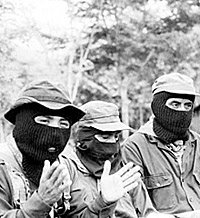 Capítulo paquistanês do FSM 2006 é adiado em pelo menos 2 meses por conta do terremoto que abalou o país em outubro. Já na Venezuela, a Rede de Movimentos Sociais convidou Exército Zapatista para reforçar a luta contra a intervenção dos Estados Unidos na América Latina.
Já era esperado, mas a definição do adiamento do capítulo paquistanês do Fórum Social Mundial 2006, que deveria ocorrer de forma policêntrico na Venezuela (Caracas), Mali (Bamako) e Paquistão (Karachi), foi tomada apenas na semana passada pelo Comitê Nacional e pelo Comitê Organizador (CO) do FSM 2006 em Karachi. O que pesou nesta decisão, segundo os paquistaneses, foi toda a conjuntura nacional pós-terremoto que arrasou o Sul da Ásia no mês passado.
Segundo o informe do secretário do Comitê Paquistanês, Irfan Mufti, o principal problema para a realização do evento – que já conta com a inscrição de 238 atividades até o momento -, além da dedicação dos esforços ao socorro às vítimas do terremoto e à reconstrução do país por grande parte das organizações participantes do FSM, é a captação de recursos. “Foi informado que o número de doadores (tanto indivíduos quanto organizações) que haviam se comprometido a financiar o evento antes do terremoto foi reduzido, uma vez que a maioria desses recursos foi agora destinada ao socorro às vítimas e aos trabalhos de reconstrução”, diz o relatório de Mufti.
Una alternativa a las guerras imperialistas - Guerra o Paz / Guerra y Paz por James Petras
En una contribución magistral presentada en la conferencia Axis for Peace 2005, el profesor James Petras analiza las contradicciones del sistema imperialista estadounidense. Destaca la manipulación de la ONU y el derecho internacional por las grandes potencias. Describe el avance desenfrenado de los militaristas civiles, neoconservadores y sionistas. Lejos de caer en el pesimismo, el célebre intelectual estadounidense traza las perspectivas de una resistencia popular internacional.
Chávez y Kirchner: Un nuevo comienzo
El fortalecimiento argentino de las relaciones económicas y políticas con el gobierno venezolano, acelerado luego del previsible fiasco de la Cumbre de Presidentes de Mar del Plata, ha provocado la santa indignación de la Casa Blanca y sus numerosos voceros esparcidos. Como era de esperarse estos no tardaron en poner el grito en el cielo reproduciendo, con tonos aún más severos y amenazantes, la voz de orden del imperio. Quienes durante más de una década celebraron como una prueba de madurez de estadista la política menemista de las relaciones carnales con Washington –causante principal de la fenomenal crisis que se abatió sobre la Argentina entre 1998 y 2002- ahora se rasgan las vestiduras ante el acercamiento de la Casa Rosada al gobierno del Presidente Hugo Chávez. Si aquel disparate era una prueba de realismo y sensatez, se comprende que los publicistas del imperio caractericen al diálogo entre Buenos Aires y Caracas como una acabada muestra de resentimiento, ideologismo o nostalgia setentista. La derecha latinoamericana es de un repugnante servilismo pero hay que reconocerle su coherencia: refleja siempre con milimétrica precisión y en tiempo real las políticas del imperio, que nunca se equivoca al identificar a sus enemigos.
Como es sabido, los cruzados de la democracia y la libertad que sientan sus reales en el eje Washington-Nueva York y que enseñan magistralmente lo que significan esos conceptos en Irak y Afganistán, o con sus aviones cargados de prisioneros políticos despachados a distintos países en donde gobiernos considerados “democráticos” se encargan de torturarlos “legalmente”, han decidido que el gobierno de la revolución bolivariana pone en peligro la democracia en Venezuela y que cualquier aproximación al mismo, o a la Cuba de Fidel, convierte al recién llegado en cómplice de todos los males imaginables. Se ignoran premeditadamente los resultados de diversos sondeos de opinión pública realizados en toda América Latina: pese a los dichos de Washington Venezuela es, de lejos, el país en donde la población muestra los más altos índices de satisfacción con la gestión del gobierno y, a causa de eso, el lugar en el cual la idea misma de la democracia es más valorada por la ciudadanía.
¿Por qué debería la Argentina plegarse a una campaña de satanización del gobierno de Chávez? ¿No es acaso evidente que aquélla forma parte de una estrategia de construcción de “mentiras que parezcan verdades” -para usar la (in)feliz expresión de Mario Vargas Llosa-, falsedades como las que aseguraban que existían armas de destrucción masiva en Irak y animada por el propósito de crear un clima de opinión internacional que consienta la agresión a Venezuela ya planificada por la Casa Blanca? ¿O es que ignoran la existencia de los documentos oficiales diseñando el “cambio de régimen”, hacia la “democracia y el libre mercado”, en Cuba y Venezuela?
Si los ideólogos de la Casa Blanca dicen que los Estados Unidos son un imperio -¡admitiendo lo que la izquierda venía diciendo desde hacía más de medio siglo!-, ¿por qué plegarse a las políticas imperiales –como el ALCA, por ejemplo- suponiendo que ellas se inspiran en el afán de garantizar el bienestar y la felicidad de nuestros pueblos? ¿Hemos de creer en las palabras del presidente del Diálogo Inter-Americano, Peter Hakim, cuando acusa al gobierno de Venezuela de “no estar comprometido con los principios del libre mercado”? Hakim, que por un extravío de su juventud supo apoyar al gobierno de Allende (algo de lo cual seguramente prefiere no acordarse ahora) parece desconocer que esta actitud de Chávez no hace sino reflejar el generalizado repudio que tales principios suscitan en la región. Una reciente encuesta de Latinobarómetro en 18 países comprueba que sólo el 19 % de los entrevistados manifestó su satisfacción con la economía de mercado. No obstante ello Hakim se cree autorizado para sermonear a Chávez diciento que éste “no es alguien que tome muy en serio” la cláusula democrática del Mercosur. El Diálogo Inter-Americano sí, y nos ofrece una lección práctica de democracia al repudiar descaradamente la opinión del 81 % de la ciudadanía que no cree en el mito malsano del libre mercado. Democracia “American style”, que le dicen.
Chávez, la gran innovación de la política latinoamericana en las últimas décadas, propone un nuevo y esperanzador comienzo. Y a diferencia de la Casa Blanca sus palabras son respaldadas con hechos. Aquélla se llena la boca hablando del libre comercio y la democracia, pero se aferra ferozmente al proteccionismo y los subsidios, y socava con su accionar las precariaes democracias de la región. Chávez, por el contrario, respalda sus propuestas de unidad latinoamericana con políticas concretas, que muestran que el egoísmo desenfrenado de los mercados no es la única manera de organizar la economía internacional. Petróleo barato para los pequeños países de Centroamérica y el Caribe; acuerdos de genuina complementación industrial con Argentina y Brasil, beneficioso para los países y no para un puñado de monopolios; solidaridad efectiva con la Argentina al comprar nuestros bonos de la deuda; intercambio de energéticos por asistencia médica y medicinas con Cuba, y así sucesivamente. Chávez está abriendo un camino, que significa revitalizar el desfalleciente MERCOSUR y construir un orden económico regional más justo y equitativo, mientras que Bush, como el Shylock en el Mercader de Venecia, se empecina en obtener su libra de carne mientras sermonea a sus víctimas sobre las virtudes de la libertad. Sólo gobiernos insanablemente ineptos, cobardes y antipatrióticos podrían darle la espalda a las generosas iniciativas del líder bolivariano.
Como es sabido, los cruzados de la democracia y la libertad que sientan sus reales en el eje Washington-Nueva York y que enseñan magistralmente lo que significan esos conceptos en Irak y Afganistán, o con sus aviones cargados de prisioneros políticos despachados a distintos países en donde gobiernos considerados “democráticos” se encargan de torturarlos “legalmente”, han decidido que el gobierno de la revolución bolivariana pone en peligro la democracia en Venezuela y que cualquier aproximación al mismo, o a la Cuba de Fidel, convierte al recién llegado en cómplice de todos los males imaginables. Se ignoran premeditadamente los resultados de diversos sondeos de opinión pública realizados en toda América Latina: pese a los dichos de Washington Venezuela es, de lejos, el país en donde la población muestra los más altos índices de satisfacción con la gestión del gobierno y, a causa de eso, el lugar en el cual la idea misma de la democracia es más valorada por la ciudadanía.
¿Por qué debería la Argentina plegarse a una campaña de satanización del gobierno de Chávez? ¿No es acaso evidente que aquélla forma parte de una estrategia de construcción de “mentiras que parezcan verdades” -para usar la (in)feliz expresión de Mario Vargas Llosa-, falsedades como las que aseguraban que existían armas de destrucción masiva en Irak y animada por el propósito de crear un clima de opinión internacional que consienta la agresión a Venezuela ya planificada por la Casa Blanca? ¿O es que ignoran la existencia de los documentos oficiales diseñando el “cambio de régimen”, hacia la “democracia y el libre mercado”, en Cuba y Venezuela?
Si los ideólogos de la Casa Blanca dicen que los Estados Unidos son un imperio -¡admitiendo lo que la izquierda venía diciendo desde hacía más de medio siglo!-, ¿por qué plegarse a las políticas imperiales –como el ALCA, por ejemplo- suponiendo que ellas se inspiran en el afán de garantizar el bienestar y la felicidad de nuestros pueblos? ¿Hemos de creer en las palabras del presidente del Diálogo Inter-Americano, Peter Hakim, cuando acusa al gobierno de Venezuela de “no estar comprometido con los principios del libre mercado”? Hakim, que por un extravío de su juventud supo apoyar al gobierno de Allende (algo de lo cual seguramente prefiere no acordarse ahora) parece desconocer que esta actitud de Chávez no hace sino reflejar el generalizado repudio que tales principios suscitan en la región. Una reciente encuesta de Latinobarómetro en 18 países comprueba que sólo el 19 % de los entrevistados manifestó su satisfacción con la economía de mercado. No obstante ello Hakim se cree autorizado para sermonear a Chávez diciento que éste “no es alguien que tome muy en serio” la cláusula democrática del Mercosur. El Diálogo Inter-Americano sí, y nos ofrece una lección práctica de democracia al repudiar descaradamente la opinión del 81 % de la ciudadanía que no cree en el mito malsano del libre mercado. Democracia “American style”, que le dicen.
Chávez, la gran innovación de la política latinoamericana en las últimas décadas, propone un nuevo y esperanzador comienzo. Y a diferencia de la Casa Blanca sus palabras son respaldadas con hechos. Aquélla se llena la boca hablando del libre comercio y la democracia, pero se aferra ferozmente al proteccionismo y los subsidios, y socava con su accionar las precariaes democracias de la región. Chávez, por el contrario, respalda sus propuestas de unidad latinoamericana con políticas concretas, que muestran que el egoísmo desenfrenado de los mercados no es la única manera de organizar la economía internacional. Petróleo barato para los pequeños países de Centroamérica y el Caribe; acuerdos de genuina complementación industrial con Argentina y Brasil, beneficioso para los países y no para un puñado de monopolios; solidaridad efectiva con la Argentina al comprar nuestros bonos de la deuda; intercambio de energéticos por asistencia médica y medicinas con Cuba, y así sucesivamente. Chávez está abriendo un camino, que significa revitalizar el desfalleciente MERCOSUR y construir un orden económico regional más justo y equitativo, mientras que Bush, como el Shylock en el Mercader de Venecia, se empecina en obtener su libra de carne mientras sermonea a sus víctimas sobre las virtudes de la libertad. Sólo gobiernos insanablemente ineptos, cobardes y antipatrióticos podrían darle la espalda a las generosas iniciativas del líder bolivariano.
"Para cambiar el mundo hay que tomar el poder"
Junto a Noam Chomsky, Howard Zinn y otros pocos adelantados del pensamiento de la izquierda mundial, Tariq Alí integra la escasa lista de escritores con una conciencia social que han acompañado las más agudas críticas al imperialismo contemporáneo con el aliento de prácticas globales de resistencia.
Desde el pasado viernes se encuentra en Cuba, invitado por el Instituto Cubano del Libro, y su presencia en el homenaje que se le hizo en la Habana a Jean Paul Sartre y en la Universidad de La Habana, donde este martes ofreció una conferencia, es una incitación a la pregunta para cualquiera que se interese en los acontecimientos de la guerra en Iraq. Al tema, que sigue con manía de explorador, le ha dedicado dos libros –El choque de los fundamentalismo y Bush en Babilonia-, reconocidos por la crítica internacional como clásicos, a escasos meses de convertirse en sucesos editoriales en Estados Unidos y Europa. Durante su visita a la Isla se ha anunciado que El choque de los fundamentalismos será publicado aquí próximamente por la Editorial de Ciencias Sociales.
Más que una entrevista formal, lo que concertamos con él es una conversación en la que él nos comenta algunas de las noticias que agitan el mundo informativo: el anuncio de Estados Unidos de que tiene un plan para retirar las tropas de Iraq, la evidencia de que Bush planificaba bombardear Al Jazeera, la presencia de médicos cubanos en Pakistán, su furtiva presencia en la Isla…
BUSH EN BABILONIA
-La administración norteamericana no deja de bombardearnos todos los días con las supuestas señales de terroristas internacionales en Iraq. ¿Qué hay de verdad en esto?
-Quién es o deja de ser terrorista forma parte de una gran maquinaria de desinformación. Los Estados Unidos intentan decirle al mundo que no hay resistencia en Iraq, sino simplemente terrorismo. Para demostrarlo, publican solo lo que hace el grupo de Abu Mussab Al Sarkawi. Pero este hombre entró a Iraq después de la ocupación. No estaba ahí antes, lo que nos prueba que la manera en que los EE.UU. luchan contra el terrorismo, aumenta el terrorismo. Al Qaeda también llegó a Iraq con la ocupación.
Lo que no dicen es que el grueso de la resistencia iraquí viene de las corrientes nacionalistas, en su mayoría de las Fuerzas Armadas de Sadam Hussein que no tenía ninguna fe en su gobierno. Ellos crearon focos de resistencia en varias ciudades del país desde antes de la entrada de los EE.UU. Por eso la característica más singular de esa resistencia es su temprana aparición frente a las tropas colonialistas. Si la comparas con otras intervenciones militares, verás que la resistencia suele demorarse. En el caso de Iraq la resistencia comenzó en los primeros diez días después de la caída de Bagdad.
El objetivo de toda ocupación es dividir, dividir, dividir. Es lo que han hecho los Estados Unidos. Han enfrentado a los tres grupos étnicos fundamentales en el país: los kurdos, los sunitas y los chiítas. No hay dudas de que los chiítas están colaborando con los interventores, pero cuando una sección de ese grupo chiíta decida romper con el clero de su etnia, se acabará la ayuda a los Estados Unidos.
En cualquier caso, es un desastre para ellos. Están en una encrucijada. O le entregan el país a Irán, o impondrán algún tipo de gobierno nacional. No se van a quedar. La ocupación es insostenible.
-De cualquier manera, el mayor terrorismo internacional que se practica en Irak es el norteamericano.
-El terrorismo de Estado practicado por los norteamericanos es de larga data. Empezó con la doctrina Monroe, que identificaba al Sur como su patio trasero. En el siglo XX, los norteamericanos fueron los únicos en usar las armas nucleares. Emplearon armas químicas contra Corea y contra Viet Nam, que todavía causan estragos, 30 años después de ser utilizadas. Usaron uranio empobrecido en la primera intervención en el Golfo, y años después, cuando volvieron a intervenir en esa región.
La mayoría del mundo conoce bien quiénes son ellos. El problema es que buena parte de la elite de este planeta, que también dirige nuestros destinos y se da perfecta cuenta del peligro de la supremacía norteamericana, no tiene valor para enfrentar al Imperio. La gran resistencia política hoy proviene de América Latina.
Desde el pasado viernes se encuentra en Cuba, invitado por el Instituto Cubano del Libro, y su presencia en el homenaje que se le hizo en la Habana a Jean Paul Sartre y en la Universidad de La Habana, donde este martes ofreció una conferencia, es una incitación a la pregunta para cualquiera que se interese en los acontecimientos de la guerra en Iraq. Al tema, que sigue con manía de explorador, le ha dedicado dos libros –El choque de los fundamentalismo y Bush en Babilonia-, reconocidos por la crítica internacional como clásicos, a escasos meses de convertirse en sucesos editoriales en Estados Unidos y Europa. Durante su visita a la Isla se ha anunciado que El choque de los fundamentalismos será publicado aquí próximamente por la Editorial de Ciencias Sociales.
Más que una entrevista formal, lo que concertamos con él es una conversación en la que él nos comenta algunas de las noticias que agitan el mundo informativo: el anuncio de Estados Unidos de que tiene un plan para retirar las tropas de Iraq, la evidencia de que Bush planificaba bombardear Al Jazeera, la presencia de médicos cubanos en Pakistán, su furtiva presencia en la Isla…
BUSH EN BABILONIA
-La administración norteamericana no deja de bombardearnos todos los días con las supuestas señales de terroristas internacionales en Iraq. ¿Qué hay de verdad en esto?
-Quién es o deja de ser terrorista forma parte de una gran maquinaria de desinformación. Los Estados Unidos intentan decirle al mundo que no hay resistencia en Iraq, sino simplemente terrorismo. Para demostrarlo, publican solo lo que hace el grupo de Abu Mussab Al Sarkawi. Pero este hombre entró a Iraq después de la ocupación. No estaba ahí antes, lo que nos prueba que la manera en que los EE.UU. luchan contra el terrorismo, aumenta el terrorismo. Al Qaeda también llegó a Iraq con la ocupación.
Lo que no dicen es que el grueso de la resistencia iraquí viene de las corrientes nacionalistas, en su mayoría de las Fuerzas Armadas de Sadam Hussein que no tenía ninguna fe en su gobierno. Ellos crearon focos de resistencia en varias ciudades del país desde antes de la entrada de los EE.UU. Por eso la característica más singular de esa resistencia es su temprana aparición frente a las tropas colonialistas. Si la comparas con otras intervenciones militares, verás que la resistencia suele demorarse. En el caso de Iraq la resistencia comenzó en los primeros diez días después de la caída de Bagdad.
El objetivo de toda ocupación es dividir, dividir, dividir. Es lo que han hecho los Estados Unidos. Han enfrentado a los tres grupos étnicos fundamentales en el país: los kurdos, los sunitas y los chiítas. No hay dudas de que los chiítas están colaborando con los interventores, pero cuando una sección de ese grupo chiíta decida romper con el clero de su etnia, se acabará la ayuda a los Estados Unidos.
En cualquier caso, es un desastre para ellos. Están en una encrucijada. O le entregan el país a Irán, o impondrán algún tipo de gobierno nacional. No se van a quedar. La ocupación es insostenible.
-De cualquier manera, el mayor terrorismo internacional que se practica en Irak es el norteamericano.
-El terrorismo de Estado practicado por los norteamericanos es de larga data. Empezó con la doctrina Monroe, que identificaba al Sur como su patio trasero. En el siglo XX, los norteamericanos fueron los únicos en usar las armas nucleares. Emplearon armas químicas contra Corea y contra Viet Nam, que todavía causan estragos, 30 años después de ser utilizadas. Usaron uranio empobrecido en la primera intervención en el Golfo, y años después, cuando volvieron a intervenir en esa región.
La mayoría del mundo conoce bien quiénes son ellos. El problema es que buena parte de la elite de este planeta, que también dirige nuestros destinos y se da perfecta cuenta del peligro de la supremacía norteamericana, no tiene valor para enfrentar al Imperio. La gran resistencia política hoy proviene de América Latina.
Dictator Bush Cheerleading at Annapolis
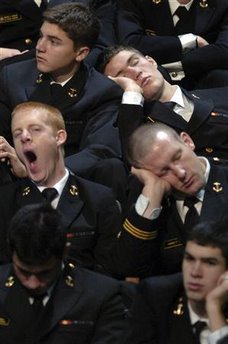 Photo: Midshipmen catch naps as they wait for more than an hour for U.S. President George W. Bush to deliver an address on the war in Iraq at the U.S. Naval Academy in Annapolis, Maryland November 30, 2005. (Jonathan Ernst/Reuters)
November 30, 2005
It's pathetic to see the world's most powerful man, shunted into prearranged venues so he can pitch his snake-oil to college aged boys. That said, Bush's appearance today at the Naval Academy has got to be a new low for the White House public relations team. Apparently the only people buying the huckster-in-chief's bedraggled vision of a democratic Iraq are rosy-cheeked young men who dream of battlefields instead of girlfriends.
Is this the last place Bush can count on a round of applause without body-scanning everyone who enters the door?
"Setting an artificial deadline to withdraw would vindicate the terrorist tactics of beheadings and suicide bombings and mass murder and invite new attacks on America," Bush boomed.
Bush loves the applause. He luxuriates in the warm glow of human affection. In many ways he is the consummate politician feeding his fragile ego with the ephemeral praise of complete strangers. Too bad, his only springboard to fame has been as bullhorn for right-wing fanatics and war-mongers. Now, he finds himself toddling on a narrower and narrower ledge, peering down into the abyss of defeat and disgrace.
Bush Resigns
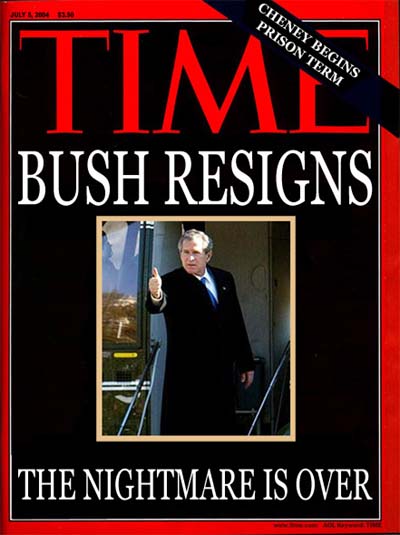 George Bush today resigned his presidency.
Three months ago, Bush was slapped with a one-count indictment by the Iraq War Crimes Tribunal charging him with crimes against humanity.
Standing before Air Force One at Andrews Air Force Base, Bush read the following statement:
"Today, I am resigning as President of the United States because I have compromised the trust of my constituents.
"Several months ago, I publicly declared my innocence because I was not strong enough to face the truth.
"So, I misled my family, staff, friends, colleagues, the public -- even myself.
"For all of this, I am deeply sorry.
"The truth is -- I broke the law, concealed my conduct, and disgraced my high office.
"I know that I will forfeit my freedom, my reputation, my worldly possessions, and most importantly, the trust of my friends and family.
"Some time ago, I asked my lawyers to inform the special war crimes prosecutor that I would like to plead guilty and begin serving a prison term.
"Today is the culmination of that process.
"I will continue to cooperate with the government's ongoing investigation to the best of my ability.
"In my life, I have known great joy and great sorrow.
"And now I know great shame."
Okay, so that wasn't George Bush.
Change a few words, and that is the verbatim statement of Congressman Randall "Duke" Cunningham, who pled guilty in San Diego today to taking more than $2.4 million in bribes from a number of defense contractors.
He faces 10 years in prison.
Here's the rest of Cunningham's statement:
"I learned in Viet Nam that the true measure of a man is how he responds to adversity.
"I cannot undo what I have done.
"But I can atone.
"I am now almost 65 years old and, as I enter the twilight of my life, I intend to use the remaining time that God grants me to make amends.
"The first step in that journey is to admit fault and apologize.
"The next step is to face the consequences of my actions like a man.
"Today, I have taken the first step and, with God's grace, I will soon take the second."
Of course, George Bush did not learn anything in Vietnam.
Because he skipped out on Vietnam. Not out of principle, but simply from the exercise of class privilege.
But as former Congressman Cunningham said today, "the true measure of a man is how he responds to adversity."
And George Bush is facing adverse times.
Why wait for the indictment?
Do what white-collar criminals do.
Go to the prosecutor and come clean.
Admit to the war crimes you have committed.
What you have done is a violation of international law.
Indeed, as former chief justice and Nuremberg prosecutor Robert Jackson put it -- a war of aggression is the supreme international crime.
And you have committed it.
The first step of your journey is to admit fault and apologize -- to the American people, to the Iraqi people and to the people of the world.
The second step is to face the consequences of your actions like a man.
You have known great joy and sorrow in your life.
Now is your time to know shame.
Q/A on the Iraq War by Noam Chomsky
1. On Reconstruction
Anthony DiMaggio: The "humanitarian reconstruction" of Iraq has been acknowledged to a large degree as a failure in the corporate press. It's interesting, though, to see the reasons given for why: the resistance is hampering reconstruction, there wasn't perfect foresight by the Bush administration in the reconstruction coordination planning process, the excessive "rapid personnel shifts" of those Americans involved in rebuilding, American money has "necessarily" gone to "pacification" instead of rebuilding, etc. What seems to be systematically omitted here is any real responsibility placed on the Bush Administration for its failure to make humanitarian reconstruction a high priority.
Chomsky: The excuses also overlook the fact that the insurgency was created by the brutality of the invasion and occupation -- which is, in fact, one of the most astonishing failures in military history. The Nazis had less trouble in occupied Europe, and the Russians held their satellites for decades with far less difficulty. It is difficult to think of an analog. A few months after the invasion, I met a highly experienced senior physician with one of the leading relief organizations, who has served in some of the worst parts of the world. He had just returned briefly from Baghdad, where he was trying to reestablish medical facilities, but was unable to because of the incompetence of the CPA. He told me he had never seen such a combination of "arrogance, ignorance, and incompetence," referring to the Pentagon civilians in charge. In fact, it was monumental. They even failed to guard the WMD sites that had been under UN supervision, so that they were systematically looted, handing over to someone -- probably jihadis --high-precision equipment suitable for producing missiles and nuclear weapons, dangerous bio-toxins, etc., which had been provided to their friend Saddam by the US, UK and others. The ironies are almost indescribable.
Anthony DiMaggio: The "humanitarian reconstruction" of Iraq has been acknowledged to a large degree as a failure in the corporate press. It's interesting, though, to see the reasons given for why: the resistance is hampering reconstruction, there wasn't perfect foresight by the Bush administration in the reconstruction coordination planning process, the excessive "rapid personnel shifts" of those Americans involved in rebuilding, American money has "necessarily" gone to "pacification" instead of rebuilding, etc. What seems to be systematically omitted here is any real responsibility placed on the Bush Administration for its failure to make humanitarian reconstruction a high priority.
Chomsky: The excuses also overlook the fact that the insurgency was created by the brutality of the invasion and occupation -- which is, in fact, one of the most astonishing failures in military history. The Nazis had less trouble in occupied Europe, and the Russians held their satellites for decades with far less difficulty. It is difficult to think of an analog. A few months after the invasion, I met a highly experienced senior physician with one of the leading relief organizations, who has served in some of the worst parts of the world. He had just returned briefly from Baghdad, where he was trying to reestablish medical facilities, but was unable to because of the incompetence of the CPA. He told me he had never seen such a combination of "arrogance, ignorance, and incompetence," referring to the Pentagon civilians in charge. In fact, it was monumental. They even failed to guard the WMD sites that had been under UN supervision, so that they were systematically looted, handing over to someone -- probably jihadis --high-precision equipment suitable for producing missiles and nuclear weapons, dangerous bio-toxins, etc., which had been provided to their friend Saddam by the US, UK and others. The ironies are almost indescribable.
Bush's Newest Crusader - Bush just appointed a guy to be deputy director of USAID who believes Muslims will burn in hell.
William Fisher has managed economic development programs in the Middle East, Africa, Latin America and Asia for the U.S. State Department and the U.S. Agency for International Development. This piece was originally published in The Daily Star and is reprinted with permission.
Washington is a town where the best and the brightest usually coexist with well-connected political hacks. However, the Bush administration has taken promotion of the latter to embarrassing extremes, selecting unqualified people for posts because of their political loyalty and ideological persuasion. The most recent example of this was the appointment of Paul Bonicelli to be deputy director of the United States Agency for International Development (USAID), which is in charge of all programs to promote democracy and good governance overseas.
One would have thought the administration had learned its lesson. In the aftermath of Hurricane Katrina, the director of the Federal Emergency Management Agency, Michael Brown, was forced to resign because of his incompetence in dealing with the consequences of the storm. Soon afterward, President George W. Bush named While House counsel Harriet Miers to the Supreme Court. Her lack of qualifications, and a Republican revolt against the nomination, forced her to withdraw.
Like Brown and Miers, Bonicelli has little experience in the field he has been tapped to supervise. The closest he comes to democracy promotion or good governance is having worked as a staffer for the Republican Party in the International Relations Committee of the House of Representatives.
More significant to the administration, perhaps, is the fact that Bonicelli is dean of academic affairs at tiny Patrick Henry College in rural Virginia. The fundamentalist institution's motto is "For Christ and Liberty." It requires that all of its 300 students sign a 10-part "statement of faith" declaring, among other things, that they believe "Jesus Christ, born of a virgin, is God come in the flesh;" that "Jesus Christ literally rose bodily from the dead"; and that hell is a place where "all who die outside of Christ shall be confined in conscious torment for eternity."
Faculty members, too, must sign a pledge stating they share a generally literalist belief in the Bible. Revealingly, only biology and theology teachers are required to hold a literal view specifically of the Bible's six-day creation story. Bonicelli has stated, "I think the most important thing is our academic excellence, [and the fact that we] combine it with a serious statement about our faith and values ... I believe in six literal days, but I remain open to someone persuading me otherwise."
Patrick Henry was founded in 2000 for home-schooled students. Among the fundamentalist community, home-schooling is seen as a way to promote Christian values as an alternative to what is regarded as an increasingly secular and irreligious culture prevalent in public schools. The college says it aims to "prepare Christian men and women who will lead our nation and shape our culture with timeless biblical values and fidelity to the spirit of the American founding." It seeks "to aid in the transformation of American society by training Christian students to serve God and mankind with a passion for righteousness, justice and mercy, through careers of public service and cultural influence."
Though Bonicelli has scant credentials for his new post, he and his institution enjoy close ties to the Bush administration and to fundamentalist religious groups that form such a critical part of the president's base. Many Patrick Henry students have been chosen to serve as interns working for White House political adviser Karl Rove, for the White House Office of Public Liaison, and for Republican members of the House and Senate. "Most students' values don't link up with [those of] the Democrats," Bonicelli says.
In 2002, Bush appointed Bonicelli—along with former Vatican adviser John Klink and Janice Crouse of the ultra-conservative Concerned Women for America—to an American delegation attending a United Nations children's conference, where they sought to promote biblical values in U.S. foreign policy. This sparked angry protests from groups advocating women's rights and the separation of church and state.
What's wrong with this picture is that the USAID programs Bonicelli will run are important weapons in the arsenal of Bush's new public diplomacy czarina, White House confidante Karen Hughes. These programs are intended to play a central role in boosting Bush's efforts to foster democracy and freedom in Iraq and throughout the broader Middle East.
One can only wonder how Muslims, the target audience for these USAID programs, will react to the view that "all who die outside of Christ shall be confined in conscious torment for eternity."
Washington is a town where the best and the brightest usually coexist with well-connected political hacks. However, the Bush administration has taken promotion of the latter to embarrassing extremes, selecting unqualified people for posts because of their political loyalty and ideological persuasion. The most recent example of this was the appointment of Paul Bonicelli to be deputy director of the United States Agency for International Development (USAID), which is in charge of all programs to promote democracy and good governance overseas.
One would have thought the administration had learned its lesson. In the aftermath of Hurricane Katrina, the director of the Federal Emergency Management Agency, Michael Brown, was forced to resign because of his incompetence in dealing with the consequences of the storm. Soon afterward, President George W. Bush named While House counsel Harriet Miers to the Supreme Court. Her lack of qualifications, and a Republican revolt against the nomination, forced her to withdraw.
Like Brown and Miers, Bonicelli has little experience in the field he has been tapped to supervise. The closest he comes to democracy promotion or good governance is having worked as a staffer for the Republican Party in the International Relations Committee of the House of Representatives.
More significant to the administration, perhaps, is the fact that Bonicelli is dean of academic affairs at tiny Patrick Henry College in rural Virginia. The fundamentalist institution's motto is "For Christ and Liberty." It requires that all of its 300 students sign a 10-part "statement of faith" declaring, among other things, that they believe "Jesus Christ, born of a virgin, is God come in the flesh;" that "Jesus Christ literally rose bodily from the dead"; and that hell is a place where "all who die outside of Christ shall be confined in conscious torment for eternity."
Faculty members, too, must sign a pledge stating they share a generally literalist belief in the Bible. Revealingly, only biology and theology teachers are required to hold a literal view specifically of the Bible's six-day creation story. Bonicelli has stated, "I think the most important thing is our academic excellence, [and the fact that we] combine it with a serious statement about our faith and values ... I believe in six literal days, but I remain open to someone persuading me otherwise."
Patrick Henry was founded in 2000 for home-schooled students. Among the fundamentalist community, home-schooling is seen as a way to promote Christian values as an alternative to what is regarded as an increasingly secular and irreligious culture prevalent in public schools. The college says it aims to "prepare Christian men and women who will lead our nation and shape our culture with timeless biblical values and fidelity to the spirit of the American founding." It seeks "to aid in the transformation of American society by training Christian students to serve God and mankind with a passion for righteousness, justice and mercy, through careers of public service and cultural influence."
Though Bonicelli has scant credentials for his new post, he and his institution enjoy close ties to the Bush administration and to fundamentalist religious groups that form such a critical part of the president's base. Many Patrick Henry students have been chosen to serve as interns working for White House political adviser Karl Rove, for the White House Office of Public Liaison, and for Republican members of the House and Senate. "Most students' values don't link up with [those of] the Democrats," Bonicelli says.
In 2002, Bush appointed Bonicelli—along with former Vatican adviser John Klink and Janice Crouse of the ultra-conservative Concerned Women for America—to an American delegation attending a United Nations children's conference, where they sought to promote biblical values in U.S. foreign policy. This sparked angry protests from groups advocating women's rights and the separation of church and state.
What's wrong with this picture is that the USAID programs Bonicelli will run are important weapons in the arsenal of Bush's new public diplomacy czarina, White House confidante Karen Hughes. These programs are intended to play a central role in boosting Bush's efforts to foster democracy and freedom in Iraq and throughout the broader Middle East.
One can only wonder how Muslims, the target audience for these USAID programs, will react to the view that "all who die outside of Christ shall be confined in conscious torment for eternity."
Wednesday, November 30, 2005
Timely demise for Free Trade Area of the Americas
From upsidedownworld.org
The stage was set for a showdown. When the Bush cabinet announced intentions to revive the moribund Free Trade Area of the Americas at the Fourth Summit of the Americas in Mar del Plata, the countries of the Southern Common Market closed ranks to prevent it. What followed was a diplomatic melee that reflects not so much divisions within Latin America, as a growing resistance to the current free trade model throughout the developing world.The November summit was officially billed as a forum to discuss employment, and the issue of creation of a Free Trade Area of the Americas was not even on the agenda. However, well before landing in the Argentine beach town, the Bush administration made clear its intentions to leave with a specific commitment to restart negotiations.
The U.S. government was determined to come out of the meeting with a revitalized FTAA because the administration feared that if the negotiations were left to languish, momentum could be lost for the initiative at a crucial time. The FTAA was first launched by George W. Bush's father, but after ten years of inconclusive talks and significant differences between the countries, the goal of a hemisphere-wide NAFTA remained elusive.
Blog from Bolivia - If Morales Wins, Will He Seek the Presidency?
Predicting the future in politics is always a dubious business. In Bolivia it is dubious en el extremo (Who predicted in 2001 that we would have five different Presidents in five years?). But with an army of fresh foreign reporters headed this way to cover Bolivia’s Presidential vote – many of whom read this Blog – here’s a bit of analysis and prediction that they ought to keep in mind as they try to interpret the strange dance of Bolivia’s unplanned elections.
Rule #1: Winning the Popular Vote is Not Winning the Presidency
Okay, let’s say that the polls are relatively accurate and not much changes between now and December 18th. If that is the case, then Evo Morales and MAS will likely finish in first place with (and this is a guess) somewhere between 30% to 35% of the vote. Tuto Quiroga comes in a strong second place with 25%. Samuel Doria Medina finishes third with 15% or so. The rest of the pack comes in with somewhere between 2% to 5% each.
Rule #1: Winning the Popular Vote is Not Winning the Presidency
Okay, let’s say that the polls are relatively accurate and not much changes between now and December 18th. If that is the case, then Evo Morales and MAS will likely finish in first place with (and this is a guess) somewhere between 30% to 35% of the vote. Tuto Quiroga comes in a strong second place with 25%. Samuel Doria Medina finishes third with 15% or so. The rest of the pack comes in with somewhere between 2% to 5% each.
Chavez, Fox and the Bolivarian Alternative for Latin America
From upsidedownworld.org
In what has become a vindictive exchange of words between Mexican President Vicente Fox and Venezuela’s Hugo Chavez, which on the surface appears to be an ideological battle over trade policy, is in fact rooted in the future development and economic integration of the Americas. Although the Venezuelan president’s words may have isolated him for the moment from the Fox administration, it is actually Fox, and his party, who may be isolated from the Mexican people and government with elections coming up in July of 2006.The debate, which is by no means a new one, has returned to public attention following the Summit of the Americas in Argentina, where Chavez, members of MERCUSOR (the South American trade bloc), and thousands of people in the streets of Mar Del Plata, "buried" the Free Trade Area of the Americas (FTAA).
Bush And Bomb Threats
The recent news that President George W. Bush might have threatened to bomb Al Jazeera is hard to believe. We don’t want to believe it. And given the source of the allegation—a British tabloid newspaper, The Daily Mirror —it deserves scrutiny. But it also deserves investigation, which so far the American press has been slow in pursuing.
Here's the background: Last week The Daily Mirror reported leaks of another memo from 10 Downing Street (a website in England called Blair Watch reports there may actually be two memos). The memo allegedly reported that, in a 2004 meeting with British Prime Minister Tony Blair, Bush discussed bombing Al Jazeera’s headquarters in Qatar. According to the allegation, Blair talked him out of it. The meeting between Bush and Blair occurred as U.S. troops were engaged in brutal combat in Fallujah—an offensive aired with all its gore by Al Jazeera but mostly sanitized in the United States. Bush was reportedly outraged that Al Jazeera was reporting the high number of Iraqi civilians killed in the assault.
The White House dismissed the bomb threat report as “outlandish.” For his part, Tony Blair tried to ignore it, and later derided it as a “conspiracy’ theory.
The specter of Bush threatening the Middle East’s most popular information source becomes less far-fetched when you consider the lengths this White House has pursued to censor damning information and the record of U.S. military attacks on the media. Many Americans don’t recall how, under George W. Bush, the U.S. military knocked out Saddam’s TV complex and attacked Al Jazeera offices in Kabul in 2001 and Baghdad in 2003. These incidents have for many U.S. viewers become “fog facts," in writer Larry Beinhart’s phrase—information we once knew, but has since disappeared from view.
Here's the background: Last week The Daily Mirror reported leaks of another memo from 10 Downing Street (a website in England called Blair Watch reports there may actually be two memos). The memo allegedly reported that, in a 2004 meeting with British Prime Minister Tony Blair, Bush discussed bombing Al Jazeera’s headquarters in Qatar. According to the allegation, Blair talked him out of it. The meeting between Bush and Blair occurred as U.S. troops were engaged in brutal combat in Fallujah—an offensive aired with all its gore by Al Jazeera but mostly sanitized in the United States. Bush was reportedly outraged that Al Jazeera was reporting the high number of Iraqi civilians killed in the assault.
The White House dismissed the bomb threat report as “outlandish.” For his part, Tony Blair tried to ignore it, and later derided it as a “conspiracy’ theory.
The specter of Bush threatening the Middle East’s most popular information source becomes less far-fetched when you consider the lengths this White House has pursued to censor damning information and the record of U.S. military attacks on the media. Many Americans don’t recall how, under George W. Bush, the U.S. military knocked out Saddam’s TV complex and attacked Al Jazeera offices in Kabul in 2001 and Baghdad in 2003. These incidents have for many U.S. viewers become “fog facts," in writer Larry Beinhart’s phrase—information we once knew, but has since disappeared from view.
Triumph of the Beast
The torture of Iraqi detainees by US military forces is undeniable. We now know the Bush administration condoned torture even before Operation Enduring Freedom and Operation Iraqi Freedom was launched upon Afghanistan and Iraq, in this post-9/11 hysteria of terrorist infiltration on American soil.
Congressman Marty Meehan (D-MA), a ranking member of the House Armed Services Committee, was horrified after he viewed Abu Ghraib prison photos released by the Department of Defense. Meehan remarked emerging from the darkened committee room, "I was obviously shocked and horrified to discover that the new photos were even more gruesome than those we have seen in the media. What went on there is indefensible and inexcusable."
During a recent trip to Panama, President Bush pontificated that Americans "do not torture"—his deployment of executive authority to keep Congress from imposing rules on prisoner treatment notwithstanding. With the implementation of the Patriot Act of 2001, President Bush was given express power to declare anyone suspected of having a connection to terrorists or terrorism an "enemy combatant" and thereby suspend his right to habeas corpus. The Senate diligently voted to cast innocent people into pain and darkness without recourse or rights. American citizens declared "enemy combatants"should not be denied the constitution; but a formable squawk about rights and habeas corpus forced a compromise of allowing a post-conviction appeal – for people who had been arbitrarily seized and held in isolation for years without charges, which had been tortured, humiliated and driven to madness, some committing suicide before facing a kangaroo court. Such was the deal cobbled together for Bush to present as a triumph of human spirit and the American way.
Congressman Marty Meehan (D-MA), a ranking member of the House Armed Services Committee, was horrified after he viewed Abu Ghraib prison photos released by the Department of Defense. Meehan remarked emerging from the darkened committee room, "I was obviously shocked and horrified to discover that the new photos were even more gruesome than those we have seen in the media. What went on there is indefensible and inexcusable."
During a recent trip to Panama, President Bush pontificated that Americans "do not torture"—his deployment of executive authority to keep Congress from imposing rules on prisoner treatment notwithstanding. With the implementation of the Patriot Act of 2001, President Bush was given express power to declare anyone suspected of having a connection to terrorists or terrorism an "enemy combatant" and thereby suspend his right to habeas corpus. The Senate diligently voted to cast innocent people into pain and darkness without recourse or rights. American citizens declared "enemy combatants"should not be denied the constitution; but a formable squawk about rights and habeas corpus forced a compromise of allowing a post-conviction appeal – for people who had been arbitrarily seized and held in isolation for years without charges, which had been tortured, humiliated and driven to madness, some committing suicide before facing a kangaroo court. Such was the deal cobbled together for Bush to present as a triumph of human spirit and the American way.
The Autumn of the Patriarchy
In the vice president's new, more fortified bunker, inside his old undisclosed secure location within the larger bunker that used to be called the West Wing of the White House, Dick Cheney was muttering and sputtering.
He wasn't talking to the pictures on the wall, as Nixon did when he finally cracked. Vice doesn't trust those portraits anyway. The walls have ears. He was talking to the only reliable man in a city of dimwits, cowards, traitors and fools: himself.
He hurled a sheaf of news reports with such force it knocked over the picture of Ahmad Chalabi that he keeps next to the picture of Churchill. Winston Chalabi, he likes to call him.
Vice is fed up with all the whining and carping - and that's just inside the White House. The only negativity in Washington is supposed to be his own. He's the only one allowed to scowl and grumble and conspire.
The impertinent Tom DeFrank reported in New York's Daily News that embattled White House aides felt "President Bush must take the reins personally" to save his presidency.
Let him try, Cheney said with a sneer. Things are nowhere near dire enough for that. Even if Junior somehow managed to grab the reins to his presidency, Vice holds Junior's reins. So he just needs to get all these sniveling, poll-driven wimps and losers back on board with the master plan.
Things had been going so smoothly. The global torture franchise was up and running. Halliburton contracts were flowing. Tax cuts were sailing through. Oil companies were raking it in. Alaska drilling was thrillingly close. The courts were defending his executive privilege on energy policy, and people were still buying all that smoke about Saddam's being responsible for 9/11, and that drivel about how we're fighting them there so we don't have to fight them here. Everything was groovy.
But not anymore. Cheney could not believe that Karl had made him go out and call that loudmouth Jack Murtha a patriot. He was sure the Pentagon generals had put the congressman up to calling for a withdrawal from Iraq. Is the military brass getting in touch with its pacifist side? In Wyoming, Vice shoots doves.
How dare Murtha suggest that Cheney dodged and dodged and dodged and dodged and dodged the draft? Murtha thinks he knows about war just because he served in one and was a marine for 37 years? Vice started his own war. Now that's a credential!
It always goes this way with the cut-and-run crowd. First they start nitpicking the war, complaining about little things like the lack of armor for the troops. Then they complain that there aren't enough troops. Well, that would just require more armor that we don't have. Then they kvetch about using incendiary weapons in a city like Falluja. Vice likes the smell of white phosphorus in the morning.
What really enrages him is all the Republicans in the Senate making noises about timetables. Before you know it, it's going to be helicopters on the rooftop at the Baghdad embassy.
Just because Junior's approval ratings are in the 30's, people around here are going all wobbly. Vice was 10 points lower and he wasn't worried. Numbers are for sissies.
Why do Harry Reid and his Democratic turncoats think they can call the White House on the carpet? Do they think Vice would fear to lie about lying about the rationale for going to war? A real liar never stops lying.
He didn't want to have to tell the rest of the senators to go do to themselves what he had told Patrick Leahy to go do to himself.
Now all these idiots are getting caught, even Scooter. DeLay's on the ropes and the Dukester is a total embarrassment, spending bribes on antique commodes and a Rolls-Royce. Vice should never have let an amateur get involved with defense contracts.
Republican moderates are running scared in the House, worried about re-election. Even senators seem to have forgotten which side their bread is oiled on. Ted Stevens let oil company executives get caught lying about the energy task force meeting, while Vice can't even get a little thing like torture chambers through the Senate. What's so wrong with a little torture?
And now John Warner wants Junior to use fireside chats to explain his plan for Iraq. When did everybody get the un-American idea that the president is answerable to America?
Vice is fed up with the whining of squirrelly surrogates like Brent Scowcroft and Lawrence Wilkerson on behalf of peaceniks like George Senior and Colin Powell. If Poppy's upset about his kid's mentor, he should be man enough to come slug it out.
Poppy isn't getting Junior back, Vice vowed, muttering: "He's my son. It's my war. It's my country."
He wasn't talking to the pictures on the wall, as Nixon did when he finally cracked. Vice doesn't trust those portraits anyway. The walls have ears. He was talking to the only reliable man in a city of dimwits, cowards, traitors and fools: himself.
He hurled a sheaf of news reports with such force it knocked over the picture of Ahmad Chalabi that he keeps next to the picture of Churchill. Winston Chalabi, he likes to call him.
Vice is fed up with all the whining and carping - and that's just inside the White House. The only negativity in Washington is supposed to be his own. He's the only one allowed to scowl and grumble and conspire.
The impertinent Tom DeFrank reported in New York's Daily News that embattled White House aides felt "President Bush must take the reins personally" to save his presidency.
Let him try, Cheney said with a sneer. Things are nowhere near dire enough for that. Even if Junior somehow managed to grab the reins to his presidency, Vice holds Junior's reins. So he just needs to get all these sniveling, poll-driven wimps and losers back on board with the master plan.
Things had been going so smoothly. The global torture franchise was up and running. Halliburton contracts were flowing. Tax cuts were sailing through. Oil companies were raking it in. Alaska drilling was thrillingly close. The courts were defending his executive privilege on energy policy, and people were still buying all that smoke about Saddam's being responsible for 9/11, and that drivel about how we're fighting them there so we don't have to fight them here. Everything was groovy.
But not anymore. Cheney could not believe that Karl had made him go out and call that loudmouth Jack Murtha a patriot. He was sure the Pentagon generals had put the congressman up to calling for a withdrawal from Iraq. Is the military brass getting in touch with its pacifist side? In Wyoming, Vice shoots doves.
How dare Murtha suggest that Cheney dodged and dodged and dodged and dodged and dodged the draft? Murtha thinks he knows about war just because he served in one and was a marine for 37 years? Vice started his own war. Now that's a credential!
It always goes this way with the cut-and-run crowd. First they start nitpicking the war, complaining about little things like the lack of armor for the troops. Then they complain that there aren't enough troops. Well, that would just require more armor that we don't have. Then they kvetch about using incendiary weapons in a city like Falluja. Vice likes the smell of white phosphorus in the morning.
What really enrages him is all the Republicans in the Senate making noises about timetables. Before you know it, it's going to be helicopters on the rooftop at the Baghdad embassy.
Just because Junior's approval ratings are in the 30's, people around here are going all wobbly. Vice was 10 points lower and he wasn't worried. Numbers are for sissies.
Why do Harry Reid and his Democratic turncoats think they can call the White House on the carpet? Do they think Vice would fear to lie about lying about the rationale for going to war? A real liar never stops lying.
He didn't want to have to tell the rest of the senators to go do to themselves what he had told Patrick Leahy to go do to himself.
Now all these idiots are getting caught, even Scooter. DeLay's on the ropes and the Dukester is a total embarrassment, spending bribes on antique commodes and a Rolls-Royce. Vice should never have let an amateur get involved with defense contracts.
Republican moderates are running scared in the House, worried about re-election. Even senators seem to have forgotten which side their bread is oiled on. Ted Stevens let oil company executives get caught lying about the energy task force meeting, while Vice can't even get a little thing like torture chambers through the Senate. What's so wrong with a little torture?
And now John Warner wants Junior to use fireside chats to explain his plan for Iraq. When did everybody get the un-American idea that the president is answerable to America?
Vice is fed up with the whining of squirrelly surrogates like Brent Scowcroft and Lawrence Wilkerson on behalf of peaceniks like George Senior and Colin Powell. If Poppy's upset about his kid's mentor, he should be man enough to come slug it out.
Poppy isn't getting Junior back, Vice vowed, muttering: "He's my son. It's my war. It's my country."
International specialists forecast black future for US dollar in 2006
The rate of the US currency may hit the all-time minimum in 2006: the dollar may drop to 1.38 dollars per one euro, Citigroup analysts said. According to this forecast, the US dollar is likely to lose 20 percent of its value during the forthcoming year. If the forecast is true, such a considerable decline of the US currency may bring severe damage to Russian people's savings.
Mystery of Woodward's Three Sources
Buried deep in an article by the Washington Post's media writer Howard Kurtz is new evidence that senior Bush administration officials knew their case for war with Iraq was shaky – and that the Post's star reporter Bob Woodward ducked his duty to the American people to present this information before the invasion began.
Not only did Woodward withhold evidence that pre-war WMD intelligence was suspect, he added his clout to a post-invasion public relations campaign aimed at heading off criminal indictments of White House officials who had retaliated against an Iraq War critic by leaking classified information that endangered a covert CIA officer and her contacts.
To make matters worse, both these abuses of information came not on some garden-variety political dirty trick but on life-and-death questions about the administration’s integrity in leading the nation to war.
While it may be true that few of Washington's elite know the mostly working-class men and women in the all-volunteer U.S. military, the moral weight of their sacrifices – and their deaths – should have some bearing on the consciences in the nation's capital. Career advancement and seven-figure book contracts might for once take a back seat.
Not only did Woodward withhold evidence that pre-war WMD intelligence was suspect, he added his clout to a post-invasion public relations campaign aimed at heading off criminal indictments of White House officials who had retaliated against an Iraq War critic by leaking classified information that endangered a covert CIA officer and her contacts.
To make matters worse, both these abuses of information came not on some garden-variety political dirty trick but on life-and-death questions about the administration’s integrity in leading the nation to war.
While it may be true that few of Washington's elite know the mostly working-class men and women in the all-volunteer U.S. military, the moral weight of their sacrifices – and their deaths – should have some bearing on the consciences in the nation's capital. Career advancement and seven-figure book contracts might for once take a back seat.
U.S. Military Covertly Pays to Run Stories in Iraqi Press
As part of an information offensive in Iraq, the U.S. military is secretly paying Iraqi newspapers to publish stories written by American troops in an effort to burnish the image of the U.S. mission in Iraq.
The articles, written by U.S. military "information operations" troops, are translated into Arabic and placed in Baghdad newspapers with the help of a defense contractor, according to U.S. military officials and documents obtained by the Los Angeles Times.
Many of the articles are presented in the Iraqi press as unbiased news accounts written and reported by independent journalists. The stories trumpet the work of U.S. and Iraqi troops, denounce insurgents and tout U.S.-led efforts to rebuild the country.
Though the articles are basically factual, they present only one side of events and omit information that might reflect poorly on the U.S. or Iraqi governments, officials said. Records and interviews indicate that the U.S. has paid Iraqi newspapers to run dozens of such articles, with headlines such as "Iraqis Insist on Living Despite Terrorism," since the effort began this year.
The operation is designed to mask any connection with the U.S. military. The Pentagon has a contract with a small Washington-based firm called Lincoln Group, which helps translate and place the stories. The Lincoln Group's Iraqi staff, or its subcontractors, sometimes pose as freelance reporters or advertising executives when they deliver the stories to Baghdad media outlets.
The military's effort to disseminate propaganda in the Iraqi media is taking place even as U.S. officials are pledging to promote democratic principles, political transparency and freedom of speech in a country emerging from decades of dictatorship and corruption.
The articles, written by U.S. military "information operations" troops, are translated into Arabic and placed in Baghdad newspapers with the help of a defense contractor, according to U.S. military officials and documents obtained by the Los Angeles Times.
Many of the articles are presented in the Iraqi press as unbiased news accounts written and reported by independent journalists. The stories trumpet the work of U.S. and Iraqi troops, denounce insurgents and tout U.S.-led efforts to rebuild the country.
Though the articles are basically factual, they present only one side of events and omit information that might reflect poorly on the U.S. or Iraqi governments, officials said. Records and interviews indicate that the U.S. has paid Iraqi newspapers to run dozens of such articles, with headlines such as "Iraqis Insist on Living Despite Terrorism," since the effort began this year.
The operation is designed to mask any connection with the U.S. military. The Pentagon has a contract with a small Washington-based firm called Lincoln Group, which helps translate and place the stories. The Lincoln Group's Iraqi staff, or its subcontractors, sometimes pose as freelance reporters or advertising executives when they deliver the stories to Baghdad media outlets.
The military's effort to disseminate propaganda in the Iraqi media is taking place even as U.S. officials are pledging to promote democratic principles, political transparency and freedom of speech in a country emerging from decades of dictatorship and corruption.
It's official: Diebold election bugware can't be trusted - The company implies as much

Diebold would rather lose all of its voting machine business in North Carolina than open its source code to state election officials as required by law, the Associated Press reports.
Due to irregularities in the 2004 election traced to touch screen terminals, North Carolina has taken the very reasonable precaution of requiring vendors of electronic voting gizmos to place all of the source code in escrow. Diebold has objected to the possibility of criminal sanctions if they fail to comply, and argued for an exemption before Wake County Superior Court Judge Narley Cashwell. The judge declined to issue an exemption, and Diebold has concluded that it has no choice but withdraw from the state.
The company's explanation is that their machines contain Microsoft software, which they have no right to make available to state election officials. This seems disingenuous, as it is hard to imagine Microsoft suing Diebold for complying with the law. It would hardly be Diebold's fault if it released MS code to a lawful authority on demand; that issue would be something for MS and North Carolina to work out.
One far-fetched explanation would be that MS has licensed its software to Diebold with a provision that the company withdraw from jurisdictions where the law requires the release of its source code. It's possible, but there's no reason to believe it.
A considerably more plausible explanation is that Diebold is using this non-problem as an excuse to keep its bugware from the prying eyes of government regulators. And the most likely reason for that is that they've got a lot of blunders to hide. If North Carolina were to reject the machines on the basis of their software, other states would undoubtedly become suspicious, and begin doing their own investigations. So in that case, withdrawing from the market is the smartest move the company can make.
But if the software is as good as the company claims, then North Carolina's future endorsement will make for excellent free advertising. Withdrawing from the market would be a very foolish move in that case, but, again, only if Diebold has nothing to hide
U.S. Farmers Use Pesticide in Violation of International Treaty

A sign, required by law, warns of a pesticide application of methyl bromide on a field near Watsonville, Calif., Aug. 12, 2005. The pesticide is used to fumigate the soil as preparation for strawberry planting. The U.S. continues to permit the methyl bromide to be used despite signing an international treaty that banned its use by 2005. Its survival demonstrates the difficulty of banishing a chemical that is a powerful toxin but that also helps deliver abundant, pest-free and affordable produce for farmers and consumers.
The Hallucinations of (Neocon Nazi) Joe Lieberman
In an op-ed in The Wall Street Journal on November 28, Sen. Joe Lieberman (D-CT) put forward an argument for staying the course in Iraq. Of course, his argument in "Our Troops Must Stay" was filled with false information.
Lieberman describes "real progress" and "self-securing nationhood." What are the facts? Rep. Murtha laid them out clearly saying the "war in Iraq is not going as advertised" and, more specifically:
Lieberman describes "real progress" and "self-securing nationhood." What are the facts? Rep. Murtha laid them out clearly saying the "war in Iraq is not going as advertised" and, more specifically:
The "National" Strategy for "Victory" in Iraq
You don't really think I have the patience to read that crap, do you? Not when the very title contains at least two lies. "National" strategy? The "nation," in its overwhelming majority, wants the troops out of Iraq ASAP (somewhere between now and six months from now). This isn't the "national" strategy, it's the Bush administration strategy (and we use the word "strategy" loosely, of course). As far as "victory," that's also completely bogus, since Iraq isn't ours to "win," so the idea of "victory" is completely out of place.
I'll just note one thing that caught my eye -- the "long term" part of the "strategy": "Longer term, Iraq is peaceful, united, stable, and secure, well integrated into the international community, and a full partner in the global war on terrorism." Most people are focusing on the first few words, and the obvious implication that the U.S. will be in Iraq for a thousand years if we're waiting for Iraq to become "peaceful, united, stable, and secure" before leaving. But I think the other phrases say more about the U.S.'s real goals in Iraq. "Well integrated into the international community" means a full "partner" (i.e., lackey) in the international capitalist system, with low-paid labor and cheap raw materials (oil in this case) being furnished to the "international community" (i.e., the wealthy, imperialist nations), and foreign companies able to extract the maximum amount of profits out of Iraq. And "full partner in the [so-called] global war on terrorism" means, I presume, willing to host secret CIA prisons where people captured in other countries can be hidden and tortured out of the reach of the U.S. or international legal systems.
Well, at least that goal won't be too difficult to achieve.
Bush's speech contains one very interesting (and, I believe, new) thought (another word we use loosely):
Bush asserts that "rejectionists" "reject an Iraq in which they are no longer the dominant group." Notice anything missing? Like the notion that the overwhelming majority (80%) of Iraqis "reject" the U.S. occupation of their country? But accepting Bush's words on their face, what is he saying? That the Sunnis are fighting to be the dominant group in Iraq. Perhaps they are. Who the hell is the U.S. to stick not only their nose, but the barrel of their guns, into that fight on the side of the other side, i.e., the Shiites? What earthly right (or international law) allows the U.S. to determine that the Sunnis should not be the dominant group, and that their wish to be so makes them an "enemy" that must be "defeated"? Shall we also go into battle in England or Canada on behalf of the Conservative parties in those countries, or into Israel on behalf of Sharon's "Forward" party? I hear all of them want to be the "dominant" group too.
I actually want to say a lot more about the response by Democratic Senators John Kerry and Jack Reed, which I watched in disgust, but I don't think there's a transcript anywhere yet. The video is online here, but I'll have to rewatch it to transcribe some of the most quoteworthy material to integrate with my comments. Suffice it for now to say that anyone counting on the Democrats to facilitate an exit from Iraq probably still believes in the tooth fairy.
I'll just note one thing that caught my eye -- the "long term" part of the "strategy": "Longer term, Iraq is peaceful, united, stable, and secure, well integrated into the international community, and a full partner in the global war on terrorism." Most people are focusing on the first few words, and the obvious implication that the U.S. will be in Iraq for a thousand years if we're waiting for Iraq to become "peaceful, united, stable, and secure" before leaving. But I think the other phrases say more about the U.S.'s real goals in Iraq. "Well integrated into the international community" means a full "partner" (i.e., lackey) in the international capitalist system, with low-paid labor and cheap raw materials (oil in this case) being furnished to the "international community" (i.e., the wealthy, imperialist nations), and foreign companies able to extract the maximum amount of profits out of Iraq. And "full partner in the [so-called] global war on terrorism" means, I presume, willing to host secret CIA prisons where people captured in other countries can be hidden and tortured out of the reach of the U.S. or international legal systems.
Well, at least that goal won't be too difficult to achieve.
Bush's speech contains one very interesting (and, I believe, new) thought (another word we use loosely):
"As we fight the enemy in Iraq, every man and woman who volunteers to defend our nation deserves an unwavering commitment to the mission -- and a clear strategy for victory. A clear strategy begins with a clear understanding of the enemy we face. The enemy in Iraq is a combination of rejectionists, Saddamists [Ed. note: do you think they've adopted that term for fear of how Bush might mispronounce "Saddamites"?] and terrorists. The rejectionists are by far the largest group. These are ordinary Iraqis, mostly Sunni Arabs, who miss the privileged status they had under the regime of Saddam Hussein -- and they reject an Iraq in which they are no longer the dominant group."
Bush asserts that "rejectionists" "reject an Iraq in which they are no longer the dominant group." Notice anything missing? Like the notion that the overwhelming majority (80%) of Iraqis "reject" the U.S. occupation of their country? But accepting Bush's words on their face, what is he saying? That the Sunnis are fighting to be the dominant group in Iraq. Perhaps they are. Who the hell is the U.S. to stick not only their nose, but the barrel of their guns, into that fight on the side of the other side, i.e., the Shiites? What earthly right (or international law) allows the U.S. to determine that the Sunnis should not be the dominant group, and that their wish to be so makes them an "enemy" that must be "defeated"? Shall we also go into battle in England or Canada on behalf of the Conservative parties in those countries, or into Israel on behalf of Sharon's "Forward" party? I hear all of them want to be the "dominant" group too.
I actually want to say a lot more about the response by Democratic Senators John Kerry and Jack Reed, which I watched in disgust, but I don't think there's a transcript anywhere yet. The video is online here, but I'll have to rewatch it to transcribe some of the most quoteworthy material to integrate with my comments. Suffice it for now to say that anyone counting on the Democrats to facilitate an exit from Iraq probably still believes in the tooth fairy.
The police who arrested the Five participated in the conspiracy to assassinate Venezuelan Attorney General Anderson
IN its November 10 late edition, the Miami daily El Nuevo Herald revealed that according to "a Venezuelan government witness in the investigation into the murder of Attorney General Danilo Anderson," Héctor Pesquera, former FBI chief in Miami, who directed, organized and effected the arrest of the five Cubans transformed into spies in a grand media show, was also involved in the assassination of the Venezuelan official.
By publishing this information, the Miami daily has confirmed what several articles that have appeared in the wake of the assassination in Granma International, linking Pesquera to the many accomplices of the crime.
In a text signed by journalists Gerardo Reyes and Casto Ocando, El Nuevo Herald specified that this witness testified that "an FBI chief by the name of Pesquera and a CIA agent, only identified as Morrison, participated in the meeting in Panama during which the official’s assassination was planned."
By publishing this information, the Miami daily has confirmed what several articles that have appeared in the wake of the assassination in Granma International, linking Pesquera to the many accomplices of the crime.
In a text signed by journalists Gerardo Reyes and Casto Ocando, El Nuevo Herald specified that this witness testified that "an FBI chief by the name of Pesquera and a CIA agent, only identified as Morrison, participated in the meeting in Panama during which the official’s assassination was planned."
Subscribe to:
Posts (Atom)