
THE NEW WORLD OIL ORDER:
HUGO CHAVEZ TELLS BBC, WE HAVE MORE OIL THAN SAUDI ARABIA
Greg Palast Reporting for BBC Newsnight TV
Monday, April 3, 2006
In an exclusive interview with GREG PALAST, Hugo Chávez declares a new oil
order.
Venezuela officially demands OPEC recognize his nation's reserves as largest.
Tonight, BBC Newsnight will kick off its Latin America Week Special with
Palast's exclusive report from Venezuela.
You can watch the BBC Newsnight Report live at 5.30 pm EST at Newsnight's
website: http://news.bbc.co.uk/1/hi/programmes/newsnight/default.stm
(The report will remain viewable for 24 hours).
Read below about BBC Newsnight revelations ...
NO MORE CHEAP OIL SAYS CHAVEZ
BBC Newsnight
Monday April 3, 2006
If you thought high oil prices were just a blip think again. In an exclusive
interview with Greg Palast for BBC Newsnight the Venezuelan President Hugo
Chavez has ruled out any return to the era of cheap oil.
The colourful Venezuelan leader hosts the OPEC meeting on June 1 in Caracas and
he will ask OPEC to set $50 a barrel - the average price last year - as the long
term level. During the 1990s the price of oil had hovered around the $20 mark
falling as low as $10 a barrel in early 1999.
Chavez told Newsnight "we're trying to find an equilibrium. The price of oil
could remain at the low level of $50. That's a fair price it's not a high
price". Hugo Chavez will have added clout at this OPEC meeting.
US Department of Energy analyses seen by Newsnight show that at $50 a barrel
Venezuela - not Saudi Arabia - will have the biggest oil reserves in OPEC.
Venezuela has vast deposits of extra heavy oil in the Orinoco. Traditionally
these have not been counted because at $20 a barrel they were too expensive to
exploit - but at $50 a barrel melting them into liquid petroleum becomes
extremely profitable.
The US DoE report shows that at today's prices Venezuela's oil reserves are
bigger than those of the entire Middle East including Saudi Arabia, the Gulf
states, Iran and Iraq. The US DoE also identifies Canada as another future oil
superpower. Venezuela's deposits alone could extend the oil age for another 100
years.
The US DoE estimates that Chavez controls 1.3 trillion barrels of oil - more
than the entire declared oil reserves of the rest of the planet. Hugo Chavez
told Newsnight's Greg Palast that "Venezuela has the largest oil reserves in the
world. In the future Venezuela won't have any more oil - but that's in the 22nd
century. Venezuela has oil for 200 years." Chavez will ask the OPEC meeting in
June to formally accept that Venezuela's reserves are now bigger than Saudi
Arabia's.
Chavez's increased muscle will not go down well in Washington. In 2002 the Bush
administration welcomed an attempted coup against Chavez. He told Newsnight that
the Americans had organised it in an attempt to get hold of Venezuela's oil.
Ironically by invading Iraq George Bush has boosted oil prices and effectively
transferred billions of dollars from American consumers to Chavez. Up to $200
million a day - half of it from the US - is flooding into Caracas. Chavez is
spending this on building infrastructure and increasing the minimum wage and
improving health and education in the poor ranchos which surround the cities. As
a result even his opponents accept that Chavez is extremely popular and will
easily win the next Presidential election in December.
Chavez is also spending billions in the rest of Latin America - exchanging
contracts for oil tankers and infrastructure projects and buying up loans in
Argentina and Brazil. He has made cheap oil deals with Ecuador and the
Caribbean.
He has also spent some of the dollars which have come in from the US supporting
Fidel Castro in Cuba. In return Cuba has supplied the thousands of doctors and
teachers who are transforming conditions in the barrios of Caracas. Washington
accuses Chavez of buying influence in Latin America.
The Newsnight team had to endure the long speeches and marathon six hour TV
shows which Hugo Chavez delights in. Chavez posed for Newsnight posing with the
sword of Simon Bolivar the 18th century liberator who drove out Spanish
imperialists from South America. The symbolism was clear but behind the showman
is a clever political brain.
Chavez has not invaded any foreign countries. He does not have secret prisons at
home or abroad. Chavez has repeatedly won democratic elections and the
opposition operates freely although some members have been charged with
accepting illegal foreign donations. Nonetheless George Bush's administration
repeatedly targets Chavez on human rights and finances his opponents.
Earlier this year US Defense Secretary Donald Rumsfeld compared Chavez to Hitler
- because he was elected democratically - and last year the influential American
evangelist Pat Robertson called for his assassination. Robertson later
apologized and said that he did not "necessarily" have to be killed so long as
he was kidnapped by American special forces.
Chavez told Newsnight that he was still concerned that George Bush had not
learnt the lessons of Iraq and would order an invasion to try to secure
Venezuela's oil. "I pray this will not happen because US soldiers will bite the
dust and so will we, Venezuelans". He warned that any such attempt would lead to
a prolonged guerilla war and an end to oil production. "The US people should
know there will be no oil for anyone".
Chavez does not accept Tony Blair's criticism of him for lining up with Fidel
Castro. He told Newsnight "if someone is sleeping together it is Bush and Blair.
They share the same bed."
--
Also see The Guardian story about the report:
http://business.guardian.co.uk/story/0,,1745467,00.html
Read, "The Assassination of Hugo Chavez," in Greg Palast's new book, "ARMED
MADHOUSE: Dispatches from the Front Lines of the Class War" to be released by
Penguin Dutton June 6 (US) and July 7 (UK).
Pre-order it today or donate to Palast Investigative Fund for a personally
signed copy at: http://www.gregpalast.com/armedmadhouse/preorder.html
View Palast's investigative reports for Harper's Magazine and BBC Television's
Newsnight at http://www.GregPalast.com
Special thanks to Matt Pascarella, Leni von Eckardt, and Richard Rowley for
their research and production assistance on this report.
Monday, April 03, 2006
THE NEW WORLD OIL ORDER: Hugo Chavez Tells BBC, We Have More Oil Than Saudi Arabia

Revealed: victims of UK's cold war torture camp (When will U$A cold war camps be revealed?)
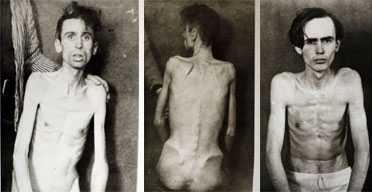
Photographs of victims of a secret torture programme operated by British authorities during the early days of the cold war are published for the first time today after being concealed for almost 60 years.
The pictures show men who had suffered months of starvation, sleep deprivation, beatings and extreme cold at one of a number of interrogation centres run by the War Office in postwar Germany.
A few were starved or beaten to death, while British soldiers are alleged to have tortured some victims with thumb screws and shin screws recovered from a gestapo prison. The men in the photographs are not Nazis, however, but suspected communists, arrested in 1946 because they were thought to support the Soviet Union, an ally 18 months earlier.
World Health Assembly Must Stop Dangerous Smallpox Experiments
News Release
3 April 2006
Health Assembly Must Stop Dangerous Smallpox Experiments
--------------------------------------------------------
Non-governmental organizations are calling for the 59th World Health Assembly (WHA), which begins on May 22nd, to stop dangerous smallpox research, including genetic engineering experiments, and to quickly bring about the destruction of all remaining smallpox virus stocks. Discussions on a draft WHA resolution will begin at an intergovernmental working group that meets in Geneva on April 5th.
Third World Network and the Sunshine Project are calling on the WHA to adopt a resolution to dramatically reduce risky research with the smallpox virus and to replace a failed oversight committee with a more balanced successor. What is urgently needed is a body that will control smallpox virus research and restrict experiments to only those which are essential, thus quickly paving the way for final destruction of smallpox virus stocks.
On smallpox research, the NGOs are asking the WHA to:
* Stop all distribution of smallpox DNA except that necessary for maintaining diagnostic labs, and to prohibit genetic engineering of smallpox, as both create unnecessary and unacceptable biosafety and security risks;
* Withdraw the temporary authorization it granted to retain smallpox virus stocks for genetic sequencing, diagnostic tests and vaccine research, as there is broad agreement that live virus is not needed for these purposes;
* Withdraw temporary authorization for experiments to infect monkeys with the smallpox virus in favor of a safer approach that does not utilize smallpox virus, and;
* Stop temporarily authorized research (that uses smallpox virus) into antiviral drugs in less than two years.
To strengthen international oversight, the NGOs are asking the WHA to:
* Terminate the WHO Advisory Committee on Variola Virus Research which, in over six years of existence, has not developed rigorous oversight and review procedures, has not adequately tracked distribution of smallpox DNA, and has broadly failed to uphold the WHA's mandate to control smallpox research, and;
* Replace the disbanded committee with an oversight body that is geographically and scientifically balanced, that is transparent, and which will reassert international control until the virus stocks are destroyed.
At the 2005 WHA meeting, many governments expressed concerns and objections to US and Russian experiments proposed for approval by the committee, including the genetic engineering of smallpox and the splicing of smallpox genes into related viruses. (A report on the WHA discussion in 2005 is available at www.smallpoxbiosafety.org)
Although the proposal to put smallpox genes in other poxviruses has been withdrawn, a number of dangerous experiments remain on the table. This could take place if the WHA does not act to stop them this year.
For more information, please visit http://www.smallpoxbiosafety.org
"IN TIMES OF UNIVERSAL DECEIT, TELLING THE TRUTH WILL BE A REVOLUTIONARY ACT." - George Orwell
“If the world is upside down the way it is now, wouldn’t we have to turn it over to get it to stand up straight?” - Eduardo Galeano
A nation of sheep will beget a government of wolves. -- Edward R. Murrow
www.milfuegos.net
"Sow Justice, Reap Peace -- Strategies for Moving Beyond War"
2006 VFP Annual Convention
August 10-13, Seattle, WA
NOTICE: Due to Presidential Executive Orders, the National Security Agency
may have read this email without warning, warrant, or notice. They may do
this without any judicial or legislative oversight. You have no recourse
nor protection save to call for the impeachment of the current President.
Sunday, April 02, 2006
Throwing Stones at Venezuela By Onnesha Roychoudhuri
U.S. criticism of Hugo Chavez's politics only serves to highlight the weakness of our democracy at home.
It's certainly no surprise. Even over a year ago, journalists were remarking at the "left turn" that so many Latin American countries were making. Of late, however, we only hear about Hugo Chavez and Venezuela. The South American country has taken the place of Cuba as the new whipping boy of alternative political models. But the targeted arguments -- coming mainly from the United States -- that depict Chavez as a tyrannical despot do little more than make the United States look the defensive paranoid for so mischaracterizing Venezuela's politics.
From Secretary of Defense Donald Rumsfeld to Pat Robertson, absurd public comparisons of President Hugo Chavez to Hitler and calls for assassination, it's clear that U.S. public figures love to vilify Chavez. The defamations have now been firmly established in mainstream politics -- Secretary of State Condoleezza Rice continues to allege that Venezuela poses the greatest threat to Latin America. Why? Rice accuses Chavez of leading a "Latin brand of populism that has taken countries down the drain."
AlterNet spoke to Bernardo Alvarez, Venezuela's ambassador to the United States, during his recent trip through California to meet with civil society groups and Latino leaders. When asked why he thought Chavez and Venezuela were so vilified, Alvarez stated, "For the first time, people are taking seriously that the major problems in the world are poverty and social exclusion -- not terrorism. These allegations are simply to avoid discussing these true problems; they are an attempt to undermine and divert from true economic development."
Whether or not this is the true motivation behind this administration's reluctance to engage in dialogue is up for debate. One thing, however, is clear: The press has spent far more energy exploring largely unsubstantiated allegations of fraud and corruption targeting Chavez than exploring the reality of his agenda.
After getting the obligatory controversial questions out of the way -- is Chavez planning to run for president in 2013? Are the United States and Venezuela too ideologically different to have meaningful discussions? What do you say to the allegations that Venezuela is becoming a dictatorship akin to Castro's Cuba? -- a common thread emerged in Alvarez's oft-repeated answers. Strung together, it goes something like this:
Chavez is not an accident. His election expresses a new awakening of people and participation. Chavez and Venezuela are not an anomaly in an otherwise "normal" world. We're talking about the entire hemisphere, here. These are societies trying to find alternative ways of dealing with the same problems. It is better that they understand what is happening in Venezuela as part of a broader process.
Alvarez is obviously quite good at responding to questions that start with "How do you respond to the allegations that." He has learned to (sometimes subtly, sometimes blatantly) work in details of Chavez's agenda amidst these usual suspect questions. Without asking, I learned that Chavez has extended health care to 10 million Venezuelans, defeated illiteracy in two years, given three million Venezuelans ID cards so that they can access social programs and vote, and worked to rebuild oil refineries and guarantee security of supply and accessible prices.
Members of the media, trying to substantiate the obsessive fixation on Chavez-as-tyrant, have let the wild accusations frame our dialogue about Venezuela. You won't read much about Chavez's focus on the eradication of poverty -- extended even to the United States through the heating oil program that is bringing over 40 million gallons of discounted and free oil to low-income Americans in eight states. Rather, you'll get an earful of the Texas congressman Joe Barton seeking an investigation into the program. You have to read academic publications like Political Affairs Magazine to get to the irony behind the facts:
The only change in Venezuelan oil supply to the U.S. in the past three years has been this year's program to provide 40 percent discounts on 49 million gallons of heating fuel for poor people in Massachusetts, Maine, Rhode Island, Pennsylvania, New York, Delaware, and soon Vermont and Connecticut. How bizarre that Texas Republican congressman Joe Barton has launched an investigation into this humanitarian offering, instead of investigating the U.S, multinational oil companies that posted over $100 billion in corporate profits last year due to soaring gasoline prices.
There are components of Chavez's agenda that merit skepticism, but the cheap oil program hardly qualifies. Critics have raised Venezuela's record of human rights violations. And while police violence against protesters has attracted rebukes from human rights organizations like Amnesty International, AI make clear that the weak record of human rights preceded Chavez: "President Chavez's administration introduced several important improvements in the 1999 Constitution to protect civil and political as well as economic, social and cultural rights." The problem is that many of these measures have yet to implemented.
Perhaps the meatiest and most interesting issue that Ambassador Alvarez touched upon was whether Chavez's agenda to eradicate poverty can be achieved through democratic means. When asked about the difference between Cuba's form of socialism and Venezuela's "new socialism," Alvarez noted,
Our revolution was made in peace, following a democratic path. But, we are looking for social justice. There is no real democracy if there is no social justice. We have to go beyond representative democracy to a participatory social system. If you don't fight poverty, you will have a very weak democracy.
So what if the kind of social justice that Chavez is seeking is at odds with the brand of democracy that currently exists in Venezuela? This is an interesting tension to explore especially in light of Alvarez's emphasis on Chavez's current intent to consolidate the infrastructure that will enable a "cultural transformation" before he leaves office: "From the very beginning," said Alvarez, "we understood that we were there not only to be another government, but that we were elected because we represented the desire and expectations of a whole transformation of society."
That's quite a charge. But, instead of reading about the ins and outs of Chavez's methodology, we consistently get sensationalized non-news. A recent article from The Economist, "Mission Impossible," reads, "Poverty is at last falling under Hugo Chavez, but not nearly as much as it should have "
No one seems to think that poverty is abating. "If only there were 50 Chavezes in the country,"sighs Minerva, a middle-aged woman from the outskirts of Caracas. "But he's all on his own. End poverty? That will take 50 years."
Better to quote Minerva than cite economic stats of a per capita growth rate of 17.9 percent in 2004 and 9 percent last year -- making it one of the fastest-growing countries in the region. Or independent polls that put Venezuelan approval of Chavez at 70 percent (an approval rating that President Bush only saw immediately following the terrorist attacks of Sept. 11, 2001.)
We are led to think that Chavez is bad because his plans to turn the formerly elitist Venezuelan political structure on its head and end poverty just aren't happening fast enough. Similarly, in a recent Foreign Policy article, Javier Corrales writes:
Civil society has not disappeared, as it did in Cuba after the 1959 revolution. There is no systematic, state-sponsored terror … there is certainly no efficiently repressive and meddlesome bureaucracy … In fact, in Venezuela, one can still find an active and vociferous opposition, elections, a feisty press and a vibrant and organized civil society. Venezuela, in other words, appears almost democratic … Undeniably, Chavez has brought innovative social programs to neighborhoods that the private sector and the Venezuelan state had all but abandoned … He also launched one of the most dramatic increases in state spending in the developing world.
Difficult to tell from this excerpt that the thrust of the article is to depict Chavez as a modern tyrant. Corrales gets one thing right -- trashing the United States is an effective way for many Latin American leaders to gain populist support. And the United States is playing right into this political tactic by posing so trashable a target. Secretary of State Condoleezza Rice has officially announced an "inoculation strategy" that involves trying to isolate Venezuela by organizing other countries against Chavez.
As Rice works the isolation strategy, using the mainstream media as a pulpit for her fulminations, Chavez continues to build alliances with other Latin American governments and political leaders around the world. While both Chavez and Rice have employed fairly vacuous public talking points and rhetoric, the differing strategies make all the difference. As the Bush administration works to slander Chavez and allege that his government consorts with terrorists, Chavez is sending poor Americans oil. It just sets up a scenario in which Ambassador Alvarez can say things like this:
Some people ask why we are helping the U.S. poor. Why not? Are they a different kind of poor people? Those are the kinds of things that people should do. We do it with energy because that's what we have. Other countries should do it with what they have. It's part of our philosophy. We're talking about an alternative model here, and we have to demonstrate what that is.
Ambassador Alvarez continues to meet with civil society groups and the media, confidently asserting that the Venezuelan government is committed to developing real instruments for participatory democracy -- starting at the grassroots.
There's always a place for criticism and cynicism, especially when it comes to politicians who claim to be developing a new political ideology, but the Bush administration's tactic of slandering a democratic and reform-minded government that has an approval rating this president can only envy is a guaranteed losing battle. The more members of the Bush administration chastise Chavez's democracy, the more embarrassing the hypocrisy becomes.
Rice told students at Johns Hopkins that she hoped Chavez will "recognize the importance of democratic values for real, not just claiming that because you're elected you are exercising democratic values. When people are elected, they have a responsibility to follow democratic values, and we have to call it for what we see."
If only our administration could heed its own advice.
Onnesha Roychoudhuri is an assistant editor at AlterNet.
It's certainly no surprise. Even over a year ago, journalists were remarking at the "left turn" that so many Latin American countries were making. Of late, however, we only hear about Hugo Chavez and Venezuela. The South American country has taken the place of Cuba as the new whipping boy of alternative political models. But the targeted arguments -- coming mainly from the United States -- that depict Chavez as a tyrannical despot do little more than make the United States look the defensive paranoid for so mischaracterizing Venezuela's politics.
From Secretary of Defense Donald Rumsfeld to Pat Robertson, absurd public comparisons of President Hugo Chavez to Hitler and calls for assassination, it's clear that U.S. public figures love to vilify Chavez. The defamations have now been firmly established in mainstream politics -- Secretary of State Condoleezza Rice continues to allege that Venezuela poses the greatest threat to Latin America. Why? Rice accuses Chavez of leading a "Latin brand of populism that has taken countries down the drain."
AlterNet spoke to Bernardo Alvarez, Venezuela's ambassador to the United States, during his recent trip through California to meet with civil society groups and Latino leaders. When asked why he thought Chavez and Venezuela were so vilified, Alvarez stated, "For the first time, people are taking seriously that the major problems in the world are poverty and social exclusion -- not terrorism. These allegations are simply to avoid discussing these true problems; they are an attempt to undermine and divert from true economic development."
Whether or not this is the true motivation behind this administration's reluctance to engage in dialogue is up for debate. One thing, however, is clear: The press has spent far more energy exploring largely unsubstantiated allegations of fraud and corruption targeting Chavez than exploring the reality of his agenda.
After getting the obligatory controversial questions out of the way -- is Chavez planning to run for president in 2013? Are the United States and Venezuela too ideologically different to have meaningful discussions? What do you say to the allegations that Venezuela is becoming a dictatorship akin to Castro's Cuba? -- a common thread emerged in Alvarez's oft-repeated answers. Strung together, it goes something like this:
Chavez is not an accident. His election expresses a new awakening of people and participation. Chavez and Venezuela are not an anomaly in an otherwise "normal" world. We're talking about the entire hemisphere, here. These are societies trying to find alternative ways of dealing with the same problems. It is better that they understand what is happening in Venezuela as part of a broader process.
Alvarez is obviously quite good at responding to questions that start with "How do you respond to the allegations that." He has learned to (sometimes subtly, sometimes blatantly) work in details of Chavez's agenda amidst these usual suspect questions. Without asking, I learned that Chavez has extended health care to 10 million Venezuelans, defeated illiteracy in two years, given three million Venezuelans ID cards so that they can access social programs and vote, and worked to rebuild oil refineries and guarantee security of supply and accessible prices.
Members of the media, trying to substantiate the obsessive fixation on Chavez-as-tyrant, have let the wild accusations frame our dialogue about Venezuela. You won't read much about Chavez's focus on the eradication of poverty -- extended even to the United States through the heating oil program that is bringing over 40 million gallons of discounted and free oil to low-income Americans in eight states. Rather, you'll get an earful of the Texas congressman Joe Barton seeking an investigation into the program. You have to read academic publications like Political Affairs Magazine to get to the irony behind the facts:
The only change in Venezuelan oil supply to the U.S. in the past three years has been this year's program to provide 40 percent discounts on 49 million gallons of heating fuel for poor people in Massachusetts, Maine, Rhode Island, Pennsylvania, New York, Delaware, and soon Vermont and Connecticut. How bizarre that Texas Republican congressman Joe Barton has launched an investigation into this humanitarian offering, instead of investigating the U.S, multinational oil companies that posted over $100 billion in corporate profits last year due to soaring gasoline prices.
There are components of Chavez's agenda that merit skepticism, but the cheap oil program hardly qualifies. Critics have raised Venezuela's record of human rights violations. And while police violence against protesters has attracted rebukes from human rights organizations like Amnesty International, AI make clear that the weak record of human rights preceded Chavez: "President Chavez's administration introduced several important improvements in the 1999 Constitution to protect civil and political as well as economic, social and cultural rights." The problem is that many of these measures have yet to implemented.
Perhaps the meatiest and most interesting issue that Ambassador Alvarez touched upon was whether Chavez's agenda to eradicate poverty can be achieved through democratic means. When asked about the difference between Cuba's form of socialism and Venezuela's "new socialism," Alvarez noted,
Our revolution was made in peace, following a democratic path. But, we are looking for social justice. There is no real democracy if there is no social justice. We have to go beyond representative democracy to a participatory social system. If you don't fight poverty, you will have a very weak democracy.
So what if the kind of social justice that Chavez is seeking is at odds with the brand of democracy that currently exists in Venezuela? This is an interesting tension to explore especially in light of Alvarez's emphasis on Chavez's current intent to consolidate the infrastructure that will enable a "cultural transformation" before he leaves office: "From the very beginning," said Alvarez, "we understood that we were there not only to be another government, but that we were elected because we represented the desire and expectations of a whole transformation of society."
That's quite a charge. But, instead of reading about the ins and outs of Chavez's methodology, we consistently get sensationalized non-news. A recent article from The Economist, "Mission Impossible," reads, "Poverty is at last falling under Hugo Chavez, but not nearly as much as it should have "
No one seems to think that poverty is abating. "If only there were 50 Chavezes in the country,"sighs Minerva, a middle-aged woman from the outskirts of Caracas. "But he's all on his own. End poverty? That will take 50 years."
Better to quote Minerva than cite economic stats of a per capita growth rate of 17.9 percent in 2004 and 9 percent last year -- making it one of the fastest-growing countries in the region. Or independent polls that put Venezuelan approval of Chavez at 70 percent (an approval rating that President Bush only saw immediately following the terrorist attacks of Sept. 11, 2001.)
We are led to think that Chavez is bad because his plans to turn the formerly elitist Venezuelan political structure on its head and end poverty just aren't happening fast enough. Similarly, in a recent Foreign Policy article, Javier Corrales writes:
Civil society has not disappeared, as it did in Cuba after the 1959 revolution. There is no systematic, state-sponsored terror … there is certainly no efficiently repressive and meddlesome bureaucracy … In fact, in Venezuela, one can still find an active and vociferous opposition, elections, a feisty press and a vibrant and organized civil society. Venezuela, in other words, appears almost democratic … Undeniably, Chavez has brought innovative social programs to neighborhoods that the private sector and the Venezuelan state had all but abandoned … He also launched one of the most dramatic increases in state spending in the developing world.
Difficult to tell from this excerpt that the thrust of the article is to depict Chavez as a modern tyrant. Corrales gets one thing right -- trashing the United States is an effective way for many Latin American leaders to gain populist support. And the United States is playing right into this political tactic by posing so trashable a target. Secretary of State Condoleezza Rice has officially announced an "inoculation strategy" that involves trying to isolate Venezuela by organizing other countries against Chavez.
As Rice works the isolation strategy, using the mainstream media as a pulpit for her fulminations, Chavez continues to build alliances with other Latin American governments and political leaders around the world. While both Chavez and Rice have employed fairly vacuous public talking points and rhetoric, the differing strategies make all the difference. As the Bush administration works to slander Chavez and allege that his government consorts with terrorists, Chavez is sending poor Americans oil. It just sets up a scenario in which Ambassador Alvarez can say things like this:
Some people ask why we are helping the U.S. poor. Why not? Are they a different kind of poor people? Those are the kinds of things that people should do. We do it with energy because that's what we have. Other countries should do it with what they have. It's part of our philosophy. We're talking about an alternative model here, and we have to demonstrate what that is.
Ambassador Alvarez continues to meet with civil society groups and the media, confidently asserting that the Venezuelan government is committed to developing real instruments for participatory democracy -- starting at the grassroots.
There's always a place for criticism and cynicism, especially when it comes to politicians who claim to be developing a new political ideology, but the Bush administration's tactic of slandering a democratic and reform-minded government that has an approval rating this president can only envy is a guaranteed losing battle. The more members of the Bush administration chastise Chavez's democracy, the more embarrassing the hypocrisy becomes.
Rice told students at Johns Hopkins that she hoped Chavez will "recognize the importance of democratic values for real, not just claiming that because you're elected you are exercising democratic values. When people are elected, they have a responsibility to follow democratic values, and we have to call it for what we see."
If only our administration could heed its own advice.
Onnesha Roychoudhuri is an assistant editor at AlterNet.
The JFK assassination and Bush's refusal to extradite Posada Carriles to Venezuela? All three were in Dallas that day
I wish that respected journalists would leave the debate whether Posada is a terrorist, and concentrate on the question whether he and Orlando Bosch were involved in the JFK assassination under direction of George HW Bush.
Because THAT is the real reason he will NEVER be extradited as long as Bushes are in the big seat.
All three were in Dallas that day ... Bosch and Posada on Dealey Plaza to be exact.
The current debate is very much like the the debate on the single bullet theory. It centers around the question whether the impossible trajectory of that bullet is possible after all. Which takes away from the much more important reasons to blow it out of the water, namely:
1) The bullet fragments retrieved from Connolly's wrist weighed much more than what the "magic bullet" had lost from its original weight.
2) No bullet penetrated Kennedy's neck
3) No bullet in recorded history has ever caused 7 wounds, penetrating and shattering bones in the process, and emerged in the un-deformed condition of the magic bullet.
4) It is simply impossible that one bullet causing such damage, emerges in almost pristine condition, while the other one, the one in Kennedy's head, purportedly from the same rifle, explodes in a thousand fragments.
Wim Dankbaar
dank@xs4all.nl
Wim Dankbaar is a 44-year-old father of two in The Netherlands. For the last four years he has been actively involved in a project to gather and present new evidence in the JFK assassination ... evidence that proves that the official story is a fraud and that the Kennedy killing was a conspiracy with the knowledge and consent of the highest powers in US government.
What is the basis for Dankbaar's assertion that the CIA and and anti-Castro elements were behind the assassination?
Dankbaar: This becomes very clear for everyone who studies the known evidence thoroughly. Both the CIA, or maybe I should say the hawks in the CIA, and the anti Castro cubans, who were trained by the CIA, had the means and the motives to kill Kennedy. But they did it in partnership with some key figures in the US Government and Big Business in Texas, as well as a few leaders in Organized Crime. These last three groups had equally strong motives to rid themselves of Kennedy, and even stronger means to pull it off. The fact of the matter is that it was an ordinary but hidden coup d'etat, to take over the US government and reverse the policies of Kennedy. Policies that were detested by all of these groups. These groups had already found each other long before 1963.
They were in bed together. The most visible proof of that, is their efforts to assassinate Fidel Castro. The groups involved in that are the exact same groups that I have mentioned, this is a proven and public fact now, and they are the exact same people that ended up killing Kennedy. They were very much intertwined, and probably still are. Now if you want to put faces to these devils of power, you could best divide them first into a 3 level hierarchy. High level, mid level and operational level. The high level is the select group of conspirators, you may think of Lyndon Johnson, J. Edgar Hoover, George and Prescott Bush, Allen Dulles, oil barons Clint Murchison and H. L. Hunt, crime bosses Santo Trafficante, Sam Giancana and Carlos Marcello. It was actually a wider group than that, but it is difficult to pinpoint them all. After all, in a cover-up you have to work with circumstantial evidence, unless someone breaks the secrecy with a public confession.
The mid-level was the planning cadre, the managers, the puppet masters directing the pawns and the actual shooters. Two of those managers, the CIA calls them controllers, were E. Howard Hunt and his partner David Atlee Phillips. They are both legends in Covert Operations. Guy Banister in New Orleans is another example. The CIA also used assets to assist with the operational side. Philip Twombly for example, a very unknown name, was instrumental in providing the fake secret service badges that were made for the executives in Dealey Plaza. He was also in Dallas that day, as was Nixon, their cover was the Pepsi Cola bottling convention. So this mid group organizes the actual operation. They direct the shooters and their spotters. They are the operational level. And it is important to understand that these shooters do not necessarily have to know about each other's participation. That is what the CIA calls compartimentalization. They only take orders from their direct boss, they are not being told who else is involved in the operation, just to follow orders. This works horizontally and vertically in the organization. Even the mid level people do not have to know all the people at the top. One man to take the orders from is enough. For example, if Howard Hunt gets his orders from Dulles, he doesn't have to know that Dulles planned it with Nixon and Johnson. And Nixon and Johnson don't need to know the identities of the shooters. So at the top the conspiracy is rather closely held, although many people are used. The ground rules are CIA only, maximum security, non-attributability, plausible denial, need to know basis, no written communication. Another ground rule is "What you don't know can't hurt anybody." Interestingly, this rule is also applied by a control of the mass media, who hardly ever report on the JFK assassination, unless it is something nutty or disinformation, but the real critics of the official version are not given a voice by US media.
Only Oliver Stone was able to break through this wall with his much attacked movie JFK, which presented a more believable scenario, however still without naming the names.
If you want names in the operational level I can tell you that Charles Nicoletti and James Files were two of the shooters. They were both under orders from Sam Giancana, the mafia boss of Chicago. John Roselli, another lieutenant of Giancana, was also there, but as a spotter, he did not shoot. Of these names I am absolutely sure, based on the detailed confession of James Files, who claims he fired the fatal headshot from the grassy knoll. Why he is credible is too detailed to explain here, I do that in my book 'Files on JFK.' He says that his boss Charles Nicoletti fired from the Daltex building behind Kennedy. His knowledge does not go further than that, which shows the compartimentalization again. Of course there were also shooters in the Texas schoolbook building, and possibly other locations like the roof of the Records building, but I don't know their identities beyond any doubt. I have strong indications though that both David Sanchez Morales and Richard Cain were shooters in the Book Depository. Richard Cain was another hitman for Sam Giancana with strong CIA ties and Morales was a husky looking Mexican-Indian with very dark complection, who developed a reputation as best CIA assassin for Latin American. He was also very close with David Atlee Phillips and he was the Chief of Operations of the CIA station in Miami which trained the Cuban exiles for raids against Castro. The boss of that station was Ted Shackley, an associate of George Bush, which connection is later formalized when Bush becomes CIA director and appoints Shackley as his Deputy Director Operations. Interestingly, James Files says that he was recruited for the CIA by David Atlee Phillips on a recommendation of Ted Shackley. Furthermore I know that Luis Posada Carriles and Orlando Bosch were on Dealey Plaza.
Was Oswald the assassin of JFK?
Dankbaar: No, of course not. Oswald was a CIA agent who was cleverly setup as the patsy by his superiors David Atlee Phillips and Guy Banister in New Orleans. It appears that George Demohrenschildt, an oil geologist who knew all the Texan oil tycoons, including Bush, was also handling Oswald in Dallas. Anyway, I am positive that Phillips made Oswald believe that he was playing the part of the hero, trying to infiltrate the assassination plot in order to inform on it and thus in order to prevent it. It is only at the last moment that Oswald realized he was just a patsy, as he said himself. This is also why he was at the right time in the right place. He cooperated, hoping up to the last moment that he could prevent the assassination. He was actually an admirer of Kennedy for his civil rights and anti-segregation policies. But he was also the perfect patsy. Through his staged defection to Russia, which was in fact a covert mission supported by the CIA, he already looked like a communist and he smelled like a communist. This was reinforced with his pro Castro cover and Fair Play for Cuba Committee, which he also did under direction of the CIA. Lee Harvey loved to be a double agent and infiltrate the other side. But the truth is that he was very strongly anti-Castro. I do know that he participated in at least one of the plans to kill Castro. Funny enough Oswald misspeaks in one of his radio interviews. He says that in Russia he" was at all times under the protection of the US Government." Then he quickly corrects himself, saying that he did not mean to say that but that he "held at all times contacts with the American Embassy in Moscow"
No, Oswald was the opposite of the assassin of JFK, and this is perhaps the greatest injustice of all. Although the media and government mouthpieces are still trying to brainwash the public with the lone-nut-assassin-lie, there is not a shred of evidence to place him on the 6th floor with that old rifle, let alone firing it, let alone hitting JFK. This is even clear for those who read the Warren Report, there is enough evidence in there to vindicate him, but they knew that the average American is not going to plough through those 26 volumes, so just repeating its "conclusion" through the media was enough to accomplish the mission. Certainly at that time when Americans still trusted their government.
Oswald would have been vindicated if he would have gone to trial. He would also have blown the lid of the conspiracy. Therefore he could not be allowed to live. It is obvious that something went wrong in the plan. They did not plan for him to be captured and alive in custody. So Jack Ruby, who was Giancana's man in Dallas and also worked for Carlos Marcello and Santo Trafficante, was hastily selected to finish the job. He had to, disobeying an order in the mob is not an option.
How long took the investigation that you have been directing?
Dankbaar: That depends on when you start counting, I have been interested in it since 1988. From that time I have read books, watched documentaries and such. But I have become actively involved when I learned about the confession of James Files, which was only 4 years ago.
Who financed your investigation?
Dankbaar: Myself, but I have to say I that am building on the work and testimonies of others, most of those have invested at great personal cost, financially, emotionally or both. Without these people my work would not have been possible. Jim Garrison and Joe West are just a few of those people. The late Joe West is the man who found James Files and persuaded him to confess, although Joe West did not live to hear it himself. Jim Garrsion was the one and only public official to take on the conspiracy and try to bring the guilty to justice. If we would have man like that today , with what we know today, the American public would quickly learn the ugly truth. But unfortunately, so far there does not seem to be a man like Jim Garrison. They should make a statue for him, maybe next to Kennedy's grave or in front of the White House.
What is the evidence for the involvement of Bush senior?
Dankbaar: He is connected to all the main players. It is a matter of common sense and circumstancial evidence. I do not know if that evidence would be enough for a conviction, but right now the problem is more that the public does not know about that evidence, because they are not informed of it. To me that clearly shows there is no real freedom of press in America, that is just a cheap myth. What can be proven without any doubt is that Bush lied about not being in the CIA in 1963. A declassified document written by J. Edgar Hoover shows that he was in contact with Hoover about the Kennedy assassination, specifically about the reaction of the cuban exile community in Miami. Hoover names him as "George Bush of the Central Intelligence Agency." It is further logical that Bush would be informed on the Cuban exiles because there are several sources that claim he helped finance the Bay of Pigs invasion and actively recruited people for it. There he made his friends in the exile community. One example is Felix Rodriguez, who is Luis Posada's buddy and takes credit for killing Che Guevara.
Common sense also tells you that someone with no experience, is appointed director of the CIA. But Bush wants us to believe the opposite. Although he seems to have insulated himself preety well, there is a wealth of evidence that puts him in the middle of all the players. Like he was good friends with Oswald's best friend in Dallas, George Demohrenschildt. But he was also very close to Nixon and Dulles, who did not only plan the Bay of the pigs, but are also better known suspects in the Kennedy conspiracy. Nixon would not do anything without the knowledge of Bush because he thanked his political career to Prescott Bush. Prescott Bush had installed Nixon as VP under Eisenhower, and he and Gerald Ford were also fundraisers for Nixon's campaign against Kennedy. Nixon lost to Kennedy by complete surprise of the Bushes, for they did not know that Kennedy had made a deal with Giancana to rig the elections in Illinois and Virginia. Had that not happened, their men would have become President. Ford and Dulles were both appointed by Johnson on the Warren Commission, no doubt to control the cover-up from there. They were the two most active members. And both were fierce Kennedy enemies, and strong friends of Nixon and the Bushes. I mean Dulles had been FIRED by Kennedy. Dulles hated the man. How could you honestly have Dulles and Ford investigate the man's murder? The Warren Commission was a complete farce to hide the truth and to convict the patsy in the eyes of the public.
Are all the files declassified now, or is there still information that is withheld?
Dankbaar: There are still a lot of documents classified. That fact alone is indication that the Warren Commission was a lie to satisfy the American Public. Because if Lee Harvey Oswald was the lone nut they said he was, there is no valid reason to keep the files locked. If the Warren Commission was correct, national security would not be endangered with the disclosure of that information. They need to lock the files to keep the real truth hidden.
On what do you base your claims that George Bush, Posada Carriles and Orlando Bosch were in Dallas the day that JFK was murdered?
Dankbaar: On documents and witness testimonies. A declassified document tells that Bush will be in Dallas on the day of the assassination. It's about a phone call from Bush to the FBI in Houston . In that phone call, Bush himself says he will be in Dallas and asks to keep the information confidential. It's funny that we have that in black and white and Bush does not recall where he was, while every normal citizen does. Another declassified FBI document proves that he was high up in the CIA in 1963, in relation to the "misguided anti-Castro Cubans." In that document Bush is being informed about their reaction to the Kennedy assassination. it's funny again that Bush himself has always denied that he was in the CIA before becoming director of the Agency. That was already a bit hard to believe, but this document proves the lie.
As for the others, I have several sources that place both Posada and Bosch in Dallas that day.
Is there a connection Posada-Bush?
Dankbaar: Lots of connections. But they are not so visible, because they are secret and not exactly advertised on CNN. The Posada-Bush connections root back all the way to the Bay of Pigs. That is when they became acquainted. Not only with Posada but with many other members of Operation 40, because Bush was the creator of Operation 40 with Dulles and Nixon. Because Operation 40 was very secret and illegal, these friendships are covert, but it is no secret that the Bush family is friends with the Cuban exile community in Florida. Jeb Bush is the Governor there, he has the support of all the anti-Castro leaders. Do you remember the Florida recount for the 2000 elections? It is no surprise it happened there and ended in Bush's favor. The most visible friendship of Bush is the one with Felix Rodriguez. Felix Rodriguez is a direct associate of Posada, both are Bay of Pigs veterans and members of Operation 40. Remember the Cuban airline bombing in 1976? This was the year that Bush was CIA director. For this atrocity, Bosch and Posada were convicted in Caracas . After Posada's escape from prison in 1985, he turns up in el Salvador, to work with Felix Rodriguez in another secret operation. It became known as Iran-Contra. It was weapons-supplies to Nicaragua and Iran, financed with drugs trafficking. This operation was also led by George Bush, who was vice president then. Maybe you recall that Carter lost the election to Reagan and Bush? Right after that, the American hostages in Iran were released. This was because Bush had made a secret deal with the Ayatollah Khomeini in Paris to postpone the release of the hostages, so that Carter could not profit from that. In return Iran would get weapons. This event is known as "The October surprise", because the release of the hostages was such a surprise to the public, but not for Bush, because it was all staged. That's how Bush became vice president.
And if you look at Bosch, Posada's accomplice in the airline bombing, who was still in jail in Caracas, he is released in 1987 after a diplomatic negotiation led by Jeb Bush. And when his father becomes President, Bosch receives a presidential pardon. Once you study this history, a clear pattern emerges. A pattern that the Bush guides and protects the terrorists and assassins of Operation 40, some of whom killed president Kennedy.
Also, a direct supervisor of Posada and Rodriguez was Ted Shackley. Shackley and Bush were very close since the Bay of Pigs. In 1976, when Bush became CIA director, he appointed Shackley as his deputy director Operations. The current CIA director, Porter Goss, also worked under Ted Shackley in Operation 40. There are a lot more connections, but suffice to say that Bush senior is a puppet master behind the scenes. The spider in the web. Very insulated in secrecy, but very deadly.
What is your analysis of the refusal to extradite Posada Carriles to Venezuela?
Dankbaar: Posada is the holder of many secrets, the disclosure of which would be disastrous for Bush. Posada himself has said this publicly. This is why Posada gets this protection, and this is why he cannot be extradited to Venezuela. The Bush administration is therefore in an extremely embarrassing situation. A hot potato that they can't swallow. The best thing that could happen for them is that Posada simply dies of old age. I can hardly see a good solution. They can't extradite him, and they can't release him, for that would create an international protest. So far the outcry is mainly coming from Castro and Chavez, and my advise to them would be to keep the pressure on. I am actually surprised that Castro is not exploiting the Kennedy connection more. After all, it is his own former girl friend Marita Lorenz, who implicated Bosch and other Operation 40 members in the Kennedy murder. The American media pay little attention to his outrage, because they are controlled by Big Business and because he is just the communist dictator, an enemy of the United States. And Chavez is his puppet. What they say is just propaganda. That is the image painted of them. If Castro would simply say that Bush is protecting the killers of JFK, it would be all over the news, also in the United States. That would shake the world awake on what's playing here. And that is what Castro wants, if I am not mistaken. He wants the world to see the hypocrisy of the Posada asylum case and the War on Terror. But I am not sure if he sees that he could unleash a scandal bigger than Watergate.
Anyway, I hope he reads this (laughs).
Wim Dankbaar
dank@xs4all.nl
www.jfkmurdersolved.com
Because THAT is the real reason he will NEVER be extradited as long as Bushes are in the big seat.
All three were in Dallas that day ... Bosch and Posada on Dealey Plaza to be exact.
The current debate is very much like the the debate on the single bullet theory. It centers around the question whether the impossible trajectory of that bullet is possible after all. Which takes away from the much more important reasons to blow it out of the water, namely:
1) The bullet fragments retrieved from Connolly's wrist weighed much more than what the "magic bullet" had lost from its original weight.
2) No bullet penetrated Kennedy's neck
3) No bullet in recorded history has ever caused 7 wounds, penetrating and shattering bones in the process, and emerged in the un-deformed condition of the magic bullet.
4) It is simply impossible that one bullet causing such damage, emerges in almost pristine condition, while the other one, the one in Kennedy's head, purportedly from the same rifle, explodes in a thousand fragments.
Wim Dankbaar
dank@xs4all.nl
Wim Dankbaar is a 44-year-old father of two in The Netherlands. For the last four years he has been actively involved in a project to gather and present new evidence in the JFK assassination ... evidence that proves that the official story is a fraud and that the Kennedy killing was a conspiracy with the knowledge and consent of the highest powers in US government.
What is the basis for Dankbaar's assertion that the CIA and and anti-Castro elements were behind the assassination?
Dankbaar: This becomes very clear for everyone who studies the known evidence thoroughly. Both the CIA, or maybe I should say the hawks in the CIA, and the anti Castro cubans, who were trained by the CIA, had the means and the motives to kill Kennedy. But they did it in partnership with some key figures in the US Government and Big Business in Texas, as well as a few leaders in Organized Crime. These last three groups had equally strong motives to rid themselves of Kennedy, and even stronger means to pull it off. The fact of the matter is that it was an ordinary but hidden coup d'etat, to take over the US government and reverse the policies of Kennedy. Policies that were detested by all of these groups. These groups had already found each other long before 1963.
They were in bed together. The most visible proof of that, is their efforts to assassinate Fidel Castro. The groups involved in that are the exact same groups that I have mentioned, this is a proven and public fact now, and they are the exact same people that ended up killing Kennedy. They were very much intertwined, and probably still are. Now if you want to put faces to these devils of power, you could best divide them first into a 3 level hierarchy. High level, mid level and operational level. The high level is the select group of conspirators, you may think of Lyndon Johnson, J. Edgar Hoover, George and Prescott Bush, Allen Dulles, oil barons Clint Murchison and H. L. Hunt, crime bosses Santo Trafficante, Sam Giancana and Carlos Marcello. It was actually a wider group than that, but it is difficult to pinpoint them all. After all, in a cover-up you have to work with circumstantial evidence, unless someone breaks the secrecy with a public confession.
The mid-level was the planning cadre, the managers, the puppet masters directing the pawns and the actual shooters. Two of those managers, the CIA calls them controllers, were E. Howard Hunt and his partner David Atlee Phillips. They are both legends in Covert Operations. Guy Banister in New Orleans is another example. The CIA also used assets to assist with the operational side. Philip Twombly for example, a very unknown name, was instrumental in providing the fake secret service badges that were made for the executives in Dealey Plaza. He was also in Dallas that day, as was Nixon, their cover was the Pepsi Cola bottling convention. So this mid group organizes the actual operation. They direct the shooters and their spotters. They are the operational level. And it is important to understand that these shooters do not necessarily have to know about each other's participation. That is what the CIA calls compartimentalization. They only take orders from their direct boss, they are not being told who else is involved in the operation, just to follow orders. This works horizontally and vertically in the organization. Even the mid level people do not have to know all the people at the top. One man to take the orders from is enough. For example, if Howard Hunt gets his orders from Dulles, he doesn't have to know that Dulles planned it with Nixon and Johnson. And Nixon and Johnson don't need to know the identities of the shooters. So at the top the conspiracy is rather closely held, although many people are used. The ground rules are CIA only, maximum security, non-attributability, plausible denial, need to know basis, no written communication. Another ground rule is "What you don't know can't hurt anybody." Interestingly, this rule is also applied by a control of the mass media, who hardly ever report on the JFK assassination, unless it is something nutty or disinformation, but the real critics of the official version are not given a voice by US media.
Only Oliver Stone was able to break through this wall with his much attacked movie JFK, which presented a more believable scenario, however still without naming the names.
If you want names in the operational level I can tell you that Charles Nicoletti and James Files were two of the shooters. They were both under orders from Sam Giancana, the mafia boss of Chicago. John Roselli, another lieutenant of Giancana, was also there, but as a spotter, he did not shoot. Of these names I am absolutely sure, based on the detailed confession of James Files, who claims he fired the fatal headshot from the grassy knoll. Why he is credible is too detailed to explain here, I do that in my book 'Files on JFK.' He says that his boss Charles Nicoletti fired from the Daltex building behind Kennedy. His knowledge does not go further than that, which shows the compartimentalization again. Of course there were also shooters in the Texas schoolbook building, and possibly other locations like the roof of the Records building, but I don't know their identities beyond any doubt. I have strong indications though that both David Sanchez Morales and Richard Cain were shooters in the Book Depository. Richard Cain was another hitman for Sam Giancana with strong CIA ties and Morales was a husky looking Mexican-Indian with very dark complection, who developed a reputation as best CIA assassin for Latin American. He was also very close with David Atlee Phillips and he was the Chief of Operations of the CIA station in Miami which trained the Cuban exiles for raids against Castro. The boss of that station was Ted Shackley, an associate of George Bush, which connection is later formalized when Bush becomes CIA director and appoints Shackley as his Deputy Director Operations. Interestingly, James Files says that he was recruited for the CIA by David Atlee Phillips on a recommendation of Ted Shackley. Furthermore I know that Luis Posada Carriles and Orlando Bosch were on Dealey Plaza.
Was Oswald the assassin of JFK?
Dankbaar: No, of course not. Oswald was a CIA agent who was cleverly setup as the patsy by his superiors David Atlee Phillips and Guy Banister in New Orleans. It appears that George Demohrenschildt, an oil geologist who knew all the Texan oil tycoons, including Bush, was also handling Oswald in Dallas. Anyway, I am positive that Phillips made Oswald believe that he was playing the part of the hero, trying to infiltrate the assassination plot in order to inform on it and thus in order to prevent it. It is only at the last moment that Oswald realized he was just a patsy, as he said himself. This is also why he was at the right time in the right place. He cooperated, hoping up to the last moment that he could prevent the assassination. He was actually an admirer of Kennedy for his civil rights and anti-segregation policies. But he was also the perfect patsy. Through his staged defection to Russia, which was in fact a covert mission supported by the CIA, he already looked like a communist and he smelled like a communist. This was reinforced with his pro Castro cover and Fair Play for Cuba Committee, which he also did under direction of the CIA. Lee Harvey loved to be a double agent and infiltrate the other side. But the truth is that he was very strongly anti-Castro. I do know that he participated in at least one of the plans to kill Castro. Funny enough Oswald misspeaks in one of his radio interviews. He says that in Russia he" was at all times under the protection of the US Government." Then he quickly corrects himself, saying that he did not mean to say that but that he "held at all times contacts with the American Embassy in Moscow"
No, Oswald was the opposite of the assassin of JFK, and this is perhaps the greatest injustice of all. Although the media and government mouthpieces are still trying to brainwash the public with the lone-nut-assassin-lie, there is not a shred of evidence to place him on the 6th floor with that old rifle, let alone firing it, let alone hitting JFK. This is even clear for those who read the Warren Report, there is enough evidence in there to vindicate him, but they knew that the average American is not going to plough through those 26 volumes, so just repeating its "conclusion" through the media was enough to accomplish the mission. Certainly at that time when Americans still trusted their government.
Oswald would have been vindicated if he would have gone to trial. He would also have blown the lid of the conspiracy. Therefore he could not be allowed to live. It is obvious that something went wrong in the plan. They did not plan for him to be captured and alive in custody. So Jack Ruby, who was Giancana's man in Dallas and also worked for Carlos Marcello and Santo Trafficante, was hastily selected to finish the job. He had to, disobeying an order in the mob is not an option.
How long took the investigation that you have been directing?
Dankbaar: That depends on when you start counting, I have been interested in it since 1988. From that time I have read books, watched documentaries and such. But I have become actively involved when I learned about the confession of James Files, which was only 4 years ago.
Who financed your investigation?
Dankbaar: Myself, but I have to say I that am building on the work and testimonies of others, most of those have invested at great personal cost, financially, emotionally or both. Without these people my work would not have been possible. Jim Garrison and Joe West are just a few of those people. The late Joe West is the man who found James Files and persuaded him to confess, although Joe West did not live to hear it himself. Jim Garrsion was the one and only public official to take on the conspiracy and try to bring the guilty to justice. If we would have man like that today , with what we know today, the American public would quickly learn the ugly truth. But unfortunately, so far there does not seem to be a man like Jim Garrison. They should make a statue for him, maybe next to Kennedy's grave or in front of the White House.
What is the evidence for the involvement of Bush senior?
Dankbaar: He is connected to all the main players. It is a matter of common sense and circumstancial evidence. I do not know if that evidence would be enough for a conviction, but right now the problem is more that the public does not know about that evidence, because they are not informed of it. To me that clearly shows there is no real freedom of press in America, that is just a cheap myth. What can be proven without any doubt is that Bush lied about not being in the CIA in 1963. A declassified document written by J. Edgar Hoover shows that he was in contact with Hoover about the Kennedy assassination, specifically about the reaction of the cuban exile community in Miami. Hoover names him as "George Bush of the Central Intelligence Agency." It is further logical that Bush would be informed on the Cuban exiles because there are several sources that claim he helped finance the Bay of Pigs invasion and actively recruited people for it. There he made his friends in the exile community. One example is Felix Rodriguez, who is Luis Posada's buddy and takes credit for killing Che Guevara.
Common sense also tells you that someone with no experience, is appointed director of the CIA. But Bush wants us to believe the opposite. Although he seems to have insulated himself preety well, there is a wealth of evidence that puts him in the middle of all the players. Like he was good friends with Oswald's best friend in Dallas, George Demohrenschildt. But he was also very close to Nixon and Dulles, who did not only plan the Bay of the pigs, but are also better known suspects in the Kennedy conspiracy. Nixon would not do anything without the knowledge of Bush because he thanked his political career to Prescott Bush. Prescott Bush had installed Nixon as VP under Eisenhower, and he and Gerald Ford were also fundraisers for Nixon's campaign against Kennedy. Nixon lost to Kennedy by complete surprise of the Bushes, for they did not know that Kennedy had made a deal with Giancana to rig the elections in Illinois and Virginia. Had that not happened, their men would have become President. Ford and Dulles were both appointed by Johnson on the Warren Commission, no doubt to control the cover-up from there. They were the two most active members. And both were fierce Kennedy enemies, and strong friends of Nixon and the Bushes. I mean Dulles had been FIRED by Kennedy. Dulles hated the man. How could you honestly have Dulles and Ford investigate the man's murder? The Warren Commission was a complete farce to hide the truth and to convict the patsy in the eyes of the public.
Are all the files declassified now, or is there still information that is withheld?
Dankbaar: There are still a lot of documents classified. That fact alone is indication that the Warren Commission was a lie to satisfy the American Public. Because if Lee Harvey Oswald was the lone nut they said he was, there is no valid reason to keep the files locked. If the Warren Commission was correct, national security would not be endangered with the disclosure of that information. They need to lock the files to keep the real truth hidden.
On what do you base your claims that George Bush, Posada Carriles and Orlando Bosch were in Dallas the day that JFK was murdered?
Dankbaar: On documents and witness testimonies. A declassified document tells that Bush will be in Dallas on the day of the assassination. It's about a phone call from Bush to the FBI in Houston . In that phone call, Bush himself says he will be in Dallas and asks to keep the information confidential. It's funny that we have that in black and white and Bush does not recall where he was, while every normal citizen does. Another declassified FBI document proves that he was high up in the CIA in 1963, in relation to the "misguided anti-Castro Cubans." In that document Bush is being informed about their reaction to the Kennedy assassination. it's funny again that Bush himself has always denied that he was in the CIA before becoming director of the Agency. That was already a bit hard to believe, but this document proves the lie.
As for the others, I have several sources that place both Posada and Bosch in Dallas that day.
Is there a connection Posada-Bush?
Dankbaar: Lots of connections. But they are not so visible, because they are secret and not exactly advertised on CNN. The Posada-Bush connections root back all the way to the Bay of Pigs. That is when they became acquainted. Not only with Posada but with many other members of Operation 40, because Bush was the creator of Operation 40 with Dulles and Nixon. Because Operation 40 was very secret and illegal, these friendships are covert, but it is no secret that the Bush family is friends with the Cuban exile community in Florida. Jeb Bush is the Governor there, he has the support of all the anti-Castro leaders. Do you remember the Florida recount for the 2000 elections? It is no surprise it happened there and ended in Bush's favor. The most visible friendship of Bush is the one with Felix Rodriguez. Felix Rodriguez is a direct associate of Posada, both are Bay of Pigs veterans and members of Operation 40. Remember the Cuban airline bombing in 1976? This was the year that Bush was CIA director. For this atrocity, Bosch and Posada were convicted in Caracas . After Posada's escape from prison in 1985, he turns up in el Salvador, to work with Felix Rodriguez in another secret operation. It became known as Iran-Contra. It was weapons-supplies to Nicaragua and Iran, financed with drugs trafficking. This operation was also led by George Bush, who was vice president then. Maybe you recall that Carter lost the election to Reagan and Bush? Right after that, the American hostages in Iran were released. This was because Bush had made a secret deal with the Ayatollah Khomeini in Paris to postpone the release of the hostages, so that Carter could not profit from that. In return Iran would get weapons. This event is known as "The October surprise", because the release of the hostages was such a surprise to the public, but not for Bush, because it was all staged. That's how Bush became vice president.
And if you look at Bosch, Posada's accomplice in the airline bombing, who was still in jail in Caracas, he is released in 1987 after a diplomatic negotiation led by Jeb Bush. And when his father becomes President, Bosch receives a presidential pardon. Once you study this history, a clear pattern emerges. A pattern that the Bush guides and protects the terrorists and assassins of Operation 40, some of whom killed president Kennedy.
Also, a direct supervisor of Posada and Rodriguez was Ted Shackley. Shackley and Bush were very close since the Bay of Pigs. In 1976, when Bush became CIA director, he appointed Shackley as his deputy director Operations. The current CIA director, Porter Goss, also worked under Ted Shackley in Operation 40. There are a lot more connections, but suffice to say that Bush senior is a puppet master behind the scenes. The spider in the web. Very insulated in secrecy, but very deadly.
What is your analysis of the refusal to extradite Posada Carriles to Venezuela?
Dankbaar: Posada is the holder of many secrets, the disclosure of which would be disastrous for Bush. Posada himself has said this publicly. This is why Posada gets this protection, and this is why he cannot be extradited to Venezuela. The Bush administration is therefore in an extremely embarrassing situation. A hot potato that they can't swallow. The best thing that could happen for them is that Posada simply dies of old age. I can hardly see a good solution. They can't extradite him, and they can't release him, for that would create an international protest. So far the outcry is mainly coming from Castro and Chavez, and my advise to them would be to keep the pressure on. I am actually surprised that Castro is not exploiting the Kennedy connection more. After all, it is his own former girl friend Marita Lorenz, who implicated Bosch and other Operation 40 members in the Kennedy murder. The American media pay little attention to his outrage, because they are controlled by Big Business and because he is just the communist dictator, an enemy of the United States. And Chavez is his puppet. What they say is just propaganda. That is the image painted of them. If Castro would simply say that Bush is protecting the killers of JFK, it would be all over the news, also in the United States. That would shake the world awake on what's playing here. And that is what Castro wants, if I am not mistaken. He wants the world to see the hypocrisy of the Posada asylum case and the War on Terror. But I am not sure if he sees that he could unleash a scandal bigger than Watergate.
Anyway, I hope he reads this (laughs).
Wim Dankbaar
dank@xs4all.nl
www.jfkmurdersolved.com
US launches major military exercises in the Caribbean as a warning/threat to Venezuela and Cuba
According to a press release by the US Southern Command on Monday, March 27: "A U.S. Navy Carrier Strike Group will deploy from the U.S. east coast to the Caribbean Sea to conduct Operation Partnership of the Americas from early April through late May 2006." The strike group will be composed of "aircraft carrier USS George Washington with embarked air wing, Cruiser USS Monterey, Destroyer USS Stout, and Frigate USS Underwood". This means that the US Navy will be sending 4 ships, one of them carrying 60 fighter planes, and a total of 6,500 soldiers on a major military exercise in the Caribbean starting in the next few weeks. (see: U.S. Navy Carrier Strike Group to make Caribbean deployment)
The stated aims of this exercise are: "enhancing military-to-military relationships with regional partner nations, improving operational readiness, and fostering good will." By "fostering good will" what is meant is sending a strong message to Venezuela and Cuba. The commander of the US Southcom General Bantz Craddock has on many occasions attacked the Venezuelan government. The decision to send this unusually large force to the Caribbean was announced just two weeks after General Craddok spoke at a US Senate committee hearing in which he called the Venezuelan government a "destabilizing force" because of its moves in the international arena, as well as ongoing efforts to purchase weapons, particularly from China. "The purchase of military equipment has not been a transparent process. This is a destabilizing factor in a region where nations are making joint efforts to face international threats, rather than fighting each other," he stated. And he added: "We are not fully convinced that such ample and large purchases have an origin in Venezuelan national defense concerns."
In a press conference during his visit to Uruguay in June 2005 he was even more specific: "I do not see Cuba as a military threat to the United States, I do not see Venezuela as a military threat to the United States, what I do see is an influence in Latin America that creates, potentially creates instability and uncertainty, because in Cuba, obviously it is a totalitarian state, a communist state, and in Venezuela it appears that democratic processes and institutions are at risk. That has great opportunity to create, again, instability and uncertainty throughout the region if those processes are exported. So we are concerned, and we believe the neighbors in the region should also be concerned." In a thinly disguised threat of military intervention, General Craddock added: "The military aspect is to create conditions to allow other solutions to work, economic, political, social". (http://montevideo.usembassy.gov/usaweb/paginas/431-00EN.shtml).
In the recently released Strategy for National Security, 2006 document Washington clearly sees Venezuela as a target: “In Venezuela, a demagogue inundated with petrol money is undermining democracy and trying to destabilize the region.” (http://www.whitehouse.gov/nsc/nss.html)
It is clear that the current military exercises must be seen in this context. This is recognised even by right military defence analysts from the US. An article in the Virginian Pilot newspaper quoted one of them: "The presence of a U.S. carrier task force in the Caribbean will definitely be interpreted as some sort of signal by the governments of Cuba and Venezuela,” said Loren Thompson of the Lexington Institute, a pro-defense think tank in Washington, who added: "the fact we are doing it now will be interpreted by Castro and Chavez as indicative of some sort of U.S. plan, or initiative, or whatever you want to call it". (GW strike group will head south for training, Jack Dorsey, Virginian Pilot, March 28th)
The US Southcom already has a number of military bases within reach of Venezuelan territory. These include smaller "Cooperative Security Locations" based in Aruba and Curaçao off the coast of Venezuela, in Manta in Ecuador and in El Salvador, together with larger bases in Soto Cano in Honduras, Guantánamo in Cuba and in several locations in Colombia. Southcom has just issued a new "theater command strategy", part of which has been declassified. Objective number one is to guarantee that "regional energy supplies will flow freely into international markets and will not be targets of aggression." Essential to meeting this security objective, says Southcom, is improving the ability of "partner nation security forces to protect critical infrastructure" of the energy industry in the region. This clearly affects Venezuela, which is the 3rd largest supplier of oil to the United States.
A number of objectives have not been declassified, but then number six is to "prevent rogue states from supporting terrorist organizations". Considering there are no "rogue" states in Latin America, this can only be a reference to Venezuela, which Washington has accused, without presenting any proof, of supporting the Farc guerrillas in Colombia (described by Gen Braddock as "narco-terrorists").
Usually the corporate media dismisses president Chavez's warnings of the danger of a US military intervention against the Bolivarian revolution in Venezuela. But information publicly available shows that this is a very real danger. Washington is not likely to start an open war in Venezuela at this particular time, when they are bogged down in a war they cannot win in Iraq, but they are certainly making preparations. One way in which military intervention can take place is by artificially fostering autonomist demands in Zulia, the oil rich Venezuelan state on the border with Colombia. Local politicians in this region (one of only two with an opposition governor) have been busy demanding a referendum on autonomy. A scenario could be envisaged in which they declare independence unilaterally and ask for foreign intervention to guarantee their "democratic rights". Such an intervention would be easier to justify and could even take place under the guise of "peace-keeping" (as is currently the case with the imperialist intervention in Haiti).
This would obviously not be an easy task. Chavez has already pointed out, correctly, that the day after military intervention by the US against Venezuela, the whole continent would be in flames. Latin America is witnessing a shift to the left with mass movements, general strikes, insurrections, elections of governments which are seen as being left wing by the masses, etc.
The United States is seriously worried about the impact the Venezuelan revolution is having in the rest of Latin America. They are accusing Chavez of interfering in the election campaigns in Peru and Mexico, as they accused him of interfering in the elections in December in Bolivia in which Evo Morales won a landslide victory. The accusation that the Venezuelan government is directly financing candidates in other countries is obviously wrong. But what is certainly true is that the Bolivarian revolution has raised the hopes of the masses of workers and peasants throughout the continent and beyond. It has provided an example that it is possible to challenge the policies imposed by Washington. In previous decades a familiar pattern would take place in Latin America. The masses of workers and peasants went on the move and elected a progressive government which would soon be overthrown by a military coup engineered from the US. This had a demoralising effect on the mass movement in the continent. The Bolivarian revolution has also changed that with the defeat of the military coup against Chavez in April 2002 by the mass movement of the people in the streets.
And the effect is not only in Latin America but also in the United States where millions of Latinos live and work, many of them keeping links with their countries of origin. The enormous hundreds of thousands of Latin American immigrants in the United States who have been demonstrating and going on strike for their rights in the last few weeks, would not remain idle if the US staged a military provocation against Venezuela.
All this makes the Bolivarian revolution even more dangerous to the ruling class in the United Sates. They are carrying out careful preparations to put an end to it. These include a campaign of relentless pressure, through the media, through diplomacy and economic sabotage, trying to prevent the purchase of weapons by Venezuela, etc. And the current military exercises in the Caribbean are clearly part of these preparations, both as a threat and as a concrete preparation for future military intervention.
For these reasons it is more important than ever to redouble the efforts of the solidarity movement. Hands Off Venezuela!!
The stated aims of this exercise are: "enhancing military-to-military relationships with regional partner nations, improving operational readiness, and fostering good will." By "fostering good will" what is meant is sending a strong message to Venezuela and Cuba. The commander of the US Southcom General Bantz Craddock has on many occasions attacked the Venezuelan government. The decision to send this unusually large force to the Caribbean was announced just two weeks after General Craddok spoke at a US Senate committee hearing in which he called the Venezuelan government a "destabilizing force" because of its moves in the international arena, as well as ongoing efforts to purchase weapons, particularly from China. "The purchase of military equipment has not been a transparent process. This is a destabilizing factor in a region where nations are making joint efforts to face international threats, rather than fighting each other," he stated. And he added: "We are not fully convinced that such ample and large purchases have an origin in Venezuelan national defense concerns."
In a press conference during his visit to Uruguay in June 2005 he was even more specific: "I do not see Cuba as a military threat to the United States, I do not see Venezuela as a military threat to the United States, what I do see is an influence in Latin America that creates, potentially creates instability and uncertainty, because in Cuba, obviously it is a totalitarian state, a communist state, and in Venezuela it appears that democratic processes and institutions are at risk. That has great opportunity to create, again, instability and uncertainty throughout the region if those processes are exported. So we are concerned, and we believe the neighbors in the region should also be concerned." In a thinly disguised threat of military intervention, General Craddock added: "The military aspect is to create conditions to allow other solutions to work, economic, political, social". (http://montevideo.usembassy.gov/usaweb/paginas/431-00EN.shtml).
In the recently released Strategy for National Security, 2006 document Washington clearly sees Venezuela as a target: “In Venezuela, a demagogue inundated with petrol money is undermining democracy and trying to destabilize the region.” (http://www.whitehouse.gov/nsc/nss.html)
It is clear that the current military exercises must be seen in this context. This is recognised even by right military defence analysts from the US. An article in the Virginian Pilot newspaper quoted one of them: "The presence of a U.S. carrier task force in the Caribbean will definitely be interpreted as some sort of signal by the governments of Cuba and Venezuela,” said Loren Thompson of the Lexington Institute, a pro-defense think tank in Washington, who added: "the fact we are doing it now will be interpreted by Castro and Chavez as indicative of some sort of U.S. plan, or initiative, or whatever you want to call it". (GW strike group will head south for training, Jack Dorsey, Virginian Pilot, March 28th)
The US Southcom already has a number of military bases within reach of Venezuelan territory. These include smaller "Cooperative Security Locations" based in Aruba and Curaçao off the coast of Venezuela, in Manta in Ecuador and in El Salvador, together with larger bases in Soto Cano in Honduras, Guantánamo in Cuba and in several locations in Colombia. Southcom has just issued a new "theater command strategy", part of which has been declassified. Objective number one is to guarantee that "regional energy supplies will flow freely into international markets and will not be targets of aggression." Essential to meeting this security objective, says Southcom, is improving the ability of "partner nation security forces to protect critical infrastructure" of the energy industry in the region. This clearly affects Venezuela, which is the 3rd largest supplier of oil to the United States.
A number of objectives have not been declassified, but then number six is to "prevent rogue states from supporting terrorist organizations". Considering there are no "rogue" states in Latin America, this can only be a reference to Venezuela, which Washington has accused, without presenting any proof, of supporting the Farc guerrillas in Colombia (described by Gen Braddock as "narco-terrorists").
Usually the corporate media dismisses president Chavez's warnings of the danger of a US military intervention against the Bolivarian revolution in Venezuela. But information publicly available shows that this is a very real danger. Washington is not likely to start an open war in Venezuela at this particular time, when they are bogged down in a war they cannot win in Iraq, but they are certainly making preparations. One way in which military intervention can take place is by artificially fostering autonomist demands in Zulia, the oil rich Venezuelan state on the border with Colombia. Local politicians in this region (one of only two with an opposition governor) have been busy demanding a referendum on autonomy. A scenario could be envisaged in which they declare independence unilaterally and ask for foreign intervention to guarantee their "democratic rights". Such an intervention would be easier to justify and could even take place under the guise of "peace-keeping" (as is currently the case with the imperialist intervention in Haiti).
This would obviously not be an easy task. Chavez has already pointed out, correctly, that the day after military intervention by the US against Venezuela, the whole continent would be in flames. Latin America is witnessing a shift to the left with mass movements, general strikes, insurrections, elections of governments which are seen as being left wing by the masses, etc.
The United States is seriously worried about the impact the Venezuelan revolution is having in the rest of Latin America. They are accusing Chavez of interfering in the election campaigns in Peru and Mexico, as they accused him of interfering in the elections in December in Bolivia in which Evo Morales won a landslide victory. The accusation that the Venezuelan government is directly financing candidates in other countries is obviously wrong. But what is certainly true is that the Bolivarian revolution has raised the hopes of the masses of workers and peasants throughout the continent and beyond. It has provided an example that it is possible to challenge the policies imposed by Washington. In previous decades a familiar pattern would take place in Latin America. The masses of workers and peasants went on the move and elected a progressive government which would soon be overthrown by a military coup engineered from the US. This had a demoralising effect on the mass movement in the continent. The Bolivarian revolution has also changed that with the defeat of the military coup against Chavez in April 2002 by the mass movement of the people in the streets.
And the effect is not only in Latin America but also in the United States where millions of Latinos live and work, many of them keeping links with their countries of origin. The enormous hundreds of thousands of Latin American immigrants in the United States who have been demonstrating and going on strike for their rights in the last few weeks, would not remain idle if the US staged a military provocation against Venezuela.
All this makes the Bolivarian revolution even more dangerous to the ruling class in the United Sates. They are carrying out careful preparations to put an end to it. These include a campaign of relentless pressure, through the media, through diplomacy and economic sabotage, trying to prevent the purchase of weapons by Venezuela, etc. And the current military exercises in the Caribbean are clearly part of these preparations, both as a threat and as a concrete preparation for future military intervention.
For these reasons it is more important than ever to redouble the efforts of the solidarity movement. Hands Off Venezuela!!
Mass Surveillance for Dummies -- Part 4 -Democracy is two wolves and a lamb voting on what to have for lunch. Liberty is a well-armed lamb contesting
Democracy is two wolves and a lamb voting on what to have for lunch. Liberty is a well-armed lamb contesting the vote! --Benjamin FranklinGeorge Bush's Democracy is two wolves (in sheep's clothing) attacking a lamb, throwing the lamb in a hole and keeping him prisoner indefinitely (for the safety of the wolves) while borrowing money from all the lambs in the neighborhood (to create a world safe for wolves) and using the lamb's wool as collateral (for the benefit of the lending wolves). If this makes no sense, read no further. It's not going to get any better than this.
This convoluted type reasoning is what makes the world of mass surveillance turn upon the axis of American government rationalization. This is the type reasoning that government shysters use to confuse any politician or entity brave enough, lucky enough or stupid enough to blunder upon their hidden world of mass surveillance programs for all the inhabitants of the planet. This is the reasoning that allows our government to continually expand their nefarious programs using well-hidden and bottomless budgets and answer only occasionally to over-zealous and misguided civil rights activists.
The power of present-day programs of mass surveillance is truly futuristic, beyond comprehension and beyond oversight and control. But even this does not properly portray their danger to the "American way of life". Their true power and danger comes in examining the programs in connection with the resumes of those who have been empowered by the Bush Administration to guide, control (and of course expand) these programs.
John Negroponte - United States National Intelligence Director:
"Intelligence czar John Negroponte . . . (worked in) the CIA's Phoenix program, which assassinated some 40,000 Vietnamese "subversives." Negroponte was the officer-in-charge for Vietnam at the National Security Council (NSC) under Henry Kissinger, having worked as a "political affairs officer" (read: CIA) at the US Embassy in Saigon starting as early as 196. In 1981 Reagan appointed Negroponte as Ambassador to Honduras. That appointment gave Reagan a base from which to assist the Contras in Nicaragua. Negroponte became good friends with General Gustavo Alvarez Martinez, infamous for his participation in Battalion 3-16 death squad human rights abuses and who was conducting a reign of terror in Honduras at that time".[1]
Michael Chertoff - Secretary United States Homeland Security:
Chertoff, as an aggressive proponent of the USA PATRIOT Act, helped set up the newly authorized surveillance networks that need not rely on a targeted individual being suspected of any crime.
Chertoff's record is one of having shredded the constitution and its protection of civil liberties, but his unquestioned fealty to the president, seems to be his primary qualification for the post of Homeland Security Czar. Virtually every aspect of the War On Terror now features someone who has been promoted for his or her misdeeds. No bad deed goes unrewarded. Chertoff's round up of Arabs, Muslims, and South Asians after 9-11 was not only a civil liberty atrocity it was wholly ineffective. None of the detainees, held incommunicado and without bond until proven innocent, was ever charged -- let alone convicted -- of any terrorism-related crime. Few if any held any useful intelligence value".[1]
Alberto Gonzalez - United States Attorney General:
"George W. Bush's pick for Attorney General, advised the President and the Pentagon that Bush was above the law concerning torture. This sicko actually said that the President is not just above international law (the Geneva Convention), but that Bush is even above Federal law).
Gonzalez's memo, which told Bush that the nature of the war on terror "renders obsolete Geneva's strict limitations on questioning of enemy prisoners and renders quaint some of its provisions of the Geneva Conventions on torture did not apply to "unlawful combatants" captured during the war on terror."
His (Gonzalez's) office also played a role in an August 2002 memo from the Justice Department's Office of Legal Counsel advising that torturing alleged Al-Qaida terrorists in captivity abroad "may be justified" and that international laws against torture "may be unconstitutional if applied to interrogations" conducted in the U.S. war on terrorism. At least five and up to 28 confirmed deaths of detainees are believed by the Pentagon to have been caused by aggressive policies Gonzales did not define as torture".[1]
We Americans through our inertia, apathy and negligence have allowed our elected representatives to put these criminals in their present positions. Imagine going into a maximum security prison, selecting the most hardened and dangerous criminals in the facility and putting them in a position to monitor and control your present, your future and that of your children under laws that have been made in secret. Our neglect of our government is an ingredient of future horror and unimaginable suffering for our country and ourselves.
The ADVISE Program:
This is a relatively new Department of Homeland Security data-mining program that is designed to collect a vast array of corporate and public online information - from financial records to CNN news stories - and cross-reference it against US intelligence and law-enforcement records. The system would then store it as "entities" - linking data about people, places, things, organizations, and events. If there is anything new about the program it is the sheer size of the program as defined by its data storage requirements. The storage requirements are huge - enough to retain information on about 1 quadrillion entities. If each entity were a penny, they would collectively form a cube a half-mile high - roughly double the height of the Empire State Building.[2]
Remember, the information being gathered is all-inclusive. It is the record of the way we live our lives - the way we buy toothbrushes, the schools we attend, the amount and type of food we purchase, where and how much gasoline we buy. In the eyes of our freshly minted totalitarian system, this is the "beauty" of the system. Who can object to having a record made of what kind of toothpaste he uses? If one objects to having his dental habits monitored, he must really have something to hide. Perhaps "Big Brother" should dig deeper into the way you live your life. Perhaps "Big" should monitor your e-mail (coming and going). Perhaps there is a law-enforcement link between people who buy lots of size 9 shoes and those who buy lots of toothpaste. Possibly we are watching an outbreak of "hoof and mouth disease" - or, maybe it's "chicken flu". This rationalization sounds implausible and facetious, but it points to the fact that the systems link worldwide law-enforcement, anti-terrorist and spy agencies. This network coupled with the fact that computers are drawing the conclusions about ones toothpaste usage and someone else's shoe buying habits should be a reason for grave concern when made available to some foreign government agency.
Questions about the innocuous things that constitute our daily lives and their value engender some other rather closely related questions. If the innocuous data of our lives is so important in protecting us, one might wonder why the following "data" didn't trigger some pre-9/11 life-saving actions. Why did the following "trends" go unnoticed - especially when these type trends are specifically what surveillance experts look for in trying to recognize such impending events as 9/11?
"A jump in UAL (United Airlines) put options 90 times (not 90 percent) above normal between September 6 and September 10, and 285 times higher than average on the Thursday before the attack. -- CBS News, September 26 A jump in American Airlines put options 60 times (not 60 percent) above norm al on the day before the attacks. -- CBS News, September 26 No similar trading occurred on any other airlines -- Bloomberg Business Report, the Institute for Counterterrorism (ICT), Herzliyya, Israel [citing data from the CBOE] 3 Morgan Stanley saw, between September 7 and September 10, an increase of 27 times (not 27 percent) in the purchase of put options on its shares. Merrill-Lynch saw a jump of more than 12 times the normal level of put opinions in the four trading days before the attacks".
The answer: These "anomalies" did not go unnoticed. They were duly noted in the SEC's post 9/11 and investigation. The SEC, after a period of silence, undertook the unprecedented action of deputizing hundreds of private officials in its investigation. The result of these deputizations was the silencing of these officials BECAUSE THEIR DEPUTIZATION MEANT THEY COULD NOT COMMENT ON A CASE UNDER INVESTIGATION TO ANYONE OUTSIDE THE CASE.
(You see, the sheep and the wolves' connection make more sense than this one). What you still may not see is why the government needs information on what toothpaste we buy and then take steps to silence information on such an important event as 9/11. It should also be remembered that 4 years after 9/11, 120,000 hours of FBI intercepted telephone conversations had still not been translated or transcribed - pointing to the urgency with which our government views such "critical information".[3]
Homeland Security Information Network (HSIN) Program:
Because of the inherent secrecy concerning every aspect of the government's many faceted spy system, it is not clear whether the ADVISE program and the HSIN program are one and the same or whether they even connected. However, the descriptions of the two programs show a lot of commonality. They are both data mining type programs and they both look at, in Comrade Chertoff's words: . . . "the thousands and thousands of routine, everyday observations and activities (of which intelligence is made). Surveillances, interactions - each of which may be taken in isolation as not a particularly meaningful piece of information, but when fused together, gives us a sense of the patterns and the flow that really is at the core of what intelligence analysis is really about. We have many interactions every day, every hour, at the border, on airplanes, with the Coast Guard. And what we need to do is to vacuum all those up and get them fused and analyzed so we can not only take appropriate action ourselves, but so we can share it with our state and local partners."[4]
Perhaps the difference between the programs, if there is one, comes from the agencies with whom the information is shared. Comrade Chertoff explains that the HSIN objective is that of making a blanket US network linking all intelligence (sic) agencies and law enforcement departments across the United States to form a hybrid spy network with the ability for all to operate as if the participants were in the same room with a common operating picture. [4] This is an impending disaster straight from Orwell.
Conclusions:
The good news is that the Department of Homeland Security has proven itself to be so criminally inefficient and negligent in overcoming the effects of a natural disaster like Katrina that the possibility of its achieving its surveillance goals in the near future is rather slim. However, we know that little things like money, patriotism or the Constitution will never stand in the way of our "Pyongyang on the Potomac" and its attempts to overcome that "goddamn piece of paper" called our Constitution. The bad news is that with criminals like Negroponte, Chertoff and Gonzalez running the asylum there is a good chance that unimagined numbers of Americans will suffer loss of freedoms, loss of a way of life and/or a loss of life. Americans will be able to get rid of Bush in November of 2008; however, they will not be so lucky in getting rid of Chertoff and Negroponte. Alberto will probably go back to "shystering" somewhere within the Bush Empire - possibly building firewalls and ironclad alibis for the Carlyle Group after November of 2008.
The ECHELON program has been with for us more that four decades. In that time the program has been refined and expanded to truly alarming proportions. The ADVISE and HSIN programs will undergo the same metamorphoses as time passes unless they are monitored and controlled for the safety of American civil liberties. Losing our liberties to our own government is no less frightening than losing them to some foreign terrorist organization. For those who doubt this basic truth, it would be well for them to examine the modern history of Russia, Germany, Cambodia and Viet Nam. Iraq's present "history in the making" should show any rational person the dangers of a government with an agenda. A government with an agenda, unlimited resources and no oversight by its people is a guaranteed formula for disaster. Creeping totalitarianism doesn't really describe the disaster(s) being created for us. However, 385 million dollar Halliburton/KBR "detention centers" being created for us do.[5]
References:
[1] http://www.informationclearinghouse.info/article9290.htm
[2] http://www.csmonitor.com/2006/0209/p01s02-uspo.html
[3] http://911research.wtc7.net/sept11/stockputs.html
[4] http://tinyurl.com/ar84z
[5] portland imc - 2006.02.04 - Halliburton gets $385 Million for "Detention Centers" for "NEW PROGRAMS"
Nolan K. Anderson is a retired engineer and a veteran of Korea who was once a "conservative" until he found there was nothing left to conserve and as a veteran hates to see a tour in Korea go to waste. (He may be reached at nkanders@bellsouth.net).
War Against Iran, April 2006 - Biological Threat and Executive Order 13292
A small group of thugs is about to lead America across a line of no return. On the other side of this line there is no nuclear taboo, no restraint on preemptive nuclear attacks on non-nuclear nations, and no incentive for non-nuclear nations to remain non-nuclear. A global nuclear war and the destruction of humanity will be a distinct possibility.
Americans are largely unaware of what is about to happen. Half a million people go to the streets on immigration law, yet nobody is demonstrating against the Iran war that will radically change the life of Americans for generations to come. The more informed sectors of society, scientists, arms control organizations, the media, the political establishment, the military, are not taking a strong stand against the impending war. Congress is silent.
Americans are largely unaware of what is about to happen. Half a million people go to the streets on immigration law, yet nobody is demonstrating against the Iran war that will radically change the life of Americans for generations to come. The more informed sectors of society, scientists, arms control organizations, the media, the political establishment, the military, are not taking a strong stand against the impending war. Congress is silent.
The Art of War for the anti-war movement by Scott Ritter
It's high time to recognize that we as a nation are engaged in a life-or-death struggle of competing ideologies with those who promote war as an American value and virtue. Blog
In the months leading up to the invasion of Iraq by a US-led coalition, and for three years since, I have spent many hours speaking to numerous anti-war forums across the country and around the world. I have always been struck by the sincerity of the vast majority of those who call themselves anti-war, and impressed by their willingness to give so much of themselves in the service of such a noble cause.
Whether participating in demonstrations, organizing a vigil, conducting town-hall meetings, or writing letters to their elected officials and the media, the participants in the anti-war movement have exhibited an energy and integrity that would make anyone proud. For myself, I have been vociferous in my defense of the actions of the majority of the anti-war movement, noting that the expression of their views is not only consistent with their rights afforded by the Constitution of the United States, but also that their engagement in the process of citizenship is a stellar example of the ideals and values set forth in that document, and as such representative of the highest form of patriotism in keeping with service to a document that begins, "We the People."
Lately I have noticed a growing despondency among many of those who call themselves the anti-war movement. With the United States now entering its fourth year of illegal war in and illegitimate occupation of Iraq, and the pro-war movement moving inexorably towards yet another disastrous conflict with Iran, there is an increasing awareness that the cause of the anti-war movement, no matter how noble and worthy, is in fact a losing cause as currently executed. Despite all of the well-meaning and patriotic work of the millions of activists and citizens who comprise the anti-war movement, America still remains very much a nation not only engaged in waging and planning wars of aggression, but has also become a nation which increasingly identifies itself through its military and the wars it fights. This is a sad manifestation of the fact that the American people seem to be addicted to war and violence, rather than the ideals of human rights, individual liberty, and freedom and justice for all that should define our nation.
In short, the anti-war movement has come face to face with the reality that in the ongoing war of ideologies that is being waged in America today, their cause is not just losing, but is in fact on the verge of complete collapse. Many in the anti-war movement would take exception to such a characterization of the situation, given the fact that there seems to be a growing change in the mood among Americans against the ongoing war in Iraq. But one only has to scratch at the surface of this public discontent to realize how shallow and superficial it is. Americans aren't against the war in Iraq because it is wrong; they are against it because we are losing.
Take the example of Congressman Jack Murtha. A vocal supporter of President Bush's decision to invade Iraq, last fall Mr. Murtha went public with his dramatic change of position, suddenly rejecting the war as un-winnable, and demanding the immediate withdrawal of American troops from Iraq. While laudable, I have serious problems with Jack Murtha's thought process here. At what point did the American invasion of Iraq become a bad war? When we suffered 2,000 dead? After two years of fruitless struggle? Once we spent $100 billion?
While vocalizing his current opposition against the Iraq War, Congressman Murtha and others who voted for the war but now question its merits have never retracted their original pro-war stance. Nor have they criticized their role in abrogating the Constitutional processes for bringing our country into conflict when they voted for a war before the President had publicly committed to going to war (we now know the President had committed to the invasion of Iraq by the summer of 2002, and that all his representations to the American people and Congress about 'war as a matter of last resort' and 'seeking a diplomatic solution' were bold face lies). The Iraq War was wrong the moment we started bombing Iraq. Getting rid of Saddam Hussein is no excuse, and does not pardon America's collective sin of brooking and tolerating an illegal war of aggression.
The reality is, had our military prevailed in this struggle, the American people for the most part would not even blink at the moral and legal arguments against this war. This underlying reality is reflected in the fact that despite our ongoing disaster in Iraq, America is propelled down a course of action that leads us toward conflict with Iran. President Bush recently re-affirmed his embrace of the principles of pre-emptive war when he signed off on the 2006 version of the National Security Strategy of the United States, which highlights Iran as a threat worthy of confrontation. This event has gone virtually unmentioned by the American mainstream media, un-remarked by a Congress that remains complicit in the war-mongering policies of the Bush administration, and un-noticed by the majority of Americans. America is pre-programmed for war, and unless the anti-war movement dramatically changes the manner in which it conducts its struggle, America will become a nation of war, for war, and defined by war, and as such a nation that will ultimately be consumed by war.
It is high time for the anti-war movement to take a collective look in the mirror, and be honest about what they see. A poorly organized, chaotic, and indeed often anarchic conglomeration of egos, pet projects and idealism that barely constitutes a "movement," let alone a winning cause. I have yet to observe an anti-war demonstration that has a focus on anti-war. It often seemed that every left-wing cause took advantage of the event to promote its own particular agenda, so that "No War in Iraq" shared the stage with the environment, ecology, animal rights, pro-choice, and numerous other causes which not only diluted the anti-war message which was supposed to be sent, but also guaranteed that the demonstration itself would be seen as something hijacked by the left, inclusive of only progressive ideologues, and exclusive of the vast majority of moderate (and even conservative) Americans who might have wanted to share the stage with their fellow Americans from the left when it comes to opposing war with Iraq (or even Iran), but do not want to be associated with any other theme.
The anti-war movement, first and foremost, needs to develop a laser-like focus on being nothing more or less than anti-war.
The anti-war movement lacks any notion of strategic thinking, operational planning, or sense of sound tactics. So much energy is wasted because of this failure to centrally plan and organize. As a result, when the anti-war movement does get it right (and on occasion it does), the success is frittered away by a failure to have planned effective follow-up efforts, failure to have implemented any supporting operations, an inability to recognize opportunities as they emerge and a lack of resources to exploit such opportunities if in fact they were recognized to begin with. In short, the anti-war movement is little more than a walk-on squad of high school football players drawing plays in the sand, taking on the National Football League Super Bowl Champions.
In order to even have a chance of prevailing with the American people, the anti-war movement is going to need much more than just good ideals and values. It needs to start thinking like a warrior would, in full recognition that we as a nation are engaged in a life-or-death struggle of competing ideologies with those who promote war as an American value and virtue.
The anti-war movement needs to study the philosophies of those who have mastered the art of conflict, from Caesar to Napoleon, from Sun Tzu to Clausewitz. It needs to study the "enemy" learning to understand the pro-war movement as well as it understands itself. It needs to comprehend the art of campaigning, of waging battles only when necessary, and having the ability to wage a struggle on several fronts simultaneously, synchronizing each struggle so that a synergy is created which maximizes whatever energy is being expended. The anti-war movement needs to understand the pro-war movement's center of gravity, and design measures to defeat this. It needs to grasp the pro-war movement's decision-making cycle, then undertake a comprehensive course of action that learns to pre-empt this cycle, getting 'inside' the pro-war system of making decisions, and thereby forcing the pro-war movement to react to the anti-war agenda, instead of vice versa.
There is an old adage in the military that “intelligence drives operations.” The anti-war movement needs to develop a centralized intelligence operation, not a spy organization, but rather a think-tank that produces sound analysis based upon fact that can be used to empower those who are waging the struggle against war. Far too often the anti-war movement dilutes its effectiveness by either being unable to produce facts during a debate, or when it does, producing facts that are inaccurate, incomplete, or both. The mainstream media treats the anti-war movement as a joke because many times that is exactly what the anti-war movement, through its lack of preparation and grasp of the facts, allows itself to become.
The anti-war movement lacks organization. There is no central leadership, or mechanism to effectively muster and control resources. The anti-war movement takes pride in its “democratic” composition, but in fact it operates as little more than controlled chaos, creating ample opportunity for the pro-war movement to effectively execute a “divide and conquer” strategy to minimize and nullify whatever good the anti-war movement achieves through its efforts. The anti-war movement would do well to take a page from the fire service and implement a version of the Incident Command System (ICS) that firefighters use when fighting complex fires involving the integration of several departments, organizations and jurisdictions. The anti-war movement needs to develop its own “ICS for the anti-war” that is universally applied throughout the movement, so that an anti-war effort in Seattle, Washington operates the same as an anti-war effort in New York City, and as such can be coordinated and controlled by an overall command staff operating from Denver, Colorado.
Complex problems, such as faced by the anti-war movement, require complex solutions, which in turn dictate a flexible control mechanism that can coordinate and synchronize every effort to achieve the desired result at a time and place of the anti-war movement's choosing, and then be prepared to follow up on successes as they occur and sustain the movement over an extended period of time. It is not enough to win a battle against the pro-war movement; the anti-war movement needs to win the war of ideologies. As such it must not only prepare to win a particular fight, but to exploit that victory, massing its forces against any developed weakness, and drive the pro-movement into the ground and off the American political map once and for all.
I have indicated my willingness to apply my training and experience as a warrior in a manner which helps teach the principles of the art of war to those who call themselves part of the anti-war movement. There seems to be not only a need for this sort of training, but also a desire among the myriad of individuals and groups who comprise the anti-war movement for an overall coordinated strategic direction, operational planning, and tactical execution of agreed upon mission objectives. One can be certain that the pro-war movement is conducting itself in full accordance with these very same organizational principles and methodologies. And let there be no doubt: the pro-war movement in America is prevailing. In order to gain the upper hand politically, and actually position itself to stop not only those wars already being fought (Iraq), but also prevent those being planned (Iran), the anti-war movement will need to re-examine in totality the way it does business. I for one am ready to assist. However, in writing this essay, I am constantly reminded of the old saying, "You can lead a horse to water, but you can't make it drink." One can only hope that the anti-war movement is thirsty.
In the months leading up to the invasion of Iraq by a US-led coalition, and for three years since, I have spent many hours speaking to numerous anti-war forums across the country and around the world. I have always been struck by the sincerity of the vast majority of those who call themselves anti-war, and impressed by their willingness to give so much of themselves in the service of such a noble cause.
Whether participating in demonstrations, organizing a vigil, conducting town-hall meetings, or writing letters to their elected officials and the media, the participants in the anti-war movement have exhibited an energy and integrity that would make anyone proud. For myself, I have been vociferous in my defense of the actions of the majority of the anti-war movement, noting that the expression of their views is not only consistent with their rights afforded by the Constitution of the United States, but also that their engagement in the process of citizenship is a stellar example of the ideals and values set forth in that document, and as such representative of the highest form of patriotism in keeping with service to a document that begins, "We the People."
Lately I have noticed a growing despondency among many of those who call themselves the anti-war movement. With the United States now entering its fourth year of illegal war in and illegitimate occupation of Iraq, and the pro-war movement moving inexorably towards yet another disastrous conflict with Iran, there is an increasing awareness that the cause of the anti-war movement, no matter how noble and worthy, is in fact a losing cause as currently executed. Despite all of the well-meaning and patriotic work of the millions of activists and citizens who comprise the anti-war movement, America still remains very much a nation not only engaged in waging and planning wars of aggression, but has also become a nation which increasingly identifies itself through its military and the wars it fights. This is a sad manifestation of the fact that the American people seem to be addicted to war and violence, rather than the ideals of human rights, individual liberty, and freedom and justice for all that should define our nation.
In short, the anti-war movement has come face to face with the reality that in the ongoing war of ideologies that is being waged in America today, their cause is not just losing, but is in fact on the verge of complete collapse. Many in the anti-war movement would take exception to such a characterization of the situation, given the fact that there seems to be a growing change in the mood among Americans against the ongoing war in Iraq. But one only has to scratch at the surface of this public discontent to realize how shallow and superficial it is. Americans aren't against the war in Iraq because it is wrong; they are against it because we are losing.
Take the example of Congressman Jack Murtha. A vocal supporter of President Bush's decision to invade Iraq, last fall Mr. Murtha went public with his dramatic change of position, suddenly rejecting the war as un-winnable, and demanding the immediate withdrawal of American troops from Iraq. While laudable, I have serious problems with Jack Murtha's thought process here. At what point did the American invasion of Iraq become a bad war? When we suffered 2,000 dead? After two years of fruitless struggle? Once we spent $100 billion?
While vocalizing his current opposition against the Iraq War, Congressman Murtha and others who voted for the war but now question its merits have never retracted their original pro-war stance. Nor have they criticized their role in abrogating the Constitutional processes for bringing our country into conflict when they voted for a war before the President had publicly committed to going to war (we now know the President had committed to the invasion of Iraq by the summer of 2002, and that all his representations to the American people and Congress about 'war as a matter of last resort' and 'seeking a diplomatic solution' were bold face lies). The Iraq War was wrong the moment we started bombing Iraq. Getting rid of Saddam Hussein is no excuse, and does not pardon America's collective sin of brooking and tolerating an illegal war of aggression.
The reality is, had our military prevailed in this struggle, the American people for the most part would not even blink at the moral and legal arguments against this war. This underlying reality is reflected in the fact that despite our ongoing disaster in Iraq, America is propelled down a course of action that leads us toward conflict with Iran. President Bush recently re-affirmed his embrace of the principles of pre-emptive war when he signed off on the 2006 version of the National Security Strategy of the United States, which highlights Iran as a threat worthy of confrontation. This event has gone virtually unmentioned by the American mainstream media, un-remarked by a Congress that remains complicit in the war-mongering policies of the Bush administration, and un-noticed by the majority of Americans. America is pre-programmed for war, and unless the anti-war movement dramatically changes the manner in which it conducts its struggle, America will become a nation of war, for war, and defined by war, and as such a nation that will ultimately be consumed by war.
It is high time for the anti-war movement to take a collective look in the mirror, and be honest about what they see. A poorly organized, chaotic, and indeed often anarchic conglomeration of egos, pet projects and idealism that barely constitutes a "movement," let alone a winning cause. I have yet to observe an anti-war demonstration that has a focus on anti-war. It often seemed that every left-wing cause took advantage of the event to promote its own particular agenda, so that "No War in Iraq" shared the stage with the environment, ecology, animal rights, pro-choice, and numerous other causes which not only diluted the anti-war message which was supposed to be sent, but also guaranteed that the demonstration itself would be seen as something hijacked by the left, inclusive of only progressive ideologues, and exclusive of the vast majority of moderate (and even conservative) Americans who might have wanted to share the stage with their fellow Americans from the left when it comes to opposing war with Iraq (or even Iran), but do not want to be associated with any other theme.
The anti-war movement, first and foremost, needs to develop a laser-like focus on being nothing more or less than anti-war.
The anti-war movement lacks any notion of strategic thinking, operational planning, or sense of sound tactics. So much energy is wasted because of this failure to centrally plan and organize. As a result, when the anti-war movement does get it right (and on occasion it does), the success is frittered away by a failure to have planned effective follow-up efforts, failure to have implemented any supporting operations, an inability to recognize opportunities as they emerge and a lack of resources to exploit such opportunities if in fact they were recognized to begin with. In short, the anti-war movement is little more than a walk-on squad of high school football players drawing plays in the sand, taking on the National Football League Super Bowl Champions.
In order to even have a chance of prevailing with the American people, the anti-war movement is going to need much more than just good ideals and values. It needs to start thinking like a warrior would, in full recognition that we as a nation are engaged in a life-or-death struggle of competing ideologies with those who promote war as an American value and virtue.
The anti-war movement needs to study the philosophies of those who have mastered the art of conflict, from Caesar to Napoleon, from Sun Tzu to Clausewitz. It needs to study the "enemy" learning to understand the pro-war movement as well as it understands itself. It needs to comprehend the art of campaigning, of waging battles only when necessary, and having the ability to wage a struggle on several fronts simultaneously, synchronizing each struggle so that a synergy is created which maximizes whatever energy is being expended. The anti-war movement needs to understand the pro-war movement's center of gravity, and design measures to defeat this. It needs to grasp the pro-war movement's decision-making cycle, then undertake a comprehensive course of action that learns to pre-empt this cycle, getting 'inside' the pro-war system of making decisions, and thereby forcing the pro-war movement to react to the anti-war agenda, instead of vice versa.
There is an old adage in the military that “intelligence drives operations.” The anti-war movement needs to develop a centralized intelligence operation, not a spy organization, but rather a think-tank that produces sound analysis based upon fact that can be used to empower those who are waging the struggle against war. Far too often the anti-war movement dilutes its effectiveness by either being unable to produce facts during a debate, or when it does, producing facts that are inaccurate, incomplete, or both. The mainstream media treats the anti-war movement as a joke because many times that is exactly what the anti-war movement, through its lack of preparation and grasp of the facts, allows itself to become.
The anti-war movement lacks organization. There is no central leadership, or mechanism to effectively muster and control resources. The anti-war movement takes pride in its “democratic” composition, but in fact it operates as little more than controlled chaos, creating ample opportunity for the pro-war movement to effectively execute a “divide and conquer” strategy to minimize and nullify whatever good the anti-war movement achieves through its efforts. The anti-war movement would do well to take a page from the fire service and implement a version of the Incident Command System (ICS) that firefighters use when fighting complex fires involving the integration of several departments, organizations and jurisdictions. The anti-war movement needs to develop its own “ICS for the anti-war” that is universally applied throughout the movement, so that an anti-war effort in Seattle, Washington operates the same as an anti-war effort in New York City, and as such can be coordinated and controlled by an overall command staff operating from Denver, Colorado.
Complex problems, such as faced by the anti-war movement, require complex solutions, which in turn dictate a flexible control mechanism that can coordinate and synchronize every effort to achieve the desired result at a time and place of the anti-war movement's choosing, and then be prepared to follow up on successes as they occur and sustain the movement over an extended period of time. It is not enough to win a battle against the pro-war movement; the anti-war movement needs to win the war of ideologies. As such it must not only prepare to win a particular fight, but to exploit that victory, massing its forces against any developed weakness, and drive the pro-movement into the ground and off the American political map once and for all.
I have indicated my willingness to apply my training and experience as a warrior in a manner which helps teach the principles of the art of war to those who call themselves part of the anti-war movement. There seems to be not only a need for this sort of training, but also a desire among the myriad of individuals and groups who comprise the anti-war movement for an overall coordinated strategic direction, operational planning, and tactical execution of agreed upon mission objectives. One can be certain that the pro-war movement is conducting itself in full accordance with these very same organizational principles and methodologies. And let there be no doubt: the pro-war movement in America is prevailing. In order to gain the upper hand politically, and actually position itself to stop not only those wars already being fought (Iraq), but also prevent those being planned (Iran), the anti-war movement will need to re-examine in totality the way it does business. I for one am ready to assist. However, in writing this essay, I am constantly reminded of the old saying, "You can lead a horse to water, but you can't make it drink." One can only hope that the anti-war movement is thirsty.
Subscribe to:
Posts (Atom)