Tuesday, October 24, 2006

'Dynasty of Death' - Historical Perspective on the Bush Family by Schuyler Ebbets


PART I

There is no historic parallel that can be drawn, nothing compares with the accomplishments of the Bush family. No dictator or tyrant can equal the suffering and destruction they have wrought on humanity, as they are not mere tyrants themselves, but the makers and breakers of tyrants, the organizers and profiteers of war and death. They are not alone and solely responsible for creating the present day military industrial complex, however since 1915 the Bush family has been directly involved in World War One and Two, the Korean War, the Vietnam War, numerous CIA secret wars, the Gulf War, and now a “Never Ending War”. The past four generations of this one family have had a hand in promoting and profiting from most of major wars that America has waged since the beginning of the industrialized age.


The nightmare for the world began in 1915, with the establishment of an unholy partnership between the U.S. Government and the ‘War Industries Board', for-runner of America's present day 'military-industrial complex'. Some of those seated on the board of directors were Samuel P. Bush, great grandfather of George W. bush, and so-called chief of Ordnance for the Small Arms and Ammunition Section, Wall Street banker Clarence Dillon, Samuel Pryor, executive committee chairman of Remington Arms, and Bernard Baruch, who, as head of the War Industries Board profited in excess of $200,000,000.

The members of the Board aptly came to be known as the "Merchants of Death." Using the facade of government to legitimize their operations, the War Industries Board represented the big munitions makers of the day who dispatched agents around the globe to sell the weapons and materials of war to both sides of any conflict. They bribed government officials and used their corporate influence and capitol to increase international tensions, which in turn generated demand and maximized profit.

It was during the First World War that Samuel P. Bush and the other board members amassed fortunes selling the weapons and materials of war not only to America but also to Germany. Most of the records and correspondence pertaining to Samuel P. Bush's activities on the War Industries Board were later burned mysteriously, "to save space" in the National Archives. When their business venture officially ended on November 11, 1918, some 37,508,686 human beings had been killed. It set a dangerous precedent for the destiny of America and the destiny of civilization itself. A small group of corporate manufactures, bankers, and industrialists had formulated a devilishly effective method by which profit is extracted from human suffering, war, and death, and their dark technique would be repeated and refined.

In 1922 while George Walker, was president at W. A. Harriman & Co, Averell Harriman went to Berlin to set up a branch bank for the company. While in Berlin Averell Harriman met with Fritz Thyssen, prime sponsor of the German politician Adolph Hitler. It was at that time that preliminary arrangements were made to establish a bank for Thyssen in New York. Two years later, in 1924, W. A. Harriman & Co. formally began the Union Banking Corporation in Manhattan, chiefly to handle German funds supplied through the Thyssen-owned Nazi front Bank voor Handel en Scheepvaart (BHS), in the Netherlands, for the mass purchase of American commodities. The W. A. Harriman & Co executives labeled these dealing as the "Hitler Project".

On May 1st 1926 Prescott Bush, grandfather of George W. Bush, close friend of Bunny Harriman and fellow Bonesmen from their Yale class of 1917 joined W. A. Harriman & Co. as its vice president under the bank's president and his father-in-law George Walker. In that same year an associate of Prescott Bush's father, Samuel P. Bush, and “Merchants of Death” board member Clarence Dillon, acquired $70 million dollars from Fritz Thyssen to set up a massive organization named the Vereinigte Stahlwerke (United Steel Works Corporation, or the German Steel Trust). This would become Germany's largest industrial corporation.

Although Thyssen's accounts were run through the Walker-Bush organization and the German Steel Trust did its corporate banking separately through Dillon Read Company, U.S. government investigations revealed that Bush's Nazi-front bank had actually worked directly with Fritz Thyssen’s United Steel Works Corporation which had produced; 50.8% of Nazi Germany's pig iron, 41.4% of Nazi Germany's universal plate, 36.0% of Nazi Germany's heavy plate, 38.5% of Nazi Germany's galvanized sheet metal, 45.5% of Nazi Germany's pipes and tubes, 22.1% of Nazi Germany's wire, and 35.0% of Nazi Germany's explosives.

On Oct. 20, 1942, the U.S. government ordered the seizure of all banking operations being carried out by Prescott Bush for the Nazis, Under the Trading with the Enemy Act, however by that time he and the other associates at W.A. Harriman & Co. had already made their fortunes financing and arming Adolph Hitler. Under the Trading with the Enemy Act, the government was able to take over Union Banking Corporation, and The U.S. Alien Property Custodian, seized the Union Banking Corporation stock owned by Prescott Bush, E. Roland Harriman, and his associates until the war ended. Prescott Bush eventually sold his holding in Union Banking Corporation for $1,500,000.

Although the “Hitler Project” had resulted in a second world war and 62,537,400 human beings had been killed, Harriman and Bush and the other Bonesmen in Union Banking Corporation were never prosecuted for helping Adolph Hitler, and their identities were never publicized by the media. During his vice presidency with Union Banking, Prescott Bush had shrewdly hired lawyers, Allen and John Foster Dulles, international attorneys for many Nazi enterprises, to represent him and Fritz Thyssen. Sons of wealthy influential families, the Dulles brothers had also worked with the War Industries Board beginning their lucrative careers along side Samuel P. Bush and the other, ‘Merchants of Death’.

In 1950, President Truman charged International attorney John Foster Dulles with the task of concluding a peace treaty with Japan. Before the treaty was signed on September 8, 1951, Dulles used his position to lay the seeds for yet another profitable war by advising South Korean president Rhee that, “if he was ready to attack the communist North, the U.S. would lend help.” South Korea immediately launched a series vicious cross boarder attacks to provoke the North into war. For the benefit of North Korea, ''U.S. Secretary of State Dean Acheson (close friend of Harriman) publicly stated that South Korea would not be defended if attacked. This was seen by North Korea as an America approval for whatever actions they decided to take to defend themselves. On June 25, 1950, eight divisions and one armored brigade, (90,000 soldiers) of the North Korean People's Army attacked in three columns across the 38th parallel invading the Republic of Korea. Not surprisingly, Acheson had lied and on June 27, President Truman ordered U.S. forces into Korea.

Harriman couldn't resist the lure and the profit of the death game. In September of 1951, using his considerable political influence, Harriman had himself appointed to serve as President Truman's Mutual Security Agency director, which also made him the U.S. chief of the Anglo-American military alliance and an adviser, to “oversee national security affairs”. His business partner, Robert Lovett, became Assistant Secretary of Defense. It seemed as though things were developing into yet another profitable war coupled with the spoils of victory. The American military had easily conquered Seoul and the North Korean capital Pyongyang.

On Oct. 26 the Chinese army under the command of Mao Tse Tung, put an abrupt end to the scheme. Entering the war with 300,000 men, China beat the U.S. back to the 39th parallel. By the time of the Armistice negotiations of 1953, North and South Korea, and China combined had suffered a total of 3,822,000 casualties mostly from U. S. aerial bombing, but America had lost 54,000 service men and women and was dealt a crushing defeat. General Omar Bradley described the entire debacle as "The wrong war, at the wrong place, at the wrong time and with the wrong enemy." But it was never the wrong war for the merchants of death and the Bonesmen, as war made big money.

Financing his campaign with Union Banking blood money Prescott Bush became elected as Republican Senator from Connecticut In1952. In 1953 President Dwight Eisenhower appointed John Foster Dulles as his secretary of state and Allen Dulles, became director of the CIA. It would be the beginning of a glorious era of war and profit. Alan Dulles immediately pursued a policy of aggression and strength toward the Soviet Union and China, officially initiating the ‘Cold War’, and the largest military industrial buildup in American history.

Prescott Bush knew there would never be a better time to bring his son, George Herbert Walker Bush, father of George W. bush, into the fold of a new and emerging military industrial power structure. After Young George had followed in his father’s footsteps through Yale and into the Skull and Bones society, Allen Dulles welcomed him into the CIA, and John Foster Dulles acted as his friend and mentor among the right wing power elite.

President Dwight D. Eisenhower was under no allusion about the ominous changes being brought about by men like Prescott Bush, Averell Harriman, the Dulles brothers and many others. During his Farewell Address to the Nation January 17, 1961, Eisenhower tried to warn the American people saying: "We have been compelled to create a permanent armaments industry of vast proportions?we must not fail to comprehend its grave implications. In the councils of government, we must guard against the acquisition of unwarranted influence, whether sought or unsought, by the military-industrial complex. The potential for the disastrous rise of misplaced power exists and will persist. We must never let the weight of this combination endanger our liberties or democratic processes. We should take nothing for granted”.

On January 20, 1961, John F. Kennedy officially took office as President of the United States. During his brilliant state of the union address Kennedy said, "The world is very different now. For man holds in his mortal hands the power to abolish all forms of human poverty and all forms of human life.” And Kennedy clarified his position by stating his, “unwillingness to witness or permit the slow undoing of those human rights to which this Nation has always been committed”.

Before Eisenhower left office he allowed the appropriation of $46,000,000 dollars to pay for a CIA scheme to invade Cuba at the Bay of Pigs. When Kennedy was told about the plan he voiced serious doubts, but he didn’t want to be seen as soft on communism and his advisers convinced him that Castro was an unpopular leader with the Cuban people. Dulles and others in the CIA theorized-fantasized that the Cuban citizens would hear of the attack and help the CIA trained Cuban exiles to overthrow Castro. Kennedy decided the plan's requirement of 16 U.S. Navy planes was too obvious and would reveal American military involvement. He cut the number down to six. As the date of the invasion neared, Kennedy had second thoughts and decided against the plan altogether. At a press conference on April 12, five days before the invasion President Kennedy was asked if the U.S. government was making preparations to stage an uprising in Cuba. The President answered; "First, I want to say that there will not be, under any conditions, an intervention in Cuba by the United States Armed Forces. This government will do everything it possibly can, I think it can meet its responsibilities, to make sure that there are no Americans involved in any actions inside Cuba? The basic issue in Cuba is not one between the United States and Cuba. It is between the Cubans themselves.”

Allen Dulles, ignored the warning contained within Kennedy’s announcement and on April 12, 1961 proceeded with attack preparations, giving the order to CIA official Fletcher Prouty to make the delivery of three ships to then CIA agent George Bush for use in the invasion. Bush christened the ships the Barbara, the Houston, and the Zapata - after his oil company that later flopped. Bush had spent 1960 and '61 recruiting right-wing Cuban exiles in Miami for the invasion. He was living in Texas with his wife Barbara and flying from Houston to Miami weekly. It was during this time that Bush met Felix Rodriguez, the CIA operative who had hunted down and murdered Che Guevara. Bush and Rodriguez spent nearly two years working closely with the right wing Cuban community building their hopes and trust, and training them as marksman for the invasion.

On April 14, 1961 a total of five merchant ships carrying a paramilitary force of 1,400 Cuban exiles arrived at the Bay of Pigs, Cuba. The landing and subsequent battle went badly from the start. Two of the ships were sunk including the ship carrying most of the equipment and supplies. Two of the planes that were attempting to provide air cover were shot down. The CIA requested that Kennedy immediately call in more planes and military reinforcements, but Kennedy would not allow America to be manipulated into a conflict with Cuba and a potential war with Russia. Within seventy-two hours the ‘Bay of Pigs’ invasion had ended in tragic defeat. Instead of fueling the conflict into a raging inferno, which threatened to engulf the world, Kennedy had allowed the flames of war to flicker and die. The CIA and others in the extremist ‘right’ were bitterly angry with Kennedy for his refusal to provide air cover. The CIA had lost 15 men; another 1100 of their faithful Cuban exiles were captured. All those whom young George H. Bush had inspired to arms with his words, all those who had believed in him, trusted him, and befriended him were gone - imprisoned or killed.

From that day forward, there was a bitter hatred for the imagined betrayal by Kennedy.

Anti-American Spy Lobby is Unmasked: The AIPAC spy scandal has many tentacles

While it may be in questionable taste to celebrate at this time of national disaster, with Iraq falling to pieces and the security of the United States compromised as never before, one can't help but savor this delicious moment as the neoconservatives fall from their formerly dizzying heights. Here's Matthew Parris, in the London Times, sounding the call to gloat:

"Hark – can you hear it? Borne on the wind, can you hear the sounds of construction – of hammers hammering and woodsaws sawing? And do you detect a note of panic? I do. The good ship Neocon is going down. She has struck the Iraqi rocks, the engine room is awash, and on the deck in anxious pursuit of something to float them away is a curious assembly."

The "good" ship Neocon is a pirate vessel, one that brazenly hoists the Jolly Roger and takes no prisoners: it patrols the sea-lanes in search of victims and, when it finds them, pounces without mercy or hesitation. Up until now, it has evaded all attempts to corner and sink it, and its success is due, in no small part, to its many allies and well-wishers onshore. Yet for those of us who see this crew as a prime candidate for sinking, the neocons' comeuppance on account of the collapse of the Iraq campaign is hardly enough. Their disgrace, properly conceived, has barely begun.

After all, instead of taking responsibility and owning up to their authorship of the Great Iraq Disaster, they are taking refuge behind all sorts of rationalizations: we didn't have enough troops, our strategy isn't aggressive and destructive enough, the war is being lost in the hearts and minds of the American people and not on the battlefields of Iraq, the invasion was launched while the moon was in Pisces – the neocons are nothing if not inventive when engaged in the process of covering their asses.

Parris dispatches this narrative of "a revolution betrayed" with a few thrusts of his polemical ice pick:

"The former hawks of press and politics now scramble for the status of visionaries let down by functionaries. This is a lifeboat that will not float. Let these visionaries understand that occupation is always brutal and usually resisted; that occupying armies are always tactless, sometimes abusive, and usually boneheaded; that in the argument between hands-on and hands-off you're damned if you do and damned if you don't; and that the first, original, and central cause of the Iraq fiasco was not the bad manners of this or that poor, half-educated squaddie from Missouri, nor the finer points of this or that State Department doctrine of neocolonial administration.

"The reason for failure was not the post-invasion strategy. It was the strategy of invasion. Blame the vision, not the execution."

Hear! Hear! Yet I have to wonder: is there really anyone who believes that occupations aren't brutal? We have at least some evidence that they knew it and gloried in it. The Ledeen Doctrine has its adherents. But this alone doesn't adequately answer the question of why – if it wasn't those "weapons of mass destruction," or Saddam's fabled "links" to al-Qaeda, or even the prospect of a drone attack on Passaic, New Jersey, as the president once implied, then what was it? Why did we ignore the best advice of our generals and the lessons of history to embark on a crusade that couldn't ever have been anything other than futile? Amid widespread bafflement, there are few plausible theories. As Grover Norquist described the neocons' Iraq project:

"Some people think we did it just to prove we could do it, like people who go running with weights on their ankles."

There is something to this: the Iraq war as an ideological exercise. What better way to demonstrate the neoconservative concept of "benevolent world hegemony" than to invade, conquer, and occupy a country that had never attacked us and represented no threat to our territory or legitimate interests, just because we could? Still, it seems the warmongers would have paid rather more attention to the potential consequences, all of which were predicted well in advance by the war's critics, instead of acting with such reckless abandon. You didn't need to be an expert on the region to realize that a postwar Shia-dominated Iraq would soon be absorbed in large part by Iran, or that it would become a battlefield of sectarian feuding likely to culminate in full-scale civil war. Nor can you convince me that the neocons really believed their own crude, Pollyanna-ish propaganda, which predicted that we'd be greeted with showers of rose petals rather than a hail of bullets.

As Parris notes, occupations are "usually resisted," and you don't have to be a Clausewitz to realize the truth of that. Donald Rumsfeld's "bitter-enders" and the portrait of the insurgency as a movement in its "last throes" were fictions believed least of all by their inventors. Even today, the more brain-dead among our officials and pro-war pundits aver that we're "making progress" in Iraq, and that the war is still winnable. Yet nobody believes this, and one thing is becoming increasingly clear: there was never any rational reason to think it would turn out otherwise.

It's funny, but in trying to understand how and why we got ourselves into this mess, I can't help but recall the slogan of the "9/11 truth" movement, which claims that the biggest terrorist attack in our history was "an inside job." I won't go into my views on the nature and origins of this phenomenon except to provide this link, but I have to say that their "inside job" phraseology fits the "Why are we in Iraq?" conundrum to a tee. What Gen. William E. Odom calls the "biggest military disaster in United States history" was indeed an inside job, one carried out at the highest levels of American policymaking in spite of the alarm bells that were going off in the national security and intelligence apparatus. It was a good job of breaking and entering, a burglary of world-historic significance, in which American foreign policy was hijacked. In effect, a political coup took place right under our noses.

As Bob Woodward put it in Plan of Attack:

"Powell felt Cheney and his allies – his chief aide, I. Lewis 'Scooter' Libby, Deputy Defense Secretary Paul D. Wolfowitz and Undersecretary of Defense for Policy Douglas J. Feith and what Powell called Feith's 'Gestapo' office – had established what amounted to a separate government."

9/11 gave the neocons their golden opportunity to seize the reins of power, and they ran with it. Their doctrine of "transforming" the Middle East, a Trotskyism-turned-inside-out that envisioned a "global democratic revolution" sparked by the "liberation" of Iraq, was a remedy that had finally found a problem. Yet it is hard to imagine, now, that these ideological daydreams were sincere.

Elections in postwar Iraq were, at most, an afterthought: the idea was to install Iranian agent and neocon hero Ahmed Chalabi as the head of the new regime, and when that didn't pan out the Americans ruled by means of a viceroy, first Jay Garner and then Paul Bremer, with a consultative council of anti-Saddam parties. The idea was to hold faux "elections" according to what was deemed the "caucus system." This meant, in essence, that each province would select representatives from among the Americans' hand-picked local quislings, who would then elevate Washington's preordained choice to head up a government no more independent than Ukraine was during the Soviet era. If the Ayatollah Sistani, the spiritual leader of Iraq's majority Shi'ites, hadn't called his followers out into the streets, those much-touted national elections would never have been held.

This horrific war was never about "democracy," in spite of the best efforts of the neocons' kept theoreticians to convince us of the sincerity behind the effort. Get behind the pretty phrases and the talk of school-building and look at what has actually occurred: the smashing up of the Iraqi nation into a pile of ethnic and religious splinters. Warring factions fight over the rubble, and the entire region is being dragged into the burgeoning conflict – with U.S. soldiers, some 140,000 of them, smack dab in the middle of it all, sitting ducks for marauders of every persuasion.

The potential dimensions of the Iraq disaster were not altogether unknowable before the launching of the war, and my own view is that that they were known and utterly disregarded. Ideology induces a kind of blindness, and this is an ailment neoconservatives are especially prone to; it goes with the characteristic arrogance and undue self-regard that invariably colors their actions. However, there's more to neoconservatism than a callous disregard for facts and a persistence that borders on mania.

The complete disregard for American interests – which can be measured in the rising U.S. casualty rate and the worldwide diplomatic and political "blowback" emanating from the decision to invade – goes beyond mere recklessness. It's not as if they made an honest mistake: American interests did not enter into the calculations of key policymakers. Other interests were paramount in the decision to go to war, and since we're talking about the neoconservatives, Israel was surely a major factor, if not the determining factor, pushing us into Iraq.

Israel's exemplary character and its key role as a U.S. ally are central canons of the neoconservative foreign policy prescription, and always have been. This is only tangentially and coincidentally linked to religion: the Sparta of the Middle East embodies all the martial spirit and sense of "national greatness" that the neocons would love to see instilled right here in America. Unconditional support for Israel has always been at the heart of the neocons' Middle Eastern strategy, and they haven't made any bones about it.

One can't help remembering this when we look at what has actually occurred in the region since the American invasion and note the winners and losers. The biggest losers, of course, are the people of Iraq: 650,000 dead, by some estimates. Iran, it's true, has extended its influence into Iraq, but at the price of a huge American force within a few days' march of Tehran. Every regime in the region, including Egypt and much of North Africa, is feeling tremors of instability radiating outward from the smoking ruins of Iraq. Geopolitically, there is but one winner in all this: Israel.

By now many are familiar with the "Clean Break" document authored by key U.S. policymakers for an Israeli prime minister. It describes a scenario in which Iraq undergoes "regime change" and triggers a fundamental change in the region that spreads to Syria, Lebanon, and Iran. These policymakers – neocons all – came to work for the Bush II administration and carried their agenda to Washington with them. It used to be forbidden to say this, except for Michael Kinsley or Pat Buchanan – who were ignored and smeared, respectively. However, as Philip Weiss, author of the indispensable "Mondo Weiss" in the New York Observer, trenchantly notes:

"The times are changing. Jimmy Carter's book is coming out, Leon Wieseltier and the New Republic spend half of Marty Peretz's hard-earned ink fighting Tony Judt. Walt and Mearsheimer are doing a book for FSG. George Soros and the Israel Policy Forum are starting a lobby to counter AIPAC, or maybe to be to the left of the Israeli government, in this country. Perestroika."

The perestroika analogy is not exact: remember that the Soviets initiated perestroika, with Gorbachev pushing reform from above, while the partisans of what Mearsheimer and Walt call "the Lobby" are being dragged, kicking and screaming, to the realization that they can no longer dictate the terms of the debate by smearing their opponents as bigots. Nor will their rather heavy-handed attempts to control the terms of the discussion over U.S. policy toward Israel be any longer tolerated, as this letter signed by a number of prominent intellectuals makes all too clear. There's a lot they can't get away with anymore, and it goes beyond the Judt-Mearsheimer-Walt controversy.

The AIPAC spy scandal – in which the top official at AIPAC, former pro-Israel spark plug Steve Rosen, and foreign policy analyst Keith Weissman were indicted for violating the Espionage Act – is the signal that the tide is turning against the Lobby. If AIPAC survives the trial of Rosen and Weissman, I'd be very surprised. Perhaps the shell of the organization will still exist, once it's forced to register as an agent of a foreign power, but it will have nowhere near its former effectiveness – which is perhaps why a new, more "liberal" version is reportedly in the works.

In spite of crude attempts to mask what amounted to spying for Israel in the pure white raiment of "free speech," it seems clear from the facts presented in the indictment [.pdf] and what has been reported in the media that the team of Rosen and Weissman routinely met with government officials and sought to extract classified information from them, which they then transmitted to Israeli government officials, some of them associated with Israel's Washington embassy. They were observed doing this on several occasions: their phone conversations were recorded, and they were followed by federal law enforcement officials as part of a long-standing investigation – dating years back – into Israel's covert activities in the U.S.

As I wrote in a piece for The American Conservative, the AIPAC case is the dorsal fin of something much larger lurking just below the surface. This was indicated by hints of Israeli involvement in the faux "intelligence" that was funneled to the White House, Congress, and the American people by the secretive Office of Special Plans in the Pentagon. According to former Pentagon analyst Karen Kwiatkowski, Israelis enjoyed rights of unrestricted access and didn't bother to go through the process of signing in at high-level Pentagon meetings with U.S. officials.

It wouldn't be the first time a foreign country undertook a successful propaganda effort to get us involved in an overseas war, as William Boyd recently pointed out in the Guardian. Israel's amen corner in the U.S., the neoconservatives who have taken over the GOP, and their allies in the supine Democratic Party – just as beholden to the Lobby – pushed hard for the invasion. The Lobby's influence on Congress and the executive played a key role in taking us down the road to war, and we aren't just talking about AIPAC's aboveground component.

What the AIPAC spy case shows is that Israel's American sock puppets also play a key role in gathering information, including classified information, as well as exercising their First Amendment rights by disseminating their opinions. The Rosen-Weissman spy team is not an isolated case; the FBI likely wouldn't be investigating just two individuals over a span of several years.

Now we learn that none other than Rep. Jane Harman (D-Calif.), a Democratic hawk who is the highest-ranking Democrat on the House Intelligence Committee, is under investigation as part of the AIPAC spy probe. One of her aides has already been suspended by the head of the House committee for reportedly leaking the National Intelligence Estimate on Iraq to the New York Times just in time for the election. However, the question raised by the Harman-AIPAC story is, who else did her office leak classified information to, and for what purpose?

The second part of that question is at least partially answered by the Time magazine story on the Harman investigation: with House Minority Leader Nancy Pelosi looking to replace Harman on the committee, the hawkish Democrat undertook a campaign that enlisted AIPAC and such pro-Israel heavyweights as Haim Saban, who weighed in with a phone call urging Harman's retention. It isn't clear from the Time story exactly what the FBI's interest in all this is: on the surface, it seems like an ordinary lobbying effort. Yet if AIPAC is seen as an instrument of Israel's covert activities in the U.S., including gathering classified information, then it isn't hard to imagine under what circumstances someone in Harman's office managed to persuade AIPAC to go to bat for the congresswoman. A simple trade: classified intelligence for political support.

AIPAC's defenders have alleged that the prosecution of Rosen and Weissman amounts to "persecution," that the two were just exercising their First Amendment rights. Oh, they say, "everybody does it" – and therefore passing classified U.S. government memos around as if they were baseball cards ought not be prosecuted. With the revelations of the Harman investigation, what "everyone" is doing, with AIPAC's assistance, is beginning to crystallize. And it isn't pretty. If "everybody" does it, then "everybody" deserves a stiff jail term.

The Lobby isn't just in the business of peddling a glorified, largely fictional portrait of Israel as America's valiant little "democratic" ally, which deserves unconditional support as it tyrannizes its Palestinian helots and rampages through Lebanon and occupied Palestine. It is clearly also performing another service for the state of Israel, namely espionage. Before the AIPAC investigation is through, it could cut a wide swath through the world of Washington politics, ensnaring members of both parties and exposing the true extent of Israel's fifth column in America.

I have to add that this new revelation, like the initial exposure of the AIPAC investigation, looks to me like a preemptive leak, a "controlled burn," undertaken to obstruct the investigation and give the guilty some opportunity to cover their tracks. These guys are professionals, and they're resisting exposure every inch of the way. However, it looks to me like we haven't heard the last of the Harman-AIPAC-espionage connection, and there's lots more to come.

Palestinian mothers forced to give birth at Israeli checkpoints

Here's a report from Middle East online about how women are being forced to give birth at checkpoints in Palestine:

Since the beginning of the second Intifada, a Palestinian uprising against Israeli military occupation, in September 2000, 68 pregnant Palestinian women gave birth at Israeli checkpoints, leading to 34 miscarriages and the deaths of four women, according to the Health Ministry's September report.

Iraqi Opposition Leader Speaks by Robert Dreyfuss

October 22, 2006


The following is the transcript of a lengthy interview, slightly edited for grammar, that I conducted by telephone with Salah Mukhtar. Mukhtar, who lives in Yemen, is a former Iraqi official and diplomat who worked in the Information Ministry and who served at the United Nations and as Iraq's ambassador to India. At the time of the invasion in 2003, he was Iraq's ambassador to Vietnam. Though he does not claim to be a spokesman for the resistance in Iraq or for the Baath party, he is close to both. Here is what he had to say:

Q. How strong is the Iraqi resistance?
A. The armed resistance has finished all the preparations to control power in Iraq. The middle class collaborators with the United States have started the leave Iraq already. Most of them are outside Iraq: Ahmed Chalabi, Iyad Allawi and others. A second wave of agents are preparing to leave, and some have already left, to Jordan, to Syria, to Britain, and some other places, because the strategic conflict, practically speaking, has reached the point of putting an end to the occupation. The resistance is controlling Baghdad now. Yesterday, I spoke to many people, and they said that the attack on the American base was part of a new strategy to inflict heavy casualties on American troops in Iraq.

Q. I’ve read that many tribal leaders in Iraq are calling for the release of Saddam Hussein, and others want to cooperate with Maliki.
A. Those who are working with Maliki are living in Jordan, not inside Iraq. They do not dare return to Iraq, especially those who are from Anbar Province, so they have no weight inside Iraq. As for those who are sending messages to release President Saddam, they constitute the overwhelming majority of the tribes in Iraq. It is becoming a national phenomenon. … It started suddenly, hundreds of messages from tribal leaders from the north to the south of Iraq.

Q. Are their pro-Baathist forces in the National Assembly?
A. They are not representing us, but they are sympathetic. They are demanding the elimination of the de-Baathification law, and to open direct dialogue with Baathists. They say that it is nonsense to talk about national reconciliation without including the Baathists in the dialogue. Even Allawi and his group were part of this.

I assure you, the resistance has the upper hand in Iraq. The only thing we are worried about is the direct intervention by Iran. Otherwise, everything is guaranteed. Within four or five hours we can impose security and stability in Iraq after the Americans withdraw. That’s why we want the UN Security Council to declare its opposition to any outside intervention in Iraq, to guarantee that Iran won’t intervene in Iraq. Otherwise, those people allied with the United States will have to leave when the United States leaves. The resistance holds the ground almost everywhere in Iraq.

Q. What is the role of Muqtada al-Sadr? Can you have a dialogue with him?
No. Muqtada is allied with Iran. … Now he is more dangerous than the Badr Brigade. The harm being inflicted on Iraqi society is from the [Sadr’s] Mahdi Army. The Badr group was crippled by the resistance.

Q. Why don’t we see a resistance movement in the Shiite areas of Iraq?
A. There are Shiites occupying high positions inside the resistance, with the Baathists. No other organization has popular support inside Iraq. But the media does not cover what is going on in the south. The nature of the operations in the south is not like the resistance operations in Anbar and Baghdad. It is directed against the so-called Hakim group [the Supreme Council for the Islamic Revolution in Iraq, SCIRI] and the Mahdi Army, who are killing the nationalists, cooperating with the occupation. They are killing more people than the occupation forces are. But there is a silent majority in the south, which is against the occupation and against Iran. They are fed up with the crimes of the pro-Iranian groups.

You know, in the south, in many cities, Iran even has official offices, and the Iranian intelligence service is controlling areas of southern Iraq. They are using Iranian money. You can tell a taxi driver, "Got to the office of the Iranian intelligence service," and they will take you. But the silent majority in the south is fed up with Iranian influence in that area. That’s why we are not concerned with the situation in the south, except for the threat of direct Iranian intervention.

The legitimate army has been rebuilt, the army that went underground in the invasion. Ands they are ready to control Iraq right now. Ninety per cent of all Iraqi resistance is made up of Iraqi army. There are highly qualified officers of the Iraqi army are leading nearly all resistance operations in Iraq.

They built the Iraqi army on a sectarian basis, with Badr Brigade and pesh merga [the Kurdish militias]. But there are some nationalists inside the army, and the resistance gets information from nationalist officers inside the official army.

Q. Will there be a Tet Offensive-type of attack? Will the Green Zone come under attack?
A. There has been talk in Baghdad about liberating the Green Zone, especially over the past few weeks. But this is not likely for the time being, because the strategy of the resistance is based on collecting points, as in boxing. You collect points, one by one, to see who is winning. So you exhaust the enemy, by attacking from time to time, until he collapses. The victory of the resistance in Iraq will not be achieved by one battle.

We expect the first month of next year will be decisive. The Americans are exhausted, and the resistance is preparing simultaneous attacks on American forces everywhere. The increase in U.S. casualties are rising sharply as part of a decision by the resistance to increase these attacks.

Q. Who speaks for the resistance?
A. No one. I do not speak for the Baath party or the resistance. But I am very close to both of them. It was decided before the invasion to not establish direct connections with any other party, to prevent penetration and to make it more difficult to get intelligence. … I speak to them by phone, and mostly by Internet. And by direct meetings, when I travel. … Some Arab governments give me passports to facilitate my movement. They play the role of mediating between the resistance and the United States.

Q. What is the U.S. attitude toward the Baath party?
A. The Americans, generals and others, contacted President Saddam in prison and spoke about the situation in Baghdad and around Iraq,. Rumsfeld met him, and Condoleezza Rice, too. She met him. And before her, Rumsfeld met him. They both tried to convince him to make statements calling on the resistance to lay down their arms and to cooperate in the so-called political process. He rejected that. But they told him, you can choose between the fate of Mussolini and the fate of Napoleon Bonaparte. Later, they alluded to something else, involving the return of the Baath party … And now some Arab governments are pressuring the United States to accept the return of the Baath party to guarantee the stability of Iraq. Saudi Arabia, Yemen, and some other Gulf states have contacted the United States to convince the United States to reinstate the Baath party as the only solution to minimize Iranian influence in the region.… The Baath party has taken a decision to build a National Front in Iraq, including other parties, including some Kurdish groups.

Q. Would Ayatollah Sistani cooperate?
A. Sistani is nothing. No one listens to him. He is not Iraqi. He will not remain in Iraq after liberation.

Q. It looks like a civil war.
A. Civil war in Iraq will never happen. In my family, there are many Shiites and Sunnis. And the majority of Iraqis are like this. So how can I kill my brother?

Q. Many Iraqis are being polarized by the killings, driven to sectarianism.
A. It is not sectarian fighting. It is political fighting. In the highest leadership of the resistance there are Shiites and Sunnis, Christians and Muslims. They are working together inside the resistance, including Kurds and Turkmen. … The people of Iraq are increasingly blaming Iran and the United States for the killing. … Iran wants to control the area, by using their influence among the Shiites. And who brought the Iranian gangs to Iraq? The United States. You remember, after the attack on Iraq in 1998, after Desert Fox, the Americans concluded that there is no way to topple the regime of Saddam Hussein without cooperating with Iran. So they started their cooperation with Iran, and it began in Europe. And the center of it was Abdel Aziz Hakim. And then Sistani made a fatwa calling on Iraqis to not resist the American invasion, and another fatwa to cooperate with the occupation. And who is supporting the Maliki government? Who supported the Jaafari government? The United States. They are Iranians. Those who are ruling Iraq since the invasion are not Iraqis.

Q. What about the possibility of a military coup in Iraq?
A. If the United States wants to give power in Iraq to the generals, through a military coup, as they are hinting about, that military coup will be [sympathetic to] the Baathists. If its leader is not pro-Baathist, there will be a second coup against that leader. … Because all officers in the Iraqi army, the old army and the new army, are under the control of the Baath party. So there is no solution outside the Baath party.

The increase in the volume of mass killings has increased the willingness of the Iraqi people to accept a military coup. I would say that 80 per cent of the Iraqi people are willing to accept it, to accept anything that would help to crush the Iranian gangs [i.e., the Mahdi Army and the SCIRI’s Badr Brigade]. That coup will be supported by the United States, to purge the Iranian gangs and groups, and destroy them by military might and to establish a military dictatorship for some time. … But those who support a military coup will accept a Baathist coup, a second coup. … The United States has made contact with some Iraqis, old generals, old army Baathist generals, to topple the government of Maliki. They are based in Jordan. Some of them accepted to cooperate with the United States, to crack down on the Mahdi Army and other gangs. And they contacted some tribes in Anbar. They are preparing an attack on Iranian gangs in Iraq, and it will happen, soon.

You know, Iran has said, if it is attacked by the United States, it will attack American troops in Iraq. And this kind of threat is a very serious one. If you combine the attacks on the United States by the Iranian gangs with the attacks of the armed resistance, it will be a big tragedy for the United States. So the American government is trying to minimize the influence of Iranian forces in Iraq before any practical move against Iran.

If [a coup] happens it will be a crazy move by the United States. It will prove again that the United States doesn’t understand the Iraqi situation. Most of the army, the old army, 99 per cent of them, are Baathists. Either the new generals will cooperate with the Baath party, or they will be toppled by the Baath party.

The limits of liberty: We're all suspects now By Henry Porter

Identity cards. Number-plate surveillance. CCTV. Control orders. The list of ways in which the Government has sought to manipulate and define the limits of our liberty grows ever longer. Ten years ago, the novelist and polemicist Henry Porter would have felt silly speaking out about human rights in Britain. But that was before the most fundamental assault on personal freedom ever undertaken. Now, he argues, it's time we woke up to reality
10/19/06 "The Independent" -- -- On new year's day 1990, three days after becoming president of Czechoslovakia, Vaclav Havel looked his people in the eye and spoke to them as no one had done before. It is difficult to read his words without feeling the vibration of history of both the liberation and the horrors of the regime that had just expired, leaving the Czech people blinking in the cold sunlight of that extraordinary winter.

This is what he said. "The previous regime, armed with its arrogance and intolerant ideology, reduced man to a force of production. It reduced gifted and autonomous people to nuts and bolts of some monstrously huge, noisy, stinking machine whose real meaning was not clear to anyone. It could do no more but slowly and inexorably wear itself out, and all the nuts and bolts too."

That perfectly defines the true tyranny, where the state takes all liberty and bends each individual will to its own purpose. And here is the interesting thing that Havel put his finger on: no matter how brutal or ruthless the regime, the act of depriving people of their freedom starts the stopwatch on that regime's inevitable demise. What he was saying was that in modern times a state can only thrive in the fullest sense when individuals are accorded maximum freedom.

I agree. Individual liberty is not just the precondition for civilisation, not just morally right, not just the only way people can reach their full potential, live responsibly and have fun; it is also a necessity for the health of government. Ten years ago I would have felt silly speaking about liberty and rights in Britain with the very real concern that I have today. But I am worried. And it's not just me. Last month Le Monde asked "Is Democracy Dying in the West?". In the spring of this year Lord Steyn, the distinguished former law lord, made a speech despairing at this Government's neglect for the Rule of Law, which was followed by Baroness (Helena) Kennedy's alarm call in the James Cameron Lecture.

The inescapable fact is that we have a Prime Minister who repeatedly makes the point that civil liberties arguments are not so much wrong as made for another age [my italics]. We have a Government that has ignored the Rule of Law, reduced rights and has steadily moved to increase the centralised power of the state at the expense of the individual.

So I don't feel quite as silly or as alarmist as I might.

The relationship between the state and individual is really at the heart of any discussion about democracy and rights. In Eastern Europe and the Soviet Union it was the state's mission not just to prevent people from expressing themselves, from moving about freely and unobserved, from pursuing their chosen careers and acting upon their religious and political convictions, but to stop them from thinking freely. It needed to occupy people's thoughts - to take up a kind of permanent residency in the mind of the average citizen. And as the many psychological studies published in the Nineties make clear, this led to psychic disrepair on a massive scale - paranoia, clinical depression, chronic internalised anger and learned helplessness.

We fell morally ill, Havel said in that speech, because we became used to saying something different from what we thought. We learned not to believe in anything, to ignore one another, to care only about ourselves. Concepts such as love, friendship, compassion, humility or forgiveness lost their depth and dimensions, and for many of us represented only psychological peculiarities.

Why am I harping on about communism? It died and was buried 17 years ago, at least in Europe and Russia. We're into another century. We've got Google and speed-dating and globalisation and melting ice caps and reality TV and al-Qa'ida and al-Jazeera and Al Gore. We've moved on.

As a character in Alan Bennett's The History Boys says, there is no period more remote in history than the recent past. Indeed, but we need to remember that recent past a little more than we do. For one thing, our knowledge of what existed on the other side of the Iron Curtain meant we valued and looked after our own freedoms much more than we do today.

It is perhaps the absence of an obvious confrontation between freedom and tyranny that allows Tony Blair to say that civil liberties arguments are made for another age. I profoundly disagree with this. It is dangerous arrogance to say that the past has nothing to teach us and that all the problems we face now are unique to our time.

During his speech to the Labour Party conference, Tony Blair said: "I don't want to live in a police state, or a Big Brother society or put any of our essential freedoms in jeopardy. But because our idea of liberty is not keeping pace with change in reality, those freedoms are in jeopardy."

What in heaven's name did he mean by that? Liberty is liberty. You can't update it. You can't divide it. You are either free, or you're not. A society is either just, or it isn't. People have rights or they don't. The rule of law is upheld, or it isn't.

But Blair believes there is nothing that can't be modernised, updated, pared down or streamlined to keep pace with change. And liberty is no exception to the modernising fury which serves as New Labour's only ideological foundation. What the Prime Minister is saying in this cute little Orwellian paradox is that in the particular circumstances of the war on terror and the rash of crime and anti-social behaviour, we must give up freedom to be free.

What an odd idea! Who is to decide which freedoms are essential and which can be sacrificed to make us secure? Tony Blair, Gordon Brown, Lord Falconer or the former Stalinist and now Home Secretary John Reid?

"Those who would give up essential liberty," observed Benjamin Franklin, "to purchase a little temporary safety deserve neither freedom or safety." That's exactly right because you can't barter one for the other even though that has been the tempting deal on offer from the British and American governments since 9/11. The truth of the matter is that relinquishing our rights in exchange for illusory security harms each one of us, and our children and grandchildren. Because once gone, these rights hardly ever return.

But let's just return to the first part of that statement by Tony Blair - the bit about him not wanting to live in a police state, or a Big Brother society. Don't get me wrong, we do not live in either a police state or a Big Brother society - yet. But there is no Englishman alive or dead who has done more to bring them about.

The trouble is that it's happening so very quietly, so very discreetly that few really see it. You have to concentrate very hard to understand what's going on and put the whole picture together because so much has been buried in obscure corners of legislation.

We used to believe in innocence until guilt was proved by a court. Not any longer. That distinction disappeared when the Serious Organised Crime and Police Act came into force and police started taking innocent people's DNA and fingerprints and treating them as a convicted criminals.

We used to believe in Habeas Corpus. Not any longer. Under terrorism laws, suspects may be held for 28 days without being charged. Now the Home Secretary wants to make that 90 days, and Gordon Brown seems to share that view.

We used to believe that there should be no punishment without a court deciding the law had been broken, and that every defendant had the right to know the evidence against him. Not any longer. Control orders effectively remove both those rights and John Reid said recently that he wanted stronger powers to detain and control, and stronger powers to deport, which would clearly require the UK to derogate from the European Convention on Human Rights.

We used to believe that an Englishman's home was his castle. Not any longer. A pincer movement by the Courts Act 2003 and the Domestic Violence, Crime and Victims Act 2004 put paid to the 400-year-old principle that entry into your home could not be forced in civil cases.

We used to believe in the right to be tried by jury. Not any longer. The Government plans to remove trial by jury in complicated fraud cases and where there is a likelihood of jury tampering. It would like to go further.

We used to believe there was a good reason not to allow hearsay evidence in court. Not any longer. The anti-social behaviour order legislation introduced hearsay evidence. The maximum penalty for breaking an Asbo can be up to five years in jail. Hearsay can send someone to jail.

We used to believe in free speech, but not any longer. People have been detained under terrorism laws for wearing anti-Blair T-shirts. Walter Wolfgang was removed from the Labour Conference for heckling Jack Straw about the Iraq war. A woman was charged under the Harassment Act for sending two e-mails to a company politely asking them not to conduct animal experiments. Her offence was to send two e-mails, for in that lies the repeated action that is now illegal. A man named Stephen Jago was arrested for displaying a placard quoting Orwell near Downing Street. It read: "In a time of universal deceit, telling the truth is a revolutionary act." And a mime artist named Neil Goodwin appeared in court recently charged under the Serious Organised Crime and Police Act for what? Well, doing an impersonation of Charlie Chaplin outside Parliament. His hearing was a grim comedy. Mr Goodwin's statement to the court concluded: "In truth, one of the first things to go under a dictatorship is a good sense of humour."

We used to believe that our private communications were sacrosanct. Not any longer. The Regulatory Investigatory Powers Act 2000 and its subsequent amendments provide such wide terms for the legitimate tapping of phones, the interception of e-mails and monitoring of internet connections that they amount to general warrants, last used in the 18th century under George III.

I could go on because there is much more, but I worry about boring you and I know I am beginning to seem obsessed. There will be many reasonable people among you who will argue that the fight against terrorism or some other compelling problem makes the removal of a fragment of liberty the best option available to us. A little bit here, a little bit there doesn't really matter, particularly when it involves somebody else's rights. Without thinking very deeply, we say to ourselves "if you've done nothing wrong you've got nothing to fear from these new laws". Not true. There is something to fear - because someone else's liberty is also your liberty. When it's removed from them, it's taken from you even though you may not be able to conceive of the circumstances when you might need it. A system of rights must apply to bank managers, illegal immigrant cockle pickers and every type of defendant otherwise it doesn't count.

Cumulatively, these small, barely noticed reductions in our rights add up to the greatest attack on liberty in the last hundred years. No wonder the Prime Minister dismisses traditional civil liberties arguments as being made for another age. With his record he can do nothing else.

In an e-mail exchange between him and me in the spring, he suggested a kind of super Asbo for major criminals. This is what the unmediated Blair sounds like. "I would go further. I would widen the powers of police to seize cash of suspected [my italics] drug dealers, the cars they drive round in and require them to prove that they came by them lawfully. I would impose restrictions on those suspected of being involved in organised crime. In fact I would harry, hassle and hound them until they give up or leave the country."

I'm sure that echoes many people's desire just to be rid of these awful people. But think about it for a moment: Tony Blair is a lawyer, yet nowhere is there any mention of due process or the courts. Apparently it will be enough for the authorities merely to suspect someone of wrongdoing for them to act. And the police won't be troubled by the tiresome business of courts, defence lawyers or defendants' rights. I wonder what Vaclav Havel would think of such a suggestion. Certainly, he would be all too familiar with the system of arbitrary arrest and state persecution that Blair seems to be suggesting.

Blair dresses up his views in a vocabulary of modernisation and inclusivity. Yet when he talks about rebalancing the criminal justice system in favour of the victim, it takes just a few moments to see that this will be achieved by doing away with the priority in our legal system of protecting the accused from miscarriages of justice. He simply wants to reduce defendants' rights in order to satisfy public demand for more prosecutions.

It is now plain that he intends nothing less than to open the ancient charters of British rights in order to tip acid into them.


The way cabinet ministers think of themselves today and what they do are at odds. They think of themselves as reasonable, tolerant, humane and liberal people, but their actions tell an altogether different story. This brings me to the Big Brother state that Tony Blair says he doesn't want to live in, but which has nevertheless rapidly come into being during his premiership.

Most people have very little understanding of what the ID card scheme will actually mean for them. They think that it just involves a little plastic identifier. But it is much more than that. Every adult will be required to provide 49 pieces of information about themselves which will include biometric measurements - probably an iris scan and fingerprinting. If you refuse to submit to what is called, without irony, enrolment, you will face repeated fines of up £2,500. The Government is deadly serious about this thing because of a simple truth. They want to know pretty much everything there is to know about you.

Personally, I find the idea of having a card repugnant and I cannot believe it will be long before policemen are stopping us on the street and asking for our papers. But this is by no means the most sinister aspect. Every time your card is swiped when you identify yourself, the National Identity Register will silently make a record of the time and date, your location and the purpose of the ID check. Gradually, a unique picture of your life will be built, to which nearly half-a-million civil servants are apparently going to have access.

But of course you will never be told who is looking at your file, or why. And nor will you be able to find out.

MPs must take responsibility for passing this invasive law but they cannot be blamed for the other half of the Big Brother society that is upon us. I refer to the total surveillance of our roads in a linked-up system of Automatic Number Plate Recognition cameras. These cameras cover every motorway, major dual carriageway, town and city centre and will feed information from billions of journeys into one computer, where the data will remain for two years.

The decision to put British motorists under blanket, round- the-clock surveillance was never taken by Parliament. It just happened. As the cost of processing enormous quantities of data came down, the police and Home Office just simply decided to go ahead. Traffic cameras became surveillance cameras. This, I gather, is known as function creep, and, as always, half the pressure comes from technological innovation.

We are about to become the most observed population in the world outside North Korea, and absolutely no work has been done on how this will affect each one of us and what it will do to our society and political institutions.

I worry that we are not alert to the possibilities of social control. No matter how discreet this surveillance, it increases the spectral presence of the state in the everyday consciousness of each individual. I grant that it is a slow process and that it is nothing like the leaden omnipresence of the Stasi in the GDR. But I think we're heading for a place from which we will not be able to return: the surveillance society where the state will crowd in on the individual human experience and threaten the unguarded freedoms of privacy, solitude, seclusion and anonymity. We may continue to attest to the feeling of freedom but in reality we will suffer more and more restrictions. Inexorably we are becoming subjects not citizens, units on a database that may be observed and classified by a Government which is taking control in areas where it has never dared in democratic times to trespass before.

Where this will all lead I cannot say, but I do know that it is neither good for us nor for the state. Humans work best when they have the maximum freedom, and so does government. As our Government gains more power in relation to us, confusing itself on the way with the entity and interests of the state, it will become less responsive to our needs and opinions, less transparent and less accountable.


Havel said of the Communist tyranny in that glorious but sombre new year's day speech: "None of us is just its victim. We are its co-creators." That is true of any society. And I believe we all need now to acknowledge what has happened to British rights and do something about it.


Firstly, there needs to be some kind of formal audit made of the rights which have been already compromised. An exact account. Linked to this should be a commission looking into the effects of mass surveillance. Second, we need a constitution which enshrines a bill of rights and places our rights beyond the reach of an ambitious Executive and Parliament. Third, we should be writing to our constituency MPs or clogging up their surgeries - asking what they are doing about the attack on liberty. And fourth, all schoolchildren should be taught about British rights and freedoms, what they mean and how they were won. History, as the National Trust is fond of saying, matters. Rights and liberties are as much a part of our heritage as St Paul's Cathedral and Shakespeare's plays.

This may all sound rather prescriptive but I have become certain over the last two years that we need to do something to save us from our Government and the Government from itself.

This was taken from the Summerfield Lecture given at the Everyman Theatre, Cheltenham, on 12 October as part of the annual literary festival. Research by Emily Butselaar

On new year's day 1990, three days after becoming president of Czechoslovakia, Vaclav Havel looked his people in the eye and spoke to them as no one had done before. It is difficult to read his words without feeling the vibration of history of both the liberation and the horrors of the regime that had just expired, leaving the Czech people blinking in the cold sunlight of that extraordinary winter.

This is what he said. "The previous regime, armed with its arrogance and intolerant ideology, reduced man to a force of production. It reduced gifted and autonomous people to nuts and bolts of some monstrously huge, noisy, stinking machine whose real meaning was not clear to anyone. It could do no more but slowly and inexorably wear itself out, and all the nuts and bolts too."

That perfectly defines the true tyranny, where the state takes all liberty and bends each individual will to its own purpose. And here is the interesting thing that Havel put his finger on: no matter how brutal or ruthless the regime, the act of depriving people of their freedom starts the stopwatch on that regime's inevitable demise. What he was saying was that in modern times a state can only thrive in the fullest sense when individuals are accorded maximum freedom.

I agree. Individual liberty is not just the precondition for civilisation, not just morally right, not just the only way people can reach their full potential, live responsibly and have fun; it is also a necessity for the health of government. Ten years ago I would have felt silly speaking about liberty and rights in Britain with the very real concern that I have today. But I am worried. And it's not just me. Last month Le Monde asked "Is Democracy Dying in the West?". In the spring of this year Lord Steyn, the distinguished former law lord, made a speech despairing at this Government's neglect for the Rule of Law, which was followed by Baroness (Helena) Kennedy's alarm call in the James Cameron Lecture.

The inescapable fact is that we have a Prime Minister who repeatedly makes the point that civil liberties arguments are not so much wrong as made for another age [my italics]. We have a Government that has ignored the Rule of Law, reduced rights and has steadily moved to increase the centralised power of the state at the expense of the individual.

So I don't feel quite as silly or as alarmist as I might.

The relationship between the state and individual is really at the heart of any discussion about democracy and rights. In Eastern Europe and the Soviet Union it was the state's mission not just to prevent people from expressing themselves, from moving about freely and unobserved, from pursuing their chosen careers and acting upon their religious and political convictions, but to stop them from thinking freely. It needed to occupy people's thoughts - to take up a kind of permanent residency in the mind of the average citizen. And as the many psychological studies published in the Nineties make clear, this led to psychic disrepair on a massive scale - paranoia, clinical depression, chronic internalised anger and learned helplessness.

We fell morally ill, Havel said in that speech, because we became used to saying something different from what we thought. We learned not to believe in anything, to ignore one another, to care only about ourselves. Concepts such as love, friendship, compassion, humility or forgiveness lost their depth and dimensions, and for many of us represented only psychological peculiarities.

Why am I harping on about communism? It died and was buried 17 years ago, at least in Europe and Russia. We're into another century. We've got Google and speed-dating and globalisation and melting ice caps and reality TV and al-Qa'ida and al-Jazeera and Al Gore. We've moved on.

As a character in Alan Bennett's The History Boys says, there is no period more remote in history than the recent past. Indeed, but we need to remember that recent past a little more than we do. For one thing, our knowledge of what existed on the other side of the Iron Curtain meant we valued and looked after our own freedoms much more than we do today.

It is perhaps the absence of an obvious confrontation between freedom and tyranny that allows Tony Blair to say that civil liberties arguments are made for another age. I profoundly disagree with this. It is dangerous arrogance to say that the past has nothing to teach us and that all the problems we face now are unique to our time.

During his speech to the Labour Party conference, Tony Blair said: "I don't want to live in a police state, or a Big Brother society or put any of our essential freedoms in jeopardy. But because our idea of liberty is not keeping pace with change in reality, those freedoms are in jeopardy."

What in heaven's name did he mean by that? Liberty is liberty. You can't update it. You can't divide it. You are either free, or you're not. A society is either just, or it isn't. People have rights or they don't. The rule of law is upheld, or it isn't.

But Blair believes there is nothing that can't be modernised, updated, pared down or streamlined to keep pace with change. And liberty is no exception to the modernising fury which serves as New Labour's only ideological foundation. What the Prime Minister is saying in this cute little Orwellian paradox is that in the particular circumstances of the war on terror and the rash of crime and anti-social behaviour, we must give up freedom to be free.

What an odd idea! Who is to decide which freedoms are essential and which can be sacrificed to make us secure? Tony Blair, Gordon Brown, Lord Falconer or the former Stalinist and now Home Secretary John Reid?

"Those who would give up essential liberty," observed Benjamin Franklin, "to purchase a little temporary safety deserve neither freedom or safety." That's exactly right because you can't barter one for the other even though that has been the tempting deal on offer from the British and American governments since 9/11. The truth of the matter is that relinquishing our rights in exchange for illusory security harms each one of us, and our children and grandchildren. Because once gone, these rights hardly ever return.

But let's just return to the first part of that statement by Tony Blair - the bit about him not wanting to live in a police state, or a Big Brother society. Don't get me wrong, we do not live in either a police state or a Big Brother society - yet. But there is no Englishman alive or dead who has done more to bring them about.

The trouble is that it's happening so very quietly, so very discreetly that few really see it. You have to concentrate very hard to understand what's going on and put the whole picture together because so much has been buried in obscure corners of legislation.

We used to believe in innocence until guilt was proved by a court. Not any longer. That distinction disappeared when the Serious Organised Crime and Police Act came into force and police started taking innocent people's DNA and fingerprints and treating them as a convicted criminals.

We used to believe in Habeas Corpus. Not any longer. Under terrorism laws, suspects may be held for 28 days without being charged. Now the Home Secretary wants to make that 90 days, and Gordon Brown seems to share that view.

We used to believe that there should be no punishment without a court deciding the law had been broken, and that every defendant had the right to know the evidence against him. Not any longer. Control orders effectively remove both those rights and John Reid said recently that he wanted stronger powers to detain and control, and stronger powers to deport, which would clearly require the UK to derogate from the European Convention on Human Rights.

We used to believe that an Englishman's home was his castle. Not any longer. A pincer movement by the Courts Act 2003 and the Domestic Violence, Crime and Victims Act 2004 put paid to the 400-year-old principle that entry into your home could not be forced in civil cases.

We used to believe in the right to be tried by jury. Not any longer. The Government plans to remove trial by jury in complicated fraud cases and where there is a likelihood of jury tampering. It would like to go further.

We used to believe there was a good reason not to allow hearsay evidence in court. Not any longer. The anti-social behaviour order legislation introduced hearsay evidence. The maximum penalty for breaking an Asbo can be up to five years in jail. Hearsay can send someone to jail.

We used to believe in free speech, but not any longer. People have been detained under terrorism laws for wearing anti-Blair T-shirts. Walter Wolfgang was removed from the Labour Conference for heckling Jack Straw about the Iraq war. A woman was charged under the Harassment Act for sending two e-mails to a company politely asking them not to conduct animal experiments. Her offence was to send two e-mails, for in that lies the repeated action that is now illegal. A man named Stephen Jago was arrested for displaying a placard quoting Orwell near Downing Street. It read: "In a time of universal deceit, telling the truth is a revolutionary act." And a mime artist named Neil Goodwin appeared in court recently charged under the Serious Organised Crime and Police Act for what? Well, doing an impersonation of Charlie Chaplin outside Parliament. His hearing was a grim comedy. Mr Goodwin's statement to the court concluded: "In truth, one of the first things to go under a dictatorship is a good sense of humour."

We used to believe that our private communications were sacrosanct. Not any longer. The Regulatory Investigatory Powers Act 2000 and its subsequent amendments provide such wide terms for the legitimate tapping of phones, the interception of e-mails and monitoring of internet connections that they amount to general warrants, last used in the 18th century under George III.

I could go on because there is much more, but I worry about boring you and I know I am beginning to seem obsessed. There will be many reasonable people among you who will argue that the fight against terrorism or some other compelling problem makes the removal of a fragment of liberty the best option available to us. A little bit here, a little bit there doesn't really matter, particularly when it involves somebody else's rights. Without thinking very deeply, we say to ourselves "if you've done nothing wrong you've got nothing to fear from these new laws". Not true. There is something to fear - because someone else's liberty is also your liberty. When it's removed from them, it's taken from you even though you may not be able to conceive of the circumstances when you might need it. A system of rights must apply to bank managers, illegal immigrant cockle pickers and every type of defendant otherwise it doesn't count.

Cumulatively, these small, barely noticed reductions in our rights add up to the greatest attack on liberty in the last hundred years. No wonder the Prime Minister dismisses traditional civil liberties arguments as being made for another age. With his record he can do nothing else.

In an e-mail exchange between him and me in the spring, he suggested a kind of super Asbo for major criminals. This is what the unmediated Blair sounds like. "I would go further. I would widen the powers of police to seize cash of suspected [my italics] drug dealers, the cars they drive round in and require them to prove that they came by them lawfully. I would impose restrictions on those suspected of being involved in organised crime. In fact I would harry, hassle and hound them until they give up or leave the country."

I'm sure that echoes many people's desire just to be rid of these awful people. But think about it for a moment: Tony Blair is a lawyer, yet nowhere is there any mention of due process or the courts. Apparently it will be enough for the authorities merely to suspect someone of wrongdoing for them to act. And the police won't be troubled by the tiresome business of courts, defence lawyers or defendants' rights. I wonder what Vaclav Havel would think of such a suggestion. Certainly, he would be all too familiar with the system of arbitrary arrest and state persecution that Blair seems to be suggesting.

Blair dresses up his views in a vocabulary of modernisation and inclusivity. Yet when he talks about rebalancing the criminal justice system in favour of the victim, it takes just a few moments to see that this will be achieved by doing away with the priority in our legal system of protecting the accused from miscarriages of justice. He simply wants to reduce defendants' rights in order to satisfy public demand for more prosecutions.

It is now plain that he intends nothing less than to open the ancient charters of British rights in order to tip acid into them.

The way cabinet ministers think of themselves today and what they do are at odds. They think of themselves as reasonable, tolerant, humane and liberal people, but their actions tell an altogether different story. This brings me to the Big Brother state that Tony Blair says he doesn't want to live in, but which has nevertheless rapidly come into being during his premiership.

Most people have very little understanding of what the ID card scheme will actually mean for them. They think that it just involves a little plastic identifier. But it is much more than that. Every adult will be required to provide 49 pieces of information about themselves which will include biometric measurements - probably an iris scan and fingerprinting. If you refuse to submit to what is called, without irony, enrolment, you will face repeated fines of up £2,500. The Government is deadly serious about this thing because of a simple truth. They want to know pretty much everything there is to know about you.

Personally, I find the idea of having a card repugnant and I cannot believe it will be long before policemen are stopping us on the street and asking for our papers. But this is by no means the most sinister aspect. Every time your card is swiped when you identify yourself, the National Identity Register will silently make a record of the time and date, your location and the purpose of the ID check. Gradually, a unique picture of your life will be built, to which nearly half-a-million civil servants are apparently going to have access.

But of course you will never be told who is looking at your file, or why. And nor will you be able to find out.

MPs must take responsibility for passing this invasive law but they cannot be blamed for the other half of the Big Brother society that is upon us. I refer to the total surveillance of our roads in a linked-up system of Automatic Number Plate Recognition cameras. These cameras cover every motorway, major dual carriageway, town and city centre and will feed information from billions of journeys into one computer, where the data will remain for two years.

The decision to put British motorists under blanket, round- the-clock surveillance was never taken by Parliament. It just happened. As the cost of processing enormous quantities of data came down, the police and Home Office just simply decided to go ahead. Traffic cameras became surveillance cameras. This, I gather, is known as function creep, and, as always, half the pressure comes from technological innovation.

We are about to become the most observed population in the world outside North Korea, and absolutely no work has been done on how this will affect each one of us and what it will do to our society and political institutions.

I worry that we are not alert to the possibilities of social control. No matter how discreet this surveillance, it increases the spectral presence of the state in the everyday consciousness of each individual. I grant that it is a slow process and that it is nothing like the leaden omnipresence of the Stasi in the GDR. But I think we're heading for a place from which we will not be able to return: the surveillance society where the state will crowd in on the individual human experience and threaten the unguarded freedoms of privacy, solitude, seclusion and anonymity. We may continue to attest to the feeling of freedom but in reality we will suffer more and more restrictions. Inexorably we are becoming subjects not citizens, units on a database that may be observed and classified by a Government which is taking control in areas where it has never dared in democratic times to trespass before.

Where this will all lead I cannot say, but I do know that it is neither good for us nor for the state. Humans work best when they have the maximum freedom, and so does government. As our Government gains more power in relation to us, confusing itself on the way with the entity and interests of the state, it will become less responsive to our needs and opinions, less transparent and less accountable.

Havel said of the Communist tyranny in that glorious but sombre new year's day speech: "None of us is just its victim. We are its co-creators." That is true of any society. And I believe we all need now to acknowledge what has happened to British rights and do something about it.

Firstly, there needs to be some kind of formal audit made of the rights which have been already compromised. An exact account. Linked to this should be a commission looking into the effects of mass surveillance. Second, we need a constitution which enshrines a bill of rights and places our rights beyond the reach of an ambitious Executive and Parliament. Third, we should be writing to our constituency MPs or clogging up their surgeries - asking what they are doing about the attack on liberty. And fourth, all schoolchildren should be taught about British rights and freedoms, what they mean and how they were won. History, as the National Trust is fond of saying, matters. Rights and liberties are as much a part of our heritage as St Paul's Cathedral and Shakespeare's plays.

This may all sound rather prescriptive but I have become certain over the last two years that we need to do something to save us from our Government and the Government from itself.

This was taken from the Summerfield Lecture given at the Everyman Theatre, Cheltenham, on 12 October as part of the annual literary festival. Research by Emily Butselaar
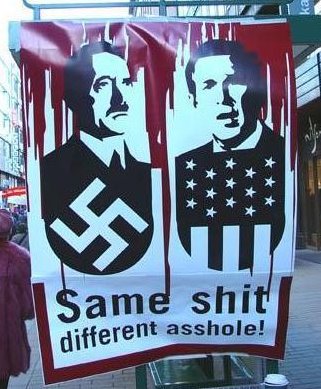
Monday, October 23, 2006

"What We Did Was Insane and Monstrous" - Israel's Cluster Bomb War By SAREE MAKDISI

Of all the statistics to emerge from Israel's recent war on Lebanon, the most shocking concerns the number of cluster bombs that Israel dropped on or fired into Lebanon.

A cluster bomb is made up of a canister that opens and releases hundreds of individual bomblets, which are dispersed and explode over a wide area, showering it with molten metal and lethal fragments.

About 40 percent of the bomblets dropped by Israel (many of which were American-made) did not explode in the air or on impact with the ground. They now detonate when someone disturbs them--a soldier, a farmer, a shepherd, a child attracted by the lure of a shiny metal object.

Cluster bombs are, by definition, inaccurate weapons that are designed to affect a very wide area unpredictably. If they do not discriminate between civilian and military targets when they are dropped, they certainly do not discriminate in the months and years after the end of hostilities, when they go on killing and maiming anyone who happens upon them.

When the count of unexploded cluster bomblets passed 100,000, the United Nation's undersecretary-general for humanitarian affairs, Jan Egeland, expressed his disbelief at the scale of the problem.

"What's shocking and, I would say to me, completely immoral," he said, "is that 90% of the cluster-bomb strikes occurred in the last 72 hours of the conflict, when we knew there would be a resolution, when we really knew there would be an end of this."

That was on Aug. 30, by which time U.N. teams had identified 359 separate cluster-bomb sites.

Since then, the true dimensions of the problem have become even clearer: 770 cluster-bomb sites have now been identified. And the current U.N. estimate is that Israel dropped between 2 million and 3 million bomblets on Lebanon, of which up to a million have yet to explode.

In fact, it is estimated that there are more unexploded bomblets in southern Lebanon than there are people. They lurk in tobacco fields, olive groves, on rooftops, in farms, mixed in with rubble. They are injuring two or three people every day, according to the United Nations, and have killed 20 people since the cease-fire in August.

"What we did was insane and monstrous," one Israeli commander admitted to the newspaper Haaretz. "We covered entire towns in cluster bombs."

As Egeland noted, the majority of these bombs were dropped in the last three days of the war--a time when the U.N. resolution to end the fighting had been agreed on, when the war was virtually over, when it was clear that Israel had failed to accomplish its declared objectives in launching this campaign.

Dropped so late in the war, it's hard to imagine what specific military objective these bombs could possibly have been meant to accomplish. Instead, they seem to have been dropped as a final, gratuitous act of violence in a war waged against an entire population. The vast majority of the 1,200 Lebanese killed by Israeli bombardments were civilians; one in three was a child.

With 100,000 innocent people trapped in the south because they could not, or dared not, flee on roads that Israel was indiscriminately bombing every day, Israel's justice minister declared that they were all--men, women and children--"terrorists who are related in some way to Hezbollah."

Nor was this his view alone. The Israelis dropped leaflets warning that "any vehicle of any kind traveling south of the Litani River will be bombed, on suspicion of transporting rockets, military equipment and terrorists." The Israeli chief of staff was especially clear. "Nothing is safe" in Lebanon, he said. "As simple as that."

Israel carried out 7,000 air raids and fired 160,000 artillery projectiles into Lebanon, a tiny country. That's about two air raids and 40 projectiles per square mile.

But the punishment was not evenly distributed. Israel's war was aimed specifically at Lebanon's Shiite population. Shiite neighborhoods in Beirut were destroyed, but other neighborhoods remained untouched. Shiite villages in the south were obliterated--literally wiped from the surface of the Earth--while nearby Christian villages escaped unscathed, mercifully able to shelter their Shiite neighbors.

Israeli officials said this was a war against Hezbollah, that Hezbollah was hiding in the midst of the population. But this wasn't a war against Hezbollah. It was a war to punish the entire population for its support of the guerrillas.

Not only was Hezbollah not hiding behind civilians, it ought to be obvious that the violence was directed in the first instance at the civilians themselves. To direct such violence at one community, one religious group, one minority--and to deny them the ability to return safely home--was what this war was all about.

To drop two or three bomblets for every man, woman and child in southern Lebanon--after having wiped out their homes, smashed their communities, destroyed their livelihoods--is to wage war against them all.

And we supplied the weapons.

Saree Makdisi, a professor of English at UCLA, is the author of Romantic Imperialism: Universal Empire and the Culture of Modernity (Cambridge University Press, 1998) and William Blake and the Impossible History of the 1790s (University of Chicago Press, 2003). He can be reached at: makdisi@humnet.ucla.edu

Dubya secretly bought 100,000 acres of land in Paraguay atop huge natural gas reserves AND close to a new U.S. military installation

- George W. Bush's Paraguay land deal. WMR's Paraguayan sources have confirmed that George W. Bush recently bought 42,000 hectares (over 100,000 acres) of land in Paraguay's northern "Chaco" region. The land sits atop huge natural gas reserves, according to sources in Asuncion. Moreover, the land deal was consummated in a dinner meeting between Bush's daughter Jenna and Paraguayan President Nicanor Duarte. Although Jenna, who was in Paraguay under the cover of a 10-day UNICEF trip to visit child welfare projects, put the Bush family seal of approval on the land deal, the actual legal papers were worked out by Bush family lawyers and business representatives. Jenna Bush is supposedly working for UNICEF in Panama City. A troubling aspect of the land deal is the role played by James Cason, the US ambassador to Paraguay, in a private Bush family business venture. Cason is a career Foreign Service officer whose previous assignment was the head of the US Interests Section in Havana, where he managed to stir up tensions between the mission and Cuban authorities with his anti-Castro advertisements placed in the windows of the U.S. offices. Cason also has a long history of cooperating with the Defense Intelligence Agency in such locations as Honduras, El Salvador, Panama, Uruguay, and Venezuela. Cason also served as the Guatemala Desk Officer at the Department of State.

Jenna Bush now acts as her dad's emissary in Latin America, consummating a land deal in Paraguay.

The Bush land is close to a new U.S. military installation, the Mariscal Estigarribia Air Base. It is also nearby a huge tract of land purchased by Sun Myung Moon that sits astride Latin America's largest water aquifer, the Guarani aquifer.

Sunday, October 22, 2006

Death of a President


Years afterthe assassination of President George W. Bush in Chicago, an investigative documentary examines that as yet unsolved crime.

Jill Bolstridge interviews Professor Norman Finkelstein, author of The Holocaust Industry: Reflections on the Exploitation of Jewish Suffering.

RNP reporter Jill Bolstridge interviews Professor Norman Finkelstein, author of the controversial book The Holocaust Industry: Reflections on the Exploitation of Jewish Suffering. The son of Holocaust survivors, Finkelstein is a sharp critic of Israel and of US foreign policy.

What compelled you to write The Holocaust Industry?

Basically, there were three reasons. One, I've been involved in the Israel/Palestine conflict for a long time. It was obvious to anybody who was involved that the Nazi Holocaust was constantly being evoked and exploited in order to justify Israel's violations of human rights. And, more currently, from a political point of view, to expose the lies and the misuse and the exploitation of the Nazi Holocaust. That was the political motive; it was the main motive. From a historical point of view, it seemed to me that there were many lessons that could be learned from the Nazi Holocaust, but those lessons were being obscured and distorted by the way that the Nazi Holocaust was being taught and being promoted by the United States. And finally, there was a personal reason. Both my parents survived the Nazi Holocaust, and I felt they deserved better than what it has been reduced to by the Holocaust industry.

Who was responsible for manufacturing this industry, as you put it, and why?

Mainly it's been the United States and the mainstream Jewish organizations. And there have been individuals and institutions which, for one reason or another, have become apologists for Israel.

It is widely considered that anyone who questions the Holocaust or the actions of Israel in the Middle East is anti-Semitic. Why do you believe this to be the case?

There are separate questions here. Questioning Israel's policies or actions, it seems to me, has no relationship whatsoever to anti-Semitism, and that is simply an exploitation of the historical suffering of Jews for political purposes. They have been using the anti-Semitism epithet to silence criticism of Israel and to intimidate critics of Israel into silence. The questioning of the Nazi Holocaust is an entirely separate question. To question whether the Nazi Holocaust itself happened is as absurd as to question whether or not in 1492, Columbus sailed the ocean blue. Of course it happened. That is not a subject for serious debate. There is no rational basis for questioning the fact that it actually happened. But once one establishes the fact that it happened, there are all sorts of unresolved questions about the Nazi Holocaust: factual questions. And then there are all sorts of interpretative questions. And those two sets of questions include when the Nazi Holocaust began, what was the motive behind it, those sorts of things.

Have you received any threats because of your opinion?

No.

How are you treated within the Jewish community as a result of your opinions?

I'm not really part of the Jewish community, per se. I'm obviously Jewish, but I have many friends in life. I have faithful friends, loyal friends, people who share my visions and ideals, and those are not particularly Jewish. I'm sure they have Jewish components, but they are not particularly Jewish. These are a set of ideals which are human.

In regards to the current situation in the Middle East, do you believe the capture of two Israeli soldiers was the real provocation of this war, or is there a hidden agenda?

Oh, it's clear that you don't turn the whole country into a parking lot because two soldiers were captured. Especially since the records show numerous skirmishes and cross-border raids and so forth since 2000, when Israeli troops were ejected from Lebanon. That clearly serves as a pretext for much bigger plans which were in the making for a long time by Israel.

Why do you believe the world, in particular the UN, has sat by and done nothing as Lebanon has been destroyed by Israel?

You can't stop the US now. Because it's run by a bunch of gang members and hoodlums, and they take out the big stick and break it over the skulls of anyone who stands in their way. And the UN has been paralyzed by the people currently occupying the White House. It's very tough. And basically, Europe's attitude is, ‘Let the United States do what it wants, and destroy itself in the process.' So the Europeans, rather than trying to fight the United States, I think have pretty much decided, ‘If that's what they want to do, let them do it, because they are going to wind up in a huge mess.' The problem, of course, is that, in the process of the United States ending up in a huge mess, it kills many, as in the case of Iraq. And hundreds of thousands of people will suffer as well; therefore, European acquiesces to a huge criminal, and that's been their basic attitude.

What do you believe is pushing the Israeli government to such extreme action?

Basically, there are two reasons. There are local reasons and then there are international reasons. The local reasons are pretty straight-forward. Israel's attitude has always been that the Arabs have to know that what they say goes. And when the Arab State, or in this case, Movement, asserts itself and claims that it has a right to take initiatives on its own part, that it's not simply a slave to Israel, then Israel comes in and smashes them. That has always been Israel's style. It will break the back and crack the skull of anyone who gets in its way. And Hezbollah, to Israel, needs to be taught a lesson. That's the local reason. And the broader reason is that Israel is pretty much now just an agent of US power in the region. And the United States is egging Israel on, urging it on, in the hopes that, by inflicting the defeat on Hezbollah, it may set back the regional aspiration to power, which is in conflict with the US. So the US not only entirely sees these acts of Syria, Iran, Hezbollah; these are all movements that are unwilling to follow completely what the US dictates. And so, the hope is that Hezbollah is the weakest link in the chain. Well, Hamas is actually the weakest link. But they think the second weakest is Hezbollah, with a militia of maybe just a thousand soldiers. And they think if they can inflict a defeat on Hezbollah, they can set back the goals of the regional aspiration to power. And the United States is leading it. Israel has its own agenda, but it is serving the US agenda as well.

What will be the wider repercussions for the Middle East?

It's really hard to guess that. I really can't make predictions. Basically, on the Arab side, Hezbollah demonstrates that Arabs have a learning curve and some groups have learned from some of the errors of the past. Hezbollah is well organized and very well-disciplined. It knows the state-of-the-art technology. And, above all else, they are wholly committed to the cause. They are not dissolute, they are not degenerate, they are not corrupt; this is a serious organization. And it may anticipate the beginning of serious organization among the Arabs to finally defeat the colonial imperialist forces which have dominated their part of the world for a century now. And that may not be a positive thing for Israel. It harbours pretty terrible prospects. Ultimately, Israel can not exist in its current form if it is going to be simply a vandal state, a rampaging state, which periodically goes into neighbouring countries and just flattens them, annihilates them, obliterates them, and pulverizes them. If that's what its existence is going to come down to, then it's going to be destroyed.

Are Israel's actions in any way connected to the US military presence in the Middle East?

Yeah, I think there is a connection. The connection basically is that the United States sees all the opposition forces as being joined together in this ‘Axis of Evil,' and they are hoping that the weaker link in the chain, Hezbollah, if it's defeated, will then defeat the forces of Iraq and others. So they are hoping that a defeat for one will be defeat for all.

The media has a very clear bias towards Israel; would you agree and, if so, why?

Well, there are two reasons. One, the media has a clear bias toward the United States, and since Israel is a connection to US power, it would be surprising if it weren't biased toward Israel. So part of the reason is that Israel is as integral to the United States, at this point, as California or Texas. So, if you say the media has a bias toward California up against Papa New Guinea, it's going to have a bias toward Israel against Papa New Guinea. So that's one reason. The other reason is that Jews have a huge presence in the media, and the bias comes, in part, from that.

Do you believe "The War on Terror" is real?

There is a problem with groups and how big they are. It's hard to say, but there are groups who are committed to acts of terrorism against the United States and other powers. That's a given. The real questions are altogether different. The rational questions are, first of all, how big is the threat? And secondly, much more important, how you deal with the threat? How many allegedly being accused as a threat really present a threat? And that brings us to another question: if they actually do present a threat, are the people in power irrational, or are they using the threat to exploit it for other reasons, which actually have nothing to do with the threat?

Confusions abound as to who is the major player in Israeli/US relations; who do you believe calls the shots?

The United States calls the shots ultimately, that's for sure. But it's not true to say that everything Israel does has an American agenda. Broadly, in the Middle East, it is correct to say that the agendas of the United States and Israel overlap. But on local issues, for example, the actual Israel/Palestine conflict, the settlements, have very little to do with the United States. The United States has no stake in the occupation of the territories. It has no stake in the settlements and so forth. Those are Israeli initiatives.

Do you believe the world is going through a new phase of neo-colonialism?

I'm not confident to speak in such global terms. What's obvious is that there are conflicting forces in the world today, toward freeing the world of US/European domination. As you can see, those tendencies are working themselves out, primarily in regions where the United States is currently unable to act, such as South America. And the other aspect is that, especially since the destruction of the Soviet Union, there has been no formidable power in any way blocking US efforts to impose its agenda on the world. And you have those two tendencies. I think it is accurate to say that there is a new phase, a continuation of long-term trends, and the struggle continues between those trends.

Many feel that demonstrations are quite frustrating in that you march, go home, lobby your friends in action, and then wait for the next demonstration. What sort of action do you believe will best force the politicians into action?

Demonstrations ought to be a culmination of activity, not the be-all-and-end-all. Demonstrations are the climax after organizing, after speaking, after writing, after doing a lot of hard labour of trying to convince people then you have a demonstration. And then, hopefully, in the course of the demonstration, you convince people to become activists. But the demonstrations are clearly not, in and of themselves, the goal. The demonstration registers the kind of support that is needed to mobilize people over time.

What do you believe is the cause of anger and so-called terrorism, particularly from the Muslim world?

I don't think you need great powers of perception to figure that out. Look at the degradations of the United States and Israel throughout the Arab world. Since the Bush Administration came to power, they have demolished Afghanistan, they have demolished Iraq, they have demolished Palestine, they have demolished Lebanon. These are vandals, straight out of the thirteenth century, like Genghis Khan. And to wonder why, is just a level of blindness, which really is very difficult to comprehend. I was listening to David Grossman yesterday and he said, “We have been here 60 years in the Middle East, and they still don't accept us.” Well that's a really big surprise, ya know? It's like, the United States' black people. They were slaves from 1619 to 1865, and they still didn't accept white people! If you keep stomping on people, if you treat them like slaves, if you wreck, destroy, rampage their society, if you flatten them, just like in Lebanon, four times since 1978! Operation Litani in ‘78, the destruction of Lebanon in ‘82, Operation Accountability in ‘93, Operation Grapes of Wrath in ‘96, each time sending hundreds of thousands of Lebanese and Palestinians fleeing from the south, and then you sit there and you wonder why they don't love us after sixty years? You're lucky they don't want to strangle you! Even though most of them do, and rightfully so. The level of self-absorption of these people is just mind-boggling! Why don't they love us? You know what? Maybe the Arabs should send Valentines to support us.

Do you believe the world is really facing a threat from radical Islamists?

The issue is not whether the world is facing threats of radical Islamists. You have radical militias in the United States. The question is, how big is the threat? And how significant is it? And, most importantly, how do you diminish it? And all the policies which have been implemented to date plainly do not have it as their main goal to diminish the threat. It's only exacerbating the threat. The same thing with Israel. Israel, in my opinion, is only two wars away from complete destruction. This war, the red line was Haifa. It's clear that, in the next war, Tel Aviv will be targeted and then, the war after that, it will be destroyed. But who's causing it? Who's creating it? Let's be honest about that.

Why are most of the western world's conflicts and disputes with Islamic nations?

I don't think it has anything to do with Islam. They could be Buddhists. It's oil. They don't care that they're Islamic. They don't care about religion. Once the oil's been depleted, then they will go to central Africa. They will let everybody starve, steal whatever minerals and wealth they have, and just let them die. They don't care about democracy anymore. All they're interested in is democratizing the oil, until they get their fair share of it, or, in their minds, their fair share of it.

Why does the United Nations not take a stronger stance against the United States for its disregard of international law?

The UN can't do anything against the US. It's impossible. This is a gang of hoodlums. What are they supposed to do? If they were really, as they say in Yiddish, mensch, then of course they could stop them. But these people are out to protect their own interests, and their own interests would come to serious conflict with the US. And they don't want to come to serious conflict with the US. The US controls too much: the World Bank, the IMF. It has too much power.

Is the United Nations redundant?

No. The UN does a lot. One shouldn't kid oneself about that. So many peace-keeping operations, so many health concerns, environmental concerns, refugee concerns. They do a lot. No question about that. It's a huge organization. There is no doubt of bureaucracy, corruption, no doubt about it. But one shouldn't gainsay the amount of good they do in the world. So it's not like it's become redundant. That's not true at all.

Do you think many have lost faith in the UN and its founding principles?

No. Not at all. There is no evidence of that at all. The world doesn't hold the United Nations to blame for the paralysis of the United States. They hold the United States to blame. If you were to take a poll of the world's population and ask whether people want to strengthen or weaken the UN, my guess is that the result would be that 95%, or even more, would say to strengthen the UN. If they were asked if they want to strengthen or weaken the US presence in the UN, I am most certain the result would be 99.5% percent would say weaken the US presence. So everybody knows who the real problem is.

The post-Israel Middle East

Norman Finkelstein has predicted that Israel is two wars away from complete destruction. That sounds about right. The next one, psychologically required after losing in Lebanon, will be a partial success, setting up the final over-reach.

The Zionists have put all their eggs in the basket of American support, but that basket has developed two holes. One is the paradox that support for the Zionist series of wars and conflicts has so weakened the United States that it is no longer a reliable ally. Faced with a real crisis in Korea, the Americans are powerless to do anything, and have to rely on China to fix things. It’s China that is going around the world – Africa, South America, Asia – sealing up oil contracts, and not, contrary to what I keep reading about the Bush Administration’s great geopolitical plans, the United States. It’s Russia that is methodically reestablishing its power over the ‘Stans, Ukraine, and Georgia, and dangling promises of hydrocarbons at Europe. Americans are so nackered from fighting Israel’s wars that the world’s sole superpower isn’t so super any longer.

The other hole is the fact that Americans are slowly waking up to the power of the Lobby, and don’t like it. A Zogby International poll (Zogby remains the only fair American polling company, as witnessed by the fact that its results are correct, instead of the ‘push-polls’ sold by all the other corrupted pollsters):

“ . . . reveals that 39% of the American public ‘agree’ or ‘somewhat agree’ that ‘the work of the Israel lobby on Congress and the Bush administration has been a key factor for going to war in Iraq and now confronting Iran.’ However, a similar number, 40%, ‘strongly disagreed’ or ‘somewhat disagreed’ with this position. Some 20% of the public, or more than one in five, were not sure.”

This despite the fact that a significant minority of Americans are religiously insane (if you extract the Christian Zionists from the Israel Lobby poll, it appears that practically every sane American opposes the Lobby). Perhaps more importantly, 50% of those between the ages of 18 and 29 agreed that the Israel lobby had a hand in forming the current pro-war policy. The tide is turning.

It is time to consider what a post-Israel Middle East will look like, and how Judaism handles post-Zionist Jewish settlement in what used to be Israel.