
When Americans ask me what happened to the vaunted U.S. press corps over the past three decades – in the decline from its heyday of the Watergate scandal and the Pentagon Papers to its failure to challenge the Iraq WMD lies or to hold George W. Bush accountable – I often recall for them the story of Gary Webb.
Two years ago, on the night of Dec. 9, 2004, investigative reporter Webb – his career shattered and his life in ruins – typed out four suicide notes for his family, laid out a certificate for his cremation, put a note on the door suggesting a call to 911, and removed his father’s handgun from a box.
The 49-year-old Webb, a divorced father of three who was living alone in a rental house in Sacramento County, California, then raised the gun and shot himself in the head. The first shot was not lethal, so he fired once more.
His body was found the next day after movers who were scheduled to clear out Webb’s rental house, arrived and followed the instructions from the note on the door.
Though a personal tragedy, the story of Gary Webb’s suicide has a larger meaning for the American people who find themselves increasingly sheltered from the truth by government specialists at cover-ups and by a U.S. news media that has lost its way.
Webb’s death had its roots in his fateful decision eight years earlier to write a three-part series for the San Jose Mercury News that challenged a potent conventional wisdom shared by the elite U.S. news organizations – that one of the most shocking scandals of the 1980s just couldn’t have been true.
Webb’s “Dark Alliance” series, published in August 1996, revived the story of how the Reagan administration in the 1980s had tolerated and protected cocaine smuggling by its client army of Nicaraguan rebels known as the contras.
Though substantial evidence of these crimes had surfaced in the mid-1980s (initially in an article that Brian Barger and I wrote for the Associated Press in December 1985 and later at hearings conducted by Sen. John Kerry), the major news outlets had bent to pressure from the Reagan administration and refused to take the disclosures seriously.
Reflecting the dominant attitude toward Kerry and his work on the contra-cocaine scandal, Newsweek even dubbed the Massachusetts senator a “randy conspiracy buff.” [For details, see Consortiumnews.com’s “Kerry’s Contra-Cocaine Chapter.”]
Thus, the ugly reality of the contra-cocaine scandal was left in that netherworld of uncertainty, largely proven with documents and testimony but never accepted by Official Washington, including its premier news organizations, such as the New York Times and the Washington Post.
But Webb’s series thrust the scandal back into prominence by connecting the contra-cocaine trafficking to the crack epidemic that had ravaged Los Angeles and other American cities in the 1980s. For that reason, African-American communities were up in arms as were their elected representatives.
So, the “Dark Alliance” series offered a unique opportunity for the major news outlets to finally give the contra-cocaine scandal the attention it deserved.
Media Resistance
But that would have required some painful self-criticism among Washington journalists whose careers had advanced in part because they had avoided retaliation from aggressive Reagan supporters who had made an art of punishing out-of-step reporters for pursuing controversies like the contra-cocaine scandal.
Also, by the mid-1990s, a powerful right-wing news media had taken shape and was in no mood to accept the notion that President Ronald Reagan’s beloved contras were little more than common criminals. That recognition would have cast a shadow over the Reagan Legacy, which the Right was busy elevating into mythic status.
There was the turf issue, too. Since Webb’s stories coincided with the emergence of the Internet as an alternate source for news and the San Jose Mercury News was at the center of Silicon Valley, the big newspapers saw a threat to their historic dominance as the nation’s gatekeepers for what information should be taken seriously.
Plus, the major media’s focus in the mid-1990s was on scandals swirling around Bill Clinton, such as some firings at the White House Travel Office and convoluted questions about his old Whitewater real-estate deal.
In other words, there was little appetite to revisit scandals from the Reagan years and there was strong motive to disparage what Webb had written.
It fell to Rev. Sun Myung Moon’s right-wing Washington Times to begin the counterattack. The Washington Times turned to some ex-CIA officials, who had participated in the contra war, to refute the drug charges.
But – in a pattern that would repeat itself over the next decade – the Washington Post and other mainstream newspapers quickly lined up behind the right-wing press. On Oct. 4, 1996, the Washington Post published a front-page article knocking down Webb’s story.
The Post’s approach was twofold: first, it presented the contra-cocaine allegations as old news – “even CIA personnel testified to Congress they knew that those covert operations involved drug traffickers,” the Post reported – and second, the Post minimized the importance of the one contra smuggling channel that Webb had highlighted – that it had not “played a major role in the emergence of crack.”
A Post side-bar story dismissed African-Americans as prone to “conspiracy fears.”
Soon, the New York Times and the Los Angeles Times joined in the piling on against Gary Webb. The big newspapers made much of the CIA’s internal reviews in 1987 and 1988 that supposedly cleared the spy agency of a role in contra-cocaine smuggling.
But the CIA’s decade-old cover-up began to weaken on Oct. 24, 1996, when CIA Inspector General Frederick Hitz conceded before the Senate Intelligence Committee that the first CIA probe had lasted only 12 days, the second only three days. He promised a more thorough review.
Nevertheless, Webb was becoming the target of outright media ridicule. Influential Post media critic Howard Kurtz mocked Webb for saying in a book proposal that he would explore the possibility that the contra war was primarily a business to its participants.
“Oliver Stone, check your voice mail,” Kurtz chortled. [Washington Post, Oct. 28, 1996]
Webb’s suspicion was not unfounded, however. Indeed, White House aide Oliver North’s emissary Rob Owen had made the same point a decade earlier, in a March 17, 1986, message about the contra leadership.
“Few of the so-called leaders of the movement … really care about the boys in the field,” Owen wrote. “THIS WAR HAS BECOME A BUSINESS TO MANY OF THEM.” [Capitalization in the original.]
Kurtz and other big-name journalists may have been ignorant of key facts about the contra war, but that didn’t stop them from pillorying Gary Webb. The ridicule also had a predictable effect on the executives of the Mercury News. By early 1997, executive editor Jerry Ceppos was in retreat.
On May 11, 1997, Ceppos published a front-page column saying the series “fell short of my standards.” He criticized the stories because they “strongly implied CIA knowledge” of contra connections to U.S. drug dealers who were manufacturing crack-cocaine. “We did not have proof that top CIA officials knew of the relationship,” Ceppos wrote.
The big newspapers celebrated Ceppos’s retreat as vindication of their own dismissal of the contra-cocaine stories. Ceppos next pulled the plug on the Mercury News’ continuing contra-cocaine investigation and reassigned Webb to a small office in Cupertino, California, far from his family. Webb resigned the paper in disgrace.
For undercutting Webb and other reporters working on the contra investigation, Ceppos was lauded by the American Journalism Review and was given the 1997 national “Ethics in Journalism Award” by the Society of Professional Journalists. While Ceppos won raves, Webb watched his career collapse and his marriage break up.
The CIA Probe
Still, Gary Webb had set in motion internal government investigations that would bring to the surface long-hidden facts about how the Reagan administration had conducted the contra war.
The CIA’s defensive line against the contra-cocaine allegations began to break when the spy agency published Volume One of Inspector General Hitz’s findings on Jan. 29, 1998.
Despite a largely exculpatory press release, Hitz’s Volume One admitted that not only were many of Webb’s allegations true but that he actually understated the seriousness of the contra-drug crimes and the CIA’s knowledge.
Hitz acknowledged that cocaine smugglers played a significant early role in the Nicaraguan contra movement and that the CIA intervened to block an image-threatening 1984 federal investigation into a San Francisco-based drug ring with suspected ties to the contras, the so-called “Frogman Case.”
On May 7, 1998, another disclosure from the government investigation shook the CIA’s weakening defenses.
Rep. Maxine Waters, a California Democrat, introduced into the Congressional Record a Feb. 11, 1982, letter of understanding between the CIA and the Justice Department.
The letter, which had been sought by CIA Director William Casey, freed the CIA from legal requirements that it must report drug smuggling by CIA assets, a provision that covered both the Nicaraguan contras and Afghan rebels who were fighting a Soviet-supported regime in Afghanistan and were implicated in heroin trafficking.
The next breach in the defensive wall was a report by the Justice Department’s inspector general Michael Bromwich. Given the hostile climate surrounding Webb’s series, Bromwich’s report opened with criticism of Webb. But, like the CIA’s Volume One, the contents revealed new details about government wrongdoing.
According to evidence cited by Bromwich, the Reagan administration knew almost from the outset of the contra war that cocaine traffickers permeated the paramilitary operation. The administration also did next to nothing to expose or stop the crimes.
Bromwich’s report revealed example after example of leads not followed, corroborated witnesses disparaged, official law-enforcement investigations sabotaged, and even the CIA facilitating the work of drug traffickers.
The report showed that the contras and their supporters ran several parallel drug-smuggling operations, not just the one at the center of Webb’s series.
The report also found that the CIA shared little of its information about contra drugs with law-enforcement agencies and on three occasions disrupted cocaine-trafficking investigations that threatened the contras.
Though depicting a more widespread contra-drug operation than Webb had understood, the Justice report also provided some important corroboration about a Nicaraguan drug smuggler, Norwin Meneses, who was a key figure in Webb’s series.
Bromwich cited U.S. government informants who supplied detailed information about Meneses’s operation and his financial assistance to the contras.
For instance, Renato Pena, a money-and-drug courier for Meneses, said that in the early 1980s, the CIA allowed the contras to fly drugs into the United States, sell them and keep the proceeds.
Pena, who was the northern California representative for the CIA-backed FDN contra army, said the drug trafficking was forced on the contras by the inadequate levels of U.S. government assistance.
The Justice report also disclosed repeated examples of the CIA and U.S. embassies in Central America discouraging Drug Enforcement Administration investigations, including one into contra-cocaine shipments moving through the international airport in El Salvador.
Inspector General Bromwich said secrecy trumped all. “We have no doubt that the CIA and the U.S. Embassy were not anxious for the DEA to pursue its investigation at the airport,” he wrote.
Despite the remarkable admissions in the body of these reports, the big newspapers showed no inclination to read beyond the press releases and executive summaries.
Cocaine Crimes & Monica
By fall 1998, Official Washington was obsessed with the Monica Lewinsky sex scandal, which made it easier to ignore even more stunning contra-cocaine disclosures in the CIA’s Volume Two.
In Volume Two, published Oct. 8, 1998, CIA Inspector General Hitz identified more than 50 contras and contra-related entities implicated in the drug trade. He also detailed how the Reagan administration had protected these drug operations and frustrated federal investigations throughout the 1980s.
According to Volume Two, the CIA knew the criminal nature of its contra clients from the start of the war against Nicaragua’s leftist Sandinista government.
The earliest contra force, called ADREN or the 15th of September Legion, had chosen “to stoop to criminal activities in order to feed and clothe their cadre,” according to a June 1981 draft CIA field report.
ADREN also employed terrorist methods, including the bombing of Nicaraguan civilian planes and hijackings, to disrupt the Sandinista government, the CIA knew. Cocaine smuggling was also in the picture.
According to a September 1981 cable to CIA headquarters, two ADREN members made the first delivery of drugs to Miami in July 1981, the CIA cable reported.
ADREN's leaders included Enrique Bermudez and other early contras who would later direct the major contra army, the CIA-organized FDN. Throughout the war, Bermudez remained the top contra military commander.
The CIA later corroborated the allegations about ADREN’s cocaine trafficking, but insisted that Bermudez had opposed the drug shipments to the United States which went ahead nonetheless.
The truth about Bermudez’s supposed objections to drug trafficking, however, was less clear. According to Volume One, Bermudez enlisted Norwin Meneses, a large-scale Nicaraguan cocaine smuggler, to raise money and buy supplies for the contras.
Volume One had quoted a Meneses associate, another Nicaraguan trafficker named Danilo Blandon, who told Hitz’s investigators that he and Meneses flew to Honduras to meet with Bermudez in 1982.
At the time, Meneses’s criminal activities were well known in the Nicaraguan exile community. But the FDN commander told the cocaine smugglers that “the ends justify the means” in raising money for the contras.
After the Bermudez meeting, contra soldiers helped Meneses and Blandon get past Honduran police who briefly arrested them on drug-trafficking suspicions. After their release, Blandon and Meneses traveled on to Bolivia to complete a cocaine transaction.
There were other indications of Bermudez’s drug-smuggling tolerance. In February 1988, another Nicaraguan exile linked to the drug trade accused Bermudez of narcotics trafficking, according to Hitz’s report.
After the contra war ended, Bermudez returned to Managua, where he was shot to death on Feb. 16, 1991. The murder has never been solved.
CIA Drug Asset
Along the Southern Front, in Costa Rica, the drug evidence centered on the forces of Eden Pastora, another leading contra commander. But Hitz discovered that the U.S. government may have contributed to the problem.
Hitz revealed that the CIA put an admitted drug operative – known by his CIA pseudonym “Ivan Gomez” – in a supervisory position over Pastora.
Hitz reported that the CIA discovered Gomez’s drug history in 1987 when Gomez failed a security review on drug-trafficking questions.
In internal CIA interviews, Gomez admitted that in March or April 1982, he helped family members who were engaged in drug trafficking and money laundering. In one case, Gomez said he assisted his brother and brother-in-law in transporting cash from New York City to Miami. He admitted that he “knew this act was illegal.”
Later, Gomez expanded on his admission, describing how his family members had fallen $2 million into debt and had gone to Miami to run a money-laundering center for drug traffickers. Gomez said “his brother had many visitors whom [Gomez] assumed to be in the drug trafficking business.”
Gomez’s brother was arrested on drug charges in June 1982. Three months later, in September 1982, Gomez started his CIA assignment in Costa Rica.
Years later, convicted drug trafficker Carlos Cabezas charged that in the early 1980s, Ivan Gomez was the CIA agent in Costa Rica who was overseeing drug-money donations to the contras.
Gomez “was to make sure the money was given to the right people [the contras] and nobody was taking ... profit they weren’t supposed to,” Cabezas stated publicly.
But the CIA sought to discredit Cabezas at the time because he had trouble identifying Gomez’s picture and put Gomez at one meeting in early 1982 before Gomez started his CIA assignment.
While the CIA was able to fend off Cabezas’s allegations by pointing to these discrepancies, Hitz’s report revealed that the CIA was nevertheless aware of Gomez’s direct role in drug-money laundering, a fact the agency hid from Sen. Kerry’s investigation in 1987.
The Bolivian Connection
There also was more about Gomez. In November 1985, the FBI learned from an informant that Gomez’s two brothers had been large-scale cocaine importers, with one brother arranging shipments from Bolivia’s infamous drug kingpin Roberto Suarez.
Suarez already was known as a financier of right-wing causes. In 1980, with the support of Argentine’s hard-line anti-communist military regime, Suarez bankrolled a coup in Bolivia that ousted the elected left-of-center government.
The violent putsch became known as the Cocaine Coup because it made Bolivia the region's first narco-state. Bolivia’s government-protected cocaine shipments helped transform the Medellin cartel from a struggling local operation into a giant corporate-style business for delivering cocaine to the U.S. market.
Some of those profits allegedly found their way into contra coffers.
Flush with cash in the early 1980s, Suarez invested more than $30 million in various right-wing paramilitary operations, including the contra forces in Central America, according to U.S. Senate testimony by an Argentine intelligence officer, Leonardo Sanchez-Reisse.
In 1987, Sanchez-Reisse said the Suarez drug money was laundered through front companies in Miami before going to Central America. There, other Argentine intelligence officers – veterans of the Bolivian coup – trained the contras.
CIA Inspector General Hitz added another piece to the mystery of the Bolivian-contra connection. One contra fund-raiser, Jose Orlando Bolanos, boasted that the Argentine government was supporting his anti-Sandinista activities, according to a May 1982 cable to CIA headquarters.
Bolanos made the statement during a meeting with undercover Drug Enforcement Administration agents in Florida. He even offered to introduce them to his Bolivian cocaine supplier.
Despite all this suspicious drug activity around Ivan Gomez and the contras, the CIA insisted that it did not unmask Gomez until 1987, when he failed a security check and confessed his role in his family’s drug business.
The CIA official who interviewed Gomez concluded that “Gomez directly participated in illegal drug transactions, concealed participation in illegal drug transactions, and concealed information about involvement in illegal drug activity," Hitz wrote.
But senior CIA officials still protected Gomez. They refused to refer the Gomez case to the Justice Department, citing the 1982 DOJ-CIA agreement that spared the CIA from a legal obligation to report narcotics crimes by non-employees.
Instead, the CIA eased Gomez, an independent contractor, out of the agency in February 1988, without alerting law enforcement or the congressional oversight committees.
When questioned about the case nearly a decade later, one senior CIA official who had supported the gentle treatment of Gomez had second thoughts.
“It is a striking commentary on me and everyone that this guy’s involvement in narcotics didn’t weigh more heavily on me or the system,” the official acknowledged.
The White House Trail
A Medellin drug connection arose in another section of Hitz’s report, when he revealed evidence suggesting that some contra trafficking may have been sanctioned by Reagan's National Security Council.
The protagonist for this part of the contra-cocaine mystery was Moises Nunez, a Cuban-American who worked for North’s NSC operation and for two drug-connected seafood importers, Ocean Hunter in Miami and Frigorificos de Puntarenas in Costa Rica.
Frigorificos de Puntarenas was created in the early 1980s as a cover for drug-money laundering, according to sworn testimony by two of the firm’s principals – Carlos Soto and Medellin cartel accountant Ramon Milian Rodriguez.
Drug allegations were swirling around Moises Nunez by the mid-1980s. At the AP, his operation was one of the targets of our investigation.
Finally reacting to these suspicions, the CIA questioned Nunez on March 25, 1987, about his alleged cocaine trafficking. He responded by pointing the finger at his NSC superiors.
“Nunez revealed that since 1985, he had engaged in a clandestine relationship with the National Security Council,” Hitz reported.
“Nunez refused to elaborate on the nature of these actions, but indicated it was difficult to answer questions relating to his involvement in narcotics trafficking because of the specific tasks he had performed at the direction of the NSC. Nunez refused to identify the NSC officials with whom he had been involved.”
After this first round of questioning, CIA headquarters authorized an additional session, but then senior CIA officials reversed the decision. There would be no further efforts at “debriefing Nunez.”
Hitz noted that “the cable [from headquarters] offered no explanation for the decision” to stop the Nunez interrogation.
But the CIA’s Central American task force chief Alan Fiers said the Nunez-NSC drug lead was not pursued “because of the NSC connection and the possibility that this could be somehow connected to the Private Benefactor program [the contra money handled by North]. A decision was made not to pursue this matter.”
Joseph Fernandez, who had been the CIA’s station chief in Costa Rica, later confirmed to congressional Iran-Contra investigators that Nunez “was involved in a very sensitive operation” for North’s “Enterprise.” The exact nature of that NSC-authorized activity has never been divulged.
At the time of the Nunez-NSC drug admissions and his truncated interrogation, the CIA’s acting director was Robert M. Gates, who was confirmed by the U.S. Senate on Dec. 6, 2006, to be President George W. Bush’s new Secretary of Defense.
Miami Vice
The CIA also worked directly with other drug-connected Cuban-Americans on the contra project, Hitz found.
One of Nunez’s Cuban-American associates, Felipe Vidal, had a criminal record as a narcotics trafficker in the 1970s. But the CIA still hired him to serve as a logistics coordinator for the contras, Hitz reported.
The CIA also learned that Vidal’s drug connections were not only in the past.
A December 1984 cable to CIA headquarters revealed Vidal’s ties to Rene Corvo, another Cuban-American suspected of drug trafficking. Corvo was working with anti-communist Cuban, Frank Castro, who was viewed as a Medellin cartel representative within the contra movement.
There were other narcotics links to Vidal. In January 1986, the DEA in Miami seized 414 pounds of cocaine concealed in a shipment of yucca that was going from a contra operative in Costa Rica to Ocean Hunter, the company where Vidal worked.
Despite the evidence, Vidal remained a CIA employee as he collaborated with Frank Castro’s assistant, Rene Corvo, in raising money for the contras, according to a CIA memo in June 1986.
By fall 1986, Sen. Kerry had heard enough rumors about Vidal to demand information about him as part of a congressional inquiry into contra drugs. But the CIA withheld the derogatory information. On Oct. 15, 1986, Kerry received a briefing from Alan Fiers, who didn’t mention Vidal’s drug arrests and conviction in the 1970s.
But Vidal was not yet in the clear. In 1987, the U.S. attorney in Miami began investigating Vidal, Ocean Hunter and other contra-connected entities.
This prosecutorial attention worried the CIA. The CIA’s Latin American division felt it was time for a security review of Vidal. But on Aug. 5, 1987, the CIA’s security office blocked the review for fear that the Vidal drug information “could be exposed during any future litigation.”
As expected, the U.S. Attorney did request documents about “contra-related activities” by Vidal, Ocean Hunter and 16 other entities. The CIA advised the prosecutor that “no information had been found regarding Ocean Hunter,” a statement that was clearly false.
The CIA continued Vidal’s employment as an adviser to the contra movement until 1990, virtually the end of the contra war.
Honduras Trafficking
Hitz revealed that drugs also tainted the highest levels of the Honduran-based FDN, the largest contra army.
Hitz found that Juan Rivas, a contra commander who rose to be chief of staff, admitted that he had been a cocaine trafficker in Colombia before the war. The CIA asked Rivas, known as El Quiche, about his background after the DEA began suspecting that Rivas might be an escaped convict from a Colombian prison.
In interviews with CIA officers, Rivas acknowledged that he had been arrested and convicted of packaging and transporting cocaine for the drug trade in Barranquilla, Colombia. After several months in prison, Rivas said, he escaped and moved to Central America where he joined the contras.
Defending Rivas, CIA officials insisted that there was no evidence that Rivas engaged in trafficking while with the contras. But one CIA cable noted that he lived an expensive lifestyle, even keeping a $100,000 thoroughbred horse at the contra camp.
Contra military commander Bermudez later attributed Rivas’s wealth to his ex-girlfriend’s rich family. But a CIA cable in March 1989 added that “some in the FDN may have suspected at the time that the father-in-law was engaged in drug trafficking.”
Still, the CIA moved quickly to protect Rivas from exposure and possible extradition to Colombia. In February 1989, CIA headquarters asked that DEA take no action “in view of the serious political damage to the U.S. Government that could occur should the information about Rivas become public.”
Rivas was eased out of the contra leadership with an explanation of poor health. With U.S. government help, he was allowed to resettle in Miami. Colombia was not informed about his fugitive status.
Drug Flights
Another senior FDN official implicated in the drug trade was its chief spokesman in Honduras, Arnoldo Jose “Frank” Arana.
The drug allegations against Arana dated back to 1983 when a federal narcotics task force put him under criminal investigation because of plans “to smuggle 100 kilograms of cocaine into the United States from South America.”
On Jan. 23, 1986, the FBI reported that Arana and his brothers were involved in a drug-smuggling enterprise, although Arana was not charged.
Arana sought to clear up another set of drug suspicions in 1989 by visiting the DEA in Honduras with a business associate, Jose Perez. Arana’s association with Perez, however, only raised new alarms.
If “Arana is mixed up with the Perez brothers, he is probably dirty,” the DEA responded.
Through their ownership of an air services company called SETCO, the Perez brothers were associated with Juan Matta Ballesteros, a major cocaine kingpin connected to the murder of a DEA agent, according to reports by the DEA and U.S. Customs.
Hitz reported that someone at the CIA scribbled a note on the DEA cable about Arana stating: “Arnold Arana ... still active and working, we [CIA] may have a problem.”
Despite its drug ties to Matta Ballesteros, SETCO emerged as the principal company for ferrying supplies to the contras in Honduras.
During congressional Iran-Contra hearings, FDN political leader Adolfo Calero testified that SETCO was paid from bank accounts controlled by Oliver North. SETCO also received $185,924 from the State Department for ferrying supplies to the contras in 1986.
Hitz found other air transport companies used by the contras implicated in the cocaine trade. Even FDN leaders suspected that they were shipping supplies to Central America aboard planes that might be returning with drugs.
Mario Calero, Adolfo Calero’s brother and the chief of contra logistics, grew so uneasy about one air-freight company that he notified U.S. law enforcement that the FDN only chartered the planes for the flights south, not the return flights north.
Hitz found that some drug pilots simply rotated from one sector of the contra operation to another. Donaldo Frixone, who had a drug record in the Dominican Republic, was hired by the CIA to fly contra missions from 1983-85.
In September 1986, however, Frixone was implicated in smuggling 19,000 pounds of marijuana into the United States. In late 1986 or early 1987, he went to work for Vortex, another U.S.-paid contra supply company linked to the drug trade.
Fig Leaf
By the time that Hitz’s Volume Two was published in fall 1998, the CIA’s defense against Webb’s series had shrunk to a fig leaf: that the CIA did not conspire with the contras to raise money through cocaine trafficking.
But Hitz made clear that the contra war took precedence over law enforcement and that the CIA withheld evidence of contra crimes from the Justice Department, the Congress and even the CIA’s own analytical division.
Besides tracing the evidence of contra-drug trafficking through the decade-long contra war, the inspector general interviewed senior CIA officers who acknowledged that they were aware of the contra-drug problem but didn’t want its exposure to undermine the struggle to overthrow Nicaragua’s leftist Sandinista government.
According to Hitz, the CIA had “one overriding priority: to oust the Sandinista government. … [CIA officers] were determined that the various difficulties they encountered not be allowed to prevent effective implementation of the contra program.”
One CIA field officer explained, “The focus was to get the job done, get the support and win the war.”
Hitz also recounted complaints from CIA analysts that CIA operations officers handling the contras hid evidence of contra-drug trafficking even from the CIA’s analysts.
Because of the withheld evidence, the CIA analysts incorrectly concluded in the mid-1980s that “only a handful of contras might have been involved in drug trafficking.” That false assessment was passed on to Congress and the major news organizations – serving as an important basis for denouncing Gary Webb and his series in 1996.
Nevertheless, although Hitz’s report was an extraordinary admission of institutional guilt by the CIA, it passed almost unnoticed by the big newspapers. [For more details, see Robert Parry’s Lost History: Contras, Cocaine, the Press & ‘Project Truth’]
On Oct. 10, 1998, two days after Hitz’s report was posted at the CIA’s Internet site, the New York Times published a brief article that continued to deride Webb but acknowledged the contra-drug problem may have been worse than earlier understood.
Several weeks later, the Washington Post weighed in with a similarly superficial article. The Los Angeles Times never published a story on the release of the CIA’s Volume Two.
To this day, no editor or reporter who missed the contra-cocaine story has been punished for his or her negligence. Indeed, some of them are now top executives at their news organizations. On the other hand, Gary Webb’s career never recovered.
Unable to find decent-paying work in a profession where his past awards included a Pulitzer Prize, Webb grew despondent. His marriage broke up. By December 2004, he found himself forced to move out of his rented house near Sacramento.
Instead, Webb decided to end his life.
One Last Chance
Webb’s suicide offered the New York Times, the Washington Post and the Los Angeles Times one more opportunity to set matters right, to revisit the CIA’s admissions in 1998 and to exact some accountability on the Reagan-era officials implicated in protecting the contra crimes.
But all that followed Gary Webb’s death was more trashing of Gary Webb. The Los Angeles Times ran a graceless obituary that made no mention of the admissions in the CIA’s Volume Two and treated Webb like a low-life criminal, rather than a journalist who took on a tough story and paid a high price.
The Times obituary was republished in other newspapers, including the Washington Post. No one reading this obit would understand the profound debt that American history owed to Gary Webb, who deserved the lion’s share of the credit for forcing the CIA to make its extraordinary admissions.
Yet, the big media’s consistent mishandling of the contra-cocaine scandal in the 1980s and 1990s carried another warning that the nation missed: that the U.S. press corps was no longer capable of reporting complex crimes of state.
That unaddressed danger returned with disastrous results in late 2002 and early 2003 when George W. Bush sold false stories about Iraq’s alleged weapons of mass destruction while the major newspapers acted as cheerleaders and accomplices.
At the time of Webb’s death on Dec. 9, 2004, the full scope of the Iraq disaster was still not evident, nor was the major press corps ready to acknowledge that its cowardice in the 1980s and its fecklessness in the 1990s were the direct antecedents to its complicity in the illegal invasion of Iraq.
Gary Webb had been a kind of canary in the mine shaft. His career destruction in the 1990s and his desperate act of suicide in 2004 were warnings about grave dangers that, if left ignored, would wreak even worse havoc on the United States and the world.
But – on this second anniversary of Webb’s death – it should be remembered that his great gift to American history was that he, along with angry African-American citizens, forced the government to admit some of the worst crimes ever condoned by any White House: the protection of drug smuggling into the United States as part of a covert war against a country, Nicaragua, that represented no real threat to Americans.
It is way past time for that reality – and that gift – to be acknowledged.
Robert Parry broke many of the Iran-Contra stories in the 1980s for the Associated Press and Newsweek. His latest book, Secrecy & Privilege: Rise of the Bush Dynasty from Watergate to Iraq, can be ordered at secrecyandprivilege.com. It's also available at Amazon.com, as is his 1999 book, Lost History: Contras, Cocaine, the Press & 'Project Truth.'
Sunday, December 10, 2006
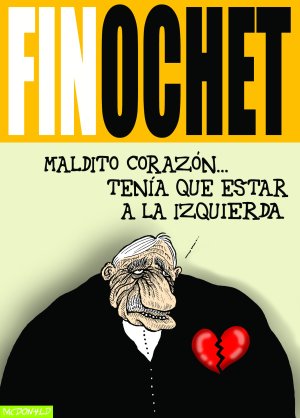
Chile: El tirano moribundo: La última hora de Pinochet
por Lisandro Otero*
Pinochet acaba de sufrir un infarto. Le han dado la extremaunción y los médicos predicen que ha entrado en su agonía final. Se extingue el hombre que frustró el experimento de la Unidad Popular, asesinó a Salvador Allende y ensangrentó Chile durante varios decenios.
7 de diciembre de 2006
La precaria democracia chilena fue inicialmente una dádiva de los militares, los "milicos" como les llaman allá. Cuando Pinochet reconoció haber perdido el plebiscito no estaba dando una lección de liberalismo. Chile se encontraba en un pésimo momento económico. El plan trazado por los "Chicago boys" y Milton Freedman ─la instauración del neoliberalismo en América Latina─, no había dado resultado. Existía un 30% de desempleo, el pueblo estaba muy descontento. De no haber cedido, Pinochet habría tenido que enfrentarse a una rebelión popular en un breve lapso. No quiso desestabilizar el país una vez más, consideró que podía gobernar detrás del trono. Y así lo hizo.
Durante su presidencia Patricio Aylwin sufrió numerosas presiones, que denunció al cesar en su cargo. Frei tuvo que hacer juegos malabares para conservar su autoridad frente a la presencia siempre ominosa del alto mando castrense. Entre los políticos chilenos es sabido —aunque ninguno quiere admitirlo—, que bastaba que Pinochet alzara su dedo meñique para que el aparato militar del país se pusiese en marcha y derrocase, una vez más, al gobierno democráticamente elegido.
Poco a poco la presión popular fue forzando a enjuiciar a Pinochet. El dictador enfrentó decenas de causas por los crímenes y torturas que se cometieron bajo su mandato. Se protegió con la inmunidad, que le otorgaba su senaduría vitalicia. Las denuncias públicas de sus numerosos crímenes fueron profundizando en la conciencia de la absoluta necesidad de arraigar las instituciones democráticas. Tras ser aprehendido en Londres, la liberación de Pinochet, ordenada por el gobierno laborista enlodó a Tony Blair, aún más.
En Chile solamente apoyaba al tirano un grupito apenas de niños fresa, hijos de los militares o los empresarios beneficiados por la dictadura pero tras ellos se hallaban los espeluznantes gorilas capaces de infundir todas las consternaciones. Sobre la sombra siniestra de Pinochet pesan figuras como el carnicero Manuel Contreras, jefe de la siniestra Dirección de Inteligencia, la siniestra DINA, y los perpetradores de la salvaje Caravana de la Muerte, que dejó un rastro de dolor y tragedias, más los verdugos de la Operación Cóndor, organización internacional que con fiereza y perversidad se lanzó por toda América Latina a decapitar a los liberales, a la izquierda pensante de nuestro continente.
También, los responsables directos de haber plantado la bomba, en Washington, en el coche del ex canciller Orlando Letelier, y quienes realizaron el atentado dinamitero, en Buenos Aires, que costó la vida al general Carlos Prats, el último militar pundonoroso que quedaba en Chile además de los causantes del atentado al líder demócrata cristiano, Bernardo Leighton, ocurrido en Roma. En Chile andan libres aún los que cortaron a hachazos las manos del guitarrista Víctor Jara —durante su encierro en el estadio nacional—, cuyo único delito fue cantar con su clara voz las realizaciones de la Unidad Popular. De todos esos crímenes se sabe que las órdenes salieron del despacho de Pinochet.
Los defensores del dictador claman que todo ello fue necesario por defender la cristiandad occidental de un comunismo agresor. El marco de la Guerra Fría le permitió mentir y abusar para mejor desdeñar los derechos humanos. Allende ni siquiera dijo que su gobierno sería socialista ─mucho menos marxista─, sino que constituía una antesala de beneficio social y recuperación de la propiedad nacional, para que en un futuro razonable pudieran mejorar las condiciones de vida del pueblo chileno.
El golpe fue alentado y organizado por la CIA y poderosas compañías transnacionales como la ITT y la Anaconda Copper. Detrás del zarpazo se hallaba la intención de recuperar y asegurar muchos miles de millones de dólares. La sangre fue vertida en nombre de los intereses privados de grandes consorcios y Pinochet fue su instrumento.
Pero el pinochetismo no está en agonía, como el tirano. Basta advertir los rictus de odio, rabia e insolencia de sus partidarios, los rostros torvos de los "milicos", de los siniestros esbirros que ensangrentaron el país, aún impunes, aún expectantes. El fascismo chileno no ha muerto aunque se haya debilitado. Debe mantenerse la guardia democrática para que nunca más ocurra una transgresión de la legalidad institucional en aquél país.
Lisandro Otero Escritor y periodista cubano. Es Presidente de la Academia Cubana de la Lengua y Premio Nacional de Literatura.

Friday, December 08, 2006
Manifestoon - The Communist Manifesto illustrated by Disney like characters.
Manifestoon - The Communist Manifesto illustrated by Disney like characters.
Manifestoon is an homage to the latent subversiveness of cartoons. Though U.S. cartoons are usually thought of as conveyors of capitalist ideologies of consumerism and individualism, Drew observes: "Somehow as an avid childhood fan of cartoons, these ideas were secondary to a more important lesson—that of the 'trickster' nature of many characters as they mocked, outwitted and defeated their more powerful adversaries. In the classic cartoon, brute strength and heavy artillery are no match for wit and humor, and justice always prevails. For me, it was natural to link my own childhood concept of subversion with an established, more articulate version [Marx and Engels' Communist Manifesto]. Mickey running over the globe has new meaning in today's mediascape, in which Disney controls one of the largest concentrations of media.
Manifestoon - The Communist Manifesto illustrated by Disney like characters.
Manifestoon is an homage to the latent subversiveness of cartoons. Though U.S. cartoons are usually thought of as conveyors of capitalist ideologies of consumerism and individualism, Drew observes: "Somehow as an avid childhood fan of cartoons, these ideas were secondary to a more important lesson—that of the 'trickster' nature of many characters as they mocked, outwitted and defeated their more powerful adversaries. In the classic cartoon, brute strength and heavy artillery are no match for wit and humor, and justice always prevails. For me, it was natural to link my own childhood concept of subversion with an established, more articulate version [Marx and Engels' Communist Manifesto]. Mickey running over the globe has new meaning in today's mediascape, in which Disney controls one of the largest concentrations of media.
Manifestoon - The Communist Manifesto illustrated by Disney like characters.
Manifestoon
Manifestoon - The Communist Manifesto illustrated by Disney like characters.
Manifestoon is an homage to the latent subversiveness of cartoons. Though U.S. cartoons are usually thought of as conveyors of capitalist ideologies of consumerism and individualism, Drew observes: "Somehow as an avid childhood fan of cartoons, these ideas were secondary to a more important lesson—that of the 'trickster' nature of many characters as they mocked, outwitted and defeated their more powerful adversaries. In the classic cartoon, brute strength and heavy artillery are no match for wit and humor, and justice always prevails. For me, it was natural to link my own childhood concept of subversion with an established, more articulate version [Marx and Engels' Communist Manifesto]. Mickey running over the globe has new meaning in today's mediascape, in which Disney controls one of the largest concentrations of media
Manifestoon - The Communist Manifesto illustrated by Disney like characters.
Manifestoon is an homage to the latent subversiveness of cartoons. Though U.S. cartoons are usually thought of as conveyors of capitalist ideologies of consumerism and individualism, Drew observes: "Somehow as an avid childhood fan of cartoons, these ideas were secondary to a more important lesson—that of the 'trickster' nature of many characters as they mocked, outwitted and defeated their more powerful adversaries. In the classic cartoon, brute strength and heavy artillery are no match for wit and humor, and justice always prevails. For me, it was natural to link my own childhood concept of subversion with an established, more articulate version [Marx and Engels' Communist Manifesto]. Mickey running over the globe has new meaning in today's mediascape, in which Disney controls one of the largest concentrations of media
The neocons have finished what the Vietcong started by Martin Jacques
Vietnam traumatised the US but left its power intact; Iraq, however, will be far more serious for the superpower
Just a month after the American electorate delivered a resounding rebuff to the Bush Iraq policy, the great and the good - in the guise of the Iraq Study Group (ISG) - have subjected that policy to a withering critique. The administration has had the political equivalent of a car crash. George Bush is being routinely condemned as one of the worst presidents ever, and his Iraq policy no longer enjoys the support of a large swath of the American establishment. The neoconservatives suddenly find themselves isolated and embattled: Rumsfeld has been sacked, Cheney has gone quiet, the likes of Richard Perle are confined to the sidelines. The president is on his own and it is difficult to see how Bush can avoid moving towards the ISG position. The political map is being redrawn with extraordinary alacrity.
Before our eyes, the neoconservative position is disintegrating. Its foreign-policy tenets have been shown to be false. As is now openly admitted, they have brought the US to the verge of disaster in Iraq, which is why the American version of the "men in grey suits" has ridden to the rescue. After less than six years in office, elected at a time when the US was unchallenged as the sole superpower, the Bush administration has managed to deliver the country to the edge of what can only be compared to a Vietnam moment: the political and military defeat of the central and defining plank of American foreign policy.
Of course, in one sense it is quite unlike Vietnam. In 1975 the Americans suffered a spectacular military defeat at the hands of North Vietnam and the Vietcong, with US helicopters seeking to rescue leading US personnel from the tops of buildings as Vietnamese guerrillas closed in on the centre of Saigon. It was to shape American foreign policy - in particular, a desire to avoid overseas military entanglements - for decades. Indeed, the rise of the neoconservatives was partly predicated on a rejection of what they saw as American defeatism during and after the Vietnam war. Iraq is very different. There is no single enemy with a clear military strategy. Baghdad will not be Saigon. This is a case of an endless, bloody and unwinnable quagmire rather than any spectacular denouement in waiting.
But the Iraq moment is far more dangerous for the US than the Vietnam moment. Although one of the key justifications for the Vietnam war was to prevent the spread of communism, the US defeat was to produce nothing of the kind: apart from the fact that Cambodia and Laos became embroiled, the effects were essentially confined to Vietnam. There were no wider political repercussions in east Asia: ironically, it was China that was to invade North Vietnam in 1979 (and deservedly got a bloody nose).
The regional consequences of the Iraq imbroglio are, in comparison, immediate, profound and far-reaching. The civil war threatens to unhinge more or less the entire Middle East. The neoconservative strategy - to remake the region single-handedly (with the support of Israel, of course) - has been undermined by its own hubris. The American dilemma is patent in some of the key recommendations of the ISG report: to involve Iran and Syria in any Iraqi settlement (including the return of the Golan Heights to Syria) and to seek a new agreement between Israel and Palestine. In short, it proposes a reversal of the key strands of Bush's foreign policy
From a longer-term perspective, moreover, it is already clear that it will be impossible for the Americans to restore the status quo ante in the region. The failure of the occupation has shown the limitations of its power - which every country, from Iran and Syria to Israel and Saudi Arabia (not to mention Hizbullah and Hamas), will have noted. The US has been the decisive arbiter in the Middle East since the end of the Suez crisis in 1956, albeit with the Soviet Union playing a secondary role until 1989. The American era is now over.
In future the US will be forced to share its influence with regional powers such as Iran, with the EU - and no doubt in time, with emerging global players such as China and perhaps even Russia. Such a scenario may well mean that the key alliance that has shaped the Middle East since 1956 - between the US and Israel - will no longer be so pivotal and could be increasingly downgraded. From a regional standpoint, it is clear that the Iraq moment is far more serious for the US than the Vietnam moment.
What is true regionally is also the case globally. We are reminded of how even the most powerful and, indeed, the most knowledgeable can get things profoundly wrong. It is worthwhile recalling the longer-term global context of the American defeat in Vietnam. It did not signal any serious upturn in the fortunes of the Soviet Union; this was already in a state of economic stagnation and growing political paralysis that was to become terminal in the 80s, leaving the US as the sole superpower. It was this that encouraged the neoconservatives to utterly misread the historical runes at the end of the 90s. They believed that the world was ripe for a huge expansion of American power and influence.
A few years later we can see the full absurdity of this position. Far from the US being in the ascendant, deeper trends have moved in the opposite direction. The US might enjoy overwhelming military advantage, but its relative economic power, which in the long run is almost invariably decisive, is in decline. The interregnum after the cold war, far from being the prelude to a new American age, was bearing the signs of what is now very visible: the emergence of a multipolar world. By misreading global trends, the Bush administration's embrace of unilateralism not only provoked the Iraq disaster but also hastened American decline.
An increasingly multipolar world requires an entirely different kind of US foreign policy: far from being unilateralist, it necessitates a complex form of power-sharing on both a global and regional basis. This is not only the opposite to neoconservative unilateralism, it is also entirely different from the simplicities of superpower cooperation and rivalry in the bipolar world of the cold war. The new approach is implicit in the ISG report, which recognises that any resolution of the Iraq crisis depends on the involvement of Iran and Syria. Elements of this approach are already apparent on the Korean peninsula and in Latin America. The ramifications of the Iraq moment will surely influence US foreign policy for decades to come.
· Martin Jacques is a visiting research fellow at the Asia Research Centre, London School of Economics
Martinjacques1@aol.com
Just a month after the American electorate delivered a resounding rebuff to the Bush Iraq policy, the great and the good - in the guise of the Iraq Study Group (ISG) - have subjected that policy to a withering critique. The administration has had the political equivalent of a car crash. George Bush is being routinely condemned as one of the worst presidents ever, and his Iraq policy no longer enjoys the support of a large swath of the American establishment. The neoconservatives suddenly find themselves isolated and embattled: Rumsfeld has been sacked, Cheney has gone quiet, the likes of Richard Perle are confined to the sidelines. The president is on his own and it is difficult to see how Bush can avoid moving towards the ISG position. The political map is being redrawn with extraordinary alacrity.
Before our eyes, the neoconservative position is disintegrating. Its foreign-policy tenets have been shown to be false. As is now openly admitted, they have brought the US to the verge of disaster in Iraq, which is why the American version of the "men in grey suits" has ridden to the rescue. After less than six years in office, elected at a time when the US was unchallenged as the sole superpower, the Bush administration has managed to deliver the country to the edge of what can only be compared to a Vietnam moment: the political and military defeat of the central and defining plank of American foreign policy.
Of course, in one sense it is quite unlike Vietnam. In 1975 the Americans suffered a spectacular military defeat at the hands of North Vietnam and the Vietcong, with US helicopters seeking to rescue leading US personnel from the tops of buildings as Vietnamese guerrillas closed in on the centre of Saigon. It was to shape American foreign policy - in particular, a desire to avoid overseas military entanglements - for decades. Indeed, the rise of the neoconservatives was partly predicated on a rejection of what they saw as American defeatism during and after the Vietnam war. Iraq is very different. There is no single enemy with a clear military strategy. Baghdad will not be Saigon. This is a case of an endless, bloody and unwinnable quagmire rather than any spectacular denouement in waiting.
But the Iraq moment is far more dangerous for the US than the Vietnam moment. Although one of the key justifications for the Vietnam war was to prevent the spread of communism, the US defeat was to produce nothing of the kind: apart from the fact that Cambodia and Laos became embroiled, the effects were essentially confined to Vietnam. There were no wider political repercussions in east Asia: ironically, it was China that was to invade North Vietnam in 1979 (and deservedly got a bloody nose).
The regional consequences of the Iraq imbroglio are, in comparison, immediate, profound and far-reaching. The civil war threatens to unhinge more or less the entire Middle East. The neoconservative strategy - to remake the region single-handedly (with the support of Israel, of course) - has been undermined by its own hubris. The American dilemma is patent in some of the key recommendations of the ISG report: to involve Iran and Syria in any Iraqi settlement (including the return of the Golan Heights to Syria) and to seek a new agreement between Israel and Palestine. In short, it proposes a reversal of the key strands of Bush's foreign policy
From a longer-term perspective, moreover, it is already clear that it will be impossible for the Americans to restore the status quo ante in the region. The failure of the occupation has shown the limitations of its power - which every country, from Iran and Syria to Israel and Saudi Arabia (not to mention Hizbullah and Hamas), will have noted. The US has been the decisive arbiter in the Middle East since the end of the Suez crisis in 1956, albeit with the Soviet Union playing a secondary role until 1989. The American era is now over.
In future the US will be forced to share its influence with regional powers such as Iran, with the EU - and no doubt in time, with emerging global players such as China and perhaps even Russia. Such a scenario may well mean that the key alliance that has shaped the Middle East since 1956 - between the US and Israel - will no longer be so pivotal and could be increasingly downgraded. From a regional standpoint, it is clear that the Iraq moment is far more serious for the US than the Vietnam moment.
What is true regionally is also the case globally. We are reminded of how even the most powerful and, indeed, the most knowledgeable can get things profoundly wrong. It is worthwhile recalling the longer-term global context of the American defeat in Vietnam. It did not signal any serious upturn in the fortunes of the Soviet Union; this was already in a state of economic stagnation and growing political paralysis that was to become terminal in the 80s, leaving the US as the sole superpower. It was this that encouraged the neoconservatives to utterly misread the historical runes at the end of the 90s. They believed that the world was ripe for a huge expansion of American power and influence.
A few years later we can see the full absurdity of this position. Far from the US being in the ascendant, deeper trends have moved in the opposite direction. The US might enjoy overwhelming military advantage, but its relative economic power, which in the long run is almost invariably decisive, is in decline. The interregnum after the cold war, far from being the prelude to a new American age, was bearing the signs of what is now very visible: the emergence of a multipolar world. By misreading global trends, the Bush administration's embrace of unilateralism not only provoked the Iraq disaster but also hastened American decline.
An increasingly multipolar world requires an entirely different kind of US foreign policy: far from being unilateralist, it necessitates a complex form of power-sharing on both a global and regional basis. This is not only the opposite to neoconservative unilateralism, it is also entirely different from the simplicities of superpower cooperation and rivalry in the bipolar world of the cold war. The new approach is implicit in the ISG report, which recognises that any resolution of the Iraq crisis depends on the involvement of Iran and Syria. Elements of this approach are already apparent on the Korean peninsula and in Latin America. The ramifications of the Iraq moment will surely influence US foreign policy for decades to come.
· Martin Jacques is a visiting research fellow at the Asia Research Centre, London School of Economics
Martinjacques1@aol.com
Rare TV NEWS report about WTC bombing FBI Foreknowledge (FBI knew of the plans and let it happen)
Allegations of FBI foreknowledge
In the course of the trial it was revealed that the FBI had an informant, a former Egyptian army officer named Emad A. Salem. Salem claims to have informed the FBI of the plot to bomb the towers as early as February 6, 1992. Salem's role as informant allowed the FBI to quickly pinpoint the conspirators out of the hundreds of possible suspects.
Salem, initially believing that this was to be a sting operation, claimed that the FBI's original plan was for Salem to supply the conspirators with a harmless powder instead of actual explosive to build their bomb, but that the FBI chose to use him for other purposes instead. [4] He secretly recorded hundreds of hours of telephone conversations with his FBI handlers; reported by Ralph Blumenthal in the New York Times, Oct. 28, 1993, secton A,Page 1.
Allegations of FBI foreknowledge
In the course of the trial it was revealed that the FBI had an informant, a former Egyptian army officer named Emad A. Salem. Salem claims to have informed the FBI of the plot to bomb the towers as early as February 6, 1992. Salem's role as informant allowed the FBI to quickly pinpoint the conspirators out of the hundreds of possible suspects.
Salem, initially believing that this was to be a sting operation, claimed that the FBI's original plan was for Salem to supply the conspirators with a harmless powder instead of actual explosive to build their bomb, but that the FBI chose to use him for other purposes instead. [4] He secretly recorded hundreds of hours of telephone conversations with his FBI handlers; reported by Ralph Blumenthal in the New York Times, Oct. 28, 1993, secton A,Page 1.
A Few Bad Men: NeoNazis, KKK, skinhead, white supremacist membership in the military on the rise. They get their training for their expected "Race War
Ten years after a scandal over neo-Nazis in the armed forces, extremists are once again worming their way into a recruit-starved military.
A Few Bad Men by David Holthouse
July 7, 2006 -- Before the U.S. military made Matt Buschbacher a Navy SEAL, he made himself a soldier of the Fourth Reich.
Before Forrest Fogarty attended Military Police counter-insurgency training school, he attended Nazi skinhead festivals as lead singer for the hate rock band Attack.
And before Army engineer Jon Fain joined the invasion of Iraq to fight the War on Terror, the neo-Nazi National Alliance member fantasized about fighting a war on Jews.
"Ever since my youth -- when I watched WWII footage and saw how well-disciplined and sharply dressed the German forces were -- I have wanted to be a soldier," Fain said in a Winter 2004 interview with the National Alliance magazine Resistance. "Joining the American military was as close as I could get."
Ten years after Pentagon leaders toughened policies on extremist activities by active duty personnel -- a move that came in the wake of the Oklahoma City bombing by decorated Gulf War combat veteran Timothy McVeigh and the murder of a black couple by members of a skinhead gang in the elite 82nd Airborne Division -- large numbers of neo-Nazis and skinhead extremists continue to infiltrate the ranks of the world's best-trained, best-equipped fighting force. Military recruiters and base commanders, under intense pressure from the war in Iraq to fill the ranks, often look the other way.
Neo-Nazis "stretch across all branches of service, they are linking up across the branches once they're inside, and they are hard-core," Department of Defense gang detective Scott Barfield told the Intelligence Report. "We've got Aryan Nations graffiti in Baghdad," he added. "That's a problem."
The armed forces are supposed to be a model of racial equality. American soldiers are supposed to be defenders of democracy. Neo-Nazis represent the opposite of these ideals. They dream of race war and revolution, and their motivations for enlisting are often quite different than serving their country.
"Join only for the training, and to better defend yourself, our people, and our culture," Fain said. "We must have people to open doors from the inside when the time comes."
Soldier Shortage
In 1996, following a decade-long rash of cases where extremists in the military were caught diverting huge arsenals of stolen firearms and explosives to neo-Nazi and white supremacist organizations, conducting guerilla training for paramilitary racist militias, and murdering non-white civilians (see timeline), the Pentagon finally launched a massive investigation and crackdown. One general ordered all 19,000 soldiers at Fort Lewis, Wash., strip-searched for extremist tattoos.
But that was peacetime. Now, with the country at war in Iraq and Afghanistan, and the military under increasingly intense pressure to maintain enlistment numbers, weeding out extremists is less of a priority. "Recruiters are knowingly allowing neo-Nazis and white supremacists to join the armed forces, and commanders don't remove them from the military even after we positively identify them as extremists or gang members," said Department of Defense investigator Barfield.
"Last year, for the first time, they didn't make their recruiting goals. They don't want to start making a big deal again about neo-Nazis in the military, because then parents who are already worried about their kids signing up and dying in Iraq are going to be even more reluctant about their kids enlisting if they feel they'll be exposed to gangs and white supremacists."
Barfield, who is based at Fort Lewis, said he has identified and submitted evidence on 320 extremists there in the past year. "Only two have been discharged," he said. Barfield and other Department of Defense investigators said they recently uncovered an online network of 57 neo-Nazis who are active duty Army and Marines personnel spread across five military installations in five states -- Fort Lewis; Fort Bragg, N.C.; Fort Hood, Texas; Fort Stewart, Ga.; and Camp Pendleton, Calif. "They're communicating with each other about weapons, about recruiting, about keeping their identities secret, about organizing within the military," Barfield said. "Several of these individuals have since been deployed to combat missions in Iraq."
Every year, the Army's Criminal Investigation Division conducts a threat assessment of extremist and gang activity among army personnel. "Every year, they come back with 'minimal activity,' which is inaccurate," said Barfield. "It's not epidemic, but there's plenty of evidence we're talking numbers well into the thousands, just in the Army."
Last July, the white supremacist website Stormfront hosted a discussion on "Joining the Military."
"There are others among you in the forces," wrote one neo-Nazi in the Army. "You are never alone."
Nazi SEAL
Not all military commanders fail to give known extremists the boot. "The response differs from command group to command group," Barfield said. "Most put up a front and say, 'Oh, this guy's in big trouble,' but actually do nothing unless he commits a felony. But some kick their ass out right away."
Barfield noted that commanders are far more likely to take immediate action if the soldier is stateside in a non-combat role, rather than fighting overseas. In one recent instance, Robert Salyer, a lieutenant in the Navy and military lawyer with the Judge Advocate General Corps, was dishonorably discharged and barred from military law practice when it came to light that he was a member of the white supremacist neo-Confederate group League of the South. And in late June, Airman First Class Andrew Dornan, who was assigned to the firing party in the U.S. Air Force Honor Guard, was sentenced to nine months confinement and dishonorably discharged after he posted messages glorifying Adolf Hitler on his personal webpage and threatened to detonate a bomb on a military base.
But the military took no such action against former Navy SEAL Matt Buschbacher, who continued to fight in Iraq after the Southern Poverty Law Center had alerted officials to his active support of neo-Nazi groups.
Buschbacher told the Intelligence Report he joined the neo-Nazi movement "for the same reason everyone joins: I was angry and looking for some answers. I wanted to belong to something that made me feel good about myself."
In 1998, when Buschbacher was still a teenager living in Terrace Park, Ohio, a wealthy, almost exclusively white suburb of Cincinnati, he was ordained as a reverend in the World Church of the Creator, a violent neo-Nazi organization. He rose fast. In 1999, he was the head of the hate group's Cincinnati chapter when Chicago member Benjamin Smith went on a three-day, two-state shooting spree that targeted Jews, Asians and blacks. Smith killed two people and wounded nine before committing suicide as police closed in.
Afterward, Buschbacher praised Smith as "a dedicated activist for our racial cause" in The Cincinnati Inquirer. "We have pride in our race, heritage, and culture, and we will do anything to prevent it from being destroyed," he said. "White man is the creator, the creator of civilizations."
In May 2000, Buschbacher attended Nordic Fest, an annual skinhead festival sponsored by the Imperial Klans of America in Kentucky, where he posed in front of a flaming swastika, seig heiling. He joined the Navy shortly afterward. Again, Buschbacher advanced quickly. In October 2001, he completed 26 weeks of SEAL training at the Naval Special Warfare Center in Coronado, Calif.
In August 2002, while an active duty SEAL but not yet stationed in Baghdad, Buschbacher attended the National Alliance's invitation-only "leadership conference" at the neo-Nazi group's West Virginia compound. The conference was held just weeks after the death of National Alliance founder William Pierce, author of The Turner Diaries, the fantasy novel about revolution and race war that inspired Oklahoma City bomber Timothy McVeigh. Pierce also wrote the seminal pamphlet, "What is the National Alliance?" It was in that tract that Pierce explained that a National Alliance member in the military "[u]ses his daily interactions with career personnel to select exceptional individuals who are receptive, and he then gives them the opportunity to serve their race while carrying out their military functions."
'Heroes Among Us'
Today, Matt Buschbacher denies recruiting Navy personnel into the Alliance. What's clear is that for years after becoming a SEAL, he violated military regulations without repercussions by staying active in the neo-Nazi movement.
Using the online pseudonym "Mattiasb88" [88 is neo-Nazi code for "Heil Hitler"] to hide his identity, Buschbacher designed and distributed National Alliance fliers, white power screen savers, and a photo montage of Pierce on the Internet via his website, racialpride.com, which displayed a logo of a burning swastika and this mission statement: "The purpose of this website is to provide white patriots with a large database of information for recruiting and self-improvement." Buschbacher also posted messages to the white supremacist website Stormfront and the website of Resistance Records, a hate rock music company owned by the National Alliance. In the fall of 2003, the National Alliance magazine Resistance even published a collage of "Scene Shots" that included a small photo of Buschbacher wearing a Turner Diaries T-shirt and giving a Nazi salute.
Buschbacher hasn't been the only neo-Nazi to fight in Iraq. Forrest Mackley Fogarty, a member of the Tampa, Fla., unit of the National Alliance, was deployed for 18 months during Operation Iraqi Freedom with his Army National Guard unit. "There are some dirty Arabs enjoying their 70 virgins because of my actions and that of my fire team," Fogarty boasted in the Winter 2005 issue of Resistance. (Fogarty was identified in the article only as "Forrest of Attack.")
Jon Fain, a neo-Nazi who currently lives on the National Alliance compound, was part of the original Iraq invasion force in 2003, as a U.S. Army engineer. Shawn Stuart, the Montana state leader of the National Socialist Movement, another neo-Nazi group, served two combat tours in Iraq as a U.S. Marine before he was discharged in 2005. Stuart told the Missoula News that he joined the NSM in 2004, while he was still a Marine, because he "came to believe the United States is fighting the war on Israel's behalf."
None of these men, it appears, were ever disciplined for neo-Nazi activities. All were honorably discharged.
James Douglas Ross Jr. was not so fortunate. Ross, a military intelligence officer stationed at Fort Bragg, was caught shipping disassembled AK-47s to the United States from Iraq in 2004, officials said. When investigators searched his off base housing, they found a weapons arsenal, thousands of rounds of ammunition, and hate group materials. Ross was forced to return from Iraq and given a bad conduct discharge. "But they let him keep the weapons [he kept in his house]," said Department of Defense investigator Barfield, adding that Ross has since relocated to Washington, where he's a leader of the Eastern Washington Skins, a neo-Nazi gang. "He kept his military connections, and he's still trying to recruit soldiers, so we're still dealing with him."
For his part, despite his sometimes brazen activities, Matt Buschbacher tried hard to avoid exposure as a neo-Nazi in the military. But his identity became clear after he posted a photo of himself in a "Mattiasb88" Yahoo profile in 2004, and then advertised his neo-Nazi E-mail address in a July 2004 posting to a currency trading forum. "I am in the military and currently in Iraq," he wrote there. "If anyone would like to purchase some Iraqi dinars I have access to as much as you would like." That September, Buschbacher was profiled in his hometown Terrace Park community newspaper, Village Views. The article, "Heroes Among Us," reported he was fighting terrorism with a SEAL unit based in downtown Baghdad.
Two years later, Matt Buschbacher is back from Iraq -- also with an honorable discharge, despite the fact that the Southern Poverty Law Center informed the military of his background while he was still on active duty. He lives in Denver, Colo., and teaches classes on how to pick up women. "I have no connection with any neo-Nazi anything any more," Buschbacher told the Intelligence Report. Photographed holding a red rose, he was recently splashed across the cover of a weekly newsmagazine in Denver promoting his new book, Date the Women of Your Dreams. The cover story made no mention of his neo-Nazi past.
Training for Race War
According to a 1998 study commissioned by the Department of Defense, "Young civilian extremists are encouraged by adult leaders to enlist in the military to gain access to weapons, training, and other military personnel."
The reasons are obvious: Soldiers are trained to be proficient with weapons, combat tactics, and explosives, to train others in their use, and to operate in a highly disciplined culture that is focused on the organized violence of war. This is why military extremists present an elevated threat to public safety, and why extremists groups both recruit active duty personnel -- especially those with access to classified information or sophisticated weaponry -- and influence their members to join the armed forces.
"The threats posed by extremism to the military are simultaneously blatant and subtle," the Defense Department study said. "On the one hand, high-profile terrorist acts and hate crimes committed by active and former military personnel can have seriously detrimental effects on the civil-military relationship as well as on the morale and security of military personnel. On the other hand, even the non-violent activities of military personnel with extremist tendencies (e.g., possessing literature and/or artifacts from the extremist 'movement'; dabbling in extremism through computerized telecommunications activities; proselytizing extremist ideologies, etc.) can have deleterious consequences for the good order, discipline, readiness, and cohesion of military units."
Special Forces soldiers who double as extremist operatives present a special danger, since they have commando skills gained at huge taxpayer expense -- often including urban warfare, long-range reconnaissance, and combat demolitions.
"Hate groups send their guys into the U.S. military because the U.S. military has the best weapons and training," said T.J. Leyden, a former racist skinhead and Marine who recruited inside the Marine Corps for the Hammerskins, a nationwide skinhead gang. He later renounced the neo-Nazi movement and now conducts anti-extremism training seminars on military bases.
"Right now, any white supremacist in Iraq is getting live fire, guerilla warfare experience," Leyden said. "But any white supremacist in Iraq who's a Green Beret or a Navy SEAL or Marine Recon, he's doing covert stuff that's far above and beyond convoy protection and roadblocks. And if he comes back and decides at some point down the road that it's race war time, all that training and combat experience he's received could easily turn around and bite this country in the ass."
Department of Defense investigator Barfield confirmed that threat assessment. "Today's white supremacists in the military become tomorrow's domestic terrorists once they're out," he said. "There needs to be a tighter focus on intercepting the next Timothy McVeigh before he becomes the next Timothy McVeigh."
'White Soldier's Burden'
In April 1995, the same month Timothy McVeigh detonated a 7,000-pound truck bomb outside a federal building in Oklahoma City, killing 168 people, the National Alliance erected a billboard on the main road leading into Fort Bragg, an Army base in Fayetteville, N.C. The billboard's message read, "Enough! Let's Start Taking Back America," and listed the neo-Nazi group's toll-free number.
The billboard was the work of Robert Hunt, a National Alliance recruiter and active duty member of the Army's elite 82nd Airborne Division, which is based at Fort Bragg. By late 1995, a large neo-Nazi skinhead gang had formed within the 82nd Airborne. Members saluted a Nazi flag in their barracks, distributed National Alliance literature on base, and held drunken barracks parties where they blasted "Third Reich," a rockabilly white power anthem by the band Rahowa (short for "Racial Holy War") with lyrics about killing blacks and Jews.
In December 1995, two members of the 82nd Airborne skinhead gang gunned down a black couple in a random, racially motivated double murder that shocked the nation and sparked a major investigation of extremism in the military as well as congressional hearings. The killers were eventually sentenced to life in prison, and 19 other members of the 82nd Airborne were dishonorably discharged for neo-Nazi gang activities.
"The fallout from the skinhead killings was immediate," racist skinhead Steve Smith recalled in his 2005 essay, "The White Soldier's Burden." Smith was in the Army from 1991 to 1996 and was stationed at Fort Bragg at the time of the murders. "White soldiers at Fort Bragg were inspected to see if they had any 'racist' tattoos. The Army also held mandatory classes on 'extremist' organizations."
Before the Fort Bragg slayings, military regulations on extremist activity by active duty soldiers were ambiguous. There were no specific regulations on extremism at all until 1986, when it came to light that active duty soldiers were providing guerilla training and stolen military weapons to a paramilitary Ku Klux Klan faction led by a former Green Beret. The Southern Poverty Law Center then urged Secretary of Defense Casper Weinberger to "prohibit active-duty members of the armed services from holding membership in groups like the Klan or from taking part in their activities." Weinberger responded by issuing this directive: "Military personnel must reject participation in white supremacy, neo-Nazi and other such groups which espouse or attempt to create overt discrimination. Active participation, including public demonstrations, recruiting and training members, and organizing or leading such organizations is utterly incompatible with military service."
Though sternly worded, many commanders interpreted that order to mean that while active participation in extremist groups was prohibited, so-called "passive support," such as distributing propaganda, listening to hate rock, displaying flags or symbols, and "mere membership," were still allowed. After the Fort Bragg slayings, however, the Department of Defense toughened military policy somewhat to read, "Engaging in activities in relation to [extremist] organizations, or in furtherance of the objectives of such organizations that are viewed by command to be detrimental to the good order of the unit is incompatible with Military Service, and is, therefore, prohibited."
Then-Defense Secretary William Perry used even stronger language to describe the intent of the updated regulation. "Department of Defense policy leaves no room for racist and extremist activities in the military," Perry stated. "We must -- and we shall -- make every effort to erase bigotry, racism, and extremism from the military. Extremist activity compromises fairness, good order, and discipline. The armed forces, which defend the nation and its values, must exemplify those values beyond question."
Lowering Standards
Neo-Nazis have no respect for the values of a free democracy or the shining example of equal opportunity its military is meant to be. When Jon Fain, the Army engineer, was interviewed in 2004 for a Resistance article titled, "On the Front Lines for the Jews," he advised neo-Nazis considering a military career to "[n]ever allow yourself to be brainwashed into the 'everybody's green' lie." In the Stormfront discussion on joining the military, neo-Nazi "Ulfur Engil" wrote that he was stationed with the Army in Europe and offered this guidance: "Nothing will change what you are. If you join, you are still the same enlightened white man (or woman) you always have been."
Hundreds of neo-Nazis online identify themselves as active duty soldiers. "When you are in, after you finish basic training, your discretion is very important," Ulfur Engil wrote in a recent Internet posting. "If you are someone who wears boots and braces keep a second pair that's neutral looking (black). Remove any obvious pins from your jacket (runes by themselves are okay, though. They don't take issue with them, providing there is no obvious [racist] arrangement. The USO in Keflavik, Iceland, actually sold runes!) Do NOT use any Internet connection offered by the base or do ANYTHING on a military server. NOTHING. Get an Internet connection that is private and off-base, invest in EvidenceEliminator, and set up an email account with Hushmail and/or Ziplip."
Extremists in the military are tricky to unmask. "They're a lot smarter about it than street gang members," said Barfield. "They don't brag and boast like gang bangers." The best way to reduce the number of extremists in the armed forces is to prevent them from entering the military in the first place. "But now we're lowering our recruiting standards. We're accepting lesser quality soldiers," Barfield said. In a move to boost enlistment, the military is allowing more and more recruits with criminal records to sign up. A recent Chicago Sun-Times article revealed the percentage of recruits granted "moral waivers" for past misdemeanors had more than doubled since 2001. The military also revised its rules on inductee tattoos earlier this year to allow all tattoos except those on the front of the face. Both changes in the rules made it easier for extremists to join. And while military regulations prohibit (PDF) all gang-related or white supremacist tattoos, many recruiters are ignoring such tattoos, or even literally covering them up. "I had one case where a recruiter and his wife took a guy to their house and covered up his tattoos with make-up so he could pass his [physical examination]," Barfield said.
Military regulations also call for any superior officer who spots a soldier with a neo-Nazi or white supremacist tattoo to refer the soldier to a commander, who then is supposed to demand the soldier have the tattoo removed. If the soldier refuses, he's supposed to be kicked out.
"But there's a loophole," Barfield said. "If they never refer them, they can't refuse, so they just never refer them, and they stay in."
"If you have any kind of tattoo prior to going in, they will require you to write out a statement as to what it is, and what it means to you," advised a neo-Nazi in the Stormfront military forum. "If it's something obvious like a swazi [swastika], then they will probably say, 'No go.' But, something more obscure, like a Schwarze Sonne [a "black sun," another Nazi symbol] or a Celtic cross would probably be okay, so long as no phraseology accompanies it."
"The average Joe recruiter can spot the most obvious tattoos," said Leyden, who trains the military in identifying hate group members. "But the vast majority of them don't know what 'White Power' in German looks like, they don't know what 88 in Roman numerals means, and now, they may not even care, because they're under this extreme pressure to fill the void, and who are they filling the void with? Therein lies the danger."
'Switchblades and Smeared Blood'
The large tattoo on the right arm of Air Force airman Robert Lee West depicts a menacing wizard with a scythe. His recruiter probably saw no problem there, but the photo of himself West has up on his EveryonesSpace web page should wave a red flag. In it, West, with his head shaved, is standing in front of a swastika and Iron Eagle banner, holding an assault rifle and a shotgun. West, 23, who's stationed at Warner Robins Air Force Base in Georgia, lists his general interests as "switchblades and smeared blood."
In his "About Me" section, he writes: "I train most days for marksmanship, combat, demolition, politics, economics, religion, military tactics, oratory, and propaganda. I will give my life for a cause greater than my own. My mind and spirit shall ensure life for my people, and death for yours. I shall fight until I have achieved victory. Just remember when you speak to me that I don't play by ZOG [Zionist Occupation Government] rules and I will not hesitate to sever your subclavian artery."
Special Agent Will Manuel of Air Force's Office of Special Investigations at Warner Robins said he's "well aware" of West's neo-Nazi identity. "We've seen all his pictures, we've read his website, and we know what's he doing." Yet despite the toughened policy declared by the Pentagon a decade ago, Manuel says, "We're not going to go after him just based on what he says he believes, or on him making a lot of claims. There has to be an overt act first. He has to actually organize or recruit or commit a crime. But even his pictures and writings raise concerns, obviously, because we know that where you have one [neo-Nazi], there's usually another, and what he claims to represent totally goes against the core values of the military."
Ten years after the military crackdown on extremism, it's clear that there are still a great many Robert Lee Wests in the U.S. armed forces. And that should worry all Americans. In 1996, the Ft. Bragg murders sparked Congressional hearings on extremism in the military. Then-Air Force Secretary Sheila E. Windall said in her testimony, "We have an absolute obligation, and the American people have an absolute right to expect, that military members will use their expertise and the lethal tools of their trade to protect them and never to harm them."
But some in the military appear to have lost sight of that obligation in the fog of war. "The regulations could use some fine tuning, but they're already on the books," Barfield said. "They're just not being enforced. My fear is that it's going to take another Fort Bragg before that changes."
Anthony Griggs, Joseph Roy Sr., and Laurie Wood contributed to this report.
Intelligence Report
Summer 2006
A Few Bad Men by David Holthouse
July 7, 2006 -- Before the U.S. military made Matt Buschbacher a Navy SEAL, he made himself a soldier of the Fourth Reich.
Before Forrest Fogarty attended Military Police counter-insurgency training school, he attended Nazi skinhead festivals as lead singer for the hate rock band Attack.
And before Army engineer Jon Fain joined the invasion of Iraq to fight the War on Terror, the neo-Nazi National Alliance member fantasized about fighting a war on Jews.
"Ever since my youth -- when I watched WWII footage and saw how well-disciplined and sharply dressed the German forces were -- I have wanted to be a soldier," Fain said in a Winter 2004 interview with the National Alliance magazine Resistance. "Joining the American military was as close as I could get."
Ten years after Pentagon leaders toughened policies on extremist activities by active duty personnel -- a move that came in the wake of the Oklahoma City bombing by decorated Gulf War combat veteran Timothy McVeigh and the murder of a black couple by members of a skinhead gang in the elite 82nd Airborne Division -- large numbers of neo-Nazis and skinhead extremists continue to infiltrate the ranks of the world's best-trained, best-equipped fighting force. Military recruiters and base commanders, under intense pressure from the war in Iraq to fill the ranks, often look the other way.
Neo-Nazis "stretch across all branches of service, they are linking up across the branches once they're inside, and they are hard-core," Department of Defense gang detective Scott Barfield told the Intelligence Report. "We've got Aryan Nations graffiti in Baghdad," he added. "That's a problem."
The armed forces are supposed to be a model of racial equality. American soldiers are supposed to be defenders of democracy. Neo-Nazis represent the opposite of these ideals. They dream of race war and revolution, and their motivations for enlisting are often quite different than serving their country.
"Join only for the training, and to better defend yourself, our people, and our culture," Fain said. "We must have people to open doors from the inside when the time comes."
Soldier Shortage
In 1996, following a decade-long rash of cases where extremists in the military were caught diverting huge arsenals of stolen firearms and explosives to neo-Nazi and white supremacist organizations, conducting guerilla training for paramilitary racist militias, and murdering non-white civilians (see timeline), the Pentagon finally launched a massive investigation and crackdown. One general ordered all 19,000 soldiers at Fort Lewis, Wash., strip-searched for extremist tattoos.
But that was peacetime. Now, with the country at war in Iraq and Afghanistan, and the military under increasingly intense pressure to maintain enlistment numbers, weeding out extremists is less of a priority. "Recruiters are knowingly allowing neo-Nazis and white supremacists to join the armed forces, and commanders don't remove them from the military even after we positively identify them as extremists or gang members," said Department of Defense investigator Barfield.
"Last year, for the first time, they didn't make their recruiting goals. They don't want to start making a big deal again about neo-Nazis in the military, because then parents who are already worried about their kids signing up and dying in Iraq are going to be even more reluctant about their kids enlisting if they feel they'll be exposed to gangs and white supremacists."
Barfield, who is based at Fort Lewis, said he has identified and submitted evidence on 320 extremists there in the past year. "Only two have been discharged," he said. Barfield and other Department of Defense investigators said they recently uncovered an online network of 57 neo-Nazis who are active duty Army and Marines personnel spread across five military installations in five states -- Fort Lewis; Fort Bragg, N.C.; Fort Hood, Texas; Fort Stewart, Ga.; and Camp Pendleton, Calif. "They're communicating with each other about weapons, about recruiting, about keeping their identities secret, about organizing within the military," Barfield said. "Several of these individuals have since been deployed to combat missions in Iraq."
Every year, the Army's Criminal Investigation Division conducts a threat assessment of extremist and gang activity among army personnel. "Every year, they come back with 'minimal activity,' which is inaccurate," said Barfield. "It's not epidemic, but there's plenty of evidence we're talking numbers well into the thousands, just in the Army."
Last July, the white supremacist website Stormfront hosted a discussion on "Joining the Military."
"There are others among you in the forces," wrote one neo-Nazi in the Army. "You are never alone."
Nazi SEAL
Not all military commanders fail to give known extremists the boot. "The response differs from command group to command group," Barfield said. "Most put up a front and say, 'Oh, this guy's in big trouble,' but actually do nothing unless he commits a felony. But some kick their ass out right away."
Barfield noted that commanders are far more likely to take immediate action if the soldier is stateside in a non-combat role, rather than fighting overseas. In one recent instance, Robert Salyer, a lieutenant in the Navy and military lawyer with the Judge Advocate General Corps, was dishonorably discharged and barred from military law practice when it came to light that he was a member of the white supremacist neo-Confederate group League of the South. And in late June, Airman First Class Andrew Dornan, who was assigned to the firing party in the U.S. Air Force Honor Guard, was sentenced to nine months confinement and dishonorably discharged after he posted messages glorifying Adolf Hitler on his personal webpage and threatened to detonate a bomb on a military base.
But the military took no such action against former Navy SEAL Matt Buschbacher, who continued to fight in Iraq after the Southern Poverty Law Center had alerted officials to his active support of neo-Nazi groups.
Buschbacher told the Intelligence Report he joined the neo-Nazi movement "for the same reason everyone joins: I was angry and looking for some answers. I wanted to belong to something that made me feel good about myself."
In 1998, when Buschbacher was still a teenager living in Terrace Park, Ohio, a wealthy, almost exclusively white suburb of Cincinnati, he was ordained as a reverend in the World Church of the Creator, a violent neo-Nazi organization. He rose fast. In 1999, he was the head of the hate group's Cincinnati chapter when Chicago member Benjamin Smith went on a three-day, two-state shooting spree that targeted Jews, Asians and blacks. Smith killed two people and wounded nine before committing suicide as police closed in.
Afterward, Buschbacher praised Smith as "a dedicated activist for our racial cause" in The Cincinnati Inquirer. "We have pride in our race, heritage, and culture, and we will do anything to prevent it from being destroyed," he said. "White man is the creator, the creator of civilizations."
In May 2000, Buschbacher attended Nordic Fest, an annual skinhead festival sponsored by the Imperial Klans of America in Kentucky, where he posed in front of a flaming swastika, seig heiling. He joined the Navy shortly afterward. Again, Buschbacher advanced quickly. In October 2001, he completed 26 weeks of SEAL training at the Naval Special Warfare Center in Coronado, Calif.
In August 2002, while an active duty SEAL but not yet stationed in Baghdad, Buschbacher attended the National Alliance's invitation-only "leadership conference" at the neo-Nazi group's West Virginia compound. The conference was held just weeks after the death of National Alliance founder William Pierce, author of The Turner Diaries, the fantasy novel about revolution and race war that inspired Oklahoma City bomber Timothy McVeigh. Pierce also wrote the seminal pamphlet, "What is the National Alliance?" It was in that tract that Pierce explained that a National Alliance member in the military "[u]ses his daily interactions with career personnel to select exceptional individuals who are receptive, and he then gives them the opportunity to serve their race while carrying out their military functions."
'Heroes Among Us'
Today, Matt Buschbacher denies recruiting Navy personnel into the Alliance. What's clear is that for years after becoming a SEAL, he violated military regulations without repercussions by staying active in the neo-Nazi movement.
Using the online pseudonym "Mattiasb88" [88 is neo-Nazi code for "Heil Hitler"] to hide his identity, Buschbacher designed and distributed National Alliance fliers, white power screen savers, and a photo montage of Pierce on the Internet via his website, racialpride.com, which displayed a logo of a burning swastika and this mission statement: "The purpose of this website is to provide white patriots with a large database of information for recruiting and self-improvement." Buschbacher also posted messages to the white supremacist website Stormfront and the website of Resistance Records, a hate rock music company owned by the National Alliance. In the fall of 2003, the National Alliance magazine Resistance even published a collage of "Scene Shots" that included a small photo of Buschbacher wearing a Turner Diaries T-shirt and giving a Nazi salute.
Buschbacher hasn't been the only neo-Nazi to fight in Iraq. Forrest Mackley Fogarty, a member of the Tampa, Fla., unit of the National Alliance, was deployed for 18 months during Operation Iraqi Freedom with his Army National Guard unit. "There are some dirty Arabs enjoying their 70 virgins because of my actions and that of my fire team," Fogarty boasted in the Winter 2005 issue of Resistance. (Fogarty was identified in the article only as "Forrest of Attack.")
Jon Fain, a neo-Nazi who currently lives on the National Alliance compound, was part of the original Iraq invasion force in 2003, as a U.S. Army engineer. Shawn Stuart, the Montana state leader of the National Socialist Movement, another neo-Nazi group, served two combat tours in Iraq as a U.S. Marine before he was discharged in 2005. Stuart told the Missoula News that he joined the NSM in 2004, while he was still a Marine, because he "came to believe the United States is fighting the war on Israel's behalf."
None of these men, it appears, were ever disciplined for neo-Nazi activities. All were honorably discharged.
James Douglas Ross Jr. was not so fortunate. Ross, a military intelligence officer stationed at Fort Bragg, was caught shipping disassembled AK-47s to the United States from Iraq in 2004, officials said. When investigators searched his off base housing, they found a weapons arsenal, thousands of rounds of ammunition, and hate group materials. Ross was forced to return from Iraq and given a bad conduct discharge. "But they let him keep the weapons [he kept in his house]," said Department of Defense investigator Barfield, adding that Ross has since relocated to Washington, where he's a leader of the Eastern Washington Skins, a neo-Nazi gang. "He kept his military connections, and he's still trying to recruit soldiers, so we're still dealing with him."
For his part, despite his sometimes brazen activities, Matt Buschbacher tried hard to avoid exposure as a neo-Nazi in the military. But his identity became clear after he posted a photo of himself in a "Mattiasb88" Yahoo profile in 2004, and then advertised his neo-Nazi E-mail address in a July 2004 posting to a currency trading forum. "I am in the military and currently in Iraq," he wrote there. "If anyone would like to purchase some Iraqi dinars I have access to as much as you would like." That September, Buschbacher was profiled in his hometown Terrace Park community newspaper, Village Views. The article, "Heroes Among Us," reported he was fighting terrorism with a SEAL unit based in downtown Baghdad.
Two years later, Matt Buschbacher is back from Iraq -- also with an honorable discharge, despite the fact that the Southern Poverty Law Center informed the military of his background while he was still on active duty. He lives in Denver, Colo., and teaches classes on how to pick up women. "I have no connection with any neo-Nazi anything any more," Buschbacher told the Intelligence Report. Photographed holding a red rose, he was recently splashed across the cover of a weekly newsmagazine in Denver promoting his new book, Date the Women of Your Dreams. The cover story made no mention of his neo-Nazi past.
Training for Race War
According to a 1998 study commissioned by the Department of Defense, "Young civilian extremists are encouraged by adult leaders to enlist in the military to gain access to weapons, training, and other military personnel."
The reasons are obvious: Soldiers are trained to be proficient with weapons, combat tactics, and explosives, to train others in their use, and to operate in a highly disciplined culture that is focused on the organized violence of war. This is why military extremists present an elevated threat to public safety, and why extremists groups both recruit active duty personnel -- especially those with access to classified information or sophisticated weaponry -- and influence their members to join the armed forces.
"The threats posed by extremism to the military are simultaneously blatant and subtle," the Defense Department study said. "On the one hand, high-profile terrorist acts and hate crimes committed by active and former military personnel can have seriously detrimental effects on the civil-military relationship as well as on the morale and security of military personnel. On the other hand, even the non-violent activities of military personnel with extremist tendencies (e.g., possessing literature and/or artifacts from the extremist 'movement'; dabbling in extremism through computerized telecommunications activities; proselytizing extremist ideologies, etc.) can have deleterious consequences for the good order, discipline, readiness, and cohesion of military units."
Special Forces soldiers who double as extremist operatives present a special danger, since they have commando skills gained at huge taxpayer expense -- often including urban warfare, long-range reconnaissance, and combat demolitions.
"Hate groups send their guys into the U.S. military because the U.S. military has the best weapons and training," said T.J. Leyden, a former racist skinhead and Marine who recruited inside the Marine Corps for the Hammerskins, a nationwide skinhead gang. He later renounced the neo-Nazi movement and now conducts anti-extremism training seminars on military bases.
"Right now, any white supremacist in Iraq is getting live fire, guerilla warfare experience," Leyden said. "But any white supremacist in Iraq who's a Green Beret or a Navy SEAL or Marine Recon, he's doing covert stuff that's far above and beyond convoy protection and roadblocks. And if he comes back and decides at some point down the road that it's race war time, all that training and combat experience he's received could easily turn around and bite this country in the ass."
Department of Defense investigator Barfield confirmed that threat assessment. "Today's white supremacists in the military become tomorrow's domestic terrorists once they're out," he said. "There needs to be a tighter focus on intercepting the next Timothy McVeigh before he becomes the next Timothy McVeigh."
'White Soldier's Burden'
In April 1995, the same month Timothy McVeigh detonated a 7,000-pound truck bomb outside a federal building in Oklahoma City, killing 168 people, the National Alliance erected a billboard on the main road leading into Fort Bragg, an Army base in Fayetteville, N.C. The billboard's message read, "Enough! Let's Start Taking Back America," and listed the neo-Nazi group's toll-free number.
The billboard was the work of Robert Hunt, a National Alliance recruiter and active duty member of the Army's elite 82nd Airborne Division, which is based at Fort Bragg. By late 1995, a large neo-Nazi skinhead gang had formed within the 82nd Airborne. Members saluted a Nazi flag in their barracks, distributed National Alliance literature on base, and held drunken barracks parties where they blasted "Third Reich," a rockabilly white power anthem by the band Rahowa (short for "Racial Holy War") with lyrics about killing blacks and Jews.
In December 1995, two members of the 82nd Airborne skinhead gang gunned down a black couple in a random, racially motivated double murder that shocked the nation and sparked a major investigation of extremism in the military as well as congressional hearings. The killers were eventually sentenced to life in prison, and 19 other members of the 82nd Airborne were dishonorably discharged for neo-Nazi gang activities.
"The fallout from the skinhead killings was immediate," racist skinhead Steve Smith recalled in his 2005 essay, "The White Soldier's Burden." Smith was in the Army from 1991 to 1996 and was stationed at Fort Bragg at the time of the murders. "White soldiers at Fort Bragg were inspected to see if they had any 'racist' tattoos. The Army also held mandatory classes on 'extremist' organizations."
Before the Fort Bragg slayings, military regulations on extremist activity by active duty soldiers were ambiguous. There were no specific regulations on extremism at all until 1986, when it came to light that active duty soldiers were providing guerilla training and stolen military weapons to a paramilitary Ku Klux Klan faction led by a former Green Beret. The Southern Poverty Law Center then urged Secretary of Defense Casper Weinberger to "prohibit active-duty members of the armed services from holding membership in groups like the Klan or from taking part in their activities." Weinberger responded by issuing this directive: "Military personnel must reject participation in white supremacy, neo-Nazi and other such groups which espouse or attempt to create overt discrimination. Active participation, including public demonstrations, recruiting and training members, and organizing or leading such organizations is utterly incompatible with military service."
Though sternly worded, many commanders interpreted that order to mean that while active participation in extremist groups was prohibited, so-called "passive support," such as distributing propaganda, listening to hate rock, displaying flags or symbols, and "mere membership," were still allowed. After the Fort Bragg slayings, however, the Department of Defense toughened military policy somewhat to read, "Engaging in activities in relation to [extremist] organizations, or in furtherance of the objectives of such organizations that are viewed by command to be detrimental to the good order of the unit is incompatible with Military Service, and is, therefore, prohibited."
Then-Defense Secretary William Perry used even stronger language to describe the intent of the updated regulation. "Department of Defense policy leaves no room for racist and extremist activities in the military," Perry stated. "We must -- and we shall -- make every effort to erase bigotry, racism, and extremism from the military. Extremist activity compromises fairness, good order, and discipline. The armed forces, which defend the nation and its values, must exemplify those values beyond question."
Lowering Standards
Neo-Nazis have no respect for the values of a free democracy or the shining example of equal opportunity its military is meant to be. When Jon Fain, the Army engineer, was interviewed in 2004 for a Resistance article titled, "On the Front Lines for the Jews," he advised neo-Nazis considering a military career to "[n]ever allow yourself to be brainwashed into the 'everybody's green' lie." In the Stormfront discussion on joining the military, neo-Nazi "Ulfur Engil" wrote that he was stationed with the Army in Europe and offered this guidance: "Nothing will change what you are. If you join, you are still the same enlightened white man (or woman) you always have been."
Hundreds of neo-Nazis online identify themselves as active duty soldiers. "When you are in, after you finish basic training, your discretion is very important," Ulfur Engil wrote in a recent Internet posting. "If you are someone who wears boots and braces keep a second pair that's neutral looking (black). Remove any obvious pins from your jacket (runes by themselves are okay, though. They don't take issue with them, providing there is no obvious [racist] arrangement. The USO in Keflavik, Iceland, actually sold runes!) Do NOT use any Internet connection offered by the base or do ANYTHING on a military server. NOTHING. Get an Internet connection that is private and off-base, invest in EvidenceEliminator, and set up an email account with Hushmail and/or Ziplip."
Extremists in the military are tricky to unmask. "They're a lot smarter about it than street gang members," said Barfield. "They don't brag and boast like gang bangers." The best way to reduce the number of extremists in the armed forces is to prevent them from entering the military in the first place. "But now we're lowering our recruiting standards. We're accepting lesser quality soldiers," Barfield said. In a move to boost enlistment, the military is allowing more and more recruits with criminal records to sign up. A recent Chicago Sun-Times article revealed the percentage of recruits granted "moral waivers" for past misdemeanors had more than doubled since 2001. The military also revised its rules on inductee tattoos earlier this year to allow all tattoos except those on the front of the face. Both changes in the rules made it easier for extremists to join. And while military regulations prohibit (PDF) all gang-related or white supremacist tattoos, many recruiters are ignoring such tattoos, or even literally covering them up. "I had one case where a recruiter and his wife took a guy to their house and covered up his tattoos with make-up so he could pass his [physical examination]," Barfield said.
Military regulations also call for any superior officer who spots a soldier with a neo-Nazi or white supremacist tattoo to refer the soldier to a commander, who then is supposed to demand the soldier have the tattoo removed. If the soldier refuses, he's supposed to be kicked out.
"But there's a loophole," Barfield said. "If they never refer them, they can't refuse, so they just never refer them, and they stay in."
"If you have any kind of tattoo prior to going in, they will require you to write out a statement as to what it is, and what it means to you," advised a neo-Nazi in the Stormfront military forum. "If it's something obvious like a swazi [swastika], then they will probably say, 'No go.' But, something more obscure, like a Schwarze Sonne [a "black sun," another Nazi symbol] or a Celtic cross would probably be okay, so long as no phraseology accompanies it."
"The average Joe recruiter can spot the most obvious tattoos," said Leyden, who trains the military in identifying hate group members. "But the vast majority of them don't know what 'White Power' in German looks like, they don't know what 88 in Roman numerals means, and now, they may not even care, because they're under this extreme pressure to fill the void, and who are they filling the void with? Therein lies the danger."
'Switchblades and Smeared Blood'
The large tattoo on the right arm of Air Force airman Robert Lee West depicts a menacing wizard with a scythe. His recruiter probably saw no problem there, but the photo of himself West has up on his EveryonesSpace web page should wave a red flag. In it, West, with his head shaved, is standing in front of a swastika and Iron Eagle banner, holding an assault rifle and a shotgun. West, 23, who's stationed at Warner Robins Air Force Base in Georgia, lists his general interests as "switchblades and smeared blood."
In his "About Me" section, he writes: "I train most days for marksmanship, combat, demolition, politics, economics, religion, military tactics, oratory, and propaganda. I will give my life for a cause greater than my own. My mind and spirit shall ensure life for my people, and death for yours. I shall fight until I have achieved victory. Just remember when you speak to me that I don't play by ZOG [Zionist Occupation Government] rules and I will not hesitate to sever your subclavian artery."
Special Agent Will Manuel of Air Force's Office of Special Investigations at Warner Robins said he's "well aware" of West's neo-Nazi identity. "We've seen all his pictures, we've read his website, and we know what's he doing." Yet despite the toughened policy declared by the Pentagon a decade ago, Manuel says, "We're not going to go after him just based on what he says he believes, or on him making a lot of claims. There has to be an overt act first. He has to actually organize or recruit or commit a crime. But even his pictures and writings raise concerns, obviously, because we know that where you have one [neo-Nazi], there's usually another, and what he claims to represent totally goes against the core values of the military."
Ten years after the military crackdown on extremism, it's clear that there are still a great many Robert Lee Wests in the U.S. armed forces. And that should worry all Americans. In 1996, the Ft. Bragg murders sparked Congressional hearings on extremism in the military. Then-Air Force Secretary Sheila E. Windall said in her testimony, "We have an absolute obligation, and the American people have an absolute right to expect, that military members will use their expertise and the lethal tools of their trade to protect them and never to harm them."
But some in the military appear to have lost sight of that obligation in the fog of war. "The regulations could use some fine tuning, but they're already on the books," Barfield said. "They're just not being enforced. My fear is that it's going to take another Fort Bragg before that changes."
Anthony Griggs, Joseph Roy Sr., and Laurie Wood contributed to this report.
Intelligence Report
Summer 2006
The Spirit of Democracy in Venezuela, a Lesson in Civics & Democracy for the U.S.A. - by Stephen Lendman
"Today we gave another lesson in dignity to the imperialists, it is another defeat for the empire of Mr. Danger....another defeat for the devil. We will never be a colony of the US again....Long live the socialist revolution....Destiny has been written....Socialism is human. Socialism is love." This is how Hugo Chavez Frias characterized his smashing electoral victory on December 3 when he appeared on the balcony of the Palacio de Miraflores (the official presidential palace residence) and addressed a huge gathering of his followers below that evening telling them of his victory for the people and that he now has an even stronger mandate to pursue his Bolivarian Project to do more for them ahead than he's already accomplished so far which is considerable.
He told his loyal, cheering supporters his impressive landslide electoral victory is one more blow to George Bush, and it follows on the others won by populist candidates in the region in the past six weeks by Inacio Lula da Silva in Brazil on October 29, Daniel Ortega in Nicaragua on November 7, and Rafael Correa in Equador on November 26. Chavez will serve for another six year term that will run until December, 2012.
Earlier in the day, Hugo Chavez showed he's indeed a man of the people by casting his own vote the same way ordinary people do. Unlike George Bush who goes everywhere in an entourage of limousine, helicopter, or Air Force One luxury accompanied by a phalanx of security needed to protect him from the people he was elected to serve, Chavez drove himself in his aging red-colored Volkswagon to his assigned polling station accompanied by his young grandson in the back seat, voted, and then left the same unaccompanied way he came. That's how a man of the people does it - no bells, whistles or extravagant trappings of power that's a hallmark of how things are done to excess in the US calling itself a model democracy but one only for the few with wealth and power and that behaves like a rogue state that's only a model for despots and tyrants.
In Venezuela under Hugo Chavez there's real participatory democracy for all the people. After it played out in a fair and open electoral process, Chavez greeted his supporters in an atmosphere of jubilant celebration once National Electoral Council (CNE) president Lucena Tibisay announced at 10:30 PM election night that with about 78% of the vote tallied, Chavez received 61.4% (5,936,000 votes) to right wing opposition candidate Manuel Rosales 38% (3,715,000 votes).
The early figures were then updated showing Chavez increased his advantage to 62.89% (7,161,637 votes), handily defeating Rosales by about 26 points (at 36.85%) - an impressive nearly two to one thrashing. It was also announced that voter turnout was about 75% or the highest percentage in Venezuela's history making this election an historic event and a clear mandate for Hugo Chavez.
Once the first results were announced on election night, it was clear to Mr. Rosales he'd lost and he was forced to concede defeat. He added, however, he would continue opposing the policies of the Chavez government "struggling for the people of Venezuela (and announcing) we are beginning the struggle for the construction of a new time for Venezuela....and I won't stop there, from today on I will be in the streets (staying) in the struggle, in the fight." He didn't say what he has in mind is returning the country to its ugly past serving the interests of wealth and power and ignoring the needs of ordinary people, all his pious rhetoric aside. He's sure to get lots of encouragement and help from Washington as its unbending agenda going forward is to do precisely that. Short of an armed invasion, however, it may be harder than ever to do that as Hugo Chavez came out ahead in all 23 of Venezuela's states including in Rosales' home state of Zulia that went for Chavez with a 50.57% majority, an embarrassment he also neglected to mention in his concession statement cum bravado. A dozen other candidates participated in the election as well, but had nothing to brag about, getting in total less than half of one percent of the vote total.
From the US capitol, State Department spokeswoman Janelle Hironimus added her government's response without a touch of irony from an administration that's already tried and failed three times to oust Hugo Chavez: The US government recognizes the right of the Venezuelan people "to elect the government of their choice and the path they want for their country." US Undersecretary of State for Latin America Thomas Shannon added: "We do not want a relationship of confrontation (with Venezuela). We've always looked for ways to deepen the dialogue with....President Chavez (and we hope) he will show a greater interest."
Neither US official tried explaining that their post-election good faith rhetoric is belied by their government's actions since the Bush administration came to power in 2001 trying every underhanded trick it could cook up to undermine and oust Hugo Chavez and is still engaging in subversion. It would be quite a change in the Bush White House if it ever practiced what it always disingenuously preaches fooling no one, especially Hugo Chavez and his government.
The same kind of post-election forked tongue comments came from US Ambassador William Brownfield who congratulated Venezuelans on a smooth and peaceful election and indicated Washington's willingness to have a less confrontational relationship with Chavez saying: "We recognize that and we're ready, willing and eager to explore and see if we can make progress on bilateral issues." Hugo Chavez understands full well the kind of relationship the ambassador means and responded to the overture: "They want dialogue but on the condition that you accept their positions. If the government of the United States wants dialogue, Venezuela will always have its door open. But I doubt the US government is sincere....we are a free country. We were once a North American colony, and we will not be one ever again."
Chavez was being polite but firm as he knows the US is never sincere in its dealings with other countries and is determined to remove him from office. Also, its relations with all Global South countries are uncompromisingly ones on an "our way or the highway" basis. For Hugo Chavez, that's no way, and it's hard to imagine relations between the two countries will change going forward, at least under a Bush administration. Chavez explained further saying: "How are we going to have good relations with a government that has financed conspiratorial activities here?"
It's also a government establishing closer ties with the military in Latin American countries (circumventing ruling governments if necessary) to counter the influence and spread of populist leftist governments like Hugo Chavez in Venezuela. Former US Southern Command General Bantz Craddock explained the real sentiment of the Bush administration toward the region when he said: "The challenges facing Latin America and the Caribbean today are significant to our national security. We ignore them at our peril." He wasn't referring to the need to be more conciliatory to populist leftist leaders like those in Venezuela, Bolivia or Ecuador (in January) or Fidel Castro in Cuba (the US has tried and failed many dozens or even hundreds of times to kill) who have notions of governance much different than those in Washington.
For the moment at least, the cheering crowd outside the Miraflores on election night had other thoughts on their mind, but like their president demand nothing less than a relationship based on equality and respect with their dominant northern neighbor. They gathered in the late evening pouring rain dressed in their signature red T-shirts and caps, waving Venezuela flags and shouting "Uh, ah, Chavez no se va" - "Uh, ah, Chavez will not go." It continued all night in the celebratory streets of Caracas echoing Chavez's words repeating "Libertad (liberty) and telling the crowd this was a victory for them, for socialism and for the Bolivarian Revolution he now wants to advance to the next stage.
Venezuela Under Chavez - How Real Democratic Elections Are Run
The polls opened at 7AM on Sunday, December 3, but hours earlier people were already queueing up in their eagerness to participate in Venezuela's democratic electoral process. Most of them, as we know, were there to support Hugo Chavez Frias as their president and won't allow anyone else to have the job as long as he wants it. The lines were long at many of the stations, but observers noted voting across the country ran smoothly with only minor problems that were no obstacle to the electoral process. About 1400 observers were on hand to witness the day's events including 10 representatives from the Carter Center in the US, 130 from the European Union (EU), 60 from the Organization of American States (OAS) and 10 from the Mercosur Common Market of the South countries.
At day's end, OAS team leader Juan Enrique Fisher congratulated Venezuelan officials for a "transparent and well-run election....We congratulate the Venezuelan people for their spirit of citizenship, President Chavez for his popular mandate and candidate Rosales for his civic spirit and for fortifying democracy." He described the voting as "massive and peaceful" and added scattered reports of voting equipment malfunctions were minor and more attributable to voter unfamiliarity with the machines than to irregularities. Spanish parliamentarian Willy Meyer, one of seven members from the European Parliament, noted the process was smooth-running and turnout was "massive, well-arranged and happy..." European Union leader Antonio Garcia Velasquez said Venezuelan electoral officials gave them "complete liberty and with all requirements so that the job (of observing) can be fulfilled in conformity with our stipulations." The NGO Electoral Eye noted in an afternoon statement that 99% of the voting centers were operating "completely normally."
Voting took place using 33,000 ballot tables at 11,118 polling stations throughout the country, and each candidate in the election was allowed to have observers present at all of them if they wished. All registered Venezuelans, of course, could vote including the 57,667 eligible ones located in other countries. Voting took place on Sunday to make it as easy as possible for people to participate, and while polling stations were scheduled to close at 4PM Caracas time, most stayed open as long as there were people in line who hadn't yet voted.
Venezuela's Electoral Process Prior to the Election of Hugo Chavez
Before Hugo Chavez was first elected the country's president in December, 1998, less than half of all eligible Venezuelans were registered to vote and thus were unable to participate in choosing their elected officials who might help them raise their standard of living including the great majority of impoverished people in the country most in need of positive change. For decades previously, two parties in the country, Democratic Action (AD) and Social Christian Party (COPEI), dominated the political process through a power-sharing arrangement that served the interests of Venezuela's wealthy elite and its "sifrino" middle class ignoring the needs and rights of the great majority of poor and effectively disenfranchised. It finally boiled over in the streets in the late 1980s and 1990s that led to the governing coalition bringing Hugo Chavez to power in 1998 that changed everything - just the way Chavez promised he's do it if elected.
Along with his political and social revolution, Chavez promised to address the problem of electoral fraud and exclusion that had to be overcome for any true democracy to exist. At the outset of his first term in office, the National Assembly strengthened earlier reforms and initiated new ones focusing on voter access and rights, security and eliminating the kinds of fraudulent practices that characterized Venezuelan elections in the past.
A major and successful initiative was later established in 2003 known as Mision Itentidad (Mission Identity) that aimed to implement Article 56 of the Bolivarian Constitution stating: "All persons have the right to be registered free of charge with the Civil Registry Office after birth, and to obtain public documents constituting evidence of the biological identity, in accordance with law." The Mission constituted a combined mass citizenship and voter registration drive that's given millions of ordinary Venezuelans national ID cards granting them the full rights of citizenship they never before had. It also resulted in over five million Venezuelans being able to register and vote in elections for the first time ever up to the middle of 2006 - including qualified immigrants and indigenous people who never before had any rights. In 2000, before this initiative was begun, 11 million Venezuelans were registered to vote. By September, 2006, the number had grown to over 16 million in a country of 27 million people.
How the Electoral Process Is Administered
The electoral process is administered by the National Electoral Council (CNE). It's an independent body, separate from the Executive, Legislative and Judicial branches of government or any private corporate interests. It's comprised of 11 members of the National Assembly and 10 representatives of civil society, none of whom are appointed by the President.
Elections are now conducted in Venezuela using Smartmatic touchscreen electronic voting machines with verifiable paper ballot receipts that voters can check to assure they confirm the vote they cast and then are saved by the CNE to have as a permanent record of vote totals that can be used in case a recount is needed. They also require voters to leave an electronic thumbprint to assure no one votes more than once.
The machines work as intended leading the Carter Center to comment, based on their observations of their use: "The automated machines worked well and the voting results do reflect the will of the people." Further independent studies verified the same thing including ones carried out by vote-process experts at the University of California Berkeley, Johns Hopkins, Stanford and elsewhere. Great care was taken in their design to eliminate any possibility of tampering. It involves using a special technology splitting the security codes into four parts that has been endorsed in numerous voting security reports because it makes the machines used in Venezuela the most advanced system in the world according to the European Union Election Observation Mission in the country.
How Elections Are Now Run in the US
Contrast this exercise of real participatory democracy with the way things are done in the US, especially since the fraud-laden election bringing the Bush administration to power. A growing number of investigations have since revealed how corrupted the electoral process has become, especially in national elections, where a systematic effort has been made to disenfranchise portions of those segments of eligible voters likely to oppose Republican candidates or selected Democrats representing elitist interests. Many techniques are used to do it starting with the privatization of the electoral process that gives large electronic voting machine companies total unregulated control over it.
In the 2004 national election, more than 80% of the US vote was cast and counted on these machines owned, programmed and operated by three large corporations, most of which have no verifiable paper ballot receipts making it impossible to have a recount as any done, if needed, will only verify the first result being challenged. The process now is secretive and unreliable run by private corporate interests with everything to gain if candidates they support win, and based on what's now known, that's exactly what's happened. As long as this system prevails, the US electoral process is fraudulent on its face making a sham of the notion of the kind of free, fair and open elections that are a hallmark of the way things are run under Hugo Chavez.
It's what one observer, commenting on US elections, calls the "ultimate crime" as the very bedrock of democracy depends on the right of the electorate to exercise its will at the polls without it being subverted by private or other interests. Its importance is what Tom Paine said about it at the nation's founding: "The right of voting for representatives is the primary right by which all other rights are protected. To take away this right (as has happened in the US) is to reduce a man to slavery."
Subversion with electronic voting machine manipulation is only part of the problem as investigations have also uncovered much more revealing a systematic perversion of the democratic process. In the 2000 and 2004 national elections in the US, millions of votes cast were never counted that included "spoiled ballots," rejected absentee ballots and others lost or deliberately ignored in the count. In addition, there's been massive voter roll purging, for a variety of reasons, that added up to one common denominator - eligible voters disenfranchised were likely to vote for the "wrong" candidates so they were denied the right to vote at all. In Venezuela under Hugo Chavez today, every eligible voter can register and is encouraged to vote without fear their vote cast will disappear, go to another candidate or they will be purged from the voter roles. That's how a true democracy is supposed to work, and in Venezuela today it does. In the US it doesn't, and it shows in the results. It also shows in that half or more of eligible voters here never bother showing up on election day believing, with justification, their votes don't count.
Another major difference between the two countries is in Venezuela the people are informed well enough to understand what the candidates stand for, how their government serves them, and they're willing to actively engage to keep their hard-won democratic rights and social benefits they won't give up without a fight. In contrast, in the US, the public is lulled into believing in an illusion of democracy and the rights of the people guaranteed under one that don't exist anymore, if they ever did. Because of their apathy, they're not in the streets like the people of Venezuela, their comrades in Mexico, who aren't as fortunate, or the anti-Bush/Olmert masses comprising up to half the population of Lebanon in the streets of Beirut demanding real democracy, justice and an end to Western domination. Instead, they're home or out shopping because they fail to understand unless they go there in large enough numbers for the rights they don't, in fact, have, they'll never get them.
Chavez's Goal to Build A Socialist Society in the 21st Century
Chavez first announced to the world his hope to build a socialist society in the 21st century in Venezuela at the January 30, 2005 Fifth World Social Forum. He wants a humanistic one based on solidarity, not the bureaucratic kind that doomed the Soviet Union and Eastern European states where governments were top - down with no participation of the people who ended up ill-served. Later on, Chavez elaborated saying "We have assumed the commitment to direct the Bolivarian Revolution towards socialism....a new socialism....a socialism of the 21st century....based in solidarity, fraternity, love, justice, liberty and equality" beyond the free-market model based on exploitation of working people for the interests of capital.
The Chavez government has pursued these goals incrementally since it came to power in February, 1999 following Hugo Chavez's election in December, 1998. He promised Venezuelans his vision of a Bolivarian Revolution to free them from what 19th century liberator Simon Bolivar called the imperial curse that always "plague(d) Latin America with misery in the name of liberty." His Movement for the Fifth Republic Party (MVR) got a peoples' mandate for change at its outset to draft a new constitution that transformed Venezuela from an oligarchy serving wealth and power alone to a model humanist democratic state serving everyone based on solidarity and the principles of political, economic and social justice.
He delivered in ways unimaginable in the US where essential government-delivered services for the people are denounced as radical and denied in a nation now dominated by a reactionary ideology and the notion that only neoliberal market-based solutions are acceptable - even though it's proved they don't work. Under this flawed model, government only works for the privileged few that benefit under its law-of-the-jungle rules that come at the expense of the great majority losing out the way it always happens in a top-down society run by and for them. This is the state of things today in the US, a nation where its founding principles have been turned upside down and is now run by and for plutocrats with values corrupted by false notions of fairness, equity and justice.
That was how Venezuela was governed before the age of Hugo Chavez. In the 28 years before he was first elected, the people suffered from deprivation, neglect and indifference. Venezuelan inflation-adjusted per capita income fell 35% in those years, the worst decline in the region and one of the worst in the world. Chavez halted the decline and turned it around as high oil prices and a favorable economic climate lifted the nation's growth to the highest level in the region following the crippling 2002-03 oil strike and destabilizing effects of the short-lived coup deposing Hugo Chavez for two days in April, 2002. Since that time, unemployment declined and the crushing poverty level in the country fell from a high of around 62% in 2003 to a level near 40% today and falling.
Chavez, however, went much further by enshrining the principles of a participatory democracy and its social revolution in the new 1999 Constitution of the Bolivarian Republic of Venezuela. It mandates revolutionary structural changes for political, economic and social justice that include quality health care for all as a "fundamental social right and....responsibility....of the state." It bans discrimination, guarantees free expression Chavez's fiercest critics enjoy and use to the fullest against him without recrimination, provides for housing assistance, an improved social security pension system for seniors, assures support for the rights of indigenous people, and requires quality education be made available for all to the highest level that virtually eliminated illiteracy - compared to the stated 20% level here in the US according to the Department of Education figures but which, in fact, is much higher and increasing based on the best evidence of functional illiteracy among the secondary student populations of the nation's inner cities.
That would now be unacceptable in Venezuela where Chavez post-election wants to take his Revolution to the next level doing more than ever for his people. Along with all of the above, the government additionally already provides subsidized food for those in need, land reform, job training and micro-credit. It's a country in which most of the productive capacity is state or privately owned, but a great emphasis has been made to be innovative and go in new directions, experimenting with the idea of co-management with state-owned enterprises allowed to be jointly managed by the workers in them. A major effort has also been made to expand the number of cooperatives outside of state or private control, and since Chavez was first elected the total number of them has grown from 800 to 100,000 employing 1.5 million people or 10% of the adult population and rising.
Another of Chavez's top priorities since first taking office in 1999 has been land reform. The country has long been run by rich oligarchs including large land-owning ones that allowed 5% of the largest landowners to control 75% of the land and 75% of the smallest ones to have only 6% of it. Chavez is trying to implement land reform legislation allowing underused land owned by the latifundistas (the large rich landowners) to be redistributed to landless campesinos who'll put it to productive use and improve their lives in the process.
Chavez also wants to continue enhancing all the above-listed programs that have improved the lives of his people including the many innovative social Missions using the country's oil wealth to do it. His impressive electoral victory gives him a greater mandate than ever to advance his Bolivarian Project to the next level and his vision of socialism or social democracy in the 21st century. It won't be a simple task as the power of the oligarchs supported by the Bush administration, and what may succeed it, are powerful obstacles in the way of social advance. So far he's achieved wonders for the past eight years in the face of great odds, but much more needs to be done. With the power of the Venezuelan people standing with him, not willing to give up the great gains already gotten, Chavez is now looking ahead to advance the country's social democracy well into the new century.
Hugo Chavez is now an empowered symbol and leader of a growing social revolutionary populist movement slowly spreading in the region that needs to be turned into an unstoppable juggernaut. It represents a hopeful and promising alternative to generations of entrenched elitism backed by military power along with oppressive US dominance and the poisonous effects of the neoliberal Washington Consensus model savagely exploiting the Global South for the interests of capital in the North. It's a way to be free from the US-controlled IMF and World Bank debt-bondage demanding in return punishing fiscal austerity, state-owned industry privatizations, social neglect, the loss of organized labor rights in a system of market deregulation benefitting the privileged alone at the expense of staggering levels of poverty, deprivation and inequality for the majority. It's a way to build a free society of, for and by the people unbeholden to wealth and power. It's a way to reduce poverty and inequality and improve the lives of ordinary people in ways never thought possible in the developing world until Hugo Chavez had a vision and was able to implement it and begin its spread.
Chavez now has allies in Bolivia, Ecuador, Brazil, Argentina, Cuba, Nicaragua, Uruguay and even Chile that still exists under the shadow of Augusto Pinochet and his 17 year dictatorship that crushed the strongest democracy in the region and from whose rule the country has yet to fully recover, but hopefully has a chance under its new more enlightened leader. They represent what author Tariq Ali refers to in the region as an "Axis of Hope," and Chavez has now earned enough political capital to bring it closer to fruition.
The momentum in Latin America is with Hugo Chavez and his allies if they can seize it and take it to the next level. The chance for success has never been better with the US more vulnerable than ever and staggering from its loss of dominance in the Middle East and the forces arrayed against it there showing they can stand up to the most powerful nation on earth and prevail. It's a sign America is not all-powerful, is in decline politically and economically and choosing an independent course is an alternative that can work if enough nations unite and do it together.
The region's most dominant nations have already shown they can oppose Washington and prevail. Following Argentina's IMF-imposed structurally adjusted economic meltdown at the end of the 1990s, President Nestor Kirchner got the financial markets in 2005 to accept his take-it-or-leave-it offer of 30 cents on the dollar payment on the country's unrepayable sovereign debt of around $130 billion and have to accept it in the form of long-term, low-interest bonds.
Then, events at the November, 2005 Summit of the Americas in Mar del Playa, Argentina sounded the death knell for the US-proposed Free Trade Agreement of the Americas (FTAA) expansion of the disastrous NAFTA model because the dominant Southern Common Market Mercosur countries in the region of Brazil, Argentina, Uruguay, Paraguay and Venezuela want no part of it signaling for scholar Immanuel Wallerstein that "The Monroe Doctrine is dead. And there are few mourners."
And yet another blow to US-promoted globalization came with the collapse of the World Trade Organization (WTO) Doha (so-called "Development") Round talks in July, 2006 because more developing countries now realize the US/Western-one-way trade deals have been disastrous despite disingenuous rosy promises of economic growth and prosperity that only delivered increased poverty, deprivation and environmental destruction instead.
Before these agreements from hell were ever agreed to, average per capital income growth in Latin America was 82% from 1960 to 1980 (4% per person, per year). Once the notion of globalization took hold after 1980 based on the Washington Consensus neoliberal model, the rate of income growth in the region through 2000 fell to 9% (less than half of 1% per person, per year), and since 2000 it dropped to 5% - a stunning indictment of how so-called "free-trade" US-style (that isn't "fair trade") is a formula for economic ruin for those countries adopting it, and significant ones like Brazil, Argentina, Venezuela, Bolivia and others in Latin America want no more of it.
It remains to be seen going forward if this kind of momentum can continue, gain strength with new allies working together for the common self-interest of all to break free from the dominant US chokehold by asserting their independence as Venezuela under Hugo Chavez has shown can be done and be able to get away with it and benefit as a result.
Further success in Venezuela and elsewhere depends on breaking free from what South African born and now activist and distinguished Bolivarian Venezuelan Professor of philosophy and political science Franz Lee says must be accomplished ahead: "(Getting) rid of all the five tentacles of capitalist imperialism: exploitation, domination, discrimination, militarization and alienation....in a class struggle against global fascism." In Venezuela, the process has only just begun. Hugo Chavez has taken up the challenge to move it ahead, but he'll need the support of other enlightened leaders to boldly go with him where he's already gone and then take it a lot further to achieve a peoples' victory over the forces that have long held them down and denied them the equity and justice they deserve.
Stephen Lendman lives in Chicago and can be reached at lendmanstephen@sbcglobal.net. Also visit his blog site at sjlendman.blogspot.com.
posted by SteveLendman @ 5:47 AM
He told his loyal, cheering supporters his impressive landslide electoral victory is one more blow to George Bush, and it follows on the others won by populist candidates in the region in the past six weeks by Inacio Lula da Silva in Brazil on October 29, Daniel Ortega in Nicaragua on November 7, and Rafael Correa in Equador on November 26. Chavez will serve for another six year term that will run until December, 2012.
Earlier in the day, Hugo Chavez showed he's indeed a man of the people by casting his own vote the same way ordinary people do. Unlike George Bush who goes everywhere in an entourage of limousine, helicopter, or Air Force One luxury accompanied by a phalanx of security needed to protect him from the people he was elected to serve, Chavez drove himself in his aging red-colored Volkswagon to his assigned polling station accompanied by his young grandson in the back seat, voted, and then left the same unaccompanied way he came. That's how a man of the people does it - no bells, whistles or extravagant trappings of power that's a hallmark of how things are done to excess in the US calling itself a model democracy but one only for the few with wealth and power and that behaves like a rogue state that's only a model for despots and tyrants.
In Venezuela under Hugo Chavez there's real participatory democracy for all the people. After it played out in a fair and open electoral process, Chavez greeted his supporters in an atmosphere of jubilant celebration once National Electoral Council (CNE) president Lucena Tibisay announced at 10:30 PM election night that with about 78% of the vote tallied, Chavez received 61.4% (5,936,000 votes) to right wing opposition candidate Manuel Rosales 38% (3,715,000 votes).
The early figures were then updated showing Chavez increased his advantage to 62.89% (7,161,637 votes), handily defeating Rosales by about 26 points (at 36.85%) - an impressive nearly two to one thrashing. It was also announced that voter turnout was about 75% or the highest percentage in Venezuela's history making this election an historic event and a clear mandate for Hugo Chavez.
Once the first results were announced on election night, it was clear to Mr. Rosales he'd lost and he was forced to concede defeat. He added, however, he would continue opposing the policies of the Chavez government "struggling for the people of Venezuela (and announcing) we are beginning the struggle for the construction of a new time for Venezuela....and I won't stop there, from today on I will be in the streets (staying) in the struggle, in the fight." He didn't say what he has in mind is returning the country to its ugly past serving the interests of wealth and power and ignoring the needs of ordinary people, all his pious rhetoric aside. He's sure to get lots of encouragement and help from Washington as its unbending agenda going forward is to do precisely that. Short of an armed invasion, however, it may be harder than ever to do that as Hugo Chavez came out ahead in all 23 of Venezuela's states including in Rosales' home state of Zulia that went for Chavez with a 50.57% majority, an embarrassment he also neglected to mention in his concession statement cum bravado. A dozen other candidates participated in the election as well, but had nothing to brag about, getting in total less than half of one percent of the vote total.
From the US capitol, State Department spokeswoman Janelle Hironimus added her government's response without a touch of irony from an administration that's already tried and failed three times to oust Hugo Chavez: The US government recognizes the right of the Venezuelan people "to elect the government of their choice and the path they want for their country." US Undersecretary of State for Latin America Thomas Shannon added: "We do not want a relationship of confrontation (with Venezuela). We've always looked for ways to deepen the dialogue with....President Chavez (and we hope) he will show a greater interest."
Neither US official tried explaining that their post-election good faith rhetoric is belied by their government's actions since the Bush administration came to power in 2001 trying every underhanded trick it could cook up to undermine and oust Hugo Chavez and is still engaging in subversion. It would be quite a change in the Bush White House if it ever practiced what it always disingenuously preaches fooling no one, especially Hugo Chavez and his government.
The same kind of post-election forked tongue comments came from US Ambassador William Brownfield who congratulated Venezuelans on a smooth and peaceful election and indicated Washington's willingness to have a less confrontational relationship with Chavez saying: "We recognize that and we're ready, willing and eager to explore and see if we can make progress on bilateral issues." Hugo Chavez understands full well the kind of relationship the ambassador means and responded to the overture: "They want dialogue but on the condition that you accept their positions. If the government of the United States wants dialogue, Venezuela will always have its door open. But I doubt the US government is sincere....we are a free country. We were once a North American colony, and we will not be one ever again."
Chavez was being polite but firm as he knows the US is never sincere in its dealings with other countries and is determined to remove him from office. Also, its relations with all Global South countries are uncompromisingly ones on an "our way or the highway" basis. For Hugo Chavez, that's no way, and it's hard to imagine relations between the two countries will change going forward, at least under a Bush administration. Chavez explained further saying: "How are we going to have good relations with a government that has financed conspiratorial activities here?"
It's also a government establishing closer ties with the military in Latin American countries (circumventing ruling governments if necessary) to counter the influence and spread of populist leftist governments like Hugo Chavez in Venezuela. Former US Southern Command General Bantz Craddock explained the real sentiment of the Bush administration toward the region when he said: "The challenges facing Latin America and the Caribbean today are significant to our national security. We ignore them at our peril." He wasn't referring to the need to be more conciliatory to populist leftist leaders like those in Venezuela, Bolivia or Ecuador (in January) or Fidel Castro in Cuba (the US has tried and failed many dozens or even hundreds of times to kill) who have notions of governance much different than those in Washington.
For the moment at least, the cheering crowd outside the Miraflores on election night had other thoughts on their mind, but like their president demand nothing less than a relationship based on equality and respect with their dominant northern neighbor. They gathered in the late evening pouring rain dressed in their signature red T-shirts and caps, waving Venezuela flags and shouting "Uh, ah, Chavez no se va" - "Uh, ah, Chavez will not go." It continued all night in the celebratory streets of Caracas echoing Chavez's words repeating "Libertad (liberty) and telling the crowd this was a victory for them, for socialism and for the Bolivarian Revolution he now wants to advance to the next stage.
Venezuela Under Chavez - How Real Democratic Elections Are Run
The polls opened at 7AM on Sunday, December 3, but hours earlier people were already queueing up in their eagerness to participate in Venezuela's democratic electoral process. Most of them, as we know, were there to support Hugo Chavez Frias as their president and won't allow anyone else to have the job as long as he wants it. The lines were long at many of the stations, but observers noted voting across the country ran smoothly with only minor problems that were no obstacle to the electoral process. About 1400 observers were on hand to witness the day's events including 10 representatives from the Carter Center in the US, 130 from the European Union (EU), 60 from the Organization of American States (OAS) and 10 from the Mercosur Common Market of the South countries.
At day's end, OAS team leader Juan Enrique Fisher congratulated Venezuelan officials for a "transparent and well-run election....We congratulate the Venezuelan people for their spirit of citizenship, President Chavez for his popular mandate and candidate Rosales for his civic spirit and for fortifying democracy." He described the voting as "massive and peaceful" and added scattered reports of voting equipment malfunctions were minor and more attributable to voter unfamiliarity with the machines than to irregularities. Spanish parliamentarian Willy Meyer, one of seven members from the European Parliament, noted the process was smooth-running and turnout was "massive, well-arranged and happy..." European Union leader Antonio Garcia Velasquez said Venezuelan electoral officials gave them "complete liberty and with all requirements so that the job (of observing) can be fulfilled in conformity with our stipulations." The NGO Electoral Eye noted in an afternoon statement that 99% of the voting centers were operating "completely normally."
Voting took place using 33,000 ballot tables at 11,118 polling stations throughout the country, and each candidate in the election was allowed to have observers present at all of them if they wished. All registered Venezuelans, of course, could vote including the 57,667 eligible ones located in other countries. Voting took place on Sunday to make it as easy as possible for people to participate, and while polling stations were scheduled to close at 4PM Caracas time, most stayed open as long as there were people in line who hadn't yet voted.
Venezuela's Electoral Process Prior to the Election of Hugo Chavez
Before Hugo Chavez was first elected the country's president in December, 1998, less than half of all eligible Venezuelans were registered to vote and thus were unable to participate in choosing their elected officials who might help them raise their standard of living including the great majority of impoverished people in the country most in need of positive change. For decades previously, two parties in the country, Democratic Action (AD) and Social Christian Party (COPEI), dominated the political process through a power-sharing arrangement that served the interests of Venezuela's wealthy elite and its "sifrino" middle class ignoring the needs and rights of the great majority of poor and effectively disenfranchised. It finally boiled over in the streets in the late 1980s and 1990s that led to the governing coalition bringing Hugo Chavez to power in 1998 that changed everything - just the way Chavez promised he's do it if elected.
Along with his political and social revolution, Chavez promised to address the problem of electoral fraud and exclusion that had to be overcome for any true democracy to exist. At the outset of his first term in office, the National Assembly strengthened earlier reforms and initiated new ones focusing on voter access and rights, security and eliminating the kinds of fraudulent practices that characterized Venezuelan elections in the past.
A major and successful initiative was later established in 2003 known as Mision Itentidad (Mission Identity) that aimed to implement Article 56 of the Bolivarian Constitution stating: "All persons have the right to be registered free of charge with the Civil Registry Office after birth, and to obtain public documents constituting evidence of the biological identity, in accordance with law." The Mission constituted a combined mass citizenship and voter registration drive that's given millions of ordinary Venezuelans national ID cards granting them the full rights of citizenship they never before had. It also resulted in over five million Venezuelans being able to register and vote in elections for the first time ever up to the middle of 2006 - including qualified immigrants and indigenous people who never before had any rights. In 2000, before this initiative was begun, 11 million Venezuelans were registered to vote. By September, 2006, the number had grown to over 16 million in a country of 27 million people.
How the Electoral Process Is Administered
The electoral process is administered by the National Electoral Council (CNE). It's an independent body, separate from the Executive, Legislative and Judicial branches of government or any private corporate interests. It's comprised of 11 members of the National Assembly and 10 representatives of civil society, none of whom are appointed by the President.
Elections are now conducted in Venezuela using Smartmatic touchscreen electronic voting machines with verifiable paper ballot receipts that voters can check to assure they confirm the vote they cast and then are saved by the CNE to have as a permanent record of vote totals that can be used in case a recount is needed. They also require voters to leave an electronic thumbprint to assure no one votes more than once.
The machines work as intended leading the Carter Center to comment, based on their observations of their use: "The automated machines worked well and the voting results do reflect the will of the people." Further independent studies verified the same thing including ones carried out by vote-process experts at the University of California Berkeley, Johns Hopkins, Stanford and elsewhere. Great care was taken in their design to eliminate any possibility of tampering. It involves using a special technology splitting the security codes into four parts that has been endorsed in numerous voting security reports because it makes the machines used in Venezuela the most advanced system in the world according to the European Union Election Observation Mission in the country.
How Elections Are Now Run in the US
Contrast this exercise of real participatory democracy with the way things are done in the US, especially since the fraud-laden election bringing the Bush administration to power. A growing number of investigations have since revealed how corrupted the electoral process has become, especially in national elections, where a systematic effort has been made to disenfranchise portions of those segments of eligible voters likely to oppose Republican candidates or selected Democrats representing elitist interests. Many techniques are used to do it starting with the privatization of the electoral process that gives large electronic voting machine companies total unregulated control over it.
In the 2004 national election, more than 80% of the US vote was cast and counted on these machines owned, programmed and operated by three large corporations, most of which have no verifiable paper ballot receipts making it impossible to have a recount as any done, if needed, will only verify the first result being challenged. The process now is secretive and unreliable run by private corporate interests with everything to gain if candidates they support win, and based on what's now known, that's exactly what's happened. As long as this system prevails, the US electoral process is fraudulent on its face making a sham of the notion of the kind of free, fair and open elections that are a hallmark of the way things are run under Hugo Chavez.
It's what one observer, commenting on US elections, calls the "ultimate crime" as the very bedrock of democracy depends on the right of the electorate to exercise its will at the polls without it being subverted by private or other interests. Its importance is what Tom Paine said about it at the nation's founding: "The right of voting for representatives is the primary right by which all other rights are protected. To take away this right (as has happened in the US) is to reduce a man to slavery."
Subversion with electronic voting machine manipulation is only part of the problem as investigations have also uncovered much more revealing a systematic perversion of the democratic process. In the 2000 and 2004 national elections in the US, millions of votes cast were never counted that included "spoiled ballots," rejected absentee ballots and others lost or deliberately ignored in the count. In addition, there's been massive voter roll purging, for a variety of reasons, that added up to one common denominator - eligible voters disenfranchised were likely to vote for the "wrong" candidates so they were denied the right to vote at all. In Venezuela under Hugo Chavez today, every eligible voter can register and is encouraged to vote without fear their vote cast will disappear, go to another candidate or they will be purged from the voter roles. That's how a true democracy is supposed to work, and in Venezuela today it does. In the US it doesn't, and it shows in the results. It also shows in that half or more of eligible voters here never bother showing up on election day believing, with justification, their votes don't count.
Another major difference between the two countries is in Venezuela the people are informed well enough to understand what the candidates stand for, how their government serves them, and they're willing to actively engage to keep their hard-won democratic rights and social benefits they won't give up without a fight. In contrast, in the US, the public is lulled into believing in an illusion of democracy and the rights of the people guaranteed under one that don't exist anymore, if they ever did. Because of their apathy, they're not in the streets like the people of Venezuela, their comrades in Mexico, who aren't as fortunate, or the anti-Bush/Olmert masses comprising up to half the population of Lebanon in the streets of Beirut demanding real democracy, justice and an end to Western domination. Instead, they're home or out shopping because they fail to understand unless they go there in large enough numbers for the rights they don't, in fact, have, they'll never get them.
Chavez's Goal to Build A Socialist Society in the 21st Century
Chavez first announced to the world his hope to build a socialist society in the 21st century in Venezuela at the January 30, 2005 Fifth World Social Forum. He wants a humanistic one based on solidarity, not the bureaucratic kind that doomed the Soviet Union and Eastern European states where governments were top - down with no participation of the people who ended up ill-served. Later on, Chavez elaborated saying "We have assumed the commitment to direct the Bolivarian Revolution towards socialism....a new socialism....a socialism of the 21st century....based in solidarity, fraternity, love, justice, liberty and equality" beyond the free-market model based on exploitation of working people for the interests of capital.
The Chavez government has pursued these goals incrementally since it came to power in February, 1999 following Hugo Chavez's election in December, 1998. He promised Venezuelans his vision of a Bolivarian Revolution to free them from what 19th century liberator Simon Bolivar called the imperial curse that always "plague(d) Latin America with misery in the name of liberty." His Movement for the Fifth Republic Party (MVR) got a peoples' mandate for change at its outset to draft a new constitution that transformed Venezuela from an oligarchy serving wealth and power alone to a model humanist democratic state serving everyone based on solidarity and the principles of political, economic and social justice.
He delivered in ways unimaginable in the US where essential government-delivered services for the people are denounced as radical and denied in a nation now dominated by a reactionary ideology and the notion that only neoliberal market-based solutions are acceptable - even though it's proved they don't work. Under this flawed model, government only works for the privileged few that benefit under its law-of-the-jungle rules that come at the expense of the great majority losing out the way it always happens in a top-down society run by and for them. This is the state of things today in the US, a nation where its founding principles have been turned upside down and is now run by and for plutocrats with values corrupted by false notions of fairness, equity and justice.
That was how Venezuela was governed before the age of Hugo Chavez. In the 28 years before he was first elected, the people suffered from deprivation, neglect and indifference. Venezuelan inflation-adjusted per capita income fell 35% in those years, the worst decline in the region and one of the worst in the world. Chavez halted the decline and turned it around as high oil prices and a favorable economic climate lifted the nation's growth to the highest level in the region following the crippling 2002-03 oil strike and destabilizing effects of the short-lived coup deposing Hugo Chavez for two days in April, 2002. Since that time, unemployment declined and the crushing poverty level in the country fell from a high of around 62% in 2003 to a level near 40% today and falling.
Chavez, however, went much further by enshrining the principles of a participatory democracy and its social revolution in the new 1999 Constitution of the Bolivarian Republic of Venezuela. It mandates revolutionary structural changes for political, economic and social justice that include quality health care for all as a "fundamental social right and....responsibility....of the state." It bans discrimination, guarantees free expression Chavez's fiercest critics enjoy and use to the fullest against him without recrimination, provides for housing assistance, an improved social security pension system for seniors, assures support for the rights of indigenous people, and requires quality education be made available for all to the highest level that virtually eliminated illiteracy - compared to the stated 20% level here in the US according to the Department of Education figures but which, in fact, is much higher and increasing based on the best evidence of functional illiteracy among the secondary student populations of the nation's inner cities.
That would now be unacceptable in Venezuela where Chavez post-election wants to take his Revolution to the next level doing more than ever for his people. Along with all of the above, the government additionally already provides subsidized food for those in need, land reform, job training and micro-credit. It's a country in which most of the productive capacity is state or privately owned, but a great emphasis has been made to be innovative and go in new directions, experimenting with the idea of co-management with state-owned enterprises allowed to be jointly managed by the workers in them. A major effort has also been made to expand the number of cooperatives outside of state or private control, and since Chavez was first elected the total number of them has grown from 800 to 100,000 employing 1.5 million people or 10% of the adult population and rising.
Another of Chavez's top priorities since first taking office in 1999 has been land reform. The country has long been run by rich oligarchs including large land-owning ones that allowed 5% of the largest landowners to control 75% of the land and 75% of the smallest ones to have only 6% of it. Chavez is trying to implement land reform legislation allowing underused land owned by the latifundistas (the large rich landowners) to be redistributed to landless campesinos who'll put it to productive use and improve their lives in the process.
Chavez also wants to continue enhancing all the above-listed programs that have improved the lives of his people including the many innovative social Missions using the country's oil wealth to do it. His impressive electoral victory gives him a greater mandate than ever to advance his Bolivarian Project to the next level and his vision of socialism or social democracy in the 21st century. It won't be a simple task as the power of the oligarchs supported by the Bush administration, and what may succeed it, are powerful obstacles in the way of social advance. So far he's achieved wonders for the past eight years in the face of great odds, but much more needs to be done. With the power of the Venezuelan people standing with him, not willing to give up the great gains already gotten, Chavez is now looking ahead to advance the country's social democracy well into the new century.
Hugo Chavez is now an empowered symbol and leader of a growing social revolutionary populist movement slowly spreading in the region that needs to be turned into an unstoppable juggernaut. It represents a hopeful and promising alternative to generations of entrenched elitism backed by military power along with oppressive US dominance and the poisonous effects of the neoliberal Washington Consensus model savagely exploiting the Global South for the interests of capital in the North. It's a way to be free from the US-controlled IMF and World Bank debt-bondage demanding in return punishing fiscal austerity, state-owned industry privatizations, social neglect, the loss of organized labor rights in a system of market deregulation benefitting the privileged alone at the expense of staggering levels of poverty, deprivation and inequality for the majority. It's a way to build a free society of, for and by the people unbeholden to wealth and power. It's a way to reduce poverty and inequality and improve the lives of ordinary people in ways never thought possible in the developing world until Hugo Chavez had a vision and was able to implement it and begin its spread.
Chavez now has allies in Bolivia, Ecuador, Brazil, Argentina, Cuba, Nicaragua, Uruguay and even Chile that still exists under the shadow of Augusto Pinochet and his 17 year dictatorship that crushed the strongest democracy in the region and from whose rule the country has yet to fully recover, but hopefully has a chance under its new more enlightened leader. They represent what author Tariq Ali refers to in the region as an "Axis of Hope," and Chavez has now earned enough political capital to bring it closer to fruition.
The momentum in Latin America is with Hugo Chavez and his allies if they can seize it and take it to the next level. The chance for success has never been better with the US more vulnerable than ever and staggering from its loss of dominance in the Middle East and the forces arrayed against it there showing they can stand up to the most powerful nation on earth and prevail. It's a sign America is not all-powerful, is in decline politically and economically and choosing an independent course is an alternative that can work if enough nations unite and do it together.
The region's most dominant nations have already shown they can oppose Washington and prevail. Following Argentina's IMF-imposed structurally adjusted economic meltdown at the end of the 1990s, President Nestor Kirchner got the financial markets in 2005 to accept his take-it-or-leave-it offer of 30 cents on the dollar payment on the country's unrepayable sovereign debt of around $130 billion and have to accept it in the form of long-term, low-interest bonds.
Then, events at the November, 2005 Summit of the Americas in Mar del Playa, Argentina sounded the death knell for the US-proposed Free Trade Agreement of the Americas (FTAA) expansion of the disastrous NAFTA model because the dominant Southern Common Market Mercosur countries in the region of Brazil, Argentina, Uruguay, Paraguay and Venezuela want no part of it signaling for scholar Immanuel Wallerstein that "The Monroe Doctrine is dead. And there are few mourners."
And yet another blow to US-promoted globalization came with the collapse of the World Trade Organization (WTO) Doha (so-called "Development") Round talks in July, 2006 because more developing countries now realize the US/Western-one-way trade deals have been disastrous despite disingenuous rosy promises of economic growth and prosperity that only delivered increased poverty, deprivation and environmental destruction instead.
Before these agreements from hell were ever agreed to, average per capital income growth in Latin America was 82% from 1960 to 1980 (4% per person, per year). Once the notion of globalization took hold after 1980 based on the Washington Consensus neoliberal model, the rate of income growth in the region through 2000 fell to 9% (less than half of 1% per person, per year), and since 2000 it dropped to 5% - a stunning indictment of how so-called "free-trade" US-style (that isn't "fair trade") is a formula for economic ruin for those countries adopting it, and significant ones like Brazil, Argentina, Venezuela, Bolivia and others in Latin America want no more of it.
It remains to be seen going forward if this kind of momentum can continue, gain strength with new allies working together for the common self-interest of all to break free from the dominant US chokehold by asserting their independence as Venezuela under Hugo Chavez has shown can be done and be able to get away with it and benefit as a result.
Further success in Venezuela and elsewhere depends on breaking free from what South African born and now activist and distinguished Bolivarian Venezuelan Professor of philosophy and political science Franz Lee says must be accomplished ahead: "(Getting) rid of all the five tentacles of capitalist imperialism: exploitation, domination, discrimination, militarization and alienation....in a class struggle against global fascism." In Venezuela, the process has only just begun. Hugo Chavez has taken up the challenge to move it ahead, but he'll need the support of other enlightened leaders to boldly go with him where he's already gone and then take it a lot further to achieve a peoples' victory over the forces that have long held them down and denied them the equity and justice they deserve.
Stephen Lendman lives in Chicago and can be reached at lendmanstephen@sbcglobal.net. Also visit his blog site at sjlendman.blogspot.com.
posted by SteveLendman @ 5:47 AM
Thursday, December 07, 2006
Iraq: not civil war, occupation by Sami Ramadani
Sami Ramadani was a political refugee from Saddam Hussein's regime. He is a senior lecturer in sociology at London Metropolitan University
7 - 12 - 2006
The Iraq Study Group has still not understood what people in Iraq well know, says Sami Ramadani: that it is the United States military occupation of Iraq itself that is fuelling the violence there.
When he was asked by the BBC whether he thought Iraq was going through a civil war, United Nations secretary-general Kofi Annan said that clashes in Lebanon and elsewhere in the past were described as civil war and that the situation in Iraq "is worse than civil war."
I don't know what Kofi Annan had in mind as to what exactly is going on in Iraq, but it is clear to me that it is certainly worse than a civil war. However, I must swiftly add that it is not a communal civil war. Civil wars come in all shapes and sizes, and some are more brutal than others. The 15th century English "wars of the roses" were a series of civil wars, and so were the French, Russian and Chinese revolutions. The clashes in the Lebanon of the 1970s and 1980s, the implosion of Yugoslavia in the early 1990s, and the conflicts in the Democratic Republic of Congo in the late 1990s all had strong elements of a communal civil war.
But we don't describe the war in Vietnam from the 1950s to the 1970s as a civil war, even though it had aspects of civil war, because the National Liberation Front (NLF) was fighting against the South Vietnamese government forces, numbering well over one million soldiers, backed by United States forces. The US policy to withdraw from Vietnam - following the 1968 Tet offensive, the withdrawal of President Johnson from the presidential election race, and the election of Richard M Nixon - went through a process of strengthening the South Vietnamese forces and relying on them to fight the NLF. It was known as "Vietnamisation".
It took the US seven more years finally to admit defeat and withdraw - and only after its "exit strategy" included a massive escalation of the war, bombing Hanoi, spreading the war into Laos and carpet-bombing Cambodia. Most Vietnamese people and their supporters called it a war of liberation (and in Vietnam's historiography it is designated the "American war"). The US media called it the "war in Vietnam" or the "war against communism".
With the blood of the innocent being spilt abundantly in many parts of Iraq, all this might sound like a scholastic exercise and an argument about semantics. Widely used terms, however, can inform and help us to understand, while misused or abused terms have the power to misinform and confuse. They can also mislead the public into supporting or acquiescing in policies on vital matters.
If the global public sees the war as a "war on terrorism" coupled with an Iraqi communal civil war (raging now or threatening to do so) then it is unlikely to demand the swift withdrawal of the troops. If, however, the public sees the war for what it really is, it will probably demand the immediate withdrawal of the troops. And that is why the argument about how to describe the war in Iraq and what exactly is the nature of this war become immensely important. Furthermore, correctly diagnosing what goes in Iraq, and going beyond the expressions of sympathetic platitudes, is an essential first step to finding a solution for the bloody tragedy engulfing the people of Iraq.
The terms "Iraqisation" and "Iraqi-isation" were introduced about two years ago, following Pentagon efforts to involve more Iraqis in the fighting; neither has caught on. They are wholly unable to address the vital questions that remain: what is the nature of the war in Iraq, and what is the way out for the Iraqi people?
How it started
Despite suggestions to the contrary, the answer to the first question hasn't changed ever since the United States-led forces occupied Iraq in March-April 2003: a war of bullets and politics between the occupying powers and most of the Iraqi people who want them out. The feelings of the Iraqi people towards the occupation became abundantly clear within two weeks of the fall of Baghdad to United States tanks on 9 April 2003.
According to the BBC, about 4 million people from all over Iraq marched on to Karbala to commemorate the anniversary of Islam's (particularly Shi'a Islam's) most famous martyr, Imam Hussain. The most popular slogans on that march, which was boosted by people from all religions and none, must have sent alarm bells ringing in Washington and London. For several days they chanted Kalla, Kalla Amreeka - Kalla, Kalla Saddam ("No to America, no to Saddam"). If this is how the Shi'a felt, how would the Sunni, not to mention the atheists?!
From that moment on most of the Iraqi people never ceased making their feelings clear towards the occupation. First they used words and engaged in peaceful protests, which quickly led to using bullets too. The latter Rubicon was crossed on 28 April 2003, one week after the march on Karbala, when US soldiers opened fire on parents and children who gathered in front of a primary school in Fallujah demanding the US forces stop using it as an outpost and to allow their children to go back to school. They killed eighteen of them in cold blood and injured about sixty others.
Until the killing of those demonstrators, not a single bullet had been fired at US soldiers in Fallujah or any of the cities north of Baghdad. This was the event that reverberated across Iraq and sparked the armed resistance to occupation. Fallujah being a predominantly Sunni town, and the occupation authorities' having a keen eye for attempting to split the opposition, led to the production of a myth as big as the weapons of mass destruction (WMD) deception that launched the invasion and occupation of Iraq: the fiction that the armed resistance is predominantly Sunni and that they are in a fight against the Shi'a.
The US-led forces responded by using even more bombs, bullets, warm words, and money to reverse the popular odds piling up against them. But within six months of the occupation the CIA boldly warned, "the resistance is broad, strong and getting stronger." Despite attempts to muddy the waters of what is going on in Iraq, it is clear that the resistance is even broader, stronger and getting stronger with every passing day.
What of the mindless violence, terrorism and sectarian murders? This is where the occupation authorities and the establishment media have succeeded in convincing most of the public in the US and Britain that, after thousands of years of living together without even a whiff of communal civil war in their history, the people of Mesopotamia don't want to "live and let live" anymore, but have decided to kill each other instead. Add to this scenario the exaggerated presence of foreign terrorists led by al-Qaida, trying to take control of Iraq's oil according to George W Bush, and you have a distorted and highly misleading picture of Iraq. It appears that an old colonial frame of mind has taken root in relation to Iraq; for some, the natives are at it again. In this mindset, the occupation forces are made to appear as a benign, almost virtuous presence in the middle of raging sectarian violence.
As a result, it has become easier for the White House and Downing Street to appear concerned and reasonable when they argue that the troops should stay in Iraq, until such time as the "job is done", "democracy is established", "the terrorists are defeated", "the Iraqis could be in charge of security" or "security is restored".
Of course they talk less of democracy nowadays, for the natives are not ready for it. There is even more talk - as there has been since the very start of the occupation - of backing a "strong man". (Someone like Saddam perhaps?) Indeed, an image of Iraq imploding and generating even greater levels of bloodshed, once the troops withdraw, has convinced even some anti-war writers and most of the anti-war public that the troops should not be withdrawn too quickly.
How it must end
The long-awaited and much-leaked Iraq Study Group report (under the direction of James A Baker and Lee Hamilton) is likely to feed into this falsehood. It suggests reducing the troops and relying more on Iraqis to do the killing (more "Iraqisation"). And to appear even more concerned and reasonable, they suggest asking Syria and Iran to help restore peace in Iraq. They do not even dare to go as far as the chief-of-staff of the British army, Richard Dannatt, and suggest that the occupation forces, which "kicked the door in", are "exasperating" the situation and creating more violence. They do not tell us about some of the disturbing facts on the ground.
They do not tell us about the "Salvador option" and the presence in Iraq of US death-squads, trained at Fort Bragg, North Carolina and Israel, nor will they spill the beans (as US generals have started to do).
They do not tell us about the secret militias trained and financed by the US, partly uncovered by the Wall Street Journal (in February 2005), but in any case common knowledge in Iraq.
They do not tell us why the occupying power should secretly smuggle 200,000 Kalashnikovs and tons of explosives into Iraq from Bosnia within one year (2004-05); nor to whom these weapons were supplied.
They do not tell us about the hundreds of millions of dollars being spent on covert political operations and the backing of proxy political forces.
They do not tell us about continuing work on building the biggest US embassy in the world in Baghdad's Green Zone embassy (fortress), about the roughly fourteen permanent military bases (including four massive ones) being constructed.
They do not tell us about the post-Abu Ghraib contracting-out of most of the torture to the Iraqi state, the backing of Iraqi state-sponsored violence against civilians.
They do not tell us - last but very from least - about the silent killers of Iraqi people.
Some Iraqi doctors think that more people are dying prematurely because of other occupation-related factors than from the violence itself. More than 654,000 Iraqis are estimated (by the Johns Hopkins Bloomberg School of Public Health) to have been killed since the US-led invasion. But the silent killers are claiming lives almost unnoticed.
The country's infrastructure has all but been destroyed; people are exposed to the health danger of depleted uranium from US and British military ordnance; the health service is near collapse and hospitals have been reduced to impotence in the face of mounting injuries and disease, particularly water-born diseases affecting children. The electricity shortage is affecting the sewage plants, which are pumping raw sewage into the rivers.
About 300 of the country's leading academics and scientists have been assassinated and its educational system is approaching collapse. How much more should the Iraqi people be subjected to for Bush and Blair to have their chosen puppets firmly installed in Baghdad?
There is another striking aspect of the war that gets rarely reported, and which I think is vitally important to bring to the attention of the public outside Iraq. There is near unanimity amongst Iraqis, outside the ruling circles and parties, particularly amongst the people most affected by the terrorist violence, that the indiscriminate violence is generated and backed or turned a blind eye to by the occupation authorities.
Anyone who cares to track the daily footage of scenes of murder and mayhem in Baghdad and elsewhere in the aftermath of terrorist atrocities would immediately notice this attitude. The raw film, broadcast by Iraqi and Arab satellite stations, is striking for the anger expressed by the injured and their families against the occupation. Some of this carnage is shown on British TV but always stripped of the comments made by the angry crowds and the injured.
It appears to be alright to state, without any evidence, that Sunni this and Shi'a that caused the explosions but it would be highly speculative to broadcast the opinions of the victims of the violence.
In reality, and this is also backed by the latest large-scale opinion poll conducted by the Program on International Policy Attitudes at the University of Maryland, most Iraqis see the occupation as the poison running through the veins of Iraqi society. Whether it is the heightened sectarian tensions, the occupation violence or the indiscriminate atrocities, the occupation's tentacles are perceived to be behind it by the people that matter: the battered and bloodied Iraqi people.
No way out of the tragedy is feasible without looking at the occupation itself and identifying it for what it is: the source of and magnet for most of the violence and antagonistic divisions. Moreover, if the US-led occupation forces are not fully and swiftly withdrawn from Iraq, then the US 'exit strategy' will mushroom into new, devastating wars against Lebanon, Syria and Iran.
Iraq will not be suddenly turned into a bed of roses once the occupation ends. Some of the violence might also continue. But the Iraqi people will get the chance to resolve their own problems without the presence of a United States-led occupation in their midst. It's called the right to self-determination.
Copyright © Sami Ramadani, Published by openDemocracy Ltd. You may download and print extracts from this article for your own personal and non-commercial use only. If you teach at a university we ask that your department make a donation. Contact us if you wish to discuss republication. Some articles on this site are published under different terms.
7 - 12 - 2006
The Iraq Study Group has still not understood what people in Iraq well know, says Sami Ramadani: that it is the United States military occupation of Iraq itself that is fuelling the violence there.
When he was asked by the BBC whether he thought Iraq was going through a civil war, United Nations secretary-general Kofi Annan said that clashes in Lebanon and elsewhere in the past were described as civil war and that the situation in Iraq "is worse than civil war."
I don't know what Kofi Annan had in mind as to what exactly is going on in Iraq, but it is clear to me that it is certainly worse than a civil war. However, I must swiftly add that it is not a communal civil war. Civil wars come in all shapes and sizes, and some are more brutal than others. The 15th century English "wars of the roses" were a series of civil wars, and so were the French, Russian and Chinese revolutions. The clashes in the Lebanon of the 1970s and 1980s, the implosion of Yugoslavia in the early 1990s, and the conflicts in the Democratic Republic of Congo in the late 1990s all had strong elements of a communal civil war.
But we don't describe the war in Vietnam from the 1950s to the 1970s as a civil war, even though it had aspects of civil war, because the National Liberation Front (NLF) was fighting against the South Vietnamese government forces, numbering well over one million soldiers, backed by United States forces. The US policy to withdraw from Vietnam - following the 1968 Tet offensive, the withdrawal of President Johnson from the presidential election race, and the election of Richard M Nixon - went through a process of strengthening the South Vietnamese forces and relying on them to fight the NLF. It was known as "Vietnamisation".
It took the US seven more years finally to admit defeat and withdraw - and only after its "exit strategy" included a massive escalation of the war, bombing Hanoi, spreading the war into Laos and carpet-bombing Cambodia. Most Vietnamese people and their supporters called it a war of liberation (and in Vietnam's historiography it is designated the "American war"). The US media called it the "war in Vietnam" or the "war against communism".
With the blood of the innocent being spilt abundantly in many parts of Iraq, all this might sound like a scholastic exercise and an argument about semantics. Widely used terms, however, can inform and help us to understand, while misused or abused terms have the power to misinform and confuse. They can also mislead the public into supporting or acquiescing in policies on vital matters.
If the global public sees the war as a "war on terrorism" coupled with an Iraqi communal civil war (raging now or threatening to do so) then it is unlikely to demand the swift withdrawal of the troops. If, however, the public sees the war for what it really is, it will probably demand the immediate withdrawal of the troops. And that is why the argument about how to describe the war in Iraq and what exactly is the nature of this war become immensely important. Furthermore, correctly diagnosing what goes in Iraq, and going beyond the expressions of sympathetic platitudes, is an essential first step to finding a solution for the bloody tragedy engulfing the people of Iraq.
The terms "Iraqisation" and "Iraqi-isation" were introduced about two years ago, following Pentagon efforts to involve more Iraqis in the fighting; neither has caught on. They are wholly unable to address the vital questions that remain: what is the nature of the war in Iraq, and what is the way out for the Iraqi people?
How it started
Despite suggestions to the contrary, the answer to the first question hasn't changed ever since the United States-led forces occupied Iraq in March-April 2003: a war of bullets and politics between the occupying powers and most of the Iraqi people who want them out. The feelings of the Iraqi people towards the occupation became abundantly clear within two weeks of the fall of Baghdad to United States tanks on 9 April 2003.
According to the BBC, about 4 million people from all over Iraq marched on to Karbala to commemorate the anniversary of Islam's (particularly Shi'a Islam's) most famous martyr, Imam Hussain. The most popular slogans on that march, which was boosted by people from all religions and none, must have sent alarm bells ringing in Washington and London. For several days they chanted Kalla, Kalla Amreeka - Kalla, Kalla Saddam ("No to America, no to Saddam"). If this is how the Shi'a felt, how would the Sunni, not to mention the atheists?!
From that moment on most of the Iraqi people never ceased making their feelings clear towards the occupation. First they used words and engaged in peaceful protests, which quickly led to using bullets too. The latter Rubicon was crossed on 28 April 2003, one week after the march on Karbala, when US soldiers opened fire on parents and children who gathered in front of a primary school in Fallujah demanding the US forces stop using it as an outpost and to allow their children to go back to school. They killed eighteen of them in cold blood and injured about sixty others.
Until the killing of those demonstrators, not a single bullet had been fired at US soldiers in Fallujah or any of the cities north of Baghdad. This was the event that reverberated across Iraq and sparked the armed resistance to occupation. Fallujah being a predominantly Sunni town, and the occupation authorities' having a keen eye for attempting to split the opposition, led to the production of a myth as big as the weapons of mass destruction (WMD) deception that launched the invasion and occupation of Iraq: the fiction that the armed resistance is predominantly Sunni and that they are in a fight against the Shi'a.
The US-led forces responded by using even more bombs, bullets, warm words, and money to reverse the popular odds piling up against them. But within six months of the occupation the CIA boldly warned, "the resistance is broad, strong and getting stronger." Despite attempts to muddy the waters of what is going on in Iraq, it is clear that the resistance is even broader, stronger and getting stronger with every passing day.
What of the mindless violence, terrorism and sectarian murders? This is where the occupation authorities and the establishment media have succeeded in convincing most of the public in the US and Britain that, after thousands of years of living together without even a whiff of communal civil war in their history, the people of Mesopotamia don't want to "live and let live" anymore, but have decided to kill each other instead. Add to this scenario the exaggerated presence of foreign terrorists led by al-Qaida, trying to take control of Iraq's oil according to George W Bush, and you have a distorted and highly misleading picture of Iraq. It appears that an old colonial frame of mind has taken root in relation to Iraq; for some, the natives are at it again. In this mindset, the occupation forces are made to appear as a benign, almost virtuous presence in the middle of raging sectarian violence.
As a result, it has become easier for the White House and Downing Street to appear concerned and reasonable when they argue that the troops should stay in Iraq, until such time as the "job is done", "democracy is established", "the terrorists are defeated", "the Iraqis could be in charge of security" or "security is restored".
Of course they talk less of democracy nowadays, for the natives are not ready for it. There is even more talk - as there has been since the very start of the occupation - of backing a "strong man". (Someone like Saddam perhaps?) Indeed, an image of Iraq imploding and generating even greater levels of bloodshed, once the troops withdraw, has convinced even some anti-war writers and most of the anti-war public that the troops should not be withdrawn too quickly.
How it must end
The long-awaited and much-leaked Iraq Study Group report (under the direction of James A Baker and Lee Hamilton) is likely to feed into this falsehood. It suggests reducing the troops and relying more on Iraqis to do the killing (more "Iraqisation"). And to appear even more concerned and reasonable, they suggest asking Syria and Iran to help restore peace in Iraq. They do not even dare to go as far as the chief-of-staff of the British army, Richard Dannatt, and suggest that the occupation forces, which "kicked the door in", are "exasperating" the situation and creating more violence. They do not tell us about some of the disturbing facts on the ground.
They do not tell us about the "Salvador option" and the presence in Iraq of US death-squads, trained at Fort Bragg, North Carolina and Israel, nor will they spill the beans (as US generals have started to do).
They do not tell us about the secret militias trained and financed by the US, partly uncovered by the Wall Street Journal (in February 2005), but in any case common knowledge in Iraq.
They do not tell us why the occupying power should secretly smuggle 200,000 Kalashnikovs and tons of explosives into Iraq from Bosnia within one year (2004-05); nor to whom these weapons were supplied.
They do not tell us about the hundreds of millions of dollars being spent on covert political operations and the backing of proxy political forces.
They do not tell us about continuing work on building the biggest US embassy in the world in Baghdad's Green Zone embassy (fortress), about the roughly fourteen permanent military bases (including four massive ones) being constructed.
They do not tell us about the post-Abu Ghraib contracting-out of most of the torture to the Iraqi state, the backing of Iraqi state-sponsored violence against civilians.
They do not tell us - last but very from least - about the silent killers of Iraqi people.
Some Iraqi doctors think that more people are dying prematurely because of other occupation-related factors than from the violence itself. More than 654,000 Iraqis are estimated (by the Johns Hopkins Bloomberg School of Public Health) to have been killed since the US-led invasion. But the silent killers are claiming lives almost unnoticed.
The country's infrastructure has all but been destroyed; people are exposed to the health danger of depleted uranium from US and British military ordnance; the health service is near collapse and hospitals have been reduced to impotence in the face of mounting injuries and disease, particularly water-born diseases affecting children. The electricity shortage is affecting the sewage plants, which are pumping raw sewage into the rivers.
About 300 of the country's leading academics and scientists have been assassinated and its educational system is approaching collapse. How much more should the Iraqi people be subjected to for Bush and Blair to have their chosen puppets firmly installed in Baghdad?
There is another striking aspect of the war that gets rarely reported, and which I think is vitally important to bring to the attention of the public outside Iraq. There is near unanimity amongst Iraqis, outside the ruling circles and parties, particularly amongst the people most affected by the terrorist violence, that the indiscriminate violence is generated and backed or turned a blind eye to by the occupation authorities.
Anyone who cares to track the daily footage of scenes of murder and mayhem in Baghdad and elsewhere in the aftermath of terrorist atrocities would immediately notice this attitude. The raw film, broadcast by Iraqi and Arab satellite stations, is striking for the anger expressed by the injured and their families against the occupation. Some of this carnage is shown on British TV but always stripped of the comments made by the angry crowds and the injured.
It appears to be alright to state, without any evidence, that Sunni this and Shi'a that caused the explosions but it would be highly speculative to broadcast the opinions of the victims of the violence.
In reality, and this is also backed by the latest large-scale opinion poll conducted by the Program on International Policy Attitudes at the University of Maryland, most Iraqis see the occupation as the poison running through the veins of Iraqi society. Whether it is the heightened sectarian tensions, the occupation violence or the indiscriminate atrocities, the occupation's tentacles are perceived to be behind it by the people that matter: the battered and bloodied Iraqi people.
No way out of the tragedy is feasible without looking at the occupation itself and identifying it for what it is: the source of and magnet for most of the violence and antagonistic divisions. Moreover, if the US-led occupation forces are not fully and swiftly withdrawn from Iraq, then the US 'exit strategy' will mushroom into new, devastating wars against Lebanon, Syria and Iran.
Iraq will not be suddenly turned into a bed of roses once the occupation ends. Some of the violence might also continue. But the Iraqi people will get the chance to resolve their own problems without the presence of a United States-led occupation in their midst. It's called the right to self-determination.
Copyright © Sami Ramadani, Published by openDemocracy Ltd. You may download and print extracts from this article for your own personal and non-commercial use only. If you teach at a university we ask that your department make a donation. Contact us if you wish to discuss republication. Some articles on this site are published under different terms.
Subscribe to:
Posts (Atom)