

Once again, we are served up an object lesson on who runs things in Washington.
“A major loophole in the Democrats’ recently unveiled ethics package will allow non-profit arms of controversial lobbying organizations to fund travel excursions for members of Congress,” reports Raw Story.
And who benefits from this “ethics exemption”?
AIPAC, of course.
“All-expense-paid tours to Israel are among the most common overseas trips made by members of Congress and their aides,” writes the Jewish Daily Forward. “Watchdog groups, using data from congressional filings, have reported that Israel is the leading destination for privately sponsored congressional trips.”
I have referred to these “trips” as “walking tours” that produce stepfordized pro-Israelites, returning to America and Congress in prime shape to vote for whatever outrage the political establishment in Israel have in mind, from pushing for an attack against Iran to continued brutality against the Palestinians.
According to AIPAC’s Josh Block, these walking tours are “substantive, educational, and valuable,” that is to say they serve well the Israel First agenda, so a Mack truck sized loophole will be provided under the 501(c)(3) ruse, designed for “educational trips for private citizens and public officials.” According to Raw Story, “organizations with that designation do not conduct lobbying directly and therefore are allowed to fund travel for members.” How AIPAC, the largest and most pernicious “lobbying group” in Washington, falls under this designation remains a mystery.
Incidentally, the other organization exempt from the ethics bill is the Aspen Institute, a pet project of the Carnegie Corporation, the Rockefeller Brothers Fund, and the Ford Foundation, a ruling elite cabal dedicated to “fostering enlightened leadership, the appreciation of timeless ideas and values, and open-minded dialogue on contemporary issues,” that is to say pushing the Neolib World Order agenda outside of ethical boundaries that apply to the rest of us, mere commoners.
Lest you think the Aspen neolibs are simply east coast banksters, consider they count as members “Dick Cheney, Secretary of State Condoleezza Rice, former Deputy Defense Secretary Paul Wolfowitz, former Vice President Al Gore, Clinton Secretary of State Madeline Albright, and former New York Times reporter Judith Miller,” a regular rogue’s gallery of war criminals, neocons, One World free traders, and quislings.
This “loophole” should serve as an example that our political system is a rigged game, a fixed horse race, no matter who is in office. Of course, examples are worthless if they are ignored, and the corporate media has dutifully ignored this story, as should be expected.
Not only did the Democrat Queen of AIPAC, Nancy Pelosi, decline to comment, so did Citizens for Responsibility and Ethics in Washington. Both understand well what side of the bread gets the butter.
In short, there is nothing to see here, so move on. Naturally, this story, not even registering on the corporate media radar screen, will dissipate soon enough, swept aside by more important news, for instance the paparazzi feeding frenzy over Prince William and his girlfriend and the introduction of the iPhone.
Friday, January 12, 2007
Thursday, January 11, 2007
Beyond Vietnam: A Time to Break Silence [THE MARTIN LUTHER KING SPEECH THAT LED TO THE U.S. GOVT. BLACK-OP THAT TOOK HIM OUT
I come to this magnificent house of worship tonight because my conscience leaves me no other choice. I join with you in this meeting because I am in deepest agreement with the aims and work of the organization which has brought us together: Clergy and Laymen Concerned about Vietnam. The recent statement of your executive committee are the sentiments of my own heart and I found myself in full accord when I read its opening lines: "A time comes when silence is betrayal." That time has come for us in relation to Vietnam.
The truth of these words is beyond doubt but the mission to which they call us is a most difficult one. Even when pressed by the demands of inner truth, men do not easily assume the task of opposing their government's policy, especially in time of war. Nor does the human spirit move without great difficulty against all the apathy of conformist thought within one's own bosom and in the surrounding world. Moreover when the issues at hand seem as perplexed as they often do in the case of this dreadful conflict we are always on the verge of being mesmerized by uncertainty; but we must move on.
Some of us who have already begun to break the silence of the night have found that the calling to speak is often a vocation of agony, but we must speak. We must speak with all the humility that is appropriate to our limited vision, but we must speak. And we must rejoice as well, for surely this is the first time in our nation's history that a significant number of its religious leaders have chosen to move beyond the prophesying of smooth patriotism to the high grounds of a firm dissent based upon the mandates of conscience and the reading of history. Perhaps a new spirit is rising among us. If it is, let us trace its movement well and pray that our own inner being may be sensitive to its guidance, for we are deeply in need of a new way beyond the darkness that seems so close around us.
Over the past two years, as I have moved to break the betrayal of my own silences and to speak from the burnings of my own heart, as I have called for radical departures from the destruction of Vietnam, many persons have questioned me about the wisdom of my path. At the heart of their concerns this query has often loomed large and loud: Why are you speaking about war, Dr. King? Why are you joining the voices of dissent? Peace and civil rights don't mix, they say. Aren't you hurting the cause of your people, they ask? And when I hear them, though I often understand the source of their concern, I am nevertheless greatly saddened, for such questions mean that the inquirers have not really known me, my commitment or my calling. Indeed, their questions suggest that they do not know the world in which they live.
In the light of such tragic misunderstandings, I deem it of signal importance to try to state clearly, and I trust concisely, why I believe that the path from Dexter Avenue Baptist Church - the church in Montgomery, Alabama, where I began my pastorate - leads clearly to this sanctuary tonight.
I come to this platform tonight to make a passionate plea to my beloved nation. This speech is not addressed to Hanoi or to the National Liberation Front. It is not addressed to China or to Russia.
Nor is it an attempt to overlook the ambiguity of the total situation and the need for a collective solution to the tragedy of Vietnam. Neither is it an attempt to make North Vietnam or the National Liberation Front paragons of virtue, nor to overlook the role they can play in a successful resolution of the problem. While they both may have justifiable reason to be suspicious of the good faith of the United States, life and history give eloquent testimony to the fact that conflicts are never resolved without trustful give and take on both sides.
Tonight, however, I wish not to speak with Hanoi and the NLF, but rather to my fellow Americans, who, with me, bear the greatest responsibility in ending a conflict that has exacted a heavy price on both continents.
The Importance of Vietnam
Since I am a preacher by trade, I suppose it is not surprising that I have seven major reasons for bringing Vietnam into the field of my moral vision. There is at the outset a very obvious and almost facile connection between the war in Vietnam and the struggle I, and others, have been waging in America. A few years ago there was a shining moment in that struggle. It seemed as if there was a real promise of hope for the poor - both black and white - through the poverty program. There were experiments, hopes, new beginnings. Then came the buildup in Vietnam and I watched the program broken and eviscerated as if it were some idle political plaything of a society gone mad on war, and I knew that America would never invest the necessary funds or energies in rehabilitation of its poor so long as adventures like Vietnam continued to draw men and skills and money like some demonic destructive suction tube. So I was increasingly compelled to see the war as an enemy of the poor and to attack it as such.
Perhaps the more tragic recognition of reality took place when it became clear to me that the war was doing far more than devastating the hopes of the poor at home. It was sending their sons and their brothers and their husbands to fight and to die in extraordinarily high proportions relative to the rest of the population. We were taking the black young men who had been crippled by our society and sending them eight thousand miles away to guarantee liberties in Southeast Asia which they had not found in southwest Georgia and East Harlem. So we have been repeatedly faced with the cruel irony of watching Negro and white boys on TV screens as they kill and die together for a nation that has been unable to seat them together in the same schools. So we watch them in brutal solidarity burning the huts of a poor village, but we realize that they would never live on the same block in Detroit. I could not be silent in the face of such cruel manipulation of the poor.
My third reason moves to an even deeper level of awareness, for it grows out of my experience in the ghettoes of the North over the last three years - especially the last three summers. As I have walked among the desperate, rejected and angry young men I have told them that Molotov cocktails and rifles would not solve their problems. I have tried to offer them my deepest compassion while maintaining my conviction that social change comes most meaningfully through nonviolent action. But they asked - and rightly so - what about Vietnam? They asked if our own nation wasn't using massive doses of violence to solve its problems, to bring about the changes it wanted. Their questions hit home, and I knew that I could never again raise my voice against the violence of the oppressed in the ghettos without having first spoken clearly to the greatest purveyor of violence in the world today - my own government. For the sake of those boys, for the sake of this government, for the sake of hundreds of thousands trembling under our violence, I cannot be silent.
For those who ask the question, "Aren't you a civil rights leader?" and thereby mean to exclude me from the movement for peace, I have this further answer. In 1957 when a group of us formed the Southern Christian Leadership Conference, we chose as our motto: "To save the soul of America." We were convinced that we could not limit our vision to certain rights for black people, but instead affirmed the conviction that America would never be free or saved from itself unless the descendants of its slaves were loosed completely from the shackles they still wear. In a way we were agreeing with Langston Hughes, that black bard of Harlem, who had written earlier:
O, yes,
I say it plain,
America never was America to me,
And yet I swear this oath -
America will be!
Now, it should be incandescently clear that no one who has any concern for the integrity and life of America today can ignore the present war. If America's soul becomes totally poisoned, part of the autopsy must read Vietnam. It can never be saved so long as it destroys the deepest hopes of men the world over. So it is that those of us who are yet determined that America will be are led down the path of protest and dissent, working for the health of our land.
As if the weight of such a commitment to the life and health of America were not enough, another burden of responsibility was placed upon me in 1964; and I cannot forget that the Nobel Prize for Peace was also a commission - a commission to work harder than I had ever worked before for "the brotherhood of man." This is a calling that takes me beyond national allegiances, but even if it were not present I would yet have to live with the meaning of my commitment to the ministry of Jesus Christ. To me the relationship of this ministry to the making of peace is so obvious that I sometimes marvel at those who ask me why I am speaking against the war. Could it be that they do not know that the good news was meant for all men - for Communist and capitalist, for their children and ours, for black and for white, for revolutionary and conservative? Have they forgotten that my ministry is in obedience to the one who loved his enemies so fully that he died for them? What then can I say to the "Vietcong" or to Castro or to Mao as a faithful minister of this one? Can I threaten them with death or must I not share with them my life?
Finally, as I try to delineate for you and for myself the road that leads from Montgomery to this place I would have offered all that was most valid if I simply said that I must be true to my conviction that I share with all men the calling to be a son of the living God. Beyond the calling of race or nation or creed is this vocation of sonship and brotherhood, and because I believe that the Father is deeply concerned especially for his suffering and helpless and outcast children, I come tonight to speak for them.
This I believe to be the privilege and the burden of all of us who deem ourselves bound by allegiances and loyalties which are broader and deeper than nationalism and which go beyond our nation's self-defined goals and positions. We are called to speak for the weak, for the voiceless, for victims of our nation and for those it calls enemy, for no document from human hands can make these humans any less our brothers.
Strange Liberators
And as I ponder the madness of Vietnam and search within myself for ways to understand and respond to compassion my mind goes constantly to the people of that peninsula. I speak now not of the soldiers of each side, not of the junta in Saigon, but simply of the people who have been living under the curse of war for almost three continuous decades now. I think of them too because it is clear to me that there will be no meaningful solution there until some attempt is made to know them and hear their broken cries.
They must see Americans as strange liberators. The Vietnamese people proclaimed their own independence in 1945 after a combined French and Japanese occupation, and before the Communist revolution in China. They were led by Ho Chi Minh. Even though they quoted the American Declaration of Independence in their own document of freedom, we refused to recognize them. Instead, we decided to support France in its re-conquest of her former colony.
Our government felt then that the Vietnamese people were not "ready" for independence, and we again fell victim to the deadly Western arrogance that has poisoned the international atmosphere for so long. With that tragic decision we rejected a revolutionary government seeking self-determination, and a government that had been established not by China (for whom the Vietnamese have no great love) but by clearly indigenous forces that included some Communists. For the peasants this new government meant real land reform, one of the most important needs in their lives.
For nine years following 1945 we denied the people of Vietnam the right of independence. For nine years we vigorously supported the French in their abortive effort to re-colonize Vietnam.
Before the end of the war we were meeting eighty percent of the French war costs. Even before the French were defeated at Dien Bien Phu, they began to despair of the reckless action, but we did not. We encouraged them with our huge financial and military supplies to continue the war even after they had lost the will. Soon we would be paying almost the full costs of this tragic attempt at re-colonization.
After the French were defeated it looked as if independence and land reform would come again through the Geneva agreements. But instead there came the United States, determined that Ho should not unify the temporarily divided nation, and the peasants watched again as we supported one of the most vicious modern dictators - our chosen man, Premier Diem. The peasants watched and cringed as Diem ruthlessly routed out all opposition, supported their extortionist landlords and refused even to discuss reunification with the north. The peasants watched as all this was presided over by U.S. influence and then by increasing numbers of U.S. troops who came to help quell the insurgency that Diem's methods had aroused. When Diem was overthrown they may have been happy, but the long line of military dictatorships seemed to offer no real change - especially in terms of their need for land and peace.
The only change came from America as we increased our troop commitments in support of governments which were singularly corrupt, inept and without popular support. All the while the people read our leaflets and received regular promises of peace and democracy - and land reform. Now they languish under our bombs and consider us - not their fellow Vietnamese - the real enemy. They move sadly and apathetically as we herd them off the land of their fathers into concentration camps where minimal social needs are rarely met. They know they must move or be destroyed by our bombs. So they go - primarily women and children and the aged.
They watch as we poison their water, as we kill a million acres of their crops. They must weep as the bulldozers roar through their areas preparing to destroy the precious trees. They wander into the hospitals, with at least twenty casualties from American firepower for one "Vietcong"-inflicted injury. So far we may have killed a million of them - mostly children. They wander into the towns and see thousands of the children, homeless, without clothes, running in packs on the streets like animals. They see the children, degraded by our soldiers as they beg for food. They see the children selling their sisters to our soldiers, soliciting for their mothers.
What do the peasants think as we ally ourselves with the landlords and as we refuse to put any action into our many words concerning land reform? What do they think as we test our latest weapons on them, just as the Germans tested out new medicine and new tortures in the concentration camps of Europe? Where are the roots of the independent Vietnam we claim to be building? Is it among these voiceless ones?
We have destroyed their two most cherished institutions: the family and the village. We have destroyed their land and their crops. We have cooperated in the crushing of the nation's only non-Communist revolutionary political force - the unified Buddhist church. We have supported the enemies of the peasants of Saigon. We have corrupted their women and children and killed their men. What liberators?
Now there is little left to build on - save bitterness. Soon the only solid physical foundations remaining will be found at our military bases and in the concrete of the concentration camps we call fortified hamlets. The peasants may well wonder if we plan to build our new Vietnam on such grounds as these? Could we blame them for such thoughts? We must speak for them and raise the questions they cannot raise. These too are our brothers.
Perhaps the more difficult but no less necessary task is to speak for those who have been designated as our enemies. What of the National Liberation Front - that strangely anonymous group we call VC or Communists? What must they think of us in America when they realize that we permitted the repression and cruelty of Diem which helped to bring them into being as a resistance group in the south? What do they think of our condoning the violence which led to their own taking up of arms? How can they believe in our integrity when now we speak of "aggression from the north" as if there were nothing more essential to the war? How can they trust us when now we charge them with violence after the murderous reign of Diem and charge them with violence while we pour every new weapon of death into their land? Surely we must understand their feelings even if we do not condone their actions. Surely we must see that the men we supported pressed them to their violence. Surely we must see that our own computerized plans of destruction simply dwarf their greatest acts.
How do they judge us when our officials know that their membership is less than twenty-five percent Communist and yet insist on giving them the blanket name? What must they be thinking when they know that we are aware of their control of major sections of Vietnam and yet we appear ready to allow national elections in which this highly organized political parallel government will have no part? They ask how we can speak of free elections when the Saigon press is censored and controlled by the military junta. And they are surely right to wonder what kind of new government we plan to help form without them - the only party in real touch with the peasants. They question our political goals and they deny the reality of a peace settlement from which they will be excluded. Their questions are frighteningly relevant. Is our nation planning to build on political myth again and then shore it up with the power of new violence?
Here is the true meaning and value of compassion and nonviolence when it helps us to see the enemy's point of view, to hear his questions, to know his assessment of ourselves. For from his view we may indeed see the basic weaknesses of our own condition, and if we are mature, we may learn and grow and profit from the wisdom of the brothers who are called the opposition.
So, too, with Hanoi. In the north, where our bombs now pummel the land, and our mines endanger the waterways, we are met by a deep but understandable mistrust. To speak for them is to explain this lack of confidence in Western words, and especially their distrust of American intentions now. In Hanoi are the men who led the nation to independence against the Japanese and the French, the men who sought membership in the French commonwealth and were betrayed by the weakness of Paris and the willfulness of the colonial armies. It was they who led a second struggle against French domination at tremendous costs, and then were persuaded to give up the land they controlled between the thirteenth and seventeenth parallel as a temporary measure at Geneva. After 1954 they watched us conspire with Diem to prevent elections which would have surely brought Ho Chi Minh to power over a united Vietnam, and they realized they had been betrayed again.
When we ask why they do not leap to negotiate, these things must be remembered. Also it must be clear that the leaders of Hanoi considered the presence of American troops in support of the Diem regime to have been the initial military breach of the Geneva agreements concerning foreign troops, and they remind us that they did not begin to send in any large number of supplies or men until American forces had moved into the tens of thousands.
Hanoi remembers how our leaders refused to tell us the truth about the earlier North Vietnamese overtures for peace, how the president claimed that none existed when they had clearly been made. Ho Chi Minh has watched as America has spoken of peace and built up its forces, and now he has surely heard of the increasing international rumors of American plans for an invasion of the north. He knows the bombing and shelling and mining we are doing are part of traditional pre-invasion strategy. Perhaps only his sense of humor and of irony can save him when he hears the most powerful nation of the world speaking of aggression as it drops thousands of bombs on a poor weak nation more than eight thousand miles away from its shores.
At this point I should make it clear that while I have tried in these last few minutes to give a voice to the voiceless on Vietnam and to understand the arguments of those who are called enemy, I am as deeply concerned about our troops there as anything else. For it occurs to me that what we are submitting them to in Vietnam is not simply the brutalizing process that goes on in any war where armies face each other and seek to destroy. We are adding cynicism to the process of death, for they must know after a short period there that none of the things we claim to be fighting for are really involved. Before long they must know that their government has sent them into a struggle among Vietnamese, and the more sophisticated surely realize that we are on the side of the wealthy and the secure while we create hell for the poor.
This Madness Must Cease
Somehow this madness must cease. We must stop now. I speak as a child of God and brother to the suffering poor of Vietnam. I speak for those whose land is being laid waste, whose homes are being destroyed, whose culture is being subverted. I speak for the poor of America who are paying the double price of smashed hopes at home and death and corruption in Vietnam. I speak as a citizen of the world, for the world as it stands aghast at the path we have taken. I speak as an American to the leaders of my own nation. The great initiative in this war is ours. The initiative to stop it must be ours.
This is the message of the great Buddhist leaders of Vietnam. Recently one of them wrote these words:
"Each day the war goes on the hatred increases in the heart of the Vietnamese and in the hearts of those of humanitarian instinct. The Americans are forcing even their friends into becoming their enemies. It is curious that the Americans, who calculate so carefully on the possibilities of military victory, do not realize that in the process they are incurring deep psychological and political defeat. The image of America will never again be the image of revolution, freedom and democracy, but the image of violence and militarism."
If we continue, there will be no doubt in my mind and in the mind of the world that we have no honorable intentions in Vietnam. It will become clear that our minimal expectation is to occupy it as an American colony and men will not refrain from thinking that our maximum hope is to goad China into a war so that we may bomb her nuclear installations. If we do not stop our war against the people of Vietnam immediately the world will be left with no other alternative than to see this as some horribly clumsy and deadly game we have decided to play.
The world now demands a maturity of America that we may not be able to achieve. It demands that we admit that we have been wrong from the beginning of our adventure in Vietnam, that we have been detrimental to the life of the Vietnamese people. The situation is one in which we must be ready to turn sharply from our present ways.
In order to atone for our sins and errors in Vietnam, we should take the initiative in bringing a halt to this tragic war. I would like to suggest five concrete things that our government should do immediately to begin the long and difficult process of extricating ourselves from this nightmarish conflict:
End all bombing in North and South Vietnam
Declare a unilateral cease-fire in the hope that such action will create the atmosphere for negotiation.
Take immediate steps to prevent other battlegrounds in Southeast Asia by curtailing our military buildup in Thailand and our interference in Laos.
Realistically accept the fact that the National Liberation Front has substantial support in South Vietnam and must thereby play a role in any meaningful negotiations and in any future Vietnam government.
Set a date that we will remove all foreign troops from Vietnam in accordance with the 1954 Geneva agreement.
Part of our ongoing commitment might well express itself in an offer to grant asylum to any Vietnamese who fears for his life under a new regime which included the Liberation Front. Then we must make what reparations we can for the damage we have done. We most provide the medical aid that is badly needed, making it available in this country if necessary.
Protesting The War
Meanwhile we in the churches and synagogues have a continuing task while we urge our government to disengage itself from a disgraceful commitment. We must continue to raise our voices if our nation persists in its perverse ways in Vietnam. We must be prepared to match actions with words by seeking out every creative means of protest possible.
As we counsel young men concerning military service we must clarify for them our nation's role in Vietnam and challenge them with the alternative of conscientious objection. I am pleased to say that this is the path now being chosen by more than seventy students at my own alma mater, Morehouse College, and I recommend it to all who find the American course in Vietnam a dishonorable and unjust one. Moreover I would encourage all ministers of draft age to give up their ministerial exemptions and seek status as conscientious objectors. These are the times for real choices and not false ones. We are at the moment when our lives must be placed on the line if our nation is to survive its own folly. Every man of humane convictions must decide on the protest that best suits his convictions, but we must all protest.
There is something seductively tempting about stopping there and sending us all off on what in some circles has become a popular crusade against the war in Vietnam. I say we must enter the struggle, but I wish to go on now to say something even more disturbing. The war in Vietnam is but a symptom of a far deeper malady within the American spirit, and if we ignore this sobering reality we will find ourselves organizing clergy- and laymen-concerned committees for the next generation. They will be concerned about Guatemala and Peru. They will be concerned about Thailand and Cambodia. They will be concerned about Mozambique and South Africa. We will be marching for these and a dozen other names and attending rallies without end unless there is a significant and profound change in American life and policy. Such thoughts take us beyond Vietnam, but not beyond our calling as sons of the living God.
In 1957 a sensitive American official overseas said that it seemed to him that our nation was on the wrong side of a world revolution. During the past ten years we have seen emerge a pattern of suppression which now has justified the presence of U.S. military "advisors" in Venezuela. This need to maintain social stability for our investments accounts for the counter-revolutionary action of American forces in Guatemala. It tells why American helicopters are being used against guerrillas in Colombia and why American napalm and green beret forces have already been active against rebels in Peru. It is with such activity in mind that the words of the late John F. Kennedy come back to haunt us. Five years ago he said, "Those who make peaceful revolution impossible will make violent revolution inevitable."
Increasingly, by choice or by accident, this is the role our nation has taken - the role of those who make peaceful revolution impossible by refusing to give up the privileges and the pleasures that come from the immense profits of overseas investment.
I am convinced that if we are to get on the right side of the world revolution, we as a nation must undergo a radical revolution of values. We must rapidly begin the shift from a "thing-oriented" society to a "person-oriented" society. When machines and computers, profit motives and property rights are considered more important than people, the giant triplets of racism, materialism, and militarism are incapable of being conquered.
A true revolution of values will soon cause us to question the fairness and justice of many of our past and present policies. On the one hand we are called to play the good Samaritan on life's roadside; but that will be only an initial act. One day we must come to see that the whole Jericho road must be transformed so that men and women will not be constantly beaten and robbed as they make their journey on life's highway. True compassion is more than flinging a coin to a beggar; it is not haphazard and superficial. It comes to see that an edifice which produces beggars needs restructuring. A true revolution of values will soon look uneasily on the glaring contrast of poverty and wealth. With righteous indignation, it will look across the seas and see individual capitalists of the West investing huge sums of money in Asia, Africa and South America, only to take the profits out with no concern for the social betterment of the countries, and say: "This is not just." It will look at our alliance with the landed gentry of Latin America and say: "This is not just." The Western arrogance of feeling that it has everything to teach others and nothing to learn from them is not just. A true revolution of values will lay hands on the world order and say of war: "This way of settling differences is not just." This business of burning human beings with napalm, of filling our nation's homes with orphans and widows, of injecting poisonous drugs of hate into veins of people normally humane, of sending men home from dark and bloody battlefields physically handicapped and psychologically deranged, cannot be reconciled with wisdom, justice and love. A nation that continues year after year to spend more money on military defense than on programs of social uplift is approaching spiritual death.
America, the richest and most powerful nation in the world, can well lead the way in this revolution of values. There is nothing, except a tragic death wish, to prevent us from reordering our priorities, so that the pursuit of peace will take precedence over the pursuit of war. There is nothing to keep us from molding a recalcitrant status quo with bruised hands until we have fashioned it into a brotherhood.
This kind of positive revolution of values is our best defense against communism. War is not the answer. Communism will never be defeated by the use of atomic bombs or nuclear weapons. Let us not join those who shout war and through their misguided passions urge the United States to relinquish its participation in the United Nations. These are days which demand wise restraint and calm reasonableness. We must not call everyone a Communist or an appeaser who advocates the seating of Red China in the United Nations and who recognizes that hate and hysteria are not the final answers to the problem of these turbulent days. We must not engage in a negative anti-communism, but rather in a positive thrust for democracy, realizing that our greatest defense against communism is to take offensive action in behalf of justice. We must with positive action seek to remove those conditions of poverty, insecurity and injustice which are the fertile soil in which the seed of communism grows and develops.
The People Are Important
These are revolutionary times. All over the globe men are revolting against old systems of exploitation and oppression and out of the wombs of a frail world new systems of justice and equality are being born. The shirtless and barefoot people of the land are rising up as never before. "The people who sat in darkness have seen a great light." We in the West must support these revolutions. It is a sad fact that, because of comfort, complacency, a morbid fear of communism, and our proneness to adjust to injustice, the Western nations that initiated so much of the revolutionary spirit of the modern world have now become the arch anti-revolutionaries. This has driven many to feel that only Marxism has the revolutionary spirit. Therefore, communism is a judgment against our failure to make democracy real and follow through on the revolutions we initiated. Our only hope today lies in our ability to recapture the revolutionary spirit and go out into a sometimes hostile world declaring eternal hostility to poverty, racism, and militarism. With this powerful commitment we shall boldly challenge the status quo and unjust mores and thereby speed the day when "every valley shall be exalted, and every mountain and hill shall be made low, and the crooked shall be made straight and the rough places plain."
A genuine revolution of values means in the final analysis that our loyalties must become ecumenical rather than sectional. Every nation must now develop an overriding loyalty to mankind as a whole in order to preserve the best in their individual societies.
This call for a world-wide fellowship that lifts neighborly concern beyond one's tribe, race, class and nation is in reality a call for an all-embracing and unconditional love for all men. This oft misunderstood and misinterpreted concept - so readily dismissed by the Nietzsches of the world as a weak and cowardly force - has now become an absolute necessity for the survival of man. When I speak of love I am not speaking of some sentimental and weak response. I am speaking of that force which all of the great religions have seen as the supreme unifying principle of life. Love is somehow the key that unlocks the door which leads to ultimate reality. This Hindu-Moslem-Christian-Jewish-Buddhist belief about ultimate reality is beautifully summed up in the first epistle of Saint John:
Let us love one another; for love is God and everyone that loveth is born of God and knoweth God. He that loveth not knoweth not God; for God is love. If we love one another God dwelleth in us, and his love is perfected in us.
Let us hope that this spirit will become the order of the day. We can no longer afford to worship the god of hate or bow before the altar of retaliation. The oceans of history are made turbulent by the ever-rising tides of hate. History is cluttered with the wreckage of nations and individuals that pursued this self-defeating path of hate. As Arnold Toynbee says :
"Love is the ultimate force that makes for the saving choice of life and good against the damning choice of death and evil. Therefore the first hope in our inventory must be the hope that love is going to have the last word."
We are now faced with the fact that tomorrow is today. We are confronted with the fierce urgency of now. In this unfolding conundrum of life and history there is such a thing as being too late. Procrastination is still the thief of time. Life often leaves us standing bare, naked and dejected with a lost opportunity. The "tide in the affairs of men" does not remain at the flood; it ebbs. We may cry out desperately for time to pause in her passage, but time is deaf to every plea and rushes on. Over the bleached bones and jumbled residue of numerous civilizations are written the pathetic words: "Too late." There is an invisible book of life that faithfully records our vigilance or our neglect. "The moving finger writes, and having writ moves on..." We still have a choice today; nonviolent coexistence or violent co-annihilation.
We must move past indecision to action. We must find new ways to speak for peace in Vietnam and justice throughout the developing world - a world that borders on our doors. If we do not act we shall surely be dragged down the long dark and shameful corridors of time reserved for those who possess power without compassion, might without morality, and strength without sight.
Now let us begin. Now let us rededicate ourselves to the long and bitter - but beautiful - struggle for a new world. This is the calling of the sons of God, and our brothers wait eagerly for our response. Shall we say the odds are too great? Shall we tell them the struggle is too hard? Will our message be that the forces of American life militate against their arrival as full men, and we send our deepest regrets? Or will there be another message, of longing, of hope, of solidarity with their yearnings, of commitment to their cause, whatever the cost? The choice is ours, and though we might prefer it otherwise we must choose in this crucial moment of human history.
As that noble bard of yesterday, James Russell Lowell, eloquently stated:
Once to every man and nation
Comes the moment to decide,
In the strife of truth and falsehood,
For the good or evil side;
Some great cause, God's new Messiah,
Off'ring each the bloom or blight,
And the choice goes by forever
Twixt that darkness and that light.
Though the cause of evil prosper,
Yet 'tis truth alone is strong;
Though her portion be the scaffold,
And upon the throne be wrong:
Yet that scaffold sways the future,
And behind the dim unknown,
Standeth God within the shadow
Keeping watch above his own.
This speech and others by Dr. Martin Luther King, Jr. are posted at Peace Race: The Better Alternative to an Arms Race.

The Work of Karl Marx and the Challenges of the 21st Century By Ricardo Alarcón
The Work of Karl Marx and the Challenges of the 21st Century By Ricardo Alarcón
Editor's Note: This speech was delivered by Cuban National Assembly President Ricardo Alarcón de Quesada on May 3, 2006. It was translated by Joe Bryak and Walter Lippmann of Cuba News. We invite the comment of our readers (pa-letters@politicalaffairs.net).
Let us remember that he said that it was not enough that the idea clamored to be made reality, but that it was also necessary that reality shout out to be made into idea. – Franz Mehring
I will not attempt to delineate here the ample and rich intellectual production of Karl Marx, his deep analysis of capitalism or the principal events of his era, nor will I touch upon his exemplary life as a social fighter and revolutionary leader. I know that these themes are familiar to you all.
I propose, if you allow me, to separate Marx from Marxism. With that I allude to the necessity of thinking of Marx as Marx, rather than from any of the versions of Marxism, to imagine him declaring the challenges of the 21st century, separating what is essential of his work from what others made of his work. Instead of embarking on the endless succession of reviews of his thinking that goes along with those who have claimed him as their own, as well as with those who have tried unsuccessfully to bury him, it is necessary to rescue his fundamental legacy, that which makes him transcend his era to be with us here and now in the struggle for human emancipation.
I take as a starting point the warning, not always heeded, of Rosa Luxemburg:
The work Capital of Marx, like all his ideology, is not gospel in which we are given revealed truth, set in stone and eternal, but an endless flow of suggestions to keep working on with intelligence, in order to continue researching and struggling for truth.
To take his work, on top of any other consideration, as a source of inspiration and guide for those who, like he, want not only to explain the world but, more than anything, transform it, fighting until achieving socialism.
Our obligation is to arm ourselves with all of his ideology and from that build a theory and practice that corresponds with that reality and helps to transform it.
There is probably no higher nor more urgent priority for socialists than this: to define a strategic conception and precisely delineate the tactics and methods of struggle adequate for confronting the capitalism that exists now. The theoretical tools at our disposal need to be sharpened for their efficient employment in this era that presents new challenges for the revolutionary movement.
These notes do not have any other aim than contributing to the discussion of that crucial theme and obviously lack any pretension of exhausting it. They have been edited having in mind that which from the great unfinished text declared Rosa Luxemburg:
Incomplete as they are, these two volumes enclose values infinitely more precious than any definitive and perfect truth, the spur for the labor of thought and that critical analysis and judgment of ideas, which is what is most genuine in the theory that Karl Marx has left to us.
Another indispensable observation: The necessity of elaborating a revolutionary theory that brings victory confronted with what has been called neoliberal globalization has absolutely nothing to do with a supposed liquidation of Marxism and much less with the imaginary disappearance of class struggle, which some intended to convert into immovable dogmas in rushed texts that inundated the planet at the beginnings of the last decade of the twentieth century.
The collapse of the USSR and the bankruptcy of the so-called "real socialism" gave way for a triumphalist operation skillfully launched by the main centers of imperialism which, nevertheless, could hardly hide their essentially defensive character with its apparently total and definitive victory, capitalism, in reality, entered a new phase that could be terminal, in which its contradictions and limitations are manifested with a frank crudeness and in which arise new, unsuspected possibilities for revolutionary action.
That paradox perhaps may explain the short duration of that triumphalism in the academic level. Few today repeat that nonsense about the "end of history." Not even Fukuyama does it, more busy these days in criticizing the failure of the policies of Bush which are, nevertheless, much due to his own laborious and wordy work. The present crisis within the US neoconservative movement suggests that not a few question now if they were the true winners of the cold war. Self-critical reflection is called for on our side as well.
We should admit our own errors, especially those that served as fertile ground for the bourgeois manipulation of the destruction of the Soviet model. This is not the time for profound analysis of the failure of an experience that now belongs to historians. But it is inevitable that we underline here something that led to the defeat and to its advantageous use by the enemy.
That project – independently of Lenin and of the creative spirit that animated the first years of the Bolshevik revolution – reduced Marxism to a determinist and mechanist school of thought, transformed research into dogma, thought into propaganda, until the point of confining it to a condition of terminal hardening of the arteries. It constructed a simplified "science" that thought it had demonstrated that socialism would inevitably come about, by itself, as an unavoidable consequence of a predetermined history and that that socialism would continue its march, also uncontestable, according to laws and rules codified in a strange ritual. Socialism, therefore, was inevitable and invincible; with it one would truly arrive to the end of history. Not any socialism, but that one in particular, that which, with admirable struggle, Lenin and the Bolsheviks tried to achieve, whose enormous meaning no one will be able to tear out of the memory of the proletariat but which was a specific project – that is to say, a human work, with virtues and defects, glories and shadows, a result of immense sacrifice of a concrete people in circumstances and conditions likewise concrete – and not the outcome of a predestined and universal idea.
The conversion of the Soviet experience into a paradigm for those who in other places fought their own anti-capitalist battles, and the imperative obligation of defending it from its inflamed and powerful enemies, led to the subordination of a great part of the revolutionary movement to the policies and interests of the USSR, which did not always correspond to those of other peoples. The cold war and the division of the world into two blocks of antagonistic states that threatened each other with mutual nuclear annihilation, reduced to a minimum the capacity of critical thought and reinforced dogmatism. In honor of the truth one must render homage to the numberless men and women who sacrificed their lives, the greater part in total anonymity, and died heroically in any corner of the planet defending the land of the Soviets, its policies and its application in its own native soil, as wrong as it may have been in more than a few cases. For them, respect and admiration. But what is being considered now is recognizing the very harmful consequences of that tendency.
The tendency to blindly "tail" thoroughly penetrated many organizations and individuals, and they couldn't react rationally when the system that supported their faith collapsed. They had lived convinced that they were part of an unbeatable force, owners and administrators of truths scientifically demonstrated, and they marched in an enthusiastic procession in which, curiously, the founder did not march, having declared, with all naturalness, "I am not a Marxist."
The myth destroyed, old dogmatists were incapable of appreciating the new possibilities in the revolutionary movement, the spaces heretofore nonexistent that were necessary to explore with audacity and creativity. There were those who, in unsurpassed acrobatics, joined the "conquerors," converting treason into their new religion.
The third world penetrates the first. The latter needs the former and at the same time rejects it. In Europe and North America appears an undesirable protagonist, a mute guest that demands its rights. While here we carry out this important collective reflection animated by the example of a truly creative and humanist thinker and try to find the paths toward a better world, the US Congress continues discussing what to do with those who number at least 11 million people – that is, the Cuban population – the so-called undocumented, searching for formulas that allow them to continue to be exploited while access to that society is closed.
But there is a growing number of those who do not conform, are unsatisfied and rebel. All the rhetoric about US hegemony falls to pieces with its bogging down in Iraq, the undeniable contradictions and limitations of its economy, the awakening of masses that were supposed to be asleep there, and the corruption and moral fissure that undermine its political system.
Their associates in Europe are in the same boat. Accustomed as well to the "bloc" discipline and "tailism," they don't arrive at the knowledge of the depth of the insurmountable crisis of that which it was, but no longer is, omnipotent boss.
In Latin America and in other parts of the third world, meanwhile, radical processes are affirmed and plans are put forth that seek to eliminate, or at least reduce, imperialist domination.
For the first time, anti-capitalist malaise is manifested, simultaneously and everywhere, in advanced countries and in those left behind and is not limited to the proletariat and other exploited sectors. This is not only expressed today in the struggles that we could call "classics" – between classes and nations that are exploited and exploiters – but in those that are added, at times with more vigor, those that demand the preservation of the environment, or work for the rights of women and discriminated people and those excluded because of gender, ethnicity or religion.
A diverse group, multicolor, in which there is no shortage of contradictions and paradoxes grows in front of the dominant system. It is not yet the rainbow that announces the end of the storm.
Spontaneity characterizes it; it needs articulation and coherence that need to be stimulated without sectarianism, without being carried away with wildness. The great challenge of revolutionaries, of communists, is to define our part, the place that we should occupy in this battle. For that we need a theory.
In that sense one must return to the well known but forgotten definition of Lenin: "A correct revolutionary theory is only formed in a definitive manner in close connection with practical experience in a movement that is truly mass and truly revolutionary."
That theory, on a world scale, does not exist in fact, to serve as a guide in the struggle to substitute the present order and transform it in the direction toward socialism. That theory has to be formed and its definitive formation has to take place in constant interrelation with practice, in a process in which both form an inseparable whole. But we are not speaking of just any practice but that of a movement that is both "truly mass and truly revolutionary."
When can a movement be defined as truly a mass movement and when does it acquire the quality of being truly revolutionary? The answers will not be found in a research laboratory, nor will they erupt from academic debate. Revolutionaries themselves will have to create them, men and women of flesh and blood, acting from the masses, building their movement and trying to make it ever more revolutionary. The entire life of the genial Bolshevik leader can be described in that commitment. A persistent legend attributes to the author of Capital the saying "Man [sic] thinks as he lives," which more than a few militants still repeat, without warning of the mistake nor of its paralyzing effects. The relation between man and his surroundings is of decisive importance for ethics and politics and in order to understand the Eleventh Thesis on Feuerbach. To transform the world the key is in the Third Thesis. Let's remember the statements of Marx:
The materialist theory that men are product of circumstances and of education, and that, therefore, changed men are a product of different circumstances and of a modified education, forgets that it is men, precisely, who make circumstances change and that even the educator needs to be educated. This leads, then, inevitably, to the division of society in two parts, one of which is on top of society (this, for example, in Robert Owen).
The coincidence of the modification of circumstances and of human activity can only be conceived and understood rationally as revolutionary practice.
In the Second Declaration of Havana, Cubans proclaimed that "the duty of every revolutionary is to make revolution." To make it means to create a new world in spite of the obstacles and limitations that circumstances impose, in a ceaseless battle in which both man and reality will go on transforming each other reciprocally.
A certain form of socialism will emerge inevitably from the also inevitable decay of capitalism. – Joseph A. Schumpeter
The prediction that I just cited has been the object of implacable denunciation on the part of bourgeois thinkers. In 1942 it was difficult to see the fall of capitalism as something inevitable. Its author, nevertheless, did not cease believing in it until the end. Eight years afterward, just before dying, he said: "Marx was wrong in his diagnosis of how capitalist society would fall; but he was not wrong in the prediction that finally it would fall."
In 1950 US capitalism reached the zenith of its hegemony. It was the only nuclear power, it hadn't suffered the devastation that the world war had wreaked on the other developed countries, it dominated Western Europe and Latin America economically and politically, it possessed a superiority in science and technology.
At the middle of the last century the world was quite different from what it is today. By a route that they probably did not foresee we are now nearer the fulfillment of the prophecy in which, paradoxically, both the author of Capital and his tenacious Austro-North American critic coincided.
The protagonist has changed, the subject of history, humanity. The world population has grown in an exponential manner since the days of the publication of the Communist Manifesto and it continues doing so. Humanity traveled through tens of thousands of years to arrive at the first billion. It took a century to triple the double of that figure.
Every 25 years is added to that figure a quantity similar to that which represented the whole planet when Karl Marx was born. At a similar rhythm the natural resources of the earth are exhausted and animal and vegetable species are annihilated forever. Humanity is the only life form that has dedicated itself with so much fury and efficiency to destroy life.
Irreversible climactic changes, forests transformed into deserts, poisoned waters, unbreathable air, irremediably degraded soils, astounding conglomerations of human beings in uninhabitable and always growing urban clogs are distressing worries that compose a reality not known before.
Beyond ideologies the people continue discovering that which is obvious. In 1992, at the Earth Summit at Rio de Janeiro, governments and civil society put ourselves in agreement that in order to save the earth it was necessary "to change the patterns of production and of consumption," words subscribed to by many, including Bush senior. They were words, certainly. But they imply explicit recognition although in the text of a document, of the necessity of the radical transformation of the relations between men and between them and nature.
The subject, besides, inevitably moves. Population grows exponentially but it doesn't do so equally in all parts of the world.
In the so-called developed countries it is frozen and even tends to shrink. In the rest, in that part of the world that was baptized as the third, they are more, ever many more – in spite of early death, misery, hunger – and also those who in an unstoppable spiral, are displaced toward the enclaves of opulence.
The third world penetrates the first. The latter needs the former and at the same time rejects it. In Europe and North America appears an undesirable protagonist, a mute guest that demands its rights. While here we carry out this important collective reflection animated by the example of a truly creative and humanist thinker and try to find the paths toward a better world, the US Congress continues discussing what to do with those who number at least 11 million people – that is, the Cuban population – the so-called undocumented, searching for formulas that allow them to continue to be exploited while access to that society is closed.
The migratory phenomenon will be maintained and will gain in size along with capitalism, with its present characteristics, as it is expanded through the whole world. Capitalism cannot stop it, just as it is neither capable of abandoning those characteristics and much less transform itself into another thing.
The Central Intelligence Agency of the United States has prognosticated that, as a consequence of that phenomenon, very soon deep changes will have been produced in the cultures of several European countries. The struggle for the rights of immigrants and against discrimination expressed in public demonstrations that mobilized millions of people and in the historic May Day protest – a date that never before had been expressed in this way in the United States – brings to the forefront a political force that now cannot be easily ignored.
The presence of millions of people discriminated against and lacking civil and political rights raises an essential question that goes to the very roots of the political system that the West has attempted to set as an obligatory model for all. There is an increasingly growing number of those who work hard there, pay their taxes, die in their wars, but cannot vote nor be elected. In today's Rome the participation of the citizens is reduced while the mass of those excluded is constantly growing, the modern "barbarians." In this very building, recently, Professor Robert Dahl – prominent apologist for the archetypical capitalist – recognized in such marginalization the principal lack of contemporary liberal democracy.
The end of that exclusion, the struggle for democracy, specifically including the democratization of Western societies, should be a priority for those who wish to transform the world. This is yet more urgent if we perceive the other face of the migratory phenomenon together with it grows, in parallel, racial hatred, xenophobia, which feeds fascist tendencies today present in an obvious manner in those societies.
The migratory problem reflects, thus, an aspect of capitalism today that it is also worthwhile reflecting on. While the emigrants are humiliated and superexploited in the countries where they end up, there they are used also as instruments for the oppression of the local workers. Being used as the international reserve army, stripped of rights, and until now not organized, they serve to lower wages, are forced to accept conditions that, as Bush the lesser likes to say, US workers do not accept.
To free the immigrants from their exploitation becomes, therefore, essential for the emancipation of the workers in the developed countries. To forge a union between both exploited sectors, in an area that has had advances that are still insufficient but whose importance cannot be underestimated, is today a task that cannot be postponed. To rescue the role of the labor union, true bulwark of civil society and to guarantee the rights of all workers, without exceptions, to organize oneself is an indispensable response to a capitalism that ever more openly casts off its "liberal" mask and demonstrates the perverse face of tyranny.
Fascism must be stopped. It is necessary to prevent it from being able to gather its own victims into a senseless opposition. Never again should a Nixon be able to mobilize construction workers against the youth who, in the 1970's, rebelled against the war in Vietnam. It is possible to unite them. We saw them united, in Seattle, both opposing neoliberal globalization.
One must help them to converge, and it is possible to propose this to them, and it is a crucial aspect of the world today and in the struggle to change it.
The poor try to emigrate to the rich world to escape poverty. The rich, meanwhile, try to place their capital in the poor countries in order to increase their profits with the misery of others and inevitably worsen the conditions of work and of life for workers in the developed countries. Few in the United States and Europe would identify themselves as members of a worker aristocracy, beneficiary of the dropping of crumbs coming from the colonies. Today they are seen as those defeated by a system that, among other things, depends ever more on "outsourcing" and the maquila and that imposes everywhere the dogma of the omnipotent market and "free trade."
To forge convergence, to later on reach unity between the exploited people of the first and third world, is now not only possible but necessary. But it is not enough to work for unity between all the proletariat of the world, of the first and third world, of the South and of the North. Antifascist unity is essential for democracy, peace and life. To fight to create new models, to forge alliances where possible or meanwhile promote points or moments of coincidence between the diverse forces that today, for the most varied motives, are out of step with the world as it is, should constitute the principal guide for revolutionaries.
To struggle so that the anti-war and anti-globalization movements flow into the same great stream and that all those discriminated against, all the marginalized be included is the main duty of revolutionaries today. It is the way to create a better world. It is the road to take in advancing toward socialism. To achieve socialism in this century there must be "heroic creation," a creation that is authentic, independent, and therefore diverse and unique.
Israel vs. Iran: Potential Nuclear Escalation by Matthew Skogstad-Stubbs
January 11, 2007
Be prepared for the possibility of a nuclear strike by Israel against Iran. The Sunday Times of London reports that Israel has ordered that its armed forces to be ready to be deployed against Iran’s nuclear enrichment facilities by the end of March. The Israeli Foreign Ministry has denied the veracity of the report.
Concerns about Iran’s nuclear enrichment program are particularly relevant considering Iran’s President Mahmoud Ahmadinejad’s vocal criticism of the State of Israel.
Speaking recently, both the American and Israeli governments have said that something needs to be done about Iran within the next couple of months. It is likely that any offensive military action will wait for the release of a report on Iran by the head of the International Atomic Energy Agency, Mohamed El-Baradei. However, reports from within the Israeli Defence establishment, which has been conducting an intensive intelligence gathering operation on Iran ever since the potential for nuclear armament was made apparent, have suggested that Iran would have the capability to build a warhead in 2 to 4 years.
Talk about the potential for military strikes against Iran has been in the news since Seymour Hersh’s article in the New Yorker in April of 2006. In his piece, entitled ‘Would President Bush go to war to stop Tehran from getting the bomb?’ Hersh cited insider sources saying that the U.S. was considering the option of dropping tactical nukes, known as “bunker-busters” on Iran in order to delay or destroy the country’s nuclear capabilities. The same kind of plan has now informally been set out by Israel. According to DemocracyNow!, they would use bombs that would be one-fifteenth the strength of the bombs dropped on Hiroshima and Nagasaki.
While the plans outlined by Hersh are for a uniquely air-offensive, the Times reports that an Israeli invasion would include land and air units. Not burdened by an existing ground war, as is the United States, Israel would probably be able to sustain such an excursion. However Lebanon has also proven that while a sustained ground assault might be unlikely to successfully achieve the objective, tactical air strikes are devastatingly efficient at destroying key infrastructure. A ground offensive would best succeed if it were limited to rapid raids rather than an all out ground assault.
Meanwhile, throughout all the subtle and not-so subtle threats by both the American and Israeli Administrations, Iran maintains that its uranium enrichment plans are for peaceful purposes only.
Iran is correct in affirming that it has the right to enrich uranium under the Non Proliferation Treaty. The United States, which is also a signatory, has contravened the treaty by ignoring the demand to disarm, and most strikingly, by making more nuclear warheads. It holds by far the most nuclear weapons in the world, and is the only country to have ever used them. The demand for an end to uranium enrichment is pure hypocrisy on the part of the United States. Israel, for its part, has not even acknowledged that it has nuclear weapons, except in a slip-up by President Ehud Olmert on German television, which was quickly denied. It is not a signatory to the treaty and is showing just as much hypocrisy as the United States in demanding a stop to any nuclear ambitions.
There is almost no way that Iran could counter-attack against Israel, which has the second largest air force and one of the most powerful armies in the world. The Israeli Defence Force (IDF) is partly funded by the American government, with U.S. weapons’ manufacturers supplying it with state of the art equipment. In all likelihood a counter-attack would come from within Iraq, where there are strong Shi’a links. Kenneth Pollack of the Brookings Institute has said that Iran “could make Iraq hell” for the occupying force by exerting its influence within the country and helping the Shi’a rebels in their defence of Iraq.
In light of the expected policy by Bush to increase troop levels in Iraq by 20,000 individuals, as reported by DemocracyNow!, any Iranian move to bolster the resistance would be perilous for American lives. The question is whether the potential for additional failures in Iraq is worth the potential for the destruction of nuclear sites in Iran.
It seems unlikely that any air strike will completely eliminate Iran’s entire nuclear capabilities. Most intelligence reports say that Iran has learned from the destruction of the Osirak reactor during the Iran-Iraq war and has spread out its operations in some 30-40 sites. Knowing where these sites are located is a problem, but one probably already solved by Israeli and American intelligence. Bombing them is another issue, and one that might not be wholly solved by the bunker-buster nukes that are at the disposal of the IDF.
Any attack by Israel, which would no doubt be backed by the United States diplomatically if not militarily, has dubious prospects. It would further inflame the anger Arabs in the region feel towards Israel, compounding the hate that springs from the occupation of Palestinian land, the choking off of its resources, and the killing of its people.
What also comes to mind is the recent “Summer Rain” offensive in Lebanon. The retaliation to the death of two Israeli soldiers and the capture of several others was severe, and occurred without an attempt at diplomacy. Many people in the region felt incensed by what they saw as an act of aggression and indiscriminate collateral damage against a country that had not condoned the initial affront against Israel.
The same kind of collateral damage will occur if there is a tactical nuclear strike against nuclear sites in Iran. The fallout will be immense, even if the bunker busters are supposed to emit fewer radiations because they explode beneath ground. Hundreds, if not thousands of people will die, many of them civilians who have nothing to do with the projects of their government. The environment will be toxic for the generations that follow.
Most of all, any attack against Iran will constitute an act of aggression and a crime against peace, the number one war crime under the Nuremberg Tribunal. Using nukes would compound the atrocity sparking the use of illegal weapon the likes of which the world has been fortunate to not see for 50 years. Finally the sheer hypocrisy of a nuclear attack to take out nuclear sites borders on the absurd.
But the chance of diminishing the scope of Iranian power might be too tempting to miss. Iran remains the primary opponent of an Israel-centered Middle East and because of its influence it is setting a widely recognized example of defiance to the demands of the West. Iran is demonstrating a strong political will, which others may follow, in pushing forward a program that has aroused the ire of the most powerful nations in the world. Destroying Iran’s ambitions would send a message to the other countries in the region about who they should look up to.
The U.S. has already proven that it will attack other countries preemptively and Israel has shown that it is inclined to retaliate with the utmost aggression to actions it deems offensive. Until now, diplomatic talks have all but failed. With Iran flatly refusing to stop enrichment, the question becomes “What next?” It seems that question may now be answered.
U.S. attack on Somalia the idea of Christian "neo-Crusaders" in Pentagon.
January 11, 2007 --
Lt. Gen. William G. ("Jerry") Boykin, the neo-crusading Undersecretary of Defense for Intelligence who once stated in uniform before a Christian fundamentalist congregation that "the god of a Muslim [Somali] warlord was ‘an idol’ and that ‘my God was a real God," reportedly ordered an attack on chiefly Muslim Somalia as a way of helping his fellow neo-Crusaders in the Ethiopian embassy in Washington. Boykin, his fellow Pentagon fundamentalists, and Ethiopian diplomats are heavily involved in the activities of the Christian Embassy, an entity that seeks to convert U.S. and foreign military officers, top politicians in the U.S. and abroad, and foreign diplomats and their wives who are assigned to Washington. It is expected that Boykin will soon follow his boss, arch-neo-con Stephen Cambone, out of the Pentagon soon as part of Defense Secretary Robert Gates' housecleaning.
A top official of the Ethiopian opposition to Ethiopian dictator Meles Zenawi, a favorite of the Pentagon Christian fundamentalists, stated that there were never any "Al Qaeda" forces in Somalia and that the attack on that nation was a way for the Bush administration to militarily support Meles, whose army invaded Ethiopia a few weeks ago.
Christian soldiers marching against non-existent "Al Qaeda" in hapless Somalia.
This morning, the Bush administration admitted that no "Al Qaeda" suspects had been killed in US attacks on Somalia. However, Ethiopian opposition sources claim "thousands" of Somali civilians, including children, have been killed in the U.S. military campaign.
Neither sanctions nor bombs will end the Iran nuclear crisis
If Bush really wants a safer Middle East, he should stop giving Tehran compelling reasons to acquire nuclear weapons
Roger Howard
Thursday January 11, 2007
The Guardian
As if George Bush did not have enough to contend with, another Middle East crisis is threatening to flare. In defiance of international condemnation and last month's UN security council resolution, Iran is pressing ahead with a programme of uranium enrichment that it claims is only for civilian energy but is widely suspected of concealing a bid to build a nuclear warhead. Is there anything the world can do to stop it - if indeed there is a pressing case for doing so?
According to recent leaks in the Israeli and British press, Israel believes that military action is the only answer. Officials in Tel Aviv argue that a nuclear bomb in Tehran's hands poses an unacceptable risk, one that a massive onslaught by warplanes - perhaps deploying Israel's own nuclear arsenal - could pre-empt and smash.
The Israelis may have a number of motives for spinning this story. They may be trying to intimidate Tehran, or soften up world opinion in advance of a strike. They could also be pressing Washington into taking a harder line with Iran. But what is certain is that the use of military force against Tehran would be an unmitigated disaster for everyone involved, not just the civilians incinerated in such an attack.
Not only would military strikes be unlikely to knock out targets that are well dispersed and defended, they would provoke deadly retaliation by Tehran's proxies in Iraq and Afghanistan against British and US servicemen; the price of oil would rocket, particularly if Iranian commanders retaliated by disrupting tanker traffic through the Strait of Hormuz; and throughout in the Muslim world and beyond massive popular reaction could well bring down pro-western regimes.
It is not as if Iran presents any immediate, compelling threat. Israeli officials argue that a nuclear bomb in the hands of a man who talks about Israel being "eliminated from the pages of time" poses an unacceptable risk, but he wields no power in foreign affairs. Moreover, Israel's nuclear deterrent would mean mutually assured destruction.
Most of Iran's critics continue to regard economic sanctions as an effective diplomatic tool, and last month the UN security council finally passed a resolution that imposed very mild sanctions on the Iranian regime for its nuclear non-compliance. Washington will be pushing for more if, as seems likely, Iran's enrichment programme goes on. But this would be more seriously resisted by Iran's allies on the council, Russia and China.
That is not to say that the US has no way of hitting the Iranian economy. It has put huge pressure on international banks not to back Iranian ventures, forcing many foreign businesses to curb their own trade and investment there. This has been particularly hard on Iran's oil sector, which earns nearly all the economy's foreign exchange. Yet such measures are unlikely to thwart Tehran, which will offer foreign contractors better terms or strike up closer relations with Chinese companies.
But even if sanctions did have any real economic impact, the effect would be more likely to rally ordinary Iranians to their country's nuclear cause. A civilian nuclear programme attracts wide popular support and most Iranians can hardly fail to see their nuclear cause as perfectly reasonable. Under the 1968 non-proliferation treaty, their country has an "inalienable right" to produce nuclear energy "for peaceful purposes"; and though their leaders have a track record of duplicity, most Iranians point to glaring double standards. Many other countries have been left free to pursue enrichment programmes, while others, such as India and Israel, are nuclear powers but have never signed the treaty.
Their history shows why Iranians are quick to sense injustice. For 2,000 years they have been subjugated by invaders and oppressors, from the Arabs to the Russian tsars. In the early 1950s the great Iranian nationalist Mohammed Mossadeq knew better than most how his fellow countrymen resented such iniquity. For two arduous years he rallied them to support his nationalisation of the Anglo-Iranian Oil Company, urging them to resist devastating British sanctions with a Shia spirit of self-sacrifice and martyrdom, until he was overthrown in a US and British-backed coup.
The same historical experiences explain why Iran has good reason to fear for its national security. How ironic, then, that its critics spin rumours of military strikes or talk openly of regime change in a way that would make any country want an ultimate deterrent of its own.
Here lies the crux of the Iranian nuclear dilemma. Threats to deny any country its inalienable rights, or the means to defend itself against nuclear neighbours, are always likely to fall on deaf ears. And to talk to Iranians in such terms is likely only to inflame their worst fears. If Iranians are to change their attitudes, America and its allies need to change theirs. They need to accept that Iran has as much right as any country to pursue a programme of civilian energy, and it cannot be blamed for pursuing nuclear weapons when it is surrounded by countries - Israel, Pakistan and the US - that have their own.
To dissuade the Iranians from pursuing either goal - nuclear energy or warheads - Washington would have to make massive concessions. It would need to fit the issue into a wider Middle East picture and find ways of making Iran feel less threatened. In return for cessation of uranium enrichment, or for more effective guarantees that it would not be used for a weapons programme, Washington could offer not only to lift all sanctions but also to drop calls for regime change and undertake not to meddle in Iran's domestic affairs; pull back its military presence in the region; and pressure Israel into surrendering or scaling down its nuclear arsenal. Israel talks about its defence against annihilation, but it might be such wider consequences of an Iranian nuclear programme that it really fears.
Unfortunately, Bush looks a long way from even considering such moves. He has rejected the recommendations of last month's Baker-Hamilton report, which called for dialogue with Tehran after 26 years of estrangement, and of congressmen who have called for a "grand bargain" to settle all the differences between Iran and the US.
By doing so, he has dramatically raised the stakes in the Middle East. In the coming months there is a real risk that Iran's nuclear ambitions could spark conflicts that make Iraq and Afghanistan look like small fry indeed.
· Roger Howard is the author of Iran Oil: the New Middle East Challenge and What's Wrong with Liberal Interventionism howard1966@btinternet.com
WAIST DEEP IN THE BIG MUDDY by Greg Palast
George W. Bush has an urge to surge. Like every junkie, he asks for just one more fix: let him inject just 21,000 more troops and that will win the war.
Been there. Done that. In 1965, Tom Paxton sang,
Lyndon Johnson told the nation
Have no fear of escalation.
I am trying everyone to please.
Though it isn't really war,
We're sending 50,000 more
To help save Vietnam from the Vietnamese.
Four decades later, Bush is asking us to save Iraq from the Iraqis.
There's always a problem with giving a junkie another fix. It can only make things worse. Our maximum leader says that unless he gets to mainline another 21,000 troops, "Iran would be emboldened in its pursuit of nuclear weapons," and terrorists "would have a safe haven from which to plan and launch attacks on the American people."
Excuse me, but didn't we hear that same promise in 2003? Nearly four years ago, on the eve of invasion, this same George Bush promised, "The terrorist threat to America and the world will be diminished the moment that Saddam Hussein is disarmed."
Instead of diminishing the threat from terrorists, Bush now admits, "Al Qaeda has a home base in Anbar province" -- something inconceivable under Saddam's rule.
Four years ago, Bush promised us, "When the dictator has departed, [Iraq] can set an example to all the Middle East of a vital and peaceful and self-governing nation." Just send in the 82d Airborne and, lickety-split, we'd have, "A new Iraq that is prosperous and free."
Well, fool me once, shame on you. Fool me twice, shame on me.
Here's my question: Who asked the waiter to deliver this dish? Who asked for the 21,000 soldiers?
We know the US military didn't ask for the 21,000 troops. (Outgoing commander General George Casey called for a troop reduction.)
We know the Iraqi government didn't ask for the 21,000 troops. (Prime Minister Nuri al-Maliki is reportedly unhappy about a visible increase in foreign occupiers).
So who wants the occupation to continue? The answer is in Riyadh. When the King of Saudi Arabia hauled Dick Cheney before his throne on Thanksgiving weekend, the keeper of America's oil laid down the law to Veep: the US will not withdraw from Iraq.
According to Nawaf Obaid, a Saudi who signals to the US government the commands and diktats of the House of Saud, the Saudis are concerned that a US pull-out will leave their Sunni brothers in Iraq to be slaughtered by Shia militias. More important, the Saudis will not tolerate a Shia-majority government in Iraq controlled by the Shia mullahs of Iran. A Shia combine would threaten Saudi Arabia's hegemony in the OPEC oil cartel.
In other words, it's about the oil.
So what's the solution? What's my plan? How do we get out of Iraq? Answer: the same way we got out of 'Nam. In ships.
But can we just watch from the ship rail as Shia slaughter Sunnis in Baghdad, Sunnis murder Shia in Anbar, Kurds "cleanse" Kirkuk of Turkmen and so on in a sickening daisy-chain of ethnic atrocities?
No. There's a real alternative. And it isn't more troops, George.
Let's imagine that somehow we could rip away the strings that allow Cheney and Rove and Abdullah to control our puppet president and he somehow, like the scarecrow in the Wizard of Oz, suddenly grew a brain. His speech last night would have sounded like this:
"My fellow Americans. Iraq is going to hell in a handbag. So the whole shebang doesn't collapse into mayhem and madness, we need to send in 21,000 more troops. So I've just wired King Abdullah of Saudi Arabia and told him to send them.
"My missive to the monarch reads: Dear Abdullah. It's time your 16,000 princelings got out of their Rolls Royces and formed the core of an Islamic Peacekeeping Force to prevent mass murder in Iraq. The American people are tired of you using the 82d Airborne as your private mercenary army. It seems like the Saudi military's marching song is, 'Onward Christian Soldiers.'
"Well, King Ab, we're out of here. We're folding tents and loading the wagons. For four years now, Saudis have been secretly funding the berserkers in the Iraqi 'insurgency' while the Iranians are backing the crazies in the militias. Well, we're telling you and the Persians: you're going to have to stop using your checkbooks to fund a proxy war and instead start keeping the peace. It's time you put your own tushies in the line of fire for a change."
"If the African Union nations, poor as they are, can maintain a peacekeeping force to stop killings in Sudan and Senegal, you Saudis, with all the military toys we've sold you, can certainly join with your Muslim brothers in Jordan, Iran and Turkey to take responsibility for your region's peace.
"And when you get to Fallujah, don't forget to drop us a postcard."
Well, that's my fantasy. But instead, War Junkie George will get his fix of another 21,000 American soldiers.
It reminds me far too chillingly of a Pete Seeger tune written when LBJ was saving Vietnam from Vietnamese. It was based on the true story of a US platoon in training, wading into the rising Mississippi, whose commander order them to keep going, deeper and deeper -- until they drowned.
We're waste deep in the Big Muddy
And the big fool says to push on.
************
Greg Palast is the author of the New York Times bestseller, "Armed Madhouse." His reports on Iraq and oil for BBC-TV and Harper's Magazine can be viewed at www.GregPalast.com
Experts Suggest the CIA, Not Kim Jong-il, is Counterfeiting Dollars - Stammen die „Supernotes“ von der CIA?
by Klaus W. Bender
Global Research, January 9, 2007
Frankfurter Allgemeine Sonntagszeitung, Germany, translated by Armin Broeggelwirth, Watching America
“Sources allege that the CIA prints the falsified 'Supernotes' at a secret facility near Washington to fund covert operations without Congressional oversight.”
January 6, 2006
Germany - Frankfurter Allgemeine Sonntagszeitung - Original Article (German)
The American secret service, the CIA, could be responsible for manufacturing the nearly-perfect counterfeit 50 and 100-dollar-notes that Washington pins on the terror regime of North Korea. The charge comes after an extensive investigation in Europe and Asia by the Sunday edition of the Frankfurter Allgemeinen Sonntagszeitung of Frankfurt, and after interviews with counterfeit money experts and leading representatives of the high-security publishing industry.
The U.S.-dollar forgeries designated "Supernotes," which are so good that even specialists are unable to distinguish them from genuine notes, have circulated for almost two decades without a reliable identification of the culprits. Because of their extraordinary quality, experts assume that some country must be behind the enterprise.
The administration of George W. Bush officially accused Pyongyang of the deed in the autumn of 2005, derailing Six-Party Talks on Pyongyang's nuclear weapons program. Since then, tensions on the Korean Peninsula have increased considerably. America charges that North Korea is financing its rocket and nuclear weapons program with the counterfeit "Supernotes."
North Korea is one of the world's poorest nations and lacks the technological capability to produce notes of such high quality. According to the Frankfurter Allgemeinen Sonntagszeitung, North Korea is at present unable to even produce the won [the North Korean currency]. The sources, which do not wish to be identified, allege that the CIA prints the falsified "Supernotes" at a secret facility near Washington to fund covert operations without Congressional oversight.
German Version Below
Stammen die „Supernotes“ von der CIA?
Diktator - aber auch Geldfälscher? Kim Jong-Il
06. Januar 2007
Der amerikanische Geheimdienst CIA könnte für die Herstellung der perfekt gefälschten 50- und 100-Dollar-Noten verantwortlich sein, welche Washington dem nordkoreanischen Terrorregime unterstellt. Das haben umfangreiche Recherchen der Frankfurter Allgemeinen Sonntagszeitung in Europa und Asien bei Falschgeldfahndern und führenden Vertretern der Hochsicherheitsdruckindustrie ergeben.
Die auch als „supernotes“ bezeichneten Dollar-Fälschungen, die selbst Fachleute nicht mehr von echten Noten zu unterscheiden vermögen, zirkulieren seit nahezu zwei Jahrzehnten, ohne daß die Täter ausfindig gemacht werden konnten. Wegen der außergewöhnlichen Qualität gehen Experten davon aus, daß dahinter ein Staat stehen muss. Die Administration von George W. Bush hatte offiziell Pjöngjang der Tat beschuldigt und damit im Herbst 2005 die Verhandlungen im Rahmen der Sechser-Runde über einen Verzicht Pjöngjangs auf sein Atomwaffenprogramm platzen lassen. Seither haben sich die Spannungen auf der Koreanischen Halbinsel bedrohlich verschäft. Amerika unterstellt, dass Nordkorea mit den gefälschten Dollar-Noten sein Raketen- und Atomwaffenprogramm finanziert.
Nordkorea ist eines der ärmsten Länder der Welt und technisch nicht zur Produktion der Dollarblüten in der Lage, schreibt die F.A.S. Es vermag derzeit nicht einmal seine eigene Währung Won zu drucken. Die Quellen, die nicht genannt werden wollen, unterstellen dem Bericht zufolge dem amerikanischen Geheimdienst, dass er die Dollar-Noten in einer Geheimdruckerei nahe Washington selbst fälscht, um sich so Geldmittel zur Finanzierung verdeckter Operationen in Krisengebieten zu verschaffen, die keinerlei Kontrolle durch den Kongress unterworfen wären.
Robert Fisk: Bush's new strategy
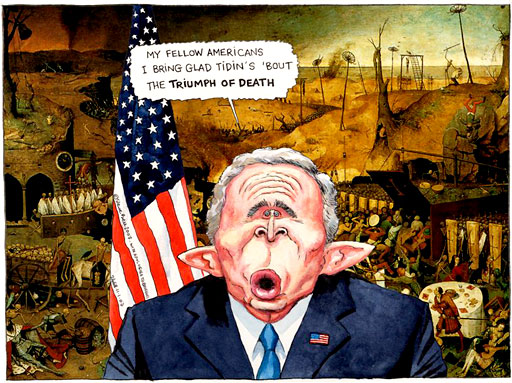
So into the graveyard of Iraq, George Bush, commander-in-chief, is to send another 21,000 of his soldiers. The march of folly is to continue...
Published: 11 January 2007
There will be timetables, deadlines, benchmarks, goals for both America and its Iraqi satraps. But the war against terror can still be won. We shall prevail. Victory or death. And it shall be death.
President Bush's announcement early this morning tolled every bell. A billion dollars of extra aid for Iraq, a diary of future success as the Shia powers of Iraq still to be referred to as the "democratically elected government" march in lockstep with America's best men and women to restore order and strike fear into the hearts of al-Qa'ida. It will take time oh, yes, it will take years, at least three in the words of Washington's top commander in the field, General Raymond Odierno this week but the mission will be accomplished.
Mission accomplished. Wasn't that the refrain almost four years ago, on that lonely aircraft carrier off California, Bush striding the deck in his flying suit? And only a few months later, the President had a message for Osama bin Laden and the insurgents of Iraq. "Bring 'em on!" he shouted. And on they came. Few paid attention late last year when the Islamist leadership of this most ferocious of Arab rebellions proclaimed Bush a war criminal but asked him not to withdraw his troops. "We haven't yet killed enough of them," their videotaped statement announced.
Well, they will have their chance now. How ironic that it was the ghastly Saddam, dignified amid his lynch mob, who dared on the scaffold to tell the truth which Bush and Blair would not utter: that Iraq has become "hell" .
It is de rigueur, these days, to recall Vietnam, the false victories, the body counts, the torture and the murders but history is littered with powerful men who thought they could batter their way to victory against the odds. Napoleon comes to mind; not the emperor who retreated from Moscow, but the man who believed the wild guerrilleros of French-occupied Spain could be liquidated. He tortured them, he executed them, he propped up a local Spanish administration of what we would now call Quislings, al-Malikis to a man. He rightly accused his enemies Moore and Wellington of supporting the insurgents. And when faced with defeat, Napoleon took the personal decision "to relaunch the machine" and advanced to recapture Madrid, just as Bush intends to recapture Baghdad. Of course, it ended in disaster. And George Bush is no Napoleon Bonaparte.
No, I would turn to another, less flamboyant, far more modern politician for prophecy, an American who understood, just before the 2003 launch of Bush's illegal invasion of Iraq, what would happen to the arrogance of power. For their relevance this morning, the words of the conservative politician Pat Buchanan deserve to be written in marble:
"We will soon launch an imperial war on Iraq with all the 'On to Berlin' bravado with which French poilus and British tommies marched in August 1914. But this invasion will not be the cakewalk neoconservatives predict ... For a militant Islam that holds in thrall scores of millions of true believers will never accept George Bush dictating the destiny of the Islamic world ...
"The one endeavour at which Islamic peoples excel is expelling imperial powers by terror and guerrilla war. They drove the Brits out of Palestine and Aden, the French out of Algeria, the Russians out of Afghanistan, the Americans out of Somalia and Beirut, the Israelis out of Lebanon... We have started up the road to empire and over the next hill we will meet those who went before."
But George Bush dare not see these armies of the past, their ghosts as palpable as the phantoms of the 3,000 Americans let us forget the hundreds of thousands of Iraqis already done to death in this obscene war, and those future spirits of the dead still living amid the 20,000 men and women whom Bush is now sending to Iraq. In Baghdad, they will move into both Sunni and Shia "insurgent strongholds" as opposed to just the Sunni variety which they vainly invested in the autumn because this time, and again I quote General Odierno, it is crucial the security plan be " evenhanded". This time, he said, "we have to have a believable approach, of going after Sunni and Shia extremists".
But a "believable approach" is what Bush does not have. The days of even-handed oppression disappeared in the aftermath of invasion.
"Democracy" should have been introduced at the start not delayed until the Shias threatened to join the insurgency if Paul Bremer, America's second proconsul, did not hold elections just as the American military should have prevented the anarchy of April 2003. The killing of 14 Sunni civilians by US paratroopers at Fallujah that spring set the seal on the insurgency. Yes, Syria and Iran could help George Bush. But Tehran was part of his toytown "Axis of Evil", Damascus a mere satellite. They were to be future prey, once Project Iraq proved successful. Then there came the shame of our torture, our murders, the mass ethnic cleansing in the land we said we had liberated.
And so more US troops must die, sacrificed for those who have already died. We cannot betray those who have been killed. It is a lie, of course. Every desperate man keeps gambling, preferably with other men's lives.
But the Bushes and Blairs have experienced war through television and Hollywood; this is both their illusion and their shield.
Churchills have gone, used as a wardrobe for a prime minister who lied to his people and a president who, given the chance to fight for his country, felt his Vietnam mission was to defend the skies over Texas.
But still he talks of victory, as ignorant of the past as he is of the future.
Pat Buchanan ended his prophecy with imperishable words: "The only lesson we learn from history is that we do not learn from history."
The Bush plan, and the question of withdrawal What Bush says 20,000 troops increase
Mistake of not sending sufficient troops must be rectified. Troops stabilise Baghdad and reinforce Anbar province, on condition that Iraqis take on Shia militias
$1bn reconstruction aid
Fresh funds will help create jobs and stimulate economy to show Iraqis there can be a peace dividend, and friendly Middle East states should help out too
Pullout
US commitment to Iraq is not open-ended but no timetable for troop withdrawal, even though US troops are expected to hand control to Iraqis by November
What Congress says 20,000 troops increase
Troop build-up is a mistake. House expected to vote on increase, Senate legislation forces Bush to seek congressional approval but neither move could block troop deployment
$1bn reconstruction aid
Don't throw good money after bad. US has squandered billions since the invasion and Democrats plan investigation. Millions of dollars 'overpaid' by Pentagon to Iraq contractors
Pullout
Bush has not learnt the lesson of November's mid-term elections which gave Democrats control of the House and Senate on the platform of a phased withdrawal from Iraq
What Baker says
20,000 troops increase
Up to 20,000 military trainers and troops embedded into and supporting Iraqi army, while combat troops drawn down to avoid increase in total numbers
$1bn reconstruction aid
US economic assistance should be boosted to $5bn per year. US should take anti-corruption measures by posting oil contracts on the internet for outside scrutiny
Pullout
All US combat troops not needed for force protection should be out of Iraq by the first quarter of 2008
Likely outcome 20,000 troops increase
Escalation of conflict
Money will be wasted, with official corruption in Iraq said to drain $7bn a year
Pullout
Troop surge could disguise 'cut and run' depending on the circumstances in both Iraq and America
Subscribe to:
Posts (Atom)