
Showing posts with label Argentina. Show all posts

Thursday, February 25, 2016

SPECIAL REPORT. Scalia's hunting ranch was meeting place for secret society by Wayne Madsen Report


SPECIAL REPORT. Scalia's hunting ranch was meeting place for secret society
The story of the late Supreme Court Associate Justice Antonin Scalia's last hours spent at the exclusive Cibolo Creek Ranch nestled in the Chinati Mountains, near Marfa, Texas, is as strange as the peculiar treatment his body received after his sudden death during his first night at the 30,000 acre compound. WMR's editor first speculated that there was more going on at ranch with Scalia and 35 other men during the Valentine's Day/President's Day weekend. First, it was a male-only "hunting" Valentine's Day weekend event for some influential married and family-oriented figures, including Scalia. Scalia's "friend" from Washington, who accompanied him from Washington to Houston where they boarded a private jet the Cibolo Creek Ranch airport, was also kept secret.

That was until the most unlikeliest of all sources, the "connected" Washington Post, revealed on February 24 that the hunting event attended by Scalia included a number of officials of the over three-century old International Order of St. Hubertus, founded in 1695 by Count Franz Anton von Sporck of the Kingdom of Bohemia, a vassal state of the Habsburg Empire. Today, the order is presided over by its "Grand Master His Imperial and Royal Highness Istvan von Habsburg Lothringen, Archduke of Austria, Prince of Hungary." The secretive hunting order, which upholds the Latin motto, "Deum Diligite Animalia Diligentes” or “Honoring God by Honoring His Creatures,” claims royal protection under "His Majesty Juan Carlos of Spain, the Grand Master Emeritus His Imperial and Royal Highness Archduke Andreas Salvator of Austria," as well as Istvan von Habsburg Lothringen.

As far as its motto of "honoring God's creatures," King Juan Carlos of Spain ultimately fell from power after hunting scandals. In 2012, the king was photographed in front of an elephant in Botswana, which was shot to death by hunters. In 2006, the king rejected as false a rumor that he shot a bear in Russia that was plied with vodka. As a teenager, Juan Carlos shot and killed his brother Alfonso in an accident in Portugal. The pistol was allegedly given to Alfonso as a gift from General Franco, Spain's dictator. Spanish priest Josémaria Escriva founded the far-right wing Catholic Opus Dei sect, of which Scalia was a member, in 1928, under the patronage of Franco.

The circumstances surrounding Alfonso's death in 1956 remain clouded in mystery. Juan Carlos, a member of the royal House of Bourbon, abdicated the Spanish throne in 2014.
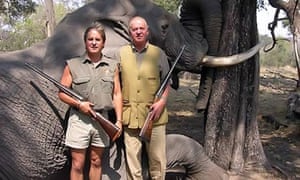
Spain's King Juan Carlos has successfully undergone hip replacement surgery
Juan Carlos's reign began to unravel after he was pictured with an elephant, shot to death by hunters in Botswana.

Ranch owner, Houston billionaire businessman John B. Poindexter, has been reticent about revealing the identities of the other 35 guests who stayed at the ranch with Scalia. Nor has Poindexter provided the names of other special guests who have participated in similar gratis functions held about three times a year. Poindexter did reveal that when he discovered Scalia's lifeless body, a pillow was partially covering his face.

It is now known, thanks to the Post article, which normally would be derided by the corporate media as "conspiracy theory" speculation had it appeared in any web-based publication, that Scalia's friend from Washington is C. Allen Foster, a prominent Republican trial lawyer who has argued cases before the Supreme Court. Foster ran as the Republican candidate for Attorney General of North Carolina in 1984.

C. Allen Foster - Whiteford, Taylor & Preston LLP
Scalia attorney friend C. Allen Foster who left the U.S. for a trip to Argentina after Scalia's funeral in DC. Argentina's new right-wing president, Mauricio Macri, is affiliated with the right-wing Catholic sect Opus Dei. Foster is with the law firm of Whiteford Taylor Preston at 1800 M Street, NW Washington. The International Order of St. Hubertus, American chapter uses a UPS rental mailbox, or "suite," at 2100 M Street.

Last year, Poindexter's firm had an age discrimination case before the Supreme Court, which it, Scalia included, decided not to hear, providing a victory for Poindexter, the defendant. Foster could not be reached by the Post because his office said he was traveling in Argentina.


The 2013 investiture in Madrid of the International Order of St. Hubertus. Cibolo Creek Ranch owner John B. Poindexter is in front row. Poindexter is also the leader of the green-caped order's Southwest Priory, consisting of Texas, Louisiana, New Mexico, and Arkansas. The order's Maltese Cross symbol suggests a tie-in with the Catholic Knights of Malta.
St. Hubertus's American chapter began in 1966 under the auspices of San Francisco's elite Bohemian Club, which sponsors an annual Bohemian Grove encampment in a dense forest north of San Francisco. The event has drawn the world's movers and shakers, including David Rockefeller and Henry Kissinger, and was once condemned by President Richard Nixon on White House tapes as "the most faggy Goddamn thing you could ever imagine." The event features male-only nudism as part of male bonding pagan ceremonies.

Poindexter and Foster are prominent members of the St. Hubertus Order as are two other guests from the hunting outing at Cibolo Creek at which Scalia died. The Post identified two private jets that arrived at Cibolo Creek airport from San Antonio just after that carrying Scalia and Foster arrived at noon from Houston. The two other jets, which departed Sunday, February 14, are owned by Wallace "Happy" Rogers III and A.J. Lewis III, both of San Antonio. Both are Republicans, in the restaurant business, and officers of the male-only Order of St. Hubertus.

So far, the description of Scalia's last outing sounds as if it is torn from the pages of a Dan Brown novel. But it gets better. WMR caught site of a number of Mexican "diablo" artifacts at the Cibolo Creek Ranch, which is odd for a Roman Catholic order like St. Hubertus.

    
Amid the Satanic artifacts, a baby's crib [left]. The ranch only has single beds, including made up beds found in the outside passageways [center], except for the king size bed found in Scalia's suite [right], remade after Scalia's death with door locked. Photos: WMR.
Outside of Scalia's room, the "El Presidente" suite, is a wood-burning pit. There was evidence that on the evening that Scalia died, there was a party outside his suite. There was ash still in the pit, some broken glass, and cigar ashes in the ashtray. Scalia was an avid cigar aficionado. Also found was a box of self-striking matches next to the ashtray, which was alleviated by the WMR editor as a "souvenir." Inside the corridor leading to Scalia's room was a statuette that can only be described as satanic in nature. Scalia's dinner, his last meal, was served under a phalanx of devil masks hanging from the ranch's dining room. A painting reproduction outside the dining room evoked memories of the pre-St. Valentine's Day Roman pagan holiday of Lupercalia, celebrated around February 14th and known for drinking and orgies.

 
Fire pit outside of Scalia's suite showed signs of a recent party: broken glass, cigar ashes, cigarette butts, and ash residue in the pit [left]. A box of strike-anywhere matches [right] was found next to the ashtray. Photos: WMR.


Paintings at ranch highly suggestive of Roman pagan Lupercalia festival in mid-February, a pre-Valentine's Day celebration of sex and orgies. Photo: WMR.


Statuette found in passageway not too far from Scalia's room. Photo: WMR


The strict Catholic Scalia had these devil masks staring down at him during his last meal in the ranch's dining room. Photos: WMR.

Friday, December 25, 2015

Top ten Soros targets in 2016 by Wayne Madsen Report


Top ten Soros targets in 2016 by Wayne Madsen Report
George Soros has a list and he's checking it twice. The list is where he will concentrate the efforts of his Central Intelligence Agency-connected non-governmental organization (NGO) assets in 2016. While supporting the CIA's agenda, Soros always manages to maximize his profits from the chaotic situations he and his operations engineer around the world.

1. Soros will continue to facilitate the arrival of hundreds of thousands of additional, mainly Muslim migrants from the Middle East, Africa, and Asia to Europe. The political and border destabilization of Europe and the resulting introduction of draconian security measures by the European Union are high on Soros's agenda.

2. Soros is backing a themed revolution for the Srpska Republic of Bosnia-Herzegovina and the Republic of Serbia, itself. The Srpska Republic president, Milorad Dodik, is threatening to declare independence from the Bosnia-Herzegovina federation and join Serbia. Dodik has the backing of the Serbian government as well as Russian President Vladimir Putin. Soros has decided to pull out all the stops to overthrow the Serbian government in Belgrade and the Srpska Republic government in Banja Luka and thus ensure compliant and anti-Russian governments take over power in both republics.

3. Soros will martial his resources in Haiti to ensure that banana company mogul Jovenel Moise wins the presidential run-off in Haiti's postponed election. Moise is the hand-picked successor of current president Michel Martelly, a singer by profession. Soros's election engineers succeeded in knocking out of a first- or second-place finish the candidate representing former president Jean-Bertrand Aristide, who is despised by Bill and Hillary Clinton, as well as Soros, for his leftist populist policies.

4. Soros's Open Society Institute and other NGO contrivances will continue to back the failed state of Ukraine. Soros will especially shore up Prime Minister Arseniy Yatsenyuk, the American Finance Minister Natalie Jaresko, and Odessa regional governor Mikheil Saakashvili, the former Soros-installed president of Georgia who is now a wanted criminal by the government in Tbilisi. Soros will continue to see to it that Ukrainian regular and irregular military forces continue to cause border problems for the Russian autonomous republics of Lugansk and Donetsk in the east and that sanctions against officials of Lugansk, Donetsk, and Crimea are not only maintained but strengthened.

5. Soros will press the opposition-controlled National Assembly of Venezuela to rescind Venezuela's diplomatic recognition of Abkhazia and South Ossetia, two republics that broke way from Georgia.

6. Soros's operatives in China will continue to stir up political problems for Beijing in the special administrative regions of Hong Kong and Macao with increased street demonstrations. Soros will also step up his financial and political support for secessionists in Tibet, East Turkestan (Xinjiang-Uighur Autonomous Republic), and Inner Mongolia.

7. With the Argentine presidency and the Venezuelan National Assembly falling under the control of right-wing fascist-oriented political parties, Soros will mobilize his Latin American assets to force Brazilian President Dilma Rousseff from the presidency. She has been battling an attempt by the Brazilian Congress to impeach her. Soros despises Rousseff for a number of reasons but chiefly they are her commitment to the BRICS alliance of Brazil, Russia, China, India, and South Africa; her family links to Bulgaria during its communist past; her rejection of Soros's "Third Way" politics; Rousseff's opposition to privatization of state-owned enterprises -- industries into which Soros wants to invest heavily; and Rousseff's opposition to Brazilian public schools being used to promote homosexual life styles. Soros's main goal is to have Rousseff replaced with a right-winger who will pull Brazil out of the BRICS bloc.

Article Image

8. Another BRICS leader Soros sees as vulnerable is Jacob Zuma, the president of South Africa. Soros's goal is to destroy the BRICS by peeling away South Africa and Brazil from the alliance, leaving only China and Russia as members after India can be persuaded the alliance is dead. Zuma and his African National Congress are also Soros targets because of their opposition to Israeli policies in Palestine and same-sex marriage. Soros backs the Democratic Alliance party, which receives much of its financial support from South African Zionists and the Jewish-dominated diamond industry.

9. Whoever the Republican U.S. presidential candidate turns out to be, Soros will throw his money and the backing of his NGOs to Hillary Clinton, a personal friend. Soros can be expected to finance intense opposition research and a massive 527 political action committee ad campaign against the GOP presidential candidate.

10. In the various presidential elections scheduled for 2016, Soros forces will back the most anti-Christian and pro-Muslim presidential candidates in the Central African Republic; Antonio Vitorino, a noted "Eurocrat," for president of Portugal; the pro-West Benin Prime Minster Lionel Zinsou for president of Benin; hedge fund manager Pedro Kuczynski for president of Peru; Juan Cohen for president of the Dominican Republic; all the anti-Putin candidates in the Russian election for the State Duma; pro-Saakashvili candidates in the Georgian parliamentary election; pro-NATO/EU parties in the Montenegro parliamentary election; and pro-EU/NATO parties in the Romanian parliamentary election.

Soros will work to defeat the Bolivian constitutional amendment referendum that will permit President Evo Morales to run for another term. They will also work against the re-election of Robert Fico as Prime Minister of Slovakia and the election of Samia Nkrumah, the daughter of Ghana's founding president Kwame Nkrumah as president of Ghana. In the Tanzanian constitutional referendum, the Soros forces will seek to protect the present union status quo and defeat any attempt by Zanzibar to secede and go its own way.

Wednesday, February 04, 2015

Neocons try to run another forgery on the international public by Wayne Madsen

Neocons try to run another forgery on the international public

by Wayne Madsen

The one thing that neo-cons deserve credit on is persistence. Even after the neocons sought to fool the international public with obviously forged foreign ministry documents from Niger that were used by the George W. Bush administration to justify going to war with Iraq and forged Iraqi Oil Ministry documents that were used to tarnish the reputations of several political leaders who opposed the U.S. invasion of Iraq, the neocons are at it again. 


This time, a purported arrest warrant for Argentine President Cristina Fernandez de Kirchner and Foreign Minister Hector Timerman for reaching a deal with Iran to shield Iranian officials wanted for planning the 1994 bombing of a Jewish center in Buenos Aires was reportedly "found" by investigators in a rubbish bin at the home of Argentine prosecutor Alberto Nisman, the alleged author of the arrest warrant. 

Nisman is said to have committed suicide in the bathroom of his Buenos Aires apartment on January 18 of this year. Forensics have shown that there was no other DNA found on the gun Nisman is said to have used to fire a single bullet into his head. Kirchner alleged that Nisman's death may have been a murder carried out by shadowy intelligence figures trying to discredit her and her administration. Kirchner has taken a decidedly anti-Israeli position with her support for Palestine and the establishment of friendly relations with Iran. Kirchner's foreign policy has irked the Israelis and Mossad, which have a heavy presence in Argentina. Kirchner announced that because of her suspicions about agents within the Argentine SIDE intelligence service carrying out a hit on Nisman, she was scrapping the agency and replacing it with a new federal intelligence agency. Presumably, such a move would clean out any Israeli intelligence plants who may have assisted in the possible murder of Nisman -- what would amount to a classic Mossad "false flag" operation in sacrificing a single Jew -- Nisman -- for the greater goals of Israel.

Only photographs of the alleged 26-page arrest warrant were published by the anti-Kirchner newspaper Clarin. Goldman Sachs is a major investor in the Clarin Group, Clarin's parent company. At first, Nisman's assistant prosecutor, Viviana Fein, denied the existence of the arrest warrant. However, she later changed her story and confirmed that the warrant published by Clarin was authentic and that she "mis-spoke" in her earlier statement. It is instructive to note that Nisman was Jewish as is Fein, an important fact that The New York Times chose to ignore in its reporting on the story.

The role of Clarin in disseminating anti-Kirchner is no surprise. The Western media has failed to report that Foreign Minister Timerman, named in the dubious "arrest warrant" is himself a newspaper editor and a longtime competitor, as was his father, Jacobo Timerman, of Clarin. The elder Timerman published the leftist La Opinion and his son, the present Foreign Minister, was editor-in-chief of La Tarde, also left-wing. Attempts by the Israel Lobby to tar Kirchner fall flat in the face of the fact that the Timermans are Jewish but not beholden to Israeli or Zionist interests in Argentina..

Nisman alleged that Kirchner has agreed to swap Argentine grain for Iranian oil in return for dropping Argentina's investigation of the 1994 bombing of the AMIA. On October 24, 2014, WMR reported on the steady warfare being waged by Israel and its allies against Kirchner, both at home and abroad:

Argentina's President Cristina Fernandez de Kirchner witnessed her September 24 speech to the UN General Assembly interrupted by what UN officials called "technical difficulties." In fact, Kirchner's speech was censored by the UN amid catcalls from the Israeli delegation and New York Zionist Jews specifically placed by the Israelis in the public gallery to boo those world leaders who criticized the Jewish state's policies.

Kirchner has been subjected to a vicious Zionist campaign launched against its financial system by the Elliott Management Fund, the "vulture" hedge fund owned by New York Zionist and neo-conservative Republican Paul Singer. In 2002, after Argentina defaulted on its debt, Singer's Cayman Islands-based NML Capital Limited bought the devalued Argentina bonds knowing full well he would be lucky to get 30 cents on the dollar. However, Singer began a shake down of Argentina to squeeze more money out of its financially-troubled economy. NML convinced Ghana to seize the Argentine naval training ship Libertad in 2012. Mark Brodsky, Singer's former Elliott Management Fund executive and now head of Aurelius Capital Management, joined in the extortion of Argentina in demanding that a portion of the $1.2 billion debt be paid not only to Singer but also to his fund.

The Israeli media avoids the use of "vulture" funds to describe contrivances like those of Singer and Brodsky. It prefers to use "hold-out funds," which places the onus on the debtors and not the unscrupulous collectors.

A Singer-owned U.S. federal judge in New York, Thomas Griesa, ordered Argentina to pay all the money Singer was demanding instead of a reduced amount. Griesa is 85 years old and is known for taking naps on the bench while hearing cases.

In June, the U.S. Supreme Court, on which three American Jews [Ruth Ginsberg, Stephen Breyer, and Elena Kagan] sit and who did not recuse themselves from the case, decided to reject Argentina's appeal of Griesa's ruling.

The Supreme Court's ruling on the Argentina case was purely political. Argentina had determined, contrary to Zionist and neocon myth, that Iran was not responsible for the 1994 bombing of the Argentine Israelite Mutual Association (AMIA) building in Buenos Aires, which killed 84 people. Kirchner and other Argentine investigators later discovered that the bombing was an Israeli-inspired false flag operation intended to embarrass Argentina's President Carlos Saul Menem, who was the son of Syrian immigrants to Argentina.

Israel was upset with Menem because he strengthened Argentina's ties to Iran. Menem was forced to abandon an Argentine nuclear cooperation deal with Iran following the 1994 bombing of the AMIA.

The U.S. ambassador to Argentina at the time of the bombing James Cheek, told The Nation magazine, "To my knowledge, there was never any real evidence [that Iran was responsible]. They never came up with anything." The only evidence of any links between the bombing and any Iranians is the fact that "evidence" of the Iranian government's alleged involvement was manufactured by the anti-Tehran Iranian terrorist group Mojaheddin-e-Khalq (MEK), which receives funding and other support from Mossad and the CIA.

After the bombing of the AMIA, Mossad planted evidence at the scene. Two years earlier, after a bomb at the Israeli embassy in Buenos Aires killed 22 people, Mossad also planted evidence suggesting Iran was behind the attack.

Realizing that Menem had been subjected to a vicious character assassination campaign by the Zionist media, Kirchner set about to inform the General Assembly of Israel's culpability in false flag attacks. Perhaps no better setting than the UN could have been used by Kirchner less than a two weeks after the commemoration of the 9/11 attacks on the World Trade Center, which amounted to yet another false flag operation that bore all the trademark Mossad handiwork.


After the appearance of the dubious Nisman arrest warrant in Clarinit was discovered in U.S. State Department cables released by WikiLeaks that Nisman had maintained extensive contacts with the U.S. embassy in Buenos Aires, which helped him prepare his "case" against Kirchner's government over the AMIA bombing. Nisman continuously met with U.S. embassy officials who helped him hammer out his strategy against Kirchner.

An October 28, 2009 cable from the U.S. embassy in Buenos Aires states that Assistant Secretary of Treasury for Terrorist Financing and Financial Crimes David S. Cohen, recently selected to be the deputy director of the CIA, met with Nisman to coordinate efforts to undermine Kirchner:

VZCZCXYZ0000 
OO RUEHWEB 
DE RUEHBU #1168/01 3011522 
ZNY CCCCC ZZH 
O 281522Z OCT 09 
FM AMEMBASSY BUENOS AIRES 
TO RUEHC/SECSTATE WASHDC IMMEDIATE 4526 
INFO RUCNMER/MERCOSUR COLLECTIVE PRIORITY 
RUEHSO/AMCONSUL SAO PAULO PRIORITY 0003 
RUEATRS/DEPT OF TREASURY WASHINGTON DC PRIORITY
C O N F I D E N T I A L BUENOS AIRES 001168 
SIPDIS 
TREASURY FOR RFEDEWA 
SAO PAULO FOR WBLOCK 
E.O. 12958: DECL: 10/28/2029 
TAGS: ECON[Economic Conditions], EFIN[Financial and Monetary Affairs]
PGOV[Internal Governmental Affairs]
AR [Argentina] 
SUBJECT: ARGENTINA TRIP REPORT OF A/S TREASURY DAVID COHEN 
Classified By: DCM Tom Kelly for reasons 1.4 (B) and (D).
¶1. (U) Summary. Treasury Assistant Secretary for Terrorist Financing and Financial Crimes David S. Cohen traveled to Buenos Aires, Argentina, on October 2 to address members of the U.S.-Latin America Private Sector Dialogue (U.S.-LA PSD) and conduct meetings with the Central Bank of the Republic of Argentina (BCRA) and Ministry of Justice and Human Rights (MOJ) . . .
¶7. (C) A/S Cohen also met with Special Prosecutor Alberto Nisman, who in late 2006 formally accused the government of Iran of directing the 1994 Argentine-Israeli Mutual Association (AMIA) bombing, and Hizballah for carrying out the bombing. Earlier this year, Nisman formally requested that the governments of Germany and France freeze four bank accounts containing over US $48 million associated with the AMIA suspects. Nismansaid that he has yet to receive a substantive reply from either Germany or France, and A/S Cohen offered, on behalf of the Treasury Department, to engage counterparts in these two countries to follow up on Nisman's requests. Nisman added that he has also requested that a judge order the arrest of former Argentine president Carlos Menem for participation in a cover-up after the AMIA attack. 
-----------
An additional cable, gated May 2009, shows that Nisman was in Washington to hold meetings with the State and Justice Departments and "other U.S. government agencies." Other cables indicate that the U.S. Justice Department and FBI assisted Nisman in preparfing INTERPOL arrest warrants for Iranian officials suspected in the AMIA bombing.
-----------
VZCZCXYZ0000 
OO RUEHWEB 
DE RUEHBU #0592 1392245 
ZNY CCCCC ZZH 
O 192245Z MAY 09 
FM AMEMBASSY BUENOS AIRES 
TO RUEHC/SECSTATE WASHDC IMMEDIATE 3744 
INFO RUCNMER/MERCOSUR COLLECTIVE 
RUEHLB/AMEMBASSY BEIRUT 0051 
RUEHBO/AMEMBASSY BOGOTA 1896 
RHEFDIA/DIA WASHINGTON DC 
RUEAIIA/CIA WASHINGTON DC 
RHMCSUU/FBI WASHINGTON DC 
RHMFISS/DEPT OF JUSTICE WASHINGTON DC 
RHMFISS/DEPT OF HOMELAND SECURITY WASHINGTON DC 
RHEHAAA/NATIONAL SECURITY COUNCIL WASHINGTON DC

C O N F I D E N T I A L BUENOS AIRES 000592 
SIPDIS 
E.O. 12958: DECL: 05/19/2029 
TAGS: PTER[Terrorists and Terrorism], PREL [External Political Relations], ASEC[Security], MASS[Military Assistance and Sales], 
PHUM[Human Rights], SNAR[Narcotics], KJUS[Administration of Justice], IR[Iran], 
LE[Lebanon], AR[Argentina] 
SUBJECT: ARGENTINA: AMIA SPECIAL PROSECUTOR READY TO ANNOUNCE INDICTMENT OF AMIA BOMBING SUSPECT 

REF: BUENOS AIRES 0247 AND PREVIOUS 
Classified By: Ambassador E. Anthony Wayne for reasons 1.4 (b) & (d). 
¶1. (C) Special Prosecutor Alberto Nisman called on the Ambassador May 19 to notify us that the following day he would ask Judge Rodolfo Canicoba-Corral to indict a new suspect in the 1994 bombing of the Argentine Jewish Mutual Association (AMIA). Nisman described his painstaking effort to establish the suspect's links to both the environs of the AMIA site, a mosque in Buenos Aires, and his links via cell phone calls to Iranian diplomat and bomb plot suspect Mohsen Rabbani and a cell phone in the Tri-Border Area registered in the name of "Marques." Although the suspect, Samuel Salman El Reda, is Lebanese-Colombian, Nisman considered this a first step against a "local connection" -- that is a resident or Argentine citizen who had helped the Iranian and other suspects, a connection long of interest to the victims of the attack and AMIA. Nisman said El Reda has an Argentine wife and thought both are now living in Lebanon. 
¶2. (C) Nisman described the indictment of El Reda as a substantial breakthrough and as asked that we closely hold his name until it is made public, probably on May 20. Post notes that El Reda has been named in the past as a suspect in the 1992 Israeli Embassy bombing and the 1994 AMIA bombing, based in part on investigations by the Argentine intelligence service (SIDE) and others. For Nisman, the breakthrough appears to be that he has pieced together enough evidence independently of the discredited first AMIA investigation to single out El Reda and pursue the indictment. 
¶3. (SBU) Post will report further on local reaction when the indictment is made public. 
¶4. (SBU) Action request: Nisman said that he will be in Washington June 15-20 and would be available to visit the Department of State or Department of Justice or other USG agencies for briefings. Washington offices are asked to contact Poloff Ted Craig by email (craigtj@state.gov) or phone (54 11-5777-4858) to arrange a meeting. 
WAYNE
***********

The alleged arrest warrant for Kirchner and Timerman was supposedly drafted by Nisman in June 2014. Two successive judges, Ariel Lijo and Daniel Refecas have passed on considering Nisman's case against Kirchner due to lack of evidence and other procedural issues. 


The alleged Argentine prosecutorial arrest warrant for Kirchner, Timerman, and National Deputy Andres Larroque has the same neocon "taint" about it as did the forged Niger government and Iraqi Oil Ministry documents. The neocons' stock-in-trade, thanks to the sometimes half-witted efforts of their Mossad allies, include crude forgeries, fake passports, and fake videos and photographs.


Forged Niger Foreign Ministry documents purprting to show that Iraq had obtained yellow cake uranium Niger. The International Atomic Energy Agency (IAEA) and the CIA determined the documents were crude forgeries.

undefined
British MP George Galloway's meetings with Saddam Hussein and Tariq Aziz were used by the neocons to intimate that he had received bribes from Saddam's government as part of the United Nations' Oil-for-Food program. Crudely forged documents, with "Liquid Paper" edits clearly visible were "found" by Western intelligence at the Oil Ministry and used to tarnish anti-war Western politicians in Britain, France, Russia, and other countries.

Monday, July 06, 2009

Honduran army had orders to assassinate Manuel Zelaya, Cristina Kirchner, Rafael Correa, Fernando Lugo, and Miguel d"Escoto

WMR has learned from its sources in Honduras that Honduran army troops were under orders to assassinate the exiled legitimate President of Honduras Manuel Zelaya and Miguel d"Escoto, the President of the UN General Assembly, if their plane managed to land at Tegucigalpa airport. However, Honduran troops loyal to the junta that has taken over the country with the support of U.S. Southern Command (USOUTHCOM) personnel on permanent duty at the U.S. Embassy in Tegucigalpa and the Soto Cano airbase, which is Washington's largest military base in Central America, blocked the airport runway with trucks preventing the landing of the airplane carrying Zelaya and d"Escoto.

Zelaya's and d"Escoto's plane was diverted to Nicaragua but the Obama administration, which WMR has previously reported supported the military coup against Zelaya via the Pentagon, USSOUTHCOM, and U.S. ambassador to Honduras Hugo Llorens, ordered Zelaya to return to Washington to enter into "negotiations" with the Organization of American States (OAS). Llorens is a career diplomat but is also a Cuban-American activist who has been linked to right-wing Cuban exile groups in Florida and the CIA.

WMR has also been informed by our Honduran sources that the Honduran military, with the knowledge of U.S. military and Israeli security advisers, planned to assassinate three Latin American presidents traveling with Zelaya and d:Escoto to Tegucigalpa in a show of support for Zelaya. The three Latin American presidents targeted for assassination at Tegucigalpa airport by the Honduran fascist junta and its American and Israeli advisers were Argentina's Cristina Fernandez de Kirchner, Ecuador's President Rafael Correa, and Paraguay's Fernando Lugo. The plane carrying the three presidents was diverted to El Salvador after the threat was received from the Honduran junta.

Pope Benedict XVI was also personally supportive of the Roman Catholic top hierarchy in Honduras supporting the coup and the military junta, according to our sources in Honduras. Paraguay's President Lugo, a former renegade Catholic "liberation theology" bishop, was a favored assassination "target of opportunity" for the Pope and his Honduran top prelates had his plane touched down in Tegucigalpa. An overwhelming majority of Honduras's priests and nuns have rejected the support of the Pope and Honduran Cardinal Oscar Andres Rodriguez for the junta and are supporting the popular uprising against the junta. Many Zelaya supporters, awaiting the arrival of Zelaya, were shot and killed by Honduran troops at Tegucigalpa airport.


Tuesday, May 12, 2009

Bolivia terror plot: The Argentine connection, revisited and confirmed


bolivians-fight-back.jpg

This is what they fear, kiddies...indigenous Bolivians fighting back against fascism.

Via ABI, I came across this report in Argentina's Página/12. It's shocking, explosive, highly relevant to what I've written about in here previously--and worth translating in its entirety, which I did:

"I was present in Beni (northern Bolivia) with an Argentine cell of eleven ex-carapintadas ("painted faces", notorious paramilitaries), along with ex-militaries who had been on missions in the Balkans. The above-mentioned 'Argentine cell' maintained contacts with sectors of the 'far right', opposed to the current Bolivian government, in Santa Cruz and Cobija, department of Pando."

The information, dated May 4, received by the Argentine Chancellery from the embassy in Bolivia and which was received by Página/12, indicated that "business owners and landowners of Santa Cruz de la Sierra requested the presence of the ex-militaries with the objective of training them in self-defence in case of their eventual imprisonment by the Bolivian authorities."

The pieces of the puzzle are beginning to fall into place following an investigation into a group of suspected terrorists, led by Eduardo Rózsa Flores, "Hero of the Balkan War", which was dismantled by the Bolivian National Police last April 16. President Evo Morales denounced the group for planning his assassination.

Last April 21, we reported that the vice-president of Bolivia, Alvaro García Linera, had communicated with the Argentine ambassador in La Paz, Horacio Macedo, to ask him to collaborate in the control of the border regions "due to the presence of Argentine activists in certain regions of Bolivia". At that time, there was mention of the travels to Bolivia of retired major Jorge Mones Ruiz, one of the "carapintadas" who between 1987 and 1991 took part in armed uprisings to demand impunity for repressors [active during the time of the Argentine military junta, 1976-83].

The new report states that "Mones Ruiz had been in contact with the late suspected terrorist/mercenary Rózsa Flores and with [Luis Enrique] Baraldini", another comrade-in-arms and fugitive-from-justice for his actions during the illegal repressions in La Pampa, and currently based in Santa Cruz under a false name. Mones Ruiz was assigned to Bolivia as an intelligence official of the Argentine army during the last dictatorship, and liked to boast of the recognition of his Bolivian comrades.

The ex-carapintada was seduced by his links to the ultra-right in Latin America. In '87, the Military Circle published his book, in which he outlined his expertise on the formation of commando groups against the revolutionary processes in Central America. This year, Mones Ruiz found anchorage in the so-called UnAmérica, an NGO claiming to be a counterweight to Unasur, the organization to which all the South American heads of state belong. Leftist governments, particularly those of Bolivia and Venezuela, were the focus of the efforts of the committee, led by the anti-Chavista Venezuelan, Alejandro Peña Esclusa.

Mones Ruiz showed his notions in various formats, but with the same obsession. With another of his carapintada comrades, Breide Obeid, he formed the "Conjunto Patria" (Homeland Alliance) and began to sing his own lyrics in all kinds of encounters. More academically, he published various books, among them "Argentina--without a future?". He studied the "new dangers" and broadcast himself on Web pages on subjects such as "misrule and institutional bankruptcy, attacks on businessses, price controls, energy crises, the 'Papeleros' case, citizen insecurity, corruption, 'twisted' justice, widening of the gap between rich and poor, 'crooked' legislators, social violence, forgotten military commanders, police forces with fewer rights than delinquents, etc., which are generating the conditions for structural changes that society demands." A hyperactive man, last year he began to show up during rural meetings and stir up conflict.

The violent entry of the police into the fourth floor of the Hotel Las Américas, which ended in the deaths of Rózsa Flores (Bolivian-Hungarian-Croatian), Arpád Magyarosi (Romanian of Hungarian origins) and Michael Dwyer (Irish), and the arrests of Mario Francisco Tadic Astorga (Bolivian with Croatian passport) and Elöd Tóásó (Romanian-Hungarian) exacerbated the virulence of the Bolivian opposition. President Evo Morales is looking for re-election next December 6, and read the actions of these transnational commandos as proof of a cabal with plans to assassinate him. Throughout this minefield, there are footprints of the same personages.

Five days after the sting in the hotel, the Hungarian Television Network broadcast an interview by journalist Andras Kepes on September 8, 2008, in which Rózsa confirmed that he was bound for Santa Cruz de la Sierra at the request of persons who asked him to form a "self-defence group" in the region and that if there was no peaceful coexistence with the rest of the country, they would seek independence. The newspaper El Deber, of Santa Cruz, stated that "the 49-year-old assured that his mission 'had legal backing' because the decision to organize his militia had the authorization of the Council of Santa Cruz. The president of the Departmental Assembly, Juan Carlos Parada, assured that he knew nothing about it and that he did not know which of the councils or assemblies of Santa Cruz had sought permission. According to Rózsa, a group of political opposition members contacted him about a year and a half earlier, from Santa Cruz. His principal mission was to defend the region against supposed armed indigenous groups and militias. "We were convinced after a few months that there was no peaceful coexistence and, in the name of autonomy, decided to proclaim the independence of Santa Cruz and create a new country," said Rózsa.

Rózsa recorded the interview as a kind of last will and testament, to be distributed only in the event of his death. The strange personage who had been a militant of Opus Dei, converted to Islam and was hailed as a "Hero of the Balkan War", ended up recruiting mercenaries to defend the Bolivian ultra-right. His participation in the Croatian war established ties with Latin American soldiers who found in these militias a sought-after niche in which to develop their competence as armed commandos.

The detailed report before the Argentine chancellery tells that businessmen and landowners in Santa Cruz de la Sierra appealed to the ex-militaries "with the objective of being instructed in self-defence in case of possible imprisonment by official organisms and various affiliates, including the taking of private lands by social entities such as the MAS"--alluding to the Movement Toward Socialism party led by President Evo Morales.

The "model" of Brazilian landlords who installed virtual death squads to counteract the landless peasant movements demonstrates what the reactionary secessionists of the rich regions of Bolivia had in mind. The "Human Rights Foundation of Bolivia", under the offices of Victor Hugo Achá, was a school in the strategies and objectives of UnAmérica, according to the report.

On April 30, prosecutor Marcelo Sosa announced that Achá would be called upon to testify, in order to corroborate the testimonies of various detainees in the case. The president of the HRF had gone to the United States one week earlier and announced that he would no return until he received legal guarantees that he would be able to defend himself against the accusations. However, in a telephone conversation with a local channel, he admitted that he had conversed on more than three occasions with Rózsa but, obviously, denied any ties with the militia organized by the Bolivian-Hungarian-Croat.

According to the daily La Prensa, of La Paz, Juan Carlos Gueder, recently arrested, declared: "There was another person with ties to the political field, to be assassinated in Bolivia, but I don't know his name either, because there are other people who should be coming forward here. Mr. Hugo Achá should show his face." Gueder assured that he HRF director had met with the suspected terrorist group. Gueder was given house arrest in exchange for collaborating with the judicial authorities.

On May 1, the Bolivian president said that if the organization had not clarified its links with "the terrorists, it would be expelled from Bolivia, as had already occurred in Venezuela. The Comité Pro Santa Cruz, a leading light in the opposition which repeatedly tried to destabilize the Morales administration, called an assembly to decide what to do against the advances of the investigation into ties between its businessmen and the suspected terrorists killed in the Hotel Las Américas.

This is how the sectors of UnAmérica act--an organization in which the Argentine paramilitary Mones Ruiz preens himself as secretary, and which says it will present a denunciation before the Inter-American Human Rights Court, accusing the Morales government of being responsible for the massacre of Pando. The objective is to counteract the report approved by Unasur which landed in prison, among others, the prefect of Pando, for racial persecution and racist murders committed by the ultra-right.

Links added.

So, another piece of the puzzle is indeed falling into place, and it's a large one. This Argentine fascist, a self-styled defender and apologist of repressors from the junta, is not surprisingly a big wheel in the fascist plot against Evo. He has ample experience in fascism in Bolivia, too, as he was a liaison between the Argentine junta and its counterpart, the Bolivian military dictatorship of the era. (Recall that Bolivia was the victim of several military coups beginning in 1964, and did not regain democracy until 1982, one year before the Argentine junta fell.) It seems natural that Mones Ruiz would therefore have abiding sympathies for fascists in Bolivia, and possibly even ties stretching back to his time in country the first time around. It would not be at all hard for him--whom Página/12 also characterizes as being "nostalgic for other times" and "frankly putschist"--to cheerfully become part of an antidemocratic plot to pull Santa Cruz out of Bolivia and install an authoritarian para-government, however illegally. To him, it would be just like the "good old days" of impunity and repression both there and in Argentina!

The name of Luis Enrique Baraldini has also come up here before. According to this report, Baraldini is currently in Bolivia. (He's also wanted by Interpol for human rights violations in Argentina, so if you've seen him, you know who to call.) Baraldini is of the Santa Cruz horsey set; he's a judge in equestrian events, and also currently runs a "school of equine therapy", presumably catering to disabled children, which may well be a front for something less pleasant--or at the very least, a way of covering his multitudinous sins. He may be using his mother's surname, Pellegri, as an alias (how macho, hiding behind Mama's skirts). He also was decorated by the Bolivian military for his "services"--a major WTF? until you consider that he, too, was operative during the days of military dictatorship, and undoubtedly, like Mones Ruiz, was sent by the higher-ups in Buenos Aires to "help" the poor, beleaguered unpopular generals maintain their death grip on that impoverished but still fractious country! Alas, it was an epic fail. Bolivia is now democratic and ruled by an uppity Injun. How lucky for him, then, that there has been mostly impunity for Argentine repressors since the return of democracy to Bolivia in '82 and Argentina in '83, otherwise he'd be in a world of hurt. (Well, it's still not too late to call Interpol if you've seen him. Or the Bolivian federal authorities, who I'm sure are more than a little interested in him again, though in a markedly different light, by now.)

And of course, there's that weaselly little UnAmérica thing again, too. Too bad it's totally illegitimate, and the Inter-American Court of Human Rights is likely to throw out its charges with a loud belly-laugh. Unasur, not UnAmérica, holds the legal cards. The declarations of this right-wing astroturf group are therefore no more legitimate than the "autonomy" declarations of the Media Lunatics (which were so preposterous that no respectable international observer wanted to be caught dead at their illegal referendum, much less dignify it with the stamp of approval.) I don't imagine that the smarmy Twat From Caracas and his little astroturf-roll will fare any better either; no one's about to grant them immunity from prosecution in exchange for testimony since they're clearly in this plot up to their collective, beady eyeballs.

I've lost count of how many points this makes for Evo's side, but I know for sure that the oppo count is still 0. Apologists for fascism, the ball's in your court now...but I doubt you can return THIS serve convincingly. You haven't done all that well with any of the previous ones.

Saturday, March 10, 2007

In Search Of Justice Under the Argentine Witness Protection Program by Michael Fox

Two large undercover security guards arrive first in a separate car to survey the parking garage. They radio "all clear" back to the second car, carrying her and her escort. The first guards then scout out the route to the restaurant and stake out her table according to lowest security risk.

"We are custodians of the architect Patricia Isasa", they say to the concierge flashing their badge, "She will be eating here this evening." Isasa arrives shortly thereafter, escorted by at least one more bodyguard. Her return home is similar to her arrival, including the security check underneath her car to ensure that no bomb has been placed while they ate.

Isasa's house is under constant surveillance, her transportation and destinations chosen carefully. Her emails and phone calls are revised, and she receives a weekly list of those who called.

"My life is crazy," Isasa admits.

Isasa- who was disappeared, tortured and held prisoner for nearly 2 and a half years during Argentina's military dictatorship -is the lead witness in a trial set to begin this year, which could bring nine influential Argentine's to justice for torture, complicity, or even genocide. She is one of approximately 2,000 witnesses across the country that could give their testimony to the crimes committed during the dictatorship, but one of only a handful protected under the Argentine Witness Protection Program with such high-level security.

Isasa's life has changed dramatically since Argentina finally lifted the amnesty for crimes committed under the military dictatorship, 1976- 1983, and began to try the perpetrators last year. Last September she fled to the States after a series of death threats and the disappearance of the lead witnesses in a landmark trial which landed the known torturer and former police commissioner, Miguel Osvaldo Etchecolatz, 77, life in prison for genocide. Etchecolatz is the second to be convicted so far and one of 900 former officers and collaborators from the dictatorship that could reportedly face trial.

But the sentences have not been without their cost. In his final remarks, Etchecolatz called himself a "political prisoner" and launched back at the court, declaring, "This tribunal is not condemning me, you are condemning yourselves."

The next day, lead witness, Jorge Julio Lopez, 77- whose testimony was instrumental in Etchecolatz's conviction -disappeared. His body, like tens of thousands during the military dictatorship, has yet to be found.

On September 19, the day after Lopez's disappearance, Isasa received suspicious calls at two former residences (and one home where the telephone line was registered under her name, but where she had never lived) from someone interested in meeting with her.

"When will Patricia return? I have information for her," they said.

Isasa did not answer. The calls persisted. Less than a week later, the federal judge in charge of Isasa's trial, Reynaldo Rodriguez, received the identical threat letter as the main judge on the Etchecolatz trial, sent from the same location. Isasa, the lead witness in her case and the only one whose testimony can incriminate all of those on trial, was immediately placed under the Argentine Witness Protection Program.

"You are the next in line," they told her.

Just under three weeks later, she was on a plane to the United States, afraid for her life.

The situation remained tense. In late November, death threats were left for the first time on her voice machine at her own home in Buenos Aires, the day she was set to return to the country. In December another witness, Luis Gerez, 51, disappeared for two days before a plea from Argentine President Nestor Kirchner appears to have forced his release.

Isasa returned home to Buenos Aires in January to pressure for the trial, which has already languished for more than two years, and which she feared without her presence might be delayed further.

"It's my commitment... I need to find justice," she responded to Amy Goodman, who asked her why she would return in an interview on Democracy Now! last fall. Isasa's trial is the culmination of over ten years of personal investigation by the Argentine architect, in which she has amassed 4000 pages of documents which she says proves the guilt of her torturers (http://www.thenation.com/doc/20051226/fox).

As a result, the defendants in Isasa's case are currently awaiting trial behind bars or under house arrest, and Isasa received the good news at the beginning of last month, that because of the sensitivity of the case, Rodriquez has extended their incarceration for at least a year longer. Rodriguez additionally assured Isasa that her case is the second in line and that it will go to trial before July and be completed by the end of the year.

But it's not that easy. Isasa's torturers are high profile, including former federal judge Victor Hermes Brusa; former mayor of San Jose del Rincon, Mario Jose Facino; and former Secretary of Security for the Province of Santa Fe, Nicolas Correa. Isasa also does not underestimate what she says is "the difficulty of trying Brusa and the other eight accused in the same trial where he was judge for more than ten years and named almost 80% of the workers, and where the Secretary was his secretary."

Nevertheless, Isasa is going to push. She has plans to return to Santa Fe (her hometown and location of her both of her kidnappings, torture and detention) to "declare" against her torturers, denounce the slow speed of the trial, and add renewed information including another name to the already nine defendants.

Although she will take precautions, she is afraid. She is not naive about the potential of her torturers in this region even if they are currently behind bars. As a result, Isasa has plans to meet soon with Argentina's Secretary of Human Rights, Dr. Eduardo Luis Duhalde, to talk about her security in Santa Fe, and the realities of trying Brusa in the district where he has held so much power.

"They have a lot of power. A lot of money," Isasa says.

In Santa Fe, Isasa says that the incessant broken windows in her father's bedroom window finally convinced him to install a grate to block the rocks. "He thinks they are stones from the neighborhood kids," Isasa said recently, but Isasa's father has not received any verbal threats and Isasa doesn't believe he will.

"They don't want to threaten this time," she says matter-of-factly. "They want to kidnap me, to kill me."

"I'm the only witness that accuses all nine repressors. In other words, kill me and there almost wouldn't be a trial... but what I want to do is declare so that even if they kill me I have my declaration opened, so that it would be unnecessary to kill me in order to block the trial. It's a way of self-protecting me," she said recently in an email to friends.

Isasa is also relying on the support of national and international solidarity and her relatively high profile for the promotion of her case and her safety. El Cerco (Cuatro Cabezas, 2006), a documentary on her trial, was aired late last April on Argentine television before an audience of millions, thrusting Isasa in to temporary stardom.

For now, however, Isasa's real safety is in the hands of Argentina's "finest", who keep their vigilant eye on the architect. Ironically, however, this is the same police force that only thirty years ago was waging a silent war on Argentina's citizens, and which would lead to the assassination and disappearance of 30,000 Argentineans.

Nevertheless, Isasa believes she is safer under the "program" than out of it. But this irony has led many witnesses, such as Lopez and Gerez, to decline protection from the Argentine government with fears that it may still have connections to their former repressors.

Bodyguards and security precautions may be a nuisance, but for now Isasa doesn't see any way around it.

"That's life," she says.

--- Michael Fox is a freelance journalist, reporter and translator based in South America. His articles have been published with The Nation, Counter Punch, Venezuelanalysis and others.

Wednesday, February 21, 2007

Chavez, Kirchner Change World Financial Architecture

Miguel Lozano

Caracas, Feb 21 (Prensa Latina) More than a boost to bilateral relations, Argentina and Venezuela inked today several agreements that lay out the base for regional integration and open the way to a new world financial architecture.

Bank of the South Ready in 120 Days


The wide list of accords for industrial development, oil and gas exploitation, agricultural coop, trade and others, a memorandum of understanding stands out for the creation in a term of 120 days of the Bank of the South.

During a two-day visit of the president of Argentina, Nestor Kirchner, the heads of state signed 17 instruments of cooperation, including the start of Block Ayacucho 6 in the Orinoco Oil Belt by Argentinian company ENARSA.

The memorandum of understanding establishes the creation of the Bank of the South, an institution that has emerged in the bilateral level but with multilateral vocation.

Kirchner himself explained that the decision of both governments pretends to boost a project much talked about but still not in operation, reason for which membership is open to other member countries.

On the subject, Chavez advanced that Bolivia, Ecuador and Brazil are interested in taking part of the institution whose purpose is to finance economic and social development plans.

Thus Argentina and Venezuela open an unprecedented option in the so-called world financial architecture, dominated by the World Bank and the International Monetary Fund, whose policies have been criticized for being invasive.

In the middle term, the Bank of the South can become an option for developing countries which will be able to assimilate the monetary reserves of nations that are today deposited in the United States and Europe.

Chavez recalled that only his country´s reserves, together with those of Argentina and Brazil reach jointly 150 billion dollars, part of which may be withdrawn from banks in the north to fill the coffers of the new institution.

As of today, Argentinian and Venezuelan experts will have 120 days to lay out a plan of action, the bank´s statutes, round up resources, estimate initial capital and other technical aspects, with which an unprecedented door will be opened in the world of finances.

The strengthening of livestock production in Venezuela with Argentina´s coop, projects of cooperation in health and medicine, exchange of experience, consultancy and training of professionals are among the accords inked during Kirchner´s visit.

Also it was agreed to establish information exchange between the Agencia Nacional de Noticias de Argentina (TELAM) news agency and the Agencia Bolivariana de Noticias (ABN) of Venezuela and cooperation between diplomatic institutes of both nations.

Memos of understanding in the field of electrical equipment, import of buses with motors that run with natural gas and its reconversion, a contract for supplying fuel oil Venezuela agreed to finance Argentinian dairy cooperative Sancor and the participation of Argentinian companies in the exploitation of oil in the Orinoco Belt.

Chavez finally estimated that by its reach, the accords mark the beginning of a South American national project of integration like the one predicted by Argentinian Jose de San Martin and Venezuelan Simon Bolivar in the 19th Century.


"IN TIMES OF UNIVERSAL DECEIT, TELLING THE TRUTH WILL BE A REVOLUTIONARY ACT." - George Orwell

“If the world is upside down the way it is now, wouldn’t we have to turn it over to get it to stand up straight?” - Eduardo Galeano