
FBI files on Trump's father focus on mob ties - By The Wayne Madsen Report
Apparently, WMR's recent Freedom of Information Act (FOIA) request to the FBI for files on ties between Donald Trump's father Fred C. Trump and Nazi and white supremacist groups reflects, save for one other inquiry, is the only media interest for such information.
While the FBI claims its files do not contain any information on Fred Trump's links to Nazi groups like the German-American Bund or white supremacist groups like the Ku Klux Klan, even though he was arrested at a Klan rally in Queens, New York in 1927, the FBI does appear to have tracked Fred Trump's links to organized crime in the 1960s. It is also noteworthy that the FBI's Central Records System (CRS) has been criticized by a number of professional researchers and librarians for its inability to return complete information on searches on specific subjects or individuals.
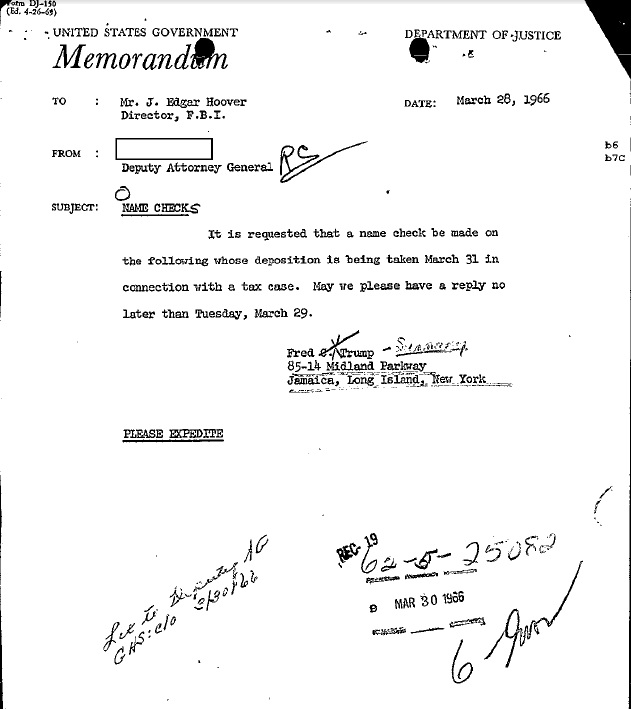
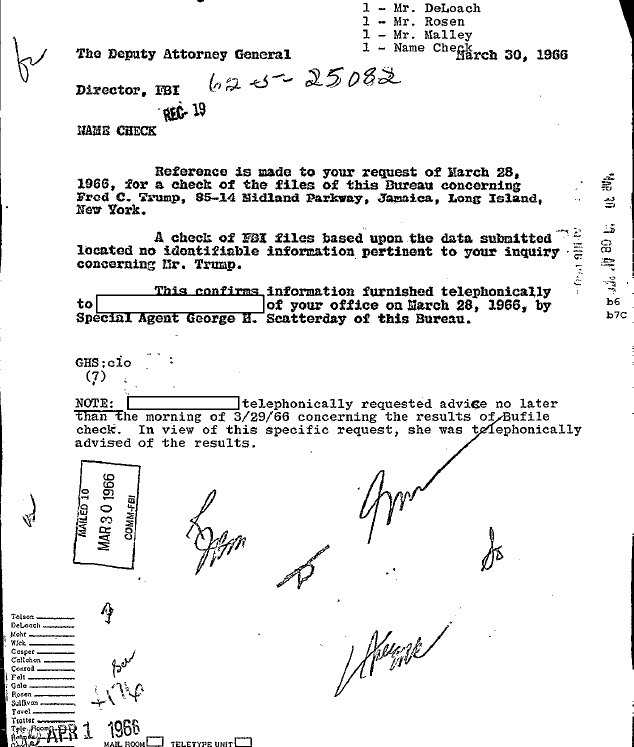
In a March 28, 1966 memo from Deputy Attorney General Ramsey Clark to FBI director J. Edgar Hoover, an FBI "Namecheck" on Fred C. Trump of 85-14 Midland Parkway, Jamaica, Long Island, New York is expeditiously requested because of a deposition by Fred Trump being taken by the Justice Department in a "tax case." Clark, who worked for Attorney General Nicholas Katzenbach, requested that the FBI respond no later than March 29, 1966. The FBI did not respond in writing until March 30, 1966, however, there was a conversation between FBI Special Agent George Scatterday and one of Clark's aides on March 28, 1966. The FBI's written response to Clark stated, "no identifiable information" was found pertinent to Clark's request concerning Trump.
Katzenbach, who succeeded anti-mob Attorney General Robert Kennedy in September 1964, continued Kennedy's aggressive pursuit of mobsters. Wiretaps and electronic bugs placed on known mobsters in New York and New Jersey by Kennedy were kept in place by Katzenbach. In 1965, President Lyndon Johnson ordered the electronic surveillance of mobsters to be discontinued.
One single paragraph FBI document, dated April 24, 1991, involving an FBI Special Agent and the Trump Organization, is completely redacted, including the name of the agent.
Another FBI file indicates the bureau conducted a Dun & Bradstreet search on the Trump Construction Company on August 27, 1988. Fred Trump died in 1993. Another FBI file shows the bureau was interested in the Trump Organization in 1986 for being one of the largest donors to the New York mayoral campaign of Democrat Ed Koch.
An index of files the FBI maintained on various individuals, not included as part of the FOIA request on Fred Trump, does contain a file under the name "Tommy Trump." It is not clear who Tommy Trump was or whether he was connected to the Fred Trump family.

While FOIA responses often do not yield much in the way of information, agency responses to such requests contain more valuable information. This appears to be the case with Fred Trump and ties to organized crime. In late 2015 and early 2016, as Donald Trump began to appear as a credible candidate for the Republican presidential nomination, the FBI received a flurry of FOIA requests from a few dozen news organizations requesting FBI files on Fred Trump's, and, by inference, Donald Trump's, links to a number of mobsters and their business entities. Amazingly, some of the Fred Trump-mob indexed cross-references sought by the media were redacted by the FBI.
Among the mob linkages to Fred Trump were Constantino "Big Paul" Castellano, head of the Gambino crime family and secret owner of S&A Concrete, a defunct New York firm run by Nick Auletta, which built the Trump Plaza and Trump Tower; Anthony "Fat Tony" Salerno, head of the Genovese crime family and secret owner of S&A Concrete, Inc.; Genovese crime family member and FBI informant Peter Savino; Atlantic City/Philadelphia crime boss Nicodemo "Little Nicky" Scarfo [an indication where Donald Trump got the idea for the nicknames "Little Marco Rubio" and "'Liddle' Bob Corker"], owner of the Cleveland Wrecking Company; Wachtel Plumbing; Chief of the New York City District Council of Carpenters Theodore "Teddy" Maritas; The Circle Group, a major Atlanta construction company headed by Long Island reputed mobster Jerry Marchelletta Jr., which built the Atlantis Resort and Casino in the Bahamas and reportedly laundered money through the Gambino-connected Gold Club, a popular Atlanta strip joint; John Cody, the racketeering-convicted president of Teamsters Local 282; Daniel "Danny" Sullivan, a Teamster official and partner in the Scarfo family's New Jersey-based SSG, Inc. and a labor "fixer" for Donald Trump; Kenny Shapiro, an SSG, Inc. partner, scrap metal dealer, and member of the Scarfo crime family; Edward J. "Biff" Halloran, a concrete contractor who owned Certified Concrete Company and the Transit Mix Company; and Michael Matthews, a mayor of Atlantic City.
Two names requested by media organizations from FBI files linked to Fred Trump were redacted in the actual news media request letters released under FOIA. While redactions of private addresses and phone numbers contained in such requests in commonplace and required under the Privacy Act, the redaction of substantive information in FOIA requests is highly suspect [see below].
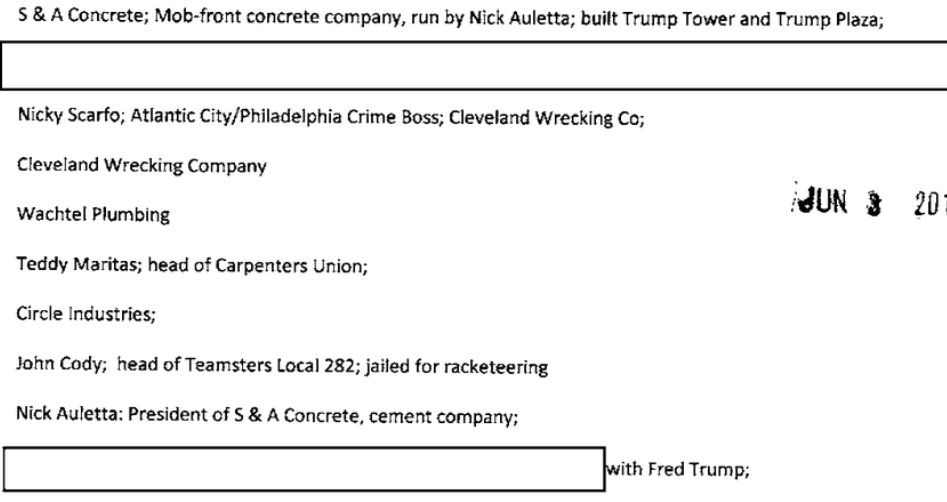
The same entries were redacted by the FBI in multiple FOIA requests, including May 31, 2016 communications from The BlackVault.com and GovernmentSecrets.com, as well as The Philadelphia Inquirer, CBS News and Cryptome.com; June 1, 2016 communications from Vice News, Judicial Watch, and The Daily Beast; a June 3, 2016 communication from Gizmodo.com and Trump biographer David Cay Johnson; and a July 27, 2016 communication from ABC News.
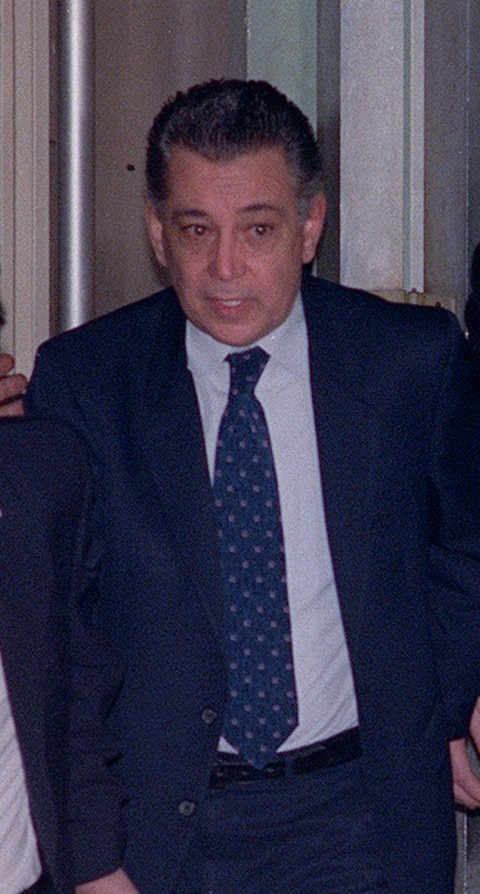 Castellano was murdered in a gangland hit in 1985 that was arranged by John Gotti. Salerno died in federal prison in 1992. Nick Aueltta died in 2013. Scarfo [pictured left] died in federal prison, while serving a life term, on January 13 of this year, a week before Donald Trump was sworn in an president. Savino died on September 30, 1997 at the age of 55 of unknown causes while living in an undisclosed location as part of the federal witness protection program. Maritas disappeared in March 1982, a day before he was to go on trial for racketeering, near the Throgs Neck Bridge in New York. Maritas's wallet was found in shallow water and a $100 bill was discovered floating on the water. Federal tax evasion charges were suddenly dropped against Marchelletta in 2012. Cody died in 2001. Sullivan died of a heart attack in 1993 at the age of 54, after he began cooperating with the FBI in a probe of Donald Trump's Atlantic City mob ties. Sullivan also said he knew what happened to the body of former Teamsters president Jimmy Hoffa, but gave no details. Donald Trump revealed that he understood that Sullivan killed Hoffa. Shapiro died in the 1990s with no details available. Halloran disappeared in Manhattan in August 1998 while visiting the city from his home in Fort Lauderdale. Matthews was recalled as Atlantic City mayor in 1984 and later convicted for extortion. Matthews was sentenced to 15 years in prison but was paroled in 1990 and died in 2014.
A high number of mobsters connected to both Fred and Donald Trump have died suspiciously and conveniently. Trump's fear and loathing of the FBI may have something to do with what the bureau has amassed in its files over the years. The FBI searches of its arcane file system may have yielded little in the way of files on the Trumps, but the files on the connections of the Trump family to those investigated by the FBI for mob activities could fill an Olympic-size swimming pool.
Apparently, WMR's recent Freedom of Information Act (FOIA) request to the FBI for files on ties between Donald Trump's father Fred C. Trump and Nazi and white supremacist groups reflects, save for one other inquiry, is the only media interest for such information.
While the FBI claims its files do not contain any information on Fred Trump's links to Nazi groups like the German-American Bund or white supremacist groups like the Ku Klux Klan, even though he was arrested at a Klan rally in Queens, New York in 1927, the FBI does appear to have tracked Fred Trump's links to organized crime in the 1960s. It is also noteworthy that the FBI's Central Records System (CRS) has been criticized by a number of professional researchers and librarians for its inability to return complete information on searches on specific subjects or individuals.
In a March 28, 1966 memo from Deputy Attorney General Ramsey Clark to FBI director J. Edgar Hoover, an FBI "Namecheck" on Fred C. Trump of 85-14 Midland Parkway, Jamaica, Long Island, New York is expeditiously requested because of a deposition by Fred Trump being taken by the Justice Department in a "tax case." Clark, who worked for Attorney General Nicholas Katzenbach, requested that the FBI respond no later than March 29, 1966. The FBI did not respond in writing until March 30, 1966, however, there was a conversation between FBI Special Agent George Scatterday and one of Clark's aides on March 28, 1966. The FBI's written response to Clark stated, "no identifiable information" was found pertinent to Clark's request concerning Trump.
Katzenbach, who succeeded anti-mob Attorney General Robert Kennedy in September 1964, continued Kennedy's aggressive pursuit of mobsters. Wiretaps and electronic bugs placed on known mobsters in New York and New Jersey by Kennedy were kept in place by Katzenbach. In 1965, President Lyndon Johnson ordered the electronic surveillance of mobsters to be discontinued.
One single paragraph FBI document, dated April 24, 1991, involving an FBI Special Agent and the Trump Organization, is completely redacted, including the name of the agent.
Another FBI file indicates the bureau conducted a Dun & Bradstreet search on the Trump Construction Company on August 27, 1988. Fred Trump died in 1993. Another FBI file shows the bureau was interested in the Trump Organization in 1986 for being one of the largest donors to the New York mayoral campaign of Democrat Ed Koch.
An index of files the FBI maintained on various individuals, not included as part of the FOIA request on Fred Trump, does contain a file under the name "Tommy Trump." It is not clear who Tommy Trump was or whether he was connected to the Fred Trump family.
While FOIA responses often do not yield much in the way of information, agency responses to such requests contain more valuable information. This appears to be the case with Fred Trump and ties to organized crime. In late 2015 and early 2016, as Donald Trump began to appear as a credible candidate for the Republican presidential nomination, the FBI received a flurry of FOIA requests from a few dozen news organizations requesting FBI files on Fred Trump's, and, by inference, Donald Trump's, links to a number of mobsters and their business entities. Amazingly, some of the Fred Trump-mob indexed cross-references sought by the media were redacted by the FBI.
Among the mob linkages to Fred Trump were Constantino "Big Paul" Castellano, head of the Gambino crime family and secret owner of S&A Concrete, a defunct New York firm run by Nick Auletta, which built the Trump Plaza and Trump Tower; Anthony "Fat Tony" Salerno, head of the Genovese crime family and secret owner of S&A Concrete, Inc.; Genovese crime family member and FBI informant Peter Savino; Atlantic City/Philadelphia crime boss Nicodemo "Little Nicky" Scarfo [an indication where Donald Trump got the idea for the nicknames "Little Marco Rubio" and "'Liddle' Bob Corker"], owner of the Cleveland Wrecking Company; Wachtel Plumbing; Chief of the New York City District Council of Carpenters Theodore "Teddy" Maritas; The Circle Group, a major Atlanta construction company headed by Long Island reputed mobster Jerry Marchelletta Jr., which built the Atlantis Resort and Casino in the Bahamas and reportedly laundered money through the Gambino-connected Gold Club, a popular Atlanta strip joint; John Cody, the racketeering-convicted president of Teamsters Local 282; Daniel "Danny" Sullivan, a Teamster official and partner in the Scarfo family's New Jersey-based SSG, Inc. and a labor "fixer" for Donald Trump; Kenny Shapiro, an SSG, Inc. partner, scrap metal dealer, and member of the Scarfo crime family; Edward J. "Biff" Halloran, a concrete contractor who owned Certified Concrete Company and the Transit Mix Company; and Michael Matthews, a mayor of Atlantic City.
Two names requested by media organizations from FBI files linked to Fred Trump were redacted in the actual news media request letters released under FOIA. While redactions of private addresses and phone numbers contained in such requests in commonplace and required under the Privacy Act, the redaction of substantive information in FOIA requests is highly suspect [see below].
The same entries were redacted by the FBI in multiple FOIA requests, including May 31, 2016 communications from The BlackVault.com and GovernmentSecrets.com, as well as The Philadelphia Inquirer, CBS News and Cryptome.com; June 1, 2016 communications from Vice News, Judicial Watch, and The Daily Beast; a June 3, 2016 communication from Gizmodo.com and Trump biographer David Cay Johnson; and a July 27, 2016 communication from ABC News.
Castellano was murdered in a gangland hit in 1985 that was arranged by John Gotti. Salerno died in federal prison in 1992. Nick Aueltta died in 2013. Scarfo [pictured left] died in federal prison, while serving a life term, on January 13 of this year, a week before Donald Trump was sworn in an president. Savino died on September 30, 1997 at the age of 55 of unknown causes while living in an undisclosed location as part of the federal witness protection program. Maritas disappeared in March 1982, a day before he was to go on trial for racketeering, near the Throgs Neck Bridge in New York. Maritas's wallet was found in shallow water and a $100 bill was discovered floating on the water. Federal tax evasion charges were suddenly dropped against Marchelletta in 2012. Cody died in 2001. Sullivan died of a heart attack in 1993 at the age of 54, after he began cooperating with the FBI in a probe of Donald Trump's Atlantic City mob ties. Sullivan also said he knew what happened to the body of former Teamsters president Jimmy Hoffa, but gave no details. Donald Trump revealed that he understood that Sullivan killed Hoffa. Shapiro died in the 1990s with no details available. Halloran disappeared in Manhattan in August 1998 while visiting the city from his home in Fort Lauderdale. Matthews was recalled as Atlantic City mayor in 1984 and later convicted for extortion. Matthews was sentenced to 15 years in prison but was paroled in 1990 and died in 2014.A high number of mobsters connected to both Fred and Donald Trump have died suspiciously and conveniently. Trump's fear and loathing of the FBI may have something to do with what the bureau has amassed in its files over the years. The FBI searches of its arcane file system may have yielded little in the way of files on the Trumps, but the files on the connections of the Trump family to those investigated by the FBI for mob activities could fill an Olympic-size swimming pool.

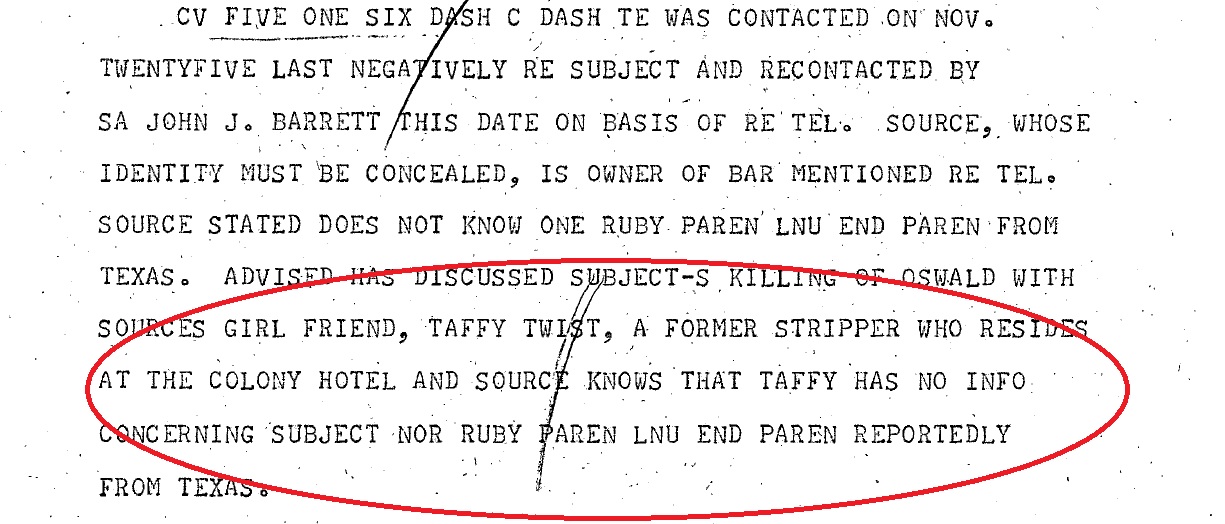

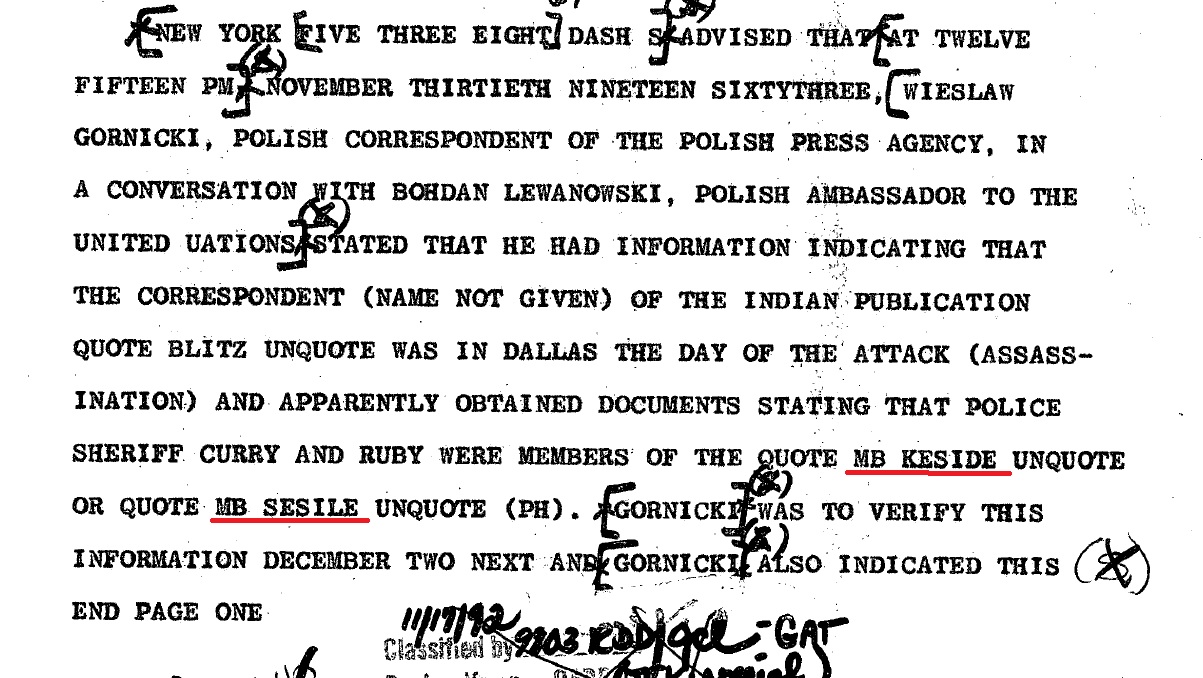
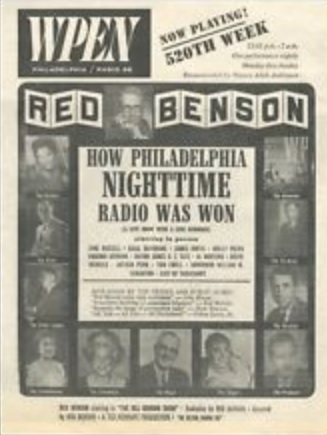 identity of a "JHC" who "sent a letter to Dallas," and a post card to radio station WPEN in Philadelphia that concerned Ruby. The FBI telex states that Theodore Reinhart, the producer of the night talk program, the Red Benson Show on WPEN, was an "established source" for the FBI. Reinhart used the Red Benson Show to appeal to "JHC," who apparently called into the Red Benson Show sometime after January 1, 1963 and before November 22, 1963 with information concerning Ruby and the planned assassinations of JFK and Lee Harvey Oswald, to "come forward" with his or her identity. There is no indication that "JHC" ever surfaced.