
Showing posts with label Oil. Show all posts

Friday, June 24, 2016

US, Britain planned to blow up Middle East oilfields By Wayne Madsen Report

US, Britain planned to blow up Middle East oilfields
The world reacted in horror when Saddam Hussein ordered his retreating troops withdrawing from Kuwait to set fire to the oil sheikhdom's oil fields. However, according to recently released declassified files of the U.S. and British governments, the two allies planned to destroy the oil wells, pipelines, and refineries in the event of the Soviet invasion during the Cold War era. The authorization for the demolition of the oil capabilities of Iran, Iraq, Saudi Arabia, Kuwait, Bahrain, and Qatar was contained in National Security Council memorandum 26/2 (NSC 26/2), signed by President Harry Truman on January 10, 1949. The operation also entailed the Central Intelligence Agency using the employees of U.S. and British oil companies in the Middle East to carry out the destruction of their own oil infrastructures in order to deny them to the Soviets. An NSC memo further describes the demolition and denial project.

NSC 26/2 was replaced by the Dwight Eisenhower administration, first with NSC 176and then NSC 5401. The Eisenhower administration changed the policy from destroying Middle East oil wells to capping the wells in order to have access to the oil in the future. There is no indication that the John F. Kennedy administration continued the plans to destroy and disrupt the Middle East's oil industry.

Although the U.S.-owned Arabian-American Oil Company (ARAMCO), headquartered in Dharan, Saudi Arabia, was part of the CIA's team that would help carry out the demolition, possibly with the aid of nuclear weapons, the Saudi government was not briefed on the plan. ARAMCO, a consortium of Standard Oil of New Jersey (Esso), Standard Oil of California (SoCal), Socony Vacuum, and Texaco, was opposed to the decision not to reveal the plan to the Saudi government because it feared the Saudis might nationalize the company if the operation's existence was leaked. Similarly, the Anglo-Iranian Oil Company of Britain, which ran the oil industry in Iran, feared that not informing the Iranian government of the operation would jeopardize its assets in that country. In the end, ARAMCO and Anglo-Iranian were overruled by the CIA and British Secret Intelligence Service (MI-6).


The smoking gun paragraph in Truman's destruction order.

The British dubbed their role in the operation "Plan NECKPIECE." The operation formerly carried the code word of SMARTWEED. MI-6 also gave the CIA responsibility for blowing up the U.S.-owned Bahrein Petroleum Company's infrastructure, even though Bahrain was then a protectorate of the United Kingdom. The British and Americans were to cooperate on the destruction of the assets of the joint U.S-British-owned Kuwait Oil Company. Britain had the role for destroying the Petroleum Development (Qatar), Ltd.'s oil assets. The American Oil Independent Company, which controlled drilling in the Kuwait-Saudi Neutral Zone, was also part of the destruction operation. MI-6 and the CIA jointly worked with the Iraq Petroleum Company to ensure the destruction of its capabilities. The Sidon, Lebanon terminus of the Trans-Arabian Pipeline, owned and operated by Tapline, an ARAMCO subsidiary, was also slated for destruction, as was an Anglo-Egyptian Oilfields Company refinery in Egypt. Although French oil companies co-owned with the British and Americans oil installations and field in Iraq and Qatar, there is no indication that the French were ever consulted on Anglo-British plans to destroy their petroleum assets in the Middle East. Among the installations to be destroyed were large British-owned facilities in Abadan, Iran and Kirkuk, Iraq. There were also U.S.-British plans to destroy pipelines in Jordan and the oil refinery in Haifa, Israel.

Sidon (Tripoli), Lebanon ARAMCO pipeline terminus on the Mediterranean Sea was slated for destruction by CIA teams working with oil company employees.
Although Secretary of State Dean Acheson was granted the discretion to inform Saudi King Ibn Saud of the demolition plans, Acheson refrained from doing so.


Formerly TOP SECRET British document outlining areas of responsibility for destruction of Middle East oil industry.


The Middle East oil denial operation was one of the most closely-guarded secrets of the Cold War.
To carry out the demolition, the CIA and their British counterparts were to assign "undercover" assets to oil companies in each of the countries involved. CIA officer George Prussing, who was undercover as an executive of Union Oil of California, helped draw up the demolition plan in cooperation with British intelligence, the senior executives of ARAMCO and other oil companies in the Persian Gulf region, and British Foreign Office diplomats assigned to the Middle East, including the British Political Resident in Bahrain.
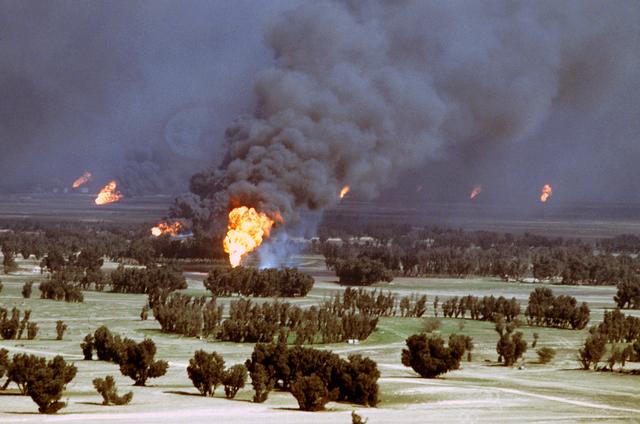
Saddam merely carried out a plan in Kuwait that had been in the hip-pocket of the Americans and British for several decades.

When Saddam Hussein ordered the destruction of Kuwait's oil fields in 1991, there were suggestions that the act, itself, was a war crime. No such suggestions were ever made about the Americans' and British planned action to destroy all of the Middle East's oil fields being a "war crime."

Tuesday, October 12, 2010

Pepe Escobar, Pipelineistan's New Silk Road - China’s Pipelineistan “War” Anteing Up, Betting, and Bluffing in the New Great Game


Future historians may well agree that the twenty-first century Silk Road first opened for business on December 14, 2009. That was the day a crucial stretch of pipeline officially went into operation linking the fabulously energy-rich state of Turkmenistan (via Kazakhstan and Uzbekistan) to Xinjiang Province in China’s far west. Hyperbole did not deter the spectacularly named Gurbanguly Berdymukhamedov, Turkmenistan’s president, from bragging, “This project has not only commercial or economic value. It is also political. China, through its wise and farsighted policy, has become one of the key guarantors of global security.”

The bottom line is that, by 2013, Shanghai, Guangzhou, and Hong Kong will be cruising to ever more dizzying economic heights courtesy of natural gas supplied by the 1,833-kilometer-long Central Asia Pipeline, then projected to be operating at full capacity. And to think that, in a few more years, China’s big cities will undoubtedly also be getting a taste of Iraq’s fabulous, barely tapped oil reserves, conservatively estimated at 115 billion barrels, but possibly closer to 143 billion barrels, which would put it ahead of Iran. When the Bush administration’s armchair generals launched their Global War on Terror, this was not exactly what they had in mind.

China’s economy is thirsty, and so it’s drinking deeper and planning deeper yet. It craves Iraq’s oil and Turkmenistan’s natural gas, as well as oil from Kazakhstan. Yet instead of spending more than a trillion dollars on an illegal war in Iraq or setting up military bases all over the Greater Middle East and Central Asia, China used its state oil companies to get some of the energy it needed simply by bidding for it in a perfectly legal Iraqi oil auction.

Meanwhile, in the New Great Game in Eurasia, China had the good sense not to send a soldier anywhere or get bogged down in an infinite quagmire in Afghanistan. Instead, the Chinese simply made a direct commercial deal with Turkmenistan and, profiting from that country’s disagreements with Moscow, built itself a pipeline which will provide much of the natural gas it needs.

No wonder the Obama administration’s Eurasian energy czar Richard Morningstar was forced to admit at a congressional hearing that the U.S. simply cannot compete with China when it comes to Central Asia’s energy wealth. If only he had delivered the same message to the Pentagon.

That Iranian Equation

In Beijing, they take the matter of diversifying oil supplies very, very seriously. When oil reached $150 a barrel in 2008 -- before the U.S.-unleashed global financial meltdown hit -- Chinese state media had taken to calling foreign Big Oil “international petroleum crocodiles,” with the implication that the West’s hidden agenda was ultimately to stop China’s relentless development dead in its tracks.

Twenty-eight percent of what’s left of the world’s proven oil reserves are in the Arab world. China could easily gobble it all up. Few may know that China itself is actually the world’s fifth largest oil producer, at 3.7 million barrels per day (bpd), just below Iran and slightly above Mexico. In 1980, China consumed only 3% of the world’s oil. Now, its take is around 10%, making it the planet’s second largest consumer. It has already surpassed Japan in that category, even if it’s still way behind the U.S., which eats up 27% of global oil each year. According to the International Energy Agency (IEA), China will account for over 40% of the increase in global oil demand until 2030. And that’s assuming China will grow at “only” a 6% annual rate which, based on present growth, seems unlikely.

Saudi Arabia controls 13% of world oil production. At the moment, it is the only swing producer -- one, that is, that can move the amount of oil being pumped up or down at will -- capable of substantially increasing output. It’s no accident, then, that, pumping 500,000 bpd, it has become one of Beijing’s major oil suppliers. The top three, according to China’s Ministry of Commerce, are Saudi Arabia, Iran, and Angola. By 2013-2014, if all goes well, the Chinese expect to add Iraq to that list in a big way, but first that troubled country’s oil production needs to start cranking up. In the meantime, it’s the Iranian part of the Eurasian energy equation that’s really nerve-racking for China’s leaders.

Chinese companies have invested a staggering $120 billion in Iran's energy sector over the past five years. Already Iran is China’s number two oil supplier, accounting for up to 14% of its imports; and the Chinese energy giant Sinopec has committed an additional $6.5 billion to building oil refineries there. Due to harsh U.N.-imposed and American sanctions and years of economic mismanagement, however, the country lacks the high-tech know-how to provide for itself, and its industrial structure is in a shambles. The head of the National Iranian Oil Company, Ahmad Ghalebani, has publicly admitted that machinery and parts used in Iran’s oil production still have to be imported from China.

Sanctions can be a killer, slowing investment, increasing the cost of trade by over 20%, and severely constricting Tehran’s ability to borrow in global markets. Nonetheless, trade between China and Iran grew by 35% in 2009 to $27 billion. So while the West has been slamming Iran with sanctions, embargos, and blockades, Iran has been slowly evolving as a crucial trade corridor for China -- as well as Russia and energy-poor India. Unlike the West, they are all investing like crazy there because it's easy to get concessions from the government; it's easy and relatively cheap to build infrastructure; and being on the inside when it comes to Iranian energy reserves is a necessity for any country that wants to be a crucial player in Pipelineistan, that contested chessboard of crucial energy pipelines over which much of the New Great Game in Eurasia takes place. Undoubtedly, the leaders of all three countries are offering thanks to whatever gods they care to worship that Washington continues to make it so easy (and lucrative) for them.

Few in the U.S. may know that last year Saudi Arabia -- now (re)arming to the teeth, courtesy of Washington, and little short of paranoid about the Iranian nuclear program -- offered to supply the Chinese with the same amount of oil the country currently imports from Iran at a much cheaper price. But Beijing, for whom Iran is a key long-term strategic ally, scotched the deal.

As if Iran’s structural problems weren’t enough, the country has done little to diversify its economy beyond oil and natural gas exports in the past 30 years; inflation’s running at more than 20%; unemployment at more than 20%; and young, well educated people are fleeing abroad, a major brain drain for that embattled land. And don’t think that’s the end of its litany of problems. It would like to be a full member of the Shanghai Cooperation Organization (SCO) -- the multi-layered economic/military cooperation union that is a sort of Asian response to NATO -- but is only an official SCO observer because the group does not admit any country under U.N. sanctions. Tehran, in other words, would like some great power protection against the possibility of an attack from the U.S. or Israel. As much as Iran may be on the verge of becoming a far more influential player in the Central Asian energy game thanks to Russian and Chinese investment, it’s extremely unlikely that either of those countries would actually risk war against the U.S. to “save” the Iranian regime.

The Great Escape

From Beijing’s point of view, the title of the movie version of the intractable U.S. v. Iran conflict and a simmering U.S. v. China strategic competition in Pipelineistan could be: “Escape from Hormuz and Malacca.”

The Strait of Hormuz is the definition of a potential strategic bottleneck. It is, after all, the only entryway to the Persian Gulf and through it now flow roughly 20% of China’s oil imports. At its narrowest, it is only 36 kilometers wide, with Iran to the north and Oman to the south. China’s leaders fret about the constant presence of U.S. aircraft carrier battle groups on station and patrolling nearby.

With Singapore to the North and Indonesia to the south, the Strait of Malacca is another potential bottleneck if ever there was one -- and through it flow as much as 80% of China’s oil imports. At its narrowest, it is only 54 kilometers wide and like the Strait of Hormuz, its security is also of the made-in-USA variety. In a future face-off with Washington, both straits could quickly be closed or controlled by the U.S. Navy.

Hence, China’s increasing emphasis on developing a land-based Central Asian energy strategy could be summed up as: bye-bye, Hormuz! Bye-bye, Malacca! And a hearty welcome to a pipeline-driven new Silk Road from the Caspian Sea to China’s Far West in Xinjiang.

Kazakhstan has 3% of the world’s proven oil reserves, but its largest oil fields are not far from the Chinese border. China sees that country as a key alternative oil supplier via future pipelines that would link the Kazakh oil fields to Chinese oil refineries in its far west. In fact, China’s first transnational Pipelineistan adventure is already in place: the 2005 China-Kazakhstan oil project, financed by Chinese energy giant CNPC.

Much more is to come, and Chinese leaders expect energy-rich Russia to play a significant part in China’s escape-hatch planning as well. Strategically, this represents a crucial step in regional energy integration, tightening the Russia/China partnership inside the SCO as well as at the U.N. Security Council.

When it comes to oil, the name of the game is the immense Eastern Siberia-Pacific Ocean (ESPO) pipeline. Last August, a 4,000-kilometer-long Russian section from Taishet in eastern Siberia to Nakhodka, still inside Russian territory, was begun. Russian Premier Vladimir Putin hailed ESPO as “a really comprehensive project that has strengthened our energy cooperation.” And in late September, the Russians and the Chinese inaugurated a 999-kilometer-long pipeline from Skovorodino in Russia’s Amur region to the petrochemical hub Daqing in northeast China.

Russia is currently delivering up to 130 million tons of Russian oil a year to Europe. Soon, no less than 50 million tons may be heading to China and the Pacific region as well.

There are, however, hidden tensions between the Russians and the Chinese when it comes to energy matters. The Russian leadership is understandably wary of China’s startling strides in Central Asia, the former Soviet Union’s former “near abroad.” After all, as the Chinese have been doing in Africa in their search for energy, in Central Asia, too, the Chinese are building railways and introducing high-tech trains, among other modern wonders, in exchange for oil and gas concessions.

Despite the simmering tensions between China, Russia, and the U.S., it’s too early to be sure just who is likely to emerge as the victor in the new Great Game in Central Asia, but one thing is clear enough. The Central Asian “stans” are becoming ever more powerful poker players in their own right as Russia tries not to lose its hegemony there, Washington places all its chips on pipelines meant to bypass Russia (including the Baku-Tbilisi-Ceyhan (BTC) pipeline that pumps oil from Azerbaijan to Turkey via Georgia) and China antes up big time for its Central Asian future. Whoever loses, this is a game that the “stans” cannot but profit from.

Recently, our man Gurbanguly, the Turkmen leader, chose China as his go-to country for an extra $4.18 billion loan for the development of South Yolotan, his country’s largest gas field. (The Chinese had already shelled out $3 billion to help develop it.) Energy bureaucrats in Brussels were devastated. With estimated reserves of up to 14 trillion cubic meters of natural gas, the field has the potential to flood the energy-starved European Union with gas for more than 20 years. Goodbye to all that?

In 2009, Turkmenistan’s proven gas reserves were estimated at a staggering 8.1 trillion cubic meters, fourth largest in the world after Russia, Iran, and Qatar. Not surprisingly, from the point of view of Ashgabat, the country’s capital, it invariably seems to be raining gas. Nonetheless, experts doubt that the landlocked, idiosyncratic Central Asian republic actually has enough blue gold to supply Russia (which absorbed 70% of Turkmenistan’s supply before the pipeline to China opened), China, Western Europe and Iran, all at the same time.

Currently, Turkmenistan sells its gas to: China via the world's largest gas pipeline, 7,000 kilometers long and designed for a capacity of 40 billion cubic meters per year, Russia (10 billion cubic meters per year, down from 30 billion per year until 2008), and Iran (14 billion cubic meters per year). Iranian President Mahmoud Ahmadinejad always gets a red-carpet welcome from Gurbanguly, and the Russian energy giant Gazprom, thanks to an improved pricing policy, is treated as a preferred customer.

At present, however, the Chinese are atop the heap, and more generally, whatever happens, there can be little question that Central Asia will be China’s major foreign supplier of natural gas. On the other hand, the fact that Turkmenistan has, in practice, committed its entire future gas exports to China, Russia, and Iran means the virtual death of various trans-Caspian Sea pipeline plans long favored by Washington and the European Union.

IPI vs. TAPI All Over Again

On the oil front, even if all the “stans” sold China every barrel of oil they currently pump, less than half of China’s daily import needs would be met. Ultimately, only the Middle East can quench China’s thirst for oil. According to the International Energy Agency, China’s overall oil needs will rise to 11.3 million barrels per day by 2015, even with domestic production peaking at 4.0 million bpd. Compare that to what some of China’s alternative suppliers are now producing: Angola, 1.4 million bpd; Kazakhstan, 1.4 million as well; and Sudan, 400,000.

On the other hand, Saudi Arabia produces 10.9 million bpd, Iran around 4.0 million, the United Arab Emirates (UAE) 3.0 million, Kuwait 2.7 million -- and then there’s Iraq, presently at 2.5 million and likely to reach at least 4.0 million by 2015. Still, Beijing has yet to be fully convinced that this is a safe supply, especially given all those U.S. “forward operating sites” in the UAE, Bahrain, Kuwait, Qatar, and Oman, plus those roaming naval battle groups in the Persian Gulf.

On the gas front, China definitely counts on a South Asian game changer. Beijing has already spent $200 million on the first phase in the construction of a deepwater port at Gwadar in Pakistan’s Balochistan Province. It wanted, and got from Islamabad, “sovereign guarantees to the port’s facilities.” Gwadar is only 400 kilometers from Hormuz. With Gwadar, the Chinese Navy would have a homeport that would easily allow it to monitor traffic in the strait and someday perhaps even thwart the U.S. Navy’s expansionist designs in the Indian Ocean.

But Gwadar has another infinitely juicier future role. It could prove the pivot in a competition between two long-discussed pipelines: TAPI and IPI. TAPI stands for the Turkmenistan-Afghanistan-Pakistan-India pipeline, which can never be built as long as U.S. and NATO occupation forces are fighting the resistance umbrella conveniently labeled “Taliban” in Afghanistan. IPI, however, is the Iran-Pakistan-India pipeline, also known as the “peace pipeline” (which, of course, would make TAPI the “war pipeline”). To Washington’s immeasurable distress, last June, Iran and Pakistan finally closed the deal to build the “IP” part of IPI, with Pakistan assuring Iran that either India or China could later be brought into the project.

Whether it’s IP, IPI, or IPC, Gwadar will be a key node. If, under pressure from Washington, which treats Tehran like the plague, India is forced to pull out of the project, China already has made it clear that it wants in. The Chinese would then build a Pipelineistan link from Gwadar along the Karakorum highway in Pakistan to China via the Khunjerab Pass -- another overland corridor that would prove immune to U.S. interference. It would have the added benefit of radically cutting down the 20,000-kilometer-long tanker route around the southern rim of Asia.

Arguably, for the Indians it would be a strategically sound move to align with IPI, trumping a deep suspicion that the Chinese will move to outflank them in the search for foreign energy with a “string of pearls” strategy: the setting up of a series of “home ports” along its key oil supply routes from Pakistan to Myanmar. In that case, Gwadar would no longer simply be a “Chinese” port.

As for Washington, it still believes that if TAPI is built, it will help keep India from fully breaking the U.S.-enforced embargo on Iran. Energy-starved Pakistan obviously prefers its “all-weather” ally China, which might commit itself to building all sorts of energy infrastructure within that flood-devastated country. In a nutshell, if the unprecedented energy cooperation between Iran, Pakistan, and China goes forward, it will signal a major defeat for Washington in the New Great Game in Eurasia, with enormous geopolitical and geo-economic repercussions.

For the moment, Beijing’s strategic priority has been to carefully develop a remarkably diverse set of energy-suppliers -- a flow of energy that covers Russia, the South China Sea, Central Asia, the East China Sea, the Middle East, Africa, and South America. (China’s forays into Africa and South America will be dealt with in a future installment of our TomDispatch tour of the globe's energy hotspots.) If China has so far proven masterly in the way it has played its cards in its Pipelineistan “war”, the U.S. hand -- bypass Russia, elbow out China, isolate Iran -- may soon be called for what it is: a bluff.

Pepe Escobar is the roving correspondent for Asia Times. His latest book is Obama Does Globalistan. He may be reached at pepeasia@yahoo.com.

Copyright 2010 Pepe Escobar

Wednesday, May 05, 2010

What If BP Was A Human Being?

gulf oil spill

What if BP, the principal corporate entity responsible for the monstrous oil well rupture a mile beneath Gulf of Mexico were a human being, a flesh and blood person instead of a faceless transnational corporation? It's a fair and simple question, and the answers tell us a lot more about the world we live in.

What If BP Was A Human Being?

By BAR managing editor Bruce A. Dixon

The third largest oil company in the world, BP was born in 1909 as the Anglo-Persian Oil Company, and was partly owned by the British government. Its headquarters offices are in the UK.. So if it were a flesh and blood person, it would be far and away the wealthiest person on earth, and a British subject. Assuming that our imaginary human BP got into the oil business at the youthful age of say, 20, and stayed at it for just over a century, BP the human being would be closing in on his 121st birthday. Damned few of us will see triple digits, and none of us that reach even our 60s and 70s retain the level of energy, or often of interest that we possessed only a couple decades before. A normal 120 year-old human will have more than a few ailments and bodily systems on the brink of failure. But not our human BP. If BP were a person, it would be immensely, almost inconceivably wealthy AND perhaps immortal.

In the 1930s, the Anglo-Persian Oil Company became the Ango-Iranian Oil Company. In the 1970s it swallowed Standard Oil of Ohio, in the 1980s it merged with Amoco, formerly Standard Oil of Indiana, and in the 21st century it bought Arco and other oil companies. Along the way, BP has utilized all these and other brands, like Conoco, at its convenience. Most recently, BP the corporation has rebranded itself, declaring that BP now stood for “Beyond Petroleum.”

Among flesh and blood humans, there are no precise analogs to what corporations do when they buy and sell each other. The acts of matrimony and cannibalism perhaps comes closest, with consenting or non-consenting spouses and/or victims, along with assumption of the spouse and/or victim's assets. Among humans, marriage is a reason to change one's name, too. Another reason to change one's name is simply to escape one's old record and reputation. Among humans, that's called assuming an alias. So our immortal, immensely wealthy human BP may have been married several times, perhaps several times at once, could be a cannibal, albeit with sometimes willing victims, and operates under several aliases.

You don't have to look too long and hard to understand why a flesh and blood BP would need aliases. The objective of the Anglo-Persian Oil Company was to monopolize the rich oil resources of what is now Iran. Among the many illegal acts it committed toward that end was a £5,000 bribe to future British PM Winston Churchill back in 1923 to lobby for its interests. A secular nationalist and democratically elected Iranian government kicked BP out in the early 1950s. BP turned its lobbying to Washington DC, and in 1953, helped persuade the US to overthrow the Democratic Iranian government and installed its puppet, the Shah, popularly known as the Crowned Cannibal. The Shah, in the course of killing millions and stealing billions, invited BP back, and it stayed until 1979, when the Shah was overthrown.

In a century of doing business, BP has been implicated in bribery of public officials, grand theft, fomenting unjust wars, of murder, torture, plunder, environmental destruction, and money laundering in and between scores of countries on every continent except Antarctica. If BP were a person it would be a career criminal, a pathological liar and an international serial killer with a rap sheet several times the size of the Chicago Yellow Pages.

Given his (we're reasonably sure a human BP would not be a woman) global reach and proclivity to corrupt public officials around the world, and past record, BP the human being would be a flight risk. It would be indicted for murder, or at least negligent homicide in the deaths of the last eleven oil workers to die when its rig exploded in the Gulf of Mexico. US law doesn't have death penalties for corporations, but the federal government, and most or all of the first wave of Gulf Coast states where the oil slick wil wash up do. We're talking Florida, Alabama, Mississippi, Louisiana and Texas.

The assets of corporations are protected against lawsuits of all kinds. BP and other oil industry giants long ago paid for the insertion of provisions into the US federal code that limit their liability in the case of oil spills to a mere $75 million dollars. But there are no limits on the liability that individually held wealth can incur. A human BP, even though 120 years old and immensely wealthy, could see all his assets around the world frozen, would be imprisoned without bail, and might be on trial for his life.

But of course the real BP is a corporation, and death penalties, like laws in general are for humans, not corporations.

In the single instance of the blown rig at Deepwater Horizon, BP had a deal with the US federal government that excused it from paying any royalties, and subcontracted the building and operation of the rig to Halliburton, Cameron and other corporations. If they too were human beings like our hypothetical human BP, we could add “conspiracy to commit” and “conspiracy to conceal” in front of all the previously mentioned offenses, and the lot of them along with many of their favorite government officials could be rounded up.

When it suits their purposes, employees and mouthpieces of various transnational firms hasten to assure us that “corporations are people, too.” In a sense this is certainly true. Despite what some bible thumping fundamentalists will tell you, corporations were not ordained by the Almighty. Corporations are legal fictions. They are artificial shields under which we agree to allow a handful of extremely wealthy people to rule over the rest us, and plunder the planet and its people at will, just as centuries ago most of the humans who mattered agreed that kings, queens and nobly born, the “people of quality” had the god given right to ride roughshod over humanity.

Ultimately, people woke up, rose up, and revoked those privileges. How long will it be before we revoke the lawless privileges of corporations, before we limit their immunity, curtail their immortality, and rein in their immorality?. How long can we, and the planet on which we depend for life itself, wait? Is there ever a line that cannot be crossed? Where is it? What will it take?

Bruce A. Dixon is managing editor at Black Agenda Report and lives in Marietta GA. You can reach him at bruce.dixon(at)blackagendareport.com.

Monday, February 01, 2010

The Fateful Geological Prize Called Haiti

President becomes UN Special Envoy to earthquake-stricken Haiti.

A born-again neo-conservative US business wheeler-dealer preacher claims Haitians are condemned for making a literal ‘pact with the Devil.’

Venezuelan, Nicaraguan, Bolivian, French and Swiss rescue organizations accuse the US military of refusing landing rights to planes bearing necessary medicines and urgently needed potable water to the millions of Haitians stricken, injured and homeless.

Behind the smoke, rubble and unending drama of human tragedy in the hapless Caribbean country, a drama is in full play for control of what geophysicists believe may be one of the world’s richest zones for hydrocarbons-oil and gas outside the Middle East, possibly orders of magnitude greater than that of nearby Venezuela.

Haiti, and the larger island of Hispaniola of which it is a part, has the geological fate that it straddles one of the world’s most active geological zones, where the deepwater plates of three huge structures relentlessly rub against one another—the intersection of the North American, South American and Caribbean tectonic plates. Below the ocean and the waters of the Caribbean, these plates consist of an oceanic crust some 3 to 6 miles thick, floating atop an adjacent mantle. Haiti also lies at the edge of the region known as the Bermuda Triangle, a vast area in the Caribbean subject to bizarre and unexplained disturbances.

This vast mass of underwater plates are in constant motion, rubbing against each other along lines analogous to cracks in a broken porcelain vase that has been reglued. The earth’s tectonic plates typically move at a rate 50 to 100 mm annually in relation to one another, and are the origin of earthquakes and of volcanoes. The regions of convergence of such plates are also areas where vast volumes of oil and gas can be pushed upwards from the Earth’s mantle. The geophysics surrounding the convergence of the three plates that run more or less directly beneath Port-au-Prince make the region prone to earthquakes such as the one that struck Haiti with devastating ferocity on January 12.

A relevant Texas geological project

Leaving aside the relevant question of how well in advance the Pentagon and US scientists knew the quake was about to occur, and what Pentagon plans were being laid before January 12, another issue emerges around the events in Haiti that might help explain the bizarre behavior to date of the major ‘rescue’ players—the United States, France and Canada. Aside from being prone to violent earthquakes, Haiti also happens to lie in a zone that, due to the unusual geographical intersection of its three tectonic plates, might well be straddling one of the world’s largest unexplored zones of oil and gas, as well as of valuable rare strategic minerals.

The vast oil reserves of the Persian Gulf and of the region from the Red Sea into the Gulf of Aden are at a similar convergence zone of large tectonic plates, as are such oil-rich zones as Indonesia and the waters off the coast of California. In short, in terms of the physics of the earth, precisely such intersections of tectonic masses as run directly beneath Haiti have a remarkable tendency to be the sites of vast treasures of minerals, as well as oil and gas, throughout the world.

Notably, in 2005, a year after the Bush-Cheney Administration de facto deposed the democratically elected President of Haiti, Jean-Baptiste Aristide, a team of geologists from the Institute for Geophysics at the University of Texas began an ambitious and thorough two-phase mapping of all geological data of the Caribbean Basins. The project is due to be completed in 2011. Directed by Dr. Paul Mann, it is called “Caribbean Basins, Tectonics and Hydrocarbons.” It is all about determining as precisely as possible the relation between tectonic plates in the Caribbean and the potential for hydrocarbons—oil and gas.

Notably, the sponsors of the multi-million dollar research project under Mann are the world’s largest oil companies, including Chevron, ExxonMobil, the Anglo-Dutch Shell and BHP Billiton.[1] Curiously enough, the project is the first comprehensive geological mapping of a region that, one would have thought, would have been a priority decades ago for the US oil majors. Given the immense, existing oil production off Mexico, Louisiana, and the entire Caribbean, as well as its proximity to the United States – not to mention the US focus on its own energy security – it is surprising that the region had not been mapped earlier. Now it emerges that major oil companies were at least generally aware of the huge oil potential of the region long ago, but apparently decided to keep it quiet.

Cuba’s Super-giant find

Evidence that the US Administration may well have more in mind for Haiti than the improvement of the lot of the devastated Haitian people can be found in nearby waters off Cuba, directly across from Port-au-Prince. In October 2008 a consortium of oil companies led by Spain’s Repsol, together with Cuba's state oil company, Cubapetroleo, announced discovery of one of the world’s largest oilfields in the deep water off Cuba. It is what oil geologists call a ‘Super-giant’ field. Estimates are that the Cuban field contains as much as 20 billion barrels of oil, making it the twelfth Super-giant oilfield discovered since 1996. The discovery also likely makes Cuba a new high-priority target for Pentagon destabilization and other nasty operations.

No doubt to the dismay of Washington, Russian President Dmitry Medvedev flew to Havana one month after the Cuban giant oil find to sign an agreement with acting-President Raul Castro for Russian oil companies to explore and develop Cuban oil.[2]

Medvedev’s Russia-Cuba oil agreements came only a week after the visit of Chinese President Hu Jintao to meet the recuperating Fidel Castro and his brother Raul. The Chinese President signed an agreement to modernize Cuban ports and discussed Chinese purchase of Cuban raw materials. No doubt the mammoth new Cuban oil discovery was high on the Chinese agenda with Cuba.[3] On November 5, 2008, just prior to the Chinese President’s trip to Cuba and other Latin American countries, the Chinese government issued their first ever policy paper on the future of China’s relations with Latin America and Caribbean nations, elevating these bilateral relations to a new level of strategic importance. [4]

The Cuba Super-giant oil find also leaves the advocates of ‘Peak Oil’ theory with more egg on the face. Shortly before the Bush-Blair decision to invade and occupy Iraq, a theory made the rounds of cyberspace, that sometime after 2010, the world would reach an absolute “peak” in world oil production, initiating a period of decline with drastic social and economic implications. Its prominent spokesmen, including retired oil geologist Colin Campbell and Texas oil banker Matt Simmons, claimed that there had not been a single new Super-giant oil discovery since 1976, or thereabouts, and that new fields found over the past two decades had been “tiny” compared with the earlier giant discoveries in Saudi Arabia, Prudhoe Bay, Daquing in China and elsewhere. [5]

It is critical to note that, more than half a century ago, a group of Russian and Ukrainian geophysicists, working in state secrecy, confirmed that hydrocarbons originated deep in the earth’s mantle under conditions similar to a giant burning cauldron at extreme temperature and pressure. They demonstrated that, contrary to US and accepted Western ‘mainstream’ geology, hydrocarbons were not the result of dead dinosaur detritus concentrated and compressed and somehow transformed into oil and gas millions of years ago, nor of algae or other biological material.[6]

The Russian and Ukrainian geophysicists then proved that the oil or gas produced in the earth’s mantle was pushed upwards along faults or cracks in the earth as close to the surface as pressures permitted. The process was analogous to the production of molten lava in volcanoes. It means that the ability to find oil is limited, relatively speaking, only by the ability to identify deep fissures and complex geological activity conducive to bringing the oil out from deep in the earth. It seems that the waters of the Caribbean, especially those off Cuba and its neighbor Haiti, are just such a region of concentrated hydrocarbons (oil and gas) that have found their way upwards close to the surface, perhaps in a magnitude comparable to a new Saudi Arabia.[7]

Haiti, a new Saudi Arabia?

The remarkable geography of Haiti and Cuba and the discovery of world-class oil reserves in the waters off Cuba lend credence to anecdotal accounts of major oil discoveries in several parts of Haitian territory. It also could explain why two Bush Presidents and now special UN Haiti Envoy Bill Clinton have made Haiti such a priority. As well, it could explain why Washington and its NGOs moved so quickly to remove-- twice-- the democratically elected President Aristide, whose economic program for Haiti included, among other items, proposals for developing Haitian natural resources for the benefit of the Haitian people.

In March 2004, some months before the University of Texas and American Big Oil launched their ambitious mapping of the hydrocarbon potentials of the Caribbean, a Haitian writer, Dr. Georges Michel, published online an article titled ‘Oil in Haiti.’ In it, Michel wrote,

… .[I]t has been no secret that deep in the earthy bowels of the two states that share the island of Haiti and the surrounding waters that there are significant, still untapped deposits of oil. One knows not why they are still untapped. Since the early twentieth century, the physical and political map of the island of Haiti, erected in 1908 by Messrs. Alexander Poujol and Henry Thomasset, reported a major oil reservoir in Haiti near the source of the Rio Todo El Mondo, Tributary Right Artibonite River, better known today as the River Thomonde. [8]

According to a June 2008 article by Roberson Alphonse in the Haitian paper, Le Nouvelliste en Haiti, “The signs, (indicators), justifying the explorations of oil (black gold) in Haiti are encouraging. In the middle of the oil shock, some 4 companies want official licenses from the Haitian State to drill for oil.”

At the time, oil prices were climbing above $140 a barrel -- on manipulations by various Wall Street banks. Alphonse’s article quoted Dieusuel Anglade, the Haitian State Director of the Office of Mining and Energy, telling the Haitian press: "We've received four requests for oil exploration permits…We have had encouraging indicators to justify the pursuit of the exploration of black gold (oil), which had stopped in 1979."[9]

Alphonse reported the findings from a 1979 geological study in Haiti of 11 exploratory oil wells drilled at the Plaine du Cul-de-sac on the Plateau Central and at L'ile de La Gonaive: “Surface (tentative) indicators for oil were found at the Southern peninsula and on the North coast, explained the engineer Anglade, who strongly believes in the immediate commercial viability of these explorations.”[10]

Journalist Alphonse cites an August 16, 1979 memo by Haitian attorney Francois Lamothe, in which he noted that “five big wells were drilled” down to depths of 9000 feet and that a sample that “underwent a physical-chemical analysis in Munich, Germany” had “revealed tracks of oil.” [11]

Despite the promising 1979 results in Haiti, Dr. Georges Michel reported that, “the big multinational oil companies operating in Haiti pushed for the discovered deposits not to be exploited.” [12] Oil exploration in and offshore Haiti ground to a sudden halt as a result.

Similar if less precise reports claiming that Haitian oil reserves could be vastly larger than those of Venezuela have appeared in Haitian websites. [13] Then in 2010 the financial news site Bloomberg News carried the following:

The Jan. 12 earthquake was on a fault line that passes near potential gas reserves, said Stephen Pierce, a geologist who worked in the region for 30 years for companies that included the former Mobil Corp. The quake may have cracked rock formations along the fault, allowing gas or oil to temporarily seep toward the surface, he said Monday in a telephone interview. ‘A geologist, callous as it may seem, tracing that fault zone from Port-au-Prince to the border looking for gas and oil seeps, may find a structure that hasn't been drilled,’ said Pierce, exploration manager at Zion Oil & Gas Inc., a Dallas-based company that's drilling in Israel. [14]

In an interview with a Santo Domingo online paper, Leopoldo Espaillat Nanita, former head of the Dominican Petroleum Refinery (REFIDOMSA) stated, “there is a multinational conspiracy to illegally take the mineral resources of the Haitian people.” [15] Haiti’s minerals include gold, the valuable strategic metal iridium and oil, apparently lots of it.

Aristide’s development plans

Marguerite Laurent ('Ezili Dantò'), president of the Haitian Lawyers’ Leadership Network (HLLN) who served as attorney for the deposed Aristide, notes that when Aristide was President -- up until his US-backed ouster during the Bush era in 2004 -- he had developed and published in book form his national development plans. These plans included, for the first time, a detailed list of known sites where the resources of Haiti were located. The publication of the plan sparked a national debate over Haitian radio and in the media about the future of the country. Aristide’s plan was to implement a public-private partnership to ensure that the development of Haiti’s oil, gold and other valuable resources would benefit the national economy and the broader population, and not merely the five Haitian oligarchic families and their US backers, the so-called Chimeres or gangsters. [16]

Since the ouster of Aristide in 2004, Haiti has been an occupied country, with a dubiously-elected President, Rene Preval, a controversial follower of IMF privatization mandates and reportedly tied to the Chimeres or Haitian oligarchs who backed the removal of Aristide. Notably, the US State Department refuses to permit the return of Aristide from South African exile.

Now, in the wake of the devastating earthquake of January 12, the United States military has taken control of Haiti’s four airports and presently has some 20,000 troops in the country. Journalists and international aid organizations have accused the US military of being more concerned with imposing military control, which it prefers to call “security,” than with bringing urgently needed water, food and medicine from the airport sites to the population.

A US military occupation of Haiti under the guise of earthquake disaster ‘relief’ would give Washington and private business interests tied to it a geopolitical prize of the first order. Prior to the January 12 quake, the US Embassy in Port-au-Prince was the fifth largest US embassy in the world, comparable to its embassies in such geopolitically strategic places as Berlin and Beijing.[17] With huge new oil finds off Cuba being exploited by Russian companies, with clear indications that Haiti contains similar vast untapped oil as well as gold, copper, uranium and iridium, with Hugo Chavez’ Venezuela as a neighbor to the south of Haiti, a return of Aristide or any popular leader committed to developing the resources for the people of Haiti, -- the poorest nation in the Americas -- would constitute a devastating blow to the world’s sole Superpower. The fact that in the aftermath of the earthquake, UN Haiti Special Envoy Bill Clinton joined forces with Aristide foe George W. Bush to create something called the Clinton-Bush Haiti Fund ought to give everyone pause.

According to Marguerite Laurent ('Ezili Dantò') of the Haitian Lawyers’ Leadership Network, under the guise of emergency relief work, the US, France and Canada are engaged in a balkanization of the island for future mineral control. She reports rumors that Canada wants the North of Haiti where Canadian mining interests are already present. The US wants Port-au-Prince and the island of La Gonaive just offshore – an area identified in Aristide’s development book as having vast oil resources, and which is bitterly contested by France. She further states that China, with UN veto power over the de facto UN-occupied country, may have something to say against such a US-France-Canada carve up of the vast wealth of the nation. [18]

Notes:

1 Paul Mann, Caribbean Basins, Tectonic Plates & Hydrocarbons, Institute for Geophysics, The University of Texas at Austin, accessed in
www.ig.utexas.edu/research/projects/cbth/.../ProposalCaribbean.pdf .

2 Rory Carroll, Medvedev and Castro meet to rebuild Russia-Cuba relations, London Guardian, November 28, 2008 accessed in http://www.guardian.co.uk/world/2008/nov/28/cuba-russia.

3 Julian Gavaghan, Comrades in arms: When China’s President Hu met a frail Fidel Castro, London Daily Mail, November 19, 2008, accessed in http://www.dailymail.co.uk/news/article-1087485/Comrades-arms-When-Chinas-President-Hu-met-frail-Fidel-Castro.html.

4 Peoples’ Daily Online, China issues first policy paper on Latin America, Caribbean region, November 5, 2008, accessed in http://english.people.com.cn/90001/90776/90883/6527888.html .

5 Matthew R. Simmons, The World’s Giant Oilfields, Simmons & Co. International, Houston, accessed in http://www.simmonsco-intl.com/files/giantoilfields.pdf .

6 Anton Kolesnikov, et al, Methane-derived hydrocarbons produced under upper-mantle conditions, Nature Geoscience, July 26, 2009.

7 F. William Engdahl, War and Peak Oil—Confessions of an ‘ex’ Peak Oil believer, Global Research, September 26, 2007, accessed in http://www.globalresearch.ca/index.php?context=va&aid=6880 .

8 Dr. Georges Michel, Oil in Haiti, English translation from French, Pétrole en Haiti, March 27, 2004, accessed in http://www.margueritelaurent.com/pressclips/oil_sites.html#oil_GeorgesMichelEnglish .

9 Roberson Alphonse, Drill, and then pump the oil of Haiti! 4 oil companies request oil drilling permits, translated from the original French, June 27, 2008, accessed in
http://www.bnvillage.co.uk/caribbean-news-village-beta/99691-drill-then-pump-oil-haiti-4-oil-companies-request-oil-drilling-permits.html

10 Ibid.

11 Ibid. The full text indicated that, “five big wells were drilled at Porto Suel (Maissade) of a depth of 9000 feet, at Bebernal, 9000 feet, at Bois-Carradeux (Ouest), at Dumornay, on the road Route Frare and close to the Chemin de Fer of Saint-Marc. A sample, a ‘carrot’ (oil reservoir) drilled up from the well of Saint-Marc in the Artibonite underwent a physical-chemical analysis in Munich, Germany, at the request of Mr. Broth. ‘The result of the analysis was returned on October 11, 1979 and revealed tracks of oil,’ confided the engineer, Willy Clemens, who had gone to Germany.”

12 Dr. Georges Michel, op. cit.

13 Marguerite Laurent, Haiti is full of oil, say Ginette and Daniel Mathurin, Radio Metropole, Jan 28, 2008, accessed in
http://www.margueritelaurent.com/pressclips/oil_sites.html#full_of_oil.

14 Jim Polson, Haiti earthquake may have exposed gas, aiding economy, Bloomberg News, January 26, 2010.

15 Espaillat Nanita revela en Haiti existen grandes recursos de oro y otros minerals, Espacinsular.org, 17 November, 2009, accessed in
http://www.espacinsular.org/spip.php?article8942 .

16 The Aristide development plan was contained in the book published in Haiti in 2000, Investir dans l’Human. Livre Blanc de Fanmi Lavalas sous la Direction de Jean-Bertrand Aristide, Port-au-Prince, Imprimerie Henri Deschamps, 2000. It contained detailed maps, tables, graphics, and a national development plan for 2004 “covering agriculture, environment, commerce and industry, the financial sector, infrastructure, education, culture, health, women's issues, and issues in the public sector.” In 2004, using NGOs and the UN and a vicious propaganda campaign to vilify Aristide, the Bush administration got rid of the elected President.

17 Cynthia McKinney, Haiti: An Unwelcome Katrina Redux, Global Research, January 19, 2010, accessed in
http://www.globalresearch.ca/index.php?context=va&aid=17063.

18 Marguerite Laurent (Ezili Danto), Did mining and oil drilling trigger the Haiti earthquake?, OpEd News.com, January 23, 2010, accessed in
http://www.opednews.com/articles/1/Did-mining-and-oil-drillin-by-Ezili-Danto-100123-329.html.


F. William Engdahl is a frequent contributor to Global Research. Global Research Articles by F. William Engdahl

Friday, January 22, 2010

Oil in Haiti -The True Economic Reasons for the UN/US Occupation


This article was first published in October 2009.


Oil in Haiti and Oil Refinery - an old notion for Fort Liberte as a transshipment terminal for US supertankers
- Another economic reason for the ouster of President Aristide and current UN occupation (Haiti's Riches:Interview with Ezili Dantò on Mining in Haiti)


There is evidence that the United States found oil in Haiti decades ago and due to the geopolitical circumstances and big business interests of that era made the decision to keep Haitian oil in reserve for when Middle Eastern oil had dried up. This is detailed by Dr. Georges Michel in an article dated March 27, 2004 outlining the history of oil explorations and oil reserves in Haiti and in the research of Dr. Ginette and Daniel Mathurin.

There is also good evidence that these very same big US oil companies and their inter-related monopolies of engineering and defense contractors made plans, decades ago, to use Haiti's deep water ports either for oil refineries or to develop oil tank farm sites or depots where crude oil could be stored and later transferred to small tankers to serve U.S. and Caribbean ports. This is detailed in a paper about the Dunn Plantation at Fort Liberte in Haiti.

Ezili's HLLN underlines these two papers on Haiti's oil resources and the works of Dr. Ginette and Daniel Mathurin in order to provide a view one will not find in the mainstream media nor anywhere else as to the economic and strategic reasons the US has constructed its fifth largest embassy in the world - fifth only besides the US embassy in China, Iraq, Iran and Germany - in tiny Haiti, post the 2004 Haiti Bush regime change.

The facts outlined in the Dunn Plantation and Georges Michel papers, considered together, reasonably unveil part of the hidden reasons UN Special Envoy to Haiti, Bill Clinton, is giving the UN occupation a facelift so that its troops stay in Haiti for the duration.

Ezili's HLLN has consistently maintained, since the beginning of the 2004 Bush regime change in Haiti, that the 2004 US invasion of Haiti used UN troops as its military proxy to avoid the charge of imperialism and racism. We have also consistently maintained that the UN/US invasion and occupation of Haiti is not about protecting Haitian rights, security, stability or long-term domestic development but about returning the Washington Chimeres/[gangsters] - the traditional Haitian Oligarchs - to power, establishing free trade not fair trade, the Chicago-boys' death plan, neoliberal policies, keeping the minimum wage at slave wage levels, plundering Haiti's natural resources and riches, not to mention using the location benefit that Haiti lies between Cuba and Venezuela. Two countries the US has unsuccessfuly orchestrated regime changes in and continues to pursue. In the Dunn Plantation and Georges Michel papers, we find and deploy further details as to why the US is in Haiti with this attempted Bill Clinton facelift to the UN's continued occupations.

For, no matter the disguise or media spins it's also about Haiti's oil reserves, and about securing Haiti's deep-water ports as transshipment location for oil or for tank sites to store crude oil without interference from a democratic government beholden to its informed population's welfare. (See Reynold's deep water port in Miragoane/NIPDEVCO property- scroll to photos in middle of the page.)

In Haiti, between 1994 to 2004 when the people had a voice in government, there was an intense grassroots movement to figure out how to exploit Haiti's resources. There was a plan, where in the book "Investing In People: Lavalas White Book under the direction of Jean-Betrand Aristide (Investir Dans L'Humain), the Haitian majority "were not only told where the resources were, but that -- they did not have the skills and technology to actually extract the gold, to extract the oil."

The Aristide/Lavalas plan, as I've articulated in the Haiti's Riches Interview, was "to engage in some sort of private/public partnership. Where both the Haitian people's interest would be taken care of and of course the private interest would take their profits. But I think it was around that time we had St. Genevieve saying they did not like the Haitian government. Obviously, they didn't like this plan. They don't like the Haitian people to know where their resources are. But in this book, it was the first time in Haitian history, it was written in Kreyòl and in French. And there was a national discussion all over the radio in Haiti with respect to all these various resources of Haiti, where they were located, and how the Haitian government was intending on trying to build sustainable development through those resources. So that's what you had before the 2004 Bush regime change/Coup D'etat in Haiti. With the Coup D'etat now, though the people know where these resources are because this book exists, they don't know who these foreign companies are. What they're profit margins are. What the environmental protection rules and regulations to protect them are. Many folks, for instance, in the North talk about losing their property, having people come in with guns and taking over their property. So that's where we are." (Haiti's Riches: Interview with Ezili Dantò on Mining in Haiti.)

The mainstream media, owned by the multinational companies fleecing Haiti, certainly won't lay out for public consumption that the UN/US invasion and occupation of Haiti is to secure Haiti's oil, strategic position, cheap labor, deep water ports, mineral resources (iridium, gold, copper, uranium, diamond, gas reserves)��, lands, waterfronts, offshore resources for privatization or the exclusive use of the world's wealthy oligarchs and US big oil monopolies. (See, Map showing some of Haiti's mining and mineral wealth, including five oil sites in Haiti; Oil in Haiti by Dr. Georges Michel; Excerpt from the Dunn Plantation paper; Haiti is full of oil, say Ginette and Daniel Mathurin; There is a multinational conspiracy to illegally take the mineral resources of the Haitian people: Espaillat Nanita revealed that in Haiti there are huge resources of gold and other minerals, and Is UN proxy occupation of Haiti masking US securing oil/gas reserves from Haiti).

In fact, the current Haitian authority-under-the-US/UN-occupation that is in charge of regulating exploration licenses and mining in Haiti does not explain, in any relevant or systematic manner, to the Haitian majority about the companies buying up, post 2004, Haiti's deep water ports, what their profit shares with the Haitian nation are, where are the accounting of said shares owed to the people of Haiti, nor explain the environmental effects of the massive excavations of Haiti's mountains and waters going on right now. Instead, the Director of Mining in Haiti blithely maintains that "further research will be necessary to confirm the existence of oil in Haiti."

In an excerpt taken from the article posted Oct 9, 2000 by Bob Perdue entitled "Lonnie Dunn, third owner of the Dauphin plantation," we learn that:

"On November 8, 1973, Martha C. Carbone, American Embassy, Port-au-Prince, sent a letter to the Office of Fuels and Energy, Department of State, in which she stated that the Government of Haiti "...had before it proposals from eight different groups to establish a trans-shipment port for petroleum in one or more of the Haitian deep water ports. Some of the projects include construction of a refinery...." She further commented that the Embassy was acquainted with three firms: Ingram Corporation of New Orleans, Southern California Gas Company and Williams Chemical Corporation of Florida.. (According to John Moseley, the New Orleans company was probably "Ingraham", not Ingram.)

In the November 6, 1972 issue of Oil and Gas Journal, Leo B. Aalund commented in his article "Vast Flight of Refining Capacity from U.S. Looms",.: "Finally, 'Baby Doc' Duvalier's Haiti is participating with a group that wants to build a transshipment terminal off Fort Liberte, Haiti". One of the proposals referred to by Carbone was undoubtedly submitted by Dunn interests.

Additionally, we learn from this article that "Lonnie Dunn who owned the Dauphin plantation "planned to straighten and widen the entrance to the [Fort Liberte] bay so that super tankers could be brought in and the cargo distributed to smaller tankers for transfer to U.S. and Caribbean ports that could not accommodate large ships...
" (Photo of Fort Liberte, Haiti).

We've put on the Ezili's HLLN website the other relevant portions of this paper that talks about the corporate eye the US has had, for decades, on Fort Liberte in Haiti as an ideal deep water port for the multinationals to establish an oil refinery.

In the 50s and 60s there was little need for Haiti's ports or oil as the Middle Eastern monopoly was gushing dollars galore. No need for these oil monopolies to undercut themselves by putting more oil on the market to cut their profits. Manipulated scarcity thy name is profit! or, did I mean capitalism?

But the oil embargo of the 70s, the advent of OPEC, the rise of the Venezuelan factor, the Gulf Crisis followed by the Iraq war for oil, all has made Haiti a better bet for the three-piece suits and their military mercernaries called "Western governments", yep, a way easier place to pillage and plunder behind the "bringing democracy" or "humanitarian aid" public covers.

Serendipitously with Haiti's 2004 Bush-the-son Regime Change, a follow up to the 1991 Bush-the-father's military coup, we find, flurries of Congressional "discussions" about off-shore drillings in preparation, perhaps, to the eventual "revelation" as written in the Dunn paper years ago, that "there is a need for supertankers that require deep-water ports which are not readily available along the U.S. East Coast - nor ...welcome...for environmental and other consideration will (not) permit the construction of domestic refinery capacity on the scale that will be required."

We underline that Haiti is an ideal dumping ground for the US/Canada/France and now Brazil, because environmental, human rights and health issues and other considerations in the US and in these other countries, would probably not permit the construction of domestic refinery capacity on the scale that new explorations of oil in this hemisphere will required. So, why not pick the most militarily defenseless country in the Western Hemisphere and dot it with such unsafe initiatives behind a UN multi-national "humanitarian" mask and fatherly Bill Clinton's snowy white hair and smiling face?

It is relevant to note here that most of Haiti's major deep water ports have been privatized since the Bush 2004 regime change in Haiti. It is also relevant to note here what I wrote last year in the piece titled Is the UN military proxy occupation of Haiti masking US securing oil/gas reserves from Haiti: "If there's substantial oil and gas reserves in Haiti, the US/Euro genocide and crimes against the Haitian population has not yet begun. Ayisyen leve zye nou anwo, kenbe red. Nou fèk komanse goumen. (Read again, John Maxwell's Is there oil in Haiti.)

The revelations of Dr. Georges Michel and the Dunn Plantation papers seem to positively answer the question that there is substantail oil reserves in Haiti. And our Ezili Dantò Witness Project information is that it's indeed being tapped and contracted out, but not for the benefit of Haitians or Haiti's authentic development. That's why there was a need to marginalize the Haitian masses through the ouster of Haiti's democratically elected Aristide government and put in the UN guns and UN occupation that today masks the US/Euros' (with a piece to the new power that is Brazil) securing Haiti's oil and gas reserves and other mineral riches such as gold, copper, diamond and underwater treasures. (Majescor and SACG Discover a New Copper-Gold in Haiti, Oct. 6, 2009; See, Haiti's Riches and There is a multinational conspiracy to illegally take the mineral resources of the Haitian people: Espaillat Nanita revealed that in Haiti there are huge resources of gold and other minerals.)

Today, the US and Euros say they are happy with Haiti's "security gains" and "stable" government. To wit: the last elections the US/UN presided over in Haiti excluded Haiti's majority party from participation. Haiti's jails are filled, indefinitely detained without trial or hearings, since 2004, with thousands upon thousands of community organizers, poor civilians and political dissenters that the UN/US label "gangsters." Site Soley has been "pacified." There are more NGOs and charitable organizations - about 10,000 - in Haiti then in any where in the world since 2004 and the Haitian people are a million times worst off than they were before this US/NGO civilization (otherwise also known as the "International Community") and their thugs, thieves and corporate death squads came and disenfranchised nine million blacks. Food prices are so high, some resort to eating dirt in the form of cookies to assuage Clorox hunger.

Lovinsky Pierre Antoine, the head of Haiti's largest human rights organization was disappeared in 2007 in UN occupied Haiti with no investigation done. Between 2004 and 2006 under the Western occupation, first by the US Marines then the UN multinational troops headed by Brazil, from 14,000 to 20,000 Haitians, mostly who opposed the occupation and regime change, were slaughtered with total impunity. More Haitian children are out of school today in 2009 than before the US/NGO "civilization" came post 2004. Under the US-imposed Boca Raton regime ,Haiti's Supreme Court was fired and brand new and paid-for judges, without any Constitutional authority inherited from the people of Haiti's mandate, took the place of the legitimate judges and law officers and are still metering out paid-for rulings in 2009 under the UN occupation and international community's tutelage.

And, as a matter of power, privilege, inequity and the violence of neocolonialism, white-sex abusers and pedophiles are having a hay day and human trafficking of Haiti children are at an all-time high. It is no revelation that in the stakes of corruption in Haiti or in Africa that a great many of the foreign NGOs along with their bourgeois/elite/pastors/priests and others are destroying poor children's life with absolute impunity while being painted as "saints" in their press back home the better to raise more funds to masturbate on Black pain some more.

Yet, Special UN Envoy, Bill Clinton, tells us "I am serving the next two years as a US Special Envoy to Haiti...This is the best chance in my lifetime that Haitians have ever had to escape the chains of their past..." The former President added, "If Haiti pulls out of this it will be in no small measure because of the efforts of non-governmental organizations."

What that means is perhaps this is the Haitian subcontractors, ruling oligarchs and US/Euro military industrial complexes' best chance to finally impose their chains on Haiti for good. Tap Haiti's oil, keep it so poor it will be grateful for slave wages at sweatshops. Let sexual tourism and the white sex-abusers do as they will. Transfer quickly more Haiti properties to foreigners and render the "good" Haitians as maids, butlers and servants in US/Euro-owned Haiti tourist resorts like the rest of the Caribbean. Militarize Haiti so that dissent is not possible even as a thought. That's perhaps UN Envoy, Bill Clinton's "best chance in my lifetime" scenario for Haiti. Nothing else makes sense. (See, HLLN comment on new IMF figures indicating Haiti is no longer the poorest country in the Western Hemisphere and Does the Western economic calculation of wealth fit Haiti -fit Dessalines idea of wealth distribution?NO! and Comparing crime, poverty and violence in the rest of the Hemisphere to Haiti and Pointing Guns at Starving Haitians: Violent Haiti is a myth and The Western vs the Real Narrative on Haiti and No other national group anywhere in the world sends more money home than Haitians living abroad.)

Going shopping in Haiti:

"It is organized violence on top which creates individual violence at the bottom. ----Emma Goldman

Though they exist and form the exception to the rule, there are very few Paul Farmers, Margaret Trosts or Bill Quigleys in the Haitian world. And even amongst "the exceptions," the number whittles down to almost zero in terms of foreign heroes who can be expected to go the lifetime-distance without making "unusual alliances" or joining the status quo that vies for the soul of Black folks. Few who would HEAR, Lila Watson who said, "If you have come here to help me then you are wasting your time, but if you have come because your liberation is bound up with mine then let us work together." This sort of thinking that inspires self-reliance not dependency and provide the respectful conditions for those in great need to, in liberty, dignity and identify, realize their own needs is not what compels the International Community in Haiti right now.

For, in the age of humanitarian imperialism, globalization, financial colonialism and neocolonial-violence obfuscated behind forced assimilation and cultural imperialism, what exactly do some whites or modern missionaries go shopping in Haiti for: sex, self-esteem, adulation, fun, challenge, adventure, the boost in serotonin-consumption, to exploit cheap labor, plunder Haiti's natural resources, for self-improvement, recovery, to use Haiti as in excuse to raise funds for their salaries and living expenses to live the old Dixie's planters' life with exploitation black sex on tap, or as an easy way to gain international expert credentials in any field and move up the socio-economic ladder at home and/or for securing the good tropical lifestyle with mountain and oceanfront houses, the waiters, maids, gardeners and seafood they couldn't obtain as easily in their Euro/US countries where they are the majority, ordinary, can’t use the white privilege inheritance without some scrutiny and are not as exotic and special as in neocolonial devastated Haiti. It’s all hidden, of course, behind the mask of being good humanitarians, altruistic charity workers and helping Haitians. (See also, Ezili Dantò Reviews Travesty in Haiti: A true account of Christian missions, orphanages, fraud, food aid and drug trafficking (a book by Timothy T. Schwartz, Ph.D.); The Slavery in Haiti the Media Won't Expose ; Haiti's Holocaust and Middle Passage Continues; UN Peacekeepers and Humanitarian Aid Workers raping, molesting and abusing Haitian children; The-To-Tell-The-Truth-About-Haiti Forum 2009; I am the History of Rape: HLLN Letter to UN asking for investigative reports on UN soldier's rapes in Haiti; and, Proposed solutions to create a new paradigm.)


Marguerite Laurent/Ezili Dantò is an award winning playwright, a performance poet, political and social commentator, author and human rights attorney. She was born in Port-au-Prince, Haiti, and raised in the USA. For more go to Marguerite Laurent/Ezili Dantò website at http://www.ezilidanto.com

Friday, October 02, 2009

Jumpin' Jack Verdi, It's a Gas, Gas, Gas Iran and the Pipelineistan Opera By Pepe Escobar

Back before email, a world traveler who wanted to keep in touch and couldn't just pop into the nearest Internet café, might drop you a series of postcards from one exotic locale after another. Pepe Escobar, that edgy, peripatetic globe-trotting reporter for one of my favorite on-line publications, Asia Times, has been doing just that for TomDispatch readers as he explores the geography that undergirds our civilization, the pipelines that crisscross Eurasia through which flow energy -- and trouble. This, then, is his third "postcard" from what he likes to call Pipelineistan. The first in March began laying out a great, ongoing energy struggle across Eurasia via an embattled energy corridor (and a key pipeline) that runs from the Caspian Sea to Europe through Georgia and Turkey -- and the Great Game of business, diplomacy, and proxy war between Russia and the U.S. that has gone with it.

In May, he plunged eastward into tumultuous Central and South Asia and the devolving battleground that, in Washington, goes by the neologism AfPak (for the Afghanistan-Pakistan theater of operations). Now, he heads west toward Europe and another developing struggle, this time over just how natural gas from the Caspian Sea will reach Europe. Think of this as a story that lurks under so many other stories. For instance, this very day, the representatives of Russia, Germany, China, France, Britain, and for the first time, the United States, will be sitting down with Iran's representative in Geneva for what's billed as an historic exchange. On the table -- and in global headlines -- will be the Iranian nuclear program, a previously secret Iranian nuclear site, Iranian medium-range missile tests, sanctions of various sorts, the possibility of future attacks on that country's nuclear establishment, and so on. What won't be in the headlines, or the accompanying reams of analysis, is the approximately 15% of the world's natural gas deposits Iran controls. As it happens, for the Europeans and the Russians (and so for Washington), that's the story hidden under the Iranian imbroglio, which is why we need Pepe Escobar. Tom

Jumpin' Jack Verdi, It's a Gas, Gas, Gas

Iran and the Pipelineistan Opera
By Pepe Escobar

Brussels -- Oil and natural gas prices may be relatively low right now, but don't be fooled. The New Great Game of the twenty-first century is always over energy and it's taking place on an immense chessboard called Eurasia. Its squares are defined by the networks of pipelines being laid across the oil heartlands of the planet. Call it Pipelineistan. If, in Asia, the stakes in this game are already impossibly high, the same applies to the "Euro" part of the great Eurasian landmass -- the richest industrial area on the planet. Think of this as the real political thriller of our time.

The movie of the week in Brussels is: When NATO Meets Pipelineistan. Though you won't find it in any headlines, at virtually every recent NATO summit Washington has been maneuvering to involve reluctant Europeans ever more deeply in the business of protecting Pipelineistan. This is already happening, of course, in Afghanistan, where a promised pipeline from Turkmenistan to Pakistan and India, the TAPI pipeline, has not even been built. And it's about to happen at the borders of Europe, again around pipelines that have not yet been built.

If you had to put that Euro part of Pipelineistan into a formula, you might do so this way: Nabucco (pushed by the U.S.) versus South Stream (pushed by Russia). Be patient. You'll understand in a moment.

At the most basic level, it's a matter of the West yet again trying, in the energy sphere, to bypass Russia. For this to happen, however -- and it wouldn't hurt if you opened the nearest atlas for a moment -- Europe desperately needs to get a handle on Central Asian energy resources, which is easy to say but has proven surprisingly hard to do. No wonder the NATO Secretary General's special representative, Robert Simmons, has been logging massive frequent-flyer miles to Central Asia over these last few years.

Just under the surface of an edgy entente cordiale between the European Union (EU) and Russia lurks the possibility of a no-holds-barred energy war -- Liquid War, as I call it. The EU and the U.S. are pinning their hopes on a prospective 3,300-kilometer-long, $10.7 billion pipeline dubbed Nabucco. Planning for it began way back in 2004 and construction is finally expected to start, if all goes well (and it may not), in 2010. So if you're a NATO optimist, you hope that natural gas from the Caspian Sea, maybe even from Iran (barring the usual American blockade), will begin flowing through it by 2015. The gas will be delivered to Erzurum in Turkey and then transported to Austria via Bulgaria, Romania, and Hungary.

Why, you might ask, is the pipeline meant to save Europe named for a Verdi opera? Well, Austrian and Turkish energy executives happened to see the opera together in Vienna in 2002 while discussing their energy dilemmas, and the biblical plight of the Jews exiled by King Nabucco (Nebuchadnezzar), a love story set amid a ferocious struggle for freedom and power, swept them away. Still, it's a stretch to turn aluminum tubes into dramatic characters.

Of course, the operatic theater here isn't really in the tubing, it's in the politics and strategic implications that surround the pipeline. In Eastern Europe, for instance, Nabucco is seen not as a European economic or energy project, but as a creature of Washington, just like the Baku-Tblisi-Ceyhan (BTC) pipeline from Azerbaijan to Turkey that President Bill Clinton and his crew backed so vigorously in the 1990s and which was finally finished in 2005. For those who have never believed the Cold War is over -- the Eastern Europeans among them -- once again it's the good guys (the West) against the commies... sorry, the Russians... at an energy-rich OK Corral.

The Great Borderless Gas Bazaar

Russia's answer to Nabucco is the 1,200-kilometer-long, $15 billion South Stream pipeline, also scheduled to be finished in 2015; it is slated to carry Siberian natural gas under the Black Sea from Russia to Bulgaria. From Bulgaria, one branch of the pipeline would then run south through Greece to southern Italy while the other would run north through Serbia and Hungary towards northern Italy.

Now, add another pipeline to the picture, the $9.1 billion Nord Stream that will soon enough snake from Western Russia under the Baltic Sea to Germany, which already imports 41.5% of its natural gas from Russia. The giant Russian energy firm Gazprom holds a controlling 51% of Nord Stream stock; the rest belongs to German and Dutch companies. The chairman of the board is none other than former German Chancellor Gerhard Schroeder.

Put this all together and Russia, with its pipelines running in all directions and firmly embedded in Europe, spells trouble for Nabucco's future and frustration for Washington's New Great Game plans to contain the Russian energy juggernaut. And that's without even mentioning Ukhta which, chances are, you've never heard of. If you aren't in the energy business, why should you have? After all, it's a backwater village in Russia's autonomous republic of Komi, 350 kilometers from the Arctic Circle. Built by forced labor, it was once part of Alexander Solzhenitsyn's Gulag archipelago. By 2030, however, you'll know its name. By then, a pipeline from remote Ukhta will be flooding Europe with natural gas and the village will be one of Nord Stream's key transit nodes.

While Nabucco as well as South Stream remain virtual, Nord Stream is a Terminator on the run. By 2010, it will be tunneling under the Baltic Sea heading for Germany. By 2011, it should be delivering the goods and a second pipe -- 12 meters wide, 100,000 tubes long -- will be under construction to double its capacity by 2014. Gazprom CEO Alexei Miller pulls no punches: this, he says, will be "the safest and most modern pipeline in the world."

How can Verdi lovers possibly compete? In the middle of a global recession, Gazprom is spending at least $20 billion to conquer Europe via Nord and South Stream. The strategy is a killer: pump gas under the sea directly to Europe, avoiding messy transit routes across troublesome countries like Ukraine. No wonder Gazprom, which today controls 26% of the European gas market, is expected to have a 33% share by 2020.

In other words, in many ways, the Nabucco versus South Stream energy war already looks settled. Nabucco is, at best, likely to be a secondary pipeline, incapable, as Washington once hoped, of breaking the EU away from energy dependence on Russia.

Brussels, predictably, is in its usual multilingual policy mess. Most bureaucrats at its monster, directive-churning body, the European Commission, publicly bemoan the "pipeline war." On the other hand, Ona Jukneviciene, chairwoman of the committees at the European Parliament dealing with Central Asia, admits that Nabucco cannot be the only option.

As for Reinhard Mitschek, managing director of the Nabucco consortium, he tries to put a brave face on things when he stresses, "we will transport Russian gas, Azeri gas, Iraqi gas." As for the top European official on energy matters, Andris Piebalgs, he can't help being a pragmatist: "We'll continue to work with Russia because Russia has energy resources."

From a business point of view, it's tough to argue with South Stream's selling points. Unlike Nabucco, it will offer cheaper, all-Russian natural gas that won't have to transit through potential war zones, and while Nabucco will always deliver limited amounts of Caspian natural gas to market, South Stream, given Russian resources, will have plenty of room to increase its output.

The fact is that, as of now, Nabucco still has no guaranteed sources of gas. In order for the gas to come from energy-rich Turkmenistan, to take but one example, the Turkmen leadership would have to break a deal they've already made with Russia, which now buys all of that country's export gas. There's no way that Moscow is likely to let one of the former Soviet Republics do that easily. In addition, both Russia and Iran could well be capable of blocking any pipeline straddling the floor of the Caspian Sea.

Gazprom will pay to build South Stream, and then distribute and sell gas it already controls to Europe; Nabucco, on the other hand, has to rely on a messy consortium of six countries (Austria, Hungary, Romania, Bulgaria, Turkey, and Germany) simply to finance one-third of its prospective costs, and then convince wary international bankers to shell out the rest.

The Pentagon does the Black Sea

So what does Washington want out of this mess? That's easy. Rewind to then-prospective Secretary of State Hillary Clinton in her Senate confirmation hearings on January 13, 2009. There, she decried Europe's dependence on Russian natural gas and issued an urgent call for "investments in the Trans-Caspian energy sector." Think of it as a signal: The new Obama administration would be as committed to Nabucco as the Bush administration had been.

What is never spelled out is why. Enter the Black Sea, that crucial geo-strategic stage where Europe meets the Middle East, the Caucasus, and Central Asia. Enter, thus, Bulgaria, home to a new Pentagon air base in Bezmer, one of six new strategic bases being built outside the U.S. and as potentially important to Washington's future games as the stalwart air bases in Incirlik, Turkey, and Aviano, Italy have been in the past. (Aviano was the key U.S./NATO base for the bombing of the Bosnian Serbs in 1995 and the 78-day bombing campaign against Serbia in 1999.)

With the Pentagon's bases already creeping within a stone's throw of Southwest and Central Asia, it doesn't take a genius to imagine the role Bezmer might play in any future attack on Iran (something the Russian defense establishment has already taken careful note of). With both Romania and Bulgaria now part of NATO, Article 5 of the alliance's charter now applies. NATO can take action "in the event of crises which jeopardize Euro-Atlantic stability and could affect the security of Alliance members."

In this way, Pipelineistan meets the American Empire of Bases.

Young Turks and Wily Russians

Why is everyone so damn hooked on Central Asian oil and gas? Elshad Nasirov, deputy chairman of the state-owned Azerbaijani oil company SOCAR, sums the addiction up succinctly enough: "This is the place where there is oil and gas in abundance. It is not Arab, not Persian, not Russian, and not OPEC."

It's the Caspian and, unfortunately for Europe, the region could, in energy terms, turn out to be not the caviar for which it's renowned but so many rotten fish eggs. No one knows, after all, whether the EU will ever be able to buy Iranian gas via Nabucco. No one knows whether the Central Asian "stans" have enough gas to supply Russia, China, and Turkey, not to mention India and Pakistan. No one knows whether any of their leaders will have the nerve to renege on their deals with Gazprom.

Ever since a 2008 British study determined that Turkmenistan may have natural gas reserves second only to Russia on the planet, the European Commission has been on a no-holds-barred tear to lure that country into delivering some of its future gas directly to Europe -- and not through the Russian pipeline system either. Turkmenistan's inscrutable leader, the spectacularly named Gurbanguly Berdymukhammedov, just has to say the word, but despite the claims of EU officials that he has agreed to send some gas Europe-wards, he's never offered a public word of confirmation. No wonder: with Nabucco unbuilt and a pipeline from his country to China still under construction, Turkmenistan can play Pipelineistan games only with Russia and Iran. In fact, Russia essentially controls the flow of Turkmen gas for the next 15 years.

Should Gurbanguly someday say the magic word -- and assuming the Russians don't throw a monkey wrench into the works -- he can marry Turkey, as the key transit country, with the EU and let them all sing Verdi till the sheep come home. In the meantime, angst is the name of the game in Europe (and so in Washington).

A declassified dossier from the FSB, the Russian heir to the KGB, is adamant: considering Nabucco's shortcomings, "Russia will remain the primary supplier of energy to Europe for the foreseeable future." Call it a matter of having your gas and processing it, too. Prime Minister Vladimir Putin has been making the point for years. If Europe tries to snub it, Russia will simply build its own liquefied natural gas (LNG) plants, to facilitate storage and transport, and sell its LNG all over the world.

Anyway it's worth paying attention to what the St. Petersburg State Mining Institute (where Putin earned his doctorate) has to say. According to the institute, Russia has only 20 years' worth of its own natural gas reserves left. Since Russia plans to sell up to 40% of its gas abroad, "Russian" gas may in the future actually mean Central Asian gas. All the more reason for the Russians to make sure that those massive Turkmen and other reserves flow north, not west.

Whatever Washington thinks, the Europeans know that energy independence from Russia is, in reality, inconceivable. Bottom line when it comes to natural gas: Europe needs everything -- Nord Stream, South Stream, and Nabucco. The bulk of the natural gas in this Pipelineistan maze may well turn out to be Central Asian anyway and a substantial part could be Iranian, if the Obama administration ever normalizes relations with Iran.

That, then, is the current state of play in the European wing of Pipelineistan. Russia seems to have virtually guaranteed its status as the top gas supplier to Europe for the foreseeable future. But that brings us to Turkey, a key regional power for both the U.S. and the EU. As President Obama has recognized, Turkey is both a real and a metaphorical bridge between the Christian and Muslim worlds. It is also an ideal transit country for carrying non-Russian gas to Europe and is now playing its own suitably complex Pipelineistan game.

Chances are that, like Ukhta in far off Siberia, you've never heard of Yumurtalik either. It's a fishing port squeezed between the Mediterranean Sea and the Taurus mountains, very close to Ceyhan, the terminal for two key nodes of Pipelineistan: the Kirkuk-Ceyhan pipeline from Iraq and the monster BTC pipeline. Turkey wants to turn Yumurtalik-Ceyhan into nothing less than the Rotterdam of the Mediterranean.

Even as it dreams of future EU membership, however, Turkey worries about antagonizing Moscow. And yet, being aboard the Nabucco Express and already fully committed to the functioning BTC pipeline puts the country on a potential collision course with Russia, its largest trading partner. Of course, this does not displease Washington.

On the other hand, the Turkish leadership draws ever closer to Iran, which provides 38% of Turkey's oil and 25% of its natural gas. Ankara and Tehran also have geopolitical affinities (especially in fighting Kurdish separatism). Together, they offer the best alternative to the Caucasus (Azerbaijan, Georgia) in terms of supplying Europe with Iranian natural gas. All this, of course, drives Washington nuts.

Needless to say, the Nabucco consortium itself would kill to have Iran as a gas supplier for the pipeline. They are also familiar with realpolitik: this could happen only with a Washington-blessed solution to the Iranian nuclear dossier. Iran, for its part, knows well how to seduce Europe. Mohammad-Reza Nematzadeh, managing director of the National Iranian Oil Company (NIOC), has insisted Iran is Europe's "sole option" for the success of Nabucco.

Is Russia just watching all this gas go by? Of course not. In October 2007, Putin signed a key agreement with Iranian President Mahmoud Ahmadinejad: If Iran cannot sell its gas to Nabucco -- a likelihood given the turbulence of American domestic politics and its foreign policy -- Russia will buy it. Translation: Iranian gas could end up, like Central Asian gas, heading for Europe as more "Russian" gas. With its European and Iranian policies at cross-purposes, Washington will not be amused.

When Turkish Prime Minister Recep Tayyip Erdogan threatened to "rethink Nabucco" if the tricky negotiations for Turkey to enter the EU drag on forever, EU leaders got the message (as much as France and Germany may be against a "Europe without borders"). Pragmatically, most EU leaders know very well that they need excellent relations with Turkey to one day have access to the Big Prize, Iranian gas; and that puts Europe's energy and EU membership inclinations at loggerheads.

Last July in Ankara, Nabucco was formally launched by an inter-governmental agreement. The representatives of Turkey, Austria, Bulgaria, Romania and Hungary were there. Obama's special Eurasian envoy, Richard Morningstar (a veteran of the BTC adventure), was there as well. The Central Asian stans were not there.

But crucially, Gurbanguly, ever the showman, finally made an entrance without ever leaving Turkmenistan, (almost) uttering the magic words in a meeting with his ministers in the capital, Ashgabat, on July 10th: "Turkmenistan, staying committed to the principles of diversification of supply of its energy resources to the world markets, is going to use all available opportunities to participate in major international projects -- such as, for example, [the] Nabucco project."

At the Vienna headquarters of Nabucco the mantra remains: this is "no anti-Russian project." Still, everyone knows that Russia's leaders are eager to kill it, and not a soul from Brussels to Vienna, Washington to Ashgabat, knows how to link Central Asia to Europe via a non-Russian pipeline, at the cost of more than $10 billion, without some assurance that Turkmeni, Kazakh, Azerbaijani, and/or Iranian natural gas will be fully (or even partially) on board. Who would be foolish enough to invest that kind of money without some guarantee that hundreds of miles of aluminum tubes won't remain empty? You don't need Verdi to tell you this is one hell of a quirky plot for a global opera.

Pepe Escobar is the roving correspondent for Asia Times and analyst for the Real News. His latest book is Obama Does Globalistan. He may be reached at pepeasia@yahoo.com.

Copyright 2009 Pepe Escobar