

The Day After Damascus Falls: the Beginning of the End for the American Republic

If Syrian President Bashar al-Assad meets the same fate as Libya’s Muammar Gaddafi or Iraq’s Saddam Hussein, much of Official Washington would rush out to some chic watering hole to celebrate – one more “bad guy” down, one more “regime change” notch on the belt. But the day after Damascus falls could mark the beginning of the end for the American Republic.
As Syria would descend into even bloodier chaos – with an Al-Qaeda affiliate or its more violent spin-off, the Islamic State, the only real powers left – the first instinct of American politicians and pundits would be to cast blame, most likely at President Barack Obama for not having intervened more aggressively earlier.
A favorite myth of Official Washington is that Syrian “moderates” would have prevailed if only Obama had bombed the Syrian military and provided sophisticated weapons to the rebels.
Though no such “moderate” rebel movement ever existed – at least not in any significant numbers – that reality is ignored by all the “smart people” of Washington. It is simply too good a talking point to surrender. The truth is that Obama was right when he told New York Times columnist Thomas L. Friedman in August 2014 that the notion of a “moderate” rebel force that could achieve much was “always … a fantasy.”
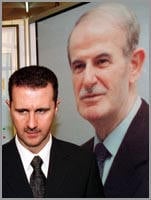
Syrian President Bashar al-Assad in front of a poster of his father, Hafez al-Assad.
As much fun as the “who lost Syria” finger-pointing would be, it would soon give way to the horror of what would likely unfold in Syria with either Al-Qaeda’s Nusra Front or the spin-off Islamic State in charge – or possibly a coalition of the two with Al-Qaeda using its new base to plot terror attacks on the West while the Islamic State engaged in its favorite pastime, those YouTube decapitations of infidels – Alawites, Shiites, Christians, even some descendants of the survivors from Turkey’s Armenian genocide a century ago who fled to Syria for safety.
Such a spectacle would be hard for the world to watch and there would be demands on President Obama or his successor to “do something.” But realistic options would be few, with a shattered and scattered Syrian army no longer a viable force capable of driving the terrorists from power.
The remaining option would be to send in the American military, perhaps with some European allies, to try to dislodge Al-Qaeda and/or the Islamic State. But the prospects for success would be slim. The goal of conquering Syria – and possibly re-conquering much of Iraq as well – would be costly, bloody and almost certainly futile.
The further diversion of resources and manpower from America’s domestic needs also would fuel the growing social discontent in major U.S. cities, like what is now playing out in Baltimore where disaffected African-American communities are rising up in anger against poverty and the police brutality that goes with it. A new war in the Middle East would accelerate America’s descent into bankruptcy and a dystopian police state.
The last embers of the American Republic would fade. In its place would be endless war and a single-minded devotion to security. The National Security Agency already has in place the surveillance capabilities to ensure that any civil resistance could be thwarted.
Can This Fate Be Avoided?
But is there a way to avoid this grim fate? Is there a way to wind this scenario back to some point before this outcome becomes inevitable? Can the U.S. political/media system – as corrupt and cavalier as it is – find a way to avert such a devastating foreign policy disaster?
To do so would require Official Washington to throw off old dependencies, such as its obeisance to the Israel Lobby, and old habits, such as its reliance on manipulative PR to control the American people, patterns deeply engrained in the political process.
At least since the Reagan administration – with its “kick the Vietnam Syndrome” fascination via “public diplomacy” and “perception management” – the tendency has been to designate some foreign leader as the latest new villain and then whip up public hysteria in support of a “regime change.” [See Consortiumnews.com’s “The Victory of Perception Management.”]
In the 1980s, we saw the use of these “black hat/white hat” exaggerations in Nicaragua, where President Ronald Reagan deemed President Daniel Ortega “the dictator in designer glasses” as Reagan’s propagandists depicted Sandinista-ruled Nicaragua as a “totalitarian dungeon” and the CIA-trained Contra “freedom fighters” the “moral equal of the Founding Fathers.”
And, since Ortega and the Sandinistas were surely not the embodiment of all virtue, it was hard to put Reagan’s black-and-white depiction into the proper shades of gray. To make the effort opened you to charges of being a “Sandinista apologist.” Similarly, any negative news about the Contras – such as their tendencies to rape, murder, torture and smuggle drugs – was sternly suppressed with offending U.S. journalists targeted for career retaliation.
The pattern set by Reagan around Nicaragua and other Central American conflicts became the blueprint for how to carry out these post-Vietnam War propaganda operations. Afterwards came Panama’s “madman” Manuel Noriega in 1989 and Iraq’s “worse than Hitler” Saddam Hussein in 1990-91. Each American war was given its own villainous lead actor.
In 2002-03, Hussein was brought back to reprise his “worse-than-Hitler” role in a post-9/11 sequel. His new evil-doing involved sharing nuclear weapons and other WMD with Al-Qaeda so the terror group could inflict even worse havoc on the innocent United States. Anyone who questioned Official Washington’s WMD “group think” was dismissed as a “Saddam apologist.”
Amid this enforced consensus, there was great joy when the U.S.-led invasion overthrew Hussein’s government and captured him. “We got him,” U.S. proconsul Paul Bremer exulted when Hussein was pulled from a “spider hole” and was soon heading to the gallows.
However, some of the triumphal excitement wore off when the U.S. occupation forces failed to discover the promised caches of WMD. Hussein’s ouster also didn’t produce the sunny new day that America’s neocons had promised for Iraq and the Middle East. Instead, Al-Qaeda, which had not existed under Hussein’s secular regime, found fertile soil to plant its “Al-Qaeda in Iraq,” a radical Sunni movement which pioneered a particularly graphic form of terrorist violence.
That brutality, often directed at Shiites, was met with brutality in kind from Iraq’s new Shiite leadership, touching off a sectarian civil war. Meanwhile, the war against the U.S. occupation turned into a messy struggle between America’s high-tech military and Iraq’s low-tech resistance.
Lessons Unlearned
What Americans should have learned from Iraq was that just because the neocons and their liberal-interventionist friends identify a foreign “bad guy” – and then exaggerate his faults – doesn’t mean that his violent removal is the best idea. It might actually lead to something worse. There is wisdom in the doctor’s oath, “first, do no harm,” and there’s truth in the old warning that before you tear down a wall, you should ask why someone built it in the first place.
However, in the propaganda world of Official Washington, a different lesson was learned: that it is easy to create designated villains and no one of importance will dare challenge the wisdom of removing that villain through another “regime change.”
Instead of the neocons and their liberal helpers being held accountable and removed from the corridors of power, they entrenched themselves more deeply inside the U.S. government, mainstream media and big-name think tanks. They also found new allies among the self-righteous “human rights” community espousing the theory of “responsibility to protect” or “R2P.”
Despite President Obama’s election – partly driven by the American people’s revulsion over the neocon excesses during President George W. Bush’s administration – there was no real purge of the neocons and their accomplices. Indeed, Obama kept in place Bush’s Defense Secretary Robert Gates and the neocons’ beloved Gen. David Petraeus while installing neocon-lite Secretary of State Hillary Clinton. Around Obama at the White House were prominent R2Pers such as Samantha Power.
So, although Obama may have personally favored a more realist-driven foreign policy that would deal with the world as it is, not as one might dream it to be, he never took control of his own administration, passively accepting the rise of a new generation of interventionists who continued depicting designated foreign villains as evil and rejecting any discouraging word that “regime change” might actually unleash even worse evil.
In 2011, the R2Pers, as the neocons’ junior partners, largely initiated the U.S.-orchestrated “regime change” in Libya, which starred Muammar Gaddafi in a returning role as “the world’s most dangerous man.” All the old terror charges against him were resurrected, including some like the Pam Am 103 bombing over Lockerbie, Scotland, in 1988 that he very likely didn’t do. But, again, no one wanted to quibble because that would make you a “Gaddafi apologist.”
So, to the gleeful delight of Secretary of State Clinton, Gaddafi was overthrown, captured, beaten, sodomized with a knife, and then murdered. Clinton made no effort to conceal her glee. “We came, we saw, he died,” she joked at the news of his murder (although it was not clear that she knew all the grisly details at the time).
But Gaddafi’s demise did not bring Nirvana to Libya. Indeed, Gaddafi’s warning about the need to attack Islamic terrorists operating in eastern Libya – his military offensive that led to the R2P demand that Obama intervene militarily to stop Gaddafi – proved to be prophetic.
Extremists grabbed control of much of Libya. They overran the U.S. consulate in Benghazi, killing the U.S. ambassador and three other U.S. diplomatic personnel. A civil war has now spread anarchy and mayhem across Libya and nearby countries.
Libya also now has its own branch of the Islamic State, which videotaped its beheadings of Coptic Christians along a beach on the Mediterranean Sea, a sickening sign of what could be expected after a possible Syrian “regime change” next. [See Consortiumnews.com’s “The US Hand in Libya’s Tragedy.”]
On to Ukraine
While U.S. Ambassador to the United Nations Samantha Power and other R2Pers took the lead in provoking the Libyan fiasco, neocon holdovers demonstrated their own “regime change” skills by turning a pedestrian political dispute in Ukraine – about how fast to build new economic ties to Europe while maintaining old ones with Russia – into not only a civil war in Ukraine but a revival of the Cold War between the United States and Russia.
In the Ukraine case, the neocons made elected President Viktor Yanukovych wear the black hat with Russian President Vladimir Putin fitted for even a bigger black hat. So, as Yanukovych and Putin were scripted as the new “bad guys,” the anti-Yanukovych protesters and rioters at the Maidan square were made into the white-hatted “good guys.”
Much as with the Sandinistas and the Contras in the 1980s, this dichotomy required assigning all evil to Yanukovych and Putin while absolving the Maidan crowd of all sins, including the key role played by neo-Nazi militias in both the Feb. 22, 2014 coup and the subsequent civil war. [See Consortiumnews.com’s “Seeing No Neo-Nazi Militias in Ukraine.”]
As the Ukraine crisis has played out, Official Washington and the mainstream U.S. news media have consistently placed all blame for the violence on Yanukovych – lodging the dubious charge that he had snipers kill both police and protesters on Feb. 20, 2014 – or on Putin – fingering him for the still-unsolved case of the Malaysia Airlines Flight 17 shoot-down on July 17, 2014.
Evidence that suggests that right-wing Ukrainian elements were responsible for those pivotal events is sloughed off with anyone daring to dispute the conventional wisdom deemed a “Putin apologist.” [See Consortiumnews.com’s “How Ukraine Commemorates the Holocaust.”]
Meanwhile, starting in 2011, the neocons and the R2Pers were both active in pushing for the overthrow of Syria’s President Assad, who – like all the other “bad guys” – has been made into a one-dimensional villain brutalizing innocent “moderates” who stand for all that is good and right in the world.
The fact that the anti-Assad opposition has always included Sunni extremists and terrorists drawing support from Saudi Arabia and other authoritarian Sunni Persian Gulf states is another inconvenient truth that usually gets kept out of the mainstream narrative.
Though it’s surely true that both sides in the Syrian civil war have engaged in atrocities, the neocon-R2P storyline – for much of the civil war – was to consistently blame Assad and to conveniently absolve the rebels. Thus, on Aug. 21, 2013, when a mysterious sarin gas attack killed several hundred people in a Damascus suburb, the rush to judgment blamed Assad’s forces, despite logic and evidence that it was more likely a provocation by rebel extremists. [See Consortiumnews.com’s “A Fact-Resistant ‘Group Think’ on Syria.”]
Though it was less clear in August 2013, it soon became obvious that the most effective rebel fighters were Al-Qaeda’s Nusra Front and the Islamic State, which had evolved from the hyper-violent “Al-Qaeda in Iraq” into the “Islamic State of Iraq and Syria” before adopting the name, “Islamic State.” By September 2013, many of the U.S.-armed and CIA-trained fighters of the Free Syrian Army had thrown in their lot with either Nusra Front or Islamic State. [See Consortiumnews.com’s “Syrian Rebels Embrace Al-Qaeda.”]
No Self-Criticism
But the opinion leaders of Official Washington are not exactly self-critical when they misread a foreign crisis. To explain why the beloved Syrian “moderates” joined forces with Al-Qaeda or the Islamic State, the neocons and the R2Pers blamed Obama for not intervening militarily earlier to achieve “regime change” against Assad.
In other words, no lessons were learned from the experiences in Iraq and Libya – that “regime change” is a dangerous strategy that fails to take into account the complexities of the countries where the United States decides to overthrow governments.
The same unlearned lesson should have applied to Ukraine, a strategically important nation to Russia and one in which much of the population is ethnic Russian. But there neocon Assistant Secretary of State for European Affairs Victoria Nuland brushed aside the possibility of a costly showdown with Russia – a conflict that could potentially evolve into a nuclear conflagration – in order to pursue the “regime change” model.
While Ukraine today remains engulfed in chaos – the same as “regime change” experiments Iraq and Libya – the most potentially catastrophic “regime change” could come in Syria. The neocons and the R2Pers – as well as the mainstream U.S. media – remain set on ousting Assad, a goal also shared by Israel, Saudi Arabia and other hard-line Sunni states.
For his part, President Obama seems incapable of making the tough decisions that would avert a Syrian victory by Al-Qaeda and the Islamic State. That’s because to help salvage the Assad regime – as the preferable alternative to transforming Syria into the bedlam of “terror central” – would require cooperating with Iran and Russia, Assad’s two most important backers.
That, in turn, would infuriate the neocons, the R2Pers and the mainstream media. Obama would face a rebellion across Official Washington, where the debating points regarding “who lost Syria” are more valuable than taking realistic actions to protect vital American interests.
Obama would also have to face down both Saudi Arabia and Israel, something he does not seem capable of doing, especially as he tries to salvage an international agreement to restrict Iran’s nuclear program to peaceful purposes only – when Saudi Arabia and Israel want to enlist the U.S. military in another “regime change” war in Iran.
Indeed, the recent decision by the Saudi-Israeli alliance to go on the offensive against what it deems Iranian “proxies” is possibly the major reason why the United States is incapable of taking action to avert what may be an impending Al-Qaeda/Islamic State victory in Syria. Between Saudi Arabia’s power over finance and energy and Israel’s political and media clout, these “strange-bedfellow” allies wield enormous influence over Official Washington. [See Consortiumnews.com’s “Did Money Seal Israeli-Saudi Alliance?”]
This alliance is now entangling the United States in ancient Sunni-Shiite rivalries dating back to the Seventh Century. Saudi Arabia, Israel and their many U.S. backers are gluing black hats on Shiite-ruled Iran and its allies while adjusting white hats on the Saudi royals and Israel’s Prime Minister Benjamin Netanyahu, who has unleashed the potent Israel Lobby to get Official Washington in line.
Israel also has intensified its airstrikes inside Syria, bombing targets associated with Lebanon’s Hezbollah militia which is supporting the Assad regime. Israel rationalizes these attacks as designed to prevent Hezbollah from obtaining sophisticated weaponry but the practical effect is to weaken the forces battling Al-Qaeda’s Nusra Front and the Islamic State.
Meanwhile, Saudi Arabia, along with Turkey and some Persian Gulf states, has stepped up support for the Sunni Islamists battling Assad’s army, thus explaining the recent surge of new recruits and improved fighting capabilities of the rebels.
Yemen’s Suffering
In another front in this Sunni-Shiite regional war, Saudi Arabia – deploying sophisticated American warplanes – continues to pummel neighboring Yemen where Houthi rebels, belonging to a Shiite offshoot, have gained control of the capital Sanaa and other major cities.
On Tuesday, Saudi jets bombed Sanaa’s airport to prevent an Iranian humanitarian aid flight from landing, but the destruction also made the runway unusable for other supplies desperately needed by the Yemeni people. While the Saudis prevented this aid from the air, the U.S. Navy has mounted what amounts to a blockade at sea, turning back nine Iranian ships last weekend because of unconfirmed suspicions that weapons might be hidden in the food and medicine.
The combination of these interdictions is creating a humanitarian crisis in Yemen, the poorest nation in the Middle East. The U.S. Navy, which likes to call itself “a global force for good,” has, in effect, been drawn into a strategy of starving the Yemeni people into submission as just more collateral damage in the Saudi war against Iranian influence.
Another consequence of the Saudi air campaign has been to boost “Al-Qaeda in the Arabian Peninsula” which has exploited the Saudi targeting of Houthi forces to seize more territory in Yemen’s east.
Yet, as tragic as the Yemeni situation is becoming, the more consequential crisis is emerging in Syria, where some analysts are seeing signs of a possible collapse of the Assad regime, a chief goal of the Saudi-Israeli alliance. Senior Israelis have been saying since 2013 that they would prefer a victory by Al-Qaeda over a victory by Assad.
For instance, in September 2013, Israeli Ambassador to the United States Michael Oren, then a close adviser to Prime Minister Netanyahu, told the Jerusalem Post in an interview:
“The greatest danger to Israel is by the strategic arc that extends from Tehran, to Damascus to Beirut. And we saw the Assad regime as the keystone in that arc. … We always wanted Bashar Assad to go, we always preferred the bad guys who weren’t backed by Iran to the bad guys who were backed by Iran.”
He said this was the case even if the “bad guys” were affiliated with Al-Qaeda.
In June 2014, Oren expanded on this thinking at an Aspen Institute conference, extending Israel’s preference to include even the hyper-brutal Islamic State. “From Israel’s perspective, if there’s got to be an evil that’s got to prevail, let the Sunni evil prevail,” Oren said.
During Netanyahu’s March 3, 2015 speech to a joint session of the U.S. Congress, he also downplayed the danger from the Islamic State – with its “butcher knives, captured weapons and YouTube” – compared to Iran, which he accused of “gobbling up the nations” of the Middle East. However, Iran has not gobbled up any nations in the Middle East. It has not invaded any country for centuries. [See Consortiumnews.com’s “Inventing a Record of Iranian Aggression.”]
Yet, while the Saudi-Israeli alarums about Iran may border on the hysterical, the alliance’s combined influence over Official Washington cannot be overstated. Thus, as absurd and outrageous as many of the claims are, they are not only taken seriously, they are treated as gospel. Anyone who points to the reality immediately becomes an “Iranian apologist.”
But the power of the Saudi-Israeli alliance is not simply a political curiosity or an obstacle to sensible policies. As it creates the conditions for an Al-Qaeda/Islamic State victory in Syria – and the possible reintroduction of the U.S. military into the middle of the Middle East – the Saudi-Israeli alliance has become an existential threat to the survival of the American Republic.
As the nation’s first presidents wisely recognized, there are grave dangers to a republic when it entangles itself in foreign conflicts. It’s almost always wiser to seek out realistic albeit imperfect political solutions or at least to evaluate what the negative ramifications of the military option might be before undertaking it. Otherwise, as the early presidents realized, if the country plunges into one costly conflict after another, it becomes a martial state, not a democratic republic.
Investigative reporter Robert Parry broke many of the Iran-Contra stories for The Associated Press and Newsweek in the 1980s. You can buy his latest book, America’s Stolen Narrative, either in print here or as an e-book (from Amazon andbarnesandnoble.com). You also can order Robert Parry’s trilogy on the Bush Family and its connections to various right-wing operatives for only $34. The trilogy includesAmerica’s Stolen Narrative. For details on this offer, click here.
