
Showing posts with label dictatorship. Show all posts

Monday, March 05, 2018

Trump prefers dictatorships, including one for the U.S. By The Wayne Madsen Report


Trump prefers dictatorships, including one for the U.S.

By The Wayne Madsen Report


At a Republican Party fundraising dinner and reception held at his Mar-a-Lago resort over the weekend, Donald Trump remarked that he envies Chinese President Xi Jinping [pictured, right] for having recently abolished the two-term limit for his office, thus opening the way for Xi to remain as president of China for life, well past what had been a presidential term that was due to expire in 2023. At 64 years of age, Xi could remain as president well into the 2030s and, quite possibly, beyond. 
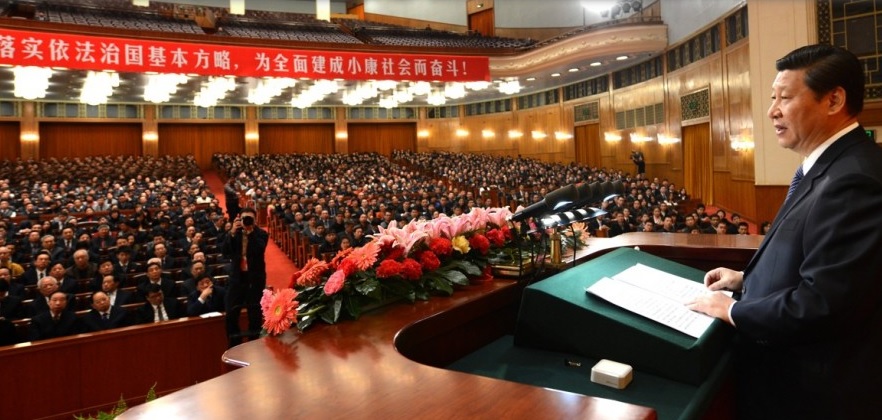
Ignoring the fact that China is a one-party state, Trump told the enthusiastic 250 Republican donors, who paid $27,700 per couple to attend the dinner, "He’s [Xi's] now president for life . . . president for life. And he’s great. And look, he was able to do that. I think it’s great. Maybe we’ll give that a shot someday.” Trump is limited to two terms in office as stipulated by a Constitutional amendment enacted in 1951.

On December 18, 2000, after it became clear that George W. Bush was president-elect after a dubious election that was contested in the courts, the president-elect said, after a meeting with Congressional leaders, "
I told all four that there were going to be some times where we don't agree with each other. But that's OK. If this were a dictatorship, it'd be a heck of a lot easier, just so long as I'm the dictator." Bush's cackling after his comment showed he thought it was funny, but members of Congress on both sides of the aisle felt the comment was inappropriate and dangerous. Bush got the message, but that did not stop him from praising other dictators, even while claiming credit for ridding the world of Saddam Hussein, who he called a ruthless dictator. Bush's dictator transgressions now seem mild compared to those of Trump.
Trump called Xi "a great gentleman," adding, "he’s the most powerful president in a hundred years." Trump appeared to have disregarded the fact that Chinese Communist Party Chairman Mao Zedong ruled China with an iron fist from 1949 to 1976.
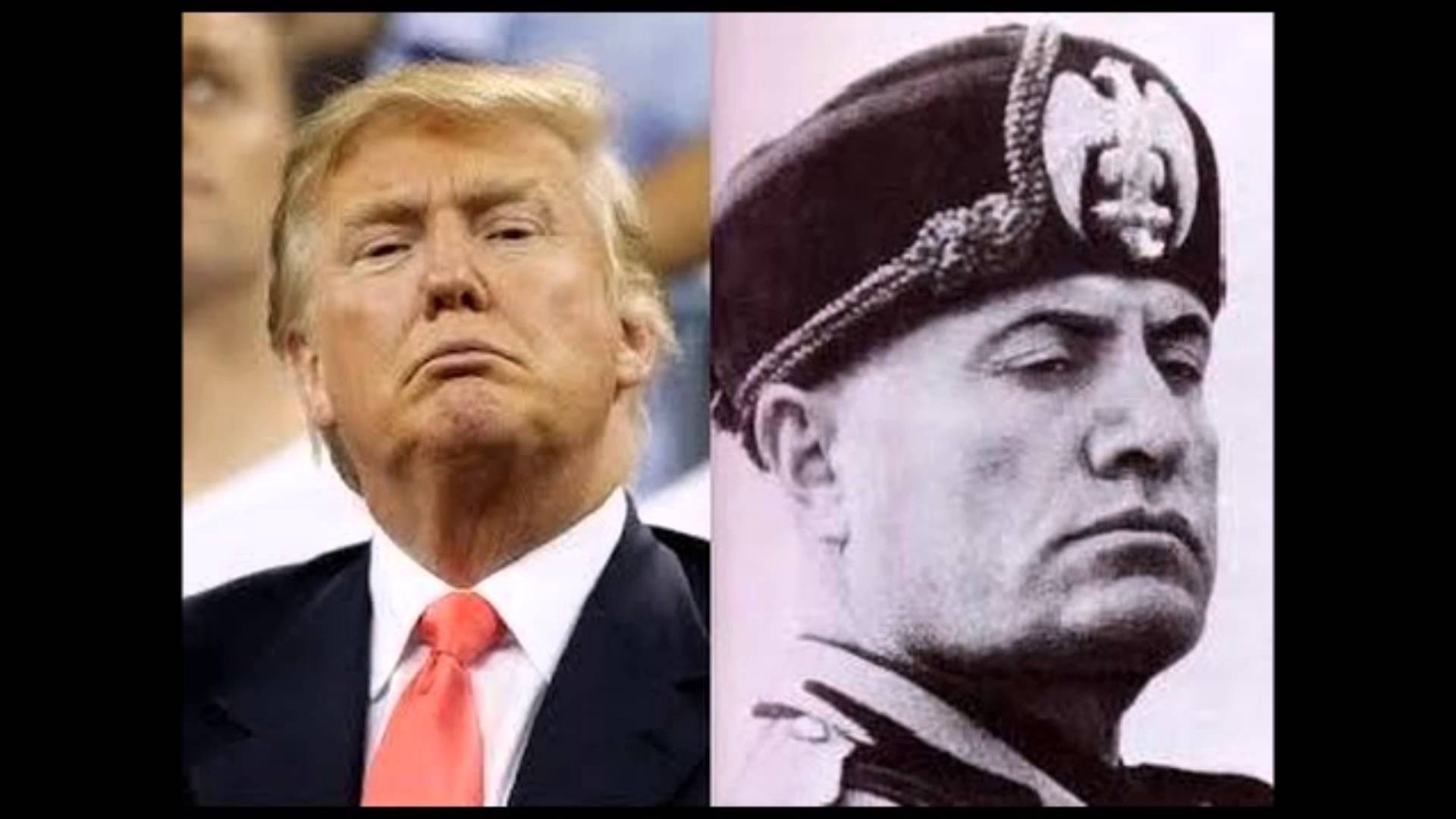
Trump's quip about becoming president-for-life was not his first dalliance with projecting fascist tendencies. On February 28, 2016, Trump tweeted a quote made notorious by Italian fascist leader Benito Mussolini, "It is better to live one day as a lion than a 100 years as a sheep." In defending the tweet after criticism, Trump said, "Mussolini was Mussolini . . . It's a very good quote. It's a very interesting quote." The electoral gains of Italy's former Prime Minister Silvio Berlusconi, an open admirer of Mussolini and his Italian fascist movement, will undoubtedly encourage Trump's promotion of fascism and dictators.
According to a 1990 interview she gave to Vanity Fair, Trump's ex-wife, Ivana Trump, said Trump kept a copy of Adolf Hitler's book Mein Kampf on a book cabinet by his bed. She said Trump would read the book "from time-to-time." Asked by Vanity Fair writer Marie Brenner about the book, Trump replied, "Who told you that? . . . I don't remember . . . Actually, it was my friend Marty Davis from Paramount who gave me a copy of Mein Kampf, and he's a Jew."
In May 2017, Trump told Philippines President Rodrigo Duterte that he was "doing an unbelievable job on the drug problem." Since being elected in June 2016, Duterte has carried out more than 6000 extrajudicial killings of suspected drug dealers. When Duterte decides to eliminate a political opponent, he merely charges them with drug dealing. Last month, Trump said he wished he could execute drug dealers in the United States, following the example of Singapore. Since its independence in 1965, Singapore adopted a meritocratic form of government, which dissuades active political opposition in return for a generous social welfare system. Trump has been quoted by one White House aide, according to Axios, as saying, "You know the Chinese and Filipinos don’t have a drug problem. They just kill them."

During a visit to Manila on November 17, 2017, Trump yucked it up with Duterte after the Philippines autocrat accused American journalists of being "spies." In response to American reporters' questions about Trump bringing up human rights in his conversations with Duterte, Trump cut off the questioners with Duterte chiming in, "With you around, guys, you are the spies," repeating, "You are." In 2016, Duterte justified killing journalists in the Philippines, declaring, "Just because you’re a journalist you are not exempted from assassination if you’re a son of a bitch."

In September 2017, Trump praised Turkey's autocratic president, Recep Tayyip Erdogan, who has imprisoned opposition politicians, journalists, businessmen, military officers, and academics, giving him "high marks." It is now widely believed in Turkey and abroad that Erdogan allowed the July 15, 2016 coup to commence, knowing full well that he would be able to put it down in its infancy and justify his subsequent assumption of near-dictatorial powers. Trump congratulated Erdogan for the passage in 2017 of a referendum that gave the Turkish president virtual unlimited powers.

Trump has also offered praise for Egypt's President Abdel Fattah al-Sisi, who came to power after he ousted the democratically-elected Muslim Brotherhood government of President Mohamed Morsi in a July 2013 coup. In April 2017, Trump said he was "very much behind President al-Sisi," adding, "he's done a fantastic job in a very difficult situation." Sisi has jailed the political opposition and members of the media and permits no dissent in Egypt.

In November 2017, Trump praised a royal coup within the House of Saud as an "anti-corruption" initiative. Trump tweeted, "
I have great confidence in King Salman and the Crown Prince of Saudi Arabia, they know exactly what they are doing . . . Some of those they are harshly treating have been ‘milking’ their country for years!”  Trump failed to mention how King Salman and his son, Crown Prince Mohammed bin Salman (MBS), has been taking part in the Saudi "milking" operation. MBS, with his dementia-stricken father's blessing, arrested hundreds of Saudi princes, government ministers, businessmen, and diplomats in a sweeping purge that saw some Saudi princes, reportedly with the aid of mercenaries supplied by Blackwater founder Erik Prince's Abu Dhabi-based Reflex Responses (R2), being hung upside down by their toes during torture sessions in Riyadh. Prince's sister, Betsy De Vos, serves as Trump's Secretary of Education. Trump's reference to "harsh treatment" by MBS failed to mention that at least two Saudi princes were assassinated by forces loyal to MBS.

Trump has also avidly praised Russian President Vladimir Putin, who is on the verge of being re-elected Russia's president and who has held the post of president or prime minister since 2000. In September 2016, Trump said of Putin, "he's been a leader, far more than our president [Barack Obama] has been a leader."

In April 2017, Trump, during a meeting with his erstwhile Argentine real estate business partner, President Mauricio Macri, called the right-wing Argentine leader "a good friend," "a great, wonderful person," and "a great leader." Macri has misused the Argentine court system and presidential powers to imprison and put on trial leaders of the political opposition, as well as attacking the opposition media and labor unions. Trump has also praised Honduran strongman President Juan Orlando Hernández, who was re-elected in a November 26, 2017 election marred by electoral fraud and violation of civil liberties.
The 1930s saw the global rise of fascist dictatorships in Germany, Italy, Japan, Spain, Hungary, Romania, Austria, Portugal, China, Argentina, Brazil, Greece, and other nations. The world could count on an American president, Franklin D. Roosevelt, to hold the ground for a small group of democratic nations that were, early on, outgunned by the fascist powers. And had FDR not been president in the 1930s, with fascism-appeasers such as Herbert Hoover, Alf Landon, and Wendell Willkie serving as successive U.S. presidents, the entire world would have quickly come under the yoke and jackboot of fascist rule under the Axis powers of Nazi Germany, Fascist Italy, and Imperial Japan. Today, a supporter and appeaser serves as President of the United States and there is no longer an American backstop to prevent the world from falling under fascist rule. 

Wednesday, January 30, 2008

American Liberty Teetering on Edge of Abyss By Paul Craig Roberts

“Your papers please” has long been a phrase associated with Hitler’s Gestapo. People without the Third Reich’s stamp of approval were hauled off to Nazi Germany’s version of Halliburton detention centers.

Today Americans are on the verge of being asked for their papers, although probably without the “please.”

Thanks to a government that has turned its back on the US Constitution, Americans now have an unaccountable Department of Homeland Security that is already asserting tyrannical powers over US citizens and state governments. Headed by the neocon fanatic Michael Chertoff, the Orwellian-sounding Department of Homeland Security has mandated a national identity card for Americans, without which Americans may not enter airports or courthouses.

There is no more need for this card than there is for a Department of Homeland Security. Neither are compatible with a free society.

However, Bush, the neocons, Republicans and Democrats do not want America to any longer be a free society, and they are taking freedom away from us just as they took away the independence of the media.

Free and informed people get in the way of power-mad zealots with agendas.

It is the agendas that are supreme, not the American people, who have less and less say about less and less.

George W. Bush, an elected president, has behaved like a dictator since September 11, 2001. If “our” representatives in Congress care, they haven’t done anything about it. Bush has pretty much cut Congress out of the action.

In truth, Congress gave up its law making powers to the executive branch during the New Deal. For three-quarters of a century, the bills passed by Congress have been authorizations for executive branch agencies to make laws in the form of regulations. The executive branch has come to the realization that it doesn’t really need Congress. President Bush appends his own “signing statements” to the authorizations from Congress in which the President says what the legislation means. So what is the point of Congress?

As for laws already on the books, the US Department of Justice (sic) has ruled that the President doesn’t have to abide by US statutes, such as FISA or the law forbidding torture. Neither does the President have to abide by the Geneva Conventions.

Other obstacles are removed by edicts known as presidential directives or executive orders. There are more and more of these edicts, and they accumulate more and more power and less and less accountability in the executive.

The disdain in which the executive branch holds the “separate and equal” legislative branch is everywhere apparent. For example, President Bush is concluding a long-term security agreement with the puppet government he has set up in Iraq. Prior to September 11, 2001, when the President became The Decider, a defense pact was a treaty requiring the approval of Congress.

All that is now behind us. General Douglas Lute, President Bush’s national security adviser for Iraq says that the White House will not be submitting the deal to Congress for approval. Lute says Bush will not be seeking any “formal inputs from the Congress.”

“There is no question that this is unprecedented,” said Yale Law School Professor O. Hathaway.

Bush can do whatever he wants, because Congress has taken its only remaining power--impeachment--off the table.

The Democratic Party leadership thinks that the only problem is Bush, who will be gone in one year. Besides, the Israel Lobby doesn’t want Israel’s champion impeached, and neither do the corporate owners of the US media.

The Democrats are not adverse to inheriting the powers in Bush’s precedents. The Democrats, of course, will use the elevated powers for good rather than for evil.

Instead of having a bad dictator, we’ll have a good one.

Paul Craig Roberts was Assistant Secretary of the Treasury in the Reagan administration. He was Associate Editor of the Wall Street Journal editorial page and Contributing Editor of National Review. He is coauthor of The Tyranny of Good Intentions. He can be reached at: PaulCraigRoberts@yahoo.com

Monday, May 21, 2007

New presidential directive gives Bush dictatorial power


New presidential directive gives Bush dictatorial power National Security & Homeland Security Presidential Directive establishes "National Continuity Policy"

by Larry Chin

Global Research, May 21, 2007


The National Security and Homeland Security Presidential Directive, signed on May 9, 2007 declares that in the event of a “catastrophic event”, George W. Bush can become what is best described as "a dictator":

"The President shall lead the activities of the Federal Government for ensuring constitutional government."

This directive, completely unnoticed by the media, and given no scrutiny by Congress, literally gives the White House unprecedented dictatorial power over the government and the country, bypassing the US Congress and obliterating the separation of powers. The directive also placed the Secretary of Homeland Security in charge of domestic “security”.

The full text is below. A critical analysis on the directive can be found here.

This is another step towards official martial law (see “US government fans homeland security fears”), which suggests that a new "catastrophic event" 9/11-type pretext could be in the pipeline.


National Security and Homeland Security Presidential Directive

NATIONAL SECURITY PRESIDENTIAL DIRECTIVE/NSPD 51

HOMELAND SECURITY PRESIDENTIAL DIRECTIVE/HSPD-20

Subject: National Continuity Policy

Purpose

(1) This directive establishes a comprehensive national policy on the continuity of Federal Government structures and operations and a single National Continuity Coordinator responsible for coordinating the development and implementation of Federal continuity policies. This policy establishes "National Essential Functions," prescribes continuity requirements for all executive departments and agencies, and provides guidance for State, local, territorial, and tribal governments, and private sector organizations in order to ensure a comprehensive and integrated national continuity program that will enhance the credibility of our national security posture and enable a more rapid and effective response to and recovery from a national emergency.

Definitions

(2) In this directive:

(a) "Category" refers to the categories of executive departments and agencies listed in Annex A to this directive;

(b) "Catastrophic Emergency" means any incident, regardless of location, that results in extraordinary levels of mass casualties, damage, or disruption severely affecting the U.S. population, infrastructure, environment, economy, or government functions;

(c) "Continuity of Government," or "COG," means a coordinated effort within the Federal Government's executive branch to ensure that National Essential Functions continue to be performed during a Catastrophic Emergency;

(d) "Continuity of Operations," or "COOP," means an effort within individual executive departments and agencies to ensure that Primary Mission-Essential Functions continue to be performed during a wide range of emergencies, including localized acts of nature, accidents, and technological or attack-related emergencies;

(e) "Enduring Constitutional Government," or "ECG," means a cooperative effort among the executive, legislative, and judicial branches of the Federal Government, coordinated by the President, as a matter of comity with respect to the legislative and judicial branches and with proper respect for the constitutional separation of powers among the branches, to preserve the constitutional framework under which the Nation is governed and the capability of all three branches of government to execute constitutional responsibilities and provide for orderly succession, appropriate transition of leadership, and interoperability and support of the National Essential Functions during a catastrophic emergency;

(f) "Executive Departments and Agencies" means the executive departments enumerated in 5 U.S.C. 101, independent establishments as defined by 5 U.S.C. 104(1), Government corporations as defined by 5 U.S.C. 103(1), and the United States Postal Service;

(g) "Government Functions" means the collective functions of the heads of executive departments and agencies as defined by statute, regulation, presidential direction, or other legal authority, and the functions of the legislative and judicial branches;

(h) "National Essential Functions," or "NEFs," means that subset of Government Functions that are necessary to lead and sustain the Nation during a catastrophic emergency and that, therefore, must be supported through COOP and COG capabilities; and

(i) "Primary Mission Essential Functions," or "PMEFs," means those Government Functions that must be performed in order to support or implement the performance of NEFs before, during, and in the aftermath of an emergency.

Policy

(3) It is the policy of the United States to maintain a comprehensive and effective continuity capability composed of Continuity of Operations and Continuity of Government programs in order to ensure the preservation of our form of government under the Constitution and the continuing performance of National Essential Functions under all conditions.

Implementation Actions

(4) Continuity requirements shall be incorporated into daily operations of all executive departments and agencies. As a result of the asymmetric threat environment, adequate warning of potential emergencies that could pose a significant risk to the homeland might not be available, and therefore all continuity planning shall be based on the assumption that no such warning will be received. Emphasis will be placed upon geographic dispersion of leadership, staff, and infrastructure in order to increase survivability and maintain uninterrupted Government Functions. Risk management principles shall be applied to ensure that appropriate operational readiness decisions are based on the probability of an attack or other incident and its consequences.

(5) The following NEFs are the foundation for all continuity programs and capabilities and represent the overarching responsibilities of the Federal Government to lead and sustain the Nation during a crisis, and therefore sustaining the following NEFs shall be the primary focus of

the Federal Government leadership during and in the aftermath of an emergency that adversely affects the performance of Government Functions:

(a) Ensuring the continued functioning of our form of government under the Constitution, including the functioning of the three separate branches of government;

(b) Providing leadership visible to the Nation and the world and maintaining the trust and confidence of the American people;

(c) Defending the Constitution of the United States against all enemies, foreign and domestic, and preventing or interdicting attacks against the United States or its people, property, or interests;

(d) Maintaining and fostering effective relationships with foreign nations;

(e) Protecting against threats to the homeland and bringing to justice perpetrators of crimes or attacks against the United States or its people, property, or interests;

(f) Providing rapid and effective response to and recovery from the domestic consequences of an attack or other incident;

(g) Protecting and stabilizing the Nation's economy and ensuring public confidence in its financial systems; and

(h) Providing for critical Federal Government services that address the national health, safety, and welfare needs of the United States.

(6) The President shall lead the activities of the Federal Government for ensuring constitutional government. In order to advise and assist the President in that function, the Assistant to the President for Homeland Security and Counterterrorism (APHS/CT) is hereby designated as the National Continuity Coordinator. The National Continuity Coordinator, in coordination with the Assistant to the President for National

Security Affairs (APNSA), without exercising directive authority, shall coordinate the development and implementation of continuity policy for executive departments and agencies. The Continuity Policy Coordination Committee (CPCC), chaired by a Senior Director from the Homeland Security Council staff, designated by the National Continuity Coordinator, shall be the main day-to-day forum for such policy coordination.

(7) For continuity purposes, each executive department and agency is assigned to a category in accordance with the nature and characteristics of its national security roles and

responsibilities in support of the Federal Government's ability to sustain the NEFs. The Secretary of Homeland Security shall serve as the President's lead agent for coordinating overall

continuity operations and activities of executive departments and agencies, and in such role shall perform the responsibilities set forth for the Secretary in sections 10 and 16 of this directive.

(8) The National Continuity Coordinator, in consultation with the heads of appropriate executive departments and agencies, will lead the development of a National Continuity Implementation Plan (Plan), which shall include prioritized goals and objectives, a concept of operations, performance metrics by which to measure continuity readiness, procedures for continuity and incident management activities, and clear direction to executive department and agency continuity coordinators, as well as guidance to promote interoperability of Federal Government continuity programs and procedures with State, local, territorial, and tribal governments, and private sector owners and operators of critical infrastructure, as appropriate. The Plan shall be submitted to the President for approval not later than 90 days after the date of this directive.

(9) Recognizing that each branch of the Federal Government is responsible for its own continuity programs, an official designated by the Chief of Staff to the President shall ensure that the executive branch's COOP and COG policies in support of ECG efforts are appropriately coordinated with those of

the legislative and judicial branches in order to ensure interoperability and allocate national assets efficiently to maintain a functioning Federal Government.

(10) Federal Government COOP, COG, and ECG plans and operations shall be appropriately integrated with the emergency plans and capabilities of State, local, territorial, and tribal governments, and private sector owners and operators of critical infrastructure, as appropriate, in order to promote interoperability and to prevent redundancies and conflicting lines of authority. The Secretary of Homeland Security shall coordinate the integration of Federal continuity plans and operations with State, local, territorial, and tribal governments, and private sector owners and operators of critical infrastructure, as appropriate, in order to provide for the delivery of essential services during an emergency.

(11) Continuity requirements for the Executive Office of the President (EOP) and executive departments and agencies shall include the following:

(a) The continuation of the performance of PMEFs during any emergency must be for a period up to 30 days or until normal operations can be resumed, and the capability to be fully operational at alternate sites as soon as possible after the occurrence of an emergency, but not later than 12 hours after COOP activation;

(b) Succession orders and pre-planned devolution of authorities that ensure the emergency delegation of authority must be planned and documented in advance in accordance with applicable law;

(c) Vital resources, facilities, and records must be safeguarded, and official access to them must be provided;

(d) Provision must be made for the acquisition of the resources necessary for continuity operations on an emergency basis;

(e) Provision must be made for the availability and redundancy of critical communications capabilities at alternate sites in order to support connectivity between

and among key government leadership, internal elements, other executive departments and agencies, critical partners, and the public;

(f) Provision must be made for reconstitution capabilities that allow for recovery from a catastrophic emergency and resumption of normal operations; and

(g) Provision must be made for the identification, training, and preparedness of personnel capable of relocating to alternate facilities to support the continuation of the performance of PMEFs.

(12) In order to provide a coordinated response to escalating threat levels or actual emergencies, the Continuity of Government Readiness Conditions (COGCON) system establishes executive branch continuity program readiness levels, focusing

on possible threats to the National Capital Region. The President will determine and issue the COGCON Level. Executive departments and agencies shall comply with the requirements and

assigned responsibilities under the COGCON program. During COOP activation, executive departments and agencies shall report their readiness status to the Secretary of Homeland Security or the Secretary's designee.

(13) The Director of the Office of Management and Budget shall:

(a) Conduct an annual assessment of executive department and agency continuity funding requests and performance data that are submitted by executive departments and agencies as part of the annual budget request process, in order to monitor progress in the implementation of the Plan and the execution of continuity budgets;

(b) In coordination with the National Continuity Coordinator, issue annual continuity planning guidance for the development of continuity budget requests; and

(c) Ensure that heads of executive departments and agencies prioritize budget resources for continuity capabilities, consistent with this directive.

(14) The Director of the Office of Science and Technology Policy shall:

(a) Define and issue minimum requirements for continuity communications for executive departments and agencies, in consultation with the APHS/CT, the APNSA, the Director of the Office of Management and Budget, and the Chief of Staff to the President;

(b) Establish requirements for, and monitor the development, implementation, and maintenance of, a comprehensive communications architecture to integrate continuity components, in consultation with the APHS/CT, the APNSA, the Director of the Office of Management and Budget, and the Chief of Staff to the President; and

(c) Review quarterly and annual assessments of continuity communications capabilities, as prepared pursuant to section 16(d) of this directive or otherwise, and report the results and recommended remedial actions to the National Continuity Coordinator.

(15) An official designated by the Chief of Staff to the President shall:

(a) Advise the President, the Chief of Staff to the President, the APHS/CT, and the APNSA on COGCON operational execution options; and

(b) Consult with the Secretary of Homeland Security in order to ensure synchronization and integration of continuity activities among the four categories of executive departments and agencies.

(16) The Secretary of Homeland Security shall:

(a) Coordinate the implementation, execution, and assessment of continuity operations and activities;

(b) Develop and promulgate Federal Continuity Directives in order to establish continuity planning requirements for executive departments and agencies;

(c) Conduct biennial assessments of individual department and agency continuity capabilities as prescribed by the Plan and report the results to the President through the APHS/CT;

(d) Conduct quarterly and annual assessments of continuity communications capabilities in consultation with an official designated by the Chief of Staff to the President;

(e) Develop, lead, and conduct a Federal continuity training and exercise program, which shall be incorporated into the National Exercise Program developed pursuant to Homeland Security Presidential Directive-8 of December 17, 2003 ("National Preparedness"), in consultation with an

official designated by the Chief of Staff to the President;

(f) Develop and promulgate continuity planning guidance to State, local, territorial, and tribal governments, and private sector critical infrastructure owners and operators;

(g) Make available continuity planning and exercise funding, in the form of grants as provided by law, to State, local, territorial, and tribal governments, and private sector critical infrastructure owners and operators; and

(h) As Executive Agent of the National Communications System, develop, implement, and maintain a comprehensive continuity communications architecture.

(17) The Director of National Intelligence, in coordination with the Attorney General and the Secretary of Homeland Security, shall produce a biennial assessment of the foreign and domestic threats to the Nation's continuity of government.

(18) The Secretary of Defense, in coordination with the Secretary of Homeland Security, shall provide secure, integrated, Continuity of Government communications to the President, the Vice President, and, at a minimum, Category I executive departments and agencies.

(19) Heads of executive departments and agencies shall execute their respective department or agency COOP plans in response to a localized emergency and shall:

(a) Appoint a senior accountable official, at the Assistant Secretary level, as the Continuity Coordinator for the department or agency;

(b) Identify and submit to the National Continuity Coordinator the list of PMEFs for the department or agency and develop continuity plans in support of the NEFs and the continuation of essential functions under all conditions;

(c) Plan, program, and budget for continuity capabilities consistent with this directive;

(d) Plan, conduct, and support annual tests and training, in consultation with the Secretary of Homeland Security, in order to evaluate program readiness and ensure adequacy and viability of continuity plans and communications systems; and

(e) Support other continuity requirements, as assigned by category, in accordance with the nature and characteristics of its national security roles and responsibilities

General Provisions

(20) This directive shall be implemented in a manner that is consistent with, and facilitates effective implementation of, provisions of the Constitution concerning succession to the Presidency or the exercise of its powers, and the Presidential Succession Act of 1947 (3 U.S.C. 19), with consultation of the Vice President and, as appropriate, others involved. Heads of executive departments and agencies shall ensure that appropriate

support is available to the Vice President and others involved as necessary to be prepared at all times to implement those provisions.

(21) This directive:

(a) Shall be implemented consistent with applicable law and the authorities of agencies, or heads of agencies, vested by law, and subject to the availability of appropriations;

(b) Shall not be construed to impair or otherwise affect (i) the functions of the Director of the Office of Management and Budget relating to budget, administrative, and legislative proposals, or (ii) the authority of the Secretary of Defense over the Department of Defense, including the chain of command for military forces from the President, to the Secretary of Defense, to the commander of military forces, or military command and control procedures; and

(c) Is not intended to, and does not, create any rights or benefits, substantive or procedural, enforceable at law or in equity by a party against the United States, its

agencies, instrumentalities, or entities, its officers, employees, or agents, or any other person.

(22) Revocation. Presidential Decision Directive 67 of October 21, 1998 ("Enduring Constitutional Government and Continuity of Government Operations"), including all Annexes thereto, is hereby revoked.

(23) Annex A and the classified Continuity Annexes, attached hereto, are hereby incorporated into and made a part of this directive.

(24) Security. This directive and the information contained herein shall be protected from unauthorized disclosure, provided that, except for Annex A, the Annexes attached to this directive are classified and shall be accorded appropriate handling, consistent with applicable Executive Orders.

GEORGE W. BUSH


Larry Chin is a frequent contributor to Global Research. Global Research Articles by Larry Chin

Thursday, March 01, 2007

The Docile American The Nexus of God, Labor, Health Care and the Fear to Strike by Zbignew Zingh

A perplexed European asked me a question: Why, she asked, have there been no general strikes in America to end its aggression in the Middle East? Why, she asked, are Americans so unwilling to force their government do what must be done?

These are not new questions. Everyone with an inkling of history and a modest awareness of international news realizes that Americans, completely contrary to the foundation myth of the American Revolution, are incredibly docile. It stings, however, when someone from the outside points out an obvious weakness.

Citizens of other industrialized countries are able to organize national actions to achieve common goals. Americans at the university, labor, middle class and working class levels, however, seem to be utterly impotent and thoroughly disorganized in any long-term, coordinated endeavor that extends beyond electoral politics. We literally struggle to organize coordinated national events.

A general strike is one of the most powerful tools of non-violent civil disobedience. In a general strike all work stops, businesses shut down, consumers do not spend money, teachers and students stay away from school, employees call in sick, lawyers do not try cases, assembly line workers do not assemble, teamsters park their rigs, pilots do not fly, doctors practice only emergency medicine, and commerce grinds to a halt. General strikes are not violent, but they cause tremendous economic hurt. When properly coordinated and prepared, they are very persuasive. General strikes have toppled governments, such as in Argentina, and they have prevented the implementation of anti-labor legislation, most notably in France and in Italy.

Some argue that Americans are simply too economically comfortable to participate in any political action more strenuous that penciling an X on a ballot. That cannot be the answer. Indeed, the notion that Americans live better than everyone else is part of our national mythology. Although many Americans reside in spacious (and heavily mortgaged) houses and, by incurring massive debt, own lots of "stuff", citizens of several European industrialized nations live, on average, healthier, more secure lives and work far fewer hours than most Americans. Certain Asian countries are not far behind. Notwithstanding their better living conditions, Germans, French, Italians and Spaniards, for example, are still more willing to take concerted political action than are Americans.

There are several reasons for Americans' complacency and Europeans' engagement.

The Legacy of Slavery

Labor often takes the political lead in Europe, but not in the United States. The historical fact of American slavery has resulted in an easily manipulable working class, particularly one that is comprised of ethnically diverse peoples. By exploiting superficial racial phenotypes, big business interests have turned American workers one against the other.

In the nation's first hundred years, slavery was a mechanism for controlling "free labor". After emancipation, freed slaves (though hardly free in any real sense of the term) were used as a cheap labor reserve that both in the South and in the North was manipulated to hold back wages all across the industrial horizon, from Black to White. By inciting White workers to extreme racial animus against Black "competitors", business interests succeeded in preventing the creation of a unified labor front that could have benefited everyone

Subsequently, poor European immigrants, women and children have been exploited in the United States for the same reason and in the same way, just as were immigrant laborers imported from China and the Philippines during the industrial expansion of the late 19th Century. The entire American immigration policy of the 19th Century was an effort to control wages by bringing in cheap labor from overseas, much as "globalized" labor is used today.

In the 21st Century, migrant workers from Mexico, Haiti and Central America now serve the government sanctioned role of restraining wage growth among America's assembly line, service and agricultural working groups. Contrary to the more infamous immigrant xenophobes of the Republican Party, big business owners in the United States prefer a legalized "guest worker" system. That "guest worker" system would permit cheap labor to temporarily enter the United States while preserving the option of throwing that cheap labor away whenever it gets injured, old or demands fair wages or benefits. Furthermore, the neoliberal globalization of capital permits businesses to move rapidly around the globe pursuing the cheapest labor and the fewest regulations, thus adding to the wage-depressing effect. Although the best defense against such wage-depressing tactics would be to improve everyone's working conditions world wide, American labor has, instead, been led down the path of trying to protect its own turf by defending against both immigration and the outsourcing of jobs.

The net effect of these intentionally debilitating efforts has been the lack of pan-labor cohesion that characterizes the American working class. In a sense, American labor's class consciousness has been lobotomized. Labor in America tends to be parochial -- it has been trained, by centuries of racism seeded from above, to shun coordination with workers from different parts of the world. In sum, by taking the bait of racism, American workers have repeatedly manacled their own legs and ensured their own, and all other labor movements', feebleness as a political force.

But the legacy of slavery is not enough, by itself, to explain the docile American.

The Conspiracy Against The Working Class

In the late 19th and early to mid 20th Centuries certain active labor unions (like the West Coast Longshoremen led by Harry Bridges, the early Steel Workers, the early UAW, United Mineworkers and Cesar Chavez's United Farmworkers) were able to coordinate industry wide or regional strikes. The assertiveness and the successes of these activist unions scared the pants off the ownership class. As documented by Alex Carey in Taking the Risk Out of Democracy and by Australian university professor Sharon Beder in her books and articles about corporate and professional power relationships, business interests in the United States, such as the Business Roundtable and the National Association of Manufacturers (NAM), embarked on a long-term program, a true conspiracy to "educate" the American public about the benefits of capitalism and the evils of democracy, socialism and unionism. It was a well-oiled, well-financed campaign, and, in part, it was a counter-reformist reaction to the increasingly socialized community that was evolving in Europe after WWII. The decades-long propaganda (1) effort continues today through the efforts of NAM's sister organization for the services industries, the ISM (Institute for Supply Management). Joining the pro-capitalism propaganda campaign are many of America's best known reactionary "think tanks" like the American Enterprise Institute, the Hoover Institution, the Heritage Foundation, the Discovery Institute and various large and ostensibly benevolent "funding institutions" on whom so many non-profit organizations depend financially.

The concerted effort was highly successful in subverting the American school curriculum, the mass media and American popular culture. By the 1950s, a majority of Americans thought it proper for the federal government to intervene on behalf of big business to "break" national strikes. The most well known modern example of these types of manipulation was Ronald Reagan's mass firing of the air traffic controllers in the 1981 PATCO strike and his use of military air controllers and non-union controllers to destroy the union. Reagan's aggressive use of the 1947 Taft-Hartley Act -- a thoroughly labor-hostile statute that persists even to the present day -- was actually applauded by the majority of Americans who, thanks to many years of cultural indoctrination, identified more with the interests of big business than with their own class interests.

Whereas many labor unions in Europe have socialist or communist affinities, contemporary American labor unions have been cowed by the well financed and ceaseless barrage of pro-capitalist propaganda. As a result, they avoid any political alliance more meaningful than the slightly less business-oriented Democratic Party.

Thus have the ownership class in America, through a concerted campaign of "education" and misinformation, succeeded in steering the American public away from the allure of European style union activism.

But the legacy of slavery and the conspiracy against workers alone cannot account for Americans' lack of political focus.

Religion as Antidote to Politics

Religion holds the greatest sway over the least politically thoughtful peoples. This is not an accident. The particular flavor of religion that dominates in the United States generally preaches doctrines of pacifism, obedience to authority and a focus on rewards in a life after death. It promotes a culture of minimal secular resistance and maximal secular resignation.

With a strong focus on otherworldliness, passivity and subservience, it is no mystery why American culture and class politics favor religious institutions. In absolute violation of 1st Amendment prohibitions, churches are granted tax concessions, they receiving federal funding through "faith based" initiatives and are otherwise supported as the main social structure of American society.

Curiously, notwithstanding its overt religiosity, American society is extremely violent in sports, sexual relationships, and crime. More curiously, beneath the religious veneer of submission, self-abnegation, sacrifice and spirituality lies a capitalist economic system that rewards violence, aggression, materialism, colonialism, self aggrandizement, selfishness and duplicity. The right wing "muscular" religious movements that have manifested themselves from time to time in United States history are amalgams of all of the social vices described above, plus racism wrapped in "patriotism", together with the traditional religious submission to secular authority. These "muscular" religious movements often work in silent partnership with ownership interests in the spheres of big business and politics, often to the disservice of the very people who make up the majority of these movements' lay membership.

Not all religious institutions are the same. Since the end of the anti-war movement of the Vietnam War era, the stamp of the moderately "liberal" religious wing has marked many of the "activist" movements in the United States. Although there is nothing wrong with polite protest, modest acts of very civil disobedience and cordial petitions to government authorities to do the right things, they have been, more often than not, ineffective. The mythology of meekly petitioning the government to seek redress comports well with the predominant American church mainstream and it has completely overshadowed the concept of the civil servant as the people's servant. In other words, the moderately liberal church-led form of civil protest prays for relief just like supplicants would pray for God's intercession -- on bended knee. They demand nothing and they would never dream of organizing a national general strike any more than they would threaten their ministers or God herself.

Unfortunately, nations like the United States that have a strong religious bias are also more oriented toward arguments of faith than reason. If a people are brought up to accept miracles and mysteries at face value, then they are also susceptible to believing the miracles and mysteries of 9-11, the official (and oft changing) rationale for America's Wars of Middle Eastern conquest, and political authority generally. Rendering unto Caesar what is Caesar's is not a good foundation for demanding a better material life for the here and now. Faith in a higher authority also marches with faith in political authority, faith in elections and the judicial system, and an unwillingness to believe that leaders are anything less than wise and well-meaning. Faith can lead one blindly to accept the mysteries of religion and, when exalted to a level of jingoism, can cause one blindly to accept the mysteries of foreign and domestic policy.

Thus religion, as currently practiced in the United States, no matter how ennobling of the spirit, is frequently a brake on political activity and not the slightest threat to established power. It tends to dissipate resistance to authority while celebrating the wholesomeness of non-confrontational and supplicating appeals to the other side's rather dubious souls. Over time, the spiritual approach to politics can leave people out of practice, exhausted and wholly unused to more vigorous (but still non violent) resistance to authority. Eventually, as they unavailingly beat their heads against institutional walls, citizens' aspirations and organizational skills may atrophy, they may lose their collective social memory, lose their momentum and lose the self-confidence necessary to assert control of their own destinies.

In many polite American street demonstrations, church groups are in the forefront of organization. In every European general strike, by contrast, churches rarely play a secondary role, if any at all.

The Fear of Unemployment

Although all of the preceding causes partially explain Americans' political timidity, probably the single biggest reason why Americans do not take more direct actions like a general strike is their legitimate fear of losing their livelihoods.

In those European countries where the citizens are most politically engaged, they also enjoy the strongest social safety nets. Whereas Americans depend on their employers for their retirement pensions, unemployment benefits and health insurance, Europeans are generally guaranteed all of that as basic entitlements of citizenship. These guarantees make Europeans freer than Americans to express their opinions and demand redress from their governments and their employers.

The European social safety nets -- socialized medicine, free or heavily subsidized higher education, public transportation and rich unemployment benefits, among others -- are paid for by compressing the range of income between the working and the management classes, taxing excess personal and corporate income, taxing the added value of manufactured or processed goods sold in commerce (thus placing the highest tax burden on those who consume the most), and by NOT spending a lot of money on the military.

It is no coincidence that when American workers were the most strident (during the early days of the union movement), they also had the worst working conditions and the fewest employment benefits to lose if they were fired. Currently, any American worker who participates in a general strike stands to lose his or her job in an anemic economy where many jobs are low-paying service positions that provide dismal benefits. The American striker risks not only her job, but the loss of retirement benefits and, most importantly, health insurance for the worker and the worker's family. European workers simply do not have to take that risk. Whether employed or not (and their job protections are vastly stronger than in the United States), Europeans tend to have extended unemployment and health care benefits that mitigate the fear of unemployment.

Indeed, we should ask: Why was the American health care system designed as a system of private "insurance" in the first place? Why should the American health care system be tied to work?

Insurance makes sense for allocating risk among people who choose to participate in certain electives like driving a car or owning a house. Insurance is also appropriate if, upon your own death, you wish to provide money for your family. Insurance is not a requirement of life because you can live without a car, you can live perfectly well without life insurance and you can rent if you will not own property. Health care, however, is different. No matter who you are, no matter how you live, sooner or later you will become old, sick and need medical help. When you need medical care you will be the least able to afford it. Why should this be a matter of private insurance? And why should this "insurance" be tied to your job? Why do Americans always think of health care as a matter of employer provided "insurance" when this is not the way it works elsewhere in the world?

The answer is precisely because it ties Americans' health care to their jobs, and by that tie so are they are also tied up. Americans are understandably afraid to do anything that might jeopardize their employability because there is far more at stake than just a paycheck. That fear rules out making too many demands on employers, it rules out doing anything that risks the stigma of arrest or criminal prosecution and it certainly rules out the possibility of a general strike. Americans have been chained to their jobs by the fear of losing health benefits for themselves and their families just as medieval peasants were tied to the land that they were forced to work for others. The system has been rigged, brilliantly so, to make sure that American workers are forever serfs and forever politically hamstrung.

Polls show overwhelming public support for socialized medical care (2) in the United States, yet politicians step gingerly all around the subject. The most that the majority of politicians are willing to do is to expand in tiny increments the preexisting private insurance system. For that they expect applause, but deserve none. Retaining the existing health care structure is not just about preserving the profit gravy train for the insurance industry. Most importantly, it is a well crafted political system that was designed to keep American workers in thrall, in a state of constant insecurity, tied to their paychecks and politically blunted. For these very reasons, the American system undoubtedly appeals to those in other parts of the world who also would like to weaken or dismantle their own socialized health programs in order make their citizens as tame as Americans are.

Big business will resist any wholesale abandonment of the current American medical care system of employer-based private health insurance unless, in so doing, it can slough off the cost of employer provided medical insurance and put yet another financial handcuff on its employees. For small and family-owned businesses, however, socialized medicine is a necessary equalizer that gives them the ability to compete in a business landscape that is otherwise heavily weighted in favor of huge corporations.

The European model shows that socialized medicine is essential for a democratic society. That model also shows that it is affordable in the United States if, as in Europe, we more tightly compress the range of compensation between the working and the management/ownership classes, eliminate the frictional costs associated with the private administration of health care (3), fairly and appropriately tax individual and corporate income especially at the highest ranges, impose a value added tax on consumer items, eliminate hidden government subsidies for the likes of energy conglomerates, agribusiness and Wall Street, and, most importantly, drastically reduce military spending.

So long as their necessities of life remain tied to their jobs, Americans will remain docile and there will never be an American national general strike. So long as Americans are incapable of organizing a national general strike, they will lack one of the most useful non-violent democratic tools to bring their own government to heel. For the very reason that the present system perpetuates the status quo, those people and entities who profit the most from it will fight tooth and nail to preserve it. But for that reason alone, in order to begin the process of freeing the American people from a culture of political servility, everyone else should fight tooth and nail for socialized medicine and other basic needs that are totally and unequivocally independent of employment.

Zbignew Zingh can be reached at: Zbig@ersarts.com. This article is CopyLeft, and free to distribute, reprint, repost, sing at a recital, spray paint, scribble in a toilet stall, etc. to your heart's content, with proper author citation. Find out more about Copyleft and read other great articles at: www.ersarts.com. copyleft 2007.

ENDNOTES

(1) The word "propaganda" derives from the Latin and is related to the verb "to propagate", or to multiply, disseminate or breed. In the 17th Century, Pope Urban VIII instituted a college of Propaganda constituted to educate mission priests around the world. "Propaganda" was a more or less neutral term until the last century when, as part of a pro-capitalist counter-propaganda campaign, it was "negativized" and associated with communism or socialism.

(2) Socialized medicine in the United States is known as either "universal" health care or "single-payer" health care. The words "socialized" or "socialist" are strictly taboo in American politics due, in large measure, to the success of the "educational" campaigns of the ownership class described above and the antipathy of the religious institutions to any coherent political creed that challenges their own cultural hegemony.

(3) The notion that the "private sector" is always more efficient than the public sector is another myth propagated by business interests. Because the private sector requires that "owners" extract "profit" from an enterprise, that profit must come from someplace. It usually comes from reduced wages of workers, higher worker "productivity" at the cost of employee layoffs, higher consumer prices, a reduction in the quality of goods or services or, most usually, a combination of all four. Privatized public utility companies with their history of providing less service at higher prices are a good example of how the reality of private enterprise rarely matches its hype. In the field of private health insurance, William McGuire, the CEO of UnitedHealth Group Inc., left office last year with a retirement package worth about $1.1 billion. That represents a lot of health care premiums and it is but one example of the private sector's diversion of assets from the commonwealth to personal wealth.


"IN TIMES OF UNIVERSAL DECEIT, TELLING THE TRUTH WILL BE A REVOLUTIONARY ACT." - George Orwell