Showing posts with label drug trade. Show all posts

Wednesday, November 02, 2016

Clinton email included classified NSA information; FBI investigation looking at links to Colombian drug cartels By Wayne Madsen Report


 Clinton email included classified NSA information; FBI investigation looking at links to Colombian drug cartels By Wayne Madsen Report
The steady drip of "Emailgate" continues to badger the Hillary Clinton campaign. Contained in the partially-released FBI report, dated July 2016, on the bureau's findings concerning Hillary Clinton's private email servers and the classified information contained on them is a reference to the presence of National Security Agency (NSA) classified information. The FBI report states that of 81 classified email chains discovered on Mrs. Clinton's server, 36 were deemed to be Not Releasable to Foreign Governments (NOFORN) and 2 were releasable to five Allied partners (FVEY). The caveat FVEY (Five Eyes) is classified information derived from communications intelligence systems operated by NSA and its four partner agencies in the United Kingdom, Canada, New Zealand, and Australia. Many of the documents revealed by NSA whistleblower Edward Snowden were marked as FVEY.


Here is what Mrs. Clinton said about Snowden in September: "[Snowden] stole very important information that has unfortunately fallen into a lot of the wrong hands . . . So, I don’t think he should be brought home without facing the music."

One could also ask whether Mrs. Clinton's cavalier handling of information at the same classification level of that released by Snowden should also warrant criminal prosecution. It is now being reported that the FBI field office in Miami is investigating the operations of the Clinton Foundation, along with other FBI offices in New York, Washington, Los Angeles, and Little Rock.

The FBI investigation in New York is principally focusing on the links between the Clinton Foundation and  Teneo Capital, a private equity and intelligence firm co-founded by Bill Clinton's former chief assistant at the Clinton Foundation, Doug Band. While collecting a government paycheck from Mrs. Clinton as her chief assistant at the State Department, Huma Abedin, now under FBI scrutiny as a result of the discovery of 650,000 of her emails on the laptop computer of her estranged and disgraced husband, former U.S. Representative Anthony Weiner, was also being paid by Teneo as an employee.

One of Teneo Intelligence’s many global offices is located in Bogota, Colombia. A secretive Colombian private equity fund, Fondo Acceso, founded in 2010 and which, ironically means "Access Fund," was financed by Mexican mega-billionaire Carlos Slim Helu and Canadian mining magnate Frank Giustra, is run out of the Clinton Foundation’s Bogota office. Not much is known about the fund other than that it claims to invest "education entities and agricultural and fishing products commercialization."

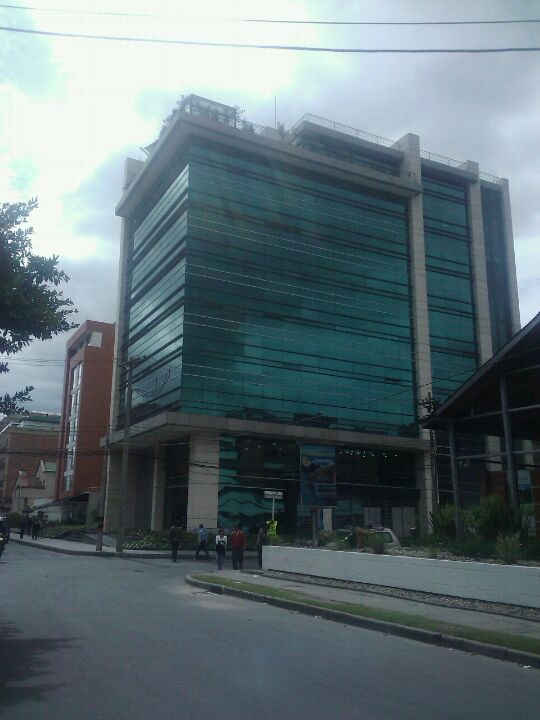
Fondo Acceso and the Clinton Foundation are co-located at Calle 93A #14-17, Suite 707, Bogota. The fund benefited financially from the U.S.-Colombia Trade Promotion Agreement, for which Mrs. Clinton strongly lobbied as Secretary of State. And, lo and behold -- Teneo Intelligence shares the same office building in Bogota, the Chico Business Park, with Fondo Acceso and the Clinton Foundation!


One big happy family at the Chico Business Park in Bogota: Clinton Foundation, Fondo Acceso, and Teneo Intelligence. The FBI field office in Miami is likely taking a very close look at this operation.
Tracking the money being fed into the Clinton Foundation may include proceeds from the illegal narcotics traffic in Colombia and other nearby countries. Therefore, the involvement of the Miami office in investigating Clinton Foundation funding, including the major donations from Slim and Giustra, makes a world of sense. There is also various reports that the Clinton Foundation diverted millions of dollars in aid money destined for earthquake- and hurricane-ravaged Haiti. The FBI field office would be the natural focal point for a multi-pronged investigation of the Clinton Foundation since it would have to coordinate its activities with FBI Legal Attachés at U.S. embassies in Bogota, Mexico City (as the investigation pertains to Slim), and Port-au-Prince, Haiti.

According to Mexican press reports, Slim, the top shareholder in The New York Times, has been linked to narcotics smuggling. "Acceso Fondo" claims it finances fruit tree farms in Colombia. Perhaps it funds other "agricultural" products, as well. The fund's investments in fishing boats is also of particular interest. The one man who knows about Slim and his drug cartel connections, Joaquin “El Chapo” Guzman, is in solitary confinement in a Mexican prison awaiting extradition to the United States. El Chapo is a prime candidate to be offered a special plea deal in return for his knowledge about the Clinton, Slim, and Giustra narcotics smuggling operations in Colombia. However, as seen with the politicization of the U.S. Justice Department by Attorney General Loretta Lynch, that is not about to happen.

The NSA maintains an active counter-narcotics intelligence operation at NSA Texas in San Antonio. The fact that Mrs. Clinton's email chains contained NSA FVEY information should have the NSA and FBI scurrying to find out if America's counter-drug cartel operations were compromised by the Clinton team.

Wednesday, March 31, 2010

Can Anyone Pacify the World's Number One Narco-State? The Opium Wars in Afghanistan

Tomgram: Alfred McCoy, Afghanistan as a Drug War

A front-page New York Times article by Rod Nordland on the aftermath of a recent U.S. Marine offensive in Helmand Province, opium poppy-growing capital of the planet, began this way: “The effort to win over Afghans on former Taliban turf in Marja has put American and NATO commanders in the unusual position of arguing against opium eradication, pitting them against some Afghan officials who are pushing to destroy the harvest.” Given the nature of Afghanistan -- the planet’s foremost narco-state -- such conundrums are only likely to multiply as war commander General Stanley McChrystal implements his strategy for pushing back the Taliban in southern Afghanistan and securing the embattled southern city of Kandahar and its environs.

Since Afghanistan now grows the opium poppies that provide more than 90% of the world’s opium, the raw material for the production of heroin, it’s not surprising that drug-trade news and war news intersect from time to time. More surprising is how seldom poppy growing and the drug trade are portrayed as anything but ancillary to our Afghan War. Fortunately, TomDispatch regular Alfred McCoy has been focused on the drug trade -- and the American role in fostering it -- in Southeast, Central, and South Asia for a long time. In the Vietnam era, the CIA actually tried to suppress his classic book (since updated with a chapter on Afghanistan), The Politics of Heroin: CIA Complicity in the Global Drug Trade. He’s been following the story ever since, and now for TomDispatch he offers what may be the first full-scale report that puts the drug trade in its proper place, right at the center of America’s 30-year war in Afghanistan. It’s a grim yet remarkable story, full of surprises, that makes new sense of the bind in which the U.S. military now finds itself in that country. (And check out the latest TomCast audio interview in which McCoy discusses just who is complicit in the Afghan opium trade by clicking here or, if you prefer to download it to your iPod, here.) Tom

Can Anyone Pacify the World's Number One Narco-State?
The Opium Wars in Afghanistan
By Alfred W. McCoy

In ways that have escaped most observers, the Obama administration is now trapped in an endless cycle of drugs and death in Afghanistan from which there is neither an easy end nor an obvious exit.

After a year of cautious debate and costly deployments, President Obama finally launched his new Afghan war strategy at 2:40 am on February 13, 2010, in a remote market town called Marja in southern Afghanistan's Helmand Province. As a wave of helicopters descended on Marja's outskirts spitting up clouds of dust, hundreds of U.S. Marines dashed through fields sprouting opium poppies toward the town's mud-walled compounds.

After a week of fighting, U.S. war commander General Stanley A. McChrystal choppered into town with Afghanistan's vice-president and Helmand's provincial governor. Their mission: a media roll-out for the general's new-look counterinsurgency strategy based on bringing government to remote villages just like Marja.

At a carefully staged meet-and-greet with some 200 villagers, however, the vice-president and provincial governor faced some unexpected, unscripted anger. "If they come with tractors," one Afghani widow announced to a chorus of supportive shouts from her fellow farmers, "they will have to roll over me and kill me before they can kill my poppy."

For these poppy growers and thousands more like them, the return of government control, however contested, brought with it a perilous threat: opium eradication.

Throughout all the shooting and shouting, American commanders seemed strangely unaware that Marja might qualify as the world's heroin capital -- with hundreds of laboratories, reputedly hidden inside the area's mud-brick houses, regularly processing the local poppy crop into high-grade heroin. After all, the surrounding fields of Helmand Province produce a remarkable 40% of the world's illicit opium supply, and much of this harvest has been traded in Marja. Rushing through those opium fields to attack the Taliban on day one of this offensive, the Marines missed their real enemy, the ultimate force behind the Taliban insurgency, as they pursued just the latest crop of peasant guerrillas whose guns and wages are funded by those poppy plants. "You can't win this war," said one U.S. Embassy official just back from inspecting these opium districts, "without taking on drug production in Helmand Province."

Indeed, as Air Force One headed for Kabul Sunday, National Security Adviser James L. Jones assured reporters that President Obama would try to persuade Afghan President Hamid Karzai to prioritize "battling corruption, taking the fight to the narco-traffickers." The drug trade, he added, "provides a lot of the economic engine for the insurgents."

Just as these Marja farmers spoiled General McChrystal's media event, so their crop has subverted every regime that has tried to rule Afghanistan for the past 30 years. During the CIA's covert war in the 1980s, opium financed the mujahedeen or "freedom fighters" (as President Ronald Reagan called them) who finally forced the Soviets to abandon the country and then defeated its Marxist client state.

In the late 1990s, the Taliban, which had taken power in most of the country, lost any chance for international legitimacy by protecting and profiting from opium -- and then, ironically, fell from power only months after reversing course and banning the crop. Since the US military intervened in 2001, a rising tide of opium has corrupted the government in Kabul while empowering a resurgent Taliban whose guerrillas have taken control of ever larger parts of the Afghan countryside.

These three eras of almost constant warfare fueled a relentless rise in Afghanistan's opium harvest -- from just 250 tons in 1979 to 8,200 tons in 2007. For the past five years, the Afghan opium harvest has accounted for as much as 50% of the country's gross domestic product (GDP) and provided the prime ingredient for over 90% of the world's heroin supply.

The ecological devastation and societal dislocation from these three war-torn decades has woven opium so deeply into the Afghan grain that it defies solution by Washington's best and brightest (as well as its most inept and least competent). Caroming between ignoring the opium crop and demanding its total eradication, the Bush administration dithered for seven years while heroin boomed, and in doing so helped create a drug economy that corrupted and crippled the government of its ally, President Karzai. In recent years, opium farming has supported 500,000 Afghan families, nearly 20% of the country's estimated population, and funds a Taliban insurgency that has, since 2006, spread across the countryside.

To understand the Afghan War, one basic point must be grasped: in poor nations with weak state services, agriculture is the foundation for all politics, binding villagers to the government or warlords or rebels. The ultimate aim of counterinsurgency strategy is always to establish the state's authority. When the economy is illicit and by definition beyond government control, this task becomes monumental. If the insurgents capture that illicit economy, as the Taliban have done, then the task becomes little short of insurmountable.

Opium is an illegal drug, but Afghanistan's poppy crop is still grounded in networks of social trust that tie people together at each step in the chain of production. Crop loans are necessary for planting, labor exchange for harvesting, stability for marketing, and security for shipment. So dominant and problematic is the opium economy in Afghanistan today that a question Washington has avoided for the past nine years must be asked: Can anyone pacify a full-blown narco-state?

The answer to this critical question lies in the history of the three Afghan wars in which Washington has been involved over the past 30 years -- the CIA covert warfare of the 1980s, the civil war of the 1990s (fueled at its start by $900 million in CIA funding), and since 2001, the U.S. invasion, occupation, and counterinsurgency campaigns. In each of these conflicts, Washington has tolerated drug trafficking by its Afghan allies as the price of military success -- a policy of benign neglect that has helped make Afghanistan today the world's number one narco-state.

CIA Covert Warfare, Spreading Poppy Fields, and Drug Labs: the 1980s

Opium first emerged as a key force in Afghan politics during the CIA covert war against the Soviets, the last in a series of secret operations that it conducted along the mountain rim-lands of Asia which stretch for 5,000 miles from Turkey to Thailand. In the late 1940s, as the Cold War was revving up, the United States first mounted covert probes of communism's Asian underbelly. For 40 years thereafter, the CIA fought a succession of secret wars along this mountain rim -- in Burma during the 1950s, Laos in the 1960s, and Afghanistan in the 1980s. In one of history's ironic accidents, the southern reach of communist China and the Soviet Union had coincided with Asia's opium zone along this same mountain rim, drawing the CIA into ambiguous alliances with the region's highland warlords.

Washington's first Afghan war began in 1979, when the Soviet Union invaded the country to save a Marxist client regime in Kabul, the Afghan capital. Seeing an opportunity to wound its Cold War enemy, the Reagan administration worked closely with Pakistan's military dictatorship in a ten-year CIA campaign to expel the Soviets.

This was, however, a covert operation unlike any other in the Cold War years. First, the collision of CIA secret operations and Soviet conventional warfare led to the devastation of Afghanistan's fragile highland ecology, damaging its traditional agriculture beyond immediate recovery, and fostering a growing dependence on the international drug trade. Of equal import, instead of conducting this covert warfare on its own as it had in Laos in the Vietnam War years, the CIA outsourced much of the operation to Pakistan's Inter-Service Intelligence (ISI), which soon became a powerful and ever more problematic ally.

When the ISI proposed its Afghan client, Gulbuddin Hekmatyar, as overall leader of the anti-Soviet resistance, Washington -- with few alternatives -- agreed. Over the next 10 years, the CIA supplied some $2 billion to Afghanistan's mujahedeen through the ISI, half to Hekmatyar, a violent fundamentalist infamous for throwing acid at unveiled women at Kabul University and, later, murdering rival resistance leaders. As the CIA operation was winding down in May 1990, the Washington Post published a front-page article charging that its key ally, Hekmatyar, was operating a chain of heroin laboratories inside Pakistan under the protection of the ISI.

Although this area had zero heroin production in the mid-1970s, the CIA's covert war served as the catalyst that transformed the Afghan-Pakistan borderlands into the world's largest heroin producing region. As mujahedeen guerrillas captured prime agricultural areas inside Afghanistan in the early 1980s, they began collecting a revolutionary poppy tax from their peasant supporters.

Once the Afghan guerrillas brought the opium across the border, they sold it to hundreds of Pakistani heroin labs operating under the ISI's protection. Between 1981 and 1990, Afghanistan's opium production grew ten-fold -- from 250 tons to 2,000 tons. After just two years of covert CIA support for the Afghan guerrillas, the U.S. Attorney General announced in 1981 that Pakistan was already the source of 60% of the American heroin supply. Across Europe and Russia, Afghan-Pakistani heroin soon captured an even larger share of local markets, while inside Pakistan itself the number of addicts soared from zero in 1979 to 1.2 million just five years later.

After investing $3 billion in Afghanistan's destruction, Washington just walked away in 1992, leaving behind a thoroughly ravaged country with over one million dead, five million refugees, 10-20 million landmines still in place, an infrastructure in ruins, an economy in tatters, and well-armed tribal warlords prepared to fight among themselves for control of the capital. Even when Washington finally cut its covert CIA funding at the end of 1991, however, Pakistan's ISI continued to back favored local warlords in pursuit of its long-term goal of installing a Pashtun client regime in Kabul.

Druglords, Dragon's Teeth, and Civil Wars: the 1990s

Throughout the 1990s, ruthless local warlords mixed guns and opium in a lethal brew as part of a brutal struggle for power. It was almost as if the soil had been sown with those dragons' teeth of ancient myth that can suddenly sprout into an army of full-grown warriors, who leap from the earth with swords drawn for war.

When northern resistance forces finally captured Kabul from the communist regime, which had outlasted the Soviet withdrawal by three years, Pakistan still backed its client Hekmatyar. He, in turn, unleashed his artillery on the besieged capital. The result: the deaths of an estimated 50,000 more Afghans. Even a slaughter of such monumental proportions, however, could not win power for this unpopular fundamentalist. So the ISI armed a new force, the Taliban and in September 1996, it succeeded in capturing Kabul, only to fight the Northern Alliance for the next five years in the valleys to the north of the capital.

During this seemingly unending civil war, rival factions leaned heavily on opium to finance the fighting, more than doubling the harvest to 4,600 tons by 1999. Throughout these two decades of warfare and a twenty-fold jump in drug production, Afghanistan itself was slowly transformed from a diverse agricultural ecosystem -- with herding, orchards, and over 60 food crops -- into the world's first economy dependent on the production of a single illicit drug. In the process, a fragile human ecology was brought to ruin in an unprecedented way.

Located at the northern edge of the annual monsoon rains, where clouds arrive from the Arabian Sea already squeezed dry, Afghanistan is an arid land. Its staple food crops have historically been sustained by irrigation systems that rely on snowmelt from the region's high mountains. To supplement staples such as wheat, Afghan tribesmen herded vast flocks of sheep and goats hundreds of miles every year to summer pasture in the central uplands. Most important of all, farmers planted perennial tree crops -- walnut, pistachio, and mulberry -- which thrived because they sink their roots deep into the soil and are remarkably resistant to the region's periodic droughts, offering relief from the threat of famine in the dry years.

During these two decades of war, however, modern firepower devastated the herds, damaged snowmelt irrigation systems, and destroyed many of the orchards. While the Soviets simply blasted the landscape with firepower, the Taliban, with an unerring instinct for their society's economic jugular, violated the unwritten rules of traditional Afghan warfare by cutting down the orchards on the vast Shamali plain north of Kabul.

All these strands of destruction knit themselves into a veritable Gordian knot of human suffering to which opium became the sole solution. Like Alexander's legendary sword, it offered a straightforward way to cut through a complex conundrum. Without any aid to restock their herds, reseed their fields, or replant their orchards, Afghan farmers -- including some 3 million returning refugees -- found sustenance in opium, which had historically been but a small part of their agriculture.

Since poppy cultivation requires nine times more labor per hectare than wheat, opium offered immediate seasonal employment to more than a million Afghans -- perhaps half of those actually employed at the time. In this ruined land and ravaged economy, opium merchants alone could accumulate capital rapidly and so give poppy farmers crop loans equivalent to more than half their annual incomes, credit critical to the survival of many poor villagers.

In marked contrast to the marginal yields the country's harsh climate offers most food crops, Afghanistan proved ideal for opium. On average, each hectare of Afghan poppy land produces three to five times more than its chief competitor, Burma. Most important of all, in such an arid ecosystem, subject to periodic drought, opium uses less than half the water needed for staples such as wheat.

After taking power in 1996, the Taliban regime encouraged a nationwide expansion of opium cultivation, doubling production to 4,600 tons, then equivalent to 75% of the world's heroin supply. Signaling its support for drug production, the Taliban regime began collecting a 20% tax from the yearly opium harvest, earning an estimated $100 million in revenues.

In retrospect, the regime's most important innovation was undoubtedly the introduction of large-scale heroin refining in the environs of the city of Jalalabad. There, hundreds of crude labs set to work, paying only a modest production tax of $70 on every kilo of heroin powder. According to U.N. researchers, the Taliban also presided over bustling regional opium markets in Helmand and Nangarhar provinces, protecting some 240 top traders there.

During the 1990s, Afghanistan's soaring opium harvest fueled an international smuggling trade that tied Central Asia, Russia, and Europe into a vast illicit market of arms, drugs, and money-laundering. It also helped fuel an eruption of ethnic insurgency across a 3,000-mile swath of land from Uzbekistan in Central Asia to Bosnia in the Balkans.

In July 2000, however, the Taliban leader Mullah Omar suddenly ordered a ban on all opium cultivation in a desperate bid for international recognition. Remarkably enough, almost overnight the Taliban regime used the ruthless repression for which it was infamous to slash the opium harvest by 94% to only 185 metric tons.

By then, however, Afghanistan had become dependent on poppy production for most of its taxes, export income, and employment. In effect, the Taliban's ban was an act of economic suicide that brought an already weakened society to the brink of collapse. This was the unwitting weapon the U.S. wielded when it began its military campaign against the Taliban in October 2001. Without opium, the regime was already a hollow shell and essentially imploded at the bursting of the first American bombs.

The Return of the CIA, Opium, and Counterinsurgency: 2001-

To defeat the Taliban in the aftermath of 9/11, the CIA successfully mobilized former warlords long active in the heroin trade to seize towns and cities across eastern Afghanistan. In other words, the Agency and its local allies created ideal conditions for reversing the Taliban's opium ban and reviving the drug traffic. Only weeks after the collapse of the Taliban, officials were reporting an outburst of poppy planting in the heroin-heartlands of Helmand and Nangarhar. At a Tokyo international donors' conference in January 2002, Hamid Karzai, the new Prime Minister put in place by the Bush administration, issued a pro forma ban on opium growing -- without any means of enforcing it against the power of these resurgent local warlords.

After investing some three billion dollars in Afghanistan's destruction during the Cold War, Washington and its allies now proved parsimonious in the reconstruction funds they offered. At that 2002 Tokyo conference, international donors promised just four billion dollars of an estimated $10 billion needed to rebuild the economy over the next five years. In addition, the total U.S. spending of $22 billion for Afghanistan from 2003 to 2007 turned out to be skewed sharply toward military operations, leaving, for instance, just $237 million for agriculture. (And as in Iraq, significant sums from what reconstruction funds were available simply went into the pockets of Western experts, private contractors, and their local counterparts.)

Under these circumstances, no one should have been surprised when, during the first year of the U.S. occupation, Afghanistan's opium harvest surged to 3,400 tons. Over the next five years, international donors would contribute $8 billion to rebuild Afghanistan, while opium would infuse nearly twice that amount, $14 billion, directly into the rural economy without any deductions by either those Western experts or Kabul's bloated bureaucracy.

While opium production continued its relentless rise, the Bush administration downplayed the problem, outsourcing narcotics control to Great Britain and police training to Germany. As the lead agency in Allied operations, Donald Rumsfeld's Defense Department regarded opium as a distraction from its main mission of defeating the Taliban (and, of course, invading Iraq). Waving away the problem in late 2004, President Bush said he did not want to "waste another American life on a narco-state.'' Meanwhile, in their counterinsurgency operations, U.S. forces worked closely with local warlords who proved to be leading druglords.

After five years of the U.S. occupation, Afghanistan's drug production had swelled to unprecedented proportions. In August 2007, the U.N. reported that the country's record opium crop covered almost 500,000 acres, an area larger than all the coca fields in Latin America. From a modest 185 tons at the start of American intervention in 2001, Afghanistan now produced 8,200 tons of opium, a remarkable 53% of the country's GDP and 93% of global heroin supply.

In this way, Afghanistan became the world's first true "narco-state." If a cocaine traffic that provided just 3% of Colombia's GDP could bring in its wake endless violence and powerful cartels capable of corrupting that country's government, then we can only imagine the consequences of Afghanistan's dependence on opium for more than 50% of its entire economy.

At a drug conference in Kabul this month, the head of Russia's Federal Narcotics Service estimated the value of Afghanistan's current opium crop at $65 billion. Only $500 million of that vast sum goes to Afghanistan's farmers, $300 million to the Taliban guerrillas, and the $64 billion balance "to the drug mafia," leaving ample funds to corrupt the Karzai government in a nation whose total GDP is only $10 billion.

Indeed, opium's influence is so pervasive that many Afghan officials, from village leaders to Kabul's police chief, the defense minister, and the president's brother, have been tainted by the traffic. So cancerous and crippling is this corruption that, according to recent U.N. estimates, Afghans are forced to spend a stunning $2.5 billion in bribes. Not surprisingly, the government's repeated attempts at opium eradication have been thoroughly compromised by what the U.N. has called "corrupt deals between field owners, village elders, and eradication teams."

Not only have drug taxes funded an expanding guerrilla force, but the Taliban's role in protecting opium farmers and the heroin merchants who rely on their crop gives them real control over the core of the country's economy. In January 2009, the U.N. and anonymous U.S. "intelligence officials" estimated that drug traffic provided Taliban insurgents with $400 million a year. "Clearly," commented Defense Secretary Robert Gates, "we have to go after the drug labs and the druglords that provide support to the Taliban and other insurgents."

In mid-2009, the U.S. embassy launched a multi-agency effort, called the Afghan Threat Finance Cell, to cut Taliban drug monies through financial controls. But one American official soon compared this effort to "punching jello." By August 2009, a frustrated Obama administration had ordered the U.S. military to "kill or capture" 50 Taliban-connected druglords who were placed on a classified "kill list."

Since the record crop of 2007, opium production has, in fact, declined somewhat -- to 6,900 tons last year (still over 90% of the world's opium supply). While U.N. analysts attribute this 20% reduction largely to eradication efforts, a more likely cause has been the global glut of heroin that came with the Afghan opium boom, and which had depressed the price of poppies by 34%. In fact, even this reduced Afghan opium crop is still far above total world demand, which the U.N. estimates at 5,000 tons per annum.

Preliminary reports on the 2010 Afghan opium harvest, which starts next month, indicate that the drug problem is not going away. Some U.S. officials who have surveyed Helmand's opium heartland see signs of an expanded crop. Even the U.N. drug experts who have predicted a continuing decline in production are not optimistic about long-term trends. Opium prices might decline for a few years, but the price of wheat and other staple crops is dropping even faster, leaving poppies as by far the most profitable crop for poor Afghan farmers.

Ending the Cycle of Drugs and Death

With its forces now planted in the dragon's teeth soil of Afghanistan, Washington is locked into what looks to be an unending cycle of drugs and death. Every spring in those rugged mountains, the snows melt, the opium seeds sprout, and a fresh crop of Taliban fighters takes to the field, many to die by lethal American fire. And the next year, the snows melt again, fresh poppy shoots break through the soil, and a new crop of teen-aged Taliban fighters pick up arms against America, spilling more blood. This cycle has been repeated for the past ten years and, unless something changes, can continue indefinitely.

Is there any alternative? Even were the cost of rebuilding Afghanistan's rural economy -- with its orchards, flocks, and food crops -- as high as $30 billion or, for that matter, $90 billion dollars, the money is at hand. By conservative estimates, the cost of President Obama's ongoing surge of 30,000 troops alone is $30 billion a year. So just bringing those 30,000 troops home would create ample funds to begin the rebuilding of rural life in Afghanistan, making it possible for young farmers to begin feeding their families without joining the Taliban's army.

Short of another precipitous withdrawal akin to 1991, Washington has no realistic alternative to the costly, long-term reconstruction of Afghanistan's agriculture. Beneath the gaze of an allied force that now numbers about 120,000 soldiers, opium has fueled the Taliban's growth into an omnipresent shadow government and an effective guerrilla army. The idea that our expanded military presence might soon succeed in driving back that force and handing over pacification to the illiterate, drug-addicted Afghan police and army remains, for the time being, a fantasy. Quick fixes like paying poppy farmers not to plant, something British and Americans have both tried, can backfire and end up actually promoting yet more opium cultivation. Rapid drug eradication without alternative employment, something the private contractor DynCorp tried so disastrously under a $150 million contract in 2005, would simply plunge Afghanistan into more misery, stoking mass anger and destabilizing the Kabul government further.

So the choice is clear enough: we can continue to fertilize this deadly soil with yet more blood in a brutal war with an uncertain outcome -- for both the United States and the people of Afghanistan. Or we can begin to withdraw American forces while helping renew this ancient, arid land by replanting its orchards, replenishing its flocks, and rebuilding the irrigation systems ruined in decades of war.

At this point, our only realistic choice is this sort of serious rural development -- that is, reconstructing the Afghan countryside through countless small-scale projects until food crops become a viable alternative to opium. To put it simply, so simply that even Washington might understand, you can only pacify a narco-state when it is no longer a narco-state.

Alfred W. McCoy is the J.R.W. Smail Professor of History at the University of Wisconsin-Madison. He is the author of The Politics of Heroin: CIA Complicity in the Global Drug Trade, which probes the conjuncture of illicit narcotics and covert operations over half a century. His latest book, Policing America's Empire: The United States, the Philippines, and the Rise of the Surveillance State, explores the influence of overseas counterinsurgency operations on the spread of internal security measures at home. To check out the latest TomCast audio interview in which McCoy discusses just who is complicit in the Afghan opium trade, click here or, if you prefer to download it to your iPod, here.

Copyright 2010 Alfred W. McCoy

Monday, March 01, 2010

CIA Drug Trafficking, Here we go again...

The color of money in Afghanistan has a chemical signature

WMR has learned from its Asian intelligence sources that the U.S. Drug Enforcement Administration (DEA) has detected hundreds of millions of dollars worth of chemically-marked U.S. and foreign currency is flowing through Afghanistan, mostly from ships leaving Dubai and off-loading the cash in Pakistan for overland transit into Afghanistan.

The DEA fears the cash is being used by the CIA to traffic in opium in Afghanistan and then using the chemical markers on the bills to trace the money. The bills involved in the chemical marking program are reportedly U.S. dollars, euros, Indian rupees, and Saudi riyals.

The chemically-marked cash in Afghanistan differs from the Nigerian scam chemical markings in that the cash awash in Afghanistan is professionally marked whereas the Nigerian scam cash is superficially marked to lure unsuspecting people into buying worthless solvents to eradicate the markings.

The word from Afghanistan is that the country is awash in so much cash from the opium trade, American officials are perplexed as to what to do next.

WMR has obtained further details of the chemically-dyed cash program used by the team of U.S. Special Envoy to Afghanistan and Pakistan Richard Holbrooke. Holbrooke reportedly authorized the payment of one type of chemically-treated cash to failed presidential candidate Abdullah Abdullah in order for his campaign to buy votes. Chemically-treated cash can later be retrieved. Holbrooke was hoping to fix the election for Abdullah but President Hamid Karzai engaged in even greater election fraud, ensuring his re-election.

Meanwhile, Holbrooke authorized the payment of a different type of chemically-treated cash to Ahmed Wali Karzai, the brother of President Karzai who is directly linked to Afghanistan's $4 billion annual drug producing and smuggling industry and is known to be on the CIA's payroll. Holbrooke was hoping to prove with the tainted cash the involvement of Ahmed Wali Karzai in the drug smuggling business as a way to help Abdullah against Hamid Karzai. The effort failed. Holbrooke recently suffered another major failure for his agenda when the leader of the Iranian Baluchi terrorist Jundallah movement, Abdolmalek Rigi, was arrested in a joint sting operation carried out by Iran's VEVAK intelligence and Pakistan's Inter Services Intelligence (ISI). Rigi was arrested when his plane was diverted to Bandar Abbas while he was en route to meet Holbrooke at the U.S. airbase in Manas, Kyrgyzstan.

Holbrooke also did not bargain for the way the large sums of cash get spread around the different competing interest groups in Afghanistan. Some of the marked cash destined for Karzai's brother and his Pashtuns ended up in the hands of Abdullah's Tajik supporters while the differently-marked cash for Abdullah's Tajiks wound up in the possession of Karzai's Pashtun opium smugglers. In addition, some of the treated cash in lawless Afghanistan found its way into the hands of the Taliban and even the ubiquitous private military contractors in the country.

The problem for Holbrooke's strategy now is that the CIA is running an independent drug smuggling operation in Afghanistan, using banks in Dubai as laundry machines, the DEA is being hamstrung by the CIA and is overwhelmed by the amount of drugs and cash flowing into and out of Afghanistan, and the Department of Treasury, with the approval of Treasury Secretary Timothy Geithner, is approving more and more U.S. currency to be dumped into Afghanistan while spending even more money for a cash retrieval effort involving hundreds of banks.

Dubai banks are unwilling to cooperate in the cash retrieval because the sudden influx of money from Afghanistan is helping Dubai's economy to recover after it went bust a few months ago. Adding to the problem is the involvement of Pakistan-based crime syndicate boss Dawood Ibrahim and his D-Company, on-and-off again collaborators of the CIA, in the drug money laundering. Last September, one of Ibrahim's top aides and money launderers, Naresh Jain, was arrested in India by Indian counter-narcotics officers. According to the Indian press, Jain, who re-located his base of operations from Dubai to New Delhi, was wanted by the DEA and Italian and British police after the two agencies conducted OPERATION KHYBER PASS. Jain is listed as a terrorist funder by the U.S. Department of Homeland Security and he has been linked by the department to drug money laundering on behalf of the Taliban and "Al Qaeda." The cover story is that it is the Taliban that is benefiting financially from opium smuggling in Afghanistan when, in reality, it is the CIA and its Afghan proxies. "Al Qaeda" is merely a contrivance of the CIA.

The Afghan heroin smuggling network operated by Ibrahim's D-Company extended from Afghanistan to Pakistan, Turkey, Nigeria, Italy, and China. The Dubai money laundering operations extended from the emirate to Islamic hawala money exchanges in Nigeria, Italy, Afghanistan, China, Pakistan, Bolivia, Democratic Republic of Congo and banks in the Cooks Islands, Cyprus, and Australia.

However, Holbrooke has apparently not learned from his experience with Jundallah and Karzai's drug trafficking family. WMR has learned that the Rigi-Holbrooke meeting at the Manas airbase was also to include a pre-arranged meeting between Rigi and captured members of the Islamic Movement of Uzbekistan (IMU), who have been converted from adherents of Osama Bin Laden's "Al Qaeda" to pipeline saboteurs, Holbrooke wanted to see an alliance between Jundallah and the reformed IMU guerrillas to plan operations targeting the Turkmenistan-Uzbekistan-Kyrgyzstan-China (TUKC) gas pipeline that recently began operations. The United States used Jundallah to attack the Iran-Pakistan-India pipeline in Baluchistan and Holbrooke was hoping that Rigi's experience would benefit the turned IMU terrorists who operate in the Fergana Valley of Tajikistan. The "reformed" IMU members have a price on their head -- the IMU is wanted by Uzbekistan and Kyrgyzstan for inciting Muslim rebellions, while the Russian SVR intelligence also keeps a wary eye on their activities. IMU stalwarts who have not joined the American side are routinely tracked down and killed by the CIA and U.S. Special Forces in Afghanistan. The IMU members working for the United States are confined to places like Bagram airbase in Afghanistan and Manas in Kyrgyzstan for protection until they can be dispatched by the CIA to carry out their missions.

After the Iranian capture of Rigi, many of the IMU converts now fear ending up in a similar situation, being captured by the governments who have a price on their heads. Holbrooke was to travel to Ashgabat, the Turkmenistan capital after leaving Kyrgyzstan after the Iranian capture of Rigi. However, the Holbrooke meeting with Turkmenistan President Gurbanguly Berdymukhammedov was canceled at the last minute due to a "scheduling conflict." Instead, Holbrooke traveled to Georgia where that nation's U.S. and Israeli puppet president, Mikhael Saakashvili, announced he was sending a further 1000 Georgian troops to fight in Afghanistan. WMR has learned that after it was known that Manas was being used as a rendezvous point between Rigi, ex-IMU members, and Holbrooke to plan sabotage against the TUKC pipeline, the Turkmen president told Holbrooke to stay away.

Holbrooke is pushing for the Turkmenistan-Afghanistan-Pakistan-India (TAPI) pipeline which terminates in Gujarat. TAPI has been heavily-invested in by U.S. oil and oil services companies.

The ex-IMU guerrillas have been reduced at Bagram and Manas to smelling the cooking of bacon fat, American soldiers drinking beer and engaging in sex with young Muslim women.

What could be stirring among the CIA's Uzbek converts is a situation similar to the agency's co-opting the support of Jordanian intelligence officers in Afghanistan. On December 30, the world was told through the corporate media that a Jordanian triple agent for the CIA named Dr. Humam Khalil Abu Mulal al-Balawi, who reportedly worked for Al Qaeda, Jordan's General Intelligence Department (GID), and the CIA, walked into the CIA's Forward Operating Base Chapman in Khost province in eastern Afghanistan and blew himself up, killing seven CIA officers and contractors, including the base's female chief. An eighth person, said to be an Afghan security officer, was also reported to have been killed in the blast but then it was revealed that a Jordanian Army Captain named Sharif Ali Bin Zeid was also killed. Zeid was said to be Balawi's handler and he was given a royal state funeral in Amman.

However, Balawi has now surfaced in a "posthumous" video tape claiming that he double crossed his handler Zeid and the CIA. WMR previously suggested that it was Zeid who was likely the person who "switched sides." The recent videotape featuring a Balawi who is very much alive, cheerful, and with more of beard growth and a darker sun tan than photographs released of him some months ago, indicate that a Jordanian died in the Chapman base blast, but it was not Balawi.

Balawi says in a 43-minute videotape that he only expected to kill Zeid but that it was an unexpected gift to kill the CIA agents. Balawi states: "We planned for something but got a bigger gift, a gift from Allah, who brought us, through His accompaniment, a valuable prey -- Americans, and from the CIA. That's when I became certain that the best way to teach Jordanian intelligence and the CIA a lesson is with the martyrdom belt." Dr. Balawi also describes how he was recruited by the GID and then the CIA after his arrest in Jordan and how he was sent to Afghanistan to work as an agent for the CIA spying on "Al Qaeda." Balawi also states that GID helped in the 2006 killing by U.S. forces of Jordanian "Al Qaeda" operative Abu Musab al-Zarqawi, who hailed from Balawi's Jordanian hometown of Zarqa, and the assassination by Mossad and the CIA of Imad Mughniyeh, the Lebanese Hezbollah military commander, in Damascus in 2008.

Balawi's post-death comments are probably the most amazing CIA asset revelations since CIA director William Casey granted The Washington Post's Bob Woodward an extensive four-minute interview on the Iran-contra scandal as Casey was drawing his last breath in his hospital bed in 1987.

Sunday, February 14, 2010

EXCLUSIVE REPORT -- CIA involvement with drug trade resulted in death threats against U.S. senator


Retired FBI sources have told FBI that the Central Intelligence Agency's involvement with drug smuggling was such a lucrative operation for the spy agency that it once threatened the life of a member of the Senate Select Committee on Intelligence, one of the two congressional oversight committees for the CIA. Arizona's Democratic senator Dennis DeConcini also feared for the lives of his family members, according to the FBI sources. DeConcini served on the Senate intelligence committee from 1987 to his retirement in 1995. President Bill Clinton reportedly offered DeConcini the job of White House drug czar but he turned down the position because of threats received against him and his family.

As chairman of the Senate intelligence committee from 1993 to 1995, DeConcini attempted to slash the intelligence community's budget in the wake of the collapse of the Soviet bloc but was constantly rebuffed by CIA director James Woolsey and the Republicans.

DeConcini incurred the ire of the CIA because he discovered how deeply the agency was involved in the smuggling of drugs into the United States, particularly during the Iran-contra scandal.

The FBI sources, who worked closely with President Ronald Reagan's task force on drug smuggling, chaired by then-Vice President George H. W. Bush, claim that Bush actually used his position to open up certain air routes into the United States from Latin America to pre-approved drug flights connected to the CIA's contra supply operation in Central America.

The major drug routes from Central America, primarily Panama, to the United States saw CIA contract flights operated by such proprietary firms as Southern Air Transport and Evergreen Aviation fly fully-loaded planes with weapons and ammunition for the Nicaraguan contras from the United States, air drop them over contra bases in Central America, land in Panama and load up with narcotics supplied by Colombia's Medellin cartel, fly through pre-approved air routes on the U.S.-Mexican border, and air drop the drugs on designated cattle ranches in Texas, New Mexico, and Arizona. The Evergreen flights, according to WMR's FBI sources, were based out of the firm's facility at Pinal Air Park in Marana, Arizona. Southern Air Transport flights were based out of Mena, Arkansas and other airfields in the Florida panhandle, Alabama, and Louisiana.

Once the drugs from the Medellin cartel were dropped on the cattle ranches, they would be loaded on trailer trucks and hauled to distribution points around the United States. Our FBI sources stated that the smuggling and distribution was aided and abetted by some of the wealthiest cattle ranchers and trucking industry executives in the United States, all of whom were large political contributors to the Republican Party and the Bush family.

DeConcini was acutely aware of the operations and how they involved his home state of Arizona. After he and his family were threatened by the CIA, through the Medellin cartel, with assassination, DeConcini, according to our well-placed sources, wore body armor when appearing in public and succeeded in being named a U.S. sky-marshal so he could carry a .357 magnum on commercial aircraft between Washington, DC and Phoenix.

Not succeeding in eliminating DeConcini physically, the CIA arranged for him to be tainted with dirty political money. DeConcini was named as one of the "Keating Five" senators who accepted cash from the owner of the failed Lincoln Savings & Loan, Charles H. Keating, Jr. Although the Senate Ethics Committee's special counsel and CIA's "clean-up man" Robert Bennett, tried to pin DeConcini on his knowledge of deals between him and Keating, WMR learned from the FBI that the Justice Department found no evidence that DeConcini was involved in anything criminal. One of our FBI sources contacted Ethics Committee chairman Senator Howell Heflin (D-AL) and told him about DeConcini's campaign against the CIA and its drug trade.

Heflin suspended the hearings after being informed of DeConcini's unique situation and only resumed them after the Justice Departmentassured Heflin that it had no plans to indict DeConcini. In fact, DeConcini was implicated in the Keating Five scandal because three of his close aides -- his chief fund raiser Earl Katz, his campaign manage Ron Ober, and his administrative assistant Gene Karp -- agreed to make favorable deals for Keating and thus enmeshed DeConcini in the scandal. Our FBI sources revealed the three aides were all "deeply involved" with Keating and when the scandal broke they helped in falsely implicating DeConcini in the scandal.

However, the Keating Five scandal resulted in DeConcini deciding not to seek another term in 1994. DeConcini's colleague from Arizona, Republican Senator John McCain, also one of the Keating Five, was, according to our FBI sources, involved deeply in not only the Keating Five scandal but the CIA's drug smuggling operations.

WMR's FBI sources also confirmed that the senior CIA officer officially vested with the job of countering the international narcotics trade was actively involved in promoting the CIA's own drug smuggling operations. The individual also served in the Treasury Department where he ensured that the surveillance databases of suspicious money flows by the Financial Crimes Enforcement Network (FINCEN) were scrubbed of any information that would point to the CIA's involvement in drug money laundering.

We have also learned that the nephew of the CIA official, who discovered his uncle's involvement in the narcotics and drug money laundering business, was recently arrested in Arizona and incarcerated in the Florence federal penitentiary for allegedly threatening the lives of federal agents, a serious crime under the new anti-terrorism laws. Although, the individual in question has been diagnosed as "delusional" by a court-appointed psychatrist, federal prosecutors are seeking a plea deal that would ensure that no mention is ever made of the uncle [who is now a well-known supporter of Israel], the CIA, FBI, or the Bush family. The jailed whistleblower also alleged that the CIA's drug trade continues to flourish and that it involves Latin American Jews, Mossad agents and fabric and window covering warehouses in Florida, Georgia, and Texas that are used to store drugs from Latin America prior to distribution.

WMR has also learned that the Republican Congressman who represents Midland and Odessa, Texas in the U.S. House of Representative, Mike Conaway, has expressed a recent interest in the laundering of CIA drug money over the years. It is estimated that between $4 and 6 trillion has been made by the CIA in the drug smuggling business and related money laundering. Although Conaway, who succeeded 11th District congressman [and House Intelligence Committee chairman] Larry Combest in 2003 after he suddenly resigned after winning his tenth term, is a friend of the Bush family, he is now faced with the possibility of a challenger in the GOP primary, either Jason or Jesse Waters, Iraq war veteran brothers who control Waters & Waters Services, an oilfield services firm. The potential challengers are also closely tied to the Bush family. Conaway served as chief financial officer for George W. Bush's failed Arbusto Energy Inc. Conaway, an accountant, also discovered that hundreds of thousands of dollars were missing from the bank accounts of the National Republican Congressional Committee after he conducted an audit of the accounts.

Conaway's potential challenge likely has resulted from asking too many questions -- the answers for which could prove highly embarrassing for his old friends, the Bushes.

WMR has learned from a Delta Force veteran that when units of the elite military force were sent into Afghanistan after the 9/11 attacks, their first order from the CIA was to protect Afghan poppy fields. WMR's FBI sources confirmed that Afghanistan has replaced Khun Sa's poppy production operations in Burma's "Golden Triangle" as the main source of opium and heroin for the CIA's narcotics trade.

George H. W. Bush and his son, former Florida Governor Jeb Bush. recently paid a "courtesy call" of President Barack Obama at the White House. WMR's FBI sources believe that Obama was "deep selected" at a young age by the CIA to eventually be installed as President of the United States.

Monday, December 14, 2009

Making Afghanistan Safe for Heroin

US Media & The Perpetual Flip-Flopping on Drug-Related Stories

When I read Mizgin’s recent great post about Richard Armitage and his involvement in the Golden Triangle, I rolled my eyes. “Some Daily Kos reader out there,” I thought, “is, at this very moment, shouting ‘conspiracy theory’ at their computer.” The “conspiracy theory” accusation comes up any time a journalist or a whistleblower points out that U.S. officials and agencies have been complicit in the global drug trade. In fact, it has been an effective tool to try and silence truth tellers at least since Alfred McCoy was viciously attacked for writing the Politics of Heroin in Southeast Asia. Never mind the fact that allegations against the Central Intelligence Agency or the State Department have often been vindicated with the passage of time. It just can’t be true that America would support drug lords, can it?

Unfortunately, the answer to that question is a resounding YES, IT CAN. American agencies, including the C.I.A. and the State Department, have given aid and comfort to international drug lords in the past and apparently continue to do so. Just read what the New York Times reported on October 28th about Ahmed Wali Karzai, the brother of Afghan President Hamid Karzai and a known drug dealer, being on the C.I.A. payroll:

The C.I.A.’s practices also suggest that the United States is not doing everything in its power [Emphasis Added] to stamp out the lucrative Afghan drug trade, a major source of revenue for the Taliban.

Gee, do ya think? Any enterprising individual of reasonable intelligence, using a minimum of Google research skills, could have determined that the drug trade out of Afghanistan has skyrocketed since late 2001, shortly after the U.S. removed the Taliban from power and installed Hamid Karzai as its puppet. If the Times had been a little bit bolder, they might have written something like this:

The C.I.A is complicit in the illegal drug trade in Afghanistan, but this should surprise no one, as a peek at the historical record demonstrates drug complicity has become routine. Just look at these facts:

1950s, Southeast Asia: The C.I.A. supports the Kuomanting (KMT) drug running in Burma.

1960s-1970s, Vietnam-Laos: Richard Armitage, Ted Shackley and Thomas Clines finance a portion of the Phoenix Program in Vietnam through the Southeast Asian heroin trade.

1980s, Southwest Asia: The C.I.A. supports Afghan rebels, many of whom, along with the Pakistani ISI, are known to be deeply involved in opium and heroin trade.

1980s, Latin America: The U.S. backs Contras, even though cocaine turns out to be a key source of their funding, and Panama dictator Manuel Noriega, also tied to the drug trade. Also in this time period, Drug Enforcement Agency (DEA) Agent Michael Levine claims Attorney General Edwin Meese blew the cover of a DEA team investigating drug corruption at the highest levels of the U.S. government.

1990s, Burma: DEA Agent Richard Horn, whose case was recently settled with the Justice Department, is spied on by the State Department and C.I.A., apparently because Horn was being too aggressive in trying to shut down the opium trade from Burma.

1996-2002: Sibel Edmonds testifies that criminal elements in Turkey tied to the drug trade, with knowledge and acquiescence of the State Department, bring drugs into the U.S. and Europe.

None of these past Agency misdeeds were mentioned by the Times to give its story context. The reason for these omissions is obvious: the Times or someone in the American government had an axe to grind either with the C.I.A. or the Karzai government itself, and the story was only trotted out because it was convenient for the moment. A few months from now, if some really enterprising journalists accuse the U.S. government of aiding the Afghan opium trade, the major newspapers will likely ignore them, or, worse, accuse them of being conspiracy mongers. This is exactly how our trusted mainstream press has treated C.I.A. drug stories in the past: When it is convenient to promote one of their pet agendas, the establishment media admit the shocking facts. Then, when it is no longer serving its purposes, the same press turns around and marginalizes anyone repeating the same. Take the example of Oliver North, Gary Webb, and the Washington Post.

According to a 1998 book Whiteout by Alexander Cockburn and Jeffrey St. Clair, in order to torpedo Oliver North’s 1994 Virginia Senate candidacy, the Post published a hard-hitting article on October 22, 1994, entitled “North Didn’t Relay Drug Tips”. The gist of the story (written by Lorraine Adams) was that while he was running the illegal Contra War from his post on the National Security Council, North failed to forward to the Drug Enforcement Agency the evidence that several members of the FDN (the main Contra organization) were involved in the cocaine business. North had claimed to have “turned over to the DEA all evidence of Contra drug running” during his Congressional testimony. The Post found the story useful at the time, given the newspaper’s opposition to North’s candidacy. However, two years later, when journalist Gary Webb and the San Jose Mercury News tied the Contras to a large crack cocaine ring in Los Angeles, the Post apparently forgot its own reporting, and (along with the New York Times and Los Angeles Times) ripped Webb’s career apart. Cockburn and St. Clair wrote:

Friday, October 4 [1996] the Washington Post went to town on Webb and on the Mercury News. The onslaught carried no less than 5,000 words in five articles. The front page featured a lead article by Roberto Suro and Walter Pincus, headlined, “CIA and Crack: Evidence Is Lacking of Contra-Tied Plot.”

The rest is history. Webb was destroyed, which ultimately led to his suicide years later. In the meantime, the U.S. Congress did nothing, which is something it is accustomed to doing in cases involving accusations of Executive Branch malfeasance. Two years after Webb’s Dark Alliance series, the C.I.A. Inspector General actually released a report admitting aspects Contra drug running, but this report was barely covered by the same newspapers that had eviscerated the story in the first place.

The press gets away with their perpetual flip-flopping on drug-related issues for a simple reason: The “C.I.A. drug trade complicity” tale is not the kind of story the average citizen wants to believe. This topic is a taboo because the public has been trained to have a visceral reaction to drugs. Ever since propaganda films like Reefer Madness were released at the beginning of the 20th Century, drug dealers have been made out to be public enemy number one and are hated perhaps even more than terrorists. Recreational drugs are often portrayed as a weapon of mass destruction on America’s youth. It just can’t be possible that our trusted officials — like Orrin Hatch, to cite one example, — would rail against drugs, claiming they endanger our children on the one hand, while moving in Congress to quash any attempt to hold federal agencies accountable for working with the pimps and pushers on the other.

Wake up, America. Our government’s acquiescence in the global drug trade is not just possible; it is an important part of our nation’s post-World War II history. Obama’s surge in Afghanistan is doomed to failure, in part because our intelligence agencies are fostering the same poppy trade that helps finance our enemies, the Taliban. We know it is doomed because all of the other C.I.A. drug operations have ended in similar catastrophes. Of course, the one “success” the U.S. government could point to, if it were willing to admit the facts of its drug alliances, is the defeat of the Soviet Army in Afghanistan. However, given what happened over a decade later on September 11, 2001, that “success” looks like an awful “short-sightedness” and “long-term failure”.

It is sad to think how many of our young men and women are dying, or are permanently scarred, mentally or physically, in the false belief that they are engaged in some higher moral battle to bring democracy and an end to the heroin trade in Afghanistan. Until the public realizes the truth about the dark history of U.S. intelligence agencies and drugs, such illusions about the morality of America’s endless wars will continue.


# # # #


Saturday, May 19, 2007

Heroin is "Good for Your Health": Occupation Forces support Afghan Narcotics Trade

Multibillion dollar earnings for organized crime and Western financial Institutions

by Prof. Michel Chossudovsky

Under the Taliban, opium production in Afghanistan had been reduced to 181 tons. Now under the U.S. and British military and the Mi5 and CIA Drug Lords it reached 6100 tons in 2006.

The occupation forces in Afghanistan are supporting the drug trade, which brings between 120 and 194 billion dollars of revenues to organized crime, intelligence agencies and Western financial institutions.

The proceeds of this lucrative multibllion dollar contraband are deposited in Western banks. Almost the totality of revenues accrue to corporate interests and criminal syndicates outside Afghanistan.

The Golden Crescent drug trade, launched by the CIA in the early 1980s, continues to be protected by US intelligence, in liason with NATO occupation forces and the British military. In recent developments, British occupation forces have promoted opium cultivation through paid radio advertisements.

"A radio message broadcast across the province assured local farmers that the Nato-led International Security Assistance Force (ISAF) would not interfere with poppy fields currently being harvested.

"Respected people of Helmand. The soldiers of ISAF and ANA do not destroy poppy fields," it said. "They know that many people of Afghanistan have no choice but to grow poppy. ISAF and the ANA do not want to stop people from earning their livelihoods." ( Quoted in The Guardian, 27 April 2007)

While the controversial opium ads have been casually dismissed as an unfortunate mistake, there are indications that the opium economy is being promoted at the political level (including the British government of Tony Blair).

The Senlis Council, an international think tank specialising in security and policy issues is proposing the development of licit opium exports in Afghanistan, with a view to promoting the production of pharmaceutical pain-killers, such as morphine and codeine. According to the Senlis Council, "the poppies are needed and, if properly regulated, could provide a legal source of income to impoverished Afghan farmers while, at the same time, depriving the drug lords and the Taliban of much of their income." (John Polanyi, Globe and Mail, 23 September 2006)

The Senlis Council offers an alternative where "regulated poppy production in Afghanistan" could be developed to produce needed painkillers. The Senlis statement, however, fails to address the existing structure of licit opium exports, which is characterised by oversupply .

The Senlis' campaign is part of the propaganda campaign. It has contrbuted to providing a false legitimacy to Afghanistan's opium economy. (See details of Senlis Project), which ultmately serves powerful vested interests.

How much opium acreage is required to supply the pharmaceutical industry? According to the International Narcotics Control Board (INCB), which has a mandate to exame issues pertaining to the supply of and demand for opiates used for medical purposes, "the supply of such opiates has for years been at levels well in excess of global demand".(Asian Times, February 2006) The INCB has recommended reducing the production of opiates due to oversupply.

At present, India is the largest exporter of licit opium, supplying approximately 50 percent of licit sales to pharmaceutical companies involved in the production of pain-killing drugs. Turkey is also a major producer of licit opium.

India's opium latex "is sold to licensed pharmaceutical and/or chemical manufacturing firms such as Mallinckrodt and Johnson & Johnson, under rules established by the UN Commission on Narcotic Drugs and the International Narcotics Control Board, which require an extensive paper trail." (Opium in India)

The area allocated to licit State controlled opium cultivation in India is of the order of a modest 11,000 hectares, suggesting that the entire demand of the global pharmaceutical industry requires approximately 22,000 hectares of land allocated to poppy production. Opium for pharmaceutical use is not in short supply. The demand of the pharmaceutical industry is already met.

Soaring Afghan Opium Production

The United Nations has announced that opium poppy cultivation in Afghanistan has soared. There was a 59% increase in areas under opium cultivation in 2006. Production of opium is estimated to have increased by 49% in relation to 2005.

The Western media in chorus blame the Taliban and the warlords. Western officials are said to believe that "the trade is controlled by 25 smugglers including three government ministers." (Guardian, op. cit).

Yet in a bitter irony, US military presence has served to restore rather than eradicate the drug trade. Opium production has increased 33 fold from 185 tons in 2001 under the Taliban to 6100 tons in 2006. Cultivated areas have increased 21 fold since the 2001 US-led invasion.

What the media reports fail to acknowledge is that the Taliban government was instrumental in 2000-2001 in implementing a successful drug eradication program, with the support and collaboration of the UN.

Implemented in 2000-2001, the Taliban's drug eradication program led to a 94 percent decline in opium cultivation. In 2001, according to UN figures, opium production had fallen to 185 tons. Immediately following the October 2001 US led invasion, production increased dramatically, regaining its historical levels.

The Vienna based UN Office on Drugs and Crime estimates that the 2006 harvest will be of the order of 6,100 tonnes, 33 times its production levels in 2001 under the Taliban government (3200 % increase in 5 years).

Cultivation in 2006 reached a record 165,000 hectares compared with 104,000 in 2005 and 7,606 in 2001 under the Taliban

Multibillion dollar trade

According to the UN, Afghanistan supplies in 2006 some 92 percent of the world's supply of opium, which is used to make heroin.

The UN estimates that for 2006, the contribution of the drug trade to the Afghan economy is of the order of 2.7 billion. What it fails to mention is the fact that more than 95 percent of the revenues generated by this lucrative contraband accrues to business syndicates, organized crime and banking and financial institutions. A very small percentage accrues to farmers and traders in the producing country.

(See also UNODC, The Opium Economy in Afghanistan,
http://www.unodc.org/pdf/publications/afg_opium_economy_www.pdf , Vienna, 2003, p. 7-8)

"Afghan heroin sells on the international narcotics market for 100 times the price farmers get for their opium right out of the field".(US State Department quoted by the Voice of America (VOA), 27 February 2004).

Based on wholesale and retail prices in Western markets, the earnings generated by the Afghan drug trade are colossal. In July 2006, street prices in Britain for heroin were of the order of Pound Sterling 54, or $102 a gram.

Narcotics On the Streets of Western Europe

One kilo of opium produces approximately 100 grams of (pure) heroin. 6100 tons of opium allows the production of 1220 tons of heroin with a 50 percent purity ratio.

The average purity of retailed heroin can vary. It is on average 36%. In Britain, the purity is rarely in excess of 50 percent, while in the US it can be of the order of 50-60 percent.

Based on the structure of British retail prices for heroin, the total proceeds of the Afghan heroin trade would be of the order of 124.4 billion dollars, assuming a 50 percent purity ratio. Assuming an average purity ratio of 36 percent and the average British price, the cash value of Afghan heroin sales would be of the order of 194.4 billion dollars.

While these figures do not constitute precise estimates, they nonetheless convey the sheer magnitude of this multibillion dollar narcotics trade out of Afghanistan. Based on the first figure which provides a conservative estimate, the cash value of these sales, once they reach Western retail markets are in excess of 120 billion dollars a year.

(See also our detailed estimates for 2003 in The Spoils of War: Afghanistan's Multibillion Dollar Heroin Trade, by Michel Chossudovsky, The UNODC estimates the average retail price of heroin for 2004 to be of the order of $157 per gram, based on the average purity ratio).

Narcotics: Second to Oil and the Arms Trade

The foregoing estimates are consistent with the UN's assessment concerning the size and magnitude of the global drug trade.

The Afghan trade in opiates (92 percent of total World production of opiates) constitutes a large share of the worldwide annual turnover of narcotics, which was estimated by the United Nations to be of the order of $400-500 billion.

(Douglas Keh, Drug Money in a Changing World, Technical document No. 4, 1998, Vienna UNDCP, p. 4. See also United Nations Drug Control Program, Report of the International Narcotics Control Board for 1999, E/INCB/1999/1 United Nations, Vienna 1999, p. 49-51, and Richard Lapper, UN Fears Growth of Heroin Trade, Financial Times, 24 February 2000).

Based on 2003 figures, drug trafficking constitutes "the third biggest global commodity in cash terms after oil and the arms trade." (The Independent, 29 February 2004).

Afghanistan and Colombia (together with Bolivia and Peru) consitute the largest drug producing economies in the world, which feed a flourishing criminal economy. These countries are heavily militarized. The drug trade is protected. Amply documented the CIA has played a central role in the development of both the Latin American and Asian drug triangles.

The IMF estimated global money laundering to be between 590 billion and 1.5 trillion dollars a year, representing 2-5 percent of global GDP. (Asian Banker, 15 August 2003).

A large share of global money laundering as estimated by the IMF is linked to the trade in narcotics, one third of which is tied to the Golden Crescent opium triangle.


Michel Chossudovsky is a frequent contributor to Global Research. Global Research Articles by Michel Chossudovsky