Showing posts with label Corruption. Show all posts

Monday, March 27, 2017

Nunes and Schiff unintentionally let the Trump cat out of the bag By The Wayne Madsen Report


Nunes and Schiff unintentionally let the Trump cat out of the bag

By The Wayne Madsen Report

Although journalists and those who believe in open government hate it, there is a reason why senior intelligence officials often reply "no comment" to questions surrounding intelligence matters. In the world of intelligence gathering, even the most innocuous comment can reveal information not intended for the ears of the general public. In the world of operational security, these minor tidbits of information are known as "essential elements of friendly information" or simply, EEFI.

In the partisan bickering that broke out on March 22 between House Intelligence Committee chairman Devin Nunes (R-CA) and the ranking member on the intelligence oversight committee, Adam Schiff (D-CA), both, likely unintentionally, revealed EEFI concerning the U.S. intelligence community's "incidental surveillance" of Donald Trump and his transition team between Election Day, November 8, and the inauguration on January 20.

During a March 22 briefing for reporters outside the White House after a controversial briefing for Trump and his advisers, Nunes revealed that "dozens" of intelligence reports he was given about the Trump "incidental surveillance" made "
no mention of Russia." Nunes said the information was brought to him by "sources who thought we should know it." Nunes said the interceptions of the Trump team were "legally collected" pursuant to a warrant issued by a Foreign Intelligence Surveillance Court judge and involved "foreign" surveillance not involving Russia.
Nunes elaborated further in stating that normal, formal surveillance” provided to him yielded "significant information" about both Trump and his "team." But Nunes provided a caveat to that particular revelation, stating that details about Trump and his team had "little or no apparent foreign intelligence value" and  "were widely disseminated in intelligence community reporting" because their identities had been "unmasked" within the U.S. intelligence community during the transition phase. However, if the "formal" surveillance of Team Trump did not involve foreign intelligence, that means it must have involved a law enforcement matter and was authorized by a Title III "wiretap" order authorized by a normal federal court outside of the FISA aegis and carried out by the FBI and Justice Department's Electronic Surveillance Unit.

Nunes's EEFI offering provides the following points of interest:

- The incidental surveillance made no mention of Russia.
- The formal surveillance was of little or no intelligence value.
- The formal surveillance, while of no value to intelligence agencies, may have been of great interest to law enforcement, especially the FBI. Hence, FBI director James Comey's reticence to provide details concerning its investigation of the Trump transition team during his recent testimony before the House Intelligence Committee.
- If some of the surveillance information made no mention of Russia, perhaps it did mention other countries.

The definition of "team" is important since if it extended beyond the transition team to the campaign team, it would include Trump's former campaign manager Paul Manafort, national security adviser Michael Flynn, and foreign policy adviser Carter Page. It is now known that Manafort was contracted to the pro-Russian political party in Ukraine that was ousted in the 2014 U.S.-inspired coup while Page also had business dealings with the Russian government-owned energy firm Gazprom and Flynn's consulting company had Russian business connections.

Senator Ron Wyden (D-OR) said that Nunes's statement appeared to reveal "classified information." It, at the very least, revealed EEFI from which more sensitive intelligence can be derived.

Trump's problems may not be found with Russia but, ironically, south of the U.S. border, a border which the president is trying to seal with a great and "beautiful" wall.

The "incidental surveillance" of Trump and his associates, which was cited by Nunes and made no mention of Russia, may very well been a result of National Security Agency and its FIVE EYES partners' surveillance of a major fraud case involving billionaire former Panamanian President Ricardo Martinelli, who escaped an arrest warrant in Panama and is now living in Miami. Last September, at the height of the U.S. presidential campaign, Panamanian President 
Juan Carlos Varela requested the Obama administration's State and Justice Departments to extradite Martinelli.

Martinelli is wanted by Panama for embezzlement of funds, wiretapping his political and business enemies, insider stock trading, money laundering, and other crimes. So far, the Trump administration has taken no action on the Panamanian extradition request. Perhaps that is because in Panama, Trump is known as the "American Martinelli." Moreover, Martinelli is a close friend and business associate of Trump. Martinelli, exiled in Miami as a fugitive from justice and wanted by Panama, was invited to attend Trump's inauguration in Washington. Before he deleted it, Martinelli posted a photograph of his Inaugural invitation on Twitter. As president, Martinelli was on hand for the 2011 opening of Trump's first tower in Panama City, the Trump Ocean Club International Hotel and Tower. During the ceremony, Trump referred to Martinelli as his "friend."

The ties between Trump and Martinelli run even deeper. The bank in which Martinelli owns a significant stake, Global Bank Corporation, was a co-trustee of Trump's Ocean Club. When the Trump property developer, 
Newland International Properties Corporation, defaulted on its Global Bank loan in 2013, the Martinelli bank was forced to bail out Newland. The real estate scams surrounding the Trump Panama Hotel Management LLC, Trump Panama Condominium Management LLC -- both incorporated in Delaware -- Newland Properties, Trump Ocean Club Unit 2710 Inc., K Group -- which pays Trump Marks Panama $5 million per year for using the Trump brand name -- the Trump Organization, the Trump Ocean Club, and Global Bank are merely the tip of the iceberg surrounding the overall criminal accusations surrounding Trump's friend Martinelli.
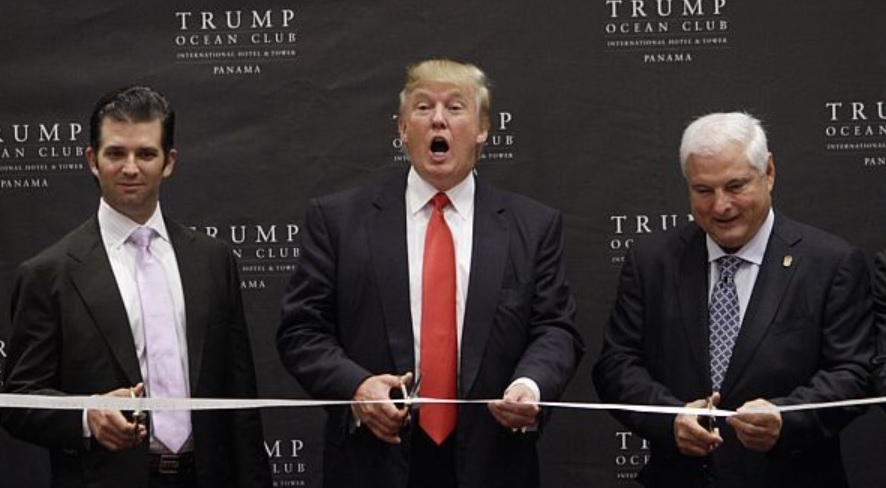
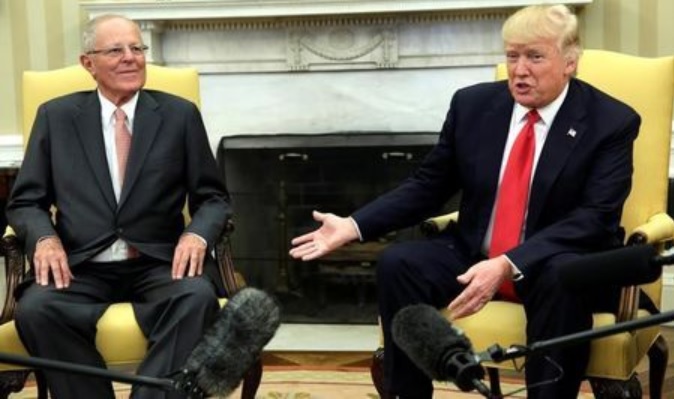
 
Left: Trump [center] at ribbon cutting ceremony for Trump Ocean Club tower in Panama City in 2011. Now a wanted fugitive, President Ricardo Martinelli [right], as well as Donald Trump Jr. [left], join Trump. Right: Trump at White House meeting with Peruvian President Pedro Pablo Kuczynski 
on February 24, 2017. Martinelli and Kuczynski are subjects of major international criminal investigations. Were Trump and his associates caught up in FISA and Title III surveillance of the Odebrecht scandal and are they also involved?

Hundreds of thousands of documents were leaked from the Panama City law firm Mossack Fonseca, which incorporated thousands of offshore shell companies for the Central Intelligence Agency, narcotics syndicates, Arab oil sheikhs, and businessmen like Martinelli, Trump, and Trump's Argentine friend, President Mauricio Macri. It is known that Latin America's largest ever bribery scandal that involves the huge Brazilian building contractor 
Odebrecht SA, now laps at the shores of the Trump Organization via Martinelli.

In December 2016, during the presidential transition phase, the U.S. Justice Department announced a settlement with Odebrecht in which the firm and its affiliate Braskem agreed to pay a fine of $3.6 billion for violation of the U.S. Foreign Corrupt Practices Act. Most of the fine collected by Justice was to be turned over to Brazil, which began the investigation of Odebrecht with its 
"Lava Jato" (Car Wash) probe.

As part of its deal with DOJ, what information did Odebrecht's executives share with Justice Department prosecutors concerning its operations in Panama, especially those involving the Trump Tower and Martinelli? Any involvement of Trump with the Odebrecht and Mossack Fonseca criminal scandals would have prompted any U.S. judge on the Foreign Intelligence Surveillance Court or on the bench of a regular U.S. court district to authorize electronic surveillance of the Trump Organization. When Nunes stated the "incidental surveillance" of Trump and his associates did not involve Russia, was he actually implying it involved another country, perhaps Panama?

The political fallout from Odebrecht is beginning to stick to Trump. Odebrecht paid hundreds of millions of dollars in bribes to politicians in Brazil, 
Venezuela, Argentina, Colombia, Peru, Ecuador, Mexico, Chile, Guatemala,the Dominican Republic, Antigua and Barbuda, Angola, Mozambique, and other countries and some of these politicians are linked to Trump business enterprises. 
Argentina's Macri has been linked to the Odebrecht bribery scandal mainly through the connections to the firm of his cousin 
Angelo Calcaterra, Macri's Energy Minister Juan José Aranguren, and other officials of his government. With the help of business associates of Macri, a Trump Tower was built in Uruguay in 2012. Trump has been pressuring Macri and his friends to build the first Trump Tower in Buenos Aires and a Buenos Aires building permit for the deal was apparently the subject of a phone conversation between Trump and Macri after Trump's election in November.

However, not all has been well between the Trump and Macri families over the years. Franco Macri, the father of the Argentine president, 
believed the mastermind behind the kidnapping for ransom of Mauricio Macri in 1991 was none other than Donald Trump, who the elder Macri described as the "true intellectual author" of the crime. Perhaps that is why the right-wing Mauricio Macri openly endorsed Hillary Clinton for president in 2016.
In Peru, an arrest warrant has been issued for former President Alejandro Toledo who stands accused of receiving a $10 million bribe from Odebrecht for a highway contract. Toledo was on his way to Israel but is now in the United States. The current President of Peru, Pedro Pablo Kuczynski, was Toledo's finance minister. The Trump administration has not responded to Peruvian requests for Toledo's extradition from the U.S. and Kuczynski has been mired in allegations concerning his own connections with Odebrecht. Perhaps that was the reason why Kuczynski followed up a phone call with Trump with a personal visit to the White House in February. All Trump and Kuczynski spoke about during their joint remarks was Kuczynski receiving an award from Princeton University, Kuczynski's two daughters attending Princeton and Columbia, and Peru's decision to buy some U.S. military vehicles. If Kuczynski and Trump are subject to FISA and Title III wiretaps concerning Odebrecht, they may have found more than family to chat about. Kuczynski previously asked Trump to extradite his former boss Toledo to Peru. But with Kucynski now a target of the Odebrecht probe, he may have asked Trump to keep Toledo under wraps in the U.S. and not singing to a Peruvian court.

The U.S. Attorney's Office most likely to have been assigned the investigation of the Martinelli extradition request is the U.S. Attorney for the Southern District of Florida in Miami. This office has historically been occupied by right-wing prosecutors linked to Latin American right-wing leaders, many of which, like Martinelli, maintain residences in the Miami area. If Trump is looking at protecting those who could spill the beans on his and his Trump Organization's own ties to Odebrecht, what better way than to nominate a former U.S. Attorney for the Southern District of Florida to his cabinet. Trump nominated such a former U.S. Attorney, Alexander Acosta, to be his Secretary of Labor. Acosta was involved in negotiating as U.S. Attorney the sweetheart plea deal with convicted child molester and Trump billionaire friend Jeffrey Epstein. The deal immunized from future prosecution Epstein's VIP friends who were involved in his underage sex operations. 

As a former U.S. Attorney in Miami and former dean of Florida International University law school, Acosta has enough clout to help ward off any federal investigations emanating from the Miami U.S. Attorney's Office, which would include advocating for the extraditions of Martinelli and Toledo back to their home countries where they might start naming names, including that of Trump and his associates. Odebrecht, the company that built Miami International Airport, may also have dirt on southern Florida politicians, including members of the Republican Cuban-American political "mafia," which also includes Acosta. Odebrecht maintained a 
Division of Structured Operations, which was dubbed the "Department of Bribery" by U.S. Justice Department investigators. Were Trump and members of his business empire caught up in a legitimate DOJ investigation of Odebrecht, with ancillary intelligence being provided by the NSA and its Canadian counterpart, Communications Security Establishment Canada (CSEC), which conducts full-time surveillance of Latin American communications? If the answer is yes, and it appears to be so, that would explain Nunes and Schiff talking around the issue, which involves the collection of raw signals intelligence data on a massive number of foreign businesses and "U.S. persons."

Tuesday, August 23, 2016

Ukrainian "black ledger" a forgery concocted by Clinton team and its Ukrainian donors By Wayne Madsen Report


Ukrainian "black ledger" a forgery concocted by Clinton team and its Ukrainian donors By Wayne Madsen Report
The Ukrainian government ledgers recently disclosed by the right-wing government in Kiev and which allegedly contain records of under-the-table payments by the former Ukrainian government to Donald Trump's former campaign manager Paul Manafort are rank forgeries, according to well-placed sources who spoke to WMR on conditions of anonymity.

Although our sources admit that Manafort was paid by his Ukrainian clients for political consulting services, they also point out that Manafort's company at the time was Davis Manafort, Inc., a partnership based in Alexandria, Virginia, between Manafort and John McCain's former presidential campaign manager, Rick Davis. The media, including the pro-Clinton New York Times, made no mention in its reporting on the Manafort-Ukraine relationship of the inclusion of Davis and McCain in the Ukrainian political consulting deal. Later, McCain actively supported the 2014 coup against Davis Manafort's client, then-Ukrainian President Viktor Yanukovych and his Party of Regions. Manafort's and Davis's consulting business in Ukraine was under the aegis of the since-dissolved Davis Manafort International.

Manafort's name allegedly appeared in a handwritten ledger of political payoffs by the former ruling Party of Regions of the now-exiled Yanukovych. The ledger was "found" in the abandoned headquarters of the political party, which was overthrown in a 2014 coup financed by the United States and George Soros and his International Renaissance Foundation (IRF) and Open Society Foundation (OSF). Also involved in the coup planning was then-U.S. ambassador to Ukraine Geoffrey Pyatt, Assistant Secretary of State for European and Eurasian Affairs Victoria Nuland, and Victor Pinchuk, a Ukrainian steel and uranium magnate who has donated as much as $25 million to the Clinton Foundation and who maintains a close relationship to Hillary and Bill Clinton and their daughter Chelsea and son-in-law Marc Mezvinsky. Also reportedly involved with 2011 to 2012 discussions at the State Department concerning the future the putsch against the democratically-elected Yanukovych government was Melanne Verveer, a Ukrainian-American State Department official under then-Secretary of State, Clinton, and Douglas Schoen, a longtime political consultant to the Clintons. Yanukovych was elected as president of Ukraine in 2010.

According to leaked Soros files, others involved in the 2014 coup against Yanukovych included David Meale (Economic Counselor to Pyatt); Lenny Benardo (OSF); Yevhen Bystrytsky (Executive Director, IRF); Oleksandr Sushko (Board Chair, IRF); Ivan Krastev (Chariman, Centre for Liberal Studies, a Soros-funded operation in Sofia, Bulgaria); Sabine Freizer (OSF); and Deff Barton (Director, U.S. Agency for International Development, Ukraine [USAID is a conduit for the Central Intelligence Agency]). Soros was also present at a post-coup meeting on March 21, 2014 that involved U.S. support for the "New Ukraine." Soros pushed for sanctions against Russia for refusing to recognize the coup government, which included neo-Nazis, and rejected a federalized Ukraine that would grant self-government to the Russian-speaking eastern Donbass region.
The so-called "black ledger" is said to cover the years 2007 to 2012 and consists of 400 pages "removed" by the newly-formed National Anti-Corruption Bureau from Party of Regions bound ledger books. As any forensic specialist is aware, the removal of bound pages from a ledger renders the authenticity of both the ledger and its information highly suspect. The new bureau is rife with operatives of Soros, who, according to files hacked from Soros computers, actually ran Ukraine shortly after Yanukovych was deposed in the themed "Euromaidan" uprising of 2014. Although Manafort was charged with accepting $12.7 million from Yanukovych's party, no records of such payments are found in the pages released by the Anti-Corruption Bureau.


A very poor quality image of a page from the alleged Party of Regions payments ledger. Paul Manafort's name does not appear on the page released by the Ukrainian government. Knowledgeable sources told WMR that the ledger is a forgery concocted by the Ukrainian government of President Petro Poroshenko, Victoria Nuland at the State Department, George Soros, Ukrainian oligarch Victor Pinchuk, and the Clinton presidential campaign.
Pinchuk's involvement in the Democrats' operation against Manafort, who resigned as Trump's campaign manager after the Ukraine story hit the press, is problematic. In addition to donating millions of dollars to the Clinton Foundation, Pinchuk's annual Yalta European Strategy (YES) summit held in Yalta on the Black Sea coast of Ukraine has drawn participation from Bill Clinton; former British Prime Minister Tony Blair; former NATO military commander, Clinton confidante, and noted anti-Russian polemicist General Wesley Clark; former George W. Bush chief adviser Karl Rove; disgraced and criminally-convicted former CIA director David Petraeus; Bush national security adviser Condoleezza Rice; former President of Georgia and current governor of Odessa Mikheil Saakashvili; disgraced former International Monetary Fund director Dominique Strauss-Kahn; former Polish foreign minister and noted neo-conservative Radoslaw Sikorski, who is married to Washington Post neocon columnist Anne Applebaum; Bill Clinton pal and journalist Strobe Talbott; and Wikipedia's dubious and disingenuous co-founder Jimmy Wales.

Rove's connections to Pinchuk are noteworthy, considering the fact that he has been covertly advising the Hillary Clinton campaign. The appearance of Ukrainian forgeries in an attempt to derail the Trump campaign bears all the markings of a typical Rove dirty tricks operation. Rove has also been a longtime political enemy of Manafort and Davis.

Thursday, August 18, 2016

Is Lynch's Justice Dept. covering up a Clinton Foundation bribery crime? By Wayne Madsen Report


 Is Lynch's Justice Dept. covering up a Clinton Foundation bribery crime?
By Wayne Madsen Report
The Department of Justice, which is normally quite detailed in its criminal indictments, left out some key information in the federal criminal charges brought against Samuel Mebiame, a political fixer whose father Leon Mebiame was once prime minister of natural resource-rich Gabon in Africa. Neither the hedge fund nor the offshore entity were named in the indictment issued by the U.S. Attorney for the Eastern District of New York in Brooklyn, a job held by Attorney General Loretta Lynch before President Obama named her as U.S. Attorney General last year.

The failure to provide details about the corporate entities involved in the bribery of African officials, including those in Gabon, in exchange for lucrative mineral rights for Western corporations may very well be an attempt by Lynch to stymie any ties to the Clinton Foundation's "pay-to-play" extortion, kickbacks, and bribery racket.

The hedge fund named in the indictment of Mebiame is, in fact, the large Och-Ziff Management Capital Group LLC, formed by former Goldman Sachs executive Daniel Och and the heirs to the publishing fortune ofWilliam Bernard Ziff, Jr., and the offshore company is Palladino Holdings, Ltd. of the Turks and Caicos Islands. The two companies, along with Mvelaphanda Holdings of South Africa, formed a joint venture called Africa Management Ltd, on behalf of which Mebiame allegedly bribed officials in Chad, Niger, and Guinea for mining contracts. Curiously, Gabon, where Mebiame lives and which has a history of bribes for mining contracts, was not named in the indictment of Mebiame. The omission may be due to the fact that the Clinton Foundation received a $175,000 donation from the mining conglomerate BHP Billiton in return for Hillary Clinton's State Department ensuring the firm's continued mining contracts in Gabon and Guinea. Hillary Clinton's presidential campaign has seen lucrative donations from another mining company with operations in Guinea, Rio Tinto, Inc.

Mvelaphanda Holdings was founded by former African National Congress government minister Tokyo Sexwale, who has been involved in negotiating a deal to take over mining operations in Guinea along with a Kazakhstan mining conglomerate headquartered in Luxembourg. Sexwale's hedge fund partner Och has contributed to Hillary Clinton's presidential campaign.

The Justice Department and the Securities and Exchange Commission are in negotiations with Och-Ziff to have its London office and its joint venture Africa Management Ltd. plead guilty to bribery charges, that, in addition to Guinea, Chad, and Niger, involve contracts in Libya and the Democratic Republic of Congo. Ever since his days as governor of Arkansas, Bill Clinton has benefited from firms that held lucrative mining contracts in the DRC, previously known as Zaire. One DRC mining firm, America Mineral Fields, owned by a national of Mauritius, located its global headquarters in Bill Clinton's birthplace of Hope, Arkansas, in order to curry favor with the Clintons.


Secretary of State Clinton's March 2010 meeting with Gabon President Omar Bongo involved more than talking about the weather. Mining companies in Gabon kicked in big to her campaign coffers and the "pay-to-play" Clinton Foundation racket.

Mebiame refused to enter a plea when he was arraigned at the U.S. Federal Courthouse in Brooklyn on August 16. None of the corporate entities were charged in the bribery scandal with only Mebiame named as a defendant in the case U.S. v. Mebiame. Government officials accepting bribes from Mebiame in Chad, Niger, and Guinea -- all part of Obama's military coalition against terrorism in West Africa -- were not named in the indictment nor were they charged with any crimes. The officials included Mohammed Conde, the son of Guinean president Alpha Conde. Sexwale and his corporate partners have tried to negotiate a takeover of BHP Billiton's mining concessions in Guinea. Sexwale's other partner was theEurasian National Resources Corporation (ENRC) of Kazakhstan, a country where Bill Clinton and his Canadian mining donor Frank Giustra have significant mining business connections with the government of President Nursultan Nazarbayev.


South African mining billionaire Tokyo Sexwale, then South Africa's Minister of Human Settlements (with microphone), visits Bill Clinton's New York office on February 23, 2012. The indictment of the son of a former Gabon prime minister by Loretta Lynch's successor in Brooklyn curiously avoided naming Sexwale's company in African bribery scandal. Reason: Sexwale is too close to "Slick Willy" and "Slick Hilly."

Part of the reason for BHP Billiton's $175,000 donation to the Clinton Foundation was to offset the influence with Clinton already "bought" by Giustra, Kazakhstan, and indirectly by Sexwale and his partners. The U.S. owes Sexwale some favors. A December 15, 2009 Confidential U.S. embassy Pretoria cable to Secretary of State Clinton paints Sexwale as not only one of South Africa's wealthiest businessman but someone who served as the eyes and ears for U.S. embassy "political officers," i.e., Central Intelligence Agency spooks, when he attended the special congress of the South African Communist Party.

The BHP Billiton donation to the Clinton Foundation was purely "protection insurance" for the firm's large mining operations in Guinea and Gabon. Apparently, Samuel Mediame's crime was not to kick in some of his bribery profits to the Clinton Foundation and Mrs. Clinton's presidential campaign as did the other players in the bribery scheme. When the Cosa Nostra engaged in such protection rackets, its crime bosses were sent away to federal prison. When the Clintons engage in them, they are rewarded not with the "Big House" but the White House.

Tuesday, June 30, 2009

EARLY EDITION. GUEST ARTICLE. Democratic Plan To Woo Karl Rove’s Alabama Friends With Justice Post May Backfire

Alabama Congressman Artur Davis, the current favorite to become the state's Democratic nominee for governor in 2010, reportedly advocates retention of Republican Middle District U.S. Attorney Leura Canary to woo business and Republican support for his candidacy.

Sources report that the plan to let Canary keep her job at least temporarily is gaining traction among Washington's Democratic power brokers as a brilliant centrist strategy to help the Harvard-educated Davis win election as state's first African-American governor.&

But critics believe the plan would ultimately doom the Davis campaign and further erode confidence in Alabama's already disgraced federal court system. Perhaps even more important, it would create a national embarrassment for Democratic leaders who would end up snookered yet again by the master Republican strategist Karl Rove, whose Alabama ties run deep and dark This is because retention of Canary -- wife of Rove's close friend Alabama Business Council President William Canary -- would inflame Alabama's progressive community.

Progressives regard her as a central villain in the 2006 federal conviction of former Democratic Gov. Don Siegelman on hoked-up corruption charges that made his seven-year prison sentence an international disgrace. Many of the state's progressives have since rallied around Siegelman along with outside legal experts, helping to make Siegelman's case the most controversial U.S. criminal prosecution of the decade.

To ignore those grassroots passions and widespread allegations of official misconduct by the Justice Department would thus undercut confidence in the Obama administration's political acumen and his campaign promises of change In this scenario, state Agriculture Commissioner Ron Sparks and a new entrant progressive African-American candidate would peel off support from Davis in a highly divisive Alabama gubernatorial primary. Davis, funded in part by business community dollars promised by Bill Canary, would probably still win the primary. But that Davis victory would come with lasting animosities that ensured Republican victory in the general election.

Asked for comment, a spokeswoman for Congressman Davis said that she's authorized only to say that Alabama's Republican Senators Jeff Sessions and Richard Shelby have rejected the congressman's two initial nominees, Michel Nicrosi of Mobile and Joseph Van Heest of Montgomery.

Theoretically, the case for Leura Canary's retention is plausible, especially for the gung-ho, fast-rising, ever-confident Davis -- and especially given the typical Democratic response to defer to Republicans who want to control the federal justice system as much as possible despite their party's recent election losses.

As background on Davis, he is a Montgomery native whose Harvard Law School education overlapped for a year with President Barack Obama's. Davis has parlayed their relationship then and since into a centerpiece of his political persona.

Davis has won his congressional re-election campaigns by huge margins in a district gerrymandered to assure large voting blocks of urban Birmingham voters. Republicans cleverly manipulate the federal Voting Rights Act to assure that African American voters in Southern states are concentrated in a few districts. The ostensibly pro-minority strategy was recently upheld by the Supreme Court. That kind of gerrymandering helps some minority office-holders such as Davis, while concentrating likely Democrats into a few districts and thereby keeping majority power concentrated in Republican hands.

But if Davis can build on his black support and his Obama relationship by neutralizing the business interests represented by William Canary, according to this rosy view, then Democrats could have a real shot at winning the state's governorship.

Additionally, conventional wisdom in national Democratic circles for many years has been that the party's voters aside from prospective office-holders care little about appointments to the lower federal courts and Department of Justice offices.

Instead, Democrats usually focus their rhetoric and media muscle on battling Republicans on Supreme Court appointments. These battles provide a win-win for activists in both parties who concentrate on abortion, gay rights, flag-burning and reverse discrimination (such as the Court's Ricci decision this week on white New Haven firefighters) and similar hot-button issues that distract the public.

Republicans, meanwhile, have quietly packed the lower courts and Justice Department political and career posts with "Loyal Bushies" recruited from the Federalist Society and other ultra-right breeder farms. These activist ideologues provide reliable, result-oriented jurisprudence on the full range of criminal and civil litigation.

In this context, letting an Obama-friendly Davis, one of Alabama's few remaining Democratic office-holders of significance, pursue his centrist campaign strategy as he sees fit seems relatively inconsequential to Democratic wonks in Washington. Alabama has become increasingly Republican anyway since Siegelman's re-election loss in a disputed 2002 election where his Election night victory by 3,000 votes suddenly disappeared. Late night voting machine changes in rural Baldwin County enabled enough vote switches for a 3,000-vote victory by the current Republican Gov. Bob Riley.

Furthermore, Alabama's black population is a lower percentage than in its neighboring Deep South states. To an outsider, this lower population of a reliably Democratic constituency argues even more for an innovative "centrist" strategy that will be applauded by the multimillion-dollar-per year leaders of Washington's media class of talking-head TV commentators, whose mantra is always that Democrats must accede to Republicans to show bipartisanship.

So why not retain a U.S. attorney that almost no one's ever heard of? Canary, who's that? Especially deference to Republicans would help Davis foster a centrist image and build support for Democratic Supreme Court nominee Sonia Sotomayor by persuading Sessions to lower his rhetoric a bit as the ranking Republican on the Judiciary Committee?

The answer is that still-unresolved prosecution misconduct allegations regarding the Siegelman conviction exploded nationally in 2007 along with revelations that the Bush administration orchestrated the firing of U.S. attorneys for political reasons, supposedly leaving Bush loyalists in place to serve the administration's goals. Congress failed to obtain testimony from those accused of wrongdoing. More recently, the Obama administration has stressed bipartisanship in failing to follow the country's tradition of requiring resignations of politically appointed U.S. attorneys en masse following a change of administration.

Indeed, the Obama administration (whether prompted by holdover Bush officials or by incoming top Obama appointees) recently asked for 20 years in prison for Siegelman at his upcoming resentencing. The Justice Department has declined to release specifics of its reasons to escalate prison time for Siegelman.

The former governor is now free on bail after serving nine months of his seven-year sentence for 2007 conviction on bribery-related charges. The charges primarily stemmed from Siegelman's 1999 reappointment of HealthSouth CEO Richard Scrushy to a state board after Scrushy arranged the first $250,000 of what became $500,000 in donations to the Alabama Education Foundation's efforts to improve Alabama public schools. Siegelman, Scrushy and 75 former state attorneys general from around the U.S. have argued that no one has ever been prosecuted in such a situation, and that both Alabama's current governor and Obama himself frequently appoint donors to major positions, not simply the kind of volunteer post that Scrushy received.

Indeed, Siegelman and Scrushy filed legal papers in recent days seeking a new trial on the basis of newly discovered evidence showing misconduct by Leura Canary, her Justice Department colleagues in Alabama and Washington, and Chief Middle District U.S. District Judge Mark E. Fuller. Fuller was a member of the Alabama Republican Party's Executive Committee before his nomination by President Bush to the federal bench in 2002.

In Fuller's confirmation hearing, Sessions and Shelby backed Fuller without notifying their Senate colleagues that Fuller held a full-time CEO job of a military contractor at the same time that he was supposedly working as a full-time Alabama state prosecutor from 1997-2002. By July 2003, that double-dipping led to claims by Missouri attorney Paul B. Weeks that Fuller should be impeached and indicted for in a blackmail scheme prompted by Fuller's military contracting work. In a 180-page binder of evidence, Weeks claimed that Fuller sought to appease blackmail pressure by conspiring to defraud Alabama's pension system of $330,000 for a subordinate who knew his secrets as a state prosecutor.

Weeks delivered his complaint to Fuller, to the House and Senate Judiciary Committees and to the Public Integrity Section of the U.S. Justice Department seeking action to protect the public against a judge that Weeks claimed was unfit to serve over any future litigant. Interviewed this spring, Weeks says no one has ever contacted him to pursue the allegations and that he is astonished that the same Public Integrity Section that should have been investigating Fuller was aggressively prosecuting Siegelman in cooperation with Canary's Alabama office on charges far less serious than those involving the judge.

The Justice Department has denied any misconduct on its part or bias by Fuller against Siegelman. Fuller has said complaints of his work as a state prosecutor are "politically motivated." He has since been promoted to run the court system in his district with a track record of highly controversial decisions approved by the heavily Republican Eleventh U.S. Circuit Court of Appeals based in Atlanta.

In this situation, Alabama's relatively small progressive community may be as doomed politically as the last Texans at the Alamo. But asking them to play nice with Karl Rove's friends such as Bill and Leura Canary may become a line in the sand -- equivalent to one that Col. Travis, according to legend, drew with his sword on the ground at the Alamo seeking volunteers for an all-out battle.

The former governor is now free on bail after serving nine months of his seven-year sentence for 2007 conviction on bribery-related charges. The charges primarily stemmed from Siegelman's 1999 reappointment of HealthSouth CEO Richard Scrushy to a state board after Scrushy arranged the first $250,000 of what became $500,000 in donations to the Alabama Education Foundation's efforts to improve Alabama public schools. Siegelman, Scrushy and 75 former state attorneys general from around the U.S. have argued that no one has ever been prosecuted in such a situation, and that both Alabama's current governor and Obama himself frequently appoint donors to major positions, not simply the kind of volunteer post that Scrushy received.

"Siegelman supporters down here aren't like others," says one political observer who's never voted for Siegelman in his decades of being one of the state's most popular Democrats, beginning with his 1978 election as state Attorney General. "It's like a religion. He used to reach out and hug these voters no matter who they were, even a garbageman in uniform. And lots of them are going to stand by him forever, through thick and thin."

Just last week, two events helped illustrate explosive potential of Leura Canary's role as a federal prosecutor. First, retired Chief U.S. District Judge U.W. Clemon of Alabama's Northern District said told a National Press Club audience in Washington, DC that the Justice Department's 2004 prosecution of Siegelman on corruption charges was the most unfounded criminal case that Clemon had presided over in nearly 30 years on the federal bench.

Speaking at a forum on selective prosecution and similar Justice Department misconduct by the Bush Administration, Clemon said federal prosecutors ultimately had to withdraw their much-publicized corruption charges against Siegelman for lack of evidence before announcing new charges a year later before Fuller just as Siegelman was gearing up for a re-election effort for the 2006 election.

The retired judge, a Democrat who holds the distinction of being the first African-American ever appointed to the federal bench in a Deep South state, said that he wrote U.S. Attorney General Eric Holder this spring to urge an investigation of Siegelman's prosecution in the second case. Siegelman was convicted in 2006 in large part based on the testimony of witness Nick Bailey, who denied wrongdoing by Siegelman in the 2004 case. But Bailey was reportedly coached in more than 70 interview sessions for the second trial without delivery to the defense of interview notes as legally required, helping Canary's office deliver a conviction in what whistleblower Tamarah Grimes described as "The Big Case" in middle district parlance in which no expense against Siegelman was to be spared.

The remarks by Clemon at the June 26 forum were cablecast nationally, as were those of legal experts and victims of purported political prosecutions by the Bush administration. Then white House strategist Karl Rove allegedly urged Justice Department officials to embark on a plan that would ultimately lead to hundreds of investigations of elected officials, who were Democrats by a 7:1 margin according to a leading study. The story has been largely ignored by the mainstream press for the past year, but C-SPAN has aired the June 26 program at least five times so far, and makes it available also on its website. http://www.c-spanarchives.org/library/index.php?main_page=product_video_info&tID=5&src=atom&atom=todays_events.xml&products_id=287304-1 Rove has denied any wrongdoing, and is scheduled to testify to House Judiciary Committee staff on the claims sometime soon after nearly two years of fighting testimony.

As noted above, Scrushy filed an 85-page motion on Friday seeking a new trial. In it, Scrushy alleged that newly discovered evidence showed misconduct by federal prosecutors and the trial judge. For example, Scrushy cited evidence from a whistleblower in Leura Canary's office that Canary continued to monitor and indeed oversee Siegelman's prosecution even though she claimed to be recused because of her husband's longstanding friendship with Karl Rove as they sought to eliminate Democrats from elected office in Alabama throughout the 1990s. During that time, they worked with Alabama's Republican Party Executive Committee, working much of that time with Judge Fuller before President Bush nominated him to the bench in 2002.

Washington masterminds may consider such seldom-reported court filings as irrelevant to a nation pre-occupied, with war, the economy, the Supreme Court and, until recently, the fate of the ever-titillating Miss California.

But those planning on an Artur Davis victory via addition of voting blocs should remember that political math also includes subtraction. And to paraphrase the orator Daniel Webster in another context, Alabama may be a small place, but "there are those who care about it."

In Alabama, state politics remains a blood sport, as any review would show of the Siegelman court filings, a 2008 CBS 60 Minutes exposé on the Siegelman case, and the ongoing congressional investigation of Karl Rove.

It's the state where the young George W. Bush went on leave from the National Guard to campaign for a Republican Senate candidate, and to make lifelong friends. Also, it's where Karl Rove and former Republican National Committee Chief of Staff Bill Canary developed, in effect, a laboratory in the 1990s for controversial election tactics. These tactics reportedly include expertise in election software, disputing close elections and other by-now standard practices that would prove successful elsewhere nationally in the first part of this decade.

Washington operatives and pundits might regard Alabama as so reliably Republican in Presidential races that nothing of national significance could arise there statewide -- except perhaps an inspirational Democratic gubernatorial victory by the Obama centrist protégé Davis as a pioneering African American. But stay tuned for potential surprises. And as they say, if it bleeds it leads.

Tuesday, August 07, 2007

El caballo de troya estadounidense en Francia: la French American Foundation por Pierre Hillard *


Hoy por hoy, la oposición política se materializa fundamentalmente entre aquellos que apoyan un gobierno unipolar del mundo bajo la autoridad de Estados Unidos y quienes preconizan un equilibrio de poderes regido por el Derecho Internacional. A ese nivel, la tradicional visión francesa que opone derecha e izquierda ya no es relevante, ya que tanto en uno como en otro bando, existen los partidarios de la Pax Americana. Una organización sin ánimo de lucro pero con cuantiosos fondos a su disposición, la French American Foundation (Fundación Franco-Americana), lleva treinta años dedicada a reclutar jóvenes líderes destinados a convertirse en dirigentes algún día para formarlos sobre el mantenimiento de la política atlantista. Entre ellos se cuentan miembros de la UMP, del PS y también integrantes del equipo de campaña de José Bové.


7 DE AGOSTO DE 2007

Desde
París (Francia)

Con motivo de su visita oficial a Estados Unidos, Nicolas Sarkozy pronunció un discurso el 12 de septiembre de 2006 en la French American Foundation (FAF en sus siglas en inglés, la «Fundación franco-americana»). Recordando la necesidad de «erigir nuevamente la relación trasatlántica (...) y de favorecer la constitución de una Europa políticamente fuerte e influyente en la escena internacional» [1], las palabras del aspirante al Elíseo han debido de hacer las delicias de los dirigentes de esa Fundación por lo general poco conocida.

El estudio de la misma es no obstante de gran utilidad a la hora de comprender mejor los vínculos —y hasta qué punto estos son estrechos—, entre las élites francesa y americana.La FAF tiene sus orígenes en las acciones de tres estadounidenses eminentes [2]: James G. Lowestein, miembro entre otros del Council on Foregin Relations (el CFR) [3] en el seno del cual se elabora la política exterior de Estados Unidos y que equivale al Royal Institute of International Affairs (RIIA, también conocido como Chatham House); James Chace, redactor jefe de Foreign Affairs, la revista del CFR, y Nicholas Wahl, catedrático de Ciencias Políticas y gran conocedor de la clase dirigente francesa, lo que le permitió establecer contactos con el general de Gaulle y Michel Debré [4] en particular.

En la década de los 70, esos tres hombres pusieron en común sus redes de contactos [5] entre los que se encontraban personalidades francesas de la política, la economía y los círculos universitarios, y que incluían entre otros a Olivier Chevrillon (uno de los fundadores de la revista Le Point), Pierre Jouven (presidente de Péchiney), Jean-Louis Gergorin (futuro miembro el comité ejecutivo de EADS) y Thierry de Montbrial (futuro presidente del Instituto Francés de Relaciones Internacionales, el IFRI, que en su día codirigió el Centro de Análisis y Previsión del Ministerio de Asuntos Exteriores). Uniendo sus esfuerzos, estos hombres consiguieron el apoyo oficial del Presidente de la República, Valéry Giscard d’Estaing, quien —de común acuerdo con su homónimo estadounidense, Gerald Ford, y el

Secretario de Estado Henry Kissinger [6]-, anunció la creación de una doble fundación franco-americana durante el transcurso de una cena celebrada en la embajada de Francia en Washington, el 18 de mayo de 1976.Se decidió que la French American Foundation tendría una sede en Nueva York y otra en París y, tal y como se expresaba en los textos oficiales, «el objetivo de la Fundación franco-americana era reforzar la relación franco-americana considerada como un elemento esencial de la alianza trasatlántica» [7]. Para conseguir dicho objetivo, magos de las finanzas, los principales medios de comunicación, y personalidades del ámbito de la universidad y la política se reunieron en torno al recién creado instituto desde un principio y, a lo largo de los años, las dádivas han sido particularmente abundantes: la rama estadounidense ha disfrutado de apoyos particularmente importantes.

La impresionante lista de participantes es tan extensa que no resulta posible reproducir en su integridad los nombres de todos los dirigentes y donantes. No obstante, sí pueden mencionarse algunos de los más destacadas miembros (antiguos y nuevos) a fecha de 2007. Para empezar, John D. Negroponte [8], varias veces embajador y gobernador de Irak, responsable del conjunto de servicios de inteligencia de Estados Unidos y número 2 del Departamento de Estado. El siempre omnipresente John Negroponte ocupó en su día la presidencia de la FAF de Nueva York. También cabe mencionar a los miembros del consejo de administración, el antiguo presidente de los patronatos francés y europeo (el MEDEF y el UNICE), Ernest-Antoine Sellière y antiguo embajador de Estados Unidos en Francia, Félix G. Rohatyn y su homólogo en Washington, François Bujon de l’Estang [9].

Otro nombre al azar: el del actual presidente de la FAF de Nueva York, Nicholas Dungan [10] que ha desarrollado su actividad profesional en el seno de la muy atlantista Chatham House [11]. Entre los numerosos contribuidores financieros, pueden destacarse nombres de tanto prestigio como los de David Rockfeller, fundador de la Comisión Trilateral y presidente honorífico del CFR; el antiguo subdirector de la CIA y el antiguo Secretario de Defensa del presidente Reagan, Franck Carlucci [12], que posteriormente a ocupado el cargo de director del poderoso grupo Carlyle, la compañía vinculada a las familias Bush y Bin Laden, así como al sector de la defensa [13].Y en cuanto a los contribuidores a la la FAF de Nueva York, cabe citar nombres como EADS, l’Oréal USA [14] o incluso la Société Générale [15].La FAF francesa, por su parte, no tiene nada que envidiar a su gemela neoyorquina: dirigida en sus orígenes por el presidente de Péchiney, Pierre Jouven, desde 1997 preside la Fundación Michel Garcin [16], director general de Hervé Consultants (especialistas en asesoría de empresas).

El Consejo Supervisor [17] reúne a entidades de la talla de EADS France, BNP Paribas y la Caisse des dépôts así como a nombres tales como Yves de Gaulle (secretario general de Suez), Jean-Louis Gergorin (vicepresidente de coordinación estratégica de EADS, pese a que ha cesado en sus actividades a raíz del caso Clearstream) o Marwan Lahoud, director general del líder europeo en el sector de los misiles MBDA, participada por EADS en un 37,5% y cuyo hermano, Imad Lahoud [18], ha tenido algún que otro encontronazo con la justicia en relación a Jean-Louis Gergorin y el caso Clearstream.También cabe añadir que la FAF francesa cuenta con el apoyo del Ministerio de Asuntos Exteriores, el de Educación Nacional y el Instituto de Estudios Políticos de París [19].

La clave del sistema de influencia de la Fundación Franco-Americana es su capacidad para reclutar a personas destinadas a ocupar altos cargos; su gran punto fuerte lo constituye el acoger en su seno a representantes políticos venidos de corrientes ideológicas oficialmente opuestas: de socialistas a miembros de la UMP pasando por el gaullista Dupont-Aignan y el responsable de comunicación de la campaña presidencial de José Bové, Bernard Loche.

Para evitar emitir juicios precipitados, téngase en cuenta que las personas con las que la Fundación se ha puesto en contacto y que han aceptado frecuentarla, sin embargo no han aceptado los servicios que se les han ofrecido posteriormente.La verdadera selección se produce en el marco de un programa denominado Young Leaders (Jóvenes líderes) del que los textos oficiales de la fundación dicen: «El programa insignia de Young Leaders, gestionado por las dos entidades (Nueva York y París) tiene por objetivo crear y desarrollar vínculos duraderos entre jóvenes profesionales franceses y estadounidenses de talento que muestran el potencial de ocupar puestos clave en uno u otro país en el futuro». [20].
Los textos oficiales precisan que la selección se lleva a cabo en 3 fases:

1. «La primera fase consiste en la preselección de candidatos. Dicha preselección se realiza por medio de la red de la Fundación Franco-Americana, y de antiguos Young Leaders o miembros del Consejo Supervisor en la actualidad. Además, recientemente se ha emprendido un esfuerzo para diversificar el origen social y profesional de los candidatos, en particular a través de la identificación de perfiles prometedores en la prensa.

2. La segunda fase es la recogida formal de candidaturas y la subsiguiente confección de informes que contienen la biografía del candidato y una carta de recomendación. Entonces se organizan unas entrevistas para profundizar en la cuestión de la motivación.

3. La última fase del procedimiento es la selección final de los candidatos.

Tras recibirse los informes de cada candidato, el Comité de Selección se reúne. Dicho comité está formado por 10 miembros, la mayoría de los cuales son antiguos Young Leaders. Los candidatos que obtienen más puntuación son los que resultan seleccionados». Como puede verse, en la FAF no entra quien quiere sino quien puede: los miembros seleccionados forman una verdadera «élite» cuyo objetivo oficial es «reforzar la relación franco-americana considerada como elemento esencial de la alianza trasatlántica», lo que hace sumamente interesante conocer quiénes son: encabezando la lista se encuentra el profesor estadounidense de ciencias políticas y miembro del CFR, Ezra Suleiman, quien fuera responsable de reclutar Young Leaders en Francia entre 1981 y 1984, y después de 1994 a 2001 [21].

Tras una rigurosa selección, sólo 125 estadounidenses y 126 franceses forman parte de los Young Leaders desde de 1981. En el caso de la FAF de Estados Unidos, pueden citarse los siguientes nombres junto con la fecha de admisión: Antony Blinken (1998, antiguo consejero de política extranjera del presidente Clinton), Ian Brzezinski (2001, encargado de asuntos de defensa de la OTAN, hijo del célebre geopolitólogo Zbigniew Brzezinski), el general Wesley K. Clark (1983, ex-comandante en jefe de las tropas de la OTAN en Europa), el presidente Clinton (1984) y Hillary Clinton (1983, senadora) [22].

En cuanto a la rama francesa de la Fundación Franco-Americana, cabe destacar en particular los siguientes nombres:
Philippe Auberger (1989, diputado de la UMP, partido político francés de derecha), Yves Censi (2003, diputado de la UMP), Jérôme Chartier (2003, diputado de la UMP), Nicolas Dupont-Aignan (2001, diputado de la UMP, Debout la République), Alain Juppé (1981, diputado de la UMP), Éric Raoult (1994, diputado de la UMP), Valérie Pécresse (2002, diputada de la UMP), Jacques Toubon (1983, diputado de la UMP), François Hollande (1996, diputado socialista francés), Arnaud Montebourg (2000, diputado socialista), Pierre Moscovici (1996, diputado socialista), Alain Richard (1981, socialista, antiguo ministro de Defensa), Henri de Castries (1994, director general del grupo asegurador AXA), Emmanuel Chain (1999, periodista), Jérôme Clément (1982, presidente de Arte), Annick Cojean (2000, periodista de Le Monde), Jean-Marie Colombani (1983, director del diario Le Monde ), Matthieu Croissandeau (2002, redactor jefe adjunto del semanario Nouvel Observateur), Jean-Louis Gergorin (1994), Bernard Guetta (1981, periodista de France Inter), Erik Izraelewicz (1994, redactor jefe de Échos), Laurent Joffrin (1994, director general del diario Libération), Jean-Noël Jeanneney (1983, presidente de la Biblioteca Nacional de Francia), Sylvie Kaufmann (1998, periodista de Le Monde), Yves de Kerdrel (2005, periodista de Échos), Marwan Lahoud (1999), Anne Lauvergeon (1996, presidenta de Areva), François Léotard (1981, antiguo ministro de Defensa), Alain Minc (1981), Laurent Cohen-Tanugi (1996, Sanofi-Synthélabo y miembro del consejo de administración del think tank «Notre Europe» creado por el antiguo presidente de la Comisión Europoea Jacques Delors [23]), Christine Ockrent (1983), Olivier Nora (1995, presidente de Éditions Grasset), Denis Olivennes (1996, presidente de la FNAC)... [24]

Semejante representación pone de manifiesto la importante influencia que ejerce la Fundación Franco-Americana en las relaciones franco-estadounidenses [25].
Se celebran múltiples encuentros entre representantes franceses y estadounidenses con objeto de debatir cuestiones relativas a defensa, política, periodismo, sindicalismo... De hecho, de trata de «limar» las aristas con objeto de llegar a un consenso que favorezca la alianza trasatlántica. Todas esas reuniones oficiales y oficiosas permiten crear una comunidad de pensamiento entre los principales miembros de la FAF pertenecientes a los más variados sectores.

Esta fundación organiza así mismo diversos coloquios sobre defensa, periodismo, educación y salud. Entre los participantes, además de los nombres ya citados, se encuentran personalidades muy conocidas tales como François Bayrou, Bernard Kouchner (éste político del partido Socialista francés acaba de pasarse al bando del nuevo presidente Sarkozy quien lo ha nombrado como primer ministro de su gobierno), Jean-François Copé (portavoz del gobierno de Chirac en 2007), Michel Barnier (asesor político de Nicolas Sarkozy en 2007), Nicolas Beytout (director de redacción de Figaro), el general Henri Bentegeat (jefe de estado mayor del ejército) etc. [26].
Por supuesto todos esos coloquios persiguen como máximo objetivo el servir mejor a los intereses de la humanidad.

Pierre Hillard
Última obra publicada: La Décomposition des nations européennes: De l’Union euro-Atlantique à l’État mondial (La Descomposición de las naciones europeas: de la Unión euro-atlántica al Estado mundial. Editor: François-Xavier de Guibert, Francia.
Los artículos de esta autora o autor


[1] http://www.u-m-p.org.

[2] http://www.frenchamerican.org/board.

[3] «Comment le Conseil des relations étrangères détermine la diplomatie US», Red Voltaire, 25 de junio de 2004.

[4] http://www.frenchamerican.org/

[5] http://www.frenchamerican.org/

[6] http://www.frenchamerican.org/

[7] http://www.frenchamerican.org/

[8] «John Negroponte bientôt à Bagdad», por Arthur Lepic, Red Voltaire, 20 de abril de 2004.

[9] http://www.frenchamerican.org/

[10] http://www.frenchamerican.org/

[11] http://www.chathamhouse.org.uk/

[12] «El honorable Frank Carlucci», Red Voltaire, 18 de julio de 2005.

[13] «El Carlyle Group, un negocio de iniciados», Red Voltaire, 27 de junio de 2005.

[14] «Histoire secrète de L’Oréal» Voltairenet, 3 mars 2004.

[15] http://www.frenchamerican.org/

[16] http://www.frenchamerican.org/

[17] http://www.frenchamerican.org/

[18] Contrariamente a lo que se ha publicado en la prensa francesa, Marwan y Iman Lahoud no son familia del presidente de Líbano Émile Lahoud.

[19] http://www.frenchamerican.org/

[20] Rapport d’étude pour le ministère des Affaires étrangères (Estudio confeccionado para el Ministerio de Asuntos Exteriores), análisis del proceso de selección de los Young Leaders franceses durante el periodo 1981-2005, Fundación Franco-Americana, Paris y Nueva York, p. 4

[21] Ibid., p. 6.

[22] http://www.frenchamerican.org/

[23] http://www.frenchamerican.org/

[24] http://www.frenchamerican.org/

[25] Dicha comparación también se produce en el terreno de lo económico. De hecho la FAF ha organizado un coloquio titulado « Économies européennes et américaines, l’impossible divorce» (Las economías europeas y americanas, el divorcio imposible) bajo la dirección de Joseph P. Quinlan, autor de un documento aparecido en 2003 con el título Drifting apart or growing together? The primacy of the transatlantic economy (¿Caminos que se separan o que confluyen? La primacía de la economía trasatlántica). Joseph P. Quinlan es así mismo coautor junto con Daniel S. Hamilton de la obra de referencia en materia de mercado trasatlántico sin barreras Deep integration (Integración profunda), cuyo valor tanto ponderó el presidente de la Comisión Europea, José Barraso, en la School of Advanced International Studies (SAIS), el 18 e octubre de 2005.

[26] Informe anual 2003-2004, Fundación Franco-Americana.

Esta fundación concede cada año el Premio Benjamin Franklin «a una persona que, con su vida, haya contribuido a mejorar las relaciones entre Francia y Estados Unidos», tal y como menciona el informe de la FAF. Entre los galardonados con dicho premio se encuentran: el embajador C. Douglas Dillon, el embajador Walter J.P. Curley, Médicos sin Fronteras, Bernard Arnault (grupo LVMH del sector del lujo), Michel David-Weill (antiguo presidente de Lazard Frères), la familia Forbes y Maurice Lévy (presidente de la Junta Directiva de Publicis Groupe), op. cit. p. 30.

Thursday, June 07, 2007

Bandar Bush takes 1.978 billion dollars in bribes while he was Saudi ambassador to the U.S.

BAE accused of secretly paying £1bn to Saudi prince (Bandar Bush)


· Money moved via US bank
· £30m payments a quarter
· Sanctioned by MoD

David Leigh and Rob Evans
Thursday June 7, 2007
The Guardian

Prince Bandar bin Sultan bin Abdul Aziz al-Saud also known in the Bush family as "Bandar Bush" takes 1.978 billion dollars in bribes while he was Saudi ambassador to the U.S.

The arms company BAE secretly paid Prince Bandar of Saudi Arabia more than £1bn in connection with Britain's biggest ever weapons contract, it is alleged today.

A series of payments from the British firm was allegedly channelled through a US bank in Washington to an account controlled by one of the most colourful members of the Saudi ruling clan, who spent 20 years as their ambassador in the US.

It is claimed that payments of £30m were paid to Prince Bandar every quarter for at least 10 years.

It is alleged by insider legal sources that the money was paid to Prince Bandar with the knowledge and authorisation of Ministry of Defence officials under the Blair government and its predecessors. For more than 20 years, ministers have claimed they knew nothing of secret commissions, which were outlawed by Britain in 2002.

An inquiry by the Serious Fraud Office (SFO) into the transactions behind the £43bn Al-Yamamah arms deal, which was signed in 1985, is understood to have uncovered details of the payments to Prince Bandar.

But the investigation was halted last December by the SFO after a review by the attorney general, Lord Goldsmith.

He said it was in Britain's national interest to halt the investigation, and that there was little prospect of achieving convictions.

Tony Blair said he took "full responsibility" for the decision.

However, according to those familiar with the discussions at the time, Lord Goldsmith had warned colleagues that British "government complicity" was in danger of being revealed unless the SFO's corruption inquiries were stopped.

The abandonment of the investigation provoked an outcry from anti-corruption campaigners, and led to the world's official bribery watchdog, the OECD, launching its own investigation.

The fresh allegations may also cause BAE problems in America, where corrupt payments to foreign politicians have been outlawed since 1977.

The allegations of payments to Prince Bandar is bound to ignite fresh controversy over the original deal and the aborted SFO investigation.

The Saudi diplomat is known to have played a key role with Mrs Thatcher in setting up Britain's biggest ever series of weapons deals.

For more than 20 years Al-Yamamah, Arabic for "dove", has involved the sale of 120 Tornado aircraft, Hawk warplanes and other military equipment.

According to legal sources familiar with the records, BAE Systems made cash transfers to Prince Bandar every three months for 10 years or more.

BAE drew the money from a confidential account held at the Bank of England that had been set up to facilitate the Al-Yamamah deal. Up to £2bn a year was deposited in the accounts as part of a complex arrangement allowing Saudi oil to be sold in return for shipments of Tornado aircraft and other arms.

Both BAE and the government's arms sales department, the Defence Export Services Organisation (Deso), allegedly had drawing rights on the funds, which were held in a special Ministry of Defence account run by the government banker, the paymaster general.

Those close to Deso say regular payments were drawn down by BAE and despatched to Prince Bandar's account at Riggs bank in Washington DC.
Under the terms of a previously unknown MoD instruction from the department's permanent secretary, Sir Frank Cooper, the payment deal would have required Deso authorisation.

The money was not characterised as commission, but as quasi-official fees for marketing services. The payments are alleged to have continued for at least 10 years and beyond 2002, when Britain outlawed corrupt payments to overseas officials.

SFO investigators led by assistant director Helen Garlick first stumbled on the alleged payments, according to legal sources, when they unearthed highly classified documents at the MoD during their three-year investigation.

Before the investigation was abandoned, the SFO interviewed Alan Garwood, head of Deso. Sources close to the arms sales unit say that he and Stephen Pollard, the commercial director of the Saudi project, were questioned about the reasons for authorising the payments.

Prince Bandar, currently head of the country's national security council, was asked about the alleged payments by the Guardian this week.
He did not respond.

BAE Systems also would not explain the alleged payments. The company said: "Your approach is in common with that of the least responsible elements of the media - that is to assume BAE Systems' guilt in complete ignorance of the facts."

Its spokesman, John Neilson, added: "We have little doubt that among the reasons the attorney general considered the case was doomed was the fact that we acted in accordance with ... the relevant contracts, with the approval of the government of Saudi Arabia, together with, where relevant, that of the UK MoD."
The attorney general's office would not discuss claims about Lord Goldsmith's concerns of "government complicity" in the payments.
A spokesman said the SFO inquiry had been halted because of the "real and serious threat to national security".

"There were major legal difficulties ... given BAE's claim that the payments were made in accordance with the agreed contractual arrangements". The spokesman added: "None of this is altered by the Guardian story."

The MoD, where minister Paul Drayson runs Britain's government arms sales unit, also refused to elaborate.

"The MoD is unable to respond to the points made ... since to do so would involve disclosing confidential information about Al-Yamamah, and that would cause the damage that ending the investigation was designed to prevent," a spokesman said.

The Liberal Democrat deputy leader, Vince Cable, called for an urgent inquiry into the new disclosures last night.

"This is potentially more significant and damaging than anything previously revealed. It is unforgivable if the British government has been actively conniving in under-the-counter payments to a major figure in the Saudi government.

"There must be a full parliamentary inquiry into whether the government has deceived the public and undermined the anti-corruption legislation which it itself passed through parliament."

He added: "It increasingly looks as if the motives behind the decision to pull the SFO inquiry were less to do with UK national interests but more to do with the personal interests of one of two powerful Saudi ministers ... Tony Blair's claims that the government has been motivated by national security considerations look increasingly hollow."

Last month, Dr Cable raised the issue of BAE in the Commons and accused Prince Bandar of benefiting personally from the Al-Yamamah deal.
The new disclosures may also make BAE's attempted takeover of the US-based Armor Holdings more difficult. The deal requires approval from US regulators.
Separately, the state department has protested to the Foreign Office about the ending of the SFO inquiry, saying it undermines global efforts to stamp out corruption by exporters.

Story of a £43bn deal

1985 Al-Yamamah agreement signed by Saudi defence minister Prince Sultan and the then defence secretary Michael Heseltine. Saudis agree to buy 72 Tornado and 30 Hawk warplanes. The deal - "the dove" in Arabic - will in time be worth £43bn to BAE

1989 National Audit Office (NAO) starts inquiry into allegations that members of Saudi royal family and middlemen were secretly paid huge bribes to land Al-Yamamah contract

1992 MPs and auditor general Sir John Bourn suppress NAO report after government claims it would upset Saudis. Report never published

2001 Whistleblower alleges BAE operates "slush fund" to keep sweet the Saudi prince in charge of country's air force, but MoD covers up allegations

2004 Second whistleblower discloses to Guardian further details of slush fund. Serious Fraud Office starts investigation into alleged BAE corruption

2006 Government halts SFO inquiry; investigators were about to gain access to Swiss accounts thought to have been linked to Saudi royal family

2007 OECD, the world's anti-bribery watchdog, rebukes Blair government for terminating SFO investigation, and launches own inquiry