

On the morning of Thursday, September 30, 2010, the city of Quito, capital of Ecuador, awoke in chaos. Groups of rebellious, armed police had taken over several areas of the city, disrupting transit, burning tires and violently protesting what they alleged was an unfair law set to cut their wages.
In an attempt to quell the situation, President Rafael Correa, immediately decided in-person dialogue would be the best way to explain to the insubordinate and rioting police officers that the law they opposed was actually going to improve their wages, benefits and overall job security.
Around 9:30am, Correa informed his entourage he would be going to the police Regiment Quito Number One to talk to the officers. Upon his arrival, police were yelling and shouting at him, many wearing hoods and gasmasks covering their faces. The Ecuadoran President opted to grap a microphone and address the angry crowd, trying to explain the benefits of the new law to them while also pointing out that clearly, they were being deceived and manipulated by interested forces seeking to desestabilize the country and his government.
The police wouldn’t listen to reason. They continued to demand Correa retract the law, while, weapons drawn, they fired tear gas at him and threw rocks and other hard items towards him and his entourage. Realizing no dialogue was possible under the circumstances, Correa defiantly exclaimed that he would not bow down to such pressure through violence and force. His government would stand by the law. “Kill me if you want, but I will not be forced to act through violence”, he declared before the crowd of armed, enraged police.
Some took his challenge seriously. As his security team tried to escort him from the scene, President Correa was hit and attacked by several police officers and items hurled from the angry crowd. A tear gas bomb almost grazed his head, while the mob around him tried to kick him in his recently-operated knee, because of which he was still walking with a cane. Official recordings later revealed that during those tense and dangerous moments, police officers called out to “kill him” on their radios. “Kill the President”, “Kill Correa”, “He won’t get out alive today”, ordered the higher-ranking officers on the internal police patrol radios.
“Kill them all, open fire, shoot them, ambush them, but don’t let that bastard leave”, said police over the radios, referring to the President and the team of ministers and secret service that accompanied him. “Kill that ‘s.o.b’ Correa”, they shouted, with clear intention to assassinate the head of state.
The President’s people barreled through the crowd, carrying him out while pushing back the violent police with force. Because of the toxic inhalation of gases during the incident, President Correa was taken to the nearby military hospital. Once inside, military and police forces involved in the rebellion wouldn’t let him leave.
“You’re not leaving here until you sign”, they ordered their Commander in Chief, indicating he sign a paper retracting the law they disliked. But Ecuador’s head of state held his position. “Through force, nothing. Through dialogue, everything”, he declared.
Days after, President Correa reflected on that moment. “I sincerely believed I wasn’t going to get out alive. I felt sorry for my family. More than fear, I felt serenity and sadness that we had arrived to this point”, he confessed before international media during a press conference after the whole ordeal ended.
COORDINATED COUP
As the President was held hostage in the hospital, military forces shut down Quito’s air force base and halted all flights from the international airport. The coup was beginning to take shape.
As thousands of Correa’s supporters filled the streets to protest the coup, they were met by police violence and repression. Security forces also impeded pro-Correa parliament members from accessing the National Assembly. Hours later, political groups supporting the coup violently forced their way into Ecuador’s state television station, Ecuador TV, to air their intentions and accuse President Correa of provoking the national crisis.
In Guayaquil, looting and rioting was rampant, and insubordinate police also joined the rebellion. Several anti-Correa organizations began to emit declarations calling for President Correa’s resignation and to dissolve his government and parliament. Some of these organizations, such as the indigenous coalition Pachakutik, have members and sectors that receive funding from US agencies, including USAID, National Endowment for Democracy (NED) and the National Democratic Institute (NDI).
During an interview on CNN from Brazil, former president and coup-leader Lucio Gutierrez called for President Correa’s resignation and blamed him for the situation in the country. Hours before, Correa had implicated Gutierrez in the coup attempt underway. “I reject the accusations made by President Correa and deny that a coup attempt is taking place. It’s just a police protest and a demonstration of the terrible economic policies of Correa in Ecuador”, said Gutierrez, adding, “This could be a self-imposed coup, like Hugo Chavez did, many international media are doubting he was kidnapped”. (Note: A coup was executed against Venezuelan President Chavez in April 2002 by an opposition coalition of dissident military officers, business leaders, political groups and private media, supported by the Bush administration. It failed after 48 hours, though Chavez was held hostage by coup forces until he was rescued by loyal military officers).
Gutierrez himself was ousted by popular rebellion and imprisoned for corruption just two years after taking office in 2003. Since then, he has run against Correa in the presidential elections. Last year he lost to Correa’s 55% landslide victory, taking only 28% of the vote.
After the coup on Thursday, President Correa reiterated his claim that Gutierrez was one of the forces behind the destabilization attempt. “Clearly Patriotic Society (Gutierrez’s party) and the Gutierrez brothers are behind this”. The Ecuadoran head of state also blamed right-wing US groups for supporting the coup. “Just like in Honduras, opposition groups in Ecuador receive funding from ‘right-wing’ organizations in the United States”, he declared.
USAID, NED, NDI and other US agencies operate multimillion-dollar programs in Ecuador to fund and train political parties, organizations and programs that promote US agenda throughout the country. During both the 2002 coup in Venezuela against President Hugo Chavez and the 2009 coup against Honduran President Manuel Zelaya, groups perpetuating the destabilization received US funding and support.
DRAMATIC RESCUE
After nearly eight hours held hostage by violent police forces, President Correa was rescued in a late night operation by Special Forces. The heavily armed camaflouged military forces raided the hospital, engaging in dangerous cross-fire with police involved in the coup. The President was secured and taken out in a wheelchair, while the bullet fire continued. His car was hit several times with bullets, in a clear attempt to assassinate him.
At least ten people were killed and over 200 injured during the coup attempt.
Afterward, President Correa was received at the Presidential Palace by hundreds of supporters who cheered him on, expressing their indignation at the events of the day, vowing to “radicalize” their “citizen’s revolution”, as Correa’s policies are termed in Ecuador.
Throughout the day, regional leaders expressed their condemnation of the coup attempt and reiterated absolute support for President Correa. Near midnight, South American heads of state from Bolivia, Colombia, Uruguay, Peru and Venezuela gathered in Argentina for an emergency UNASUR meeting to back Correa and seek solutions to the crisis. They embraced with relief as the images of Correa’s rescue were broadcast across the continent on Telesur, Latin America’s television station.
The coup had been stopped, but the forces behind it still remain active. Ecuador imposed a state of emergency last Thursday, which was extended this week through Friday. As the dust settles on the attempted coup, the parties and actors involved become more visible.
US-funded organizations, big business interests, police and military trained at the US School of the Americas, Cold War relics from US agencies, including Norman A. Bailey, veteran intelligence specialist working closely with opposition groups, and politicians such as Lucio Gutierrez, a strong Bush-ally, were all involved in trying to overthrow Rafael Correa’s government. They failed this time around, but the threat remains. Ecuador hasn’t seen its last coup d’etat.
Showing posts with label Ecuador. Show all posts
Showing posts with label Ecuador. Show all posts
Thursday, October 07, 2010
Monday, October 04, 2010
Obama administration fingerprints on Ecuador coup attempt by Wayne Madsen*
With Nobel Peace Prize laureate Barack Obama, coups against unaccommodating Latin American leaders would appear to be back in style. After Honduran President Zalaya’s overthrow in June 2009, Ecuador’s Rafael Correa was the latest target. An outspoken member of the Bolivarian Alliance (ALBA), Correa had been giving Washington a tough time. Behind the abortive coup, Wayne Madsen’s investigation not only unveils the modus operandi of the CIA, but also lays bare Mossad’s murky activities inside Ecuador.
- Ecuadorean President Rafael Correa speaks from the balcony of the Carondolet Palace as hundreds of supporters gathered to greet him in Quito; September 30, 2010.
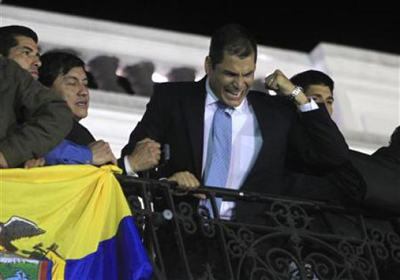
Using the standard CIA playbook on toppling democratically-elected governments in Latin America, the Obama administration, which was not happy with Ecuadorian President Rafael Correa’s moves to increase state control over oil companies in the nation and his decision to oust the United States military from its airbase at Manta, appears to have suffered a major defeat in the failed coup attempt in Ecuador by police officers and Air Force personnel who were backed by rightist elements in the National Assembly and business community. Correa was re-elected with an overwhelming majority last year after he gave the U.S. military its walking papers from the Manta airbase. The Pentagon and CIA have been working to topple Correa ever since by pumping money into opposition political parties and other groups through NGOs funded by the U.S. National Endowment for Democracy.
In a statement from Correa after his rescue from the Police Hospital in Quito by a military special operations team, the president warned of a larger conspiracy launched against him by his political opposition, saying the "attempt at destabilization is the result of a strategy that has been brewing for quite some time. A barrage of messages and misinformation have been given to the National Police, which today has been realized through violent actions from a conspiracy attempt."
Correa’s predecessor, the pro-U.S. Lucio Gutierrez, who is wedded to foreign oil company interests in the country, was accused by the government of covertly supporting the police and Air Force mutineers.
Although Secretary of State Hillary Clinton issued a weak statement saying the United States backed Correa, it came one day after Clinton heaped praise on former Secretary of State Henry Kissinger, the person who helped to craft the September 11, 1973 coup in Chile and the assassination of its progressive president Salvador Allende. In fact, Clinton and Obama had given military and political support to the right-wing junta that ousted democratically-elected progressive President Manuel Zelaya in Honduras in June 2009 and has fought against allowing the ousted democratically-elected president of Haiti, Jean-Bertrand Aristide, to return to his country from exile in South Africa after the CIA-engineered coup against him in 2004.
Clinton’s tepid response to the attempted coup against Correa was in marked contrast to the strong denunciations of the attempted coup and messages of support for Correa that came from Venezuela, Brazil, Argentina, Peru, Mexico, Bolivia, Cuba, and Spain.
- Riot police repel supporters of Ecuadorean President Rafael Correa from reaching the hospital where he took refuge for protection from police protesters, in Quito; September 30, 2010.

And the fact that Correa, like Venezuelan President Hugo Chavez, who was briefly ousted in an April 2002 coup organized by the CIA, was held as a virtual hostage at the Police Hospital in Quito for the greater part of a day provided a grim reminder of an old CIA tactic in staging coups in Latin America. Chavez was briefly held hostage on a Venezuelan island in the Caribbean while a U.S.-registered plane stood by to fly him into exile. In an emergency Latin American summit meeting in Argentina, Chavez saw the U.S. behind the events in Ecuador. He said, "The Yankee extreme right is trying right now, through arms and violence, to retake control of the continent." Chavez’s own experience with a CIA backed coup and the June 2009 coup, supported by the Pentagon, CIA, and Mossad against his ally Zelaya in Honduras, makes him an expert on CIA and Mossad tactics in the region. Informed sources have told WMR [1] that Correa and Chavez are currently comparing notes on the coups launched against them.
Ecuadorian intelligence will be looking closely at the wereabouts of key CIA personnel stationed at the CIA station at the US embassy in Quito and a smaller CIA station within the US Agency for International Development (USAID) mission in Guayaquil. In the 2002 coup attempt against Chavez, the US embassy’s top CIA and DIA officers were discovered to be helping to direct the coup from Venezuelan military installations.
Clinton’s State Department has been casting Ecuador in a bad light throughout the past two years, calling the country "difficult to do business in," the only real priority that the Obama administration cares about due to its total subservience to Wall Street and the fat cat bankers. The State Department’s "Investment Climate Statement" for Ecuador states: "Ecuador can be a difficult place in which to do business. . . There are restrictions or limitations on private investment in many sectors that apply equally to domestic and foreign investors . . . A 2006 hydrocarbons law imposed new conditions in the petroleum sector that have been problematic for many companies, complicated by a 2007 decree that imposed additional restrictions. A 2008 mining mandate stalled mining activity, and a new Mining Law is expected in early 2009. Negotiations for a free trade agreement between the United States and Ecuador, which would have included investment provisions, stopped in April 2006. The current Government of Ecuador has not expressed interest in restarting negotiations."
Correa’s financial policies, as well as his foreign policy that saw him order out the American base at Manta and establish close ties with Venezuela, Iran, and other countries inimical to American and Israeli hegemony, placed a huge CIA and Mossad target on Correa’s back. In June, Ecuador sponsored a resolution at the Organization of American State (OAS) summit in Lima condemning Israel’s attack on the Turkish aid flotilla transporting humanitarian aid to Gaza. Ten nations voted with Ecuador in support of the resolution.
- Ecuadorian army soldiers stand on the runway of the military airbase of the Mariscal Sucre International Airport to force its closure, in Quito; September 30, 2010.
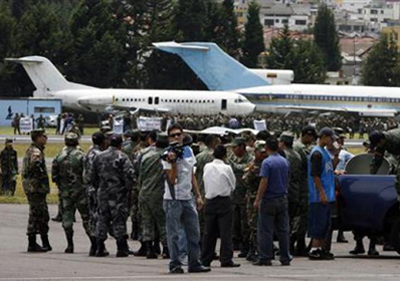
The uprising among Ecuadorian Air Force ranks, with Air Force personnel taking over and shutting down Quito’s international airport, will have Ecuadorian counter-intellligence personnel looking closely at the possible role of Israeli technicians and trainers who support the Air Force’s 26 Israeli-made Kfir combat planes. Israel also reportedly sold Python-3 air-to-air missiles to the Ecuadorian Air Force in 1997.
Mossad also has its hooks into the Ecuadorian National Police, where the main coup plotters received support. Mossad is chiefly tasked with spying on Ecuador’s large Ecuadorian-Arab community. The activities of the Mossad station at the Israeli embassy in Quito before and during the coup attempt will also draw the attention of counter-intelligence officers. Last year, Tel Aviv-based On Track Innovations received a contract to provide an electronic biometric-based electronic identification card system to Ecuador’s Central Registry Office.

Friday, October 01, 2010
More on the Coup attempt in Ecuador by Sabina Becker
Wow. Was today exciting or what?

Even in a gasmask, yowza.
Holy fucking moly. Just when I thought nothing was going on in the world, a fascist coup decided to go down (and fuck up) in Ecuador. The federal police took the president prisoner in the military hospital where he'd recently had knee surgery, and tear-gassed rioting ensued. So far, the Red Cross reports two dead (both police) and 88 injured. (Sadly, we can expect these tolls to rise.)
President Correa finally made it out of the hospital, with the help of a hefty contingent of loyal soldiers and citizens who fought it out barrel-to-barrel with the police in an intense firefight; he was spirited out from an underground parking garage in a grey truck. His rescuers pulled him out in a wheelchair with a gasmask on his face to protect him against the tear gas which the cops were shooting with no regard for the other patients at the hospital (including at least 20 newborn babies, so's you know. Yeah, those fascists value human life so much!)
I ended up spending the night hunched over a hot (and often balky) tweeter, RTing and translating headlines from Spanish to English. And biting my nails for President Correa, and vowing to kill anyone who harmed one hair on that fine head of his. And cursing the crappy reporting from all the Anglo sources, including the usual shitty suspects (Chicken Noodle Network; the fucking Torygraph, with its creative use of quotation marks) and the otherwise excellent (Al-Jazeera, HOW COULD YOU?) They all wrongly reported that Correa had cut police salaries; in fact, he has doubled them. And there is ample evidence that the CIA was behind this one, too...where is it ever not?
Anyhow, other than my own frenetic tweetlings, there was Otto, keeping score here, here, here and here. He was awesome in his own right, and I was thankful he was still tweeting when my birdie temporarily lost its cheep.
And how about those UNASUR leaders? In spite of tremendous political differences, they were unanimous in condemning the coup. They are meeting in Buenos Aires as I write this. Chavecito was first and loudest in condemning the coup; Fidel predicted it would fall apart quickly, and it did. Evo even suggested, in a ballsy move, that they all fly to Quito to make clear to the police that Correa was to be freed at once, no fucking around. (Just when I thought I couldn't possibly love those guys any more than I already did. That'll teach me.)
Needless to say, tomorrow's FLFB entry is all sewn up, and I won't be left scrounging for material as I'd feared I might. If anything, I'll have a surplus. Can you guess what I'll be blogging, kiddies? (Hint: Diabetics, please have your insulin syringes handy. You're gonna need 'em.)
Thursday, September 30, 2010
Obama administration fingerprints on Ecuador coup attempt
Using the standard CIA playbook on toppling democratically-elected governments in Latin America, the Obama administration, which was not happy with Ecuadorian President Rafael Correa's moves to increase state control over oil companies in the nation and his decision to oust the United States military from its airbase at Manta, appears to have suffered a major defeat in the failed coup attempt in Ecuador by police officers and Air Force personnel who were backed by rightist elements in the National Assembly and business community. Correa was re-elected with an overwhelming majority last year after he gave the U.S. military its walking papers from the Manta airbase. The Pentagon and CIA have been working to topple Correa ever since by pumping money into opposition political parties and other groups through NGOs funded by the U.S. National Endowment for Democracy.
In a statement from Correa after his rescue from the Police Hospital in Quito by a military special operations team, the president warned of a larger conspiracy launched against him by his political opposition, saying the "attempt at destabilization is the result of a strategy that has been brewing for quite some time. A barrage of messages and misinformation have been given to the National Police, which today has been realized through violent actions from a conspiracy attempt."
Correa's predecessor, the pro-U.S. Lucio Gutierrez, who is wedded to foreign oil company interests in the country, was accused by the government of covertly supporting the police and Air Force mutineers.
Although Secretary of State Hillary Clinton issued a weak statement saying the United States backed Correa, it came one day after Clinton heaped praise on former Secretary of State Henry Kissinger, the person who helped to craft the September 11, 1973 coup in Chile and the assassination of its progressive president Salvador Allende. In fact, Clinton and Obama had given military and political support to the right-wing junta that ousted democratically-elected progressive President Manuel Zelaya in Honduras in June 2009 and has fought against allowing the ousted democratically-elected president of Haiti, Jean-Bertrand Aristide, to return to his country from exile in South Africa after the CIA-engineered coup against him in 2004.
Clinton's tepid response to the attempted coup against Correa was in marked contrast to the strong denunciations of the attempted coup and messages of support for Correa that came from Venezuela, Brazil, Argentina, Peru, Mexico, Bolivia, Cuba, and Spain.
And the fact that Correa, like Venezuelan President Hugo Chavez, who was briefly ousted in an April 2002 coup organized by the CIA, was held as a virtual hostage at the Police Hospital in Quito for the greater part of a day provided a grim reminder of an old CIA tactic in staging coups in Latin America. Chavez was briefly held hostage on a Venezuelan island in the Caribbean while a U.S.-registered plane stood by to fly him into exile. In an emergency Latin American summit meeting in Argentina, Chavez saw the U.S. behind the events in Ecuador. He said, "The Yankee extreme right is trying right now, through arms and violence, to retake control of the continent." Chavez's own experience with a CIA backed coup and the June 2009 coup, supported by the Pentagon, CIA, and Mossad against his ally Zelaya in Honduras, makes him an expert on CIA and Mossad tactics in the region. Informed sources have told WMR that Correa and Chavez are currently comparing notes on the coups launched against them.
Ecuadorian intelligence will be looking closely at the wereabouts of key CIA personnel stationed at the CIA station at the US embassy in Quito and a smaller CIA station within the US Agency for International Development (USAID) mission in Guayaquil. In the 2002 coup attempt against Chavez, the US embassy's top CIA and DIA officers were discovered to be helping to direct the coup from Venezuelan military installations.
Clinton's State Department has been casting Ecuador in a bad light throughout the past two years, calling the country "difficult to do business in," the only real priority that the Obama administration cares about due to its total subservience to Wall Street and the fat cat bankers. The State Department's "Investment Climate Statement" for Ecuador states: "Ecuador can be a difficult place in which to do business. . . There are restrictions or limitations on private investment in many sectors that apply equally to domestic and foreign investors . . . A 2006 hydrocarbons law imposed new conditions in the petroleum sector that have been problematic for many companies, complicated by a 2007 decree that imposed additional restrictions. A 2008 mining mandate stalled mining activity, and a new Mining Law is expected in early 2009. Negotiations for a free trade agreement between the United State and Ecuador, which would have included investment provisions, stopped in April 2006. The current Government of Ecuador has not expressed interest in restarting negotiations." Correa's financial policies, as well as his foreign policy that saw him order out the American base at Manta and establish close ties with Venezuela, Iran, and other countries inimical to American and Israeli hegemony, placed a huge CIA and Mossad target on Correa's back. In June, Ecuador sponsored a resolution at the Organization of American State (OAS) summit in Lima condemning Israel's attack on the Turkish aid flotilla transporting humanitarian aid to Gaza. Ten nations voted with Ecuador in support of the resolution.
The uprising among Ecuadorian Air Force ranks, with Air Force personnel taking over and shutting down Quito's international airport, will have Ecuadorian counter-intellligence personnel looking closely at the possible role of Israeli technicians and trainers who support the Air Force's 26 Israeli-made Kfir combat planes. Israel also reportedly sold Python-3 air-to-air missile to the Ecuadorian Air Force in 1997.
Mossad also has its hooks into the Ecuadorian National Police, where the main coup plotters received support/ Mossad is chiefly tasked with spying on Ecuador's large Ecuadorian-Arab community. The activities of the Mossad station at the Israeli embassy in Quito before and during the coup attempt will also draw the attention of counter-intelligence officers. Last year, Tel Aviv-based On Track Innovations received a contract to provide an electronic biometric-based electronic identification card system to Ecuador's Central Registry Office.
Obama’s 2nd Latin American Coup attempt is in progress in Ecuador
Están tratando de tumbar al Presidente Correa. ¡Alerta los pueblos de la Alianza Bolivariana! ¡Alerta los pueblos de UNASUR! ¡¡Viva Correa!!
Ecuatorianos se dirigen en masa al hospital para rescatar a Correa
Por Cubadebate
Cientos de personas se congregaron hoy frente al palacio presidencial de Carondelet en Quito, para respaldar al jefe de Estado Rafael Correa frente a las protestas de policías y militares por la retirada de incentivos profesionales.
Funcionarios del Gobierno han llamado a dirigirse al Hospital donde se encuentra recluido el presidente ecuatoriano para “rescatarlo”, ya que el mismo Correa ha denunciado que se encuentra atrapado y que policías y manifestantes en su contra intentan ingresar a su habitación.
Gritando “¡Vamos Quito, Quito no se agueva carajo!”, los ecuatorianos a favor del Presidente han acudido a su ayuda.
Los manifestantes agredieron a unos cinco agentes policiales que no protestaban, sino que llegaban a Carondelet como protección de unas autoridades gubernamentales, según pudo constatar una periodista de Efe.
La manifestación de personas afines al presidente se realizó en reacción a las protestas por parte de centenares de policías y militares que ocuparon hoy un regimiento en Quito y obligaron al cierre del aeropuerto de la capital.
Los agentes huyeron corriendo mientras explotaba una bomba lacrimógena, que no está claro quién lanzó.
Al grito de “Correa, amigo, el pueblo está contigo”, cientos de personas expresaron su apoyo al jefe de Estado que previamente en el regimiento Quito, donde comenzó la protesta de los policías, advirtió que no cederá ante los reclamos.
La protesta de los policías y militares estalló después de que la Asamblea Nacional aprobase ayer la eliminación de incentivos en los ascensos y se extendiese el plazo para los mismos.
Según constató Efe, el palacio de Gobierno, situado en el centro colonial de Quito, no tiene resguardo policial en la parte exterior, en tanto que una veintena de militares dan seguridad en el interior.
Con información de Agencias
Tuesday, July 07, 2009
Ecuadorian President Rafael Correa on Global Capitalism, Why He Won’t Renew the US Base in Manta, Chevron in the Amazon, Obama’s War in Afghanistan
Ecuadorian President Rafael Correa on Global Capitalism, Why He Won’t Renew the US Base in Manta, Chevron in the Amazon, Obama’s War in Afghanistan, and More

In a national broadcast exclusive, we speak with the President of Ecuador, Rafael Correa. He was in New York attending the United Nations Conference on the World Financial and Economic Crisis and Its Impact on Development. In a wide-ranging interview, we speak with President Correa about global capitalism, his decision not to renew the license for the US military base in Manta, the $12 billion lawsuit against Chevron brought by thousands of Amazon residents for toxic oil pollution, Ecuador’s relationship with Colombia, and his advice to President Obama: “To learn more and come to better understand the region, and that [Obama] not let himself be taken along by the power of certain media outlets that are compromised with certain ideological fundaments, and that the heroes aren’t necessarily heroes, and the villains aren’t necessarily villains.” [includes rush transcript]
Guest:
Rafael Correa, President of Ecuador.
Rush Transcript
This transcript is available free of charge. However, donations help us provide closed captioning for the deaf and hard of hearing on our TV broadcast. Thank you for your generous contribution.Donate - $25, $50, $100, More...
AMY GOODMAN: We turn now to our national broadcast exclusive, a wide-ranging discussion with Ecuador’s President Rafael Correa, who today is in Nicaragua, a meeting with Zelaya.
Last week, President Correa was in New York attending the United Nations Conference on the World Financial and Economic Crisis and Its Impact on Development. Correa was the only world leader to attend the conference.
He spoke at the General Assembly last Thursday. And President Correa is an economist by training. He outlined the steps by which Latin America could free itself from relying on international financial institutions like the International Monetary Fund and the World Bank. The former finance minister of Ecuador was elected president in 2006, then reelected to a second term earlier this year.
I interviewed President Correa on Thursday in the Ecuadorian mission here in New York. It was before the coup in Honduras. I began by asking him to comment on the absence of so many heads of state at the UN conference. According to press reports, Western diplomats said the conference was just a platform to attack capitalism.
PRESIDENT RAFAEL CORREA: [translated] Well, if this is an attack on capitalism, I think it’s well deserved. Look at the problem it’s got us into. So I don’t understand those who say they’re not here because it might descend into an attack on capitalism. They must have a strong ideological bias, because certainly if they thought maybe there would be an attack on socialism, or had they thought it was going to be an attack on socialism, they would have been delighted to have come.
AMY GOODMAN: Talk about why you think at this point capitalism should be criticized, what you think needs to happen now.
PRESIDENT RAFAEL CORREA: [translated] Well, what we’ve undergone in recent decades worldwide has been totally insane, and all of this in function of capitalism. If you look at what was done with the workforce in Latin America, it was treated as a vulgar instrument for capital accumulation. Mechanism of exploitation were imposed, such as outsourcing, labor intermediation and the like. Efforts were made to destroy nation states, or at least to minimize nation states, especially in key areas such as the economy, on grounds that were closer to religion than to science, that everything would be resolved by the marketplace.
I could speak at much greater length on this, but the results are plain to see: greater inequality in Latin America. We haven’t resolved the unemployment problem. Indeed, unemployment is higher than in previous decades. We haven’t resolved the problem of poverty. We’ve lost a great deal of sovereignty by implementing policies that didn’t answer to our international reality.
And finally, we’re facing a crisis that we have not provoked, yet we are the main victims, the greatest crisis since the 1930s of last century, where there was a crisis in global capitalism. But it’s not been generated by factors external to the system, but by factors that are of the very essence of the system: exacerbated individualism, deregulation, competition and so on. This clearly shows us that something has to change.
AMY GOODMAN: Ecuador is joining ALBA, the Bolivarian alliance, seen as an alternative to the whole push to expand NAFTA to Latin America. Why? Talk about what you’re doing now.
PRESIDENT RAFAEL CORREA: [in English] Why not? [translated] Why not? We are friendly countries, sister countries. We coincide on many points of view. So why not take that step towards integration, and which, among other things, is moving forward much more quickly than other integration schemes that have made the mistake of wanting to include everyone so we are moving at the pace of those who don’t want integration? Those of us who have acceded to ALBA voluntarily want to see the integration of Latin American peoples. And it’s gone forward much more quickly than other integration arrangements. In any event, my answer is “why not?” Why not join ALBA?
Now I’ll tell you why. Just one piece of information to illustrate. At this time in the ALBA, we have 30 percent of all the votes in the Organization of American States. So we now have very specific weight in order to propose other points of view. For example, the Organization of American States—that’s just mentioned in the Organization of American States. But we could say something similar about the United Nations. That alone would justify our entering ALBA, but there are many additional factors.
AMY GOODMAN: You are not talking about a free trade agreement with the United States, but you are with the European Union. Why?
PRESIDENT RAFAEL CORREA: [translated] No, we’re not talking about a free trade agreement with the European Union; we’re talking about fair trade for development. And that’s how the agreement was originally posed. First, a block-to-block agreement between the European Union and the Andean community, with three pillars: a political dialogue, cooperation and trade. And this last one, trade, is understood as trade for development.
Unfortunately, all of that has been deteriorating. Among the reasons, because two of the Andean community countries already have a free trade agreement with the United States, and I’m referring to Colombia and Peru. And they have very little to lose in the negotiations with the European Union. So, the first thing that collapsed was the block-to-block negotiation.
And it’s clear that the emphasis was focused on the trade aspect. And I should also recognize that from the European Union, they tried to approach it as a free trade agreement, which has always been rejected by Ecuador. We’re interested in all three dimensions of the agreement: political dialogue, cooperation and trade. And within trade, we’re talking about fair trade, not the idea of free trade, which we see as simplistic, liberalizing everything. And we’re engaged in tough negotiations with the European Union on this.
Now, in the event that we’re not satisfied with the agreements that result, then we simply won’t sign. But I reiterate, we’re not negotiating a free trade agreement with the European Union.
AMY GOODMAN: The US contract with Ecuador over one of the largest US military bases in Latin America, Manta, expires later this year. You will not renew it. Why?
PRESIDENT RAFAEL CORREA: [translated] Why renew it? Now, if you’d like, I would renew it with one condition: that they allow me to set up an Ecuadorian military base here in New York. If there’s no problem with foreign bases, then let’s reach an agreement on that. I think that everybody listening is going to find that impossible. And for us Ecuadorians, it also seems impossible, based on our outlook informed by sovereignty, at least with the current government, to have a foreign military base on our soil.
AMY GOODMAN: You also recently threw out a US diplomat, Armando Astorga, calling him insolent and foolish and saying he treated Ecuador like a colony.
PRESIDENT RAFAEL CORREA: [translated] Yes. I don’t know if you’re aware that, among other things, because of the dismantling of the state that Ecuador has suffered in recent years, but money for certain police units to operate, including certain intelligence units, police and military, was provided by the US embassy. Well, this itself is sufficiently serious. But it wasn’t even unconditional or spontaneous assistance. Rather, they would choose the directors of those police units. They had them take lie-detector tests at the US embassy. So those units answered more to the US embassy than to the Ecuadorian state.
And we, in the exercise of our sovereignty, wanted to change the director of one of those units. Mr. Astorga, in a totally arrogant manner, sent a letter saying that we need to return or give back everything that the United States has given us—computers, automobiles and so on. Well, they should take it all back then. But Mr. Astorga would also have to leave the country, because we are no one’s colony.
AMY GOODMAN: Mr. President, do you think President Obama represents something different to Latin America and specifically to Ecuador?
PRESIDENT RAFAEL CORREA: [translated] Yes, I’m convinced that that is the case. Indeed, we’ve already begun very fruitful bilateral dialogues at a very high level, which never happened with the Bush administration. And not just that, there’s a question of building trust, and I think that President Obama offers trust. Personally, I think he is a transparent individual with the right intentions. So I think things are going to change in terms of foreign policy, US foreign policy, especially with respect to Latin America.
AMY GOODMAN: Let me ask you about President Chavez and his comments recently supporting the Iranian president Ahmadinejad. What are your views toward what’s happening right now in the disputed Iranian elections?
PRESIDENT RAFAEL CORREA: [translated] We’ve spoken with our chargé d’affaires in Tehran, and he tells me that it’s an exaggerated reaction, because President Ahmadinejad won by too large a margin. We’re talking about at least six million votes. All the surveys show that he was the winner. So this reaction on the part of the opposition can’t be explained. Now, I don’t want to meddle in internal Iranian affairs, but a response of this sort vis-à-vis such a broad victory is somewhat suspect.
In any event, it’s my understanding that the Council of Guard has ordered that the vote be recounted and so on. I would hope that things could be worked out peacefully and that a determination is reached as to who won that electoral contest. But I reiterate, the reports that we are getting from Tehran is that President Ahmadinejad’s victory is too broad, and therefore there’s no way to imagine that he could have lost or that he would have won by fraud.
AMY GOODMAN: And the killings of a number of the protesters, do you condemn that?
PRESIDENT RAFAEL CORREA: [translated] Well, one would have to see in what situation those deaths took place. We’re talking about a country of 80 million, in which there have been serious street protests. I am not familiar with the specific conditions in which the lamentable deaths have taken place. Everybody should lament their deaths and be in solidarity with the victims and their families. But obviously, if there’s protest and violence in a country of 80 million, it’s likely that such things can come to pass without that necessarily meaning repression, violations of human rights and so forth. But all the investigations should be undertaken to determine.
AMY GOODMAN: Let me ask you, Mr. President, about another violent crackdown, and it was in Peru against those in the Amazon who were protesting the opening up of the area to mining interests, that has ultimately led to the resignation of the prime minister. Do you condemn President Garcia for what happened in Peru?
PRESIDENT RAFAEL CORREA: [translated] Well, I insist we are not going to meddle in the internal matters of any country. That will have to be worked out within Peru’s institutional framework determining the responsibilities that lie in this matter.
AMY GOODMAN: Now, you know exploitation by large corporations in your own country. Tens of thousands of indigenous people have brought suit against Chevron, now ChevronTexaco. An expert appointed by the Ecuadorian judge has said that Chevron should pay $27 billion. Where do you stand on this?
PRESIDENT RAFAEL CORREA: [translated] This is private litigation brought by social organizations in the Amazon region against this transnational corporation, Texaco Chevron. And there, the Ecuadorian government has nothing to do, in judicially speaking. Obviously, we have borne witness to the harm caused in the Amazon, and we’re in solidarity with those social organizations. But I reiterate, as the executive branch, we are not a party, and we cannot meddle in judicial matters.
AMY GOODMAN: You have gone to the area, though, and shown support. What is the harm done?
PRESIDENT RAFAEL CORREA: [translated] It’s terrible. The oil companies continue doing whatever they please. But at that time, it was really the law of the jungle. There was no processing of waste, of contaminated water. Everything was dumped in the rivers. There were pits created that were totally non-technical. If you go into the Ecuadorian Amazon and you stick your hand in the ground, what you get is oil sludge. They dumped the oil wherever with total impunity, because there was no oversight by the state. And these countries really did abuse the country. These countries have done in our country something they never would have dared to have done even by far in the United States. And it is time that they answer to the justice system.
AMY GOODMAN: Have you heard about Shell settling with the Saro-Wiwa family, the Nigerian activist who was killed in Nigeria fourteen years ago? He was protesting Shell’s exploitation of the Niger Delta. And they just settled for something like $15 million to be paid to the family and the Ogoni people. Do you see that as a positive example?
PRESIDENT RAFAEL CORREA: [translated] Well, of course. I’m not familiar with the case, but, of course, for these countries need to be held accountable for and answer for everything they’ve done, because I am indignant as a Latin American about the dual reality of certain transnationals. It’s not that they couldn’t have done it otherwise. The technology existed, the measures were available, to prevent environmental harm and so forth. But they didn’t want to do so, probably because we’re poor countries, so they consider that we’re inferior. But what they did in our country, they never would have dared to have done that in the United States.
AMY GOODMAN: We’ll return to my conversation with the Ecuadorian president Rafael Correa after break.
[break]
AMY GOODMAN: We return to our national broadcast exclusive, my conversation with the Ecuadorian President Rafael Correa.
AMY GOODMAN: Now, indigenous people, campesinos, recently protested your policies around the issue of large-scale mining and opening up the region. You called them extremists and nobodies.
PRESIDENT RAFAEL CORREA: [translated] I didn’t call them “nobody.” I said they didn’t represent anyone. And the last elections gave [inaudible] right. The person who headed up the effort against mining won only four percent, and we won, by overwhelmingly so, in all the mining regions. And the areas with the greatest protests are in the province of Azuay. That’s where we have good, strong support. So, clearly the population trusts us. But three or four people are enough to make a lot of noise, to appear in the media, and so on. But, quite sincerely, they don’t have the popular backing or the representation.
In any event, there are many contradictions on these kinds of positions. First, it’s not that we’re inaugurating mining in Ecuador. Mining goes back to the Preclassic Inca period in Ecuador. To the contrary, finally, we’re regulating mining in Ecuador—because it was a matter of total anarchy—with a very tough law that protects the state, that protects the environment, that protects society.
Second, one of the main criticisms of the groups that oppose mining, or, as you put it, large-scale mining, is the environmental impact of mining. But this is where the contradiction comes up. Small-scale mining causes much more pollution than large-scale mining. So if that’s the reason why they oppose large-scale mining, there is a big contradiction there. And if you begin to analyze, some of these leaders—not all of them, but some—have their own interests in small-scale mining.
So I would say, in general—indeed, we’ve carried out surveys—there’s more than 70 percent support for the new mining law, but as I say, three or four fundamentalists who take over a highway are enough to appear in the newspaper and for them to say that there’s opposition to such mining in Ecuador.
AMY GOODMAN: President Correa, in the Wall Street Journal, there was just a piece talking about documents that the Colombian government uncovered on a laptop when Colombia raided Ecuador and killed a FARC leader, linking you to the FARC. What is your response?
PRESIDENT RAFAEL CORREA: [translated] If they show that I have some connection to the FARC, then I’ll step down. It’s a big lie, and we have presented a denunciation through the Foreign Ministry. And if they don’t rectify that, we will take the appropriate legal actions. We are tired of such infamies, which are not based on facts. They’re based on interests that seek to treat certain governments which are their allies as superheroes and other governments as villains.
So, we think that a daily newspaper should report the news, not play at geopolitics. In any event, the editorial—I think it was an editorial—is based on information that long ago was shown to be unreliable: supposed computers with supposed messages in which supposedly there is talk of a former member of the national government, not the president of the republic, negotiating with the FARC. Indeed, those computers also talk about—supposedly talk about the Workers’ Party of Lula da Silva having ties with FARC, but they don’t say that. So, as I say, it’s really just a geopolitical game that they’re pursuing.
And the woman who wrote the article recently admitted to RCN that she published that article resenting President Obama, because he called me to offer his support upon my reelection. And this is an extremely right-wing journalist who’s angry because he didn’t call Alvaro Uribe. Instead, he called Rafael Correa. That reflects the level of professionalism of the person who wrote that.
AMY GOODMAN: How do you think peace can be achieved in Colombia, and do you think the US can play a role in that? I mean, the US has poured a tremendous amount of money into the war on terror there, into the war on drugs, so-called, so-called. What do think could achieve peace in Colombia?
PRESIDENT RAFAEL CORREA: [translated] Einstein said if somebody time and again does something, or tries to do something, with the same negative results, and continues to insist on doing so, then he’s a fool. This strategy carried out, applied by the United States in Colombia has been a total failure. Drugs have not been eradicated. It could be that the FARC have been weakened. But quite sincerely, I don’t think there’s any military solution to the conflict with the FARC, but rather a political solution. And what they have accomplished in pursuing a military solution is extending the conflict to neighboring countries and destabilizing the region.
Ecuador has about 700 kilometers of border with Colombia, and a lot of it is impenetrable jungle. Colombia’s strategy has been to attack the FARC from north to south. They have two military units in the south, but far from the border. We have thirteen. So, it seems to be a strategy to try to draw us into the conflict.
So I hope that the United States and the Obama administration understand this, that as [inaudible] into drawing us in neighboring countries into this conflict, which is not our own, which pains us greatly, but it’s not ours, and that they carefully analyze the matter, whether the anti-drug strategy, despite the billions spent, has yielded no results and whether this conflict with the FARC has any military solution.
AMY GOODMAN: Last two questions. One is, do you support President Obama expanding the war into Afghanistan and Pakistan?
PRESIDENT RAFAEL CORREA: Can you say again, please?
AMY GOODMAN: Do you support President Obama expanding the war in Afghanistan and Pakistan?
PRESIDENT RAFAEL CORREA: [translated] Well, I’m a pacifist by nature. I would hope that the Afghanistan problem could be solved as quickly as possible. I also think the strategy there, as in Iraq, was totally mistaken, that the United States has a big problem on its hands that’s going to be very complex to resolve. But I’m practically convinced that it’s not going to be resolved by more war.
AMY GOODMAN: And finally, your overall advice to the new President of the United States, President Obama, in how he approaches Latin American and, just overall, how he approaches the world?
PRESIDENT RAFAEL CORREA: [translated] Well, I’m not accustomed to giving advice to those who haven’t asked for it. I would just want to wish President Obama the best of luck, and that he should bear in mind that just as he is a good person, there are many of us presidents in Latin America who are also good people.
AMY GOODMAN: And is there one single message you could give to President Obama to improve relations with Latin America, what he could do?
PRESIDENT RAFAEL CORREA: [translated] To learn more and come to better understand the region, and that he not let himself be taken along by the power of certain media outlets that are compromised with certain ideological fundaments, and that the heroes aren’t necessarily heroes, and the villains aren’t necessarily villains, that he should get to know the region better and get to understand the region a little better.
AMY GOODMAN: President Correa, thank you very much.
PRESIDENT RAFAEL CORREA: Thank you.
AMY GOODMAN: Ecuadorian President Rafael Correa. He’s in Nicaragua today meeting with other Latin American leaders as well as the ousted Honduran President Manuel Zelaya over the coup in Honduras. Meanwhile in Washington, DC, President Obama is meeting with Colombian President Alvaro Uribe.
Saturday, June 14, 2008
INTERPOL Clarifies it Never Determined Authenticity of Laptops that Implicate Venezuela AND Uribe is Planning to Assassinate Chavez
INTERPOL Clarifies it Never Determined Authenticity of Laptops that Implicate Venezuela
June 12th 2008, by James Suggett - Venezuelanalysis.com
Mérida, June 12, 2008 (venezuelanalysis.com)-- Representatives of the International Police Organization (Interpol) told Ecuadorian Presidential Adviser Fernando Bustamante in a meeting last week that its investigation of laptop computers which Colombia claims belonged to the FARC "does not determine if the computers provided were found in the guerrilla camp of the FARC during the incursion on March 1st, if they effectively belonged to Raúl Reyes, and even less so their contents," according to a recent missive released by the Ecuadorian Foreign Relations Ministry.
Bustamante, the chief advisor to Ecuadorian President Rafael Correa, met with INTERPOL representatives last Tuesday during a United Nations conference in New York. At the meeting, INTERPOL "confirmed that their forensic informational analysis does not imply the validity or the exactitude of the user files that [the computers] contain," the Ecuadorian government disclosed.
Today, Venezuela's Vice-President, Ramón Carrizalez, echoed Bustamante's evaluation when he said about the computer files, "This is an information that no serious person can validate. Anyone who knows how to read and write and who has some common sense will notice that these are proofs that cannot be used anywhere in the world."
The Colombian government claims the files prove that Venezuela financed the Revolutionary Armed Forces of Colombia, or FARC, and that Ecuador provided refuge for the insurgents. Colombia also claims to have found the computers in the wreckage of a FARC camp inside Ecuador that the Colombian armed forces bombarded last March 1st, killing FARC second-in-command Raúl Reyes, to whom Colombia says the computers belonged.
INTERPOL clarified to Bustamante that the report was an act of "independent technical assistance" and that it only confirmed that after March 3rd, Colombia complied with international standards for the treatment of evidence. Proper handling of the evidence could not be determined for the period between the attack and March 3rd.
"Between March 1st and 3rd... there are no indications that user files have been created, modified, or eliminated, but neither is there evidence that demonstrates that this has not been done," INTERPOL told Bustamante.
Based on this clarification, the Ecuadorian government reiterated Tuesday its "position of not granting any legal validity to the information found in the computers supposedly belonging to Raúl Reyes." Ecuadorian Foreign Relations Minister María Isabel Salvador previously set this policy in mid-May when the INTERPOL report was first released.
The Ecuadorian government also reiterated its concern over Colombia's manipulation of the results of INTERPOL's report to make it look like the report proved the accusations against Venezuela and Ecuador, a falsity that has been perpetuated by the mainstream international media.
Bustamante suggested that Ecuador should have been allowed to participate in the investigation, to which the INTERPOL delegates replied that Ronald Noble, the General Secretary of INTERPOL, would be willing to visit Ecuador to discuss the details of the report.
Meanwhile, President Correa echoed Venezuelan President Hugo Chávez's recent call for the liberation of all FARC hostages yesterday after meeting with the father of a Colombian soldier who has been held prisoner by the FARC for 10 years.
Correa also asserted that Ecuador "is not going to ask anybody's permission [to continue with] the humanitarian action that is incomplete," referring to the process of humanitarian hostage releases underway before Colombia's March 1st attack, which ended the humanitarian exchange.
FARC: Uribe is Planning to Assassinate Chavez
FARC leader Iván Márquez, who had met with Chávez to discuss hostage release last year, alleged in a communiqué last weekend that President Uribe "attempted and continues trying to kill" Chávez and Correa with the help of the United States.
The Colombian Department of Security Administration (DAS) has already infiltrated Caracas with 100 paramilitary forces to assassinate Chávez, and a similar plan exists for Correa, Márquez alleged.
In the statement, Márquez also railed that the laptops examined by INTERPOL are fake and used by Uribe to threaten neighbors and to cover up the political scandal in Colombia in which Uribe allies have recently been convicted of contracting paramilitaries to perform politically motivated assassinations.
Ecuador and Colombia expressed their willingness to renew diplomatic relations last Friday with arbitration by former U.S. President Jimmy Carter's Carter Center, which commented that both presidents were open to "the possibility of immediately re-establishing diplomatic relations between both governments without preconditions."
Source URL: http://www.venezuelanalysis.com/
Printed: June 12th 2008
License: Published under a Creative Commons license (by-nc-nd). See creativecommons.org for more information.
June 12th 2008, by James Suggett - Venezuelanalysis.com
Mérida, June 12, 2008 (venezuelanalysis.com)-- Representatives of the International Police Organization (Interpol) told Ecuadorian Presidential Adviser Fernando Bustamante in a meeting last week that its investigation of laptop computers which Colombia claims belonged to the FARC "does not determine if the computers provided were found in the guerrilla camp of the FARC during the incursion on March 1st, if they effectively belonged to Raúl Reyes, and even less so their contents," according to a recent missive released by the Ecuadorian Foreign Relations Ministry.
Bustamante, the chief advisor to Ecuadorian President Rafael Correa, met with INTERPOL representatives last Tuesday during a United Nations conference in New York. At the meeting, INTERPOL "confirmed that their forensic informational analysis does not imply the validity or the exactitude of the user files that [the computers] contain," the Ecuadorian government disclosed.
Today, Venezuela's Vice-President, Ramón Carrizalez, echoed Bustamante's evaluation when he said about the computer files, "This is an information that no serious person can validate. Anyone who knows how to read and write and who has some common sense will notice that these are proofs that cannot be used anywhere in the world."
The Colombian government claims the files prove that Venezuela financed the Revolutionary Armed Forces of Colombia, or FARC, and that Ecuador provided refuge for the insurgents. Colombia also claims to have found the computers in the wreckage of a FARC camp inside Ecuador that the Colombian armed forces bombarded last March 1st, killing FARC second-in-command Raúl Reyes, to whom Colombia says the computers belonged.
INTERPOL clarified to Bustamante that the report was an act of "independent technical assistance" and that it only confirmed that after March 3rd, Colombia complied with international standards for the treatment of evidence. Proper handling of the evidence could not be determined for the period between the attack and March 3rd.
"Between March 1st and 3rd... there are no indications that user files have been created, modified, or eliminated, but neither is there evidence that demonstrates that this has not been done," INTERPOL told Bustamante.
Based on this clarification, the Ecuadorian government reiterated Tuesday its "position of not granting any legal validity to the information found in the computers supposedly belonging to Raúl Reyes." Ecuadorian Foreign Relations Minister María Isabel Salvador previously set this policy in mid-May when the INTERPOL report was first released.
The Ecuadorian government also reiterated its concern over Colombia's manipulation of the results of INTERPOL's report to make it look like the report proved the accusations against Venezuela and Ecuador, a falsity that has been perpetuated by the mainstream international media.
Bustamante suggested that Ecuador should have been allowed to participate in the investigation, to which the INTERPOL delegates replied that Ronald Noble, the General Secretary of INTERPOL, would be willing to visit Ecuador to discuss the details of the report.
Meanwhile, President Correa echoed Venezuelan President Hugo Chávez's recent call for the liberation of all FARC hostages yesterday after meeting with the father of a Colombian soldier who has been held prisoner by the FARC for 10 years.
Correa also asserted that Ecuador "is not going to ask anybody's permission [to continue with] the humanitarian action that is incomplete," referring to the process of humanitarian hostage releases underway before Colombia's March 1st attack, which ended the humanitarian exchange.
FARC: Uribe is Planning to Assassinate Chavez
FARC leader Iván Márquez, who had met with Chávez to discuss hostage release last year, alleged in a communiqué last weekend that President Uribe "attempted and continues trying to kill" Chávez and Correa with the help of the United States.
The Colombian Department of Security Administration (DAS) has already infiltrated Caracas with 100 paramilitary forces to assassinate Chávez, and a similar plan exists for Correa, Márquez alleged.
In the statement, Márquez also railed that the laptops examined by INTERPOL are fake and used by Uribe to threaten neighbors and to cover up the political scandal in Colombia in which Uribe allies have recently been convicted of contracting paramilitaries to perform politically motivated assassinations.
Ecuador and Colombia expressed their willingness to renew diplomatic relations last Friday with arbitration by former U.S. President Jimmy Carter's Carter Center, which commented that both presidents were open to "the possibility of immediately re-establishing diplomatic relations between both governments without preconditions."
Source URL: http://www.venezuelanalysis.com/
Printed: June 12th 2008
License: Published under a Creative Commons license (by-nc-nd). See creativecommons.org for more information.
Friday, April 25, 2008
WILL THE CIA KILL OR OUST ECUADOR'S PRESIDENT Rafael Correa?
Will the CIA Kill or Oust Ecuador's President?
by Jacob G. Hornberger
Ecuador's president Rafael Correa may not be long for this world, both in a political sense and in genuine life-or-death sense. He recently fired his defense minister, army chief of intelligence, and commanders of the army, air force, and joint chiefs.
Why might those firings cost Correa his job or even his life? Because the reason he fired them was that Ecuador's intelligence systems were "totally infiltrated and subjugated to the CIA." As other rulers around the world, including democratically elected ones, have learned the hard way, bucking the CIA is a real no-no that sometimes leads to coups and assassinations.
What's the CIA doing infiltrating Ecuador's military intelligence systems? Good question! Maybe it's because the CIA still fears the threat of communism. Don't forget that that was the apparent rationale for the U.S. government's support of Operation Condor, the campaign of assassination and torture co-sponsored by the brutal regimes in Chile, Argentina, Paraguay, Bolivia, Uruguay, Brazil, Ecuador, and Peru during the 1970s. Don't forget also that many of the brutal military personnel in those regimes received their training at the U.S. Army's infamous School of the Americas, famous for, among other things, its torture manuals.
To make matters worse for Correa, he promises to throw the U.S. military out of his country when the U.S. government's lease at its base in Manta expires in 2009. The U.S. government spent $60 million to build the base in 1999, securing a 10-year lease that provided no rent to be paid to Ecuador.
So, why does the U.S. military have a $60 million military base in Ecuador? The base is part of the U.S. government's much-vaunted 30-year-old war on drugs, one of the U.S. Empire's never-ending wars around the world. The base houses Awacs surveillance planes whose purported mission is to search for international drug smugglers.
What irked President Correa is that apparently his CIA-infested intelligence services fed classified information to Colombian officials that led to a Colombian military attack on a Colombian rebel camp that was located inside Ecuador. One big problem was that when Correa's intelligence services leaked the information to Colombia, they left Correa (their boss) out of the loop.
The final nail in Correa's coffin might be the fact that he is an ally of Venezuela's Marxist president Hugo Chavez, who himself is a likely target of CIA ouster or assassination.
The good news for Americans in all this is that the Ecuadorian people are doing their best to rid their country of the CIA and the U.S. military. Maybe the Ecuadorans will start a trend in which all other countries will do the same. While it would obviously be best if the American people were to dismantle their government's overseas empire themselves, having foreigners do it instead by throwing the CIA and the Pentagon out of their countries would be just as effective and beneficial — to both the United States and the people of the world.
by Jacob G. Hornberger
Ecuador's president Rafael Correa may not be long for this world, both in a political sense and in genuine life-or-death sense. He recently fired his defense minister, army chief of intelligence, and commanders of the army, air force, and joint chiefs.
Why might those firings cost Correa his job or even his life? Because the reason he fired them was that Ecuador's intelligence systems were "totally infiltrated and subjugated to the CIA." As other rulers around the world, including democratically elected ones, have learned the hard way, bucking the CIA is a real no-no that sometimes leads to coups and assassinations.
What's the CIA doing infiltrating Ecuador's military intelligence systems? Good question! Maybe it's because the CIA still fears the threat of communism. Don't forget that that was the apparent rationale for the U.S. government's support of Operation Condor, the campaign of assassination and torture co-sponsored by the brutal regimes in Chile, Argentina, Paraguay, Bolivia, Uruguay, Brazil, Ecuador, and Peru during the 1970s. Don't forget also that many of the brutal military personnel in those regimes received their training at the U.S. Army's infamous School of the Americas, famous for, among other things, its torture manuals.
To make matters worse for Correa, he promises to throw the U.S. military out of his country when the U.S. government's lease at its base in Manta expires in 2009. The U.S. government spent $60 million to build the base in 1999, securing a 10-year lease that provided no rent to be paid to Ecuador.
So, why does the U.S. military have a $60 million military base in Ecuador? The base is part of the U.S. government's much-vaunted 30-year-old war on drugs, one of the U.S. Empire's never-ending wars around the world. The base houses Awacs surveillance planes whose purported mission is to search for international drug smugglers.
What irked President Correa is that apparently his CIA-infested intelligence services fed classified information to Colombian officials that led to a Colombian military attack on a Colombian rebel camp that was located inside Ecuador. One big problem was that when Correa's intelligence services leaked the information to Colombia, they left Correa (their boss) out of the loop.
The final nail in Correa's coffin might be the fact that he is an ally of Venezuela's Marxist president Hugo Chavez, who himself is a likely target of CIA ouster or assassination.
The good news for Americans in all this is that the Ecuadorian people are doing their best to rid their country of the CIA and the U.S. military. Maybe the Ecuadorans will start a trend in which all other countries will do the same. While it would obviously be best if the American people were to dismantle their government's overseas empire themselves, having foreigners do it instead by throwing the CIA and the Pentagon out of their countries would be just as effective and beneficial — to both the United States and the people of the world.
Friday, March 09, 2007
Organización popular para defenderse de depredadores, colonizadores y explotadores. Ecuador: «Agua Tierra y Vida»
En Patricia Pilar, del Ecuador que nace, donde el pueblo resiste a la construcción de la Presa Baba y a la destrucción de su habitat y su medio ambiente, surgió la organización AGUA TIERRA Y VIDA, de la decisión de organizaciones de Intag, Angamarca, Morona, Zamora, Sucumbíos, Guayaquil, Santa Elena... Conozcamos su voluntad de organización y lucha, su proyecto de vida para defender el agua y la tierra que son de todas, de todos...
Declaración fundacional
El agua es vida, constituye un bien natural y el acceso a ella es un derecho humano.
El acceso a la tierra, como fuente de trabajo y producción, es también un derecho fundamental de la sociedad.
Por tanto, privatizar el agua, convirtiéndola en mercancía, y acaparar la tierra para el goce de unos pocos es atentar contra la vida de las mayorías.
Esto es lo que viene dándose en nuestro país, sobre todo en las dos últimas décadas, bajo el imperio del neoliberalismo que, en este campo, significa la privatización de bienes naturales y empresas públicas a favor de monopolios multinacionales y de la oligarquía criolla, con la complicidad de gobiernos, autoridades judiciales, congresos antisociales y vendepatrias.
Como consecuencia de lo dicho, ha crecido la ruina, el empobrecimiento y la marginalidad de las comunidades urbanas y rurales, de los pueblos indígenas y afrodescendientes, de los montubios y los cholos peninsulares.
En tanto, se multiplica la emigración masiva del campo a la ciudad, y de todo el país hacia Estados Unidos, España, Italia, a dondequiera que se vislumbre una posibilidad de escapar de la miseria y el desempleo, aunque para ello se destrocen las comunidades y las familias.
Por lo demás, esta situación se ha generalizado en el Continente, desde México hasta la Patagonia, en el extremo sur, mediante sistemas que se aplican por igual en todo lado y del que hoy, afortunadamente, van saliendo los pueblos gracias a su acción y al concurso de gobiernos que se orientan hacia la soberanía, la justicia y la democracia plena.
Tales sistemas son:
MENOSPRECIO A LOS PROPIETARIOS ANCESTRALES DE LOS BIENES NATURALES, CUYO CONSENTIMIENTO JAMÁS BUSCAN NI PIDEN LOS PRIVATIZADORES. ESTO OCURRE PARTICULARMENTE EN LA EJECUCIÓN DE MEGAPROYECTOS, SUPUESTAMENTE ENCAMINADOS AL DESARROLLO.
REPRESIÓN Y CRIMINALIZACIÓN DE LOS LÍDERES COMUNITARIOS POR MEDIO DEL JUICIO FABRICADO, LA CÁRCEL, LA PERSECUCIÓN ECONÓMICA Y EL ASESINATO.
DEPREDACIÓN DE RECURSOS NATURALES, DESTRUCCIÓN DE BOSQUES Y MANGLARES, CONTAMINACIÓN DE RÍOS, AIRE Y SUELOS. OTORGAMIENTO DE LICENCIAS AMBIENTALES COMO MERO FORMULISMO, QUE NADIE SUPERVISA Y QUE JAMÁS SE APLICA.
CONCESIÓN DE SERVICIOS BÁSICOS COMO EL MANEJO DEL AGUA POTABLE A FAVOR DE EMPRESAS MULTINACIONALES, IGUAL QUE EN EL CASO DE LA BECHTEL, EL PULPO NORTEAMERICANO QUE OPERA LO MISMO EN GUAYAQUIL, DONDE SE CAMUFLA COMO INTERAGUA, QUE EN EL IRAK DESTRUIDO POR LAS TROPAS DEL IMPERIO.
COMPLICIDAD DE GRANDES MEDIOS DE COMUNICACIÓN, CUYOS INTERESES ESTÁN FUSIONADOS CON LOS DE LA BANCA PRIVADA O LOS GRANDES EXPORTADORES.
La irracionalidad de esta situación salta a la vista. Basta ver el ejemplo de la creciente industria del agua embotellada en el Ecuador, cuyo consumo popular se ha generalizado y que cuesta más que la gasolina. O este otro ejemplo conocido, según el cual la Coca Cola, gigantesca empresa mundial, despilfarra diez litros de agua para obtener uno de su bebida, mientras grandes provincias y regiones ecuatorianas perecen de sed, como ocurre en Manabí, Tungurahua, Loja o la Península de Santa Elena.
En cuanto a la tierra, unos pocos agroexportadores van constituyendo latifundios mediante el despojo a los pequeños propietarios o la compra de sus parcelas a precios miserables.
Esta situación no puede continuar:
¡BASTA YA DE ACEPTAR SUMISOS EL SAQUEO Y LA EXPLOTACIÓN POR PARTE DE LOS AMOS DEL PAÍS!
¡BASTA YA DE CREAR HIJAS E HIJOS DESTINADOS AL HAMBRE Y AL ÉXODO!
Por eso desde PATRICIA PILAR, rincón de Patria que se ha convertido en símbolo de lucha al levantarse contra la Presa Baba, ALZAMOS NUESTRA BANDERA DE REBELDÍA Y CONSTITUIMOS EN ESTA FECHA LA ORGANIZACIÓN DENOMINADA AGUA TIERRA Y VIDA, con la participación combativa de organizaciones sociales de Zamora-Chinchipe, Morona-Santiago, Imbabura, Cotopaxi, Guayas, Manabí y Los Ríos.
Al nacer nos comprometemos a luchar activamente y unidos por la liberación del pueblo ecuatoriano, contra el imperialismo y el neoliberalismo.
Estamos convencidos de que no se puede privar a un pueblo de sus propios medios de subsistencia para alimentarse y vivir con dignidad, no como mendigos.
El Estado está obligado a garantizar a todos el acceso al agua y a la tierra, así como a mantener políticas de soberanía alimentaria.
Estamos igualmente convencidos de que el gobierno de Rafael Correa, con el apoyo y la participación de todo el pueblo, posibilitará el nacimiento de la Patria Nueva que siempre nos negaron los amos del país.
Y para ello debemos exigir la pronta realización de la Asamblea Constituyente de plenos poderes y en ella, la participación de los sectores marginados de la decisión política pero no de proveer de alimentos a todas y todos. De allí que en este encuentro fundacional, hemos adoptado las siguientes resoluciones:
ORGANIZACIÓN DE IGUALES
1. Construir una organización de iguales: participativa, unitaria, democrática, justa, libre, patriótica, defensora de la Soberanía Nacional y la dignidad de los pueblos y nacionalidades del Ecuador y solidaria con las luchas y demandas de los sectores agrarios y pueblos de Nuestra América y el Mundo.
ACCESO AL AGUA SIN DUEÑOS
2. Luchar para que se reconozca como política de Estado el acceso al agua segura, en cantidad y calidad suficiente a toda la población; proteger, fortalecer y promover los sistemas comunitarios de distribución de agua para el consumo humano, riego y saneamiento, y el manejo comunitario y la protección de las cuencas hídricas bajo las premisas de preservación, conservación, uso y recuperación, ésto es, gestión integral del agua. Evitar cualquier forma de privatización y exigir que bajo ningún concepto se realicen acuerdos, tratados o concesiones a proyectos hidroeléctricos y mineros para el uso del agua o del subsuelo con fines mercantiles.
AGUA: ELEMENTO INALIENABLE E IMPRESCRIPTIBLE DE ACCESO EQUITATIVO
3. Trabajar y luchar en unidad para que en la Nueva Constitución se declare al agua como elemento vital de dominio público, inalienable e imprescriptible. Promover un nuevo modelo de gestión del riego que garantice el acceso equitativo al agua y también la productividad de la tierra.
SOBERANÍA ALIMENTARIA
4. Trabajar y luchar en unidad para que el Estado y la Nueva Constitución reconozcan integralmente la soberanía alimentaria como eje transversal de las políticas públicas.
FRENAR CRECIMIENTO DE LATIFUNDIOS CON ACCESO A LA TIERRA PARA EL CAMPESINADO POBRE. REDISTRIBUIR EL ESPACIO HABITABLE.
5. Frenar el crecimiento de los latifundios y combatir los mecanismos de fracturación que permiten el tráfico de tierras. Defender el acceso a la tierra al campesinado pobre, el derecho ancestral y derecho consuetudinario de la tenencia de la tierra. Trabajar por la redistribución justa y equitativa del espacio habitable para poner un alto a la especulación inmobiliaria.
PROTECCIÓN NACIONAL DE LA TIERRA ANCESTRAL Y ÁREAS PROTEGIDAS ENTREGADAS A PRIVATIZADORES.
6. Trabajar y luchar en unidad para que el Estado conjuntamente con las comunidades y sus organizaciones revise las concesiones y adjudicaciones de las cuencas hidrográficas, territorios, tierras ancestrales y áreas protegidas otorgadas o por otorgar a empresas privadas de capitales nacionales y extranjeros para su uso y explotación minera o de cualquier índole, a costa del desalojo humano, la destrucción y contaminación del hábitat y el medio ambiente.
Declarar éstas nulas en caso de que el Estado no haya obtenido el consentimiento pleno y total de las poblaciones afectadas, sin presión de ninguna especie, o que se haya dado bajo procedimientos irregulares y lesivos al interés de las comunidades.
El derecho a la propiedad de la tierra no da derecho a la destrucción de la naturaleza para satisfacer mezquinos intereses.
DEFENDER LOS INTERESES NACIONALES Y LOS DERECHOS HUMANOS Y COLECTIVOS
7. Expulsar del Ecuador a las compañías que afecten los derechos humanos y colectivos de las poblaciones, la soberanía y los intereses nacionales de las presentes y futuras generaciones.
ECUADOR ESTADO SOCIAL DE DERECHO Y JUSTICIA. NUEVA CONSTITUCIÓN CON SOBERANÍA, INMUNIDAD E INEMBARGABILIDAD DEL ESTADO ECUATORIANO DE TODAS Y TODOS.
8. Luchar para que en la Nueva Constitución se reconozca la soberanía, la inmunidad e inembargabilidad del Estado Ecuatoriano con el fin de evitar que a nivel internacional se lo enjuicie por tomar medidas soberanas que benefician a sus habitantes y a las generaciones venideras.
Luchar para que en el artículo uno de la Constitución se reconozca al Ecuador como un Estado Social de Derecho y Justicia.
BASTA DE CRIMINALIZAR NUESTRA LUCHA Y DIRIGENTES. BASTA DE CRÍMNES DESARMANDO A PARAMILITARES Y PARAPOLICIAS.
9. Poner fin a la criminalización de los dirigentes de las comunidades y organizaciones que luchan por el agua, la tierra y la vida. Demandar el archivo de todos los procesos judiciales iniciados en su contra y exigir garantías para su seguridad personal y familiar.
Desarmar las organizaciones paramilitares y parapoliciales, encubiertas como ‘compañías de seguridad’, las mismas que agreden a los dirigentes y a las comunidades que luchan por la defensa de sus legítimos derechos.
Requerir el esclarecimiento y sanción a los responsables de los asesinatos y atentados contra la integridad de los dirigentes campesinos y sociales del Ecuador.
DISOLVER INSTITUCIONES DEL ESTADO QUE SIRVEN A FAMILIAS OLIGARCAS.
10. Luchar y trabajar en unidad para disolver las instituciones del Estado que fueron creadas para servir a reducidos grupos de poder oligárquico, como la CEDEGÉ, realizando una auditoria económica, técnica, social y ambiental y estableciendo responsabilidades y sanciones por los daños ambientales y sociales ocasionados.
Promover la creación de nuevos organismos de desarrollo que pongan fin al neoliberalismo, respondan a un modelo de igualdad, equidad y justicia social y que cuenten con la participación activa de las organizaciones sociales.
REPARACIONES INTEGRALES DEL FMI, BM, BID... POR COAUSPICIAR MEGAPROYECTOS LESIVOS.
11. Exigir reparaciones integrales a los organismos internacionales como el Fondo Monetario Internacional (FMI), Banco Mundial (BM), Banco Interamericano de Desarrollo (BID), y otros, y a los gobiernos financistas de los megaproyectos que han tenido un precio inaceptable en materia social y ambiental.
Demandar de éstos el reconocimiento de los daños ocasionados y la revalorización de las tierras para el pago justo de indemnizaciones a las comunidades afectadas.
DEUDA EXTERNA YA FUE CANCELADA A USUREROS
12. Demandar de los organismos financieros internacionales el reconocimiento del pago de más de 125.000 millones de dólares como cancelación definitiva a la deuda externa ecuatoriana y sus servicios.
FIN DEL PLAN COLOMBIA. SOLIDARIDAD CON LOS CAMPESINOS ECUATORIANOS DE FRONTERA NORTE Y CON CAMPESINOS COLOMBIANOS. BASE DE MANTA SIN TROPA EXTRANJERA.
13. Solidaridad con nuestros compatriotas de la frontera Norte ante la agresión química y militar de la que son objeto por parte del gobierno uribista de Colombia y del denominado Plan Colombia.
Nos unimos a la voluntad nacional de impedir la intervención ecuatoriana y extranjera en el conflicto interno que vive ese hermano país. Apoyamos la justa lucha del campesinado colombiano por paz y justicia.
Reiteramos la demanda de poner fin a la ocupación militar extranjera de la Base de Manta.
SOLIDARIDAD CON CUBA
14. Unir nuestra voz a la exigencia universal para que los EEUU pongan un fin al criminal bloqueo contra Cuba.
Agradecer la solidaridad del pueblo cubano con nuestro país cuando comparte sus logros en educación, salud y deporte con nuestros jóvenes becarios, nuestros enfermos y nuestros deportistas.
SOLIDARIDAD CON VENEZUELA Y BOLIVIA
15. Solidaridad con el gobierno bolivariano de Venezuela y sus organizaciones agrarias, así como con el gobierno popular de Bolivia y su lucha por un nuevo orden de justicia social, ambos agredidos por las fuerzas oligárquicas y terratenientes internas y por el imperialismo norteamericano.
UNIDAD EN LA ORGANIZACIÓN
16. Llamar a las organizaciones agrarias y populares que luchan por el agua y la tierra para la vida, a integrarse a esta propuesta.
DELEGACIÓN Y LUCHA
17. Delegar a la Secretaría Ejecutiva de ATV, junto a la Coordinación Nacional, para que tomen las acciones pertinentes con el fin de legalizar nuestra organización, implementar su sede en Quito, organizar la defensa de sus integrantes, difundir sus documentos y contactar con organizaciones fraternas y solidarias.
Organizaciones Participantes:
Junta Parroquial de Cuellaje Cotachi,
Junta Parroquial de Peñaherrera Cotacachi, Asamblea de Unidad Cantonal del Cantón Cotacachi, Coordinadora Zonal de Intag. IMBABURA.
Frente de Defensa del Río Angamarca - Movimiento Indígena y Campesino de Cotopaxi. COTOPAXI.
Coordinadora Campesina Popular de Morona Santiago. MORONA.
Comuna Bajadita de Colonche, Junta Administradora de Agua Potable Unión y Progreso de Chanduy, Comuna Montañita, Consorcio de Juntas de Agua Potable del Guayas, Consorcio Nacional de Juntas de Sistemas Comunitarios de Agua Potable. PENÍNSULA DE SANTA ELENA.
Club Social Unión y Progreso de Flor de Bastión, Movimiento Mi Cometa. GUAYAQUIL.
Comité Recinto La Morena, Centro Agrícola de Quevedo, Centro Agrícola de Valencia, Cooperativa Babahoyo, Comité Cívico de Quevedo, Cooperativa Higuerones, Cooperativa Nueva Unión, Comunidades Afectadas por Daule Peripa, Derechos Humanos de Vinces, Derechos Humanos de Quevedo, Federeración de Pesqueros de la Provincia de Los Ríos, Comité Biprovincial contra la la Represa Baba, Coordinadora por la Defensa de la Vida y la Naturaleza de la Cuenca del Río Guayas-COORDENAGUA, Comunidades Eclesiales de Base de Los Ríos. LOS RÍOS.
Invitados fraternos:
Comisión Ecuménica de Derechos Humanos-CEDHU, Fundación Pueblo Indio-FPIE, FIAN Ecuador, UBV, Unión de Organizaciones Campesinas de Quevedo-UOCQ, Acción Ecológica, Confeunassc, Acuerdo Nacional Constituyente-ANC, Alianza PAIS, Altercom, Observatorio de Servicios Públicos y el escritor Jaime Galarza Zavala.
Declaración fundacional
El agua es vida, constituye un bien natural y el acceso a ella es un derecho humano.
El acceso a la tierra, como fuente de trabajo y producción, es también un derecho fundamental de la sociedad.
Por tanto, privatizar el agua, convirtiéndola en mercancía, y acaparar la tierra para el goce de unos pocos es atentar contra la vida de las mayorías.
Esto es lo que viene dándose en nuestro país, sobre todo en las dos últimas décadas, bajo el imperio del neoliberalismo que, en este campo, significa la privatización de bienes naturales y empresas públicas a favor de monopolios multinacionales y de la oligarquía criolla, con la complicidad de gobiernos, autoridades judiciales, congresos antisociales y vendepatrias.
Como consecuencia de lo dicho, ha crecido la ruina, el empobrecimiento y la marginalidad de las comunidades urbanas y rurales, de los pueblos indígenas y afrodescendientes, de los montubios y los cholos peninsulares.
En tanto, se multiplica la emigración masiva del campo a la ciudad, y de todo el país hacia Estados Unidos, España, Italia, a dondequiera que se vislumbre una posibilidad de escapar de la miseria y el desempleo, aunque para ello se destrocen las comunidades y las familias.
Por lo demás, esta situación se ha generalizado en el Continente, desde México hasta la Patagonia, en el extremo sur, mediante sistemas que se aplican por igual en todo lado y del que hoy, afortunadamente, van saliendo los pueblos gracias a su acción y al concurso de gobiernos que se orientan hacia la soberanía, la justicia y la democracia plena.
Tales sistemas son:
MENOSPRECIO A LOS PROPIETARIOS ANCESTRALES DE LOS BIENES NATURALES, CUYO CONSENTIMIENTO JAMÁS BUSCAN NI PIDEN LOS PRIVATIZADORES. ESTO OCURRE PARTICULARMENTE EN LA EJECUCIÓN DE MEGAPROYECTOS, SUPUESTAMENTE ENCAMINADOS AL DESARROLLO.
REPRESIÓN Y CRIMINALIZACIÓN DE LOS LÍDERES COMUNITARIOS POR MEDIO DEL JUICIO FABRICADO, LA CÁRCEL, LA PERSECUCIÓN ECONÓMICA Y EL ASESINATO.
DEPREDACIÓN DE RECURSOS NATURALES, DESTRUCCIÓN DE BOSQUES Y MANGLARES, CONTAMINACIÓN DE RÍOS, AIRE Y SUELOS. OTORGAMIENTO DE LICENCIAS AMBIENTALES COMO MERO FORMULISMO, QUE NADIE SUPERVISA Y QUE JAMÁS SE APLICA.
CONCESIÓN DE SERVICIOS BÁSICOS COMO EL MANEJO DEL AGUA POTABLE A FAVOR DE EMPRESAS MULTINACIONALES, IGUAL QUE EN EL CASO DE LA BECHTEL, EL PULPO NORTEAMERICANO QUE OPERA LO MISMO EN GUAYAQUIL, DONDE SE CAMUFLA COMO INTERAGUA, QUE EN EL IRAK DESTRUIDO POR LAS TROPAS DEL IMPERIO.
COMPLICIDAD DE GRANDES MEDIOS DE COMUNICACIÓN, CUYOS INTERESES ESTÁN FUSIONADOS CON LOS DE LA BANCA PRIVADA O LOS GRANDES EXPORTADORES.
La irracionalidad de esta situación salta a la vista. Basta ver el ejemplo de la creciente industria del agua embotellada en el Ecuador, cuyo consumo popular se ha generalizado y que cuesta más que la gasolina. O este otro ejemplo conocido, según el cual la Coca Cola, gigantesca empresa mundial, despilfarra diez litros de agua para obtener uno de su bebida, mientras grandes provincias y regiones ecuatorianas perecen de sed, como ocurre en Manabí, Tungurahua, Loja o la Península de Santa Elena.
En cuanto a la tierra, unos pocos agroexportadores van constituyendo latifundios mediante el despojo a los pequeños propietarios o la compra de sus parcelas a precios miserables.
Esta situación no puede continuar:
¡BASTA YA DE ACEPTAR SUMISOS EL SAQUEO Y LA EXPLOTACIÓN POR PARTE DE LOS AMOS DEL PAÍS!
¡BASTA YA DE CREAR HIJAS E HIJOS DESTINADOS AL HAMBRE Y AL ÉXODO!
Por eso desde PATRICIA PILAR, rincón de Patria que se ha convertido en símbolo de lucha al levantarse contra la Presa Baba, ALZAMOS NUESTRA BANDERA DE REBELDÍA Y CONSTITUIMOS EN ESTA FECHA LA ORGANIZACIÓN DENOMINADA AGUA TIERRA Y VIDA, con la participación combativa de organizaciones sociales de Zamora-Chinchipe, Morona-Santiago, Imbabura, Cotopaxi, Guayas, Manabí y Los Ríos.
Al nacer nos comprometemos a luchar activamente y unidos por la liberación del pueblo ecuatoriano, contra el imperialismo y el neoliberalismo.
Estamos convencidos de que no se puede privar a un pueblo de sus propios medios de subsistencia para alimentarse y vivir con dignidad, no como mendigos.
El Estado está obligado a garantizar a todos el acceso al agua y a la tierra, así como a mantener políticas de soberanía alimentaria.
Estamos igualmente convencidos de que el gobierno de Rafael Correa, con el apoyo y la participación de todo el pueblo, posibilitará el nacimiento de la Patria Nueva que siempre nos negaron los amos del país.
Y para ello debemos exigir la pronta realización de la Asamblea Constituyente de plenos poderes y en ella, la participación de los sectores marginados de la decisión política pero no de proveer de alimentos a todas y todos. De allí que en este encuentro fundacional, hemos adoptado las siguientes resoluciones:
ORGANIZACIÓN DE IGUALES
1. Construir una organización de iguales: participativa, unitaria, democrática, justa, libre, patriótica, defensora de la Soberanía Nacional y la dignidad de los pueblos y nacionalidades del Ecuador y solidaria con las luchas y demandas de los sectores agrarios y pueblos de Nuestra América y el Mundo.
ACCESO AL AGUA SIN DUEÑOS
2. Luchar para que se reconozca como política de Estado el acceso al agua segura, en cantidad y calidad suficiente a toda la población; proteger, fortalecer y promover los sistemas comunitarios de distribución de agua para el consumo humano, riego y saneamiento, y el manejo comunitario y la protección de las cuencas hídricas bajo las premisas de preservación, conservación, uso y recuperación, ésto es, gestión integral del agua. Evitar cualquier forma de privatización y exigir que bajo ningún concepto se realicen acuerdos, tratados o concesiones a proyectos hidroeléctricos y mineros para el uso del agua o del subsuelo con fines mercantiles.
AGUA: ELEMENTO INALIENABLE E IMPRESCRIPTIBLE DE ACCESO EQUITATIVO
3. Trabajar y luchar en unidad para que en la Nueva Constitución se declare al agua como elemento vital de dominio público, inalienable e imprescriptible. Promover un nuevo modelo de gestión del riego que garantice el acceso equitativo al agua y también la productividad de la tierra.
SOBERANÍA ALIMENTARIA
4. Trabajar y luchar en unidad para que el Estado y la Nueva Constitución reconozcan integralmente la soberanía alimentaria como eje transversal de las políticas públicas.
FRENAR CRECIMIENTO DE LATIFUNDIOS CON ACCESO A LA TIERRA PARA EL CAMPESINADO POBRE. REDISTRIBUIR EL ESPACIO HABITABLE.
5. Frenar el crecimiento de los latifundios y combatir los mecanismos de fracturación que permiten el tráfico de tierras. Defender el acceso a la tierra al campesinado pobre, el derecho ancestral y derecho consuetudinario de la tenencia de la tierra. Trabajar por la redistribución justa y equitativa del espacio habitable para poner un alto a la especulación inmobiliaria.
PROTECCIÓN NACIONAL DE LA TIERRA ANCESTRAL Y ÁREAS PROTEGIDAS ENTREGADAS A PRIVATIZADORES.
6. Trabajar y luchar en unidad para que el Estado conjuntamente con las comunidades y sus organizaciones revise las concesiones y adjudicaciones de las cuencas hidrográficas, territorios, tierras ancestrales y áreas protegidas otorgadas o por otorgar a empresas privadas de capitales nacionales y extranjeros para su uso y explotación minera o de cualquier índole, a costa del desalojo humano, la destrucción y contaminación del hábitat y el medio ambiente.
Declarar éstas nulas en caso de que el Estado no haya obtenido el consentimiento pleno y total de las poblaciones afectadas, sin presión de ninguna especie, o que se haya dado bajo procedimientos irregulares y lesivos al interés de las comunidades.
El derecho a la propiedad de la tierra no da derecho a la destrucción de la naturaleza para satisfacer mezquinos intereses.
DEFENDER LOS INTERESES NACIONALES Y LOS DERECHOS HUMANOS Y COLECTIVOS
7. Expulsar del Ecuador a las compañías que afecten los derechos humanos y colectivos de las poblaciones, la soberanía y los intereses nacionales de las presentes y futuras generaciones.
ECUADOR ESTADO SOCIAL DE DERECHO Y JUSTICIA. NUEVA CONSTITUCIÓN CON SOBERANÍA, INMUNIDAD E INEMBARGABILIDAD DEL ESTADO ECUATORIANO DE TODAS Y TODOS.
8. Luchar para que en la Nueva Constitución se reconozca la soberanía, la inmunidad e inembargabilidad del Estado Ecuatoriano con el fin de evitar que a nivel internacional se lo enjuicie por tomar medidas soberanas que benefician a sus habitantes y a las generaciones venideras.
Luchar para que en el artículo uno de la Constitución se reconozca al Ecuador como un Estado Social de Derecho y Justicia.
BASTA DE CRIMINALIZAR NUESTRA LUCHA Y DIRIGENTES. BASTA DE CRÍMNES DESARMANDO A PARAMILITARES Y PARAPOLICIAS.
9. Poner fin a la criminalización de los dirigentes de las comunidades y organizaciones que luchan por el agua, la tierra y la vida. Demandar el archivo de todos los procesos judiciales iniciados en su contra y exigir garantías para su seguridad personal y familiar.
Desarmar las organizaciones paramilitares y parapoliciales, encubiertas como ‘compañías de seguridad’, las mismas que agreden a los dirigentes y a las comunidades que luchan por la defensa de sus legítimos derechos.
Requerir el esclarecimiento y sanción a los responsables de los asesinatos y atentados contra la integridad de los dirigentes campesinos y sociales del Ecuador.
DISOLVER INSTITUCIONES DEL ESTADO QUE SIRVEN A FAMILIAS OLIGARCAS.
10. Luchar y trabajar en unidad para disolver las instituciones del Estado que fueron creadas para servir a reducidos grupos de poder oligárquico, como la CEDEGÉ, realizando una auditoria económica, técnica, social y ambiental y estableciendo responsabilidades y sanciones por los daños ambientales y sociales ocasionados.
Promover la creación de nuevos organismos de desarrollo que pongan fin al neoliberalismo, respondan a un modelo de igualdad, equidad y justicia social y que cuenten con la participación activa de las organizaciones sociales.
REPARACIONES INTEGRALES DEL FMI, BM, BID... POR COAUSPICIAR MEGAPROYECTOS LESIVOS.
11. Exigir reparaciones integrales a los organismos internacionales como el Fondo Monetario Internacional (FMI), Banco Mundial (BM), Banco Interamericano de Desarrollo (BID), y otros, y a los gobiernos financistas de los megaproyectos que han tenido un precio inaceptable en materia social y ambiental.
Demandar de éstos el reconocimiento de los daños ocasionados y la revalorización de las tierras para el pago justo de indemnizaciones a las comunidades afectadas.
DEUDA EXTERNA YA FUE CANCELADA A USUREROS
12. Demandar de los organismos financieros internacionales el reconocimiento del pago de más de 125.000 millones de dólares como cancelación definitiva a la deuda externa ecuatoriana y sus servicios.
FIN DEL PLAN COLOMBIA. SOLIDARIDAD CON LOS CAMPESINOS ECUATORIANOS DE FRONTERA NORTE Y CON CAMPESINOS COLOMBIANOS. BASE DE MANTA SIN TROPA EXTRANJERA.
13. Solidaridad con nuestros compatriotas de la frontera Norte ante la agresión química y militar de la que son objeto por parte del gobierno uribista de Colombia y del denominado Plan Colombia.
Nos unimos a la voluntad nacional de impedir la intervención ecuatoriana y extranjera en el conflicto interno que vive ese hermano país. Apoyamos la justa lucha del campesinado colombiano por paz y justicia.
Reiteramos la demanda de poner fin a la ocupación militar extranjera de la Base de Manta.
SOLIDARIDAD CON CUBA
14. Unir nuestra voz a la exigencia universal para que los EEUU pongan un fin al criminal bloqueo contra Cuba.
Agradecer la solidaridad del pueblo cubano con nuestro país cuando comparte sus logros en educación, salud y deporte con nuestros jóvenes becarios, nuestros enfermos y nuestros deportistas.
SOLIDARIDAD CON VENEZUELA Y BOLIVIA
15. Solidaridad con el gobierno bolivariano de Venezuela y sus organizaciones agrarias, así como con el gobierno popular de Bolivia y su lucha por un nuevo orden de justicia social, ambos agredidos por las fuerzas oligárquicas y terratenientes internas y por el imperialismo norteamericano.
UNIDAD EN LA ORGANIZACIÓN
16. Llamar a las organizaciones agrarias y populares que luchan por el agua y la tierra para la vida, a integrarse a esta propuesta.
DELEGACIÓN Y LUCHA
17. Delegar a la Secretaría Ejecutiva de ATV, junto a la Coordinación Nacional, para que tomen las acciones pertinentes con el fin de legalizar nuestra organización, implementar su sede en Quito, organizar la defensa de sus integrantes, difundir sus documentos y contactar con organizaciones fraternas y solidarias.
Organizaciones Participantes:
Junta Parroquial de Cuellaje Cotachi,
Junta Parroquial de Peñaherrera Cotacachi, Asamblea de Unidad Cantonal del Cantón Cotacachi, Coordinadora Zonal de Intag. IMBABURA.
Frente de Defensa del Río Angamarca - Movimiento Indígena y Campesino de Cotopaxi. COTOPAXI.
Coordinadora Campesina Popular de Morona Santiago. MORONA.
Comuna Bajadita de Colonche, Junta Administradora de Agua Potable Unión y Progreso de Chanduy, Comuna Montañita, Consorcio de Juntas de Agua Potable del Guayas, Consorcio Nacional de Juntas de Sistemas Comunitarios de Agua Potable. PENÍNSULA DE SANTA ELENA.
Club Social Unión y Progreso de Flor de Bastión, Movimiento Mi Cometa. GUAYAQUIL.
Comité Recinto La Morena, Centro Agrícola de Quevedo, Centro Agrícola de Valencia, Cooperativa Babahoyo, Comité Cívico de Quevedo, Cooperativa Higuerones, Cooperativa Nueva Unión, Comunidades Afectadas por Daule Peripa, Derechos Humanos de Vinces, Derechos Humanos de Quevedo, Federeración de Pesqueros de la Provincia de Los Ríos, Comité Biprovincial contra la la Represa Baba, Coordinadora por la Defensa de la Vida y la Naturaleza de la Cuenca del Río Guayas-COORDENAGUA, Comunidades Eclesiales de Base de Los Ríos. LOS RÍOS.
Invitados fraternos:
Comisión Ecuménica de Derechos Humanos-CEDHU, Fundación Pueblo Indio-FPIE, FIAN Ecuador, UBV, Unión de Organizaciones Campesinas de Quevedo-UOCQ, Acción Ecológica, Confeunassc, Acuerdo Nacional Constituyente-ANC, Alianza PAIS, Altercom, Observatorio de Servicios Públicos y el escritor Jaime Galarza Zavala.
Wednesday, February 21, 2007
Ecuador's President Embraces Bolivarianism - by Stephen Lendman
Ecuador's President Embraces Bolivarianism
http://sjlendman.blogspot.com/2007/02/ecuadors-president-embraces.html
Ecuador's President Embraces Bolivarianism - by Stephen Lendman
Hugo Chavez Frias gained an Ecuadoran ally last November when voters rejected Washington's choice and the country's richest man and elected Raphael Correa its President by an impressive margin. Correa is a populist economist and self-styled "humanist, leftist Christian" promising big changes for another Latin American country long ruled by and for the elite and against the interests of ordinary people Ecuador abounds in whose voices finally spoke and prevailed.
Correa took office January 15 in a country of 13 million, over 70% of whom live in poverty. They voted for a man promising social democratic change and the same kinds of benefits Venezuelans now have under Hugo Chavez they too now have a chance to get. Correa is the country's 8th president in the last decade including three previous ones driven from office by mass street protest opposition against their misrule and public neglect.
Correa campaigned on a promise of change including using the country's oil revenue for critically needed social services Ecuadoreans never before had. He promised a "citizens' revolution" and to be an "instrument of change" beginning by drafting a new Constitution in a Constituent Assembly he hopes will be authorized by popular referendum following the same pattern Hugo Chavez chose in 1999 following his first election as Venezuela's President in December, 1998.
Ecuador's majority right wing Christian Democratic Union (UDC) party tried stopping him but overwhelming popular support for it finally got enough members in it to go along. The vote came February 13 and won out 54 - 1 with two abstentions in the nation's single-seat legislature. Most opposition deputies walked out before the vote when it was apparent they'd face defeat.
Following the vote, Ecuador's Supreme Electoral Council (TSE) set April 15 for the referendum vote that's virtually certain to pass as popular support for its purpose runs around 77%. After passage, as expected, voters in June or July will select 130 delegates to the Constituent Assembly that should begin meeting in August or September. It then will have six to eight months to write a new Constitution that would go before voters to be ratified, and if it changes the Congress or presidency would require new elections be held for legislators and the nation's highest office.
It things go as planned, Ecuador is now poised to change its method of governance the same way Venezuela did it eight years ago. Raphael Correa promised it, and he's now moving ahead to give his people the same kind of 21st century socialism Venezuelans now have and embrace. Ecuadoreans want it too and now have their best chance ever to get it under a leader working for them just as Chavez does for Venezuelans with overwhelming approval.
Correa is confident of success and told his people on February 17 on his weekly radio program he'll resign if his supporters don't win a majority of seats in the Constituent Assembly. He said he'd rather go than "warm the bench and be just another of the bunch of traitors and impostors we've had in the presidency...." That's not likely as long-denied Ecuadoreans overwhelming support their new President and the process of change he's now poised to deliver for them the same way Hugo Chavez did in Venezuela that works.
It's one more step left in Latin America but just a small one on a continent long under Washington's ominous shadow watching events closely and not about to let its control slip away without resisting. Any leader trying knows the threat, but those willing to risk it are the ones to watch. Hopefully others in the region and beyond will join them, and they have a courageous model in Hugo Chavez who defied the odds and continues moving ahead boldly after eight successful years. If Chavez can do it, why not others if they'll try. The more who do, the stronger the process for real social change becomes that with luck could be unstoppable. What a glorious impossible dream, but even those kinds come true.
Correa intends a further challenge to US hegemony by following through on another campaign promise to close the major US military base at Manta when the 10 year treaty authorizing it expires in 2009. Doing it won't make Pentagon top brass happy as it's their largest base on South America's Pacific coast and one costing many millions to build. It's certain they'll try getting Correa to reconsider and won't go light on the pressure doing it. But as of now Minister of Foreign Relations Maria Fernanda Espinosa stated her country's position: "Equador is a sovereign nation, we do not need foreign troops in our country (and they likely will have to go)."
Correa also plans a new relationship with US-dominated international lending agencies following through on his campaign to renegotiate the country's $16 billion foreign debt and hasn't ruled out an Argentine-style default to free up revenue for vitally needed social programs including 100,000 low-cost homes, raising the minimum wage, and doubling the small "poverty bonus" 1.2 million poor Ecuadorans get each month. For now, Correa opted to make a scheduled $135 million debt payment to foreign bond holders while pursuing his greater aim to renegotiate the whole debt and annul the odious part of it resulting from previous governments' corrupt dealings it profited from at the peoples' expense.
Correa is also negotiating bilateral trade and other economic deals with Hugo Chavez and Bolivia's Evo Morales based at least in part on Venezuela's Bolivarian Alternative for the Americas or ALBA model. It's the mirror-opposite of FTAA or NAFTA-type one-way pacts sucking wealth from developing states agreeing to them. Instead it's based on sound principles of complementarity, solidarity and cooperation to achieve comprehensive integration among Latin American nations agreeing to them and being willing to work together toward developing their "social state" in contrast to US-type deals being all for its corporate giants and the privileged.
These are the early bold steps of a courageous new leader promising and now proceeding to follow in the footsteps of the example Hugo Chavez set. He's off to a fast start on a road sure to have promise and perils but with great potential payoff for his people if he can persevere and succeed. He's showing he intends to try.
Stephen Lendman lives in Chicago and can be reached at lendmanstephen@sbcglobal.net.
Also visit his blog site at sjlendman.blogspot.com and tune in each Saturday to hear the Steve Lendman News and Information Hour on The Micro Effect.com each Saturday at noon US central time.
"IN TIMES OF UNIVERSAL DECEIT, TELLING THE TRUTH WILL BE A REVOLUTIONARY ACT." - George Orwell
“If the world is upside down the way it is now, wouldn’t we have to turn it over to get it to stand up straight?” - Eduardo Galeano
http://sjlendman.blogspot.com/2007/02/ecuadors-president-embraces.html
Ecuador's President Embraces Bolivarianism - by Stephen Lendman
Hugo Chavez Frias gained an Ecuadoran ally last November when voters rejected Washington's choice and the country's richest man and elected Raphael Correa its President by an impressive margin. Correa is a populist economist and self-styled "humanist, leftist Christian" promising big changes for another Latin American country long ruled by and for the elite and against the interests of ordinary people Ecuador abounds in whose voices finally spoke and prevailed.
Correa took office January 15 in a country of 13 million, over 70% of whom live in poverty. They voted for a man promising social democratic change and the same kinds of benefits Venezuelans now have under Hugo Chavez they too now have a chance to get. Correa is the country's 8th president in the last decade including three previous ones driven from office by mass street protest opposition against their misrule and public neglect.
Correa campaigned on a promise of change including using the country's oil revenue for critically needed social services Ecuadoreans never before had. He promised a "citizens' revolution" and to be an "instrument of change" beginning by drafting a new Constitution in a Constituent Assembly he hopes will be authorized by popular referendum following the same pattern Hugo Chavez chose in 1999 following his first election as Venezuela's President in December, 1998.
Ecuador's majority right wing Christian Democratic Union (UDC) party tried stopping him but overwhelming popular support for it finally got enough members in it to go along. The vote came February 13 and won out 54 - 1 with two abstentions in the nation's single-seat legislature. Most opposition deputies walked out before the vote when it was apparent they'd face defeat.
Following the vote, Ecuador's Supreme Electoral Council (TSE) set April 15 for the referendum vote that's virtually certain to pass as popular support for its purpose runs around 77%. After passage, as expected, voters in June or July will select 130 delegates to the Constituent Assembly that should begin meeting in August or September. It then will have six to eight months to write a new Constitution that would go before voters to be ratified, and if it changes the Congress or presidency would require new elections be held for legislators and the nation's highest office.
It things go as planned, Ecuador is now poised to change its method of governance the same way Venezuela did it eight years ago. Raphael Correa promised it, and he's now moving ahead to give his people the same kind of 21st century socialism Venezuelans now have and embrace. Ecuadoreans want it too and now have their best chance ever to get it under a leader working for them just as Chavez does for Venezuelans with overwhelming approval.
Correa is confident of success and told his people on February 17 on his weekly radio program he'll resign if his supporters don't win a majority of seats in the Constituent Assembly. He said he'd rather go than "warm the bench and be just another of the bunch of traitors and impostors we've had in the presidency...." That's not likely as long-denied Ecuadoreans overwhelming support their new President and the process of change he's now poised to deliver for them the same way Hugo Chavez did in Venezuela that works.
It's one more step left in Latin America but just a small one on a continent long under Washington's ominous shadow watching events closely and not about to let its control slip away without resisting. Any leader trying knows the threat, but those willing to risk it are the ones to watch. Hopefully others in the region and beyond will join them, and they have a courageous model in Hugo Chavez who defied the odds and continues moving ahead boldly after eight successful years. If Chavez can do it, why not others if they'll try. The more who do, the stronger the process for real social change becomes that with luck could be unstoppable. What a glorious impossible dream, but even those kinds come true.
Correa intends a further challenge to US hegemony by following through on another campaign promise to close the major US military base at Manta when the 10 year treaty authorizing it expires in 2009. Doing it won't make Pentagon top brass happy as it's their largest base on South America's Pacific coast and one costing many millions to build. It's certain they'll try getting Correa to reconsider and won't go light on the pressure doing it. But as of now Minister of Foreign Relations Maria Fernanda Espinosa stated her country's position: "Equador is a sovereign nation, we do not need foreign troops in our country (and they likely will have to go)."
Correa also plans a new relationship with US-dominated international lending agencies following through on his campaign to renegotiate the country's $16 billion foreign debt and hasn't ruled out an Argentine-style default to free up revenue for vitally needed social programs including 100,000 low-cost homes, raising the minimum wage, and doubling the small "poverty bonus" 1.2 million poor Ecuadorans get each month. For now, Correa opted to make a scheduled $135 million debt payment to foreign bond holders while pursuing his greater aim to renegotiate the whole debt and annul the odious part of it resulting from previous governments' corrupt dealings it profited from at the peoples' expense.
Correa is also negotiating bilateral trade and other economic deals with Hugo Chavez and Bolivia's Evo Morales based at least in part on Venezuela's Bolivarian Alternative for the Americas or ALBA model. It's the mirror-opposite of FTAA or NAFTA-type one-way pacts sucking wealth from developing states agreeing to them. Instead it's based on sound principles of complementarity, solidarity and cooperation to achieve comprehensive integration among Latin American nations agreeing to them and being willing to work together toward developing their "social state" in contrast to US-type deals being all for its corporate giants and the privileged.
These are the early bold steps of a courageous new leader promising and now proceeding to follow in the footsteps of the example Hugo Chavez set. He's off to a fast start on a road sure to have promise and perils but with great potential payoff for his people if he can persevere and succeed. He's showing he intends to try.
Stephen Lendman lives in Chicago and can be reached at lendmanstephen@sbcglobal.net.
Also visit his blog site at sjlendman.blogspot.com and tune in each Saturday to hear the Steve Lendman News and Information Hour on The Micro Effect.com each Saturday at noon US central time.
"IN TIMES OF UNIVERSAL DECEIT, TELLING THE TRUTH WILL BE A REVOLUTIONARY ACT." - George Orwell
“If the world is upside down the way it is now, wouldn’t we have to turn it over to get it to stand up straight?” - Eduardo Galeano
Subscribe to:
Posts (Atom)