
On the morning of Thursday, September 30, 2010, the city of Quito, capital of Ecuador, awoke in chaos. Groups of rebellious, armed police had taken over several areas of the city, disrupting transit, burning tires and violently protesting what they alleged was an unfair law set to cut their wages.
In an attempt to quell the situation, President Rafael Correa, immediately decided in-person dialogue would be the best way to explain to the insubordinate and rioting police officers that the law they opposed was actually going to improve their wages, benefits and overall job security.
Around 9:30am, Correa informed his entourage he would be going to the police Regiment Quito Number One to talk to the officers. Upon his arrival, police were yelling and shouting at him, many wearing hoods and gasmasks covering their faces. The Ecuadoran President opted to grap a microphone and address the angry crowd, trying to explain the benefits of the new law to them while also pointing out that clearly, they were being deceived and manipulated by interested forces seeking to desestabilize the country and his government.
The police wouldn’t listen to reason. They continued to demand Correa retract the law, while, weapons drawn, they fired tear gas at him and threw rocks and other hard items towards him and his entourage. Realizing no dialogue was possible under the circumstances, Correa defiantly exclaimed that he would not bow down to such pressure through violence and force. His government would stand by the law. “Kill me if you want, but I will not be forced to act through violence”, he declared before the crowd of armed, enraged police.
Some took his challenge seriously. As his security team tried to escort him from the scene, President Correa was hit and attacked by several police officers and items hurled from the angry crowd. A tear gas bomb almost grazed his head, while the mob around him tried to kick him in his recently-operated knee, because of which he was still walking with a cane. Official recordings later revealed that during those tense and dangerous moments, police officers called out to “kill him” on their radios. “Kill the President”, “Kill Correa”, “He won’t get out alive today”, ordered the higher-ranking officers on the internal police patrol radios.
“Kill them all, open fire, shoot them, ambush them, but don’t let that bastard leave”, said police over the radios, referring to the President and the team of ministers and secret service that accompanied him. “Kill that ‘s.o.b’ Correa”, they shouted, with clear intention to assassinate the head of state.
The President’s people barreled through the crowd, carrying him out while pushing back the violent police with force. Because of the toxic inhalation of gases during the incident, President Correa was taken to the nearby military hospital. Once inside, military and police forces involved in the rebellion wouldn’t let him leave.
“You’re not leaving here until you sign”, they ordered their Commander in Chief, indicating he sign a paper retracting the law they disliked. But Ecuador’s head of state held his position. “Through force, nothing. Through dialogue, everything”, he declared.
Days after, President Correa reflected on that moment. “I sincerely believed I wasn’t going to get out alive. I felt sorry for my family. More than fear, I felt serenity and sadness that we had arrived to this point”, he confessed before international media during a press conference after the whole ordeal ended.
COORDINATED COUP
As the President was held hostage in the hospital, military forces shut down Quito’s air force base and halted all flights from the international airport. The coup was beginning to take shape.
As thousands of Correa’s supporters filled the streets to protest the coup, they were met by police violence and repression. Security forces also impeded pro-Correa parliament members from accessing the National Assembly. Hours later, political groups supporting the coup violently forced their way into Ecuador’s state television station, Ecuador TV, to air their intentions and accuse President Correa of provoking the national crisis.
In Guayaquil, looting and rioting was rampant, and insubordinate police also joined the rebellion. Several anti-Correa organizations began to emit declarations calling for President Correa’s resignation and to dissolve his government and parliament. Some of these organizations, such as the indigenous coalition Pachakutik, have members and sectors that receive funding from US agencies, including USAID, National Endowment for Democracy (NED) and the National Democratic Institute (NDI).
During an interview on CNN from Brazil, former president and coup-leader Lucio Gutierrez called for President Correa’s resignation and blamed him for the situation in the country. Hours before, Correa had implicated Gutierrez in the coup attempt underway. “I reject the accusations made by President Correa and deny that a coup attempt is taking place. It’s just a police protest and a demonstration of the terrible economic policies of Correa in Ecuador”, said Gutierrez, adding, “This could be a self-imposed coup, like Hugo Chavez did, many international media are doubting he was kidnapped”. (Note: A coup was executed against Venezuelan President Chavez in April 2002 by an opposition coalition of dissident military officers, business leaders, political groups and private media, supported by the Bush administration. It failed after 48 hours, though Chavez was held hostage by coup forces until he was rescued by loyal military officers).
Gutierrez himself was ousted by popular rebellion and imprisoned for corruption just two years after taking office in 2003. Since then, he has run against Correa in the presidential elections. Last year he lost to Correa’s 55% landslide victory, taking only 28% of the vote.
After the coup on Thursday, President Correa reiterated his claim that Gutierrez was one of the forces behind the destabilization attempt. “Clearly Patriotic Society (Gutierrez’s party) and the Gutierrez brothers are behind this”. The Ecuadoran head of state also blamed right-wing US groups for supporting the coup. “Just like in Honduras, opposition groups in Ecuador receive funding from ‘right-wing’ organizations in the United States”, he declared.
USAID, NED, NDI and other US agencies operate multimillion-dollar programs in Ecuador to fund and train political parties, organizations and programs that promote US agenda throughout the country. During both the 2002 coup in Venezuela against President Hugo Chavez and the 2009 coup against Honduran President Manuel Zelaya, groups perpetuating the destabilization received US funding and support.
DRAMATIC RESCUE
After nearly eight hours held hostage by violent police forces, President Correa was rescued in a late night operation by Special Forces. The heavily armed camaflouged military forces raided the hospital, engaging in dangerous cross-fire with police involved in the coup. The President was secured and taken out in a wheelchair, while the bullet fire continued. His car was hit several times with bullets, in a clear attempt to assassinate him.
At least ten people were killed and over 200 injured during the coup attempt.
Afterward, President Correa was received at the Presidential Palace by hundreds of supporters who cheered him on, expressing their indignation at the events of the day, vowing to “radicalize” their “citizen’s revolution”, as Correa’s policies are termed in Ecuador.
Throughout the day, regional leaders expressed their condemnation of the coup attempt and reiterated absolute support for President Correa. Near midnight, South American heads of state from Bolivia, Colombia, Uruguay, Peru and Venezuela gathered in Argentina for an emergency UNASUR meeting to back Correa and seek solutions to the crisis. They embraced with relief as the images of Correa’s rescue were broadcast across the continent on Telesur, Latin America’s television station.
The coup had been stopped, but the forces behind it still remain active. Ecuador imposed a state of emergency last Thursday, which was extended this week through Friday. As the dust settles on the attempted coup, the parties and actors involved become more visible.
US-funded organizations, big business interests, police and military trained at the US School of the Americas, Cold War relics from US agencies, including Norman A. Bailey, veteran intelligence specialist working closely with opposition groups, and politicians such as Lucio Gutierrez, a strong Bush-ally, were all involved in trying to overthrow Rafael Correa’s government. They failed this time around, but the threat remains. Ecuador hasn’t seen its last coup d’etat.
Showing posts with label Rafael Correa. Show all posts
Showing posts with label Rafael Correa. Show all posts
Thursday, October 07, 2010
Monday, October 04, 2010
Obama administration fingerprints on Ecuador coup attempt by Wayne Madsen*
With Nobel Peace Prize laureate Barack Obama, coups against unaccommodating Latin American leaders would appear to be back in style. After Honduran President Zalaya’s overthrow in June 2009, Ecuador’s Rafael Correa was the latest target. An outspoken member of the Bolivarian Alliance (ALBA), Correa had been giving Washington a tough time. Behind the abortive coup, Wayne Madsen’s investigation not only unveils the modus operandi of the CIA, but also lays bare Mossad’s murky activities inside Ecuador.
- Ecuadorean President Rafael Correa speaks from the balcony of the Carondolet Palace as hundreds of supporters gathered to greet him in Quito; September 30, 2010.
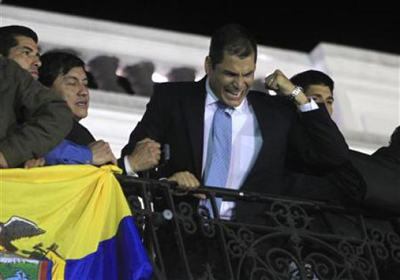
Using the standard CIA playbook on toppling democratically-elected governments in Latin America, the Obama administration, which was not happy with Ecuadorian President Rafael Correa’s moves to increase state control over oil companies in the nation and his decision to oust the United States military from its airbase at Manta, appears to have suffered a major defeat in the failed coup attempt in Ecuador by police officers and Air Force personnel who were backed by rightist elements in the National Assembly and business community. Correa was re-elected with an overwhelming majority last year after he gave the U.S. military its walking papers from the Manta airbase. The Pentagon and CIA have been working to topple Correa ever since by pumping money into opposition political parties and other groups through NGOs funded by the U.S. National Endowment for Democracy.
In a statement from Correa after his rescue from the Police Hospital in Quito by a military special operations team, the president warned of a larger conspiracy launched against him by his political opposition, saying the "attempt at destabilization is the result of a strategy that has been brewing for quite some time. A barrage of messages and misinformation have been given to the National Police, which today has been realized through violent actions from a conspiracy attempt."
Correa’s predecessor, the pro-U.S. Lucio Gutierrez, who is wedded to foreign oil company interests in the country, was accused by the government of covertly supporting the police and Air Force mutineers.
Although Secretary of State Hillary Clinton issued a weak statement saying the United States backed Correa, it came one day after Clinton heaped praise on former Secretary of State Henry Kissinger, the person who helped to craft the September 11, 1973 coup in Chile and the assassination of its progressive president Salvador Allende. In fact, Clinton and Obama had given military and political support to the right-wing junta that ousted democratically-elected progressive President Manuel Zelaya in Honduras in June 2009 and has fought against allowing the ousted democratically-elected president of Haiti, Jean-Bertrand Aristide, to return to his country from exile in South Africa after the CIA-engineered coup against him in 2004.
Clinton’s tepid response to the attempted coup against Correa was in marked contrast to the strong denunciations of the attempted coup and messages of support for Correa that came from Venezuela, Brazil, Argentina, Peru, Mexico, Bolivia, Cuba, and Spain.
- Riot police repel supporters of Ecuadorean President Rafael Correa from reaching the hospital where he took refuge for protection from police protesters, in Quito; September 30, 2010.

And the fact that Correa, like Venezuelan President Hugo Chavez, who was briefly ousted in an April 2002 coup organized by the CIA, was held as a virtual hostage at the Police Hospital in Quito for the greater part of a day provided a grim reminder of an old CIA tactic in staging coups in Latin America. Chavez was briefly held hostage on a Venezuelan island in the Caribbean while a U.S.-registered plane stood by to fly him into exile. In an emergency Latin American summit meeting in Argentina, Chavez saw the U.S. behind the events in Ecuador. He said, "The Yankee extreme right is trying right now, through arms and violence, to retake control of the continent." Chavez’s own experience with a CIA backed coup and the June 2009 coup, supported by the Pentagon, CIA, and Mossad against his ally Zelaya in Honduras, makes him an expert on CIA and Mossad tactics in the region. Informed sources have told WMR [1] that Correa and Chavez are currently comparing notes on the coups launched against them.
Ecuadorian intelligence will be looking closely at the wereabouts of key CIA personnel stationed at the CIA station at the US embassy in Quito and a smaller CIA station within the US Agency for International Development (USAID) mission in Guayaquil. In the 2002 coup attempt against Chavez, the US embassy’s top CIA and DIA officers were discovered to be helping to direct the coup from Venezuelan military installations.
Clinton’s State Department has been casting Ecuador in a bad light throughout the past two years, calling the country "difficult to do business in," the only real priority that the Obama administration cares about due to its total subservience to Wall Street and the fat cat bankers. The State Department’s "Investment Climate Statement" for Ecuador states: "Ecuador can be a difficult place in which to do business. . . There are restrictions or limitations on private investment in many sectors that apply equally to domestic and foreign investors . . . A 2006 hydrocarbons law imposed new conditions in the petroleum sector that have been problematic for many companies, complicated by a 2007 decree that imposed additional restrictions. A 2008 mining mandate stalled mining activity, and a new Mining Law is expected in early 2009. Negotiations for a free trade agreement between the United States and Ecuador, which would have included investment provisions, stopped in April 2006. The current Government of Ecuador has not expressed interest in restarting negotiations."
Correa’s financial policies, as well as his foreign policy that saw him order out the American base at Manta and establish close ties with Venezuela, Iran, and other countries inimical to American and Israeli hegemony, placed a huge CIA and Mossad target on Correa’s back. In June, Ecuador sponsored a resolution at the Organization of American State (OAS) summit in Lima condemning Israel’s attack on the Turkish aid flotilla transporting humanitarian aid to Gaza. Ten nations voted with Ecuador in support of the resolution.
- Ecuadorian army soldiers stand on the runway of the military airbase of the Mariscal Sucre International Airport to force its closure, in Quito; September 30, 2010.
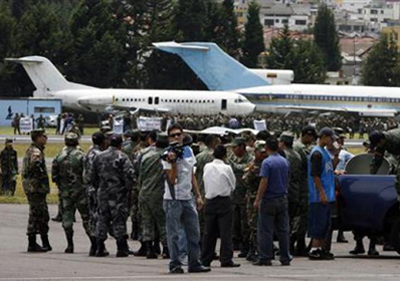
The uprising among Ecuadorian Air Force ranks, with Air Force personnel taking over and shutting down Quito’s international airport, will have Ecuadorian counter-intellligence personnel looking closely at the possible role of Israeli technicians and trainers who support the Air Force’s 26 Israeli-made Kfir combat planes. Israel also reportedly sold Python-3 air-to-air missiles to the Ecuadorian Air Force in 1997.
Mossad also has its hooks into the Ecuadorian National Police, where the main coup plotters received support. Mossad is chiefly tasked with spying on Ecuador’s large Ecuadorian-Arab community. The activities of the Mossad station at the Israeli embassy in Quito before and during the coup attempt will also draw the attention of counter-intelligence officers. Last year, Tel Aviv-based On Track Innovations received a contract to provide an electronic biometric-based electronic identification card system to Ecuador’s Central Registry Office.

Friday, October 01, 2010
More on the Coup attempt in Ecuador by Sabina Becker
Wow. Was today exciting or what?

Even in a gasmask, yowza.
Holy fucking moly. Just when I thought nothing was going on in the world, a fascist coup decided to go down (and fuck up) in Ecuador. The federal police took the president prisoner in the military hospital where he'd recently had knee surgery, and tear-gassed rioting ensued. So far, the Red Cross reports two dead (both police) and 88 injured. (Sadly, we can expect these tolls to rise.)
President Correa finally made it out of the hospital, with the help of a hefty contingent of loyal soldiers and citizens who fought it out barrel-to-barrel with the police in an intense firefight; he was spirited out from an underground parking garage in a grey truck. His rescuers pulled him out in a wheelchair with a gasmask on his face to protect him against the tear gas which the cops were shooting with no regard for the other patients at the hospital (including at least 20 newborn babies, so's you know. Yeah, those fascists value human life so much!)
I ended up spending the night hunched over a hot (and often balky) tweeter, RTing and translating headlines from Spanish to English. And biting my nails for President Correa, and vowing to kill anyone who harmed one hair on that fine head of his. And cursing the crappy reporting from all the Anglo sources, including the usual shitty suspects (Chicken Noodle Network; the fucking Torygraph, with its creative use of quotation marks) and the otherwise excellent (Al-Jazeera, HOW COULD YOU?) They all wrongly reported that Correa had cut police salaries; in fact, he has doubled them. And there is ample evidence that the CIA was behind this one, too...where is it ever not?
Anyhow, other than my own frenetic tweetlings, there was Otto, keeping score here, here, here and here. He was awesome in his own right, and I was thankful he was still tweeting when my birdie temporarily lost its cheep.
And how about those UNASUR leaders? In spite of tremendous political differences, they were unanimous in condemning the coup. They are meeting in Buenos Aires as I write this. Chavecito was first and loudest in condemning the coup; Fidel predicted it would fall apart quickly, and it did. Evo even suggested, in a ballsy move, that they all fly to Quito to make clear to the police that Correa was to be freed at once, no fucking around. (Just when I thought I couldn't possibly love those guys any more than I already did. That'll teach me.)
Needless to say, tomorrow's FLFB entry is all sewn up, and I won't be left scrounging for material as I'd feared I might. If anything, I'll have a surplus. Can you guess what I'll be blogging, kiddies? (Hint: Diabetics, please have your insulin syringes handy. You're gonna need 'em.)
Thursday, September 30, 2010
Obama administration fingerprints on Ecuador coup attempt
Using the standard CIA playbook on toppling democratically-elected governments in Latin America, the Obama administration, which was not happy with Ecuadorian President Rafael Correa's moves to increase state control over oil companies in the nation and his decision to oust the United States military from its airbase at Manta, appears to have suffered a major defeat in the failed coup attempt in Ecuador by police officers and Air Force personnel who were backed by rightist elements in the National Assembly and business community. Correa was re-elected with an overwhelming majority last year after he gave the U.S. military its walking papers from the Manta airbase. The Pentagon and CIA have been working to topple Correa ever since by pumping money into opposition political parties and other groups through NGOs funded by the U.S. National Endowment for Democracy.
In a statement from Correa after his rescue from the Police Hospital in Quito by a military special operations team, the president warned of a larger conspiracy launched against him by his political opposition, saying the "attempt at destabilization is the result of a strategy that has been brewing for quite some time. A barrage of messages and misinformation have been given to the National Police, which today has been realized through violent actions from a conspiracy attempt."
Correa's predecessor, the pro-U.S. Lucio Gutierrez, who is wedded to foreign oil company interests in the country, was accused by the government of covertly supporting the police and Air Force mutineers.
Although Secretary of State Hillary Clinton issued a weak statement saying the United States backed Correa, it came one day after Clinton heaped praise on former Secretary of State Henry Kissinger, the person who helped to craft the September 11, 1973 coup in Chile and the assassination of its progressive president Salvador Allende. In fact, Clinton and Obama had given military and political support to the right-wing junta that ousted democratically-elected progressive President Manuel Zelaya in Honduras in June 2009 and has fought against allowing the ousted democratically-elected president of Haiti, Jean-Bertrand Aristide, to return to his country from exile in South Africa after the CIA-engineered coup against him in 2004.
Clinton's tepid response to the attempted coup against Correa was in marked contrast to the strong denunciations of the attempted coup and messages of support for Correa that came from Venezuela, Brazil, Argentina, Peru, Mexico, Bolivia, Cuba, and Spain.
And the fact that Correa, like Venezuelan President Hugo Chavez, who was briefly ousted in an April 2002 coup organized by the CIA, was held as a virtual hostage at the Police Hospital in Quito for the greater part of a day provided a grim reminder of an old CIA tactic in staging coups in Latin America. Chavez was briefly held hostage on a Venezuelan island in the Caribbean while a U.S.-registered plane stood by to fly him into exile. In an emergency Latin American summit meeting in Argentina, Chavez saw the U.S. behind the events in Ecuador. He said, "The Yankee extreme right is trying right now, through arms and violence, to retake control of the continent." Chavez's own experience with a CIA backed coup and the June 2009 coup, supported by the Pentagon, CIA, and Mossad against his ally Zelaya in Honduras, makes him an expert on CIA and Mossad tactics in the region. Informed sources have told WMR that Correa and Chavez are currently comparing notes on the coups launched against them.
Ecuadorian intelligence will be looking closely at the wereabouts of key CIA personnel stationed at the CIA station at the US embassy in Quito and a smaller CIA station within the US Agency for International Development (USAID) mission in Guayaquil. In the 2002 coup attempt against Chavez, the US embassy's top CIA and DIA officers were discovered to be helping to direct the coup from Venezuelan military installations.
Clinton's State Department has been casting Ecuador in a bad light throughout the past two years, calling the country "difficult to do business in," the only real priority that the Obama administration cares about due to its total subservience to Wall Street and the fat cat bankers. The State Department's "Investment Climate Statement" for Ecuador states: "Ecuador can be a difficult place in which to do business. . . There are restrictions or limitations on private investment in many sectors that apply equally to domestic and foreign investors . . . A 2006 hydrocarbons law imposed new conditions in the petroleum sector that have been problematic for many companies, complicated by a 2007 decree that imposed additional restrictions. A 2008 mining mandate stalled mining activity, and a new Mining Law is expected in early 2009. Negotiations for a free trade agreement between the United State and Ecuador, which would have included investment provisions, stopped in April 2006. The current Government of Ecuador has not expressed interest in restarting negotiations." Correa's financial policies, as well as his foreign policy that saw him order out the American base at Manta and establish close ties with Venezuela, Iran, and other countries inimical to American and Israeli hegemony, placed a huge CIA and Mossad target on Correa's back. In June, Ecuador sponsored a resolution at the Organization of American State (OAS) summit in Lima condemning Israel's attack on the Turkish aid flotilla transporting humanitarian aid to Gaza. Ten nations voted with Ecuador in support of the resolution.
The uprising among Ecuadorian Air Force ranks, with Air Force personnel taking over and shutting down Quito's international airport, will have Ecuadorian counter-intellligence personnel looking closely at the possible role of Israeli technicians and trainers who support the Air Force's 26 Israeli-made Kfir combat planes. Israel also reportedly sold Python-3 air-to-air missile to the Ecuadorian Air Force in 1997.
Mossad also has its hooks into the Ecuadorian National Police, where the main coup plotters received support/ Mossad is chiefly tasked with spying on Ecuador's large Ecuadorian-Arab community. The activities of the Mossad station at the Israeli embassy in Quito before and during the coup attempt will also draw the attention of counter-intelligence officers. Last year, Tel Aviv-based On Track Innovations received a contract to provide an electronic biometric-based electronic identification card system to Ecuador's Central Registry Office.
Obama’s 2nd Latin American Coup attempt is in progress in Ecuador
Están tratando de tumbar al Presidente Correa. ¡Alerta los pueblos de la Alianza Bolivariana! ¡Alerta los pueblos de UNASUR! ¡¡Viva Correa!!
Ecuatorianos se dirigen en masa al hospital para rescatar a Correa
Por Cubadebate
Cientos de personas se congregaron hoy frente al palacio presidencial de Carondelet en Quito, para respaldar al jefe de Estado Rafael Correa frente a las protestas de policías y militares por la retirada de incentivos profesionales.
Funcionarios del Gobierno han llamado a dirigirse al Hospital donde se encuentra recluido el presidente ecuatoriano para “rescatarlo”, ya que el mismo Correa ha denunciado que se encuentra atrapado y que policías y manifestantes en su contra intentan ingresar a su habitación.
Gritando “¡Vamos Quito, Quito no se agueva carajo!”, los ecuatorianos a favor del Presidente han acudido a su ayuda.
Los manifestantes agredieron a unos cinco agentes policiales que no protestaban, sino que llegaban a Carondelet como protección de unas autoridades gubernamentales, según pudo constatar una periodista de Efe.
La manifestación de personas afines al presidente se realizó en reacción a las protestas por parte de centenares de policías y militares que ocuparon hoy un regimiento en Quito y obligaron al cierre del aeropuerto de la capital.
Los agentes huyeron corriendo mientras explotaba una bomba lacrimógena, que no está claro quién lanzó.
Al grito de “Correa, amigo, el pueblo está contigo”, cientos de personas expresaron su apoyo al jefe de Estado que previamente en el regimiento Quito, donde comenzó la protesta de los policías, advirtió que no cederá ante los reclamos.
La protesta de los policías y militares estalló después de que la Asamblea Nacional aprobase ayer la eliminación de incentivos en los ascensos y se extendiese el plazo para los mismos.
Según constató Efe, el palacio de Gobierno, situado en el centro colonial de Quito, no tiene resguardo policial en la parte exterior, en tanto que una veintena de militares dan seguridad en el interior.
Con información de Agencias
Friday, April 25, 2008
WILL THE CIA KILL OR OUST ECUADOR'S PRESIDENT Rafael Correa?
Will the CIA Kill or Oust Ecuador's President?
by Jacob G. Hornberger
Ecuador's president Rafael Correa may not be long for this world, both in a political sense and in genuine life-or-death sense. He recently fired his defense minister, army chief of intelligence, and commanders of the army, air force, and joint chiefs.
Why might those firings cost Correa his job or even his life? Because the reason he fired them was that Ecuador's intelligence systems were "totally infiltrated and subjugated to the CIA." As other rulers around the world, including democratically elected ones, have learned the hard way, bucking the CIA is a real no-no that sometimes leads to coups and assassinations.
What's the CIA doing infiltrating Ecuador's military intelligence systems? Good question! Maybe it's because the CIA still fears the threat of communism. Don't forget that that was the apparent rationale for the U.S. government's support of Operation Condor, the campaign of assassination and torture co-sponsored by the brutal regimes in Chile, Argentina, Paraguay, Bolivia, Uruguay, Brazil, Ecuador, and Peru during the 1970s. Don't forget also that many of the brutal military personnel in those regimes received their training at the U.S. Army's infamous School of the Americas, famous for, among other things, its torture manuals.
To make matters worse for Correa, he promises to throw the U.S. military out of his country when the U.S. government's lease at its base in Manta expires in 2009. The U.S. government spent $60 million to build the base in 1999, securing a 10-year lease that provided no rent to be paid to Ecuador.
So, why does the U.S. military have a $60 million military base in Ecuador? The base is part of the U.S. government's much-vaunted 30-year-old war on drugs, one of the U.S. Empire's never-ending wars around the world. The base houses Awacs surveillance planes whose purported mission is to search for international drug smugglers.
What irked President Correa is that apparently his CIA-infested intelligence services fed classified information to Colombian officials that led to a Colombian military attack on a Colombian rebel camp that was located inside Ecuador. One big problem was that when Correa's intelligence services leaked the information to Colombia, they left Correa (their boss) out of the loop.
The final nail in Correa's coffin might be the fact that he is an ally of Venezuela's Marxist president Hugo Chavez, who himself is a likely target of CIA ouster or assassination.
The good news for Americans in all this is that the Ecuadorian people are doing their best to rid their country of the CIA and the U.S. military. Maybe the Ecuadorans will start a trend in which all other countries will do the same. While it would obviously be best if the American people were to dismantle their government's overseas empire themselves, having foreigners do it instead by throwing the CIA and the Pentagon out of their countries would be just as effective and beneficial — to both the United States and the people of the world.
by Jacob G. Hornberger
Ecuador's president Rafael Correa may not be long for this world, both in a political sense and in genuine life-or-death sense. He recently fired his defense minister, army chief of intelligence, and commanders of the army, air force, and joint chiefs.
Why might those firings cost Correa his job or even his life? Because the reason he fired them was that Ecuador's intelligence systems were "totally infiltrated and subjugated to the CIA." As other rulers around the world, including democratically elected ones, have learned the hard way, bucking the CIA is a real no-no that sometimes leads to coups and assassinations.
What's the CIA doing infiltrating Ecuador's military intelligence systems? Good question! Maybe it's because the CIA still fears the threat of communism. Don't forget that that was the apparent rationale for the U.S. government's support of Operation Condor, the campaign of assassination and torture co-sponsored by the brutal regimes in Chile, Argentina, Paraguay, Bolivia, Uruguay, Brazil, Ecuador, and Peru during the 1970s. Don't forget also that many of the brutal military personnel in those regimes received their training at the U.S. Army's infamous School of the Americas, famous for, among other things, its torture manuals.
To make matters worse for Correa, he promises to throw the U.S. military out of his country when the U.S. government's lease at its base in Manta expires in 2009. The U.S. government spent $60 million to build the base in 1999, securing a 10-year lease that provided no rent to be paid to Ecuador.
So, why does the U.S. military have a $60 million military base in Ecuador? The base is part of the U.S. government's much-vaunted 30-year-old war on drugs, one of the U.S. Empire's never-ending wars around the world. The base houses Awacs surveillance planes whose purported mission is to search for international drug smugglers.
What irked President Correa is that apparently his CIA-infested intelligence services fed classified information to Colombian officials that led to a Colombian military attack on a Colombian rebel camp that was located inside Ecuador. One big problem was that when Correa's intelligence services leaked the information to Colombia, they left Correa (their boss) out of the loop.
The final nail in Correa's coffin might be the fact that he is an ally of Venezuela's Marxist president Hugo Chavez, who himself is a likely target of CIA ouster or assassination.
The good news for Americans in all this is that the Ecuadorian people are doing their best to rid their country of the CIA and the U.S. military. Maybe the Ecuadorans will start a trend in which all other countries will do the same. While it would obviously be best if the American people were to dismantle their government's overseas empire themselves, having foreigners do it instead by throwing the CIA and the Pentagon out of their countries would be just as effective and beneficial — to both the United States and the people of the world.
Subscribe to:
Posts (Atom)