Showing posts with label Spain. Show all posts

Thursday, October 05, 2017

Confine kings and queens to decks of playing cards By The Wayne Madsen Report


Confine kings and queens to decks of playing cards
By The Wayne Madsen Report
Although it is difficult to believe that in the 21st century there are still kings, queens, and other potentates in the world, it is even harder to fathom such leeches on taxpayers calling political shots. However, that is exactly what Spain experienced recently when King Felipe VI weighed in on the results of a popular referendum in Catalonia that overwhelmingly backed independence for the region.
The president of Catalonia, Carles Puigdemont, denounced the king, saying, "The king has adopted the (national) government's position and policies which have been disastrous with regard to Catalonia. He is deliberately ignoring millions of Catalans." In a televised address to the nation, Felipe railed, "With their irresponsible behavior they [the Catalans] put their own region and all of Spain at risk." However, Puigdemont countered the King by stating the Spanish monarchy refuses to even negotiate with Catalonia, "I will repeat it as many times as necessary: dialogue and agreement are part of the political culture of our people. However, the state has not given any positive answer to those offers."
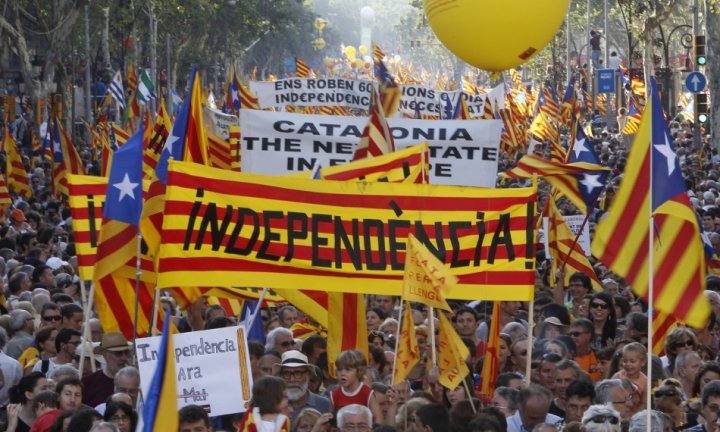
Spanish Prime Minister Mariano Rajoy totally rejected Catalonia's offer of dialogue. Rajoy accused the Catalonian government of blackmail.
King Felipe bears a lot of family baggage in coming to the support of Rajoy in his confrontation with the Catalonian government and people. It was the ideological forefather of Rajoy's People's Party, Generalissimo Francisco Franco, Spain's fascist leader, who placed Felipe's father in the position of Spanish regent, or "Prince of Spain." Although Spain's monarchy had been abolished in 1931 by the Second Spanish Republic, Franco restored the kingdom after winning the Spanish Civil War in 1939 with the help of Adolf Hitler and Benito Mussolini. Franco made Juan Carlos his heir apparent in 1969 after the "prince" swore allegiance to Franco's fascist movement.
Franco skipped over Juan de Borbón, the Count of Barcelona, the son of King Alfonso XIII, the nation's last king before the republic was established in 1951, and chose Juan Carlos. Juan de Borbón was seen by Franco as "too liberal," a euphemism for the Count having too much sympathy for Catalonia, the capital of which is Barcelona.
There is a widely-held belief in Spain that Juan Carlos shot to death his younger brother, Prince Alfonso, at the Borbón family's estate in Portugal, on purpose. Although Juan Carlos and royal aides claimed the shooting death was an accident, it was revealed that the revolver used by Juan Carlos was a personal gift from Franco. The only two people in the room when the shot was fired were Juan Carlos and Alfonso. The Spanish embassy in Lisbon crafted a press release that rivals any of the fake news seen today:
"Whilst His Highness Prince Alfonso was cleaning a revolver last evening with his brother, a shot was fired hitting his forehead and killing him in a few minutes. The accident took place at 20.30 hours, after the Infante's [Alfonso] return from the Maundy Thursday religious service, during which he had received holy communion."
During the Spanish Civil War, Franco's fascists committed genocide against the Catalans and Basques, both ethnic groups strong supporters of the loyalist forces of the Second Republic. During the first decade of Franco's rule, Catalans and Basques were massacred in the "White Terror," which saw as many as 400,000 opponents of the fascists fall victim to Franco's feared Guardia Civil. Franco ruthlessly made illegal the Catalan language; abolished Catalonia's instruments of autonomy; proscribed Catalonian political parties, trade unions, and newspapers; and wiped out all vestiges of Catalan culture. It is with these historical underpinnings that Catalonia today seeks to part ways with a Spanish government steeped in fascist traditions and a blind eye toward the past genocide of the Catalan people.
As if to remind Catalans of the White Terror, Rajoy's government dispatched helmeted and armed Guardia Civil members to forcibly shut down independence referendum polling places across Catalonia, beat voters and protesters, arrest Catalonian government officials, and clash with Catalonian firefighters trying to protect Catalans who were attempting to vote. The Rajoy regime has threatened to charge with sedition Major Josep Lluis Trapero, the chief of the Catalonian police force, the Mossos d’Esquadra, for failing to take the side of the Guardia Civil and other Spanish state security forces against his own people. Trapero faces up to 15 years in prison if convicted.     
European integrationist supporters of monarchies in the European Parliament, including the quisling Green Party, as well as Guy Verhofstadt, the Belgian chairman of the "liberal" ALDE European parliamentary group, insisted that Catalonia must remain, at all costs, a part of Spain. These so-called "liberal" and "centrist" parties made common cause with the proto-fascist Rajoy and Donald Trump, who recently insisted on Spain remaining united at a White House press conference held with the Spanish prime minister.
Verhofstadt, a major opponent of the Brexit referendum in the United Kingdom, is also a fierce opponent of the secession from Belgium of Flanders as an independent republic. Verhofstadt served as Belgian prime minister from 1999 to 2008, during a time when Belgian King Albert II was embroiled in a festering scandal involving pedophiles at the highest levels of the government, church, and business. In 2013, Albert suddenly abdicated the throne in favor of his son Philippe.
Felipe of Spain, Philippe of Belgium, Willem-Alexander of the Netherlands -- who insists on retaining colonies as his personal fiefdom in Aruba, Curacao, Bonaire, St. Maarten, St. Eustatius, and Saba, Elizabeth II of the United Kingdom -- who quietly campaigned against independence for Scotland and republic status for Jamaica and Barbados, Mohammed VI of Morocco -- who brutally governs the stolen nation of Western Sahara, and the jihadist-supporting monarchs of Saudi Arabia, Kuwait, and Abu Dhabi have seen their era come and go. The only kings, queens, and knaves should be those found in every deck of playing cards and not governing from palaces in European capitals and desert sands of the Middle East.

Thursday, January 14, 2010

SEMANTICS...Why Iran’s is a ‘regime’ and Afghanistan’s a ‘government’?

gal_6707

WRITTEN BY: Grupo Antimilitarista Tortuga (Alicante, Spain)
Translated by Ana Atienza, Revised by David Brookbank (Tlaxcala)

If we paid attention to the terminology used by the mass media to refer to certain issues, perhaps we would learn more than a few lessons about the interests behind those media and the subterfuges they use to present the news ‘embellished’ with certain attributes.

A good example of this is the name that virtually all conventional media in Spain associate with officials of certain countries – but not with others.

When referring to Iran’s highest authorities, the term regularly used is ‘regime’, whereas in the case of Afghanistan the term of choice is ‘government’.

It is not our purpose here to analyze Iran’s political system in depth, a country in which Islamic law plays an important role in its institutional order. As we all know, Iranians celebrate elections and there is more than one political party, contrary to other totalitarian states whose governments could properly and quite clearly be termed ‘regimes’. We lack enough information to judge the extent to which the electoral game is fairly played in Iran. There are differing opinions both in and out of the country. Only if evidence beyond any doubt showed that the country is being despotically ruled by a minority with no possible chance for alternating of power could we more or less properly use the word ‘regime’. Given that what exists in the worst of cases in Iran are only suspicions of vote rigging in a specific election process, we consider the use of this term by these media to be abusive and biased.

Now let’s take a look to the case of Afghanistan, a country ruled by a man brought in by the occupying powers, backed by cruel racketeering tribal chiefs called ‘warlords’ and whose power has been legitimated by virtually phantom elections characterized by overwhelming abstentionism and an electoral fraud beyond any doubt, a situation acknowledged even by the very people who placed him in the presidential chair. Mr. Karzai did not need a re-run of the fraudulent elections to remain in office. His only opponent withdrew as a form of protest in the face of a more than likely repeat of the irregularities seen in the first round and the absolute lack of guarantees that it would not happen again. Western media completely ignored this act of protest demanding electoral fair play and consecrated before public opinion the victory of Karzai, a person who, according to the unanimous view of the media, now rules not a ‘regime’ – which would be the more proper term – but rather a ‘government’.

There are more examples though. Certain Spanish media use the term ‘regime’ when referring to Venezuela, a country where Hugo Chávez overwhelmingly wins time and again in elections whose fairness has been acknowledged even by his most right-wing and inflammatory opposition. Imagine what the media would say if Venezuela experienced such a blatant fraud as Afghanistan’s and the only opponent withdrew from a possible re-run of the elections for lack of democratic guarantees.

Interestingly enough, officials in countries with clear dictatorships or semi-feudal absolutist monarchies, such as Morocco, Saudi Arabia and others, are called ‘governments’.

As we can see, for the mass media, being a ‘regime’ (a term conveying a charge an of political illegitimacy) versus being a ‘government’ has not so much to do with the political and legal systems existing in a country but with the fact that the state in question is more or less willing to serve the political and economic interests of the Western powers.

Let’s take a look at some examples from both ‘progressive’ and conservative newspapers in Spain:

About Iran:

El País: El régimen iraní responsabiliza a los "enemigos extranjeros" de las protestas

ABC: El régimen iraní lanza a sus seguidores a la calle al grito de «¡Muerte a Musavi!»

Público: Miles de personas apoyan al régimen iraní y piden castigo para los opositores

El Mundo: Miles de opositores desafían al régimen iraní en Teherán

About Afghanistan:

El País: El Gobierno afgano crea una unidad de alto nivel para combatir la corrupción

Público: El Gobierno afgano critica a la ONU y pide que se respete su soberanía nacional

ABC: Un líder talibán y fuentes del gobierno afgano confirman los sobornos italianos

El Mundo: El Gobierno afgano y la OTAN consideran un ’éxito’ las elecciones

Translated by Ana Atienza and edited by David Brookbank, members of Tlaxcala, the network of translators for linguistic diversity.

Grupo Antimilitarista Tortuga

This antimilitaristic group is made up of ten people from Alicante (Spain), some of which took part in the conscientious objection and anti-military service campaigns linked to the Conscientious Objection Movement (MOC) in their province. They work for a demilitarized society by increasing social awareness via non-violent actions.

This group belongs to the Spanish network Alternativa Antimilitarista-MOC, and collaborates with War Resisters’ International, the European Network against NATO and several conscientious objection movements in countries such as Chile or Colombia.

Also on Tlaxcala: http://www.tlaxcala.es/pp.asp?reference=9727&lg=en

Monday, May 25, 2009

South Korean ex-President Roh Moo-hyun had been targeted by neocon naval operation

Just a week prior to the December 2002 South Korean presidential election that pitted progressive liberal Millennium Democratic Party candidate Roh Moo-hyun against the pro-U.S. conservative candidate Lee Hoi Chang, the Spanish Navy, then under the command of the neo-con Spanish Prime Minister Jose Maria Aznar, intercepted a North Korean freighter in the Arabian Sea after honoring a special request from the U.S. Navy. The Spaniards and the Bush administration immediately floated the news that the ship was carrying Scud missiles for Iraq, then under the leadership of Saddam Hussein. At the time, the neocons in Washington and Madrid were looking for any excuse to begin military operations against Iraq and ratchet up tensions with North Korea.

The seizure of the North Korean vessel So San almost sank Roh's candidacy for president of South Korea, since he favored continuation of the "Sunshine Policy" of incumbent South Korean President Kim Dae-jung of rapprochement with North Korea at the same time the Bush administration was branding North Korea, Iraq, and Iran and an "Axis of Evil." The term "Axis of Evil" had already been conjured up by a cabal of neocons that included Bush speechwriters David Frum and Michael Gerson, State Department counter-proliferation undersecretary John Bolton, and House of Representatives apparatchik Yossef Bodansky.

The interception of the North Korean vessel and discovery of Scuds also came as a total surprise to Kim's government in Seoul, including top South Korean intelligence officials. The Son Sanwas permitted to continue to Hodeida, Yemen after being stopped by the Spanish Navy. Yemen maintained that the North Korean vessel was carrying cement, but the U.S. Navy insisted it seized Scud missiles. During the 1994 Yemeni civil war, in which the Clinton administration backed the victorious North Yemenis over South Yemen, the United States permitted the North to buy Scud missiles from the North Koreans. In fact, the North Korean ship was transporting 15 Scuds, conventional warheads, Scud missile parts, and missile fuel for the Yemenis. The parts were for missiles procured by Sana'a during the Yemeni civil war and approved by the Clinton administration. The missiles were transported to a Yemeni missile base near Sana'a after delivery to Hodeida.

The Spanish paper El Pais wrote that the entire incident with the North Korean vessel had been staged by Washington to send a warning to North Korea. However, it appears that the actual target of the naval incident was to try to influence the South Korean presidential election, which was one week away. Then-Secretary of Defense Paul Wolfowitz played a leading role in negotiating with the Yemenis over the release of the missiles and the North Korean ship.

The conservative Grand National Party immediately went on the offensive against Roh and his Sunshine Policy with the North after the seizure of the North Korean ship. Its candidate Lee was narrowly trailing Roh in polls and it was clear the U.S. seizure of the North Korean ship was intended to influence the South Korean electorate. It was also clear that the Bush administration favored Lee over Roh and was prepared to do anything to bring about a victory for Lee and his right-wingers. Some political observers in Seoul blamed the Bush administration for staging the naval incident in a bid to help Lee.

However, younger voters, who opposed the U.S. hegemony over South Korea and wanted better relations with the North, made the difference and handed Roh a victory and the neocons in Washington a bitter pill.

In 2004, South Korea's two main opposition parties impeached Roh. The nation's Constitutional Court reinstated Roh three days after his impeachment. In October 2007, Roh held a meeting with North Korea's Kim Jong Il amid heavy criticism from Washington after the North detonated its first nuclear weapon.

Roh was being investigated by South Korean prosecutors for allegedly accepting bribes from Taekwang Industries chairman Park Yeon-cha. However, prosecutors were not keen on investigating similar alleged bribes paid by the South Korean tycoon to friends of Roh's pro-American successor Lee Myung-bak.

On May 22, Roh reportedly committed suicide by jumping off a cliff near his home in Busan. Roh had allegedly gone on an early-morning hike. Roh's alleged suicide note includes the sentence: "Don't blame anybody."

Taekwang, which stands accused of paying bribes to Roh, was a major player in the South Korean cable television market in 2007. Taekwang MSO's major cable competitors were entities controlled by or linked to the Carlyle Group.