Showing posts with label independence. Show all posts

Thursday, October 05, 2017

Confine kings and queens to decks of playing cards By The Wayne Madsen Report


Confine kings and queens to decks of playing cards
By The Wayne Madsen Report
Although it is difficult to believe that in the 21st century there are still kings, queens, and other potentates in the world, it is even harder to fathom such leeches on taxpayers calling political shots. However, that is exactly what Spain experienced recently when King Felipe VI weighed in on the results of a popular referendum in Catalonia that overwhelmingly backed independence for the region.
The president of Catalonia, Carles Puigdemont, denounced the king, saying, "The king has adopted the (national) government's position and policies which have been disastrous with regard to Catalonia. He is deliberately ignoring millions of Catalans." In a televised address to the nation, Felipe railed, "With their irresponsible behavior they [the Catalans] put their own region and all of Spain at risk." However, Puigdemont countered the King by stating the Spanish monarchy refuses to even negotiate with Catalonia, "I will repeat it as many times as necessary: dialogue and agreement are part of the political culture of our people. However, the state has not given any positive answer to those offers."
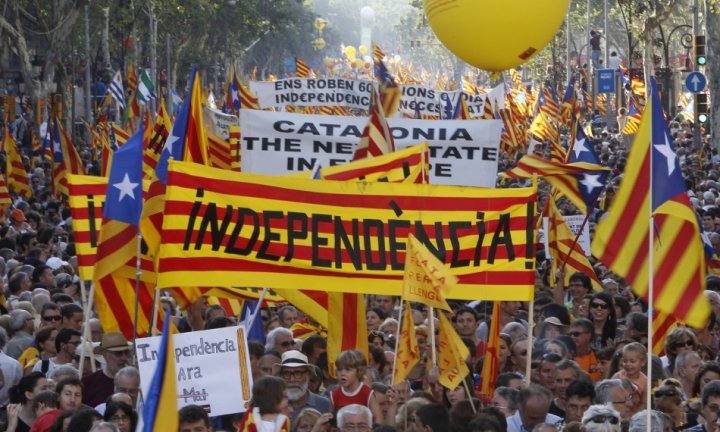
Spanish Prime Minister Mariano Rajoy totally rejected Catalonia's offer of dialogue. Rajoy accused the Catalonian government of blackmail.
King Felipe bears a lot of family baggage in coming to the support of Rajoy in his confrontation with the Catalonian government and people. It was the ideological forefather of Rajoy's People's Party, Generalissimo Francisco Franco, Spain's fascist leader, who placed Felipe's father in the position of Spanish regent, or "Prince of Spain." Although Spain's monarchy had been abolished in 1931 by the Second Spanish Republic, Franco restored the kingdom after winning the Spanish Civil War in 1939 with the help of Adolf Hitler and Benito Mussolini. Franco made Juan Carlos his heir apparent in 1969 after the "prince" swore allegiance to Franco's fascist movement.
Franco skipped over Juan de Borbón, the Count of Barcelona, the son of King Alfonso XIII, the nation's last king before the republic was established in 1951, and chose Juan Carlos. Juan de Borbón was seen by Franco as "too liberal," a euphemism for the Count having too much sympathy for Catalonia, the capital of which is Barcelona.
There is a widely-held belief in Spain that Juan Carlos shot to death his younger brother, Prince Alfonso, at the Borbón family's estate in Portugal, on purpose. Although Juan Carlos and royal aides claimed the shooting death was an accident, it was revealed that the revolver used by Juan Carlos was a personal gift from Franco. The only two people in the room when the shot was fired were Juan Carlos and Alfonso. The Spanish embassy in Lisbon crafted a press release that rivals any of the fake news seen today:
"Whilst His Highness Prince Alfonso was cleaning a revolver last evening with his brother, a shot was fired hitting his forehead and killing him in a few minutes. The accident took place at 20.30 hours, after the Infante's [Alfonso] return from the Maundy Thursday religious service, during which he had received holy communion."
During the Spanish Civil War, Franco's fascists committed genocide against the Catalans and Basques, both ethnic groups strong supporters of the loyalist forces of the Second Republic. During the first decade of Franco's rule, Catalans and Basques were massacred in the "White Terror," which saw as many as 400,000 opponents of the fascists fall victim to Franco's feared Guardia Civil. Franco ruthlessly made illegal the Catalan language; abolished Catalonia's instruments of autonomy; proscribed Catalonian political parties, trade unions, and newspapers; and wiped out all vestiges of Catalan culture. It is with these historical underpinnings that Catalonia today seeks to part ways with a Spanish government steeped in fascist traditions and a blind eye toward the past genocide of the Catalan people.
As if to remind Catalans of the White Terror, Rajoy's government dispatched helmeted and armed Guardia Civil members to forcibly shut down independence referendum polling places across Catalonia, beat voters and protesters, arrest Catalonian government officials, and clash with Catalonian firefighters trying to protect Catalans who were attempting to vote. The Rajoy regime has threatened to charge with sedition Major Josep Lluis Trapero, the chief of the Catalonian police force, the Mossos d’Esquadra, for failing to take the side of the Guardia Civil and other Spanish state security forces against his own people. Trapero faces up to 15 years in prison if convicted.     
European integrationist supporters of monarchies in the European Parliament, including the quisling Green Party, as well as Guy Verhofstadt, the Belgian chairman of the "liberal" ALDE European parliamentary group, insisted that Catalonia must remain, at all costs, a part of Spain. These so-called "liberal" and "centrist" parties made common cause with the proto-fascist Rajoy and Donald Trump, who recently insisted on Spain remaining united at a White House press conference held with the Spanish prime minister.
Verhofstadt, a major opponent of the Brexit referendum in the United Kingdom, is also a fierce opponent of the secession from Belgium of Flanders as an independent republic. Verhofstadt served as Belgian prime minister from 1999 to 2008, during a time when Belgian King Albert II was embroiled in a festering scandal involving pedophiles at the highest levels of the government, church, and business. In 2013, Albert suddenly abdicated the throne in favor of his son Philippe.
Felipe of Spain, Philippe of Belgium, Willem-Alexander of the Netherlands -- who insists on retaining colonies as his personal fiefdom in Aruba, Curacao, Bonaire, St. Maarten, St. Eustatius, and Saba, Elizabeth II of the United Kingdom -- who quietly campaigned against independence for Scotland and republic status for Jamaica and Barbados, Mohammed VI of Morocco -- who brutally governs the stolen nation of Western Sahara, and the jihadist-supporting monarchs of Saudi Arabia, Kuwait, and Abu Dhabi have seen their era come and go. The only kings, queens, and knaves should be those found in every deck of playing cards and not governing from palaces in European capitals and desert sands of the Middle East.

Wednesday, January 30, 2008

Puerto Rican Independence Movement under Attack in New York and San Juan

by Jan Susler

"It appears to us to be a reinitiation of the harassment of independentists."1 -- U.S. Congressman José Serrano, speaking to FBI director Robert Mueller


An unexpected knock on the door . . . men in trench coats handing you a grand jury subpoena . . . . If you're involved in the movement for the independence of Puerto Rico, this isn't just a not-so-fond memory of the COINTELPRO era. It's 2008 in New York City, and you are Christopher Torres, a young social worker; Tania Frontera, a young graphic designer; or Julio Pabón Jr., a young filmmaker from the Bronx.

Their subpoenas have aroused vigorous support for them, not just in New York, but in cities across the U.S. and in Puerto Rico. On the island, over forty organizations united to condemn this latest wave of repression and convened a demonstration on January 11 where over a thousand people participated under the theme "In the Face of Repression, Unity and Struggle," with placards and banners calling for the FBI and the federal courts to leave the island. Simultaneous activities took place in Brooklyn, Hartford, Chicago, San Francisco, Los Angeles, Philadelphia, Orlando, Fitchburg, Massachusetts, and Cleveland. As resolutions condemning the repression emanated from the National Lawyers Guild New York City Chapter, the American Association of Jurists, the Interfaith Prisoners of Conscience Project, and the Latin America Solidarity Coalition, the New York Spanish language daily El Diario/La Prensa published an editorial ringing the alarm bell, and U.S. congressman José Serrano telephoned FBI director Mueller to voice his concern.

Why the subpoenas? Why now? And why the resounding, unified denunciations?

Dating back to the era of Spanish colonial control over Puerto Rico, Puerto Rican people have organized to wrest their sovereignty from foreign domination. That resistance continued after the U.S. invasion and occupation in 1898. When the colonizers repressed and criminalized public organizing for independence, clandestine organizations formed, including the Popular Boricua Army -- Macheteros in the 1980s. In 1985, the FBI arrested and almost killed its leader, Filiberto Ojeda Ríos, accusing him of participation in the 1983 expropriation of $7.5 million U.S. government insured dollars from a Wells Fargo depot in Hartford, Connecticut. After his release on bail, Ojeda returned to clandestine existence. In spite of the FBI's ever-increasing reward for information leading to his capture, he remained underground for some fifteen years. On September 23, 2005, however, a squad of FBI assassins circled his home, shot him, and left him to bleed to death.2 The assassination outraged the entire nation, and the FBI became a pariah.

Hoping to distract public attention from their own criminal conduct and justify their presence on the island, particularly in the post-911 era, the FBI soon went on the offensive. On February 10, 2006, allegedly in a continuing investigation of the Macheteros, they raided the homes and businesses of several independence activists and in the process pepper-sprayed the nation's journalists who were covering the FBI's paramilitary incursions. Again, the entire country expressed its outrage. Since then, activists have been stopped, searched, and harassed, with the homes and offices of many others, including attorneys and movement leaders, mysteriously broken into in events reminiscent of the infamous black-bag COINTELPRO jobs: computers, digital cameras, and cell phones are taken, while other valuable items remain untouched.

Recent rumors are that the head of the FBI in San Juan, Luis Fraticelli, is close to the end of his tenure and has given instructions to accelerate efforts to neutralize the remains of the clandestine group.3

For Fernando Martín, a leader of the Puerto Rican Independence Party, the FBI "wants to clean up its image after the assassination of Filiberto (Ojeda Ríos), because they want to be able to say that in Puerto Rico, they investigate people of all parties (and) somehow salvage their image after their selective attacks."4

Julio Muriente, a leader of the National Hostos Independence Movement, stated, "The legal facade of this repressive operation is directed against the Macheteros, but the real intention is against the entire independentist movement, including against the people of Puerto Rico," calling it "an attack which is not against any particular organization, but against a political, social, patriotic movement, and against a people."5

U.S. Congressman José Serrano (D-NY), who was instrumental in getting the FBI to disclose thousands of pages of records documenting its illegal surveillance of and intervention in the independence movement6, said of these subpoenas, "It certainly appears to be a fishing expedition,"7 which, he noted, harkens back to the days when, according to FBI director Freeh, the agency engaged in "egregious illegal action, maybe criminal action."8

The subpoenas, initially returnable on January 11, were continued to February 1. Attorneys announced they would file motions to quash the subpoenas. Frontera's attorney, Martin Stolar, noted that "if the motion is denied, Tania will have to appear before the grand jury, and may decide not to testify, invoking her constitutional rights."9

Organizations in Puerto Rico have announced they will protest in various towns of the island on February 1 in defense and support of the three young people subpoenaed, with the themes "Wake Up, Boricua, Defend Your Own!" and "the Grand Jury Is illegal!" Additional protests are being planned in U.S. cities as well.

The consequences of not collaborating with the grand jury are well known to those who support independence. Norberto Cintrón Fiallo, whose home was searched during the February 10, 2006 FBI incursion, and who participated in the January 11 protest in San Juan, refused to collaborate with various grand juries investigating the independence movement in both Puerto Rico and New York in 1981 and 1982 and served close to three years in prison as a result.110 Julio Rosado, who participated in the January 11 protest in New York, resisted grand juries investigating the Puerto Rican independence movement, serving nine months for civil contempt in 1977, and later much of his three year sentence for criminal contempt. "They have always been there, whenever they want to intimidate," he said, adding that he is convinced there will be more subpoenas to come.111

A New York daily Spanish language newspaper expressed editorial concern over the political witch hunt, in words which should give usall pause:

Because of laws initiated by the Bush Administration and passed by our Congress, the legal protections that would give political dissidents a right to due process have been eroded. The net is wide for casting someone with "suspicious" political beliefs, without having been charged, tried or convicted of a crime, as a threat. [ . . . ] Because the attacks on civil liberties and human rights and the historical intimidation and repression of Puerto Rican independence supporters are interrelated, activists must make those links.

That's all the more urgent considering the silence of most elected leaders and the virtual media blackout on the subpoenas. In the context of secret prisons, torture, detention without trial, and warrantless wiretapping, the FBI's fishing should be a concern for anyone interested in rescuing this country from a rising police state.112


1 José Delgado, "Habla con el jefe del FBI," El Nuevo Día, January 9, 2008.

2 In the white papers designed to avoid criminal liability, the government blamed some of the errors in the operation on Luis Fraticelli, the Puerto Rican special agent in charge of its San Juan field office. Not coincidentally, Fraticelli had also participated in the 1985 near assassination of Ojeda Ríos. See: U.S. Department of Justice, Office of the Inspector General, "A Review of the September 2005 Shooting Incident Involving the Federal Bureau of Investigations and Filiberto Ojeda Ríos," August 2006, available atwww.usdoj.gov/oig/special/index.htm.

3 José Delgado, "El caso de Nueva York," El Nuevo Día, January 14, 2008.

4 Combined Services, "Denunciation of persecution of independentists:Fernando Martín criticized the newspaper El Nuevo Díafor articles published December 23," El Nuevo Día, January 4, 2008.

5 AP, "Repudio independentista a citaciones a Gran Jurado," El Vocero, January 7, 2008.

6 The disclosed documents are being classified at Center for Puerto Rican Studies of the City University of New York at Hunter College. See: www.pr-secretfiles.net/.

7 José Delgado, "Habla con el jefe del FBI: José Serrano le expresó a Robert Mueller el malestar que existe entre los boricuas en Nueva York por la citación de tres jóvenes," El Nuevo Día, January 9, 2008.

8 Matthew Hay Brown, "Puerto Rico Files Show FBI's Zeal; For Decades, Secret U.S. Dossiers Targeted Suspected," Orlando Sentinel, November 06, 2003.

9 Ruth E. Hernández Beltrán/Agencia EFE, "Posponen citación a independentistas de Nueva York," Primera Hora, January 11, 2008.

10 José "Ché" Paralitici, Sentencia Impuesta: 100 Años de Encarcelamientos por la Independencia de Puerto Rico, Ediciones Puerto Histórico (San Juan, Puerto Rico: 2004), pp. 339-341.

11 Ruth E. Hernández Beltrán/ Agencia EFE, "Posponen citación a independentistas de Nueva York," Primera Hora, January 11, 2008. Rosado was one of five supporters of independence so imprisoned. Ricardo Romero, Steven Guerra, María Cueto, who are Mexican, and Rosado's brother Andres, simultaneously served time for criminal contempt of the same grand jury. See: United States v. Rosado et al., 728 F.2d 89 (2nd Cir. 1984).

12 "Constructing an Enemy," Editorial, El Diario/La Prensa, January 17, 2008.

Jan Susler is a partner with the People's Law Office in Chicago, which she joined in 1982 after a six year stint at Prison Legal Aid, the legal clinic at Southern Illinois University's School of Law. Her long history of work on behalf of political prisoners and prisoners' rights includes litigation, advocacy, and educational work around USP Marion and the Women's High Security Unit at Lexington, KY. Her practice at PLO focuses in addition on police misconduct civil rights litigation. For several years she was an adjunct professor of criminal justice at Northeastern Illinois University and has also taught at the University of Puerto Rico. Representing the Puerto Rican political prisoners for over two decades, she served as lead counsel in the efforts culminating in the 1999 presidential commutation of their sentences. She continues to represent those who remain imprisoned.

Wednesday, March 07, 2007

Bush Trip Destined to Fail as Hardliner John Negroponte Takes Control of US Latin American Policy

By: Roger Burbach

Bush’s trip to Latin America is a calculated effort to counter Hugo Chavez’s growing influence in the region and to separate the “bad left” from the “good left”, namely Uruguay and to some extent Brazil. He hopes to add them to the dwindling bloc of pro-US nations, including Colombia, Guatemala and Mexico which he is visiting.

From the beginning the trip is provoking widespread opposition. He will be greeted by demonstrators in Montevideo, Uruguay who are opposed to the special trade agreements being negotiated with the government of Tabare Vasquez. Even members of his ruling party, the Broad Front, are active in organizing the demonstration.

Across the border in Argentina, which Bush will not visit, massive demonstrations are being organized to coincide with his stay in Uruguay. And to add insult to injury, Hugo Chavez, is flying in to take part. While President Nestor Kirchner will not be participating, lower level government officials are. This comes on the heels of a series of commercial and economic accords that Kirchner just signed with Chavez on a trip to Caracas, including the founding of the Bank of the South, which is seen as an alternative to US dominated institutions like the Inter-American Development Bank.

In Colombia and Guatemala, Bush will try to prop up governments shaken by recent political scandals. And in Mexico, his trip is designed to assist Felipe Calderon, one of the last presidents in Latin America to back the orthodox neoliberal free trade policies of Washington. His narrow election victory last year is widely perceived as fraudulent.

On the eve of Bush’s trip the White House declared that he wants to “promote peace and prosperity” and that he will dispense $75 million for a new education program for Latin Americans to study in the United States and $385 million for programs promoting home ownership. These are token programs at best, and will do nothing to relieve the poverty and growing income disparity in Latin America.

New blows to US policy have come in the days leading up to Bush’s trip. Panama has announced it will not sign the free trade agreement with Washington that was being negotiated. And in Nicaragua the new government of Daniel Ortega has just set up a special commission with Venezuela that will oversee the implementation of 15 economic accords, particularly in the areas of energy, agriculture, education and health. A special initiative aimed at alleviating hunger will receive $54 million and $21 million will go to education and building schools. Investments are also being planned to modernize Nicaragua’s electric plants, to construct an oil refinery, and to refurbish Nicaragua’s main international port, Puerto Cabezas.

In South America a radical axis of nations intent on implementing profound social reforms at home and opposing US intervention in the region appears to be taking shape, comprised of Venezuela, Bolivia and the recently elected government of Rafael Correa in Ecuador. Correa has rejected any free trade agreement with the United States and has announced he is closing down the US base on South America’s Pacific Coast located at Manta. Ostensibly set up to help monitor narco-trafficking over the ocean and the nearby Amazon basin, it has become a major operations center for US intelligence gathering and for coordinating counterinsurgency efforts against the leftist guerrillas in neighboring Colombia. Upwards of 475 military personal are continually rotated between Manta and the US Southern Command headquarters based in Florida.

The Ecuadorian Minister of Foreign Relations, Maria Fernanda Espinoza, in announcing the base will be officially closed in 2009, declared: “Ecuador is a sovereign country. We don’t need foreign troops on our soil.”

All three countries are raising the banner of socialism. In Venezuela Hugo Chavez is intent on leading the country to a “new socialism for the twenty-first century.” In Bolivia Evo Morales governing party is called Movement Towards Socialism, a “party of a new type” comprised largely of social movements. And in Ecuador, Rafael Correa in his inaugural address in January called for an opening to the “new socialism for the twenty-first century” and declared that Ecuador has to end “the perverse system that has destroyed our democracy, our economy and our society.”

When Bush returns and finds out that his trip has done little to alter the growing leftist trend of Latin America, the iron fist of the new Deputy Secretary of State, John Negroponte, will take control of US policy. Negroponte as ambassador to Honduras helped run the contra war in Nicaragua in the 1980’s, which murdered thousands of innocent civilians in Honduras as well as Nicaragua, and he is known to believe that more aggressive measures have to be taken against Chavez and the gathering storm in Latin America. He comes to his new post after serving as Director of National Intelligence, and prior to that ambassador in Bagdhad. Given that Condoleezza Rice has little expertise in Latin America, Negroponte will set policy for the region, overriding the few remaining moderates in the State Department’s office of Hemispheric Affairs.

With Negroponte we can expect a marked increase in US covert operations, aimed not only at Chavez in Venezuela, but also at the other governments and the popular movements in the region that are leading the charge against the historic US domination of Latin America and are bent on constructing more equitable societies.

Roger Burbach is director of the Center for the Study of the Americas based in Berkeley, California. He has written extensively on Latin America, including, “The Pinochet Affair: State Terrorism and Global Justice.” He is also the co-author with Jim Tarbell of: “Imperial Overstretch: George W. Bush and the Hubris of Empire.”

"IN TIMES OF UNIVERSAL DECEIT, TELLING THE TRUTH WILL BE A REVOLUTIONARY ACT." - George Orwell